







Abstract
More recently, coverage and promotion of urban digital twins within mainstream media outlets, urban and technology focused publications, trade press, and scholarly journals has increased visibility and awareness of these 3D, interactive images as tools for urban management and urban planning. Rose offers compelling theoretical foundations for understanding these types of urban data imaginaries and technologized visions of cities. In this response, I recognize the importance of Rose's cultural reading and critique of urban digital twins while briefly looking at the discursive construction of digital twins through slightly different cultural comparisons. It is imperative to investigate the types of changes enacted, ethnographic understandings of how decisions are made, technological affordances that inform these decisions, and the types of places created through the use of urban digital twins. In considering similar issues of race and gender in the “volumetricisation” of the city, I want to suggest that urban digital twins are more closely related to spectacles of prevention and preparation than disaster as well as sensory experiences of media that spotlight the apparatus of their own production (satellite or live television, video games, operational aesthetics) rather than disaster films. In fact, there may be a de-emphasis of disaster in the discursive construction of “actually existing” urban digital twins. The mundane simulation of risk and risk mitigation may indicate a shift in smart city rhetoric overall, albeit not in the socio-technical imaginaries and power relations that substantiate and benefit from “smartness”.
As Rose outlines in her essay, digital twins and the software to create them have been integrated into city imagery for at least a decade. More recently, urban digital twins have been utilized more frequently and their coverage and promotion within mainstream media outlets, urban and technology focused publications, trade press, as well as scholarly journals has increasingly rendered these 3D, interactive images as recognizable tools for urban management and urban planning. Urban digital twins have entered popular culture and urban imaginaries more provocatively than in previous years as they have been explained and demonstrated in reporting on preparations for the 2024 Summer Olympics in Paris (Vrentas, 2024; Why Olympic Venues Are Using Digital Twins 2024), linked to the Metaverse as in the case of Seoul's Digital Twin Lab and the city's ventures into Metaverse Seoul, and created by companies familiar to video game players and developers (Unity, Unreal Engine) and to internet users in South Korea (Naver). Popular descriptions of urban digital twins often use familiar video game metaphors and markers to explain their function: Vectuel's digital twin of La Defense neighborhood in Paris is “like a video game” (“Paris La Défense,” n.d.) or that digital twins function “like a SimCity for Policymakers” (Poon, 2022). In several presentations of digital twin technologies, designers note that urban digital twin imagery is commonly requested to replace photojournalistic footage of cities and neighborhoods on newscasts. Other popular and industry press compare digital twin visualizations and image manipulation to drone footage (NAVER LABS, 2022) and/or celebrate their connection to other legible technological infrastructures and apparatuses: drones, aerial and terrestrial photography, real-time street and building sensors, cameras, 3D software, and other surveillance technologies. In technology news publications, the evolution of urban digital twins is contextualized within AI hype. These “semantic twins” that integrate AI and digital twin simulations offer interpretations of big data for urban and business enterprise decision-making (Kahil, 2024).
These references to the digital infrastructures and myriad technologies that are visually and rhetorically stitched together in urban digital twins is similar to Parks’ analysis of live satellite TV productions that “spotlight the apparatus” to showcase the technological power and cultural imaginations of a new, global medium. Although the digital twin technologically and ideologically works toward the illusion of standardized coherence, it simultaneously “showcases the dispersed machinery” that makes it possible. This curated coherence is evident in digital twin company names (e.g., OnePlan, ALIKE) and the stitching of “live” or “real-time” footage and urban information from drones, planes, sensors, cameras, and software through images of the simulated city and performative explanations of its simulation. These efforts toward a standardized, interactive vision of a city spectacularizes the coordination and convergence of information and communication technologies into a singular super-apparatus that can be easily manipulated and changed at will, which fosters an imaginary of the city, its flows, frictions, futures, and built environment as knowable and mutable.
As Parks argues in the case of satellite television: “Such stylistic flourishes are especially pronounced when technologies converge as they are often imagined as expanding, extending, or overtaking the capacities of another” (Parks, 2005: 34). In this case, the urban digital twin aspirationally expands and is intended to supersede the capacities of previous digital urban visualizations and ways of computationally seeing and knowing the city, and needless to say, surpassing human sight as on-the-ground receptors of urban activity. In addition to superseding human sight as a means for ground truthing, the digital twin sidelines the messiness of embodied experience in favor of simulated streets and curated accidents that can be resolved through digital manipulation.
This type of urban data imaginary and technologized vision of cities is common within analyses of smart city technologies, and Rose offers compelling theoretical foundations for these processes and perceptions. In this response, I recognize the importance of Rose's cultural reading and critique of urban digital twins to media studies, geography, and urban studies research while briefly looking at the discursive construction of digital twins through slightly different cultural comparisons. Rose's call for further critical cultural critiques of digital and technological imaginaries of urban space and urban activities and critical examinations of the human subjectivities that emerge alongside their design and use is imperative. I would also add that it is imperative to investigate the types of changes enacted, ethnographic understandings of how decisions are made and the technological affordances that inform these decisions, and the types of places created through the use of urban digital twins. In considering similar issues of race and gender in their visualization, imagination, and “volumetricisation” of the city, I want to suggest that urban digital twins are more closely related to spectacles of prevention and preparation than disaster as well as sensory experiences of media that spotlight the apparatus of their own production (satellite or live television, video games, operational aesthetics) rather than disaster films. In fact, there may be a de-emphasis of disaster in the discursive construction of “actually existing” urban digital twins. The mundane simulation of risk and risk mitigation may indicate a shift in smart city rhetoric overall, albeit not in the socio-technical imaginaries and power relations that substantiate and benefit from “smartness.”
Based on promotional materials, industry, and popular press describing the design and use of digital twins, the urban digital twin seems to imbue previous discourses of “smartmentality” (Halpern and Mitchell, 2023; Vanolo, 2014) and algorithmic prediction of imminent emergency, with controlled, circumscribed practices of prevention. This response should not be read as counter to Rose's critique and connection to popular culture, but in addition to it, and further analysis of the politics and imagery of digital twins should consider our readings together. From slightly different perspectives we both point to aspects of digital twins that reify previous problematic smart city discourses and “smart” urban imaginaries as embedded within gendered and racialized power dynamics of urban visualizations.
Through a cultural critique of visual cultures of urban spatial representations, Rose continues and expands important debates within digital media studies and cultural geography that unpack digital simulations, cartographic technologies, satellite imagery and infrastructure, computational and algorithmic visualization practices, and the world as (digital) picture as embedded within colonial, gendered, and racialized power relations (Benjamin, 2019; Farman, 2010; Kwan, 2002; Mattern, 2017; McKittrick, 2011; Noble, 2018; Parks and Starosielski, 2015; Strengers and Kennedy, 2021; Summers, 2019). Her previous work has been instrumental in contouring these debates (Degen and Rose, 2022; Rose, 1997; 2022). Although not mentioned directly in this article, Degen and Rose's conceptualization and operationalization of the “new urban aesthetic” and everyday power relations – sensory experiences of urban imaginaries and urban visualizations and the sort of sensory experiences that are prioritized over others – could be employed to understand and pull at the invisibilized seams of urban digital twins and what is spectacularized in these ludic or “animated” images of the city.
I appreciate the original, close reading of urban digital twins as associated with disaster films but read the urban imaginaries, sensory experiences, data and visualizations that are prioritized over others not akin to dramatic, “anxious masculinism,” but another way of seeing that Rose also associates with masculinity: an ordering, empowering gaze of geospatial control and manipulation over observable and measurable forms of urban flow and urban life. Anxiety in this case leads to detailed, preparatory action rather than valiant, heroic efforts. This perspective connects the digital twin less to spectacular relationships between disaster and hero and more to the spectacularizing of gendered, racialized, and geopolitical regimes of professionalized and industrialized urban understanding. If there is any drama here, it's in the process and (unexpected?) outcomes of trial and error, the immediate erasure of buildings or alteration of bus route on screen, or the allure of the simulated fly-over to effortlessly float through and survey the city from above.
As Rose's essay clearly illustrates, previously recognized issues with digital representations of urban environments persist. As has been argued regarding other smart city technologies such as the urban dashboard, open data portals, centralized control rooms, city apps, interactive visualizations, and planning tools, technologized vision and quantifiable data offer a particular way of seeing and knowing the city. Kitchin, Maalsen, and McArdle note the cultural and institutional complexity embedding within the seemingly objective interfaces, information, and visualizations of the smart city dashboard; and that dashboards, as well as other smart city interfaces for digital information about the city, “produce a particularized set of spatial knowledges about the city” (Kitchin et al., 2015; Kitchin et al., 2016). Unlike Donna Haraway's framing of distanced, mediated vision as “seeing everything from nowhere” (Haraway, 1991), urban digital twins visualize, animate, and repeat certain urban activities and behaviors from everywhere while invisibilizing or omitting others – representing quantifiable, observable, and measurable activities and ways of being in the city from the ground, sky, and street while marginalizing certain populations and their behaviors and meanings of the city as noise, surplus or “excess” (Aradau, 2022; Stephens, 2002; also see Rose's essay for more on this interpretation of excess).
At least two interrelated aspects of Rose's connection between digital twins and disaster films struck me as debatable. First, that both mediations address “cities as in crisis” or “cities under threat.” Although, smart city discourse and justification tends to reiterate technological solutionism to alleviate imminent and ongoing risk and emergency and to foster data-driven urban solutions to cities wrought with urgent wicked problems, I would argue that these tropes aren’t as evident in dominant narratives of digital twins. Urgency, crisis, and disastrous breaking points are replaced by empowered, tempered, control over urban environments through simulations of the city as pre-marker, demo, trial, or run-through. The digital twin is framed as a tool of learning and practice toward efficient, cost-effective decisions about the city before an actual endeavor to change it. A virtual testbed without actual inhabitants, but with “users.”
One example, is the Mcity digital twin in Ann Arbor, MI. Researchers affiliated with Mcity, the University of Michigan's autonomous vehicle research and testing center, have developed an open-source, 3D, digital twin that replicates their on-site testing track and facilities [Figure 1]. As Mcity's Director of Research notes, “Researchers anywhere can use the facility's features—with a variety of road materials, markings, signals and intersections—to test their autonomous algorithms without having to make the trip to Ann Arbor” (Carney, 2024). The digital twin generates “road users” such as pedestrians, cyclists, bus and car drivers as well as simulations of potential collisions and “safety-critical” or “high-risk driving scenarios” based on real-world data. Although the digital twin is intended to simulate potential autonomous vehicle accidents to mitigate algorithmically predicted risks, the value of the simulation is framed in terms of remote training, trial, testing and remote control rather than disaster. As press releases for the project explain, there's no need to be here (or anywhere) to test your autonomous vehicle, a researcher can control all aspects, “factors,” or scenarios of the urban environment from afar, including those that may be organic or random when taking place on city streets. Designed experiences of the city through digital twins emphasize pseudo-standardized and controlled flow, even in the case of the accident. Instead of a hero embedded in and surviving catastrophe to save the city, the user of the digital twin is removed from the street, manipulating and controlling random factors from afar. The images of cities maintain a sense of emptiness, malleability, mutation, cut and paste, fly-over or drone-like aerial images, distant while experiencing direct manipulation of objects on screen. If the affordances of the digital twin encourage embodied distance and remote control unlike the disaster film, then it is important to further investigate the urban imaginaries being spectacularized or reified here, and to think further about what it means to ground truth the urban digital twin?
In addition to a de-emphasis on disaster, uncommon themes around smart cities emerge through discourse on digital twins, in efforts toward: preservation and conservation (Kouroupi and Metaxas, 2023; Rahmadian et al., 2023), remote access to locations (including cultural locations, i.e., Mona Lisa at the Louvre), participation and engagement (although this is mostly through the positionality of a spectator) alongside more recognizable tropes of digital information aggregation and display and moves toward efficiency, optimization, standardization, “inevitably reducing downtime, construction time, and errors, as well as overall project costs” (John, 2021). These more uncommon tropes emerge through discussions of digital twins in terms of temporality–for imagining future scenarios, improving historical architectural preservation, environmental conservation and stewardship, displaying upcoming or proposed neighborhood projects or events to members of the public. One reading of this rhetoric is about resilience through ongoing trials, future thinking, and routine, speculative run-throughs rather than intervening at moments of emergency. The design, use, and value of digital twin technology is justified through reiterated smart city logics of computational, algorithmic, and data-driven assistance in decision-making processes, the usefulness of the statistical city, and processes of prediction and preparedness to exert more control over urban futures.
Second, Rose is concerned with the “affiliate humans” characterized as the “technocratic urban manager who uses a CDT; the algorithmically-generated images of humans who inhabit a CDT; and a more unruly form of human life which is understood as excessive to the CDT” who (drawing from McKittrick and Mirzoeff) are subject to positionalities of white masculinity and the “tactical mapping of white sight.” She argues that both disaster films and digital twins are “attentive to the human bodies inhabiting these digital urban volumes.” We need to examine the ways in which digital twins are “attentive” to human bodies that inhabit cities and that inhabit digital twins. The attention to embodiment, mobility, and urban activity in digital twins is reminiscent of early smart city critiques questioning, “where are the people?” Even when twins are populated with vehicles, pedestrians, proxies for the user (as is the case with digital twins used during summer Olympics preparations), promotional representations of people who may populate these spaces and predictions of how they will act, there is a sterility, emptiness, and dehumanized aspect to digital twin simulations. Although some digital twins are conceptualized as promoting citizen engagement or public information about urban planning and urban change, these projects reiterate the perspective that citizen input and engagement are both important and supplemental or superfluous, that members of the public are invited to engage with digital twins in similar boundaried ways as with other smart city projects (Halegoua, 2020a).
In my previous research on “smart” or digital cities (Halegoua, 2020b; 2020a), I argue that scholars analyzing digital cities should start with the question: “what is a city?” as it pertains to the logics that developers, managers, and planners of digital cities adhere to. If an urban planner or manager thinks of a city as a statistical space or, on the other hand, a place of “organized complexity” (Jacobs, 1961), then they design and consider technologies and data that address that type of place. This question also recognizes that perceptions of cities, what a city is, who belongs in it as a resident, participant, and member of the “public,” who has a right to change it and to see themselves and their stories and histories in its construction, are varied and polysemic – they are influenced and intersect with experiences of gender, race, class, ethnicity, ability, sexuality, citizenship status, and language, that inform differential mobilities (Sheller, 2018), urban intelligences (Mattern, 2017), digital urban literacies (Lingel, 2011), and ways of being in the world. This question, “what is a city,” should be asked of people who design and use digital twins to aid in urban decision-making, citizen engagement, and address “urban problems.”
While some of the advantages of digital twins are touted as related to ground truth, they’re still often verified through sensors and real-time data collection; not qualitative, sensory, contradictory, or embodied data. The differential experiences of populated urban places are not translatable or transcoded into digital twins. Instead, digital twin foundational models necessitate ground truthing that produces singular, definable, quantifiable results: presence, absence, scale, height, speed, light, temperature, proximity, etc. The model and its affordances maintain limited “data imaginaries” (Burgos-Thorsen, 2023) that undervalue how an intersection feels to diverse populations in lieu of whether it exists and has the correct number of turn lanes; valuing granularity but not gradation in urban planning. The digital twin and the ways in which data is collected and integrated ignores and/or smooths out actually existing urban frictions and introduces statistically known disruptions or variations to urban flow that digital twin users can prepare for or work to amend. However, the status quo returned or aspired to through digital twins is a simulation itself. Depending on how you read the ideological implications and masculinist, racial fantasies of disaster films, this could be a similarity or difference when compared to digital twins.
While Farman contextualizes the ideological power of GIS and Google Earth as “seemingly neutral” but implicitly gendered and directly embedded within colonial histories of cartography and subjective “master representations,” he also ascribes potentially resistive agency to users of these maps (Farman, 2010). As many cultural geographers and critical cartographers (Rose and scholars from many other disciplines) have acknowledged, technologies and mediated representations that purport to represent “reality” through claims to scientific objectivity are loaded with biases and cultural meanings that need to be unpacked. Farman recognizes these critiques, but also notes some participatory potential within Google Earth as a tool and platform for making geospatial information legible (to members of the public with digital literacies, robust digital connection, etc). Something similar could be at work with digital twins. Urban digital twins are what Rose says they are, and utilizing them may reinforce their dominance. But there might also be some potential uses for these tools for public spatial education and to identify the ways in which urban digital twins illuminate a biased way of seeing the city, what the city is, and the circumscribed and statistical ways in which urban activity, problems, and solutions are imagined by planners. In addition, digital twins could be used in participatory action research or community-centered or co-design practices to encounter, elicit, and articulate how these logics and decision-making processes may exist in contrast to the experiences of communities impacted by the decisions made through this type of computerized vision. There may be instances where an urban digital twin is useful for certain tasks, but these tasks, as well as the technologies used to complete them, potentially oversimplify the city and the experiences, knowledges, and behaviors of people who exercise a right to it.
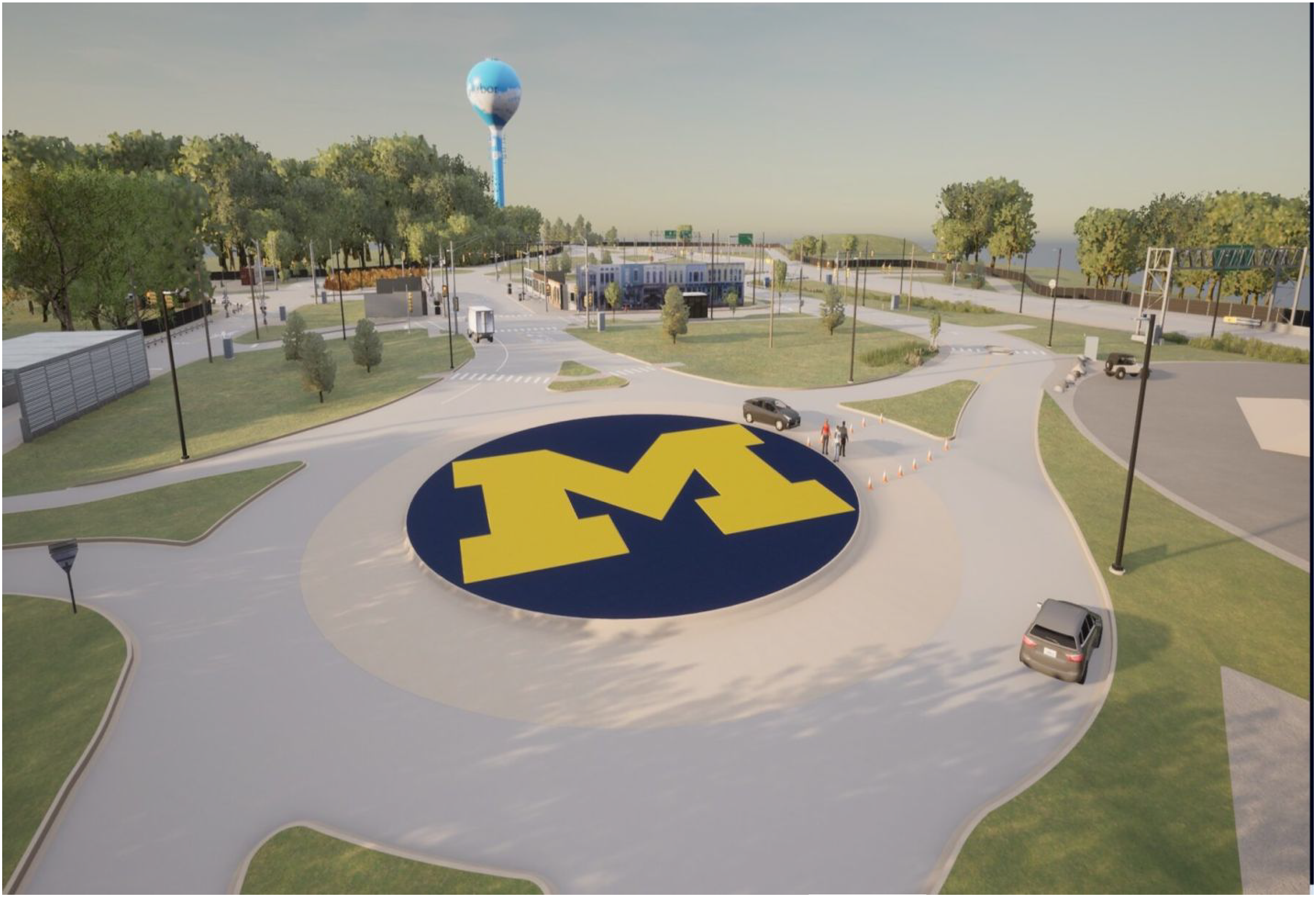
Image of Mcity taken from University of Michigan's an open-source, 3D digital twin for mobility systems testing. The imagery simulates the Mcity autonomous vehicle test center at the University of Michigan – Ann Arbor https://mcity.umich.edu/mcity-unveils-digital-twin-making-its-physical-av-testing-facility-available-for-free-in-the-virtual-world/.
