







Abstract
In an era of socio-ecological crisis, the dominant cultural narratives of the Anthropocene paradoxically reinforce a deep reliance on fossil fuels. These systems profoundly shape modern life, including our most fundamental conceptions of health. This article argues that societal conceptions of health in the Global North are constituted within, and constrained by, fossil-fuelled paradigms. To analyse this lock-in, we propose Fossil Health as a conceptual tool designed to show how fossil fuel dependency perpetuates productivist and unsustainable notions of health. By applying this lens through an integration of political ecology, sociology, and public health, we trace its manifestations across healthcare systems, policies, behaviours, and daily practices. Ultimately, transcending this cycle is essential for re-imagining more equitable and ecologically-attuned relationships between society, nature, and health.
Introduction
The current era is marked by unprecedented socio-ecological crises, from disrupted ecosystems to accelerating global warming. 1 These crises are driven by dominant practices that persistently overshoot planetary boundaries, perpetuating environmental injustices and failing to meet social needs.2–6 This situation is often described as the Anthropocene, 7 the Capitalocene, 8 or the Great Acceleration, 9 signalling human activity and capitalist processes as primary forces shaping Earth’s systems.10,11 Some authors frame this long historical process as the Homogenocene, emphasising how centuries of colonial expansion and ecological simplification underpin today's socioecological crises.12,13 A central driver of these processes is the deep dependency on fossil fuels, which powers harmful practices for both nature and society.
Despite increased awareness, consciousness of planetary limits remains largely absent from mainstream thought and policy. 14 The prevailing system often rationalizes ongoing environmental devastation as a manageable ‘externality' of growth, promoting technological fixes and market mechanisms that fail to address root causes.15,16 This inadequacy is compounded by a looming energy dilemma. While the depletion of fossil fuels and the impacts of climate change make a post-carbon transition urgent,17–19 fossil fuels still power over 70% of global electricity. 20 Furthermore, renewable alternatives, despite their promise, 21 face significant limitations regarding high capital costs, intermittency, and scalability.17,19,22,23
Consequently, a growing consensus argues that technological substitution is insufficient, and that profound societal and lifestyle changes are necessary. This is the foundation of degrowth and post-growth proposals, which urge a deliberate shift away from growth-focused models, prioritizing principles of energy justice instead.24–28 Critical ecosocial and ecofeminist lenses also stress the need to reimagine socio-ecological relationships.29–31 They call for imaginative capacity grounded in care, empathy, and ecological balance to envision and pursue sustainable futures. 32
The political discussions surrounding the problems of the Anthropocene, including which energy transitions should be implemented and how, necessitate critical examination of how societies construct and understand themselves. 33 These transformations are grounded on fundamental ‘intergenerational' issues: What kind of society do we aspire to become? How will we behave, interact, and think within it, including our relationship with nature? Inhibiting such reflective thinking and failing to question what a society considers ‘normal’ invites risks and multiple forms of violence, 34 encompassing the discursive violence of foreclosing alternative futures, the structural violence of embedding inequalities, and the slow violence of delayed ecological destruction. 35
We must therefore continue to scrutinize our shared assumptions: the collective frameworks of meaning, or imaginaries, that are manifested through social norms, laws, beliefs, values, and narratives, 36 which ultimately drive behaviours. It is through these frameworks that dominant ideas, like the reliance on fossil fuels, become embedded in societal views of progress and health.14,33,37 We draw inspiration from a range of thinkers who have explored how imaginaries structure society36,38–44 and we position capitalist productivism and its imperative for growth as a foundational engine of the dominant imaginaries. This logic actively cultivates and relies upon mass consumerism, normalizing energy-intensive lifestyles and infrastructures as markers of well-being.45–47 While other ideological forces are significant, our focus is on the central role of this productivist drive in shaping beliefs, values, social aspiration, policy orientation, and progress in general.
Questioning the ‘normalities' embedded within the dominant beliefs and practices requires tools to systematically analyse how they operate. This is crucial for adapting to reduced energy availability and striving towards intergenerational health. 48 ,49 However, a critical gap remains: the specific mechanisms through which dominant, fossil-fuelled energy imaginaries shape and constrain our very definitions of ‘good health' are unexplored. To bridge this gap, we propose the conceptual framework of Fossil Health. This interdisciplinary tool illuminates the intersections between energy systems and health in domains such as healthcare, lifestyle practices, and ideals of well-being. It introduces five guiding categories to analyse how fossil fuel dependencies underpin dominant health assumptions. Ultimately, it aims to assist scholars and practitioners across disciplines to deconstruct these entrenched links and foster critical thinking, enabling a shift towards health approaches that are truly regenerative, equitable, and aligned with a sustainable future.
Health as a Verb in the Anthropocene
In the Anthropocene (and predominantly within capitalist societies), notions of ‘good health' and well-being are powerfully shaped by a confluence of social, political, and economic factors. These include neoliberal, globalised, and productivist logics that define what is considered healthy, sustainable, and achievable for all.49–51 Significantly, these notions are also connected with our societal relationships with energy.27,52
Biomedical models dominate contemporary health paradigms in many societies, framing understanding through clinical and technological narratives. Situated within a positivist epistemology, these models reduce health knowledge to discrete norms and metricised, evidence-based protocols.53–59 However, their isolated application – neglecting socio-environmental determinants of health and the interplay of agency and structure60–63 – fosters a fragmented view of health 64 that skews research, policy, and practice.65,66
This narrow focus is ill-equipped for the interconnected socio-ecological crises. 67 As Romanello et al 68 assert, health is now “at the mercy of fossil fuels”, locked in feedback loops where climate change and biodiversity exacerbate risks and strain care systems. It is a precarious reality that demands reimagining ‘good health’ beyond clinical confines, a task which can draw inspiration from long-standing intellectual and political traditions. Environmental justice frameworks and Latin American critical epidemiology, for instance, analyse how power structures and socio-environmental inequalities are the primary determinants of health and disease.61,62,69,70
Moreover, health has a dual nature: it is autonomous, shaped by its own internal logic, and heteronomous, conditioned by broader systemic forces.38,71,72 Far from a static or purely individual state, health is a dynamic and collective process,61,62,73–75 linked to society's energy use and underlying beliefs. Power structures shape health practices, personal subjectivities, and life-and-death processes,76,77 privileging elites while marginalizing vulnerable groups.45,62 These power dynamics operate through pathways of embodiment, where material and social factors interact across multiple scales (global, societal, ecological, molecular, etc.) and are biologically expressed. 78
Consequently, health in the Anthropocene must be understood not as a static noun but as an active verb, echoing Lynn Margulis and Dorion Sagan's expression 79 “life as a verb” (p. 14). It is both a product of its surroundings and a shaper of society, 80 deeply embedded in its material and cultural environment.80–82 Recognizing that our health imaginaries – how we envision health and its causes – contribute to the socio-ecological crisis opens essential pathways for transformation. Within this context, we present the Fossil Health framework to analyse how health imaginaries are intertwined with energy systems and guide the exploration of possibilities for more sustainable and equitable ways of living.
Fossil Health: A Conceptual Proposal
The Anthropocene is dominated by fossil modernities – socio-economic systems and cultural practices built on a deep dependency of fossil fuels.6,83,84 These systems, originating in the Industrial Revolution, are sustained by historical narratives which relate fossil fuels to progress, economic growth, and modern lifestyles, thereby legitimizing a productivist logic that structures society's relationship with nature and technology.6,14,52,84
Crucially, fossil modernities both result from and reinforce historic and ongoing social inequalities.6,84,85 They operate by embedding colonial legacies and exploitation into political and cultural structures, a dynamic that intensifies as the system is challenged. This intensification can manifest as fossil fascism, 86 a political response employing state aggression and repression to protect fossil fuel interests. The result is a cycle of power concentration, ecological destruction, and worsening of health inequalities,45,50,52,67,87–89 whose consequences are disproportionately borne by marginalized communities in resource-extractive regions.90,91 These systemic injustices underscore the necessity of a political ecology and decolonial lens to advance energy justice by questioning the fundamental power structures of our energy systems.27,92
Our reliance on fossil-fuels is captured by scholars through terms like fossil capitalism, 84 carbon democracy, 46 fossil neoliberalism, 93 fossil developmentalism, 94 fossil aesthetics, 6 or fossil culture, 95 which together reveal the interlinkages between industrial modernity (economy and power), energy matrices (ecology), and collective worldviews (society and culture). 6 It is within this integrated system that we must situate our understandings of health, which are equally permeated by this fossil-fueled logic.
The relationship, however, is complex and paradoxical. Fossil fuels exacerbate health problems yet also facilitate health benefits, from refrigerated food storage to heating systems. This paradox is mirrored in contemporary health interventions, which often prioritize short-term and market-driven fixes over addressing root causes. Examples include over-medicalization, diets reliant on globally-imported foods, self-care products, energy-intensive gyms, and motorized getaways to relax. These approaches aim to counteract the adverse effects of systemic-related unhealthy modes of life – or the collective products of industrial and techno-capitalist routines and occupations. They pivot upon ideals of autonomy and responsibility, outweighing collective or systemic influences.54,64,71,96 Whilst sometimes useful, these responses are energetically overreaching, operating under the assumption of infinite resources and/or relying on technological fixes for ecological damage.71,97 They are inefficient in preserving good health as they fail to target the upstream, structural and root causes of public health problems. Additionally, more investment is placed on treatment of disease rather than in prevention. 98
While health is a broad socio-ecological condition extending far beyond clinical care, 67 the healthcare system – as an intermediary determinant - provides a critical entry point to analyse fossil fuel lock-in. 99 For example, its operational footprint fossil serves as a tangible manifestation of fossil fuel dependency.100–108 Globally, healthcare is responsible for approximately 4.4% of global greenhouse gas emissions, 109 with mounting impacts over the past years. A significant share stems from its energy-intensive infrastructure, technologies, and supply chains.100,101,105 Beyond carbon, the sector generates substantial waste and contributes to the toxification of ecosystems, which inequitably impact some neighbourhoods or social groups more than others, leading to environmental injustice.69,110,111
This evidence points to a fossil conundrum: the very systems tasked with healing are simultaneously contributing to the planetary crisis that undermines health.68,112,113 This paradox is epitomized by a narrow application of the biomedical model of health, isolated from social, ecological, and structural contexts. The solutions it offers often perpetuate the very ecological crises they aim to solve. By overlooking the social origins of illness and broader socio-ecological determinants, these approaches reinforce the fossil fuel dependency and resource exploitation they are meant to counteract.53,54,66,114
Thus, the health and social practices of the Anthropocene cannot be limited to a carbon-centric approach, and new (cultural, political, social, ecological) alternatives must be sought. As some authors note,112,113 alternatives can align with opportunity to improve long-term public health outcomes 112 and driving broader socio-ecological transformations. Health is a tangible, universal concern that can make the threat of climate change more immediate and actionable for the public compared to technical elements such as CO2 data. 113 Primary healthcare is particularly prone to playing a significant role in this effort due to its community interactions and the intersectional nature of the health issues it addresses. 115 This idea gains importance given existing literature evidencing insufficient knowledge of health professionals regarding climate change and their role in how to respond. 116
Considering this broad context, we propose Fossil Health as a conceptual tool. It synthesizes insights from environmental humanities, political ecology, sociology, and public health to emphasize health as a core apparatus of fossil modernity. Fossil Health is designed to unpack the multifaceted ways in which societal dependencies on fossil fuels shape, and are shaped by, our very conceptions of health and well-being. Rooted in post-structuralist thought on the interplay between knowledge and power,76,117 Fossil Health provides a diagnostic tool to make the invisible dependencies of our health systems visible and debatable. 118 Its structured categories allow tracing how fossil fuel logic – from productivism to anthropocentrism – becomes embedded in everything from medical infrastructure to conventional health promotion. This process sparks critical questioning, moving debate beyond technical efficiency to confront fundamental issues of energy cost and systemic reinforcement. Ultimately, by rendering these problems tangible, the tool can empower communities, researchers, and policymakers to legitimize and advocate for concrete alternatives, fostering a necessary rethinking of how fossil dependencies impact our bodies, societies, and environments.
The structure of this diagnostic tool is illustrated in Figure 1. The figure shows how Fossil Health emerges from the interplay of three co-constitutive layered:
Broader social imaginaries: the foundational layer of shared cultural ideas, norms, and institutions that shape a society's reality, together with material circumstances. Energy imaginaries: the dominant energy paradigms – rooted in narratives of progress and growth – that exert a powerful influence within these worldviews. Health imaginaries: the understanding and practice of health, which are profoundly shaped by fossil modernity.
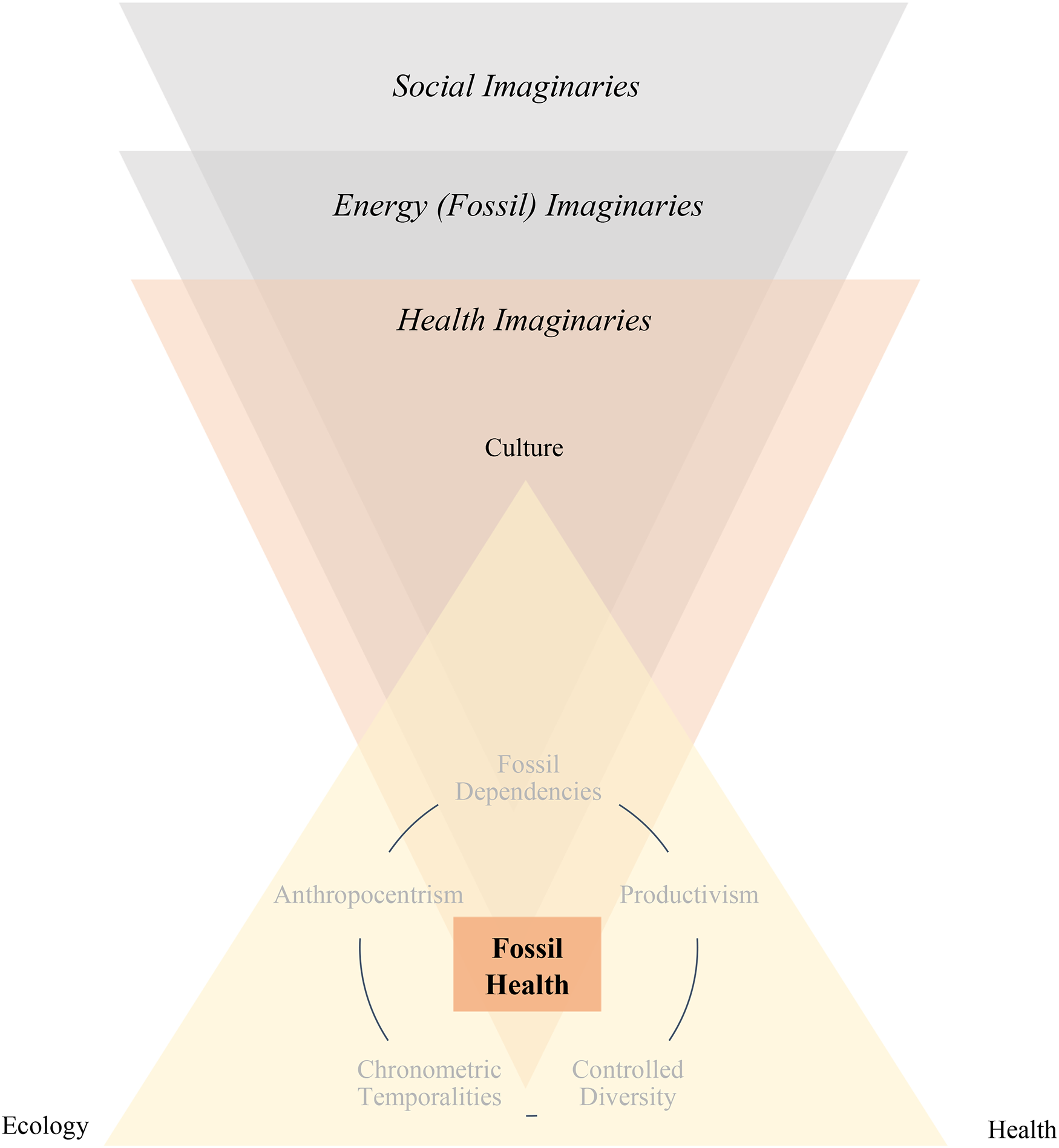
Fossil Health: A Conceptual Proposal.
The two-way arrows in the figure emphasize that this is not a linear sequence but a dynamic process of co-production: our health assumptions and practices reinforce fossil imaginaries, which in turn legitimize Fossil Health. The figure also introduces the guiding categories (detailed in the next section) that serve as analytical lenses to unravel the pathways through which Fossil Health operates, mapping the fundamental integration of the cultural, ecological, and health spheres.
Fossil Health: Guiding Characterisations for Analysis
We propose five guiding categories to facilitate identifying core processes and paradigmatic ‘normalities' which are embedded within Fossil Health: (1) fossil dependencies; (2) productivism; (3) controlled diversity; (4) chronometric temporalities; (5) anthropocentrism. These categories are based on critical social science and political ecology literature that denounce the exploitative and accelerated nature of capitalism, and the global social practices of the Anthropocene.6,31,119–125 They are also underpinned by a foundational understanding of (fossil) modernity as a system that operates through hierarchical binaries (such as society/nature and core/periphery). Such binaries facilitate a process of ‘othering', which systematically devalues and externalizes entities – be they ecosystems, non-human life, or marginalized populations – treating them as resources for extraction or sacrifice zones. The ideological separation is a prerequisite for the dispossession and relentless resource exploitation that fuels capital expansion.126,127
The first key category, fossil dependencies refers to the direct and indirect fossil-dependent culture of dominant health imaginaries. These underlie the standards of what is considered a ‘good health’ or ‘healthy lifestyle’, which has practical implications in terms of how to diagnose health problems, as well as how to design health interventions. Fossil dependencies include some of the examples mentioned previously, such as the direct carbon emissions from healthcare infrastructure or the dependencies indirectly driven by health-promotion activities that presume abundant and cheap energy.
Secondly, productivism describes an ideology that prioritizes activities generating profit and measurable economic growth, often at the expense of essential but uncommodified reproductive work like caregiving. 128 This logic – reliant on extractive industries – drives great environmental degradation.129–131 The biophysical economy and ecofeminism, among other frameworks, convey the limits of such processes by emphasizing the finite nature of physical and biological resources. 132 In the case of ecofeminism, they underscore the essentiality of care work and interdependent action for protecting life.29,31
In modern health, a productivist paradigm takes precedence, which overemphasizes market-based approaches to improve health outcomes. This paradigm externalizes care needs and expands the role of pharmaceutical industries, resulting in intensive resource consumption.100,105,133 Consequently, more holistic, preventive, and social justice practices are frequently marginalized.98,110 These alternative approaches could ultimately be more efficient and sustainable in social, environmental, and economic terms.70,134
Thirdly, controlled diversity links the subjugation of nature to a division between predictable and contingent socio-ecological processes. This division fosters an overemphasis on predictability, which in turn shapes narratives of control that manage ecological diversity through standardization.127,130,135,136 Such an approach reduces the complexity of ecological systems to manageable components devoid of their nuanced interrelations. This view not only simplifies but also commodifies nature, driving exploitative actions that disproportionately affect vulnerable communities and ecosystems, leading to an asymmetrical distribution of risks between and within social groups, countries, and world regions.27,137
This paradigm is also evident in modern health practices that apply standardized protocols and pharmaceutical interventions to manage illness and regulate health outcomes.134,138 While beneficial in many cases, attempts to rigidly control the diversity of health, primarily through pathogenic and biomedical models alone, tend to favour market-driven solutions (the pharmaceutical industry in particular) which can lead to overmedicalization. This approach also imposes escalating energy demands through associated industry and infrastructure, and indirectly triggers other environmental consequences, including resource extraction, toxic substance generation, and pollution, thereby furthering Fossil Health.
Fourthly, “chronometric temporalities”. A modern conception of time, built on a linear notion of progress and incessant economic growth, privileges chronometry over experienced time. This dichotomy accelerates social and consumption rhythms.139–141 Contemporary health practices are heavily influenced by temporalities that prioritize a capitalistic view of efficiency and time-control. While efficiency can improve health outcomes, the current definition of efficiency overemphasises too often an economization of healthcare that neglects other important temporalities and non-productivist processes (i.e. the value of experienced time in a medical consultation vs. isolated diagnosis). Modern challenges – such as growing chronic illness – remain inadequately addressed within the fast-paced biomedical model, questioning the chronometric perspective.
Also, the pursuit of rapid health production (linked to short-term solutions) is engrained with over-focus on the pharmaceutical industry and large-scale health infrastructures, as these rhythms necessitate quick, ‘magic-bullet' approaches that these sectors provide. In this way, health is envisioned centrally through a problem-solving based model that contributes to co-producing the patterns of extractivism, productivism, rigid prefiguration, and control. Collectively, these factors perpetuate health system imbalances and are a key driver of a Fossil Health. Embracing slow-er and more diverse temporal relationships in the health sector can facilitate more preventive and sustainable approaches.
Lastly, anthropocentrism, insists on the theoretical divide between society and nature, 127 where nature is primarily considered a passive resource to be managed and manipulated for human benefit and supposed freedom. This perspective creates separation between human health and non-human health, fostering the notion that human well-being can be achieved independently of the health of the natural environment. Despite many scholars and activists denouncing anthropocentrism in the context of health,97,142,143 it still heavily influences many health policies and technologies. 97 An example is the predominance of securitizing144,145 and pathogenic paradigms57,71 that define elements such as bacteria, viruses, or vectors as external contingencies to human health, overlooking the intricate interconnectedness between health and the environment.79,146 Embracing a more interdisciplinary awareness of the interdependence between nature, society, and health can help to dismantle these dualist logics and has the radical potential to drive necessary transformative changes towards broader socioecological understandings. 73
Overall, these five categories provide a diagnostic framework to deconstruct the paradigmatic factors and processes that constitute Fossil Health. They reveal how many current ‘healthy’ solutions fail to tackle root causes and instead perpetuate the very fossil fuel dependencies that drive ill health. By making these mechanisms visible, the categories create the conceptual space necessary to imagine new health paradigms and actions – ones based on sustainable energy and harmonious nature-society-health relationships. The ultimate aim is to catalyse a shift away from a Fossil Health to desirable sustainable good health.
Fossil Health as a Heuristic Tool to Promote New Imaginaries and Solutions
As many scholars and activists have stated, to sustain all life on earth, we must critically rethink what it means to sustain health and challenge a status quo deeply dependent on fossil fuels; a status quo historically driven by the colonial and industrial expansion of the Global North. 147 This perspective also aligns with the long-duration analyses of the Homogenocene as a period of bio-cultural simplification and dispossession.12,13 Written from this context, this paper acknowledges that the dominant, unsustainable health imaginaries we analyse are inextricable from this capitalist and colonial legacy. To challenge them entails transcending productivist models by reorienting concrete practices – from food systems to mobility – towards ecological sustainability, thereby challenging the underlying values, ideas, and practices that harm health and nature.55,98
This paper brings together multiple disciplinary ideas to argue that such a transformation requires a fundamental shift in our health imaginaries. Fossil Health provides a conceptual tool to make these deep interconnections visible. Recognizing that transforming entrenched norms is a long-term process reinforced by imitative behaviours,148,149 the framework is designed not as an instant solution, but as a heuristic tool to sustain collective reflection and make invisible norms open to challenge.
The critical potential of this tool is best illustrated by the fundamental questions it compels us to ask. It shifts the debate beyond technical fixes to confront systemic roots, as exemplified in Figure 2. For example, it pushes us to interrogate: Do alternative technologies and energy sources merely shift resource extraction – potentially triggering a Jevons Paradox, rather than ending it? 150 More specifically, we can investigate the effects of fossil modernities on health: Through what precise pathways do fossil fuel dependencies increase morbidity and the need for medical intervention? How does the reliance on fossil fuels in health convey environmental degradation?
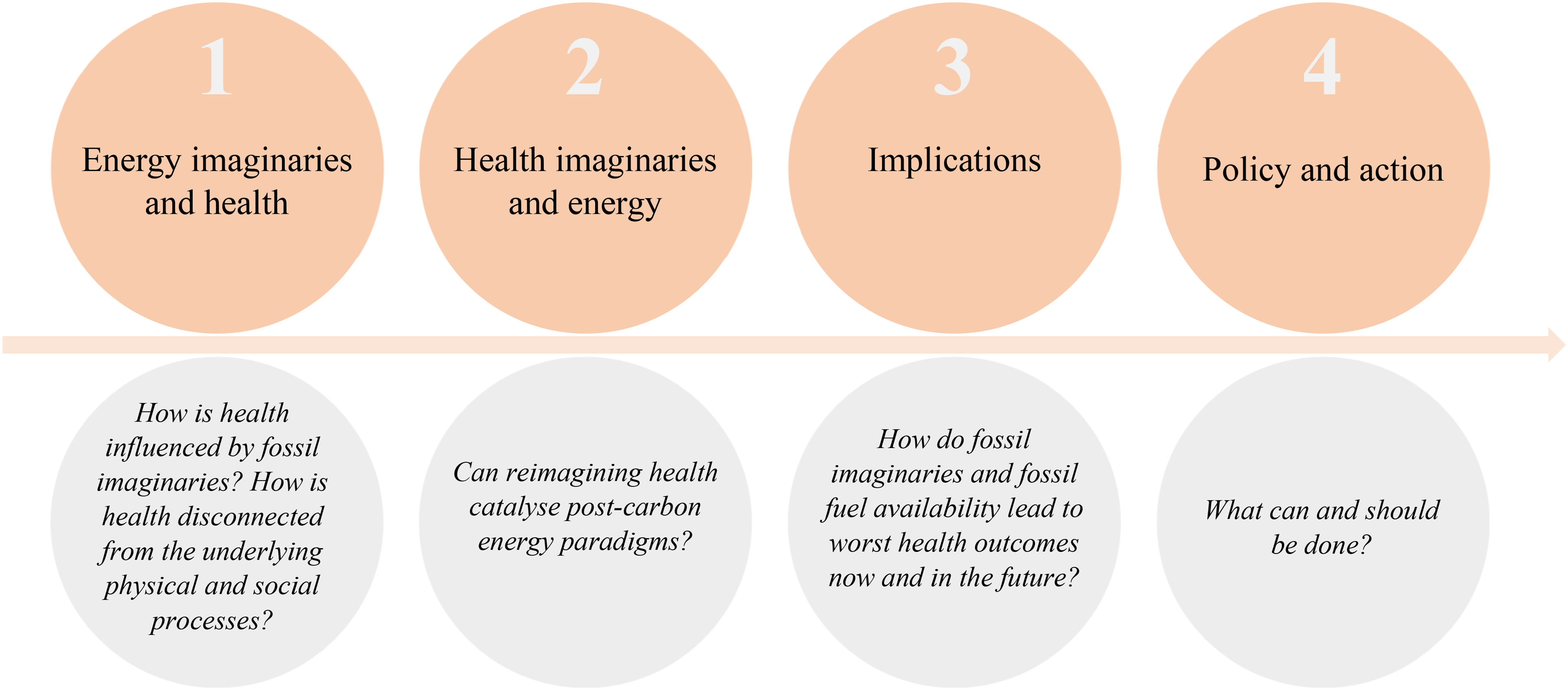
Rethinking the Relationships Between Health and Energy.
Conversely, we must also consider the effects of health on fossil modernities: Can modern health systems ever be truly sustainable? If so, what processes and mechanisms would be involved? Can reimagining health catalyse post-carbon energy paradigms? To what extent can a focus on preventive and holistic well-being reduce fossil-fuel dependent and productivist lifestyles, ultimately leading to better health outcomes?
Before implementing a public health policy, contemplating Fossil Health and its guiding categories may help to reflect on: Does it reinforce fossil dependencies? How does it affect care and social reproduction? How is diversity (of health conditions, knowledge, socioeconomic factors, cultural values, etc) understood and expressed? Does it foster slower-paced living? What is its impact on ecosystems, biodiversity, and different habitats? Among others.
This practice of rigorous questioning is the engine of transformation. 151 As Angela Davis asserts, “only by thinking critically and raising questions do we arrive at a way of thinking, a way of understanding, a way of being that is very different from what is encouraged by the prevailing knowledge”. 152
Ultimately, moving beyond Fossil Health demands employing biomedical knowledge in accordance with perspectives that emphasize ecological interdependence, including degrowth, Eco Health, 153 and Indigenous knowledge systems, 154 alongside a decolonial critique that exposes and challenges the extractive logics of fossil modernity.10,152,155 Figure 3 synthesizes the potential pathways through which the Fossil Health proposal can generate awareness and inspire action.
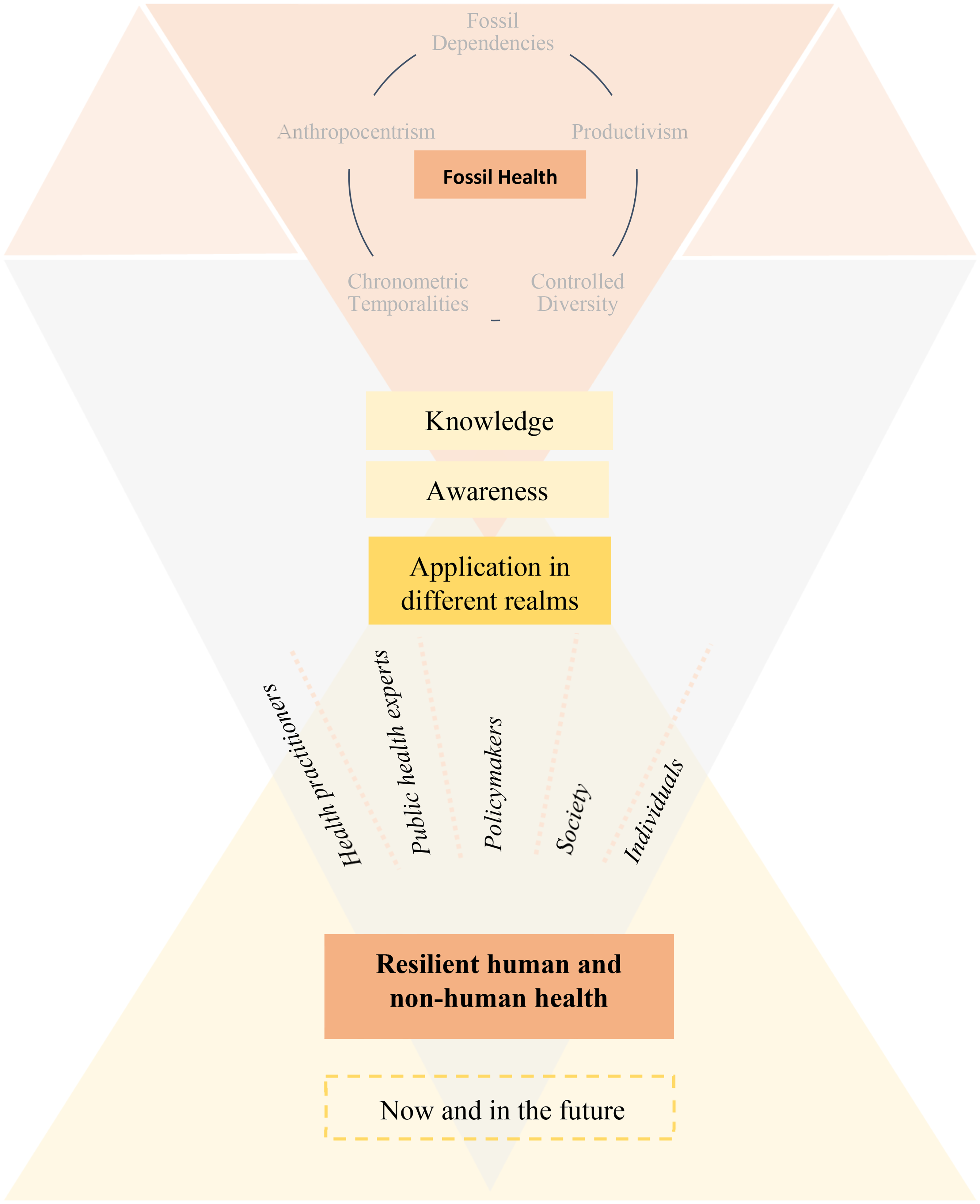
Fossil Health: Possibilities of Application.
To conclude, the socio-ecological ruptures of the Anthropocene demand that we fundamentally reconsider the foundations of our health and wellbeing, including how we imagine health, society, and our relationships with nature. 73 In Fraser's terms, contemporary “cannibal capitalism” consumes the very social and ecological infrastructures on which it depends, provoking self-destructive dynamics embedded in fossilised forms of extraction. 128 Fossil Health, along with its guiding categories, provides diagnostic and discursive tools that contribute to making the invisible threads between overreaching energy systems and health paradigms visible. By fostering the critical questioning we have outlined, it creates a legitimate space for alternative actions. This process demands breaking down disciplinary silos and promoting creativity and political participation to counter the aggressive protection of the fossil fuel status quo. The task ahead is not merely technical, but deeply cultural and political. Future research and action must use this lens to interrogate emergent threats – from climate nationalism to new forms of greenwashed productivism – and to create the socio-political conditions for a viable future – including, in some readings, gestures toward “survival cosmopolitanism” as an ethic of shared vulnerability and cooperation. 156 Ultimately, achieving health and good lives can no longer be a product of precarious, energy-intensive structures that undermine their own foundations. It must become a transformative practice cultivated in harmony with the planet's limits and social justice.
Footnotes

Funding
The authors disclosed receipt of the following financial support for the research, authorship, and/or publication of this article: This work was supported by the FSE invierte en tu futuro, MCIN/AEI/10.13039/501100011033, (grant number Ref. PRE2020-095159, FSE invierte en tu futuro (Ref. PRE2020-095159)).
Declaration of Conflicting Interests
The authors declared no potential conflicts of interest with respect to the research, authorship, and/or publication of this article.