







Abstract
Deference by courts to democratically elected legislature is at the heart of our constitutional democracy. This paper constructs a novel database of 249 cases involving the judicial review of legislation in Canada from the inception of the Charter to present. Deference increased sharply as the Charter was introduced, but has been steadily decreasing since 2000 after the McLachlin and Wagner courts. Deference is rising for the right to free expression, but declining for penal statutes and the right to equality. The recent fall in judicial deference can largely be attributed to certain Liberal appointees striking down more penal statutes due to both construing criminal rights more broadly and, as predicted by Irwin Toy, finding that the least intrusive means have not been taken. The justice-level data also provide insights on differences (or lack thereof) in judicial behaviour across sex and politics. One could conclude that Canada does, in fact, have de facto tiered judicial review.
1. Introduction
More guidance is needed on how exactly to engage in democratic dialogue that both respects the ideal of the separation of powers and the practical necessity of inalienable rights, for Canada has no such tiered judicial review, such as in the United States. One such hypothesis for where this judicial power ought to be exercised comes from the landmark free speech case of Irwin Toy. 1 The Irwin Toy Hypothesis, as I define it, states that a court will give less deference to Parliament under the constitutional balancing test in Oakes when the State is best characterized as ”singular antagonist” of the individual with respect their constitutional right, ” [f]or example, in justifying an infringement of legal rights enshrined Sections 7 to 14 of the Charter” which deal with legal rights of the accused in criminal cases. 2 The Irwin Toy Hypothesis also states that in these cases, “the courts can assess with a high degree of certainty whether the least intrusive means have been chosen to achieve the government’s objective.” 3
This paper analyzes a novel database of the universe of judicial review of legislation cases from the inception of the Charter of Rights and Freedoms 4 to present to study these hypotheses. I find that there has been a recent increase since 2010 in the probability that penal statute is struck down relative to non-penal statutes, consistent with the Irwin Toy hypothesis, but also an over-determined pattern by other competing hypotheses such as ”penal populism” or the unique textual or structural aspects of Section 7 right to life, liberty, and security of person and the associated principles of fundamental justice in the penal context enshrined in Sections 8 to 14 of the Charter. I find that penal statutes are much more likely to be struck down when they violate Sections 7 to 12, rights of the accused, as opposed to penal statutes which infringe Sections 2(b) or 15, speech and equality, respectively. The decline in the use of Section 1 of the Charter, its saving provision, to uphold penal statutes starting around the time of Irwin Toy is also consistent with the Irwin Toy Hypothesis. The court has become more likely to find that the least intrusive means have not been taken in the case of a penal statute, but have remained constant in the way it balances non-penal statutes.
The difference in the treatment of rights of the accused relative to other jurisprudences on speech and equality are difficult to square with this initial hypothesis. But one must remember that Irwin Toy itself was about the free expression of corporations in advertising directed towards children. Canadian law still uses the two-stage test from Irwin Toy in determining whether there has been an infringement on the right to free expression. 5 The results from my analysis comport with what one’s priors upon a close reading of the free expression jurisprudence: a broadly defined right with many justified infringements. The Court defines the free expression right extremely broadly, but with a higher propensity to save the statute as a justified infringement in a free and democratic society. Only the Irwin Toy Hypothesis can justify both the distinct treatment of legal rights in the penal context and the opposite treatment of penal statutes that violate the fundamental freedom of expression right.
Given the new justice-level data, I am able to look at characteristics of justices, such as politics and sex, to decompose the trends in averages. The recent fall in judicial deference can largely be attributed to certain Liberal appointees striking down more penal statutes due to both construing criminal rights more broadly and, as predicted by Irwin Toy, finding that the least intrusive means have not been taken. Conservative-appointed justices are, on average, more deferential than Liberal appointees, especially with respect to criminal cases involving penal statutes. However, importantly, there are no differences between Conservative and Liberal appointees in important dimensions, such as free expression and equality. Again consistent with one’s priors from reading the jurisprudence, I find that the sharpest divide across party lines is among Section 2(d) cases regarding the right to freedom of association in the labour context.
Examining sex differences, I find no difference in judicial behaviour across male and female justices except with respect to one right – the right to equality. Legal realism, judicial philosophy, or judicial biography – something must explain this large, statistically significant, and persistent difference in male-female behaviour in the adjudication of statutes alleged to be in violation of Section 15 right to equality. Indeed, my results are consistent with past evidence on sex differences in sex discrimination cases (Boyd, 2016; Boyd et al., 2010; Johnson & Masood, 2023).
There are many conclusions to be drawn from this empirical exercise. The Court appears to apply a stricter Oakes test for minimal impairment in the case of penal statutes that infringe the rights of the accused. In particular, I find that penal statutes which violate of Section 7 right to life, liberty, and security of person are completely fatal and rarely if ever saved, akin to something like the oft-fatal strict scrutiny in US judicial review. Though, this heightened scrutiny is equally concentrated among legal rights in the penal context and not merely Section 7 itself, which is subject to its own internal limits by the principles of fundamental justice. Moreover, this statement fails to hold in the case of free expression cases, where the Court defines the free speech right broadly and often saves legislation as justified infringements, which excludes what Irwin Toy calls harmful speech. This rules out competing hypotheses, such as ”penal populism” and Section 7’s unique and exceptional textual structure and architecture, and offers support for the Irwin Toy Hypothesis.
Female justices appear to conceive of Section 15 right to equality in a broader way than male justices and Liberal-appointed justices conceive of Section 2(d) right to freedom of association in a broader way than Conservatives. One might conclude that Canada does have de facto tiered judicial review. This is so in both a formalistic or post-realist legal process sense, as Irwin Toy prescribes more deference in cases where the State is the singular antagonist, and in a realist sense, where Liberal-appointed and female justices construe labour and equality rights, respectively, in a broader way than their counterparts.
The paper proceeds in seven sections. The next section describes the institutional setting of Canada’s constitutional democracy. The third section describes a brief of history of tiered judicial review in the United States, in Canada, and across the world. The fourth section reviews the relevant literature on the study of deference and judicial behaviour in Canada and elsewhere. The fifth section describes the novel database constructed. The sixth section examines trends in the data and formally tests the Irwin Toy Hypothesis. The seventh section ranks the justices by deference across various rights and by courts. The eighth section studies judicial behaviour across politics and sex, and in unanimity, concurrence, and dissent. The final section concludes.
2. Judicial Review in Canada
The origins of judicial review in Canada technically go further back than the creation of the Charter of Rights and Freedoms in 1982 (Smith, 1983). To be sure, there was a robust judicial review pertaining to division of powers under the British North America Act, 1867. Canada had experimented with a federal statutory bill of rights in 1960, but until the Charter it lacked anything resembling the kind of judicial review of legislation for compliance with substantive rights that had been central to post-Lochner American political life (Sigalet, 2021a). The introduction of the Charter led to a more robust protection of civil liberties and fundamental freedoms, for example, in protection of the right to freedom of religion (s. 2(a)), expression (s. 2(b)), and association (s. 2(d)), the right to life, liberty, and security of person (s. 7), rights of the accused (ss. 8-14), and equality (s. 15). This would lead to a Constitution Act which section 52 declared the Constitution to be the supreme law and any law inconsistent with its provisions to be of no force or effect, giving courts the power to invalidate laws for the first time. The statute can be struck down (i.e. declared invalid), but also read in, up, or down. 6
The Charter contained within it in Section 1 a saving provision which would allow for infringements that could be ”demonstrably justified in a free and democratic society”. The level of judicial review prescribed by Section 1 is best understood as most alike the intermediate scrutiny standard of review in the United States. The Court in R v. Oakes
7
laid out the test for a justified infringement in a free and democratic society as follows. (1) Pressing and Substantial. The law must be of sufficient importance to warrant overriding a constitutionally protected right or freedom; (2) Rational Connection. There must be a rational connection between the fact proved and the ultimate fact presumed; (3) Minimal Impairment. The means chosen must be reasonable and demonstrably justified (“proportional”); and (4) Proportionality. The law must have its salutary effects that outweigh its deleterious ones.
8
This remains the test for a justified infringement in a free and democratic society per the saving provision in Section 1 of the Charter today. The Oakes test technically prescribes a uniform approach to the standard of review to all infringements akin to that of intermediate scrutiny in the United States.
Section 7 protects the right to life, liberty, and security and not to be deprived thereof except in accordance with the principles of fundamental justice. Section 7 is somewhat anomalous, as it has its own internal limits, the principles of fundamental justice, a form of unwritten law in Canadian constitutional architecture. 9 Canadian jurisprudence made clear very early on that Section 1 will only be used to save a Section 7 violation ”only in cases arising out of exceptional circumstances, such as natural disasters, the outbreak of war, epidemics, and the like”, 10 applying a stricter scrutiny to penal statutes in violation of Section 7, making Section 7 itself somewhat anomalous. Indeed, no majority judgment in the Supreme Court of Canada dataset used in this paper has saved an infringement of Section 7 only. Though, increasingly Section 7 violations have been found not to be justified in a free and democratic society by provincial appellate courts. 11
Irwin Toy also outlines cases where there can be more or less deference given to Parliament in various cases, such as when the State is the singular antagonist of the individual with respect to their right, such as under Sections 8 to 14 of the Charter, or where there is inconclusive or conflicting social science evidence on the matter. This suggests a sort of tiered judicial review or varying intensity of scrutiny for legal rights of the accused where the State is the singular antagonist of the individual with respect to their constitutional right. However, it is much less certain, compared with the case of Section 7, whether or not this doctrinal hypothesis is empirically true.
Irwin Toy was itself a case about freedom of expression. The Court in Irwin Toy set out a very different path for the right to freedom of expression. The Court defined a broad two-part test for a violation of the s. 2(b) right to freedom of expression as. (1) a non-violent conveyance of meaning, and (2) a government purpose or effect to restrict freedom of expression.
The test encompasses virtually every government restriction on activity with expressive content. This broad test would leave most of the work to be done on restricting the right to freedom of expression to Section 1 analysis under the Charter’s saving provision for justified infringements in a free and democratic society.
The Supreme Court of Canada sits en banc. The panel size at the Supreme Court of Canada is typically nine justices, but justices are frequently absent and take no part in the judgment leaving many cases with less than nine. Criminal cases are granted automatic leave to appeal as of right if a justice on the panel of a court of appeal disagrees with the decision on a point of law or if the acquittal was overturned by the court of appeal, as are constitutional reference questions per Section 53 of the Supreme Court Act.
12
All criminal cases are legislated by Parliament at the federal level since the criminal law power lies exclusively within the federal head of power under Section 91(27) of the Constitution Act, 1867. The appointment of justices to the Supreme Court of Canada is largely at the Prime Minister’s discretion. The process for appointment to the Supreme Court of Canada is as follows. • Following extensive informal consultations, the minister of justice will create a list of eight nominees. • An all-party parliamentary selection panel will narrow the minister of justice’s list to a short list of three candidates. • The prime minister will nominate one of the three candidates. • The nominee will appear at a publicly-televised hearing before an all-party parliamentary committee. • The prime minister will make the final decision whether to appoint the nominee (Alarie & Green, 2009, p. 8).
3. A Brief History of Tiered Judicial Review
Tiered judicial review begins in the United States. The famous footnote four of United States v. Carolene Products Co. 13 established lower and higher standards of review. In particular, the Court held that a higher standard would apply in cases involving discrete and insular minorities, fundamental rights, or interference with political processes. 14 At the same time, the Court explained that ”a statutory discrimination will not be set aside if any state of facts reasonably may be conceived to justify it.” 15 This would end up sketching out what are now known as rational basis and strict scrutiny.
Strict scrutiny would apply a heightened form of review for fundamental rights or legislation involving a suspect classification, such as race, religion, national origin, and alienage, as well as content-specific speech regulations. The highly deferential form of rational basis review was later cemented in Williamson v. Lee Optical of Okla., Inc., 16 where the Court stated: ”It is enough that there is an evil at hand for correction, and that it might be thought that the particular legislative measure was a rational way to correct it.” 17 Rational basis review is used for presumptively constitutional economic regulation. Intermediate scrutiny was developed subsequently in Craig v. Boren 18 to handle quasi-suspect classifications such as gender, but is now widely applied, in particular for content-neutral freedom of expression infringements.
The tiered system of judicial review is not merely procedural formalism. Ely emphasizes that heightened scrutiny exists to protect discrete and insular minorities when the political process cannot be relied upon to safeguard their rights (Ely, 1980). Indeed, the core of the case for judicial review rests on the assumption of a well-functioning legislature (Fallon, 2008; Waldron, 2006). Tiered judicial review also ensures consistency among lower courts (Grove, 2016).
Canada’s Oakes test for a Section 1 justification laid out in Oakes mirrors much of the language from the United States jurisprudence, drawing on aspects of each standard of review. For example, rational basis review requires a legitimate state interest and a rational connection; intermediate scrutiny requires a substantial state interest by means that are substantially related to that interest; and strict scrutiny requires the statute be narrowly tailored to a, more stringent or heightened, compelling governmental interest using the least restrictive means necessary to achieve that objective. All of these criteria show up in the test in Oakes, but Oakes is often likened to the intermediate scrutiny standard (Sigalet, 2021b) despite appearing to contain all of the relevant language of strict scrutiny, as it does not presume unconstitutionality in any way and could hardly be said to be ”‘strict’ in theory and fatal in fact” (Gunther, 1972, p. 8).
However, varying intensities of scrutiny for judicial review of legislation are used widely across the world, though seldom have formal tiered review as in the United States but rather a functionally equivalent approach. I briefly review some of the more relevant judicial review systems that resemble a tiered-style approach, such as Germany and the European Union. However, most jurisdictions use a more standard-based, proportionality-style approach rather than a categorical or tiered approach. Indeed, Canada could hardly be said to have a tiered approach to judicial review, but there exist doctrinal norms to apply varying intensities of judicial review on a principled basis that derive from constitutional jurisprudence.
Germany uses a varying intensity of proportionality depending on the rights involved and the weight of the state interest. A higher intensity is used for core fundamental rights, such as human dignity, personal liberty and bodily integrity, freedom of expression, and core political participation rights, while a lower intensity is used for less central rights, such as economic or property rights, consumer rights, freedom of association, and environmental rights. Grimm (2007) writes that The Court [has] developed a scale of scrutiny that ranges from whether the legislature’s prognostications are evidently wrong (Evidenzkontrolle) to a reasonableness test (Vertretbarkeitskontrolle) to strict scrutiny (intensivierte inhaltliche Kontrolle), depending on the nature of the policy area, the possibility of basing the decision on reliable facts, and the importance of the constitutionally protected goods or interests at stake. (p. 391)
A similar approach of varying intensities of review has been adopted in the European Union. Harvey (2024) writes of the Court of Justice of the European Union (CJEU) that Since the elevation of the Charter to primary law status […] the CJEU has come to subject EU legislation to far more rigorous levels of scrutiny (in some cases at least). In Digital Rights Ireland, the [CJEU] held for the first time: With regard to judicial review […] where interferences with fundamental rights are at issue, the extent of the EU legislature’s discretion may prove to be limited, depending on a number of factors, including, in particular, the area concerned, the nature of the right at issue guaranteed by the Charter, the nature and seriousness of the interference and the object pursued by the interference. In that case, the EU legislature’s discretion was reduced, with the result that judicial review of the exercise of that discretion was ’strict’. This heightened intensity of review was justified on the basis of ‘the important role played by the protection of personal data in the light of the fundamental right to respect for private life and the extent and seriousness of the interference with that right.’ Subsequent cases have confirmed this approach. Consequently, in the post-Lisbon era, one finds the Court engaging in ‘high-intensity’ proportionality review of EU acts that limit fundamental rights in certain contexts. (p. 172) [emphasis in original; footnotes omitted].
In setting down this fundamental shift in the approach, the CJEU cited the Grand Chamber judgment of the European Court of Human Rights in S and Marper v. United Kingdom. 19 The European High Court of Human Rights (ECtHR) uses a margin of appreciation, which is the degree of discretion that the ECtHR allows national authorities in regulating rights. Factors used in determining the margin of appreciation include the nature of the Convention right in issue, its importance for the individual, the nature of the interference, and the object pursued by the interference.
The core claim of this paper – that the Supreme Court of Canada applies stricter review to penal statutes implicating legal rights than to statutes infringing expressive or equality rights – can be understood as an interpretivist observation. That is, the differential scrutiny reflects the Court’s interpretive judgments about the nature of the rights themselves. Legal rights under Sections 7 to 14 protect physical liberty and due process, values that the Court treats as demanding near-fatal scrutiny. By contrast, rights such as freedom of expression or equality are construed more broadly but with greater tolerance for legislative justifications. In this sense, the empirical pattern reflects a deeper interpretive commitment to treating categories of rights differently.
4. Related Literature
This paper contributes to the literature documenting empirical observations in judicial behaviour at the Supreme Court of Canada. Perhaps the most similar paper that performs a comparable exercise for Canada is Choudhry and Hunter (2003) at the time the NAPE 20 was before the Supreme Court of Canada. In general, our methodology follows that of Choudhry and Hunter by looking at cases pertaining to the judicial review of legislation. While the dataset follows the approach taken in the legal and political science academic literature on judicial activism, 21 such as Cross and Lindquist, 2007, it is the first to analyze justice-level behaviour at the Supreme Court of Canada in the judicial review of legislation in the Canadian setting, and is the first to look across rights and by statutes.
The novel database on the judicial review of legislation used in this paper allows me to build on Choudhry and Hunter’s (2003) analysis by examining justice-level behaviour and looking across differences in statutes and rights. The results answer several open questions from the debate between Choudhry and Hunter (2003) and Manfredi and Kelly (2004) in the McGill Law Journal. Choudhry and Hunter (2003) and Manfredi and Kelly (2004) debated three key hypotheses. 1. Judicial Activism Is High 2. Judicial Activism Is Increasing over Time 3. Section 1 Analysis as the Locus of Activism
And a fourth on the delegitimization of Section 33 override under the Notwithstanding Clause, which, while has been of renewed attention at the time of writing, is not the subject of this paper. I construct a novel database which allows me to re-evaluate the first three critical hypotheses, building on the debate that proceeded Choudhry and Hunter (2003). I find that judicial activism has been rising, largely among penal statutes, while the Court has shown more deference on rights such as freedom of association and freedom of expression. The debate over the use of Section 1, the Charter’s saving provision, is somewhat more nuanced.
My database resolves the longstanding puzzle in average invalidation rates by looking across penal versus non-penal statutes and across different rights. Criminal cases compose nearly half of the dataset that I construct. The Irwin Toy Hypothesis can be tested by examining activism across different statutes and rights. The probability that a statute is found unconstitutional masks significant heterogeneity across criminal and non-criminal cases and across different rights, which previous literature has left uncovered. The Court is much less likely to save a penal statute that violates rights of the accused contained in Sections 8 to 12 of the Charter, and much more likely to save statutes which violate Section 2(b) right to freedom of expression. This suggests that the Court has something like a tiered standard of review, as in the United States where restrictions on free expression are upheld more often under strict scrutiny (Winkler, 2006).
There are, however, other competing hypotheses that could also explain these trends and differences. The first competing theory is that the distinction between legal rights and fundamental freedoms derives from the textual treatment between Section 7 of the Charter and fundamental freedoms, such as free expression and equality, since Section 7 has its own internal limits by requiring that the violation be in accordance with the principles of fundamental justice. Indeed, Sections 8 and 9 of the Charter allow for ”reasonable” searches and ”non-arbitrary” detentions in the definition of those rights. The second theory is what has been dubbed ”penal populism” to describe the increase in Private Member’s Bills during the Harper government from 2006 to 2015 (Kelly & Puddister, 2017; Pratt, 2007). Some inquiries have found support for the idea that the Harper government took a stronger posture against the Supreme Court of Canada on criminal justice policy, especially with respect to mandatory minimum sentences (Hennigar, 2017; Macfarlane, 2018).
I find support for the Irwin Toy Hypothesis over these two competing theories. First, my raw data show that statutes violating Sections 8 to 12 of the Charter, principles of fundamental justice in the penal context, are struck down and saved at similar rates to statutes alleged to violate only Section 7, which are subject to the principles of fundamental justice by way of the Charter’s text and structure. This pattern holds even when excluding judicial review of legislation which is purported to infringe Sections 8 and 9 of the Charter, which may be seen as having internal limits. Thus, the internal limits of Section 7 presented by the principles of fundamental justice cannot account for the difference in treatment of legal rights in the penal context, where the State is singular antagonist, relative to fundamental freedoms, where it is not. For this reason, I examine differences across both Section 7 only and any Section 7 violation, which includes Sections 8 to 12 of the Charter. Second, I find no average difference in invalidation of penal statutes relative to non-penal statutes, lending less support for the ”penal populism” hypothesis that suggests that Court was correcting for a peculiar ”tough-on-crime” pathology in the legislature. Rather, the Court appears to be more likely to strike down only penal statutes that infringe on legal rights and less likely to strike down Criminal Code offences which violate the right to freedom of expression, more consistent with a hypothesis such as Irwin Toy.
The justice-level data allow me to look across differences in sex and politics, as well as other aspects of judicial behaviour. I find that Conservative-appointed justices are, on average, more deferential, consistent with evidence on judicial ideology from the United States (Martin & Quinn, 2002). However, my proxy of the party of the appointing Prime Minister ignores other possible ways of measuring ideology such as the policy preferences of the appointing prime minister or the Ostberg-Wetstein scores assigned to the justices based on newspaper accounts at the time of their appointments (Ostberg & Wetstein, 2007). The largest difference across political affiliation is concentrated in labour cases involving the right to freedom of association and criminal cases involving penal statutes. However, Conservative- and Liberal-appointed justices behave relatively the same in important dimensions, such as freedom of expression and equality rights. Sex differences in deference are driven entirely by the right of equality, where female justices are substantially more likely to uphold the constitutional right to equality enshrined in Section 15, consistent with past evidence on sex differences in the sex discrimination cases (Boyd, 2016).
This supplements other work on gender differences at the Supreme Court of Canada which finds that female justices are more likely to dissent (Johnson & Reid, 2020) and are trailblazers on equality rights (Johnson & Masood, 2023). The justice-level data also paint a vivid judicial biography of each justice by measuring their individual deference across various rights, an exercise which has not yet been done on justices at the Supreme Court of Canada, but has been done for the United States (Cross & Lindquist, 2007). I am also able to compare justice behaviour across various courts, an exercise which has also not yet been done for the Supreme Court of Canada (Epstein & Martin, 2012; Landes & Epstein, 2012; Ringhand, 2007). Work on the Court of Appeal for Ontario found that ”neither the party of appointment nor the gender of a justice had any bearing on case outcomes” (Stribopoulos & Yahya, 2007, p. 361). This contributes also to literatures on the attitudinal and justice attribute models of judicial decision-making (Songer & Johnson, 2007; Tate & Sittiwong, 1989).
This paper uses a novel database to test various statistical hypotheses at the Supreme Court of Canada. The empirical results found in this paper may be of interest not just to observers of the Supreme Court of Canada, but also to the broader legal theory community whom may have an interested in naturalized jurisprudence (Leiter, 2011). All major legal theories – legal formalism, legal realism, law-as-politics, interpretivist post-realist legal process – attract at least some support in the data. Each of these camps are correct in asserting that their theory is predictive and wrong in insisting that their theory alone is complete.
5. The Database
I construct a novel database containing the universe of cases involving the judicial review of legislation from the inception of the Charter to present (1984-2023). The database has a total of 249 cases spanning 1984 to 2023. Our data were constructed manually using the Supreme Court of Canada’s Reasons for Judgment. The database consists of two companion datasets: a case-level database and a justice-level database. The database contains information on the case, such as the provision of the Charter at issue and the statute alleged to be in violation of the Charter, the split of the Court and whether the judgment was a plurality, as well as information on the justice, such as their position in the majority, concurrence, or dissent. A detailed description of the variables contained in both datasets are described in Appendix A. The two datasets can be merged using the case name or neutral citation, its unique identifier. The data are publicly available at https://github.com/dclarke7/SCCJR.
Each justice in a decision is assigned to the majority or the dissent. However, the majority is broken up into the majority opinion and a second concurring opinion.
22
In cases where there are two opinions written by the majority of equal size, I break the tie by assigning the opinion in which the Chief Justice to be the majority opinion and the group without to be the concurring opinion.
23
The key variable I am able to construct, which measures whether the justice deferred to Parliament, takes the value of one if the statute being considered was found to be in violation of the Charter (i.e.
The database covers the universe of Supreme Court of Canada cases from the inception of the Charter to present (1984-2023) where the court partakes in the judicial review of legislation to determine whether or not it complies with the rights of citizens conferred by the Charter. 24 However, the database also considers other remedies other than the declaration of invalidity, such as reading in, up, or down the statute, and treats all of these remedies identically in terms of coding of whether or not there was a violation that was not saved. I exclude Section 24 cases in which the remedy is damages, injunction, stay of proceedings, or exclusion of evidence, as they do not make use of Section 1 saving provision, they result in more than one remedy rendering the sample sizes too small for independent statistical analysis, and they refer to deference to the executive, such as police, and not democratically elected legislature. A justice is declared to have found a statute unconstitutional if they find it violates a right conferred under the Charter and that the statute cannot be justified in a free and democratic society under Section 1 of the Charter. The approach mirrors that of Choudhry and Hunter (2003) however, I do not examine Section 33 cases involving the override power in the Notwithstanding Clause. The approach in this paper follows the approach taken by Choudhry and Hunter (2003) to determining constitutional invalidity in judicial review cases (i.e. accounting for Section 1 of the Charter) and by combining cases that are decided together (i.e. companion cases).
The database examines only cases in which the State action is a piece of legislation, which excludes cases where other State actions may implicate Charter rights.
25
In the lion’s share of cases, the right implicated is one of Sections 2(b), 2(d), 7, 8, 11(d), 12, or 15 of the Charter. The most frequent statute considered is the federal Criminal Code,
26
Canada’s second longest statute next to only the Income Tax Act.
27
When faced with multiple rights at issue in the challenge of a particular statute’s constitutionality, rights which are not considered by the court in their decision are immediately ignored. All rights considered explicitly by the court are included, though the user of the database that is unfamiliar with Canadian constitutional architecture will immediately notice that Section 7 of the Charter is often challenged alongside multiple rights within Section 11 of the Charter because of the way the Charter is written.
28
When multiple rights are considered, a justice is determined to have found the statute invalid if at least one of the rights are violated by at least one of the statutes considered. Statutes that are not found in violation of a right conferred under the Charter are not considered under the
Summary Statistics
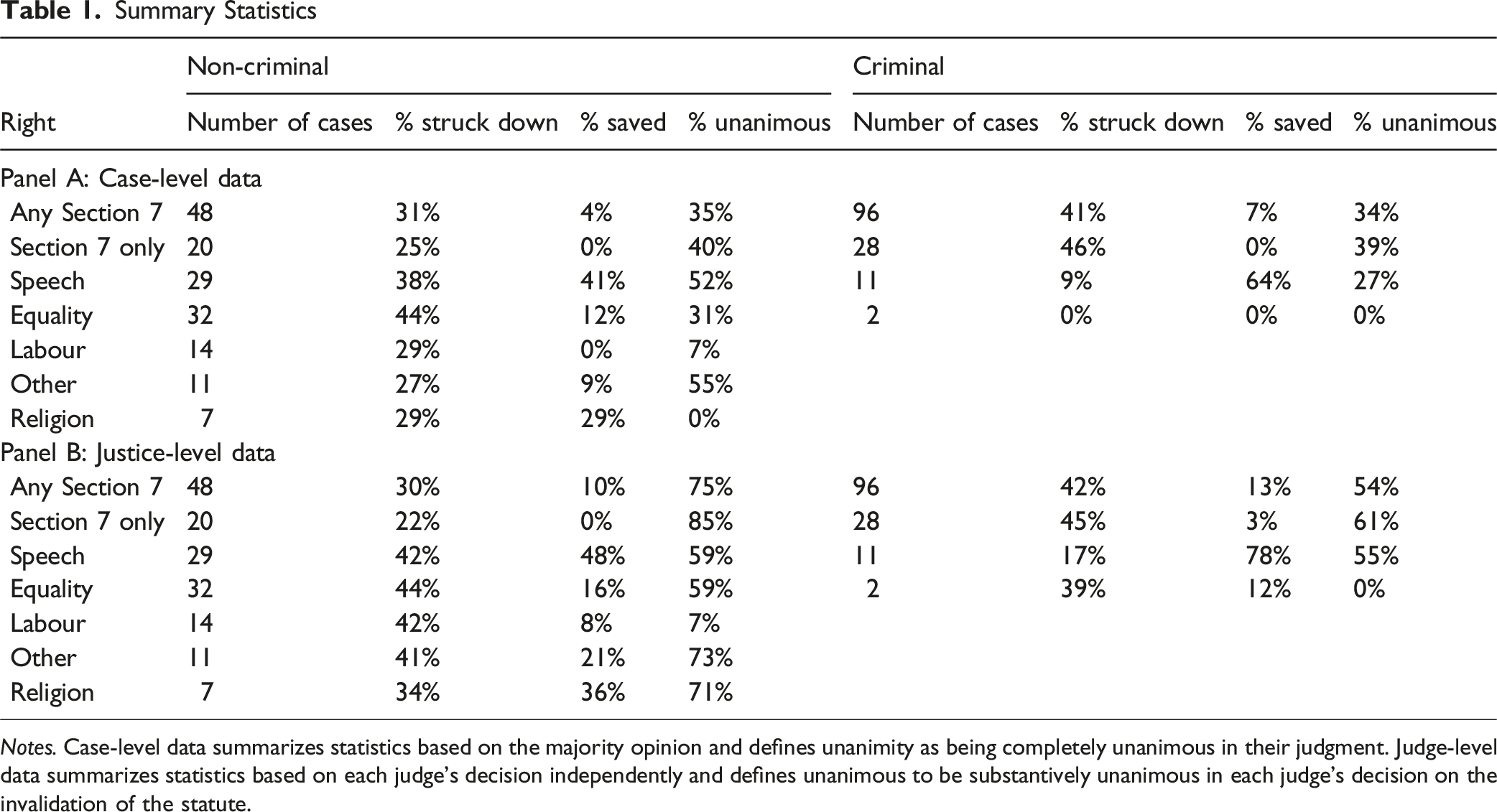
Notes. Case-level data summarizes statistics based on the majority opinion and defines unanimity as being completely unanimous in their judgment. Judge-level data summarizes statistics based on each judge’s decision independently and defines unanimous to be substantively unanimous in each judge’s decision on the invalidation of the statute.
6. Results
6.1. Trends in the Data
Using the justice-level dataset, I compute the average number of times a justice found a statute to be in violation of the Charter that could not be saved under Section 1 of the Charter. This is justice-level average violations plotted across time with a kernel-weighted local polynomial smoothing in Figure 1.
29
I see that as the Charter is introduced there is a high propensity to strike down a statute, but this decreases until 2000. However, after 2000, there is a steady increase in the percentage of statutes found in violation of the Charter under the McLachlin and Wagner Courts. However, the size of the judicial review of legislation Charter rights caseload at the apex court has declined since the inception of the Charter in 1982. Percentage of statutes struck down across time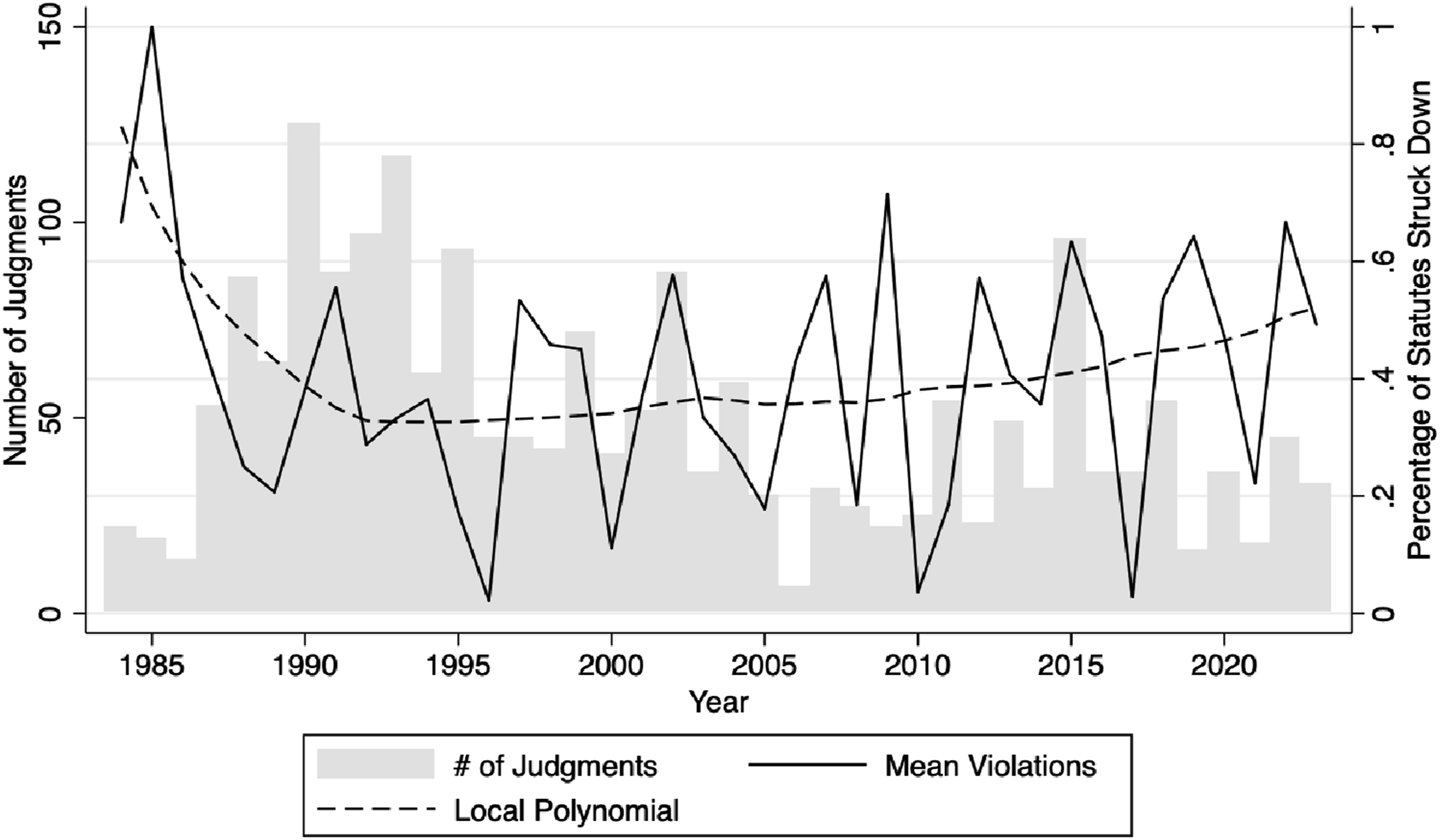
The rising difference in the deference shown to Parliament for penal versus non-penal statutes can be viewed several different ways. First, Figure 2 plots a kernel-weighted local polynomial smoothing of mean invalidation rate by penal and non-penal statutes.
30
Appendix B reports the same outcome using both a five-year moving average and decade fixed effects. Percentage of statutes struck down across time by criminal cases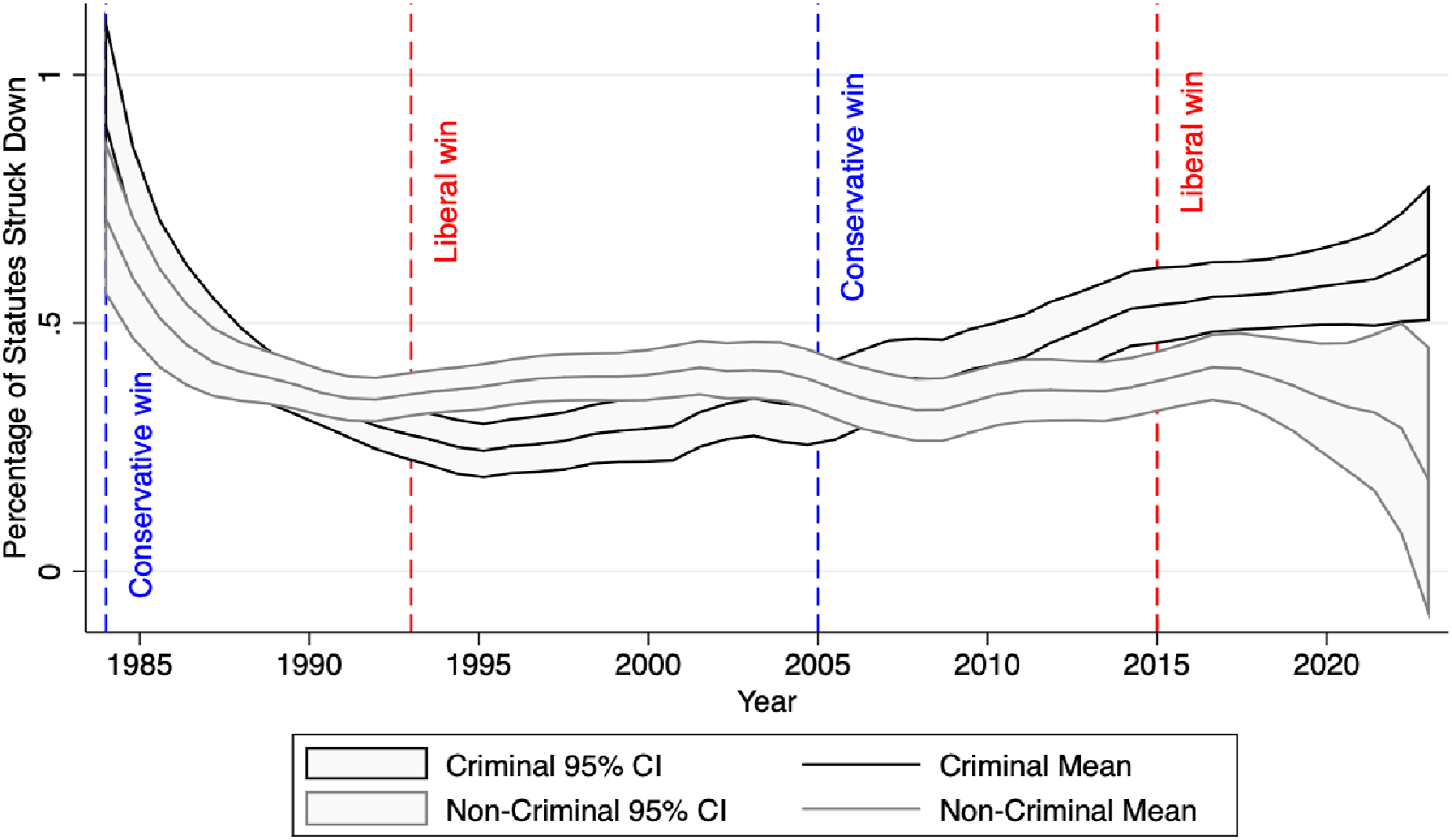
Deference is virtually constant in non-criminal cases. However, there has been an increased propensity of justices to find penal statutes in violation of the Charter. This post-2010 average difference is statistically significant (post-2010 reg. adj. diff. = 0.34, t-stat = 6.19, P < 0.001, N = 1988) after the inclusion of justice and year fixed effects. 31 In general, one would expect a priori the probability that a penal statute is unconstitutional is higher than for non-penal statutes, all else being equal, as less deference is given to Parliament under the constitutional balancing test in Oakes when the State is best characterized as ”singular antagonist” of the individual with respect their constitutional right. 32 This is entirely consistent with the Irwin Toy Hypothesis.
A second part of the so-called Irwin Toy Hypothesis would analyze the use of Section 1 of the Charter to save State actions which are found to violate the Charter. Figure 3 plots a kernel-weighted local polynomial smoothing of the percentage of violations saved conditional on finding a violation. Appendix B reports the same outcome using both a five-year moving average and decade fixed effects. Percentage of statutes saved across time by criminal cases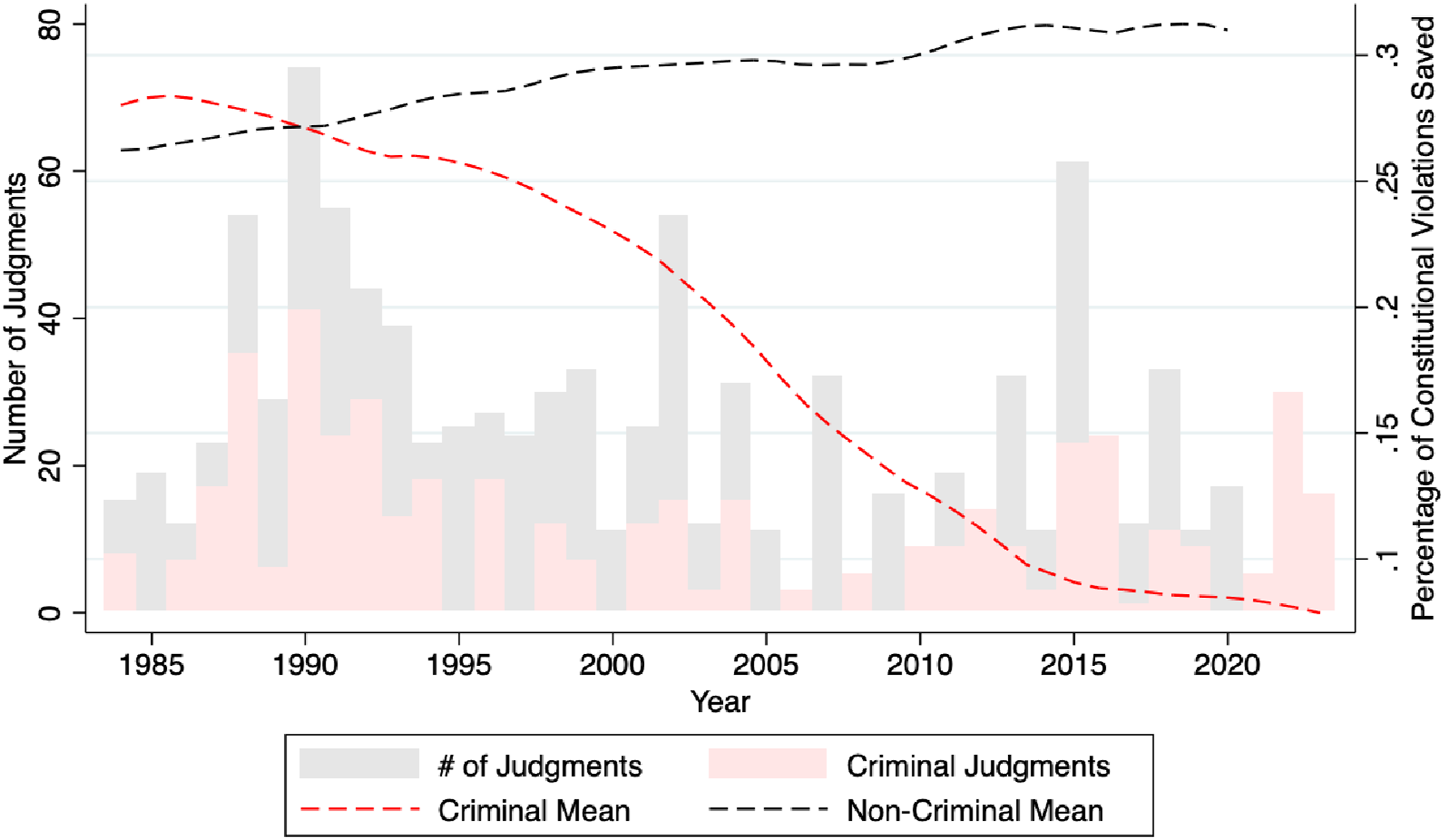
Since 1990-2000, the use of Section 1, the Charter’s saving provision, in the judicial review of penal statutes has fallen, meaning that the court has increasingly found that the State has failed to take the least intrusive means in achieving its objective. Section 1 saving rates are virtually constant for non-penal statutes in violation of the Charter. The decline in the use of Section 1 to save penal statutes is consistent with the Irwin Toy Hypothesis, in cases which “the courts can assess with a high degree of certainty whether the least intrusive means have been chosen to achieve the government’s objective.” 33 However, the decade fixed effects indicate that the use of Section 1 has declined for both criminal and non-criminal cases in the present decade at the time of writing.
Appendix C contains further analysis of trends broken down by right and statute. The fall in deference is concentrated among penal statutes and the right to equality, while the Court has shown more deference on speech cases. Looking within rights in the invalidation of penal statutes, I find that the fall in deference in penal statutes holds across various rights, including the right to life, liberty, and security of persons in Section 7, the presumption of innocence in Section 11(d), and cruel and unusual punishment in Section 12. Therefore, any internal limits contained in the the principles of fundamental justice in Section 7 or the language of ”unreasonable” searches and seizures or ”arbitrary” detention in Sections 8 and 9 cannot explain the rise of activism or fall in deference.
6.2. The Irwin Toy Hypothesis
I now formally test the Irwin Toy Hypothesis. 34 The two hypotheses that emerge from Irwin Toy are.
The Court will show less deference on Section 7 violations when the statute is penal.
The Court will show more deference on free expression violations when the statute is penal.
The Irwin Toy Hypothesis holds for most of the principles of fundamental justice enumerated in Sections 8 to 14 of the Charter which pertain to rights of the accused. A regression of the form
for justice j sitting on case c in year t where Section 7 is a dummy for a statute which is purported to infringe Section 7 in case c, recovers a significant and positive coefficient on the 1{section 7 c } × 1{Criminal c } interaction term both for all Section 7 rights 35 (δ = 0.36, t-stat = 6.48, P < 0.001, N = 1988) and Section 7 only (δ = 0.31, t-stat = 5.88, P < 0.001, N = 1988) relative to other rights. The results suggest that penal statutes which violate Section 7 right to life, liberty, and security of person are oft-fatal and hardly, if ever, saved, consistent with BC Motor Vehicle.
However, this relationship fails to hold in cases where a penal statute is being challenged under the right to freedom of expression. A regression of the form
Irwin Toy itself was about the right to freedom of expression and set out the two-stage test for freedom of expression that is still used in Canadian law today. To the extent that it suggested that the court take a ”broad, large and liberal, and purposive” approach to the interpretation of Section 2(b), then Irwin Toy has been followed. The court is around 35% more likely (reg. adj. diff. = 0.37, t-stat = 13.92, P < 0.001, N = 1988) to find a Section 2(b) infringement relative to other cases. However, it is equally as likely (reg. adj. diff. = 0.31, t-stat = 9.23, P < 0.001, N = 1019) to save the statute under Section 1 of the Charter. This is especially so when the statute is criminal (reg. adj. diff. = 0.46, t-stat = 6.58, P < 0.001, N = 448) which can be taken to be prima facie evidence of allowing prohibitions on harmful speech (Scanlon, 1977, p. 161). The Court appears to be following Irwin Toy’s approach to freedom of expression with respect to its general jurisprudence: a broadly defined right with rightly justified infringements.
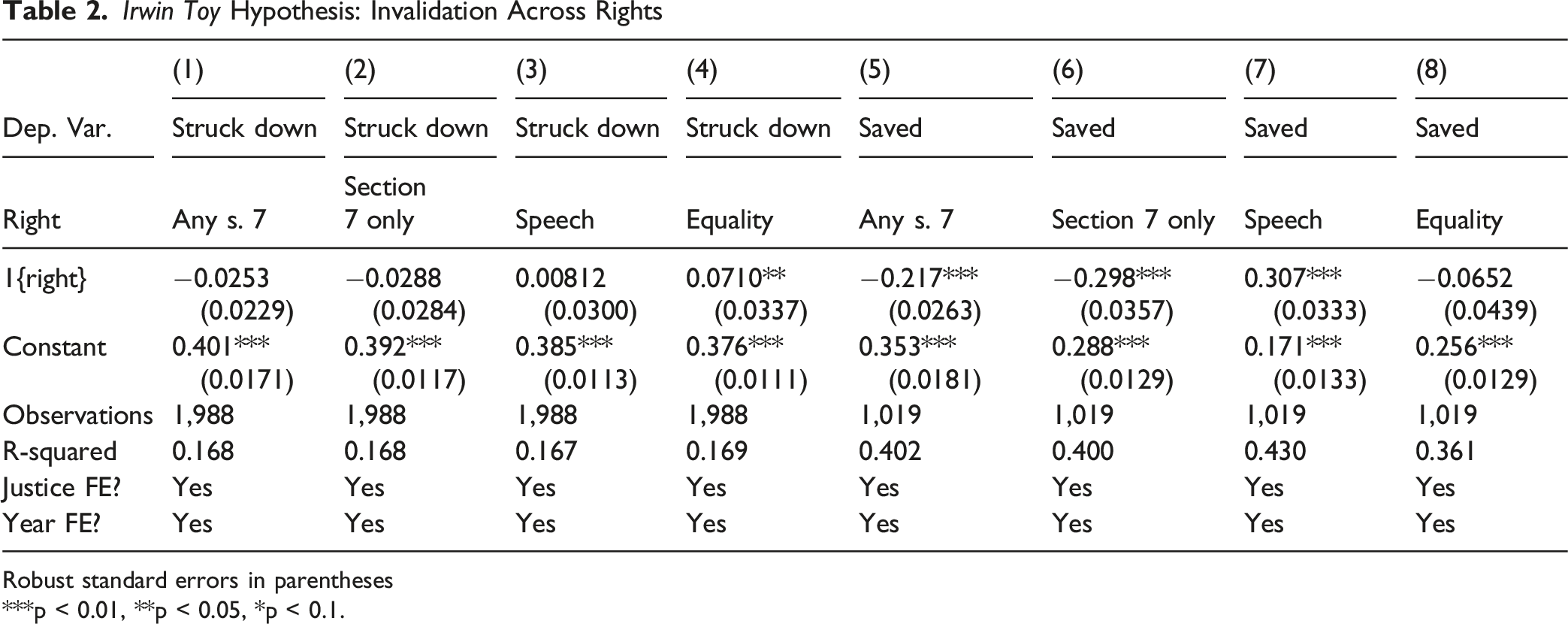
Irwin Toy Hypothesis: Invalidation Across Rights
Robust standard errors in parentheses
***p < 0.01, **p < 0.05, *p < 0.1.
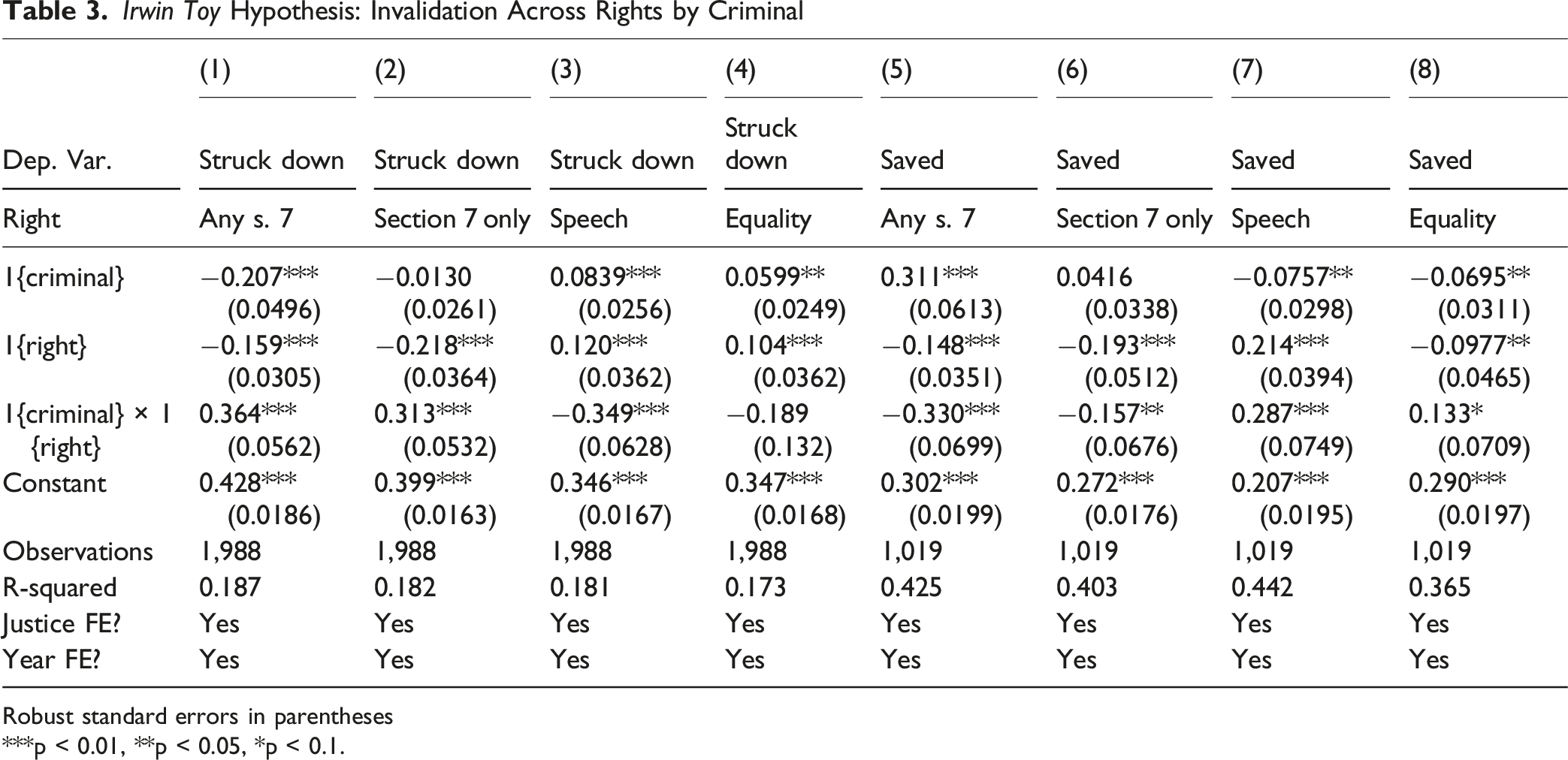
Irwin Toy Hypothesis: Invalidation Across Rights by Criminal
Robust standard errors in parentheses
***p < 0.01, **p < 0.05, *p < 0.1.
Columns 1 to 4 of Table 2 regresses a dummy of whether the statute was struck down on a dummy for any individual right (e.g., Sections 7, 2(b), 15). No particular right is more likely to invalidate legislation than any other right except for equality. Columns 5 to 8 of Table 2 regresses a dummy of whether the statute was saved on a dummy for any individual right. Statutes which violate Section 7 of the Charter are no more or less likely to be struck down, but significantly less likely to be saved upon finding a violation of the right not in accordance with the principles of fundamental justice, per BC Motor Vehicle. Section 1 of the Charter is the locus of activism, as predicted by Irwin Toy which prescribes a stricter Oakes test when the State is the ”singular antagonist”, as in the case of Section 7 cases. The court is somewhat less likely to save a statute in violation of the right to equality. However, the pattern reverses for the right to freedom of expression. Rather, the Court is more likely to save a statute in violation of the right to freedom of expression relative to other rights. This is entirely consistent with the Irwin Toy Hypothesis, but also other hypotheses, such as Section 7’s unique constitutional architecture.
Columns 1 to 4 of Table 3 regresses a dummy of whether the statute was struck down on a dummy for any individual right interacted with a dummy for whether or not the statute at issue was a criminal statute. Columns 5 to 8 of Table 3 regresses a dummy of whether the statute was saved on any individual right interacted with a dummy for whether or not the statute at issue was a criminal statute. Penal statutes that violate Section 7 of the Charter are more likely to be struck down and less likely to be saved, as predicted by Irwin Toy. No such pattern exists for the rights to freedom of expression or equality. Rather, the Court is less likely to strike down and more likely to save a penal statute in violation of the right to freedom of expression relative to other speech cases. This comports with one’s priors upon reading the jurisprudence which employs the broad test from Irwin Toy for a Section 2(b) infringement of freedom of expression and upholds restrictions on harmful speech. Thus, the Irwin Toy Hypothesis offers a more consistent interpretation for explaining the difference in judicial behaviour towards penal statutes than simpler ”penal populism” explanations.
7. Judicial Behaviour
Armed with new justice-level data, I am able to explore differences in judicial behaviour across justice attributes such as politics and sex. 37 This allows me to test for differences in judicial behaviour across different rights which may be ideologically contested in contrast with those that are less contested. These differences, or lack thereof, point towards an attitudinal model and confirm hypotheses which have emerged from the new legal realism.
7.1. Judicial Politics
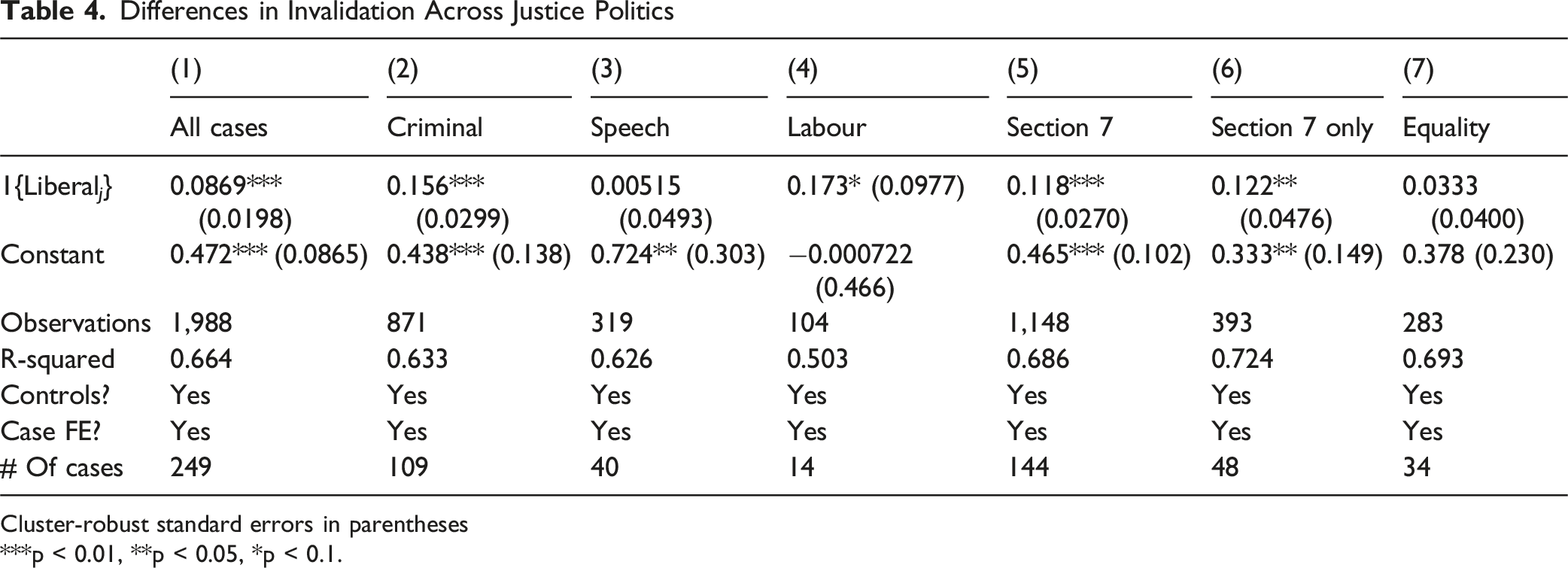
I can use data on the justice’s appointing political party using the year they were appointed to examine how a justice’s level of deference varies by political affiliation. In a regression of the form

Differences in Invalidation Across Justice Politics
Cluster-robust standard errors in parentheses
***p < 0.01, **p < 0.05, *p < 0.1.
In a regression of the form
The differences across justice politics in the invalidation of penal statutes is perhaps the most robustly supported in the data. The difference in justice politics across criminal and non-criminal cases is seen below in Figure 4. Liberal- and Conservative-appointees do not differ in their invalidation of non-penal statutes, on average, but differ greatly in the invalidation of penal statutes. This difference in the invalidation of penal statutes explains virtually all of the differences across justice politics, with the sole exception of labour rights. See Table 14 in Appendix F. Percentage of statutes struck down across justice politics and criminal cases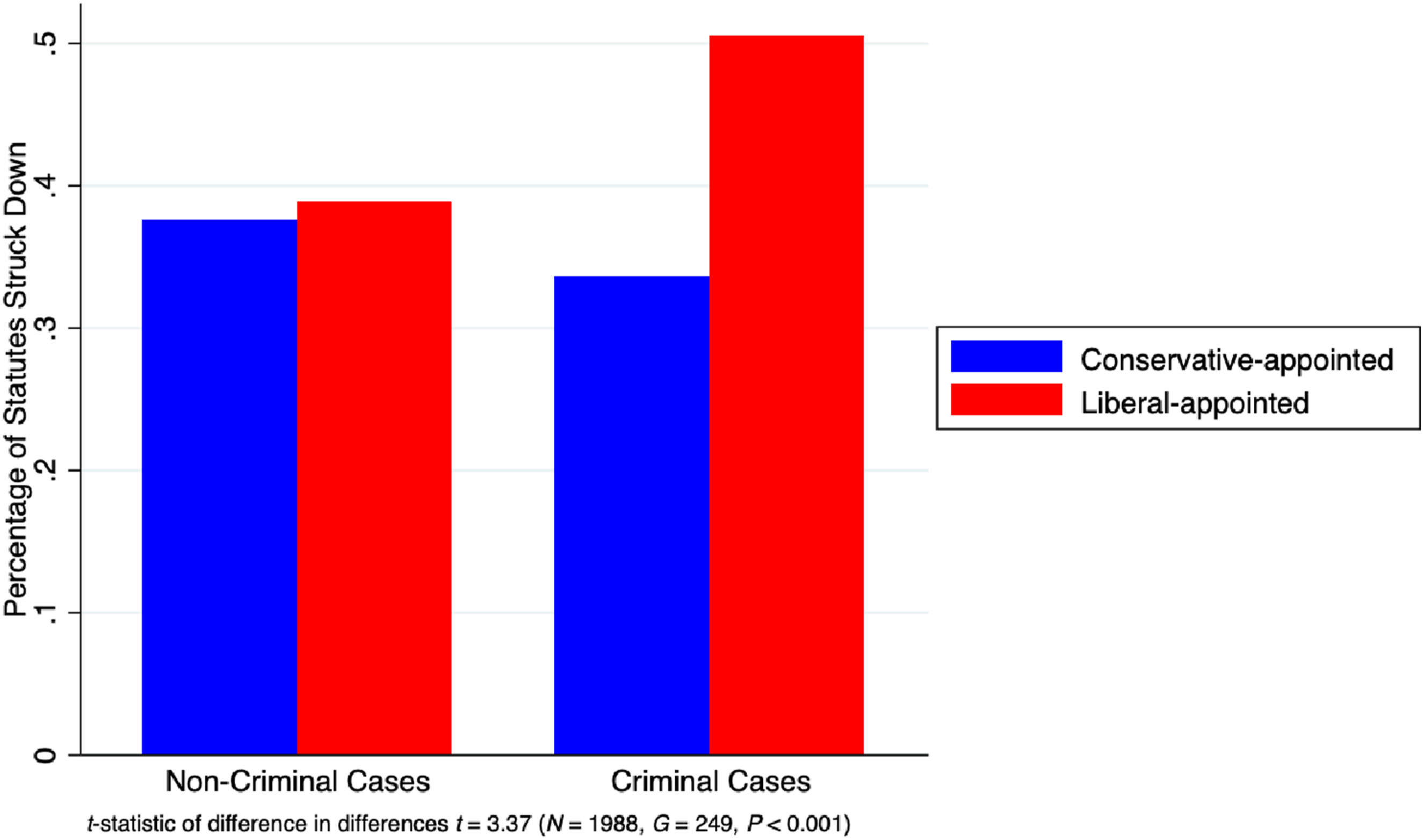
Rather than outright differences in judicial politics in all or perhaps the most obvious dimensions, the data appear to support a sort of Liberal-appointed penal and economic theory that is distinct from the approach taken by Conservative appointees, which does not show up in their approaches to equality or speech cases, areas where one may have anticipated a strong difference. An obvious rejoinder is that perhaps Liberal and Conservative appointees prefer to invoke the right to free expression to protect certain types of speech and not others. I leave this as a question for future research.
7.2. Justice Sex
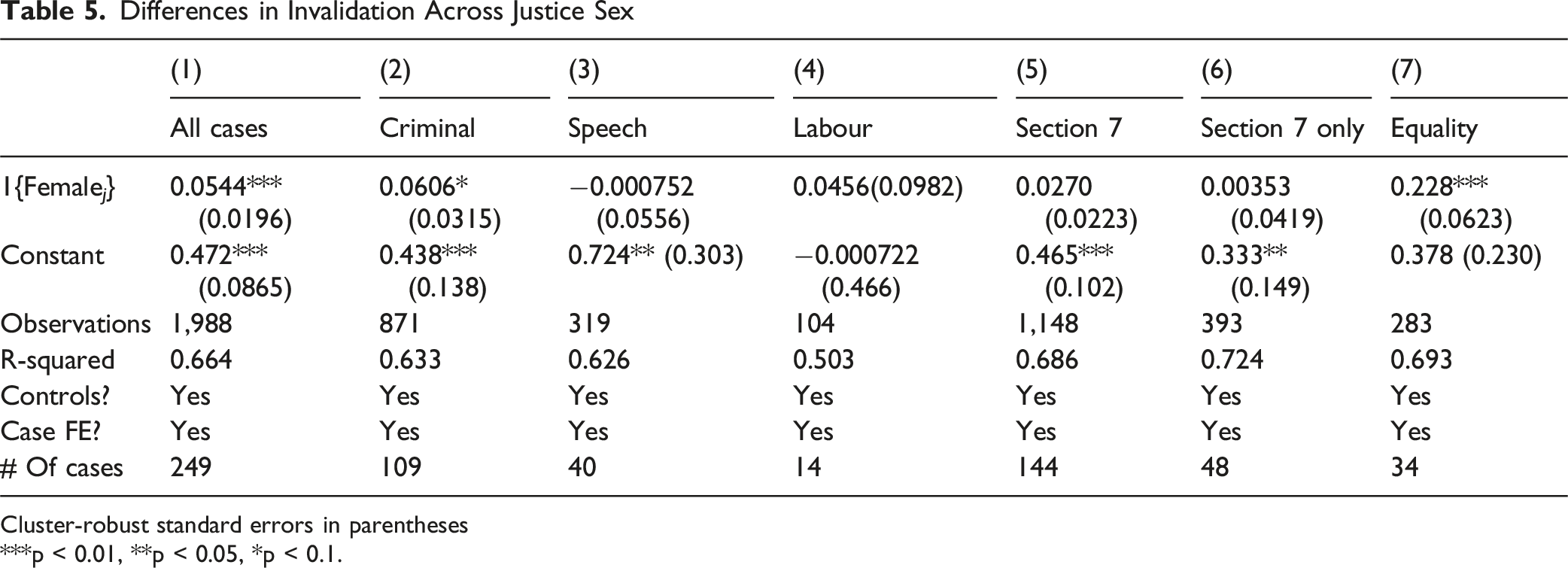
Further, one can analyze sex differences in judicial behaviour. In a regression of the form

I find that this difference is substantially larger when the Charter right being upheld is the right to equality conferred in section 15 (β = 0.03, t-stat = 1.38, γ = 0.19, t-stat = 3.51, P < 0.001, N = 1988, G = 249) even upon the inclusion of case fixed effects. Case fixed effects control for any case-level factors specific to the individual matter before the court by de-meaning the score by the average of the split. The controls include justice characteristics, such as age, tenure, appointing party, and region. The results are plotted below in Figure 5. The difference in judicial behaviour across sex is virtually entirely driven by this difference in behaviour on the right to equality. There are no sex differences in the striking down of penal statutes in the Criminal Code, free expression rights in section 2(b), labour rights in section 2(d), cases in which only Section 7 is considered, or rights of the accused conferred in Sections 7 to 12. Percentage of statutes struck down across justice sex and equality rights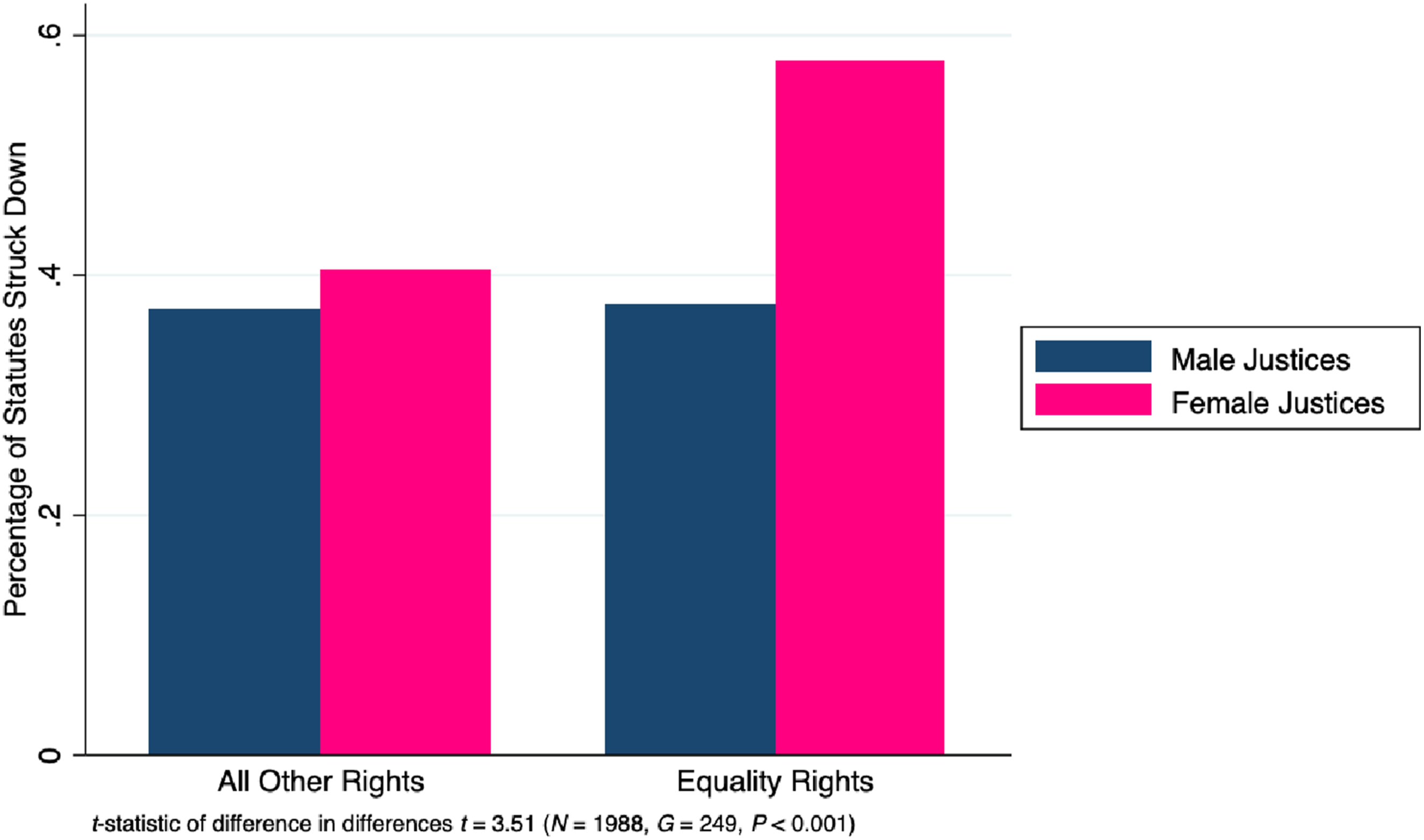
The difference in the treatment of equality or sex discrimination cases across justice sex has been documented before (Boyd, 2016; Boyd et al., 2010), and even in the Canadian context at the Supreme Court of Canada (Johnson & Masood, 2023). However, this paper is the first to look across all rights to find that equality is the only domain in which male and female justices differ. The significance (and insignificance) of the results comport with what a legal realist might predict and confirm with new data the attitudinal model of judging at the Supreme Court of Canada by looking across both equality rights and ”less ideologically contested domains” (Miles & Sunstein, 2008, p. 837).
Differences in Invalidation Across Justice Sex
Cluster-robust standard errors in parentheses
***p < 0.01, **p < 0.05, *p < 0.1.
Legal realism, legal philosophy, judicial biography – something must explain the large, statistically significant, and persistent difference in the way male and female justices adjudicate equality rights. It appears that male and female justices behave such that they treat the constitutional right to equality in two different ways, almost entirely in the determination of whether or not a statute violates the right to equality and not as much in the determination of whether such a violation is justified in a free and democratic society. This is consistent with the attitudinal model, which suggests that justices’ decisions are influenced by their personal values and ideological orientations – here, potentially reflecting a greater sensitivity among female justices to issues of gender equality and discrimination. The results also comport with another interpretation which is defined by the term ”new legal realism” where justice attributes do contribute to judicial decision-making in predictable ways and less so in cases where one would not expect such differences to matter, such as with respect to other rights.
7.3. Concurrence and Dissent
The share of cases in which a justice is in the majority but writes on a concurring opinion can serve as a crude measure of judicial minimalism. In the data, I find that, conditional on justice and year fixed effects, justices are less likely to write a concurring opinion when the statute is being struck down. That is, the slope β of the regression equation for case c by justice j in year t
Figure 6 plots the percentage of cases in which the court is either purely unanimous where the Court writes a single opinion, is substantively unanimous in their judgment on the validity of the statute, is split into a plurality of more than one opinion in the majority, or has at least one member of court dissent. The Court was highly unanimous at the time that the Charter was introduced, though, unanimity has fallen as of late and dissents have become more common. One possible explanation for the fall in unanimity is the increasing number of female justices on the court, as female justices are more likely to dissent (reg. adj. diff. = 0.06, t-stat = 2.77, P = .006, N = 1988, G = 249) and concur (reg. adj. diff. = 0.06, t-stat = 3.19, P = .002, N = 1988, G = 249) controlling for case fixed effects and justice characteristics, such as age, tenure, appointing party, and region. Unanimity, plurality, and dissent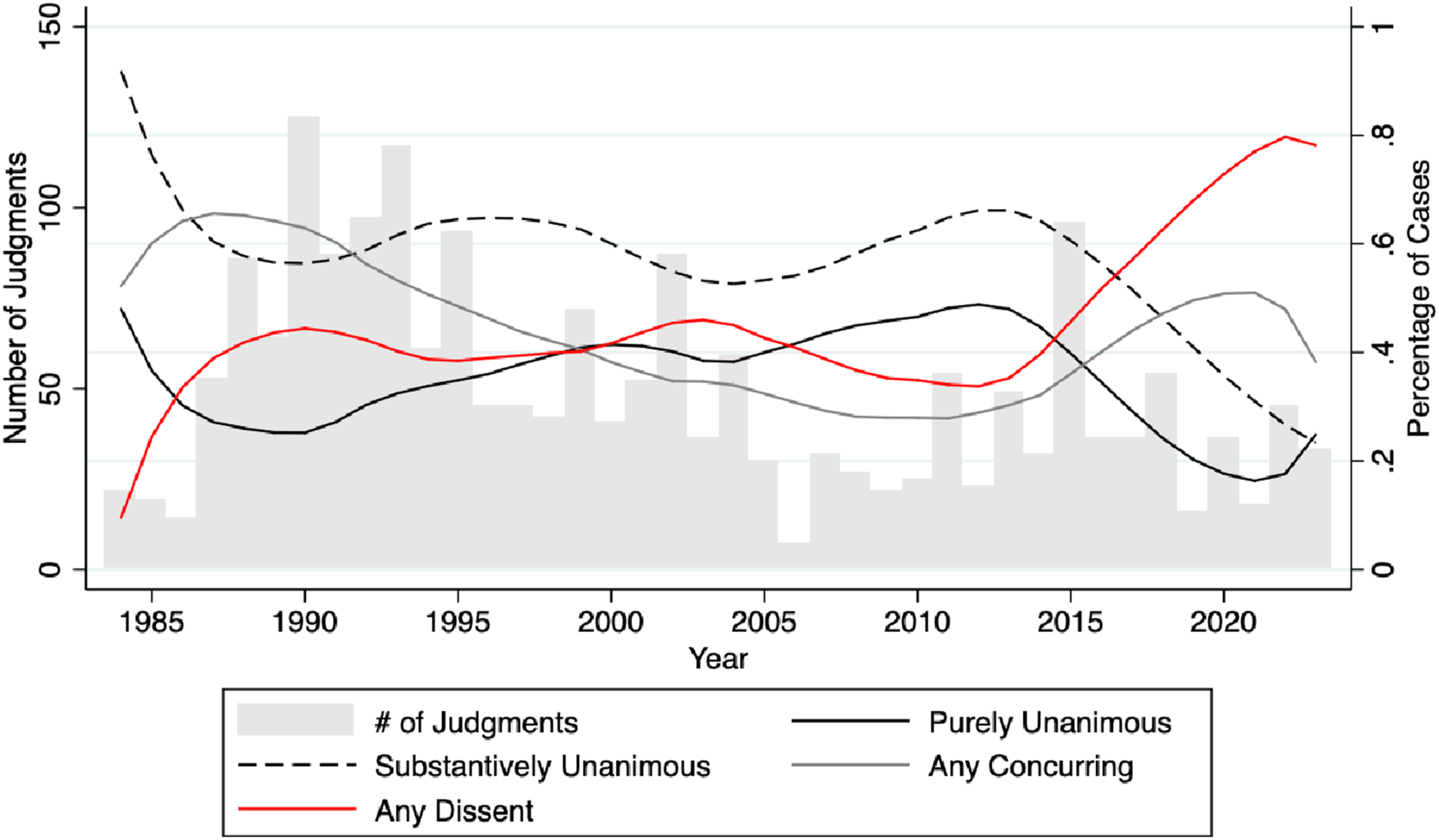
8. Conclusion
I perform analysis on a novel dataset of the universe of Supreme Court of Canada cases involving the judicial review of legislation. I find that deference to Parliament has fallen steadily in the last twenty years, but especially in cases involving penal statutes. The recent fall in judicial deference can largely be attributed to certain Liberal appointees striking down more penal statutes due to both construing criminal rights more broadly and, as predicted by Irwin Toy, finding that the least intrusive means have not been taken. With regard to other rights, such as free expression, free association, but not equality, the apex court has shown more deference.
The Irwin Toy Hypothesis has been borne out. I find that the Court shows less deference in judicially reviewing penal statutes which infringe Section 7 right to life, liberty, and security of person and its associated rights in Sections 8 to 12 of the Charter which uphold the constitutional rights of the accused. This lack of deference is concentrated among Section 1 analysis, the Charter’s saving provision. However, Irwin Toy established a much different tradition for the s. 2(b) right to freedom of expression, where the Court construes the definition of the free speech right broadly and is more likely to find that the statute is a justified infringement.
This paper advances the study of the science of judicial activism and shows how new data can be used to generate insights in judicial behaviour which I hope other researchers in law and political science will find useful. Justices vary widely in how they evaluate the constitutionality of different rights and types of statutes. In particular, I find that female justices are much more likely to strike down statutes which infringe upon the right to equality and Conservative-appointed justices are much less likely to strike down states which infringe upon the labour right to freedom of association and penal statutes in criminal cases. This is consistent with what a legal realist might predict.
Irwin Toy lays out a very clear command. I call it a hypothesis because it is not unambiguously true. The hypothesis has been borne out since the time it was conjectured. I suppose one could conclude that Canada does have de facto tiered judicial review. Taken together, the results also have implications for legal theorists interested in naturalized jurisprudence. Legal formalism, legal realism, law-as-politics, interpretivist post-realist legal process – all of these popular theories in legal philosophy attract some support in the data. I suppose one could also conclude that each of these camps are correct in asserting that their theory is predictive and wrong in insisting that their theory alone is complete.
Supplemental Material
Supplemental Material - Two Tiers of Judicial Review? An Empirical Analysis of the Supreme Court of Canada
Supplemental Material for Two Tiers of Judicial Review? An Empirical Analysis of the Supreme Court of Canada by Dylan R. Clarke in Journal of Law & Empirical Analysis.
Footnotes

Funding
The authors received no financial support for the research, authorship, and/or publication of this article.
Declaration of Conflicting Interests
The authors declared no potential conflicts of interest with respect to the research, authorship, and/or publication of this article.
Supplemental Material
Supplemental Material for this article is available online.
Notes
References
Supplementary Material
Please find the following supplemental material available below.
For Open Access articles published under a Creative Commons License, all supplemental material carries the same license as the article it is associated with.
For non-Open Access articles published, all supplemental material carries a non-exclusive license, and permission requests for re-use of supplemental material or any part of supplemental material shall be sent directly to the copyright owner as specified in the copyright notice associated with the article.
