







Abstract
Objectives:
Type 2 diabetes (T2D) is a chronic, low-grade inflammatory condition affecting around 537 million people worldwide. Conventional diabetes management strategies are unable to prevent diabetes-related complications, and as a result, current guidelines prioritize achieving T2D remission as the primary clinical objective rather than simply managing the condition.
Methods:
“Decoding Diabetes” is a customized online program designed to promote diabetes remission through yoga-based lifestyle interventions. The program includes yoga practices such as asanas, pranayama, meditation, yogic diet (a plant-based vegetarian diet), and weekly lectures on diabetes, benefits of yoga, importance of lifestyle changes, and ways to enhance physical activity. Participants were also given weekly tasks based on the lifestyle modifications with regular follow-up for the duration of the 3-month program. Before enrolment, the patient’s height, weight, body mass index, fasting blood sugar (FBS), postprandial blood sugar (PPBS), and glycated hemoglobin A1c (HbA1c) were measured. All parameters were assessed at the end of the third month, and HbA1c was reassessed at the end of the sixth month.
Results:
All three participants showed improvements in anthropometric and glycemic outcomes after 3 months. The mean body weight reduced by 3.2 kg. FBS decreased from 130, 138, and 284 mg/dL to 96, 83, and 84 mg/dL, respectively. PPBS decreased from 268, 298, and 390 mg/dL to 167, 154, and 120 mg/dL, respectively. HbA1c reduced from 7.8%, 8.1%, and 9.43% to 5.6%, 5.9%, and 6.21%, respectively. At 6-month follow-up, HbA1c remained below or near remission thresholds (5.7%, 5.9%, and 6.01%) without antidiabetic medication.
Conclusions:
This case series highlights the therapeutic potential of online yoga-based lifestyle intervention in T2D remission. Further clinical trials with a larger sample size are required to validate our findings.
Keywords
Introduction
Type 2 diabetes (T2D) is a chronic low-grade inflammatory condition characterized by elevated blood sugar levels, associated with insufficient insulin production or utilization. 1 An estimated 537 million individuals suffer from T2D. 2 Since the current conventional pharmacological management cannot halt the beta cell dysfunction and prevention of diabetes-related complications, there is a pressing need for effective T2D remission strategies. 3 Current recommendations and consensus on T2D highlight the importance of aiming for T2D remission as the primary clinical goal, rather than focusing merely on the management. 4 T2D remission is characterized by maintaining glycated hemoglobin (HbA1c) levels below <6.5% over a continuous period of 3 months without antidiabetic medication. 5 Structured lifestyle modifications, including dietary modifications, improved physical activity, and weight reduction, are widely accepted and reported to be beneficial in T2D across the world.6–8 Yoga is an ancient mind–body technique and is more than just a physical activity. 9 Yoga is often emphasized as a way of life, but scientific evidence exploring its potential in this holistic role remains limited. Therefore, we developed a structured online yoga-based lifestyle intervention incorporating the practical principles of Ashtanga Yoga and report its potential role in supporting T2D remission in this case series.
Patient information
Intervention details
A holistic yoga-based lifestyle program for a diabetes remission program, called the Decoding Diabetes Program was designed and delivered in the virtual mode for a duration of 12 weeks (Supplementary Table S1). Patients were given weekly tasks and goals such as post-meal walking, self-affirmation, improving physical activity, gratitude practices, and intake of fiber-rich prebiotic and probiotic natural foods. Each patient was assigned separate mentors to enable regular everyday monitoring. All mentors were qualified yoga and naturopathy doctors. The yoga lectures helped patients improve their intellectual aspects (Vijnanamaya Kosha), adopt healthy lifestyle changes, and stay motivated to achieve their goals. Among the eight limbs of ashtanga yoga, the yama, niyama, pratyahara (withdrawal of mind from the object of senses) and dharana (concentration) were given special emphasis during the lectures. A lecture also gives importance to making patients understand how a particular practice helps them in T2D remission. Regular yoga practices along with yogic dietary (a plant-based vegetarian diet) modification were provided. Weekly lectures regarding the yogic yama and niyama principles, mindfulness, santhosha (gratitude), and diabetes education were provided. All the patients practiced yoga for 1 hour thrice a week and also encouraged to practice on all days of the week. Yoga practices included joint exercises, asana, pranayama, meditation, mudra, and yoga nidra (with resolutions/affirmations). Patients were asked to consume one raw sattvic meal that included uncooked vegetables or fruits for either breakfast or dinner.
Outcome assessment
Before enrollment, the patient’s height, weight, BMI, FBS, PPBS, and HbA1c were measured. All parameters were assessed at the end of the third month, and HbA1c was reassessed at the end of the sixth month. FBS and PPBS were also monitored on week 2 and week 4 in order to understand the trend in their blood glucose levels.
Results
All three cases showed significant improvements in anthropometric and glycemic parameters after the 3-month intervention. Body weight reduced in Case 1 (from 82 to 77.5 kg, −4.5 kg, 5.49%), Case 2 (from 62 to 60 kg, −2 kg, 3.23%), and Case 3 (from 55 to 52 kg, −3 kg, 5.45%). Correspondingly, BMI decreased in all three participants. Fasting blood glucose reduced from 130 to 96 mg/dL (−26.15%), 138 to 83 mg/dL (−39.86%), and 284 to 84 mg/dL (−70.42%) in Cases 1, 2, and 3, respectively. Postprandial glucose also declined substantially from 268 to 167 mg/dL (−37.69%), 298 to 154 mg/dL (−48.32%), and 390 to 120 mg/dL (−69.23%). HbA1c decreased from 7.8% to 5.6% (−2.2%), 8.1% to 5.9% (−2.2%), and 9.43% to 6.21% (−3.22%) across the three cases. At the end of 2 weeks, blood glucose levels of the patients were monitored, as there were signs of hypoglycemia. And the antidiabetic medications of all three patients were stopped after due consultation with their respective endocrinologists. The patients remained without any antidiabetes medications until the end of the 6-month follow-up. At the 6-month follow-up, HbA1c levels remained stable at 5.7%, 5.9%, and 6.01%, respectively. In addition to this, none of the patients had reported any adverse events during the intervention, except the signs of hypoglycemia in week 2. Further, Case 1 reported being able to carry out day-to-day activities without getting tired. Case 3 has reported that the burning sensation in the leg was reduced completely. The results of the intervention are shown in Table 1.
Patient Outcomes Before and After 3-Month Yoga-Based Lifestyle Intervention
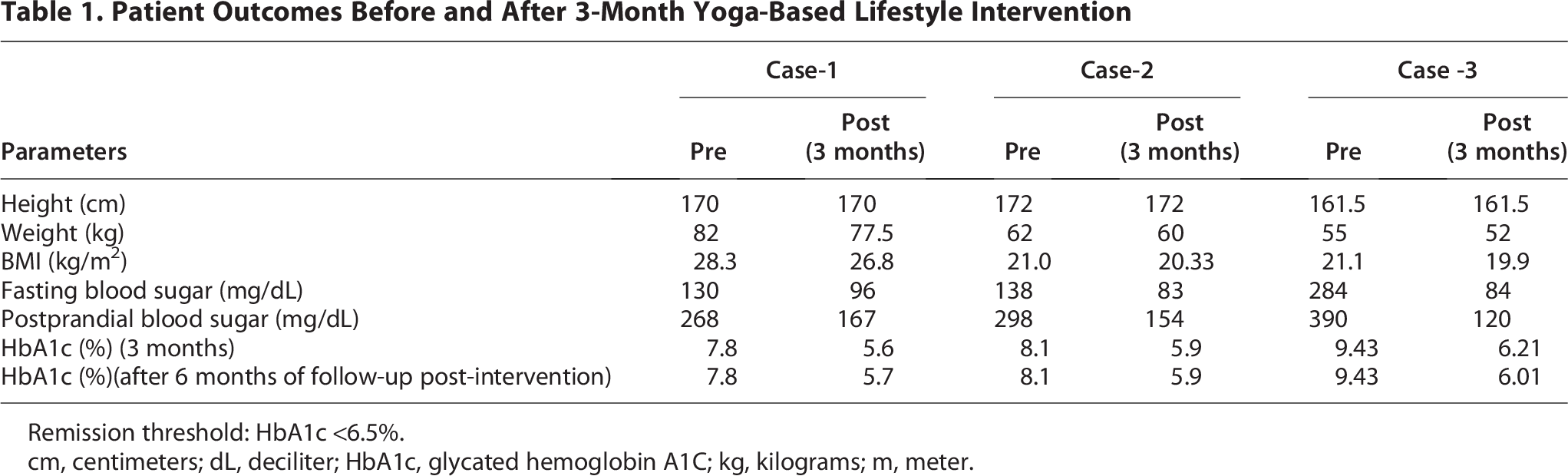
Remission threshold: HbA1c <6.5%.
cm, centimeters; dL, deciliter; HbA1c, glycated hemoglobin A1C; kg, kilograms; m, meter.
Discussion
To the best of our knowledge, this is among the first reports documenting scientific evidence on the effects of an “Online yoga-based lifestyle intervention” in T2D remission. While most previous studies mentioned the combination of interventions such as asanas, pranayama, and meditation as a “yoga-based lifestyle” intervention, we, however, had focused on inculcating the panchakosha concept, the ashtanga yoga components, and the yogic diet components together and making it a more holistic way of life. 10
The beneficial effects of yoga could be attributed to autonomic balance, which could possibly have a positive impact on the pancreas through the cholinergic pathways and also reduce the underlying systemic inflammation.11,12 In addition, the beneficial effects of yoga in reducing oxidative stress and thus reducing inflammation are also well documented in T2D patients. Promoting psychological practices like positive affirmation alleviates stress, leading to good resilience to healthy lifestyle practices, and also helps in achieving good glycemic control. 13 A Yogic diet or plant-based vegetarian diet has a greater influence on the emotional and physical well-being of an individual via the short-chain fatty acids secreted by the positive gut microbiomes. Plant-based diets are a good source of fiber, which acts as a prebiotic and also has a direct impact on maintaining long-term blood glucose levels (HbA1c). 14 The isometric contractions involved during the practice of asanas help in glucose utilization and redistribution of fat. 15 The practice of pranayama brings about parasympathetic dominance and improves baroreceptor sensitivity along with good stress tolerance. 16 Similarly, the practice of mindful eating is believed to have possible improvement in the cephalic phase insulin release via sight, smell, and touch of food. T2D remission was sustained in the 6-month follow-up in all the patients (Table 1), and the patients mentioned that the yoga-based lifestyle is very practical and simple to follow, with a very positive impact on their quality of life. A holistic yoga-based lifestyle modification could be beneficial in inducing T2D remission. However, adequately sampled randomized controlled trials are required to substantiate and validate our observation.
Conclusions
This case series highlights the therapeutic potential of a holistic yoga-based lifestyle intervention in T2D remission. Further trials with a larger sample size are required to confirm our findings.
Ethics Approval and Consent to Participate
Formal ethics approval was waived by the Institutional Ethics Committee as this study was a retrospective case series based on routinely delivered clinical practice and involved analysis of de-identified patient data without any additional research-related intervention. Written informed consent for publication was obtained from all participants.
Authors’ Contributions
V.V.: Conceptualization, methodology, investigation, data curation, and writing—original draft. P.R.: Methodology, formal analysis, visualization, and writing—review and editing. D.B.: Supervision, validation, writing—review and editing, and project administration. M.K.: Conceptualization, resources, supervision, and writing—review and editing.
Footnotes
Availability of Data and Materials
The data will be provided upon reasonable request to the corresponding author (M.K.) and the first author (V.V.).
Author Disclosure Statement
The authors declared that they have no conflicts of interest.
Funding Information
No funding was received for this article.
Supplemental Material
Abbreviations
References
Supplementary Material
Please find the following supplemental material available below.
For Open Access articles published under a Creative Commons License, all supplemental material carries the same license as the article it is associated with.
For non-Open Access articles published, all supplemental material carries a non-exclusive license, and permission requests for re-use of supplemental material or any part of supplemental material shall be sent directly to the copyright owner as specified in the copyright notice associated with the article.
