






Abstract
Background:
Suicide is a significant public health concern in the U.S. that has been rising steadily over the last 2 decades. Addressing substance use as a form of suicide prevention may help counteract the rising suicide rate, as alcohol and opioids are found in 22% and 20% of individuals who died by suicide, respectively. The Substance Abuse and Mental Health Services Administration envisions crisis response as addressing both substance use and suicide, including through the 988 Suicide and Crisis Lifeline. Unfortunately, few report they would contact 988 if they were experiencing a substance use issue. We sought to explore reasons for, barriers to, and likelihood of contacting 988 for substance use and inform future efforts to increase utilization.
Methods:
A survey of 1090 U.S. adults was conducted November 6 to 10, 2025 via the AmeriSpeak Omnibus, a nationally representative bi-monthly multi-client survey using the AmeriSpeak Panel.
Results:
Only 18% of respondents reported they would contact 988 if they were experiencing substance use issues. No cost (41%), immediate support while on a wait list for treatment (32%), and avoiding stigma (32%) were the most commonly reported motivators for contacting 988 for substance use support. Being advertised as a suicide and crisis lifeline (22%), lack of follow-up (14%), and lack of training among counselors (13%) were reported as barriers. Familiarity with 988 was associated with likelihood of contacting 988 for substance use support for at least 1 listed reason (81% of those extremely/very familiar vs 51% not very/not at all familiar). Responses varied by education, gender, race/ethnicity, and age.
Conclusion:
Findings identified factors that influence the public’s likelihood of contacting 988 for substance use support and suggest a need for standardized substance use intervention protocols and targeted messaging tailored to specific audiences.
Highlights
Only 18% of respondents would contact 988 for substance use support
Immediate support and avoiding stigma were reasons to contact 988 for substance use
Crisis advertising and lack of counselor training and follow-up were deterrents
Familiarity was associated with likelihood of using 988 for substance use support
Introduction
Suicide is a significant public health concern in the U.S. that has been rising steadily over the last 2 decades. The age-adjusted suicide rate rose 31.8% between 2001 and 2023, reaching an all-time high of 14.3/100 000 in 2022 and dropping only slightly in 2023. 1 An even greater number of adults have considered or attempted suicide, including 12.8 million who seriously thought about suicide, 3.7 million who made a plan, and 1.5 million who attempted suicide in 2023. 1
To address this increasing risk, the Centers for Disease Control and Prevention recommends a comprehensive approach to suicide prevention, including addressing substance use, 2 the second most common risk factor for suicide. 3 Addressing substance use as a form of suicide prevention is important, as alcohol and opioids are found in 22% and 20% of individuals who died by suicide, respectively, 4 and substance use and suicide share several risk factors (eg, hopelessness, depression, impulsivity, and a history of trauma). 5 In addition, alcohol use is closely related to both opioid overdose and suicide via its effects on mood, inhibition, aggressiveness, and coping. 4 Unfortunately, though critically important, efforts to jointly address substance use and suicide are rare. 6
The Substance Abuse and Mental Health Services Administration’s (SAMHSA) National Guidelines for a Behavioral Health Coordinated System of Crisis Care envisions crisis response for both mental health and substance use. 7 Recent efforts to bolster the crisis care system have focused on expanding the 988 Suicide and Crisis Lifeline, or 988. Launched in 2022, 988 provides immediate, accessible support 24/7, free-of-charge for various causes of emotional distress, including suicidal ideation, mental health crises, and substance use, serving as an entryway to the crisis care system. 7 Evaluations have found 988 to be effective in preventing suicide attempts. 8 Unfortunately, 3.5 years after its launch, awareness remains low; a recent survey found that only 10% of the general public were very or extremely familiar with 988. 9 When prompted, 46% would contact 988 for thoughts of suicide, while only 20% would do so if they were experiencing substance use issues. 10 Clearly, more research is needed to better understand what deters people from contacting 988 for substance use before new approaches to increase utilization can be designed.
Though several surveys have focused on general utilization of 988, there is no research on 988 for substance use beyond intentions to use it, and, unfortunately, even these basic questions have been removed from recent surveys. To fill this gap, we conducted the first national public opinion survey to explore reasons for, barriers to, and likelihood of contacting 988 for substance use, which may help inform efforts to increase utilization. In this article, we present novel findings along with recommendations for marketing, promotion, and implementation.
Methods
Data Collection
Data were collected using AmeriSpeak, our probability-based, nationally representative survey panel. Our panel is comprised of randomly selected U.S. households sampled with a known, non-zero probability from the AmeriSpeak National Sample Frame and contacted by U.S. mail, email, and telephone. After providing informed consent and completing an introductory survey, panelists are invited to participate in surveys regarding a variety of topics.
We conducted our 988 survey in English, online (n = 1036) and by telephone (n = 54), November 6 to 10, 2025, with adults 18 and older. Respondents were offered points redeemable for gift cards as an incentive for completing the survey. The overall margin of sampling error was ± 4.0% at the 95% confidence level. The AmeriSpeak data collection protocol was approved by the NORC IRB (IRB00000967).
Survey Measures
Survey measures included: (1) level of familiarity with 988, (2) whether participants would contact 988 for a variety of concerns, (3) reasons that would motivate or prevent participants from contacting 988 for substance use support, and (4) likelihood of contacting 988 if they or someone they know needed support for substance use (Supplemental 1). Our measures were part of a larger survey on other topics not included in this article.
Data Analysis
Quality assurance checks were conducted to ensure data quality; 100 surveys were removed prior to weighting, either for nonresponse to at least 50% of the questions, for completing the survey in less than one-third the median survey time for the full sample, or for straight-lining all grid questions. The final stage completion rate for this survey was 15.0%, the weighted household panel response rate 26.3%, and the weighted household panel retention rate 78.0%, for a cumulative response rate of 3.1%.
After quality assurance, poststratification was used to adjust for survey nonresponse, noncoverage, or under- and oversampling resulting from the study-specific sample design. Poststratification variables included age, gender, census division, race/ethnicity, and education. Weighting variables were obtained from the 2025 Current Population Survey. The weighted data reflect the U.S. population of adults 18 and over.
A series of bivariate and multivariate logistic regression analyses were conducted in Stata 19 11 to examine the association between the dependent variables of reasons for, barriers to, and likelihood of contacting 988 and the following predetermined independent variables: education, sexual orientation, gender, race/ethnicity, age, residence in a metropolitan versus nonmetropolitan area, and familiarity with 988. First, we ran 32 separate multivariable regression models, 1 for each response option for the dependent variables. Then, we ran bivariate regressions to establish the unadjusted associations between each independent and dependent variable. All independent variables were included as predictor variables in the models to account for confounding effects. The significance level for all analyses was set at P < .05. Though not publicly available, we will share data, methods, and materials individually upon request.
Results
Table 1 summarizes respondent demographic characteristics.
Respondent Demographic Characteristics.
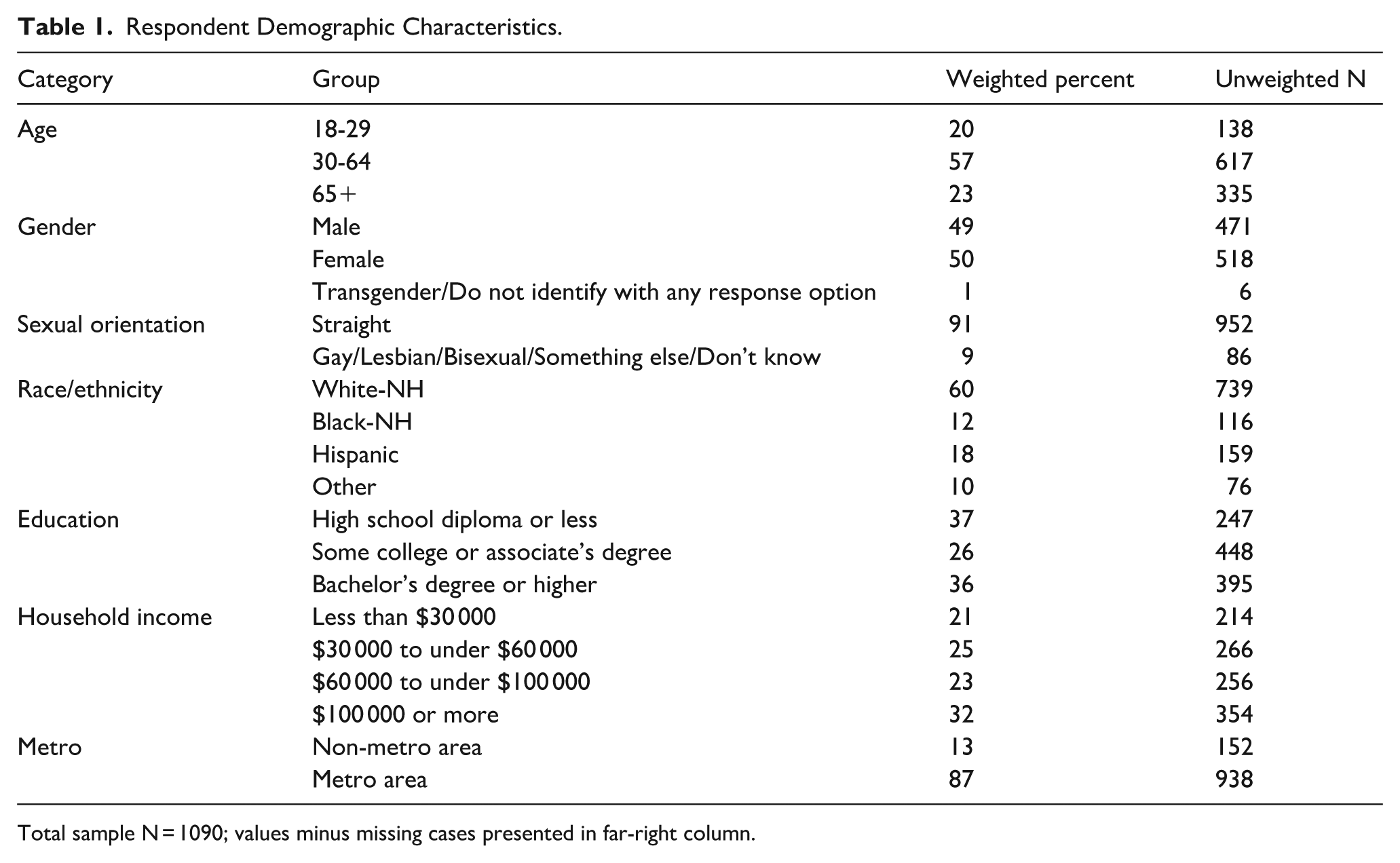
Total sample N = 1090; values minus missing cases presented in far-right column.
Only 18% of respondents indicated they would contact 988 if they were experiencing substance use issues. After reviewing a brief explanation of how 988 can be used for this purpose, only 26% reported they would be very or extremely likely to contact 988 if they or someone they know needed support for substance use.
Table 2 summarizes the reasons that would motivate respondents to contact 988 for substance use support, barriers that would prevent them from doing so, and likelihood of contacting 988 if they or someone they know needed support for substance use. More than half (59%) would contact 988 for substance use support for at least 1 listed reason; the most commonly reported reasons included that it is free (41%), they can get immediate support while on a waitlist for treatment (32%), and to get support from a trained counselor while avoiding the stigma of formal treatment (32%). Reasons that would prevent respondents from contacting 988 for substance use support included that 988 is advertised as a suicide and crisis lifeline (22%), lack of follow-up (14%), and lack of training among counselors (13%). Responses varied by gender, age, race/ethnicity, and education. For example, older adults and those of Black, Non-Hispanic race reported a greater likelihood of contacting 988 if the quality of support were on par with the quality of formal treatment. Women and those with a college degree reported a greater likelihood of contacting 988 for substance use support across a variety of reasons.
Motivators, Barriers, and Likelihood of Contacting 988.
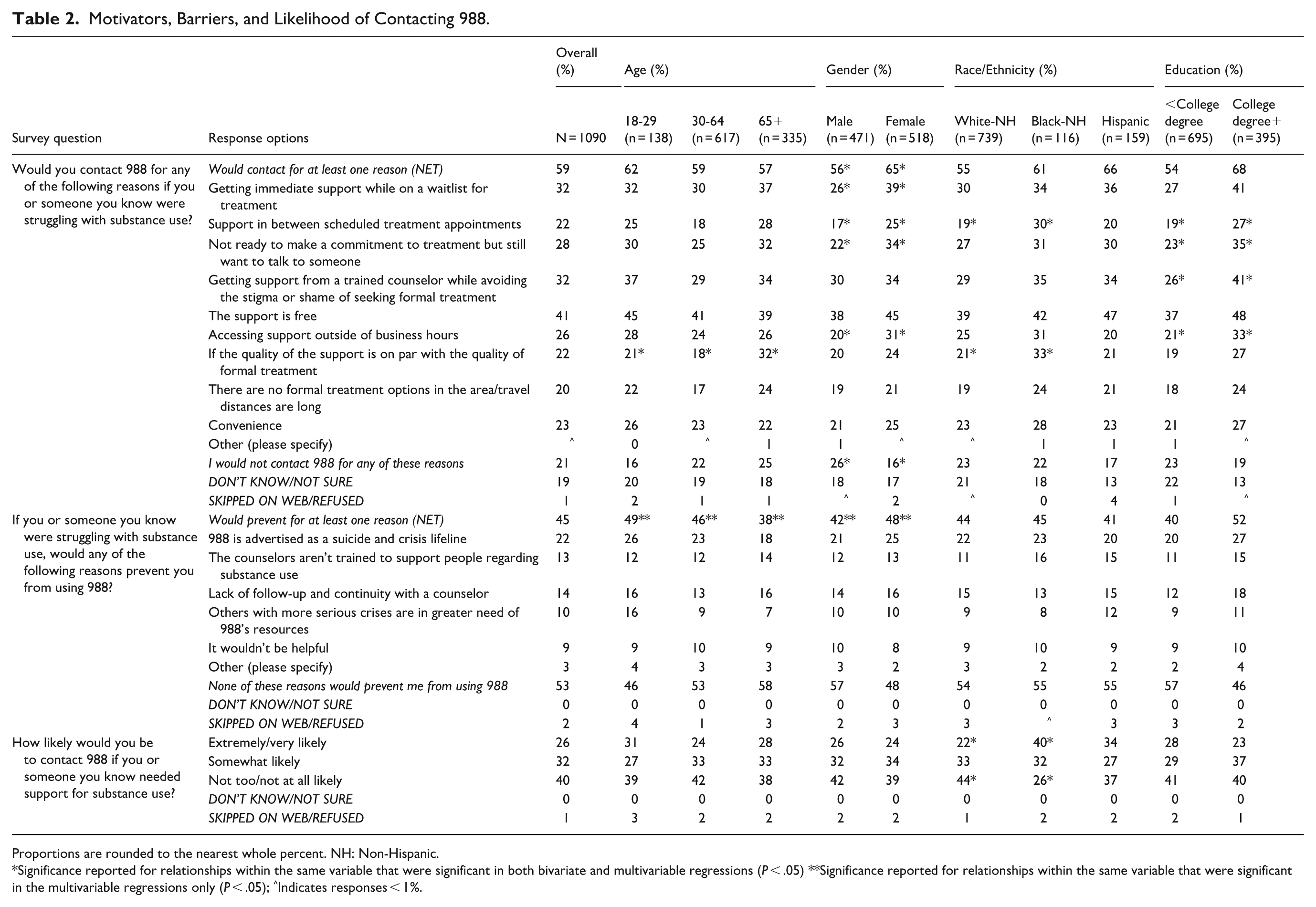
Proportions are rounded to the nearest whole percent. NH: Non-Hispanic.
Significance reported for relationships within the same variable that were significant in both bivariate and multivariable regressions (P < .05) ** Significance reported for relationships within the same variable that were significant in the multivariable regressions only (P < .05) ^ Indicates responses < 1%.
Familiarity with 988 was associated with likelihood of contacting 988 for substance use support for at least 1 listed reason (81% of those extremely/very familiar vs 51% not very/not at all familiar). However, those who were more familiar were also more likely to say they would not contact 988 for substance use support because of how it is advertised as a suicide and crisis lifeline (33% of extremely/very familiar vs 19% of not very/not at all familiar).
Discussion
Though factors that influence the use of helplines for mental health support are largely known, 12 research on helpline utilization for substance use (other than tobacco) is limited. Our first-of-its-kind study explored motivators, barriers, and likelihood of contacting 988 for substance use, filling an important gap in our understanding about what encourages and deters people from using this invaluable resource for substance use support. It is critical that we better understand these factors to help inform an action plan for marketing, promotion, and implementation of substance use services for 988, especially at a time when rates of substance use, overdose, and suicide remain high.
The literature shows that having suicide or crisis in the name of a helpline deters people from using it for any reason, including mental health crises; 12 our study confirms this finding for substance use support. In fact, our study found limited interest in contacting 988 for substance use (18%), with the most common reason being that it is advertised as a suicide and crisis lifeline (22%; 33% among those extremely/very familiar with 988). Even with recent efforts by the Lifeline to encourage the use of 988 for broader emotional support, including substance use, 9 likelihood of contacting 988 for substance use support has not increased over time (23% in 2022, 20% in 2024, and 18% in our survey in 2025), 10 suggesting a need to modify and evaluate current marketing and promotion strategies to ensure more targeted messaging resonates with the public. Given demographic differences in our results, as well as differences by level of familiarity with 988, messaging should be designed for specific audiences and evaluated.
Our study identified no cost, convenience, and filling gaps in care as reasons people would contact 988 for substance use support, consistent with studies on utilization of helplines for mental health. 12 What our study adds is the draw of 988 for avoiding stigma; though stigma is widely reported as a barrier to help-seeking, 13 avoiding it is likely more important for substance use given greater levels of stigma around addiction than mental health or suicide, 14 making this an ideal focal point for future messaging. This may be particularly effective in rural areas, where close-knit communities amplify stigma. 13
Other concerns among survey respondents were that 988 counselors are not trained to provide substance use support, and there is a lack of follow-up and continuity of care; some would be more likely to contact 988 for this purpose if the quality of support were on par with formal treatment, especially older adults. Unfortunately, though SAMHSA’s National Guidelines for a Behavioral Health Coordinated System of Crisis Care states that crisis counselors should be trained to address both mental health and substance use concerns and provide follow-up care, no specific protocols are provided, resulting in a lack of consistency across the 988 system. 7 Standardized guidance should be considered; evidence-based models like Screening, Brief Intervention, and Referral to Treatment (SBIRT) have been successfully integrated into primary care, emergency departments, and mental health clinics to address substance use across a continuum of risk. SBIRT embeds follow-up brief interventions into workflows and can be delivered effectively alongside suicide risk screening and safety planning, 15 making it ideal for integration into 988 contact center protocols. Once standard protocols are implemented, messaging should ensure the public that, if they contact 988 for substance use support, they will receive high-quality initial and follow-up care by a trained professional.
Limitations
While AmeriSpeak covers approximately 97% of the population, certain groups were excluded (people with P.O. box-only addresses, addresses not listed in the USPS Delivery Sequence file, some newly constructed dwellings). Surveys were conducted in English only, online and by phone, which may have excluded non-English speakers and those without internet or phone access. The survey was part of a larger study that included questions about other topics, so context effects are possible. 16 Our cumulative response rate was 3.1%; though typical of multi-stage panel surveys, this subjects our results to self-selection bias, which may overrepresent familiarity with and likelihood of contacting 988 for substance use support.
Conclusion
Our findings identified key factors that influence the public’s likelihood of contacting 988 for substance use support. These findings are significant in that they can be used to help inform future marketing and promotion of 988 to increase utilization for substance use, the second most common risk factor for suicide. Future research should test how these messages resonate with different audiences – including men versus women, older versus younger adults, those with and without college degrees, and various racial/ethnic groups – and assess their impact on utilization of 988.
Supplemental Material
sj-docx-1-saj-10.1177_29767342261458554 – Supplemental material for Motivators, Barriers, and Likelihood of Contacting 988 for Substance Use Support: Implications for Marketing, Promotion, and Practice
Supplemental material, sj-docx-1-saj-10.1177_29767342261458554 for Motivators, Barriers, and Likelihood of Contacting 988 for Substance Use Support: Implications for Marketing, Promotion, and Practice by Brett R. Harris, Abigail Sekar, Sabrina Avripas, Jordan Hinkle and Tracy L. McPherson in Substance Use & Addiction Journal
Footnotes
Acknowledgements
The authors gratefully acknowledge Sean Collins and Emily Alvarez for their data review, analytic support, and review of the draft methods and results section.
Author Note

Ethical Considerations
All procedures in studies involving human participants were performed in accordance with the protocol approved by the NORC Institutional Review Board (IRB00000967). AmeriSpeak has implemented the necessary protocols to comply with legislations such as the Privacy Act, the Confidential Information Protection and Statistical Efficiency Act of 2002 (CIPSEA), and the privacy provisions of the E-Government Act of 2002.
Consent to Participate
Informed consent to participate and have data published was obtained and documented during the initial AmeriSpeak panel recruitment phase.
Author Contributions
Brett R. Harris, conceptualization, project administration, resources, supervision, writing – original draft, writing – review & editing; Abigail Sekar, data curation, project administration, resources, supervision, visualization, writing – original draft, writing – review & editing; Sabrina Avripas, conceptualization, project administration, resources, supervision, writing – original draft, writing – review & editing; Jordan Hinkle, formal analysis, visualization; Tracy L. McPherson, conceptualization, resources, writing – review & editing.
All authors approved the final version of the article.
Funding
The authors received no financial support for the research, authorship, and/or publication of this article.
Declaration of Conflicting Interests
The authors declared no potential conflicts of interest with respect to the research, authorship, and/or publication of this article.
Data Availability Statement
The authors will not make their data, analytic methods, and study materials publicly available to other researchers. We will share data, methods, and materials individually upon request.*
Supplemental Material
Supplemental material for this article is available online.
References
Supplementary Material
Please find the following supplemental material available below.
For Open Access articles published under a Creative Commons License, all supplemental material carries the same license as the article it is associated with.
For non-Open Access articles published, all supplemental material carries a non-exclusive license, and permission requests for re-use of supplemental material or any part of supplemental material shall be sent directly to the copyright owner as specified in the copyright notice associated with the article.
