







Abstract
This paper examines the use of TikTok by female Israeli Defense Forces (IDF) soldiers as a tool for digital militarism and image warfare. Following the Hamas attacks on October 7, 2023, there was a surge in IDF soldiers posting ‘thirst trap’ videos, blending dance, seduction, and militarized imagery to humanize soldiers and amplify state narratives. Analysing 200 accounts and 500 videos, the study identifies a spectrum of different seduction strategies ranging from ‘cute’ soft power dynamics to the dramatization of eroticized brutality. The low-tier content features playful, non-militant aesthetics, while middle-tier content incorporates weapons and military settings to recontextualize platform trends and high-tier content involves explicit self-sexualization and provocative imagery. These videos exploit TikTok’s participatory affordances and algorithmic visibility to maximise engagement while trivialising violence across varying intensities. The paper further identifies a semi-automated computational propaganda campaign that repurposes authentic IDF content through personalised overlays to engage audiences, producing forms of participatory militainment. In doing so, these strategies collapse distinctions between the personal and the political, recasting propaganda as entertainment. The study underscores the urgent need for critical media literacy to understand how platform infrastructures actively shape conflict narratives in the era of post-digital warfare.
Keywords
Introduction
Social media platforms serve as arenas for informal propaganda, blending personal expression with military symbolism (Hoskins and O’Loughlin, 2010). An intriguing example of this dynamic is the surge, following the Hamas attacks on October 7, 2023, in female Israeli soldiers sharing ‘thirst trap’ videos on their private TikTok accounts, featuring them dancing in their Israeli Defense Force (IDF) uniforms. A thirst trap is a photo or video shared online featuring individuals with the intent of drawing attention to encourage engagement and boost social media metrics (Boffone and Rosvally, 2023). Originating from internet slang, ‘thirst’ initially described intense eagerness towards a particular focus but has evolved to carry a distinctly sexual connotation (Maddox, 2023).
At first glance, this circulation of ‘thirst trap’ content by IDF soldiers on TikTok may appear innocuous; however, we argue that it reveals significant dynamics of digital militarism on platforms (Kuntsman and Stein, 2020). First, it underscores the place of TikTok, as a pivotal battleground in the ‘image war’ (Yarchi and Boxman-Shabtai, 2023), where the contest for public opinion runs parallel to events on the ground, with soldiers continuously performing their roles (Melpignano, 2023). Second, it highlights how dance functions as a form of soft power in military contexts, with personnel leveraging platform-specific rhetorics and aesthetics – such as TikTok's dance culture – to vernacularize the state, foster an ‘everyman’ appeal (Stein, 2012), and distract from the realities of war.
Studies trace the use of thirst traps featuring women in uniform across various media by militaries such as those of the United States, Spain and North Korea (Walker, 2023), with analysis focusing on IDF thirst traps during times of war on platforms like YouTube and Instagram (Kuntsman and Stein, 2020; Melpignano, 2023). However, the structure, scale and engagement achieved by IDF soldiers’ TikTok videos – measured through views, likes, shares, comments and reused sounds – remains underexplored. We identified 200 individual TikTok accounts, belonging to IDF soldiers participating in dance trends, each posting up to 127 videos, some with up to 46 M views. These videos function as thirst traps insofar as they deploy suggestive gestures and embodied performances designed to attract attention and stimulate engagement (Quick, 2021).
In our analysis, we show how the thirst traps evolution on TikTok introduces a distinct set of rhetorics, modes of address, performances and aesthetics shaped by the platform's native practices for imitation-based content creation (Zulli and Zulli, 2022). We claim that as an easily adaptable template, soldiers’ thirst traps represent a highly effective form of memetic soft propaganda (Mattingly and Yao, 2022), blending traditional methods of military mass seduction (O'Shaughnessy, 2024) with the strategic utilization of TikTok's distinctive affordances (Klinger et al., 2023). This strategic adaptation not only leverages the platform's affect-driven environment but also demonstrates its potency: thirst trap propaganda content achieved viewership over seven times greater than traditional actors such as IDF's (@idf) and Prime Minister Netanyahu's (@bnetanyahu) TikTok accounts, highlighting a stark disparity in audience reach and impact. 1
Through this analysis, we seek to illuminate broader patterns of the platform's memetic participation and amplification where seductive soldiers dance routines are charged with propagandistic meaning, as seen in other conflicts like the Russian invasion of Ukraine (Bösch and Divon, 2024; Geboers and Pilipets, 2024). Furthermore, we inquire into how exploitative actors employ semi-automated campaigns using ‘hijacked’ IDF soldiers’ thirst trap footage to amplify engagement through the platform's affective mechanisms of attention capture. This demonstrates that weaponization now extends beyond military command centres, infiltrating the everyday rhythms of platforms via clicks, ‘shares’ and the algorithmically driven tides of networked information flows, where emotions become tools of militarization (Kunstmann and Stein, 2020).
To contextualize our research, we first trace the enduring connection between dance, warfare, and propaganda through military rituals and earlier propagandistic seduction strategies, identifying key aspects of digital militarism prior to TikTok’s emergence (Deiana, 2023). We then examine TikTok’s affordances in military contexts before and after October 7, 2023, focusing on how platform-specific aesthetics, sounds, and trends enable Israeli military creators to capture engagement and assert dominance. We conceptualize these dynamics as participatory militainment, in which militarized performances circulate, reenacted, and affectively amplified by users through platform infrastructures of visibility, turning entertainment and participation into propagandistic components of the image war.
Military strategies of dance
The dancing body is a symbolic expression that embodies many notions. Among these are romance, desire and sexual climax (Hanna, 2010). At first sight, dancing might not seem like an activity with an immediate association to conflict, violence and militarism. Yet, choreography and war have long been intertwined through military rituals and dances, parades, processions and military drills (Morris, 2016). The earliest representations of the Pyrrhic dance, a war-training ritual among Spartan youths, appear on Attic vases from the 6th century BC. Over time, it evolved into a multifaceted performance with social, ritualistic and entertaining aspects, including increasing participation by women (Goulaki-Voutira, 1996). Weapon dances, used to simulate, recall or reenact combat, have been a common folk ritual across many parts of the world, reflecting diverse cultural traditions around the globe (Chvaicer, 2002).
Dance can be interpreted as a political act with a communicative power that transcends language (Mills, 2017). In military conflict, its embodied political expression fulfils three distinct objectives: First, internal training and motivation with the US military incorporating Zumba and Latin-inspired dances promote fitness and cardiovascular health (Carlson, 2009), while dance therapy is employed to address post-traumatic stress disorder and prevent suicide following operations (Reid, 2023). Second, intimidation of the enemy; in Māori culture, a ceremonial war dance is performed by warriors to intimidate opponents with vigorous body actions, fierce facial expressions and powerful chants, cries and grunts (Simon, 2015). This use of dance to assert dominance is evident in videos of IDF soldiers circulated online, clad in uniforms and armed with rifles, dancing in the Palestinian territories. Here, dance is employed as ‘a new tool of hegemonic control’, reaffirming settler colonial dominion and military power (Melpignano, 2023: 199).
Third, dance for public consumption: After the Russian invasion of Ukraine in February 2022, Ukrainian soldier Alex Hook (@alexhook23) gained 88 million views in 24 h on TikTok for dancing to Michael Jackson's ‘Smooth Criminal’ in full combat gear, performing the iconic moonwalk in an open field (Bösch and Divon 2024). The video aligned with TikTok's playful ethos, where each user functions as a performer who ‘externalizes personal political opinion via an audiovisual act’ (Medina Serrano et al., 2020: 264). Hook and other soldiers, dancing to pop songs despite their uniforms, serve as a ‘civilianizing’ device that challenges public expectations of violence associated with military gear (Melpignano, 2023). These performances become ‘a spectacle performed for the benefit of an audience’ (Bakogianni and Hope, 2015), intentionally steering away from depictions of combat, killing or death, while highlighting the valour of soldiers confidently positioned on the battlefield, projecting strength and assurance.
This spectacle of bodily performance in unexpected settings can obscure how, within a military context, dancing serves as a deliberate political act aimed at advancing propaganda objectives. Beyond Ukrainian male soldiers, TikTok videos also feature female soldiers engaging in seductive dance routines alongside military vehicles to attract attention and foster a positive, humanized image of Ukraine for an international audience (Bösch and Divon, 2024). Within our framework of ‘thirst trap propaganda’, it is essential for us to acknowledge that ‘dance and sex may be conceived as inseparable even when sexual expression is unintended’ (Hanna, 2010: 212). Within these tensions of mediated visibility – where intention, perception, and circulation diverge – female dance performances project an aura of control and confidence and become available as affective resources for shaping global public opinion in favour of Ukraine. Thus, we shift our focus now to mediated forms of mass seduction (O'Shaughnessy, 2024), with the aim of exploring and unpacking propaganda strategies that have utilized (sexualized) female bodies over time.
Militarized aesthetics: propaganda from posters to platforms
The female body and dance have long been exploited as instruments of propaganda, understood here as the deliberate and systematic effort to shape perceptions, influence cognition and direct behaviour in a way that furthers the desired intent of the propagandist (Jowett and O’Donnell, 2018: 7). One notable example is the fascist body aesthetic in Leni Riefenstahl's 1938 film Olympia, where Ausdruckstanz (German expressionist dance) links idealized Greek sculptures to the Nazi Aryan ideal. Scenes of women dancing naked, framed to highlight strength, discipline and unity, embody Nazi ideology (Viggiano, 2011). Riefenstahl achieves Goebbels’ vision of ‘invisible propaganda,’ disguising propaganda as entertainment to enhance its effectiveness (Doob, 1950), an early form of mediatized soft propaganda (Mattingly and Yao, 2022) fuelling misogynist male fantasies (Theweleit, 2023).
The use of women's images in military propaganda predates the advent of film. Shover (1975) describes World War I as ‘the poster war’ (p. 469), with poster art as the leading mass commercial medium in the United States, Britain, Germany, France and beyond. These posters employed traditional notions of femininity to portray women in various roles: as victims of war to motivate enlistment and as active participants in nursing, agriculture and factory work. Poster art continued to play a role in World War II, exemplified by J. Howard Miller's iconic We Can Do It! poster from 1943, featuring Rosie the Riveter as a symbol of strength and determination (Covert, 2011). However, print media's influence extended to advertisements in women's magazines like Good Housekeeping and Ladies’ Home Journal, as well as booklets like War Jobs for Women, which glamorized war work and underscored the medium's relevance during the era (Yesil, 2004).
As the media landscape evolved, so too have the methods of exploiting women in the context of military propaganda as ‘weapons of mass seduction’ (O'Shaughnessy, 2024). With the rise of television, computers and smartphones, propaganda strategies shifted from the sender–receiver model of mass media to the dynamic, interactive environments of the platform era in the early 21st century (Klinger et al., 2023), including TikTok (Rastrilla et al., 2023). Today, propagandists leverage every available tool, including influencers (Ross and Rutland, 2022), social media (Kuntsman and Stein, 2020) and internet culture staples like memes (Silvestri, 2016). Women play a prominent role, from e-girls enticing Gen Z into military recruitment (Dazed, 2023) to AI-generated content amplifying these efforts (Goldstein et al., 2024). Meanwhile, advanced technologies like bot networks (Agarwal et al., 2017) and computational propaganda (Woolley and Howard, 2018) further refine and expand these strategies.
Building on these global trends, the Israeli military exemplifies how social media is integrated into military public relations, leveraging its unique context of mandatory service by tech-savvy conscripts aged 18 to 21 (Dickson, 2021). The IDF launched a YouTube channel during the 2008–2009 Gaza incursion and employed Facebook and Twitter as wartime tools in 2012. During this period, Israeli military personnel – frequently female – began posting selfies, often posing with weapons (Melpignano, 2023). In 2020, the IDF expanded its digital presence by establishing an official TikTok account, publishing its first known dancing video on April 17, 2021, featuring three female soldiers and two male soldiers, all in uniform. While IDF soldiers had previously been penalized for uploading dancing videos on YouTube (Greenberg, 2010), the military leadership has since sanctioned such practices. In fact, the IDF actively encourages private use of social media, even awarding a soldier a certificate for promoting the IDF on TikTok through dancing videos (Jerusalem Post, 2021).
This omnipresent embrace of social media marks a clear alignment with ‘militainment’ (Stahl, 2009), an interactive form of militarized entertainment where soldiers’ social media activities merge public relations with participatory engagement. This shift invites a traditionally passive public to actively participate in dark participation (Quandt, 2018), forms of engagement that amplify harmful or propagandistic narratives, including participatory propaganda (Wanless and Berk, 2020), or even assume the role of virtual citizen-soldiers (Stahl, 2009). On TikTok, users amplify military narratives by liking, commenting, sharing and creating duets, stitches or participating in dance challenges and trends. These activities not only magnify military messages but also foster a ‘civilianising’ effect, employing new rhetorics, modes of address and aesthetics to vernacularize and personalize the state through social media platforms (Kuntsman and Stein, 2020). Instead of explicit and clear messaging, militainment turns war into an ambient vibe.
Female bodies and the concept of dance are once again utilized as tools of seduction, persuasion and amplification for propaganda in an increasingly polluted media landscape (Phillips and Milner, 2021), characterized by pervasive information disorder (Wardle and Derakhshan, 2017). In this environment, vernacular and platform-native dance aesthetics draw on affect and emotion to capture attention within an image war structured by competing narratives (Citton, 2017). This polluted ecosystem fosters a functionally zero-sum attention dynamic, where algorithmic amplification of a digital army of young women dancing in uniform redistributes visibility and affective investment away from other pressing issues, such as the humanitarian crisis in Gaza. Thus, after analysing military strategies of dance and retracing the roles of women in various mediatized forms of propaganda, we now address the previously unexamined research gap by focusing on the use of seduction strategies – such as dance and thirst traps – by female IDF soldiers, with the following section specifically examining their application on the TikTok platform.
Vernaculars of seduction on TikTok: dance and thirst
War, once largely confined to the regulated domain of broadcast news, now unfolds through fragmented audiovisual snippets circulating on smartphones and across platform infrastructures designed as engagement engines (Ford, 2024; Merrin and Hoskins, 2024). These environments function with distinct socio-technological affordances that shape user communication and social interactions (Bucher and Helmond, 2018). On TikTok, audiovisual content is dense, layered, fast-paced and designed to capture attention from the very first moment. Creators strive to hook viewers within milliseconds, aiming to maximize view-time, generate likes and drive engagement through comments, shares and interactive features like stitches, duets and remixes.
Propaganda messages on TikTok, particularly during times of war, leverage the platform's multimodal features to effectively capture and hold users’ attention (Hautea et al., 2021). Geboers and Pilipets (2024) highlight the role of musical sound as both a carrier and amplifier of affect, as well as the participatory practices surrounding trends and comments within TikTok's networked memetic environments following the Russian invasion of Ukraine. Similarly, Primig et al. (2023) and Divon and Krutrök Eriksson (2023) examine embodied self-performance by creators, some operating as ‘war influencers,’ (Divon and Krutrök Eriksson, 2025) within the platform’s trend-specific affordances during the Russian-Ukraine conflict, while Cervi and Divon (2023) focus on playful activism expressed through audio-visual memes (the ‘challenge’) in the Israeli-Palestinian conflict.
Neither dance nor thirst traps have been explored on TikTok within the context of propaganda research, despite their prominent role in the platform's body-centric economy. Dance routines, referred to as dance challenges in TikTok's vernacular, have been a defining feature since its global launch in 2018 (Boffone and Rosvally, 2023). These challenges are a popular means for users to interact with the algorithm as they aspire for visibility and to foster communal affiliations (Divon and Eriksson Krutrök, 2024). By submitting their bodies for platform visibility, users participate daily in recreating viral videos through synchronized movements set to sound bites. This embodied participation reinforces a sense of belonging (Klug, 2020) and provides a space for users to express political opinions via audiovisual acts, making political communication on TikTok far more interactive than on YouTube or Instagram (Medina Serrano et al., 2020). Politicized by diverse interest groups, dance challenges have also been adopted by Ukrainian military personnel during the Russian invasion, illustrating the ‘low-volume disorder’ of war-information flows (Wardle and Derakhshan, 2017) while capturing significant global attention (Bösch and Divon, 2024).
The term thirst trap originated in the 1990s but gained prominence as internet slang in the early 2010s, rooted in selfie culture (National Public Radio, 2018). In 2011, Urban Dictionary defined it as ‘any statement used to intentionally create attention or “thirst”’ (Davis, 2015). By 2018, the phrase entered mainstream use, with outlets like The New York Times using it without explanation. In academic research thirst traps remain largely unexplored, appearing in only a few studies on topics such as the gender presentation of male Disney Channel stars (Dashiell, 2023), expectations of gay culture masculinity (Lawn, 2022), lesbian identity on TikTok (October, 2021) and queer aesthetics in musicals (Boffone and Rosvally, 2023). However, military use of thirst traps has drawn journalistic attention, with Rolling Stone asking, ‘Why Are Israeli Defense Forces Soldiers Posting Thirst Traps on TikTok?’ in 2021 (Dickson, 2021) and Dazed exploring the ‘girl bossification of warfare’, highlighting IDF thirst traps (Dazed, 2023). In January 2024, media reported on the ‘Yemeni Pirate Thirst Trap’, a viral TikTok of a 19-year-old allegedly involved in Houthi rebel attacks, dubbed ‘Timhouthi Chalamet’ from social media users for his striking appearance (Owen, 2024).
TikTok has been available in Israel since 2019, rapidly absorbing platform vernaculars and everyday practices, including entertainment, dance, and teasing performances designed to generate ‘thirst’. One early example features Jewish-American TikTok star Jesse Underhill teasing a live performance in Tel Aviv in December 2019, sporting a bare, well-defined chest and a transparent rain jacket, smiling at the camera and ‘elating fans’ (Brown, 2019). By 2021, TikTok had established itself as a key player in the social media landscape during the Israeli-Palestinian conflict. In May 2021, a decision by Israeli courts to evict Palestinian families from Sheikh Jarrah in East Jerusalem sparked what became known as the ‘TikTok Intifada’ (Abbas et al., 2022; Divon, 2022). During this period, digitally mediated protests between Israelis and Palestinians circulated widely on the platform, and violence intensified in Israel’s mixed cities. In this period, pro-Palestinian activists were notably more successful at generating engagement on the platform than their Israeli counterparts (Yarchi and Boxman-Shabtai, 2023).
Building on this context, our paper offers a focused analysis of thirst trap propaganda, specifically examining the platform vernaculars and dance strategies employed by female IDF soldiers on their private TikTok accounts, both prior to and following October 7, 2023. We investigate how everyday platform practices, such as dancing, are utilized to humanize, minimize and trivialize military violence, thereby playing a central role in shaping public images and narratives. Our study is guided by three key questions: (Q1) Which aesthetics, features, and trends do Israeli military creators adopt to enact thirst trap propaganda in the context of the war with Hamas? (Q2) How does this propaganda operate beyond surface engagement metrics on TikTok? (Q3) What indicators suggest the orchestration of coordinated thirst trap campaigns that may be linked to official actors?
Method
To analyse thirst trap propaganda in the times of the Israel-Hamas War since 2023, we began with an exploratory user-centric approach, adopting the perspective of an ‘analytical eye’ (Light et al., 2018: 791) through the walkthrough method as our primary data-gathering tool. This method is ‘a way of engaging directly with an app's interface to examine its technological mechanisms and embedded cultural references to understand how it guides users and shapes their experience’ (Light et al., 2018: 882). We found the method's principles suitable for research aimed at uncovering propagandistic patterns, emerging not only through the act of watching a single video but also the broader ecology surrounding it – spanning screens, interactions, features and the organizing structures that shape the visibility and dissemination of content. Building on Prier's (2020) call to immerse in sociotechnical settings to fully comprehend digital encounters with propaganda, this framework enabled us to critically examine the interplay between videos and the platform's structural affordances, which amplify their reach and influence.
To operationalize this approach, we set up an anonymous research account and began collecting content in October 2023. We initiated our exploration by reviewing hundreds of war-related videos, using hashtags such as #IDF and #Israel to guide our searches in the hashtag pages. This process allowed us to identify 25 unique accounts of female IDF soldiers in uniform who had posted videos of themselves dancing, either solo or with others. We sought to analyse their role in shaping narratives, given their strategic use of dance, seduction and visual appeal to engage audiences. These videos serve as key examples of the intersection between creators’ personal branding and military messaging, while also embodying the content ambiguity that is a hallmark of TikTok's vernaculars (Hautea et al., 2021). By October 2024, we had identified 200 accounts of female IDF soldiers engaging in thirst-trap videos. This repository comprised 500 unique videos scraped using the Zeeschuimer web tool, which tracks and captures platform content for analysis.
With this data, we addressed our first research question, examining the aesthetics, features and trends utilized by individual Israeli military creators to implement thirst trap propaganda. Through an iterative review and coding process, we categorized these practices into three distinct levels: low, middle and high. This typology provided a framework for a granular analysis of the spectrum of seduction strategies employed by soldiers, from ‘cute’ soft power dynamics to the dramatization of eroticized brutality. The low-tier content featured playful, non-militant aesthetics, while middle-tier content incorporated weapons and military settings to recontextualize platform trends. High-tier content involved explicit self-sexualization and provocative imagery, blending unsettling and alluring elements to maximize engagement.
The next step was addressing our second and third research questions, assessing effectiveness and audience engagement with these strategies beyond likes, comments and views, and discernible indicators of orchestrated thirst trap campaigns. We employed a multipronged approach to deepen our analysis by first scraping 970 videos featuring a distinct sound that was prominently used in what we observed as a thirst trap coordinated campaign involving ‘stolen’ footage of IDF soldiers. These videos exemplified computational propaganda tactics, incorporating filters, textual overlays and calls to action, which created a compelling narrative. Second, we examined the participation of users in this campaign, focusing on reaction videos as examples of how individuals ‘fell’ for thirst traps. These reactions, often featuring men engaging with the campaign through silent, self-recorded stares or other forms of direct response, underscored the campaign's ability to mobilize and engage audiences while resulting in algorithmic amplification.
For the analysis of videos we utilized a purposive sampling technique (Sandelowski, 1995) to ‘deliberately look for information-rich cases’ (p. 81), like the account @yaelderiofficial run by a female IDF soldier named Yael Deri. Deri, who has sparked controversy before October 2023 with videos, including one in which she can be seen dancing and smiling to a patriotic Palestinian song plastered with emojis of the Israeli flag (Ghosh, 2021). Utilizing the 4CAT Video Frame Extraction module for frame extraction (Peeters and Hagen, 2022), we conducted a multimodal content analysis of selected dance videos, allowing us ‘to examine textual, aural, linguistic, spatial, and visual resources’ (Pearce et al., 2020: 6), focusing on users’ diverse uses of multifaceted modes of communication in imitated videos. This encompassed technical aspects (editing techniques), creative expressions (innovative uses of the medium), temporal elements (looping or repetition) and metalinguistic features (emoticons or emojis). We relied on the Ethics Working Committee of the Association of Internet Research and committed to anonymize creators’ faces and identifying details in both public presentations and the published version of this study, unless the individual is a public figure already covered extensively in the global press (Franzke et al., 2020).
Findings
Military thirst trap categories
The thirst trap practices observed in our study navigate a spectrum between the ordinary and the exceptional, employing strategies that range from low, middle and high levels of intensity within the context of military seduction strategies. First is the low-intensity category, where individual soldiers or groups appear in non-military settings, such as private rooms or semi-military spaces with no visible weapons. These videos rely on casual or playful behaviours, using soft power techniques to establish a sense of relatability and approachability. Second is the middle-intensity category, where individual soldiers or groups are shown in more explicitly militarized contexts, wearing combat uniforms, positioned near weaponry, or filmed in military bases. The integration of military aesthetics reinforces a sense of authority and legitimacy, blurring the boundaries between casual engagement and militarized identity performance. Finally, the high-intensity category includes individual soldiers or groups who deliberately craft performances to ‘trap’ engagement, either via acts of explicit self-sexualization (Choi and DeLong, 2019) or through unsettling juxtapositions of attraction-driven content with militarized imagery. These videos heighten the seductive appeal of military representation, transforming desire into a mechanism for participation, reinforcing an emotionally charged spectacle akin to war porn (Baudrillard, 2006).
Low thirst: playful authority cuteness
The low-tier thirst trap features IDF soldiers performing dance challenges in non-militant settings, often adopting selfie poses to appear alluring or cute. Cuteness, a culturally pervasive aesthetic in contemporary digital culture, has proliferated due to its capacity to elicit strong affective responses, particularly within media-saturated environments (Dale et al., 2016). Defined as an affect that ‘comprises a set of visual and/or behavioral characteristics capable of triggering a physical and emotional response in the body of the subject: what we may term the “Aww” factor’ (Dale et al., 2016: 35), cuteness is strategically employed in various ways. For instance, soldiers incorporate pink headbands with cat ears into their uniforms and adopt exaggerated selfie poses, including pursed-lip ‘duck face’ expressions, blending playful aesthetics with military roles (see Figure 1).

Low-tier thirst traps: IDF soldiers performing dance trends and challenges in non-militant settings, often adopting selfie poses to appear alluring or cute.
Cuteness, widely applied in influencer marketing (Kansara, 2024), takes on a more complex dynamic in the military context. Being ‘deeply associated with the infantile, the feminine and the unthreatening’ (Ngai, 2005: 814), we argue that this phenomenon reflects the ‘authority cuteness’, a dual dynamic of vulnerability and power that ‘effectively combines weakness, submissiveness, and humility with influence, domination, and control’ (McVeigh, 1996: 292). This interplay aligns with the concept of soft power, which leverages cultural appeal and shared values rather than coercive force to achieve political influence (Pramaggiore, 2016). By incorporating elements of cuteness, IDF soldiers’ performances strategically humanize and soften the perception of military authority while embedding it within the broader context of cultural and political persuasion.
On TikTok, this logic of ‘authority cuteness’ is enacted through platform-specific vernaculars, most notably dance challenges and audio use. Soldiers tap into popular audio snippets to render military life fun and relatable, foregrounding the everydayness of soldiering. As these performances accumulate, their collective participation drives wider uptake by other user-soldiers, triggering a surge of imitation that effectively ‘hijacks’ trending sounds and contributes to their militarization across the platform. Through these practices, IDF soldiers blur the boundary between seemingly spontaneous creative expression and calculated strategic appropriation, as familiar sounds are folded with military echos into the ordinary flows of entertainment. This deliberate positioning of creators’ performances within platform-specific audio streams has emerged as a hallmark visibility strategy in mediated conflicts on platforms (Bösch and Divon, 2024). Thus, beyond mere mimicry of trends designed to achieve algorithmic visibility and engagement, we argue that this approach amplifies soldiers’ self-humanizing narratives. It functions as a ‘civilianizing’ dispositif, actively subverting audience expectations of violence typically associated with soldiers, especially during wartime, when such contrasts become even more striking (Melpignano, 2023).
This sonic appropriation is most clearly realized when sound is paired with movement, as audio trends are taken up and performed through dance challenges. IDF soldiers perform dances in dormitories, bases, and everyday spaces, blurring the boundary between public and private realms as they navigate the personal and the political (Papacharissi, 2015). These performances cultivate a persona that appears apolitical, relatable, and aesthetically appealing, leveraging what Manor (2024) describes as the ‘beautification of war’. Initially applied to the representation of weapons and military hardware, this logic extends here to soldiers themselves, reframing them as approachable, playful, and emotionally legible figures within platformed cultures of entertainment.
From a necropower perspective (Mbembe, 2003), the hyper-humanization of IDF soldiers starkly contrasts with the ‘instrumentalization of human existence’ imposed on Palestinians (p. 82), who are often reduced to faceless victims or aggressors in media narratives. This dynamic is further intensified through the strategic use of ‘cuteness’, which not only humanizes but is weaponized to exert necropolitical power via the platform itself (Lewis, 2023). TikTok's affective economy rewards these performances with heightened visibility, simultaneously determining which narratives and lives are prioritized, rendered visible, or erased within the digital space. When interwoven with military content, this strategy serves to obscure the brutal realities of war while recasting militarized individuals as relatable agents of soft power.
We further see how this aestheticization of militarization operates not only at the collective level but also through individualized modes of self-presentation. Creators who mobilize war aesthetics to appear cute, desirable, or relatable enact what Duffy (2016) terms aspirational labour: self-branding practices driven by the pursuit of visibility, engagement, and future opportunity. By crafting personas that resonate with the platform’s playful, affective, and highly visual economy, soldiers transform participation into an aspirational project, deploying cuteness as a form of currency to expand reach and relatability. Figures such as Miss Israel 2021, alongside other creators who invest sustained digital labour in this genre, illustrate how war, self-branding, and platform aesthetics converge, in some cases translating militarized visibility into modelling and influencer careers.
Mild thirst: weaponry as a prop
The medium-tier thirst trap features IDF soldiers recontextualizing platform vernaculars, such as dance challenges, trends and sounds, but with a distinctly more militant aesthetic. These videos incorporate military props and settings, intensifying the visual impact and blurring the line between playful performance and militarized authority.
For example, in some videos, soldiers were dressed in full military gear – including a uniform, tactical vest and rifle adorned with the Israeli flag and IDF insignia – performed at an outdoor checkpoint or military post (see Figure 2). The backdrop, marked by a covered structure, plastic chairs, and military equipment, situates the performance within a space deeply embedded in the infrastructures of occupation and control, underscoring the overtly inflammatory militarized setting (de Vries and Majlaton, 2021). The five-second videos begin with soldiers adjusting their cap, stepping back, smiling and lip-syncing to the song Whatta Man by Salt-N-Pepa featuring En Vogue. While this 1993 anthem celebrates strong and respectful men, the TikTok version modifies the line ‘You so crazy, I think I wanna have your baby’ to ‘You so crazy, I think I wanna’, followed by the sound of a gunshot. Creators intensify the aggressive tone by mimicking a gun with their fingers and pretending to shoot the viewer.

Medium-tier thirst traps: IDF soldiers recontextualizing platform vernaculars, such as dance challenges and trends, but with a distinctly more militant aesthetic.
Another example of the military recontextualization of trending sounds can be found in several videos using the song ‘Titanium’ by David Guetta featuring Sia. Released in 2011, the track is widely regarded as an empowering anthem, emphasizing themes of inner strength and resilience. The song has achieved significant popularity on TikTok with its lyrics, particularly the recurring line, ‘You shoot me down, but I won't fall; I am titanium’, serving as a declaration of invincibility and determination. When performed by soldiers armed and positioned near checkpoints, military camps, or active operational zones, the song takes on a distinctly militarized interpretation. The pop anthem becomes ‘militained’ – a modification of Stahl's concept of militainment (2009) – transforming into a political act with significant communicative power (Mills, 2017).
We argue that this reframing of invulnerability, when paired with the visible presence of weapons, performs several interconnected functions within what we term a militant thirst trap. These include boosting morale among fellow soldiers, intimidating perceived enemies, and producing a highly mediated spectacle aimed at attracting global attention and sympathy, often through implicitly sexualized cues (Choi and DeLong, 2019). Cuteness elements further complicate these performances, as soldiers are seen wearing pink plush ear warmers with animal ears while on duty as armed watchguards at checkpoints, with rifles and tanks visible in the background.
This fusion of playful platform vernaculars with overtly militarized and confrontational settings distinguishes the medium-tier thirst trap from its lower-tier counterparts, shifting the tone from approachable cuteness to authority and provocation. By repurposing military gear and occupied spaces as aesthetic props, these performances work to soften and normalize militarism within everyday entertainment, while obscuring the material realities of violence imposed on Palestinians. Soldiers are reframed as relatable and playful figures in wartime, smiling as they perform gestures such as pointing and miming gunfire toward the camera. Yet the presence of real weapons remains unmistakable, with rifles being visibly carried, loaded, and ready for use, signaling ongoing preparedness for confrontation. In this way, we argue, threat and entertainment coexist, with military power simultaneously directed toward potential enemies on the ground and rendered consumable for distant spectators.
High thirst: military self-sexualization and war porn
High-tier thirst traps feature exceptional forms of military seduction strategies showcased on IDF soldiers’ accounts, ranging from explicit acts of self-sexualization (Choi and DeLong, 2019) to platform-adapted iterations of war porn (Baudrillard, 2006).
Military self-sexualization
We observed numerous instances of female IDF soldiers engaging in self-sexualization, emphasizing their sexual attractiveness through a combination of visual and auditory cues. The popular Natalia Fadeev, known as Gun Waifu, posts videos featuring close-ups of her breasts in tight clothing, bras and undershirts, deliberate presentations of her stretched-out buttocks and suggestive gestures like sticking out her tongue (see Figure 3). These visuals are often paired with audio tracks like ‘The Pussycat Dolls’ ‘Don’t you wish your girlfriend was hot like me’ or music by Sade, adding a seductive tone to the content. Fadeev extends this persona to platforms like OnlyFans, where she shares explicit sexual imagery, further enhancing her online brand (Ettinger, 2023).
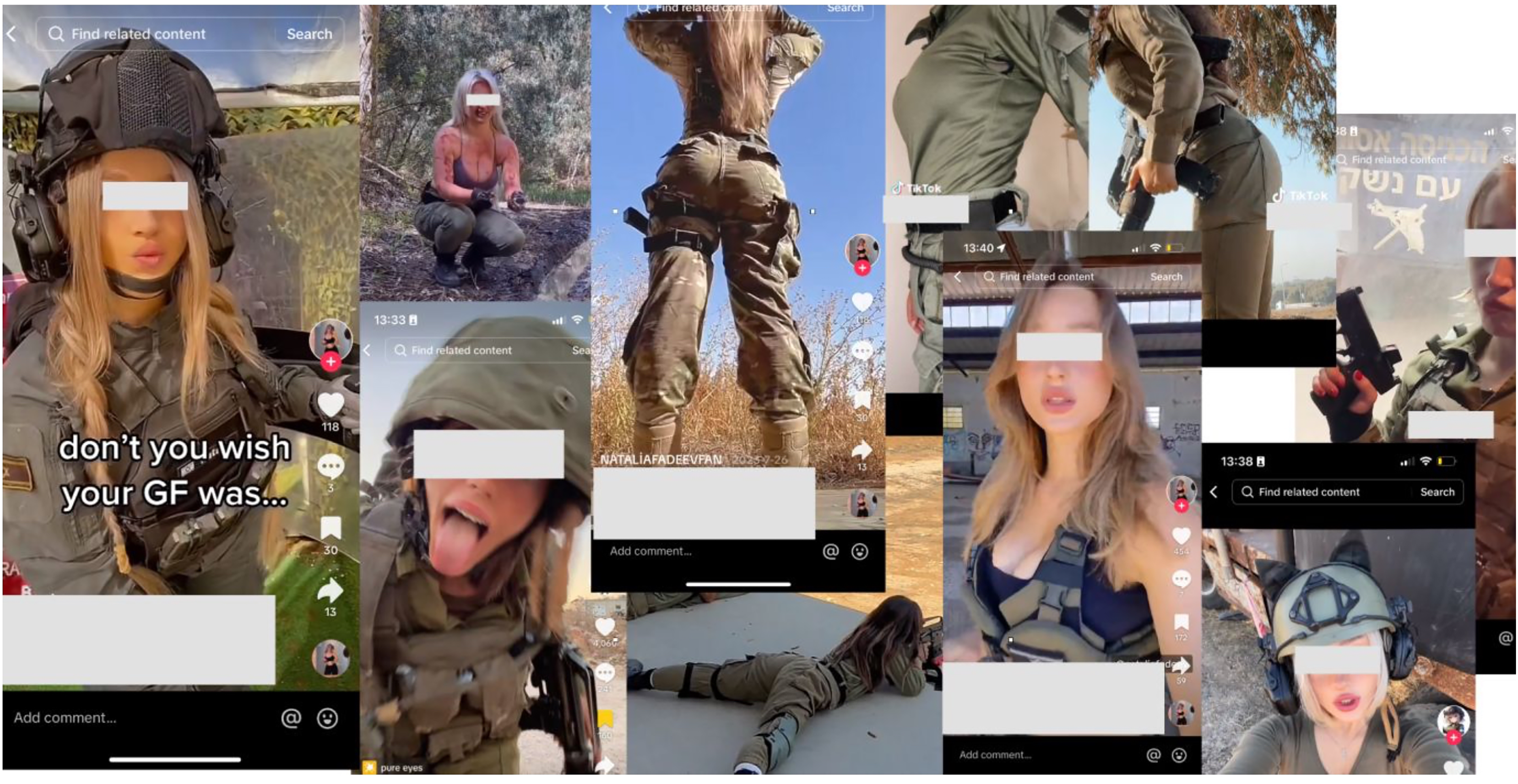
High-tier thirst traps: military self-sexualization, featuring close-ups of breasts in tight clothing, bras and undershirts, deliberate presentations of stretched-out buttocks and suggestive gestures like sticking out tongues.
Such content aligns with a broader, well-documented pattern of sexualized imagery involving IDF soldiers across digital platforms in recent years. Kunstman and Stein (2020) describe instances of scantily clad female recruits dancing for the smartphone, their nudity covered with army-issued weapons shared on Facebook (p.75). Similarly, journalistic accounts have identified Instagram profiles explicitly curated to showcase so-called ‘Hot IDF Girls’ (Yenisey, 2016). These examples point to the entanglement of military branding, sexualization, and platform-specific dynamics in shaping public perceptions of soldiers, where we see visibility, desirability, and authority strategically co-produced through digital media.
Baby killer’ war porn
In our dataset, we identified reaction videos in which IDF soldiers respond to comments labeling them as ‘baby killers,’ reframing accusations of child casualties through playful performances and dance. This reframing is especially stark given the broader war context, where children have figured centrally both as victims and as objects of propaganda. At least 38 children were killed during Hamas’s October 7 attack on Israel (i24NEWS, 2023), while claims of Hamas beheading 40 babies and burning one alive were debunked by Le Monde (2024) and Haaretz (2023). At the same time, UNICEF describes Gaza as a ‘graveyard for thousands of children’ (UNICEF, 2023), with Save the Children (2024) reporting that 30% of the 11,300 children killed (as of October 2024) were under five. A guest essay in the New York Times (Sidhwa, 2024) cited X-rays showing deliberate targeting of children under 12, who were shot in the head or chest. These accounts underscore the devastating material realities of the conflict’s youngest victims.
As part of the ‘baby killers’ reactions trend, a user with 69.2 K followers and 557.7 K likes, identifying as ‘Mommy and Soldier,’ posted a video featuring two individuals in military uniforms wearing makeshift toilet paper roll goggles, set in what appears to be a modest barracks or institutional space (see Figure 4). Engaging in a satirical skit, the video uses audio from the popular American animated comedy series The Minions, characterized by the humorous noises of its main characters. Originally uploaded on July 11, 2024, this audio snippet has since been reused in over 1271 videos, many of which depict people mimicking Minions with similar toilet paper roll goggles.

High-tier thirst traps: war porn, a parody of violence, a parody of the war itself.
The video juxtaposes playful gestures, such as holding a broom while a rapid-fire rifle hangs slung over the shoulder, with the gravity of the accusation embedded in the comment overlay: ‘baby killers.’ The caption directly addresses the critic with the phrase ‘do you think?’ accompanied by a grimacing face emoji ( ), reframing the charge through irony and playful affect. By pairing light-hearted performance with viral sound cues, the video trivializes the critique and diffuses its moral weight. This strategy recurs across similar clips, including videos in which IDF soldiers perform the kangaroo-inspired dance trend el paso del canguro within militarized settings, blending humor with armed presence to neutralize accusation through their spectacularized behaviours.
The juxtaposition of military personnel mocking serious accusations through satirical skits aligns closely with Baudrillard’s concept of ‘war porn’ (2006). In a video published by a user (1058 followers, 22.9K likes) who identifies herself as ‘BPD = beautiful princess disorder’ and links to another TikTok account alongside her Instagram handle, a clip features her and another soldier in what appears to be a classroom or training room. The setting, marked by standard desks and a ceiling projector, anchors the scene in everyday normalcy, even as militarized elements remain visibly present. The video shows the user dressed in a military-style uniform, smiling as she holds a plastic baby doll and tosses it into the air in slow motion, in a gesture that mimics celebration or playful affection. The scene then escalates as she swings the doll around, again in slow motion, nearly striking the camera, while a weapon strapped to her back remains clearly visible. In Baudrillardian terms, the video does not deny violence but aestheticizes it, emptying and converting the charge of killing into an affective spectacle designed for enjoyment, circulation, and detachment, thereby exemplifying how war becomes pornographic via its pleasurable mediation (see Figure 5).

High-tier thirst traps: war porn, the dramatization of eroticized brutality.
The video loops with the sound of ‘The End of the World’, a country-pop song from 1962, used in over 55k TikTok videos ranging from lip-syncing clips to reflections on poor decisions, such as regrettable haircuts. The song's melancholic theme of heartbreak and despair sharply contrasts with the smiling protagonist who lifts the doll playfully, only to swing it in a manner that would be life-threatening if the doll represented an actual baby. In the background, another undressed doll lies on the floor near a second soldier, adding to the surreal juxtaposition. The caption reads ‘combat medic’ and ‘quality time with the baby,’ accompanied by a Smiling Face with Hearts  , commonly expressing feelings of affection and happiness. This combination of imagery and text amplifies the unsettling contrast between the serious implications of the setting and the light-hearted tone of the performance.
Stripped of its uniform, weapon, and immediate combat context, and detached from the broader reality of war that has claimed over 11,000 children’s lives, the video might initially register as a morbid joke. We argue, however, that it exemplifies what Kowalczuk (2019) terms the dramatization of eroticized brutality, in which aggression is rendered legible through stylized play rather than overt force. The slow-motion choreography, smiling performance, and incongruously tender soundtrack displace the meaning of violence from harm to affect, recoding symbolic aggression as entertainment. In doing so, the video does not merely aestheticize violence but reorganizes it as a consumable affective form within the platform’s economy of attention. As Baudrillard (2006) observes, this marks ‘a parody of violence, a parody of the war itself, pornography becoming the ultimate form of the abjection of war, which is unable to be simply war, to be simply about killing, and instead turns itself into a grotesque infantile reality-show’ (p. 86).
Overall, female IDF soldiers deploy a range of platform aesthetics and trends on TikTok during the ongoing war, moving fluidly between the ordinary and the spectacular. These performances collapse distinctions between private self-presentation and official military representation, as seen in videos in which soldiers toggle between personal and institutional accounts, such as the Israeli Air Force (@israeli_air_force). Read through the logic of thirst content, these practices frame military self-sexualization as a visibility strategy, collapsing intimacy, desirability, and authority into a single affective register. War becomes consumable through spectacle and algorithmic circulation, aligning personal allure with institutional power. The next step, therefore, is to assess how effective these strategies are beyond surface metrics such as likes, comments, and views.
Use case – contact me: ‘I work as a nurse’
In our dataset, we uncovered a coordinated propaganda campaign titled ‘I Work as a Nurse’, consisting of hundreds of manipulated videos featuring IDF soldiers. This campaign, disseminated as serial thirst trap content during October 2023, serves as a case study to address our inquiry into thirst trap propaganda effectiveness in capturing engagement beyond widespread reach on TikTok and indicators of orchestration. The campaign successfully captivated a global audience, particularly middle-aged men, by introducing ‘a new interactive mode of militarized entertainment’ (Stahl, 2009). Participants were drawn to produce selfie responses to deceptive invitations from purportedly ‘“sad” military nurses’, using enticing phrases such as ‘Let's be friends’ (see Figure 6).
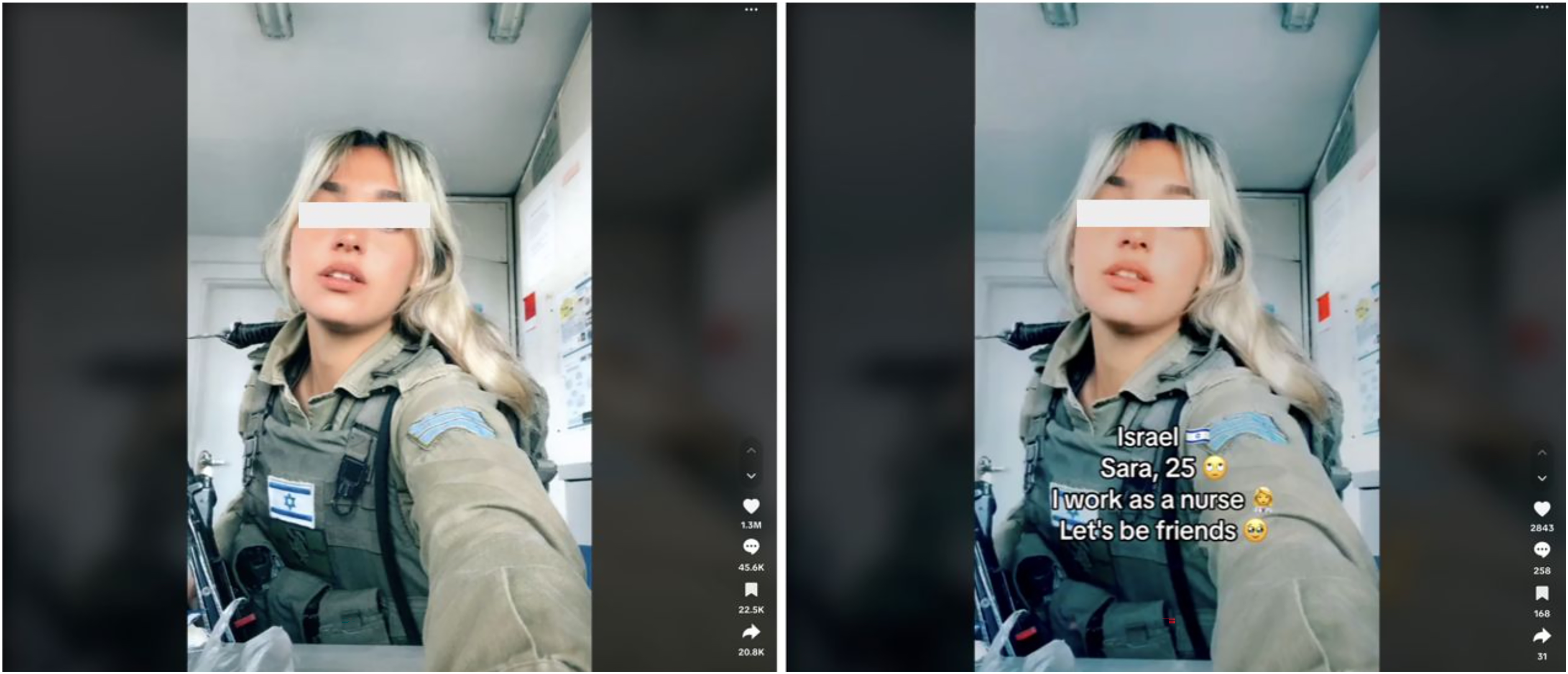
Original video on the left, modified video with filter and textual overlay on the right.
We identified a recurring pattern of videos featuring identical elements: textual overlays, sparkle filters and an eerie ambient sound reminiscent of computer ventilation, titled ‘  ’. These videos, often posted by inauthentic accounts such as @klare1822, @lior6177, @alla0498 or @lina61630, repeatedly appeared on our For You Page. Among these accounts, we detected familiar faces associated with well-known IDF soldiers, with most accounts easily traceable back to actual human beings. Some soldiers use their real names or link their profiles to Instagram accounts filled with contextual details. Visual cues, such as their initial appearance in uniform, offer clues about the start of their military service. Videos featuring multiple soldiers with distinct accounts provide additional layers of contextual information, revealing potential locations and military activities. TikTok's timestamp further aids in situating these videos chronologically.
Moreover, public records and press coverage corroborate these identities, such as St-Sgt. Yael Deri, awarded for promoting the IDF on TikTok (Jerusalem Post, 2021), Natalia Fadeev (‘Gun Waifu’), known for explicit content on OnlyFans (Ettinger, 2023) and Noa Cochva, ‘Miss Israel 2021’, who blends military service with public visibility (Campanile and O'Neill, 2024). We identified videos from these and other creators reposted on inauthentic accounts under different aliases, producing an appearance of grassroots authenticity. For instance, several videos by Yael Deri, originally posted in May 2021, reappeared on accounts like @rita6299, user138849413 and @kiddeesfgui between October 18 and November 3, 2023. These videos were traced back to a specific audio track used in 1491 other videos, and were consistently altered through minor edits, including trimming and added visual filters such as sparkles. The videos featured personalized overlays with female names (e.g. ‘Noa’, ‘Lina’), ages (e.g. ‘22’, ‘25’), professions like ‘nurse’, and emotional appeals (e.g. ‘Let's be friends’  ). Yael Deri appeared under various aliases such as ‘Anna’ or ‘Sara’, with differing details. All individuals wore military uniforms or accessories suggesting IDF affiliation, often accompanied by the Israeli flag emoji
  , creating a personal and approachable tone to encourage interaction (see Figure 6).
The similarity of these videos reflects a coordinated computational propaganda effort, characterized by the ‘use of algorithms, automation, and human curation to purposefully manage and distribute misleading information’ (Woolley and Howard, 2018: 3). This mode of operation rests on three core affordances: automation, which enables rapid scaling; scalability, which facilitates mass content circulation; and anonymity, which helps obscure coordination and accountability. While computational propaganda can serve a range of purposes, including advertising and commercial marketing, its most consequential effects emerge in political contexts, particularly in relation to foreign information manipulation (Bolsover and Howard, 2017). By leveraging existing automated infrastructures, such campaigns amplify selected messages and viewpoints, shaping visibility and public perception at scale (Figure 7).

266 modified videos include additional filters like sparkles and personalized overlays with female names (e.g. ‘Noa’, ‘Lina’), ages (e.g. ‘22’, ‘25’), professions like ‘nurse’, and emotional appeals (e.g ‘Let's be friends’ ).
We contend that this campaign epitomizes computational propaganda, deliberately engineered to advance an Israel-friendly narrative by humanizing actors long framed as the predatory side of the wars on Gaza (Khan, 2004). Practices associated with thirst traps are strategically reworked into memetic performances, folded into meme-based modes of online participation (Milner, 2018), and coupled with explicit calls to action. The result is a hybrid form of platform-optimized propaganda that blends affective appeal with coordinated amplification. To illustrate this, we scraped 970 out of approximately 1500 videos featuring the sound , along with their metadata. This data was analysed to examine the scope, process and anomalies within the campaign, applying the key features of computational propaganda to assess its mechanisms and impact.
Automation
Regarding the automated dimensions of this campaign, the videos employing the described template (stolen footage, sparkle filters, textual overlays and a call to action like ‘Let's be friends’) suggest a systematic, copy-and-paste approach. Minor variations in filters and overlays were applied across accounts with uniform setups: usernames combining women's names and numbers, identical bios such as ‘Talk to me. MY CONTACT’, and links to external sites like ‘flirtfire.fun’ or ‘cozychat.xyz’, often registered in Russia. Most accounts posted only three to five videos, often recycling the same individuals under different aliases or rotating between a small pool of soldiers.
This pattern indicates a campaign that exploits platform infrastructures to generate affective, memetic content – well-established triggers of visibility on TikTok (Cervi and Divon, 2023; Zeng and Kaye, 2022). By pairing relatable aesthetics with subtle erotic cues, the videos amplify their viral potential and align with TikTok’s algorithmic preference for emotionally resonant engagement. Crucially, however, the campaign’s semi-automated character depends on sustained human labor: scripting content, designing templates, selecting filters and overlays, and coordinating scalable modes of replication. Automation here is therefore not fully autonomous but embedded within a hybrid production model that combines human curation with algorithmic amplification.
Scalability
The scale of the ‘Contact Me’ campaign is striking. The ten most-viewed videos amassed a combined 18.2 million views – more than double the 8.3 million views generated by the top ten videos from authentic creators in our post–October 7 comparison sample. This disparity illustrates how semi-automated, inauthentic content can outperform human-generated material in reach. Engagement patterns further reinforce this dynamic: the top ten most-liked videos from the ‘Contact Me’ campaign received 491,200 likes, nearly matching the 499,600 likes of the comparison group of authentic creators. Similarly, the campaign's top ten most-commented videos accumulated 47,057 comments, closely rivalling the 47,625 comments garnered by authentic accounts. Moreover, the campaign's top ten most-shared videos achieved 126,900 shares, significantly surpassing the 89,400 shares recorded by authentic creators’ top-shared content. These findings highlight how a semi-automated campaign, built on stolen footage, deployed over a short launch window, and active for only a few weeks, can rival or surpass authentic creators in engagement while dramatically exceeding them in visibility over time.

Template videos featuring IDF soldiers with text overlays and ‘Call to action’ prompts and selfie videos of men staring into the camera using the same sound.
Anonymity
The actors behind the campaign remain largely undetectable, relying on anonymity as a core operational feature. The first video using the sound was posted on October 1, 2023, by the account ‘@a500854’, which has no other activity. The user profile features a generic image of a woman posing outdoors in front of lush flowering plants, but a reverse image search produced no results, offering no identifiable information about the account holder. The only traceable infrastructure appears in the external links included in some account bios, all of which redirect to websites registered in Russia. Although the identity of the original uploader and the source of the sound remain unknown, the uniformity of execution across accounts – combined with shared templates, timing, and intent – strongly indicates a coordinated and deliberately obscured operation.
Participatory militainment
The significance of this case extends beyond demonstrating the scale and efficiency of computational propaganda or its impressive engagement metrics (views, likes, comments). Instead, it reveals the contours of what we define as participatory militainment: a process through which militarized performances circulate, are reenacted, and are affectively amplified by users via platform infrastructures of visibility, converting entertainment and participation into propagandistic components of the image war. Further analysis of our sample shows how this participatory dynamic unfolds in practice. Not all videos utilizing the sound relied on stolen or altered footage of IDF soldiers. As the dataset expanded, an increasing number of videos featured men simply staring into the camera, introducing an additional layer of participation that complicates the campaign’s structure and reach.
Within the sample, we identified three content types: 266 template videos featuring IDF soldiers with text overlays and ‘Call to Action’ prompts, 327 selfie videos of men gazing into the camera and 377 unrelated ‘noise’ videos, such as random tapestry clips unconnected to Israel or the soldiers (see Figure 8). The prevalence of reaction videos featuring men from diverse backgrounds – often in beds, sofas or cars, dressed or undressed – all staring at the screen is particularly notable. This behaviour appears to reflect their attempt to respond to the ‘contact me’ invitation, though the manner of their engagement seems uncertain.
Central to this participatory dynamic is the eerie mechanical sound itself, which exploits TikTok’s sound-based affordances. By tapping the ‘Use this sound’ button, users are redirected to a centralized feed aggregating all videos using the same audio, thereby amplifying visibility and circulation. A viewer may initially encounter a thirst trap video featuring an IDF soldier lip-syncing, only to hear mechanical ventilation sounds in place of lyrics. Curious, he follows the sound to a feed populated by videos of young female IDF soldiers dancing under the title Contact Me. Selecting the sound then invites participation, often resulting in a selfie video of the user silently staring into the camera. Through this convergence of platform design and user curiosity, participation is subtly engineered, blurring the boundary between intentional interaction and incidental engagement while extending the campaign’s reach through ordinary user activity.
Crucially, the 327 men who documented their attempts to engage by posting selfie videos in which they stare intently at the screen do not merely respond to the thirst trap; they become folded into its operational logic. By reproducing the sound and visual format, their videos extend the circulation of the contact me template, rendering their own bodies additional nodes within an engineered economy of desire. Each act of participation lowers the threshold for further engagement, drawing more users into the same loop of attention, imitation, and affective alignment. While individual motivations remain ambiguous, their cumulative participation positions them as visual components of a broader militarized narrative that redirects desire and curiosity away from critical interrogation of war and toward its normalization. In this way, attraction and affect are mobilized to embed militarization seamlessly within everyday digital interactions, rendering it approachable and routinized feature of the online entertainment ecosystem (Stahl, 2009).
This reliance on personal imagery and affective appeals to humanize militarization also manifests in the video overlays of ‘I am a nurse’. The nurse archetype evokes an image of care, gentleness and harmlessness – even when paired with a military uniform. Such representations echo earlier propaganda traditions, particularly World War I posters that mobilized femininity to soften the realities of war (Shover, 1975). We argue that despite significant shifts in media technologies, these enduring strategies reveal the continued centrality of emotional and symbolic appeals in generating engagement within militarized contexts. In this process, female bodies are once again instrumentalized as affective conduits through which violence is rendered palatable and relatable.
Building on this, thirst trap propaganda, when coupled with features of computational propaganda, becomes particularly effective in terms of scalability, reach and creator anonymity. By augmenting seemingly authentic content with technical affordances and explicit ‘Calls to Action’, such strategies amplify propaganda messages within the broader image war (Yarchi and Boxman-Shabtai, 2023), generating new modes of engagement aligned with the logics of militainment. The distributed amplification tactics observed here represent just one example of the diverse and calculated efforts to trap engagement (Boffone and Rosvally, 2023), boost social media metrics and strategically deploy available tools to influence perceptions and steer cognitive and affective responses.
Conclusion
Our paper serves to be a reminder that some of the most consequential forms of contemporary propaganda are those that dissolve into entertainment, intimacy, and participation. When militarized narratives are embedded in playful aesthetics, parasocial interaction, and platform vernaculars, propaganda becomes difficult to see precisely because it feels ordinary, relatable, and affectively rewarding. Tracing such invisible propaganda (Doob, 1950) therefore requires analytical attention not only to content, but to the participatory infrastructures through which meaning, trust, and alignment are produced on social media platform (Chung and Cho, 2017). Detecting such propaganda thus demands attentiveness beyond spectacle, attuned to the covert narratives that circulate within ‘participative warfare’ contexts when ‘civilians are newly enrolled in the digital battlefield’ (Ford, 2024: 1548).
Our analysis identifies a recurring pattern of amplification, where young, attractive individuals engage in familiar platform vernaculars, such as dance challenges and trends. While these interactions appear routine, visual disruptions – rifles, tanks and uniforms – complicate this ordinariness (Berezin, 2020), revealing a strategically curated spectacle designed for public consumption (Bakogianni and Hope, 2015). This aligns with the concpet of militainment (Stahl, 2009) as a core instrument in the image war (Yarchi and Boxman-Shabtai, 2023), materializing within contemporary ‘war feeds’ (Hoskins and Shchelin, 2023) where propagandists mobilize all available technical means (Ellul, 2021) and, as our findings show, weaponize platform-specific vernaculars to shape public perception.
TikTok thirst traps featuring female IDF soldiers illustrate a significant shift in digital militarism, blending aesthetic appeal, platform affordances and computational propaganda to influence engagement and perception in the ongoing Gaza war. We frame this phenomenon as a highly sophisticated strategy of amplification, where seduction, virality and platform culture converge as mechanisms of influence with low-, middle- and high-intensity levels, emphasizing the escalating degrees of militarized visibility and affective engagement.
The findings reveal that these thirst traps transcend mere entertainment. They humanize military actors, trivialize violence and foster participatory militainment by exploiting TikTok's networked, affect and desire-driven environment. While these performances are enacted by individual soldiers, our analysis does not frame them as the primary locus of responsibility. Rather, we situate these practices within a broader platformized and institutional ecology that incentivizes, amplifies, and normalizes such forms of mediated militarization. Our research also raises ethical concerns about weaponizing everyday platform activities and manipulating users’ emotions to shape narratives. As digital propaganda increasingly erodes distinctions between authenticity and orchestration, we call for heightened critical awareness of how conflict narratives are constructed and consumed on platforms. TikTok thirst traps are not only reflective of modern warfare but also actively shape its perception. In an era where the battlefield for public opinions has migrated to social media, understanding these strategies is essential.
While our study provides valuable insights into the intersection of platforms, vernaculars and military propaganda, we recognize its limitations. Although we have begun to explore possible audience reception, much more analysis is needed to fully understand this aspect. Additionally, our focus on TikTok excludes cross-platform dynamics. Future research should further analyze audience reception, investigate how militarized content is disseminated across platforms and beyond and assess the broader societal implications of this convergence of entertainment and conflict.
Footnotes

Funding
The authors received no financial support for the research, authorship and/or publication of this article.
Declaration of conflicting interests
The authors declared no potential conflicts of interest with respect to the research, authorship, and/or publication of this article.