







Abstract
Efforts to transform urbanisation processes highlight the state's pivotal role in shaping unfolding digital futures. Datta and Hoefsloot propose the concept of the state as auteur to underscore the significance of time and the imperative of timing as a performative, strategic, anticipatory, and symbolic practice of the state to project, direct, execute, accelerate, and synchronise circulating technological ideals. In this commentary, I introduce three attributes – time essence, time thicket, and time passage – to further emphasise the centrality of time and timing for the auteurist state in the digital age. Finally, I interrogate what the state as auteur framework might overlook, particularly given that Southern digital futures emerge through multiple open-ended and incomplete essences, thickets, and passages of time.
Efforts to transform urbanisation processes underscore the central role of the state. Since the mid-1990s, several countries have witnessed state-led efforts to transform their bureaucratic systems. The enormous growth of digital technologies, and processes of digitalisation and datafication, have transformed how the state imagines and approaches urban and future possibilities, triggering new concepts, practices, processes, structures and techniques in urban development and planning. Across Africa, various states have acted swiftly, strategically, and pragmatically to project, direct, promote, enforce, coordinate, and facilitate digitalisation trajectories of their countries and regions. For example, following the rise and spread of mobile phone networks and technology, by the early 2000s, several states played a central role in digitising paper-based systems and integrating basic ICTs in their daily operations, laying the groundwork for e-communication and e-governance (Guma, 2013). By the late 2010s, a stronger focus was paid to upending service delivery through digitalisation and integrating IoTs following the sporadic rise of leapfrog and transformational applications and technologies of financial inclusion, such as mobile money and e-commerce (see, e.g. Guma and Monstadt, 2021). The last few years have witnessed a shift toward automation of governance, with AI-powered algorithms and data analytics adding an additional layer to existing digitisation processes in management, planning, and development. Combined with widespread internet connectivity driven by 5G networks and undersea fibre-optic cables, these developments reflect a wider trend in which certain digital advances gain increased expediency in management, governance and planning over others.
Likewise, across the continent, African states have acted to shape urban futures in ways that prioritise certain aspects of the current digital era. They have put in place institutions and departments to match the pace of development, enhanced institutional capacity and digital skills, and built digital infrastructure to automate municipal processes, service delivery, and urban governance under pressure to excel and avoid being left behind (Issaka, 2023). They have also rolled out ambitious plans, national policy instruments, and strategy documents to translate incoming circulating ideals (Guma and Monstadt, 2021). As Datta and Hoefsloot (2024) argue, these efforts and initiatives have been most notable for the Kenyan state that in the digital age launched a sequence of digital transformation agendas and policies: the Information and Communication Act in the late 1990s; the e-Government and the Vision 2030 strategies in the 2000s; the ICT Transformation Roadmap, the ICT Policy, and the Digital Economy Blueprint in the 2010s; and more recently, the Digital Master Plan in 2022, the ICT Authority Strategic Plan in 2024, and ICT Policy amendments incorporating emerging technologies and AI in its alignment. These processes and developments highlight the Kenyan state's shrewd and proactive prioritisation and execution of the digital, explaining its current information revolution and strategic positionality as one of the leading and prominent digital hubs in Africa.
The above developments demonstrate the state's role as a central protagonist that ‘seizes the moment’ toward new dimensions in the unfolding of digital futures, from ICT and IoT to smart cities and the AI-driven state. These developments reflect public claims and statements in government reports, institutional websites, promotional brochures, and popular media promoting, articulating, and delineating national digital agendas (see Figure 1), but also the rhetoric of public promises, gestures, and declarations in electoral campaigns and politics. Ultimately, these processes underscore a broader trend across the continent, where circulating ideals seek to synchronise and spatially align Western style ‘smart’, ‘intelligent’, and ‘networked’ transformations into locally translated forms of urbanisation. The appropriation of the Silicon Valley ‘ideal’ and nomenclature that exemplifies hybrid adaptations like Yabacon Valley in Nigeria, Silicon Zanzibar in Tanzania, and Silicon Savannah in Kenya, serves as a clear indication of this pattern.
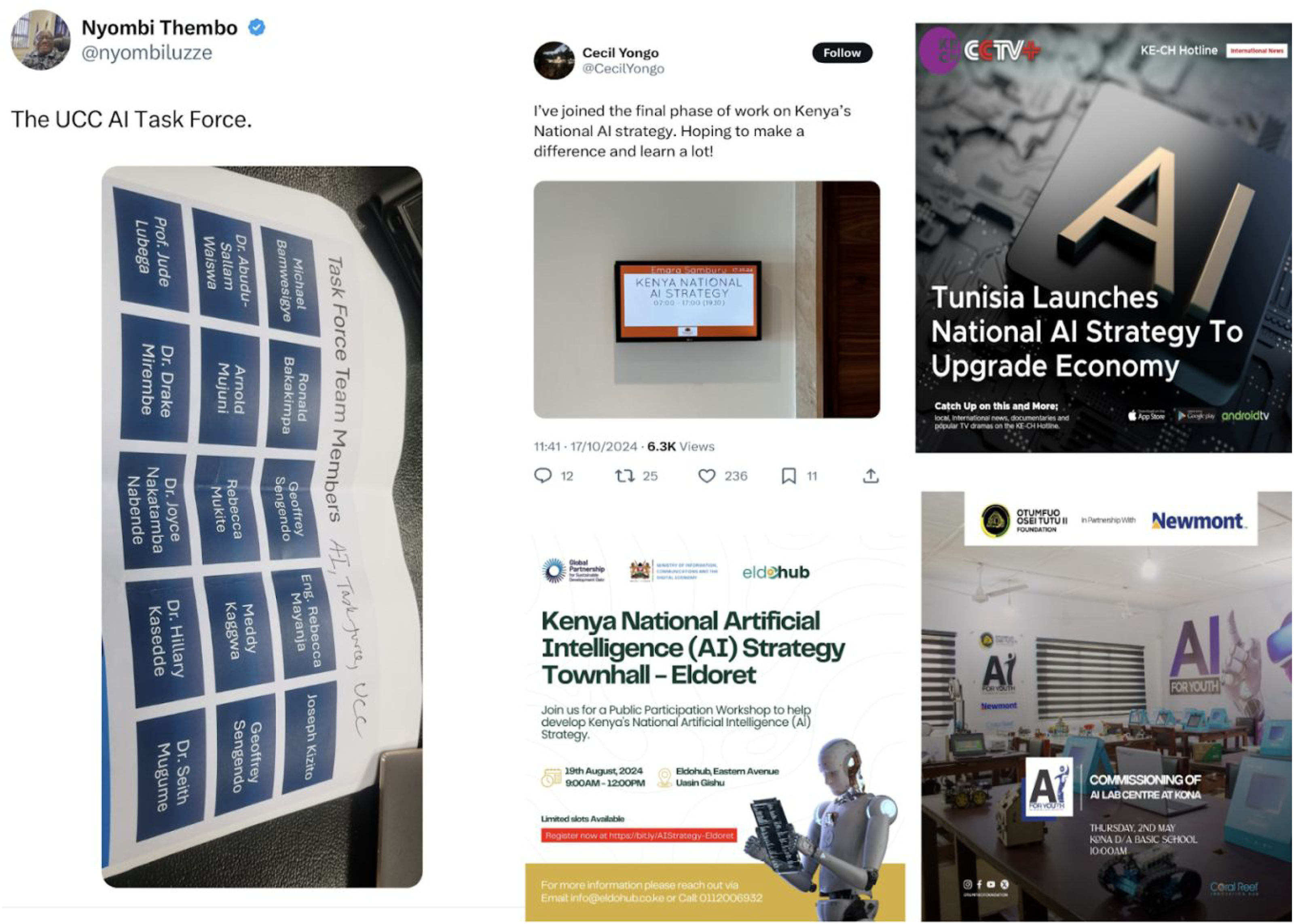
Displayed from left to right. A post on X (formerly Twitter) by the Executive Director of the Uganda Communications Commission (UCC) announcing the launch of a Task Force to shape Uganda's response to AI. The post includes a screenshot of a document, possibly designed with the outdated Microsoft Publisher, with the words ‘AI Task Force UCC’ handwritten in ink. The other four images are also from other X posts, each highlighting state-driven initiatives focused on expediting AI – through task forces, strategies, town halls, launches, and commissions. These images underscore a timely trend of states announcing, expediting, and unveiling unfolding digital futures, where time is of the essence, where things unfold in the thicket of time, and where state and other actors operate in the constant passage of time.
Datta and Hoefsloot (2024) propound the notion of ‘state as auteur’ to better examine, interpret and assess the digitalising state in time and context. Drawing on a Deleuzian concept of an ‘auteur’ piecing together ‘time-images’ into a coherent storyline, they demonstrate how the digitalising state projects, directs, enforces, facilitates, and coordinates the circulation and appropriation of technological ideals and transformations into tangible reality. In the Deleuzian manner, Datta and Hoefsloot reveal how the state attributes meaning and significance to a seemingly asynchronous array of disconnected digitisation initiatives across space and time. In so doing, they reveal the digitalising state as a highly performative, strategic, anticipatory, and symbolically driven entity, attuned to the present and its significance not only in adopting prevailing frameworks but also in actively shaping digital futures. This commentary highlights three attributes that further highlight the value of time and timing for the auteurist state amid unfolding digital futures. These are time essence (where time is of the essence), time thicket (or where in the thicket of time, the diverse temporalities of various actors are densely entwined and negotiated), and time passage (where in the passage of time, the digitalising state remains an ever-incomplete, evolving project shaped by varied temporalities and practices of future making).
Therefore, I would like to sum up this commentary with two concluding remarks. The first has to do with the imperative of ‘state as auteur’ as a lens for understanding the interplay of state power and state techniques and visions amid the unfolding of digital futures in real time. This frame allows us to centre the role of the state in ‘timing’ unfolding circulating ideals and digital futures – where the state plays a critical role in interpreting and assessing digitalisation beyond reductive one-size-fits-all approaches. This is important as imagining digital futures and their unfolding requires us to seriously appreciate the role of the auteurist state in projecting, directing, enforcing, coordinating, and facilitating digital transformations, especially in contexts where local and situated negotiations must be made with non-state actors likely to shape or influence incomplete, heterogeneous, and nonlinear outcomes (Guma, 2022). Moreover, and as importantly, ‘state as auteur’ allows us to place ‘timing’ both as a performative and strategic practice ‘crucial to statecraft’ (Datta and Hoefsloot, 2024: 3). This is critical for purposes of moving away from purely structuralist and quantitative understandings of time itself to foreground the layered conceptions of ‘times composed at different momentums, continuities, ruptures’ (Mbembe et al. 2023: ix), where diverse actors within multiple, extended governance and political-economic contexts, make moves on various fronts to influence unfolding digital futures within moments in time.
The second emphasises the need to further scrutinise the ‘state as auteur’ framework, particularly considering what Datta and Hoefsloot – or the framework itself as proposed – may overlook. Here, it is important to think about what possibilities, and ultimately, pathways are obscured or foreclosed by such a framework in our reading of unfolding digital futures in the Global South. This is particularly critical considering that Southern digitalisation processes encompass modes that, whether by design or by default, fall outside the dominant realms of ordering. Such modes, so often diverse, multiple, and plural, are oft-times ungovernable and unregulatable, existing outside of the state's purview and reach, and embodying orientations not constrained by time – and timing – but in fact existing beyond it. Likewise, Southern state undertakings, whether intently or not, sometimes operate outside or regardless of their prescribed and categorical roles, functions and timelines, where states and authorities may opt not to play a central role in the shaping of unfolding digital futures, choosing inaction rather than action, by playing fiddle in ‘letting things be’, and watching or leading ‘from behind’ (see, e.g. Guma, 2020).
In tandem, these articulations accentuate dimensions in which linear time, time as forward motion, and logical state action, projection, and speculation may appear out of sync with the ordinary ‘realities’ of place and the (urban) majority. They provide a glimpse into diverse orientations, and logics and sensibilities beyond those predetermined by the state, challenging the notion of the ‘state as auteur’, which, in this context, may appear limited in its conceptualisation, failing to encompass all that may seemingly or unseemingly be at play in the unfolding of digital futures in time and space. This is especially true in cases where the state may have limited capacity to anticipate or respond to global and capitalist pressures of digitalisation and circulating ideals; where synchronicity and process unfold timelessly, overlap unimpededly, and coexist simultaneously; where nothing is bound by time – only by the immediacy of what is momentarily working; and, where diverse and plural digital pasts, presents, and futures are all fluid, evoking different temporalities of time essences, thickets, and passages amid unfolding digital futures.
Footnotes
Author's note
Prince Guma is a visiting researcher in the University of Linköping (LiU), Linköping, Sweden.
Declaration of conflicting interests
The author declared no potential conflicts of interest with respect to the research, authorship, and/or publication of this article.
Funding
The author received no financial support for the research, authorship, and/or publication of this article.
