







Abstract
This Further engagement article takes up Blok and Jensen's recent call, made through a Dialogues in Sociology Forum, to ‘invent around’ the work of Bruno Latour to highlight his continued relevance and contribution to the practice of sociology. It is proposed that one way in which Latour might be usefully invented around is by bringing his work, particularly on matters of concern, into greater relation with Alain Touraine's concept of social conflicts where knowledge and morals are contested. This is argued to represent a unique conversation between Latour and Touraine which indicates one means by which Latour's work can be useful, especially for the study of narratives, social movements, and the environment and climate. The Latour-Touraine framework created by this conversation could help sociologists identify and critically analyse dominant values, perceptions and practices specifically concerning human-Nature relationships as a novel focus, alongside possibilities to challenge and re-negotiate these in response to pressing environmental and climate crises.
Introduction
Responding to a recent Forum in Dialogues in Sociology concerning the usefulness of Bruno Latour and his work, this Further engagement article takes up the leading authors’ invitation to ‘invent around’ Latour (Blok and Jensen, 2025a: 64). It therefore brings his conceptualisation of matters of concern and non-human actants into conversation with Alain Touraine on social conflict and the Subject. In particular, this conversation is situated against the backdrop of a time of environmental and climate crisis, and the pressing need for societies to take action in response.
The product of this meeting is a critical perspective on human-Nature framings and a means to analyse possibilities for alternative relations between human society and Nature as they are represented and negotiated through different actors’ narratives. It centres attention on the importance of these narratives that are produced, shared and challenged by actors across society, including governments, civil society and the private sector, through which human-Nature relations may be understood and, potentially, changed. This perspective emphasises the importance of understanding actors’ competing constructions of Nature and possibilities for human interactions with it in ways which could deepen or alleviate environmental degradation and the effects of climate change, analysed through spoken, written and visual narratives as data. This is proposed as a potentially useful and interesting framework reached by inventing around Latour, via Touraine. ‘Nature’ is used here to refer to the natural (non-human) environment in general.
Blok and Jensen's (2025a) Forum on engaging in this invention around Latour's work is first discussed, before key concepts of interest from Latour are presented. This is followed by an account of Touraine's concepts of social conflict and the Subject. A sketch of the framework produced through this meeting between Latour and Touraine concludes the paper.
‘Inventing around’
Blok and Jensen's (2025a) contribution to Dialogues in Sociology centred on exploring the ways in which Latour's work can be used to contribute to new ideas in sociological research. The interest is not, the authors write, in contention around Latour's ideas of the more-than-human, for instance, concerning how non-human entities like machines or elements of the natural environment interact with and alter human society as actants. Nor is an orthodoxy in following Latour called for. Instead, the claim is to seek complementarity from Latour's work with other concepts and approaches, highlighting the existence of ‘still underexplored potentials in Latour's work’ that can be ‘catalyzed as conceptual change agents through interactions with ideas, problems, and situations originating elsewhere’ (Blok and Jensen, 2025a: 64, emphasis in original). Summarising their argument, the authors state that Latour's work should be taken up by others in a manner whereby ‘new intersections, interfaces, and pathways in the ecology of practices are encouraged, explored, and invented around’ (Blok and Jensen, 2025a: 71). As this Further Engagement article proposes, this could be fruitfully and interestingly pursued through building connections between Latour and Alain Touraine, to produce a critical framework elaborated upon below.
Blok and Jensen's position did not go without critique, perhaps most strongly from Stamenkovic (2025) who argued that, in advancing a focus on the perceived interests or agency of the non-human, Latour loses important distinctions between humans and others which renders his perspectives too abstract and potentially problematic in practice, losing sight of core challenges facing society, including the environmental crisis which needs to be distinctively recognised to be addressed. In their response, Blok and Jensen (2025b) nonetheless highlight how focusing on non-human actants and challenging dualistic notions that divide human and non-human does not mean disregarding their differences and unique characteristics, including their respective needs and challenges, whether socio-economic and/or environmental.
Similarly, Heinich (2025) underlines a perceived empirical weakness of Latour's writings related to the identification of a potentially limitless range of human and non-human actants which cannot be practically known nor researched, while also highlighting Latour's changing positions seen particularly through his more extensive French-language work. As Blok and Jensen (2025a) originally argue, however, Latour's usefulness may be found in adopting aspects of his work in ways complementary to other ideas and approaches, rather than in strict adherence to the whole. Doing so, as I propose in this article, could produce new lines of enquiry with practical application to contemporary challenges.
Lastly, it was also raised how Latour's work has already in effect been invented around, such as through feminist Science and Technology Studies (Giraud, 2025). Again, while such research exists and is important (Blok and Jensen, 2025b), it does not exclude possibilities for opening other ‘underexplored potentials’ of Latour in conjunction with alternative lines of thought and research agendas (Blok and Jensen, 2025a: 64). It is proposed here that one such potential can be found through a novel meeting with Touraine, resting particularly on Latour's treatment of matters of concern.
Bruno Latour
Latour is arguably best known for his contributions to the development of ‘Actor Network Theory’ and ideas around the non-human – or more-than-human – in which attention extends beyond consideration of human actions and interests to incorporate interlinking relations to, for instance, pieces of technology or aspects of the natural environment as actants in their own right (Blok and Jensen, 2025a; Latour, 2008). Of particular interest here is his focus on matters of concern and non-human agency.
In discussing matters of concern, Latour (2004, 2008) helps draw attention to complex webs of relations between a diverse range of actors, in which agency is shared and mutually intertwined as part of a wider yet often hidden assemblage. This idea of mutual interdependencies was well-illustrated by Latour's (2008) reference to theatre and how what is seen on stage is influenced by a variety of people, objects and processes behind the scenes in important ways. As Latour (2014: 5) later wrote, to exercise agency is ‘not to act autonomously in front of an objective background’, but rather to be part of an interconnected and interdependent whole.
This is contrasted against a focus on matters of fact which obfuscates the interconnectedness highlighted by matters of concern. Here, the human and non-human are portrayed as separate, divided categories in which the latter can be objectivised and its own agency, interwoven with humans’, neglected and externalised (Latour, 2008, 2014; Latour et al., 2018). The result of this artificial bifurcation when seen between Nature and humans thereby arguably contributes to contemporary environmental and climate crises as Nature reacts to human-led degradation of the natural world, with Nature perceived as a passive and externalised object subject to exploitation. This situation represents a time of crisis for both Nature and humans which Latour (2018; Latour et al., 2018) refers to as the New Climatic Regime.
A matters of concern lens thereby foregrounds this interweaving of agencies, actions and dependencies to recognise that it is ‘necessary to associate with others in order to remain in existence’ (Latour, 2008: 16), including through greater recognition of Nature as comprising actants with which human society is inextricably and mutually tied (Latour, 2008, 2011). It is the ability to recognise Nature as a co-actor, and to advocate for a matters of concern rather than matters of fact understanding and interaction with it, which Touraine (1985, 2002) complementarily helps develop into a practical framework through an emphasis on contention over cultural norms and claims to truth.
Alain Touraine
Touraine contributed strongly to the study of contention and social movements during his lifetime. Of key interest here is Touraine's (1980, 1985) foregrounding of social relations as being productive of society and, in particular, the notion of social conflict in which social movement and other actors engage in conflict over cultural patterns which, if changed, could signal the possibility of a new society. Specifically, Touraine (1985) identifies these patterns around which conflict can occur as knowledge, investment (production) and ethics, representing society's core truth claims and norms.
In later work, Touraine (2000, 2002) locates the ability to challenge dominant social norms within the Subject. This Subject exists in tension between adherence to and reproduction of societal norms, and the ability to engage in the imagination of alternatives which can in turn challenge dominant norms and social relations. It is from this perspective that focus can be centred upon contestation over how Nature could be seen beyond the dominant matters of fact rendering, critiqued by Latour (2008), toward renderings of Nature and human interactions and dependencies with it that are more akin to matters of concern. By extension, this could indicate a potentially altered knowledge and ethics of engagement with Nature that opens different pathways for addressing environmental and climate breakdown. Analysing actor narratives for the (re)production of new or existing understandings of Nature and human-Nature relations, and what this could mean for recognising and effectively addressing environmental and climate crises represented by the New Climatic Regime, can thereby be critically foregrounded.
A possible framework
Figure 1 summarises this potential meeting between Latour and Touraine around Nature. Within this framework, the links between Latour and Nature exist in the recognition of the non-human as holding agency that is not separate from, but deeply interconnected with and reactive to, human practices and engagement with Nature. The Touraine-Nature linkage is found in taking Touraine's focus on social conflict and applying it to understand Nature as a site for contestation over what it is, how it is valued and, by extension, engaged with in practice.
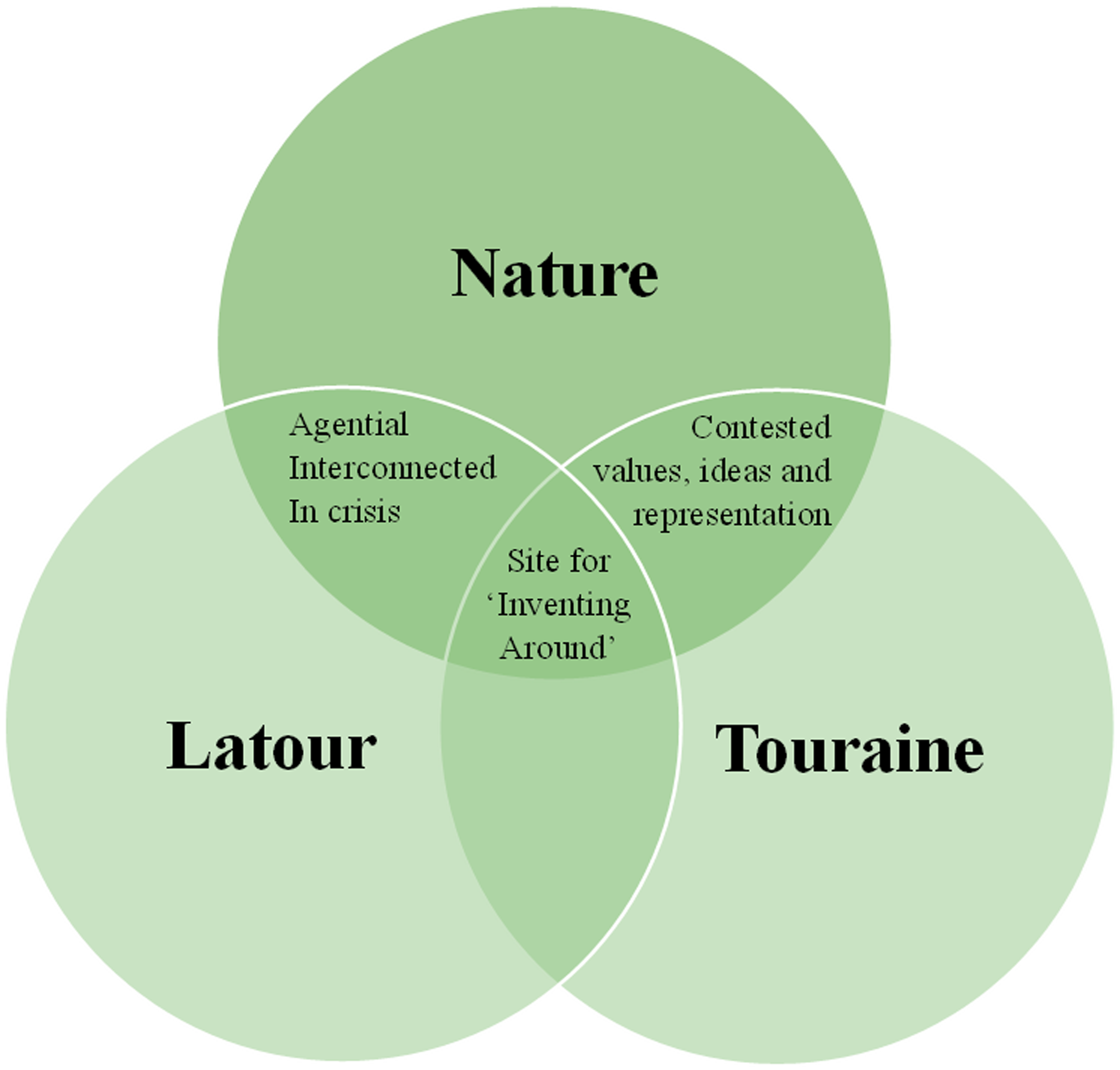
Sketching a Latour-Touraine conversation on narratives and social conflict around Nature.
The site for ‘inventing around’ which combines Latour and Touraine in relation to Nature thereby creates a unique lens through which to critically analyse narratives around Nature in a time of environmental and climate crisis. It focuses attention on understanding the ways and extent to which different actors across society construct, in speech, text and visual images, both Nature and human connections to it, as well as the potential outcomes of these constructions. This could include destructive perspectives which continue to objectivise and exploit Nature through a problematic human-Nature division, contributing to the New Climatic Regime without addressing the challenges it poses for both humans and non-humans alike.
It is here also where wider understandings of and diverse connections to Nature can be recognised through Latour's focus on interwoven agency and matters of concern, combined with a critical and practical focus on actor narratives and contestation around key ideas, values and knowledges represented by Touraine's analysis of social conflict. Put differently, this framework adopts Latour's unique perspective on the non-human and situates it through Touraine into a novel means by which to identify and unpack contestation, continuity and change in how Nature is valued and engaged with across society in a time of crisis, and what pathways for action may emerge from these narratives.
Conclusion
Through the above discussion, this Further engagement article has taken up Blok and Jensen's recent call to ‘invent around’ the work of Bruno Latour, to highlight Latour's relevance and contribution to the practice of sociology. It is argued here that one means by which Latour may be usefully invented around is to bring his work, particularly on matters of concern, into greater relation with the work of Alain Touraine on social conflicts where knowledge and morals are contested. It is proposed that doing so represents a unique conversation between these two authors, which helps to underscore one way in which Latour could be useful, especially at the intersection of studies on narratives, social movements, and the environment and climate. The framework created by a Latour-Touraine conversation could support sociologists in the identification and critical analysis of dominant values, perceptions and practices specifically concerning human-Nature relationships as a novel focus, as well as of possibilities to challenge and re-negotiate these in response to pressing environmental and climate crises.
Footnotes

Funding
The authors disclosed receipt of the following financial support for the research, authorship, and/or publication of this article: This work was supported by the University of Milan [doctoral scholarship]; This work was partially supported by the Swedish Research Council (Formas) through the project ICARUS [grant number 2022–01835].
Declaration of conflicting interests
The author declared no potential conflicts of interest with respect to the research, authorship, and/or publication of this article.
Data availability
No data were produced for this research.