






Abstract
Introduction
Radicalization occurs when individuals gradually adopt beliefs and behaviors that endorse violence against other groups while prioritizing the pursuits of their own group (McCauley & Moskalenko, 2008). After the collapse of the ISIS caliphate in Syria/Iraq, the ISIS movement has splintered and moved to various parts of the world, particularly to Africa. Various Islamist groups in sub-Saharan Africa today have pledged allegiance to ISIS ideology and are fighting to create their own pockets of the “Islamic State (IS)” or Dar-ul Islam (rule of Islam). There are several groups in West Africa (Mali, Niger, etc.), groups such as Boko Haram in Nigeria, and even ISIS-affiliated Islamist groups in Mozambique, who are today fighting in the name of the IS.
Notwithstanding substantial territory losses in Iraq and Syria from 2017 to 2019, ISIS persisted in its pursuit of transnational goals. Rather, it ushered in a phase of decentralized expansion, with sub-Saharan Africa emerging as one of the most critical theaters of ISIS activity. Currently, ISIS has five highly active and officially recognized provinces across Africa: The Islamic State West Africa Province (ISWAP), primarily active in Nigeria, and the Lake Chad Basin; the Islamic State Central Africa Province (ISCAP), based in the Democratic Republic of the Congo (DRC); the Islamic State Mozambique Province in Cabo Delgado; the Islamic State Sahel Province, operating in Mali, Burkina Faso, and Niger; and the Islamic State Somalia Province in Puntland. These provinces represent some of ISIS’s most enduring territorial footholds beyond the Middle East (Karr & Carter, 2025).
ISIS’s shift from the Middle East to Africa raises the question: Why has ISIS shifted its operations to Africa? The group’s ideology has flourished in sub-Saharan Africa, where affiliates such as ISWAP, Islamic State in the Greater Sahara (ISGS), and factions in Mozambique and the DRC have grown. Political instability, porous borders, poverty, local grievances, and transnational jihadist narratives that exploit ethnic and communal tensions fuel this spread. Insurgent groups can consolidate in sub-Saharan Africa, which provides recruits and weak state control. While ISIS has not yet established a pan-African caliphate, its growing reach raises concerns about regional security, humanitarian stability, and global counter-terrorism. The key question is whether these fragmented networks can form a caliphate or remain fragmented insurgencies that threaten African states and international security.
The success of these affiliates is closely tied to the structural weaknesses of many African states. Chronic governance deficits such as ineffective institutions, entrenched ethnic and communal tensions, lack of essential public services, and overstretched or abusive security forces have created fertile ground for jihadist insurgencies. ISIS affiliates have adeptly exploited these ungoverned or weakly governed spaces, embedding themselves in local conflict ecosystems and mobilizing support by capitalizing on long-standing grievances. This strategic adaptation has allowed ISIS to transform from a fragmented ideological presence into a regionally entrenched insurgent threat across sub-Saharan Africa.
The ISIS Spread in Africa: A Causal Analysis
ISIS is a Sunni jihadist militant organization and former proto-state that gained international notoriety for its extreme violence, declaration of a global caliphate, and extensive control of territory in Iraq and Syria.
After its decline in the Middle East, ISIS has now expanded into Africa through its franchises (Bere, 2024). After losing most of its land and fighters in Iraq and Syria by 2017, ISIS looked for new ground. Around 10,000 fighters from North Africa helped it expand into weak and unstable regions such as Libya, the Sahel, and Mozambique. Instead of ruling territory, ISIS now uses small insurgencies, local alliances, and propaganda to grow (Warner et al., 2021). Africa’s governance problems and conflicts made it easier for ISIS to spread. At first, Africa was not ISIS’s main focus. But since 2014, the group has built a strong network of affiliates in West, North, and East Africa. North Africa became especially important, with ISIS-linked groups active in countries such as Morocco, Algeria, Tunisia, Libya, and Egypt. The region also produced the largest number of foreign fighters nearly 10,000, who joined ISIS. This shows that the group’s ideology found support among many in North Africa. While ISIS continues to target Western interests, its growing presence also creates serious security risks for Africa itself.
ISIS has struggled to firmly establish itself across Africa because local recruitment drivers—such as poverty, political grievances, and insecurity—do not always align with its ideology of a global caliphate. In West Africa, Boko Haram pledged allegiance to ISIS in 2015 but continues to operate independently, mainly recruiting from Nigeria and the Lake Chad region. In the Sahel, ISIS gained limited support from an al-Qaeda splinter group but remains weak. Similarly, in East Africa, a faction of al-Shabaab declared loyalty but failed to secure ground in Somalia or beyond.
After losing 60% of its territory and 80% of its revenue by mid-2017, ISIS shifted strategies. Its leaders called for supporters to avoid Iraq and Syria, instead focusing on strengthening networks in Africa and Southeast Asia, and promoting “lone-wolf attacks” worldwide. Despite its failure to build a caliphate, ISIS remains a powerful ideological brand that can inspire extremists.
For Africa, this poses real risks. Weak governance, corruption, human rights abuses, and marginalization of certain communities create vulnerabilities that ISIS could exploit. Policymakers in Africa need stronger regional cooperation and decisive action to prevent ISIS from regrouping and expanding its foothold on the continent (Reva, 2017).
According to a BBC report, sub-Saharan Africa recorded the highest number of ISIS-related terrorist fatalities in 2019, with 982 deaths, representing around 41% of the global total. ISIS often uses extreme and highly public acts of violence, such as beheading videos, as part of its strategy. This approach can attract radical followers, but it also alienates the wider Muslim population (Gardner, 2020).
To survive in Africa, the IS has become a “caliphate of the mind,” integrating into local conflicts and grievances. It sponsors local rebellions and maintains its brand as an ideological parasite rather than a foreign occupier. International complacency is dangerous: Militarized responses kill militants but ignore governance failures, poverty, and injustice, which fuel extremism. Without a comprehensive, African-led strategy promoting resilience, equity, and development, Sahel instability could spread southward, creating a vast crisis from the Atlantic to the Red Sea. Reclaiming Raqqa and Mosul is less important than contesting legitimacy in Africa’s fragile states in the fight against IS.
Siegle (2017) argues that at the end of 2016, Abu Bakr al-Baghdadi, the head of ISIS, said that the group had “expanded and moved some of our command, media, and wealth to Africa.” Dabiq, an ISIS magazine, called the areas of Africa that were part of its “caliphate” the “Caliphate Province of Alkinaana,” which included Sudan, Chad, and Egypt; the “Province of Habasha,” which included Eritrea, Ethiopia, Somalia, Kenya, and Uganda; and the “Province of the Caliphate,” which included Libya, Tunisia, Morocco, Algeria, Nigeria, Niger, and Mauritania. Ignoring the fact that the ethnic and linguistic groups in each of these “provinces” do not match up, ISIS has long wanted to have a presence in Africa as part of its plan for a global caliphate.
ISIS’s influence in Africa has been more ideological than operational, with its strongest links in Tunisia, the Sinai, parts of Libya, and the Sahel. Boko Haram in Nigeria pledged allegiance in 2015 but receives little material support, relying mainly on local recruits; its main gain from ISIS has been reputational, which may fade if ISIS collapses. Al-Shabaab in Somalia, tied to al-Qaeda and hostile to ISIS, is driven by local politics and clan rivalries rather than ISIS’s fortunes. In Tunisia, thousands joined ISIS in the Middle East, raising fears of instability if trained fighters return; in Libya, ISIS’s presence in Sirte was ended by local militias, and any regrouping depends on the governance vacuum. Some splinter groups of Al-Qaeda in the Islamic Maghreb in the Sahel have aligned with ISIS, and in Egypt’s Sinai, Ansar Beit al-Maqdis adopted ISIS tactics after pledging allegiance. Overall, most African militant groups predate ISIS, remain rooted in local grievances, and are more influenced by long-standing Gulf-funded Wahhabi ideology than by direct ISIS support (Siegle, 2017).
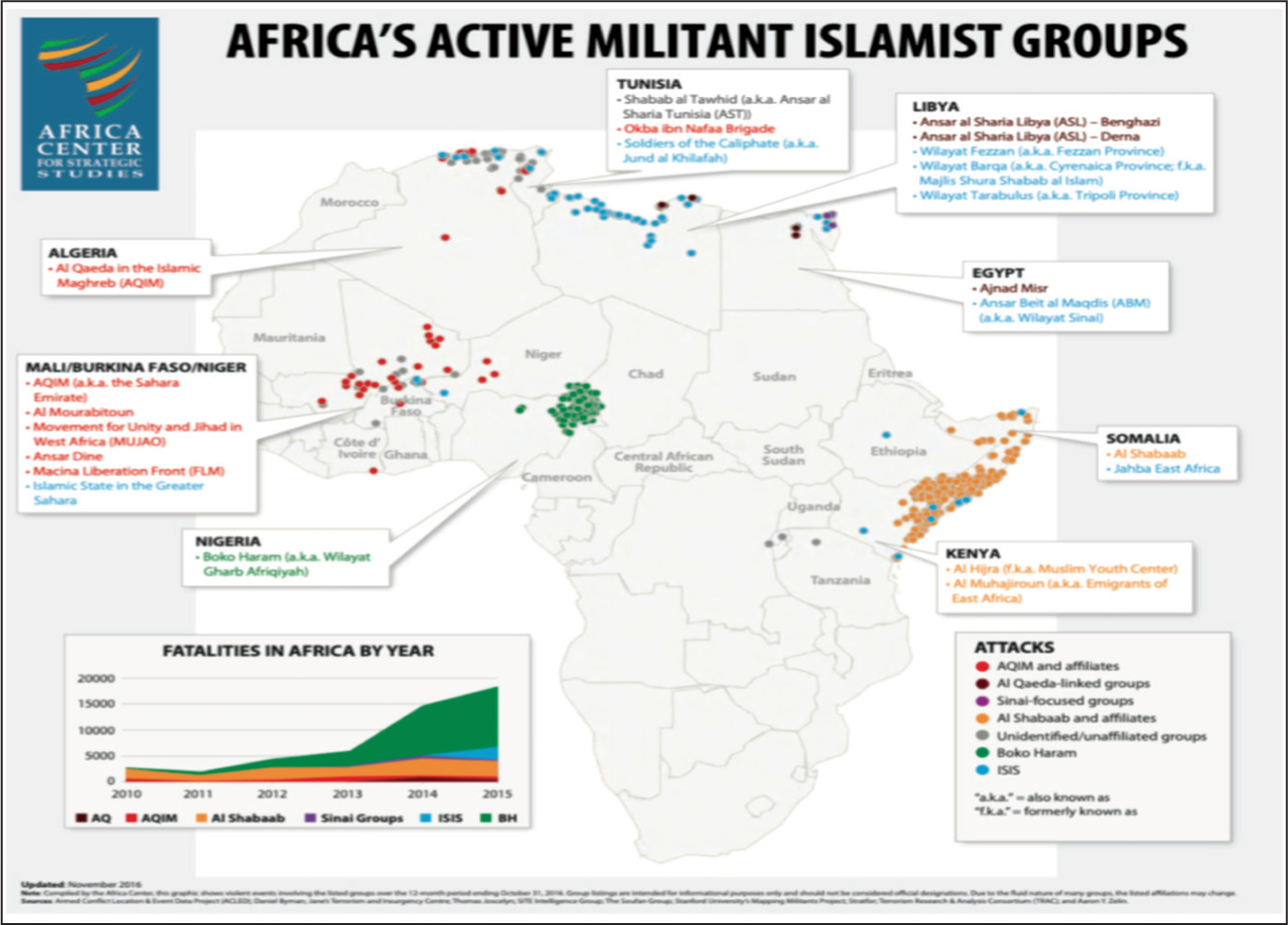
Figure 1 depicts the geographical distribution of active militant Islamist groups in Africa in 2017. The map shows the concentration of insurgent activity across important regions such as the Sahel, the Lake Chad Basin, North Africa and the Horn of Africa. It shows that groups such as Boko Haram, Al-Shabaab, AQIM and Islamic State affiliates were active in a number of nations, illustrating the international aspect of militancy on the continent. The map also depicts the spatial distribution of attacks and deaths, displaying the increasing severity and reach of extremist violence throughout Africa (see Figure 1; Africa Center for Strategic Studies, 2017).
ISIS’s presence in Africa is not confined to Central Africa; rather, the group has sought to expand its influence across multiple regions of the continent. From North Africa, where it once held territory in Libya, to West Africa through its affiliations with Boko Haram and the ISWAP, and to the Sahel and East Africa, ISIS has attempted to exploit local conflicts and governance vacuums to establish a foothold. The formation of the ISCAP represents only one dimension of this wider continental strategy (Beevor & Berger, 2020).
This development has turned into one of the most pressing security challenges for African states. In recent years, the Sahel has increasingly become the epicenter of global violent extremism. After the withdrawal of Western military forces from Burkina Faso, Mali, and Niger between 2021 and 2024, the region witnessed a sharp rise in terrorist activity, both in frequency and lethality. Strikingly, while the Sahel accounted for only about 1% of global terrorism-related deaths in 2007, by 2024 it was responsible for 51% of such fatalities worldwide (Institute for the Study of Diplomacy, 2025).
Following the death of Abu Ibrahim al-Hashimi al-Qurashi in early 2022, the IS announced Abu al-Hassan al-Hashimi al-Qurashi as its new leader in March 2022, after which affiliated groups, including the ISGS, pledged allegiance to him (VOA News, 2022). They have extended their activities with financial and strategic support from IS central command, including a 2018 ambush on US and Nigerien forces that killed four Americans. In 2022, ISWAP produced a video portraying child soldiers beheading Nigerian troops to recruit locals and inspire lone-wolf strikes overseas, reminiscent of ISIS’s global reach in 2015. Recent smuggling, weapons, and human trafficking narcotics have sought Atlantic coast access to finance operations (Institute for the Study of Diplomacy, 2025).
On June 15, 2022, the ISWAP, which is the regional branch of the IS in northeastern Nigeria and the Lake Chad Basin, released a propaganda video with the title “A Book that Guides and a Sword that Helps.” The video was 39 minutes long. To establish a new operational base, the video urged Muslims all over the world to embark on hijrah (migration) to Africa. After that, in the 343rd issue of An-Naba, the weekly newsletter of the IS, it was stated that African nations were “one of the fruits of IS’s blessed path” and that the continent was referred to as the “land of jihad and hijrah” (Singh & Dass, 2022).
The IS’s growing presence in Africa is far from uncontested. While IS projects strength through videos, photos, and editorials highlighting Nigeria, Mozambique, Congo, and the Sahel, it faces a strong rival in al-Qaeda and its affiliates. The competition for territory, recruits, and influence has created a fragmented extremist landscape, preventing either group from achieving dominance (Global Fight Against Terrorism Funding, 2022).
In the case of DRC, most of ISIS’s violence is linked to the Allied Democratic Forces (ADF), a long-standing Islamist group that brutally attacks civilians. However, it is still unclear whether the entire ADF now functions under the banner of ISCAP or if only a faction of it does. In October 2019, the Congolese army (FARDC; the Armed Forces of the DRC) launched a major operation to destroy the ADF’s largest base, Madina. Although the army reported success, ADF attacks in the Beni region continued, with more than 40 civilians killed. The ADF has previously shown the ability to regroup quickly, making it a highly mobile and resilient force (Beevor & Berger, 2020).
The situation in Mozambique is equally alarming. Fighting in the northern Cabo Delgado Province began in 2017, but attacks escalated sharply in 2019. The insurgent group behind the violence, locally called al-Shabaab (not linked to the Somali group of the same name), has been gaining ground. In March 2020, militants briefly captured the strategic town of Mocimboa de Praia, raised the ISIS flag, and addressed residents. Their combined religious and social appeals claim to support Muslims and the poor. This was a shift from ISIS’s official rhetoric, which often emphasized targeting Christians. The group’s ability to seize and control territory is expanding, and its local influence and recruitment capacity are likely to grow.
In March 2019, ISIS announced a merger between the ISGS and the ISWAP. ISWAP had earlier carried out smaller attacks but gained international attention after a May 2019 assault in Tongo, Niger, that killed 28 soldiers. The group later released videos of fighters in Mali and Burkina Faso pledging allegiance to ISIS leader Abu Bakr al-Baghdadi. By the end of 2019, ISGS was described as one of ISIS’s most “successful” branches. However, this so-called merger was largely propaganda. In reality, ISGS and ISWAP lacked the structure, coordination, and reach to function as one united group across the Sahel. Even so, ISIS’s announcement served to raise the group’s profile and attract greater attention. Since March 2019, ISGS has strengthened its ties with ISIS central, boosting its operational capacity and attack sophistication. ISGS attacked military bases in Mali (Mondoro, Boulkessy, Indelimane, Tabankort) and Niger (Inates, Sanam, Chinagodar) in late 2019 and early 2020, killing 400 soldiers.
In response, the January 2020 G5 Sahel Summit introduced a new cooperative framework—the International Coalition for the Sahel—for prioritizing the fight against ISGS in the Liptako-Gourma region (Burkina Faso, Mali, Niger). This was significant, as the region had previously been dominated by al-Qaeda affiliates. In the future, there are big risks, such as the possibility of ISGS and al-Qaeda’s local network Jama’at Nusrat al-Islam wal-Muslimin (JNIM) getting into more fights and ISGS and ISWAP joining forces in northwest Nigeria or moving south toward the Gulf of Guinea.
Conclusion
The threat from the IS in Africa is not about a new, formal state, but rather a growing network of decentralized affiliates. These groups, often referred to as “provinces” (wilayats), are gaining power and territory by exploiting local conflicts, weak governance, and economic instability. Their goal is to establish a network of resilient, autonomous entities rather than a single unified state, making them a significant and evolving threat.
Analysts estimate that jihadist groups in North and West Africa have amassed over €100 million through ransom payments, reinvesting these funds in weapons, vehicles, surveillance tools, recruitment, and bribery to strengthen their networks. ISIS and its affiliates also increasingly rely on cryptocurrencies, exploiting the anonymity of digital transactions. Beyond Africa, ISIS’s ultimate aim is not merely regional dominance but a broader global resurgence. Strategically, they use entry points such as the Gulf of Aden and the Red Sea to expand into Somalia and North Africa, reviving their position on the world stage. ISIS is not a desperate, defeated force—it re-emerges, and Africa has become the soil for this resurgence.
Tragically, this resurgence is unfolding in regions already scarred by insurgencies, hunger crises, pandemics, climate change, poverty, and political instability. As a result, Africa may become the primary battleground for violent jihad, potentially surpassing the Middle East. Yet, governance remains the most decisive factor. Preventing jihadist insurgencies in the long term depends less on policing and fortified borders and more on addressing deeper socioeconomic root causes. Strong economic opportunities and political stability are essential to provide alternatives to violence and to promote lasting peace.
Footnotes
Declaration of Conflicting Interests
The author declared no potential conflicts of interest with respect to the research, authorship, and/or publication of this article.
Funding
The author received no financial support for the research, authorship, and/or publication of this article.