







Abstract
A wide range of methodologies are available for predicting the future such as foresight. Such approaches have been widely deployed by organisations and governments to explore potential developments for purposes of planning, resilience, mitigation and adaptation. The differing methods employ a range of qualitative, quantitative and mixed methodology research tools. The future is subject to dynamic intervention as embodied in innovation and the phrase that ‘if you wish to know the future, design it’. The advent of widespread use of artificial intelligence, robotics, neurotechnology and continuous advance in each of the domains is impacting many if not all aspects of society. This review uses diverse methodologies to explore developments within a defined time horizon, a generation taken as approximately 25 years, focussed on 2050, across a range of domains and topics subject to multi, cross, inter and transdisciplinary practice. Although all domains are considered along with major influences on society, a focus is given to eight domains, medicine, robotics, photonics, materials, AI, space, physics and behavioural science, in particular, as representative examples of changes expected. Major societal and behavioural drivers identified in this presentation of preliminary data from the study include well-being, authenticity and sustainability, the steady influence of established philosophy and religion, emerging social media influences, thinking and developments arising from transcending our planetary boundaries, and the impact of disciplinary boundary morphing approaches on innovation in both established and emerging domains.
Keywords
Introduction
Knowledge of the future is often associated with planning processes. There are a wide range of tools, methods and approaches available for exploring potential future scenarios ranging from modelling to foresight and forecasting. Foresight and assumptions driven planning can help mitigate many of the uncertainties inherent in the future. Such tools have been used in business, organisations and government to support planning, mitigation of potential risks, provide resilience and the capacity to adapt by identification of signals and outliers. Knowledge is not static. It can be discovered through exploration, experimentation and theory, and also generated as in innovations and designs that show that something novel is possible. As a result, exploring future scenarios is a challenging endeavour with many potential variables compounded by complex behavioural factors such as heuristics and biases.
Indicative List of Domains
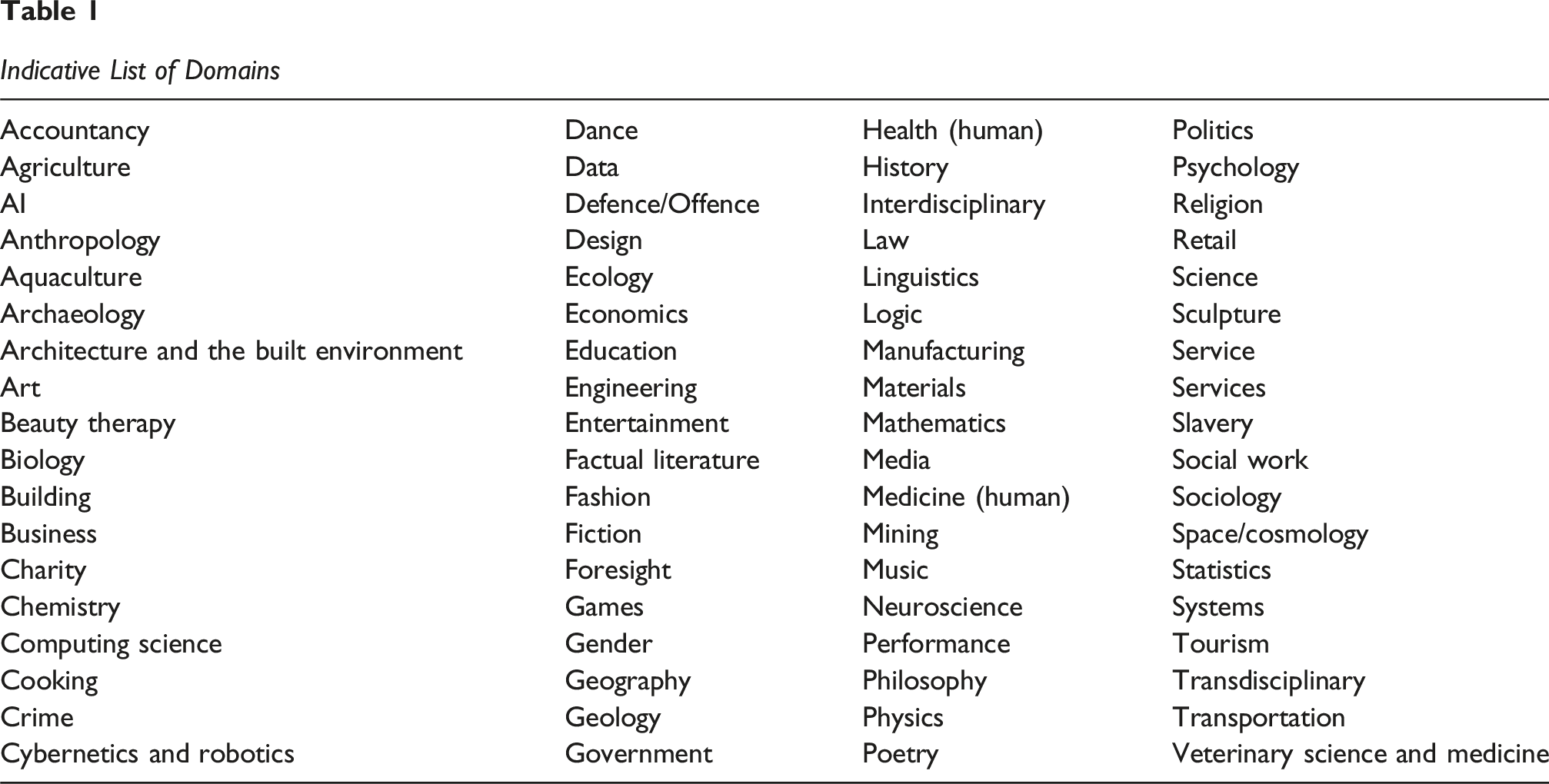
Although siloed domains represent important facets of society, all the examples presented in Table 1 involve crossovers and interactions with other domains. Some actors in society, such as politicians, media influencers and religions, operate across many domains. There are diverse ways of representing a society, ranging from contextual drivers operating at a macro level from geographical regions and economic sectors, to cultural characteristics and age to micro drivers. As evident from the very broad topics described, in order to capture potential areas of development and arising future scenarios within and across domains and within wider society it is important to consider a very range of factors.
A series of methodologies amenable to foresight is described along with the arising methodology adopted. This paper presents preliminary results from the initial phases of the study and is limited in terms of the number of domains and areas considered with a focus on medicine, robotics, photonics, materials, AI, space, physics and behavioural science. This series of areas of domains were deemed representative of change and are presented. Discussion of some of the arising themes is presented along with the arising conclusions.
Methodology
Foresight is the analysis of alternative futures. Foresight’s function is to prepare strategies and shape policies that are robust enough across a number of plausible futures, particularly where the underlying systems are rapidly evolving, often asymmetrically and exponentially. Thus, when surprises occur, they can be highly disruptive to the incumbent system. In effect, it can be said Foresight is a form of ‘Strategic Options Analysis’ acting as an insurance against uncertainties defined as ‘unknown-knowns’ and ‘unknown-unknowns’, improving organisational resilience against such contingencies. Often confused with strategy, foresight precedes and helps shape strategy thus making the two activities complementary and crucial to organisational survival and success. Foresight aims to support policymakers in making better-informed decisions, having considered future eventualities, scenarios and outcomes. Foresight involves combining expert input, scenario planning, and use of visual tools such as roadmaps to identify, prioritise, and shape future research and technology strategies, often involving structured dialogue, consensus-building, and ongoing monitoring to guide organisations toward desired future outcomes. Foresight’s function is to prepare strategies and shape policies that are robust enough across a number of plausible futures, particularly where the underlying systems are evolving and often asymmetrically. Thus, when surprises occur, they can be highly disruptive to the incumbent system.
Foresight is often confused with forecasting. Forecasting does try to predict the future. It takes data from the past and extrapolates it into the future using a variety of tools from statistics to simulations. Forecast helps users understand the present and the most likely future, often with upper and lower limits. However, at a time when underlying systems are changing in fundamental ways, users of forecasting should take care to confirm that the supporting assumptions are still accurate (Padbury, 2020).
Future casting is a strategic process for imagining and planning for potential future scenarios. The approach is used in business and other fields to anticipate and prepare for change and involves exploring trends, identifying risks and opportunities, and developing proactive strategies based on these projections. A number of inputs including scenario planning, trend analysis, in-depth research and data analysis, and collaborative exploration of diverse perspectives are all used in future casting. Scenario planning involves creating multiple scenarios that represent potential future states, allowing for a more comprehensive view of possible outcomes. Trend analysis concerns analysing trends and identifying key drivers of change in the industry, market, and broader environment. In-depth research and data analysis are crucial for identifying and evaluating potential future scenarios. Engaging diverse perspectives and expertise is essential for creating robust and insightful future casting exercises. By comparison, forecasting tends to be a more linear approach to determining one point of a future that usually is more focused on the market. Back-casting in contrast involves defining a future, say 5, 10 or 20 years ahead, and working backward the necessary specific steps to achieve this.
The further out a projection is then the likelihood increases that more distant assumptions will be subject to a variety of inflexions, each of which can impact the level of variance from the original projection (see Lorenz, 1963). The importance of constant monitoring and variance analysis of projections made earlier is vital if the longer term projections are to have any substantive value. One technique which can help to identify future inconsistencies is back-casting, allowing the analyst to test future assumptions by a bottom-up and top-down approach. This process can help identify inconsistencies between short and longer term projections.
Qualitative scenario analysis explores future possibilities using expert elicitation, narratives and storylines, descriptions, red teams, and visual representations rather than numerical data. Qualitative scenario analysis allows for rich, narrative-driven exploration of complex, uncertain futures, facilitates participatory stakeholder engaged approaches, incorporating diverse perspectives, handles deep uncertainty and is useful when quantitative data is scarce or when exploring long-term, transformative changes and has potential to enable holistic understanding capturing socio-political and behavioural factors that are hard to quantify. Qualitative analysis should also allow for historical factors which may impact underlying behavioural and cultural drivers in the projection often latent or hidden.
Quantitative scenario analysis is a method of evaluating potential future states by using numerical data, model-based projections, and simulations to assess trends and relationships. Merits include precision and reproducibility, providing numerical outputs, enabling clear comparisons, integration with other models such as linking socio-economic scenarios (e.g. SSPs) with climate models (e.g. RCPs), policy-relevant insights that can be useful for cost-benefit analysis and infrastructure planning, and sensitivity testing allowing for probabilistic risk assessments. There has been a tendency for the two schools of scenario analysis to take up polarised positions. This is unnecessary as it ignores the fluid, transitional and dynamic nature of data with at some stages hard (quantitative) data available and at other times, usually further out in the projection no data available. Good analysis must be able to incorporate both quantitative and qualitative material in the projection and amend accordingly as new information becomes available and adopt a mindset of being approximately right rather than precisely wrong.
Participatory scenario development is a process that involves stakeholders in envisioning and exploring different possible future scenarios. It is a collaborative approach where individuals with diverse perspectives work together to create storylines and narratives about the future, considering factors such as social, economic, and environmental influences. Participatory scenario development can use workshops involve a range of people representing the diverse stakeholders. Merits of participatory scenario development include inclusivity engaging policymakers, communities, and experts in co-creating scenarios, local relevance tailoring scenarios to specific contexts, building consensus helping align different stakeholders on plausible futures and enhances legitimacy and acceptance of scenario outcomes in decision-making. The deployment of a highly motivated skilled team to resolve an issue can help challenge group-based biases.
One method, the Delphi method is a structured communication technique used for forecasting and decision-making (Drumm et al., 2022; Humphrey-Murto et al., 2020; Linstone and Turoff, 1975). It is used principally where expert opinions are crucial but face-to-face discussions may be impractical or biased (Landeta, 2006; Zartha Sossa et al., 2019). The Delphi method relies on a panel of experts who provide their insights anonymously through multiple rounds of questionnaires, with feedback aggregated and shared between rounds to refine opinions and reach a consensus. The drawback to the Delphi method is that it is demanding of expert manpower resources and the phased iterations can be too slow – an issue increasingly in a rapidly changing world, politically, economically, social and especially technologically. Survey responses are also widely used to illicit broad trends (see, e.g. McKinsey and Company, 2025).
Hybrid approaches combining qualitative and quantitative methods are useful in exploring multiple objectives and differing stakeholder requirements. Merits of hybrid research methods can include balance of depth and rigour, for example, integrating storytelling with data-driven modelling, addresses uncertainty by combining exploratory scenarios with probabilistic risk assessment and robust decision-making through provision of both narrative context and numerical projections. No single method is superior; the choice depends on the purpose (e.g. policy planning vs risk assessment) and data availability. Participatory and hybrid approaches are increasingly favoured for resilience studies due to their ability to integrate local knowledge with scientific modelling. Combining qualitative narratives with quantitative models improves robustness in uncertain futures.
A wide range of tools have been developed and promoted for exploring trends and future possibilities such as the futures cone, trends of evolution along with models such as STEEPV (an acronym standing for social, technological, economic, environmental (or ecological), political, and value c.f. PESTLE), and hype and S curves, also known as Gartner hype curves some of which can be called megatrends, as well as a group of methods called Structured Analytic Techniques (SATs). In addition, approaches such as design thinking and various creativity tools have been found to be consistently influential in innovation. The futures cone is a model for representing and considering the range of possible futures for any given factor or scenario (van der Heijden, K., 2004; Voros, 2017; Gall et al., 2022). In TRIZ (the Theory of Inventive Problem Solving (see Childs, 2019; Gadd, 2011), Trends of Evolution (ToE) are patterns that describe how technical systems develop over time. These trends help predict future improvements and guide innovation by showing common pathways that successful systems follow. There are several recognised trends, often categorised into classical (original) and modern (expanded) versions. These include: increasing ideality = Σ benefits/(Σ costs + Σ harms); dynamisation (flexibility and adaptability); transition to a higher-level system (system integration); transition from macro to micro (miniaturisation); increasing controllability; non-uniform development of system parts; decreasing human involvement (automation); transition from mechanical to field-based interactions; segmentation and multiplication; rhythm coordination (matching frequencies) – systems improve by synchronising the rhythms of interacting components. Further methods include Causal Layered Analysis (CLA) which provides multi-layered perspectives for developing foresight based assumptions and Structured Analytical Techniques (SATs).
Design thinking is used by some organisations as part of a hybrid methodology for prediction, for example, combined with strategic foresight. Design thinking concerns leverage of approaches associated with insights and their implementation from design practice. Common characteristics of design thinking include consideration of the stakeholders, exploration and experimentation, prototyping and testing. Design thinking is relevant to this study as futures are not static and subject to change arising from innovation. Creativity can be regarded as a process, ability or outcome (Green et al., 2024). Innovation can be defined as the realisation of value from creativity. The topics of creativity and innovation are interlinked with design being the enabler to transition from an idea or concept, enabling the detailed embodiment for innovation (Childs and Fountain, 2011).
Fundamental to a review such as is this is consideration of knowledge, what it is, how it emerges and its consequences. Knowledge can be regarded in terms of belief of what is considered true and justifiable. Knowledge tends to arise from interpretation of information arising from experience and education. Knowledge can involve discovery of pre-existing phenomena but can also be generated through innovation and creativity. Through a novel design, the embodiment of detailing that links creativity and innovation (see Childs and Fountain, 2011), a new possibility is revealed and this contributes towards further developing the knowledge base. Just as with classic understanding of finance, money can be mined, grown, manufactured and provided as a service, so too are there a number of ways in which knowledge can be generated. For these reasons, a diversity of approaches to exploring how review of the existing state of knowledge is needed to enable considerations of how this knowledge could develop. Of relevance to current discourse on knowledge in the context of the AI era is the nature of data. AI can be useful in generating novel insights, but can also be used to generate diverse alternatives, which may not constitute a useful ground truth in modelling. The generation of data is expected to vastly increase going forward and represents a challenge to knowledge acquisition and its wise application.
Multidisciplinary, interdisciplinary, cross-disciplinary, transdisciplinary, and variations, describe different approaches to integrating knowledge and methods across multiple fields, Figure 1. Disciplinary practice is focused on a single academic discipline or field. Multidisciplinary approaches concern people or leverage of knowledge from different disciplines working side by side but not integrated. Multi-disciplinarity is characterised by each discipline retains its own methods and perspectives. In cross-disciplinary practice one discipline borrows methods or concepts from another without deep integration. Cross-disciplinary approaches can involve viewing a topic from the ‘lens’ of another field. Representation of Disciplinary, Multi, Cross, Inter and Transdisciplinary Practice. Image Produced by P. Childs
Interdisciplinary practice involves integration of methods, theories, or concepts from multiple disciplines to create a unified approach. Interdisciplinary practice is sometimes associated with attempts to address complex problems that are anticipated to require collaboration beyond a single field. Transdisciplinary practice concerns leverage of knowledge from various domains to form new domain knowledge and approaches that transcend traditional disciplinary boundaries.
Blending aspects of foresight and futures processes, along with various design and trend analysis tools the arising mixed research methodology adopted comprised the following sub-tasks and is illustrated in Figure 2. • Identification of principal domains • Expert interviews round 1 • Use of at least two LLMs including ChatGPT, DeepSeek • Literature review • Identification of principal insights 1 • Trends of Evolution, Morphological Analysis, Design Thinking and Causal Layered Analysis • Expert interviews round 2 • Confirmation of principal insights. Research Methodology Phases. Image Produced by P. Childs
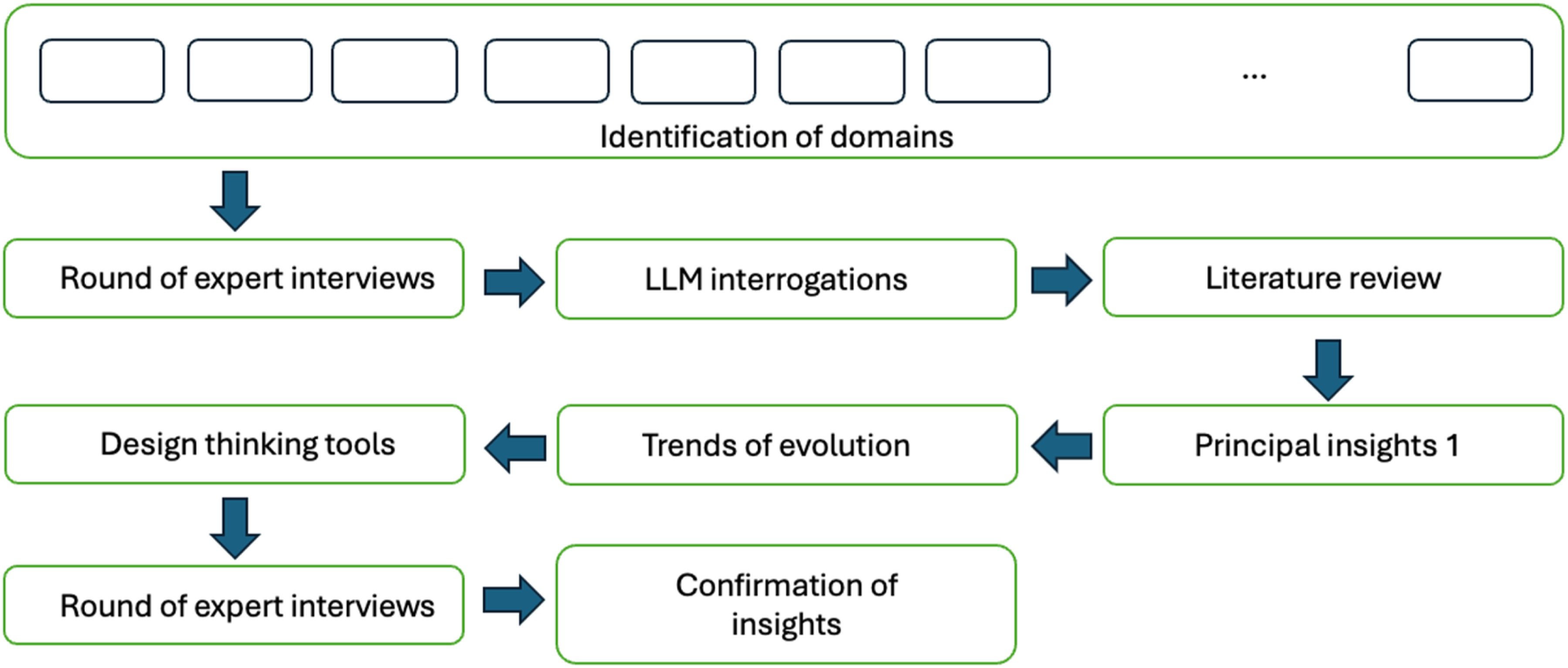
The methodology design with a preliminary review of information from experts, enables identification of prompt inputs for the LLMs and literature review. The use of trends of evolution following identification of the first round of principal insights enables leverage of this key information. The notion of creativity and associated agency in determining the future is embodied in the methodology design by inclusion of design thinking tools after identification of a series of key insights and information. A further round of expert interviews is used to explore and verify findings.
An arbitrary time frame of a generation, approximately 25 years was adopted, focussed on 2050 AD. One or two decades could have been adopted but were deemed too short for some of the domains, such as physics and space, and their impact on society. Three or more decades was deemed too long in terms of the methodology and uncertainty associated with the impact of emerging trends in society. 16 experts were invited with over 20 years’ post first degree experience in the eight selected domains, with the exception of AI where 10 years’ experience was deemed more representative for the domain in terms of its rapid development. The studies involving human participants were subject to review and approval by the Science Engineering Technology Research Ethics Committee (SETREC number 7871602) at the lead author’s institution. Written informed consent to participate in this study was provided by the participants. All experts engaged in the two rounds of interviews. The number of experts surveyed represents a convenience sample and does not pertain to be a statistically representative sample. Nevertheless, the expert interviews as part of the mixed-methods research methodology provide additional data enabling identification of key areas for other aspects of the research methodology such as literature review and LLM interrogations, as well as confirmation of key areas. Preliminary results from the study for the arising technology trajectories for the eight areas are presented in the following section. Subsequent publications will address detailed analysis of the expert interviews and in-depth data analysis.
Technology Trajectories
Although this review has considered a very broad set of variables relevant to society with drivers identified from foresight, interviews, literature, LLMs, trends of evolution and design thinking, consideration of institutions and a wide set of domains, the presentation of trajectories is limited here to eight topic areas deemed representative of some of the broad findings from this preliminary study. This limited set, covering medicine, robotics, photonics, materials, AI, space, physics and behavioural science is presented here. The time as noted previously for this review is arbitrarily taken as generational, circa 25 years.
Medicine
Medicine is expected to undergo breakthroughs driven by advances in biotechnology, artificial intelligence (AI), genomics, and nanotechnology. The methodology adopted resulted in the identification of several key areas in medicine where substantive developments are expected to have transformatory influence, including the implementation of AI and machine learning, gene editing and advances with CRISPR (Clustered Regularly Interspaced Short Palindromic Repeats) gene editing, mRNA (messenger ribonucleic acid) and next-generation vaccines, regenerative medicine and stem cell innovation, implementation of neurotechnology and brain-computer interfaces, nanomedicine and targeted drug delivery, microbiome-based therapies, immunotherapy and cancer breakthroughs, longevity and anti-ageing medicine, digital health and wearables.
AI and machine learning are impacting many areas of medicine (Haug and Drazen, 2023). AI-assisted diagnostics are expected to improve early detection of diseases (e.g. cancer, Alzheimer’s) through imaging analysis and biomarker prediction. In drug discovery AI has potential to vastly accelerate the development of new drugs by predicting molecular interactions and optimising clinical trials. For personalised treatment plans machine learning can be deployed to analyse patient data to recommend tailored therapies.
Gene editing, which involves altering the genetic material of a living organism by inserting, replacing, or deleting a DNA (deoxyribonucleic acid) sequence, and CRISPR advancements, a gene-editing tool, have already had an impact on the medical sector but the pace of these is expected to accelerate. CRISPR 2.0 can be expected to produce safer, more precise gene-editing tools (such as base and prime editing) to treat genetic disorders including sickle cell anaemia, cystic fibrosis, and muscular dystrophy (Chavez et al., 2023). Epigenome editing represents a further area for breakthroughs, enabling modification of gene expression without altering DNA for treatment of diseases such as cancer and diabetes. Gene therapies for common diseases could be further developed enabling potential cures for heart disease, HIV (human immunodeficiency virus), and neurodegenerative conditions.
mRNA (messenger ribonucleic acid) and next-generation vaccines are expected to gain significant prominence as a result of developments. Laboratory produced mRNA can be used to prompt cells how to make a protein, or part of a protein, that can trigger an immune response. mRNA is not a vaccine as such but instead its introduction to the body can assist the immune system in recognising a virus and making antibodies against it. Autoimmune disease treatments for conditions such as multiple sclerosis could be treated using mRNA to reprogram immune responses. Cancer vaccines leveraging mRNA technology (c.f. COVID vaccines) are expected to target tumour-specific antigens (Pardi et al., 2018; Sayour et al., 2024; Yaremenko et al., 2025). Universal flu and HIV (human immunodeficiency virus) vaccines and other broad-spectrum vaccines may become a reality.
Regenerative medicine and stem cells represent significant areas of development. Stem cells exhibit abilities to self-renew and to recreate functional tissues. They have been subject to significant scientific study and their properties for regeneration show Human and other species organ regeneration with laboratory-grown organs including kidneys and livers, using 3D bioprinting and stem cells (Jain et al., 2022) has already been demonstrated as a possibility and could become routine. Developments in stem cell therapies indicated that it be possible to undertake spinal cord repair and restore function after paralysis. Anti-ageing therapies are increasingly gathering attention in certain demographics representing an arising business development opportunity. Senolytics, a class of class of drugs that selectively target and eliminate senescent cells (‘zombie cells’), and stem cell rejuvenation could extend healthspan (Chaib et al., 2022) and be used as treatments for conditions such as frailty, cancer and cardiovascular disease. At the other end of the spectrum artificial womb technology is subject to significant advances (Andonotopo et al., 2025; Bulletti et al., 2023) with breakthroughs expected in areas such as oxygenation, sterilisation, endocrine simulation, umbilical cannulation and0 AI monitoring, opening the way towards demonstrations of ectogenesis.
Neurotechnology and brain-computer interfaces (BCIs) are breakthrough technologies relevant to a wide range of domains. In medicine BCIs have potential for both control of equipment such as implants and exoskeletons but also in treating paralysis and brain disorders. BCIs such as Neuralink may help stroke and amyotrophic lateral sclerosis (ALS) patients regain movement.
AI-brain integration could enhance cognitive function and memory restoration for Alzheimer’s patients. Precision neuromodulation, for example, deep brain stimulation, has potential for mental health treatments such as depression and PTSD (post-traumatic strain disorder).
Nanomedicine and targeted drug delivery are key areas of development. Nanobots, can manipulate the orientation of cells enabling precise drug delivery and perform precision surgical tasks such as removing plaque from arteries (Kong et al., 2023). Cancer nanotherapies could be developed using nanoparticles that selectively destroy tumours with minimal side effects. Real-time monitoring is another area of potential an interest, for example, using implantable nanosensors for continuous health tracking (e.g. for glucose and blood pressure).
Increased attention and arising understanding of gut-brain linkages has led to a series of potential areas for development of microbiome-based therapies, treatments and personalised well-being and nutrition. Gut-brain axis treatments using probiotics and microbiome transplants have potential for depression, autism, and Parkinson’s. For personalised nutrition, microbiome analysis can be used and further developed to optimise diets for metabolic health (Bajaj et al., 2022; Manrique et al., 2024; Sorbara and Pamer, 2022).
Many immunotherapy and cancer breakthroughs can be expected within the timeframe enabled by CAR-T cell treatments, custom vaccines and use of novel biopsy processes. CAR-T (chimeric antigen receptors) cell expansion could enable more cancers (solid tumours) to be treatable with engineered immune cells (Cappell and Kochenderfer, 2023; Kaczanowska et al., 2024; Sterner and Sterner, 2021). Custom neoantigen vaccines could be tailored to a patient’s tumour mutations. Cancer early detection could become routing using liquid biopsy blood tests for catching cancers at stage 0.
Longevity and anti-ageing medicine are highlighted as areas of societal interest. Rapamycin and mTOR (mammalian target of rapamycin) inhibitors drugs that slow ageing by enhancing cellular repair can be expected to become increasingly available and effective. Telomere extension and other experimental therapies to delay cellular ageing could be developed (Ali et al., 2022; Mao et al., 2022). Plasma-based rejuvenation through young blood transfusions may become another routine treatment although it should be noted that such topics are controversial.
Digital Health and Wearables have been enabled by electronics miniaturisation, computational advances and improvements in batteries. These represent enabling technologies for areas such as continuous health monitoring, remote patient care and decentralised clinical trials. Smartwatches detecting arrhythmias, blood sugar, or early infections can be used for continuous health monitoring with potential consequences for management, treatment and even insurance. Decentralised clinical trials can be undertaken with wearables and AI with increasing capabilities for faster treatment and drug approvals.
Robotics
Robotics advances are being driven by enabling technologies and capability in AI, materials science, and improved computing power. Indeed, robotics is expected to transition from niche and industrial use to widespread adoption across society. Potential areas for significant development over the time period concerned include AI-enabled autonomous robots, humanoids and social robots, soft robotic and biohybrid, swarm robotics and collective intelligent systems, medical and surgical robotics, self-replicating and evolving robots, advanced mobility, BCI controlled robots, energy and sustainability related innovations, ethical and safety developments and ever-increasing human-robot collaboration.
AI-enabled autonomous robots can be expected to become widespread in society. General-purpose and ever more adaptable robots will be produced with developments from Tesla’s Optimus and Figure AI, capable of performing diverse tasks in homes, factories, and hospitals. Self-learning robots learn from experience rather than pre-programming will be possible leveraging further developments in reinforcement learning and large language models (LLMs). Human-like reasoning can be expected in robotics. AI models such as OpenAI’s GPT will enable robots to understand complex instructions and problem-solve in real-time.
Humanoid and social robots can be expected to become common in society. Whether this is actually the case may depend on social context, affordability and acceptability, but the technical challenges and cost trajectory appear attainable. Such robots could become widespread as domestic helpers with humanoids or task specific robots assisting with chores such as cleaning, cooking, and care for the elderly and other dependents. Enhanced capability in AI as demonstrated in LLMs enables emotionally intelligent robotics. Social robots as demonstrated currently by Ameca or Sophia 2.0 can be expected with better facial expressions and natural conversations for diverse applications including therapy and customer service. Robotic companions may become common and certainly represent a significant market opportunity. This may span AI-driven pets and assistants for the elderly to combat loneliness to personal companions.
Soft Robotics, using compliant materials, and biohybrid systems and living robots, leveraging materials and processes inspired from nature offer step changes in capability. Flexible, soft robots with components such as grippers and limbs made of silicone or polymers can be used for delicate tasks such as surgery and fruit picking. Living robots may be demonstrated. Xenobots, biological robots made from frog cells from the African clawed frog (Xenopus laevis), could perform medical tasks inside the body (Coghlan and Leins, 2020; Pai et al., 2025). Self-healing materials can be utilised so that robots can repair damage incurred autonomously.
Swarm robotics and collective intelligence offer significant potential for enhanced functionality (Devi et al., 2024; Dorigo et al., 2021; Shahzad et al., 2023). In a swarm coordinated groups of robots work together in a decentralised manner, originally inspired by the collective behaviour of social insects and other swarms in nature. The robots, acting autonomously, interact with each other and their environment through local communication and sensing to achieve complex tasks that would be difficult or impossible for a single robot. Swarm robotics systems operate without a central controller with each robot making decisions based on local information and interactions. Their performance is characterised by emergent behaviour that arises from interactions between individual robots and their environment (Abdel-Rahman et al., 2022). A swarm can move together in a coordinated manner, change shape to adapt to a scenario or searching for resources, can explore and map an environment efficiently and can collectively decide on a course of action or a target. Swarm robotics has potential applications in various fields, including logistics and warehousing, moving goods and managing inventory in large-scale environments, search and rescue: exploring disaster zones and locating survivors, military applications, agriculture, automated spraying, pollinating crops, micro-bots weeding fields and harvesting, environmental monitoring, collecting data and assessing environmental conditions, and construction 3D-printing buildings in teams (e.g. MIT’s digital construction platform).
As indicated previously robotics is expected to continue to have impact on medicine with applications ranging from surgery across scales to care and rehabilitation tasks. Autonomous AI-guided surgical robots offering functionality beyond current systems, such as the Da Vinci robot, could potentially perform surgery with minimal human oversight (Attanasio et al., 2021; Han et al., 2022). At the cellular and microscopic level, nanobots could undertake precision tasks such as capturing and orientating cells to be receptive to drug or surgical interventions. This could transform clearing of clots and delivery of drugs. Robotic exoskeletons, wearable mechanical or robotic devices that enhance human strength, endurance and physical performance, offer significant potential in transforming rehabilitation and care, for example, helping paralysed patients walk.
Self-replicating robots that are capable of reproducing autonomously using raw materials found in the environment and evolving robots that improve the performance, of a robot according to criteria such as speed, cost of transport or manoeuvrability but with adaptations that occur on condensed timescales, are reversible, and entail no net change in mass or re-assembly of discrete components (Baines et al., 2024) offer significant advantages in resource constrained applications. These technologies have already be demonstrated in the case of modular self-assembling robots, such as MIT’s voxels, that reconfigure themselves for different tasks (Bray and Groß, 2023), AI-designed Evolutionary robots that improve over generations using generative AI and simulation, and application targeted concepts such as space construction robots that can build lunar bases or Mars habitats autonomously (Zhao et al., 2025).
Robots can move by diverse means including pedipulators or legs, wheels, whegs which involve combine wheel and leg attributes, tracks, thrust, electromagnetism and serpentine locomotion. Advances in Mobility and Legged Locomotion can be expected from improvements in motors, materials and energy storage technologies and gait control. As a result faster, more agile robots are likely to emerge demonstrating capabilities substantially beyond those exhibited to date by for instance Boston Dynamic’s Atlas with its impressive parkour skills. These could open up potential for all terrain performance with diverse applications from disaster zone relief to opening up previously inaccessible terrains to agriculture. As well as land based applications there have been many flying and water based robots and further developments are possible including bird-like drones (see Festo’s BionicSwift) or fish robots for environmental monitoring and aquaculture (Wu et al., 2022). Wheel-leg (Whegs) hybrids and robots that switch between walking and rolling for varied terrain can provide enhanced functionality (Nanayakkara, 2024) enabling benefits of speed, stability and accessibility.
The combination of advances in understanding and capability in neuroscience, computing and neurotechnology is enabling significant new developments in brain-computer interfaces (BCIs). Such technology enables BCI controlled robotics (An et al., 2024; Hu, 2024), mind-controlled prosthetics with advanced neural implants allowing precise robotic limb control (Qu et al., 2024), telepresence robots where people can control avatars remotely via thought (for remote work or space missions) and AI-augmented BCIs where the robot predicts user intent before full commands are given.
Energy and sustainability innovations have been influential in many sectors of society subject to resource constraints and concerns relating to climate change. Untethered robots are subject to limitations in range and function as a result of limitations in battery energy storage. Substantial improvements in battery life and charge times, open up new possibilities in terms of functionality and applications. In addition to pulling charge from the battery, self-charging robots that can dock to recharge or using solar-powered or wireless energy harvesting (ambient radio frequencies, e.g. wi-fi). Biodegradable robots are eco-friendly bots that decompose after use offering potential solutions for environmental cleanup. High-efficiency actuators provide significant potential for new robotic functionalities with electrostatic and pneumatically actuators that mimic human muscles.
Ethics, safety, and human-robot collaboration are key issues in robotics and will increase in prominence with increases in capability and use across differing facets of society. Emergence of understanding of AI and its capacities extending beyond that of a tool to a partner and even director and agent mean increasing attention to issues relating to the ethics associated with AI and robotics using AI. Currently, considerations include requirements for explainable AI systems where justification of decisions is possible. This is critical for healthcare and law enforcement applications but will be likely become relevant to more sectors. Although views on sentience of AI systems are contentious, robot rights have been considered (Gunkel, 2018) and it is plausible that with new business structures and decision-making capability that new legal frameworks for autonomous AI entities will emerge. Wider use of robotics could result in requirements for job displacement solutions such as UBI (Universal Basic Income) or reskilling programs as automation spreads. Figure 3 illustrates a judge generated by AI indicative of the potential use of AI to evaluate AI ethics where the issues are potentially too complex for human evaluation. Image Depicting a Judge Generated by AI Indicating Use of AI to Evaluate AI Ethics. AI-Generated Image, P.Childs, 2025
Photonics
Photonics – the science of generating, controlling, and detecting light – is poised for transformative breakthroughs that will impact computing, communications, healthcare, and energy. Photonics could be viewed as within the domain of engineering, electrical engineering or physics. The technology, however, offers potential for transformation of a range of areas within society including communications, robotics, medicine and agriculture to name but a few. For these reasons, potential for significant development of this area is highlighted in this review.
Silicon photonics and optical computing are pivotal technologies. Light-based processors, Photonic chips (such as those from Ayar Labs or Light-matter) could replace copper wires in data centres, enabling ultra-fast, low-power AI computing with transformatory impact on data processing and requirements for critical metals. Quantum photonic processors, through integration with quantum computing, offer potential for unbreakable encryption and secure communications and ultra-efficient simulations (Luo et al., 2023). Further commercial deployment of quantum key distribution (QKD), hack-proof quantum networks, can be anticipated (e.g. China’s Micius satellite). Co-packaged optics, combining photonics with traditional silicon chips, could overcome bandwidth bottlenecks in CPUs/GPUs. Entangled photon sources provide the technology for scalable quantum repeaters for long-distance quantum internet.
LiDAR (light detection and ranging) and Advanced Sensing advances will stimulate a range of transformatory innovations. Solid-state LiDAR will provide cheaper, more compact LiDAR for autonomous vehicles, drones, and robotics (Li et al., 2022; Ran et al., 2024). Next-generation optical coherence tomography (OCT) imaging can be expected for early cancer detection and non-invasive glucose monitoring. Hyperspectral imaging, real-time material analysis innovations would enable crop health monitoring in agriculture and explosives detection in security.
Optics can be found in many devices and aspects of current society. Ultra-thin metasurface lenses could replace bulky optics in smart glasses (e.g. Metalenz) leading to their much wider adoption. Dynamic beam steering enables LiDAR and free-space optical communication without moving parts, again opening up innovation possibilities for products where visual analysis of the environment is required. Nanostructured light control will enable more energy-efficient and brighter displays and screens in everyday products.
Biophotonics developments for Medical Applications (Chen et al., 2022; Yan et al., 2024) can be expected to address a series of long-standing challenges. Optogenetics, use of light-controlled neurons for treating Parkinson’s, depression, and blindness has potential to transform care in these sectors. Lab-on-a-chip diagnostics, using portable photonic biosensors for instant virus/bacteria detection could transform diagnostic practice and treatment. Photoacoustic imaging, deep-tissue scans combining light and sound can be applied for cancer and brain monitoring.
Photonics technologies enable ultra-fast optical communications. Examples include 6G and terabit networks with photonic crystal fibres and multiplexing technology enabling near-instant global data transfer (Chaudhary et al., 2022; Wang et al., 2022), and on-chip optical interconnects, replacing electrical wiring in chips with nanophotonic waveguides. Further applications include space laser communications such as NASA’s LCRD and SpaceX’s Starlink lasers for high-speed inter-satellite links.
Photonics is critical in solar energy and photosynthesis-based technology. Photonic engineering of Perovskite solar cells can be expected to boost efficiency beyond 30% (Azmi et al., 2024; Chowdhury et al., 2023). Thermophotovoltaics (TPV), conversion of heat to light and back to electricity for industrial waste heat recovery could significantly boost business performance and energy efficiency efforts. The quest for clean hydrogen could be enabled by artificial photosynthesis with use of light-driven catalysts for hydrogen fuel production.
Topological photonics developments where light flows without scattering will enable robust optical circuits with enhanced quality and performance. Novel light control of chiral light-matter interactions will stimulate innovations in new quantum light sources and sensors (VanOrman et al., 2025). Neuromorphic Photonics, brain-inspired optical neural networks, will enable faster, more efficient AI training using light-based synapses (Li et al., 2025; Shastri et al., 2021).
Materials
Materials science is set for revolutionary breakthroughs, driven by advances in nanotechnology, AI-driven discovery, and sustainable engineering. Areas of significant development and arising societal impact include AI-designed and self-healing materials, superconductors and quantum materials, sustainable and circular materials, energy materials, smart and responsive materials, biomimetic and biohybrid materials, ultra-strong and lightweight materials, quantum and spin-based materials, medical and bio-integrated materials, and materials for use in space and extreme environments.
AI is expected to enable significant development in materials such as AI-designed and self-healing materials (Andreu et al., 2024; Roppolo et al., 2024). Generative AI will be applied in materials discovery. For example, platforms such as Google’s GNoME and Citrine Informatics are expected to accelerate the discovery of new alloys, polymers, and superconductors such as room-temperature superconductors. Self-repairing and smart materials are expected, for example, polymers that mimic biological systems so that cracks in aeroplane wings heal autonomously, metals with microcapsules that can release healing agents, bacteria-infused concrete that repair cracks and materials that are actually biological.
Significant developments in superconductors and quantum materials are expected driving innovations in semiconductors and computing, power networks and fusion.
The development of ambient-temperature superconductors with materials such as LK-99 and derivatives could enable lossless power grids, ultra-fast maglev trains, and compact fusion reactors (Cho et al., 2024; Timokhin et al., 2023). Topological insulators, materials that conduct electricity only on the surface, could enable ultra-efficient electronics. 2D materials beyond graphene developments may include MXenes for flexible electronics and energy storage, and Boron nitride (hBN) providing ultra-thin insulators for quantum devices.
Developments in Sustainable and Circular Materials are expected to include carbon-negative concrete using CO2 mineralisation (e.g. CarbonCure) or algae-based binders (Coffetti et al., 2022; Nilimaa, 2023) and plastic alternatives such as mycelium-based packaging grown from fungi and seaweed-derived bioplastics that are compostable and edible. Development of infinite recycling enabled by depolymerisation, breaking plastics back down into their original monomers and enzymatic recycling using engineered enzymes (e.g. Carbios’ PET-eating enzymes) are both expected to contribute towards sustainability options.
Material developments are needed in the energy sector to provide increased energy density and performance for batteries, higher efficiency solar and enable the safe storage of hydrogen. Developments in solid-state batteries are expected to include Lithium-metal anodes Doubling EV range (e.g. QuantumScape) (Acebedo et al., 2023) and sulphide/oxide electrolytes giving Safer, faster-charging. Perovskite solar cells with tandem designs surpassing 30% efficiency could become viable (e.g. Oxford PV) (Jiang and Zhu, 2024). Hydrogen is expected to emerge as a widespread fuel for use in transportation possibly including long-range aircraft (Jagtap et al., 2024). Hydrogen storage innovations could include further developments in metal-organic frameworks (MOFs) giving high-capacity, low-pressure storage (Yuvaraj et al., 2024) and liquid organic carriers (LOHCs) enabling safe transport of hydrogen.
Smart and Responsive Materials that could be developed include programmable matter, materials that change shape/properties on demand (e.g. MIT’s ‘kinetic tiles’). Phase-change materials (PCMs) offer functionalities for buildings regulating temperature passively, and clothing adjusting thermal insulation based on the temperature. Electrochromic and thermochromic materials enable windows to tint dynamically (e.g. View Glass).
Biomimetic and Biohybrid Materials offer significant potential. Examples are artificial spider silk offering stronger-than-steel fibres for lightweight armour and medical sutures (Huang et al., 2024; Wang et al., 2022b), and living materials such as bacteria-infused textiles detecting toxins or healing wounds and self-growing bricks using microbes to build structures.
Ultra-strong and lightweight materials are essential to enable development of capability in areas such as more sustainable transportation, space missions, fusion reactor production as well a diverse range of product-based applications. Carbon nanotube and aerogel composite developments offer potential materials for use in space elevators and ultra-light vehicles. High-entropy alloys (HEAs) could provide extreme durability for aerospace applications and nuclear reactors. Various product-based applications could be served by developments in metamaterials. Materials could be further development for invisibility cloaks by enhancement of the control of light and sound waves (Chu et al., 2018; Jiang and Wang, 2024; Qian and Chen, 2021). Such materials have already been demonstrated but capabilities could be extended to enable cloaking of facilities such as plant. Negative Poisson’s ratio materials that expand when stretched have many applications ranging from apparel to engineering (Zhou et al., 2024b).
Significant technology advances could be enabled by advances in quantum and spin-based materials. Spin ice developments and application could enable brain-like neuromorphic computing (Skjærvø et al., 2020). Skyrmions, tiny magnetic vortices, could enable development of ultra-dense storage (Shen et al., 2024).
Medical and Bio-Integrated Materials are a key area for clinical practice and medicine.
Bioresorbable electronics such as Dissolvable pacemakers and neural monitors could transform associated medical procedures. Organ-on-a-chip materials are expected to be further developed that mimic human tissues enabling more reliable drug testing and trials (Ingber, 2022; Zhou, Li et al., 2024). Further developments of antimicrobial surfaces to combat superbugs such as copper-infused and nanostructured coatings (Zhang, Lin et al., 2025).
Higher performance materials are required for space applications and other extreme environments. Extended space missions necessitate materials that can protect against cosmic radiation. Self-shielding materials such as NASA’s polyethylene composites show promise. Development of technologies for in-situ resource utilisation (ISRU) of materials, for example, to enable 3D-printing planetary bases using planetary dust.
AI
AI is having an impact on almost every aspect of society. Further developments in capacity, progress towards artificial general intelligence (AGI) and superintelligence in combination with massive increases in computing power mean that AI will become an increasingly dominant topic relevant to society and its development ranging from government, employment, entertainment and healthcare, to scientific breakthroughs, creativity and systems management. Although developments can be expected across a broad range of topics, specific topics highlighted by the review include artificial general intelligence and superintelligence, AI-driven scientific discovery, generative AI and creativity explosion, autonomous agents and AI ecosystems, AI-enhanced human capabilities, quantum AI and post-Moore’s law computing, ethical and aligned AI, robotics and embodied AI, AI in defence and security, and societal transformation.
Major developments anticipated include demonstrations of Artificial General Intelligence (AGI) and Superintelligence, self-improving AI and neuromorphic AI. The prospect of AGI and its timeframe are contended. Nevertheless, indications suggest imminent breakthroughs that will have a cascade effect that could enable acceleration of many of the topics described in this review. The pathway to AGI has already included demonstration of systems with human-like reasoning, learning, and adaptability such as DeepMind’s Gato and OpenAI’s Q project (Pei et al., 2019; Emmert-Streib, F., 2024). Self-improving AI, such as recursive self-enhancement could lead to superintelligence with arising discourse on control and accountability. Neuromorphic AI with brain-inspired architectures such as Intel’s Loihi could bridge the gap between narrow and general AI.
Increased reasoning capacities combined with enhanced knowledge bases and computational power are expected to result in a multitude of AI-driven scientific discoveries. The scope of activities and prospects for outcomes is extensive ranging from autonomous laboratories with AI designing and managing experiments, in essence AI chemists (e.g. Google’s AlphaFold 3 for protein discovery), the optimisation of fusion reactor control, carbon capture, and smart grids, new drug creation with generative AI designing novel molecules (e.g. Insilico Medicine’s AI-generated drugs already in trials).
Creativity has traditionally been viewed as a human attribute (Childs et al., 2022). However, creativity traits have been recognised in other species, such as some predators (Wooster et al., 2025), and it is not implausible that enhancement in the capability of AI could enable machine produced outcomes that can be viewed as creative. AI is widely viewed as a tool in design and enhancements in AI capability in particular AGI could result in transformation of the creative sectors. There is already widespread adoption of sector specific tools such as text to image, and sketch to render and multimodal models with text, image, video, and audio merged seamlessly are now available (e.g. OpenAI’s Sora, Google’s Gemini 2.0). There are prospects for personalised media with AI generating custom movies, music, and games in real-time, instant CAD models, virtual worlds, and holograms.
Autonomous agents and AI ecosystems where AI ‘workers’ and agents handle complex tasks (e.g. Devin AI coding entire apps) can be expected to emerge. Swarm intelligence with millions of micro-agents collaborating (e.g. disaster response, traffic optimisation) is a possibility. Such scenarios would likely leverage digital twins, potentially AI replicas of cities, factories, humans, and other entities, for simulation.
AI-enhanced human capabilities represent a frontier topic with enabling technology and breakthroughs arising from neuroscience, computing, AI, the biosciences and electrical engineering. There are as a result prospects for cyborgs with cyberphysical adaptations and BCI enabled capabilities. Brain-computer interfaces (BCIs) with AI translating thoughts into actions have already been demonstrated albeit with limited capability to date (e.g. Neuralink, Synchron) (Drigas and Sideraki, 2024; Mridha et al., 2021; Tang et al., 2023). Such technology could be readily extended to diverse cognitive augmentations such as real-time AI tutors, memory enhancers and decision aids. Emotional AI and affective computing could provide support for mental health (e.g. Woebot).
Quantum computing offers massive increase in computational processing capacities. Quantum-based machine learning offers potential for solving currently intractable problems including optimisation and cryptography applications. Optical AI chips, light-based processors (e.g. Light-matter) could be used for ultra-efficient training. Such capability can be incorporated into new generations of products such as robotics and medical devices, as well as general machinery.
Ethical issues arise with AI ranging from causal interference on AI models, governance and traceability, to ownership and fairness. Explainable AI (XAI) with models justifying decisions is critical for sectors such as healthcare, industrial control and law (Angelov et al., 2021; Dwivedi et al., 2023). AI governance will be necessary. Global frameworks for accountability such as the EU’s AI Act and UN advisory bodies can be expected to play increasing roles. Early implementations of LLMs with limited training data and naïve algorithms have demonstrated capacities for significant bias. Nevertheless, there are prospects for bias mitigation enabling higher levels of fairness guarantees in hiring, lending, and policing.
As indicated previously, AI has a significant role in robotics ranging from object recognition, localisation to control and decision-making. AI developments are expected to enhance the capabilities of General-purpose robots and humanoids (e.g. Figure 1, Tesla’s Optimus) in homes, workplaces and other applications. AI is expected to have an increasing role in the design and control of self-replicating robots for use in construction, space and other industrial applications.
Societal transformation arising from widespread adoption of AI is likely. There are prospects for automation of up to 50% of current jobs prompting requirements for economic reform such as provision of universal basic income (UBI). As examples of transformation, it is feasible that the majority of online content could be AI-generated within a few years, AI companions whether virtual or embodied social robots could mitigate loneliness epidemics, and AI systems could be better at data analysis and truth seeking enabling advances in science and the humanities.
Space
Human presence beyond our atmosphere is increasing dramatically. Increased use of satellite technologies for communications and earth observations represents significant business activity. Major OEMs have recognised the value of system integration and arising data and have developed worldwide communication capabilities. Such integration and infrastructure can enable product wide insights and potential business opportunities. Areas of significant development and potential societal impact associated with space include reusable and next-generation rockets, lunar exploration and permanent bases, mars missions and human settlement preparations, space stations and orbital economy, advanced propulsion and interplanetary travel, space telescopes and deep-space science, asteroid mining and space resources, space tourism, and military and defence in space.
Reusable and Next-Generation Rockets developments are key to enable cost effective operations and capability for satellite launches, and missions to the Moon and Mars. Fully reusable super heavy-launch vehicles include Starship (SpaceX) aiming for Mars missions, lunar landings, and point-to-point Earth travel, and the New Glenn (Blue Origin) heavy-lift reusable rocket for orbital and deep-space missions. Relativity Space’s Terran R and other manufacturers could slash costs and production time with 3D-printed rockets. Air-launch system developments include Stratolaunch’s Talon-A hypersonic vehicle for rapid satellite deployment.
Lunar exploration and permanent bases include NASA’s Artemis III (expected in 2028) the first crewed lunar landing since Apollo, and the Lunar Gateway Station, an orbital outpost for deep-space missions. Commercial moon landings expected include Blue Origin’s Blue Moon, SpaceX’s Starship HLS, and Intuitive Machines’ lunar landers. Planetary mining extracting water ice for fuel and oxygen represents a key enabler for space exploration (e.g. NASA’s VIPER rover). Mars missions and human settlement preparation include Mars sample return (NASA/ESA) with the first return of Martian soil (late 2020s) and SpaceX’s Starship Mars missions with nncrewed test flights by 2026, and crewed missions by 2029–2030. In-Situ Resource Utilization (ISRU) producing fuel and oxygen on Mars is planned by DATE.
Space stations and an emerging orbital economy will service and drive activities in space. Commercial space stations activities include the Axiom Station (replacing ISS by 2030) and Orbital Reef (Blue Origin/Sierra Space), a mixed-use space habitat. Space manufacturing plans include Varda Space undertaking drug and fibre optic production in microgravity and Made In Space (Redwire) producing 3D-printed satellites and structures.
Advanced propulsion and interplanetary travel concepts and plans are focussed on Nuclear Thermal Propulsion (NTP), electric and solar sails and fusion propulsion. NTP is being developed by DRACO (DARPA/NASA) and offers potential for faster Mars transit (3–4 months vs. 6–9 months). Electric and solar sails concepts, Laser-propelled nanocrafts for transit to Alpha Centauri are being developed by Breakthrough Starshot. Companies including Helion and Lockheed Martin are exploring compact fusion propulsion concepts for space travel.
Significant developments in space telescopes and deep-space science are expected from the Nancy Grace Roman Telescope (expected late 2026) enabling wide-field exoplanet imaging (Bailey et al., 2023) and LUVOIR/HabEx providing direct imaging of Earth-like exoplanets. The next-generation Event Horizon Telescope upgrades will enhance capabilities for black hole imaging. The LISA facility (ESA/NASA, ∼2035) will provide gravitational wave detectors.
Asteroid Mining and Space Resource harvesting are expected to be developed within the timeframe considered in the review. First Asteroid Mining Missions (Hein et al., 2020; Zhang, Zhang et al., 2025) could include AstroForge with Platinum extraction from asteroids, TransAstra lunar and asteroid resource harvesting and water extraction from the Moon and Asteroids, a key enabler for deep-space refuelling.
To date the number of people who have left the Earth’s atmosphere is limited to hundreds. However, this is changing on a monthly basis with demonstrations and the commencement of commercial space tourism including sub-orbital joyrides being provided by various companies (Blue Origin’s New Shepard, Virgin Galactic’s Delta-class) with prospects for major expansions in the sector, such as zero gravity space sports and associated sports leagues. The Voyager Station, a space hotel may become operational by 2027.
Physics
Physics as a fundamental science provides an underpinning to many other domains and diverse technologies. Areas identified through the review where significant breakthroughs with arising impacts on society can be expected within the timeframe of the review include quantum gravity and unification theories, dark matter and dark energy, high-energy particle physics, room-temperature superconductors, quantum technologies and macroscopic quantum effects, fusion energy, time crystals and exotic matter, new states of matter, black hole and wormhole physics and AI-driven physics discoveries.
Continued progress in understanding in quantum mechanics from both theoretical developments and data from particle accelerators (e.g. the LIGO, Virgo, KAGRA interferometers) and other approaches to Planck-scale physics (Bosso et al., 2025; Petruzziello and Illuminati, 2021) can be expected to advance our capabilities in modelling fundamental forces. These will inform attempts to unify quantum mechanics and general relativity and associated Theory of Everything models. Quantum gravity (Ashtekar and Bianchi, 2021; Castellano et al., 2023; Javed, 2024) is a particular area of relevance with its focus on modifications to quantum mechanics and gravity theory to reconcile incompatible models (Batista et al., 2025).
Dark matter is a hypothetical form of diffuse matter that interacts with gravity but not light or other electromagnetic radiation, making it invisible (Adhikari et al., 2022). Dark matter acts as a gravitational force, pulling objects together, and is used explain the observed rotation of galaxies and the structure of large-scale cosmic structures. Dark energy, in contrast, is a form of energy with repulsive gravity, causing the universe to expand at an accelerating rate. Observation efforts are occurring worldwide in efforts to expand our understanding and results from programmes such as LUX-ZEPLIN (LZ), XENONnT, DARWIN and the Vera Rubin Observatory, DESI, Euclid and Nancy Grace Roman Telescope could help identify WIMPs (Weakly Interacting Massive Particles) or axions (Aalbers et al., 2023; Aprile et al., 2023) and map the cosmic acceleration and the large-scale structure of the universe.
Although the Standard Model of particle physics has been successful in describing fundamental interactions and particles, it has limitations. The Standard Model does not include gravity, does not explain dark matter and dark energy, and fails to account for matter-antimatter asymmetry in the universe. Major programmes in high-energy particle physics such as the Future Circular Collider (ca. 2040s), Muon g-2 (Cao et al., 2024), DUNE (Deep Underground Neutrino Experiment) and IceCube-gen2 are expected to contribute to our understanding in areas such as the production of new particles, supersymmetry (Aad et al., 2025) and identify new particles, neutrino asymmetry (Borah and Dasgupta, 2023) and ultra-high-energy neutrinos (Markus et al., 2022).
Room-temperature superconductors are important as they offer the potential to transform energy transmission, enhance computing capabilities, and improve many industrial and scientific processes. By enabling electricity to flow without resistance at room temperatures, they could enable more efficient power grids, faster and more powerful digital interconnects for computers, along with advancements in medical imaging and quantum computing. Given the prospects to transform many industrial processes efforts include further work on LK-99 (Kumar et al., 2023; Si and Held, 2023) to try and validate early indications and to explore other promising materials (Chen et al., 2024; Du et al., 2022).
Advances in understanding of quantum mechanics are expected to result in a plethora of technology that deliver functionality and performance beyond that possible hitherto with classical physics. Phenomena such as superposition and entanglement could be leveraged to enable new capabilities in computing, communication, sensing and other applications. Many of these advances relate to quantum behaving at macroscopic rather than atomic scales (Farrow and Vedral, 2015; Mercereau, 2018). Examples of emergent macroscopic quantum behaviour exhibited include superfluidity, superconductivity, quantum Hall effect, Josephson effect and tolopogical order (Chegnizadeh et al., 2024; Kim et al., 2023; Poonia et al., 2024).
Fusion energy developments this decade have seen the first-ever net-energy gain (Q > 1) at Lawrence Livermore’s National Ignition Facility (NIF) with Input of 2.05 MJ laser energy leading to output of 3.15 MJ fusion energy (Q = 1.5) and repeated success in 2023 with higher yield (3.88 MJ). In 2024 the JT-60SA in Japan, the world’s largest tokamak reactor began testing as a precursor to ITER (International Thermonuclear Experimental Reactor). Fusion energy offers the prospect of ample provision of societal energy requirements. Key issues remain ranging from demonstration of sustained net-energy gains, development of effective heat transfer technologies to enable power extraction at scale, requirements for new materials such as high-entropy alloys and robotics for infrastructure inspection, repair and maintenance. Breakthroughs anticipated over the timeframe of the review include ITER’s first plasma (2025), proof of sustained fusion (Q ≥ 10 expected by 2035), private fusion (SPARC, Helion, TAE), net-energy gain demonstrations by 2030, indications whether Muon-catalysed fusion could become viable. The China One Sun also known as the CFETR (China Fusion Engineering Test Reactor) Tokamak bridges a gap between ITER and DEMO (demonstration). Phase 1 (2025–2035) is focussed on demonstration of steady-state fusion (burning plasma) with Q ≥ 10 (10× energy output vs input). Phase 2 (2040s) concerns scale up to a demonstration power plant (DEMO) generating 200–1000 MW electricity. The target is grid-connected fusion power by ca. 2050.
Advance in understanding of time crystals and other forms of exotic matter are expected to produce a range of new technologies. Time crystals are a state of matter at the quantum scales where the spatial structure of the particles exhibit a periodic, oscillating motion (Else et al., 2020). While time crystals appear to exhibit perpetual motion without needing any external energy, they are not perpetual motion machines as their motion is a consequence of the quantum system’s lowest energy state, and they cannot be used to extract work or violate the laws of thermodynamics. Time crystals have potential applications in quantum computing, producing more stable and long-lived qubits (Boltasseva et al., 2024; Ichikawa et al., 2024). Exotic matter refers to matter that does not behave according to the standard model with examples including dark matter, mirror mass and other hypothetical particles such as magnetic monopoles, Q-balls and nuclearites (Cavenaghi and Grama, 2024; Rincón et al., 2023). Exotic matter in the form of negative mass is postulated to stabilise wormholes. It has been suggested that exotic matter could be used to power and Alcubierre drive to enable faster than light mobility.
Identification of and advance in understanding of new states of matter can be expected within the timeframe covered in this review such as spin liquids, quantum spin ice and time quasi-crystals. A quantum spin liquid is a state of matter where the spin of electrons, though interacting and entangled, do not form a long-range magnetic order even at absolute zero (Gao et al., 2019). Quantum spin ice is a state of matter where the magnetic moments of electrons are arranged in a locally ordered but globally disordered (Desrochers and Kim, 2024). Time quasi-crystals are dynamic structures repeating in time, not just space (He et al., 2025).
Significant advance in our understanding of black hole and wormhole physics can be anticipated. This could include resolving Hawking’s paradox, whether black holes can completely destroy information, via quantum error correction (Bronnikov and Skvortsova, 2025; Bronnikov and Sushkov, 2023), testing if entangled particles are connected by microscopic wormholes (Jafferis et al., 2022) and observing wormhole signatures (Jafferis et al., 2022).
As in other domains AI is being utilised in many areas of physics with AI being used in analysis and increasing in designing and conducting experiments and driving discovery (Stanev et al., 2021; Wang et al., 2023). Examples include use of robots in nuclear science (Chun et al., 2025), derivation of fundamental laws from data (Karagiorgi et al., 2022).
Behavioural Science
Advances in understanding of the behavioural sciences such as psychology, sociology, economics and political science are expected to have a substantive impact on societal development over the next 25 years arising from broader approaches leveraging capabilities in AI, large data sets, computer science, genetics, neuroscience and techno-economics. Examples of developments that can be expected include AI and avatar enabled therapy, predictive and proactive psychiatry and psychology, approved psychedelics, neuroplasticity enhancements, microdosing, BCIs and thought decoding, dream engineering, epigenetics, DNA based therapy, psychobiotics, neurosensing wearables, hybrid cognition (see Figure 4), and neuroadaptive education. Many of these potential advances have been highlighted in the consideration of other domains and areas considered previously in this paper. Consideration of behavioural responses are a crucial component in foresight and futures as responses to technology are increasingly being seen to impact human interaction and uptake/denial of new and rapidly changing technology. Image Depicting Hybrid Cognition. AI-Generated Image, P.Childs, 2025
The current trend in AI therapy can be expected to accelerate to provide real-time, personalised CBT and DBT interventions. Interfaces will become increasingly emotionally intelligent through advances in AI modelling with systems that can reliably detect expressions, micro-expressions, voice intonations and vocal tremors across an ever-increasing range of users to adapt responses in real-time. Avatars will become more sophisticated along with wider availability of companion robots that are able to engage sensitively with users. Further insights on mindfulness, meditation and prayer will lead to a focus on flourishing as individuals and groups along with growth in workplace based well-being programmes.
The reliability of machine learning to analyse biometrics such as sleep, voice, user interface interactions and fidgeting will enhance providing opportunities to diagnose a range of conditions including predicting bipolar episodes and relapses before they occur.
Psychedelics research will be boosted through AI scientific discovery and insights from broad data sets enabling new approaches to depression and post-traumatic stress disorder interventions and accelerated treatment approvals. Use of non-hallucinogenic psychedelics may become a feature in the workplace for enhancing creativity or focus. Ethical and moral issues will become highlighted with further debate and consideration of therapy risks, neural privacy and psychedelics misuse.
Brain-computer interfaces will advance with improvements in technologies such as EEG, fMRI, fNIRS and ECoG, as well as integration with other sensing and transducer technologies. Arising thought decoding and thought nudging will enable and enhance various applications ranging from modulation of brain activity, personalised services and treatments. Implantable BCIs can be expected to treat and manage OCD (obsessive compulsive disorder) and addictions by modulating thoughts. Real-time analysis of subjective experiences such as depression and pain may become amenable to BCI intervention. BCI neuro-nudges can be utilised to influence diverse behavioural patterns, from service supply and purchasing habits to well-being, albeit with arising privacy, free-will and the potential for harm concerns. The ability to decode thoughts opens the door to a plethora of dream-state and dream-based products allowing the decoding of unconscious states and replay and representation of dreams.
Epigenetics, the study and management of heritable changes in gene expression that do not involve alterations to the underlying DNA sequence has been subject to a series of advances with potential for precision interventions on how genes can be turned on or off to impact cellular function and development. Examples include the addition of a methyl group to repress gene expression and use of small RNA molecules to degrade or block translation. Applications include development, ageing, stress responses and diseases such as cancer.
Advances in modelling of the gut-brain axis and the impacts of arising interventions provides an opportunity for a range of new advanced therapies. Psychobiotics, mental health probiotics, could become common for treatment of conditions such as anxiety.
AI in combination with wearable technologies such as EEG or neurolinks analysing vast datasets will enable personalised behavioural interventions and inform behavioural modelling. The scope of arising interventions is extensive ranging from education, well-being and health, social interactions, purchasing and media consumption.
Advances in BCIs and behavioural interventions have significant implications arising from our understanding in neuroplasticity with the linkage between cognition and physiological response. Nevertheless, the developments in BCI enable linkage of AI in various forms as well as other computing science approaches to a single or multiple brains evoking the prospect of hybrid minds. By blending the knowledge base and capabilities of an LLM with human cognition a variety of cognitive factor enhancements are possible such as short, long and working memory, common and remote association, and combination (Yin and Childs, 2024).
Education paradigms are subject to continuous change. As well as emergence and churn in pedagogies (Vohra and Childs, 2025) the rapid development and availability of AI and robotics along with advances in neuroscience provide new opportunities. BCIs/BMIs using EEG headbands, neurolinks and other interface technologies provide the potential to enable learning to be personalised and adapted according to attributes such as the attention, retention and perhaps predictions for the attainment capacities of the individual.
Personalised nutrition is expected to become mainstream with wearable devices such as continuous glucose monitors (CGMs) giving real-time feedback on how foods affect individuals.
Knowledge of nutrigenomics, how genes interact with diet, will be enhanced allowing better-informed interventions and choices. Functional foods will become increasingly available providing specific or broad-based attributes such as muscle building or toning or mood enhancement. Further developments in knowledge of microbiome-focused nutrition will enable personalised synbiotics.
Improved understanding of culture, cultural norms and the development of culture will enable opportunities for communities and organisations alike such as more effective management of change or deliberate cultivation of changes in behaviour. Population and demographic changes (United Nations, 2024) can be managed and cross-cultural understanding leveraged sensitively in design (Zou et al., 2024). Digital technologies such AR (Augmented Reality), VR (Virtual Reality), digital twins, metaverse platforms and digital marketing concepts are already significant in driving online retail brand behaviours (Zou et al., 2025) with platform experience, product experience, user demand, and interactive experience augmentation collectively constituting a holistic experience. Enhanced understanding of such interactions will enable deeper insights and management of experiences enabling targeted campaigns to enhance marketing campaigns and more positive product engagement. Although, the development of technology and its integration in products and services can be expected to manifest at an ever-increasing rate with breakthroughs in areas such as quantum computing, biotechnology and AI, the social nature of humans can be expected to maintain recognisable social interactions.
Discussion
In its purest form the future is unknowable. Nevertheless, analysis of the evidence base can reveal insights that suggest likely or plausible scenarios. Furthermore, consideration of options available may prompt action in the attempt to ensure a particular outcome. In this regard, there is an element of agency to future whereby we influence its outcome.
A series of common themes have arisen in the review including cross domain and comprehensive use and influence of AI, massive computational power capabilities enabled by quantum computing and photonics, bespoke and dynamic solutions accounting for an individual’s preferences and profile, and enduring influence of societal structures and faith. A common theme in the technologies and developments considered is transition from resource constraints enabled by new developments in energy production, technology and extension of human presence beyond planetary boundaries.
Various emergent social drivers emerge from the analysis including the ubiquity in the influence of AI on nearly every aspect of society at individual, group, organisation and cultural levels. AI continues to develop and is transitioning from a tool to partner and in some cases may emerge in managerial or directional capacities. Although predictions on the prospects of the advent of general intelligence vary, massive advances in computational capability combined with both AI and human efforts on development of AI systems suggest that aspects of general intelligence will be demonstrated and achieved well within the horizon of this review. Dominant drivers for individuals include well-being, authenticity and sustainability. Of interest there remains continued influence from media influencers, politicians and religion both on institutions and individuals. Breakthroughs in understanding in the behavioural sciences arising from large data sets, neuroscience and domain specific studies mean that businesses and institutions have increasing potential to influence behaviours on an individual and collective basis.
AI in combination with computing power and large-scale databases enables provision of bespoke solutions that are cater for an individual’s preferences. Businesses are able to develop platforms that can be tailored to a specific user giving a unique experience. Such approaches can result in providing a more authentic experience for the user and can also be combined with dynamic pricing models, as symbolically indicated in Figure 5. Of interest in Figure 5 are some curiosities associated with the current capability of AI image rendering tools such as the ‘error’ in the right cyclist leg to footwear attachment. Dynamic and Bespoke Solutions and Provision can be Expected to Become Ever More Prevalent. AI-Generated Image, P.Childs, 2025
Photonics is poised for rapid advances and is a key enabling technology for a range of advanced applications such as computing, communications, healthcare, and energy. Phenomena such as superposition and entanglement could enable new capabilities in computing, communication, sensing and other applications. Quantum photonic processors, for example, with integration with quantum computing, offer potential for secure encrypted communications and quantum-based computing offers the potential for ultra-efficient simulations that could be deployed for currently intractable problems. In essence a technology should not be looked at as a discrete set but be assessed as part of a broader interconnected system of varying and supportive technologies. Admittedly this adds to the overall complexity but reflects a reality which needs to be addressed.
Human presence beyond our atmosphere is increasing dramatically with plans for the development of settlements on the Moon and Mars as well as further expansion in space stations and the orbital economy including space tourism. Use of satellite technologies for communications and earth observations represents significant business activity. Major OEMs have recognised the value of system integration, leveraging the arising data and are developing worldwide communication capabilities. Significantly the prospects of substantive off-planet activities are projected to give rise to changes in perspectives regarding Earth being the only human-habitable planet and attitudes to views, for example, on sustainability and resources. This beyond a single planetary boundary could have as significant or even more significant impact than the original Blue Marble view of the Earth from the Moon.
The approximate 25 year time frame of this review is aligned with governmental 2050 scenarios and intents for carbon neutral energy production. Whether or not these intents will be achieved in the manner envisaged large-scale energy production is key for provision of societal requirements and expectations be they for thermal comfort, air purification, water provision, construction, entertainment, mobility, communications or food production. Many energy related innovations are expected, ranging from improvements in batteries that could transform cultural behaviours such as food production and consumption and mobility, to large-scale production and use of hydrogen for mobility and energy storage. Fusion developments are no longer a long shot as a result of the Q > 1 demonstrations. However, implementation of GW large-scale power production will require breakthroughs and innovations in heat transfer technology.
Conclusions
The prediction of future scenarios is useful in planning, be it for personal use, organisations, government or foresight. Knowledge of a future possibility allows targeted deployment of resource for implementation or to mitigate a risk, as well as being able to identify scenarios as being probable, plausible, possible or highly unlikely/unthinkable. There are many approaches that have been found useful in prediction including modelling, forecasting and foresight. Diverse methodologies are associated with these including qualitative, quantitative and mixed research methods. Mixed methodologies have been adopted in this review, including a literature review, use of forecasting and foresight methods such as the Delphi method with associated interviews, use of LLMs, domain disciplinary practice and disciplinary morphing. The review has been undertaken within the context of society. Society is a multifaceted and highly complex entity, with a vast number of variables required to visualise the boundaries and structure, exacerbated by high levels of interconnectivity and intangible factors inherent to the nature of individual and group behaviour. Emergent future development from several domains are presented including medicine, robotics, photonics, materials, AI, space, physics and behavioural science as indicators of trends and emergent possibilities. The principal time period considered is a generation, approximately 25 years, focussed on 2050. The review is speculative.
Various emergent social drivers emerge from the analysis including the ubiquity in the influence of AI on nearly every aspect of society, and continued influence of media influencers, politicians and religion. Dominant drivers for individuals include well-being, authenticity and sustainability. In many domains AI is expected to move beyond use as a tool to a partner with agency. Innovation and breakthroughs have long been associated with multidisciplinary, interdisciplinary, cross-disciplinary and transdisciplinary practices in addition to domain specific disciplinary practice. The review has identified the value of disciplinary boundary morphing approaches in the eight domains presented with arising innovations anticipated in each arising from leverage of knowledge from the broader context.
In addition to AI enabling capabilities such as bespoke solutions for individuals in areas including well-being, medicine, nutrition, personalised and dynamic products and experiences, augmented capabilities via personalised brain machine interfaces, AI is leading to new capabilities in scientific discovery and robotics. An intriguing and further driver evident from the review of physics, space and society is the emergence of operations beyond planetary boundaries in many domains that have hitherto been largely restricted to a single planet. The notion of beyond planetary boundaries is expected to become an increasing influence on society.
Specific outcomes that can be expected within the 25 year time frame arising from strong indications from more than one domain or a strong indication within a single domain were as follows. • Cancer/Alzheimer’s and ageing resolutions • Anti-ageing industry – will be one of the world’s new large industrial sectors • Personalised nutrition – enabled by improved understanding, wearables and microbiome interventions • Mental fitness economy – building on the existing emergence of well-being, the mental fitness economy will be a major sector • Hybrid cognition – human/neurolinked brains will develop • Ectogenesis – will be demonstrated transforming perceptions on procreation • AI citizens will be recognised as entities with associated rights – sentient AI will exist in multiple platforms/synthetic companions will be common • New education paradigms – AI personalised and humanoid classroom enabled education will become mainstream • Predictive everything – arising from improved modelling, AI and digital twins • Climate adaptation – weather resilient/weather-proof cities will provide protection against significant atmospheric and planetary events – Climate engineering and repair, enabling regional and localised interventions • Beyond planetary boundary perspectives • Population collapse – is anticipated with only expansions expected in ca. 20% of existing countries • 100 year working will become commonplace as economies fluctuate, demographics change and longevity rises • Influencer culture – Macro, micro- and nano-influencers drive trust and engagement • Distraction free time – will be recognised as an ultimate status symbol/slow living where you are not subject to interruptions
It is incumbent for all of us whether researchers, leaders, changemakers or interested parties to dynamically monitor these predictions over the next 25 years to see when, how and where they become manifest and to update such predictions as part of the foresight learning process.
Footnotes

Author Contributions
All authors contributed to the research design, data acquisition, analysis, writing and editing.
Funding
The authors received no financial support for the research, authorship, and/or publication of this article.
Declaration of Conflicting Interests
Peter Childs, Yixin Zou, and Chao Zhao are members of the editorial board. However, these authors did not participate in the peer review process of this manuscript. We hereby declare that there are no conflicts of interest.