







Abstract
Intimate relationship satisfaction serves as a core pillar of individual psychological well-being and marital stability, yet the role of implicit interpersonal dynamics, particularly tacit cooperation, remains underexplored alongside its boundary conditions. To fill this research gap, the present research adopted a stepwise empirical design to examine whether and how tacit cooperation shapes romantic relationship satisfaction across distinct interaction structures and relational developmental stages, while further establishing the causal direction of this association through experimental evidence. Study 1 (N = 80 heterosexual couples) adopted a symmetric coordination game with zero conflict of interest and showed that the developmental stage of relationship moderated the association between tacit cooperation and satisfaction: Tacit cooperation positively predicted relationship satisfaction only in Knapp’s coming-together phase, with no significant effect detected in the coming-apart phase. Study 2 (N = 91 heterosexual couples) employed an asymmetric coordination game involving partial conflict of interest, revealing that tacit cooperation positively predicted relationship satisfaction across both developmental stages; additionally, social status served as a positive predictor of couples’ tacit cooperation. Study 3 (N = 54 heterosexual couples) established causality via priming perceived tacit cooperation and revealed that priming low tacit cooperation reduced relationship satisfaction, while priming high tacit cooperation yielded no boosting effect. Collectively, these findings demonstrate that tacit cooperation is a robust predictor of intimate relationship quality, especially in asymmetric conflict-laden scenarios. This research clarifies the core nature of implicit positive interactions in romantic relationships, providing targeted theoretical and practical implications for promoting and sustaining high-quality intimate bonds.
Keywords
Introduction
Intimate relationship has been viewed as a relationship in which the partners have exhibited strong mutual influence on each other’s behavior for an extended period of time and for which the partners’ mental representations of the relationship are idiosyncratic to the relationship along frequency, intensity, diversity, and duration, and are more affect-laden (Reis et al., 2000). In this investigation, it shares the same meaning as romantic relationship. Intimate relationship represents one of the most fundamental and enduring forms of human social connection, serving as a primary source of emotional security and social belonging. The quality of these bonds is a key correlate of individual psychological well-being: The happiest individuals report stronger romantic relationships and lower levels of psychopathology compared with less happy groups (Diener & Seligman, 2002). This connection exists because interpersonal resources, particularly social support within close relationships, serve as humanity’s most fundamental, internally validated pain-management and stress-buffering mechanism (Zhou & Gao, 2008). Indeed, when immediate relational resources are compromised, individuals often actively deploy cognitive and emotional counter-mechanisms—such as nostalgia—to restore perceived social support and psychological resilience (Zhou et al., 2008). Furthermore, high-quality intimate relationships also profoundly shape social adaptation and long-term developmental outcomes through enduring patterns of interpersonal interaction (Ryff & Singer, 2008). As a core quantitative metric, relationship satisfaction reflects a partner’s subjective appraisal of the relationship, encompassing emotional acceptance, need fulfillment, and perceived stability (Funk & Rogge, 2007). Despite decades of empirical focus, the mechanisms that sustain high-quality satisfaction amidst the complexities of daily life remain a central inquiry in relationship science.
Existing literature on relationship satisfaction has largely divided into two distinct research streams, with complementary yet limited focuses. The first stream predominantly examines relationship satisfaction from an individual perspective, investigating how stable intrapersonal factors shape relational quality, including adult attachment orientations, emotion regulation abilities, and attributional styles (Butzer & Campbell, 2008; Meyer et al., 2016). The second stream shifts focus to dyadic interpersonal interactions between romantic partners, exploring how reciprocal behaviors influence satisfaction levels. Notably, the vast majority of dyadic research centers on negative interactions and relationship conflict, with consistent evidence showing that destructive behaviors such as mutual criticism, withdrawal, defensiveness, and verbal blame during marital or romantic conflicts exert significant detrimental effects on relationship satisfaction (Birditt et al., 2010; Greeff & De Bruyne, 2000; Traeder & Zeigler‐Hill, 2019). While the detrimental effects of negative interpersonal interactions are well-documented (Gottman, 1994), a notable empirical gap remains regarding the nuanced mechanisms of positive relational interactions. Most prior studies conceptualize positive interaction as a monolithic, explicit construct, typically operationalized as general social support or verbal affirmation. However, thriving romantic relationships rely on far more than explicit verbal communication; they are deeply rooted in implicit coordination—the ability to achieve mutual goals without constant overt negotiation or explicit expression.
In fact, many ancient classics affirm the importance of unity in marital relationship. For instance, in the Record of Music, The Book of Rites (a book in the Spring and Autumn–Warring States era in China between around 500 B.C. and 221 B.C.), the authors maintained that through unity, people grow affectionate toward one another, and through differentiation, they respect one another. Similarly, the Bible stated, “So they are no longer two but one flesh. What therefore God has joined together, let not man separate” (Matthew 19:6). All these doctrines pointed to one truth: That a couple is one flesh and should be of one mind.
Consistent with this view, intimate relationships are inherently characterized by tacit cooperation, as outlined by Kirchler et al. (2001), who conceptualized romantic bonds as collaborative partnerships built on mutual trust. Such relationships require ongoing mutual adjustment and compromise between partners, gradually fostering stable and close bonds through daily dyadic interactions. Fundamentally, the core nature of intimate relationships lies in mutual interdependence and collaborative coordination, such that partners routinely prioritize and account for each other’s interests in everyday interpersonal exchanges (Clark & Reis, 1988). Drawing from interdependence theory, the essence of relationship quality rests on how partners coordinate their behaviors to maximize mutual outcomes and satisfy shared needs (Kelley et al., 2001). We define tacit cooperation as the ability of partners to successfully achieve collaborative goals based on shared mental models and a deep, intuitive understanding of each other’s preferences. This ability is hypothesized to fulfill the innate needs for autonomy and competence as proposed by the self-determination theory (Ryan & Deci, 2000). When partners coordinate successfully without words, they experience a sense of relational efficacy and being known, which may be more predictive of long-term satisfaction than explicit support alone.
A critical oversight in previous research is the failure to consider the dynamic evolution of relationships and the structural heterogeneity of cooperation scenarios. According to Knapp’s (1978) dual-process model, relationships are not static; they evolve through “coming-together” and “coming-apart” phases. The diagnostic value of tacit cooperation—serving as a signal of compatibility—may shift as trust and information barriers fluctuate across these developmental stages of relationships. Furthermore, real-world coordination involves diverse payoff structures. In symmetric coordination (e.g., choosing a shared leisure activity), interests are perfectly aligned. In contrast, asymmetric coordination (e.g., making major financial decisions) often involves a partial conflict of interest where individual preferences may clash. We propose that tacit cooperation in asymmetric scenarios—in which “give-and-take” and sacrifice are required—provides a more robust and “high-stakes” signal of relationship health compared to simple behavioral synchrony.
The present research aimed to address these gaps through three progressive, interrelated studies. To ensure theoretical rigor, we systematically operationalized each dimension of tacit cooperation within these experimental paradigms. First, collaborative goals were represented by shared monetary incentives across all studies, where mutual gain was strictly contingent upon dyadic alignment. Second, shared mental models—the cognitive scaffolding for coordination—were explored through behavioral synchrony in Study 1 and further refined into “social status consensus” in Study 2. Finally, preferences understanding was directly captured in Study 2 through tasks requiring partners to navigate each other’s known preferences in conflict-laden scenarios. We adopted coordination game paradigms from experimental economics to objectively quantify tacit cooperation, effectively avoiding biases inherent in self-report measures. Study 1 examined symmetric coordination and the moderating role of the developmental stage of relationships. Study 2 further explored asymmetric coordination and the impact of perceived social status within the relationship. Study 3 established causal evidence through experimental priming of perceived tacit cooperation levels. By integrating game theory with classic relationship science theories, this research sought to refine current understanding of how implicit interpersonal coordination shapes couples’ long-term relationship satisfaction.
Ultimately, this study aimed to unpack the “silent dance” of intimate relationships that sustains relational satisfaction, providing empirical insights for understanding implicit interpersonal dynamics. The findings carried practical implications for promoting healthy romantic relationships and developing targeted interventions to enhance relational quality, contributing to the broader goal of fostering individual well-being through evidence-based relationship science.
Study 1: Symmetric Tacit Cooperation Predicted Satisfaction Only During Coming-Together Phase
Participants
Ninety-two heterosexual couples were recruited from three universities in Guangzhou, China. After excluding 12 couples due to incomplete data, voluntary withdrawal, or failing attention checks, the final sample comprised 80 valid couples (N = 80 dyads, n = 160 individuals). The mean age of participants was 21.64 years (SD = 1.99, range: 18–27 years). All participants were naive to game-theory paradigms and provided written informed consent prior to participation. The study protocol was approved by the Institutional Review Board, Department of Psychology, Sun Yat-sen University.
Measures and Materials
Tacit Cooperation: Symmetric Coordination Game
We adopted 25 items adapted from the coordination item bank developed by Chartier and Abele (2016) to measure tacit cooperation. This validated item bank provides a series of standardized, everyday coordination scenarios that simulate real-world “silent” collaboration. Unlike traditional game-theory tasks with abstract symbols, these items (e.g., “Choosing a pet: Cat or Dog”) possess high ecological validity while intentionally excluding obvious “focal points”. Consequently, successful coordination in these tasks serves as a rigorous indicator of the partners’ shared mental models and their ability to intuitively anticipate each other’s preferences. We conducted targeted localized revisions to create a version more suitable for Chinese college student couples. Tacit cooperation level between couples was quantified by the number of successful collaborative trials they achieved in the symmetric coordination game, a paradigm where the payoff matrix was completely symmetrical for both partners and thus there was no conflict of interest. This task allowed us to examine partners’ ability to achieve tacit cooperation without explicit communication when their interests were fully aligned.
Couples were instructed to make independent choices for each scenario with no verbal or non-verbal communication; a trial was deemed a “success” if both partners selected the same option and a “failure” if their choices diverged. Participants were informed that each successful cooperation would earn both partners a ¥3 game reward, with no reward for failed attempts. A higher number of successful trials indicated a higher level of tacit cooperation (Chartier & Abele, 2016), and the total number of successful collaborations across the 25 trials was ultimately used as the behavioral index for couples’ tacit cooperation.
Relationship Satisfaction
Participants’ satisfaction with their romantic relationship and partner was assessed using the Couple Satisfaction Index (CSI; Funk & Rogge, 2007), whose Chinese version was revised with targeted adaptations based on the translated version by Wang (2017). The scale comprises 32 items with a two-tier scoring system: One global item (Overall, how happy is your romantic relationship?) was rated on a 7-point Likert scale (1 = Extremely unhappy, 7 = Extremely happy), while the remaining 31 specific items (e.g., I feel warm and comfortable in my romantic relationship) were scored on a 6-point Likert scale (1 = Completely untrue, 6 = Completely true). We intentionally utilized an even-numbered scale to eliminate a neutral midpoint, thereby reducing central tendency bias and encouraging participants to indicate a directional valence in their relationship appraisal. This forced-choice format has been shown to enhance the discriminative power of satisfaction measures by capturing subtle leaning in subjective well-being (Funk & Rogge, 2007). Such methodological control is particularly critical in dyadic surveys, where partners are highly prone to impression management and social desirability biases that can lead to inflated neutral responses (Guo et al., 2022). In the present study, the scale demonstrated good reliability and validity and Cronbach’s α was .86.
Developmental Stage of Relationships
The developmental stage of relationships was measured using the categorical scheme developed by Welch and Rubin (2002), which is based on Knapp’s (1978) Relationship Model (the so-called “staircase” model of intimate relationships). This model divided the establishment and development of intimate relationships into ten sequential stages, with the first five stages defined as the coming-together phase (characterized by the evolution from unfamiliarity to emotional closeness) and the last five as the coming-apart phase (marked by the deterioration from a stable bond to relationship dissolution). Couples were instructed to independently select the single stage that best described their current romantic relationship. A couple was categorized as being in the coming-together phase only if both partners selected a stage from 1 to 5; if either partner chose a stage from 6 to 10, the couple was classified as in the coming-apart phase.
Procedure
Each couple joined a synchronous online platform (Tencent Meeting) remotely at a scheduled time, with cameras on and microphones off. After providing informed consent, they first performed the symmetric coordination game on the computer. Subsequently, they completed the CSI and the relationship stage measure. To minimize order effects, the presentation of stimulus pairs within the game was randomized. Upon completion, participants were debriefed and compensated.
Results
Data were analyzed at the dyadic level to account for the non-independence of observations within romantic couples. The couple was treated as the primary unit of analysis for all statistical procedures. Following established protocols for dyadic research (Kenny et al., 2006), we calculated dyadic-level indices to represent relationship-level constructs: tacit cooperation was quantified as the total number of successful coordination trials achieved by the dyad, while relationship satisfaction was represented by the dyadic mean (CSImean) and the dyadic minimum (CSImin). All reported sample sizes and degrees of freedom throughout the manuscript refer to the number of participating dyads, ensuring that statistical power and error terms were appropriately estimated for paired data.
Descriptive Statistics and Correlations
The mean of tacit cooperation was 12.54 (SD = 2.86), ranging from 7 to 21. The mean of CSI was 162.77 (SD = 16.47). To capture both individual and dyadic characteristics of relationship satisfaction, we examined the couple’s mean, maximum, minimum, and absolute difference in CSI scores. Correlational analyses revealed that tacit cooperation level was not significantly correlated with the relationship satisfaction (CSImean), the maximum score (CSImax), the minimum score (CSImin), or the score difference (CSIdiff) of relationship satisfaction.
The developmental stage of relationships was used as a grouping variable to conduct separate correlational analyses of the study variables for couples in the coming-together and coming-apart phases, respectively. Results indicated that in the coming-together phase, tacit cooperation level was significantly positively correlated with CSImin (r = .33, p = .019) and significantly positively correlated with CSImean (r = .29, p = .039). No significant correlation was found between tacit cooperation level and CSImax (r = .20, p = .176). Additionally, the correlation coefficient between tacit cooperation level and CSIdiff approached significance (r = −.26, p = .069). In the coming-apart phase, tacit cooperation level was not significantly correlated with any of the four relationship satisfaction indices: CSImean, CSImax, CSImin, or CSIdiff.
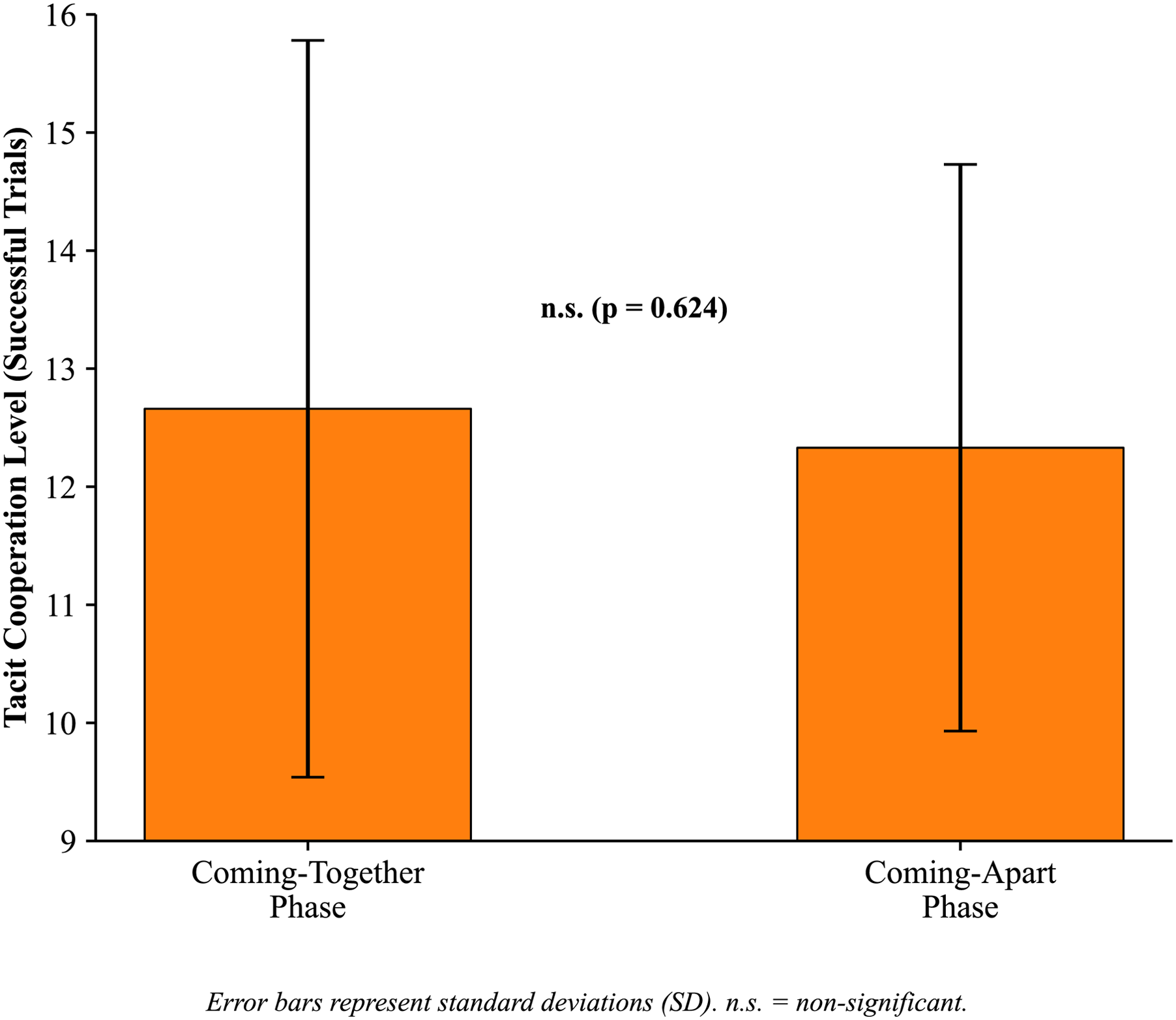
Regarding group differences across relationship development stages: Relationship satisfaction was significantly higher for couples in the coming-together phase (M = 161.34, SD = 16.26) than in the coming-apart phase (M = 145.20, SD = 20.92), t (78) = 3.85, p < .001, as depicted in Figure 1. In contrast, no significant difference in tacit cooperation level was observed between the coming-together phase (M = 12.66, SD = 3.12) and coming-apart phase (M = 12.33, SD = 2.40), t (78) = 0.49, p = .624, as depicted in Figure 2. Group differences in relationship satisfaction between coming-together and coming-apart phases. Group differences in tacit cooperation level between coming-together and coming-apart phases.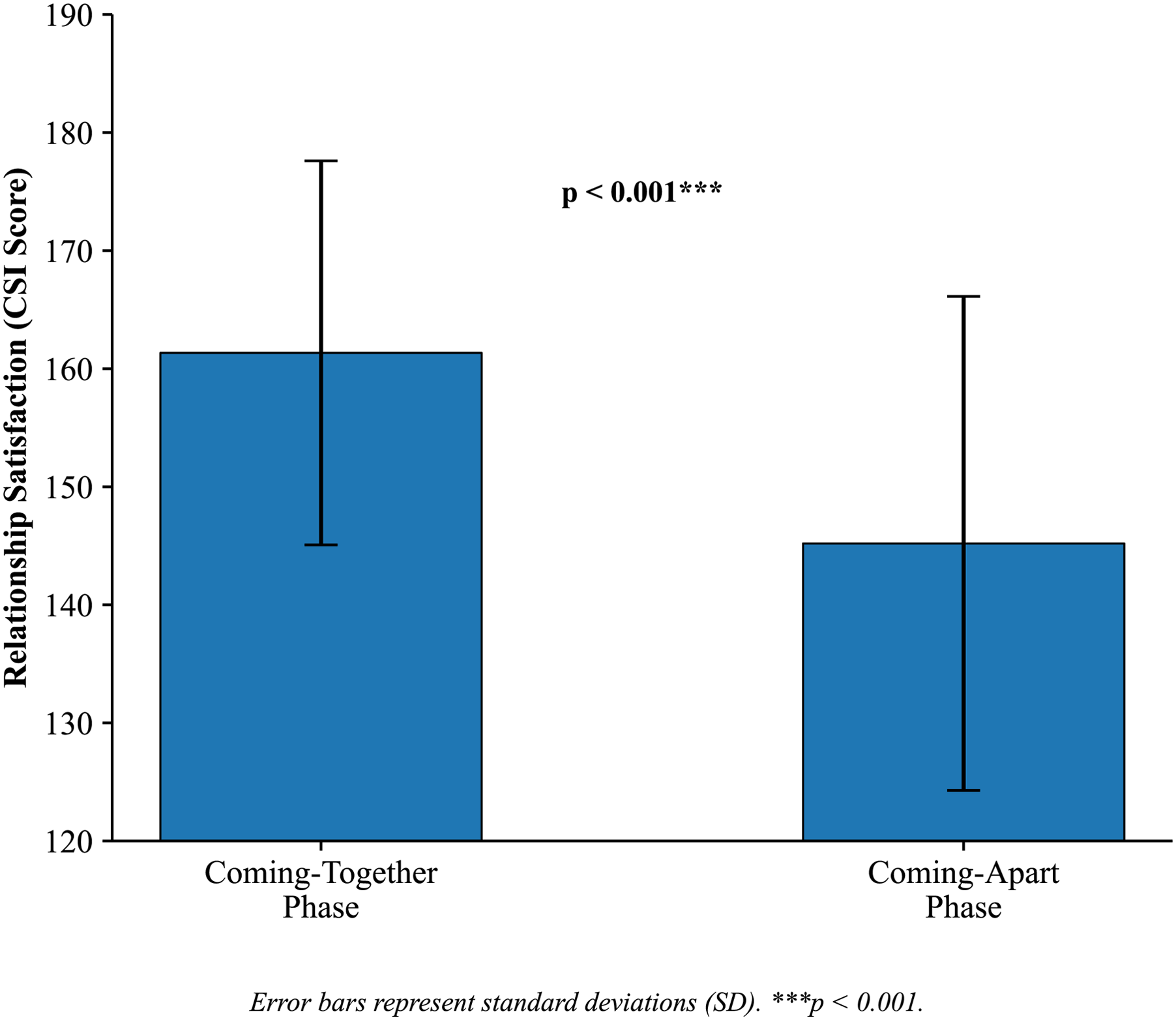
Study 2: Asymmetric Tacit Cooperation Forecasted Satisfaction Across Relational Stages
Findings from Study 1 demonstrated that relationship stage moderated the link between tacit cooperation and relationship satisfaction in a symmetric coordination game with no conflict of interest. Specifically, tacit cooperation positively predicted relationship satisfaction only in the coming-together phase and mainly predicted baseline satisfaction (CSImin).
However, Study 1 left open two critical questions: Which indicator of tacit cooperation can predict overall relationship satisfaction (CSImean), and whether such cooperation can predict satisfaction consistently across relationship stages. To address these issues, Study 2 adopted an asymmetric coordination game that involves partial interest conflict, where couples must compromise to cooperate. Because tacit cooperation under conflict reflects deeper responsiveness to one’s partner, we expected it to positively predict overall relationship satisfaction (CSImean) and to show stable predictive effects across both the coming-together and coming-apart phases.
Participants and Design
A new sample of 95 heterosexual student couples was recruited using the same criteria as Study 1. After data cleaning (excluding 4 pairs for failing attention checks or incomplete surveys), the final sample consisted of 91 valid couples (N = 91 dyads, n = 182 individuals). The mean age of participants was 21.63 years (SD = 1.63, range: 18-27 years).
Measures and Materials
Tacit Cooperation: Asymmetric Coordination Game
Tacit cooperation level was measured using an asymmetric coordination game paradigm. The task was adapted from the symmetric coordination game used in Study 1 with modified rules. First, each partner independently completed 25 coordination items and selected their personally preferred option for each item. Then, 20 items were randomly selected, and couples were informed that their preferences were inconsistent on these items. They were then asked to choose again between their own preference and their partner’s preference. A trial was coded as cooperative if both partners reached a consistent choice. The payoff structure was as follows: Choosing one’s own preference yielded ¥4 for oneself and ¥2 for the partner; choosing the partner’s preference yielded ¥2 for oneself and ¥4 for the partner. If the pair failed to reach agreement, neither partner received a reward.
Relationship Satisfaction
Relationship satisfaction was assessed using the CSI, identical to that employed in Study 1. Higher total scores indicated higher levels of relationship satisfaction. In the present study, the scale exhibited good reliability and validity, with Cronbach’s α of .89.
Developmental Stage of Relationships
The developmental stage of relationships was measured using the same nominal scale developed by Welch and Rubin (2002) as in Study 1. Couples independently selected the stage that best characterized their current relationship from 10 descriptive stages. Consistent with Study 1, couples were classified as being in the coming-together phase if both partners endorsed one of the first five stages, and as being in the coming-apart phase if either partner selected one of the last five stages.
Social Category Information
Social category information was operationalized as couples’ degree of understanding of each other’s preferences, measured using the same coordination item bank from Study 1. Each partner completed the 25 coordination items independently, and was instructed to guess their partner’s preferred response for each item to the best of their ability, based on their knowledge of the partner. A higher number of correctly guessed preference items indicated a higher level of understanding regarding each other’s social category information. The total number of correctly guessed items across both partners served as the quantitative index for social category information.
Social Status Information
Social status information was assessed with two items measuring partners’ perceived understanding of each other’s social status within the relationship and the level of agreement between them, adapted from De Kwaadsteniet and Van Dijk (2010). Both items were rated on a 7-point Likert scale, with 1 equal to a very small extent and 7 equal to a very large extent. The items were as follows: “To what extent do you think you need to adjust your own choices based on your partner’s preferences?”; “To what extent do you think your partner needs to adjust their choices based on your preferences?”.
Procedure
The general procedure was identical to Study 1. Each couple joined a synchronous online platform (Tencent Meeting) remotely at a scheduled time, with cameras on and microphones off. First, participants completed a personal preference survey consisting of 25 coordination items, in which they indicated their own preferences without considering their partner. Second, they completed a partner preference survey with the same 25 items, in which they guessed their partner’s choices. The number of correctly guessed items served as the index of social category information.
After a 2-minute delay to enhance task credibility, participants completed the asymmetric coordination game measuring tacit cooperation. They were presented with 20 items on which their preferences allegedly conflicted. On each item, they chose either their own preference (self: ¥4; partner: ¥2) or their partner’s preference (self: ¥2; partner: ¥4). No reward was given for mismatched choices. Immediately after the game, participants completed two items measuring social status information (De Kwaadsteniet & Van Dijk, 2010). Finally, participants completed the Couple Satisfaction Index and reported their developmental stage of the relationship.
Results
Consistent with Study 1, all data in Study 2 were analyzed at the dyadic level.
Descriptive Statistics and Correlations
The mean score of tacit cooperation was 12.96 (SD = 3.91), ranging from 5 to 20. The mean score of CSI was 160.00 (SD = 19.14). Correlational analyses revealed that tacit cooperation level was significantly positively correlated with social status information (r = .56, p < .001), as well as with mean relationship satisfaction (CSImean, r = .33), maximum satisfaction (CSImax, r = .35), and minimum satisfaction (CSImin, r = .27). These results indicate that tacit cooperation in the asymmetric coordination game was strongly associated with overall relationship satisfaction. Accordingly, CSImean was used as the indicator of relationship satisfaction in subsequent analyses to examine the effect of tacit cooperation on couples’ overall relationship satisfaction.
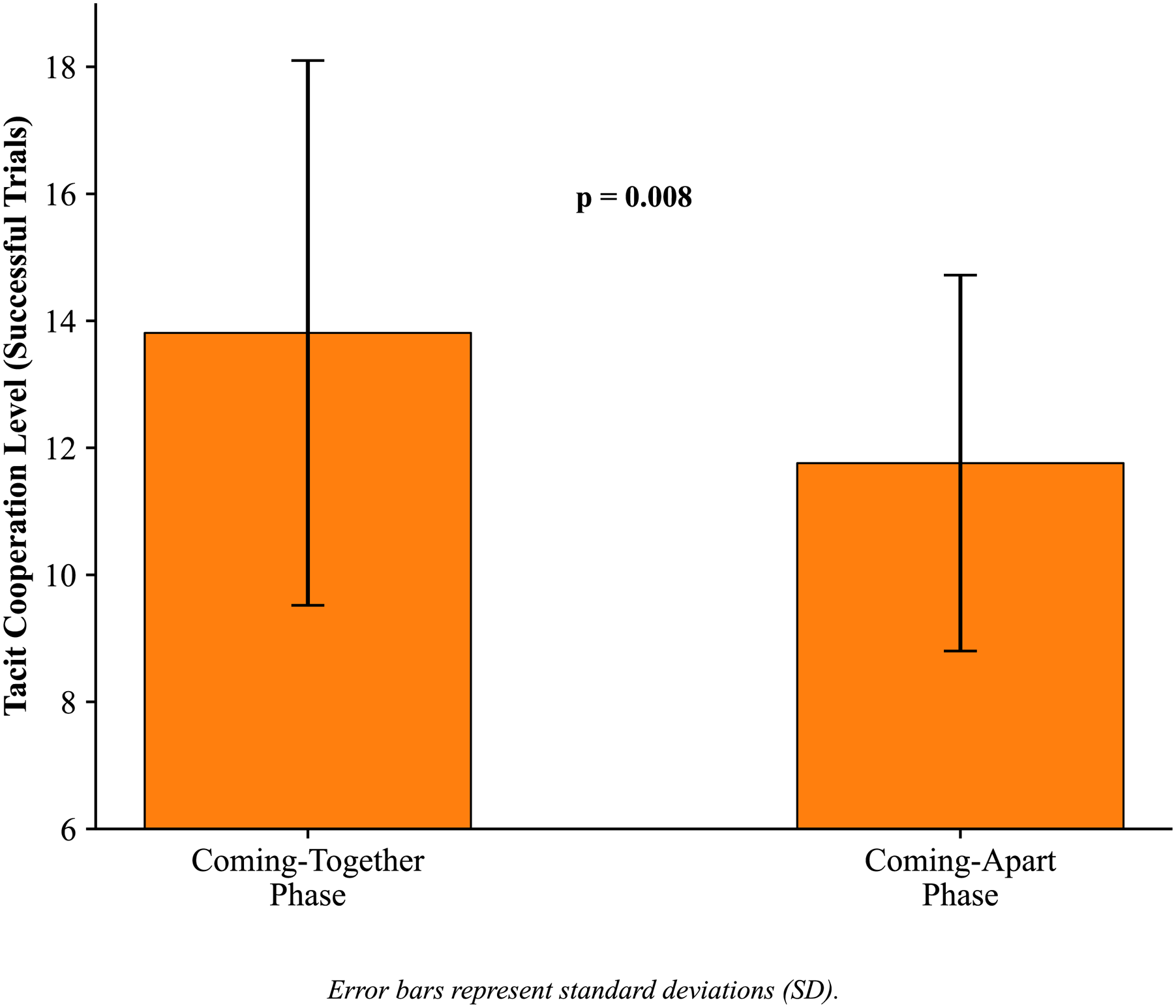
Regarding group differences across relationship development stages: Relationship satisfaction was significantly higher for couples in the coming-together phase (M = 175.06, SD = 13.82) than in the coming-apart phase (M = 160.11, SD = 21.04), t (89) = 3.83, p < .001, as depicted in Figure 3. This result replicated Study 1, indicating that relationship satisfaction decreased significantly as couples shifted from the coming-together to the coming-apart phase. In contrast, tacit cooperation level in the asymmetric coordination game was also significantly higher for couples in the coming-together phase (M = 13.81, SD = 4.29) than in the coming-apart phase (M = 11.76, SD = 2.96), t (89) = 2.69, p = .008, as depicted in Figure 4. This finding suggests that tacit cooperation level declined significantly when couples transitioned from the coming-together phase to the coming-apart phase. Group differences in relationship satisfaction between coming-together and coming-apart phases (Study 2). Group differences in tacit cooperation level between coming-together and coming-apart phases (Study 2).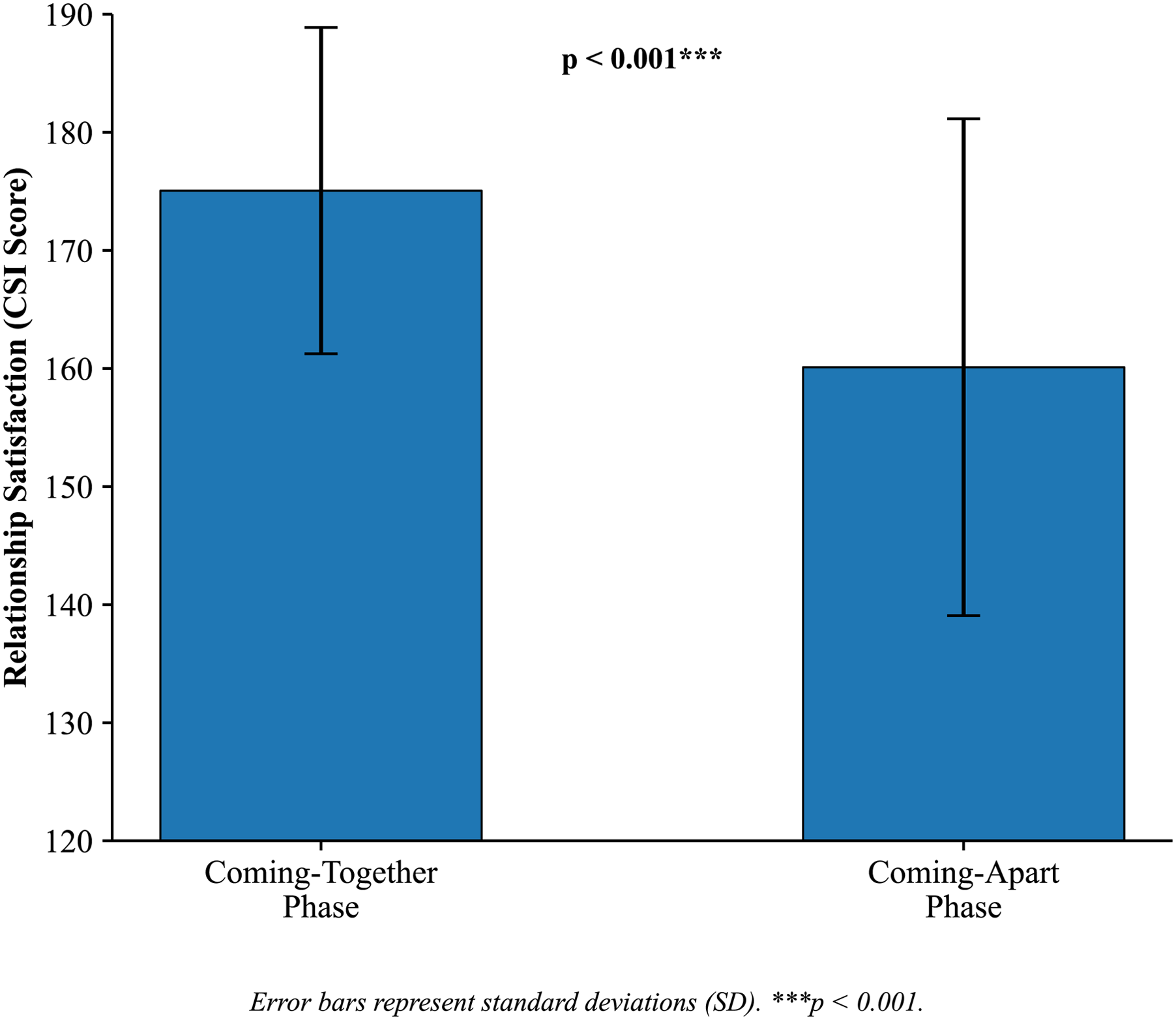
To enable direct comparison with the results of Study 1, grouped regression analysis was again conducted to examine whether relationship development stage still plays a significant moderating role in the effect of tacit cooperation level on relationship satisfaction. Results of the grouped regression analysis revealed that when relationship development stage was not distinguished, the overall model indicated a significant positive effect of tacit cooperation level on relationship satisfaction (F (2, 88) = 13.40, p < .001). When stratified by relationship development stage, tacit cooperation level had a significant positive effect on relationship satisfaction in the coming-together phase (F (2, 50) = 3.64, p = .033), and a significant positive effect was also observed in the coming-apart phase (F (2, 35) = 8.84, p = .001). These findings suggest that tacit cooperation level exerts a significant positive effect on relationship satisfaction across both relationship development stages. A test of equality of regression coefficients revealed no significant difference between the two stages (b1 = 1.109, b2 = 1.564, t (89) = −0.47, p = .638). Collectively, these results confirm that relationship development stage does not play a significant moderating role in the association between tacit cooperation level and relationship satisfaction.
To examine the effect of social status information on tacit cooperation level in the asymmetric coordination game, hierarchical regression analysis was performed with age and social category information included as control variables, social status information as the independent variable, and tacit cooperation level as the dependent variable. Results showed that the control variable-only model was not significant (ΔR2 = .031, F (2, 88) = 1.39, p = .256), accounting for 3% of the total variance in tacit cooperation level. After adding social status information, the regression model was significant (ΔR2 = .295, F (3, 87) = 38.05, p < .001), explaining 29.5% of the total variance in tacit cooperation level. Notably, social status information exerted a significant positive predictive effect on tacit cooperation level.
Study 3: Tacit Cooperation Facilitated Relationship Satisfaction
Although Studies 1 and 2 consistently demonstrate the association between tacit cooperation and relationship satisfaction, their cross-sectional nature limits causal inference. Therefore, Study 3 was conducted to establish causality using an experimental priming paradigm.
Participants and Design
Before participant recruitment, G*Power 3.1 was used to calculate the required sample size. With a medium effect size (f = 0.25) and a statistical power of 0.80, at least 34 couples were needed for the present study.
Eligible participants were required to be in a continuous romantic relationship for 3 months or longer, and neither partner had participated in the previous two couple-related studies. Written informed consent was obtained from both partners prior to the experiment, and eligible couples were randomly assigned to either the high tacit cooperation level group or the low tacit cooperation level group. A sample of 54 heterosexual student couples (N = 54 dyads, n = 108 individuals) was recruited for a laboratory experiment. Using a between-subjects design, couples were randomly assigned to either the High Tacit Cooperation (HTC) group (n = 27 couples) or the Low Tacit Cooperation (LTC) group (n = 27 couples). The mean age of participants was 21.36 years (SD = 1.54, range: 18-27 years).
Measures and Materials
Relationship Satisfaction
Considering that couples were required to complete the relationship satisfaction scale twice in the pretest and posttest, respectively, for a more streamlined and efficient administration process, the short-form Couple Satisfaction Index (CSI-16) was adopted to measure participants’ satisfaction with their partner and the intimate relationship. The CSI-16 has demonstrated high measurement precision and strong sensitivity to detecting differences in relationship satisfaction levels (Graham et al., 2011). This short-form scale consists of 16 items: One global item rated on a 7-point scale, and the remaining 15 specific items rated on a 6-point scale (Funk & Rogge, 2007). In the present study, the scale exhibited good reliability and validity (Cronbach’s α = .86).
Tacit Cooperation Level
Consistent with Study 2, the asymmetric coordination game paradigm was used to assess couples’ tacit cooperation level. In this task, couples were asked to choose again between their own preferred response and their partner’s preferred response, and a trial was coded as successful cooperation only if both partners reached a consistent choice.
Experimental Priming Manipulation
Differing from the procedure in Study 2, Study 3 implemented performance feedback after couples completed each coordination item to manipulate perceived tacit cooperation, following a well-established paradigm from prior research (Abele & Stasser, 2008). For couples assigned to the high tacit cooperation level group, 80% success feedback was provided: Sixteen out of the twenty coordination items were randomly selected to signal successful cooperation, while the remaining 4 items indicated cooperation failure. For couples in the low tacit cooperation level group, only 20% success feedback was given: Four out of the twenty coordination items were randomly marked as successful cooperation, and the other 16 items were marked as failed cooperation. After the manipulation was completed, a single 5-point Likert item was used for the manipulation check: “How would you rate the level of tacit understanding and coordination between you and your partner?”
Procedure
The experiment was conducted in three phases. Baseline Phase: On the night before the experiment, each partner completed the pretest relationship satisfaction measure separately by responding to the 16 items of the short-form Couple Satisfaction Index (CSI-16) based on their current romantic feelings. Manipulation Phase: For the personal preference survey, each partner completed 25 coordination items independently and selected their own preferred response for each item. Couples then completed the questionnaire for the asymmetric coordination game, which included 20 coordination items randomly selected from the 25-item pool. The task instructions were identical to those in Study 2: Each partner chose again between their own preference and their partner’s preference, and cooperation was deemed successful if both partners reached a consistent choice. Following each round of the asymmetric coordination game, participants received feedback indicating whether their coordination was successful (HTC: 80% success feedback vs. LTC: 20% success feedback). Measurement & Debriefing Phase: Following the 20 rounds of the asymmetric coordination game, participants completed the manipulation check and the CSI-16 posttest. Finally, a thorough debriefing was conducted. Experimenters explained the use of false feedback, ensured participants understood that the scores did not reflect their actual relationship quality, and addressed any emotional distress before they left the lab.
Results
Manipulation Check
The HTC group reported significantly higher perceived tacit cooperation (M = 4.35, SD = 0.65) than the LTC group (M = 3.15, SD = 0.96), t (52) = 13.85, p < .001, d = 3.12, indicating that the experimental manipulation was effective.
Impact on Satisfaction
To examine whether relationship satisfaction differed significantly before and after the experimental priming between the high tacit cooperation group and the low tacit cooperation group, a repeated-measures analysis of variance (ANOVA) was conducted. Group was treated as the between-subjects variable and time (pretest vs. posttest) as the within-subjects variable. Results revealed a non-significant main effect of group (F (1, 52) = 0.02, p = .889); a significant main effect of time (F (1, 52) = 6.07, p = .017); and a significant interaction effect between time and group (F (1, 52) = 4.65, p = .036).
Given the significant interaction, simple main effect analyses were performed. For the simple effect of group, no significant difference was found at pretest (F (1, 52) = 0.71, p = .405) or at posttest (F (1, 52) = 0.28, p = .602). For the simple effect of time, the change was not significant in the high tacit cooperation group (F (1, 26) = 0.05, p = .829) but was significant in the low tacit cooperation group (F (1, 26) = 10.67, p = .002). These results indicate that relationship satisfaction significantly decreased only when couples perceived low tacit cooperation, whereas no significant change emerged among those in the high tacit cooperation condition (see Figure 5 for the interaction pattern). Relationship Satisfaction before and after tacit cooperation manipulation (HTC Group vs. LTC Group).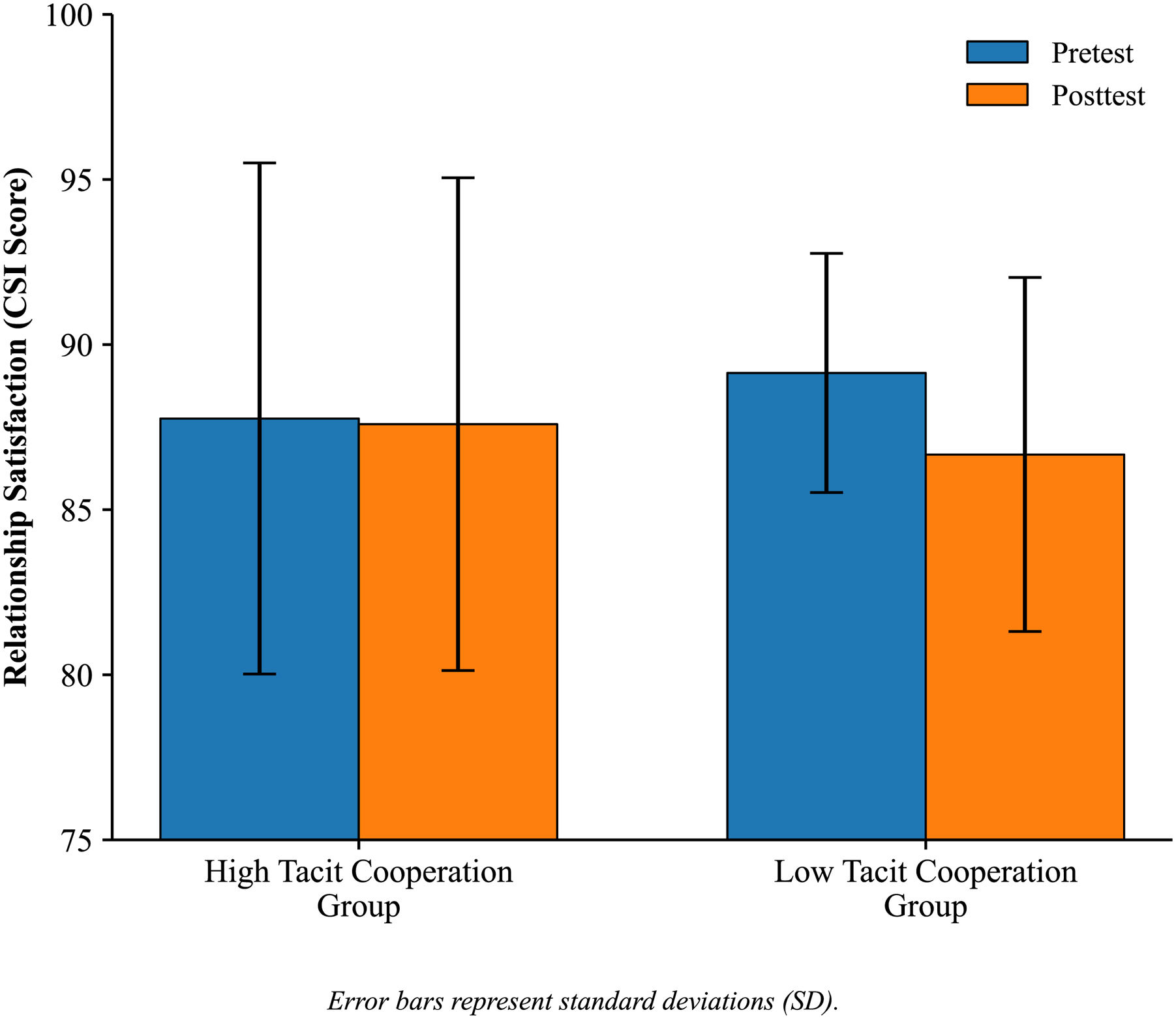
Discussion
This research consisting of three serial studies examined the association between tacit cooperation and intimate relationship satisfaction, as well as the boundary conditions of interaction payoff structure and the developmental stage of relationships, further verifying the causal link between perceived tacit cooperation and relationship quality. In general, the findings across all studies consistently supported the core hypothesis that tacit cooperation serves as a critical predictor of intimate relationship satisfaction, while its predictive effect presents significant contextual variability: The moderating role of relationship developmental stage only emerges in conflict-free symmetric coordination scenarios, whereas tacit cooperation positively forecasts relationship satisfaction across both coming-together and coming-apart phases in asymmetric contexts with interest conflicts. Moreover, the research also explored social status as an antecedent factor of couples’ tacit cooperation and revealed that perceived tacit cooperation plays a protective rather than promotive role in maintaining relationship quality. As demonstrated throughout the three studies, this research achieves high construct validity by grounding abstract theoretical terms in objective, incentivized behavioral tasks. By aligning the operational design with the three core pillars of tacit cooperation—collaborative goals, shared mental models, and preferences understanding—we provide a robust framework for measuring the “silent dance” of intimacy.
Our findings suggest that while tacit cooperation serves as a robust predictor of relationship satisfaction, its psychological weight is fundamentally shaped by the payoff structure of interpersonal interactions. In symmetric coordination scenarios involving zero conflict of interest, the predictive effect of tacit cooperation on relationship satisfaction was strictly contingent upon the developmental stage of relationships. In line with interdependence theory (Kelley et al., 2001), when partners’ interests are fully aligned, behavioral synchrony acts as a valuable diagnostic signal of relational compatibility during the coming-together phase. However, this signal loses its evaluative potency as couples transition into the coming-apart phase. We argue that eroded trust, increased emotional distance, and heightened informational barriers in declining relationships lead partners to attribute simple behavioral synchrony to coincidence or routine, rather than a genuine reflection of relational quality and mutual understanding.
In stark contrast, the association between asymmetric coordination (with partial conflict of interest) and relationship satisfaction remained stable across both relationship stages. A pivotal finding of this research is that the introduction of a conflict of interest neutralizes the moderating effect of relationship developmental phases observed in Study 1. This divergence stems from a qualitative shift in the functional basis of tacit cooperation. In symmetric scenarios, tacit coordination primarily operates on social category information—the shared knowledge of a partner’s routine preferences. During the coming-together phase, successful coordination serves as a salient signal of compatibility; however, as the relationship progresses to a coming-apart phase, such behavioral synchrony often becomes habituated or attributed to environmental consistency, thereby losing its predictive power.
Conversely, in asymmetric scenarios, the presence of conflict necessitates the navigation of social status information, such as an implicit consensus on relational hierarchy and decision-making roles. Unlike static habit-based knowledge, the negotiation of social status is a dynamic, ongoing process that remains highly diagnostic across all relational stages. In these conflict-laden contexts, achieving tacit agreement requires a “pro-relationship transformation”—a psychological process wherein individuals transcend immediate self-interest to prioritize dyadic harmony (Van Lange et al., 2013). This micro-level transition resonates with broader socio-ecological phenomena; for instance, macroscopic collaborative systems—such as the sharing economy—have been shown to cultivate interpersonal trust and actively promote positive moral behaviors through institutionalized reciprocity (Guo et al., 2019). In a similar vein, the persistent practice of silent coordination within a dyad acts as a powerful engine for a pro-relationship transformation. Because this transformation serves as a high-stakes diagnostic of a partner’s responsiveness and commitment, its impact on relationship satisfaction remains robust and stage-invariant, acting as a resilient buffer throughout the relational lifecycle.
The results of Study 3 demonstrate an asymmetric causal impact of perceived tacit cooperation, exposing a “necessary but not sufficient” pattern that aligns with the negativity bias in relational cognition (Baumeister et al., 2001). Specifically, while perceived coordination failures significantly eroded relationship satisfaction, high cooperation feedback did not yield a corresponding boosting effect. This causal asymmetry suggests that the predictive power found in the cross-sectional studies is primarily driven by the “cost” of low coordination rather than the “benefit” of high coordination. This phenomenon can be theoretically explained by integrating Expectancy Violation Theory (Burgoon, 1993) and Herzberg’s (1966) dual-factor framework. Intimate partners typically hold a high baseline expectation of mutual tacit understanding, viewing it as an internalized norm and a core hallmark of close bonding. Consequently, successful tacit cooperation acts as a “hygiene factor”—its presence is taken for granted and maintains relational stability, but does not drive exceptional satisfaction growth due to ceiling effects in established relationships. Conversely, coordination failures constitute a salient expectancy violation, interpreted as a breach of the relational contract. This violation triggers a disproportionately sharp decline in satisfaction, suggesting that in the daily maintenance of intimacy, preventing coordination mismatches is far more impactful for long-term relational stability than pursuing perfect synchronization.
A novel and valuable contribution of this research was identifying social status consensus as a critical precursor of tacit cooperation. Findings indicate that shared rules of engagement, specifically a mutual understanding of decision-making authority and compromise norms within the relationship, function as a cognitive scaffold that reduces the mental burden of coordination. When partners hold congruent mental models of their relational hierarchy (De Kwaadsteniet & Van Dijk, 2010), they can achieve behavioral synchrony without laborious explicit negotiation. This internal cognitive clarity enables dyads to navigate complex coordination challenges more efficiently, fostering a sense of relational competence and ultimately enhancing overall relationship satisfaction.
The positive association between social status information and tacit cooperation in Study 2 suggests a potential serial mediating mechanism: Social Status Consensus → Tacit Cooperation → Relationship Satisfaction. Specifically, social status consensus functions as an implicit “coordination scaffold”; it clarifies “who leads and who follows” in asymmetric interactions, which significantly reduces interactional friction and enables partners to achieve tacit agreement more efficiently. This successful coordination serves as a daily reinforcement of the couple’s “silent dance,” which accumulates into higher subjective relationship satisfaction. Although the present study did not formally test the serial mediation due to sample size constraints, this pathway offers a refined theoretical framework for understanding how social-structural clarity within a dyad translates into relational well-being.
Theoretical Contributions
First, this research deconstructed the monolithic conceptualization of positive interpersonal interactions by isolating tacit cooperation as a distinct dimension of implicit relational coordination. Previous literature often aggregated positive behaviors into a single construct of social support (Gable et al., 2004), while this study demonstrated that the silent ability to synchronize without verbal cues is a unique and powerful predictor of relational health, independent of explicit positive interactions. Second, we extended Knapp’s (1978) Dual-Process Model of Relationship Development by verifying that the diagnostic value of interpersonal coordination depends on both relationship stage and interaction payoff structure, revealing the dynamic and context-dependent nature of relational signaling. This indicates that the meaning of interpersonal behaviors is not static but is constantly re-evaluated as relationships evolve. Third, this study bridged the methodological gap between behavioral economics and relationship science (Kelley et al., 2001). Integrating game-theory paradigms with classic psychological constructs, we provided a quantifiable, objective method to measure tacit understanding, reducing reliance on self-report biases and enhancing the empirical rigor of intimacy research.
Practical Implications
For romantic couples, the findings advocate for context-specific relational optimization: Early-stage couples in the coming-together phase can prioritize shared low-conflict activities to build behavioral synchrony and perceived compatibility, while long-term couples should focus on establishing clear social status consensus and decision-making rules to navigate asymmetric conflict scenarios smoothly. For relationship clinicians and family therapists, this research offers a promising assessment heuristic—tacit cooperation performance in asymmetric scenarios can serve as a diagnostic relational stress test, encouraging practitioners to consider implicit shared mental models alongside explicit communication training. This practice-oriented insight moves beyond abstract relational advice, providing actionable and targeted strategies for both couples themselves and professional practitioners to maintain and improve intimate relationship quality.
Limitations and Future Directions
Despite the theoretical and empirical contributions, this study has several limitations. First, the sample was restricted to heterosexual college students in Guangzhou, China, which limits the generalizability of findings to married couples, older populations, LGBTQ+ dyads, or cross-cultural groups. Future research should validate the model across diverse cultural, relational, and demographic backgrounds. Second, while Study 3 established causality, the underlying mediating mechanisms (e.g., perceived partner responsiveness, relational trust) remain to be explored. Future studies could adopt the Actor-Partner Interdependence Model (APIM; Kenny et al., 2006) to examine the dyadic effects of tacit cooperation, analyzing how one partner’s coordination capacity influences the other’s satisfaction over time. Third, while the priming paradigm in Study 3 established a causal link from tacit cooperation to satisfaction, the relationship is likely bidirectional. Partners with higher initial satisfaction may possess greater cognitive resources and motivation to achieve tacit coordination. Future research should employ longitudinal designs to further disentangle this reciprocal feedback loop and examine the potential role of underlying variables such as relationship commitment or attachment security, which may jointly drive both coordination efficiency and subjective well-being. Finally, lab-based coordination games have high internal validity but lack the ecological complexity of real-life relational crises. Future research could combine laboratory paradigms with Ecological Momentary Assessment (EMA; Shiffman et al., 2008) to capture tacit cooperation dynamics in natural daily settings.
Conclusion
This research identifies tacit cooperation as a core pillar of intimate relationship satisfaction. Our findings demonstrate that tacit cooperation is a robust, stage-invariant predictor of relationship quality, particularly in asymmetric coordination scenarios involving conflict. While the coming-together phase of relationships relies on simple behavioral synchrony, long-term relational health depends on implicit shared rules and social consensus that enable stable coordination across diverse interaction contexts. Integrating game theory, relational developmental psychology, and human-centered design, this study provides a refined theoretical framework for understanding the silent dance of human intimacy, offering empirical and practical insights for fostering and sustaining high-quality romantic relationships.
Footnotes

Author Contributions
M. Xu and S. Wu designed the study, collected and analyzed data, and drafted the manuscript. C. Lin and R. Tang analyzed data. D. Gao framed and designed the study, and revised the manuscript. Xu and Wu contributed equally to this study.
Funding
The authors disclosed receipt of the following financial support for the research, authorship, and/or publication of this article: The study was funded by Natural Science Foundation of Guangdong Province (Grant No. 2024A1515010826) and the National Natural Science Foundation of China (Grant Nos. 32571254 and 32171073).
Declaration of conflicting interests
The authors declared the following potential conflicts of interest with respect to the research, authorship, and/or publication of this article: Ding-Guo Gao is member of the editorial board. However, D. Gao did not participate in the peer review process of this manuscript. We hereby declare that there are no conflicts of interest.