






Abstract
Dissatisfaction in midlife is a common phenomenon and has been for at least several decades. Much, however, is still unknown about why. This review briefly summarizes literature which finds midlife lows in survey data before examining the explanations proposed for their existence. The evidence presented is interdisciplinary, often from the field of psychotherapy, which has engaged deeply with the topic. Given that dissatisfaction in midlife can be substantial for some people, efforts to understand the phenomenon and how it might be mitigated seem to be worthwhile. In pursuit of this aim, the article concludes with some research questions which emerge from the preceding discussions and which, if answered, will advance our collective knowledge about this complex and important stage of the lifecycle.
This is a very definite moment in life. It is a point at which many normal people fall ill and come to us [psychotherapists] for help . . . the depression of the middle age is something we frequently see in our consulting rooms among people otherwise normal. (W. Brown, 1938, pp. 164–165) “The explanations for the midlife shape currently remain open.” A “foundational puzzle for economists, behavioural scientists and perhaps other kinds of scientific researchers.” (Giuntella et al., 2023, p. 78)
Introduction
Within wellbeing economics, one of the most frequently researched areas of enquiry is the relationship between age and wellbeing (e.g., Blanchflower & Graham, 2022; Blanchflower & Oswald, 2008; Blanchflower et al., 2023; Cheng et al., 2017; Clark et al., 2021; de Ree & Alessie, 2011; Frijters & Beatton, 2012; Li et al., 2025; Piper, 2015a; Ranjbar & Sperlich, 2020; Schwandt, 2016; Tobias & Bond, 2025; Wunder et al., 2013). Most of this work has centered around the pattern of this relationship over the lifecycle, without delving much into the whys behind the observed patterns. However, this article is not one more entry in this much debated area. Instead, it explores in detail one part of the age range, midlife, and offers a discussion regarding why some people suffer dissatisfaction with life in this part of the lifecycle. The work thus explores what has been called a foundational puzzle for economists and other scientific researchers (Giuntella et al., 2023). While not discounting the value of good quality “over the lifecycle” studies, there are good reasons to consider age groups, and issues central to their wellbeing, separately (see Piper, 2015a for related arguments). This work, focusing solely on wellbeing in midlife, is interdisciplinary. Wellbeing in general is inherently interdisciplinary, and interest in this period of life is also shared by social scientists with other academic backgrounds; of course, other scientists (e.g., biologists, neurobiologists) are also interested in wellbeing. In any case, scholarship both inside and outside what we think of as wellbeing economics offers useful insights into wellbeing, particularly in midlife, which is a guiding principle for the discussion below.
The epigraph which opens this work is from William Brown, a psychologist and psychiatrist, as well as the director of the Institute of Experimental Psychology at Oxford University, who was professionally active in the first half of the 20th century. The book the quote is taken from is his general introduction to psychotherapy, which is, he states, based upon his then 25 years’ long career as a practising psychotherapist. He devotes several pages to discussions about midlife dissatisfaction. That it was written almost 90 years ago, and nearly 30 years before the publication of Elliot Jaques’ influential article Death and the Midlife Crisis, informs us that this phenomenon is not a new concept. Like Brown did in his book, contemporary psychotherapists also state that dissatisfaction in midlife is a cause of much of their client base, indicating an important issue (e.g., Hollis, 1993, 2023; Jamieson, 2022; Tallis, 2026). Furthermore, psychotherapists have written extensively about our overall wellbeing during this part of the lifespan and insights from this literature are considered below. Similarly relevant literature from other disciplines is also discussed, building up a picture of what is collectively known about dissatisfaction during this period while also indicating what remains unknown.
Throughout this article, the term midlife crisis is intentionally avoided for several reasons. This is particularly in keeping with the perspective of psychotherapists who see this stage of life as a necessary transitional phase (and reframe it as a passage, or other euphemisms; e.g., Hollis, 1993; Jamieson, 2022). This is also more in keeping with the position adopted by some psychologists who argue that a full-blown midlife crisis is an uncommon event, while dissatisfaction in midlife is much more common (e.g., Lachman, 2004; Wethington, 2000). This article is about the latter, much more common phenomenon and is applicable to a wider population. Furthermore, a crisis suggests something dramatic whereas the data typically show a general pattern of gradual decline to midlife. Unlike midlife dissatisfaction, there are also substantial measurement issues with midlife crises—whether subjectively assessed or compared to some yardstick of low wellbeing. In contrast, some scholars of midlife have debated the definition of midlife crises, demonstrating its complexity (e.g., Wethington, 2000).
Like the concept of a crisis, the term midlife itself is also probably best conceived of within a wide frame. Many of the psychotherapists whose insights are discussed below are reluctant to define it. While some scholars do give an age range (Lachman, 2015, e.g., states that it is broadly between 40 and 59; Erikson, 1950, has his relevant stage of man, which corresponds with midlife and its concerns and facets, starting at 40 and ending at 65), others argue against thinking about it chronologically. Lachman (2004) herself, for example, considers that such age boundaries are secondary. Without neglecting age completely, arguments put forward for such an approach include people of the same chronological age having different economic, psychological, and social realities (Lachman, 2004). Moreover, life course theory emphasizes roles, traditions and timings rather than age (Elder et al., 2003). Consequently, this work also considers midlife rather broadly. A similar approach is taken to wellbeing, which—unless a specific result from an empirical study is discussed—is also treated rather broadly. Thus, the discussion of wellbeing in midlife presented in this paper will not be overly concerned with definitions, whether of a specific chronological notion of midlife or of a precise nuanced understanding of wellbeing. 1
Empirically, there is a substantial evidence base demonstrating that some form of dissatisfaction in midlife (if not a crisis) is a prominent aspect of the human experience. While this is not to say that it is necessarily universal or, for those who have yet to reach this time of life, inevitable, this evidence has been observed in many different countries, at different times, using different methods (see Blanchflower & Graham, 2022; Lepinteur & Piper, 2023, for summaries). Recently, Li et al. (2025) employed machine learning techniques covering over 1.9 million individual observations from 168 countries collected between 2009 and 2022 and “empirically confirm a U-shaped relationship between age and subjective well-being, indicating that middle-aged individuals consistently experience the lowest well-being” (p. 1). This confirmation reflects many prior studies where midlife dissatisfaction was demonstrated empirically many times with both cross-sectional and longitudinal survey data (e.g., Blanchflower, 2021; Blanchflower & Oswald, 2008; Blanchflower & Piper, 2022; Blanchflower et al., 2023; Chaudhuri & Piper, 2025; Cheng et al., 2017; Clark, 2019; Oparina et al., 2025) and with more objective data on, for example, hypertension, prescriptions of depressants, suicidal ideation, deaths of despair and more (see Case & Deaton, 2015, 2020; Giuntella et al., 2023; Graham & Pinto, 2019; Oswald, 2026a; Section 2 of Blanchflower et al., 2023). However, despite the vast literature investigating wellbeing across the (working) lifespan, not much is known about why midlife dissatisfaction occurs or how it might be mitigated against. This article hopes to contribute to closing this gap in our understanding of these concerns.
That dissatisfaction in midlife may be a fundamental part of the human experience is a viewpoint that the psychotherapeutic literature would subscribe to. If so, then we would expect some supporting evidence to emerge from non-WEIRD countries. However, good quality longitudinal data is not available for many parts of the world and studies are currently unable to adjudicate on this (see Piper & Weiss, 2026 for more information). Even when good data sources are available (even if not longitudinal) and well used, there is substantial debate about the precise nature of the relationship between age and wellbeing. For example, Jebb et al. (2020) investigate the wellbeing of 1.7 million individuals and claim that any midlife dip in wellbeing is overstated. This is cross-sectional data, however, and as is well-known, age patterns observed in cross-sectional data combine age, cohort, and period effects, and therefore cannot be interpreted as pure lifecycle changes (e. g. Palmore, 1978). 2 Lifecycle changes are what the psychotherapeutic literature discusses. This debate about the shape and pattern will no doubt continue.
This article contributes to the wellbeing economics literature in several ways. Much of the wellbeing economics literature is empirical in nature, focusing on identifying associations and, where possible, causal relationships between variables. While this work is invaluable, it often leaves open deeper questions about the underlying mechanisms that generate observed patterns. At times, therefore, it is useful to step back and engage with other disciplines that have developed richer conceptual accounts of human experience. In this spirit, it brings together evidence on midlife dissatisfaction from different disciplines, drawing in particular on the psychotherapy literature, which has been less widely used in economics. It moves beyond documenting such dissatisfactions in survey data by examining the explanations that have been put forward for why they occur. Finally, it sets out a series of research questions that point toward a future empirical agenda focused on better understanding the drivers of midlife wellbeing and how dissatisfaction might be mitigated, even if only partially. It is hoped that wellbeing economists will draw inspiration from the engagement with the psychotherapeutic literature undertaken here in pursuit of interdisciplinary insights which may help explain wellbeing at different ages and other commonly researched phenomena in wellbeing economics and wellbeing science more generally. More broadly, and in this journal issue, there is even speculation that the economics of wellbeing may increasingly merge with the natural sciences in the future (Oswald, 2026b).
The next section briefly considers what might cause midlife unhappiness, using modern empirical evidence. The subsequent section to that discusses the psychology and psychotherapy literature (and to a lesser extent related work from other areas). This work, particularly that from psychotherapists, contains ideas and insights which are perhaps unknown to quantitative social scientists working on the relationship between aging and wellbeing. This is unfortunate because there is a great need for more empirical investigations of these possibilities and hypotheses. To further such investigations, the last section of the paper concludes with a brief discussion of how the ideas and hypotheses presented in psychology and psychotherapy literature might be usefully investigated and lists potential research questions. Future investigations of these questions could lead to a better understanding of wellbeing in midlife, which in turn may provide information helpful to mitigate some of the dissatisfaction people can face in midlife. A hope is that this work will inspire wellbeing economists and other social science scholars to explore wellbeing in midlife, an important issue that merits continued study (Giuntella et al., 2023; Lachman, 2004, 2015).
What Might be Behind Dissatisfaction in Midlife?
That dissatisfaction in midlife has been identified by (at least) several hundred studies covering much of the world, and that these studies have used data collected over multiple decades, from different countries and datasets, and with different methods and control sets (including designs without controls), perhaps suggests that a biological basis exists for midlife lows. Reflecting this possibility, this section starts by discussing a famous study which investigated ape wellbeing, and a more recent study confirming that ape study’s general result with a very different method. If biology is a partial reason, other evidence suggests other influences. A subsequent subsection demonstrates this by briefly highlighting recent empirical studies that distinguish differing levels of wellbeing at midlife for different groups, thus suggesting a role for individual volition and/or circumstance. Thus, following a subsection on biology, there is a subsection on individual and group differences for dissatisfaction in midlife. This research highlights a speculative possibility regarding individuals and groups who might avoid midlife dissatisfaction altogether, which is collected in a subsequent subsection before a summing up discussing future research possibilities based upon current evidence provided by wellbeing economists.
Biology
Rather than assessing the wellbeing of humans, the notable and pioneering study of Weiss et al. (2012) investigated the wellbeing of great apes and had people responsible for the care of the apes answer four questions regarding ape wellbeing. These apes were chimpanzees and orangutans in different habitats in different countries, and the conclusion was that apes in midlife have lower wellbeing than those younger and older. Based on this finding, they proposed that the midlife low may partly have its origins in the biology humans share with great apes. A more recent investigation supports this biological conclusion with a finding of a midlife dip in wellbeing with a validated method appropriate for their test of 66 colobus monkeys (Colobus angolensis ruwenzorii), in their native habitat (the wild) with a study, being behavioral, making use of responses to ambiguous auditory stimuli rather than ratings (Tucker-Gritt et al., 2025). 3
Individual and Group Differences
The biological explanation suggests that dissatisfaction in midlife is something everybody experiences, however, there is other evidence that different individuals experience it to different degrees. 4 As Stein asserts in the introduction to an early work on this topic, “each of us goes through it in his own way, experiences it with greater or lesser intensity, and emerges from it more or less reconciled to the years ahead. It is a ‘natural’ developmental crisis, and it is unavoidable” (Fried, 1967, p. vii). Here, the intention is to suggest that different groups of people may go through midlife in systematically different ways. This claim is supported by recent research: work by Helliwell et al. (2019), Clark et al. (2021), and Piper (2021) presents evidence of different passages through the midlife years. A summary of what these studies found is as follows: those not married or in a relationship had a greater midlife dip than those who were; while those who had lived in their neighborhood less than 15 years had a greater midlife dip in comparison to those who had for at least fifteen years; and, in the work environment, those whose manager was more like a boss than a partner had lower wellbeing in midlife; those on temporary contracts suffered much more than those on permanent contracts (with only one-sixth of this substantial gap found to be attributable to fears about job security).
More recently, Piper et al. (2026) offered further support in their longitudinal study of different trajectories of wellbeing over the lifespan and the Big 5 personality traits. All 30 of their estimates (5 traits × 2 high/low scores × 3 countries) showed this general pattern longitudinally, suggestive of a biological underpinning, with distinct trajectories, suggestive of individual differences, too.
Escaping Dissatisfaction in Midlife Entirely?
Intriguingly, the research discussed above (Clark et al., 2021; Helliwell et al., 2019) highlights the possibility that some groups may avoid dissatisfaction in midlife entirely, and this short subsection speculates about which individuals and groups might. As Figure 1 shows, Clark et al. (2021) derived a substantial difference in life satisfaction at midlife (and at other times) between those in marriage or partnership and those not. For those in a relationship, the midlife dip is rather small; for those who are not, it is substantial, at close to a full point difference on this scale. This difference far outweighs the slight difference attributable to gender. Given that these data are averages, and that relationship quality can vary, perhaps those in excellent marriages and relationships (on average) do not have any dip at all. Clark et al. describe partnerships as protective against typical wellbeing declines in midlife; perhaps excellent partnerships are fully protective against midlife dissatisfaction. 5 Note well that this is about the quality of such relationships, and thus not identifiable with standard controls for marital status.
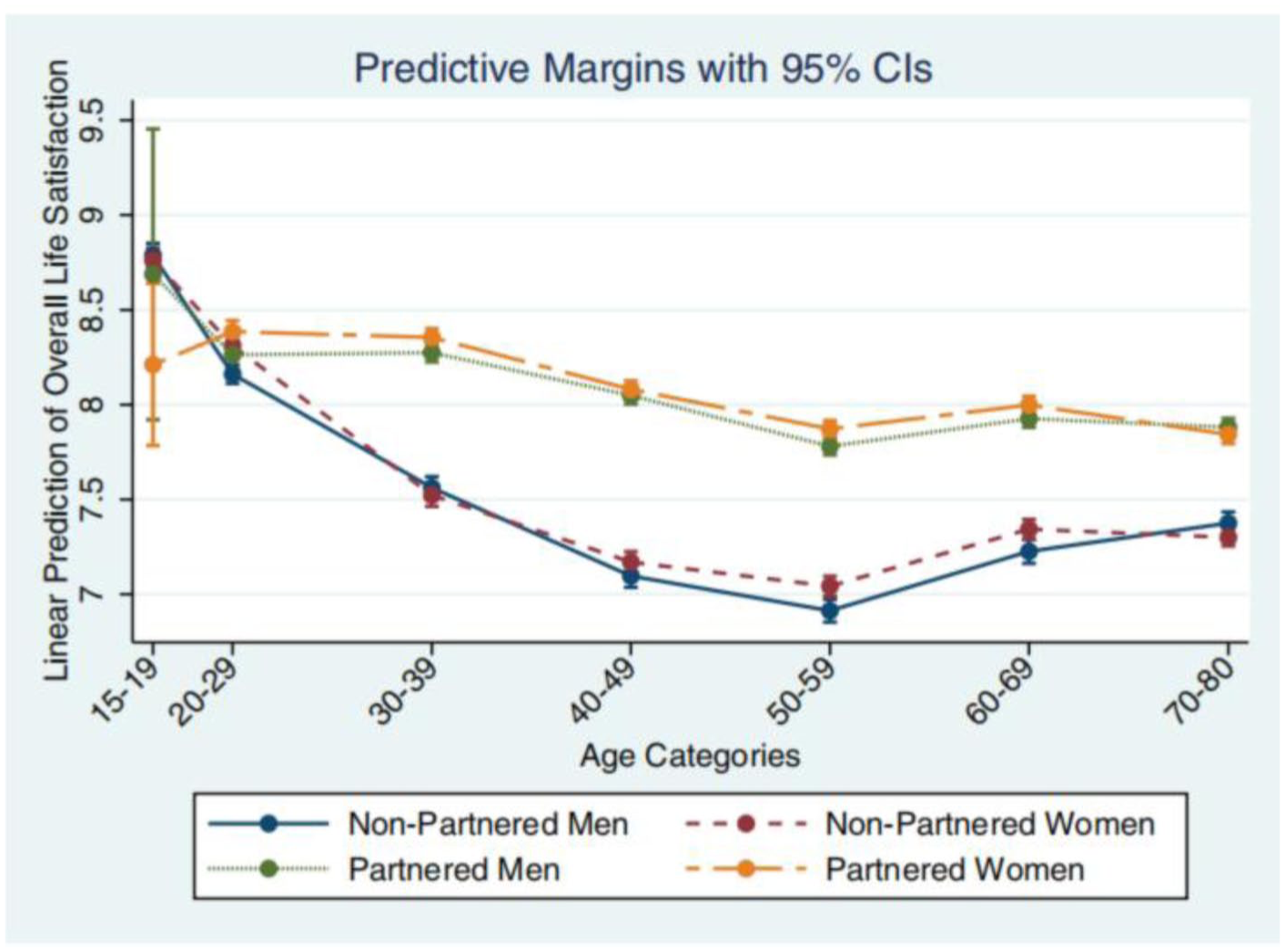
The age and life satisfaction relationship by partnership status, EU-SILC 2013 data.
Group Differences: Future Research
Clearly, future research could address the possibility just raised that differing quality of partnerships may well have differing associations with wellbeing, with high-quality ones possibly fully mitigating any midlife dissatisfaction. It is an intriguing possibility, currently untested. Other possibilities for future research come from the investigations discussed above. For example, the studies above form no strong conclusions about why systematic group differences are found for dissatisfaction in midlife. Thus, potential reasons seem particularly fruitful avenues for future investigation. These include heterogeneity in social capital, belonging, institutional embeddedness, social status, lifecycle expectation shortfalls, and insider-outsider inequalities. All of these are potential reasons for the results regarding group differences. Investigating these issues may help to explain some of these differences in wellbeing in midlife and, in turn, help us to understand how we might mitigate the reductions in wellbeing reported in midlife. Furthermore, it is possible that individuals may (involuntarily or voluntarily) “self-select” into the categories of lower wellbeing (no relationship, temporary employment), perhaps representing a limited capacity or feeling for belonging. 6 Some of this “self-selection” may be related to childhood, with systematic differences possibly having their foundations in early life (e.g., Baumeister & Leary, 1995; Bowlby, 1951, 1988; Corrales et al., 2016; Counted et al., 2025). Cohort surveys which follow individuals from birth onwards include the National Childhood Data Survey (NCDS) and the British Cohort Survey (BCS). Given that they started in 1958 and 1970 respectively, individuals have so far been traced up until at least midlife (62 in the NCDS and 50 in the BCS at the time of writing) and the relationship between early life and midlife can be shown, and interesting questions can be asked. 7
To conclude this subsection, two other possibilities for future research which lead from existing knowledge within wellbeing economics: gender; and different measures of subjective wellbeing. In Figure 1, we observe very minor differences between the average wellbeing of females and males over the lifecycle. This is potentially surprising given that they experience very different physiological changes in midlife and have had historically different roles in society. This similarity is not just exhibited by Figure 1, which is Figure 4 in Clark et al. (2021), above. Figure 2 in Clark et al. (2021) is almost identical to Abbildung 1 of Grözinger and Piper (2019) despite different datasets and methodologies: in midlife average wellbeing seems basically the same (with, elsewhere in the lifecycle, younger females reporting slightly higher average wellbeing than males, and again in the years immediately following the midlife nadir; a pattern that reverses after around age 65). Why so is an open question. 8
The discussion now turns to a consideration of the writings of psychoanalysts and others who, like William Brown, are arguably leading the way in thinking about wellbeing in midlife. Their work offers further possibilities that have the potential to be investigated empirically and help further advance understanding of midlife dissatisfaction.
Insights From the Psychotherapy Literature and Related Works
Introductory Remarks
In understanding wellbeing generally, and dissatisfaction in midlife specifically, the work of psychotherapists is perhaps particularly important. As well as having thought deeply about wellbeing, psychotherapists were arguably the first people to uncover these midlife issues. Professionally involved in the topic, they have also attributed a substantial proportion of their client base to midlife issues (e.g., Hollis, 1993; Jamieson, 2022; Tallis, 2026). To summarize, the most popular notion in this literature is that midlife is a liminal, developmental, period in the human lifecycle; a time when individuals slowly reorientate their lives from their “old selves” to “new selves” (e.g., Hollis, 1993; Stein, 2014). This connects midlife with gestalt therapy notions of a “fertile void” (Perls, 1969), the “emptiness through which we all must pass to let go of one set of experiences, in order to fully engage with a new set of experiences” (Clarkson, 1993, p. 65). Highlighting this belief as more generally held, recall the quote from Murray Stein regarding midlife being a natural development period through which we must all go, to a greater or lesser extent.
Such assertions are not new. Predating Elliot Jaques’s coinage of the term midlife crisis by over 20 years is an introduction to psychotherapy which states that “the depression of the middle age is something we frequently see in our consulting-rooms among people otherwise normal” (W. Brown, 1938, p. 165) 9 ; and that this is “a turning point in life [which] varies from one person to another according to physique, type of mind, past history, and the extent to which the individual has escaped physical or mental illness . . . but sooner or later . . . the individual has to adapt himself to this situation . . . [and] this is a very definite moment in life. It is a point at which many normal people fall ill and come to us [psychotherapists] for help” (W. Brown, 1938, p. 164). Brown calls the problems that occur “in the late forties and early fifties” the problems of the mature personality. That Brown writes this in a very matter-of-fact way suggests that midlife unhappiness was a well-known and uncontroversial issue even then. He also, albeit briefly, states why these problems occur, and what is necessary. This resembles subsequent writings on this topic, including those of Jaques.
In his seminal article “Death and the Midlife Crisis,” Jaques (1965) argued that midlife was the time when an unconscious depressive anxiety emerges, which can lead to feelings of loss and thoughts of suicide, though he also emphasized external circumstances and one’s role in society. A central suggestion was that an increasing awareness of mortality lay behind this anxiety, the recognition that “we are all going to die” causing an existential panic. Jaques argued that maladaptations resulted in such as hypochondria and “the emergence of sexual promiscuity in order to prove youth and potency, and a hollowness and lack of genuine enjoyment of life” (Jaques, 1965, p. 511). These attributes (and others) he summarizes as an impoverishment of emotional life and warns that real character deterioration is possible. His solution: suffering individuals need to craft creativity and serenity in their lives as a route out of their slump. This last comment connects with the work of more modern psychotherapists (Hollis, 1993; Jamieson, 2022; Polden, 2002; Stein, 2014), who argue that midlife is when development toward a more emotionally meaningful life should take place, and also with Erik Erikson’s argument that people in what he termed the second stage of adulthood (i.e., midlife) need to make a choice (knowingly or not) between generativity and stagnation (Erikson, 1950). 10
Psychotherapist Literature on Why Dissatisfaction in Midlife Exists and How it Might be Reduced
Before moving on to discuss considerations around generativity and stagnation, just why do people in midlife need to change or develop? These writers (Hollis, 1993; Jamieson, 2022; Jaques, 1965; Polden, 2002; Stein, 2014) argue that adults in midlife unhappily come to a realization that their old routines and adaptations no longer work and there is a need to create new ones. In short, this is said to result in a sense of dissatisfaction with life in midlife, which provides the drive for change and development. 11 Above, we have also seen that the sense of dissatisfaction in midlife is felt at different degrees by different groups of people; such differences may reflect different levels of urgency or need for development. They may also reflect innate personality differences, and this possibility inspires some of the research questions listed in the conclusion. In any case, this relative unhappiness drives individuals to make changes in their lives. The psychotherapists’ interpretation is that in the first half of their lives individuals are following “ego” goals, for example establishing careers and families, and making a place in the world for themselves. In doing so, the argument goes, individuals are following directions set out by society which, whether achieved or not, become dissatisfying. Even if achieved, people may still find themselves dissatisfied, perhaps because of goal cessation, as suggested by Setiya (2017) in his reflections on midlife, but also perhaps because of our inability to predict what will make us happy (e.g., Odermatt & Stutzer, 2019).
As well as seeking so-called “ego goals” in the first half of life, psychologists and psychotherapists assert that individuals are following adaptations and behaviors formed and developed in childhood for survival and to get needs met. In midlife, individuals realize that both “scripts” (ego goals and childhood adaptations) provide decreasing levels of satisfaction, inducing action. Hollis summarizes as follows, “our stories that we work hard to serve . . . no longer serve us” (Hollis, 2023, p. 19) and in midlife we “face a summons to something larger” (p. 20). Part of the solution is argued to involve unpicking these (increasingly dissatisfying) processes and patterns and, as Jamieson (2022) puts it, taking up the “unprecedented opportunity to review our lives.” Moreover, “a period of introspection and self-examination is an essential need at this stage in life” (Jamieson, 2022, p. 57). Thus, rather than “ego goals,” based in part on society’s roles and conventions, individuals should strive to pursue paths that they find are more emotionally meaningful. This might reflect the creativity and serenity that Jaques called for, and serenity as a goal fits with research about the changing meaning of happiness over the lifespan (Mogilner et al., 2011). This pursuit of emotionally meaningful goals may also help individuals combat the “hollowness and lack of genuine enjoyment of life” that Jaques observed many people feel in midlife (Jaques, 1965, p. 151).
Some scholars argue that an authentic, rather than reflexively rote, connection to society becomes paramount; that the reduction in focus on “ego goals” should be replaced, at least in part, by goals that are societally useful. Rauch (2018), for example, argues that people in midlife are repurposed for a new role in society and that, over time, people come to see ambition as a distraction from the life they want to live, instead increasingly preferring deeper connection with themselves and others. Jamieson (2022) makes similar comments, and even states that this repurposing in midlife has substantial evolutionary purpose. Among the strands of thought which connect ideas of individual development with improvements in society, two stand out. One relates to an argument based on generativity versus stagnation, proposed by Erikson (1950), and another—more recent—we could call the evolutionary argument, as advanced by Jamieson (2022), whereby the changes in the life of an individual at midlife are important for the evolution of society and culture. Both are briefly discussed below.
Erikson’s Midlife Dilemma: Generativity or Stagnation
Erik Erikson wrote about various stages of human development and the stage most closely aligned with the concerns of midlife outlined above is his second stage of adulthood, which occurs between 40 and 65 and is centered around the conflict between generativity and stagnation (Erikson, 1950). Generativity meant doing developmental things for one’s self (which includes meeting the challenges of midlife mentioned above), for society, and for the next generation, finding benefit and meaning in doing things for others and for those who follow. Doing so is expected to reinforce individuals’ credentials and enhance their talents as parents and as leaders of organizations and communities. 12 Such engagement is thus of benefit for both the individual and society. Slater’s (2003) elaboration of Erikson’s generativity vs stagnation conflict highlights the similarities between this stage of life and Maslow’s notion of self-actualization; both, he argues, reflect the change from a self-centered orientation to an other-centered orientation. Through generativity, individuals are better able to help and contribute to society when they are better able to more fully be themselves. 13
In contrast, not engaging with the challenges of midlife can lead to, in Jung’s words “stagnation and desiccation of the soul. Our convictions become platitudes ground out on a barrel-organ, our ideals become starchy habits, enthusiasm stiffens into automatic gestures.” (Jung, 1967, pp. 356–357). Individuals in midlife can try to avoid this outcome by individuating and engaging (and being better able to engage because of individuation) with society and the next generation. The possibility of failure to achieve generativity, succumbing to stagnation, also suggests that some individuals might not achieve a rebound in wellbeing after midlife. Of course, in common with the midlife dip, the uptick after midlife found by empirical studies also represents an average effect and thus is concomitant with the possibility of different trajectories in wellbeing after midlife. Recent empirical evidence supporting this notion is the finding that there is no upward trajectory (a rare event) for males who exhibit antagonistic (rivalrous) narcissistic traits (Piper, 2025).
Dissatisfaction in Midlife: An Evolutionary Necessity?
The evolutionary argument is, according to Jamieson (2022), as follows: society needs both the young and the old, with their typical traits and characteristics; a functioning society needs both the energy, audacity and impetuousness of the young and also the wisdom, experience, moderation and foresight of the not so young. The midlife transition is an often uncomfortable, liminal phase between these two, during which individuals move from the former to the latter. This change is slowly “formed on the anvil of crisis” in Jung’s words, and creates individuals who are capable of wise, individuated eldership in society. Jamieson (2022) supports this general argument and follows Jung in asking why humans are one of two species who are capable of a longer post-reproductive life than their reproductive life. He argues that “our midlife experience therefore is crucial in providing our species with the wisdom, compassion and altruism necessary to guide humanity safely through the challenges ahead (p. 4).” Rauch (2018) calls this reorientation a change in emotional direction, one that repurposes us for a changing role in society and a new stage of life. This repurposing can be difficult. Hollis (1993), Jung (1965) and others state how hard this “confrontation with inner demons and outer misfortune” (Jamieson, 2022, p. 2) can be and, as the empirical evidence shows, this midlife transition can take years. This is not something that can be easily solved by simply aiming for a more cheerful disposition.
Related Comments From Biology, Psychology, and Economics
Following the discussions above regarding what the psychotherapeutic literature states about dissatisfaction in midlife, this subsection offers some comments from other disciplines. Above, suggestions were made that biology might be partially behind dissatisfaction in midlife. Our biology might also help us in getting out of any midlife trough. While the next paragraphs briefly present evidence of such a biological role, suggesting that most individuals, on average, can wait any midlife unhappiness out, some individuals will be suffering extreme distress in midlife. Suicides, and particularly male suicides, are relatively prevalent in midlife and such individuals will need active support (Oswald, 2026a).
Carstensen and co-authors have presented arguments, supported by evidence from brain scans and other research, that as individuals age, they gain more life experience and can see the world and their own problems with more equanimity (Carstensen & Mikels, 2005; Carstensen et al., 1999; Mather & Carstensen, 2005). Indeed, this work has shown that negative emotions decline as we age while positive ones increase. This “positivity effect” helps us to both appreciate life more and to take less notice of anything negative in our environment as we age. 14 Perhaps these are candidate reasons for the uptick in wellbeing after midlife that is maintained until, dependent upon the dataset, the late 60s and early 70s, for which the data are less clear cut. Evidence for this positivity effect was put forward via imaging of the amygdala, the part of the brain that is said to direct our attention, which, as we age, is visibly less activated by negative images and more by positive images. In youth, it is the reverse, with negative stimuli being more prevalent within the brain, and in midlife there is more balance. This balance of positive and negative feelings seems to align well with the common U-shape finding for wellbeing over life (at least until near the end of life) and is thus a pattern entirely consistent with that uncovered in most of the empirical studies using survey data (e.g., the list of over 600 studies in an Appendix of Blanchflower et al., 2023).
Carstensen is one of the most noteworthy social scientists in this area of enquiry and has also contributed via her socioemotional selectivity theory, which offers a positive counterpoint to a key part of Jaques’s article on midlife “death and the midlife crisis.” Jaques (1965) suggested that in midlife people become aware of their own mortality, realizing perhaps for the first time that we are all going to die. Relatedly, psychoanalytic theorist Kohut calls acceptance of life’s transience a major challenge of midlife. This awareness is said to cause existential angst and contribute to lows in midlife, but the work of Carstensen and others suggests that it is also partly responsible for the uptick in wellbeing following midlife. The argument proposes that acceptance of the finitude of our lives, felt keenly in midlife according to Jaques (1965), leads us to be more appreciative of them, and of the gift of life, helping us to draw more emotional meaning from and for our lives. Declining time horizons help this process, which likely involves a letting go (Carstensen, 2006); this is likely an issue even more prevalent for the old than the middle-aged. Schwandt (2016) provides evidence about how this process might (painfully) happen.
Approaching the subject from the perspective of economics, Schwandt’s (2016) empirical findings are supportive of at least two main strands in the psychotherapy and psychology literature discussed above. Using the SOEP, he compared what individuals said about their expected life satisfaction in 5 years’ time with their actual life satisfaction realized and reported in that year, that is, 5 years later. The comparison showed that younger respondents systematically overestimated their future life satisfaction, concomitantly with the decline of life satisfaction to midlife. In contrast, those older than middle age systematically underestimated their future life satisfaction. There was also a small period at the bottom of the traditional U-shape (which, for the SOEP, is in the fifties age range), where the predictions are more accurate.
This broad result was shown to be robust and to apply to different groups in society. Schwandt argues that one explanation for the decline of wellbeing in the first half of adult life is unrealistic expectations, which (cumulatively) take a toll, and are partly responsible for falling wellbeing. This supports the evolution-based arguments mentioned just above: society needs its young to have high expectations, to pursue lofty goals without being burdened by the knowledge of how unrealistic they might be. In midlife, it seems that a more accurate appraisal takes place as people give up some of their aspirations and illusions and reassess their life. Hollis (1993) discusses the (necessary?) shattering of illusions that happens during the midlife passage. Another important empirical paper, by economists, made a similar suggestion: “Perhaps, by the middle of their lives, people relinquish some of their aspirations and thereby come to enjoy life more” (Blanchflower & Oswald, 2008, p. 1734). The evidence seems to support such notions.
Concluding Remarks
Lachman (2004, 2015), a researcher who has published notable work on midlife, has called for much more research to help to further our understanding of this largely understudied period of life. This article has taken up her challenge, discussing the existing empirical research, offering some explanations for the common phenomenon of midlife dissatisfaction and, just below, offering a set of research questions to enhance our understanding in the future. The discussion above demonstrated that dissatisfaction in midlife is a robust and meaningful phenomenon, with scholarly discussion existing for at least several decades. While there is still much to uncover (hence the research questions below), research so far suggests that dissatisfaction in midlife might be partially biological but also shaped by social and relational contexts. Much of the discussion above suggests that midlife is a liminal developmental stage, having a purpose for the individual and society, with successful navigation involving a shift in priorities and goals.
This article’s most important contribution to social science is to investigate the psychotherapy (and related) literature and reflect upon the insights it has to offer regarding the midlife experience and, subsequently, offer research questions which fall out of these reflections. Wellbeing economists, investigating most topics, may similarly find useful insight from such literature, given that psychotherapists have thought deeply about wellbeing. In the article’s context, psychotherapists are particularly important because they were arguably the first people to uncover these midlife issues; the epigraph is from a book published almost 90 years ago which reports about the frequent midlife issues that were deemed to exist then. Rather than seeing midlife as a crisis, in general they see it as an (albeit tricky) development period. This development period can, supporting the more modern empirical work, last for years, is said to be a readjustment and a repurposing for the second half of adult life and is often viewed as natural. Rauch (2018), for example, compares midlife struggles to those of adolescence, drawing parallels between these development periods in the typical human lifespan. As well as a reframing of midlife issues, the notion of midlife being a development period offers much food for thought for future research.
Midlife dissatisfaction is clearly an important part of the human experience, and much evidence, empirical and anecdotal, has been put forward over many decades in support of such a phenomenon. This dissatisfaction is likely perennial as anecdotes from history suggest. As one example, Tallis (2026) describes Tolstoy’s midlife as years of crisis, exhibiting severe dissatisfaction and confusion in midlife, and which came after he had success with his two major novels (which fits some of the points made above); this occurred when Tolstoy was around 50, that is, in the late 1870s, thus almost 150 years ago. Other examples abound from different periods in history. By design, this article did not involve itself with the debate about whether midlife lows are universal and instead considered an interdisciplinary literature to learn more about wellbeing, and especially dissatisfaction in midlife, which is clearly a common phenomenon. This consideration of this literature made above leads to the research questions proposed just below. All are eminently researchable with modern methods and quantitative data and which, if answered, will push on our collective knowledge about this tricky and important part of the lifecycle.
In Pursuit of Greater Understanding: Suggested Avenues for Future Research
The insights in the psychotherapy literature are theoretically rich and often clinically grounded but have not been readily amenable to empirical testing in the manner economists are accustomed to. This final section therefore outlines avenues for future research arising from the preceding discussion. These are organized into four subsections reflecting areas of interest for wellbeing economists, and are helpful for developing our understanding regarding what lies behind found associations between age and wellbeing, particularly in midlife: aspirations and expectations mismatch; relational capital and social embeddedness; purpose, identity, and goal adjustment; and a broader individual heterogeneity category. The latter is divided into two subcategories: preferences, traits, and behavioral heterogeneity; life-course conditions and selection. Each subsection contains a set of research questions, and the section concludes by outlining possible approaches to their empirical investigation.
Aspirations and Expectations Mismatch
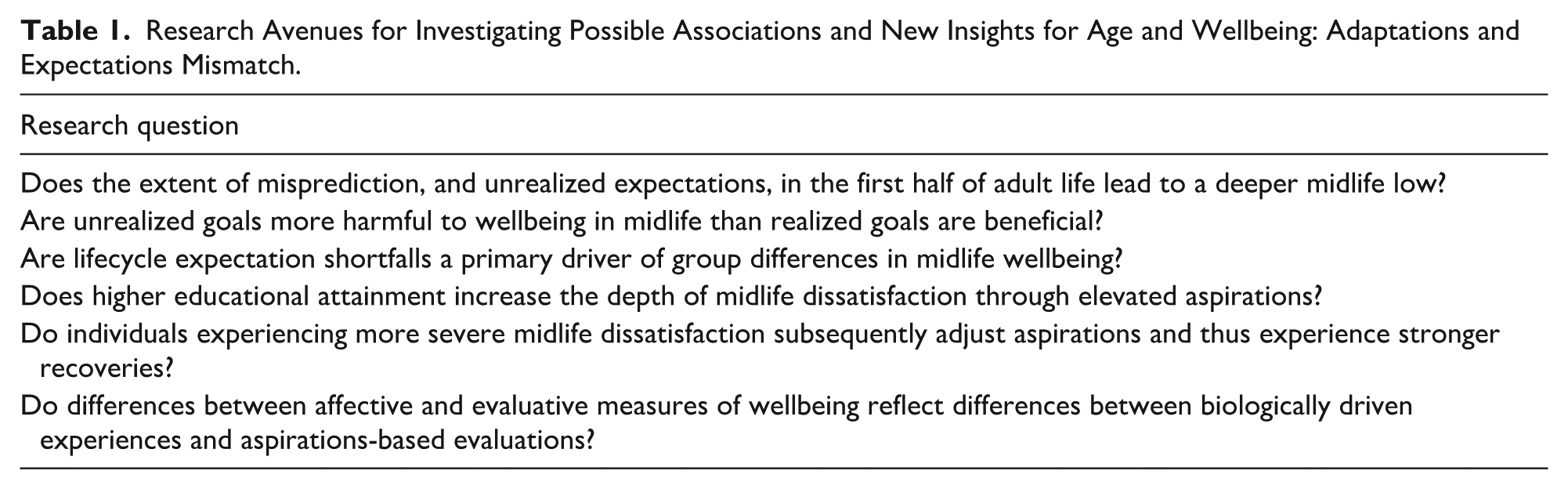
The questions presented in this subsection follow on from the view that midlife is an important development point and assume that different individuals may develop, and hence navigate midlife, in different ways. This may lead to mismatches between how an individual thinks his life should be, or should have turned out, and how it is. One example is education, which in general, raises expectations and aspirations as well as outcomes. A hypothesis is that the more education that someone has, the higher their aspirations and, if unmet, the greater the midlife low. This hypothesis was suggested by Polden (2002) and was also indicated by the findings of Schwandt (2016). However, when these are not met reductions in life satisfaction can result (e.g., Ahmed Lahsen et al., 2024; Piper, 2015b). Other mismatches might relate to our subjective life evaluations and goal achievement and how these evolve or are revised over time. Table 1, lists a number of research questions, including about educational mismatch that could guide investigations into the links between aspirations and expectations mismatch and the midlife low.
Research Avenues for Investigating Possible Associations and New Insights for Age and Wellbeing: Adaptations and Expectations Mismatch.
Relational Capital and Social Embeddedness
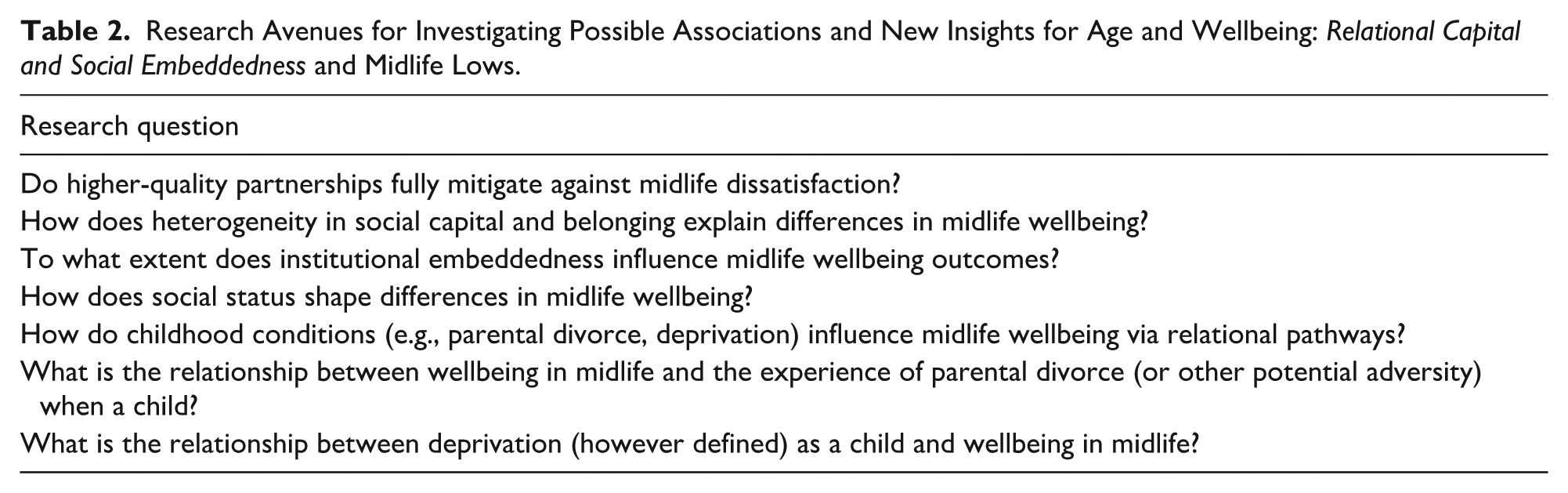
Some of the discussion above related to our relational capital and social embeddedness. Recall the findings of Helliwell et al. (2019) and Clark et al. (2021) about relationships in the home and at work. Erikson (1950) argues that we have a choice to make in midlife—an active decision between stagnation and personal growth—and that generativity is often, as discussed in more detail above, related to our social roles. Other comments above suggested that our relational capital and social embeddedness may be shaped by early-life conditions, including family life and socioeconomic circumstances, which may influence the development of social relationships and status in midlife and over the life course, thereby affecting wellbeing (e.g., Bowlby, 1951, 1988). Table 2, lists a series of questions indicating elements of interest regarding relational capital and social embeddedness and the midlife low.
Research Avenues for Investigating Possible Associations and New Insights for Age and Wellbeing: Relational Capital and Social Embeddedness and Midlife Lows.
Purpose, Identity, and Goal Adjustment
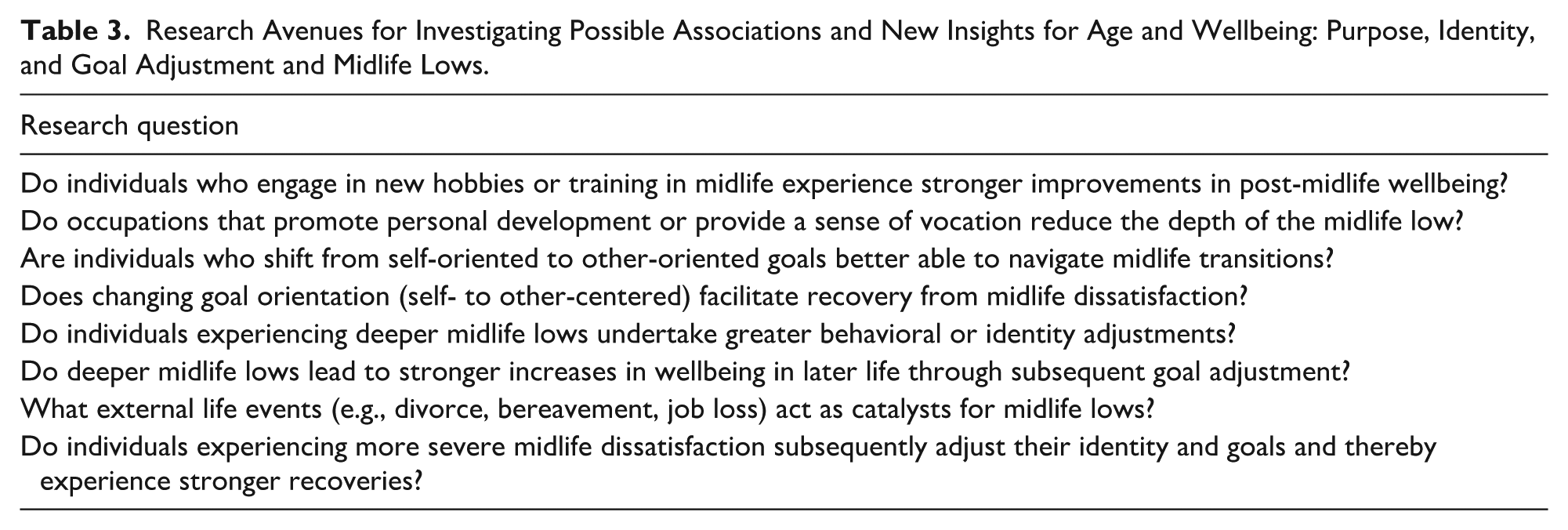
As mentioned above, psychotherapists often view midlife as an internally driven process, with some scholars asserting that midlife crises are purely internal. However, subjective states and external circumstances are likely to be strongly linked. It is not hard to imagine a strong bidirectional relationship between low wellbeing and divorce, for example. Indeed, there is evidence showing that life dissatisfaction can lead to divorce and quitting jobs (Clark et al., 1998, 2008). Complementing this evidence, external events such as divorce or career disappointment may induce midlife lows. Causality may run in both directions, and simultaneity is also possible; see Bauer and Kaiser (2025), for some recent work linking major life events to age and wellbeing. Such events may act as triggers that disrupt established life trajectories, particularly those shaped around socially prescribed “ego goals”—such as career success, status, and role attainment—which dominate the first half of adult life (Hollis, 1993; Jamieson, 2022; Polden, 2002). As these goals are reassessed or lose their capacity to provide meaning (Jamieson, 2022; Odermatt & Stutzer, 2019; Setiya, 2017), individuals may experience what the psychotherapeutic literature describes as a “call from within”: a growing sense that prior structures and aims no longer suffice as a source of wellbeing (Hollis, 1993, 2023; Stein, 2014). This, in turn, may prompt a period of reflection, identity change and goal adjustment in midlife, often involving a shift toward more meaningful and intrinsically grounded goals, alongside a redefinition of identity and purpose (Erikson, 1950; Hollis, 1993, 2023; Rauch, 2018). Table 3, lists questions for investigation of the role played by purpose, identity, and goal adjustment in midlife lows. These questions explore how such processes are reflected in observable changes in behavior, purpose, and identity.
Research Avenues for Investigating Possible Associations and New Insights for Age and Wellbeing: Purpose, Identity, and Goal Adjustment and Midlife Lows.
Individual Heterogeneity in Midlife Wellbeing
Table 4 presents questions related to midlife wellbeing and individual heterogeneity, captured in two subcategories: preferences, traits, and behavioral heterogeneity; life-course conditions and selection. The first subcategory covers variations in personality, preferences and behaviors, including physical activity, which may influence how individuals experience midlife. The second reflects differences arising from earlier life conditions and cumulative processes over the life course, including childhood adversity, deprivation, and self-selection into outcomes.
Research Avenues for Investigating Possible Additional Associations With Midlife Lows.
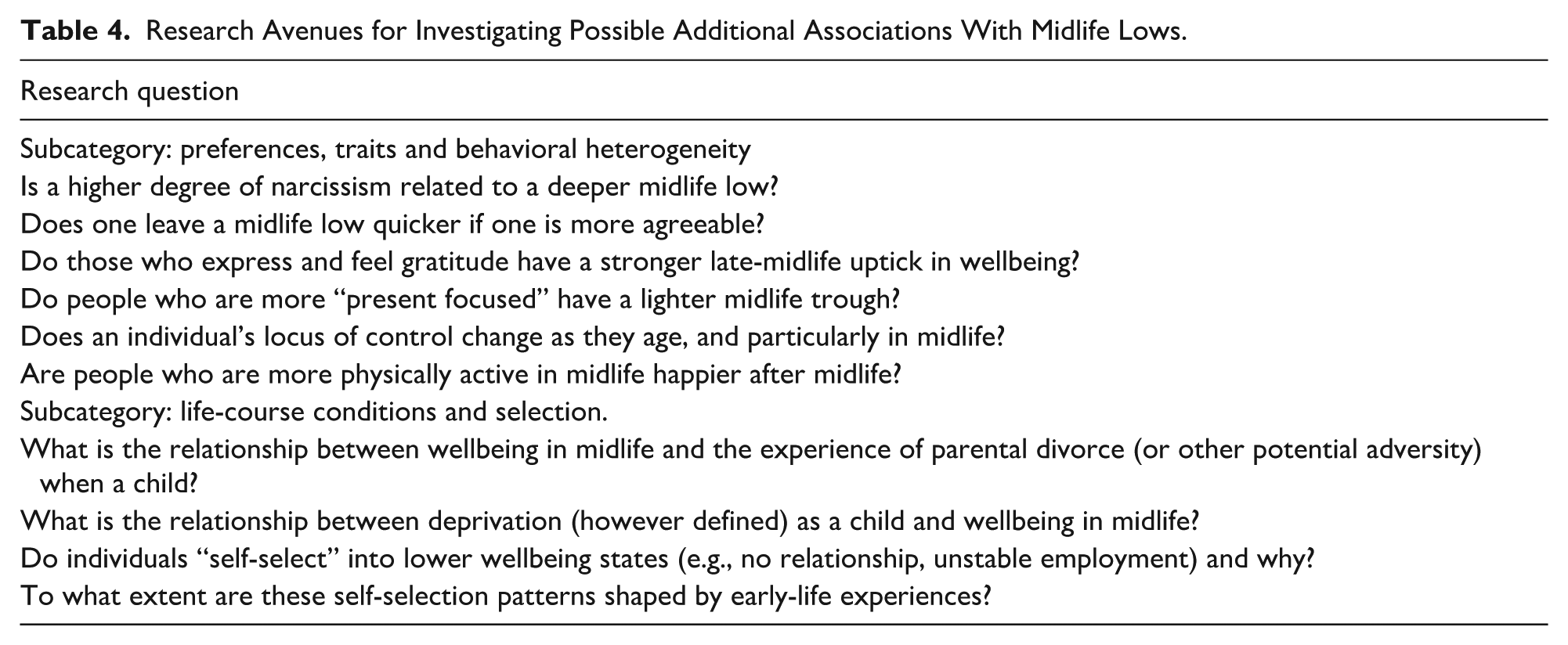
Following on from the discussion above, the psychology and psychotherapy literature places considerable emphasis on individual heterogeneity in how dissatisfaction in midlife is experienced and navigated (e.g., Fried, 1967). In particular, midlife is often conceptualized as a developmental phase requiring adaptation, maturity, and the reassessment of earlier patterns of behavior and motivation (Hollis, 1993; Jamieson, 2022; Jaques, 1965). From this perspective, differences in personality traits and behavioral orientations may play an important role in the extent of dissatisfaction in midlife and how individuals are able to adjust, recover, and experience subsequent improvements in wellbeing. The questions below reflect these themes, drawing on concepts discussed above, including socioemotional selectivity, the reassessment of earlier goals (including ego goals), and individual differences in the capacity for maturation and adaptation. These differences may also reflect earlier life conditions (Hollis, 1993, 2023; Jamieson, 2022). From this perspective, dissatisfaction in midlife may partly reflect long-run consequences of early-life adversity which may, in turn, affect an individual’s ability to select into good, stable partnerships and favorable employment situations. Table 4 collects questions on both subcategories which may contribute to our collective understanding by uncovering reasons behind some sources of heterogeneity in midlife wellbeing.
Some of the questions from these four tables can be answered quantitatively with cross-sectional data. For example, the question of Table 2 concerning how social status is associated with differences in midlife wellbeing can be investigated using individual-level data on occupational status, income or education alongside contemporaneous life satisfaction or wellbeing. However, when analyzing age-related differences in outcomes, the possibility of cohort effects driving the observed differences cannot be easily ruled out and thus weakens the argument for the use of cross-sectional data. Some require longitudinal data, for example the question in Table 2 about whether higher-quality partnerships mitigate midlife dissatisfaction (possibly entirely) can be examined by following individuals as they enter or exit relationships and observing the corresponding changes in their wellbeing, allowing for within-individual comparisons. However, such analyses are subject to endogeneity concerns. Others require data from cohort surveys that track individuals from birth, or at least from early life. Examples here include the questions from the life-course conditions subcategory in Table 4, which require information about the individual as a child, including family status, and wellbeing as an adult in midlife. Unusual for this research, interventions could also be considered. As an example, researching the second question in Table 3 could involve a randomized controlled trial where a treatment group of individuals in midlife is induced to participate in a new hobby and any changes in subsequent wellbeing are compared with a similar, perhaps artificially matched, control group who do not. Difference-in-differences techniques could be used to estimate a causal effect of this (and other) interventions; where interventions are not practical, perhaps instrumental variables could be used. The other questions all fall into one or more of these four categories: cross-sectional analysis; longitudinal analysis; cohort study; an experiment or intervention. However, given issues regarding cohort effects, endogeneity, and related concerns such as reverse causality, failure to account for these factors can lead to misleading inferences. Care is needed.
Footnotes
Acknowledgements
I am very grateful for comments to Nick Adnett, Carol Graham, and Margie Lachman as well as seminar audiences at the following institutions and conferences: Berlin Wellbeing Research Network (February 2023, March 2024); Staffordshire University (March 2023); Trier University (May 2023); Leeds University Business School (June 2023); ISQOLS (August 2023, July 2024), and the ESRC Festival of Social Science (November 2023), ISQOLS Webinar (October 2024), University of Surrey (November 2024), Leeds University School of Psychology (October 2025).
Declaration of Conflicting Interests
The author declared no potential conflicts of interest with respect to the research, authorship, and/or publication of this article.
Funding
The author received no financial support for the research, authorship, and/or publication of this article.
