







Abstract
COVID-19 drastically changed college students’ experiences in the fall of 2020. First-year students, in particular, faced challenges in connecting with peers in classes, residential halls, and clubs amid pandemic restrictions. Research has documented the pandemic’s effect on sense of belonging, which impacted students’ mental health and overall college experience. Phenomenological interviews with 16 seniors highlighted COVID-19’s lasting social-emotional impact and how institutional policies contributed to their lack of belonging by not providing opportunities for intentional peer connections after the first year. Students with positive residential life experiences and opportunities for sustained interactions through clubs, jobs, and educationally purposeful activities reported higher levels of belonging over four years, despite the pandemic’s restrictions. Students without these experiences struggled to find belonging and considered transferring. This study has implications for student affairs offices seeking to improve belonging for all students in the first year and beyond.
Introduction
The transition to college can be challenging for many students as they attempt to integrate academically and socially into the institution (Tinto, 2017). Experiences in the first year can challenge students’ beliefs in their ability to succeed, influencing their motivation to persist into the second year (Tinto, 2017). Institutions can help students persist by creating campus environments that facilitate connections with peers and faculty, creating a sense of belonging (Strayhorn, 2019). Belonging is essential for all people, “second only to more basic needs such as food and safety,” and this need must be met in order to achieve other goals (Strayhorn, 2019, p. 31). Conversely, when people lack belonging, they often feel isolated, rejected, and lonely (Strayhorn, 2019). For college students, feeling that they belong and matter to faculty, peers, and the institution more broadly increases their chances of persisting (Tinto, 2017) by positively impacting their engagement, overall well-being, and academic achievement (Strayhorn, 2019).
Higher education institutions provide numerous resources to ease the transition and help students develop belonging through First-Year Experience (FYE) activities like orientation (Ning et al., 2021), first-year seminars (Hendel, 2007), learning communities (Hoffman et al., 2002), and supportive residential life communities (Johnson et al., 2007). Making meaningful connections with faculty and students during the institution’s welcome activities helps students feel they matter (Ning et al., 2021), promoting growth and a sense of belonging that fosters students’ persistence and success beyond their first year (Hausmann et al., 2007). However, not all students find belonging in their first year, which may negatively impact their mental health (Dutcher et al., 2022), academic performance, and social experiences (Strayhorn, 2019).
The COVID-19 pandemic presented new challenges for first-year students, as students reported fewer opportunities to create connections amid public health restrictions (Ning et al., 2021). Research has explored the pandemic’s immediate effect on college students’ mental health (Son et al., 2020) and sense of belonging after returning to campus (Barringer et al., 2023). However, scant research has sought to understand COVID-19’s more prolonged impact on college students’ sense of belonging. This study fills a gap in the literature by using phenomenology to understand how residential college students interpreted the role COVID-19 played in their overall sense of belonging throughout their college experience. Interviews with college seniors who enrolled in college during the pandemic in the fall of 2020 explored the following research questions:
Literature Review
This literature review examines different aspects of the first-year experience that facilitate connections and a sense of belonging, including orientation, curricular activities, and residential life. Next, the review examines the students’ role in their campus engagement by exploring agency and student involvement. It then explores how COVID-19 affected the first-year experience, including academics, belonging, and mental health. It concludes with a discussion of the guiding theoretical framework.
The First-Year Experience (FYE)
Institutions offer a range of activities for first-year students, designed to inform them about campus life, provide opportunities to explore the campus, foster connections, and instill a sense of belonging (Ning et al., 2021). These activities start with pre-college orientation programs and continue throughout the first year in clubs, classrooms, and residential halls. Schreiner (2024) suggests that institutions can help first-year students thrive by instilling skills during orientation, first-year seminars, peer mentoring, advising relationships, and residential life programming that build on their strengths and help them cope when facing challenges. When planning first-year programming, institutions should consider how certain student populations, such as commuters, low-income students, and students of color, may face challenges in engaging in campus activities due to work schedules and other responsibilities (Schreiner, 2024).
Orientation programs and welcome week events help first-year students develop a sense of belonging through opportunities to meet faculty, staff, and other students both on and off campus. In addition to fostering community among peers and faculty, outdoor orientation programs (OOPs) enhance flourishing and resilience among first-year students by overcoming outdoor challenges (Hill et al., 2023). In Ning et al.'s (2021) survey of 2,200 first-year and transfer students, 80% of students reported meeting at least one other student they intended to maintain contact with at the Fall Welcome events, and 88% felt at least a medium level of belonging. Having the chance to meet at least five new potential friends and feeling positively about the move-in experience and orientation activities had the greatest impact on the students’ sense of belonging (Ning et al., 2021). However, underrepresented students reported feeling less belonging than their peers in the study. Although orientation programs may help to enhance belonging at the start of college, Perrine and Spain's (2008) survey of first-year residential students found that participation in the social events at new student days had little to no effect on their retention at the university. If orientations alone are insufficient to ensure positive academic outcomes and retention (Perrine & Spain, 2008), institutions must make an effort to promote belonging throughout the first year.
Some first-year college students also find a sense of belonging in the classroom, where they connect with peers on both social and academic levels (Hendel, 2007). Students develop friendships in a safe environment when they frequently interact with classmates over group projects and bond over shared academic experiences, connections that are vital for social integration (Young, 2020). First-year seminar courses help to foster these connections because they are similar to orientations in that they equip students with resources and skills that contribute to their retention and successful academic and social outcomes (Hoffman et al., 2002). A survey of first-year students found that those enrolled in first-year seminars developed a stronger sense of community than those not enrolled (Hendel, 2007). Some universities offer freshman learning communities that allow students to take a few courses with the same classmates (Hoffman et al., 2002). Hoffman et al. (2002) found that first-year and transfer students enrolled in a learning community felt greater belonging than those enrolled in general first-year seminar courses because the students could develop academic and social relationships with classmates through sustained interactions and shared experiences in the classroom.
The residential life experience can significantly enhance belonging for students from all racial/ethnic backgrounds by offering a supportive and inclusive environment, as well as the opportunity to develop close relationships with diverse peers (Johnson et al., 2007). Feeling respected for their diverse identities in a residential hall can increase belonging among first-year undergraduate students, who generally report lower belonging in college, such as students of color (Johnson et al., 2007). Students develop a higher sense of peer belonging living on campus with a roommate in their first year than living alone (Dumford et al., 2019). In contrast, living off-campus, particularly during a pandemic with fewer opportunities for socialization, may increase stress and isolation for some students who desire a sense of community (Barriteau Phaire, 2022; Dumford et al., 2019). The structure of the residential hall can play a crucial role in students’ ability to make connections, as “a single space can both foster and hinder a sense of student belonging” (Samura, 2018, p. 21). Samura’s (2018) spatial approach to student belonging research found that spatial cues in residential halls, such as open doors, can encourage interaction among residents, thereby influencing their ability to make connections and feel belonging.
Student Involvement
College students receive numerous benefits from participating in clubs and extracurricular activities on campus, including improved physical health, skill development, and increased self-confidence (Buckley & Lee, 2021). The social benefits of student involvement may be most impactful for first-year students, as they offer the opportunity to make friends, ease the college transition, and foster belonging at the university (Buckley & Lee, 2021). When students invest more time in social and academic activities, this engagement has been associated with higher grades and higher satisfaction with academic experiences, although the impact is lower for underrepresented students (Webber et al., 2013).
Research has shown that engagement in educationally purposeful activities during the first year contributes to better grades, increased satisfaction with college experiences, improved retention, and higher degree completion rates, particularly for academically underprepared, low-income, or first-generation students (Kuh et al., 2008). Educationally purposeful activities include activities that promote active learning, faculty interactions, and experiences with diverse peers (Kuh et al., 2008). Kuh et al. (2008) suggest that institutions can enhance student success beyond the first year by creating engaging classroom environments and offering opportunities for first-year students to connect with peers on social and academic levels through internships, on-campus employment, and service learning.
Although institutions play a significant role in creating an inclusive and supportive environment for first-year students, students also share a responsibility for their integration into the university (Johnson et al., 2007). Theories of student agency suggest that students can shape their college outcomes and experiences to some degree, “even if their autonomy is limited by rigid rules and regulations,” such as those imposed by universities during the pandemic (Klemenčič, 2023, p. 26). Bandura’s (2001) social cognitive theory explains how people use cognitive processes, such as self-reflection, self-regulation, and forethought, to exert intentional control over outcomes, rather than being passive recipients of external influences. A survey of 1,269 first-year and senior-level students reveals that frequent engagement in faculty interactions, high-quality staff and peer relationships, and community service leads to higher satisfaction with their college experience (Webber et al., 2013).
COVID-19’s Influence on the First-Year Experience
COVID-19 disrupted people’s lives on a global scale, and college students were no exception. For first-year college students, the pandemic posed a challenge to their ability to form meaningful connections with peers due to restrictions on in-person interactions (Ning et al., 2021; Pearman et al., 2022; Son et al., 2020). In Ning et al.’s (2021) survey of 1,400 first-year and transfer students in the fall of 2020, 64% reported not meeting anyone at the fall welcome event they intended to stay in contact with, up from 20% the previous year. Restrictions on outdoor activities made it difficult for students to meet new people or maintain contact with current friends outside of text communication (Son et al., 2020). For students of color at predominantly White institutions, wearing masks increased their visibility while providing fewer opportunities to connect with peers on a deeper level (Potts, 2021).
The pandemic also impacted students’ academic experiences, as the shift to online courses negatively affected academic performance due to increased distractions at home, decreased motivation, and challenges associated with learning in a virtual environment (Son et al., 2020). Hansen-Brown et al.’s (2022) survey of 160 undergraduates in fall 2020 found that taking synchronous courses was correlated with lower feelings of belonging and increased feelings of loneliness. First-year students were less likely to engage in college or feel that faculty responded to their needs if they were enrolled in remote classes (Kinzie, 2023). Students also experienced disruptions to their internships and other experiential learning activities (Kinzie, 2023), which raised concern about the impact on their future careers (Son et al., 2020).
Prior to the start of the pandemic in 2019, mental health issues among college students were already on the rise, as the number of students suffering from anxiety and depression doubled over the previous 10 years (Kodish et al., 2022). A 2019 study of college students found that 30.6% suffered from depression and 46.2% suffered from anxiety, and these rates were higher for students of color (Kodish et al., 2022). The disruption in college students’ social lives and concerns about their health increased anxiety and depression during the pandemic (Fruehwirth et al., 2025; Hansen-Brown et al., 2022; Lee et al., 2021; Potts, 2021; Son et al., 2020). Hansen-Brown et al. (2022) reported that COVID-19 stress was strongly correlated with a lower sense of belonging and loneliness in college students, as well as more significant mental health issues. Of the 195 undergraduates surveyed in Son et al.’s (2020) research, 71% reported increased stress and anxiety because of health concerns for themselves and family members, feelings of isolation, worries about academic performance, and other effects of the pandemic, while 44% experienced depressive thoughts. For first-year students without pre-existing mental health conditions, the early stages of the pandemic increased mental health symptoms due to isolation and difficulties adjusting to online learning (Fruehwirth et al., 2025).
Despite challenges, some students demonstrated resilience by focusing on what they gained, rather than what they lost, during the pandemic (Pearman et al., 2022; Potts, 2021). Students in Pearman et al.'s (2022) research benefited from smaller class sizes due to pandemic restrictions and believed that blended class formats helped ease their college transition. Additionally, some students reported being able to make friends and get involved despite the restrictions in place (Pearman et al., 2022). The full-time first-year students in Potts’s (2021) research felt a greater connection to peers through shared experiences. Students employed coping strategies and resilience to accept the reality of their modified first-year experiences, resulting in a greater sense of belonging and appreciation for their school (Potts, 2021).
Conceptual Framework
Strayhorn’s sense of belonging framework provides the theoretical foundation for this research, as it helps explain the effects of COVID-19 on first-year college students’ sense of belonging in the fall of 2020 and their ability to find belonging throughout college. Feeling a sense of belonging in college is essential for achieving positive academic, social, and mental health outcomes (Strayhorn, 2019), an intention to persist, and a commitment to the institution (Hausmann et al., 2007). When students feel satisfied with the quality of their social relationships, it enhances their belonging, leading to better overall well-being (Romeo et al., 2024). Recent research suggests that a daily feeling of belonging is crucial for mental health outcomes (Dutcher et al., 2022).
Defined as “students’ perceived social support on campus,” a sense of belonging increases when students identify with certain groups or feel they matter to people on campus and is particularly essential for students from marginalized populations or those who feel lonely, such as first-year students attending college in a pandemic (Strayhorn, 2019, p. 4). Since belonging is contextual, students with intersecting identities may feel they belong in one aspect of college, like their academic major, but feel they do not belong in other aspects, such as the campus racial climate (Strayhorn, 2019). Although belonging is often conceptualized as an external construct measuring students’ perceptions of how they fit in (or do not fit in) to an institution or group, belonging is also a measure of a student’s internal need to belong (Romeo et al., 2024).
A 2020 national survey of first-year students found that 80% of them felt valued by the institution and felt a part of the campus community (Building a Sense of Community for All, 2020). When first-year students interact with faculty and feel supported by peers, they develop belonging early in their college experience, influencing their commitment to the university (Hausmann et al., 2007). A sense of belonging and satisfaction that continues into the second year may prevent the “sophomore slump” and contribute to greater academic engagement (Wang & Kennedy-Phillips, 2013, p. 541). However, even when first-year students develop belonging at the start of their first year, their belonging can decline as the year progresses without successful academic adjustment (Hausmann et al., 2007). Demographics and institution type can shape belonging, as students enrolled in 4-year colleges report higher belonging than those at 2-year colleges, and underrepresented minority and first-generation students report lower belonging than other students (Gopalan & Brady, 2020). Since belonging at 4-year colleges is positively linked to persistence and mental health (Gopalan & Brady, 2020), institutions must prioritize practices that foster belonging among students, including those from marginalized groups.
Methods
Research Design
This study explores how COVID-19 shaped college students’ experiences and belonging in the fall of 2020 and throughout college using Interpretive Phenomenological Analysis (IPA). IPA is a collaborative approach that “explores experiential meanings through the interpretative work between the researcher and the participant rather than being a theory-driven examination” (Smith & Fieldsend, 2021, p. 147). This method is consistent with my interpretive paradigm, which believes knowledge is created through interactions with participants (Tracy, 2020).
IPA is a research method adapted from different phenomenological approaches, including those of Husserl, Heidegger, Merleau-Ponty, and Sartre (Smith & Fieldsend, 2021). Smith and Fieldsend (2021) adopted Husserl’s philosophical approach to understanding participants’ experiences when creating IPA, but rejected Husserl’s notion that researchers are not active participants in the research process. In addition to philosophy, IPA incorporates theories of hermeneutics and idiography (Smith & Fieldsend, 2021). Like Heidegger, Smith and Fieldsend (2021) believe that phenomenology requires interpretation by the researcher of the participants’ narratives, an IPA approach called double hermeneutics. Lastly, IPA employs idiographic principles, as developed by Merleau-Ponty and Sartre, which take an existential approach to the human experience by emphasizing participants’ perception of their experience and how relationships shape that experience (Smith & Fieldsend, 2021).
Participants
The research was conducted in the spring of 2024, four years after the COVID-19 pandemic began. To meet the eligibility criteria, participants must have enrolled as full-time, first-year undergraduates at a four-year degree-granting residential institution during the 2020–21 academic year and completed at least three years of coursework. To understand a phenomenon from the perspective of a population that shares specific criteria (i.e., college students’ sense of belonging), IPA recommends using purposive homogeneous sampling (Smith & Fieldsend, 2021). I used social media sites to distribute a recruitment flyer to colleagues at other universities, which contained a link to an online consent form and a brief Qualtrics survey. Snowball sampling also helped to expand the sample size through recommendations from other participants (Tracy, 2020). Participants were not offered incentives or compensation.
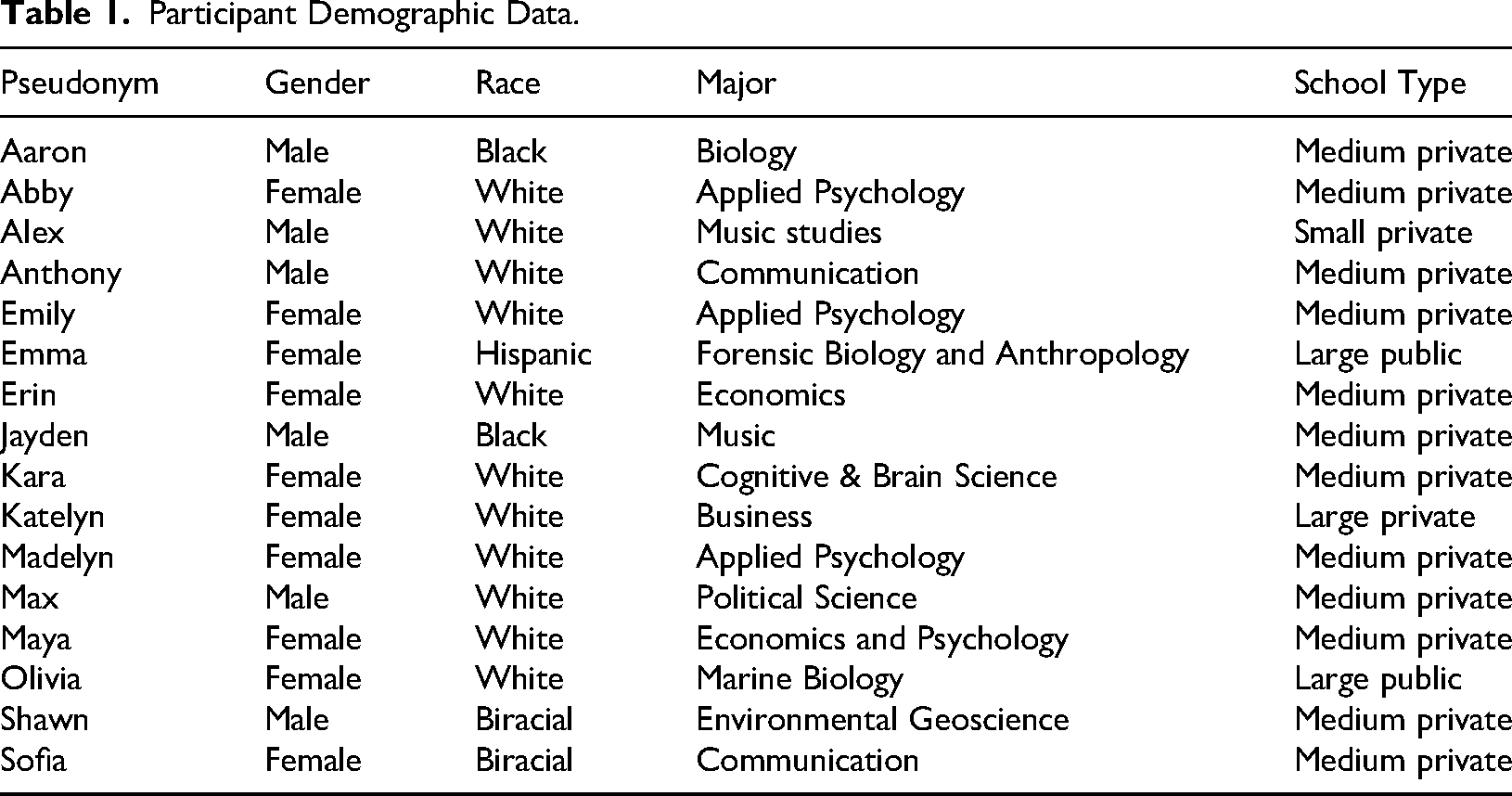
The final sample consisted of 16 residential undergraduate students (N = 16), aged 21–23 years old, who began their first year in college during the height of the COVID-19 pandemic in the fall of 2020 (see Table 1). Of the 16 participants, 10 are female, and six are male. Eleven students identify as White, two as Black, two as biracial, and one as Hispanic. Fourteen students attended private schools, and two attended a public state university. They enrolled in eight different schools in the U.S., with most institutions located on the East Coast. The institutions included small liberal arts colleges and large public research universities, ranging in size from 2,000 to 88,000 undergraduate students.
Participant Demographic Data.
Data Collection
The most frequently used IPA data collection method is the semi-structured interview, as it provides participants with the flexibility to interpret their lived experiences related to COVID-19, sense of belonging, residential life, academics, and student involvement (Smith & Fieldsend, 2021). After receiving approval from the institutional review board, I scheduled a 60-minute Zoom meeting with participants who met the study criteria and signed the consent form. Sample questions included: “Describe your experience making friends in your first year,” and “What factor had the greatest influence on your sense of belonging in a positive way?” I created analytic memos throughout the data collection process to help organize and make sense of the collected data (Tracy, 2020).
Data Analysis
I recorded the interviews using Zoom’s internal recording feature and manually transcribed the recordings verbatim. IPA’s analytical approach required four systematic steps, beginning with a process of carefully reading through each transcript to become familiar with the participant’s lived experience (Smith & Fieldsend, 2021). Using Dedoose qualitative software, I began the second stage of IPA analysis, which involved taking notes of pertinent phrases on each transcript and developing an experiential statement that best described the participant’s sense-making process (Smith & Fieldsend, 2021). Some of the pertinent phrases included “difficult meeting people with masks,” “afraid of breaking social distancing policies,” and “could only have two people in your room.” An example of an experiential statement that encompassed the relevant phrases included “Katelyn struggled to meet people in her residential hall because she was afraid of breaking social distancing rules and getting in trouble.”
The third step involved consolidating the notes and experiential statements from the previous step into themes and patterns that summarized the participant’s experience (Smith & Fieldsend, 2021). This step required reading all transcripts and notes carefully to interpret how each participant perceived their sense of belonging at each stage of their college career, and taking an idiographic approach to understanding how COVID-19 and institutional policies impacted their experiences. For example, Emily’s personal experiential theme is the following: “COVID-19 policies exacerbated her loneliness in the first year by instilling fear and making it difficult to meet friends. Although she eventually felt belonging by the end of senior year, she believed the school should do more to bring sophomores together and appreciated connections she made through on-campus employment.”
The final step involved identifying patterns and differences among all participants (Smith & Fieldsend, 2021). The themes presented in this manuscript represent the common perceptions shared by participants regarding their experiences of starting college during the pandemic and how they believe these experiences have shaped their sense of belonging. I shared the findings with all participants to confirm I was interpreting their perceptions of their college experiences in a holistic and accurate manner.
Positionality and Trustworthiness
As a White, middle-class female researching the experiences of college students from diverse racial and socioeconomic backgrounds, I understand how power dynamics may introduce bias into the research process. It is essential to remain reflexive and adopt a paradigm that allows participants to share their lived experiences without judgment or preconceived ideas. Utilizing an interpretive point of view allowed me to employ empathy in understanding how participants co-constructed their reality (Tracy, 2020). To achieve trustworthiness, I employed member checking by sharing the raw data with participants immediately following the interviews and a summary of findings during data analysis (Creswell & Miller, 2000).
Findings
The research revealed five primary themes: 1) COVID-19’s enduring social-emotional impact, 2) res life “is a giant sh*t show,” 3) where is the first-year experience sophomore year? 4) belonging depends on sustained interaction, and 5) support for identities leads to belonging. These themes are discussed below.
COVID-19’s Enduring Social-Emotional Impact
The first research question explored how college seniors who started in the fall of 2020 perceived the impact of COVID-19 on their first-year experience. The findings revealed that most students (n = 14) perceived COVID-19 had a significant influence on their sense of belonging in the first year, primarily due to the isolation they felt. Additionally, these students reported experiencing lasting social-emotional impacts due to institutional social distancing restrictions that made it difficult to interact with students other than their roommates. Students feared breaking the school’s policies due to harsh penalties, which included losing university housing. Even after institutions lifted the restrictions in the fall of their second year, the lasting social-emotional impact left these students lacking the confidence to venture out of their pandemic-generated social pods from the first year. For some (n = 8), the lack of belonging made them consider transferring. Students suffered from lingering mental health issues and struggled to find connections on their campuses.
Most students (n = 14) felt that the COVID-19-related social distancing policies in the residence halls, online classes, and the absence of extracurricular activities restricted their ability to meet people in their first year and make meaningful connections. Abby described, I was kind of like, interacting with people just to make sure I wasn’t totally isolated. But yeah, I didn’t really feel like I had enough friendships or like, at the end of the year, I didn’t feel like I had enough, like sustaining connections. I think that sense of … if you mess up or you get COVID, like you’re gonna be punished … increased the anxiousness I think people feel when being in social situations. … I think a lot of people look to college as a time to like branch out and like express themselves. … I think that a lot of people, because of COVID freshman year, didn’t get to properly develop those skills. It was really difficult for me also mentally … I think it was just like being so alone all the time, like not being able to see people. I suddenly like realized, oh my gosh, I think I like, might be an anxious person. I kind of went into a deep state of depression my sophomore year. … I didn’t have in-person clubs and organizations. I hated my roommate, and I didn’t want to leave my room. The other few classes that I had in person sucked. … I didn’t want to go anywhere. … I just definitely felt zero sense of belonging. … I’m a very, very personable person and I couldn’t do all these in-person things. So I was just really, really sad all the time. I think there were times where I contemplated transferring. … I had never really struggled with anxiety until my freshman year. … And I think COVID really sparked that. And when I first got to campus, I actually tested positive for COVID right off the bat. … It kind of set the tone for, I guess foreshadowed what was kind of a lonely, anxious semester. I don't think it helped my mental health. … Especially because they ended up having a season. … That was kind of hard to watch everyone else and, you know, watch them win and, and just like, it was just like very lonely in terms of like the friendship thing. That’s when I like called my mom and I was like, yeah, I’m trying to transfer. … I didn’t feel a connection to the school. … I was very grateful for my friends and stuff. And that was probably like one of the major reasons why I stayed for as long as I did. But by then, you know, I didn’t see any more point to it.
Res Life “is a Giant Sh*t Show”
The second research question explored how college seniors perceived the impact of COVID-19 after their first year. Almost all participants (n = 14) reported that their institutions were fully back in person for their second year, with the only COVID-19 restrictions being recommended masking and social distancing. The remaining two students recalled having classes and activities virtually until the spring of their second year. Discussions with participants revealed two significant impacts that shaped their belonging and college experiences. The first significant impact related to their residential life experiences, which many (n = 13) believed was complicated by COVID-19 social distancing restrictions in the first year, making it challenging to make friends outside their immediate roommates. Those lucky enough to be paired with good roommates in their first year, such as Aaron, Madelyn, Jayden, and Shawn, felt less isolated than those who did not have a positive roommate experience. Madelyn recalled, My roommate and I … became like best friends. And truly, like she was like my lifesaver freshman year, because we were like stuck in our dorms and couldn’t like have people over because we were worried about getting kicked out. … I honestly don’t think I would have like been able to survive freshman year without like having a good roommate because I know, like I have so many other friends who, their roommates weren’t as great.
Erin summed up the housing selection process that many of the participants felt when she said, “The res life process here is a giant sh*t show.” Not all students are fortunate enough to make meaningful connections through their residential life experiences, and the COVID-19 restrictions exacerbated these experiences for many students during the 2020–21 school year. Sense of belonging frameworks explain how those who felt they mattered to people, such as their immediate roommates, felt a greater connection than first-year students who struggled to fit into a group in the residential halls. Beyond the first year, most students (n = 10) struggled with their residential life experience and its impact on their sense of belonging. As students sought other avenues on campus to make connections, they lamented the lack of university-sponsored programs to support their efforts.
Where is the First-Year Experience Sophomore Year?
The second impact relates to the lack of engagement that participants felt in their second year, resulting from the loss of a traditional first-year experience. Those with older siblings and friends regret missing out on first-year experiences, such as in-person orientations, sporting events, in-person first-year seminars, and other on-campus welcome events. Olivia explained, Who’s going to want to sit on a Zoom call for two hours and be forced to like talk to people? They don’t want to talk to you. So that felt a little sad, versus like, I heard that people before had like pretty cool orientation situations. So, if they had events, like I’m not going to say that they didn’t, but they just didn’t really tell us about them. They didn’t really put that much effort into advertising it. And we were all kind of doing our own thing. … It didn’t seem very united. And then the class of 2025 … I was so jealous because they had just, like, everything that you would have as a college student that we didn’t have. … They had the club fair. … They had a lot of things in their dorms to do bonding and almost felt like [university] learned from us and prioritized the next freshman class without attending to the fact that some of us in that, you know, 2024 class, you know, still needed help. … like making friends and making connections. I mean, I don’t know … if the blunders they made when I was a transfer was because of, like, COVID … they need to treat transfers like they want them to be here. … Living at home with my family my freshman year made it harder to move in sophomore year. … I was pretty lonely the first few weeks, which is tough.
Belonging Requires Sustained Interactions
The third research question investigated how college students who enrolled in the fall of 2020 found a sense of belonging on campus. By the spring of their second year, all students (N = 16) described their college campuses as “back to normal,” with no remaining COVID-19 social restrictions, despite many campuses still requiring students to test regularly for COVID-19. Two themes emerged from this question. The first theme relates to the sustained interactions that enabled students to form close bonds with their peers through on-campus jobs and clubs. Having a meaningful job on campus gave some students, such as Aaron, Olivia, Max, and Emily, a sense of purpose and an opportunity to develop worthwhile relationships with other students through sustained interactions. Maya described her student-calling job: That was like, probably one of the biggest things that helped me feel more connected to the school. ‘Cause I felt like I had more of a purpose there. It was like, oh, I’m like actually doing something, like helping the school or whatever. And I loved it. I loved the kids that I worked with, too. It was a really great opportunity to meet a ton of different people from different class years. The music stuff, I mean that stuff I was interested in, the passions that I could still pursue or knew. … I was still doing music in a way. … We would rehearse and learn individually and sing in our own dorm rooms on a Zoom screen together. … I could still do it and felt like, okay, that, you know, [university] is my home. Freshman year, I’d say people had the most access to the [university] soccer field, where you could go on whenever you want. And I would play soccer, which I would set up on social media for matches with a bunch of people I’ve never met, and I met people through that.
Students of Color Need Support for Identities
A second significant factor positively contributing to participants’ sense of belonging was finding support for their identities. Four of the five students of color in this study found belonging at their predominantly White schools by the time they graduated. Aaron and Sofia joined in-person ethnic student organizations during their sophomore year, which gave them a sense of belonging among peers with shared identities. Aaron recalled: “I met people that, you know, looked like me and had the same culture as me, so I think it grew from that point. And then kind of kept on increasing until senior year.” Shawn found belonging by interacting with diverse peers on the soccer field. He described: A lot of the Latin-speaking clubs here have group chats on like WhatsApp. And I was added to that, and people were talking about, you know, in Spanish. Okay, basically, I was just introduced to a whole other part of [city] that [university] is integrating into.
Although some students were fortunate enough to find an activity or job that gave them purpose and a chance for meaningful connections during the pandemic, others were not. These findings underscore the significance of positive residential life experiences, university support throughout the college experience, and sustained interactions in promoting student retention and a sense of belonging. They also underscore how COVID-19 influenced students’ ability to benefit from a first-year experience and created social-emotional challenges that would last throughout college.
Discussion
The first year of college can be a challenging transition for many students, even without the stresses of a pandemic. Before COVID-19 started, anxiety and depression rates among college students in 2019 were around 46% and 30%, respectively (Kodish et al., 2022). Yet, nationwide surveys revealed that 80% of first-year students felt they belonged at their institutions (Building a Sense of Community for All, 2020), and 82% returned for their second year at 4-year universities (Undergraduate Retention and Graduation Rates, 2022). This study aimed to understand the immediate and long-term effects of COVID-19 on the sense of belonging of college students who enrolled in the fall of 2020. Findings revealed that most college seniors in this study (n = 14) left their first year without a sense of belonging and perceived COVID-19’s impact to be long-lasting. Many students continued to struggle to find belonging because the restrictions in their first year made it challenging to develop connections with peers, although all students except three (n = 13) eventually found belonging by the end of their senior year. The students who found belonging in the first two years of the pandemic demonstrated resilience by finding creative ways to make connections.
Consistent with the findings in Ning et al.’s (2021) research, most participants (n = 14) in the current study reported a low sense of belonging in their first year because of their inability to make quality connections with other students amid the COVID-19 restrictions. An interesting finding is that all 16 students made at least one connection in their first year; however, the friendships were not enough to foster a sense of belonging at the university without clubs and in-person classes. Although universities quickly moved orientations and activities to a virtual environment, the participants hesitated to join for various reasons. Similarly, the students in Ning et al.’s (2021) research reported a lack of communication about virtual events or technology issues as barriers to participation. The students in Pearman et al.’s (2022) study were dissatisfied with their first-year experience because COVID-19 restrictions impacted their social lives by canceling campus clubs and activities, a finding congruent with the current study. Only two students in the current study bonded with peers over shared pandemic stress, a finding that contradicts the results of Potts’s (2021) research, in which first-year students felt greater belonging because of the resilience they developed and shared experiences during COVID-19.
The shift to synchronous and asynchronous classes in the fall of 2020 was socially and academically challenging for most participants (n = 13) in the current study. Supporting prior research (Hansen-Brown et al., 2022; Son et al., 2020), participants in the study found the interactions with peers awkward and inorganic. Many (n = 5) felt that the learning environment for specific courses, such as statistics or chemistry, was unmanageable, wishing they had more opportunities to interact with professors. These sentiments contradict Barriteau Phaire’s (2022) research, in which students living off-campus in the fall of 2020 found comfort and community in their Zoom classes. Unlike the students in Pearman et al.’s (2022) research who appreciated the smaller class sizes and blended formats of the pandemic, only one of the current participants shared a similar sentiment.
Most participants (n = 13) reported that the pandemic-related social distancing restrictions in residential halls during the first year, which required them to wear masks and prohibited large gatherings, made it challenging to meet people or develop friendships outside of their roommates. Although most students reported getting along with their roommates (n = 11), only a few developed lasting friendships that enhanced their belonging, a finding consistent with the findings in Johnson et al.’s (2007) study. Two students described their first-year residential life experience as having the greatest negative impact on their belonging over the four years. The findings support Samura’s (2018) research on spatial approaches to belonging in residential halls, which suggests that on-campus living provides students with opportunities for social interaction and engagement—an aspect of residential life that was missing during the pandemic. The COVID-19 social distancing restrictions required two students in the current study to live alone or off-campus, resulting in isolation and additional challenges connecting with peers. This finding is similar to the isolation and stress that students felt living off-campus in Barriteau Phaire’s (2022) study, as well as the lower sense of belonging experienced by first-year students in Dumford et al.’s (2019) research when living alone or off-campus.
The COVID-19 restrictions that resulted in fewer interactions with friends and family increased anxiety and mental health issues for many of the students (n = 6), a finding similar to previous research (Hansen-Brown et al., 2022; Lee et al., 2021; Pearman et al., 2022; Potts, 2021; Son et al., 2020). The mental health concerns of the students in the current study at the end of the first year supported the findings of Dutcher et al.’s (2022) study that showed an increase in depressive symptoms in first-year students who did not feel a daily sense of belonging. Additionally, a couple of students (n = 2) in the current study who had no pre-existing mental health issues experienced an increase in anxiety or depression symptoms during the pandemic, supporting prior research (Fruehwirth et al., 2025). Although most students in the current study felt increased stress as a result of COVID-19, both students who identified as LGBTQ (n = 2) reported more significant impacts on their mental health. This finding confirms the results of Lee et al.’s (2021) research in which populations like females, LGBTQ students, and students from low-income and rural backgrounds reported higher rates of severe anxiety and depression.
Contrary to prior research, which showed that 4 out of 5 students felt they were part of the community at their institution (Building a Sense of Community for All, 2020), only two of the 16 participants in the current study felt they belonged by the end of their first year. Two students transferred, and six others seriously considered doing so. The fact that a couple of students found ways to make connections during the social distancing restrictions demonstrates the resilience discussed in Potts’s (2021) research. Conversely, the other 14 students struggled to make friends and feel connected to the university, supporting Kinzie’s (2023) research, which reported that first-year students were less engaged during the pandemic. This finding contradicts Gopalan and Brady’s (2020) quantitative study, conducted in the spring of 2020, which found no change in belongingness among the general student population, except for first-generation and underrepresented minority students. However, Gopalan et al.’s (2021) study acknowledges that the campus closure in the early months of the pandemic may not have significantly impacted belonging, as socialization had already occurred. Similarly, the findings do not support Barringer et al.’s (2023) research in which students felt no decrease in belonging in the spring and summer of 2020 compared to before the pandemic.
Supporting extant literature (Buckley & Lee, 2021; Strayhorn, 2019), half of the participants (n = 8) found belonging in their first year through sustained interactions with students in clubs who shared their interests and identities, such as the marching band, ethnic student clubs, and religious organizations, even though many interactions were virtual. Another significant influence on sense of belonging during the pandemic was having an on-campus job, which allowed the students in the current study to feel connected to the university by earning money and developing relationships with peers through sustained interactions. Consistent with sense of belonging frameworks, most students of color (n = 4) found belonging early through ethnic student clubs, interactions with diverse peers, and educationally purposeful activities, such as research labs. The connection they developed supported Kuh et al.’s (2008) research that links first-year engagement in educationally purposeful activities to greater satisfaction, retention, and persistence. This finding contradicts Potts’s (2021) research, in which students of color reported difficulty making connections in their first year due to the masking requirement.
Engaging in educationally purposeful activities, such as in-person first-year seminars or research labs, enabled some of the participants (n = 5) in the current study to socially integrate into their institution, leading to greater satisfaction, retention, and persistence (Kuh et al., 2008; Young, 2020). Two students successfully found belonging in their in-person first-year seminar classes because it allowed them to develop close bonds with their classmates in a small classroom setting and connect over shared concerns during COVID-19. These findings are similar to the results in Hoffman et al.’s (2002) study that found “the common agenda and similar struggles further encouraged student/peer interactions and helped to create meaningful bonds between students that are characterized by support rather than mere social unions” (p. 252). Feeling a greater sense of community and finding connections through shared experiences are results similar to Potts’s (2021) and Hendel’s (2007) research findings. Additionally, students like Shawn and Alex found creative ways to make connections their first year through pickup soccer games and virtual jam sessions, a finding that supports Pearman et al.’s (2022) research.
Most students (n = 14) began their second year without a sense of belonging because they had not developed sustaining friendships through clubs, classes, or residential life experiences. They expressed frustration that their universities did not do more to support them, given the restrictions on their first-year peer interactions. Despite the lack of programming geared toward sophomores, the participants in this study were motivated to engage with peers and faculty. This finding diverged from Wang and Kennedy-Phillips's (2013) research in which students with lower belonging after the first year were less likely to engage academically. The disparate finding is most likely because the participants in this study were trying to make up for what they lost socially during the pandemic.
Limitations
The findings should be considered in light of several limitations. First, the sample size was small (N = 16), so although they represent experiences from residential, full-time undergraduate students at eight different colleges and universities, the findings are not generalizable to all college students, such as commuter students or those attending community colleges. Second, a sole researcher conducted the study, so adding a second researcher would have improved the study’s trustworthiness. Third, the students were asked to comment retrospectively on their four-year experiences, which may have introduced bias. However, the research aims required students to interpret COVID-19’s long-term impact on their sense of belonging, which necessitated interviewing college seniors.
Implications
This study is significant because it is one of the first to adopt a phenomenological approach in exploring the pandemic’s long-term effects on college students’ sense of belonging, as perceived by college seniors who were first-year students at the start of the pandemic. Although the existing literature has identified COVID-19’s immediate impacts on college students’ mental health and belonging, scant research has explored how institutional policies related to the pandemic continued to shape college students’ belonging and experiences after the first year. The findings from this study present opportunities for institutions seeking to enhance belonging and retention for all students by highlighting the challenges students face in forming connections and finding a sense of belonging beyond the first year.
As prior research has reported, synchronous and asynchronous courses made it difficult for many students in this study to make connections with classmates and faculty members because interactions were unnatural, leading to stress and negative impacts on mental health. Those taking more difficult science or math courses struggled learning in a virtual environment. The findings suggest that institutions prioritize in-person learning environments for first-year students whenever possible to enhance the personal peer connections, faculty interactions, and academic outcomes.
Students overwhelmingly expressed negative feelings about their residential life experiences due to pandemic restrictions and the room selection process that impacted their belonging. Although institutions could not control public health restrictions during the pandemic, institutions should explore ways to improve residential life experiences, with a primary focus on matching roommates to ensure a successful first-year residential life experience. In addition, not all students will have a positive first-year residential experience. Therefore, universities should be more proactive in helping rising second-year students find new roommates by repeating some of the processes used in the first year and hosting events that allow students to connect with other first-year students before housing selection begins.
The findings regarding student involvement suggest that institutions should enhance students’ sense of belonging by providing opportunities for sustained interactions. Many participants complained that clubs were too exclusive or that interactions were too infrequent to foster meaningful friendships. Those who found belonging successfully did so through on-campus jobs and activities that provided them with opportunities to connect with other students on a regular basis, suggesting that institutions should maximize these opportunities for sustained interaction. Additionally, institutions should create clubs and activities designed to support the identities of students of color, as some of the students of color in this study found belonging through ethnicity-based student groups.
Finally, study participants yearned for institutional support after their first year. Although the need for this support may have been heightened for this cohort, who missed out on the first-year experience, students in this study reported they would have benefited from having structured social activities in the second year and beyond. As the study highlighted, many students, including transfers and continuing students, do not develop connections in the first year, leaving them vulnerable to mental health issues and at risk of transferring. Participants suggested that institutions implement grade-wide activities to promote interaction and healthy competition among different residence halls, such as an Olympics. Offering programming similar to that offered in the first year would help all students become socially integrated into the university, resulting in greater satisfaction, a sense of belonging, and improved outcomes.
Conclusion
Although institutions varied in their responses to the COVID-19 pandemic, study participants agreed that institutional staff and faculty did the best they could, given the circumstances they faced. Students who were fortunate enough to be living on campus and taking some in-person classes appreciated the effort by institutions to maintain a degree of normalcy. Still, all students regretted missing out on their first-year experience and the chance to develop long-lasting relationships because of social distancing restrictions. Their challenge in making these connections early on left many with lasting social and emotional issues that influenced their sense of belonging and intentions to persist beyond the first year.
The students’ shared struggle to meet people beyond the first year underscores the importance of the second-year experience in college, not just for transfer students but for any college student who did not acclimate and make connections in their first year. It also highlights the need for more creative residential life policies, as most students continued to have negative living experiences after their first year.
Fortunately, most participants eventually found a place where they belonged, whether through on-campus employment, clubs, or meaningful academic experiences. However, the students in the study who finished college without a sense of belonging to their institutions are members of marginalized groups who struggled to fit in. Their experiences underscore the need for institutions to provide resources that create a welcoming and inclusive campus environment for all student populations.
Footnotes

Ethical Considerations
The author received approval from the Institutional Review Board before conducting research.
Consent to Participate
All participants provided written informed consent before participating.
Consent for Publication
Not applicable.
Author Contribution(s)
Funding
The author received no financial support for the research, authorship, and/or publication of this article.
Declaration of Conflicting Interests
The author declared no potential conflicts of interest with respect to the research, authorship, and/or publication of this article.
Data Availability Statement
The datasets generated during and/or analyzed during the current study are not publicly available due to the sensitive nature of the participant information, but are available from the corresponding author upon reasonable request.