






Abstract
Self-determination is linked to in-school academic achievement and positive postschool outcomes of students with disabilities. Self-determination can enhance one's ability to establish and maintain connections with other individuals and their environments, ultimately enhancing their sense of belonging in their lives. Such efforts can elevate an individual's overall quality of life. However, self-determination is a complex and nuanced construct, where practitioners should make intentional decisions on what to include in a treatment to increase the self-determined behaviors of their learner. Yet, this complexity can lead to challenges when determining what should be included when working on these skills. A component analysis single case experimental design can help practitioners identify components to include in these interventions. Therefore, the purpose of this review was to provide a systematic and comprehensive review of the literature on component analysis methodology, outcomes, and study characteristics pertaining to self-determination. Across the 21 studies identified within 18 articles, 177 participants were reported to have participated in interventions that implemented a component analysis experimental method exploring interventions focusing on self-determination. Outcomes from studies using a component analysis around self-determination are discussed, including the identification of critical components versus the need for the full treatment package. Implications for future research are also discussed.
Identifying Active Ingredients of Self-Determination Interventions: An Exploration of Component Analysis Research
Individuals with disabilities often experience poorer social participation outcomes than their typically developing peers. However, when practitioners intentionally focus on fostering and cultivating a sense of belonging, positive outcomes ensue. Within the disability literature, a sense of belonging can be defined as being present, noticed, welcomed, cared for, supported, accepted, known, befriended, needed, and loved (Carter et al. 2016; Gur & Bina, 2022). Thus, when a framework of belonging is used as an overlay to instruction for students with disabilities, social connectedness and participation can take place.
The experience of belonging is deeply rooted in the principle of self-determination. As a factor that facilitates a sense of belonging in individuals with disabilities, self-determination plays a role by helping individuals with disabilities develop a disposition of relatedness, that is, a feeling of connection and support from others (Frielink et al., 2018). Self-determination and choice (i.e., a component of self-determination) empowers individuals to have “control over to whom or what they belong to and the power to develop satisfying reciprocal interactions” (Mahar et al., 2012, p. 1031).
Individuals with disabilities, therefore, should have an active role in their lives to emit self-determined behaviors leading them to a sense of belonging within the communities they participate. This call to action, set forth by Nirje (1972), catalyzed the fields of applied behavior analysis (ABA) and special education to understand self-determination and its impact on individuals with disabilities. On the outset of this article, we would be remiss not to note the emotions the word “self-determination” evokes. The field of ABA advocate their discipline as a natural science, where deterministic laws are formed rather than a mentalistic approach (Callahan et al., 2023; Watson, 1913). Yet, both fields (i.e., ABA and special education) use self-determination to explain a set of behaviors that can be taught to individuals to become more self-determined. Self-determination is both a “process to apply and an outcome for individuals to achieve, which provides them with a means to identify their preferences and desires and become more active in managing and directing their own behavior” (Agran & Hughes, 2014, p. 75).
Self-Determination Across the Fields of ABA and Special Education
Through a special education framework, self-determination includes patterns of observable, measurable, and teachable skills including self-management, goal setting, plan development, implementing action plans, problem solving, evaluating progress toward goal attainment, and behavioral adjustment based on one's self-evaluation (e.g., Martin et al., 2020; Wehmeyer et al., 2000). Promoting self-determination is critical to support meaningful in-school and postschool outcomes (Raley et al., 2023) such as self-care, self-advocacy, belonging, and employment. Students acquire self-determination when they are provided capacity in (i.e., instruction in self-determination) and opportunity for (i.e., practice) emitting behaviors associated with self-determination (Pulos et al., 2024). Although improving self-determination is seen across the extant literature in both general education and special education, much of the self-determination research is couched in special education targeting students with disabilities (e.g., Algozzine et al., 2001; Burke et al., 2020). When students with disabilities are more self-determined, they achieve higher rates of education-related goals (e.g., Shogren et al., 2012). In addition, they achieve positive postschool outcomes associated with community participation, employment, and overall quality of life (e.g., Lachapelle et al., 2005; Nota et al., 2007), ultimately leading them toward a powerful sense of belonging within the various communities they participate. Self-determination interventions provide a means for all individuals to be more self-determined so they can act in service to freely chosen goals (Shogren et al., 2015). Actions associated with self-determination (e.g., goal setting, problem solving, self-evaluation) “function to enable a person to be the causal agent in his or her life” (Shogren et al., 2015, p. 258).
Prior Reviews of Self-Determination
Self-determination has been a topic of interest for educational researchers. Through systematic reviews and meta-analytic research, researchers have worked to better understand self-determination as an independent variable (IV) on a variety of behaviors (i.e., dependent variable [DV]) to increase in-school and postschool outcomes. One of the first inclusive reviews of self-determination was directed by Algozzine et al. (2001), where they conducted a comprehensive review of the literature to better understand interventions to promote self-determination. Algozzine et al.'s (2001) results suggested self-determination interventions focused primarily on teaching single component self-determination skills to transition-age youth, which included choice making (students with intellectual disability) and self-advocacy (students with specific learning disability and intellectual disability). Additional examples of self-determination interventions focusing on multi-component treatment packages found by Algozzine et al. (2001) included self-awareness, goal setting, choice making, problem solving, and personal advocacy (Abery et al., 1995); goal setting, self-awareness, self-evaluation, problem solving, choice making, and decision making (Cross et al., 1999); and decision-making, goal setting and attainment, problem-solving, self-advocacy, self-awareness, and self-evaluation (Wehmeyer & Lawrence, 1995).
Following Algozzine et al.'s (2001) study, subsequent reviews with more specific aims were conducted (e.g., Burke et al., 2020; Raley et al., 2018). These reviews investigated single aspects of self-determination interventions (e.g., choice making, problem solving), curricula designed to increase student self-determination, and a specific self-determination model of teaching. For example, Wood et al. (2005) investigated the research on interventions to foster skills associated with self-determination for individuals with severe disabilities. Their results suggested choice making as the most frequently taught self-determination skill supporting Algozzine et al.'s (2001) findings. Among the interventions supporting choice making, all studies identified used systematic instruction and reinforcement strategies to teach this skill. Finally, Fowler et al. (2007) was interested in the impact self-determination had on the academic performance of students with disabilities and conducted a review of the literature. Their findings suggested self-determination interventions can support the academic performance (e.g., organizational and communication skills) and academics skills related to English language arts and math productivity of students with disabilities.
Component Analysis
A component analysis is an experimental method to evaluate the independent and combined effects of intervention components that comprise a treatment package (Cooper et al., 2020) to identify the active components of a treatment package and eliminate unneeded package components. This is accomplished through the systematic presentation or removal of components, which can provide an experimental analysis of the necessity and sufficiency of components and component combinations. Examples of such treatment packages include behavioral skills training, habit reversal, check-in/check-out, good behavior game, self-management, toilet training, and bedtime pass (Campbell & Anderson, 2011; DiGangi & Maag, 1992; Foley et al., 2019; Freeman, 2006; Greer et al., 2016; Ward-Horner & Sturmey, 2012; Woods et al., 1996).
After necessary components have been identified, inactive ones can be eliminated without compromising the effectiveness of the intervention, making it easier to administer, more successful, and sometimes less restrictive (Riden et al., 2022). If an element, or set of factors, is found to be sufficient, it can also allow researchers to propose equally effective solutions. Furthermore, a component analysis can justify continued usage of the entire treatment package when all its components are necessary.
Study Purpose and Research Questions
Given the nuanced and often multi-component nature of self-determination interventions, it is important to better understand which components (e.g., choice making) provide the most noticeable self-determination outcomes for individuals with disabilities, which can ultimately contribute to an enhanced sense of belonging for these individuals. Therefore, the purpose of this review was to provide a systematic and comprehensive review of the literature on component analysis methodology, outcomes, and study characteristics pertaining to self-determination. The following research questions guided this study:
What populations have been targeted with self-determination interventions using a component analysis and in which settings? What DVs have researchers investigated in relation to self-determination component analysis studies? What method of component analysis and decision-making process have researchers used to evaluate self-determination IV efficacy? To what extent have researchers identified critical components of self-determination interventions?
Method
Study Identification Procedure and Rationale
Rather than being a single, consistently defined intervention or skill set, self-determination has long been described as a multi-component, latent construct (Wehmeyer et al., 2011). Self-determination is expressed through a variety of functional components, including goal setting, self-regulation, decision-making, problem-solving, self-advocacy, and autonomy, according to core theoretical models (Shogren et al., 2015). In intervention research involving students with disabilities, these components are frequently examined and labeled independently of the overarching term self-determination, despite their conceptual and functional alignment with self-determination theory (Algozzine et al., 2001).
Consistent with best practices in systematic and scoping reviews, our broad search strategy served a deliberately generative function allowing us to identify how self-determination is operationalized across studies, rather than imposing an a priori or overly restrictive definition. This approach is particularly warranted in fields such as special education, where construct definitions have shifted over time and vary across disability categories, age ranges, and instructional contexts (Wehmeyer & Shogren, 2020).
Studies for this investigation were identified using the following procedures modified from Riden et al. (2024). First, studies were located through a search of electronic databases including PsycINFO, Educational Resources Information Center (ERIC), ProQuest Educational Journals, EBSCO Open Dissertation, PRO Quest, EdArXiv, and PsyArXiv. EBCSO Open Dissertation, EdArXiv, and PsyArXiv are all considered to be gray literature (Gage et al., 2017). Searches were conducted using the following Boolean string: AB(choice making or decision making OR problem solving OR goal setting OR goal attainment of self-knowledge OR self-advocacy OR self advocacy OR leadership OR self-management OR self management OR self-monitoring OR self monitoring OR self-regulation OR self regulation OR self-awareness OR self awareness OR self-efficacy OR self efficacy OR self-graphing OR self graphing OR locus of control) AND AB(component analysis) NOT AB(principal component analysis or principle component analysis). Additional limitations were set to only return results from peer-reviewed journals (except for gray literature databases) and written in English. The initial search yielded 12,624 articles for the preliminary screening. Second, the research team conducted a hand search in the Journal of Applied Behavior Analysis to identify potential articles not identified through the Boolean string, which resulted in 150 additional articles. We conducted the hand search online by clicking the journal's table of contents volume by volume and reviewing each article's title and abstract. We chose to conduct a hand search in this journal because many of the articles identified for potential review were published in this journal. Finally, an ancestral search of the identified articles resulted in 44 additional articles qualifying for initial screening bringing the total to 12,818. The identification process involved reading titles, abstracts, method sections, and reviewing tables and graphs of potential articles to identify those meeting initial inclusion criteria (see Figure 1 for the search process flow diagram).
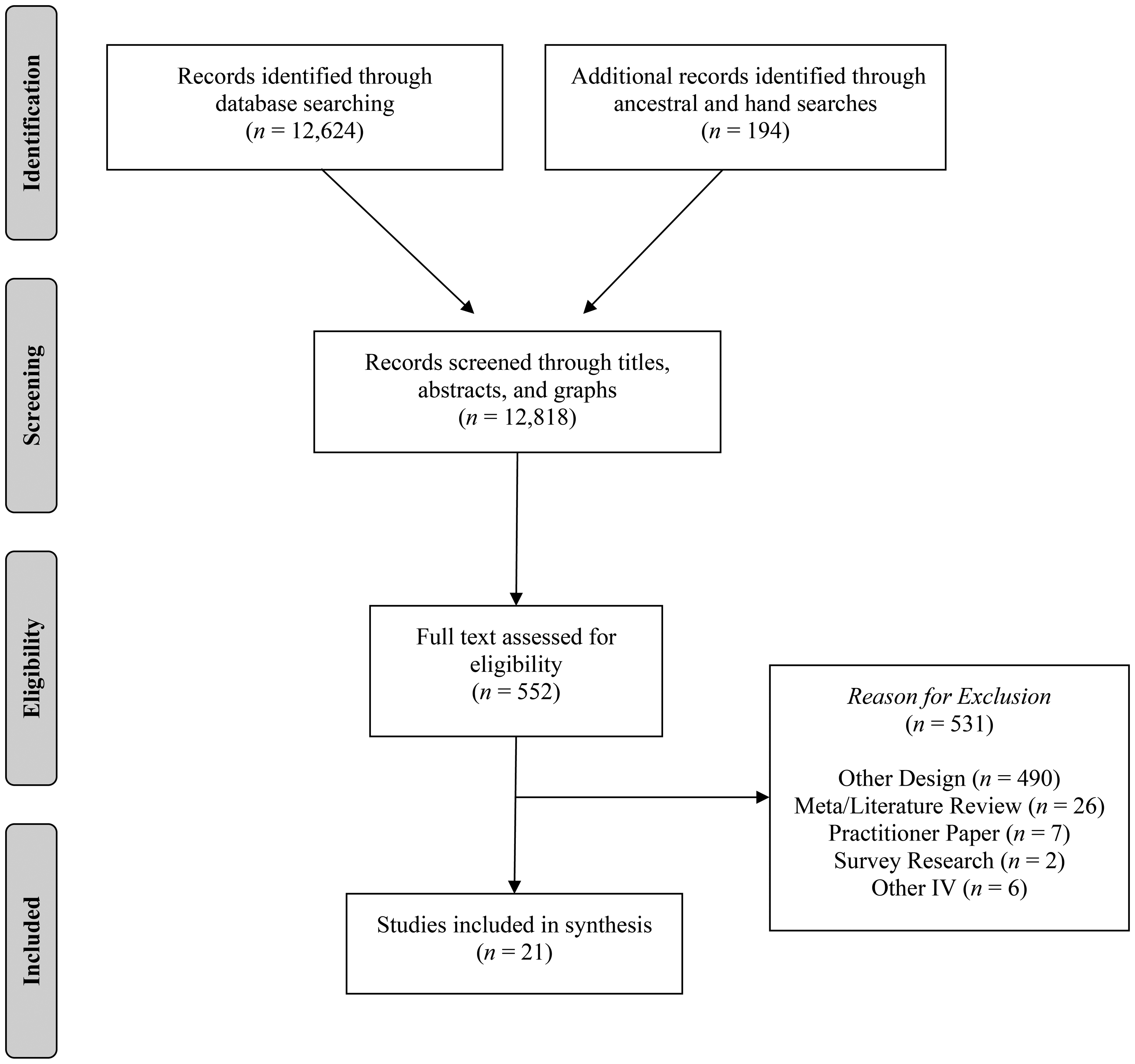
Study procurement flow diagram.
Screening and Eligibility
Study Coding Manual and Procedures
We developed our coding manual to support data extraction for evaluation. The coding manual consisted of eligibility criteria. For each area, there was a list of codes, descriptors, and scoring procedures. The screening criteria were developed to support coders in determining whether the retrieved study should be reviewed or if it was not appropriate for the present investigation and why it was marked ineligible. Providing a reason why a particular study was screened out is important for both reporting and organizational purposes (Riden et al. 2022). All articles were initially screened for eligibility. Initial screening protocols were developed to identify (a) study characteristics, (b) participant and setting characteristics, (c) outcome variables, and (d) component analysis methodology.
Coder Training
The first author conducted a synchronous training session via video conferencing with the coding team. The second and third authors also attended the training to collect procedural integrity and reliability throughout training sessions. All training sessions lasted approximately 60 min, which included an introduction to the coding manual, coding sheets, and article assignment. During the first session, the first author reviewed inclusion criteria codes and coding procedures. Definitions and examples were provided, and time was allotted for coders questions for clarification. At the end of the training, the coders were instructed where to access the coding manual, coding sheets, and articles assigned to them for review. We replicated Riden et al.'s (2022) training procedures.
The purpose of the second training was to introduce the coders to the full coding manual. During the second training, the first author reviewed the coding procedures the coders would need to use when coding articles identified for inclusion. Definitions and examples were provided, and time was allotted for clarifying questions. At the end of this meeting, the coders were instructed on where to access the coding manual, coding sheets, and articles assigned to them for review. Procedural reliability for both training sessions was 100%.
Inclusion Review Procedure
Coding Team
Three individuals made up the inclusion criteria review team. Two members had a Ph.D. in Special Education and were Board Certified Behavior Analysts. The third member had a Ph.D. in Special Education. The review team examined articles for inclusion criteria independently of one another.
Eligibility
To determine eligibility for this evaluation, coders examined identified articles via three domains: (a) component analysis, (b) included a self-determination intervention, and (c) included a graph, table, and/or figure. To meet eligibility for the domain labeled as component analysis, an identified article had to have conducted a component analysis with a method section outlining the procedures for conducting a component analysis. For the second domain, articles needed to include a self-determination intervention that aligned with the search terms in the Boolean string. Finally, the articles had to include a table, graph, and/or figure representing the component analysis. If the article included more than one experiment, we treated it as a separate study during coding and reporting.
Full Study Coding Procedures
Coding Team
The study coding team consisted of the same individuals who conducted the preliminary screening.
Study Characteristics
Fourteen domains were created to code study characteristics including (a) intervention name, (b) intervention description, (c) intervention type, (d) total number of intervention components, (e) number of intervention component combinations evaluated, (f) number of phases, (g) number of participants, (h) participant characteristics, (i) setting characteristics, (j) intervention characteristics, (k) outcome variables, (l) methodological features, (m) type of design reported, and (n) component analysis definition.
Participant and Setting Characteristics
Five domains were created to code participant and setting characteristics: (a) participant gender; (b) participant age; (c) participant race/ethnicity; (d) disability; and (e) setting.
Outcome Variables
Two domains were developed to code outcome variables: (a) DV and (b) effect size.
Component Analysis Methodology Coding
Finally, ten domains were created to code methodological features of identified component analyses: (a) add-in; (b) drop-out; (c) add-in/drop-out combinations; (d) components independently evaluated; (e) components combined evaluation; (f) component decision; (g) visual analysis; (h) statistical analysis; (i) treatment integrity; and (j) interobserver agreement.
Intercoder Agreement Procedure
We calculated intercoder agreement for all coding and screening procedures. Intercoder agreement was calculated for all screening and coding procedures that included a dichotomous choice (e.g., include or exclude, yes/no). We calculated intercoder agreement by dividing the total number of agreements by the total number possible and multiplying by 100 across all studies. In addition to simple agreement, Cohen's Kappa was calculated for all screening and coding procedures. Cohen's Kappa is used to assess the agreement between raters accounting for chance agreement (Cohen, 1960). For our initial inclusion screening, simple agreement was 92.67%. We also calculated Cohen's Kappa to account for chance agreement resulting in a Kappa score of .94. In addition, we calculated simple agreement for our full coding procedures. Simple agreement for full coding was 95.00%, with Cohen's Kappa resulting in a Kappa score of .88. Disagreements were discussed as a team and were resolved across all coding stages.
Results
Participant and Setting Characteristics
Across included studies (n = 21), 177 participants were reported to have participated in interventions that implemented a component analysis experimental method exploring interventions with self-determination components. Eighty one percent of articles (n = 17) reported participants’ gender (i.e., 36 male and 35 female participants). The authors of four articles did not report gender in their method sections (n = 106 participants).
All studies identified for this review reported participants’ ages, which ranged from 47 months to 59 years old. Only eight articles reported the race/ethnicity of their participants. Of those articles reporting race demographics, one student was identified as Black, one Hispanic/Latino, two as Native American, and 36 as being White. Not all author groups identified a specific setting where their studies took place. Studies that did report this information specified eight different settings: school settings (n = 7); businesses (n = 4); inpatient/hospital (n = 2); university-based settings (n = 2); mixed settings (n = 2); preschool/daycare (n = 2); group/residential home (n = 1); and swimming pool (n = 1). Five studies did not specify a setting.
Disabilities, Disorders, and Syndromes
Participant disabilities, disorders, and syndromes varied widely in the studies identified for this review. Most studies included at least one participant with a disability (n = 45 participants), two studies did not report subjects with disabilities, disorders, or syndromes and six reported participants did not have a disability, disorder, or syndrome. The disability categories representing the largest number of participants was developmental disability 1 (n = 9) and those identified as having an emotional disturbance, including those referred to as emotionally disturbed and behaviorally disordered (n = 9). The second largest participant pool was autism spectrum disorder (n = 6). The remaining disabilities, disorders, and syndromes that were included in the identified studies were represented by three or less participants including multiple disabilities, attention deficit hyperactivity disorder, adjustment disorders, Fragile X, DiGeorge syndrome, visual impairments, and speech and language impairment. For a complete description of participant characteristics identified in this review, please see Table 1.
Participant Characteristics from Studies That Reported Demographic Data.
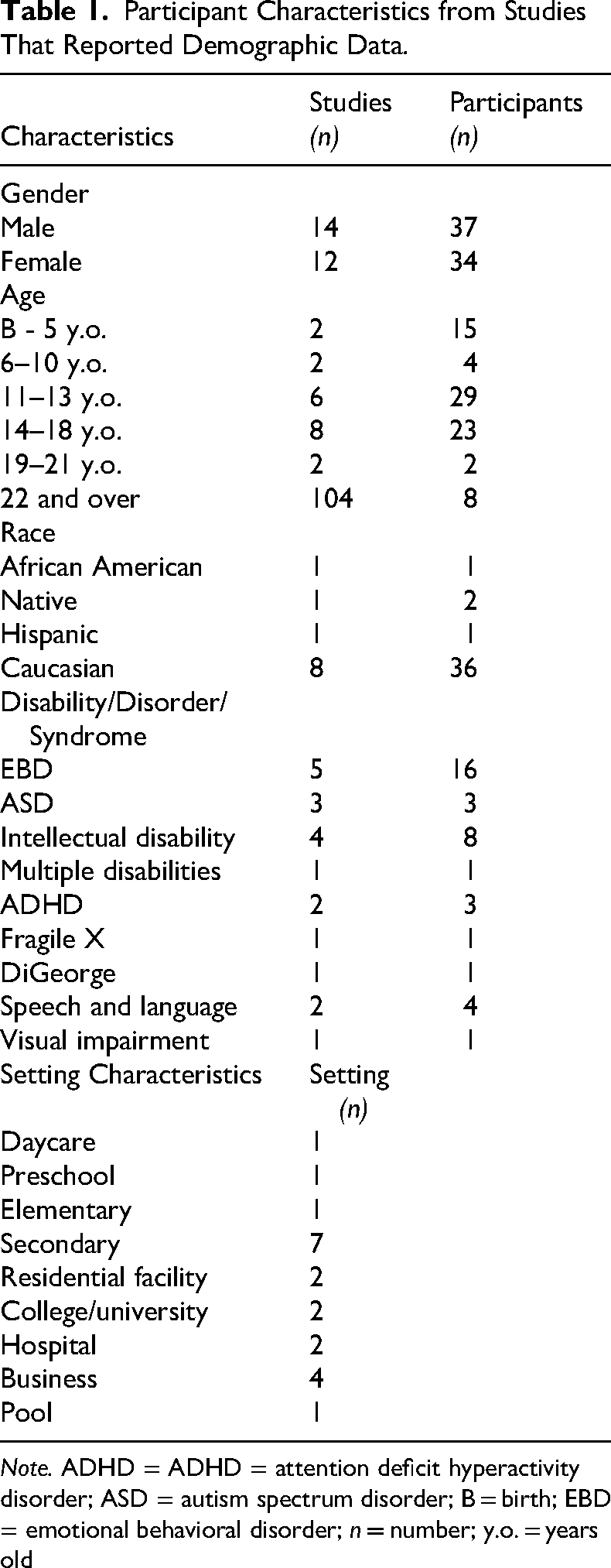
Note. ADHD = ADHD = attention deficit hyperactivity disorder; ASD = autism spectrum disorder; B = birth; EBD = emotional behavioral disorder; n = number; y.o. = years old
Dependent Variables
We identified a variety of primary DVs across the studies synthesized in this review. Nine author teams examined social behavior/social interactions, five looked at on-task related behaviors (e.g., on-/off-task), and three author teams examined the behaviors of service delivery personnel (e.g., teachers, professionals). Additional DVs include the number of Individualized Education Program (IEP) steps implemented correctly, stereotypy, problem behavior, prolonged sitting, safe work behavior, and athletic performance.
Component Analysis Characteristics
The number of components across studies ranged from two to five. Studies that included two (n = 7) or three (n = 7) components in their investigation made up most studies in this review. Regarding component analysis method, six used the add-in method and two used the drop-out method. But the most used approach was a combination of add-in and drop-out methodology (n = 13). The total treatment package was evaluated in 10 studies with six teams evaluating each component independent of one another. Four teams failed to examine the full treatment package and/or evaluate the individual treatment components.
Design Types
In total, authors embedded their component analysis in other single case designs or within a combination of other designs. Across the identified studies, seven different designs or design combinations were used to examine the IV. Most designs used by authors when conducting their component analysis were reversal designs (n = 5), multiple baseline designs (n = 5), combination designs (n = 5), and withdrawal designs (n = 3). To a lesser extent, authors employed a multi-element design (n = 1), multiple probe design (n = 1), and a changing criterion design (n = 1). When analyzing the various designs, the data revealed no clear patterns being employed with participants (e.g., disability classifications, typically developing) or settings (e.g., school, hospital).
The number of experimental phases within each component analysis ranged from one to eight, with four studies having a range of phases across participants. Of the studies that did not report a range, six included four phases, four had seven phases, three had six phases, two included eight phases, one had five phases, and one had two phases. For a description of study characteristics identified in this review see Table 2.
Study Characteristics.
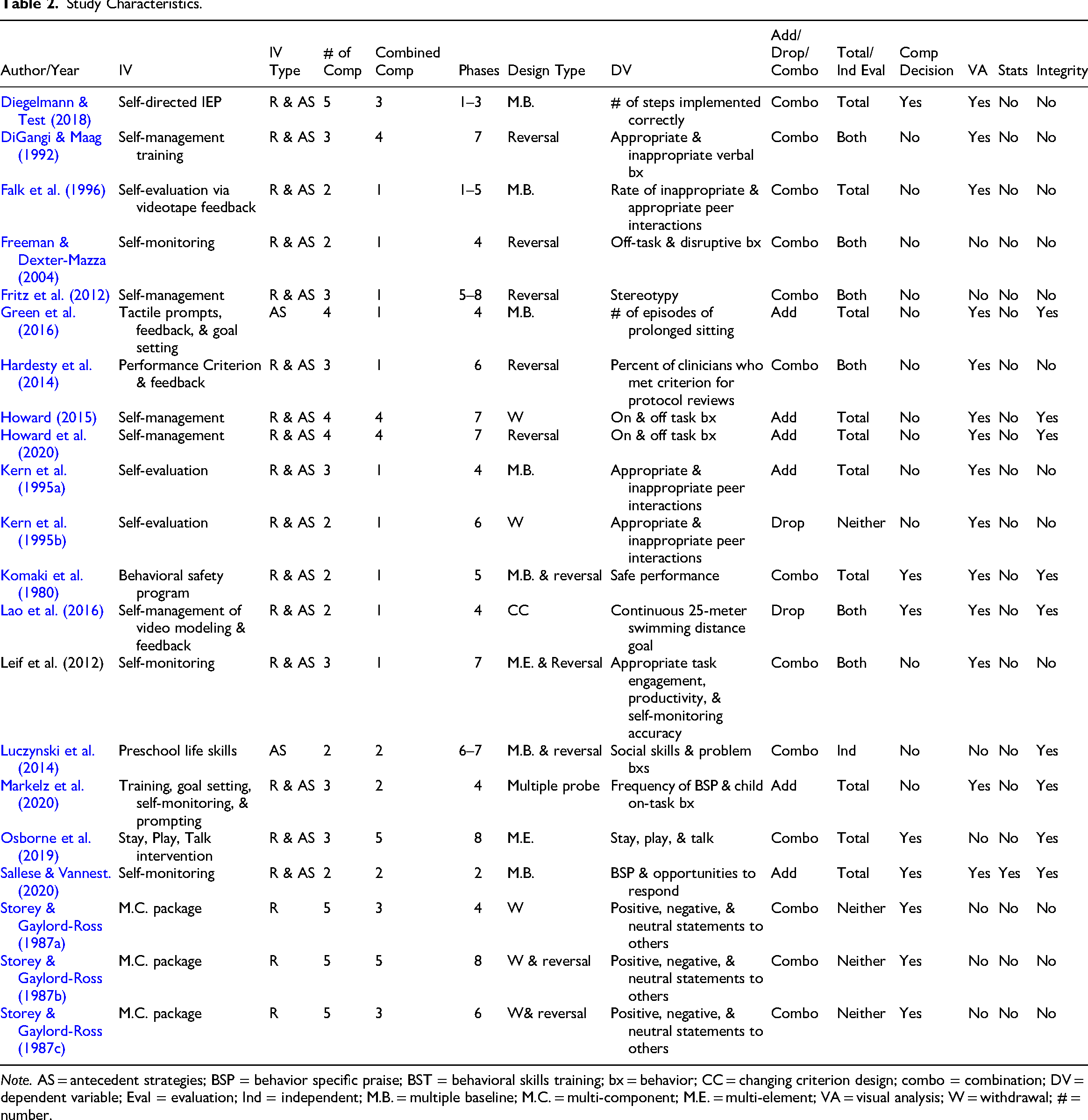
Note. AS = antecedent strategies; BSP = behavior specific praise; BST = behavioral skills training; bx = behavior; CC = changing criterion design; combo = combination; DV = dependent variable; Eval = evaluation; Ind = independent; M.B. = multiple baseline; M.C. = multi-component; M.E. = multi-element; VA = visual analysis; W = withdrawal; # = number.
Critical Component Decisions
Regardless of component analysis methodology, author teams of six experiments identified a single critical component of their self-determination interventions (Diegelmann & Test, 2018; Freeman & Dexter-Mazza, 2004; Kern et al., 1995a; Komaki et al., 1980; Osborne et al., 2019; Storey & Gaylord-Ross, 1987c). Ten experiments included in this review suggested that the full treatment package was required to get the participant to a specific criterion (DiGangi & Maag, 1992; Falk et al., 1996; Fritz et al., 2012; Green et al., 2016; Howard, 2015; Howard et al., 2020; Kern et al., 1995b; Lao et al., 2016; Luczynski et al., 2014; Sallese & Vannest 2020). Finally, the author teams of five experiments described varied results across participants (Hardesty et al., 2014; Leif et al., 2012; Markelz et al., 2020; Storey & Gaylord-Ross, 1987b, 1987c). Please see Table 3 for a description of component decisions within the identified interventions included in this review.
Component Decisions of Identified Self-Determination Interventions.
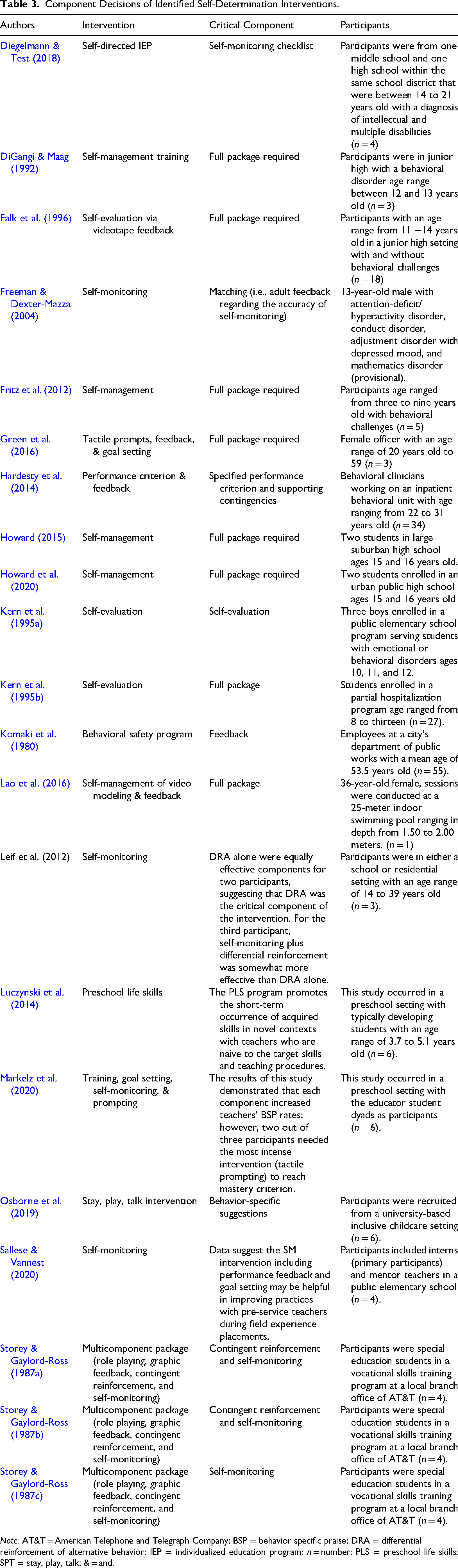
Note. AT&T = American Telephone and Telegraph Company; BSP = behavior specific praise; DRA = differential reinforcement of alternative behavior; IEP = individualized education program; n = number; PLS = preschool life skills; SPT = stay, play, talk; & = and.
Critical Components
Six author teams identified critical components of their self-determination interventions. For example, Digelmann and Test (2018) suggested one way to improve outcomes for students with disabilities is to include them in decisions about their future by teaching students how to participate in their IEP meetings. In their study, two middle school and two high school students learned the steps of leading their IEP meeting. The authors tested their theory using a multiple baseline across participants design to examine the effects of a self-monitoring checklist as an essential component of the Self-Directed IEP process for students with intellectual and multiple disabilities. Results demonstrated three of four students only met criteria once the self-monitoring checklist was introduced. In addition, three students were able to generalize to post-intervention mock IEP meetings using the self-monitoring checklist, which is an important skill (i.e., self-monitoring) associated with a sense of belonging (Wilkowski et al., 2009). Their results suggest that a self-monitoring checklist is a critical component of the intervention.
Another example of the identification of critical components of a self-determination intervention can be seen in the work conducted by Komaki et al. (1980). The results of their study underscore the importance of consequent control. When employees received training in the form of a slide presentation, verbal explanations, and written rules, performance improved slightly. It was not until feedback was delivered that employee performance significantly improved. Thus, it was concluded that training alone was not sufficient to substantially improve and maintain performance even though desired practices were objectively defined, and examples were tailored to specific job situations.
Full Package
While there were experiments included in this review that identified a single critical component of the IV, the author or author groups of ten experiments we reviewed suggested the full intervention package was needed to produce the desired effect on the DV. For example, DiGangi and Maag (1992) examined the self-management training of youth with behavioral disorders. What they found was a treatment package consisting of self-instruction, self-monitoring, and self-evaluation/self-reinforcement were the most effective treatments across all three subjects. In addition, when the authors tested the components in isolation, they were less effective. A more recent example of this is provided by Sallese and Vannest (2020), where they examined the effects of a multi-component self-monitoring intervention on the use of a classroom management practice. They conducted this experiment using a multiple baseline design across four preservice teacher interns in general education classroom settings. The results of their study support the use of a self-management intervention including performance feedback and goal setting as a promising way to increase the use of behavior specific praise with pre-service teachers.
Varied Results Across Participants
There is one more category in which studies were grouped when identifying critical components of an intervention package, and that is studies that obtained varied results across participants (i.e., some participants may have only needed one component to meet a set criterion while others needed a combination or the full treatment package to achieve criterion; n = 5). Varied results across participants can be found in the work conducted by Markelz et al. (2020). They examined the effects of an intervention package consisting of training, goal setting, self-monitoring, and tactile prompting on early childhood teachers’ behavior specific praise rates using an add-in, multiple probe component analysis. Using visual analysis, they found that each component increased teachers’ behavior specific praise rates with two of three teacher participants needing the full treatment package to reach mastery criterion, while one participant met mastery criterion after self-monitoring was introduced.
Common Components Across Identified Studies
Whether or not author teams identified variable results about the training package they employed or suggested either critical components or the full package was necessary, there are some interesting trends that were found across treatment packages. Based on the results of this review, it is suggested that self-determination interventions include one or more of the following intervention components: self-monitoring checklists, feedback, clearly presented contingencies and performance criteria, self-evaluation, differential reinforcement of alternative behavior, and self-evaluation.
Discussion
It is intuitive to accept that self-determination skills are beneficial to all individuals. Identifying preferences and directing behaviors to achieve outcomes are important life skills when developing agency and autonomy (Shogren et al., 2019), which can lead students with disabilities to a sense of belonging in their communities. However, the literature describes individuals with disabilities often facing barriers to this sense of belonging relative to becoming active, engaged, and accepted in their communities (Raines et al., 2023). Given the history of self-determination research, it is warranted that component analysis of self-determination interventions be examined to understand how this methodology is contributing to the fields of ABA and special education, specifically its impact on self-determination and subsequently the potential it has on the sense of belonging of individuals with disabilities.
Behavior analysts and special education teachers spend extensive amounts of time working with students with disabilities on a variety of outcomes. Promoting the abilities, skills, and attitudes students need to set and work towards goals is critical for in-school and postschool success (Shogren et al., 2015). In fact, the Individuals with Disabilities Education Act (IDEA; 2004) mandates that students’ strengths, preferences, interests, and needs be considered when planning for their transition from school to adult life. Unpacking multi-component interventions that are designed to promote self-determination skills may provide future behavior analysts, special educators, and researchers valuable information as to what works and what works better.
Participant Variables
The component analysis self-determination literature has investigated expected representations of populations in terms of gender, age, and disability category. Most studies included in this review targeted age-ranges of participants where transition related services within IEPs are required (i.e., 14–21 years old). It is during these years that school personnel, family members, and students themselves consider postsecondary goals without the support of IDEA services. Furthermore, the disability category type of participants included in most studies examined populations that typically require more intensive services like developmental disabilities and autism spectrum disorders. Although individuals with emotional and behavioral disorders often have normative cognitive capacities, challenges with behavior regulation and the impact that has on goal attainment does explain the high representation of this populations’ inclusion in self-determination studies.
One concern regarding the representation of included participants is the lack of race/ethnicity demographic reporting. Of those included studies that did report race/ethnicity demographics, the small representation of marginalized and minoritized participants is problematic. Self-determination scholarship suggests the construct of self-determination has universal value; however, there are cultural influences on the development of self-determination (Shogren et al., 2015).
When race and ethnicity demographics are underreported, disparities may be obscured and the experiences of marginalized and minoritized individuals may remain insufficiently represented in the literature. Practitioners’ ability to understand how self-determination and belonging vary across social identities and intersectional experiences is essential for determining whether interventions promote equitable outcomes across groups and for informing instructional design and delivery. These concerns underscore the importance of intentional, inclusive, and transparent demographic reporting practices related to race and ethnicity. In the absence of adequate representation, practitioners working with culturally and linguistically diverse individuals and their families should carefully consider this limitation within the current body of research on self-determination interventions included in this review.
Component Analysis Variables
Interventionists seek to change behavior, and researchers that are attempting to increase self-determination skills are comparing results against a null hypothesis. Researchers often design interventions upon evidence-based practices, sometimes in combination with each other to produce the greatest amount of change in the quickest amount of time. The paradox when implementing treatment packages is that although behavior change is more likely to occur with multiple components, fidelity of implementation as well as adoption by practitioners may diminish (Riley-Tillman & Chafouleas, 2003). Thus, the purpose of a component analysis is to systematically add or drop components of a treatment package while monitoring target behavior to determine the impact of the selected components (Cooper et al., 2020).
Component analyses are not a methodology frequently used by researchers (Riden et al., 2024). One barrier to their use is the time required to isolate individual components. Reversal phases are needed within a study design to add or remove components. When doing so, recommend researchers consider “(a) additive effects of components, (b) multiplicative or interactive relations among components, (c) necessity and sufficiency of each component, (d) behavioral effects related to combining different components, and (e) sequence effects” (p.687). Most self-determination component analysis studies included in this review examined 2–3 components with a combination of add-in and drop-out procedures. Approximately 20% of studies did not examine individual treatment components and/or the full treatment package, making the evaluation of interactive relations among those components difficult.
Self-Determination Variables
The construct of self-determination has emerged from functional theoretical models of self-determination (e.g., Wehmeyer, 1992) to include a strength-based focus in disability studies (Burke et al., 2020). Shogren et al. (2015) introduced Casual Agency Theory which defined self-determination as a construct within organizing structures of theories of human agentic behavior. Specific skills associated with self-determination are choice-making, decision-making, problem solving, goal setting and attainment, planning, self-management, self-advocacy, self-awareness, and self-knowledge. Given this wide spectrum of skills associated with a broad construct that enables a person to be the causal agent in their life, we found mapping the component analysis literature on self-determination variables interesting yet challenging.
One challenge in reviewing self-determination interventions is that the IVs and DVs are substantially diverse and individualized across studies. We categorized DVs into buckets of behavior with most studies examining social/interactive/appropriate behaviors, yet within those studies, operational definitions of behaviors varied. Surprisingly, not one included study measured academic skills as a DV. This skew in the literature identifies a potential bias among scholars on the prioritization of social behaviors over academic behaviors in the promotion of self-determination. The previously identified skills associated with self-determination are not exclusive to social behaviors; rather, higher-order academic proficiency includes problem solving, choice-making, decision-making, goal setting, self-awareness, and others. The results of this review suggest there is a noticeable gap in the literature as it pertains to the examination of self-determined academic behaviors. Burke et al. (2020) also identified this gap in their review of self-determination interventions as they emphasized the importance of self-determination on student goal attainment of both academic and transition-related goals in general education contexts.
When isolating individual components, it was nearly evenly split between study teams that suggested an individual component was critical for intervention success versus the full treatment package. However, the procedures in which study teams added, removed, and isolated components varied in rigor (with four teams not examining the full package or all individual components). The quality of self-determination interventions has been an ongoing issue (see Burke et al., 2020); nevertheless, our results suggest an individualistic nature of participants when responding to IV type and intensity. Self-determined behaviors are agentic in nature; therefore, individual responses to interventions are understandable and self-fulfilling as a construct of agency. A component analysis seems to be an appropriate method of examining interventions for singular participants yet makes generalization difficult.
Self-Determination as a Facilitator to a Sense Belonging
A multitude of components were used to increase the self-determination behaviors of participants across this review. Those behaviors included self-monitoring checklists, feedback, clearly presented contingencies and performance criteria, self-evaluation, differential reinforcement of alternative behavior, and self-evaluation. Like self-determination, belonging is a complex and multidimensional phenomenon (Carter et al., 2016).
Because phenomena such as belonging are shaped by individuals’ feelings and lived experiences (Merriam & Tisdell, 2016), the construct is inherently difficult to define. Although research on belonging did not gain significant traction until the mid-1970s, interest in the construct was catalyzed by the passage of legislation designed to expand opportunities for individuals with disabilities to participate in their communities and make decisions about the direction of their lives (i.e., an essential component of self-determination). As a result, researchers across disciplines have conceptualized and defined belonging in a variety of ways, much like the evolving conceptualizations of self-determination over time. Within the literature, several overarching themes consistently emerge across definitions of belonging (e.g., Carter et al., 2016); however, one constant remains true–we are social beings that need to feel as if we are a part of a larger group that values, respects, and cares for us (Cohen, 2022).
Self-determination, which encompasses an individual's right to choose how and with whom they interact (Gur & Bina, 2023), may serve as an important mechanism for enhancing one's sense of belonging. The variables associated with self-determination identified in this component analysis review have the potential to create conditions that support individuals with disabilities in establishing meaningful participation and thriving within their communities, ultimately fostering a strong sense of belonging. However, this can only take place when practitioners intentionally build capacity in self-determination and opportunity to practice behaviors associated with self-determination in their instructional design for their students with disabilities. The first step to deciphering this equation is by choosing those self-determination variables that create the biggest and lasting change through the systematic approach of component analysis.
Implications for Practitioners
Belonging-Centered Instruction is highlighted as the crucial provision of social and pedagogical opportunities that lessen students’ feelings of alienation, exclusion, and dehumanization (i.e., experiencing the racial and cultural oppression in spaces that they encounter in broader society; Gutiérrez, 2018). Given teachers’ responsibility and opportunities to address students’ need for a sense of belonging, we have identified several implications for practice. First, the deployment of the component analysis single case design can allow practitioners to pinpoint the active component(s) of a self-determination intervention. By doing so practitioners can engage in effective and efficient intervention delivery. Engaging in this type of inquiry as a practitioner can foster a sense of belonging for the entire classroom.
There is also practical value to this experimental approach for practitioners. The component analysis design enables practitioners to move beyond evaluating omnibus intervention packages and instead focus on identifying active ingredients that are necessary and, in some cases, sufficient for producing meaningful outcomes. This process has direct implications for improving intervention efficiency implementation fidelity, as unnecessary and/or redundant components can be eliminated, reducing implementation burden while maintaining effectiveness.
To affect behavior change, interventions can be classified on a continuum from low intensity (i.e., low effort, minimal resources) to high intensity (i.e., large effort, resource intensive). Due to the demanding nature of education, teachers often struggle with implementing high intensity treatment packages with fidelity (Mouzakitis et al., 2015). To combat this, targeting critical components of treatment packages and focusing on the usage of low intensity components may support teachers in affecting positive change without having to implement the full, high intensity, treatment package. The component analysis design also supports ethical intervention design by allowing for the evaluation and potential removal of more restrictive or effortful procedures, thereby promoting less intrusive and more socially valid practices. Collectively, component analysis within single-case research design provides a rigorous, experimentally grounded framework for developing streamlined, effective, and contextually feasible interventions that can foster the sense of belonging in their students. Ultimately, it comes down to intentionally arranging the learning environment for students to build capacity and opportunities to practice the self-determined skills so students can generalize them in their various communities which can further cultivate a sense of belonging outside of the school setting.
Limitations and Future Direction
There are several limitations to this review. First, despite the wide-ranging search process, we may have overlooked studies due to authors not incorporating the term component analysis in the method, title, or abstract. We tried to minimize this limitation by examining graphs in the studies, which allowed us to identify many component analysis studies focusing on self-determination even when the author teams failed to explicitly state it in their manuscripts. Next, when coding for age we identified the minimums, maximums, and standard deviations of the age of the included participants, if provided. This could have led to error in the reporting of the number of studies working with which age groups. Third, when coding, we included all participants in a study even if only one participant had a component analysis used with them. Next, we did not investigate the quality of the included studies. A look into the quality indicators of the research methodology of individual studies may bring to light any challenges surrounding the utility of component analysis. We encourage readers to explore individual articles for more detailed descriptions of the methodology used by individual researchers or research teams. Next, students with disabilities, while the focus of this manuscript, was not a term in our Boolean string. The intent of this review was to identify the component analysis literature in relation to self-determination. While many of the studies do include students with disabilities, it was our intent to identify any self-determination studies that used a component analysis experimental design. Next, it is difficult to determine if a critical component was included when authors determined if a full treatment package was needed. This only adds to the complexity or number of responses of which the DV was composed, which may provide a possible explanation for the need of the full intervention package.
Given the complexities and time involved with isolating individual components in comparison to others and the full treatment package, it is predictable that author teams used a variety of design types (e.g., multiple baseline) and experimental phases to make critical component decisions. One area of concern regarding internal validity across many studies was a lack of treatment integrity data and normative decision-making procedures. Ward-Horner and Sturmey's (2010) considerations are a good start; however, the field of component analysis researcher would benefit from more detailed guidance concerning quality indicators of design. We suggest future component analysis designs include: (a) treatment integrity data to address fidelity of implementation and practitioner adoption concerns; (b) detailing of decision-making for adding or dropping components across phases; (c) at least one phase where the full-treatment package is evaluated; (d) evaluate all components individually; (e) the method section should include all relevant information regarding participant characteristics, condition descriptions, DV definitions, and recording procedures; and (f) identify if there is a critical component needed or if the full package is required.
The final limitation of this study is that “sense of belonging” was not included as a search term within the Boolean string used to identify component analyses of self-determination interventions. As a result, relevant studies examining the relationship between self-determination intervention components and belonging-related outcomes may not have been captured in the review. Future research should consider incorporating belonging-related terminology into search procedures to provide a more comprehensive understanding of how self-determination interventions may influence individuals’ sense of belonging.
Conclusion
Self-determination has been described as acting as the primary causal agent in one's life and making choices and decisions regarding one's quality of life free from undue external influence or interference (Wehmeyer, 2020). Engaging in self-determined behaviors empowers individuals with disabilities to develop a stronger sense of belonging, rooted in feelings of connection and support from others. However, the aspects used in the approaches to foster self-determination skills with learners are wide-ranging. Because of the complexities associated with self-determination intervention work, it would benefit researchers to deploy a component analysis methodology when doing this work. Results of this review suggest there may be several components that are critical to the success of self-determination interventions which include: self-monitoring checklists, feedback, clearly presented contingencies and performance criteria, self-evaluation, differential reinforcement of alternative behavior, and self-evaluation.
Footnotes

Author Contribution(s)
Funding
The authors received no financial support for the research, authorship, and/or publication of this article.
Declaration of Conflicting Interests
The authors declared no potential conflicts of interest with respect to the research, authorship, and/or publication of this article.