






Abstract
Philosophy of design remains a predominantly Western disciplinary formation, shaped by Euro-American institutions, concepts, and standards of legitimacy. In African contexts, making and design practice are systematically misrecognised: classified as culture, reduced to craft, or framed as informal adaptation when they in fact constitute infrastructural intelligence and social organisation. This commentary argues that African design philosophy is constitutive of design thought rather than regional in scope. It argues further that the pluriverse, while valuable, has circulated without displacing epistemic authority, a condition named here pluriversal mimicry. Two propositions follow: African philosophy must shape the terms of design philosophy itself, rather than diversify a field defined elsewhere; and design is better understood as the organisation of life than as the production of objects. The commentary proposes criteria for evaluating claims of pluriversality, alongside a philosophy grounded in relationality, repair, temporality, and collective life.
Philosophy of design, as it has largely been institutionalised, remains a Western disciplinary formation. This is an institutional fact before it is an intellectual complaint. The canonical texts, journals, doctoral programmes, and conferences through which design philosophy is most often authorised remain overwhelmingly Euro-American in orientation. Even where design is expanded to include systems, futures, or services, it is usually narrated through a familiar genealogy: industrial modernity, professional expertise, individual authorship, innovation, and novelty.
That genealogy helps determine what counts as design, where it is expected to happen, and who is authorised to theorise it. It also shapes which kinds of intelligence appear foundational and which are relegated to the expressive, the cultural, or the informal. Across African contexts, the effects of this arrangement are readily visible. Making is everywhere, yet it is often read as aesthetic before operational, cultural before infrastructural, and artisanal before philosophical.
This commentary begins from two linked propositions. African design philosophy demands treatment on its own constitutive terms, as an intellectual formation that generates the field’s concepts and sets the conditions for how design is defined, assessed, and professionalised. At the same time, the language of the pluriverse falls short of resolving this asymmetry on its own. Too often, pluriversal discourse expands the rhetoric of inclusion while leaving epistemic authority untouched. African worlds are welcomed as examples, cases, or enrichments, while the conceptual frame remains in command.
The argument enters an established and growing field. A growing body of African design scholarship and practice has advanced these questions through philosophical, institutional, pedagogical, and practice-led work. Research on Ubuntu and industrial design (Moalosi and Rapitsenyane, 2023), ecology-centric decolonised design thinking (Gordley-Smith and Hackett, 2023), African philosophy and the creative arts (Ugwuanyi, 2024), African aesthetics (Ofosu-Asare, 2025), and African-centred design education demonstrates that this field is intellectually substantial. Practitioners such as Saki Mafundikwa, whose founding of ZIVA represents both an institutional and philosophical proposition about African graphic design, have helped establish African design as a site of intellectual and institutional experimentation beyond cultural display. Platforms such as Design Indaba have extended that terrain. This body of work has demonstrated that African design transcends heritage, ornament, and local adaptation. What remains less settled is whether this scholarship can move from recognition and representation toward the reconstitution of design philosophy itself.
That distinction matters because citation and authority are different things. A discipline may reference African concepts while preserving the assumptions through which design is defined, assessed, and professionalised. The issue, then, exceeds simple absence. It is a problem of misrecognition, and at this level, the effects are institutional.
One form this takes is the coloniality of making, a concept developed by Van Amstel et al. (2024) and extended here to the specific domain of African design philosophy. Colonialism did more than seize land, labour, and resources. It also exported categories for sorting reality. In material practice, one enduring example is the triad of art, craft, and design. The taxonomy is anything but neutral. It is a hierarchy of intelligence. Art becomes what can be exhibited and interpreted as meaning. Craft becomes what can be romanticised as tradition or heritage. Design becomes what resembles Western professional structures, industrial production, branded authorship, and the rhetoric of innovation, and what falls outside those criteria is reclassified downward.
African practices may be admired as expressive, yet they are less often treated as foundational forms of governance, coordination, and life-organisation. These effects reach far beyond symbolism. These categories determine what receives funding, what enters curricula, what gets published, what gets archived, and what becomes professionalised. Once design is treated mainly as surface, institutions approach it as branding or visual enhancement rather than as infrastructure. The most consequential design work then happens elsewhere, in imported procurement forms, bureaucratic procedures, donor templates, software defaults, and policy standards built around assumptions of stable documentation, stable electricity, fixed addresses, and durable trust. Where those assumptions fail, workarounds emerge. Informality develops as an adaptive response to systems misaligned with lived conditions. Inefficiency and corruption, as later narrated by development discourse, often originate in a mismatch between designed requirements and social realities. The central issue, then, is whether African design intelligence is permitted to govern where it matters most: in concepts, institutions, systems, and policy.
At this point, the familiar response is to invoke the pluriverse. Escobar’s (2018) formulation of a world in which many worlds fit has been one of the most significant interventions in decolonial design discourse. It challenged the presumption that Euro-modernity is the singular horizon of the human and opened an important space for ontological plurality. Yet, as the concept travels, it produces a second problem. In many academic and design settings, the pluriverse has become easier to affirm than to enact, easier to cite than to allow to reorganise the terms of analysis. It can function as a moral vocabulary of openness while institutional power remains largely unchanged. Projects invoke pluriversal futures while continuing to operate through familiar norms of proof, value, coherence, legibility, and evaluation. The frame stays in place – the vocabulary shifts.
That condition has a name: pluriversal mimicry. The adoption of plurality as rhetoric, without any redistribution of conceptual power, is its defining feature. Difference appears as content, while governance remains elsewhere. Many worlds are acknowledged, yet one world still decides the terms on which those worlds become intelligible. This condition is illustrated in Figure 1. Pluriversal mimicry and the retention of epistemic authority.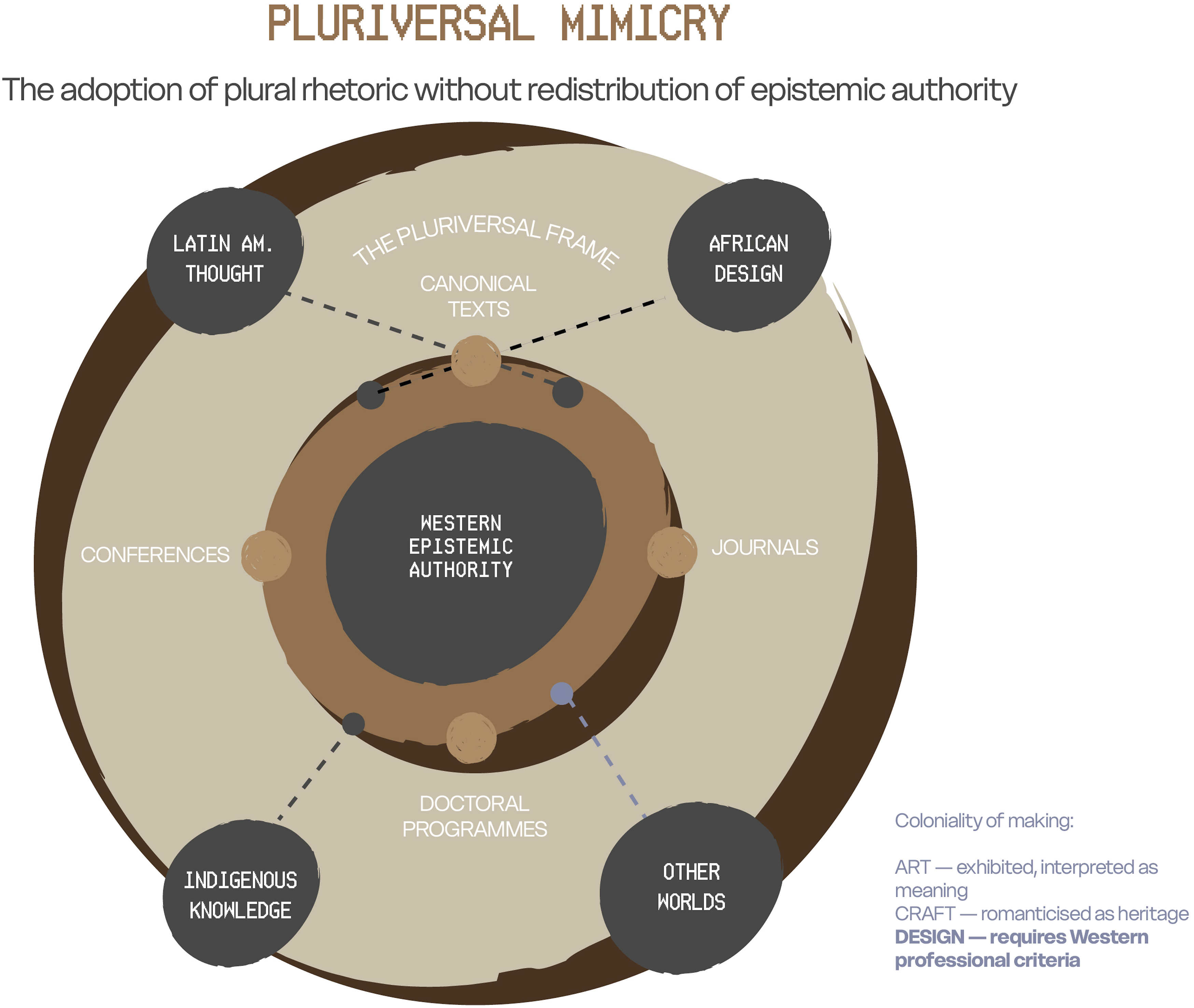
The argument begins with how knowledge is made, then moves to where it is situated. What matters is not whether Africa or the West is the subject of analysis, but whose concepts are organising the analysis. The West can be studied pluriversally when it stands as one situated tradition among many, rather than as the universal norm. Africa can still be studied colonially even when placed at the centre, if Western categories continue to define what counts as design, knowledge, or legitimacy. Africa becomes the topic; African thought is excluded from the thinking. The real question is whether African philosophy gets to shape the concepts themselves. The deeper question is whether epistemic authority moves. Does the work allow non-Western concepts to organise the analytic spine? Can the problem be defined from outside dominant Western framings? Must every difference pass through the checkpoint of Western legibility before it counts as knowledge? Who benefits from the extraction of insight, who bears its cost, and are those relationships disclosed? Does the work leave space for refusal, opacity, and incommensurability, or must every world render itself transparent to the institutions that hold the power of recognition? These are the minimum criteria for any serious claim to pluriversality.
Glissant’s (1997) notion of opacity is especially important here, and it matters as a political principle rather than a literary flourish. Where non-Western worlds are required to become fully legible to Western institutions to count, those institutions remain the governors of interpretation. Tuck and Yang’s (2012) warning about the conversion of radical ideas into metaphor sharpens this point. The pluriverse is increasingly at risk of becoming a term that allows institutions to appear transformed while leaving their epistemic structure largely intact. The concern has wider purchase: a growing critical commentary has raised related questions about the uptake of pluriversal design (Ansari, 2025; Gutiérrez Borrero, 2021; Jakobsen and Pineda, 2024; Van Amstel, 2023).
A further complication enters here. Much of the decolonial vocabulary now circulating in design has been shaped through Latin American thought. That work has been indispensable in challenging universalist reason and developmentalist modernity. Even so, dialogue across South-South traditions is rarely symmetrical. African thought has often entered these conversations through uneven terms of translation and reception, especially within European and North American institutions where concepts are selected, authorised, and circulated. Those uneven terms are also institutional and embodied, shaping who secures stable positions, who accumulates a sustained scholarly presence, and who is granted the mobility and legitimacy required for concepts to be authorised across generations, not only whose ideas are valued, but whose presence is funded. Exchange across South-South traditions is welcome in itself; the structural problem is the asymmetry of conceptual authority governing who enters those exchanges and on what terms. African design philosophy emerges beyond mere addition to a pluriversal catalogue. It must be able to judge the frame itself.
African thought resists reduction to extractable concepts or culturally specific language. Longstanding debates within African philosophy carry direct implications for what a philosophy of design can be.
The debate over personhood and relationality offers the most direct philosophical resource here. In different ways, Menkiti (1984) and Gyekye (1992) have argued over the relation between individuality and community in African moral thought. In strict disciplinary terms, these are philosophical texts; their implications for any philosophy of making, authorship, agency, and collective life are profound. If personhood is fundamentally relational, even in the moderate communitarian sense that Gyekye argues, then the figure of the designer as isolated author, sovereign creator, and proprietary owner becomes philosophically incoherent. Much of Western design theory assumes precisely such a subject. Western design theory then encounters collective, distributed, or socially embedded forms of making and names them informal, unstructured, or pre-professional. The encounter is with a different ontology of agency.
Wiredu’s (1996) call for conceptual decolonisation sharpens the point. Inherited concepts carry foreign assumptions; design language itself, therefore, requires scrutiny. Terms such as user, function, innovation, impact, and problem-solving encode assumptions from the tradition that generated them, historical categories whose genealogy demands attention. Placing African examples under those terms while leaving the categories intact is precisely the error this commentary contests. The categories themselves require interrogation once the frame shifts.
African philosophies of time deepen the challenge. Modern design discourse often privileges novelty and treats the future as its highest moral horizon. The past becomes either a reservoir of inspiration or a condition to be overcome. Yet in many African contexts, temporality is organised through continuity, return, obligation, recurrence, and repair. Mbiti’s (1969) work on African time has been extensively critiqued by Wiredu (1996), among others, yet even that debate forces a recognition: time is culturally organised, and design futures are therefore culturally organised as well. Many African life-systems are accommodating of innovation. The resistance is to innovation that fractures relational continuity and names the break in progress.
Repair, therefore, matters here as a philosophical question as much as a technical one. Jackson’s (2014) account of broken world thinking is useful because it recentres maintenance, upkeep, and repair as the work through which worlds persist. Jackson’s account finds strong resonance in many African repair cultures, where continuity is often understood as an achievement rather than a passive background condition, a point kept distinct from romanticised accounts of improvisation. Repair can involve technical skill, distributed knowledge, material attunement, ethical obligation, and long practice in sustaining social life under pressure. It is one way of organising life against abandonment.
Once the unit of analysis shifts from objects to life-systems, different forms of design come into view. Markets, for example, are more than sites of exchange. They organise circulation, storage, movement, negotiation, display, trust, credit, risk, and social coordination. Their intelligence exceeds the logic of product form. Their design lies in the management of flows, relationships, obligations, and material contingencies.
Funerary systems offer a second example. In many African contexts, funerals generate temporary infrastructures of governance. They coordinate movement, hospitality, authority, resource redistribution, sound, logistics, and social protocol. They produce spatial order, collective visibility, and forms of care that must be assembled quickly and enacted publicly. They arrive, govern, and dissolve. Design inquiry has placed them at its cultural margins; they belong at the centre. They are evidence that design already operates as a life-organisation.
Simone’s (2004) formulation of people as infrastructure is helpful here because it names a reality that formalist design discourse often misses. Where state systems are partial, brittle, or absent, social relations perform infrastructural work. The point is analytical, distinct from any celebration of institutional absence, an acknowledgement that worlds are continuously organised through relational intelligence, obligation, improvisation, and forms of distributed coordination that professional design discourse has often failed to recognise. This philosophical framework is summarised in Figure 2. Design as life-organisation grounded in African traditions.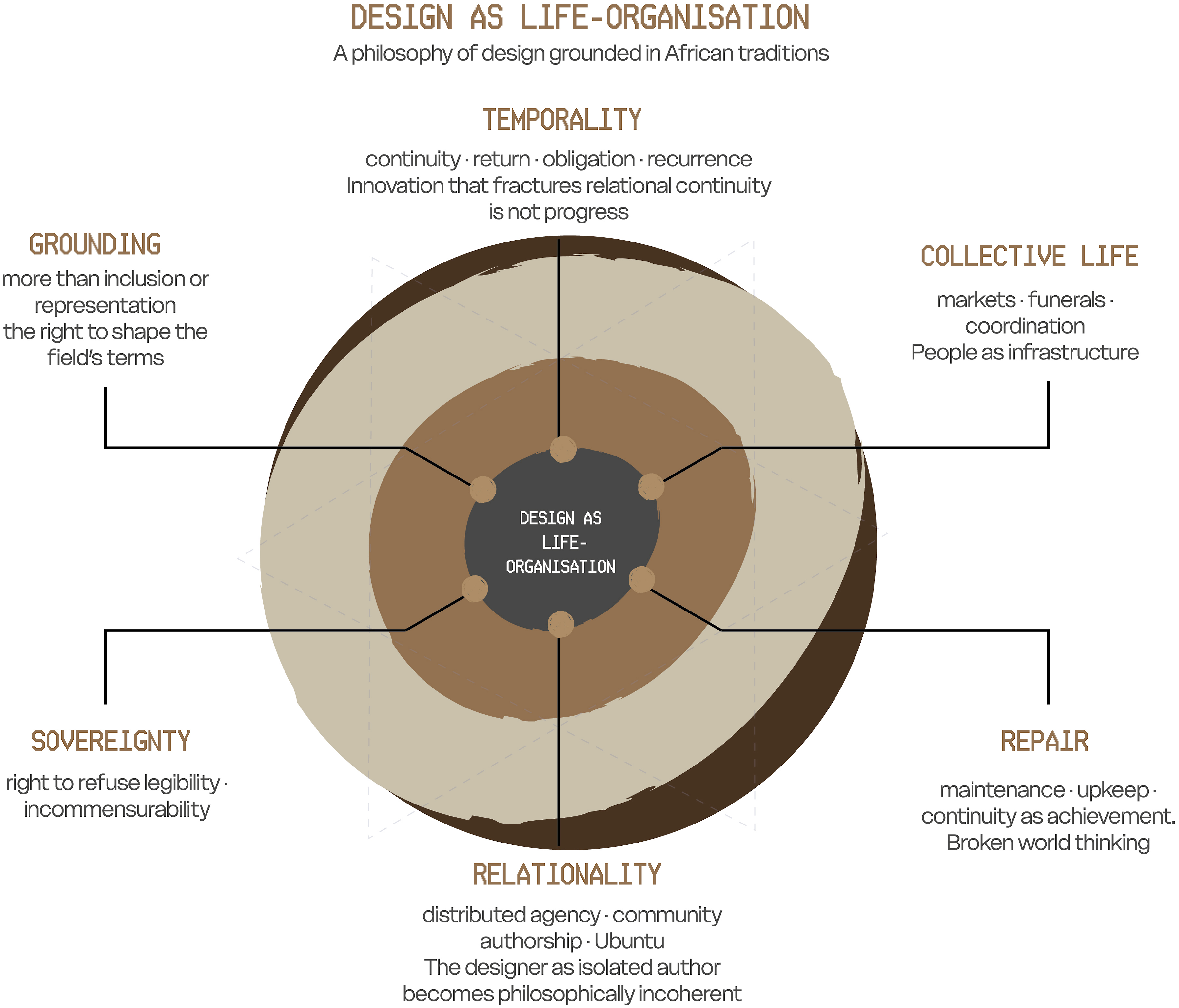
The stakes reach beyond design studies alone. When African making is repeatedly mined for aesthetic inspiration while African philosophy is structurally excluded from the disciplining of theory, Black worlds are positioned as sources of cultural value without equivalent conceptual authority, a racialised arrangement of authorship and legitimacy that requires no individual malice to reproduce. A genuine pluriverse would demand something more difficult. It would require a surrender of the Western right to remain the default interpreter of all worlds.
African philosophy should do more than diversify design philosophy. Constitution, and with it the authority to generate the field’s terms, is the demand. The claim is generative rather than substitutive, standing apart from any invocation of a singular African essence. African thought is internally plural, historically dynamic, and often contested. That plurality strengthens the argument. African intellectual traditions are fully capable of generating concepts, critique, and methodological direction without first passing through Euro-American philosophical permission.
So what is being proposed? The proposal is stricter than inclusion and more demanding than representation. The proposal calls for a philosophy of design grounded in African traditions of relationality, temporality, repair, and collective life. This philosophy treats design less as the production of objects than as the organisation of possibility through which worlds are made durable, liveable, and accountable.
Both the force and the limit of the pluriverse crystallise from this position. The concept remains useful when tied to real displacement. Where it leaves epistemic authority untouched, it remains rhetorical. Where it welcomes many worlds while preserving one world as judge, it reproduces the very hierarchy it claims to unsettle.
The task, then, is larger than asking whether Africa may now be included within design philosophy. The sharper question is whether design philosophy is prepared to be reorganised by African thought. That is the more difficult demand. It is also the one that matters.
Footnotes

Ethical considerations
Not applicable. This is a critical commentary and does not involve human participants, human data, or human tissue.
Author contributions
The author is the sole contributor to the conception, research, and writing of this commentary.
Funding
The author received no financial support for the research, authorship, and/or publication of this article.
Declaration of Conflicting Interests
The author declared the following potential conflicts of interest with respect to the research, authorship, and/or publication of this article: The author is a member of the editorial board of this journal. To avoid any potential conflict of interest, the author had no role in the handling, review, or acceptance decision of this manuscript.
Data Availability Statement
Not applicable. This commentary did not generate or analyse datasets.