






Abstract
To more fully address widespread skepticism of journalism, it behooves journalism scholars and practitioners to understand how the public perceives “democracy’s detectives.” Yet there is limited research on what factors shape public opinion of investigative journalism. And the studies that do explore public evaluations of investigative journalism vary in terms of shedding light on what motivates perceptions of accountability journalism. Employing two U.S.-based, statewide survey datasets (N = 1077; N = 546), this research builds on existing scholarship by examining public perceptions of the news media’s importance, with a particular focus on investigative journalism. Consistent with prior research, this study suggests that journalism’s watchdog role generally remains highly valued with the American public. The research also confirms that beliefs about the value of investigative journalism correlate with the notions of how the news media serves democracy. Departing from prior research findings, however, this study demonstrates that political conservatism has a significant negative correlation with perceptions of investigative journalism, underscoring the polarized nature of attitudes about journalism. Notably, this study also highlights how individuals with a “need for evidence” to support their decisions and beliefs tend to have a higher regard for investigative journalism, indicating an alignment between investigative journalism’s epistemology and one’s personal epistemology.
Keywords
Investigative reporting, according to some scholars and practitioners, has been enjoying something of a renaissance amid otherwise negative indicators for contemporary news media as a whole (Brenan, 2024; Carson, 2019). Moreover, many argue that it is imperative that it continues to flourish because of the critical role it plays in democratic governance (Hamilton, 2016; Kovach & Rosenstiel, 2021). Much research has been devoted to examining investigative reporting from the viewpoint of professional journalists (e.g., Cancela et al., 2021; Dahmen & Walth, 2021) and in terms of their impacts on public policy outcomes (e.g., Lanosga & Martin, 2018). These lines of inquiry are a function of the administrative nature of industry-focused research (Zelizer, 2004) as well as conceptions of how policymaking in general works (Protess et al., 1991). Yet these approaches, emphasizing journalists and policymakers, often skim over the role of the citizen-consumer of investigative news.
This research explores that vital third sector in democratic governance, addressing two key questions: To what extent do citizen-consumers value and care about the work of investigative journalism? And what factors explain such perceptions among the public? While some scholarship has probed such questions, empirical research is remarkably limited. From a practical standpoint, by better understanding the underlying individual differences that contribute to motivating perceptions of investigative journalism’s importance, journalism advocates can be better equipped to address public skepticism about “democracy’s detectives” (Hamilton, 2016).
Building on previous research (e.g., Fielder & Weaver, 1982; Weaver & Daniels, 1992; Willnat et al., 2019; Willnat & Weaver, 1998), this study refreshes the sparse literature addressing public perceptions of investigative reporting through survey research. Employing two surveys in the state of Indiana (N = 1,077; N = 546), the study analyses highlight the explanatory value of several factors for predicting valuations of investigative journalism. These factors include attributing personal value to a range of normative journalism roles, basic trust in the motives of journalists more generally, personal epistemology (i.e., Need for Evidence), political ideology and valuing journalism’s role in democracy. Ultimately, both datasets generally demonstrate meaningful predictive value relative to these five factors—even when controlling for traits like gender, education, income and political party affiliation.
Investigative Journalism
How to define investigative reporting is a matter of some debate, stemming partly from the idea that all reporting should be investigative. That notion, prevalent among professionals in the field, is reflected in the title of a study of Swiss investigative journalists, “To me, it’s just normal journalism” (Cancela et al., 2021). Nevertheless, practitioners acknowledge investigative news work is different from ordinary beat reporting, for instance, and research has examined it as a distinct genre (Ettema & Glasser, 1998). To some degree, it has been defined simply as more and deeper journalism, although usually with the added element that it involves matters that are hidden from public view, often deliberately (Aucoin, 2005). Building on previous survey research exploring public perceptions of investigative reporting, this study uses the following definition: “in-depth reporting about public affairs that involve wrongdoing, failure, or social problems brought to light by journalists” (Lanosga, 2014, p. 492).
In both popular and professional discourse, investigative reporters are often portrayed as paragons of ideal journalistic practice, their work representing “the Cadillac” or the pinnacle of the field (Coronel, 2013; Greenwald & Bernt, 2000). Such framing points particularly to investigative journalists’ view of themselves as “custodians of conscience” (Ettema & Glasser, 1998). Previous research has indicated relatively stable support for that investigative role among the public as well, although that support is tempered by unease toward some investigative tactics such as hidden camera use (Fielder & Weaver, 1982; Opt & Delaney, 2001; Weaver & Daniels, 1992; Willnat & Weaver, 1998). Moreover, it is not clear that members of the public share an understanding with journalists about what exactly constitutes investigative reporting (Opt & Delaney, 2001). Focus group research on newspaper readers, for instance, found they had a “yearning” for investigative journalism that was at odds with their desire for more neutral reporting (Wilner et al., 2021). Yet while it is questionable how much citizens generally understand what journalists mean by “investigative reporting” (Opt & Delaney, 2001), citizens do commonly express an openness to the basic elements of investigative journalism. In Opt and Delaney’s (2001) survey work in Texas, the top reasons respondents gave for approving of investigative journalism included wanting to be informed, uncovering crime, keeping others honest and providing checks and balances. The researchers reasoned that “approval of investigative reporting . . . appears related to the perceived need for the information and its use and the belief that the media are acting in the public interest” (p. 95). Given the presumed importance of investigative reporting, coupled with recent declines in audience attention to and confidence in the news media (Brenan, 2024), it is essential to forge a deeper understanding of what motivates such attitudes about investigative journalism.
Perceived News Media Importance
Questions about citizens’ valuations of investigative journalism are nested within a broader scope of inquiry: What personal value do people find in the common, aspirational pursuits of mainstream journalism more generally? Existing research (Peifer, 2018b; Moon & Peifer, 2024) discusses this question via the concept of Perceived News Media Importance (PNMI). PNMI considers citizens’ relationship with news media from an attitude importance and instrumental value standpoint and offers the capacity to consider the extent to which an individual perceives personal value in what journalists commonly aspire to do. Importantly, PNMI relates to conceptions of journalism roles at an individual level. PNMI is different from perceptions pertaining to the general trustworthiness of news media or evaluations of what one believes journalism ought to do within a larger social structure—that is, judgments of journalistic norms, largely shaped by perceptions of social consensus (Mellado et al., 2017). For example, a person may feel persuaded by the pervasive notion that journalism is good for democracy, but they do not feel strongly that a journalistic aspiration like fostering social empathy or facilitating a public forum is very important in terms of their own lived experiences. Existing scholarship provides insight on the implications of attributing high personal import to normative news media functions, including being predictive of stronger news trust (Peifer, 2018a), of endorsing journalism’s value in a democracy (Peifer, 2018b) and of when one is most likely to express support for news media (Peifer, 2020).
This study proposes that the “perceived importance” approach to attitudes about the news media in a broad sense can also be useful in understanding how citizens value different types of journalism. Given considerations of investigative reporting as an exemplary form of journalism (Carson, 2019), this project directs focus to the “watchdog” form of journalistic inquiry. In this regard, prior research offers some baseline insights. For instance, Fielder and Weaver (1982) reported that about 96% of Chicago residents surveyed in 1980 indicated they thought it was “very” or at least “somewhat important” for newspapers to do investigative reporting. Similar figures were reported in a 1984/85 U.S. national survey conducted by the American Society of Newspaper Editors (Opt & Delaney, 2001; Willnat & Weaver, 1998) and a state-level (Indiana) poll in 1989 (Weaver & Daniels, 1992).
In more recent decades, approval of investigative journalism seems to have maintained positive support—though the support ratings have been measured in different ways. For instance, in 1997, the Pew Research Center (1997) reported that 80% of the American public approved of investigative reporting that uncovers and reports on corruption and fraud in business, government agencies and other organizations. In a 2014 U.S. national survey, Willnat et al. (2019) found about half (49.7 %) of the respondents considered the classic watchdog role to “investigate claims and statements made by the government” to be “extremely important.” Delving deeper into this data point, the average rating on this question was M = 3.33 on a 1 to 4 scale, with 1 = “not really important” and 4 = “extremely important.” This mean value is indicative of relatively positive evaluations of the investigative/watchdog role in the 2010s. In sum, research in recent decades generally seems to have highlighted positive attitudes toward journalism’s investigative dimensions. Even so, research on public opinion of investigative journalism has been sporadic and limited in scope. Accordingly, our first research question aims to examine basic perceptions of investigative journalism’s value.
To what extent do citizens perceive value in different facets of investigative journalism’s work?
Furthermore, given the proposition that scholars can better understand valuations of investigative journalism within a conceptual framework that encompasses valuations of journalism more generally, we also seek to confirm a foundational expectation of a strong, positive relationship between PNMI in a general scope and valuing of investigative journalism more specifically.
Perceptions of investigative journalism’s importance will positively correlate with PNMI more generally.
Attitudes Toward Journalists and News Media as Institutions
News media scholars and practitioners often describe journalism as a critical means of providing society with comprehensive information on public affairs, thereby equipping citizens to be informed participants in governance (Kovach & Rosenstiel, 2021). For example, Graber (2003) highlights four ways in which journalism is commonly theorized to serve a democracy: by serving as a marketplace of ideas, giving voice to the opinions/preferences of various publics, surveilling representatives in government and the soundness of their policymaking and performing a watchdog function relative to corruption, misbehavior and abuses of power. In general, research has indicated public support for such notions of news media’s importance to a democracy. A 2020 Gallup/Knight survey (N = 20,046) found a strong majority of Americans agree the news media is “critical” (42%) or “very important” (39%) to democracy (Brenan & Stubbs, 2020). Yet such support is not uniform and manifest in all instances. A 2016 Pew Research Center poll (2016) for instance, asked how important it was that “news organizations are free to criticize political leaders” for maintaining “a strong democracy.” Among registered voters who supported Donald Trump, only 48% affirmed this liberty as very important, versus 83% of voters supporting Hillary Clinton. Still, in a 2020 survey, the Pew Research Center found that about three out of four U.S. adults believe it is important for news organizations to act as watchdogs (Jurkowitz & Mitchell, 2020).
As discussed earlier, assessments of journalism’s roles in society are similar to evaluations of journalism’s importance at an individual level (e.g., PNMI). Yet the loci of such valuations are not identical. Accordingly, we posit it is important to also examine perceptions of journalism in terms of its institutional role. Given investigative reporting’s strong association with watchdog journalism (again, an accountability role strongly endorsed by many citizens), it is reasonable to expect that those who indicate strong agreement with journalism’s importance to democracy would tend to also place high value on investigative journalism. Notably, in their seminal study on public perceptions of investigative reporting, Willnat and Weaver (1998) did not find strong connections between support for investigative journalism and factors such as age, gender, education, or party affiliation. Rather, public attitudes toward news media’s role in society were “the best predictor for whether people approve or disapprove of investigative reporting” (Willnat & Weaver, 1998, p. 460). In view of such findings, we predict that strong agreement with the notion of journalism being important in a democratic society will positively correlate with valuing the work of investigative journalists.
Perceptions of journalism’s institutional importance to democracy will positively predict the perceived importance of investigative journalism.
Perceptions of Journalists’ Motives
Another type of attitude that may illuminate citizens’ valuations of investigative journalism involves perceptions of news actors’ motives. Cappella and Jamieson (1997) posit that “the public’s perceptions of the motivations of actors are what determines their trustworthiness” (p. 142). Indeed, the Pew Research Center found that many Americans question the quality of journalistic work as well as journalists’ intentions; about seven in 10 believe news media’s mistakes are covered up rather than corrected. A large majority of U.S. citizens (80%) believe that corporate interests have at least a minor influence on the news (Gottfried et al., 2020). Meanwhile, Opt and Delaney (2001) reported that while a strong majority (about two-thirds) of their study respondents believed investigative journalism is “very important” or “important,” they also found strong disapproval of practices such as invading privacy, skewing facts and being exploitative. Concerns of this nature indicate broad skepticism of journalists’ motives and ethics (Culver & Lee, 2019).
Such skepticism is likely, in part, attributable to the broader decline of citizens’ faith in a range of social/political institutions (Zuckerman, 2021). For better or worse, skepticism increasingly seems to serve as the default lens for the public’s understanding of what to expect of cultural institutions, including journalism as a social institution (Carlson, 2017). While detailed explanations for declining faith in institutions lay beyond the scope of this study, it is reasonable to expect that doubt, skepticism and perhaps even cynicism (or lack thereof) about the motives of news media actors can help to explain public evaluations of the “watchdog” labor of journalism. Accordingly, we reason that if individual citizens do think favorably about journalists’ motives, in terms of journalists truly desiring to perform functions like holding powerful people accountable and providing substantive analysis, they will be more likely to express positive assessments of investigative journalism.
Positive perceptions of journalists’ motives will predict positive perceptions of investigative journalism’s importance.
Personal Epistemology/Need for Evidence
Scholars have devoted considerable discussion to how journalism’s knowledge claims are justified and articulated, along with how citizens engage with those claims. Knowledge claims and questions of how people know what they know pertain to epistemology—or, alternatively stated, the study of knowledge and how people justify beliefs (Dancy, 1985). Journalism practitioners and scholars engage with epistemological considerations when describing journalism as (ideally) a “discipline of verification” (Kovach & Rosenstiel, 2021, p. 101). Journalism of this ilk places an emphasis on fact over opinion, draws from multiple sources, exhibits a healthy skepticism of what sources assert and places high value on reporting the deeper context of a story (Kovach & Rosenstiel, 2021). It should be emphasized, however, that journalism’s epistemology is not monolithic. Indeed, Hanitzsch (2007) posits there is meaningful variation in “epistemologies of journalism” across different contexts and cultures.
Focusing more specifically on the watchdog dimension of journalism, Ettema and Glasser (1985) identify an “epistemology of investigative journalism,” highlighting how investigative journalism—typically not beholden to daily deadlines—is relatively distinct in its knowledge production practices. Compared to “daily reporters” who heavily rely upon and largely accept the credibility of official/bureaucratic sources, Ettema and Glasser (1985) note that investigative journalism must more actively work to establish credibility in their reporting by screening, weighing, fitting together, and extensively evaluating bodies of evidence. In the realm of investigative journalism, a truth claim may be justified when “evidence is so ‘heavy’ and the pieces ‘fit’ so well that the reporter has become ‘morally certain’ that he cannot disconfirm it” (Ettema & Glasser, 1985, p. 137).
Just as we can conceptualize contrasting epistemologies of journalism, there are also epistemological distinctions to consider relative to citizens’ orientations and predispositions. A person’s beliefs about the nature of knowledge and knowing pertain to matters of personal epistemology (Hofer, 2002; Schommer, 1990). Though perhaps not consciously developed and recognized, our respective epistemological theories help shape “what and how we make meaning of the information we encounter” (Hofer, 2002, p. 10). In terms of seeking out and/or engaging with news-related content, a given individual may be oriented to have a high “need” for verifiable and systematic evidence when establishing beliefs about truth claims. In this regard, Garrett and Weeks’s (2017) explication and examination of epistemic beliefs highlight several types of citizen “beliefs about the nature of knowledge and how one comes to know” (p. 1), including a self-reported instinct for valuing a rational basis for belief formation, in alignment with available empirical evidence. Garrett and Weeks label this inclination as a need for evidence (NFE). NFE stands in contrast to individuals who highly value intuition as a basis for establishing beliefs. In view of investigative journalism’s ideal-typical epistemological alignment with high empiricism (Ettema & Glasser, 1985; Hanitzsch, 2007) and of the notion that certain citizens may have a heightened preference for empirical evidence when establishing their beliefs, we propose that the NFE concept may offer utility for understanding valuations of investigative journalism. It stands to reason that one’s general beliefs about the nature of knowledge and knowing (i.e., their personal epistemology) should serve as a significant indicator of valuing investigative journalism.
Need for evidence will positively predict perceptions of investigative journalism’s importance.
Political Ideology
Finally, it bears mentioning the significant amount of research exploring how political ideology is strongly correlated with public sentiments toward news media. More specifically, trust in news media tends to vary by individuals’ political attitudes and respective positions within political networks (Gunther, 1992; Stroud et al., 2014). Past research indicates that strong conservative political attitudes correlate with low levels of news media trust/credibility (Gronke & Cook, 2007; Lee, 2010; Robinson & Kohut, 1988) and hostile media perceptions (Lee, 2005). While charges of liberal media bias are common, empirical evidence of such has been inconsistent (Groeling, 2013). Putting aside the question of whether journalists/news organizations are in fact consistently partial to a liberal political agenda, it is evident that perceptions of media bias can at least partly be understood as a product of biased audience perceptions, in accordance with one’s partisan or ideological commitments (Gunther, 1992; Lee, 2005; Vallone et al., 1985).
Elite cues—particularly on the part of conservative elites—plausibly contribute to perceptions of audience bias, such that the steady stream of rhetoric critiquing mainstream news media as having a liberal bias creates a perceptual screen for interpreting the motivations of journalists and evaluating the importance of their work (Watts et al., 1999). Given the widespread association of mainstream journalism with a liberal bias, as commonly emphasized by much elite rhetoric, it would hardly be surprising that one’s (conservative) political orientation contributes to devaluating the work of investigative journalism. Furthermore, the reform-minded nature of investigative journalism (i.e., exposing injustices and, at times, advocating for corrective measures) may also contribute to perceptions of liberal bias. Research on “moral foundations” indicates that conservatives, compared to liberals, tend to place a higher priority on the moral foundations of authority (valuing social order, respect for hierarchical relationships, duty and obedience) and loyalty (i.e., valuing group membership and self-sacrifice; despising betrayal; Graham et al., 2009; Haidt & Graham, 2007). Such an orientation has potential to conflict with the impulse of investigative journalism to serve as “custodians of conscience” (Ettema & Glasser, 1998) who identify problems in society, take an adversarial/skeptical stance toward official power and big business interests and promote reform. That is, conservatives may be more likely than liberals to take issue with the common aspirations of investigative journalism. Indeed, research by the American Press Institute and The Associated Press-NORC Center highlights how those strong in moral instincts like authority and loyalty were less likely to value a journalistic principle like giving voice to the less powerful (American Press Institute, 2021). Synthesizing these insights, it seems reasonable to expect that political ideology can also meaningfully contribute to explaining valuations of investigative journalism.
Conservative political ideology will negatively predict perceptions of investigative journalism’s importance.
Method
We collected data for two surveys via opt-in panel samples from the Qualtrics survey firm. Because a cross-section survey represents a “snapshot” of one point in time, conducting two surveys allows for confirmation of findings in different (temporal) contexts; such replication helps to bolster confidence in the reliability of this study’s findings (Schmidt, 2009). Both Study 1 and Study 2 data were drawn from the U.S. Midwestern state of Indiana—in 2019 (August-September) and 2020 (April), respectively. Both surveys were part of a broader study of public attitudes toward news media—not just investigative journalism. Though the survey questionnaires were not fully identical, both studies featured the same set of questions in terms of perceptions of investigative journalism’s importance, perceived news media importance, need for evidence, journalism’s importance for democracy, perceptions of journalists’ motives and various demographic and political orientation-related items. An Institutional Review Board approved both studies’ procedures (Study 1 protocol #1907900135; Study 2—#2002539030).
Participants
Upon indicating informed consent, a total of N = 1,077 fully and successfully completed the Study 1 survey—of which 58.2% identified as female, 41.5% identified as male, and 0.3% (n = 3) indicated their sex as other. In terms of race, 88.9% of the respondents identified as White, 6.5% Black, 1.6% Asian and 3.1% other. Meanwhile, 6.9% (n = 74) self-identified as Hispanic or Latino. The Study 1 sample represented a wide range of ages (M = 47.54, SD = 17.35), ranging from 18 to 95, and education levels (24.1% high school or less, 39.0% some postsecondary education, 36.9% four years of college or more). In terms of political party identification, there were more Republicans (27.9%; n = 300) than Democrats (25.5%, n = 274). With political ideology measured on a 7-point scale from very liberal to very conservative, the sample’s average for ideology resided around the scale’s midpoint (M = 4.19, SD = 1.72).
In Study 2, a total of N = 546 fully and successfully completed the survey. The Study 2 sample was 56.8% female, with 40.8% identifying as male and 0.4% (n = 2) as other. For race, a strong majority of the sample was White (86.8%); 8.2% was Black. A small portion self-identified as Asian or Pacific Islanders (2.9%) and 7.9% identified as Hispanic or Latino. The sample’s ages ranged from 18 to 89 (M = 49.29, SD = 17.02) and were relatively mixed in terms of education (25.5% high school or less, 38.3% some postsecondary education and 36.3% four years of college or more). For political party identification, 30.0% identified as Republican and 32.2% as Democrat. The sample’s political ideology matched that of Study 1 (M = 4.19, SD = 1.75).
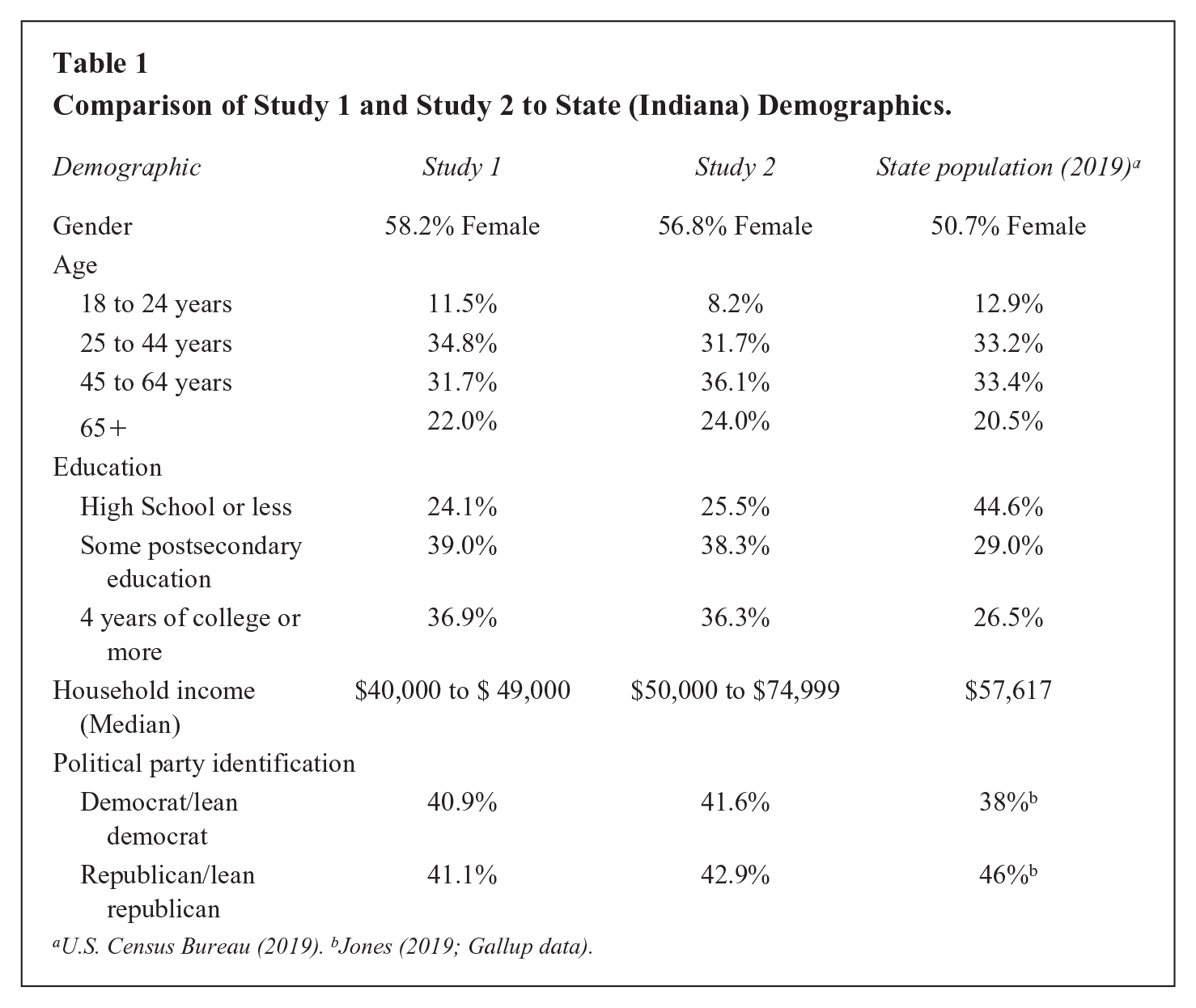
In terms of the state-level context, Table 1 provides an overview of the state’s basic demographics along the line of gender, age, household income, education and partisan identification. As of 2023, Indiana’s population of approximately 6.86 million is predominantly White, with 84% identifying as White alone, 10.3% as Black and 2.8% as Asian. Furthermore, 7.9% identify as Hispanic or Latino (U.S. Census Bureau, 2024). Despite economic growth in recent years, the state—as of 2022—has a poverty rate of 12.6%, which is higher than the national rate of 11.5% in the same year (U.S. Census Bureau). Though the state has exhibited some variability in voting patterns in recent decades, particularly in gubernatorial and Senate races, it has historically leaned Republican. Since 1976, the state’s majority has voted Republican in all but one presidential election—in 2008. Regarding the local news environment, as of 2020, Indiana had one county without any local newspaper whatsoever, and around 40 counties with one newspaper (Abernathy, 2020). Between 2004 and 2019, there was a 48% reported decline in newspaper circulation; in the same period, the total number of newspapers fell from 220 to 170 (Abernathy, 2020).
Comparison of Study 1 and Study 2 to State (Indiana) Demographics.
U.S. Census Bureau (2019). bJones (2019; Gallup data).
While this research effort does not employ a probability-based sample within the context of Indiana, and therefore is limited in its capacity to make claims of being representative, we did seek to match the demographics of the state in which the surveys were fielded. As shown in Table 1, the samples of Studies 1 and 2 were fairly similar to 2019 Census Bureau data in terms of age and income, though the samples are slightly disproportionate in terms of gender (skewed female). For education, the samples underrepresent those whose highest level of education is “high school or less” and overrepresents those with college education. The samples were fairly similar to state demographics in terms of political party breakdown, as reported by Gallup (Jones, 2019).
Measures
Perceptions of Investigative Journalism’s Importance
Both Study 1 and Study 2 measured perceptions of investigative journalism, employing survey items used in previous research on public attitudes about investigative journalism (e.g., Weaver & Daniels, 1992; Willnat & Weaver, 1998). Of note, due to space constraints in this study’s questionnaires, several of the commonly-featured questions in this line of research were not included—namely regarding the questions about investigative journalism’s use of hidden cameras, hidden microphones, quoting unnamed sources and paying for information. The survey section on perceptions of investigative journalism began by asking respondents to read this prompt: “News outlets sometimes conduct what is called investigative journalism. That is, in-depth reporting about public affairs that involve wrongdoing, failure, or social problems brought to light by journalists. Thinking about investigative journalism, how important do you think the following are for an investigative reporter?” Respondents were then asked to evaluate the importance of the following items on a 1 to 5 scale (1 = Not at all important, 5 = Extremely important): “Be an adversary of businesses by being constantly skeptical of their actions,” “Investigate claims and statements made by the government actions,” “Motivate policymakers to adopt reform based on investigative findings,” “Identify problems in society,” “Identify solutions for societal problems,” “Be an adversary of public officials by being constantly skeptical of their actions” and “Provide analysis and interpretation of complex problems.” (Study 1: Cronbach’s α = .87, M = 3.58, SD = 0.81; Study 2: Cronbach’s α = .89 M = 3.63, SD = 0.87). We conducted an exploratory factor analysis (EFA) with the Study 1 data to ascertain if the survey items for gauging perceptions of investigative journalism’s importance would be best understood as having one or multiple dimensions. Using maximum likelihood extraction and direct OBLIMIN rotation, a solution converged in 4 iterations. Using the traditional cutoff of an eigenvalue of one (or greater), one factor was extracted with an eigenvalue of 3.97. This factor, consisting of seven items, accounted for 56.68% of the variance. Similarly, in Study 2, a solution converged in 4 iterations, and we extracted one factor with an eigenvalue of 4.19. This factor accounted for 59.87% of the variance.
Perceived News Media Importance
To measure PNMI, we used the 13-item PNMI scale (Peifer, 2018b). This measure includes agreement with statements about the importance—at a personal level—of different journalism functions. Using a 7-point scale (1 = strongly disagree to 7 = strongly agree), the PNMI battery of questions includes items like, “it is important to me that the news media keep me up to date on what my political leaders and government are doing” and “provide analysis and interpretation of the complex problems around me.” (Study 1: Cronbach’s α = .88, M = 5.21, SD = 0.88; Study 2: Cronbach’s α = .88, M = 5.32, SD = 0.86).
Need for Evidence
Using questions based on Garrett and Weeks’ (2017) epistemic beliefs measures, study participants were asked to answer the following questions: “Evidence is more important than whether something feels true,” “A hunch needs to be confirmed with data,” “I trust the facts, not my instincts, to tell me what is true” and “I need to be able to justify my beliefs with evidence.” Respondents indicated how well each of the statements describes themselves on a 7-point scale (1 = strongly disagree to 7 = strongly agree; Study 1: Cronbach’s α = .75; M = 5.77, SD = 0.91; Study 2: Cronbach’s α = .84; M = 5.64, SD = 1.01).
Perceived Importance to Democracy
Using a 1 to 5 scale (1 = Not at all important, 5 = Extremely important), both studies posed the question, “In your view how important is the news media to our democracy?” (Study 1: M = 4.08, SD = 1.02; Study 2: M = 4.12, SD = 1.02).
Trust in the Motives of Journalists
Both studies posed an identical set of questions regarding perceptions of journalists’ motives. Participants read the prompt, “In general, I believe that the journalists who work in the news media truly want to . . .” and were asked to indicate their level of agreement (1 = Strongly disagree, 7 = Strongly agree) with the following items: “hold powerful people accountable,” “fully inform citizens about important issues and events,” “provide substantive analysis and interpretation of the complex issues facing our country,” “promote substantive public debates about important issues,” “help citizens better understand the experiences of people from all walks of life,” “encourage ordinary people to get involved in important societal issues” and “report the news fairly.” (Study 1: Cronbach’s α = .93; M = 4.73, SD = 1.37; Study 2: Cronbach’s α = .93; M = 4.97, SD = 1.38).
Findings
The first research question examined the extent to which the respondents of each survey perceived value in facets of investigative journalism’s work. In Study 1, the most endorsed aspect of investigative journalism—in terms of mean ratings on a 1 to 5 scale, where 5= “extremely important,” 4= “quite important” and so forth—was the “Investigate claims and statements made by the government” statement (M = 4.06, SD = 0.92). Consistent with prior research on attitudes about journalism functions more generally (e.g., Willnat et al., 2019), respondents rated the “adversarial” dimension of investigative journalism as least important—with regard to the statements “be an adversary of businesses by being constantly skeptical of their actions” (M = 3.08, SD = 1.16) and “be an adversary of public officials by being constantly skeptical of their actions” (M = 3.21, SD = 1.18). The remaining four evaluations of investigative journalism (i.e., “motivate policymakers,” “identify problems in society,” “identify solutions” and “provide analysis and interpretation”) in Study 1 ranged between M = 3.55 and M = 3.90. (See Table 2 for the means and standard deviations for each respective question in Study 1 and 2.) Similarly, in Study 2, “Investigate claims and statements made by the government” ranked highest among the investigative journalism survey items (M = 4.13, SD = 0.94) while “adversary of businesses” (M = 3.14, SD = 1.24) and “adversary of public officials” (M = 3.24, SD = 1.24) ranked lowest. As shown in Table 2, the other four functions ranged between M = 3.60 and M = 3.98.
Means, Standard Deviations and Ratings of Perceptions of Investigative Journalism

Note. Sample means (on 1-5 scale, with “extremely important” coded high) shown in the first column, with standard deviation reported in parentheses.
To address Hypotheses 1 to 5, we constructed OLS hierarchical linear regression models with perceived importance of investigative journalism as the dependent variable. As shown in Tables 3 and 4, the first block in the models of both studies included basic demographics (gender, income, education and age) and political party identification. The second block of both studies includes the key variables at the core of
Study 1 Results Predicting Perceptions of Investigative Journalism’s Importance

Note. Study 1 N = 1,077. Standardized coefficients reported with standard error in parentheses. PNMI = Perceived News Media Importance.
p < .001. *p < .05.
Study 2 Results Predicting Perceptions of Investigative Journalism’s Importance
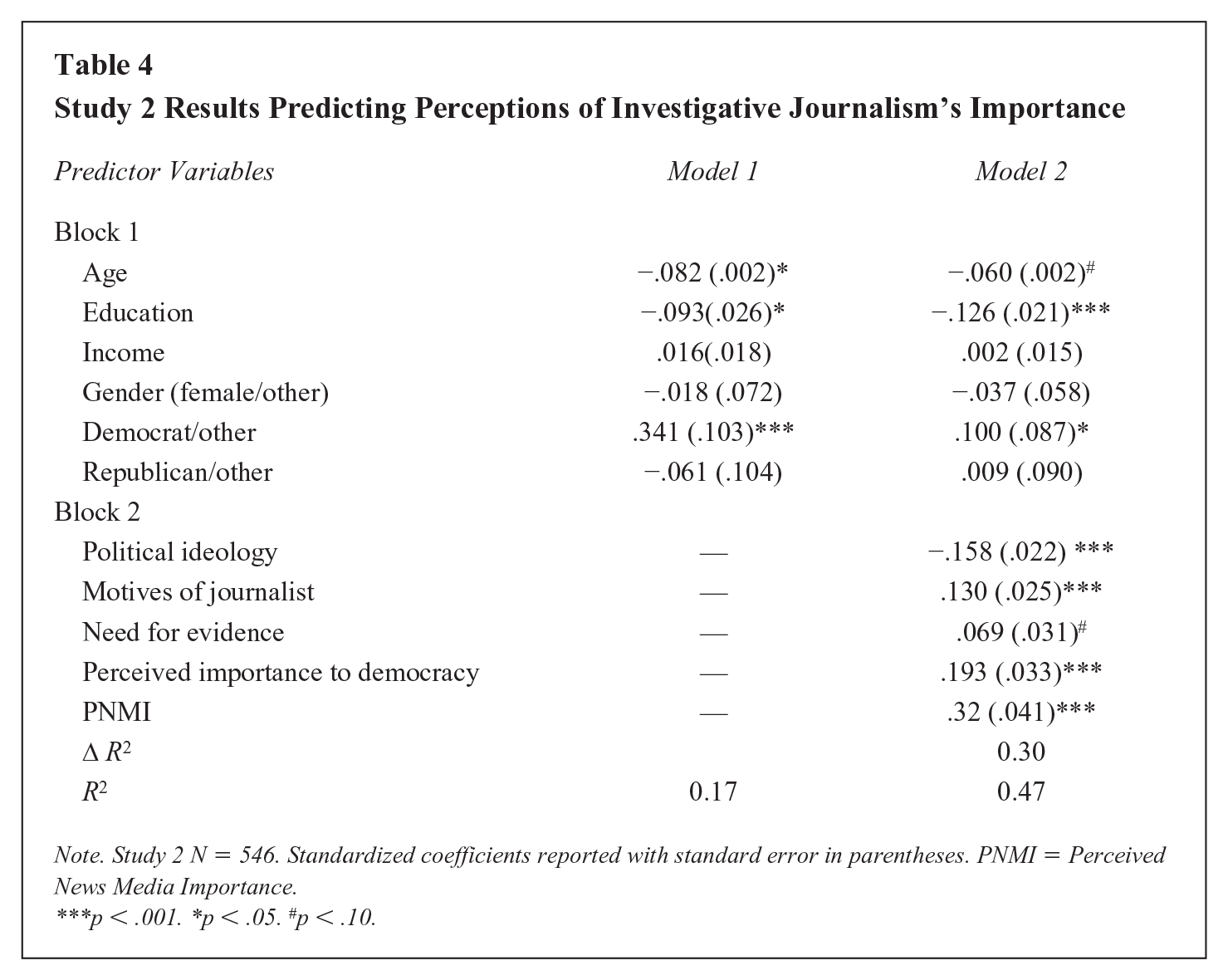
Note. Study 2 N = 546. Standardized coefficients reported with standard error in parentheses. PNMI = Perceived News Media Importance.
p < .001. *p < .05. #p < .10.
The first hypothesis (
The remaining hypotheses (
Discussion
This study’s analyses examine public attitudes about investigative journalism, contributing to an ongoing understanding of how citizens perceive and value this genre of newswork. Even as the two surveys featured herein do not fully mirror prior research of investigative journalism (e.g., in terms of some question wording and probing attitudes about the acceptability of investigative reporting methods; see Weaver & Daniels, 1992; Willnat & Weaver, 1998), the project’s line of inquiry nonetheless offers useful points of comparison about perceptions of this specialized form of journalism. For instance, in Weaver and Daniels’ (1992) statewide survey in Indiana, more than 90% of respondents indicated they considered investigative reporting to be very or somewhat important. And a 1997 U.S. national poll by Pew Research (Pew Research Center, 1997) found that nearly 84% of the American public approved of investigative reporting. Although this present research does not employ identical measures, similar strong support for investigative reporting is evident in the large proportion of respondents who rated the journalistic function of “investigating claims and statements made by the government” as extremely or quite important (74.6% of respondents in Study 1; 80% in Study 2).
Overall, then, this research effort suggests continued public appreciation of journalism’s accountability/watchdog role. Moreover, it confirms our expectation that valuations of investigative journalism are embedded within a broader understanding of journalism’s value for a democracy (cf., Willnat & Weaver, 1998). This research also demonstrates a strong association between personally valuing core aspirations of journalism in general (i.e., PNMI) and various functions of investigative journalism—indicating that citizens’ understanding of investigative journalism tends to be closely tethered to attitudes about journalism’s personal value and utility. Such evidence suggests that it can be wise for investigative journalists (as well as journalists in the more general scope) to make their professional set of values explicit. Given the findings that citizens are least enthusiastic about the “adversary”-based dimensions of investigative work (see Table 2), this study indicates that articulating why a skeptical posture toward public officials and business interests is necessary may help to clarify the import of such values.
In highlighting political conservatism’s significant negative correlation with perceptions of investigative journalism, this research also underscores the increasingly polarized nature of attitudes about news media. While past research did not generally evince a meaningful difference in approval of investigative journalism relative to political orientation (Willnat & Weaver, 1998), political ideology clearly plays a role in this study. Given the heightened rhetoric of hostility directed toward mainstream journalism in recent years (Krämer, 2018), it is evident that citizens with right-leaning political views continue to hold less than favorable views of virtually all forms of journalism. For instance, in the lead up to the 2024 presidential election cycle, polling commissioned by the American Press Institute/NORC indicated that Republicans were more likely than Democrats to be concerned about inaccurate information being reported by news organizations during the election (Bauder, 2024). With no signs of low confidence in the press among Republicans easing up since the time this study’s surveys were administered (Brenan, 2024), there’s little reason to believe perceptions of investigative journalism have changed in a positive direction either over the intervening years.
Beyond the issue of ideological orientation, the ways in which one perceives journalists’ motives also prove relevant. The data suggests that individuals who do not trust the intentions of journalists are also not likely to see investigative enterprises as important. Perceptions of this nature undoubtedly have links to partisanship and ideology. However, by controlling for ideology and partisanship, both Study 1 and Study 2 suggest that skepticism of journalists’ motives is not strictly the province of the political right. Indeed, national polling suggests erosion of faith among Democrats. Gallup reported that Democrats’ trust in the media fell 16 points (70% → 54%) from 2022 to 2024 (Brenan, 2024). Such findings underscore how the journalism industry’s credibility issues extend beyond political divisions in the United States. As alluded to earlier, this may have something to do with broader trends of declining faith in political/social institutions.
An important way in which this study breaks newer ground in a scholarly understanding of public attitudes about investigative journalism is the introduction of the role of personal epistemology. Different from a mere enjoyment of thinking (e.g., Need for Cognition), Need for Evidence (NFE) represents a style of sense making and preference for truth claims that arguably align with journalism, and particularly investigative journalism, as a “discipline of verification.” While Study 2 did not show NFE to be a significant predictor (b = .07, p = .57) at the .05 alpha level with the battery of control variables, the preponderance of the data across the two studies does nonetheless strongly indicate a relationship between NFE and evaluations of investigative journalism’s importance. Though perhaps not representing a primary explanation for appreciation of investigative journalism, examination of NFE’s contribution to motivating attitudes about investigative journalism provides insight into why individuals may find value in this specialized form of journalism.
Limitations
In terms of limitations, we would reiterate that the survey data featured in this research are not probability-based samples. Accordingly, caution is warranted when seeking to draw conclusions about the degree to which citizens value investigative journalism. Nonetheless, given the consonance between our data and statewide demographics as well as the cross-validation evident through the use of two independent samples, these surveys are useful for highlighting the relationships between perceptions of investigative journalism’s importance and factors like PNMI, NFE, political conservativism, faith in journalists” intentions, and so forth. We posit that these psychological profiles and related linkages can be reliably established outside the scope of a probability-based sample. Second, because the survey questions featured in this research were part of a broader project related to more general news media attitudes, certain aspects of prior research on public attitudes about investigative journalism (e.g., Weaver & Daniels, 1992; Willnat &Weaver, 1998) were not replicated here—largely due to space constraints. That is, this study is not able to address public attitudes about techniques like using hidden cameras, using hidden microphones, quoting unnamed sources, and paying for information. Finally, the study’s focus within the scope of one U.S. state is another limitation. It is fair to wonder how well responses from citizens of one state offer a basis on which to generalize more broadly. We would note, however, that given the wide range of political orientations in the study samples and the battery of control variables employed in our analyses, the key relationships highlighted by this research would seem to bear relevance to a more national U.S. context.
Future Directions and Conclusions
Because this study was conducted within a relatively narrow geographical scope (i.e., within the state of Indiana), future work should seek a broader frame of reference. To be sure, this would include a broader U.S. context, but there is an even more pressing need for research of attitudes about investigative journalism at an international level. There would be considerable value in examining and comparing how publics in different regions around the world perceive watchdog reporting and what factors might motivate/explain variation in perceptions of investigative journalism. Such an avenue of future research, within a more international domain, should also include the public’s perception of different journalistic methods, such as hidden recorders and the concealment of a journalist’s identity. Furthermore, we urge those who conduct scholarship in this area to continue investigating how citizens’ personal epistemologies in particular align with (or do not) the dominant epistemologies of journalism—in all the different dimensions of journalism cultures and the interpretive communities they represent.
Examining the practical implications of this research effort, in view of the study’s regional focus, it’s worthwhile to first briefly consider how local news might leverage the study’s insights. Given the public’s general appreciation for journalism’s watchdog function (see Table 2), local media could conceivably bolster its value and utility to the local communities they serve by investing in investigative reporting that addresses community-specific issues (Hamilton, 2017; Kovach & Rosenstiel, 2021). In doing so, local media may also be able to address the politically polarized views of investigative journalism highlighted by this research via emphasizing transparency in reporting processes and providing cogent explanations of the investigative journalistic methods employed in the community (Culver & Lee, 2019). By aligning investigative reporting with the preferences of a localized audience, local news media ecosystems may be able to strengthen public trust and appreciation for their work in a context that is more tangibly relevant to one’s life than, say, some national issue that feels more distant.
In a broader sense, this study is most instructive to investigative journalism practitioners and advocates as a window for “knowing your audience.” That is, the panorama offered by this research confirms that those who value investigative work (and presumably, are more likely to consume, support and defend it) are those already inclined to trust and value the normative aspirations of journalism and its role in a democracy, and those whose personal epistemology is loosely aligned with that of investigative journalism. Conversely, these findings also indirectly illuminate traits of those who are not fully convinced of investigative journalism’s value, highlighting individuals who indicated placing less of a premium on “evidence” and “data” (i.e., low in Need for Evidence) and are more neutral—or apathetic—about how essential journalism is to a democracy.
To reiterate, this research also showcases a partisan skew of those who value/devalue investigative journalism. These findings add to a wealth of existing evidence that journalism practitioners/the news industry need to be attentive to cultural and partisan divides relative to faith and engagement with news. Though we do not propose novel and simple remedies in this regard, investigative journalism initiatives would do well to be reflexive about whether they are addressing the priorities and interests of a wide audience, not just those who share similar sensibilities and values. This insight can also apply to funding streams for investigative journalism. While instances of non-profit/philanthropic funding being directed toward investigative enterprises are to be lauded, it is also important to grapple with the potential for backing of investigative work being perceived by large swaths of the public as instances of liberal meddling, oriented to promote “liberal” causes (Usher, 2021).
To be sure, investigative journalism is strongly associated with progressive reform impulses, following in the tradition of “muckraker” journalists who worked to expose corruption and abuse during the late 1800s/early 1900s Progressive Era. While it is debatable how well this historic brand of Progressivism aligns with contemporary notions of what it means to be a progressive and the conservative/liberal spectrum of 21st century United States (Johnston, 2002; Leonard, 2017), this reformist/adversarial impulse likely makes it especially difficult to shake public perceptions of investigative journalism as having a liberal/elitist tilt. Nonetheless, the partisan contrast in valuing the aspirations of investigative journalism featured herein suggests an ongoing need to make a case for investigative journalism’s relevance and value to those who may not be privileged, affluent and left-leaning (i.e., “Rich, White and Blue”; see Usher, 2021). To this end, a continued focus on the factors that motivate public opinion about investigative journalism can contribute to building an understanding of how to best make such a case.
Footnotes
Ethical Approval
An Institutional Review Board approved this research’s procedures (Study 1 protocol # 1907900135; Study 2 protocol #2002539030).
Funding
The author(s) disclosed receipt of the following financial support for the research, authorship and/or publication of this article: This research was supported in part by the Association for Education in Journalism and Mass Communication’s (AEJMC) Emerging Scholars Program (2019). The project was also partially supported by Indiana University’s Arts and Humanities Council and the New Frontiers in the Arts and Humanities Program.
