







Abstract
Scholars have long observed that American audiences see fewer stories on major national news platforms that occur beyond U.S. borders, despite the proliferation of 24-hour cable news networks, digital platforms and mobile technology. However, as social media platforms open up more avenues to share and connect with global audiences, do U.S. legacy media organizations offer international news coverage on these channels? Guided by framing theory, this research examines how legacy national news media outlets use their social media platforms as a distribution tool to share and frame newsworthy images. The results suggest that U.S news organizations underutilize their social media platforms as a tool to share newsworthy international news images.
In 1989, when the Berlin Wall fell, major American news networks devoted nearly 5,000 hours to coverage of international events (Enda, 2010). By 2011, the Journalism Review noted that number had fallen precipitously to slightly more than 2,000 hours a year (Enda, 2010). Americans see fewer stories on major national news networks that occur beyond their borders, despite the proliferation of 24-hour cable news networks, digital platforms and mobile devices.
Halton (2001) observed several decades ago that even with the technological advancements that make international news gathering and distribution easier, the rate of world news shared by American news outlets has “fallen dramatically” (pg. 500).
The decline in news outlets’ coverage of international events has been the subject of attention from scholars dating back to the 1960s. Galtung and Ruge (1965) suggested that media from other nations might share content to combat the dearth of international coverage that did not directly impact their home countries. In addition, they noted that news coverage would skew negative if it were from distant countries. From an American media standpoint, scholars have noted spikes occur in international coverage when dramatic global events impact the United States, such as the global Coronavirus Pandemic or the Russo-Ukrainian War that began in 2014 but escalated in early 2022 when Russia committed a full-scale invasion of Ukraine. However, as these events unfold, what meager international coverage is offered can lack important context. Jemele Hill (2023), a nationally recognized sports media personality, tweeted during a crucial 24 hours during the Russo-Ukrainian War, when it appeared a faction of Russian mercenaries were staging a coup, that “this situation in Russia makes it that much more noticeable the dearth of foreign/international reporting here in the States. . .” because “outlets either eliminated or seriously downsized their foreign desks, which is why a lot of Americans right now aren’t able to fully grasp what’s happening. ” Outside of these major events, international news coverage remains strikingly low despite the considerable growth of digital and social platforms that allow near unlimited publishing space.
Broadly, scholars have devoted much of their efforts studying international news on legacy news media, such as broadcast or cable news, newspapers and the web; however, this study advances this body of research on social media platforms (SMPs), which meets Halton’s (2001) definition of technological advancements. These platforms allow for wider distribution and deeper engagement with audiences. Indeed, scholars have observed that traditional and new media are intertwined (Mao et al., 2023). As with other scholarly works, this study focuses on national U.S. media organizations, which collectively represent the highest level of American journalism and who claim a responsibility to objectively inform their public.
This study focuses exclusively on legacy news organizations’ Instagram accounts. The social network is a global photo and video-sharing platform that ranks as one of the most popular SMPs with billions of global users (Taher, 2019). In addition, Instagram’s emphasis on visual stories was a key consideration. Media critics suggest that communication is increasingly based on visual storytelling (Bajarin, 2015; Newton, 2017) and that stories with visuals improve news consumers’ understanding of information (Fahmy et al., 2007). In addition, Instagram’s popularity as a global communication platform makes it a natural space to study international news activity.
Unsurprisingly, the social network is a strategic platform for news organizations: market research shows that it is the most popular SMP among younger adults (Greenwood et al., 2016; Walker & Matsa, 2021) and ranks as one of the top four social media sites for news and information (Gottfried & Shearer, 2016; Walker & Matsa, 2021). Nearly every national U.S. news organization, from traditional brands like the Washington Post and the New York Times (NYT) to broadcast stations like Fox, CNN and NBC, have accounts and regularly share stories. Unlike traditional media platforms, Instagram is generally free of traditional media constraints like minute or word count restrictions —although some restrictions include time limits on videos and caption lengths. In addition, organizations can post unlimited content.
Considering the global reach of Instagram and its potential as a platform for sharing visual newsworthy international news, this research examines how national news media outlets use Instagram, and more broadly, their SMPs as a distribution tool to share and frame newsworthy international news stories.
Literature Review
A few traditional news organizations like the NYT maintain international bureaus with “boots-on-the-ground” reporters (Journalism That Stands Apart, 2017, para. 9). However, that appears to be the exception (Enda, 2010; Halton, 2001; Pew Research Center, 2008). Many large U.S. news organizations have shuttered their international operations for a number of reasons, including financial constraints (Enda, 2010) and a general lack of interest from audiences (Barthel & Mitchell, 2017). Scholars have noted that other factors may be in play, such as a lack of proximity or irrelevance to American interests (Ahern, 1984; Baum & Zhukov, 2019; Chang et al., 1987; Hong & Oh, 2017; Wu, 2007).
The rise of U.S. nationalism may contribute to a heightened focus on domestic news (“Nationalism in the U.S.,” 2019). Barthel and Mitchell’s (2017) survey of audience news interests reveals that Democrats, whom the authors identify as historically more interested in international news, have become more recently drawn to domestic political news. Even recent foreign conflicts that include U.S. interests have done little to impede the decline of international news coverage. Enda (2010) claimed that several recent wars involving the United States did not influence news organizations to offer more international news. Greater interest in domestic news makes it difficult for newsroom leaders to commit the considerable resources—such as travel, salaries and supplies—to international bureaus when audiences remain indifferent with the coverage (Enda, 2010). The Pew Research Center (2008) surveyed newsroom leaders across the country and reported that international news was the least popular topic among their audiences. More than half (64%) claimed that foreign news coverage in their publications had diminished in the past 3 years. Furthermore, only 10% of newsroom leadership believed that international news coverage was considered to be “very essential” (The Pew Research Center, 2008). As a result of shifting audience interests and newsroom operations, American audiences are exposed to fewer international news stories on legacy platforms.
Determinants of International News in American News Organizations
A number of studies have identified specific predictors for the lack of international news coverage in American media. Chang et al. (1987) discovered several significant predictors including relevance to American interests and geographical distance. Similarly, Kim and Barnett (1996) discovered that a country’s economic status, language, physical location, political independence and population determined coverage.
A country’s economic interests appear to be a common predictor for coverage (Ahern, 1984; Kim & Barnett, 1996; Liu & Yang, 2015; Wu, 2007). Both Ahern (1984) and Kim and Barnett (1996) claimed that economic development in a country was a significant factor in which stories from what countries were represented in American media. Wu’s (2007) study, which looked at the websites of CNN and the NYT, discovered that the more trade volume exists between a foreign country and the United States, the higher the publication of international news. Unsurprisingly, the author also discovered that news coverage increased if the country or region employed international news bureaus (Wu, 2007). Baum and Zhukov (2019) discovered that media ownership can influence how the organization views newsworthy domestic and international stories. International sports coverage may also show signs of international bias. Hong and Oh (2017) found that during the 2012 Olympics in London, U.S. media overwhelmingly selected and represented mostly elite countries with proximate cultural values. Overall, studies demonstrate there is little consistency—outside the loose criterion of economic status, proximity and relevance—for how the U.S. media identifies newsworthy international stories. Randal (2000) argued that a post-Cold War American electorate was unwilling to dive into the complexity of non-domestic narratives.
The United States is hardly alone in framing a large international event from ethnocentric points of view. During the same 2012 Olympic Games, the BBC’s Arabic speakers showed “a good deal of positive empathy . . . towards fellow Arabic-speaking countries and their victories and defeats” (Gillespie et al., 2015, p. 404). Russian social media users framed the games by their own domestic politics (Gillespie et al., 2015). Traditional media may not have had the global reach of modern social media audiences, and media had a tendency to contextualize news from abroad in an “abridged” frame (Wilke & Rosenberger, 1994, p. 10).
Scholars and critics argue international stories hold considerable value. News coverage from abroad can influence foreign policy (Burstein, 2003), immigration (Gil de Zúñiga et al., 2012), and in some instances, even presidential elections (Hughes, 2007). In addition, as the global village grows smaller as a result of digital networks and safer, more accessible modes of travel, the public rely heavily on national media to stay informed about international and domestic news (Castelltort & Mäder, 2010).
News on Social Media
While this study is less concerned with what legacy media are currently doing on traditional platforms of print, online and broadcast, it is important to note how international news coverage is decreasing on these platforms as a lens to understand how these trends may be emerging on new distribution platforms, such as SMPs. Legacy media outlets have hired digital content teams to manage their social presence—and for good reason. Studies show that SMPs play an important role as a communication tool in today’s global world (Fullerton et al., 2017; Graham & Broersma, 2015; Nuernbergk, 2016; Paulussen & Harder, 2014; Tandoc & Vos, 2016; Walker & Matsa, 2021).Graham and Broersma (2015) note that social media’s quick and flexible information exchange erodes news agencies’ information monopolies and is becoming more indispensable in news organizations’ attempts to regain audience attention. However, scholars have noted that journalists often have difficulty adapting to social media coverage, often using practices that were honed in legacy media, indicating that digital media is an afterthought (Bloom et al., 2016).
A number of studies reveal that news organizations and journalists increasingly use SMPs for news information gathering and for promoting their work directly with audiences (Paulussen & Harder, 2014; Tandoc & Vos, 2016). Tandoc and Vos (2016) report that many journalists are recurrently tasked by management to convey information to audiences via SMPs. Paulussen and Harder’s (2014) examination of the Belgian press observed that journalists frequently browse SMPs for story ideas.
As noted, Instagram was selected as the SMP for this study primarily because of its popularity with younger news audiences (Gottfried & Shearer, 2016; Greenwood et al., 2016; Walker & Matsa, 2021) and because of its unique visual emphasis—an important factor in an increasingly visual communication world (Fahmy et al., 2007). In addition, Instagram allows direct linking across SMPs including Facebook and Twitter, which means the content can live beyond the social network. Instagram reports billions of global users, with most residing outside of the United States (Taher, 2019). Along with the platform’s growing popularity is its increasingly critical role as a tool to inform audiences. Researchers identify Instagram as among the top four social media sites for news consumption by users (Walker & Matsa, 2021).
As more news organizations turn to SMPs for news distribution, and as audiences continue to participate in this exchange, emerging research suggests that international news shared on social channels can have an impact on how audiences perceive the world. Fullerton et al. (2017) discovered that SMPs played a key role in positively changing Americans’ knowledge and perceptions of Cuba as a nation. Barnett et al. (2017) analyzed more than 1.8 billion Facebook posts and 51 million Chinese Weibo posts, and concluded that SMPs serve as a “transnational electronic public sphere” (p. 38) and that relations between countries are associated with the amount of news coverage a country receives. These studies demonstrate the influence SMPs have on audiences, in particular, the impact international news can have on audience perceptions of the global community.
Visual Framing Theory
Mass communication scholars have long examined how the media frame news and information for audiences (Entman, 1993; Gitlin, 1980; Goffman, 1974; McCombs & Ghanem, 2001). Framing theory suggests that media entities can influence audiences’ attitudes toward and perceptions of the information presented to them based on its presentation (Brantner et al., 2011; Entman, 1993; Gitlin, 1980; Goffman, 1974; McCombs & Ghanem, 2001). News organizations routinely make editorial decisions about what to include, exclude and emphasize in their coverage (Fahmy et al., 2007; Gitlin, 1980; Goffman, 1974). Framing is evident in how media portrays race (Eagleman, 2011), gender (Cooky et al., 2015; Cranmer et al., 2014; Fink & Kensicki, 2002; Hardin et al., 2002), and national and international disasters (Fahmy et al., 2007) and conflict (Brantner et al., 2011; Moriarty & Shaw, 1995).
A sub-thread of framing analysis includes the process of visual framing. Visual framing theory examines how an image can influence audience perceptions of a news story. Most scholars utilize a content analysis to determine if an image is included with a story, the frequency with which specific images appear before audiences, and how subjects are framed within the images (Fahmy, 2010; Fahmy et al., 2007; Hardin et al., 2002, 2004; Kim, 2012; Kinnick, 1998; Moriarty & Shaw, 1995). Brantner et al. (2011) discovered that some types of images elicit stronger responses than others. Fahmy et al. (2007) revealed that images, more so than text alone, have a higher influence on audience perceptions. Scholarship repeatedly demonstrates that the visual has power to shape how audiences perceive a news story.
Our research explores how national news organizations use SMPs to frame international content for audiences through selection, emphasis, or exclusion. Furthermore, if/when news organizations share international news stories on their Instagram accounts, what type of themes emerge from those images? This project leans on research from Jones (2008), Meyer (1996) and Wanta and Hu (1993), who examined the frequency in which international news was shared on traditional news platforms and what themes emerged from the coverage. In addition, Fahmy (2010) guided the visual analysis framework. These scholars’ analyses provided a groundwork for this study, but this work builds off this framework by looking exclusively at images shared via social media.
These researchers delineated U.S. news coverage into two basic categories: domestic or international (Jones, 2008; Meyer, 1996; Wanta & Hu, 1993). Wilke & Rosenberger, (1994); however, used four categories to describe ethnocentric news. This study finds a balance between Wilke and Rosenberg and other scholars by using three of the former’s categories: (a) “home news at home,” (b) “foreign news abroad,” and (c) “home news abroad” (p. 425). The authors of the current study contend that stories involving Americans overseas merits its own category as it fails to meet the explicit definition of domestic or international stories. Scholars note that when news organizations cover its citizens beyond their borders, they often frame information based on the interests of that country (Clausen, 2004). Audiences can lose important context about international stories through this selective framing process (Clausen, 2004). The authors of the current study argue that Wilke and Rosenberg’s “foreign news at home” category does not fit in this study because proximity, a standard news value, of an outlet’s home country lends such news a domestic frame.
This research examines whether there is an underrepresentation of international news stories on legacy media’s global SMPs and if discrepancies exist between organizations. For example, U.S. cable news programming often focuses on issues at home, and it’s possible that their SMPs reflect this emphasis (Martin-Kratzer, & Thorson, 2010). The study thus proposes the following research question:
Is international news (“foreign news abroad”) underrepresented on news outlets’ Instagram platforms?
In addition, this study explores possible inconsistencies between how news organizations frame “home news at home” and “foreign news abroad.” The latter inquiry might provide a rationale for why news organizations emphasize “home news at home” coverage over “foreign news abroad.”Jones (2008), Meyer (1996) and Wanta and Hu (1993), also applied deeper thematic analysis to news stories by looking at how the stories were framed. Their work suggests that when U.S. news organizations infrequently cover international news stories, they often contain negative themes, including crisis, politics, poverty, terrorism and trade problems. Al-Rawi et al. (2021) found that negative framing of international news also extends to social media. By framing stories in that way, news organizations influence how their audiences think and see the world outside their country. Thus, our study proposes a second research question:
Do news organizations use different news frames to share “foreign news abroad” than “home news at home” or “home news abroad” on their Instagram accounts?
Finally, as new media continually struggle to find ways to replace revenue from legacy media, it is likely that news organizations will make the decision that makes the most economic sense. The commodification of the internet also coincided with a shift away from family media ownership to large and profit-focused corporations (Randal, 2000). The United States has become increasingly ethnocentric. Large percentages of Americans distrust the media (Nadler & Taussig, 2022), and political populism that fosters strong connection to nationalism and American exceptionalism have especially grown among conservatives (Ott & Dickinson, 2019), the group most likely to distrust media reports. Social media users also face the added pressure of distinguishing news from politically driven “spam” shared by bots (Segev, 2020, p. 9). Thus, we propose a third research question that explores whether news organizations might be justified in focusing on “home news at home” news.
Does “home news at home” shared on news organizations’ Instagram accounts garner more engagement than “foreign news abroad”?
Method
To address the research questions, the researchers conducted a content analysis of images shared by the primary Instagram account of major daily national American newspapers, television news networks and cable news channels. The researchers selected the outlets based on their prominence in the American and international news landscape, resulting in nine total accounts for observation: the NYT, the Washington Post, USA Today, CBS News, NBC News, ABC News, Fox News, MSNBC and CNN. While Instagram allows users to post video, the differing nature of images and videos makes cross comparison problematic. Therefore, for validity reasons, the researchers only collected images and omitted videos from the sample. The researchers acknowledge the limitation of the omission of much of the content, especially those that would be shared by the television news outlets. However, the importance of comparing similar content is paramount and suggests that the videos shared by these accounts should be a preferred avenue for a separate future research project.
To limit the effect that major breaking news stories would have on the type of news that would be shared, the researchers employed stratification in sample selection. A calendar year was separated into four quarters to allow 1 week from each season of the year an equal chance of selection. One full week from each quarter was randomly selected, and all Instagram images that were shared during those weeks were collected for study. It was determined that one of the broadcast news outlets, CBS News, only shared video during the selected weeks, and therefore it was eliminated from the study, leaving a total of eight news outlets for study. To help with identifying the major photo subject(s) in each image, the entire Instagram post, including the text, was captured and archived.
The unit of analysis for the study was an individual Instagram post. Following sample collection, two teams of coders were trained to analyze the images for content. The first team was instructed to identify the name of the outlet that shared the Instagram post, the whether an image contained a human being, whether the image consisted of domestic or international news, and the dominant news frame of the image. The second team was asked to account for narrative qualities of the image, and to record the interactivity measures of likes and comments that each post received. We use three categories suggested by Wilke and Rosenberger (1994) study on ethnocentric news coverage. News categories are therefore identified as: (a) “home news at home,” for stories that take place in the United States, (b) “foreign news abroad,” international stories that do not cover American interests and (c) “home news abroad,” which involved stories about U.S. citizens that take place outside of the United States (p. 425).
The frames that were used originally followed works like Jones (2008), Meyer (1996), and Wanta and Hu (1993) definitions of visual news framing; however, after pilot studies indicated that some of the categories were not prominently featured, several categories were condensed into similar classifications, resulting in the news frames of: crime and public safety, disaster, entertainment, health and science, finance, technology, nature, politics and social issues and war and terrorist attacks.
Before coding the main sample, coders were trained and tested for intercoder reliability using approximately one-tenth (n = 124) of the overall sample of images. The four coders who were tasked with recording the numbers of likes and comments reached high levels of agreement. Using Krippendorff’s alpha, the coders passed well above the accepted .80 limit (Lombard et al., 2002) on both likes (a = .999) and comments (a = .986). Cohen’s kappa was used as a measure of intercoder reliability for the outlet (K = 1.0), gender (K = .845), news type (K = .816) and frames (K = .818) and frames variables because of their nominal nature and because we used two coders. On the first attempt, the coders reached agreement on outlet (K = 1.0) and news type (K = .816), but failed to reach agreement on gender of the photo subject and news frames.
To answer the research questions, we subjected the coded data to a series of statistical tests, including chi-square tests for independence for the relationships between categorical data and a pair of linear regression model for the questions that explored the measures of interactivity, namely likes and comments. The primary dependent variable for the first regression model was the logged number of likes for each individual post. The independent variable in this regression was the type of news, such as “foreign news abroad” or “home news abroad.” The second regression was similarly constructed, with the logged comments serving as the primary dependent variable and the type of news serving as the primary independent variable. Various control variables were included in the model and are displayed in Tables 4 and 5.
Results
The two teams coded the same sample resulting in a dataset of 1,237 images. The print newspapers shared the most images (n = 553), followed by cable (n = 450) and broadcast news (n = 234) outlets. Of the individual outlets, Fox News (n = 298) was the most prolific whereas MSNBC (n = 26) was the least. The news outlets shared images of domestic news most often (71.9%, n = 890). While not as prolifically shared as domestic news, international news items were more common (21.5%, n = 266) than those that featured Americans abroad (6.5%, n = 81). Overall, the news outlets shared more images of political/social (n = 357) and entertainment (n = 300) news than any other news frame. The researchers conducted a chi-square test for independence (Table 1) between the nature of the news outlet and the type of news shared. The results of this test were statistically significant (χ2 = 50.344, df = 4, p < .01) and showed a small effect (Cramer’s V = .14). The cable news outlets did share significantly fewer images of international news (14.2%) than both broadcast (26.5%) and print (25.3%) outlets. Cable news outlets also shared the most items containing domestic news (78.0%).
Chi Square Test* Between Outlet Type and News Type
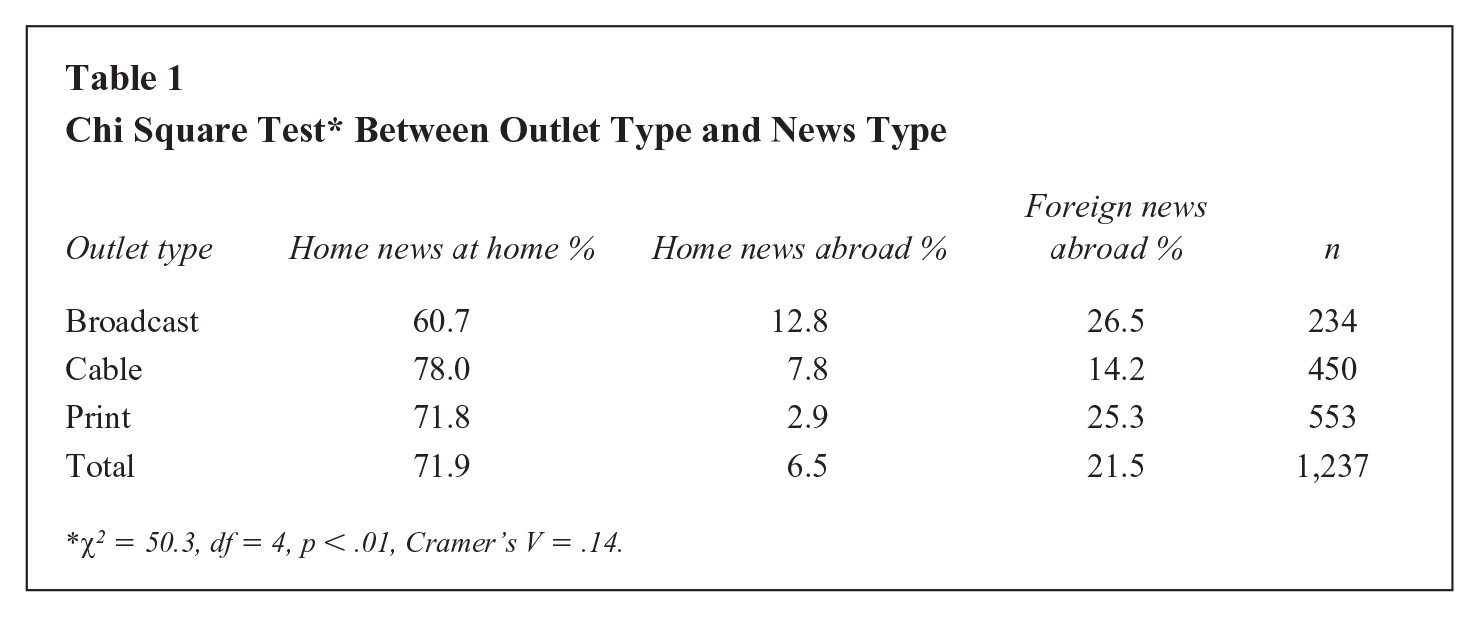
χ2 = 50.3, df = 4, p < .01, Cramer’s V = .14.
The first research question asked whether international news was underrepresented among the outlets’ Instagram posts. This question was partially answered in Table 1, which shows that only broadcast outlets consistently shared images that featured international news in a domesticated context, with 12.8% of their images falling in the Americans abroad category. Print newspapers shared the fewest of such images (2.9%). A more detailed breakdown of these phenomena can be found in Table 2, which shows that each individual outlet shared images of domestic news in a majority of its Instagram posts.
Chi Square Test* Between Outlet and News Type
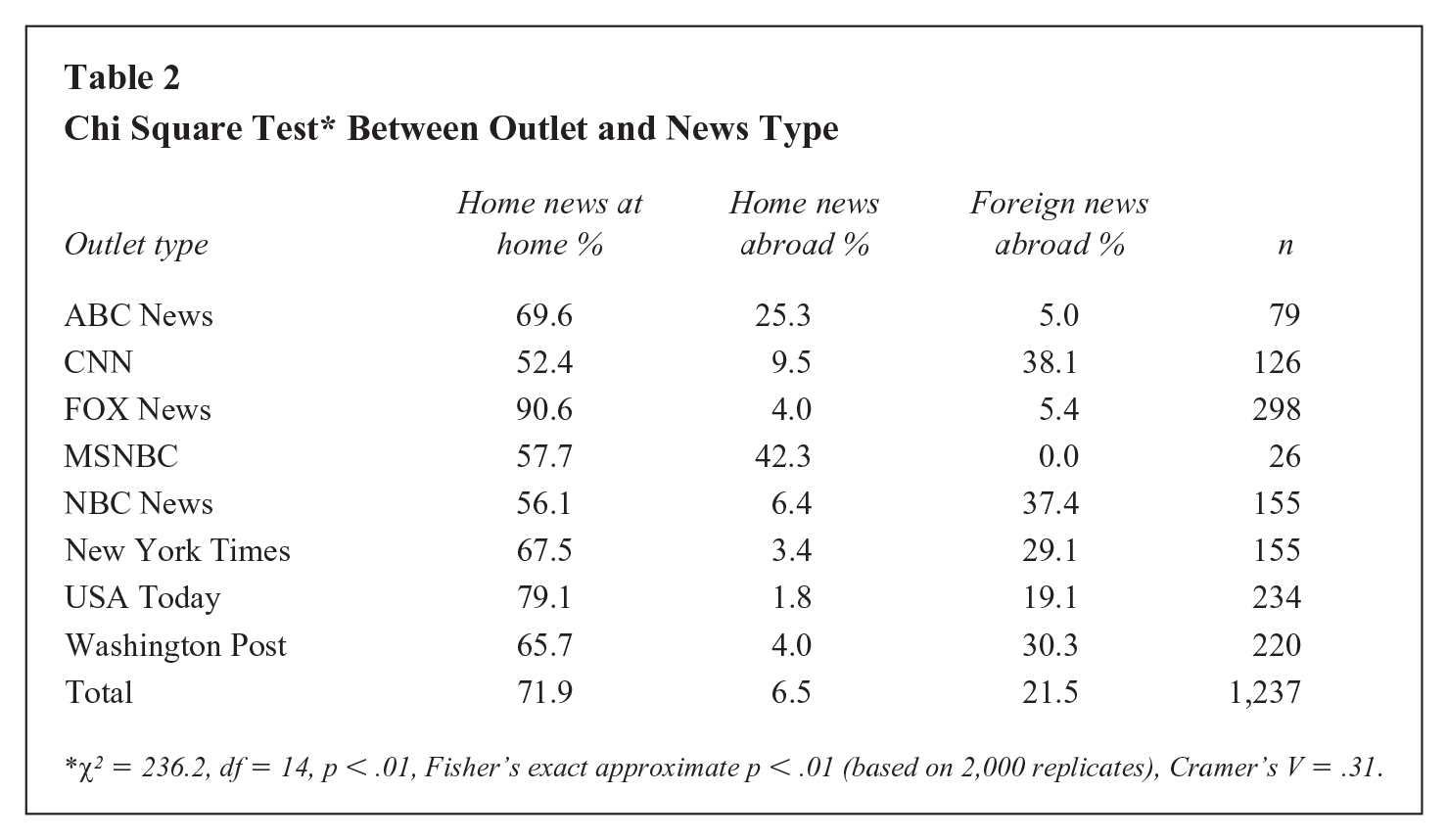
χ2 = 236.2, df = 14, p < .01, Fisher’s exact approximate p < .01 (based on 2,000 replicates), Cramer’s V = .31.
Fox News overwhelmingly shared domestic news with its posts (90.6%), perhaps accounting for much of the difference between cable outlets and print newspapers as seen in Table 1. While MSNBC shared a nearly even split of domestic (57.7%) and Americans abroad (42.3%) news items and did not post any images of international news, its sample size (n = 26) was too small to make definitive conclusions. Of the cable news outlets, CNN was the most likely to share international news (38.1%). The results of the chi-square between news type and individual outlet were statistically significant (χ2 = 236.24, df = 14, p < .01, Fisher’s exact p < .01) and showed a medium-sized effect (Cramer’s V = .31). The data in Table 2 also indicate that while individual news organizations do share international news in different proportions regardless of their publication format—for example, the differences between Fox News and CNN show that a cable news outlet does not necessarily share more domestic images and that the differences are instead systematic choices made by individual news outlets—two conclusions can be drawn from Table 2: (a) news organizations overwhelmingly share more news items of domestic interest on their Instagram platforms and (b) international news items are rarely present in a frame of Americans abroad.
The second research question asked whether news organizations would frame international news differently than domestic news on their Instagram accounts. Due to the low numbers of domesticated international news, the images of the “home news abroad” category were removed from the data to increase the validity of statistical tests. As the news outlets had shown differences in the type of news they had shared, to account for potential organizational differences in the types of frames that were used that may confound the results, the researchers first stratified the data to look for potential framing patterns. While the individual organizations did show some small differences in the frames they used, the NYT was the only news outlet that framed international news items in significantly different proportions. Therefore, for the purposes of RQ3, the data were stratified into two chi-square tests (Table 3). The first (n = 998) featured all other outlets excluding the NYT, whereas the second (n = 226) featured the NYT exclusively.
Chi Square Test Between News Type and Frames
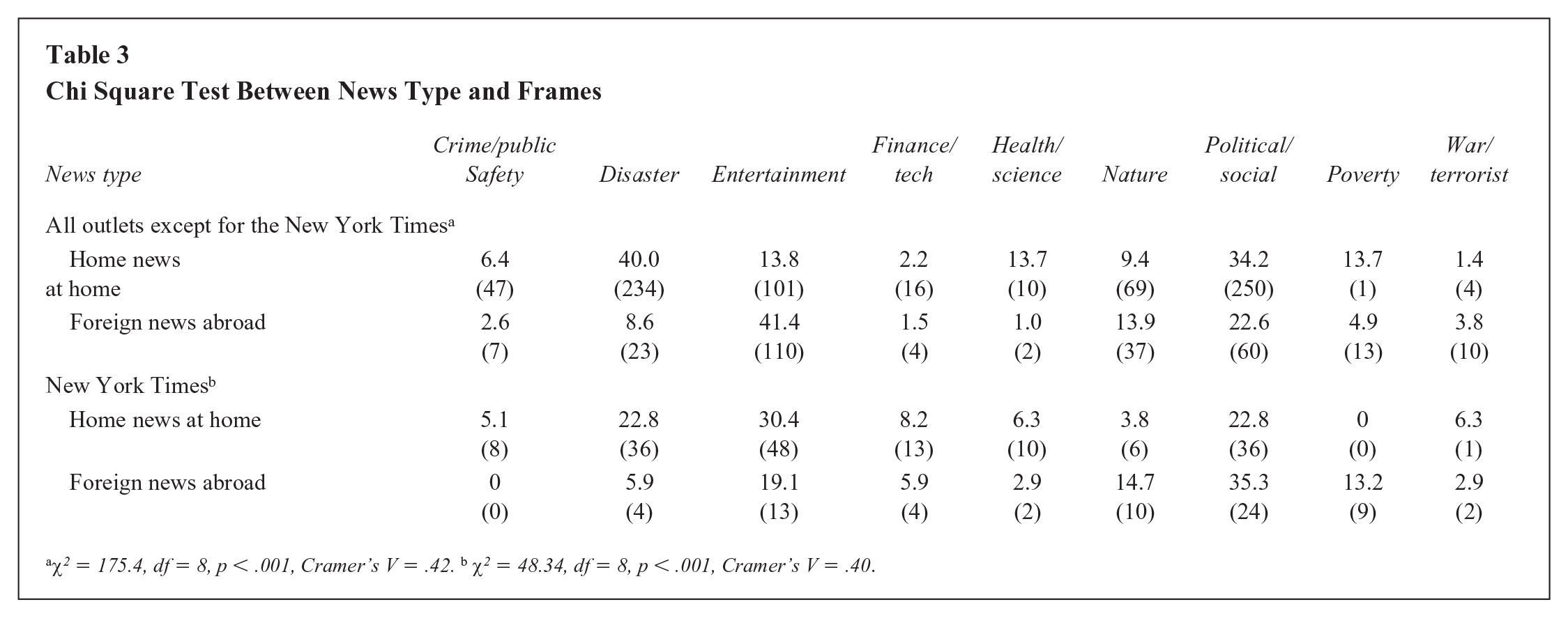
χ2 = 175.4, df = 8, p < .001, Cramer’s V = .42. b χ2 = 48.34, df = 8, p < .001, Cramer’s V = .40.
The results of both chi-square tests between news type and the frames variable were statistically significant with strong effect sizes. The test that included the other seven outlets (χ2 = 175.4, df = 8, p < .001, Fisher’s exact p < .001, Cramer’s V = .41) showed that when the outlets shared items of foreign news abroad (n = 266) on their Instagram posts, they were largely (41.4%) identified as entertainment news. Domestic news (n = 732), however, was shared in the entertainment frame only 13.8% of the time. Conversely, political news was featured in 34.1% of the images of home news at home and only 17.3% of the foreign news abroad—which included the news of American politicians abroad. The war and terrorism frame was mostly used for foreign news abroad (n = 10) and was only used for home news at home four times. Also contrary to previously stated findings, images that concerned natural disasters or catastrophes were used in 32% of the domestic news items and only 8.6% of international news.
The NYT, however, showed a different pattern of frame selection (χ2 = 48.34, df = 8, p < .001, Fisher’s exact p < .001, Cramer’s V = .40) compared with the other news outlets. The NYT did not share a majority of entertainment-related news. In fact, it showed more home news at home entertainment news photographs (30.4%) than foreign news abroad images (19.1%). Unlike the other outlets, it also shared more international (35.3%) than home news at home (22.8%) political news items. Where the NYT shared similar patterns to other outlets, however, was in prioritizing international war and terrorism framed images and home news disaster coverage.
The final research question explored whether Instagram posts of home news at home items would garner more engagement than posts that featured images with international news. To answer this question, the researchers built linear regression models between the type of news and the number of likes or comments. Because the large numbers of likes or comments on some of the posts created distributions with a strong positive skew, the researchers first formulated the numbers of likes in a log-plus-one format. A full and reduced analysis of variance between two regression models was conducted to measure for significant differences caused by a variable’s inclusion or exclusion. The comparison between the two regression models indicated that the likes regression model should include the following potential factors for which we should control: the outlet and the frames featured in the image. The full and reduced model showed no significant difference when factoring in whether the image contained a human subject, and therefore that factor was removed from the model. The primary dependent variable was the logged number of likes, whereas news type served as the primary independent variable. The likes model (Table 4) showed a statistically significant decrease (p < .05) in the number of likes between home news at home and home news abroad images. However, there was not a significant difference between home news at home and foreign news abroad. For each outlet, images of Americans abroad garnered fewer likes.
Linear Regression Model Between Likes by News Frame
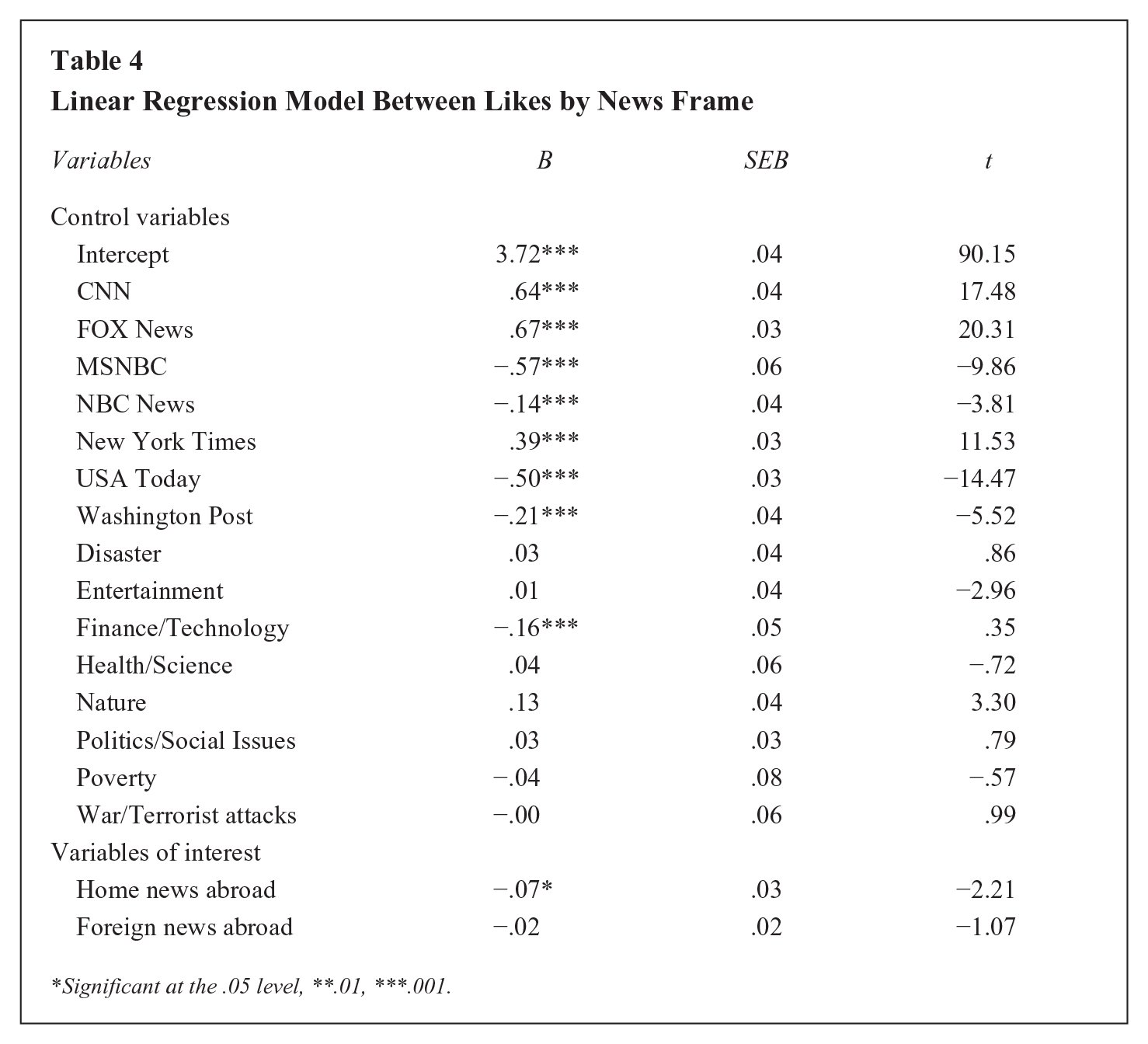
Significant at the .05 level, **.01, ***.001.
For the comments model, a full and reduced analysis of variance showed that whether a photo subject was human or not did show a significant difference, meaning it should be included in the model with other control variables, including outlet and news frames. The regression model for the logged comments can be found in Table 5. As with the likes model, the number of logged comments served as the primary dependent variable with the news type serving as the primary independent variable.
Linear Regression Model of Comments by News Frame

Significant at the .05 level, **.01, ***.001.
Unlike with the number of likes, news outlets did show a statistically significant decrease in engagement between home news at home and foreign news abroad. There was no significant difference, however, between Americans abroad and domestic news items. This finding is interesting because comments are a higher level of engagement than likes as they require more participation. International news garnered on average fewer logged comments for each outlet except ABC News and MSNBC, which did not share any international news items.
Discussion
American news organizations devote nearly two-thirds of their SMP news coverage to domestic issues, which corroborates the disheartening trend in U.S. media long observed by scholars (Ahern, 1984; Barthel & Mitchell, 2017; Baum & Zhukov, 2019; Chang et al., 1987; Enda, 2010; Halton, 2001; Hong & Oh, 2017; Wu, 2007): American audiences continue to receive little international news coverage on either traditional platforms or on SMPs. As previously noted, social media is generally free from the textual and spatial restraints of traditional media; additionally, SMPs global reach offers a natural avenue for more international stories, including those produced by freelancers or citizen journalists—yet U.S. media organizations undervalue this opportunity.
Cable news social media accounts are generally devoid of international news coverage—especially in the case Fox News. While scholars have argued that cable news’ roots are in domestic news, their reach as a news gatekeeper has outgrown their linear TV channel. FoxNews.com and CNN.com are among the most visited digital news sites and their social platforms boast tremendous followings (Polskin, 2019). If Fox News promotes American nationalism and exceptionalism as some scholars suggest (Thiessen, 2018), its overwhelming domestic coverage could be a manifestation of this philosophy.
American greatness and exceptionalism is at the core of Donald Trump’s messaging. The 45th and 47th President of the United States projects an air of strength and greatness to which Americans must aspire (Edwards, 2018). Trump’s populist discourse consistently portrays globalism (“Trump calls on,” 2019), Muslims (Khan et al., 2021) or Latin American immigrants (Finley & Esposito, 2020) as threats to American interests. It is perhaps of little surprise that the major network that most consistently acts as a megaphone to conservative ideas (Bard, 2017) would have the strongest inclination to heavily feature coverage of “home news at home.” Ott and Dickinson (2019) observe that Trump’s rhetoric has contributed to an increase in White rage. American conservatives distrust the media at large (Nadler & Taussig, 2022), and tend to see social media as a more trustworthy platform (Eddy, 2024). In this critical era, when much of America could benefit from more diversity of thought, social media audiences may be receiving even less substantive “foreign news abroad” than ever.
The more troubling trend may be that the little international news American audiences do get through their Instagram accounts may lack substance. Hill’s (2023) observation about the lack of context of international news stories may prove appropriate. We acknowledge Instagram was not created intrinsically as a news platform and that users say their primary purpose of interacting on the site is more socially oriented (Shearer et al., 2024); however, studies imply that the platform’s role as a medium for news and information has grown (Shearer et al., 2024). It may be unsurprising that news organizations share more entertainment-framed information on the platform, but if Instagram is a major avenue for young audiences to stay informed, the lack of international news and the heightened emphasis on entertainment news suggests it’s mostly a vapid source of global news.
The dearth of international news may not entirely be the fault of news organizations. Scholars who have surveyed news organizations and U.S. audiences have overwhelmingly observed that American news audiences routinely report a disinterest or apathy toward international news coverage (Barthel & Mitchell, 2017; “internet overtakes newspapers,” 2008). Newsroom leaders have expressed their hesitancy to commit more resources to undesired topics (“internet overtakes newspapers,” 2008). Newsroom managers at national news organizations—which track social media engagement numbers—may be aware of the data. Therefore, if social media engagement is a primary directive of news organizations’ social media teams, it is reasonable that editorial teams will shift content to meet the interest of audiences.
Journalists safeguard their role as the fourth estate in a democratic society, but the reality is that news organizations have business obligations. With business models still uncertain for news organizations three decades after the popularization of the internet (Darcy & Passantino, 2024), news companies must find a way to generate revenue. Although research has shown that traditional journalists say they don’t allow online trends to affect news coverage (Lowrey & Wan Woo, 2010), content analyses show that stories that receive the most audience attention will be covered more intensely (Welbers et al., 2015). Media outlets face the reality of supply and demand and the need to attract younger demographics, and as a result, organizations feed their mobile platforms more “breaking, entertainment-oriented and sensational news” (Santana & Dozier, 2019). Consumers may have been conditioned to receive dumbed-down, simplified international narratives since before news organizations moved online (Wilke & Rosenberger, 1994), but news organizations’ mobile platforms—including Instagram—on which younger audiences more regularly consume news (“Social Media and News,” 2024) are not emphasizing a global discussion.
The lack of international news stories is detrimental to American audiences who rely on news organizations to stay informed about the world. As scholars have observed, Americans rely on these stories to shape the political landscape, foreign policy, international business and controversial issues such as immigration (Burstein, 2003; Castelltort & Mäder, 2010; Gil de Zúñiga et al., 2012; Hughes, 2007). As SMPs offer access to younger audiences, news organizations’ overall lack of international news coverage misses an opportunity to inform these audiences that they struggle to otherwise reach.
The results of this study offer insights into the current focus and perceptions of the American audience. Findings suggest American social media audiences’ interest in engaging on posts about current global issues is low, but also that as a result, many major news networks adapt their coverage to the interests of viewers. Such adaptation comes at the expense of audience education toward international discourse. Studies of European audiences have shown that “global news consumption is associated with a stronger global identity, which in turn leads to lower ethnocentrism over time,” (Kersten & Greitmeyer, 2022). Despite global reach, not all social media inherently decreases ethnocentrism (Gelovani et al., 2024) and the result can be an echo chamber of confirmation bias (Cinelli et al., 2021).
While American news organizations’ overwhelmingly feature mostly domestic news on their SMPs, some organizations are more committed to international stories than others. The NYT more frequently featured images of international news than their peers. This could be correlated to an organization’s commitment to international teams and bureaus (“Journalism That Stands Apart,” 2017). Perhaps, the standard for international news coverage on SMPs among major American news organizations is the NYT.
This study has limitations. The omission of videos left out much of the content produced by television news networks. However, in this exploratory study, we wanted to compare legacy and cable news outlets, and that required that we analyze comparable content for validity purposes. We suggest that future research could explore the video content for similar patterns. Finally, because the sample was taken from a stratified sample of 1 year’s posts, with each network’s posts collected on the same day, it is possible that a particular day’s news items could have dominated the news coverage cycle for that day, making long-term conclusions from this data problematic.
However, the stratified sample was randomly selected, allowing each week to have an equal chance of selection. Coupled with the fact that each network showed similar patterns of ignoring international news of consequence in this limited sample frame, these patterns illustrate that American news organizations’ social media feeds often consist of an echo chamber that ignores substantive international news. In addition to including the videos news networks share on their Instagram feeds, future researchers should consider a longitudinal study that offers a larger sampling frame to offset the potential bias of certain news items dominating a specific news cycle.
Future researchers could consider other topics of study to explore the cause of Americans seeming apathy toward international news, or if something other than international trade has the potential to boost interest levels in global news.