







Abstract
This study examines how professionalism is constructed and negotiated within Nigerian journalism discourse. Drawing on 422 news articles mentioning the Nigeria Union of Journalists (NUJ) published between 1995 and 2025, this study employs a qualitative content analysis to identify the key actors who invoke the term, the contexts of its use and how professionalism is defined through media narratives. Grounded in field theory, the findings reveal that journalists and politicians most frequently employ the term during professional gatherings, discussions of issues affecting journalists collectively or tributes to deceased journalists. In most instances, the term remains undefined; when defined, it is often equated with enduring journalistic norms and values such as ethics and objectivity. The findings yield new insights while reaffirming enduring journalism principles, despite Nigeria’s evolving media landscape. The study contributes to the broader discourse on the professionalization of journalism by offering fresh evidence and perspectives from a less-studied African context.
Keywords
Introduction
The term “professionalism” has been used to describe different aspects of a journalist’s life and practice. It has been invoked to demand ethical conduct from journalists, and it is sometimes regarded as the most significant identity of practitioners (Deuze, 2005; Schudson & Anderson, 2009). It has been used to describe commitment to the norms of journalism such as objectivity, verification, neutrality, fairness and editorial independence (Aldridge & Evetts, 2003; Hallin, 1992; Hermida, 2015). Sometimes, it is used to refer to qualifications or formal training, positioning journalism as a career that requires academic preparation (De Burgh, 2003; Reese & Cohen, 2000). At other times, professionalism is used in union statements and advocacy as an identity call (Örnebring, 2009; Wiik, 2009, 2019). The term has also been used to draw boundaries between individuals traditionally recognized as journalists and those who engage in non-conventional forms of journalism, such as bloggers, citizen journalists and news influencers (Örnebring, 2013; Ugland & Henderson, 2007). Although several scholars have argued against the “professionalization of journalism” (e.g., Craft, 2017; Donsbach, 2014; Meyers et al., 2012), the term and its adjacent versions continue to gain usage in journalism literature. Professionalism is often used in addressing journalists as a group. Hence, this study investigates how the term “professionalism” is used in relation to Nigerian journalists, with a particular focus on the discourse about the Nigerian Union of Journalists (NUJ). The study analyzes news articles to identify the key actors invoking the term, the contexts in which it appears and how it is defined within public discourse.
Although “professionalism” is frequently used in discussions about journalism globally, its meaning, usage and implications often remain contested. In Nigeria, the setting of this study, the term is frequently used in public discourse that focuses on the Nigeria Union of Journalists (NUJ). Established in 1955 for “promoting the welfare of journalists and upholding ethical standards in journalism,” the NUJ, as the primary professional body for journalists in Nigeria, has played a prominent role in discussions around journalistic standards and identity (Nigeria Union of Journalists, 2025). Over time, “professionalism” has appeared in various discussions involving the NUJ, among its members and actors outside the journalism profession. Despite its widespread use, there is limited empirical research on how the term is deployed in Nigerian media narratives—who uses it, in what contexts and how it is defined. It is unclear whether the use promotes a coherent vision of journalism or serves broader institutional or even external interests. More broadly, the term itself is often ambiguously defined in current journalism studies literature. This raises questions about the implications of its definition on the practice and practitioners. This study fills these gaps by analyzing how the concept of “professionalism” is defined in 422 news articles that mention the NUJ from 1995 to 2025. Through qualitative content analysis, the study identifies key actors who invoke the term, the contexts in which it was used and how it was defined or framed. Given the contested nature of professionalism and the central role of journalists in shaping norms, a qualitative content analysis enables a nuanced exploration of both the definitions and applications of professionalism in Nigerian journalism.
This study addresses a gap by aiming to understand how journalistic identity and professional standards are discursively constructed and debated in Nigerian news coverage, a context that has been less studied. In an era of blurred boundaries between traditional and non-traditional media actors, understanding how professionalism is deployed rhetorically provides insight into journalism’s evolving norms, power dynamics and institutional roles. In addition, identifying who invokes the term “professionalism” and how they define it provides insight into how responsibility is being assigned and negotiated within journalism. Moreover, while prior studies have largely focused on journalists’ own definitions of professionalism, less attention has been paid to how other actors—such as politicians and media-adjacent organizations—invoke the term to influence journalistic practice. This study addresses these gaps. The findings contribute to broader conversations about professionalism in journalism, particularly in the Global South, and offer a nuanced perspective on how professionalism is used to include, exclude, legitimize or challenge various forms of journalistic practice.
Literature Review
This literature review examines scholarship on professionalism in journalism, focusing on professional ideology, values and boundary-making practices. It situates these debates within field theory and the Nigerian context.
Journalists’ Professional Ideology and Values
Scholars have explored the concept of professionalism in journalism by analyzing how journalists have constructed an ideological sense of responsibility toward their work and the values that operationalize this ideology. In many explorations, professionalism is invoked as a signifier of collective thinking or group identity among journalists. For instance, Deuze (2005) noted that journalists share a global “occupational ideology” that determines their professional status. This ideology defines a “real journalist” and is reflected in the journalist’s commitment to public service, objectivity, autonomy, immediacy and ethics (Deuze, 2005, p. 444). For Aldridge and Evetts (2003), professionalism in journalism is less about structures and more about practitioners mobilizing professional values and self-identity. The authors reject “organized professionalization,” noting that being professional is a “cultural capital” that manifests in objective reporting and separation of news and comments—values, they believe, must guide the output of journalists (Aldridge & Evetts, 2003, p. 555). Making a clear distinction between the collective and organizational, Örnebring (2009) distinguishes two forms of journalism professionalism: organizational and occupational. Organizational professionalism centers on managerial control, training and formal structures within the organization, while occupational professionalism is grounded in a collective professional identity, where journalists collectively exercise authority (Örnebring, 2009). These studies view professionalism as an ideology defined by normative commitments in a journalist’s practice. Other scholars attribute a more profound meaning to the term by situating it within everyday journalism practice.
One of the studies that attempted to operationalize journalists’ professional reality defined professionalism in terms of university education, commitment to journalistic values, a critical attitude, the prestige attached to the occupation and a willingness to improve a newspaper’s operations (Singletary, 1982). However, some key professionalization elements, such as licensing, entry and exit rules, are still missing, leading the author to conclude that “based on a review of the criteria of professionalism, it is apparent that journalism is not now a profession” (Singletary, 1982, p. 85). Hallin (1992) also described professionalism as a shared occupational ideology, framing it in relation to economic influences that impact everyday practice. He observed that American journalists in the 1930s “are more committed to the profession’s norms than to political ideals” (1992, p. 15). At that time, the few existing media outlets were able to withstand economic pressure, allowing journalists to view themselves as “public servants” rather than employees of a profit-making enterprise (Hallin, 1992, p. 15). More recent studies have expanded the understanding of professionalism in a journalist’s everyday practice. For instance, Kovach and Rosenstiel identified the core professional values a journalist must fulfill to include public service, objectivity, autonomy, immediacy and ethics. They contend that journalism is not merely a job but a social mission. They noted, “In the end, most newsroom people feel that communicating to fellow citizens is a mission that transcends the institution where they work. It is something of a calling, and everyone who works in a newsroom is steward of that mission” (Kovach & Rosenstiel, 2007, p. 242). Other signifiers have also been used to describe journalists’ adherence to professionalism. These include verification (Godler & Reich, 2017; Hermida, 2012, 2015), adherence to ethics (Borden & Tew, 2007; Schudson & Anderson, 2009; Tumber & Prentoulis, 2005), objectivity, neutrality, accuracy and fairness (Craft, 2017; Janowitz, 1975; Porlezza, 2019).
Research suggests that journalists’ sense of professionalism is shaped by an ideological framework expressed through shared values. This ideology may emerge from organizational structures, from journalists themselves as a collective or from a combination of both. In all cases, shared definitions and group dynamics are central to understanding professionalism in journalism. This study aligns with that focus by examining how professionalism is conceived within Nigerian journalism, particularly in relation to the NUJ. While much of the existing literature emphasizes how journalists define professionalism in the discharge of their work, this research expands the scope by considering how other actors also contribute to defining professionalism and the specific contexts in which these definitions are applied.
Professionalism as a Boundary Marker
The term “professionalism” is often used as a boundary marker to delineate who is granted legitimacy, authority and inclusion within the journalism field. In this context, it is employed as a collective mechanism to assert authority and marginalize those who are deemed outsiders. Although the specific attributes defining an “ideal” profession may vary, sociologists have identified some common attributes. The evaluation of an occupation commonly centers on criteria such as the presence of professional associations, formal licensing, standardized education, ethical codes, accreditation systems, autonomy and certification (Abbott, 1988; Banning, 1999; Bucher & Stelling, 1969; Greenwood, 1957; Wilensky, 1964). Although some scholars contend that journalism satisfies key criteria of professionalization and merits recognition as a profession (for instance, Davis, 2010; Glasser, 1984; Schudson, 1978; Singletary, 1982), it is more commonly classified as a semi-profession or non-profession within scholarly and institutional discourse. Its classification as a non-profession is primarily attributed to: (a) the freedom of speech guaranteed to everyone by the Universal Declaration of Human Rights (UDHR), which makes it impossible for journalists to exclude non-journalists from information dissemination to public, (b) the absence of or lack of power to enforce formal entry requirements, (c) and the lack of a centralized regulatory authority with such powers as obtains in law or medicine (Deuze, 2005; Meyers et al., 2012; United Nations, 1948; Zelizer, 1993). Regardless, journalists often claim the status of being “professional” to distinguish themselves from the “others” (Singer, 2015). Eldridge II (2019) described the others as “interlopers”—bloggers, citizen journalists, comedians, satirists—positioning them as actors on the periphery of journalism. They “have been widely rebuffed as not sufficiently journalistic” because they do not engage in the “same routines and practices” as traditional journalists (Eldridge II, 2019, p. 11).
According to Carlson, traditional journalists maintain their territory through protection of autonomy and expulsion. The former happens through “defense from non-professional outsiders” and the latter by “expelling deviant actors” (Carlson, 2015, p. 10). Similarly, Ugland and Henderson (2007) observe that journalists maintain professional boundaries through the strategic use of nomenclature. In their classification of information providers, social media influencers are labeled as “public communicators,” bloggers as “second-level journalists”’ and only those individuals who demonstrate a commitment to journalistic ideals—such as truth-telling, ethical standards, neutrality and formal training—are recognized as “top-level journalists” (Ugland & Henderson, 2007). Citizen journalists are among the most frequently criticized interlopers, with traditional journalists asserting their professional legitimacy and distinction from these “amateurs” through “expertise, duty and autonomy” (Örnebring, 2013, p. 35). To assert their authority, traditional journalists use professionalism claims to distinguish themselves. They often invoke filtering/gatekeeping and editorial judgment (domain of expertise), adherence to ethical codes and professional principles, mostly verification (domain of duty) and strong emphasis on the collective—a broader institutional and organizational context that guarantees their (relative) autonomy. “The straw-man citizen journalist is outside this collective, outside the system of shared knowledge and controls” (Örnebring, 2013, p. 48). Sometimes the boundary demarcation happens within the traditional journalism system. For example, Wiik’s study of Swedish journalists identifies age and employment status as key markers of professional boundaries within conventional newsrooms. The study reveals that professional autonomy is a privilege that increasingly seems to be reserved for a few, high-profile journalists with very specialized skills. Despite journalism facing challenges from technological change, commercialization and the destabilization of institutions, the study notes that the ideals that form its professional identity remain resilient (Wiik, 2015).
In recent times, scholars have argued against the “Us Vs them” narrative, insisting that the lines of professionalism are now blurred (Belair-Gagnon & Holton, 2018; Cheng & Tandoc, 2022; Holton & Belair-Gagnon, 2018; Hujanen et al., 2022; Kim & Shin, 2021; Singer, 2003, 2007). Rather than a sharply defined boundary, Schudson and Anderson (2009) encourage us to envision journalism as existing within a “thick, poorly defined border zone made up of proliferating hybrids, shifting social and occupational roles, and networks of expertise.” This perspective highlights the fluidity of journalistic identity and the evolving criteria for inclusion within the field. For instance, Tenenboim-Weinblatt’s (2009) study of the journalistic community’s response to comedian Jon Stewart illustrates this dynamic; while he was initially dismissed as an outsider, his commitment to truth-telling and critique of power gradually earned him recognition as a journalist. The current study, among other things, examines how professionalism has been used to perpetuate or blur journalistic boundaries.
Field Theory and the Nigerian Context
This study is grounded in field theory, which originates in Kurt Lewin’s early conceptualization of social fields as structured spaces of interaction and power (Lewin, 1951). According to Pierre Bourdieu (1993), who popularized the theory within the field of journalism studies, society comprises distinct “fields”—such as politics, religion, economics and journalism—each with its own rules, power dynamics and forms of capital. Within and across these fields, individuals, called “agents,” do not act solely based on self-interest; rather, their actions are shaped and constrained by the relational structures of the field they occupy and its position relative to other fields. To fully engage and operate in a field like journalism, individuals must possess “capital,” a currency that includes cultural capital (such as formal training), social capital (professional networks) and symbolic capital (recognition and reputation) (Benson & Neveu, 2005). Individual judgments and behaviors within the field—including how they define key terms—are not entirely theirs but a result of a long-term process of socialization. Bourdieu used the term “habitus” to describe this process, adding that an agent’s habitus is changeable and constantly modified. He used the term “doxa” to describe the taken-for-granted beliefs, values and rules, which are beyond question and which each agent tacitly accords without questioning (Bourdieu, 1977, p. 169). As a group, Bourdieu argued that the journalistic field operates in an environment of constant opposition between the “heteronomous pole” such as forces external to the field and “autonomous pole” representing the specific capital unique to that field (Benson & Neveu, 2005, p. 4). The present study follows the Bourdieusian tradition in journalism studies, which conceptualizes journalism as a semi-autonomous field structured by struggles over legitimacy, symbolic capital and professional boundaries. Within this framework, references to “professionalism” are treated as a form of discursive boundary work through which actors seek to define, defend or contest journalistic norms, values and authority.
Field theory offers a valuable framework for analyzing how various actors within the Nigerian journalism field and beyond construct and invoke the concept of “professionalism” and the functions it serves in their interactions. The theory foregrounds the role of the “autonomous pole,” which encompasses the distinct forms of capital unique to journalism, in shaping these definitions and claims to professionalism. Moreover, field theory elucidates how external actors, operating from the “heteronomous pole,” influence journalists and contribute to contests surrounding professionalism. Since journalistic ideology often serves as a form of collective consciousness, the concept of habitus is instrumental in understanding how individual dispositions and experiences shape variations in the definition and application of professionalism over time. Existing literature further suggests that professionalism functions as doxa—that is, a set of taken-for-granted norms and values within the field. This study will examine the extent to which this is true within the Nigerian journalistic context. Thus, field theory enables a critical examination of professionalism not as a fixed ideal but as a contested and socially constructed concept shaped by the dynamics and struggles within the Nigerian journalism field and its relation to other fields. Furthermore, field theory’s inherent dynamism makes it particularly well suited for examining journalism—an occupation in constant flux, shaped first by the disruptive impact of the commercial internet since 1994 and now by the transformative forces of artificial intelligence.
Field theory has been widely applied in journalism studies to examine professional autonomy, boundary work and struggles over legitimacy within the journalistic field, particularly in Western contexts. Scholars drawing on Bourdieu have analyzed how journalistic norms, identities and authorities are constructed through interactions among journalists, political actors and media institutions. For instance, Wiik (2019) argues in their conceptualization of professionalism that journalism is not undergoing a straightforward process of deprofessionalization but rather a reformation. While traditional journalistic ideals, such as autonomy and scrutiny, continue to gain support, the professional boundaries within the field are increasingly contested and subject to negotiation (Wiik, 2019). Similarly, Bourdieu’s field theory has been employed to analyze the influence of the core capitals (autonomy, external influences, ownership) on the journalistic field (Hanitzsch, 2011). The study identified four main journalistic archetypes: Detached Watchdog (journalists in democracies who act as objective observers focused on holding power accountable); Opportunist Facilitator (journalists who see themselves as partners in development, often in contexts with limited press freedom); Populist Disseminator (journalists who provide engaging and sometimes populist-oriented news); and Critical Change Agent (journalists who actively seek to drive social reform and encourage political participation). The theory has also been used to study how provocative media actors (bloggers, citizen journalists, etc.) challenge the journalistic field (Eldridge II, 2019), how journalism identity is constructed in the face of destabilization (Wiik, 2009) and how individual journalists assess symbolic capital within the newsroom (Perreault & Tham, 2024).
The present study examines how professionalism is defined and applied, using Nigerian journalism as a case study. Historically documented evidence shows that journalism in Nigeria began in 1859 with the publication of Iwe Irohin fun awon ara Egba ati Yoruba (the newspaper for the Egba and Yoruba people) by Reverend Henry Townsend, a Christian missionary (Duyile, 2019). About a decade later, in 1955, the NUJ was founded, first as an informal gathering of journalists and later as a strong advocate for journalists in Nigeria (Ogunlusi, 2013). Scholarly inquiry into the activities of the NUJ has highlighted the concept of professionalism. For instance, in a study, five of 15 respondents who answered the question “who is a professional journalist,” NUJ membership was mentioned as the primary indicator of professionalism (Olajide et al., 2012, p. 32). Another study notes that although the NUJ approved a code of ethics, its implementation is weak, leaving journalists susceptible to internal and external pressures that may cause them to deviate from being professional. The study notes that Nigerian journalists face and eventually succumb to “pressure to avoid reporting on corruption cases, especially those involving powerful individuals or institutions” (Olubunmi & Rita, 2023). While advocating ethics as the primary definer of ethics in Nigerian journalism, the study recommends a periodic review of the Code of Ethics by NUJ and that media outlets should “liaise with the NUJ to ensure that only trained journalists are employed to work as journalists” (Pepple & Acholonu, 2018, p. 56). Existing studies show that the NUJ has been central to ongoing discussions about the professionalism of journalism in Nigeria, with much of the discourse placing responsibility for upholding professional standards at the NUJ’s doorstep. However, while prior research acknowledges the NUJ’s role, there has been limited empirical engagement with how professionalism is defined, who is involved in defining it, and the specific contexts in which these definitions emerge. This study builds on previous work by delving into the core dimensions of the concept by interrogating the construction and deployment of professionalism in Nigerian journalism. To thoroughly examine these issues, the study is guided by the following research questions:
Who are the key actors invoking the term “professionalism” in relation to Nigerian journalists?
In what contexts or situations is the term “professionalism” used in reference to Nigerian journalism or journalists?
How is the term “professionalism” defined by various actors within the Nigerian journalistic discourse?
Method
To answer these questions, this study employed a qualitative content analysis of media texts retrieved from the Nexis Uni, an information database, using the keywords “Nigeria Union of Journalists” and “professionalism.” The analysis focused on identifying and interpreting the contexts, meanings and discursive uses of the term “professionalism” within Nigerian journalism discourse.
Data Gathering and Cleaning
News articles containing the keywords “Nigeria Union of Journalists” and “professionalism” were extracted from Nexis Uni, an online database, on September 17, 2025. This database has been identified as a rich data source and frequently used by academics for empirical research (Buntain et al., 2023; Gilbert et al., 2024). The database was selected for this study due to its extensive catalog of news articles related to Nigerian journalism. While Nexis Uni covers major national and regional news outlets, it does not index all independent print, digital or broadcast-affiliated outlets. Nonetheless, the sample offers a comprehensive overview of how professionalism has been portrayed in Nigerian news coverage over this period. The keyword search returned 715 articles from print and digital news outlets, published between 1995 and 2025, a 30-year period. The timeframe was selected to capture significant developments in Nigerian journalism, including the country’s transition from military rule to democracy, the emergence of digital media and the overall evolution of journalistic norms over a substantial period. An initial manual review of the downloaded articles in Word format was conducted to remove duplicate entries and clearly irrelevant texts, reducing the dataset to 476 articles. A second round of close readings was then performed to further refine the dataset. Manual review was preferred to allow the researcher to become thoroughly familiar with the data, supporting the identification of qualitative themes. Articles were included if they (a) mentioned both professionalism and the NUJ and (b) clearly discussed professionalism in relation to Nigerian journalism. Articles were excluded if they (a) did not discuss professionalism in reference to journalists or journalism, (b) were opinion pieces rather than reported news or (c) were published by foreign media outlets. Based on these criteria, an additional 54 articles were removed, resulting in a final corpus of 422 articles. The articles were published by Nigerian traditional print and digital news outlets such as Punch, Daily Trust, Daily Independent and Premium Times.
Data Analysis
This study employed a conventional qualitative content analysis to examine how “professionalism” was constructed and interpreted within Nigerian journalism discourse (Hsieh & Shannon, 2005). While categories and themes were allowed to emerge inductively from close engagement with the data rather than being imposed a priori, the analysis was informed by field theory. Specifically, the identification of “actors” reflects attention to positions within and around the journalistic field; the analysis of “contexts” captures sites of boundary negotiation and struggle; and the examination of definitional patterns engages questions of symbolic capital and legitimacy. To guide the analysis, a codebook was developed based on insights from the literature review and initial immersion in the data. The codebook served as a structured framework to classify indicators based on the theory, the study’s objectives and the research questions.
For RQ1, which explores who invokes the term professionalism, the codebook included actor-based categories such as journalists, politicians and political appointees, and government agencies. Each article was reviewed to determine the main source or quoted source that used the term. For example, when a journalist discussed professionalism, the article was coded under “journalists”; when the president or a government official made the reference, it was coded under “politicians.” For RQ2, which examined the contexts and situations in which professionalism was invoked, articles were coded based on the setting or event surrounding the reference. These included contexts such as journalist gatherings, NUJ visits and when a journalist dies. For instance, when NUJ releases a press statement to eulogize a deceased journalist, it is classified under the third category. Only one actor per article is included, as determined based on their prominence in the story. RQ3 focused on how professionalism was defined or described across the dataset. Articles were coded based on the specific language or meaning attached to the term. Definitions were grouped into categories depending on how professionalism was defined by the main actor in the article. In cases where multiple definitions appear within a single article, the meaning attributed to the primary actor is adopted for analysis. While the primary emphasis of the study was on qualitative interpretation, descriptive frequency counts were used to summarize patterns in the data and to support analytic transparency. All articles were manually coded using the codebook developed for this study. The codebook was treated as flexible and iteratively refined during the initial analysis. As patterns emerged from the data, codes were expanded, merged or removed to better reflect the dataset, in line with established qualitative research practices (Braun & Clarke, 2006; Oliveira, 2023). To assess intercoder reliability, approximately 10% of the dataset (n = 43) was double-coded independently. Intercoder reliability was calculated manually in Microsoft Excel using the Cohen’s kappa formula. The results indicated substantial agreement (Cohen’s kappa = .77). The estimate was derived from a coder-by-category agreement table, which cross-tabulated rater judgments for each thematic category to determine observed and expected agreement levels. The coefficient exceeded the generally accepted reliability threshold of 0.70, and discrepancies were discussed until consensus was reached.
Findings
This section presents the findings from both the content analyses. The results are presented to directly address the research questions.
Who Are the Actors Invoking Professionalism?
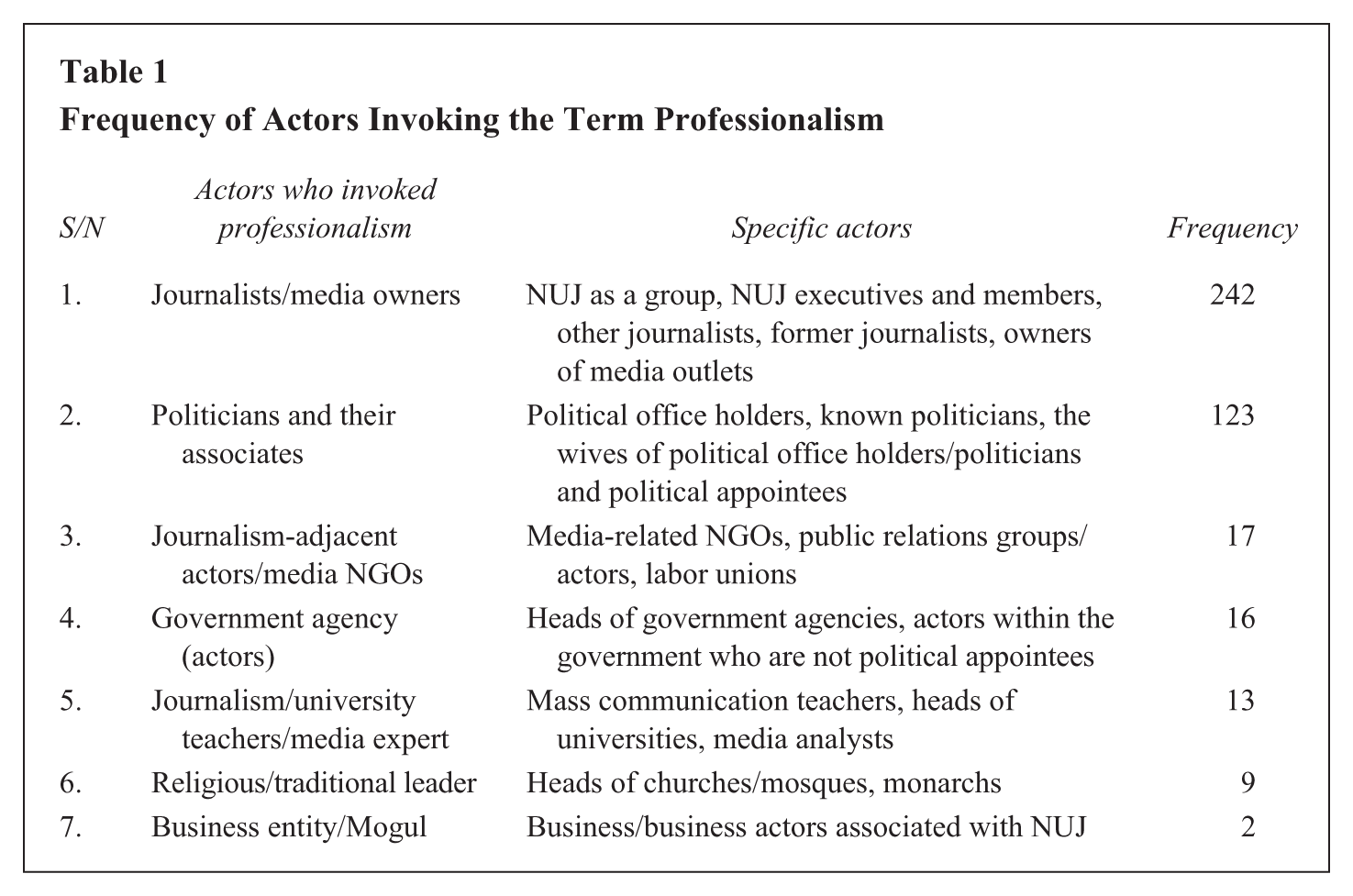
The analysis reveals that the term professionalism is most frequently employed by journalists, whether in reference to their collective identity, ethical values, individual practices or in response to external developments. Out of the 422 articles examined, the term was invoked 242 times by journalists or journalism-related actors—a frequency significantly higher than any other group represented in the dataset. These journalists’ actors include the NUJ as an organization, its executives and members, individual journalists, former journalists and media owners. Politicians and associates followed journalists and media owners, invoking the term 123 times. This represents the second-highest frequency among all actor groups in the dataset.
As illustrated in Table 1, usage significantly drops after the first two categories of actors. The term was used by groups and individuals in journalism-adjacent roles, media non-governmental organizations (NGOs), government agencies and actors, journalism/university teachers, etc. Notably, certain actor groups, such as bloggers and citizen journalists, did not feature among the actors invoking the term in the sampled articles.
Frequency of Actors Invoking the Term Professionalism
In What Contexts or Situations is the Term “Professionalism” Used?
Findings show that professionalism is most commonly used in seven contexts, each reflecting different aspects of a journalist’s life. It is used during journalists’ gatherings, in discussions about journalists’ affairs and in eulogies for deceased journalists. It also appears during visits by NUJ executives and members, as a tool for peer review, regulation and discipline, when journalists are being commended and when they are attacked. With the highest frequency of 181, the term is used mostly when NUJ holds events such as training, seminars, awards ceremonies, etc. In such events, the term is used by attendees to address the collective. For instance, at a public event, then NUJ president, Mohammed Garba said, “there is need for us to practice journalism in the high sense of professionalism” (Article 73). Close to this, with 152 occurrences, is the invocation of “professionalism” during discussions about journalists’ welfare and affairs, such as during arrest or victimization of a journalist, after an NUJ election, to clamor for improved welfare, or editorializing about journalists’ standards and conduct. While several conversations about professionalism happen during journalists’ events, the instances categorized here are mostly communicated through press releases, editorials, letters and interviews. For instance, in congratulating the newly elected executive members of the Nigerian Guild of Editors (NGE) in 2013, NUJ urged them to “uphold the spirit of professionalism and non-partisanship for which the body of editors had been known and respected for” (Article 69). The invocation of professionalism in this category sometimes comes as a reaction to an issue involving a journalist. For instance, in reaction to cases of brutalization of journalists and poor welfare in 2012, then NUJ president, Mohammed Garba, notes in an interview,
You have the union . . . If there are any kind of issue especially, welfare, wrongful termination and other problems, we address them once they are brought before us. We also have a committee on ethics and professionalism that also checkmate the activities of members. (Article 66)
As shown in Table 2, the term was also invoked 37 times when discussing deceased journalists such as Remi Oyo, Dimgba Igwe, Ude, Ejikeme, Dele Giwa, Ahmed Abubakar, Duro Onabule and Charles Gyamfi. This typically occurs during their burials or remembrance events, when they are presented as role models or when their professional contributions are highlighted. For instance, in remembering a deceased journalist, NUJ notes in its press statement, “Ejikeme is leaving behind a legacy of humility, excellence, professionalism and will forever be remembered by those he has inspired as a role model in the profession” (Article 360). The term is also commonly used (31 times) when NUJ visits politicians, business moguls or media houses. Among these three hosts, politicians are the most frequently visited, typically during “courtesy visits” that follow the election of new NUJ executives, or a “thank you” visit after the appointment of a union member to a political office, or at the invitation of a new politician who wants to be a “friend” of the press. Interestingly, journalists also invoke the term in speaking about the excesses of their peers or antagonize those not regarded as “journalists.” There were three interesting instances of this. In 1995, the Federation of International Football (FIFA) decided not to allow Nigeria to host the Junior Soccer World Cup, and the government blamed this on the “excessively negative reports” by Nigerian journalists. In reaction, then Lagos Chairman of NUJ, Dele Odebiyi, warned the government against using journalists as the “whipping child” but was quick to note the unethical behavior of some journalists, citing the case of a journalist who fabricated names of alleged coup plotters leading to the death of innocent officers. “It is not my duty as chairman to condemn my colleagues . . . in the practice of journalism, we need professionalism,” he said (Article 1). In the second instance, the NUJ “called on security agencies and the public to remain vigilant and report fraudulent actors (acting as) genuine journalists” (Article 445). In the third instance, NUJ spoke similarly against social media influencers: “Unlike traditional journalism, social media is a bottom-up, emergent phenomenon in which there is little or no editorial oversight or formal journalistic workflow. It does not require training or professionalism” (Article 308).
Frequency of Contexts in Which the Term Professionalism was Invoked
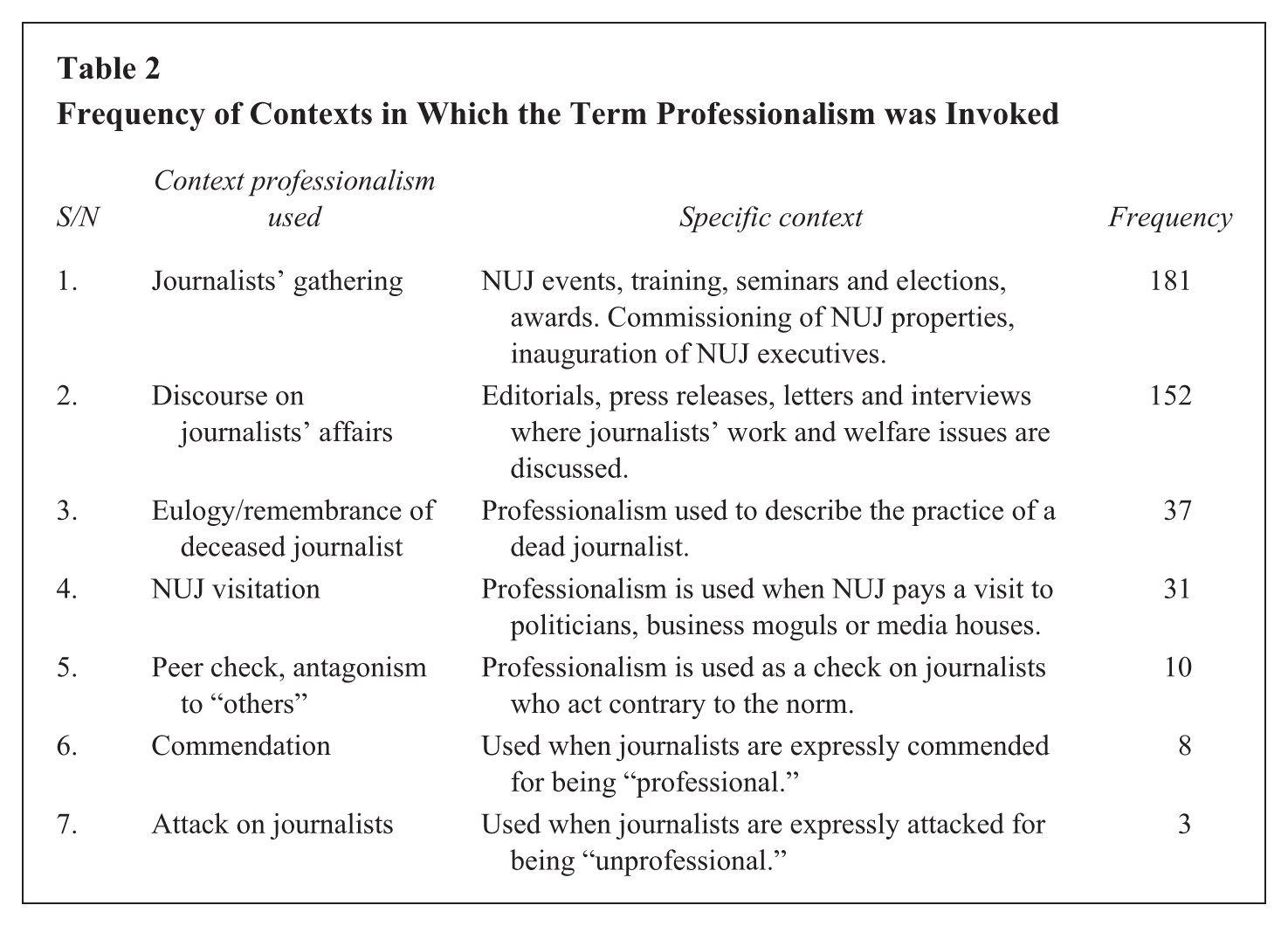
Professionalism also comes up when journalists are commended for their work (eight times) and when they are fiercely attacked for being unprofessional. An instance of the former was when the leadership of the Independent Electoral Commission (INEC) commended journalists for their role in an election. “I want to say that Journalists in Ekiti showcased professionalism before and during the 2019 elections,” the commission noted (Article 213). On the contrary, journalists have been attacked for being unprofessional. For instance, in response to a case of “unprofessionalism” involving journalists portraying the country in a negative light, a state commissioner emphasized the need for systemic reform. He stated that, “there must be a conscious effort to overhaul the educational processes that throw up ill-trained journalists and other half-baked information managers” (Article 26).
How is the Term “Professionalism” Defined?
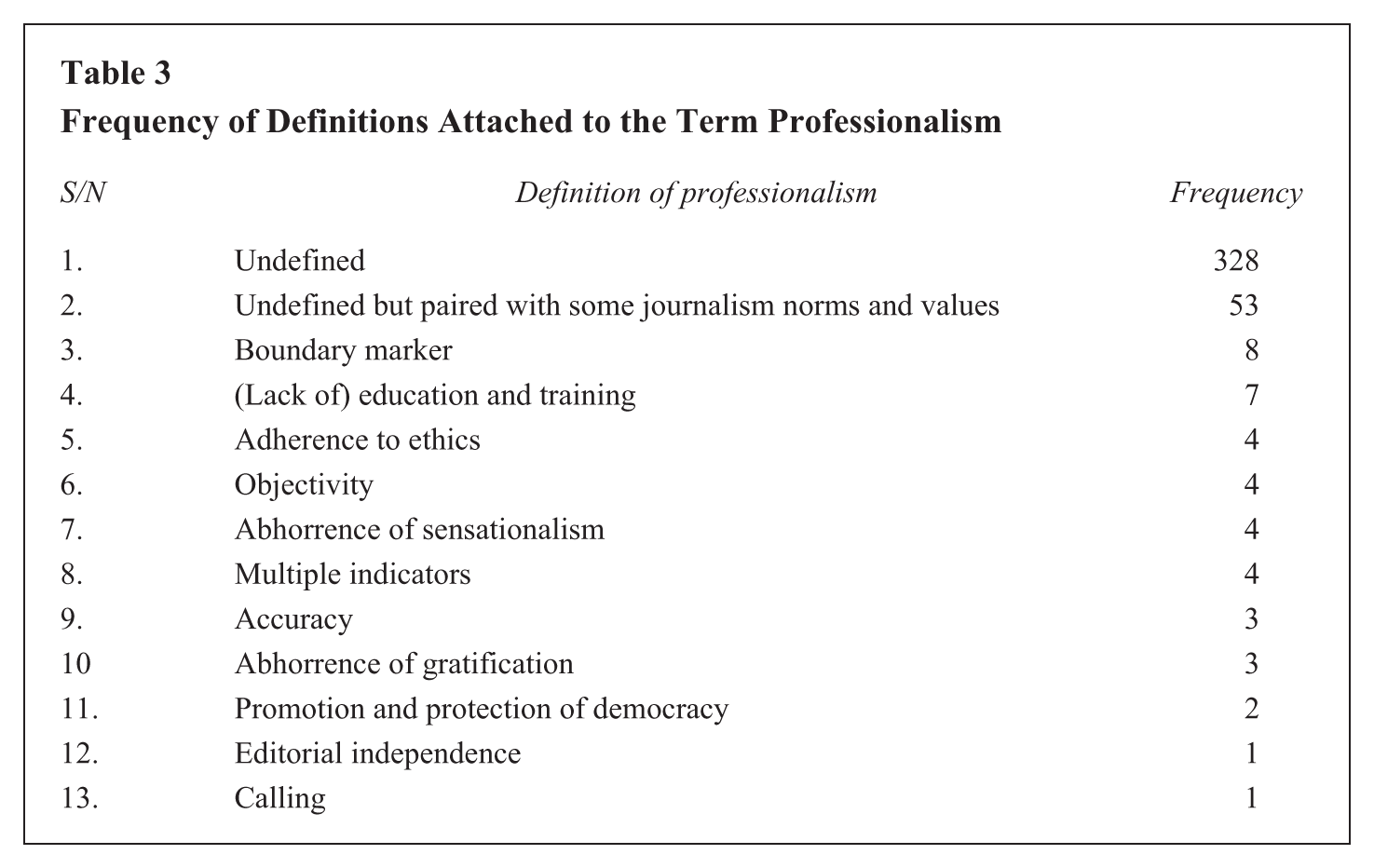
Analysis shows that the term “professionalism” is mostly undefined by its users. When defined, it is measured through the journalists’ display of particular journalism norms and values or the presence or absence of certain qualities or attributes in a journalist/journalism. As shown in Table 3, while professionalism is undefined in over 90% of the times it was invoked, it was defined in terms of a particular set of journalism norms or values in the remaining 10%. The definitions are treated in the following sections.
Frequency of Definitions Attached to the Term Professionalism
Professionalism Undefined
There are two categories of undefined: those where professionalism is absolutely undefined (328 times) and those where it is paired with a journalistic norm or value (53 times). In both cases, professionalism is used as if its meaning is universally understood. As a result, when it is mentioned, no effort is made to define it. An instance of the first category was in the Taraba State Governor Garba Umar’s address while interacting with journalists. He said, “I commend your maturity and professionalism in reporting the recent misunderstanding that we had in the state,” without further defining professionalism (Article 80). In his remarks at the inaugural All Nigerian Editors’ Conference 2004, renowned journalist Ray Ekpu underscored the assumed clarity of professionalism. He stated, “I do not intend to get into any definitional quagmire because all of us understand what we mean by remuneration, incentives, professionalism, and ethics” (Article 23). In the second category, professionalism is still not defined but mentioned in the same sentence with some journalism norms and values, separated by a comma or “and.” Such words include timeliness, thoroughness, integrity, credibility, responsibility, ethics, knowledge, standard, fairness, transparency and courage. At other times, it is associated with highly subjective concepts such as patriotism, good governance, personal appearance and welfarism.
Professionalism Defined as a Boundary Marker
The term is used nine times—eight by NUJ as a body or their executives, and once by a politician—to serve as a boundary marker for journalists and “others.” In this context, the term professionalism is employed to distinguish so-called “real” journalists—typically identified as members of the NUJ—from “others,” a category that often includes non-NUJ members, bloggers, citizen journalists, and, at times, vaguely defined groups. The NUJ frequently uses the term “quacks” to mark this distinction. Some instances are presented as follows:
“NUJ is mindful of the fact that there are many strangers in the profession and has insisted on professionalism.”—then NUJ president, Ndagene Akwu, speaking on the Freedom for Information Bill (Article 34)
“Unlike traditional journalism, social media is a bottom-up, emergent phenomenon in which there is little or no editorial oversight or formal journalistic workflow. It does not require training or professionalism. It is therefore my contention that in an attempt to discuss this topic, adequate consideration should be given to the traditional media. This becomes more pertinent because of my professional calling which today faces threats from the misuse of the social media.”—NUJ president, Chris Isiguzo, at a public event (Article 310)
“Journalism is not for quacks and individuals who think that because we are in the era of social media they can spoil the profession.”—Chairman, NUJ Sapele Chapel, Comrade Nelson, to colleagues—(Article 333)
“. . . such exercise would foster cohesion and enhance professionalism for the journalists, especially in these days when junk journalism is trending with untrained citizen journalists who tend to override the core professional journalists.”—then National Chairman of the All Progressives Grand Alliance, Sly Ezeokenwa, extolling journalists for setting aside a day to celebrate themselves (Article 337)
In one instance, the “other” is considered “fake” as in this headline, “Fake journalists in trouble in Oyo as NUJ sanitises profession” (Article 174).
Professionalism Defined by Education and Training
In some instances (seven times), education and training for journalists are used as a signifier of professionalism. For example, when Bauchi State NUJ “in its determination to ensure that all working journalists in Bauchi State attain professionalism” inaugurated an “education committee and charged it with identifying relevant training institutions and securing placement for members to upgrade their educational standards” (Article 20). In a 2011 interview, Gbenga Adefaye, then President, Nigeria Guild of Editors (NGE), stated, “the best way to achieve professionalism is through constant training of journalists” (Article 62). Politicians are also involved in this classification. For instance, the Yobe State Governor, Baba Goni Machina questioned the practice of journalism without training. He stated, “You can’t wake up in the morning and say you are a lawyer or a doctor. . .you must pass through a formal training and accreditation, journalism practice should be seen as sacred and those practicing it should be seen as credible” (Article 37). Similarly, in the remembrance of deceased journalist, Duro Onabule, who died in 2022, then Ekiti State Governor, Kayode Fayemi said, “Having trained at the popular London School of Journalism, one could not expect less than the professionalism with which Onabule plied his trade in the media industry.”—(Article 276)
Adherence to Ethics/Objectivity
In some cases, professionalism is defined as adherence to ethics or display of objectivity. For the former, what ethics mean is not mostly defined. For instance, the then NUJ President, Mohammed Garba, said that “a new code of conduct has been introduced by his leadership to enhance professionalism among media practitioners” (Article 79). Similarly, in addressing the NUJ President, then Zamfara State Governor, Abdulaziz Yari, said, “Journalism is a worthy profession that requires proper observance of the ethics” (Article 126). Professionalism is also defined as the act of being objective. For instance, the current Ogun State Governor, in addressing journalists after the 2023 general elections, said, “I want to commend your consciousness for professionalism, by being objective and patriotic in your reportage” (Article 323).
Multiple Indicators
In some cases, professionalism is used to mean a combination of norms and values of journalism. Some instances are presented as follows:
“Babalola harped on ethics of journalism and professionalism which dwell on objectivity, fairness and factual reportage of events to ward off sensationalism and prejudice that could set the State on fire or allow for a repeat of Rwanda’s genocide which left many lives wasted.”—Report on the comments of Oyo State NUJ Chairman, Ademola Babalola, on pre-2023 election violence (Article 298)
“In other words, individual journalist that wishes to guarantee his or her safety must imbibe and demonstrate the professional norms of good journalism, which have been identified as including particularly truthfulness, objectivity, neutrality and detachment. Such ethos of professionalism enjoins journalists to avoid the practices of fraternization with political aspirations of their owners. It encourages them to eschew all forms of subjective or biased reporting of political events and issues.”—Dr. Adesina Azeez of the Department of Mass Communication, University of Ilorin (UNILORIN) talking during a journalist’s training—(Article 110)
Other Definitions
Other definitions of professionalism include abhorrence of sensationalism, accuracy, abhorrence of gratification, promotion and protection of democracy, editorial independence and calling. The instances of each in the articles are analyzed as follows:
Discussion
This study examined the use of the term professionalism in Nigerian journalism, focusing on who uses it, in what contexts and how it is defined. An analysis of 422 news articles referencing professionalism in relation to the NUJ identified the top users, contexts and definitions. Qualitative content analysis reveals that journalists are the most frequent users, followed by politicians. The term is most frequently invoked at journalists’ gatherings, during discussions of issues affecting the profession, at memorials for deceased journalists and during courtesy visits. In most cases, the term is left undefined; however, when defined, it is equated with or used to express key journalistic norms and values such as adherence to ethics, objectivity, rejection of gratification and sensationalism and as a boundary marker distinguishing journalists from “others.”
Findings on the dominant users of the term align with existing literature, which often describes professionalism as an ideology primarily invoked by journalists (Aldridge & Evetts, 2003; Deuze, 2005; Schudson & Anderson, 2009). However, this study reveals an additional dynamic in which political actors frequently invoke “professionalism” when engaging with journalism. Existing scholarship has paid limited attention to political actors’ role in defining journalistic professionalism, making this an important contribution. This suggests that while professionalism is primarily a self-referential concept among journalists, it is also strategically invoked by political actors—to support or challenge media legitimacy. This also reflects the nature of journalism in Nigeria, which is characterized by the influence of and reliance on political actors, as well as the extent to which political forces, as an external field, shape journalistic practices. The substantial use by politicians indicates that the term holds rhetorical value beyond the journalistic field. For example, the three instances where professionalism was used to attack journalists were by political actors. This finding aligns with Bourdieu’s notion that journalism is a “weak” field, guided by its own internal logic but continually shaped by external forces, particularly politics (Bourdieu, 1993, 1996). Here, political actors attempt to exert influence over what constitutes professionalism. The nature and extent of this influence require further study, but they point to a persistent power struggle over who defines journalistic standards.
Although professionalism was invoked most frequently in living contexts such as journalists’ gatherings and discussions of professional affairs, its use in eulogies for deceased journalists reveals a deeper symbolic function. These memorial references elevate professionalism from a moral ideal to an aspirational standard that defines the essence of good journalism. The invocation of professionalism in the remembrance of deceased journalists is a symbolically powerful act, revealing the values that journalists seek to immortalize. From a Bourdieusian perspective, this moral framing of professionalism illustrates how journalists accumulate and reproduce symbolic power by celebrating the dead as embodiments of professional virtue, thereby legitimizing their collective identity within the field. Although symbolic capital in journalism is well documented, its expression through the remembrance of deceased journalists has received little attention. This finding demonstrates how professionalism can be celebrated retrospectively, serving to uphold and transmit ethical and moral ideals to the present day.
Definitions of professionalism that encompass journalistic norms, values and boundaries align with existing literature. This finding is particularly instructive given the substantial transformations journalism has undergone, including the rise of digital media, social media platforms, news influencers and the increasing influence of artificial intelligence in news production. Despite these profound changes, the core practices of journalism—adherence to ethics, objectivity, editorial independence, etc.—remain remarkably stable. This is consistent with previous research (Deuze, 2008; Wiik, 2009). The finding that professionalism is largely undefined suggests it functions as a taken-for-granted concept among journalists. Although its meaning is rarely stated, professionalism is unquestioned and accepted as natural within the journalistic field and other fields that interact with it. In Bourdieu’s terms, it represents a doxa—an ideology whose meaning is implicitly understood once invoked (Benson & Neveu, 2005).
Conclusion
This study examined how professionalism is invoked in Nigerian journalism, focusing on who uses the term, the contexts in which it appears and how it is defined. The findings reveal that journalists are the primary users of the term, with politicians also rhetorically mobilizing it within news coverage. Findings also reveal that professionalism functions both as a practical guide and an ideal within the field. While most uses are implicit and taken-for-granted, the explicit definitions and commemorative invocations—particularly in reference to deceased journalists—highlight the ethical and moral ideals that journalists seek to uphold.
The findings of this study contribute to field-theory understanding of journalism in several ways. First, the largely undefined nature of professionalism highlights the fluid and contested character of symbolic capital within the journalistic field. Second, the ways in which journalists invoke professionalism to enforce norms and set boundaries exemplify classic field boundary work, demonstrating how actors regulate legitimacy and inclusion. Third, the mobilization of professionalism by political actors underscores the influence of external forces on the journalistic field, revealing the permeability and negotiation of power beyond the profession itself. Fourth, the substantial use of professionalism in memorializing deceased journalists extends prior research by identifying new contexts in which the term is deployed. Finally, by showing how multiple actors participate in defining professionalism across different contexts, this study extends field theory by highlighting the complex, multi-actor processes through which professional norms and authority are constructed and contested, especially in a less-studied global south context.
This study is limited to content available online on Nexis Uni and may not capture offline discussions, unpublished practices or news articles not indexed in the chosen repository. Future studies should further examine the discursive and relational dynamics between journalists and political actors, particularly how political actors attempt to shape or contest professional boundaries. Within the Nigerian context, research could contrast these dynamics across the military and democratic eras to determine how different government types affect journalists’ ability to maintain these boundaries. More broadly, these findings provide a foundation for comparative analyses in other Global South settings with similar media-political landscapes, such as emerging democracies in Southeast Asia or Latin America. Such studies could reveal whether these boundary-work strategies are a common response to heightened political polarization globally. In addition, future research might explore how journalists’ memorialization of deceased colleagues functions as a unique form of professional identity work in high-risk reporting environments.
