






Abstract
Newspaper coverage of medical aid in dying (MAID) in states that considered but did not pass such legislation commonly used frames of personal autonomy, protecting vulnerable sources, physician’s duty, and sanctity of life. Official sources were used most overall, but unofficial sources were dominant in news, briefs, and features and for the personal autonomy frame, which was dominant. The findings raise questions about the use of sources and effectiveness of news framing regarding legislative action.
Since the passage of the first aid-in-dying legislation in Oregon in 1994, several states introduced legislation that would permit access to medical aid in dying (MAID). Two decades later, it had been legalized in three additional U.S. jurisdictions, through referendum in Washington, a court decision in Montana (Baxter v. Montana, 2009), and legislative action in Vermont. However, the pace of legislative initiatives increased after widely published stories in 2014 highlighted the personal story of a 29-year-old Californian, Brittany Maynard. Maynard moved to Oregon in 2014 to use its Death with Dignity law after being diagnosed with terminal brain cancer (Egan, 2014). She partnered with Compassion and Choices to share her conviction that terminally ill individuals should have a right to choose the time, date, and circumstances of their death (D. Diaz, personal communication, November 30, 2017). After Maynard’s widely publicized death in late 2014, aid-in-dying advocacy organizations were established or rejuvenated in many states; these organizations worked with politicians to introduce aid-in-dying legislation, and they organized citizens, who gathered signatures to bring initiatives to the ballot box.
From the beginning of 2015 to the end of 2019, 24 states’ legislatures and/or voters initiated legislation that would codify protection for aid in dying, but only Vermont (2013), California (2015, reauthorized in 2021), Colorado (2016), Washington, D.C. (2016), Hawai’i (2018), Maine (2019), and New Jersey (2019) passed legislation. Although a state district court decision legalized physician-aided death in New Mexico in 2014, a state supreme court overturned that decision, recriminalizing medically assisted death in New Mexico. Legislation has been introduced in several states 1 but has failed to emerge from readings or committees or gain enough traction to pass a chamber vote.
While researchers (Lauffer & Baker, 2020; Lauffer et al., 2020a, 2020b) have examined the frames, sources, and language news organizations used in three of the jurisdictions that passed aid-in-dying laws (California, Colorado, and Washington, D.C.) after Maynard’s highly publicized death, no one has examined the frames, sources, and language used by news organizations in the states where efforts failed. This study aims to close that gap, using content analysis to examine 4 years of newspaper content in the 18 states that introduced MAID legislation that did not succeed. The researchers coded for frames identified in previous studies of decision-making around assisted death (Strate et al., 2005) and media coverage of end-of-life issues (Lauffer, 2001; Lauffer & Baker, 2020; Lauffer et al., 2020a, 2020b). While many framing studies limit their scope to news or editorial content, the nature of this legislation—reflecting public opinion and challenging cultural beliefs—demands an examination of journalistically produced content such as news and editorials as well as publicly contributed content such as op-eds and letters to the editor.
Since 2001, most Americans have expressed support for aid in dying in public opinion polls. From 1996 to 2014, an average of 58% of Americans thought physician-aided death should be legal (Jones & Saad, 2013), but since 2014, an average of 65% have supported it (Yi, 2024). A 2020 Gallup poll found 72% of Americans believed doctors should be able to help a terminally ill person end his or her life (Jones, 2020). Before Maynard’s death in November 2014, a Gallup Poll found 58% of Americans favored “physician-assisted suicide” (McCarthy, 2014, para. 5). However, a Health Day/Harris Poll conducted in December 2014, after Maynard’s well-publicized death, showed 74% of Americans believed “terminally ill patients who are in great pain should have the right to end their lives” up from 70% in 2011” (Thompson, 2014, para. 2). The poll also found 72% approving of “physician-assisted suicide,” up from 67% in 2011 (Thompson, 2014, para. 12).
Cultural institutions, such as religion and health care, affect approbative values toward aid in dying. People from both Protestant (58%) and Catholic (55%) support aid in dying despite official doctrine critical of the practice (e.g., Childress, 1982; Greenberg, 1997). Opinion 5.7 of the American Medical Association’s (2017) Code of Ethics opposes physician-aided death, saying it “is fundamentally inconsistent with the physician’s professional role” (para. 3), but many state and national medical societies and academies 2 have focused on a patient’s autonomy to make decisions regarding life-extending treatments, palliative care, hospice, and aid in dying (where legal) at the end of life. In a meta-analysis, Dickinson et al. (2005) found 14% to 66% of physicians have favored legalizing physician-aided death over the years. More recently, a 2016 Medscape survey found 57% of U.S. doctors favored MAID, an increase from 46% in 2010 (Bailey, 2018).
Literature Review
Framing is often presented as both a construct and a theoretical approach, and D’Angelo et al. (2019) assert that framing within the public sphere is better understood by integrating theory and method. While framing is sometimes presented as a second level of agenda setting (e.g., McCombs et al., 1997), others see it as a way of studying mass media effects (see e.g., Cacciatore et al., 2016; Carter, 2013; Chong, 1993; Chong & Druckman, 2007; Johnson-Cartee, 2005; Scheufele, 1999). Theoretically, it draws from analyses of ideology (Gans, 1979; Gitlin, 1980) and construction of social reality (Berger & Luckmann, 1966), as journalists construct stories that highlight particular images and meanings (Goffman, 1974). Hall (1980) argued these highlighted aspects of news are designed to maintain dominant ideological beliefs (see also Noelle-Neumann, 1995). Some of the ideological beliefs regarding aid in dying include valuing and preserving life, protecting vulnerable groups, and recognizing personal autonomy (Glick & Hutchinson, 1999; Strate et al., 2005), which can lead to potentially polarizing framing (Seelig et al., 2022).
In framing, information that is included and excluded shapes public understanding of events (e.g., Entman, 1991; Gitlin, 1980; Pan & Kosicki, 1993; Scheufele, 1999; Tuchman, 1978), and the gatekeeping process omits some topics from public discourse altogether (Lippmann, 1997; Lowery & DeFleur, 1995). This gives journalists “more power than most to construct social reality” (Tuchman, 1978, p. 208) because frames work as “prepackaged social constructions” (Gillespie et al., 2013, p. 225) that help readers make sense of news. Gamson (1989) notes these processes of framing and gatekeeping can be intentional or unintentional.
Framing studies often examine the language used in news coverage, particularly structural elements of text, such as words, tone, symbols, figurative language, themes, and visual images (Entman, 1991; Gamson et al., 1992; Goffman, 1974; Pan & Kosicki, 1993). Word choices, punctuation, language, and phrasing are meaningful in media coverage of social issues like aid in dying and legislation because the words, images, ideas, themes, and values that are associated with movements and related legislation will affect how people will perceive and integrate these issues into their existing schemata (Neuman et al., 1992; Tuchman, 1978). For example, Wiggins (2001) found that letter writers on the topic of gay marriage used the language of journalists that resonated with and reflected ideological beliefs, while Perlman (2013) noted the choice to use quotation marks for text other than direct quotes can suggest the indicated phrase contains sarcasm, irony, or a euphemism. Because headlines are the first piece of text seen by news consumers and a primary entry point into news content, they can affect how readers remember and perceive the information within the article (Ecker et al., 2014).
Regarding discussion of aid in dying, the Associated Press prefers the phrase medically assisted suicide (Hoppin, 2015). Black’s Law Dictionary (“What is suicide?” 2019) defines suicide as an individual willfully, voluntarily, and sanely ending one’s life. 3 However, use of the term “suicide” implies a legally criminal act and is frowned upon by psychological experts as well as individuals who elect aid in dying. Compassion and Choices as well as other right-to-die advocates’ preferred terms include death with dignity, physician-assisted death or physician-assisted dying, aid in dying, physician aid in dying, or MAID (“Terminology,” 2018) as these terms are descriptive without judgment. However, Sams and Jaggard (2024) called upon members of the American College of Family Medicine to recognize MAID as a euphemism for provider assisted death (PAD), whether by prescription (PAD-P )or administration (PAD-A).
In addition to language and word choice, the sources journalists use in stories about controversial issues reflect and affect ideological values. Sources communicate “preferred meanings” (D’Angelo et al., 2019, p. 363) and include stakeholders and claims makers; public officials or private individuals; and “individuals, informal groups, or organized interest groups” (Miller & Riechert, 2003, p. 110). Researchers examining source credibility have identified persuasive cues (Bergan et al., 2022) such as expertise and trustworthiness (Haley, 1996) that can affect the persuasiveness of messages, and Lippmann (1993) has argued insiders shape opinions more effectively than outsiders. Insiders understand an issue and act upon that understanding, thus they are perceived as the only ones qualified to render judgment. In contrast, outsiders rely on partisan ideology because they lack the knowledge or motivation to make informed decisions. However, Bergan et al. (2022) note that when a topic is personally relevant, source credibility may have less effect.
Briggs and Hallin (2016) found reporters writing about medicine and public health focused on experts and specialists—mostly doctors and researchers—as well as public relations practitioners and activists because they were perceived as having the most knowledge and/or experience. Members of community groups and governmental officials were also used as sources, particularly if a medical issue involved policy (Briggs & Hallin, 2016). Geiger (2022) also found non-experts were perceived as equally trustworthy when it came to policy advocacy in public health. Briggs and Hallin (2016) found unofficial sources like patients were less often used, but when they were, it was often to provide a human-interest angle. The underrepresentation of affected parties is sometimes characteristic of health-related issues (Armstrong & Boyle, 2011) and can affect how such issues are perceived by the public and policy-makers (Andsager, 2000). However, other researchers (Mayo-Cubero, 2020; Paul, 2022) have seen unofficial sources prioritized over official sources. Mayo-Cubero (2020) found unofficial sources like victims were prioritized over government sources in news coverage of crises, and Paul (2022) found leading Indian media widely used members of the lesbian, gay, bisexual, transgender, and queer (LGBTQ) community and its advocates, denoting them as credible.
Power is embedded in the process of framing (Carragee & Roefs, 2004; Vliegenthart & van Zoonen, 2011), allowing researchers to examine political news (e.g., Carter, 2013; Entman, 1991; Gamson & Modigliani, 1989; Gitlin, 1980; Iyengar, 1996), health news (e.g., Kempton & DiRusso, 2022; Park & Bryan, 2010; Weberling, 2012), climate news (e.g., Seelig et al., 2022), and activism (e.g., Ashley & Olson, 1998; Reber & Berger, 2005), among other topics. Iyengar (1996) characterized coverage of political issues as episodic or thematic. Episodic and individualistic news coverage shapes how people understand and create meaning about those events (Kitch & Hume, 2008; Pan & Kosicki, 1993; Shah et al., 2001). Public opinion often aligns with the perspectives in the coverage. Episodic coverage, including personalization, makes individuals accountable for social issues (Pan & Kosicki, 1993; Shah et al., 2001), but thematic coverage results in audiences holding governmental offices as responsible (Kim et al., 2010).
News media can strengthen consensus of public opinion through the “spiral of silence” (Noelle-Neumann, 1995), which enforces consensus by shutting down those who dissent through self-censorship or not including them in coverage. Price and Oshagan (1995) used a four-cell matrix to identify normative and informational influences on mediated and interpersonal communication, noting that mediated communication can be influenced both interpersonally (through opinion leaders) and informationally (by identifying majority opinions and norms). These norms increase consensus and salience. Both Noelle-Neumann (1995) and Price and Oshagan (1995) argue that majority opinions can thus be silenced in favor of minority opinions.
Framing has been used to analyze death, MAID, and end-of-life (Kitch & Hume, 2008; Lauffer, 2001; Lauffer & Baker, 2020; Lauffer et al., 2020a, 2020b). Both the practice of aid in dying and health practitioners who aided others in dying received negative coverage from the news (Atwood-Gailey, 2000; Bishop, 2006; Kalwinsky, 1998; Lauffer, 2001). U.S. news tends to use negative words in headlines and depict events as overly pessimistic or even tragic (Lauffer & Baker, 2020).
Researchers have examined news framing of legislative efforts in California, Colorado, and Washington, D.C., the first jurisdictions to pass legislation after Maynard’s death in 2014. Newspapers in California emphasized individual autonomy in making medical decisions and relied less on cultural opposition to aid in dying (Lauffer & Baker, 2020), but D.C. papers relied on established belief systems, especially among minorities (Lauffer et al., 2020a), focusing on religion and cultural experience rather than individual freedoms. In D.C. and Colorado, news was more impartial, but opinion content in Colorado was largely positive and D.C. opinion content was highly polarized (Lauffer et al., 2020a, 2020b). While headlines in D.C. were largely negative (Lauffer et al., 2020a), in Colorado, they were more balanced (Lauffer et al., 2020b). Given this previous research, the researchers wanted to determine if news content and framing differed in states that did not pass such legislation after 2014, leading to these four research questions:
What is the tone of newspaper coverage about end-of-life legislation in states that considered but did not pass such legislation?
Does tone vary by item type?
What frames are used most often in newspaper coverage about end-of-life legislation in states that considered but did not pass such legislation?
Does frame use vary by item type?
Previous research examining sources used in coverage of end-of-life legislation in Colorado and Washington, D.C., found official sources dominated the D.C. coverage (Lauffer et al., 2020a) while unofficial sources were more common in Colorado items (Lauffer et al., 2020b). In addition, the use of sources differed by frame. Thus, the researchers also wanted to understand more about the sources used in news coverage in states that did not pass end-of-life legislation between 2014 and 2019, leading to the following two research questions:
What sources are used most often in newspaper coverage about end-of-life legislation in states that considered but did not pass such legislation?
Does source use vary by item type or frame?
Method
Items for analysis were gathered from the NewsBank and Newspaper Source Plus databases and included news and feature stories, editorials, op-ed columns, letters to the editor, and news briefs from newspapers in the 18 states that proposed but did not pass end-of-life legislation (see Appendix). While using database-based media content has limitations, it facilitates research spanning many geographic areas (e.g., Terracina-Hartman, 2020; Yu & Farrell, 2020). To mitigate as much as possible the limitations of database-identified material (e.g., Ridout et al., 2012), the researchers searched the databases using the name of each of the 18 states; the date range of January 1, 2015, through December 31, 2019; terms such as “death with dignity,” “end of life,” and “aid in dying” with “law” or “legislation”; and, when possible, the name of the specific bills. 4 While 664 items were found, upon review and removal of duplicate items, 519 items were identified as unique and used for analysis.
The researchers used content analysis to identify patterns in content, describe content, and make inferences about its production and/or consumption (Riffe et al., 2015). The unit of analysis (Riffe et al., 2005) was the story. The researchers created a coding sheet and coding guidelines identifying item stance, headline tone, potential frames, and source types based on previous research (e.g., Briggs & Hallin, 2016; Lauffer et al., 2020b; Strate et al., 2005). To ascertain intercoder agreement, three trained coders read the headline, byline, and full text of 67 items to code the variables, including:
Writer type/gender: Male, female, unknown (if name is not indicative of gender), none (e.g., staff-written editorial), wire service, 5 both male and female.
Type of item: News story, feature story, editorial (no byline), op-ed column, letter to editor, news brief, other.
Tone of headline: Judge the tone of the headline using headline content only; negative (use of terms such as assisted suicide, even though that is part of the Associated Press’s preferred term; quotation marks intentionally used to mock language, such as “death with dignity” or “aid in dying” unless referring to a specific piece of legislation), neutral (language that does not obviously take an opinion on aid in dying; reporting poll results without taking a stance; using phrases like physician-aided death, physician-assisted death, doctor aid in dying), positive (use of terms like aid in dying, physician aid in dying, MAID without quotation marks unless referring to a specific piece of legislation, obvious bias toward aid in dying), or NA (briefs or letters to the editor where the headline is not at all related to aid in dying).
Frames: Protect vulnerable groups (vulnerable groups include people with disabilities, those who are incompetent to make their own decisions, the poor, elderly, or sick people whose families want their money, and so on. Sometimes the term “slippery slope” is used as a fear-promoting device to suggest that if we allow terminally ill people to choose to die, the next group will be those who have debilitating but not terminal diseases, such as Parkinson’s or Alzheimer’s or severe intellectual disabilities. May invoke overseas laws (The Netherlands, Belgium, Switzerland) that permit euthanasia.), personal autonomy (Personal autonomy is a civil rights frame that may include such words or phrases as “right to die,” “choose the time and place of death” or “choice to end suffering.” It asserts that people have the right of self-determination, not doctors, God, or a higher power. It is often linked to other types of medical decision-making, such as advance directives and health care power of attorney. Includes taking government out of dying process), sanctity of life (The sanctity of life frame is mostly used by religious authorities and refers to the belief that it’s God’s choice whether we live or die. This frame focuses on the value in suffering from a religious perspective, the concept of “God’s will,” and life as a gift.), physician’s duty (This frame focuses on the physician’s oath to “do no harm” or to preserve life; Hippocratic Oath may be referenced.).
Sources used: Health care professionals (doctors, specialists, nurses, etc.), elected officials (legislators, council members, members of Congress, the president, etc.), legal sources (lawyers, judges, paralegals, Supreme Court justices, etc.), aid-in-dying advocates (anyone who favors aid in dying (AID) who is likely associated with Compassion and Choices (national or local), Dan Diaz, Brittany Maynard’s mother, Barbara Coombs Lee, etc.), patients (anyone identifying as having an illness [terminal, debilitating] who seeks palliative, hospice, life-extending, or end-of-life care), religious officials (pastors, priests, bishops, the Pope, and people in charge of religious groups or organizations; some organizations, like right-to-life groups, are based more in politics than religion), families (family members of patients but not Dan Diaz or Brittany Maynard’s mother, as they are considered AID advocates), disability advocates (anyone who is associated with a disability-oriented organization, for example, Not Dead Yet, ARC, who opposes AID as a threat to people with disabilities).
Overall stance of item: Negative, neutral, positive, NA (see headline tone for sample indicators of each quality; base judgment on preponderance of sources used, information included, arguments made, headlines, subheadings, and so on; if necessary, count number of paragraphs supporting or objecting to aid in dying and go with clear majority, or if equal, indicate neutral).
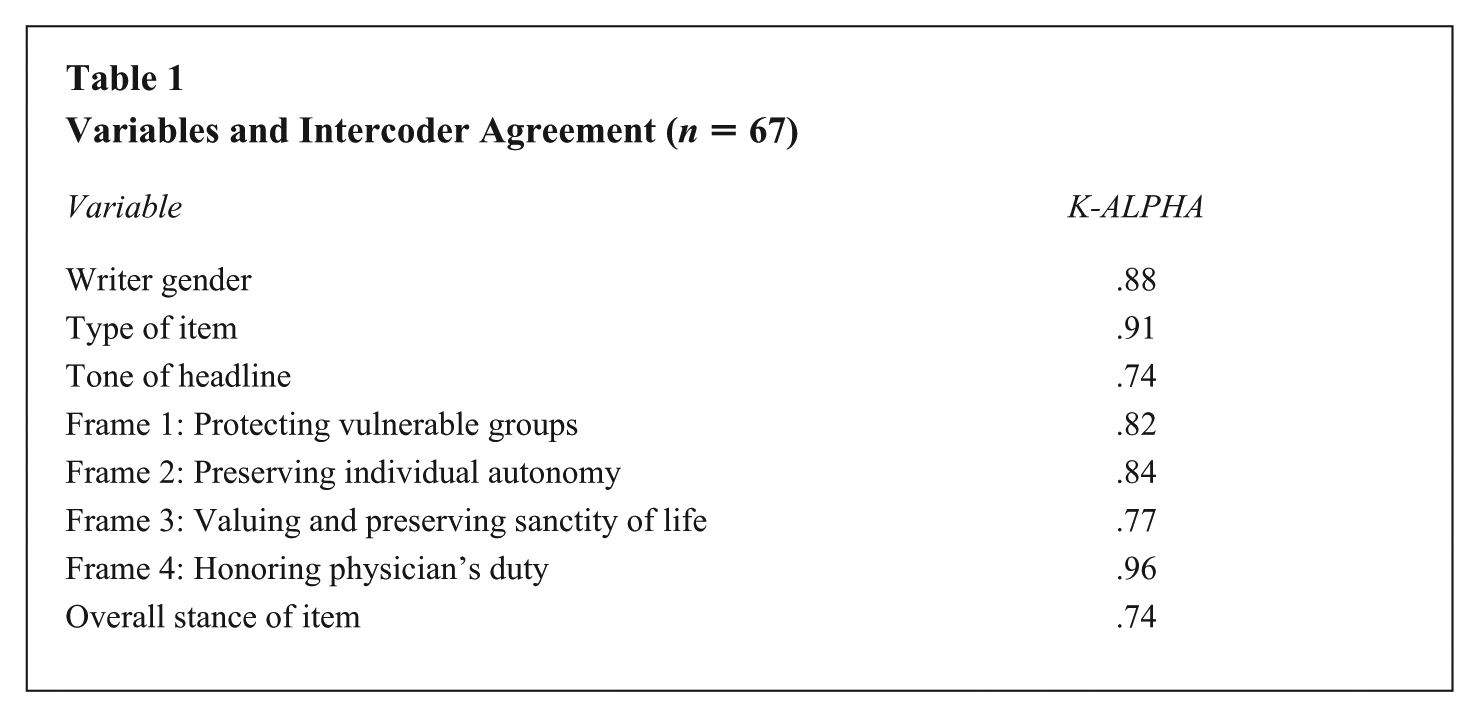
Three trained coders read and coded 67 items, after which Krippendorf’s alpha (K-ALPHA) was calculated to ascertain intercoder agreement for the relevant variables. K-ALPHA (Hayes & Krippendorff, 2007) assesses the accuracy of measurement by multiple coders. K-ALPHA was calculated for each of the variables included in this study and values ranged from 0.74 to 0.96 (Table 1). During the coding process, the coders highlighted words and phrases from headlines and text of items that exemplified particular frames to assist in discerning the overall meaning of the coverage.
Variables and Intercoder Agreement (n = 67)
Results
Overall, 519 items were coded, including 228 news articles (43.6%), 47 features (9.2%), 39 editorials without bylines (7.6%), 83 op-ed columns with bylines (16.2%), 84 letters to the editor (16.4%), 26 news briefs (5.1%), and 8 other (1.6%). Items were most likely to appear on Thursdays and Sundays (18.8% each), followed by Wednesdays (16.6%), Fridays (14.4%), Tuesdays (12.9%), Mondays (10.7%), and Saturdays (7.5%). Almost a third of the items were published in Massachusetts (156), while Rhode Island published the least (3).
RQ1 and RQ2 Tone of Coverage
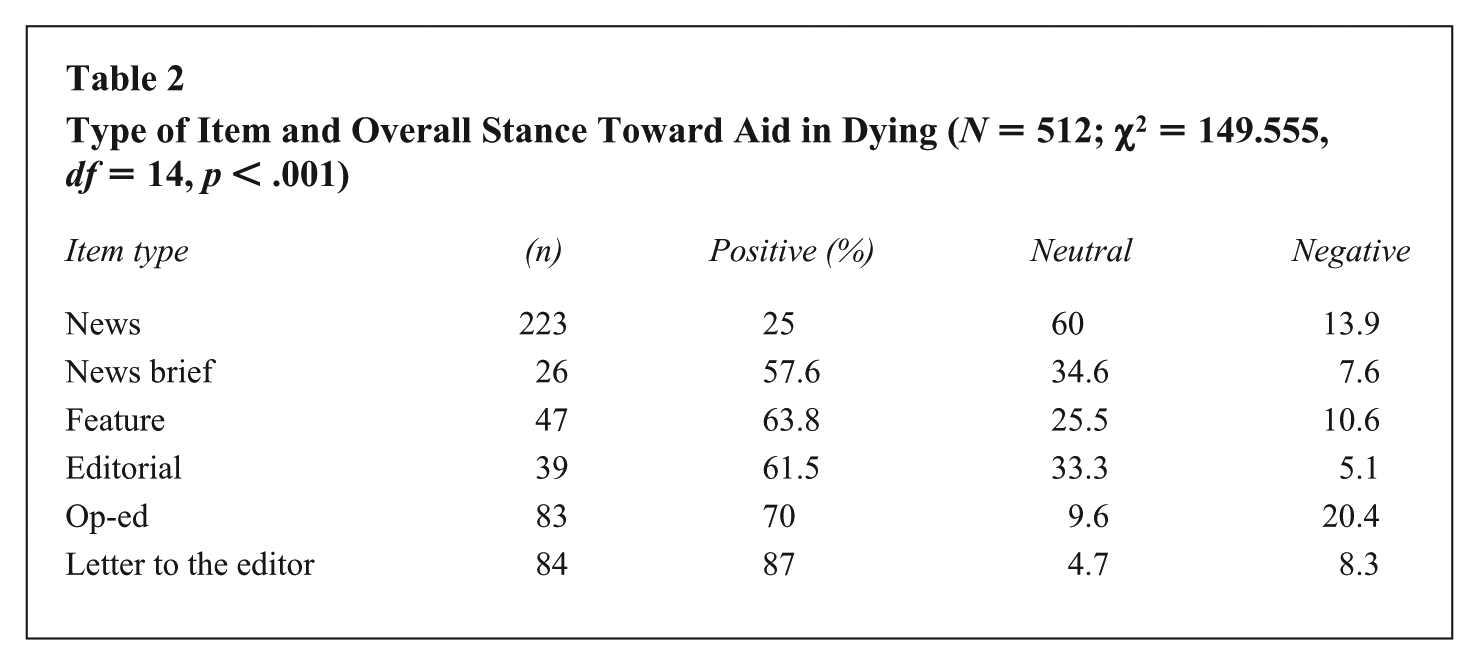
The researchers attempted to answer these questions by first examining overall stance and headline tone. Nearly half of the coverage had an overall positive tone, while 37.3% was neutral and 14.2% was negative. Pearson chi-square testing showed a significant relationship (χ2 = 149.55, df = 14, p < .000) between overall stance toward MAID and the type of item. News stories were most likely to be neutral versus negative or positive; however, feature stories, op-eds, and letters to the editor were more likely to be positive than negative or neutral (Table 2).
Type of Item and Overall Stance Toward Aid in Dying (N = 512; χ2 = 149.555, df = 14, p < .001)
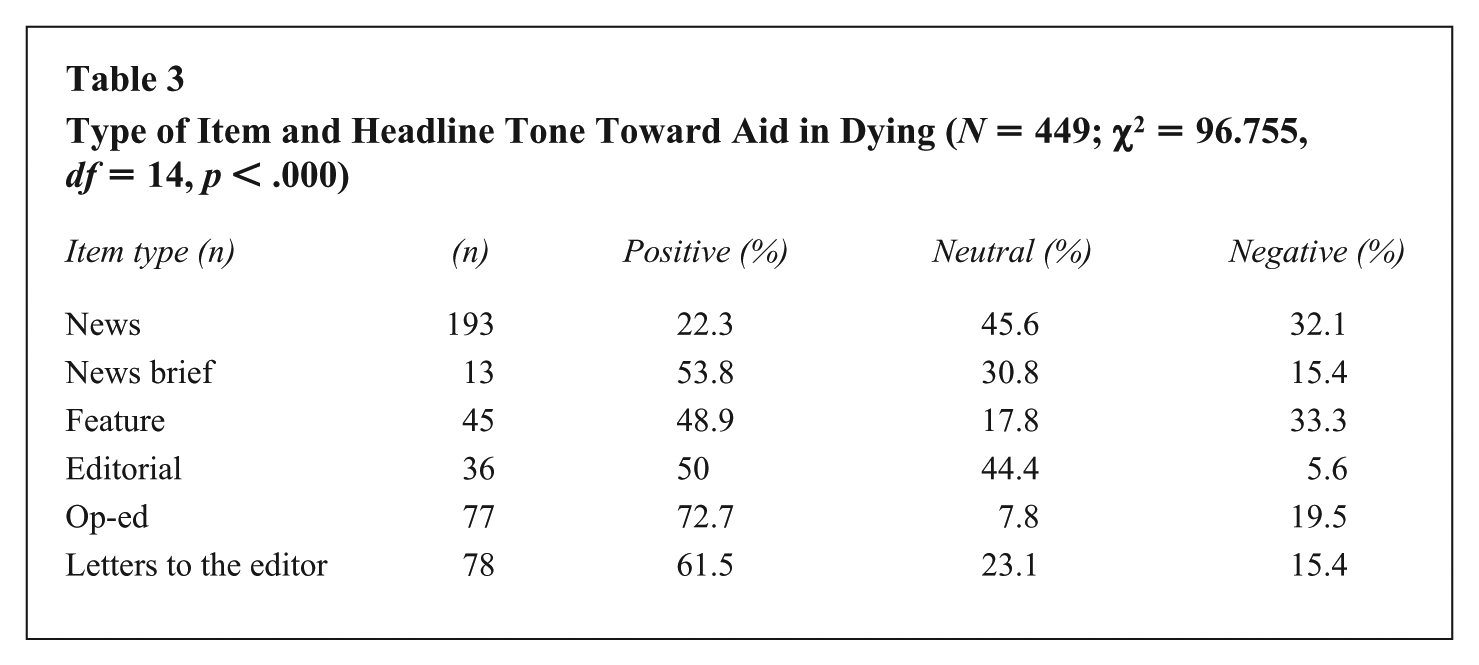
The researchers also examined headline tone using descriptive statistics. Overall, two-thirds of headlines had either an overtly positive (43.8%) or negative (24%) tone, while a third (32.2%) were neutral in their wording. Headline tone was moderately positively correlated with overall stance (r = .487, p < .001, n = 454). Item type also was associated with headline tone. News items had headlines that were more likely to be neutral or negative, while nearly half of features, half of editorials, and more than half of news briefs, op-eds, and letters to the editors had positive headline tone (Table 3).
Type of Item and Headline Tone Toward Aid in Dying (N = 449; χ2 = 96.755, df = 14, p < .000)
Slight differences in the words used in headlines affected the tone. For example, two headlines in Nevada news items offered different tones even as the totality of the article was neutral: “Bill in Nevada legislature aims for dignity at the end of life” (neutral; Sebelius, 2017) and “Nevada lawmakers weigh assisted suicide for terminally ill” (negative; Noon, 2017). Another example was news headlines from Massachusetts: “Emotions run high on physician assisted death bill” (neutral; Capelouto, 2017) and “Assisted suicide bill gets emotional hearing” (negative; Wade, 2017). Positive examples of news headlines included “An act of kindness: Medical aid-in-dying legislation advances in D.C.” (Nirappil, 2016) and “Aid in dying bill debate revived” (Budion, 2019).
RQ3 and RQ4 Frames
The researchers examined several characteristics of the coverage, including the overall use of frames and differences by item type and frame using descriptive statistics and Pearson chi-square analysis when appropriate. Overall, Frames 1 (Protecting Vulnerable Groups) and 2 (Preserving Individual Autonomy) were most common. Frame 1 was present in 44.3% of items, and Frame 2 was present in 66.4% of items. Frame 3 (Valuing and Preserving Sanctity of Life) was present in 13.8% of items, and Frame 4 (Honoring Physician’s Duty) was present in 15.5% of items. Other frames were present in less than 1% of items.
The four frames were present in almost every type of item, save Frame 4 in news briefs. In fact, news briefs were least likely to contain any of the frames. Frame 2 was present more than 60% of the time in all item types except news briefs, where it was used in less than 20%. The next most-used frame was Frame 1, which was present in more than half of news items and more than 40% of features, editorials, and op-eds. Frame 3 was more commonly found in features than Frame 4, although in news, editorials, op-eds, and letters to the editor, Frame 4 was more commonly used than Frame 3 (Table 4).
Frame Present by Item Type (N = 509; an Item Could Have More Than One Frame)
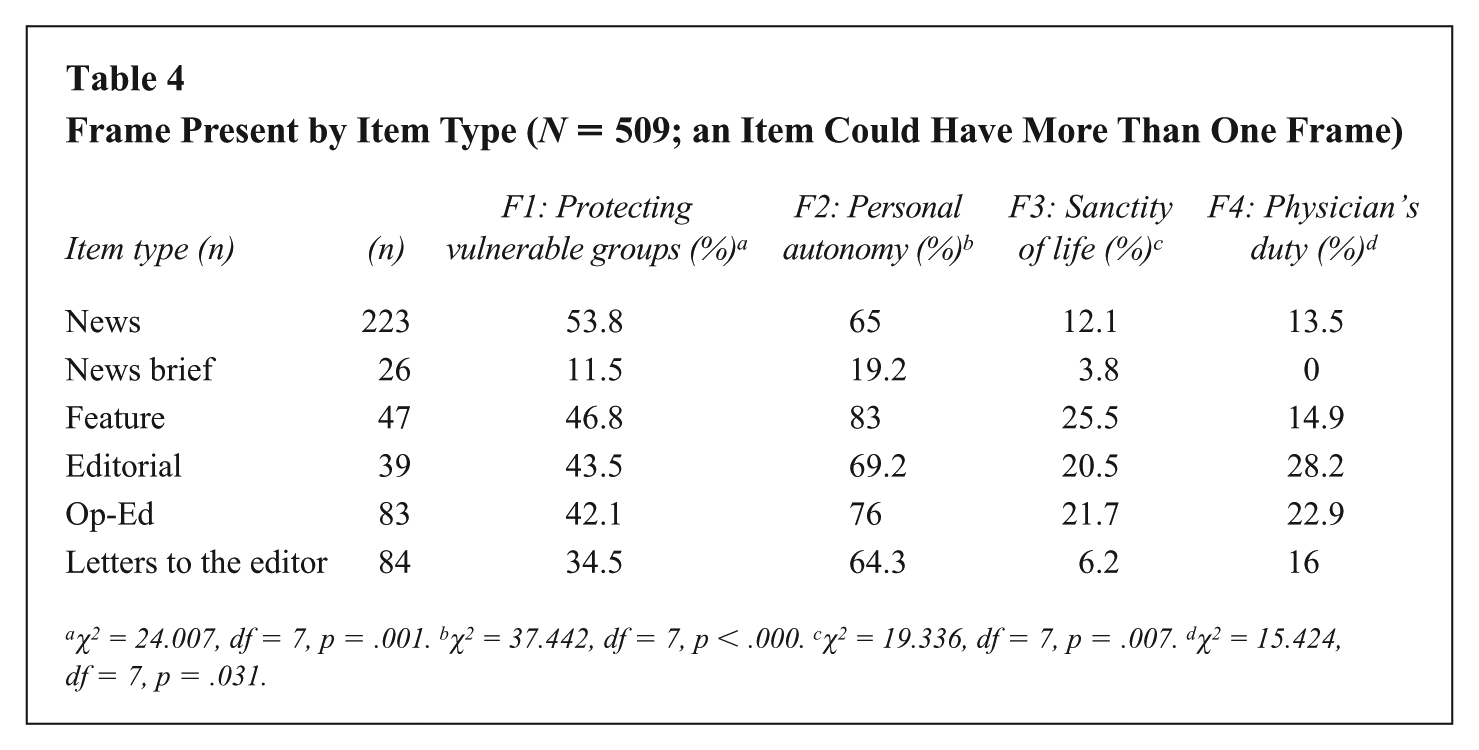
χ 2 = 24.007, df = 7, p = .001. b χ 2 = 37.442, df = 7, p < .000. c χ 2 = 19.336, df = 7, p = .007. d χ 2 = 15.424, df = 7, p = .031.
Frame 1 emphasized consideration of groups who are vulnerable where aid in dying is concerned: “They expressed concern that others—people with disabilities, people of color, or those who lack resources—could be denied costly treatment and instead receive recommendations for assisted death” (Lannan, 2015, para. 15). It also focused on threats of a slippery slope: “Money-starved governments and profit-minded insurance companies will gladly pay for cheap suicide pills rather than expensive treatments” (Rollo, 2017, para. 5); “The risk of mistakes, coercion and abuse is too great” (Hughes, 2016, para. 12); and “It’s not hard to see that in a time of cost containment low income individuals, the disabled, and the elderly could become vulnerable if H.1991 is passed” (Kucharski, 2015, para. 6). However, many stories focused on the protections against targeting and coercion built into the proposed legislation or analyses of outcomes in states that had legalized the practice, which also triggered this frame. Examples of these include:
To receive a lethal dose, patients must submit an oral request for aid in dying. After a 15-day waiting period — during which they can rescind their petition — patients can follow up with a written statement. This request must be witnessed by at least two people who are not related to the patient, are not one of their health care providers, and are not in the patient’s will (Milliken, 2017, para. 8)
and
Oregon has highest utilization of hospice in the nation and more than 90 percent of aid-in-dying patients are enrolled in hospice at the time of their death. No evidence of heightened risk for elderly, women, uninsured, low educational status, poor, physically disabled, minors, psychiatric illnesses, or minorities (Grube, 2019, para. 5).
Frame 2 was characterized by examples such as: “Those who do not endorse medical aid in dying, for whatever reason, need not choose it for themselves. However, denying it to others, for whatever reason, is no longer justifiable” (Milch, 2017, para. 13); “This is a basic right—control over our own deaths—in the face of intractable suffering” (Aronstein, 2016, para. 6); “This final, most personal decision should, like advanced directives, be up to the individual” (Robinson, 2015, para. 17); and “People have a fundamental right to self-determination with respect to their bodies and to control the course of their medical treatment” (Backer, 2019, para. 4).
Frame 3 focused primarily on religious arguments, such as: “Their stance against medical aid in dying is tied to the ‘ethic of life’ that also informs opposition to abortion. The statement quotes the late Pope John Paul II, saying ‘natural law’ is the ‘sacred value of human life from its very beginning until its end’” (Hooks, 2019, para. 5) and “The worst thing would be losing faith, refusing to trust in God’s purpose in my life and trying to grab that control myself” (Schotte, 2015, para. 7).
Examples of Frame 4 included appeals to the Hippocratic Oath: “Hippocrates understood this 2,500 years ago when he wrote the Hippocratic Oath, which stated in part, ‘I will neither give a deadly drug to anybody who asks for it nor will I make a suggestion to this effect’” (Rollo, 2017, para. 4) and “The American Medical Association says ‘physician-assisted suicide’ is ‘fundamentally incompatible with the physician’s role as healer’” (Gorman, 2015, para. 14).
Chi-square testing showed some frames were associated with overall stance toward MAID (Table 5). For example, when Frame 1 was present, item stance was slightly more likely to be positive than neutral or negative. When Frame 2 was present, item stance was much more likely to be positive; however, when Frame 3 was present, item stance was more likely to be neutral. While stories using Frame 4 were more likely to be positive than negative or neutral, the differences were not statistically significant. When present, all the frames were likely to be associated with a positive headline tone even though the associations were not statistically significant for Frames 3 and 4 (Table 6).
Frame Present and Overall Stance Toward Aid in Dying (Note an Item Could Have More Than One Frame)
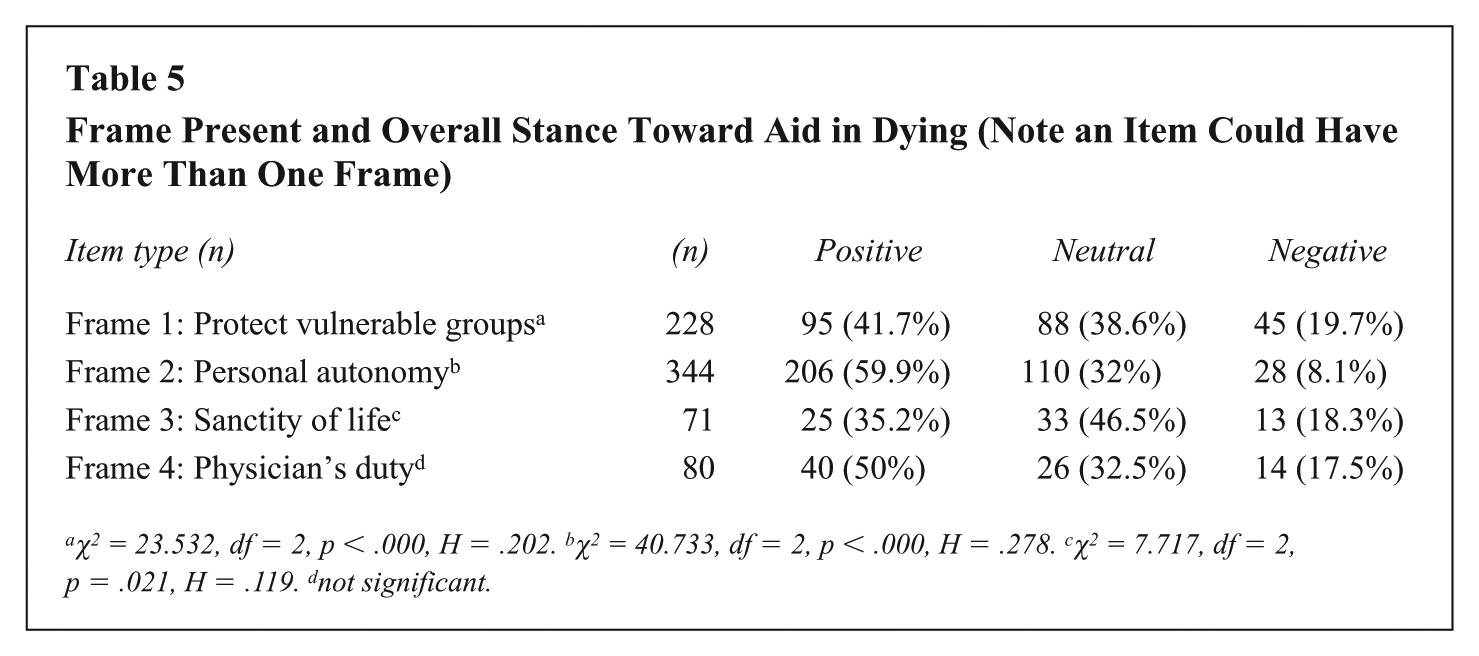
χ 2 = 23.532, df = 2, p < .000, H = .202. b χ 2 = 40.733, df = 2, p < .000, H = .278. c χ 2 = 7.717, df = 2, p = .021, H = .119. d not significant.
Frame Present and Headline Tone Toward Aid in Dying (Note an Item Could Have More Than One Frame)
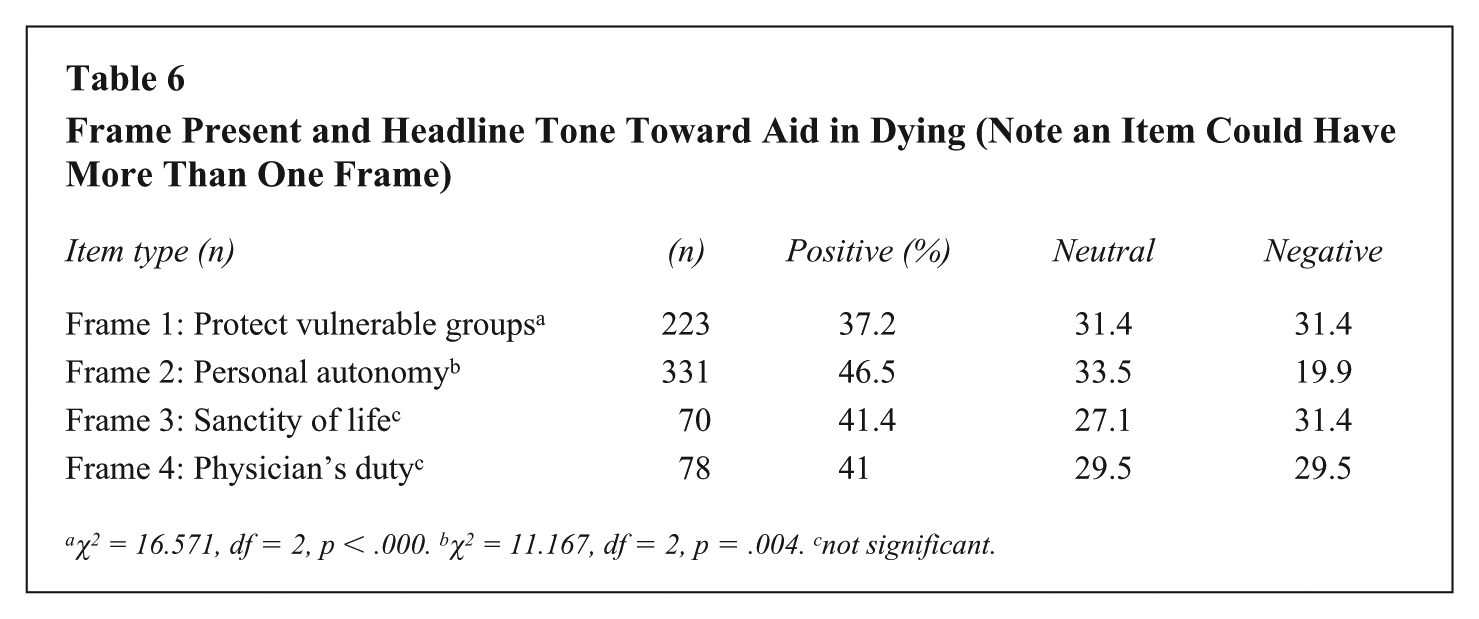
χ 2 = 16.571, df = 2, p < .000. b χ 2 = 11.167, df = 2, p = .004. c not significant.
RQ5 and RQ6 Sources
The researchers used descriptive statistics as well as Pearson chi-square to analyze source usage. Overall, sources used in these items included 31.9% health care professionals, 45.7% elected officials, 10.9% legal sources, 48.9% aid-in-dying (MAID) advocates, 28.6% patients, 16.1% religious officials, 25% family members, and 16.8% disability advocates. The researchers looked at each type of source and how likely it was to be used in each type of item and frame. As one might expect, elected officials were used as a source in most news items, followed by MAID advocates, health care professionals, patients, disability advocates, and family members (Table 7). Feature stories were more likely to use patients, followed by MAID advocates, elected officials, family members, and health care professionals. Op-eds relied more on health care professionals, followed by patients, MAID advocates, and elected officials. However, when sources were categorized as official and unofficial, it became clear that unofficial sources were used more often in news, briefs, and features while official sources were used more often in editorials, op-eds, and letters to the editor (Table 8). Sources for Frames 1 and 2 included mostly elected officials and MAID advocates, followed by health care professionals. Frame 3 was more likely to use elected officials and religious officials than other frames, and Frame 4 was most likely to use health care professionals. Official sources outweighed unofficial sources for all frames except Frame 2.
Type of Item and Use of Source Type (Not All Source Types Were Used in All Items; Other Not Included in Analysis)
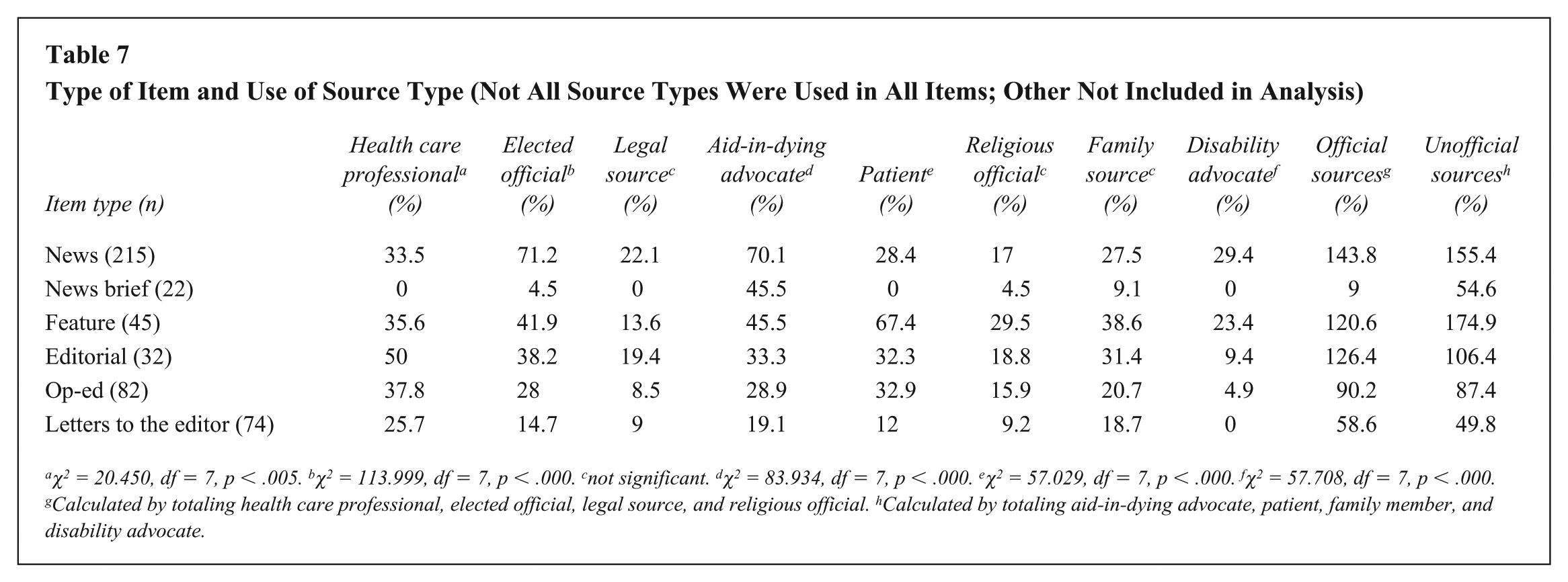
χ 2 = 20.450, df = 7, p < .005. b χ 2 = 113.999, df = 7, p < .000. c not significant. d χ 2 = 83.934, df = 7, p < .000. e χ 2 = 57.029, df = 7, p < .000. f χ 2 = 57.708, df = 7, p < .000. g Calculated by totaling health care professional, elected official, legal source, and religious official. h Calculated by totaling aid-in-dying advocate, patient, family member, and disability advocate.
Frame and Item Use of Source Type (Other Not Included in Analysis)
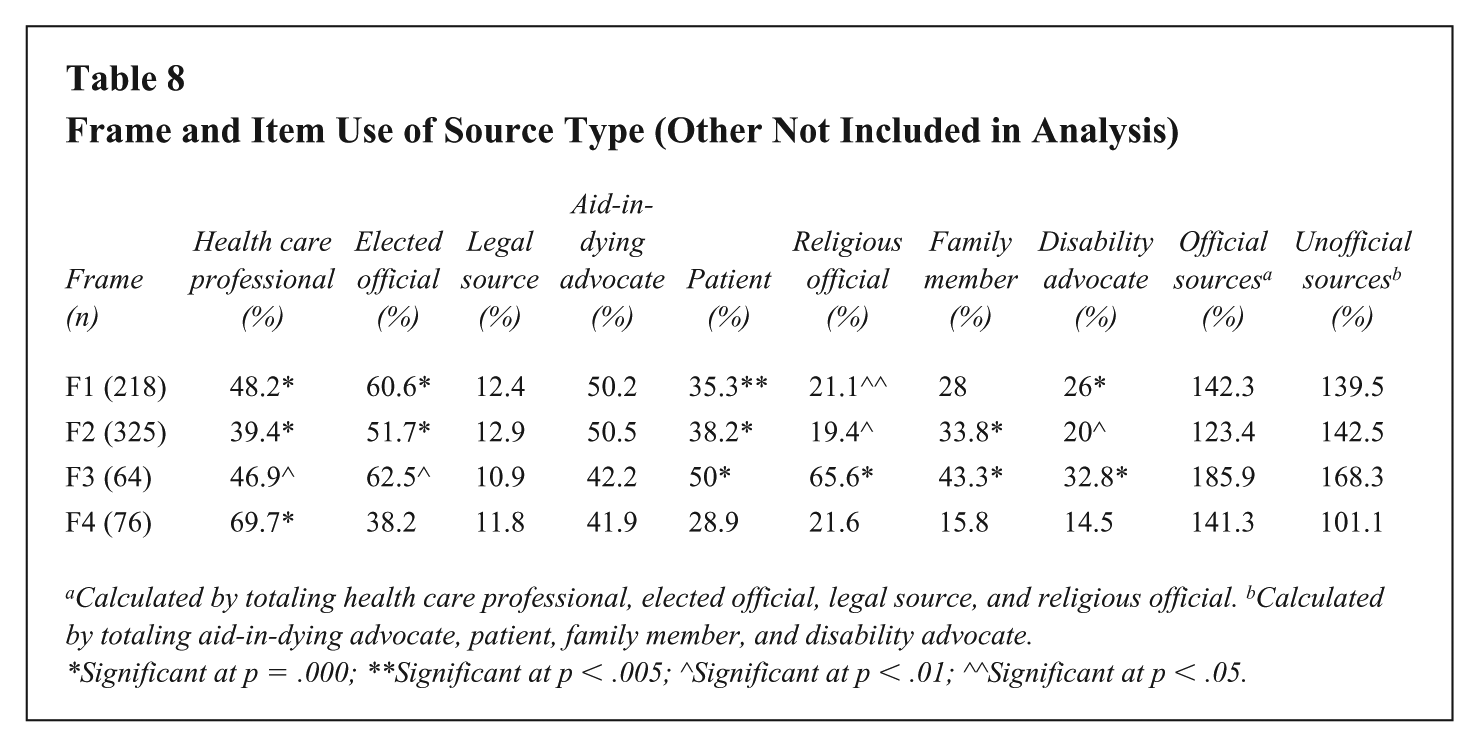
Calculated by totaling health care professional, elected official, legal source, and religious official. b Calculated by totaling aid-in-dying advocate, patient, family member, and disability advocate.
Significant at p = .000; **Significant at p < .005; ^Significant at p < .01; ^^Significant at p < .05.
Discussion
The data show that news organizations’ coverage of aid in dying remained largely positive, even when lawmakers did not pass legislation to legalize the practice. This could indicate that the spiral of silence (Noelle-Neumann, 1995) is effectively muting opposing viewpoints in the mainstream press, or it could simply reflect the dominant public opinion, which favors aid in dying as a concept. News items covering legislative sessions prioritize legislative actions as worthy of news coverage, but the episodic nature of the legislative process (introducing bills, debating, hearing testimony, and voting) emphasizes individual (Pan & Kosicki, 1993; Shah et al., 2001) rather than government responsibility (Kim et al., 2010). This episodic treatment of MAID legislation is suggested by the small number of stories (519) included in this analysis, which looked at 18 states over 4 years; however, the small number of stories could also be a result of using databases to find relevant stories, as those databases likely did not capture all coverage in a state.
Overall stance—across all item types—was positive, while only 14% was negative. Headline tone across all item types except news was largely positive, with just a quarter of headlines manifesting a negative tone. In fact, only in news items were the overall stance and headline more likely to be neutral, reflecting journalistic norms of balance and objectivity, or negative, focusing on conflict. The significant moderately positive correlation between overall stance and headline tone indicates item content is congruent with headlines, so newspapers are sending a consistent message to readers, who are thus more likely to remember it (Ecker et al., 2014). Opinion pieces, including op-eds, editorials, and letters, were largely positive and used a wider variety of frames, giving a more accurate reflection of public opinion, which largely supports MAID. Letters and op-ed pieces commonly told the story of one person’s experience with the painful, horrific death of a loved one who would have chosen MAID were it legal. This public support balanced process-oriented coverage where legislators pontificated about the ethicality of MAID and significantly outweighed the occasional letter or column invoking God’s divine plan for the human body. It also was personally relevant for many people, which may have mitigated the effect of source credibility inherent in elected officials.
Newspapers in states that did not pass end-of-life legislation primarily utilized frames of personal autonomy (Frame 2) and protecting vulnerable groups (Frame 1) in both news and opinion to present end-of-life choices in a positive light. Frame 1 was used frequently to emphasize the protections built into the proposed laws, while Frame 2 resonated with the American cultural values of individualism. These frames were also dominant in Colorado newspapers’ coverage of Proposition 106, which sought to legalize MAID (Lauffer et al., 2020b), as well as D.C. newspapers’ coverage of the District’s Death with Dignity Act (Lauffer et al., 2020a), albeit under different names. However, while Frames 1 and 2 were nearly equally common in Colorado, Frame 2 was more evident in states that did not pass these laws (Lauffer et al., 2020b). While Frame 3 was least common in this study, it was third-most frequent in Colorado news coverage (Lauffer et al., 2020b). The sanctity of life concept is less dominant in mainstream news coverage, which may correspond with the increasingly dominant U.S. emphasis on rights of privacy, bodily integrity, and self-determination and a decentralization of religion in personal and professional life between 2015 and 2019. The limited use of this frame was related to the low use of religious sources found in this study. The physician’s oath frame, which was used slightly more frequently than the sanctity of life frame, mirrors social beliefs that one (particularly health care professionals) should avoid causing harm.
Overall item stance and headline tone toward aid in dying were associated with frames in ways that were expected and unexpected. For example, Frame 2 was significantly associated with positive headline tone and positive overall stance toward aid in dying, which might be anticipated. However, Frame 1 was also significantly associated with positive headline tone and positive overall stance toward aid in dying. Many items with Frame 1 focused on the safeguards built into the proposed legislation as well as the lack of evidence of abuse of the laws in states that had legalized the practice, even as some attempted to arouse fear by suggesting MAID would be used to target the weak and marginalized.
Previous studies (Lauffer et al., 2020a) have found a heavy reliance on official sources like elected officials and health care professionals. Elected officials (Entman, 1991) and health care professionals (Briggs & Hallin, 2016) are official, legitimate, and often revered, credible sources who provide information and interpret legislation from their perspective. Overall, official sources were used more often than unofficial sources in news coverage of end-of-life legislation in states that considered but did not pass such legislation, but that pattern was not consistent over all types of items. News (155.4%), briefs (54.6%) and features (174.9%) were more likely to use unofficial sources than official sources (143.8%, 9%, and 120.6%, respectively), while all opinion-oriented items used more official than unofficial sources. Within opinion-oriented items, editorials relied more on official sourcing (difference of 20%), but op-eds and letters to the editor had a closer margin (2.8% and 8.8%, respectively). Paul (2022) notes that advocates are used to share preferred frames and Geiger (2022) asserts that unofficial sources—such as the MAID advocates, patients, and families in this study—may be perceived as equally trustworthy as official sources.
The differences in source use in this study could have affected the persuasiveness of the coverage for lawmakers considering passing end-of-life legislation. MAID advocates, by their very nature, are biased toward legalizing MAID, which may decrease their credibility for legislators. However, given public support for aid in dying, the use of advocates may have resonated with regular readers. In addition, the use of source by frame showed that only Frame 2 relied more on unofficial sources like MAID and disability advocates, patients, and their families. This is similar to coverage in Colorado, which also found unofficial sources were most commonly used with Frame 2, while Frames 1 and 3 relied more on official sources (Lauffer et al., 2020b). Indeed, the sanctity of life frame relied most heavily on religious sources, followed by elected officials, yet official sources were more likely to be used in this frame than any of the others. Also predictably, the dominant source category in the physician’s duty frame was health care professionals, followed by MAID advocates and elected officials. This lends support to Lippmann’s (1993) theory that insiders are more present in news coverage than outsiders. Many of the health care sources in this frame focused on the importance of patient-directed care, triggering the personal autonomy frame and suggesting that “doing no harm” was secondary to personal autonomy.
Conclusion
This study adds to the understanding of framing as it relates to a health issue connected to legislative action. It is consistent in many respects with previous research in states that passed legislation permitting MAID in terms of the overall stance toward MAID, headline tone, frames, and sources used (Lauffer et al., 2020a, 2020b). Previous research has shown that media representations of controversial issues can influence public opinion (e.g., Entman, 2004; Iyengar, 1996; Lippmann, 1993, 1997; Price & Oshagan, 1995), and newspapers also reflect opinions on issues of public concern through the publication of letters to the editor and op-ed columns. Aid in dying is an important social issue nationally and internationally. Journalists’ and editors’ frames—inclusion, emphasis, or omittance of facts, viewpoints, and opinions favorable and unfavorable to the aid-in-dying movement and related legislation—work as “prepackaged social constructions” (Gillespie et al., 2013, p. 225) that affect how people will perceive and integrate aid-in-dying and related laws.
This study contributes to the broader understanding of how media framing shapes public discourse around complex health and policy issues like MAID. By demonstrating consistency with prior research in states that passed MAID legislation, it reinforces the idea that both the selection of frames and the sources used by journalists can play a critical role in shaping public understanding. While media may not determine legislative outcomes directly, their influence on public opinion through framing, op-eds, and letters to the editor underscores their power in legitimizing certain perspectives over others. As aid in dying continues to generate debate both nationally and globally, media’s role in constructing and conveying these narratives remains a crucial factor in how societies engage with and respond to end-of-life legislation.
This study highlights that although official sources may be most dominant overall within media coverage of MAID, unofficial sources are used to frame the issue around personal autonomy. In this case, unofficial sources also outweighed the use of official sources in news, features, and briefs and were nearly equal within op-eds. While traditional reliance on official sources such as elected officials and health care professionals remains significant, the increased presence of unofficial sources, particularly in news, suggests an effort to connect with public sentiment and humanize the debate. This divergence in source use may influence how audiences and policy-makers interpret the issue: lawmakers might be more skeptical of unofficial sources’ (like advocates, patients, and families) inherent bias, while general readers could find their stories more compelling and relatable. Ultimately, the credibility and impact of a source depend not only on its status but also on its alignment with the values and emotions of the intended audience.
However, while no content analysis can definitively show causation, the assumption that news framing is related to the success or failure of legislative initiatives may be misplaced. The same frames were used in similar proportions in these states that did not pass MAID laws as in Colorado, which did pass such a law (Lauffer et al., 2020b). This may suggest that while news coverage of aid in dying may shape public discourse and awareness, it may matter little to eventual legislative action or success, which may be because legislators are acting from their own personal experiences and biases rather than their constituents’ preferences. Other variables—such as political climate, advocacy efforts, institutional structures, and public mobilization—likely play a more decisive role in determining policy outcomes. It also may suggest that most opposition to aid in dying is entrenched and no amount of news coverage can make it more palatable. As Price and Oshagan (1995) note, issues of public concern can be subject to amplification or moderation by normative and informational social influences, but the persuasiveness of mediated content may be moderated by factors beyond those that can be examined through content analysis.
Therefore, it is worth investigating other characteristics that might help illuminate the state-by-state differences in overall stance, headline tone, and source usage that might be related to passage of MAID legislation. For example, while public opinion polls in the U.S. indicate support for MAID, does political composition of a state’s leadership or populace correspond with frames used, overall stance, or headline tone? Does the amount of coverage matter? Are some sources more persuasive to legislators than others? Does a threshold exist (story frequency, volume, etc.) that must be surpassed for the salience of an issue to rise above the clutter? Do newspapers still have a role in this fractured, digital environment? Do people rely on newspapers to learn more about legislation under consideration in their state houses? Do legislators vote with the majority of their constituents in mind, or are their votes influenced by other factors? Future research also could widen the content examined to include additional interpersonal, mediated, and social influences, such as content published in religious and other specialty publications and/or social media sentiments.
Footnotes
Appendix: States and Their Newspapers Included in the Sample
Democrat-Gazette
Times
Arizona Daily Star
Casa Grande Dispatch
News & Sun
Sierra Vista Herald
Tri-Valley Dispatch
Tucson Weekly
Berlin Citizen
Bulletin
Cheshire Citizen
Chronicle
Connecticut Post
Courant
Day
Greenwich Times
Journal Inquirer
Hour
New Haven Register
News-Times
Newtown Bee
North Haven Citizen
Record-Journal
Register Citizen
Stamford Advocate
Times
Town Times
Capital Gazette
Journal
Milford Chronicle
Elkhart Truth
Evansville Courier & Press
Evening News & Tribune
Herald-Times
Journal Gazette
Post-Tribune
Reporter-Times
Daily News
Gazette
Hawk Eye
Newton Daily News
Quad-City Times
Telegraph Herald
Daily News
McPherson Sentinel
Pratt Tribune
Baltimore Sun
Banner
Capital
Capital Times
Carroll County Times
Crofton-West County Gazette
Cumberland Times
Enquirer-Gazette
Enterprise
News-Post
Independent
Northeast Booster Reporter
Sunday Star
Towson Times
Advocate
Andover Townsman
Berkshire Eagle
Billerica Minuteman
Boston Herald
Bulletin & Tab
Burlington Union
Cape Cod Times
Chronicle
Citizen
Community Advocate
Daily Hampshire Gazette
Daily Item
Daily News
Eagle-Tribune
Easton Journal
Enterprise
Framingham Tab
Gloucester Daily Times
Haverhill Gazette
Herald News
Hudson Sun
Independent
Medfield Press
MetroWest Daily News
Milford Daily News
Minuteman
Norwood Transfer & Bulletin
Patriot Ledger
Recorder
Republican
Salem News
Sentinel & Enterprise
Standard Times
Sudbury Town Crier
Sun
Sun Chronicle
Tab
Telegram & Gazette
Walpole Times
Waltham News Tribune
Wilmington Advocate
Budgeteer News
Crookston Daily Times
Daily Tribune
Duluth News Tribune
Grand Rapids Herald-Review
Hometown Focus
Hutchinson Leader
Journal
Lake County News
Mesabi Daily News
Pilot-Independent
Post-Bulletin
St. Paul Pioneer Press
Star Tribune
Boulder City Review
Dayton Valley Dispatch
Humboldt Sun
Independent
Las Vegas Optic
Las Vegas Review Journal
Las Vegas Sun
Nevada Independent
Ralston Flash
Rebel Yell
Sagebrush
Sparks Tribune
Alamagordo Daily News
Albuquerque Journal
Daily Press
Daily Times
Deming Headlight
Gallup Independent
Las Cruces Sun-News
Los Alamos Monitor
Santa Fe New Mexican
Sun-News
Taos News
Buffalo News
Daily Gazette
Daily Mail
Daily Messenger
Daily Reporter
Daily Star
Eastchester Rising
Harrison Rising
Mount Vernon Rising
New York Daily News
New York Post
North Castle Rising
Pelham Rising
Post-Standard
Press-Republic
Press-Republican
Record
Register-Star
Rye Rising
Sound View Rising
Times Herald-Record
Times Union
Union Sun & Journal
Westchester Rising
Yonkers Rising
Chapel Hill News
Courier Tribune
Daily Reflector
Pilot
Times-News
Washington Daily News
Winston-Salem Journal
Call
Westerly Sun
Deseret News
Salt Lake Tribune
Standard-Examiner
Arlington Catholic Herald
Free Lance-Star
Progress-Index
Times-Dispatch
Capital Times
Wisconsin State Journal
