







Abstract
This study examines how legacy news organizations in Bangladesh are navigating digital transformation within a repressive political system and a moderately developed media market. Drawing on the frameworks of disruptive innovation and post-industrial journalism, it employs a mixed-methods approach to analyze how digital adaptation is reconfiguring journalistic labor, editorial practices, and professional norms. Findings suggest that news organizations are increasingly adopting platform-oriented content strategies to reach large domestic and diasporic audiences, with particular emphasis on algorithm-driven and sensationalized news distributed through official YouTube channels. This shift is accompanied by the expansion of multimedia desks staffed primarily by digitally skilled younger journalists. While these “innovative” strategies are perceived as generating new revenue streams, they also intensify job insecurity among senior journalists and raise concerns about the erosion of journalistic quality. The study also contributes to scholarship on the digital transformation of legacy media in politically constrained Global South contexts.
Keywords
The contemporary shift toward technological adaptation in journalism is driven by two converging forces: the pursuit of operational efficiency through emerging digital tools (Amponsah & Atianashie, 2024) and intensifying competition within a platform-dominated media environment (Ferrucci & Perreault, 2021), where digital intermediaries such as Facebook and YouTube increasingly shape news visibility and monetization through algorithmic ranking systems. Together, these dynamics are reshaping newsroom routines, influencing editorial decision-making, and recalibrating long-standing professional norms (Papadopoulou & Kalogeropoulos, 2024; Ross Arguedas et al., 2022).
Globally, the integration of artificial intelligence and related digital technologies has enabled new forms of storytelling, including data-driven reporting, multimedia production, and cross-platform distribution (Amponsah & Atianashie, 2024; Conboy, 2023; de-Lima-Santos & Ceron, 2022). At the same time, the growing centrality of engagement metrics and algorithmic visibility has generated sustained normative concerns (Ferrucci & Perreault, 2021; Gollmitzer, 2023). Scholars argue that increasing reliance on audience analytics and productivity indicators may marginalize traditional journalistic competencies such as investigative depth, editorial judgment, and public-interest orientation (Anderson et al., 2015; Deuze & Witschge, 2018; Ferrucci & Perreault, 2021). As news organizations adopt platform-oriented monetization strategies that prioritize click-through rates and algorithmic amplification, questions emerge regarding implications for journalistic autonomy and perceived quality (Denisova, 2023; Khawar & Boukes, 2024; Simon, 2024).
Although these transformations have been widely documented, most empirical research has concentrated on Western liberal democracies, where digital disruption unfolds within comparatively stable regulatory and institutional environments. Far less attention has been devoted to settings in which platformization intersects with structural political constraint and economic precarity. This gap is significant because the effects of digital adaptation are conditioned by the broader political–economic environment in which news organizations operate (Papadopoulou & Kalogeropoulos, 2024; Salaverría & de-Lima-Santos, 2021). When professional autonomy is already fragile and financial sustainability uncertain, platform logics may not simply reshape newsroom practices—they may intensify pre-existing structural vulnerabilities (Deuze & Witschge, 2018; Guo & Volz, 2019; Nielsen & Cherubini, 2022). Platform logics refer to the set of institutionalized rules, algorithmic priorities, economic incentives, and data-driven performance metrics embedded within digital platforms (e.g., Facebook, YouTube, Google) that shape how news is distributed, monetized, and evaluated, thereby influencing editorial decision-making within news organizations.
In media systems characterized by regulatory uncertainty, high advertising dependence, and politically embedded ownership structures, digital adaptation may function less as innovation and more as institutional survival. Under such conditions, organizational expectations for technological integration can amplify metric-driven evaluation, accelerate labor reconfiguration, and embed algorithmic visibility as a central criterion of professional performance. Rather than merely reproducing trends observed in liberal democracies, platformization—the increasing dependence of news organizations on digital platforms for distribution, monetization, and audience engagement—in constrained environments may intensify commercial pressures and deepen professional insecurity. Examining such contexts, therefore, enables closer assessment of whether digital transformation operates differently when institutional autonomy is limited.
Bangladesh provides a strategically revealing setting for investigating this amplification dynamic. As a politically constrained yet commercially competitive media system, Bangladesh is marked by regulatory oversight, dependence on public and private advertising, and ownership structures closely tied to business and political elites (Khan & Urbanski, 2025; Rahman & Rahman, 2022). Simultaneously, the country has experienced rapid digital expansion, widespread social media adoption, and growing reliance on platforms for audience reach and revenue generation (Ahmed et al., 2020; Partha et al., 2024). This convergence creates a compressed environment in which economic incentives, regulatory pressures, and technological disruption operate simultaneously. In such a context, digital adaptation is not merely a process of modernization; it represents an organizational strategy shaped by structural precarity.
Studying Bangladesh therefore extends existing theories of digital transformation beyond well-institutionalized media systems and allows closer examination of how platform logics operate when institutional autonomy is constrained. Grounded in the frameworks of disruptive innovation (Christensen, 1997, 2006) and post-industrial journalism (Deuze & Witschge, 2018), this study employs a sequential explanatory mixed-methods design combining survey data and in-depth interviews. It investigates how legacy news organizations navigate digital transformation and whether these adaptations are associated with changes in recruitment practices, job evaluation criteria, newsroom labor expectations, and journalists’ perceptions of journalistic quality.
The findings indicate that many legacy outlets increasingly emulate platform-native actors, including YouTubers and digital influencers, by prioritizing algorithm-oriented content strategies such as sensationalized headlines and visually optimized video production across digital editions and official YouTube channels. To support these shifts, organizations have expanded multimedia desks and recruited digitally skilled mobile journalists. Recent political developments, including regime change in Bangladesh, have further accelerated platform-centered journalism, particularly through the influence of exiled Bangladeshi content creators with substantial YouTube followings. While these strategies are perceived as generating new revenue streams for financially vulnerable outlets, they are also associated with heightened job insecurity among senior journalists and evolving criteria for professional evaluation.
Literature Review
Theory of Disruptive Innovation
Disruptive innovation, introduced by Christensen (1997), explains how new entrants challenge established industries by offering lower-cost, more accessible alternatives that initially serve marginal or underserved markets. Although such innovations may appear inferior to dominant products at first, they often improve over time and can eventually displace incumbent models (Christensen, 2006). Within the news industry, this framework has been used to interpret how digital technologies and platform-based production models have unsettled traditional news organizations, compelling legacy media to restructure their operations, revenue strategies, and professional practices (Ferrucci & Perreault, 2021).
Legacy news organizations began to experience disruptive pressures in the early twenty-first century as they adopted digital tools, analytics, and, more recently, artificial intelligence in response to declining audiences and advertising revenues. These technologies facilitated new forms of storytelling and cross-platform distribution aimed at digitally native and globally dispersed audiences (Ferrucci & Perreault, 2021). At the same time, digital transformation increasingly embedded performance metrics—such as clicks, shares, and engagement time—into newsroom decision-making, often placing pressure on journalistic depth, contextual reporting, and public-interest commitments (de-Lima-Santos & Ceron, 2022; Simon, 2024).
As a consequence, journalists are now expected to combine traditional competencies—writing, editing, verification—with digital proficiencies, including multimedia production, social media publishing, audience analytics, and basic computational skills (Guo & Volz, 2019). This market-oriented shift has reshaped newsroom cultures by emphasizing speed, responsiveness, and technological adaptability (Ferrucci & Perreault, 2021). Increasing reliance on automation, artificial intelligence, and multimedia workflows has become characteristic of contemporary journalism, even as scholars raise concerns regarding ethical implications, labor displacement, and the potential deskilling of journalistic work (Deuze & Fortunati, 2009; Gollmitzer, 2023; Simon, 2024).
Post-Industrial Journalism and the Reconfiguration of Labor
Deuze and Witschge (2018) conceptualize post-industrial journalism as a reorganization of news production shaped by digital disruption and market pressures. In this paradigm, journalism is increasingly marked by precarity, multitasking, and a shift from institutional loyalty toward individualized, entrepreneurial self-management. Traditional newsroom hierarchies have weakened, giving rise to hybrid environments in which professional advancement is linked to adaptability, digital fluency, and output efficiency (Anderson et al., 2015; Deuze & Fortunati, 2009).
Within such systems, news organizations often prioritize recruits with digital agility over those with extensive editorial experience. Consequently, experienced journalists may be marginalized in favor of younger, lower-paid workers proficient in digital tools but possessing less accumulated professional knowledge, or cultural capital, associated with traditional journalism (Bourdieu, 2005; Conboy, 2023; Simon, 2024). In resource-constrained contexts, this transformation can further devalue established forms of journalistic expertise, replacing them with cost-efficient, multitasking labor optimized for platform-based production (Deuze & Witschge, 2018; Guo & Volz, 2019).
This market-oriented restructuring stands in tension with normative theories of journalism that emphasize editorial autonomy, professional responsibility, and the centrality of human judgment (Deuze & Fortunati, 2009; Ferrucci & Perreault, 2021). Journalism continues to be understood as a public-interest institution that contributes to democratic life through narrative construction and agenda-setting (Conboy, 2023; Schudson, 2011). Yet, across diverse political and economic contexts, revenue generation increasingly depends on platform visibility and audience attention, often incentivizing sensationalism and click-oriented content strategies (Denisova, 2023; Khawar & Boukes, 2024).
Platform Adaptation in Constrained Journalism in Bangladesh
Legacy media across the Global South are rapidly digitizing to enhance visibility, competitiveness, and financial sustainability within platform-dominated environments (Moon et al., 2024; Salaverría & de-Lima-Santos, 2021). Yet many organizations engage platforms with limited scrutiny of their power over distribution and monetization (Papadopoulou & Kalogeropoulos, 2024). As Nielsen and Cherubini (2022) note, publishers often view platforms as profit-driven intermediaries that offer lower barriers to entry and greater revenue potential than saturated local advertising markets.
Bangladesh exemplifies these dynamics. Digitization has been driven largely by market imperatives—expanding reach, increasing engagement, and capturing digital advertising revenue (Ahmed et al., 2020; Partha et al., 2024). The country counts more than 66 million internet users and 44 million social media users, with mobile penetration exceeding 100% and a sizable diaspora audience (Kemp, 2023).
However, this digital expansion unfolds within a politically constrained regulatory environment and an oversaturated offline market, limiting traditional watchdog capacity (Khan & Urbanski, 2025). News outlets remain dependent on public and private advertising, while the state maintains influence through licensing, regulatory oversight, and advertising allocation (Rahman, 2022; Rahman & Rahman, 2022). Ownership structures tied to politically connected business elites further embed political–economic interests within journalistic institutions (International Federation of Journalists, 2020).
Within this context of regulatory vulnerability and financial fragility, platforms are increasingly positioned as avenues for revenue diversification and audience growth (Ahmed et al., 2020; Partha et al., 2024). This shift parallels broader regional trends in which social media platforms have become central to news circulation, reshaping both economic models and editorial practices (Kim & Ihm, 2020; Nielsen & Cherubini, 2022; Suherman, 2025).
Taken together, these structural conditions make Bangladesh a strategically revealing case for examining how digital transformation unfolds in constrained media systems. Drawing on disruptive innovation and post-industrial journalism frameworks, this study investigates the organizational motivations driving digital adaptation in Bangladeshi legacy media, the platforms prioritized for distribution, and the content logics that follow. It further examines whether these shifts are associated with changes in recruitment practices, job evaluation criteria, and journalists’ perceptions of journalistic quality. Accordingly, the study addresses the following research questions:
What forces do journalists perceive as most influential in motivating legacy news organizations in Bangladesh to adopt digital technologies?
How do organizational expectations regarding short-term and long-term benefits of digital adaptation relate to recruitment practices and job evaluation in Bangladeshi news organizations?
How do journalists perceive the impact of digital adaptation on the overall quality of journalism?
Method
This study employed an explanatory sequential mixed-methods design, in which quantitative data were collected and analyzed first, followed by a qualitative phase designed to explain and elaborate statistical patterns (Creswell & Creswell, 2023). In such designs, the qualitative phase is connected to the quantitative results through purposeful participant selection, allowing for deeper interpretation of identified trends.
Sample Description
The study consisted of two sequential phases conducted among journalists working across print, broadcast, and digital platforms in Bangladesh. Institutional Review Board (IRB) approval was obtained prior to each phase.
Quantitative Phase
For the quantitative phase, a U.S.-based researcher with prior professional experience in Bangladeshi journalism invited journalists to participate voluntarily in an online Qualtrics survey. Recruitment occurred through social media networks used by political, education, health, sports, environment, utility, and entertainment beat reporters, as well as through Dhaka Reporters Unity, a national journalist platform.
A total of 124 journalists completed the survey. Respondents ranged in age from 23 to 52 and reported between 1 and 29 years of professional experience. Their roles varied across organizations and included chief correspondents, special correspondents, senior reporters, and general reporters in print, broadcast, and digital media. In addition, the survey link was shared individually with 20 senior journalists and editors to establish contact for the subsequent qualitative phase; 17 of these individuals completed the survey and they were later invited to participate in in-depth interviews.
Together, the sample size of survey respondents was 141. While the number of survey respondents may appear modest in isolation, quantitative sample sizing in mixed-methods research is driven by analytic goals and design logic rather than universal numerical thresholds (Onwuegbuzie & Collins, 2007). The final sample exceeds Green’s (1991) commonly cited guideline, N ≥ 120, for conducting regression analyses in social science research.
Qualitative Phase
Consistent with explanatory sequential design logic, the qualitative phase was explicitly connected to the quantitative findings (Creswell & Creswell, 2023). After analyzing survey results, senior journalists and editors were purposefully selected for follow-up interviews to provide institutional-level insight into patterns observed in the data, particularly those concerning recruitment practices, job evaluation criteria, and organizational expectations regarding technological competence.
Seventeen senior journalists who had completed the survey were invited; 14 agreed to participate. All interviewees had over 15 years of professional experience and held leadership or senior editorial positions (e.g., deputy editor, executive editor, multimedia desk head, senior reporter) in major news organizations.
The selection of senior journalists was theoretically aligned with the study’s research questions, which focus on organizational motivations, recruitment decisions, and evaluation practices, processes typically shaped or influenced by individuals in decision-making roles. Creswell and Creswell (2023) note that in explanatory sequential designs, qualitative participants are purposefully selected based on their capacity to help interpret and explain quantitative results, rather than to statistically represent the broader population. Accordingly, senior journalists were positioned to clarify institutional logics underlying the statistical trends identified in the survey. Participants are identified as Journalist 1–14 to preserve anonymity.
Quantitative Phase: Survey Design and Data Analysis
The survey instrument comprised 67 closed-ended items organized into 10 theoretically grounded batteries, followed by demographic questions. All attitudinal items were measured on 7-point Likert-type scales (1 = strongly disagree; 7 = strongly agree), except recruitment items, which used a 5-point importance scale (1 = not important; 5 = very important). Composite indices were computed by averaging items within each battery to retain original scale ranges.
Organizational expectations for technological adaptation were measured using eight items assessing perceived institutional emphasis on digital competence in daily routines, evaluation, and hiring. Personal intention to adopt new technologies was measured with four items capturing proactive engagement, including experimentation and training.
Perceived ease of use (six items) assessed technological self-efficacy. Perceived usefulness was divided into near-term usefulness (six items capturing immediate task-related benefits) and long-term usefulness (four items capturing anticipated career advantages). Application of digital technologies in journalistic routines was measured using 11 items reflecting the use of multimedia tools, AI-assisted writing, data visualization, automation systems, SEO, and related practices. Job evaluation based on digital expectations was assessed with five items measuring the role of technological proficiency in promotion, recognition, and job security.
Recruitment criteria were measured using 14 items and analytically divided into two theoretically distinct subscales: traditional journalistic competencies (seven items, including sourcing, investigative ability, linguistic skills, and analytical reasoning) and digital/technical competencies (seven items, including multimedia production, statistical analysis, data visualization, graphic design, video editing, and SEO). This distinction reflects the study’s focus on shifting forms of professional skills in hiring.
The perceived impact of digital adaptation on journalistic quality was measured using ten items assessing investigative rigor, watchdog performance, analytical depth, and information reliability. Negatively worded items were reverse-coded so that higher scores indicated stronger perceptions of quality decline.
Internal consistency was evaluated using Cronbach’s alpha, yielding the following coefficients: organizational expectations for technology adaptation (.937); personal intention to adapt new technologies (.894); perceived ease of use (.932); near-term usefulness (.966); long-term usefulness (.943); application of new technologies (.923); job evaluation (.850); recruitment criteria—technical (.948) and traditional journalism (.935); and perceived impact on journalistic quality (.925).
Qualitative Phase: In-Depth Interviews and Thematic Analysis
The semi-structured interview guide was developed using key themes identified in the quantitative results and included 20 open-ended questions across five areas: (a) organizational expectations for technology adaptation; (b) perceived value and efficacy of AI and digital tools; (c) newsroom adaptability and workflow change; (d) recruitment and performance evaluation; and (e) perceptions of journalistic quality. Interview design allowed for follow-up questions to capture contextual nuance.
Interview data were analyzed in two coding cycles. First-cycle deductive coding applied a structured codebook derived from survey constructs. Second-cycle inductive analysis used axial coding to expand and refine emergent patterns (Saldana, 2016). Analysis generated three overarching thematic categories: (a) perceived motivations for digital transformation, (b) newsroom practices and labor change, and (c) perceived effects on journalistic quality.
Meta-Inferences and Integration
Following separate analyses of the quantitative and qualitative phases, integration occurred at the interpretation stage through the development of meta-inferences, consistent with explanatory sequential mixed-methods procedures (Creswell & Creswell, 2023). Quantitative findings informed the qualitative sampling and interview protocol (connection), and results were subsequently compared using a joint display matrix that aligned statistical associations with thematic patterns. This process enabled the identification of convergence, complementarity, and areas of tension between strands. Rather than treating qualitative data solely as explanatory support, integration was used to refine and, where appropriate, reinterpret quantitative patterns by situating them within organizational decision-making contexts.
Results
Application of Technology in Journalistic Work
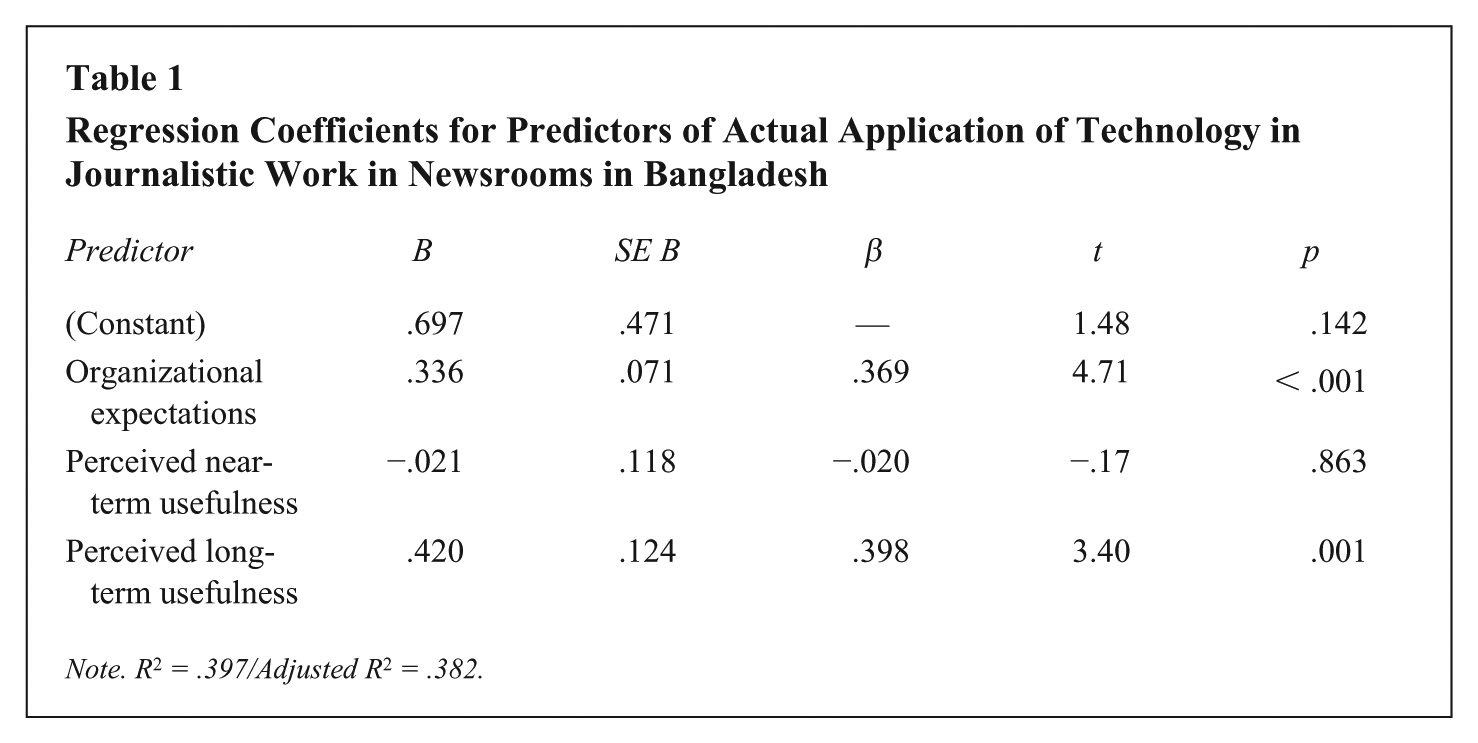
A multiple linear regression was conducted to assess whether organizational expectations, perceived near-term usefulness, and perceived long-term usefulness predict the actual application of technology in journalistic work among legacy media organizations in Bangladesh. The model was statistically significant, F(3, 122) = 26.76, p < .001, with an Adjusted R2 of .382, indicating that the predictors accounted for 38.2% of the variance in technology application (R2 = .397).
Regression Coefficients for Predictors of Actual Application of Technology in Journalistic Work in Newsrooms in Bangladesh
Note. R 2 = .397/Adjusted R 2 = .382.
Organizational expectations emerged as a significant positive predictor (β = .369, p < .001). Perceived long-term usefulness was also a significant positive predictor (β = .398, p = .001). Perceived near-term usefulness, however, was not statistically associated with actual technology use (β = –.020, p = .863). These results warrant further explanation from qualitative analysis.
Journalists’ Perceptions of Motivating Factors for Adapting
Interview data indicate that legacy media organizations in Bangladesh are undergoing accelerated technological adaptation driven primarily by market instability, shifting audience behavior, and structural disruption within the national media ecosystem. Participants consistently described digital transformation as a strategic response to declining advertising revenue, intensified competition, and distribution challenges that were exacerbated during the COVID-19 pandemic (Journalists 11, 13).
Several journalists emphasized that audience consumption patterns have shifted decisively toward video-based, mobile-optimized formats, particularly on platforms such as YouTube and Facebook (Journalists 2, 6). Respondents noted that YouTubers and digital influencers capitalized on these shifts by producing personality-driven content tailored to algorithmic visibility, thereby attracting large and highly engaged audiences (Journalists 1, 8). This competitive pressure, combined with the proliferation of online portals publishing politically sensitive content, prompted legacy newsrooms to reconsider their production strategies (Journalist 9).
Journalists identified the July 2024 mass uprising in Bangladesh as a critical turning point. During this period, exiled Bangladeshi YouTubers—operating beyond state censorship—gained substantial influence in shaping political narratives and public opinion. As one senior journalist explained,
During the uprising in 2024, Bangladeshi YouTubers living in the West played a critical role in shaping public opinion. Because they worked from abroad, they were beyond government censorship. Local press could not independently publish news due to intimidation and restrictions. At that time, some of these YouTubers gained millions of followers among Bangladeshis worldwide (Journalist 1).
Journalists reported that the visibility and reach of these actors accelerated legacy media’s shift toward mobile-first and platform-oriented production (Journalists 1, 3). Following regime change and the repeal of the Cyber Security Act, respondents described a rapid expansion of multimedia operations, including the establishment of dedicated desks for producing YouTube-optimized video content (Journalists 4, 9):
People no longer prefer reading long texts. They now prefer video formats, particularly short, attention-grabbing clips and thumbnails. Legacy outlets are aligning their output with platform algorithms and audience expectations (Journalist 4).
Journalists emphasized that this strategic shift was implemented quickly, often without long-term planning or retraining of existing staff. Instead, organizations recruited independent mobile journalists, videographers, social media producers, and AI-assisted content creators to strengthen multimedia desks (Journalists 10, 11). Several respondents also noted growing pressure on newsroom staff to adopt generative AI tools to increase production speed and maintain competitive visibility (Journalist 7).
Journalists described broader changes in production routines: print outlets began live streaming via YouTube, television networks expanded online-first formats, and short video clips increasingly dominated digital distribution streams (Journalists 11, 13, 14). These adaptations were frequently framed as necessary for financial survival, as YouTube monetization offers expanded reach and comparatively lower operating costs than traditional models (Journalists 3, 8):
This digital shift has become a critical revenue stream in a depressed media market. Both local and diaspora audiences consume these short news videos on YouTube. This model has provided financial relief for outlets that previously struggled in an oversaturated advertising market (Journalist 3).
Journalists further observed that platform-based production often yields high returns with limited investment, particularly when targeting diaspora audiences (Journalists 5, 8). By contrast, legacy print and broadcast formats were described as costly and increasingly vulnerable to shrinking advertising budgets (Journalists 5, 9). As a result, newsroom priorities have shifted toward speed, volume, and engagement metrics, leading to more frequent “breaking” updates and rapid content recycling from single events (Journalists 2, 7).
Finally, journalists noted regulatory asymmetries between digital and legacy formats. Since the repeal of the Cyber Security Act in 2024, online content—unless overtly critical of the government—faces fewer legal constraints (Journalists 5, 8). Print and broadcast outlets, however, remain subject to more restrictive media laws and oversight mechanisms (Journalist 1).
Mixed-Methods Meta-Inference
Integrating quantitative and qualitative findings reveals both convergence and divergence in newsroom motivations and practices. Integrating quantitative and qualitative findings reveals that technological adaptation in Bangladeshi legacy media operates through mechanisms that extend beyond patterns established in prior Western-centered research. While the regression analysis confirms that organizational expectations and perceived long-term usefulness significantly predict technology application, the qualitative findings complicate the interpretation of these relationships.
Quantitatively, perceived near-term usefulness was not associated with reported technology use once organizational expectations and long-term benefits were considered. However, interview data indicate that newsroom decisions are strongly shaped by immediate financial pressures, audience metrics, and competitive visibility—factors that resemble short-term instrumental motivations in practice. This divergence suggests that “organizational expectations,” as measured in the survey, may function less as abstract modernization goals and more as institutionalized responses to short-term market precarity. In other words, what appears statistically as future-oriented adaptation is experienced qualitatively as survival-driven compliance.
Similarly, while the quantitative model demonstrates a significant association between digital expectations and technology use, interviews reveal that these expectations are embedded within a broader political–economic context marked by advertising dependence, regulatory asymmetry, and competition with politically unconstrained YouTubers. Participants described YouTube-centered strategies not merely as innovation, but as a strategic response to structural vulnerability in an oversaturated and politically constrained media market. The influence of exiled Bangladeshi YouTubers—particularly during the July 2024 uprising—emerged as a catalytic factor accelerating this transformation, reshaping newsroom priorities toward algorithm-driven production and diaspora-oriented monetization.
Technological Skill-Based Job Evaluation, Recruitment
To address
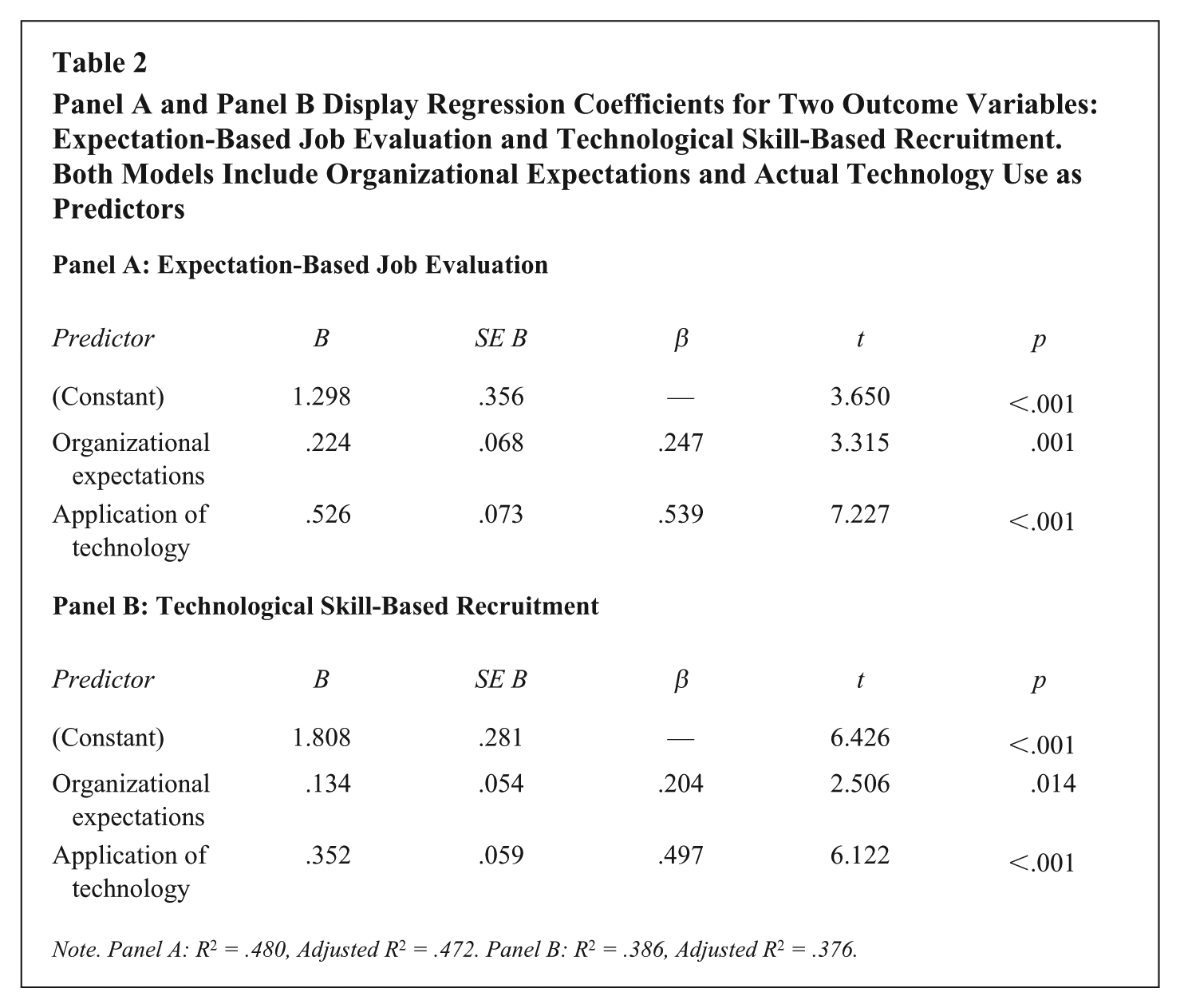
The first model assessed predictors of technology-based job evaluation. The regression was statistically significant, F(2, 122) = 56.34, p < .001, with an Adjusted R2 of .472, indicating that 47.2% of the variance in technology-based job evaluation was explained by the predictors (R2 = .480).
Both predictors were significant. Organizational expectations were positively associated with technology-based evaluation (β = .247, p = .001). Application of technology emerged as a stronger predictor (β = .539, p < .001), indicating that journalists who report greater integration of digital tools are more likely to perceive that technological competence influences performance evaluation, promotion, and job security.
The second model examined predictors of technology-oriented recruitment practices. This model was also significant, F(2, 121) = 38.61, p < .001, with an Adjusted R2 of .376, accounting for 37.6% of the variance in technology-oriented recruitment (R2 = .386).
Panel A and Panel B Display Regression Coefficients for Two Outcome Variables: Expectation-Based Job Evaluation and Technological Skill-Based Recruitment. Both Models Include Organizational Expectations and Actual Technology Use as Predictors
Note. Panel A: R 2 = .480, Adjusted R 2 = .472. Panel B: R 2 = .386, Adjusted R 2 = .376.
Organizational expectations significantly predicted the prioritization of technological skills in hiring (β = .204, p = .014). Application of technology again showed a stronger association (β = .497, p < .001), suggesting that organizations in which digital tools are more fully integrated are more likely to emphasize technological competencies in recruitment decisions.
Across both models, actual application of digital technologies was the most consistent and substantial predictor of technology-based evaluation and recruitment practices. These findings indicate that digital transformation within Bangladeshi legacy media extends beyond workflow adaptation to influence institutional criteria for performance assessment and hiring.
Journalists’ Perceptions of Newsroom Practices, Job Evaluation, and Recruitment
Thematic analysis identified two structural shifts reshaping newsroom labor. First, multimedia desks have expanded rapidly, staffed by technically skilled recruits such as mobile journalists, videographers, video editors, and digital content producers (Journalists 7, 11). Second, existing staff are increasingly expected to adopt digital tools and AI applications to accelerate production and meet platform-driven output demands (Journalists 2, 13). As one participant noted,
Everyone is racing to expand multimedia operations. This is where the audience is, and this is where revenue could be (Journalist 8).
Multimedia teams are responsible for mobile video reporting, live streaming, producing short-form reels, optimizing YouTube content, and maintaining continuous updates across websites and social media platforms (Journalists 3, 11). Additional hires focus on video editing, graphic design, and SEO to enhance platform visibility and engagement metrics (Journalists 1, 10). Several respondents emphasized that recruitment increasingly prioritizes digital and technical skills over linguistic, analytical, or interpretive competencies, except in specialized roles such as feature writing (Journalist 2). As one interviewee explained,
News organizations recruit content creators at lower salaries to expand YouTube output and compete with other media and influencers (Journalist 6).
Participants also described a shifting definition of “news,” with attention-grabbing material, such as celebrity updates or street incidents, repackaged as platform content if it generates engagement (Journalists 2, 9, 11). Multitasking has intensified, requiring journalists to report, script, produce video, and provide ongoing digital updates simultaneously (Journalist 5).
To sustain output, journalists are encouraged to use AI tools for drafting, editing, translation, headline writing, and visual production (Journalist 10). Those who adapt gain visibility and institutional value, while experienced reporters lacking digital proficiency increasingly depend on younger colleagues for technical support (Journalist 8). Some senior journalists reported declining productivity and heightened job insecurity as performance metrics shifted toward volume and platform engagement. One participant described,
Recently a special correspondent lost his job because he could not produce multiple tasks simultaneously. He explained that multitasking was affecting his investigative reporting, but the editor was not convinced (Journalist 7).
Respondents further noted cost-cutting measures, including reduced print circulation, staff downsizing, and shrinking editorial budgets (Journalist 1). Technology-proficient journalists are perceived as more secure within this environment, while those considered digitally limited face marginalization. Increased reliance on AI for editing, translation, and design functions was also described as reducing the need for traditional editorial and production roles (Journalist 7).
Mixed-Methods Meta-Inference
Integration of quantitative and qualitative findings refines and extends the statistical results by situating them within the political–economic conditions of Bangladeshi newsrooms. The regression analyses demonstrate that organizational expectations and individual technology use significantly predict technology-based job evaluation and recruitment priorities. While such relationships have been documented in prior studies of digital transformation, the qualitative findings complicate their interpretation.
Interviews indicate that organizational expectations are not experienced primarily as modernization goals, but as institutional responses to financial precarity, political asymmetry, and platform competition. What appears quantitatively as long-term professional alignment is described qualitatively as short-term survival strategy. Digital competence functions not merely as a valued skill but as a mechanism of organizational discipline tied to revenue generation, output acceleration, and algorithmic visibility.
Similarly, while the quantitative models show that technology use strongly predicts evaluation and recruitment outcomes, qualitative evidence reveals that this relationship reflects a deeper restructuring of newsroom authority. Performance metrics increasingly privilege speed, volume, and platform optimization, reshaping professional hierarchies. Senior journalists lacking digital fluency report diminished influence, while technologically skilled recruits—particularly those able to operate AI tools and produce monetizable multimedia content—are positioned as strategic assets within platform-centered business models.
This integration reveals that technological adaptation in Bangladesh is not simply an extension of global digital trends but a structurally intensified process occurring within a constrained media environment. Platform logics intersect with economic vulnerability and regulatory pressures, accelerating labor reconfiguration and altering definitions of professional competence.
Skill-Based Job Evaluation Predicts Journalism Quality
To address
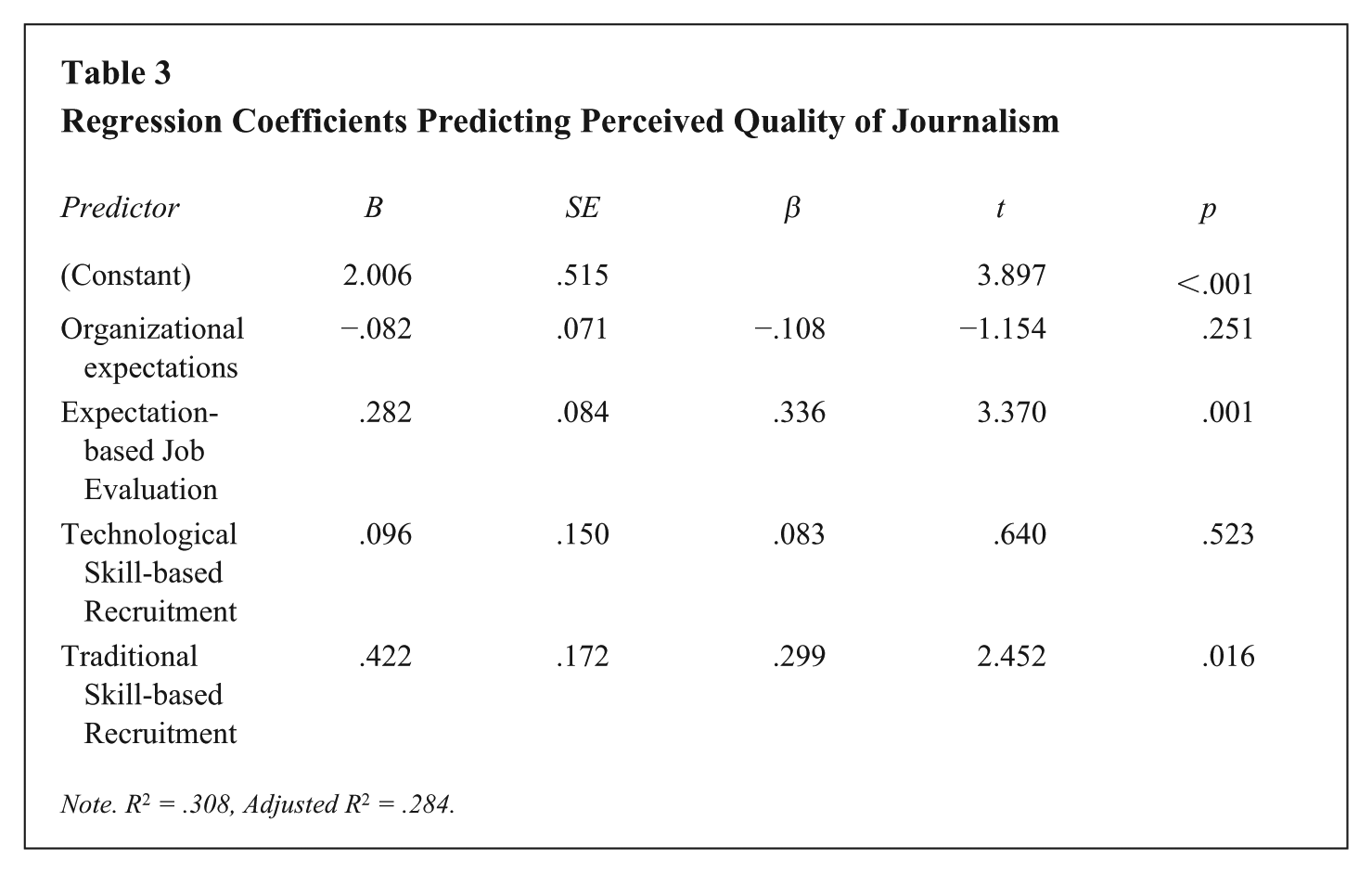
Technology-based job evaluation was positively associated with perceived journalistic quality (β = .336, p = .001), indicating that when technological competence is embedded in performance assessment, respondents report stronger evaluations of newsroom output. Traditional skill-based recruitment also emerged as a significant positive predictor (β = .299, p = .016), suggesting that the continued prioritization of conventional journalistic competencies remains associated with perceived quality.
In contrast, organizational expectations for digital adaptation (β = –.108, p = .251) and technology-oriented recruitment (β = .083, p = .523) were not statistically significant predictors. These findings indicate that perceptions of journalistic quality are more closely linked to evaluation practices and the preservation of traditional skills than to formal digital expectations or hiring emphasis alone.
Journalists’ Perceptions of News Quality Following Digital Transformation
Journalists consistently described a perceived decline in journalistic quality following the adoption of platform-driven production models. Several respondents referred to the emergence of a “hit-based” model of journalism, shaped in part by the influence of politically exiled YouTubers, in which speed and viewership metrics are prioritized over verification and editorial standards (Journalist 3). Under this model, journalists are pressured to produce high volumes of content, increasing the likelihood of factual inaccuracies and grammatical errors (Journalist 7).
Regression Coefficients Predicting Perceived Quality of Journalism
Note. R 2 = .308, Adjusted R 2 = .284.
As one participant noted, this shift is particularly visible within online and multimedia desks, where recruitment prioritizes technical proficiency over linguistic and interpretive competence:
Even though they rely on AI for writing and editing, they still can’t contextualize the news within the local socio-political environment. Many of them lack basic language skills in Bengali and make several spelling and grammatical errors (Journalist 10).
Journalists also reported a decline in investigative and in-depth reporting. The demand for rapid updates and continuous breaking news has reduced time available for verification and contextual analysis (Journalist 8). One senior journalist reflected,
Honestly, I can’t maintain my own standards because I don’t have enough time for serious reporting, even though I work more hours these days (Journalist 8).
Several journalists described an increasingly blurred boundary between journalism and influencer-style content. “We are competing with YouTubers now,” remarked Journalist 12, emphasizing pressure to replicate influencer strategies. Legacy outlets were said to adopt sensational thumbnails, emotionally charged headlines, and attention-grabbing framing designed to maximize engagement (Journalists 2, 6):
In most cases, the headlines are distorted intentionally to make the content viral, as done by prominent YouTubers, undermining credibility of news (Journalist 6).
Journalists further reported that some outlets publish provocative thumbnails, controversial framing, or graphic material on YouTube and social media channels—content that would not appear in print editions (Journalists 7, 10). One journalist described the growing circulation of disturbing or sensationalized footage for viral potential:
We are now going beyond scandalous reports of politicians and celebrities. Some outlets upload disturbing videos, such as, harassment of women, elderly people, or minors, or violent street fights without editorial judgment. These videos wouldn’t appear on the main news website but are pushed on official YouTube channels for their viral potential (Journalist 5).
Although financial pressures were widely acknowledged, many respondents expressed concern about the erosion of ethical standards. Some described deliberate blurring between responsible journalism and sensationalism, resulting in misinformation, inconsistent framing of events, and declining public trust (Journalists 1, 4, 6). As one participant observed,
Sometimes it becomes difficult to know what’s true. People criticize us yet actively seek out controversial and sensational content. Whether they see it as news or just entertainment is unclear (Journalist 2)
Overall, participants portrayed digital transformation as reshaping not only newsroom routines but also definitions of journalistic quality, with speed, engagement, and monetization increasingly displacing verification, depth, and editorial restraint.
Mixed-Methods Meta-Inference
Integration of quantitative and qualitative findings refines the interpretation of the relationship between digital adaptation and perceived journalistic quality. Quantitatively, organizational expectations for digital adaptation and technology-oriented recruitment were not significant predictors of perceived quality. Instead, technology-based job evaluation and traditional skill-based recruitment were positively associated with quality assessments.
At first glance, these statistical patterns might suggest that digital transformation is compatible with journalistic standards when embedded in evaluation structures. However, qualitative findings complicate this interpretation. Interviewees consistently described newsroom environments in which performance metrics privilege speed, engagement, and output volume, often at the expense of verification and contextual reporting. What the regression identifies as “technology-based job evaluation” is experienced by many journalists not as quality enhancement but as intensified performance monitoring tied to platform visibility and revenue imperatives.
Similarly, while traditional skill-based recruitment emerged as a positive predictor of perceived quality, interviews indicate that such recruitment practices are increasingly marginalized within multimedia desks. Participants described a widening gap between formal institutional rhetoric about quality and operational pressures favoring algorithm-driven production. In practice, digital hiring and rapid content turnover were perceived as diluting editorial oversight, blurring boundaries between journalism and influencer content, and increasing factual and linguistic errors.
Discussion and Conclusion
This study examined how legacy news organizations in Bangladesh navigate digital transformation within a politically constrained and commercially fragile media system. The findings show that platformization, particularly YouTube-centered distribution, operates less as technological modernization and more as a monetization strategy embedded within structural vulnerability. Digital adaptation is organized through interconnected mechanisms—organizational expectations, technology use, recruitment criteria, job evaluation systems, and contested definitions of quality—each shaped by platform logics and economic precarity.
A central empirical finding is that legacy outlets increasingly rely on short-form, platform-optimized video to expand revenue and audience reach. Journalists described YouTube-based distribution as an “innovative” business model suited to an oversaturated and advertising-dependent market (Khan & Urbanski, 2025; Rahman, 2022). Rather than revitalizing investigative or public-interest reporting, however, platform monetization intensifies commercial incentives tied to algorithmic visibility (Ferrucci & Perreault, 2021; Simon, 2024). Content strategies prioritize speed, affective framing, and engagement optimization. In this sense, digital transformation does not eliminate structural constraints; it reorganizes them through monetization infrastructures (Kim & Ihm, 2020; Suherman, 2025).
Interview data further indicate that this transformation accelerated following the 2024 regime change and repeal of the Cyber Security Act, developments that participants experienced as expanding the scope for online publication and monetization. The influence of exiled Bangladeshi YouTubers, who accumulated large audiences and shaped political narratives during the uprising, served as a strategic model for legacy outlets seeking digital scale and diasporic reach. In this respect, the Bangladesh case sharpens global scholarship on platform logic by illustrating how regulatory change, diaspora attention economies, and monetization infrastructures can converge to rapidly restructure newsroom strategy (Kim & Ihm, 2020; Nielsen & Ganter, 2022; Suherman, 2025).
The findings also qualify assumptions that financial stabilization enhances professional autonomy (Bourdieu, 2005; Hallin & Mancini, 2012). Although digital revenue streams offer economic relief, they do not necessarily strengthen watchdog capacity (Carlson, 2015; Schudson, 2011). Instead, platform expansion intensifies commercial incentives tied to algorithmic visibility, narrowing editorial priorities and elevating content optimized for engagement. Short-form, visually striking, and affectively framed material becomes highly valued, often structured to maximize controversy and attention (Guo & Volz, 2019; Nielsen & Cherubini, 2022; Papadopoulou & Kalogeropoulos, 2024; Salaverría & de-Lima-Santos, 2021). The findings therefore suggest that constraints on journalism do not disappear in post-censorship moments; rather, they are reorganized through commercial and algorithmic infrastructures (Ferrucci & Perreault, 2021).
This shift carries broader political and cultural implications. Whereas previous constraints were frequently associated with overt state control, contemporary pressures operate through monetization logics that shape what becomes visible and profitable. Socially and culturally, the pursuit of virality reinforces demand for sensational and conflict-oriented content, blurring distinctions between journalism and entertainment (Gollmitzer, 2023; Khawar & Boukes, 2024). These dynamics align with broader scholarship demonstrating how algorithmic incentives reshape news values and editorial decision-making (Nielsen & Cherubini, 2022; Nielsen & Ganter, 2022), yet the Bangladesh case reveals how such processes intensify under conditions of economic fragility and political transition.
The study also illuminates significant reconfigurations of newsroom labor and newsroom governance. The incorporation of independent mobile journalists and digital content creators into multimedia desks illustrates how occupational value is increasingly tied to platform visibility and technological fluency rather than institutional tenure. This finding supports arguments that journalistic authority is socially constructed and contingent (Carlson, 2015; Schudson, 2011). Here in case of Bangladesh, legacy organizations appear to be internalizing new forms of skill evaluations associated with digital reach and algorithmic performance, displacing capital rooted in editorial expertise and investigative depth (Bourdieu, 2005; Conboy, 2023). These dynamics align with post-industrial journalism scholarship (Deuze & Witschge, 2018): newsroom hierarchies flatten, multitasking intensifies, and technological adaptability becomes central to occupational value.
The relationship between digital adaptation and journalistic quality emerges as particularly complex. Regression results show that technology-based evaluation and traditional skill-based recruitment are positively associated with perceived quality, while general digital expectations and technology-oriented recruitment alone are not significant predictors. On the surface, this suggests that quality may be preserved when evaluation systems integrate digital competence without abandoning traditional skills. However, interview data complicate this interpretation. Journalists described newsroom environments where engagement metrics privilege speed and volume, often at the expense of verification and contextual reporting. In practice, “technology-based evaluation” reflects institutional alignment with platform performance demands. Traditional competencies remain symbolically associated with quality but are increasingly marginalized in multimedia workflows. Quality, therefore, becomes a negotiated institutional category shaped by monetization imperatives rather than a stable professional standard.
Importantly, variation persists. Some print and broadcast divisions reportedly maintain stronger editorial norms, indicating that platformization does not deterministically erode professional standards. Instead, differentiated newsroom cultures emerge, with varying degrees of resistance to algorithmic sensationalism. This nuance tempers deterministic narratives of decline and highlights institutional agency within constraint.
Methodologically, the explanatory sequential design strengthens interpretive depth by linking patterned survey relationships with context-specific meanings surfaced through interviews (Creswell & Creswell, 2023). The quantitative strand identifies systematic associations among expectations, technology use, evaluation, recruitment, and perceived quality. The qualitative strand refines these associations by situating them within political–economic conditions of advertising dependence, regulatory asymmetry, and platform competition. Integration reveals that similar statistical relationships documented in Western settings may produce intensified labor precarity and redefined professional hierarchies in constrained environments. The contribution of the quantitative analysis, therefore, lies not in identifying novel correlations but in demonstrating how institutional mechanisms of evaluation and recruitment embed platform logics under structural vulnerability.
Several limitations warrant caution. The purposive sampling strategy and qualitative focus on senior journalists mean that findings reflect perspectives of professionals positioned within organizational decision-making structures. Younger and precariously employed multimedia workers may experience digital transformation differently. Future research incorporating early-career journalists, freelancers, and regional newsrooms would extend the explanatory scope. In addition, conclusions regarding sensationalism and declining quality are grounded in self-reported perceptions rather than direct content analysis. These perceptions are analytically meaningful as indicators of field-level interpretation but do not constitute objective measures of output. Complementary methods, such as content analysis or newsroom ethnography, would provide valuable triangulation.
Overall, the Bangladesh case demonstrates how platformized news production can generate economic vitality while simultaneously reorganizing professional hierarchies and contested standards of quality within a politically constrained and resource-limited media system. Digital transformation appears driven less by innovation in journalism than by innovation in monetization, with YouTube-centered strategies functioning as structurally transformative forces (Khan & Urbanski, 2025; Rahman, 2022). By extending disruptive innovation and post-industrial journalism frameworks to Global South conditions (Christensen, 1997, 2006; Deuze & Witschge, 2018), the study shows how platform logics become embedded in newsroom governance, intensifying tensions between commercial survival and professional standards (Bourdieu, 2005; Hallin & Mancini, 2012; Schudson, 2011).
Supplemental Material
sj-csv-1-nrj-10.1177_30497841261453539 – Supplemental material for YouTube-driven news production in Bangladeshi legacy media: How an “innovative” business model reconfigures journalism
Supplemental material, sj-csv-1-nrj-10.1177_30497841261453539 for YouTube-driven news production in Bangladeshi legacy media: How an “innovative” business model reconfigures journalism by Ershad Komal Khan and Harsha Gangadharbatla in Newspaper Research Journal
Footnotes

References
Supplementary Material
Please find the following supplemental material available below.
For Open Access articles published under a Creative Commons License, all supplemental material carries the same license as the article it is associated with.
For non-Open Access articles published, all supplemental material carries a non-exclusive license, and permission requests for re-use of supplemental material or any part of supplemental material shall be sent directly to the copyright owner as specified in the copyright notice associated with the article.
