






Abstract
Covering a mass shooting can change a journalist’s outlook on the profession and craft of journalism. Some journalists thought of themselves as trusted in the community and righting wrongs, while others questioned the value of their coverage, regretted their processes or reflected on the ethical challenges they faced. The 51 journalists interviewed in this article demonstrated the media functions described by Weaver et al.—interpretive-watchdog, adversarial, disseminator and populist-mobilizer.
In 2018, a gunman opened fire on the Route 91 Festival in Las Vegas, killing 58 people and wounding hundreds (Pearce, 2018). Las Vegas reporters were on the scene in minutes (Crosby et al., 2017). When violence breaks out, journalists join first responders in running toward the danger. A mass shooting that reaches anywhere near the scale of the Las Vegas shooting often leads to around-the-clock coverage for days, including vigils, funerals and profiles. In the weeks following, journalists cover police press conferences, criminal proceedings and community reaction. In the months and even years following, journalists conduct investigations to learn what went wrong and what could have been done differently. The results can be awards and accolades, appreciation from the community and fellow journalists, and a renewed outlook on the value of journalism.
But for some journalists, covering a mass shooting changed their view of journalism. I interviewed 51 journalists who covered a mass shooting—23 who covered the Las Vegas shooting, 18 who covered the Pulse nightclub shooting in Orlando and 10 who covered the Marjory Stoneman Douglas High School shooting in Parkland, Florida—to understand the experiences of these journalists and to learn how these experiences affected their views on the field and craft of journalism. This study builds on the growing body of literature on the effect of mass shootings on journalists (Arrey & Reynolds, 2023; Hill, 2023; Markovikj & Serafimovska, 2023) and the literature on how journalists view their jobs (Weaver et al., 2019).
Literature Review
Relevant literature for this study comes from three main areas of study—journalists covering trauma, journalists’ understanding of their jobs and journalism ethics.
Journalists Covering Trauma
The mental health of journalists has received increasing attention in recent years. Scholars have suggested that journalists experience “vicarious trauma” (Xiong & Liao, 2024). Vicarious trauma is an idea that started with therapists and their experience of other people’s trauma (Steed & Downing, 1998). Xiong and Liao (2024) found reporters in China who practiced “emotional livelihood journalism” experience vicarious exposure to trauma but also post-traumatic growth, improvements that come after trauma. Charles (2022) argues that some journalists experience continuous traumatic stress (CTS), not just post-traumatic stress (PTS), because of the ongoing nature of their exposer to traumatic situations. Shilpa et al. (2023) found that mental health in media professionals in India decreased after the COVID-19 pandemic and that covering the pandemic can lead to nightmares and disruptive memories.
With increased attention to the mental health of journalists who are exposed to trauma, more resources have been made available. The Dart Center for Journalism & Trauma from the Columbia Journalism School has resources for educators, managers and journalists about the science of trauma and strategies for covering it (Dart Center, n.d.). The Society of Professional Journalists (SPJ) hosts panels and conferences and publishes news stories about trauma in the news industry (Woolard, 2022). Journalism and Mass Communication Educator dedicated an entire issue to trauma literacy in the media, including articles about student journalists covering an execution (Hill, 2023) and the need for mental health education in the mass communication curriculum (Arrey & Reynolds, 2023; Markovikj & Serafimovska, 2023). It is clear that many journalists are exposed to trauma, even more so when covering a mass shooting. This study aims to understand what that coverage does to their understanding of their jobs.
Journalists’ Understanding of Their Jobs
Experiencing the vicarious trauma might lead journalists to reflect on their work critically. When the community most needs them, the journalists might review how they did and why. For example, the COVID-19 pandemic, a news story that dominated for more than a year, created stress in journalists that was associated with occupational alienation (Alaimo et al., 2023). Generally, journalists think of four main journalism roles (Weaver et al., 2019), according to a 2013 survey of 1,080 journalists. First, the interpretive-watchdog function involves investigating the government and analyzing problems. Second, the adversarial function assumes an adversarial relationship between the press and the government. The disseminator function is about getting information quickly and efficiently to the widest audience. Finally, the populist-mobilizer function allows the public to express their views and motivates people to get involved.
Weaver et al. (2019) also compared the 2013 data with similar surveys in 2002, 1992, 1982 and 1971. Results showed a 28% reduction in the journalist workforce between 2002 and 2013. They found that journalists were mostly satisfied with their jobs, but the percentage of those who said “somewhat” or “very” dissatisfied increased 9% since the 2002 survey. Their results indicate that journalists have lost the ability to choose which stories or aspects of stories to cover.
Weaver et al. (2019) found that journalists still value the watchdog role of the press and the importance of explanatory journalism—both of those numbers were higher in 2013 than in any previous survey. Considering Donald Trump’s adversarial attitude toward the press and the need for clear information during the COVID-19 pandemic, journalists’ attitudes toward watchdog and explanatory journalism seem unlikely to decline. Weaver et al. (2019) found that reporters in 2012 were less likely to use “controversial” reporting techniques like using confidential documents without permission, badgering sources and getting employed to gain access to information. Lanosga et al. (2017), however, found that investigative reporters were more open to controversial reporting techniques when compared to U.S. journalists as a whole, according to their survey of 861 self-identified investigative journalists.
Mellado (2015) proposes an alternative to self-report survey methods to understanding professional journalism roles. Instead, she suggests looking at the content and outcomes that would result from journalists who value particular roles. She conceptualizes three dimensions of “journalistic role performance”: Presence of the Journalistic Voice, Power Relations and Audience Approach. Each of those dimensions would manifest in the content created by the journalist. Presence of Journalistic Voice, for example, would include first-person voice, adjectives, taking sides; Power Relations would include watchdog journalism known for questioning those in power and investigative reporting. While this study does not try to use the work journalists produce to determine roles, it does go deeper than a self-report survey. In-depth interviews, with the focus on narratives and reflections, provide insight.
Journalism Ethics
Ethics inevitably come up when discussing a journalist’s view of the job, especially when covering victims of crimes. Journalistic ethics can most easily be summarized by the SPJ’s code of ethics and its four principles—Seek Truth and Report It; Minimize Harm; Act Independently; and Be Accountable and Transparent (SPJ, 2014). While the SPJ attempts to codify ethical journalism, scholars have seen how ethics is often situational and contextual. For example, Henkel et al. (2019) and Mellado et al. (2013) studied ethics from an international lens, comparing how ethics are practiced or taught in different countries. Reader (2006) compared the approaches to ethical issues at large and small newspapers. He found that larger newspaper staffs appear to be more concerned with their reputation, while smaller newspaper staffs appear more concerned with their connection to the community. “You live in the aftermath,” one participant said (p. 861). Ferrucci and Taylor (2019) explored the complex and evolving norms around digital photo editing. Interview participants indicated that the norms vary organization-to-organization, with little top-down industry-side standards.
One context that might challenge a journalist’s execution of the code of ethics would be covering violence and terrorism. Abubakar (2020), for example, interviewed 41 journalists who covered the Boko Haram insurgency in Nigeria. He found that journalists wrestled with issues like selecting content to inform, but not create fear; choosing terms that were accurate and would not minimize or exaggerate issues; and avoiding “aiding and empowering” extremists (p. 293). Ghersetti and Johansson (2021) used survey results from 1,092 journalists and 3,881 citizens in Stockholm, Sweden, to compare how journalists and the public assess ethical decisions. One interesting finding is that journalists who were involved in the coverage were more forgiving of incorrect reports.
Coverage of a mass shooting can put journalists’ action in direct contact with the SPJ principle of “Minimize Harm.” Scholars have argued this principle could be better accomplished through the framework of “ethics of care.” Vanacker and Breslin (2006) summarize the attitude of a journalist practice ethics of care:
For example, the more the vulnerable a crime victim is as the unexpected subject of a news story, the more the values of compassion and dignity from a care-based approach should trump traditional journalistic values, such as objectivity and truth telling.
Hossain and Aucoin (2018) argue that journalists should “incorporate more sustained and focused attention to the suffering and discrimination of vulnerable groups in society” (p. 202).
Anastácio and Aufderheide (2026) examined 23 journalism organizations; statements of ethics and conclude that the ethics of care is “hidden among core journalistic values” (p. 2). Journalists can honor their core values, like accuracy and independence by “engaging in care practices” (p. 2). Similarly, Walsh-Childers et al. (2011) found that victims and survivors of the Virginia Tech shooting wanted the media to practice more care as they approached vulnerable sources. Miller and Dahmen (2020) concluded that photojournalists show more concern for their subjects than their audience when taking graphic or shocking images. The photojournalists are concerned with gaining permission prior to taking a photo, and they consider the impacts of taking and publishing the photo.
Research Question and Objectives
This study aims to answer an overarching research question: How does covering a mass shooting change a journalist’s approach to the field of journalism?
The answers to that question will address ethics, interviewing victims, holding the powerful to account, informing the community, documenting history and even wrestling with the struggling economics surrounding community news. To get those answers, this study explores and describes the lived experience of journalists at local news organizations in Central Florida, South Florida and Las Vegas, sites of major mass shootings.
Background
These three mass shootings—the Pulse night club shooting in Orlando, and the Route 91 Festival shooting in Las Vegas, and the Marjory Stoneman Douglas High School shooting in Parkland, Florida—came in relatively rapid succession, a span of 20 months. These shootings drew attention. The Orlando shooting set the record for highest death toll at 53 when a shooter opened fire in a crowded gay nightclub in Downtown Orlando (Ellis et al., 2016). In a grim competition, the Las Vegas shooting surpassed that record less than 16 months later with a death toll that was revised to 60 (Lacanlale, 2020) when a shooter broke a window on the 32nd floor of the Mandalay Bay Resort and Casino and opened fire at concertgoers 400 yards away. Four and a half months later, the nation saw echoes of the Columbine High School shooting as a former student killed 14 students and 3 staff members at Marjory Stoneman Douglas High School (Alanez et al., 2018). These tragedies left indelible images of grief, pain and horror (Foster-Frau et al., 2023; Gajanan, 2019).
Method
Qualitative research allows inquirers to explore participants’ experiences richly and deeply. The goal is not to create generalizable knowledge but to understand the range of experiences of a phenomenon (Creswell & Poth, 2018). This article follows the spirit described by communication scholar Pauly (1991), who suggested that qualitative researchers’ goal is to become “wise in the ways of others” (p. 23). With that goal in mind, I will prioritize participants’ voices alongside my analysis.
This study includes 51 participants who worked at newspapers, radio stations and television stations. The diverse sample includes junior reporters in their first or second year of their career to senior managers with 30 or more years of experiences. It includes photographers and camera operators, anchors and producers, reporters and editors (Table 1). Several reporters were on the scene as soon as possible, sometimes arriving when the scene was still active and the danger still present. Some reporters took on investigations and long-term projects to unravel the story. Participants were recruited via direct emails to publicly available email addresses or through coordination with a newsroom leader or manager.
Roles, Media Type, Location and Date
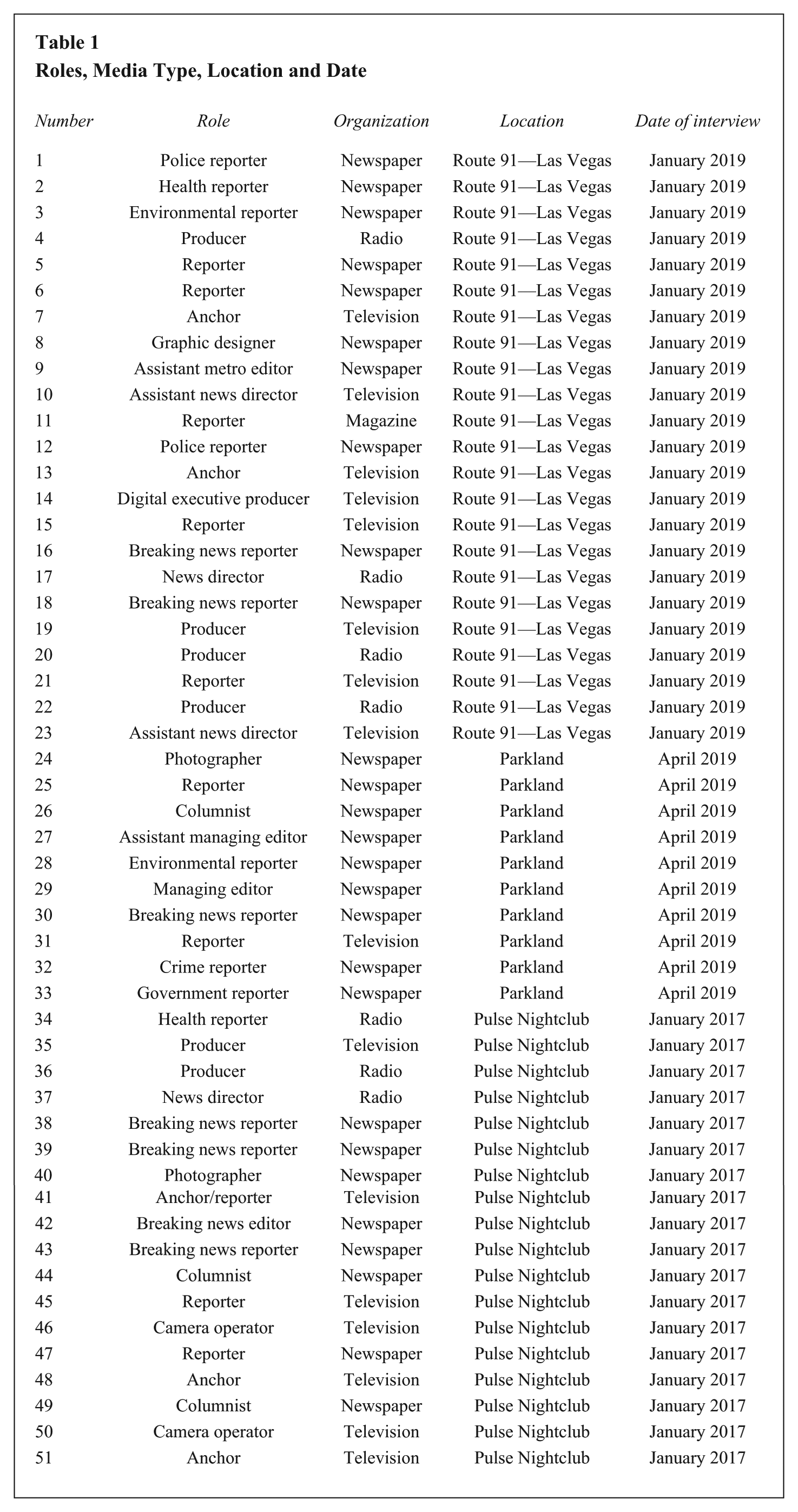
The interviews followed a research protocol that was approved by an institutional review board (IRB). Participants were asked to recap their careers, to describe their participation in the coverage of the shooting, to describe ethical issues faced during the coverage, to explain what mental health resources were provided by their organizations or what they did to cope, to describe what this coverage did to their perceptions of journalism—both their work and its role in society. The Pulse interviews were conducted in January and February 2017, more than 6 months after the shooting. The Las Vegas interviews were conducted in January and February 2019, about 16 months after the shooting. The Parkland interviews were conducted in April 2019, about 14 months after the shooting.
All participants signed an IRB-approved informed consent form. Interviews lasted from 30 to 70 min and were done in person, save for one conducted via video conference and were transcribed by the researchers with help from a transcription software Otter.AI. 1 The overarching goal of the semi-structured interviews was to understand what these journalists went through while covering a mass shooting. However, the interviews touched on their views on journalism, newsroom culture, ethics and more.
Once the interviews were transcribed, participants reviewed the transcript for accuracy and to highlight any sensitive information they wanted protected. I used a data coding and analysis process similar to Stout (2004). I read through each interview again, searching for codes dealing with the journalism profession—roles, values, ethics and job satisfaction, for example. I looked for phrases of praise or criticism of their own work, the work of their newsroom, or work of other newsrooms and the news industry at large. After the initial coding, I organized the codes into larger themes, looking for common observations as well as unique opinions, trying to understand common experiences as well as finding the range of experiences. After organizing the codes into themes, I sought to define, explain and interpret the themes, using direct quotations from the participants as evidence.
Results
The journalists who participated in this project reflected several themes about how they viewed their craft. The following sections describe and support those themes.
“We Cemented Our Trust”
Many journalists talked about how their focus was on getting accurate information for their communities. When they think about their work, they are thinking about readers, viewers or listeners who live in their community. One Central Florida TV photojournalist said, “We told the story the best we could. I think the viewers appreciated it. And hopefully we cemented our trust with our viewers.” The reporters wanted to be helpful: a Central Florida TV reporter said, “We did what we could to assist our fellow citizens by providing them with information.”
That commitment was often put in contrast to the national media organizations that “parachute” into town during these crises. Those national journalists took up resources and landed preferred interviews, but were not connected to the community. One Las Vegas TV anchor said the national media techniques were sometimes “greasy.” A Central Florida TV reporter said after the national media leaves, her team remains:
We’re still here. We still talk to these people. We still reach out to them and, you know, try to talk to them about their stories. So it’s really important that we handle it differently. And then already you pick up the pieces form the things that [national media members] did.
For that reporter who lives in the community she reports on, the national media threatened the trust they wanted to earn and keep with thoughtful, accurate and considerate reporting. This reflects Reader’s (2006) conclusion that staffs at small newspapers appear to be more concerned about their local communities.
However, some journalists thought their commitment to their communities did not always show up in their coverage. One Las Vegas reporter said, “I think we didn’t do a good enough job covering it as a local paper, . . . we should be covering more as a local paper rather than national paper.” He said they chased stories that were already covered by the better-resourced national media instead of focusing more closely on the stories that the national media could not or would not cover. One South Florida reporter said that “our management went insane chasing after awards.” That duty to inform was heavy, and some journalists did not think they lived up to it.
“I Am an Observer”
Many journalists in this project embraced the idea that they act as neutral conveyors of information. Their job is a “noble pursuit” to be an “instant historian,” as one Central Florida TV camera operator described. He said,
My goal is to capture this thing. I am an observer[. . .] My overall goal [. . .] is to transport the viewer to where I was standing. I want them to see and hear what I am seeing and hearing.
For some, this was an obligation. The job is to “bear witness” to the events. During times of crisis, this was not just about feeding the content machine; it was about providing valuable, accurate information. “When [expletive] hits the fan big time like this, everybody runs to a TV,” one Central Florida TV anchor said. She said she felt “honored and proud” to be in the anchor chair during that terrible time for her city.
A Central Florida radio producer listened to hour after hour of 9-1-1 tapes of the Pulse shooting. He used the analogy of a “filter.” He listened to the call and picked out what his listeners needed:
. . . so someone like my wife, if I ever have kids, so that they don’t have to read all that bad terrible stuff. And my job is to go through and filter it, and, you know, I keep the real bad stuff from getting out there but still getting the story out there.
Like a filter that collects dirt and lets clean air pass through, this reporter absorbed the brutal content from those 9-1-1 calls so his listeners did have to. A South Florida reporter used a different metaphor: “You’re like a sponge, absorbing all of that.” She absorbed the grief of her sources and tried to help her readers understand that grief. “I’m very, very, very proud of the work we did,” she said.
Many journalists talked about the negative side of that responsibility. One Central Florida newspaper reporter noticed other reporters posting nearly identical request for an interview on the social media pages of family members. She said, “I’m like, ‘Oh my god. This is just embarrassing; we are all a bunch of vultures. We are just all a bunch of vultures trying to get the story’.” Another Las Vegas newspaper reporter said she thought in journalism school that she was supposed to be a third-party “vessel” for the story. A professor disabused her of that notion late in her education. Covering the Las Vegas shooting, she experienced how much the story affected her and how inadequate the “vessel” metaphor was. One Las Vegas newspaper reporter suggested that the “obligation first and foremost” to produce stories put “blinders on” the team, preventing them from noticing reporters who were struggling and needed more care. The obligation and honor these journalists felt to be the vessel, filter or observer for the readers, viewers and listeners may have prevented them from seeing some of their own struggles or the struggles of their colleagues and employees in the newsroom.
“We’re Righting Wrongs”
After each mass shooting, journalists get to work investigating what happened and how it could have been prevented. While several journalists were concerned about “tragedy fatigue”—are the readers tiring of the constant coverage?—these investigations can keep the shooting in the news for months and years. One Central Florida editor said the investigation into the Pulse shooting was how they honor the victims. She said, “I think that we are protecting and honoring the memory of those people who died and those people who were injured.” Their investigation, among other issues, was trying to determine if any victims were killed by police gunfire or why the police waited so long to enter the club. That investigation needs to happen, she said, “because that’s our job as reporters. And if we learn something about what happened, it won’t happen again.”
Journalists talked about “the fourth estate” and their “concern for democracy.” One Las Vegas graphics designer said the newspaper can use the “pen” as a “sword.” A Las Vegas assistant news director said journalism is a great business to be in “if you want to change the world.” One photographer said the work her paper was doing to investigate the Parkland shooting was making a difference. “Things are happening because of the work that we do,” she said. One South Florida reporter said of their investigation, “I think we’ve done everything that we could, and we still are investigating the hell out of it.” She and her colleagues were nearly held in contempt of court for finding information on a poorly redacted document. A Las Vegas reporter said more than a year later, they were still watching the body-worn camera footage: “if they had made a major, major mistake and no one knew about it. Like, hello. We have to hold them accountable,” she said. The desire to hold those who mishandled their responsibility drove many of these journalists to work as hard as they did.
“We’re so Diminished”
A major stress to the modern newsroom, especially daily newspapers, is the economic outlook. The reduction in staff has been well documented (Bauder, 2024). Several reporters commented on how their newsrooms are smaller. Many mentioned layoffs and buyouts—sometimes sardonically—“Survivor Island” one South Florida photojournalist described it. A Central Florida reporter said, “I think our industry is not healthy, and I’m glad I have my master’s.” This reality has an impact on how they cover every story, but especially with a story as big as a mass shooting. Fewer reporters means a combination of more stress on the smaller staff and more stories not getting told due to resource constraints. A reporter from South Florida said, “We were so diminished. It was—it was a very difficult story to cover with so few journalists now.” During her coverage of the Marjory Stoneman Douglas shooting, she covered stories that were out of her comfort zone. She said, “So I’ll do anything to help the paper, you know, serve the community. And if it if it means a few tears have to get shed, then that’s just the way it’s going to be.”
Another Las Vegas newspaper reporter talked about how the economics might affect a reporter’s mental health:
So right, people are being laid off at a at a whim, and you don’t get a raise, and maybe you don’t have a job next year. And your prospects for getting a job tomorrow is not very good. So yeah, this is not a great business to be in if you’re looking for someone to really care about you. You know what I mean?
A Las Vegas reporter said because newsrooms are shrinking, journalists do not want to appear weak, potentially ending up in the next round of layoffs. He said, “I find what we do so important, but I’m scared to death that it will ruin me financially or put me in such a precarious place that I can’t depend on it.” He later said, more than once, “Working in journalism is one of the worst decisions you can make for your mental health.”
These reporters felt that when the community really needed them, they were not strong enough to be there. While they feel that fact every time a reporter has to choose which city council meeting to cover, a major story like a mass shooting exposes the costs of diminishing newsrooms.
“Is What I’m Doing Right?”
These shootings led several journalists to reflect on the practices of their industry, becoming self-critical. For example, one Las Vegas reporter approached a concertgoer whose shirt was torn and bloody and asked for an interview. The woman yelled and cursed at the reporter. “So she lost it, and I lost it,” the reporter said. She cried behind a tree and thought to herself, “Is what I’m doing right?” Her story was a dramatic version of a not uncommon thought—what is the right way to do this work? One radio reporter in Central Florida was concerned about what he called “gore porn.” Another wondered if he was capturing “grief porn.” He said he wondered if “things that we are putting out are helping people or hurting.” A Las Vegas reporter was worried about glorifying the violence:
But also, especially early on, it almost felt like we were like beating a dead horse sometimes. And it almost felt like we were glorifying the violence that happened that night. I know we try very hard not to do that.
Similarly, a South Florida photojournalist demonstrated the ethics of care approached described in Miller and Dahmen’s (2020) study of photojournalists covering graphic or shocking scenes. She said,
Every time you take a picture, you have to think how much is this helping or hurting somebody? How much is this picture going to, you know, move someone? How much is this picture going to matter? Do I really need to take this picture and expose this personal grief?
Another Las Vegas reporter said she questions the way that news organizations cover these tragedies. The “sheer amount of reporting,” she said, might be glorifying these crimes more than they should. “I think now I find myself questioning what I’m doing more often than I did,” she said. Another reporter from Las Vegas said she thought her newspaper needed to “pump the brakes a little bit.” She said, “In the end that kind of like bombardment of coverage, I don’t think does really anybody any good.” Other journalists echoed the challenge of knowing how much coverage is too much.
A Las Vegas reporter said watching the police body-worn camera footage was hard on the journalists, but also seemed to harm the readers:
So there were times like that where I was like, what, why are we doing this? And you know, people would tell us, definitely me, I would hear from sources like we want, we want to move on. We’re done. And we’re not talking about this anymore, I want to move on. And it almost felt like, “Well, I’m not allowed to,” you know, so.
A reporter from South Florida showed the concerns called for by Walsh-Childers et al. (2011). The reporter said she understands that interviewing a victim might “retraumatize” them. “I try to be as respectful of their space as possible,” she said. Another South Florida reporter said calling witnesses, victims and family members is hard, but needs to be done:
So it’s one of those journalism jobs that feels icky. And nobody likes to do it. Nobody wants to do it. We all wish we didn’t have to do it, but it has to be done. And you do it as ethically as you can. You do it as kindly as possible and as gently as possible.
A Central Florida reporter said he does not think about ethics because it has become instinctual:
I think reporters like myself who have been in the game for so long, that especially if you cover criminal justice, you’d know after certain length of time, you know when to pull back, you know when to pursue, you know when to give people a chance to breathe.
It’s not that he does not care about ethics—it is that he cares so much about ethics that he knows his action will align with his ethics.
A Las Vegas breaking news reporter said he questions sometimes why he continues to do this difficult work, covering murders, accidents and crimes. He loves being a journalist, he said. “I know what I do has value even if sometimes I have a hard time seeing that what I do has value.”
“We’re Living With This Story”
The trauma of covering such a tragedy had an impact on many of these journalists. Very few broke down while they were “on the job”—upholding the image of the dispassionate vessel of information that is often held as the ideal. One from Las Vegas, described above, broke down in tears after being cursed at by a survivor. A Central Florida reporter called her boyfriend a few hours into coverage and started crying while on the phone.
But for many, the tears and pain came later. A South Florida photographer was driving home 2 days after the shooting in Parkland when her emotions overcame her:
I was getting off of the exit from the freeway to turn to go to my house. And I noticed that like the front of my shirt was wet. And I guess I had been crying all the way home, and I didn’t realize it.
One reporter was triggered by a song from the musical Hamilton. Another was a John Denver song. Some were watching the news later that day. A Central Florida TV anchor would drive around in her car in a daze. She said, “My poor family that has to deal with it because I kind of become like a zombie.”
Because these stories stretch out much longer than the typical breaking news cycles, some journalists were thinking about mass violence every day for months or more as they covered trials, investigated the authorities and commemorated the lost. A reporter who worked on the investigation into the Parkland shooting said she’s “living with the story”:
I’ve friended so many people—parents, cousins, friends, siblings, you know, of the victim—that they’re so my social media is full of these people. So I’m constantly waking up and seeing a video of you know, excuse me . . .(crying).
Some found positive ways to cope with the trauma—focusing on the good they are able to do through their work, finding joy with their time with family or even signing up for a first marathon. Others, however, struggled—drinking more, not eating or sleeping well, and carrying guilt about how much or how little they are working.
Conclusion
This study shows how journalists wrestled with the three areas described in the literature review—dealing with vicarious trauma, struggling with ethics and rethinking their roles as journalists. These journalists experienced the “vicarious trauma” (Xiong & Liao, 2024) as they covered these stories. The effects of the trauma the Central Florida journalists who covered Pulse and South Florida journalists who covered Parkland have been reported in detail (Petersen, 2025; Petersen & Soundararajan, 2020) as well as lessons journalism educator and newsroom leaders can learn from these reporters (Petersen, 2024). That trauma was not shared equally among the participants—some seemed unfazed while some were troubled months later. For many, that trauma led them to reflect and rethink the way they do their jobs, including the ethics of covering mass shootings and the value their work brings to the community.
Ethics
The SPJ Code of Ethics provides direction for navigating the ethical quagmires that can come with practicing the craft of journalism. However, the code leaves room for gray areas: “minimize harm,” rather than do no harm, requires a judgment call from the journalists. How much harm is acceptable? Who should be harmed? When is the potential harm worth the overall good that comes from reporting? Veteran journalists, like the Central Florida reporter who said he does not think about ethics, might be confident working in the gray zone. Other reporters, maybe those less experienced or those thrust into the dark world of breaking news and crime reporting, might struggle navigating zone.
As suggested in recent literature, these journalists might better navigate this territory using the ethics of care (Anastácio & Aufderheide, 2026; Hossain & Aucoin, 2018; Miller & Dahmen, 2020; Walsh-Childers et al., 2011), where journalists consider the vulnerability of the sources they are contacting. They showed glimpses of it—many developed relationships with the families of victims. Some showed a resistance to editors who might demand more than the reporter was willing to push for. They talked about recognizing the humanity of the people they interviewed and respected those who declined. But very few described the kind of thoughtful reflection the ethics of care researchers call for.
Another SPJ Code of Ethics principle is “Seek truth and report it.” That principle is not written in the negative, like minimize truth. It does not describe behaviors and outcomes to avoid. Instead, it is a command. This is what you MUST do: find the truth and share it. Several journalists in this study said it was their job to cover these shootings. It did not seem like a callous comment, but rather as a statement about the important role journalists play in uncovering the truth and informing the community. These reporters felt the tension between the ethical obligations to seek truth and minimize harm.
Journalistic Roles
This study shows that going through the process of reporting on a mass shooting—whether as a breaking news reporter on the scene, as an investigative reporter figuring out how this could happen or a features editor leading the coverage of the aftermath—can alter a journalist’s view of the profession and craft of journalism.
The media roles described by Weaver et al. (2019) showed up in the findings from this project. The most common appeared to be the disseminator function, especially early in the coverage. These massive breaking news events are full of uncertainty—how many shooters? How many victims? Is the situation resolved? What was the motive? Viewers, readers and listeners crave clarity, and journalists try to provide that. That explains why a Las Vegas reporter was at the scene in minutes—so close that he ended up getting evacuated from the hotel like a tourist. That explains why environmental, health and government reporters ended up covering breaking news. The public needed information, and they turned to the journalists to provide it.
As the coverage shifts, the media organizations often shift to the populist-mobilizer function. Reporters cover funerals and write obituaries. They contact loved ones in effort to “tell victim’s story” and let the survivors be heard. One Las Vegas reporter said he wrote 18 obituaries. A South Florida report said she ran out of black clothes covering funerals.
The next phase represents the interpretive-watchdog function. Once the shooting is over and the community slowly understands the gravity of the event, reporters shift into investigation mode. How could this have happened? Who was responsible? How was the shooter able to accomplish this? How effective were the police, school system or hospital system responses? The Central Florida radio producer who listened to all of the 9-1-1 calls from Pulse or the Las Vegas reporter who stopped what he was doing every Friday to review the latest document released from the police were operating in the watchdog function.
It is not uncommon for the watchdog function to turn adversarial. Several news organizations sued police departments or the school system for access to records. A South Florida reporter was threatened with jail and contempt of court for “un-redacting” a poorly redacted document. Here, the reporters are clearly on opposite sides from the government, advocating for transparency and accountability.
These four phases provide useful explanations of these journalists’ experiences. However, these in-depth interviews revealed deeper and more concerning understandings of their experiences. These journalists describe the ethical challenges when the editors want something—more stories—that the reporters and maybe even the audience do not. These reporters suffered the stress from this coverage and the lack of mental health resources, doing “more with less” and worrying about the next round of layoffs. Many of them, through all of it, wondered if their work was providing value to their viewers and readers.
Limitations and Future Research
This study reached a wide range of journalists, providing a wide range of perspectives. Future researchers might learn more from a narrower group. For example, what effect did a major breaking news story like a mass shooting have on the editors who stayed in the newsroom and managed the reporters in the field? How did television anchors reflect on the wall-to-wall coverage they did during the hours after a mass shooting? Future studies could also focus on other types of traumatic coverage. Are the findings different when covering protests that might turn violent, police shootings, extreme weather events or terrorism attacks? Studies could focus on how college newsroom handled on-campus shootings. Did those experiences strengthen their desire to become journalists or discourage them from entering the field?
A limitation to this study is that these shootings and interviews were done in 2017 to 2019. While newsrooms were already changing, the COVID-19 pandemic dramatically reshaped many newsrooms. Reporters often work remotely or from home, rather than in a centralized newsroom. Are colleagues able to check-in on each other? Are managers able to notice tensions or challenges in their employees? The concept of newsroom culture may not mean what it once did and deserves examination.
