






Abstract
Within specialized beats such as the arts, reporters may rationalize accepting perks from external influences such as sources or public relations representatives, as an integral part of their job responsibilities. The purpose of this study was to test whether Fear of Missing Out (FoMO) is connected to arts journalists’ willingness to accept job-related perks, as well as to establish network relationships and maintain job status. A survey of U.S.-based journalists (n = 48) found that FoMO, maintaining working relationships, competition with influencers, job security, and a reporter’s specific beat all increased arts journalists’ willingness to accept external perks. The constantly shifting landscape of contemporary media may affect each reporter differently, depending on their beat, including deciding whether to accept external perks or not. Denying such offers could lead to the journalist fearing they may be missing out on an eventful experience, building network relationships or maintaining their job status in the competitive nature of modern journalism, which includes the presence of influencers who navigate similar spaces as specialized reporters.
Introduction
For arts journalists in the modern landscape of media, it could be tempting to accept external perks offered by public relations practitioners or sources (Lodamo & Skjerdal, 2009). Not just for the privilege of access or accommodations (see Hardin, 2005; Hardin et al., 2009), but also for professional survival (Mathews et al., 2023; Ndangam, 2006; Viererbl & Koch, 2021). Perks could range from front-row tickets to a high-profile traveling musical or a simple voucher to a county festival. Though tempting, it comes down to the individual character of each journalist to accept or reject these offerings, which is challenged by some journalists who tend to combat low salary and inadequate working conditions by self-branding and taking an entrepreneurial approach to their professional goals (Gollmitzer, 2023). Within specialized beats, reporters may rationalize accepting perks from external influences such as sources or public relations practitioners as an integral part of their job responsibilities, especially if viewed as standard practice or if denying such offers could lead to the journalist fearing they may be missing out on an eventful experience, building network relationships or maintaining their job status in the competitive nature of modern journalism, ultimately challenging their moral character (see Hardin et al., 2009; Perdomo & Rodrigues-Rouleau, 2022; Perreault & Bélair-Gagnon, 2024; Tandoc, 2019; Whipple, 2022).
Fear of Missing Out, or FoMO, is characterized by the desire to stay continually connected with what others are doing, and can be linked to motivations and behaviors, including the focus of skilled professional workers (Dharamsi & Clemis, 2023; Przybylski et al., 2013). From a journalistic perspective, these motivations and behaviors could compromise a reporter’s integrity and independence. Within journalism’s ethics code, its practitioners are expected to refuse gifts and deny favored treatment from internal and external influences (Society of Professional Journalists, n.d.), for they could undermine journalistic integrity (Day, 2003; Márquez Ramírez, 2014). In extreme situations, these codes are challenged by corruption and bribery. In some countries outside the United States, it has been referred to as “gombo” or “brown envelope journalism,” and the acceptance of gifts could be linked to poor salaries and even common industry practice (see Lodamo & Skjerdal, 2009; Ndangam, 2006; Onyebadi & Alajmi, 2023), ultimately challenging the journalist’s ethical decision-making (Borden, 2013; Hardin et al., 2009). This is especially relevant in specialized beats (Hardin et al., 2009; Stamm & Boatwright, 2025), such as arts reporting (Viererbl, 2023). In addition, the “everybody does it” attitude may pressure journalists into tolerating the broken practice (Lodamo & Skjerdal, 2009). If journalists accepting gifts has become common within the industry, then a reporter must rely on their commitment to personal integrity rather than that of duty. Quinn (2018) argued that one’s character, a fundamental characteristic of virtue ethics, is completed through a culmination of moral emotions, motives and intentions.
Although extreme cases of accepting gifts and unethical conduct in journalism have been researched before (see Hardin et al., 2009; Lodamo & Skjerdal, 2009; Ndangam, 2006; Onyebadi & Alajmi, 2023), there is no substantial literature specifically addressing the external influences behind arts reporters’ decisions to accept or not accept perks. In addition, this study aims to apply FoMO into the field of journalism, where the theory is currently uncharted, and expand on the literature that suggests FoMO is a state of mind as well as a personality trait. The purpose of this survey study was to examine the external influences connected to arts journalists’ decisions on accepting job-related perks, as well as to establish network relationships and maintain job status in contemporary media, which includes the presence of influencers who navigate similar spaces.
A Fear of Losing It
Beat reporting refers to a structured production around unique events, sources, routine and thematic specialization in journalism, and specialized journalists have varying characteristics, perceptions, training, expertise, network connections and reporting methods toward their respective beats (Gans, 1979; Magin & Maurer, 2019; Marchetti, 2005; Mellado et al., 2024; Tunstall, 1971). Arts journalists specialize in a variety of cultural, entertainment and lifestyle topics, and their approach to interviews and writing sometimes differs from reporters who work other beats (Franklin, 2008; Harries & Wahl-Jorgensen, 2007; Jaakkola, 2015; Sharp & Vodanovic, 2022; Strahan, 2010). Their method has been criticized for being too subjective in their reporting and becoming too close to sources and subjects, the style even being compared to how public relations operates (Chong, 2019; Franklin, 2008; Strahan, 2010). Yet, arts journalists claim their methods are essential to their role, and that they are service providers who stay in the profession due to their passion and personal connection to the topic and people within the genre (Hanusch, 2019; Perreault & Bélair-Gagnon, 2024; Strahan, 2010; Syamsiyah et al., 2018). Due to the complexity of their coverage and defense of their method, accepting minor perks may be deemed necessary for an arts journalist to fulfill their beat responsibilities (Jewell, 2014). Perks are considered inventive or gifts a journalist willfully receives from external sources without outright solicitation to carry out his or her professional function, including tokens, vouchers, comped tours, trips, registration fees, meals, products and amenities, and access to events and interviews (Hardin et al., 2009; Jewell, 2014; Lodamo & Skjerdal, 2009; Márquez Ramírez, 2014; Ndangam, 2006; Onyebadi & Alajmi, 2023). This approach could be mutually beneficial for journalists and public relations practitioners through engagement with public opinion and the strategic dissemination of information (Fisher et al., 2021; Jewell, 2014; Koch et al., 2023; Van Leuven et al., 2021). This, however, can ultimately result in a fear of missing out on network relationships and full story coverage if they do not accept perks they consider essential to fulfilling the responsibilities of their beat, as the presence of influencers has disrupted both the journalism and public relations industries (Brooks et al., 2021; Gillin, 2008).
The challenges facing the news industry, including the significant decline in newspaper readership, are partially due to changes in audience expectations and behavior and the increased competition of amateur news sources and influencers, the latter creating disruptive new models for average individuals to pose as lifestyle propagators who appear more relatable to the general public (Davies & Hobbs, 2020; Ekdale et al., 2015). Arts journalists fall within the lifestyle realm where there is a vast range of online producers serving as competition, and the digital space has created democratization of the field through participatory technologies (Fulton, 2015; Hanusch, 2019). In addition, in mainstream publications, both Hanusch (2012) and Singer (2015) have addressed the hierarchies in journalism that suggest some news is valued over other news, the latter including lifestyle or service journalism (Franklin, 2012; Fulton, 2015). Fulton (2015) found that even influencers who work in the lifestyle space have difficulty classifying themselves as journalists, though others do believe they fulfill the journalistic role. This somewhat demeans the role of arts journalism, however, which is dangerous when the mainstream industry is faced with layoffs and outlets must decide on what and who is valued more in the newsroom.
FoMO
FoMO is considered a pervasive state of apprehension that others might be having rewarding experiences from which one is absent, creating a psychological need to stay continually engaged with others (Przybylski et al., 2013). Although mostly studied in the social media realm in regard to disconcerting trends among youth, it correlates with motivations, behaviors and overall well-being, as well as decreased productivity among skilled workers (Dharamsi & Clemis, 2023; Przybylski et al., 2013). Key concepts of FoMO include social comparison, anxiety from not taking advantage of beneficial experiences, basic needs of belonging, regret and self-determination (Dogan, 2019; Elhai et al., 2016; Lin & Jian, 2022; Przybylski et al., 2013; Reer et al., 2019). Self-determination theory posits individuals have tendencies to develop connections within their own psyche, as well as other people and groups in their social—and possibly professional—circles, including extrinsic motivations and a basic need of competence (Deci & Ryan, 2004, 2008; Maxwell et al., 2022; Ryan & Deci, 2000, 2002, 2008) Much of the prior research has been focused on how FoMO is related to psychological well-being, emotional issues and fatigue from social media and smartphone use (Dhir et al., 2018; Elhai et al., 2016; Tugtekin et al., 2020). However, Maxwell et al. (2022) explain that FoMO could affect people regarding a variety of experiences, and it could be beneficial to address FoMO from varied perspectives rather than a single construct. They argued that it can be studied as both a state of mind and a personality trait.
Even though it is associated with negative outcomes, FoMO has spread into social life and future developments could facilitate heightened awareness of others’ experiences (Dogan, 2019). FoMO could serve as a mediating link to motivational behavior, psychological and general life satisfaction, and overall mood within social engagement (Przybylski et al., 2013). Journalists could convince themselves that accepting perks is essential to perform their responsibilities through extrinsic motivation, reassuring competence to network connections and social comparison to influencers.
Therefore, based on the fear of missing out on building external relationships and taking part in job-related enjoyable experiences, and the anxiety that comes from maintaining these relationships and job status, as well as the social comparison to external competition, the following hypothesis is posed:
Relationships
The relationship between journalists and public relations practitioners has fluctuated, and though they share a solid working relationship, it is one of contention and antipathy, a tradition of mistrust, a lack of education and negative attitudes toward the other’s practice (Aronoff, 1975; Kopenhaver et al., 1984; Supa, 2014; Wilson & Supa, 2013). This relationship continues to be tested with the presence of online influencers (Brooks et al., 2021; Gillin, 2008; Weder et al., 2023), adding to the uncertain future of the journalism industry. Some journalists leave the industry for myriad reasons, including being stuck, feeling like they must always be on, mental strain, the lack of internal support and job security, and external positivity and validation (Gollmitzer, 2023; Mathews et al., 2023; Viererbl & Koch, 2021). Due to the decline of readership at newspapers and how arts journalism may not be valued as much as hard news departments in the hierarchy of newsrooms (Ekdale et al., 2015; Hanusch, 2012; Singer, 2015), arts journalists’ job security may be more at risk as influencers enter a similar space through the broad reach of digital technologies (Fulton, 2015; Hanusch, 2019). Influencers utilize the internet domain where a large amount of commercial value lies, and the digital space has created external competitive stress on journalists and their job security, which leads to an increase in social media fatigue, separating their professional and personal identities, and pressure to develop an independent persona and participate in branding activities (Bossio & Holton, 2018; Bossio & Sacco, 2017; Brems et al., 2017; Brooks et al., 2021; Canter, 2015; Fisher et al., 2021; Holton & Molyneux, 2017; Van Leuven et al., 2021). In addition, audiences gravitate toward social media because it is associated more with lifestyle and entertainment than news, and influencers are aware that social media tools enhance their abilities to influence audiences, especially in the media and entertainment industries (Gillin, 2008; Mellado & Alfaro, 2020). Influencers disrupt both the journalism and public relations industries as they provide a new style of marketing and coverage by working with a brand to deliver significant promotional value by catering to their audience’s preferences for the type of content it absorbs and how it wishes to receive it (Brooks et al., 2021; Gillin, 2008). Public relations practitioners have been quick to incorporate influencers because they can target publics they may not normally interact with, expanding a brand’s reach (Davies & Hobbs, 2020). Journalists attempt to keep pace with influencers by using social media to obtain information, report on the news, engage in branding activities and increase their interaction with their audience (Mellado & Alfaro, 2020). Both the journalism and public relations industries are challenged due to these modern communicators influencing traditional channels of information, but they seem to have a positive co-dependent relationship, for they find themselves in similar professional positions, including maintaining their respective ethical models (Davies & Hobbs, 2020; Gillin, 2008; Weder et al., 2023).
Due to the uniqueness of specific practices, journalists must understand the realm in which they navigate, leading to internal independent choices (Borden, 2013; MacIntyre, 2007) and the adoption of different ethical codes, associations and values (Ward, 2005). This diverse outlook has led to a call for a more beneficial abstract strategy regarding how journalists respond to ethical dilemmas—such as the acceptance of external perks—rather than a broad industry norm to follow because each sector faces its own respective ethical challenges (Hanitzsch, 2007; Keeble, 2005). Arts journalists immerse themselves in various social dynamics while in the field, maintaining both a cultural and journalistic domain of authority, and present a diverse set of values outside traditional journalistic models (Pauly, 2014; Perdomo & Rodrigues-Rouleau, 2022; Tandoc, 2019; Whipple, 2022). Hellman and Jaakkola (2012) found that strategic management of incorporating standard journalistic methods into the arts department to gain readership may possibly have an adverse effect through the production of lower-quality work and less validity in the eyes of beat sources and readers.
Based on the specialized approaches and traits of arts journalists, it is possible that reporters in this realm fear that if they are less willing to accept external perks from public relations practitioners, they may lose network relationships and possibly their jobs. Therefore, the following hypotheses are posed:
Method
The method used in this study was a quantitative survey. Surveys are an excellent vehicle to measure the attitudes and orientations of large populations, and, considering this study dealt with individual decisions that may challenge the Society of Professional Journalists’ (SPJ) ethics code, surveys value maintaining the norm of confidentiality (Babbie, 2020). A purposive sample of journalists, primarily arts journalists, was recruited for this study. Although this research focuses primarily on arts journalists, there were two reasons to include and compare all journalists in the survey. First, including all journalists provided more generalized access during recruitment. Second, having journalists from different departments provided a comparable aspect to see if arts journalists were more willing to accept external perks than non-arts journalists, as predicted to do so in H5.
To involve human subjects in the research, this study was approved by the researcher’s university’s Institutional Review Board (IRB), protocol #25-0025. For recruitment, the researchers focused on U.S.-based outlets rather than international outlets, specifically, to increase the chance of gaining participants due to the researchers also being based in the U.S. and English-speaking. To incentivize participation, individuals who completed the survey were given an opportunity to win one of five $100 Amazon gift cards. Their email address was collected for the purposes of the gift card drawing, but it was collected and stored separately from the survey responses. Confidentiality was offered by the researcher in the informed consent language, and participants’ email addresses were deleted from the data file after the drawing took place.
The researchers first ran a month-long advertisement on SPJ’s website, SPJ.org, and in the organization’s weekly eNewsletter, Leads. This route did not yield any participants. Over the course of a week, the researchers then sent out emails to staff writers (n = 431) at the two largest daily newspapers in each U.S. state and Washington D.C., and arts- and entertainment-specific online publications (n = 103). Not every journalist recruited during this stage was an arts journalist, especially at smaller publications or larger newsrooms that did not have a large arts department. Regarding smaller publications, primarily publications that had 10 or fewer contacts listed on their website, the entire newsroom was invited to take part in the survey, no matter their department. Regarding larger newsrooms with smaller arts departments, the researchers extended invites to non-arts journalists, such as general assignment reporters and journalists from other specialized departments, such as sports or business. This route yielded 48 participants who completed the survey, which was an 11% response rate (see Table 1).
Participant Demographics by Department
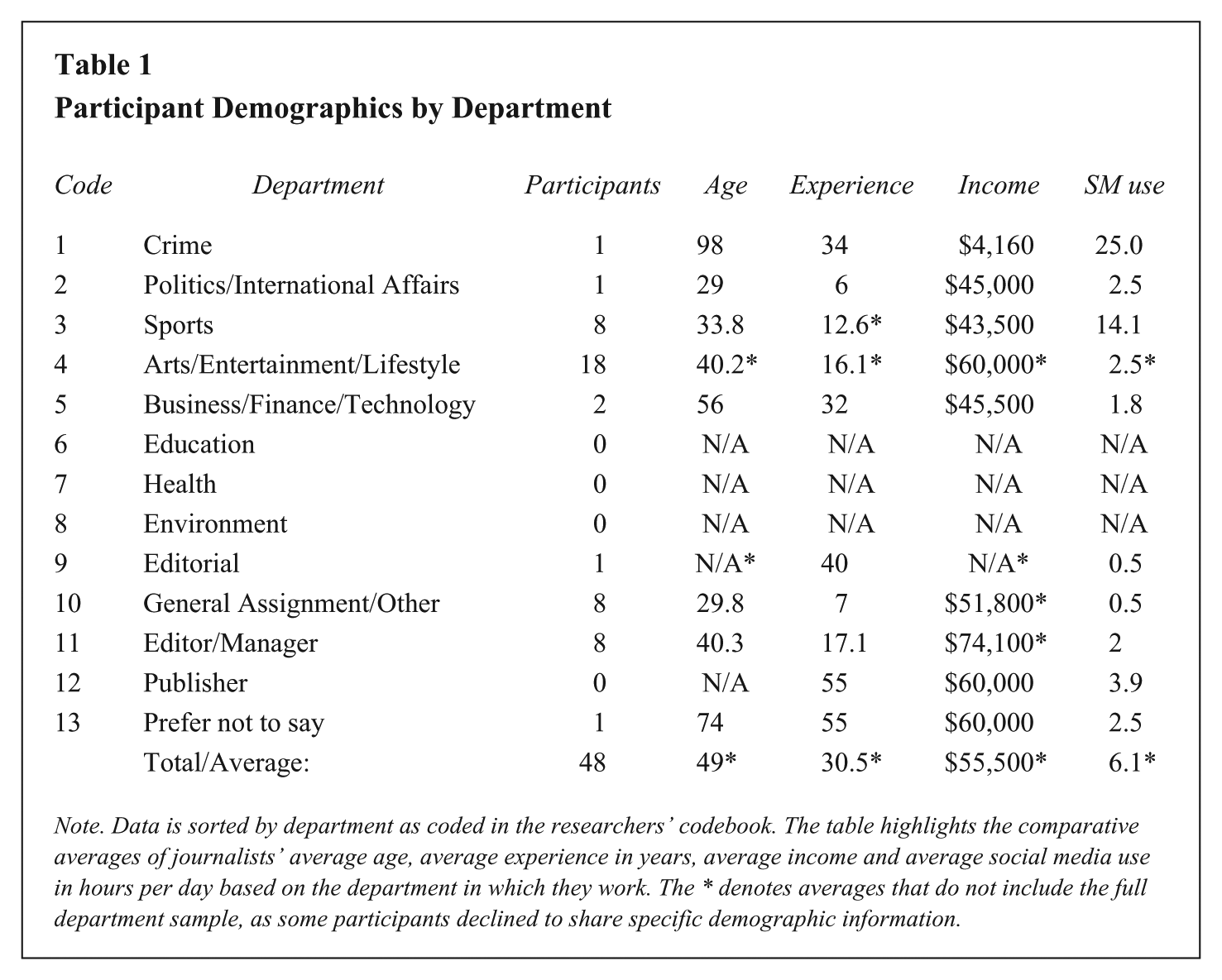
Note. Data is sorted by department as coded in the researchers’ codebook. The table highlights the comparative averages of journalists’ average age, average experience in years, average income and average social media use in hours per day based on the department in which they work. The * denotes averages that do not include the full department sample, as some participants declined to share specific demographic information.
The survey was developed on Qualtrics, a software management platform, and participants were provided with informed consent before entering the questionnaire, and by continuing, they consented to take part in the research. Participants were provided with 20 statements to answer. The survey featured a five-item concise version of the FoMO scale (Przybylski et al., 2013), which provides participants with statements such as “I fear others are having more rewarding experiences than me” and “I get anxious when I don’t know what my friends are up to.” Each item featured a 5-point Likert-type response option.
In addition, the survey featured four statements related to arts journalists’ desire to maintain working relationships with public relations representatives. These four statements included “I worry that if I don’t accept perks from PR reps/sources, it will hurt our working relationship.” Respondents provided their agreement on a 5-point Likert-type response option. Likewise, statements for arts journalists’ perceived competition with influencers were measured using four statements, such as “I fear more people consume an influencer’s content than a professional journalist’s content.” Finally, journalists’ fear about their job security was measured using four items, including “It gives me anxiety if my social engagement numbers are not as strong as other reporters in the newsroom.”
Although no identifying information was asked of participants, certain demographic questions were posed after the statements. These questions included what newsroom department the participants work in, their age, years as a professional journalist, gross yearly income and daily social media usage.
Results
The sample in this study consisted of 48 individuals. More than a third (N = 18, 37.5%) identified themselves as arts and entertainment journalists, while eight individuals stated they were general assignment reporters (16.7%), another eight stated they were editors or managers (16.7%), eight said they were sports reporters (16.7%) and the remaining six said that they were either crime, politics, business or editorial reporters (see Table 1).
Before any hypotheses were tested, the scales for each variable were examined for reliability. Because of the low sample size in this study, a = .70 was considered to be acceptable for the purpose of this analysis. By removing one item, the scale for FoMO was increased to a reliable level, a = .75. Similarly, the other scales were found to be reliable at a = .70 using all of the items measured. In addition to reliability, normality was tested for each of the continuous variables; they were all found to be relatively normal with skewness between [−1, 1] and kurtosis between [−1, 2].
H1 stated that there is a positive relationship between FoMO and arts journalists’ willingness to accept external perks related to covering their beat. This hypothesis was tested using a correlation and linear regression. A Pearson’s correlation showed a strong relationship between the two variables, r(47) = .83, p < .001, and the regression test confirmed that FoMO was a predictor of willingness to accept perks and explained 68 percent of the variance in the model, b = .73, t(47) = 9.79, p < .001. Therefore, H1 was supported.
H2 indicated that there is a positive relationship between arts journalists’ desire to maintain working relationships with public relations representatives and their willingness to accept external perks related to covering their beat. A correlation test indicated that there was a strong relationship between the two variables, r(47) = .76, p < .001, and a regression test indicated that desire to maintain working relationships was a positive predictor of willingness to accept external perks, b = .66, t(47) = 7.75, p < .001. This means that H2 was supported.
H3 stated that there is a positive relationship between arts journalists’ perceived competition with influencers and their willingness to accept external perks related to covering their beat. A Pearson’s correlation showed a moderate relationship between the two variables r(47) = .55, p < .001. Subsequently, a linear regression test showed that perceived competition with influencers was a positive predictor of willingness to accept perks, b = .47, t(47) = 4.44, p < .001. H3 was therefore supported.
H4 stated that there is a positive relationship between journalists’ fear about their job security and their willingness to accept external perks related to covering their beat. A correlation test showed that there was a moderate relationship between these variables, r(47) = .63, p < .001, and a subsequent linear regression also showed that fear about job security positively predicted willingness to accept external perks, b = .55, t(47) = 29.20, p < .001 and explained 39 percent of the variance in the model. Therefore, H4 was supported.
H5 stated that arts journalists are more willing to accept external perks related to their beat than non-arts journalists. To test this hypothesis, the department of the journalist was recoded into a binomial variable for “arts and entertainment journalists” and “all other types of journalists.” Then an ANOVA was used to compare these groups. Results indicated that arts journalists had a mean willingness to accept perks of 1.99 (SD = 0.82) and all other journalists had a mean of 1.46 (SD = 0.68), and that this difference was significant, F(1, 45) = 5.70, p = .02. Therefore, H5 was supported.
Limitations
This research did not come without limitations. The main limitation for the study was recruitment and a small sample size, which could be a product of targeting a specific, but relatively small sample to begin with, due to the challenges arts journalists face in the contemporary media landscape. The researchers believe their recruitment efforts were strong and rigorous. As discussed in the method section, the researchers placed a month-long advertisement on SPJ’s website and in its eNewsletter and directly reached out via email to 431 journalists at 103 U.S.-based outlets. Due to the low sample size, reliability and validity were affected. In addition, there were respondents who did not complete the survey, primarily by not entering the questionnaire after reading the consent form. Due to the difficulty in getting complete responses, some scale items were removed to shorten the survey, resulting in low scale reliability.
Discussion
The aim of this study was to examine whether FoMO predicts arts journalists’ willingness to accept external job-related perks, sustain relationships with public relations practitioners and maintain job status in contemporary media, which includes the presence of influencers who navigate similar spaces. A survey of 48 U.S.-based journalists was conducted to examine the relationship between FoMO and arts journalists’ willingness to accept external perks.
The results of H1 showed that there was a strong relationship between FoMO and arts journalists’ willingness to accept external perks. This was primarily supported by participants’ fear that missing out on an event would hurt their coverage and reporting. Arts journalists, similar to sports journalists and other specialized reporters, rely on access to events and accommodations to fulfill their specific roles (Hardin, 2005; Hardin et al., 2009; Jewell, 2014), which include immersing themselves into specific topics, as well as various social dynamics that present different values and diverse approaches to reporting (Pauly, 2014; Perdomo & Rodrigues-Rouleau, 2022; Tandoc, 2019; Whipple, 2022). Given arts reporters’ coverage of the arts, entertainment and lifestyle beats, their approach differs from reporters who work beats in other newsroom departments (Franklin, 2008; Harries & Wahl-Jorgensen, 2007; Jaakkola, 2015; Sharp & Vodanovic, 2022; Strahan, 2010). Considering arts journalists defend their methods, claiming they are necessary to fulfilling the responsibilities of their role, which helps them stay on their respective beats (Hanusch, 2019; Perreault & Bélair-Gagnon, 2024; Strahan, 2010; Syamsiyah et al., 2018), missing out on an event, which a reporter may deem necessary for coverage, can cause fear in an individual through a lack of engagement and decreased productivity (Dharamsi & Clemis, 2023; Przybylski et al., 2013).
The results of H2, which showed a strong relationship between arts journalists’ desire to maintain working relationships with public relations practitioners and their willingness to accept external perks, and H3, which showed a moderate relationship between journalists’ perceived competition and their willingness to accept external perks, are somewhat connected. Participants primarily experienced fear that public relations practitioners prefer to use influencers for similar coverage of their own due to having a stronger online reach. In addition, the participants appeared to believe that audiences consume content from influencers more than journalists, branding themselves on social media is an important part of their job, but they also suffer anxiety knowing they don’t post as much as influencers on social media. Extrinsic motivations and a basic need of competence through self-determination (Deci & Ryan, 2004, 2008; Maxwell et al., 2022; Ryan & Deci, 2000, 2002, 2008) potentially relates to the relationship between journalists and public relations practitioners and enhancing communication within the network, as public relations practitioners could trigger FoMO-related behavior in journalists by perhaps moving on to someone else who would be willing to accept perks in order for coverage, or has a broader social reach, such as an influencer. The journalist may then be motivated to satisfy the need to stay connected with external groups related to their beat to perform their responsibilities successfully and efficiently. Journalists’ fear and anxiety within this network triangle could also be explained by social comparison (Reer et al., 2019), especially compared to the productivity and value of influencers. The struggle journalists may face is that influencers formed their status in the social media space while journalists have adopted it as a tool and addition to their responsibilities. Influencers navigate the digital space well, and due to commercial value of this domain, it has created competition with journalists and, which leads to social media fatigue, trouble maintaining a work-life balance and the pressure to participate in branding activities as an independent persona (Bossio & Holton, 2018; Bossio & Sacco, 2017; Brems et al., 2017; Brooks et al., 2021; Canter, 2015; Fisher et al., 2021; Holton & Molyneux, 2017; Van Leuven et al., 2021). These fears and anxieties are also related to a journalist’s job security.
The results of H4, which showed a moderate relationship between journalists’ fear about their job security and their willingness to accept external perks, were supported by journalists’ fear that they do not produce enough content, that their organization does not have enough resources to provide reporters with the ability to fully cover their stories, and even inter-department competition through comparing social engagement metrics in the newsroom. Considering it has been found that journalists leave the industry due to feeling stuck or that they must always be working, mental strain and the lack of internal support, they may find validation through external positivity (Gollmitzer, 2023; Mathews et al., 2023; Viererbl & Koch, 2021). There is the social comparison with influencers that leads to mental strain after adopting branding activities on top of their main responsibilities, and there is also comparison and competition within the newsroom. Journalists could use social comparison to argue they should be covering the event because it is their beat, which could be viewed as a threat to their professional status, which eventually could lead to the journalist chasing experiences and accepting perks even if it does not align with their personal values. This ultimately could lead to challenging the ethical standards of the field, like accepting gifts and favored treatment from external influences (Society of Professional Journalists, n.d.).
The results of H5, which showed a significant difference in arts journalists’ willingness to accept external perks over reporters who work other beats, can either challenge the ethical standard of practice or support the call for different ethical codes, associations and values stemming from internal independent choices (Borden, 2013; MacIntyre, 2007; Ward, 2005). This is relevant in specialized beats such as the sports and arts (Hardin et al., 2009; Stamm & Boatwright, 2025; Viererbl, 2023). Similarities have been found between sports and arts reporters, and both may feel pressure to gain access to games, press conferences and events, especially since they rely on immersing themselves into a source’s life, which may also include multiple interviews and travel (Hardin et al., 2009; Pauly, 2014; Perdomo & Rodrigues-Rouleau, 2022; Perreault & Bélair-Gagnon, 2024; Tandoc, 2019; Whipple, 2022). In addition, specialized beats compete more directly with influencers and face challenges to validate their position on staff, especially as diminishing benefits and layoffs from financial repercussions have long been a significant concern for journalists (Goyanes & Rodríguez-Gómez, 2021; Picard, 2015; Weaver, 1998; Xiaoming et al., 2013). Although arts journalists’ reporting approaches have been criticized (see Chong, 2019; Franklin, 2008; Strahan, 2010), the defense of their methods explains why an arts reporter may be more willing not to view this as an ethical dilemma because competing with influencers and cooperating with public relations practitioners are part of their job. The key difference between journalists and online influencers, as it relates to their relationship with public relations practitioners, is cooperation, and who is willing to appease the preferences of public relations (Borden, 2013). Influencers may be more willing to partake in external cooperative activity due to the interactive and relational dynamics of social media. Cooperation achieves more than competition, for when an individual sets competitive goals, they tend to use self-protective strategies (Johnson & Johnson, 2005), and competition has become a “counterfeit virtue” that creates tension, even within the same organization, let alone from external influences (Borden, 2013, p. 69). Each department faces unique ethical challenges, and inserting blanket standards may disrupt the processes, validity and quality of specialized beats such as the arts (Hanitzsch, 2007; Hellman & Jaakkola, 2012; Keeble, 2005). With the combination of a complex beat and unique approach to reporting, arts journalists operate in a different ethical realm, one that could be a case-by-case basis and requires further exploration in research.
Future Research
This research provides further opportunities to explore the nuances of specialized reporters and expand on FoMO as it relates to journalism studies, examining specialized reporters and their views on accepting external perks related to the responsibilities of their specific beat. This study initially contained a virtue ethics component, but due to the aforementioned nuances and varying views on the acceptance of perks, the researchers believe that ethics would be better measured through qualitative, in-depth interviews. Therefore, future research on this topic will explore the relationships and dynamics between journalists, public relations practitioners, sources and influencers in contemporary media. In addition, FoMO can be applied in more areas of journalism studies after this research’s inclusion of the theory in an uncharted field.
Conclusion
The aim of this study was to examine the relationship external influences have on arts journalists’ willingness to accept external perks related to their beat. Through a survey of U.S.-based journalists, it was found that FoMO, maintaining working relationships, competition with influencers, job security and a reporter’s specific beat all had moderate to significant positive relationships with arts journalists’ willingness to accept external perks. The inclusion of FoMO as both a state and a trait in journalists has never been researched. It not only specifically analyzes the potential connection between FoMO and journalists, as related to their individual beats and duties, but it also opens the possibility of more psychology-based research into journalism studies to help better understand the effects modern journalism has on practitioners. Therefore, the implications from the results of this study can be used in academia and practice. In addition, it adds to growing research in FoMO, as journalism is also uncharted in FoMO scholarship. This study also adds to scholarship on journalism and ethics, but future research can be conducted from the results of the study to explore the nuances of each department and the views of individual journalists as it relates to their decision-making on a story-by-story basis.
