






Abstract
The rule of anticipated importance holds that journalists allocate limited resources to stories deemed most significant to audiences, often disadvantaging third-party candidates. This study explores the Jamaican context through a content analysis of 100 newspaper articles. Results show no difference in the level of coverage between third and mainstream parties, contrary to mostly U.S.-based studies. However, third parties were framed as less conventional. These findings highlight the need to examine Global South media systems more deeply.
Keywords
Introduction
In many democratic contexts, third-party political actors are often marginalized by news media (see Carilli, 2021; Pankiewicz, 2010). It is widely presumed that even when these candidates receive coverage, they are rarely portrayed as serious contenders with a legitimate shot at influencing electoral outcomes (Kirch, 2013). Instead, they are often framed as spoilers, that is, fragments of political dissent that siphon votes from more viable candidates representing the dominant parties. In systems such as the United States, electoral competition is overwhelmingly structured around a two-party duopoly, with the Democratic and Republican parties commanding nearly all institutional, financial and media attention (Kirch, 2015). As a result, even ideologically distinct or credible third-party candidates are frequently dismissed, ignored, stigmatized or trivialized by journalists and political commentators alike.
This pattern of exclusion has been explained through what is termed the rule of anticipated importance (Zaller, 1999). According to Zaller’s heuristic, journalists prioritize stories and actors they believe will matter most to their audiences in the long run. Given the scarcity of journalistic resources which include space, airtime, attention (among other considerations), news professionals often make strategic calculations about which candidates are most electorally viable, subsequently shaping the narrative arc of election coverage around those frontrunners (Iyengar & Kinder, 2010). In effect, media exposure becomes both a reflection and reinforcement of a candidate’s perceived legitimacy.
Yet, while the bulk of this research has focused on the U.S. context, far less is known about how third-party actors are represented in parliamentary democracies, particularly in the Global South. This gap is especially evident in Jamaica, where general elections continue to be dominated by two major political parties: the People’s National Party (PNP) and the Jamaica Labour Party (JLP). Despite this dominance, third parties have sporadically entered the electoral arena, garnered modest levels of public support and at times been included in national debates or political “horse races.” Yet, the extent and nature of their coverage in Jamaican news media remain absent.
To date, no systematic content analysis has examined how Jamaican third parties are represented in the national press across general elections. This omission is surprising given evidence from broader media studies, suggesting that favorable or increased media exposure can significantly enhance the visibility, credibility and perceived viability of political actors (Iyengar & Kinder, 2010). Research consistently shows that media visibility is a key factor in political success, and increasing public familiarity and shaping reputations, while the lack of coverage can hinder political actors’ ability to compete effectively (Norris, 2000). In the Jamaican context, leaders of small parties and commentators have noted that third parties receive minimal media attention, which is believed to contribute to their marginalization and limited electoral impact (CEEN TV, 2023; Francis, 2024). In the context of the United States, the media are seen as kingmakers and have a significant impact on the selection of the Democratic and Republican presidential nominees (London, 2023). They can conduct interviews, examine candidates’ backgrounds and transmit sound snippets from their speeches. The candidates who receive the greatest media attention gain traction and perform well in the initial primary and caucus elections. This then results in more media coverage, increased momentum and ultimately a successful candidate. Candidates therefore require the media (London, 2023).
If this media logic also applies in Jamaica, it raises critical questions: Are third parties systemically overlooked by Jamaican news media? And if they are covered, how are they portrayed in comparison with dominant parties? This study addresses these questions by conducting a content analysis of 100 The Gleaner newspaper articles from two Jamaican general elections (2011 and 2020). Rooted in the rule of anticipated importance, we again note that third parties are often presumed to receive limited media attention, particularly in contexts dominated by two-party systems (such as Jamaica). This logic is widely supported in U.S.-based scholarship, where third parties are routinely marginalized in both volume and tone of coverage. However, this study complicates that narrative by offering a rare empirical assessment of third-party visibility within a Caribbean parliamentary democracy.
The findings suggest that, contrary to expectations, there are no consistent quantitative disparities in the level of coverage afforded to third parties versus mainstream political actors. This challenges the assumption that media marginalization is purely a matter of volume. Instead, the key differences emerge in the quality and framing of that coverage. Third parties, while present in the news, are more likely to be portrayed as unconventional, marginal or politically unserious. Such portrayals may serve to symbolically delegitimize third-party actors, reinforcing their outsider status in the political imagination, even when they are not excluded from coverage entirely.
By shifting the focus from how much third parties are covered to how they are portrayed, this article offers an even more nuanced account of media gatekeeping in Jamaica’s electoral landscape. It also raises broader questions about the applicability of anticipated importance in Global South contexts, where political histories, media systems and democratic expectations differ substantially from those of the United States. As such, the findings urge a small shift in how we consider established media effects theories in light of cross-national political realities.
Literature Review
Despite the central role political parties play in shaping democratic discourse, there has been limited scholarly attention to how Jamaican media cover these actors, especially third parties. While academic work on media and politics in Jamaica remains sparse, research from comparable political systems, particularly the United States, offers valuable insights into the systemic challenges third-party candidates face in achieving media visibility and legitimacy.
In the United States, third-party and independent candidates are routinely marginalized in press coverage, a pattern well-documented in political communication literature. Kenski and Zaller (1993) argue that independent presidential candidates are frequently ignored by the media due to their perceived lack of electoral viability, with quantitative disparities in coverage reflecting this assumption (Kenski & Zaller, 1993). Earlier research by Doris Graber similarly found that third-party candidates receive significantly fewer news appearances than their Democratic and Republican counterparts, reinforcing their peripheral status (Graber, 1971).
Kirch (2013) builds on this literature, demonstrating that Green and Libertarian gubernatorial candidates in the United States received markedly different treatment than those from major parties (Kirch, 2013). Kirch (2013) found that minor-party candidates were seldom featured in headlines or lead paragraphs, quoted less frequently and more likely to be described as spoilers or long shots. By contrast, major-party candidates lagging in the polls were more generously framed as underdogs. These patterns suggest that journalistic framing, even in subtle forms, plays a crucial role in reinforcing the dominance of two-party politics.
To explain the roots of this disparity, Stovall contends that mainstream political actors often view third-party candidates as useful only for enriching the electoral spectacle, not for their substantive contributions to policy debate (Stovall, 1985). Nwazota (2004) echoes this argument, emphasizing that third-party candidates face structural barriers to media access and are often questioned more about their motivations for running than their platforms (Nwazota, 2004). This type of treatment undermines their credibility and denies them meaningful engagement with the electorate.
Neville-Shepard (2019) expands this critique by examining the marginalization faced not just by candidates, but also their supporters. He argues that third-party voters are often subjected to rhetorical backlash, portrayed as naïve, irrational or even responsible for disrupting political outcomes. These portrayals frame third-party engagement as immature and politically irresponsible, further entrenching the dominance of major-party narratives.
Pirch (2004) offers a more conditional explanation, noting that minor-party candidates only attract media attention when they exhibit traits such as cognitive unpredictability, novel political positions or a demonstrated influence on the likely outcome of an election (Pirch, 2004). This suggests that media coverage of third parties is not only limited but also contingent, dependent on the extent to which these candidates can be framed within existing news values and electoral expectations.
Although most of the scholarship on third-party coverage stems from the United States, studies from other parliamentary democracies offer useful comparative perspectives. Rudd and Connew (2007), in their analysis of New Zealand’s 2005 general election, noted that minor parties did receive substantial coverage. However, this attention was often driven by game-oriented journalism focused on electoral strategy; questions such as who’s winning? or who are you forming a coalition with?, rather than substantive issue engagement. While such coverage may increase visibility, it does not necessarily foster legitimacy.
This distinction between visibility and favorability reflects a critical issue in political communication. Increasingly, scholars argue that the framing of political actors matters as much as, if not more than, the volume of coverage (Oxley, 2020). When third-party candidates are covered, they are often framed as unconventional, unserious or incompetent, traits that subtly but powerfully delegitimize them in the public eye (Kirch, 2008). Studies of media in European parliamentary democracies reflect similar dynamics, with minor parties frequently included in news reports but rarely portrayed as credible contenders (Maier et al., 2019). Esser and Strömbäck further note that national media cultures shape how electoral competition is portrayed, with implications for both media pluralism and democratic representation (Strömbäck & Esser, 2014).
Media Systems and the Jamaican Landscape
The structure of the media system itself also influences patterns of party visibility. The rise of political parallelism in the United States, where media outlets adopt overt ideological positions, has amplified polarization and transformed public expectations about journalistic neutrality (Hallin & Mancini, 2004). However, this pattern is not mirrored in Jamaica. Jamaican media, while not without flaws, are generally not characterized by strong ideological divides. The country’s leading newspapers, the Jamaica Gleaner, Jamaica Observer and Jamaica Star, are privately owned, and the broadcast media remain commercially driven, offering a broad range of perspectives (Pate, 2021).
There is no legal or constitutional obligation for Jamaican media houses to maintain political neutrality, and while individual outlets or journalists may have political leanings, the overall media landscape is not dominated by overt partisanship as seen in some other democracies (Jamaica Observer, 2023). Press freedom is respected, and the media play an important role in democratic responsiveness, with civil society and journalistic communities quick to address any threats to access or intimidation (Chapultepec Index, 2024; The Media Institute of the Caribbean for UNESCO, 2021). Reporters Without Borders (2024) similarly affirms that most local media operate independently of government control, contributing to a relatively free and open press environment.
The newspaper selected for analysis was The Gleaner, one of Jamaica’s most influential print outlets. The Gleaner was chosen for its extensive reach, credibility and centrality in Jamaica’s media landscape. As it stands, The Jamaica Gleaner serves as the most influential component of the country’s leading newspaper media conglomerate, its reporting plays a critical role in reflecting and shaping the information environment that voters encounter during elections.
The Gleaner Company Limited, founded in 1897, manages a wide-ranging media portfolio that includes The Gleaner (published continuously since 1834), several print and digital outlets, international weekly editions, Gleaner Online and the Gleaner Archives, as well as radio operations through the Independent Radio Company (The Gleaner Company Limited, n.d.). The Gleaner Company significantly outperforms its main competitor, The Jamaica Observer, in both daily and Sunday readership (Forbes, 2015). For example, 77.3% of readers prefer the Sunday Gleaner to the Sunday Observer, which attracts only 22.7%. In addition, The Gleaner’s weekday tabloid, The Star, consistently surpasses The Observer in readership, confirming the company’s dominance in the print market. This dominance was further consolidated when the Gleaner Company merged with RJR Communications, a conglomerate that owns Television Jamaica (TVJ), a station that controls nearly three quarters of Jamaica’s free-to-air television market. Thus, coverage in The Gleaner is reflective not only of dominant newspaper framing but also of broader media agendas shaped by one of the most powerful communication groups in the country.
Therefore, it is important to situate The Gleaner within the broader structure of Jamaica’s media system. Jamaica does consistently maintain a high level of press freedom; however, its media landscape, like many small-market systems, is characterized by a limited number of dominant owners. The 2015 merger of the Gleaner Company and the RJR Communications Group created the RJRGLEANER Group, the country’s largest multimedia entity, with cross-ownership across print, radio, television and digital platforms (RJR, 2015). While such consolidation does not inherently threaten press freedom or journalistic independence, scholars note that high ownership concentration in small media markets can shape the flow of information simply by virtue of scale and capacity: dominant groups possess the widest reach, set many of the agenda priorities and often define the boundaries of political visibility during election cycles (Garz & Ots, 2025; Martin et al., 2024; Wellstone, 1999). This is comparable to dynamics in the U.S. context, where structural features, notably commercial imperatives and concentrated ownership, tend to reinforce the salience of major-party actors (Lucas, 2024; Pirch, 2004). Yet, despite these parallels, the Jamaican case remains understudied. Framing The Gleaner within this context helps clarify why its coverage is analytically significant.
Nonetheless, concerns remain regarding media concentration. The consolidation of media ownership in Jamaica, especially following the merger of The Gleaner Company and RJR Communications (Forbes, 2015), raises questions about how editorial priorities are set and which voices are amplified. Research on media pluralism in small democracies has shown that even in politically neutral environments, concentrated ownership can restrict the range of perspectives available to the public (Dunn, 2004). This may be true particularly in times of electoral competition (Valcke et al., 2015).
These material shortcomings restrict media access, particularly access to news media, which Pirch (2004) and Zaller (1999) identify as critical communicative barriers that disproportionately affect third-party candidates. Limited exposure in news coverage not only diminishes public awareness but also reinforces negative voter perceptions about the credibility and viability of third-party movements. In the Jamaican context, this is not merely theoretical. Joseph Patterson, president of the United Independents’ Congress (UIC), a third party in Jamaica, has publicly argued that insufficient media representation, including in the news, further marginalizes alternative political actors and makes it nearly impossible for them to gain traction within national political discourse (CEEN TV, 2023; Smikle, 2025). Such claims illustrate the tangible consequences of media gatekeeping for political diversity and democratic engagement.
Despite these concerns, there is a conspicuous absence of empirical research on how Jamaican third-party candidates are portrayed in the media. While third parties have participated in multiple electoral cycles and have, on occasion, attracted pockets of voter support, their treatment by the national press remains largely unexamined. This gap in the literature is especially surprising given the long-standing dominance of the PNP and JLP and the structural similarities Jamaica shares with other Westminster-style democracies.
By drawing on the comparative literature and adapting its insights to the Jamaican context, this study offers a timely intervention. It addresses the underexplored intersection of media, political competition and third-party representation in Jamaica by examining how third-party candidates were covered in The Gleaner during the 2011 and 2020 national elections. Specifically, it considers both the quantity and the tone of media coverage, paying particular attention to whether third-party actors were marginalized, framed as unconventional, or delegitimized in comparison with their mainstream counterparts.
Given these objectives, the following research questions guide the analysis:
Research Questions
Are mainstream parties more likely to be in prime focus as opposed to third parties?
Do third parties receive the same level of press coverage through The Gleaner as opposed to the two major political parties in Jamaica?
Have third parties received greater consideration as a long shot between 2011 and 2020?
Are mainstream parties more likely to be described as normal/conventional as opposed to third parties?
Is the tone of third parties more negative as opposed to mainstream parties?
Method
This study employs a quantitative content analysis to examine how third-party and mainstream political parties were represented in Jamaican general elections. The analysis focuses on two election cycles, 2011 and 2020, which were selected because they represent the most recent elections in which third parties actively sought national relevance by attempting to field a full slate of candidates. In both cases, third-party leaders positioned themselves as credible contenders, not only to “bring change to the Jamaican public” but also to establish long-term political viability.
The unit of analysis for this study was the individual news article. Articles were retrieved from The Gleaner’s online archives using search terms that included the full names of the political parties involved. To ensure adequate coverage of the electoral cycle, the search focused on articles published during the 4 months leading up to each election, including the month in which the election was held and a short period following election day. This time frame allowed for the inclusion of both campaign-related and post-election reporting. Given the lower visibility of third-party actors, all available articles referencing these political parties during the specified timeframes were included when necessary. In total, 100 articles were selected and coded for analysis.
Each article was systematically coded for 28 variables. Several of these variables were used to capture the structural presence of political parties in the news (such as whether they were mentioned or were the primary subject of the article), whereas others were designed to assess evaluative features, such as the tone and characterization of coverage. To allow for comparative analysis, many variables were coded twice, once for the mainstream parties, the JLP and the PNP, and again for third-party actors, specifically the National Democratic Movement (NDM) and the Jamaica Progressive Party (JPP). The analysis examined which party was the main focus of the article, how much textual space was devoted to each party, whether third parties were portrayed as “long shots” with little chance of electoral success, whether they were depicted as conventional or unconventional actors in Jamaican politics and whether the tone of the article was positive, negative or neutral toward each party.
To ensure the reliability of the coding process, a subset of 10% of the articles was independently coded by two trained coders. The coders underwent several weeks of training using a detailed codebook that outlined the definition, scope and coding criteria for each variable. Intercoder reliability was assessed using Krippendorff’s alpha, a widely accepted statistical measure for content analysis (Krippendorff, 2018). Alpha scores for the key variables ranged from 0.67 to 1.00, indicating a generally acceptable level of reliability for exploratory political communication research.
By drawing on systematic procedures and replicable coding techniques, this study offers an empirically grounded assessment of both the extent and quality of media coverage afforded to third-party actors in Jamaican elections. In doing so, it sheds light on the role of news media in reinforcing, or potentially disrupting, the long-standing dominance of the two-party system in Jamaica.
Findings
RQ1—Are Mainstream Parties More Likely to be in Prime Focus as Opposed to Third Parties?
The content analysis revealed that mainstream political parties in Jamaica are significantly more likely to be the prime focus of newspaper articles than third parties. Despite the relatively small sample, the data showed that the JLP was in prime focus in 31.7% of articles, whereas the PNP was in prime focus in 28.7% of articles. Combined, Jamaica’s two major parties were the primary focus in approximately 60% of the total news articles sampled (see Table 1). In contrast, third parties were much less likely to receive primary focus, indicating a disparity in editorial attention.
Frequency of Political Parties in Prime Focus in Jamaican News Coverage
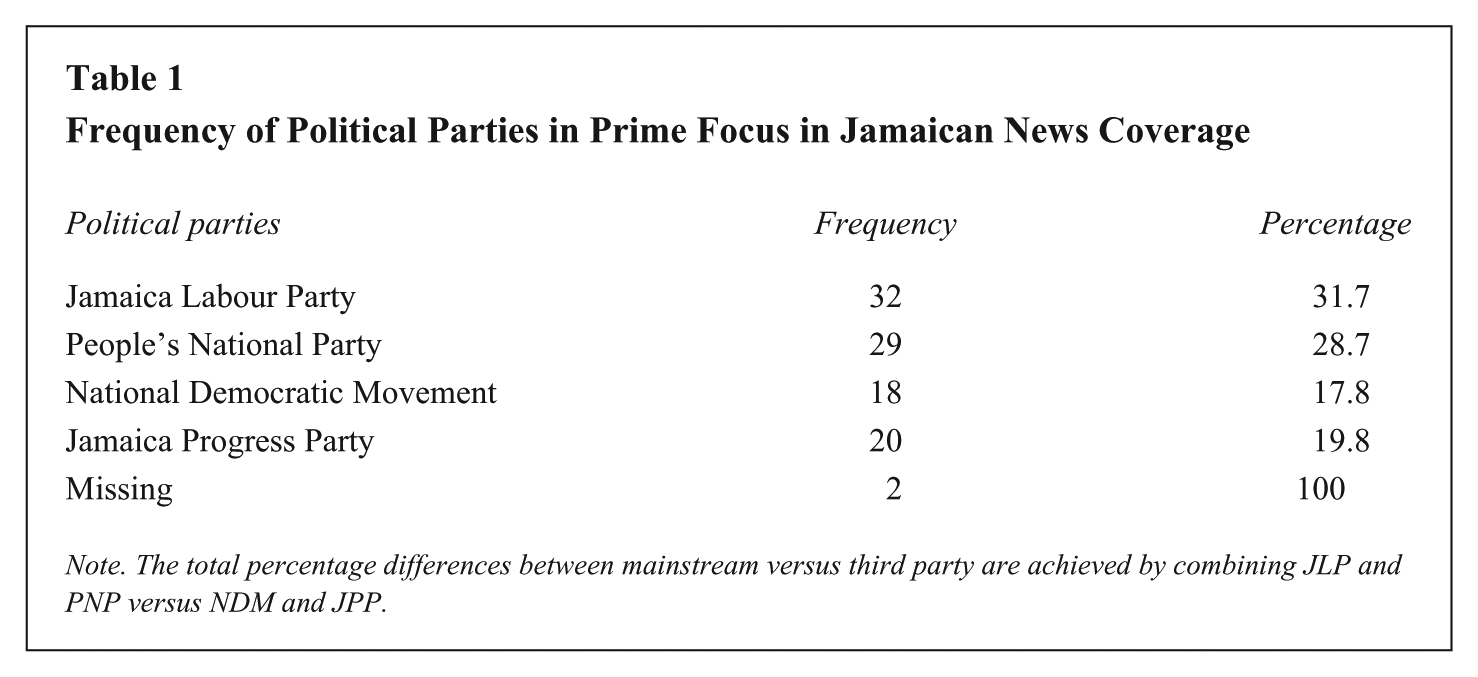
Note. The total percentage differences between mainstream versus third party are achieved by combining JLP and PNP versus NDM and JPP.
In addition to article prominence, story placement further reflects this imbalance. Articles focused primarily on the JLP or PNP were featured on the front page in 60% of cases. Conversely, articles with a third party as the prime focus appeared on the front page in only 27% of instances. This suggests that third-party visibility is reduced not only in terms of volume but also in terms of strategic placement. (Front-page data was available for 15 articles).
RQ2—Do Third Parties Receive the Same Level of Press Coverage Through Newspapers as Opposed to the Two Major Political Parties in Jamaica?
This analysis proceeded from the assumption, well-supported in U.S.-based literature, that mainstream parties receive more extensive media coverage than third parties. However, in the Jamaican context, this assumption was not statistically supported. A one-way analysis of variance (ANOVA) was conducted, with parties recoded as “mainstream” versus “third party” as the independent variable, and the length of article as the dependent variable (measured only when the party was in prime focus). The analysis showed no significant difference in article length between party types: F(1, 97) = 0.011, p = .916. While this finding diverges from U.S.-based research, the small sample size may be a valid explanation for the lack of statistical significance. These results should therefore be interpreted with caution.
RQ3—Have Third Parties Received Greater Consideration as a Long Shot Between 2011 and 2020?
The third research question assumed that third parties would be increasingly framed as “long shot” candidates during the 2011 to 2020 electoral period, following trends observed in comparative research. However, the results again diverged from expectations. A chi-square test of association showed no statistically significant relationship between electoral year and whether third parties were portrayed as long shots: χ2(1, N = 50) = 0.015, p = .903. With p > .05, we fail to reject the null hypothesis. Thus, there is no empirical basis to assert a shift in how third parties are framed over time within this sample.
RQ4—Are Mainstream Parties More Likely to be Described as Normal/Conventional as Opposed to Third Parties?
This question rested on two theoretical assumptions: that mainstream parties would be more likely to be described as normal or conventional, and that third parties would be more frequently portrayed as unusual or unconventional. The first assumption was not supported. A chi-square test showed no significant relationship between party type and being described as conventional: χ2(2, N = 86) = 0.128, p = .938.
However, the second assumption was supported. Third parties were significantly more likely to be described as unconventional: χ2(1, N = 39) = 9.953, p = .002. This indicates that third parties are portrayed in ways that reinforce their political marginality. The adjusted standardized residuals (ASRs) revealed a significant underrepresentation of third parties being framed as conventional and a significant overrepresentation of them being described as unconventional. With an ASR of −3.2 to 3.2, there is a significant underrepresentation of a third party being classified as conventional and a significant overrepresentation of that third party being classified as unconventional. These results fall outside the threshold of ±1.96, indicating strong statistical significance (Riffe et al., 2024) The effect size was also substantial, with Cramer’s V = 0.505, suggesting a strong relationship between party type and perceived conventionality (Riffe et al., 2024). These findings reinforce the argument that media framing may play a role in delegitimizing third-party actors.
RQ5—Is the Tone of Third Parties More Negative as Opposed to Mainstream Parties?
This final question also involved two assumptions: that mainstream parties would receive more positive tone in coverage, and that third parties would receive more negative tone. However, neither assumption was supported by the data. A chi-square test found no significant difference in tone for mainstream parties: χ2(2, N = 86) = 1.515, p = .469. Similarly, third-party coverage did not show a significant difference in negative tone: χ2(2, N = 49) = 0.256, p = .880. These results suggest that tone, unlike framing and visibility, may not be the primary vehicle through which third parties are marginalized in Jamaican newspaper coverage.
Conclusion
Prime Focus and Level of Coverage
The findings of this content analysis confirm that mainstream political parties in Jamaica are more frequently featured as the prime focus in news stories than their third-party counterparts. This aligns with expectations based on prior literature, which suggests that media institutions typically devote more attention to the major political parties, particularly in the run-up to elections (Kirch, 2015). In this study, mainstream parties dominated just over 60% of the total sample in terms of prime focus. This outcome reflects the prevailing dynamics of political competition in Jamaica, where electoral governance has alternated between the PNP and the JLP, and where third-party candidates have historically struggled to mount viable challenges.
This emphasis is not only a function of political viability but also of media logic, which favors actors involved in the central horse race of electoral contests and those likely to generate sustained public interest (Pirch, 2004). The consistent two-party governance structure in Jamaica reinforces this trend, as media houses logically prioritize the parties most likely to assume power.
However, the lack of a statistically significant difference in the level of coverage (measured by article length) complicates the dominant narrative that third parties are systematically ignored. While third parties may not be in prime focus as often, when they are, the extent of coverage, at least in terms of article length, appears comparable. This contradicts many U.S.-based studies, which suggest that third parties receive both less frequent and less substantial coverage (Kirch, 2013). One possible explanation is the relatively independent nature of Jamaica’s media landscape. According to Reporters Without Borders, Jamaican journalism maintains a high level of content independence and limited political interference, particularly when compared with systems like that of the United States (Reporters Without Borders, 2024).
This distinction is critical. In the United States, increasing political parallelism, where media outlets align with specific ideological positions, can exacerbate the marginalization of third parties, favoring the bipartisan dynamics between Democrats and Republicans (Hallin & Mancini, 2004). In contrast, the ideologically neutral posture of Jamaican news media may mitigate the severity of third-party exclusion. Thus, media ideology, or the lack thereof, emerges as a potential moderator in understanding disparities in coverage between dominant and nondominant parties.
Third-Party Descriptions
Turning to how third parties are described, the findings offer a more interesting view. Based on existing literature, it was reasonable to guess that third parties would be more likely to be framed as long shots, unconventional and subject to negative tone. However, the data revealed no statistically significant differences in the framing of third parties as long shots across the 2011 and 2020 general elections, nor were there differences in the tone (positive, neutral or negative) applied to mainstream versus third-party candidates.
Again, this departs from much of the existing literature, particularly U.S.-centric studies, where third parties are often trivialized, delegitimized or framed as spoilers. As with the earlier finding on article length, Jamaica’s media independence may play a role here. Without the ideological entrenchment and partisan media culture present in other democracies, Jamaican newspapers (in this case, The Gleaner) may adopt a more equitable approach to tone and evaluative framing.
However, one clear and significant difference did emerge: third parties were significantly more likely to be framed as “unconventional.” This framing suggests that these parties are perceived as outside the norms of Jamaican political tradition, whether in terms of structure, messaging or leadership style. Unconventionality in media coverage often signals a deviation from the political mainstream, and such framing can have complex effects. On one hand, it may attract media attention when third parties adopt novel or provocative policy positions (Pirch, 2004); on the other, it may undermine their legitimacy by casting them as fringe actors.
The strong statistical significance and effect size observed in this variable (Cramer’s V = 0.505) underscore that how parties are framed, rather than how much they are covered, may be a more important determinant of political marginalization. Notably, one party was significantly underrepresented as “conventional” and overrepresented as “unconventional,” suggesting consistent framing biases that, perhaps, deserve further exploration in qualitative follow-up research.
Contributions and Implications
These findings contribute to a more context-sensitive understanding of third-party representation in news media. While quantitative disparities in media coverage remain a valid concern globally, this study demonstrates that in small democratic systems with high media independence, third parties may receive comparable coverage volume-wise, but still face symbolic exclusion through framing strategies. This distinction is especially important for researchers and practitioners in political communication. Much of the existing literature has prioritized measures of coverage volume, such as article length or frequency, at the expense of examining the discursive treatment of third parties. This study suggests that symbolic framing (e.g., as unconventional) may be more subtle but equally influential in shaping public perceptions and political legitimacy.
This pattern appears especially relevant in parliamentary systems with relatively neutral media environments, such as Jamaica and New Zealand. As Rudd and Connew (2007) observed, minor parties in New Zealand were not systematically excluded from media coverage, though their portrayal often centered on strategic considerations rather than substantive policy positions. These cases suggest that media ideology and institutional design interact in shaping how nondominant parties are represented. Future research should investigate whether changes in symbolic framing, particularly around perceived conventionality, can influence voter perceptions and contribute to greater political diversity in similar electoral systems.
Moreover, in systems like Jamaica’s, where electoral outcomes are rarely contested beyond the two main parties, the media may still allocate space to third-party voices, but in ways that reify their marginality. This presents a cautionary insight: equal coverage does not guarantee equal representation if the nature of that coverage undermines perceived credibility or normalcy. Future research should also investigate how these patterns play out across different media formats (e.g., broadcast, digital) and whether audience reception aligns with media framing. In addition, comparative studies could explore whether similar patterns exist in other small democracies with relatively independent media systems, offering a counterpoint to the U.S.-centric models that dominate much of the literature.
Limitations
A limitation of this study is the relatively small sample size, which may have constrained the ability to detect more subtle or marginal differences in coverage between third-party and mainstream political actors. However, the limited number of articles is itself reflective of the empirical reality of third-party politics in Jamaica. Third-party actors receive very sparse coverage in national news, and Jamaican elections, particularly the 2011 and 2020 cycles analyzed here, produce a comparatively small population of political stories centered on minor-party candidates. As a result, the dataset used in this study is very close to the full population (functionally a census) of articles published in The Gleaner that met the inclusion criteria during these two election cycles, rather than a subsample drawn from a larger pool. While it would have been possible to increase the number of third-party articles by incorporating outlets with far smaller audiences, doing so would have resulted in a dataset that was less representative of what most Jamaicans actually encounter in their news consumption and could have introduced skewed patterns relative to mainstream exposure.
Although this structural constraint reduces opportunities to detect small effects statistically, it is itself analytically meaningful: the scarcity of media attention reflects the broader visibility challenges that third-party actors face in small democracies and two-party dominant systems. Future research drawing on additional election cycles, multiple media outlets or comparative cross-country designs may increase statistical power and enhance generalizability, but these expansions would require the collection of new data beyond what is available within the population studied here.
In addition, the study did not include a variable to capture instances where both mainstream and third-party candidates appeared within the same article. As a result, it was not possible to assess how third parties are positioned in direct contrast or comparison to dominant parties, an important dynamic in news framing. The absence of this interactional context limits the ability to examine relational framing strategies, such as whether third parties are portrayed as inferior alternatives, symbolic challengers or issue-based disruptors when mentioned alongside the PNP or JLP.
Future research should address these limitations by incorporating more comprehensive coding schemes that capture joint appearances and comparative language, and by expanding the sample across additional time periods, election types or media formats (e.g., television, radio or online platforms). Doing so would offer a more nuanced understanding of the narrative environments in which third parties are embedded and how those representations shape their perceived legitimacy.
Footnotes
Appendix
The purpose of this research is to content analyze how third parties which exist outside the two-party status quo are portrayed in news media, particularly lead newspapers in Jamaica and examine the resultant perception this may create for the populace.
Author Note
Steven D. Gardiner (MSc, University of West Indies, 2019), PhD Graduate, Department of Communication, University of Missouri, Columbia, USA.
