






Abstract
Background
Early childhood development is shaped by interactions between biological, prenatal, nutritional, and social factors. Evidence regarding their domain-specific associations across ASQ-3 domains remains limited in Eastern Europe.
Objectives
To examine biological, prenatal, nutritional, and social predictors of developmental outcomes measured with the ASQ-3.
Methods
This cross-sectional study included 167 full-term Bulgarian children aged 14–42 months. Parents completed age-appropriate ASQ-3 questionnaires and a structured survey on prenatal and family characteristics. Raw ASQ-3 scores were converted into age-standardized Z-scores. Stepwise multiple linear regression analyses were conducted for each domain.
Results
Longer breastfeeding duration was positively associated with communication, fine motor, and problem-solving outcomes. Prenatal tobacco exposure was associated with lower communication, fine motor, and problem-solving scores. Communication outcomes were additionally associated with residential setting and bilingual home environment. No significant predictors were identified for gross motor development.
Conclusions
Early developmental domains demonstrate distinct associations with prenatal, nutritional, and social factors.
Keywords
Introduction
Early childhood, particularly the period up to 3–4 years of age, represents a highly sensitive developmental window during which core cognitive, motor, language, and socio-emotional competencies are formed. Global estimates indicate that a substantial proportion of children experience developmental vulnerability, with the greatest burden observed in low- and middle-income countries.
Among potentially modifiable influences in early life, breastfeeding and prenatal exposure to tobacco smoke have been repeatedly linked to neurodevelopmental outcomes. A large national cohort study from Israel demonstrated that longer duration and exclusivity of breastfeeding were associated with a lower likelihood of delayed language, motor, and social milestones at 2–3 years of age, even after extensive adjustment for sociodemographic factors. 5 Findings from additional cohort studies indicate that breastfeeding is associated with higher cognitive performance in preschool years, independent of maternal intelligence and educational attainment.6,7 Consistent with this evidence, professional guidelines emphasize breastfeeding as a key contributor to optimal neurodevelopment. 8
Conversely, prenatal and early postnatal exposure to tobacco smoke has been consistently associated with less favorable cognitive, motor, and language outcomes. Studies in preterm populations have identified prenatal tobacco exposure as an independent predictor of poorer mental, speech, and motor performance at two years of age.
9
Systematic reviews further confirm its negative effects on early communication, including impairments in receptive and expressive language development.10,11 Importantly, developmental risks have been reported across different routes of nicotine exposure, including e-cigarettes,
Beyond biological and prenatal factors, social determinants such as maternal education, family structure, and the home language environment play a critical role in shaping early development. Meta-analytic data indicate that low maternal education is associated with nearly a threefold increase in the risk of developmental delay, while adverse socioeconomic conditions during the first 1000 days of life exert particularly strong effects.1,3 Maternal education has also been shown to influence the accuracy of parent-reported developmental screening instruments, including the ASQ-3, with lower educational attainment linked to a higher risk of misclassification. 1
The Ages and Stages Questionnaires, Third Edition (ASQ-3), is among the most widely used parent-report screening tools for early development worldwide. It assesses five domains—communication, gross motor, fine motor, problem solving, and personal–social development—and is validated for children aged 1 to 66 months. 14 The ASQ-3 is integrated into population-level screening programs, such as the routine developmental assessment conducted at 2–2.5 years of age in England,15,16 and has been applied across diverse cultural and socioeconomic contexts, including Nepal. 2 Systematic reviews identify the ASQ-3 as a practical, reliable, and feasible instrument, particularly in settings with limited resources.4,17,18
Despite this extensive international literature, evidence from Eastern Europe—and Bulgaria in particular—remains scarce regarding the combined influence of biological factors (child sex), prenatal exposures (maternal smoking), nutritional determinants (breastfeeding), and social characteristics (home language environment, family structure, maternal education) on individual ASQ-3 developmental domains. Addressing this gap, the present study examines predictors of developmental outcomes among Bulgarian children aged 14–42 months across all five ASQ-3 domains. Using stepwise multiple regression analyses, the study aims to
Materials and Methods
Study Design, Recruitment, and Participants
This study employed an observational, analytical, cross-sectional design to examine biological, prenatal, and social determinants of early childhood development across the five ASQ-3 developmental domains. Participant recruitment was carried out between January and October 2025 in three publicly funded daycare centers located
Eligibility criteria included child age between 14 and 42 months and provision of signed parental consent. Children were excluded if they were born preterm, had congenital anomalies, diagnosed genetic syndromes, or chronic medical conditions with potential impact on neurodevelopment.
Characteristics of the Study Sample (N = 167)
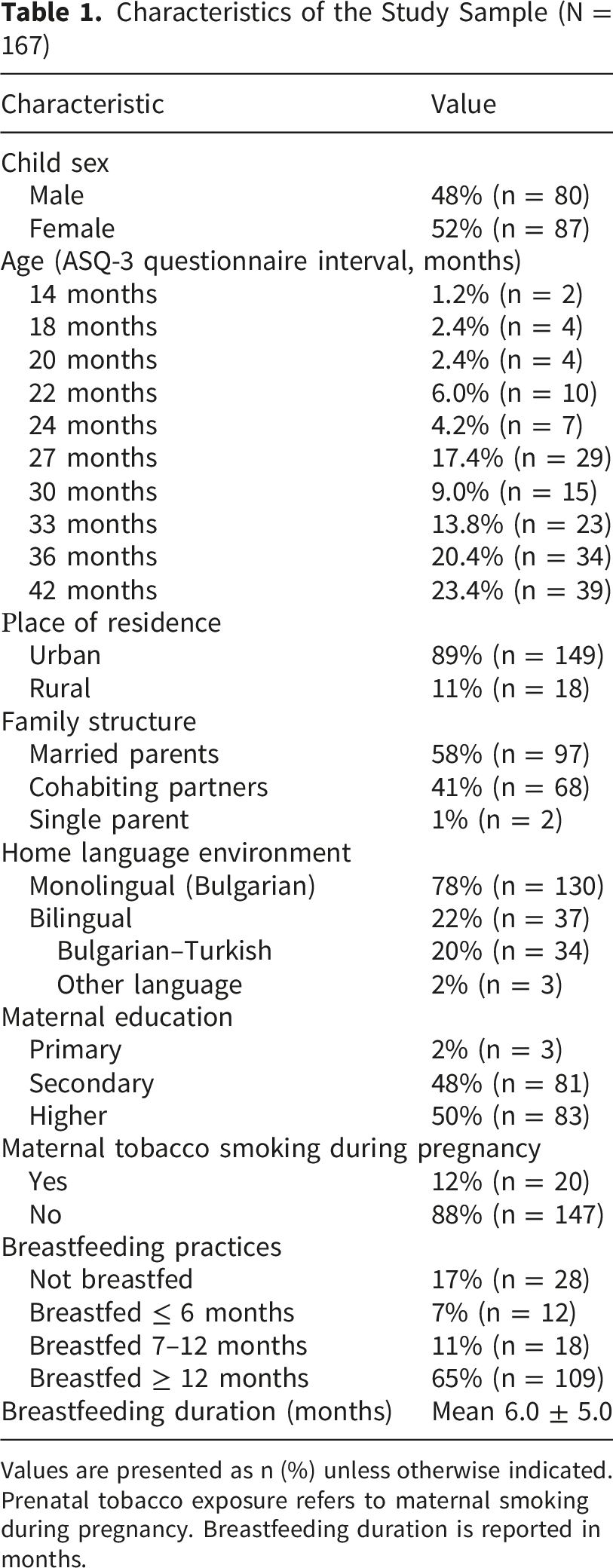
Values are presented as n (%) unless otherwise indicated. Prenatal tobacco exposure refers to maternal smoking during pregnancy. Breastfeeding duration is reported in months.
Measures
Developmental Assessment
Child development was assessed using the Ages and Stages Questionnaires, Third Edition (ASQ-3), a standardized parent-report screening instrument validated for children aged 1–66 months. The ASQ-3 evaluates five developmental domains: communication, gross motor, fine motor, problem solving, and personal–social development. Each child was assessed with the questionnaire corresponding to their chronological age within the 14–42 month range.
Score Standardization
Raw scores for each ASQ-3 domain were converted into age-standardized Z-scores to allow comparison across different age groups. Age-specific normative means and standard deviations from the ASQ-3 User’s Guide
19
were applied separately for each domain and age-specific questionnaire using the following formula:
The resulting Z-scores have a mean of 0 and a standard deviation of 1, with positive values indicating performance above and negative values indicating performance below age-specific normative expectations. Because outcomes were standardized for age, chronological age was not included as a covariate in subsequent analyses.
Predictor variables included child sex, place of residence (urban vs. rural), home language environment (monolingual vs. bilingual), family structure (married, cohabiting, single parent), maternal education level, prenatal exposure to tobacco smoke, and duration of breastfeeding.
Statistical Analysis
Pearson Correlations Among Age-Standardized ASQ-3 Developmental Domain Z-Scores.
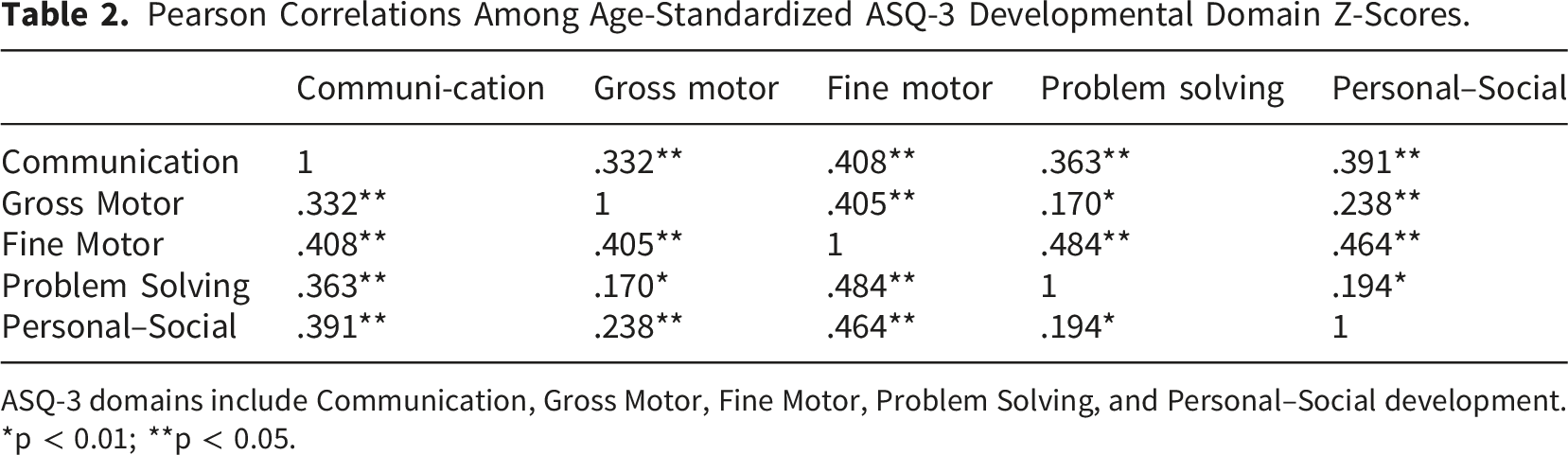
ASQ-3 domains include Communication, Gross Motor, Fine Motor, Problem Solving, and Personal–Social development.
*p < 0.01; **p < 0.05.
Stepwise multiple regression was used as an exploratory modeling approach to identify independent predictors across multiple correlated biological and social variables while limiting overparameterization relative to sample size.
Separate stepwise multiple linear regression analyses were conducted for each ASQ-3 developmental domain.
To assess the robustness of the findings, sensitivity analyses were additionally performed using logistic regression models with
Ethical Approval and Informed Consent
All study procedures were conducted in accordance with the principles of the Declaration of Helsinki. The study protocol was reviewed and approved
Results
Stepwise Multiple Linear Regression Model Summary for ASQ-3 Developmental Domain Z-Scores
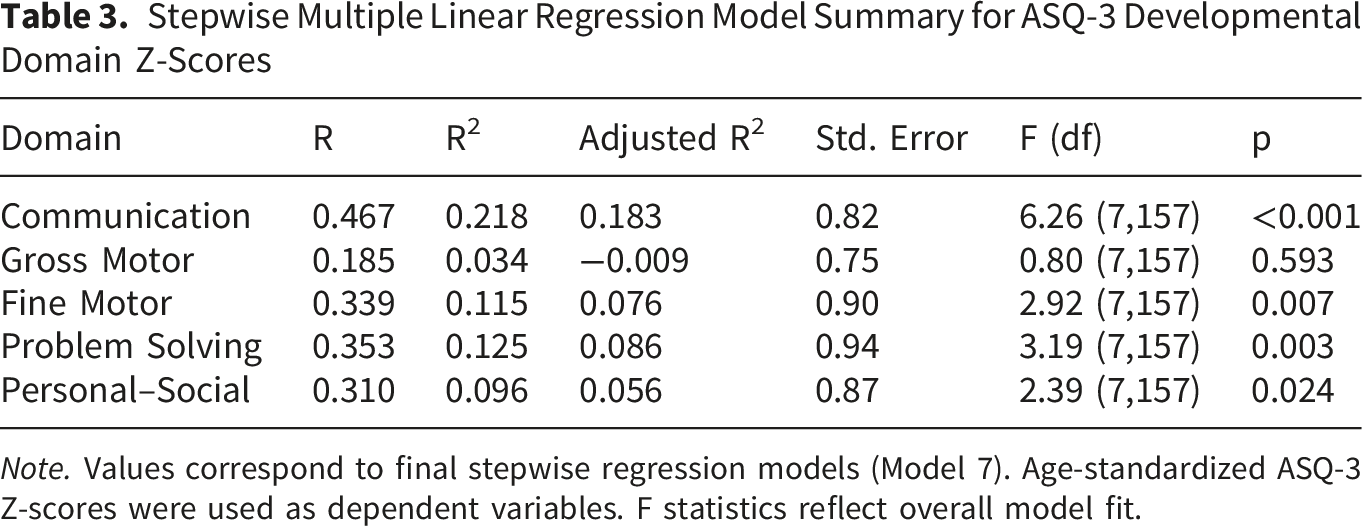
Note. Values correspond to final stepwise regression models (Model 7). Age-standardized ASQ-3 Z-scores were used as dependent variables. F statistics reflect overall model fit.
ANOVA Results for Final Stepwise Regression Models Predicting ASQ-3 Domain Z-Scores.
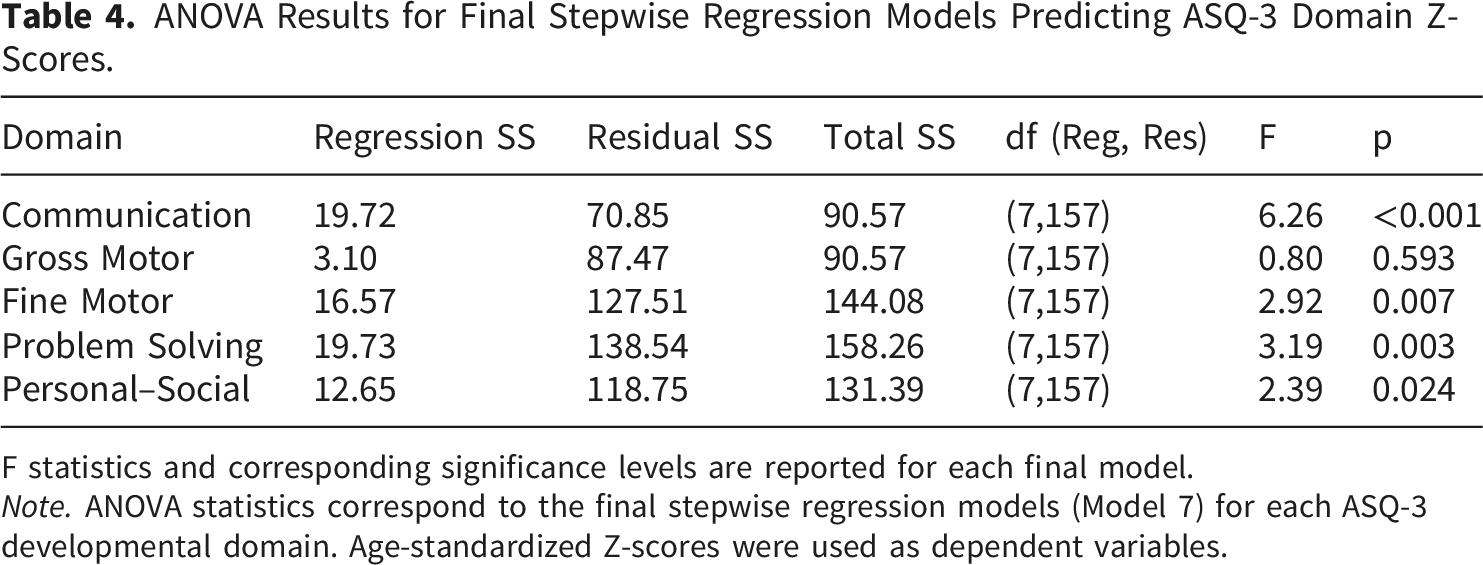
F statistics and corresponding significance levels are reported for each final model.
Note. ANOVA statistics correspond to the final stepwise regression models (Model 7) for each ASQ-3 developmental domain. Age-standardized Z-scores were used as dependent variables.
Final Stepwise Multiple Linear Regression Models Predicting ASQ-3 Developmental Domain Z-Scores
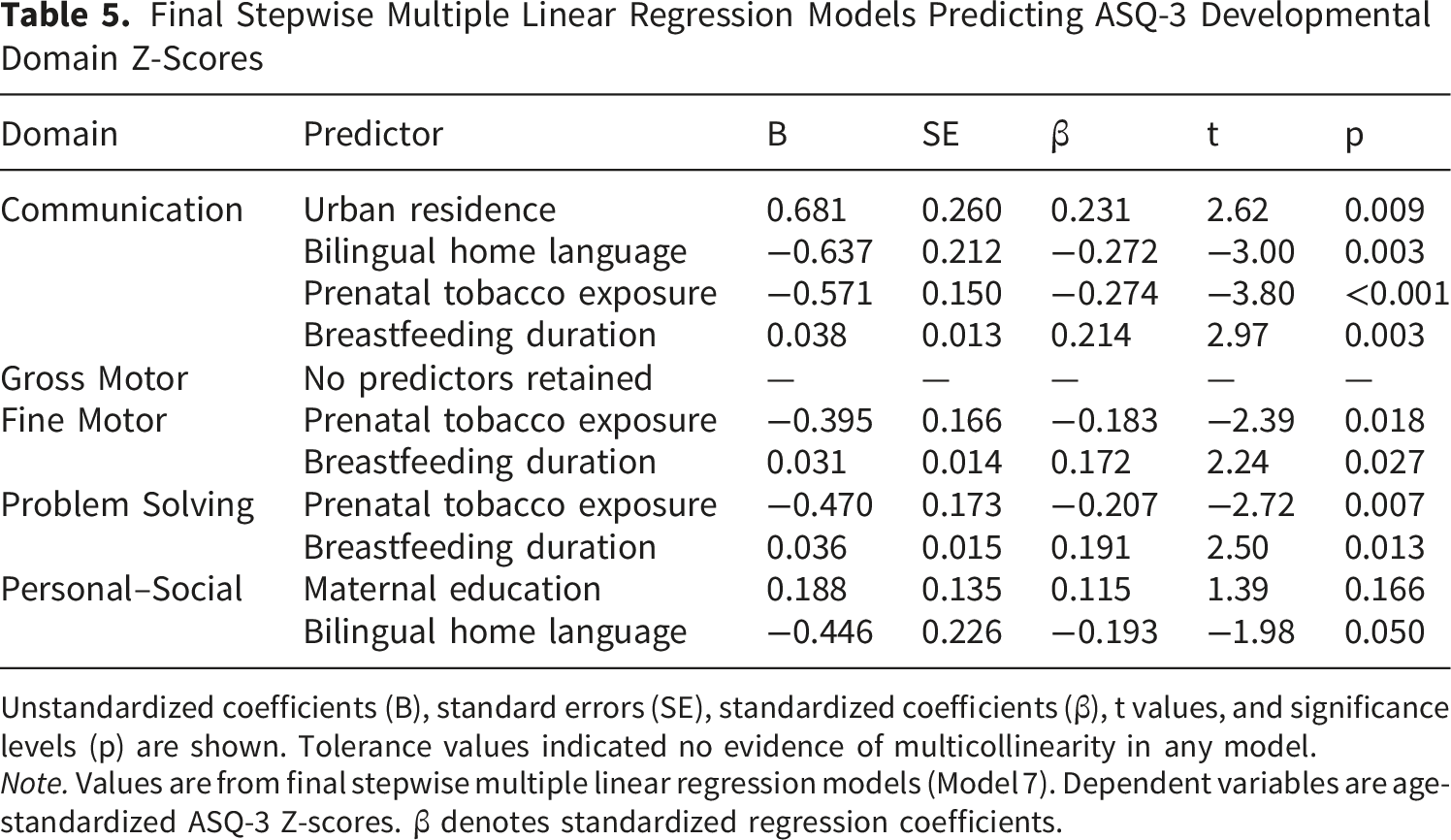
Unstandardized coefficients (B), standard errors (SE), standardized coefficients (β), t values, and significance levels (p) are shown. Tolerance values indicated no evidence of multicollinearity in any model.
Note. Values are from final stepwise multiple linear regression models (Model 7). Dependent variables are age-standardized ASQ-3 Z-scores. β denotes standardized regression coefficients.
Communication
The final regression model for communication outcomes accounted for a substantial proportion of variance (R2 = 0.218; adjusted R2 = 0.183) and demonstrated a statistically significant overall fit (F(7,157) = 6.26, p < 0.001; Tables 3 and 4). Residence in an urban setting was independently associated with higher communication Z-scores (β = 0.231, p = 0.009). In contrast, exposure to a bilingual home language environment (β = −0.272, p = 0.003) and prenatal tobacco exposure (β = −0.274, p < 0.001) were associated with lower communication performance. Longer breastfeeding duration was positively related to communication outcomes (β = 0.214, p = 0.003). Child sex, maternal education, and family structure did not show independent associations in the fully adjusted model.
Gross Motor Development
For gross motor development, the final model explained only a negligible proportion of variance (R2 = 0.034; adjusted R2 = −0.009) and did not reach statistical significance (F(7,157) = 0.80, p = 0.593; Tables 3 and 4). None of the examined biological, prenatal, or social predictors were significantly associated with gross motor Z-scores in the final model (Table 5).
Fine Motor Development
The final regression model for fine motor development explained 11.5% of the variance (R2 = 0.115; adjusted R2 = 0.076) and showed a statistically significant overall fit (F(7,157) = 2.92, p = 0.007). Prenatal exposure to tobacco smoke was independently associated with lower fine motor Z-scores (β = −0.183, p = 0.018), whereas longer breastfeeding duration was associated with higher fine motor performance (β = 0.172, p = 0.027). Other biological and social predictors did not remain significant after full adjustment.
Problem Solving
The final model predicting Problem Solving outcomes accounted for 12.5% of the variance (R2 = 0.125; adjusted R2 = 0.086) and demonstrated a significant overall fit (F(7,157) = 3.19, p = 0.003). Prenatal tobacco exposure was negatively associated with Problem Solving scores (β = −0.207, p = 0.007), while breastfeeding duration showed a positive independent association (β = 0.191, p = 0.013). No additional predictors retained statistical significance in the fully adjusted model.
Personal–Social Development
Personal–social development was most strongly related to social determinants. Maternal education emerged as a positive predictor across successive model steps.
Discussion
The present study identifies distinct, domain-specific patterns in the associations between biological, prenatal, nutritional, and social factors and early childhood development in a community sample of Bulgarian children. While several developmental domains demonstrated sensitivity to modifiable early-life exposures,
Although the observed effect sizes were modest, the communication model explained approximately 22% of the variance in developmental scores, suggesting clinically relevant associations between early-life exposures and developmental screening outcomes. The remaining unexplained variance likely reflects the multifactorial nature of early childhood development and the influence of additional environmental, genetic, and relational factors not captured in the present study.
Communication outcomes were most strongly shaped by a combination of prenatal, nutritional, and contextual influences. Longer breastfeeding duration and urban residence were associated with more favorable communication scores, whereas prenatal tobacco exposure and bilingual home language environments were linked to lower performance. The adverse association with prenatal tobacco exposure is consistent with previous research demonstrating negative effects of maternal smoking on early language development 10 and broader neurocognitive functioning. 9 Similar developmental risks have been reported across different nicotine delivery methods, including e-cigarettes, 12 whereas evidence regarding passive exposure remains less consistent. 11 Biological mechanisms proposed in the literature include disrupted neuronal differentiation and synaptic development due to nicotine, as well as reduced fetal oxygenation resulting from carbon monoxide exposure.20-22
In contrast,
Gross motor development did not demonstrate significant associations with any of the examined predictors, suggesting that basic motor milestones in typically developing children may be primarily driven by maturational processes.
Problem-solving abilities displayed a comparable pattern, with breastfeeding associated with higher scores and prenatal tobacco exposure associated with poorer outcomes. This domain captures early cognitive processes that are predictive of later attention regulation and executive functioning
2
Personal–social development was most closely linked to social context, particularly maternal education and the home language environment. Although child sex was not an independent predictor in the fully adjusted model, higher scores among girls are consistent with evidence of early sex differences in social and communicative behaviors.
26
Language-rich and responsive caregiving environments have been repeatedly shown to support early social competence.
38
Figure 1 synthesizes the domain-specific findings by illustrating how shared and distinct Conceptual model illustrating domain-specific associations between modifiable prenatal and social determinants and ASQ-3 developmental domains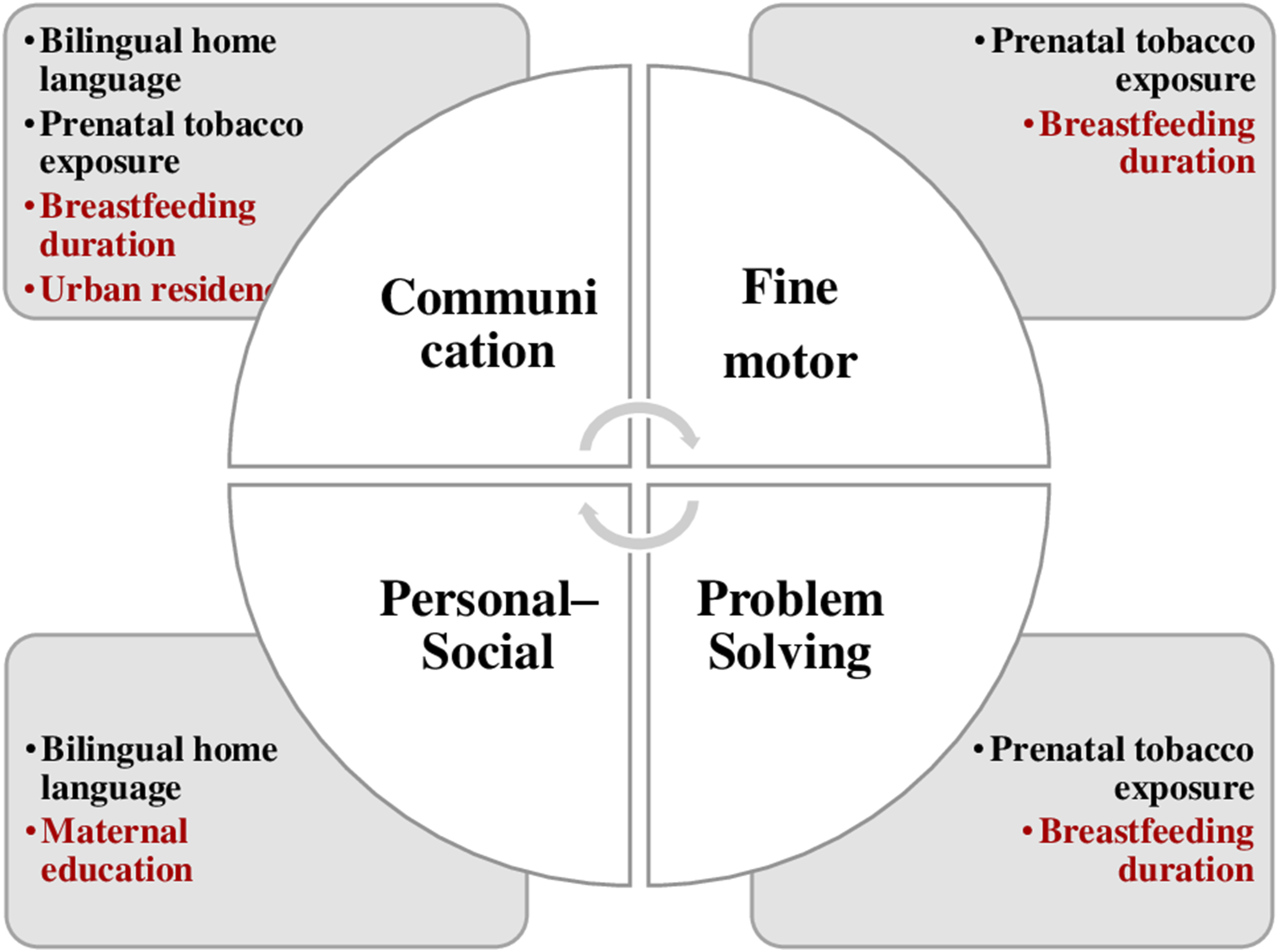
Strengths
The present study has several strengths. To our knowledge, this is among the first studies in Bulgaria to examine multiple ASQ-3 developmental domains simultaneously in relation to biological, prenatal, nutritional, and social factors in early childhood. The use of age-standardized Z-scores allowed comparison across different ASQ-3 age intervals and facilitated domain-specific interpretation of developmental variability. In addition, the simultaneous evaluation of multiple early-life determinants enabled a broader examination of developmental patterns across communication, motor, cognitive, and personal–social domains.
Limitations
Several limitations should be considered when interpreting the findings of the present study. First, the cross-sectional design does not permit conclusions regarding temporal or causal relationships between the examined factors and developmental outcomes. Second, both developmental outcomes and exposure variables were based on parent-reported information, which may introduce recall and reporting bias. Third, the ASQ-3 is a developmental screening instrument rather than a diagnostic assessment tool; therefore, the findings should be interpreted as reflecting developmental screening performance rather than confirmed developmental disorders. In addition, participant recruitment through daycare centers and the predominantly urban composition of the sample may limit generalizability to other populations. Finally, subgroup categories such as children exposed to prenatal tobacco smoke and those from bilingual households were relatively small, which may have reduced statistical power for some comparisons. Lower communication-related scores observed in bilingual environments should also be interpreted cautiously, as bilingual language development may not be fully captured by monolingual screening norms.
Clinical and Public Health Implications
Across multiple developmental domains, breastfeeding duration and prenatal tobacco exposure
Conclusion
This study provides new evidence on the domain-specific determinants of early childhood development in a Bulgarian community sample. Communication, fine motor, problem-solving, and personal–social development were associated with modifiable prenatal and postnatal factors, including breastfeeding duration and prenatal tobacco exposure, whereas gross motor development showed no significant associations.
Footnotes
Acknowledgments
The author would like to thank the participating families and daycare institutions for their cooperation. The author also wishes to express sincere gratitude to Momchil Itov for his support with organizational activities and for assistance with logistical coordination.

Ethical Considerations
The study protocol was approved by the Ethics Committee of University Multidisciplinary Hospital “MEDIKA – Ruse” Ltd., Ruse, Bulgaria (approval No.
Consent to Participate
Written informed consent was obtained from the parents or legal guardians of all participating children.
Author Contributions
The author was responsible for the study conception and design, data collection, data analysis and interpretation, drafting of the manuscript, and critical revision of the final version.
Funding
The author disclosed receipt of the following financial support for the research, authorship, and/or publication of this article: This study was conducted under the project
Declaration of conflicting interests
The author declared no potential conflicts of interest with respect to the research, authorship, and/or publication of this article.
Data Availability Statement
The data supporting the findings of this study are available from the corresponding author upon reasonable request.