






Abstract
Introduction
Warfarin produces its anticoagulation properties through the antagonism of vitamin K. Specific coagulation factors produced in the liver (ie, factors II, VII, IX, X) and proteins C and S require vitamin K in order to undergo carboxylation to become active. Warfarin specifically works to inhibit the enzyme, vitamin K epoxide reductase, which is responsible for the oxidation of vitamin K. 1 Using warfarin can be challenging due to the significant number of drug–drug and drug–food interactions and its narrow therapeutic window requiring continuous monitoring to ensure appropriate anticoagulation. These factors have lead researchers to develop newer agents, which may avoid some of the problems encountered with warfarin. Its use has continued unchallenged for many years, but with the availability of new oral anticoagulants for thromboprophylaxis there appears to be a shift in practice.
At the time of this study, 2 of the newer oral anticoagulants available in the United States, rivaroxaban (Xarelto) and dabigatran (Pradaxa), were approved for patients with atrial fibrillation (AF), venous thromboembolism (VTE), or thromboprophylaxis following hip and knee surgeries.2,3 Subsequent approval of apixaban (Eliquis) provides an additional option for thromboprophylaxis. 4 Unlike warfarin, the dosing of these agents needs to be modified in patients with renal insufficiency. Based on the package insert for each medication, the dose of dabigatran and rivaroxaban should be reduced with a creatinine clearance (CrCl) of <30 mL/min and <50 mL/min, respectively.2,3 However, many clinicians and electronic medical record systems use ideal body weight (IBW) to calculate CrCl. As a result, dosing of these anticoagulants may not follow recommendations found in the package insert that utilized actual body weight (ABW) for the calculation.
Objective
The objective of this study was to evaluate whether rivaroxaban and dabigatran were dosed according to the package insert recommendations in patients with renal insufficiency.
Methods
This was a retrospective review of patients admitted to the Medical University of South Carolina (MUSC) or had a prescription filled from the outpatient pharmacy. Utilizing a query into the Horizon Meds Manager Pharmacy System (inpatient) or QS/1 Data Systems (outpatient) all patients who were prescribed either rivaroxaban or dabigatran were identified. Patients who received one of the medications were considered for inclusion. Patients who were eligible for inclusion and ≥18 years of age were reviewed in detail through MUSC medical records. Data were collected on a standardized data collection form.
Pertinent data included gender, age, height, weight, serum creatinine (SCr), and estimated glomerular filtration rate (eGFR). Creatinine clearance was calculated on all patients using both the patients’ IBW and ABW. While the original equation developed by Cockcroft and Gault recommended use of lean body weight for calculation of patient CrCl, the trials evaluating rivaroxaban and dabigatran used ABW in the study protocol. Information regarding drug indication, concomitant medications, and location where the medication was initiated was obtained from medical records. This study was approved by the MUSC Institutional Review Board.
Results
From November 2010 through February 2013, we identified 400 patients who met our initial inclusion criteria from the inpatient and outpatient pharmacy services query. There were 30 patients that were excluded from the identified patient list. Of these 30 patients, 13 did not have the medication filled or did not receive the medication on the inpatient service, 7 had no or unknown indication documented for anticoagulation, and 10 were duplicate patients. An additional 15 patients were excluded from the study due to inability to calculate IBW.
Of the remaining 355 patients, 100 patients received rivaroxaban and 255 patients received dabigatran (Table 1). Overall, 67.6% of patients were male (n = 240), which was evenly distributed between the rivaroxaban and dabigatran groups. Atrial fibrillation (91.0%, n = 323) was the predominant indication for the use of anticoagulation.
Baseline Characteristics.
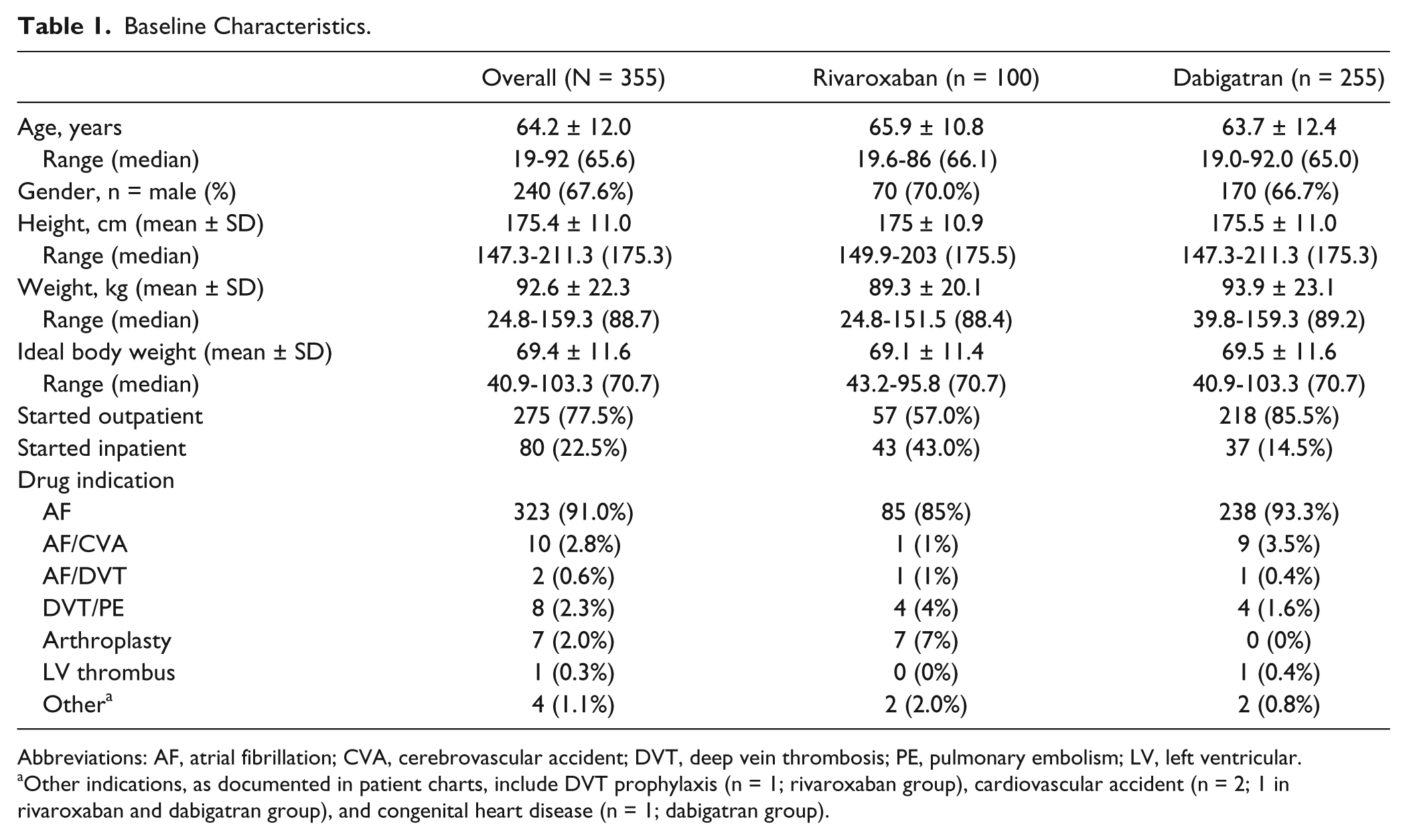
Abbreviations: AF, atrial fibrillation; CVA, cerebrovascular accident; DVT, deep vein thrombosis; PE, pulmonary embolism; LV, left ventricular.
Other indications, as documented in patient charts, include DVT prophylaxis (n = 1; rivaroxaban group), cardiovascular accident (n = 2; 1 in rivaroxaban and dabigatran group), and congenital heart disease (n = 1; dabigatran group).
Using the Cockcroft–Gault equation, CrCl was calculated (using both IBW and ABW) and evaluated in both the rivaroxaban and dabigatran groups (Table 2). On average, patients were 20 kg above their IBW.
Renal Function.

Abbreviations: SCr, serum creatinine; eGFR, estimated glomerular filtration rate; ABW, actual body weight; CrCl, creatinine clearance; IBW, ideal body weight.
Patients receiving dabigatran and either dronendarone or ketoconazole.
In reviewing eGFR, there were 272 of 355 patients who had an eGFR >59 mL/min/1.73 m2 (76.0% in the rivaroxaban group and 76.9% in the dabigatran group). Evaluation of eGFR compared with ABW-calculated CrCl showed a discrepancy between the 2 groups. When eGFR was used as the sole determinant there were 27 patients who fell below the threshold where a reduction in dose should be considered, whereas if ABW CrCl was utilized, there were only 8 patients who met the same criteria. In the dabigatran group only 6 patients had both eGFR and calculated CrCl <50 mL/min. In the rivaroxaban group, 12 patients had an eGFR < 50 mL/min/1.73 m2 while only 6 patients had a similar finding with ABW-calculated CrCl. There were only 4 patients who had both an eGFR and calculated CrCl <50 mL/min in the rivaroxaban group. The SCr closest to drug initiation was used in the calculation. The average time from measured SCr to drug initiation was 11.4 ± 44.9 days, with a range of 277 days before drug initiation to 494 days after drug initiation. Patients in the dabigatran group had a longer time frame from their most recent SCr compared with the rivaroxaban group (13.2 ± 49.3 days vs 6.8 ± 31.1 days, respectively).
Renal function was calculated using both ABW and IBW. There were 15 patients in the rivaroxaban group with a calculated CrCl (IBW) < 50 mL/min; however, there were only 6 patients with a CrCL < 50 mL/min when ABW was utilized (Table 3). Overall, 3 of 6 (50.0%) patients receiving rivaroxaban who required a dose adjustment based on ABW CrCl had a dose reduction. When IBW was utilized for CrCl calculation, 9 of 15 (60%) patients requiring a dose adjustment had a dose reduction.
Primary Outcome.
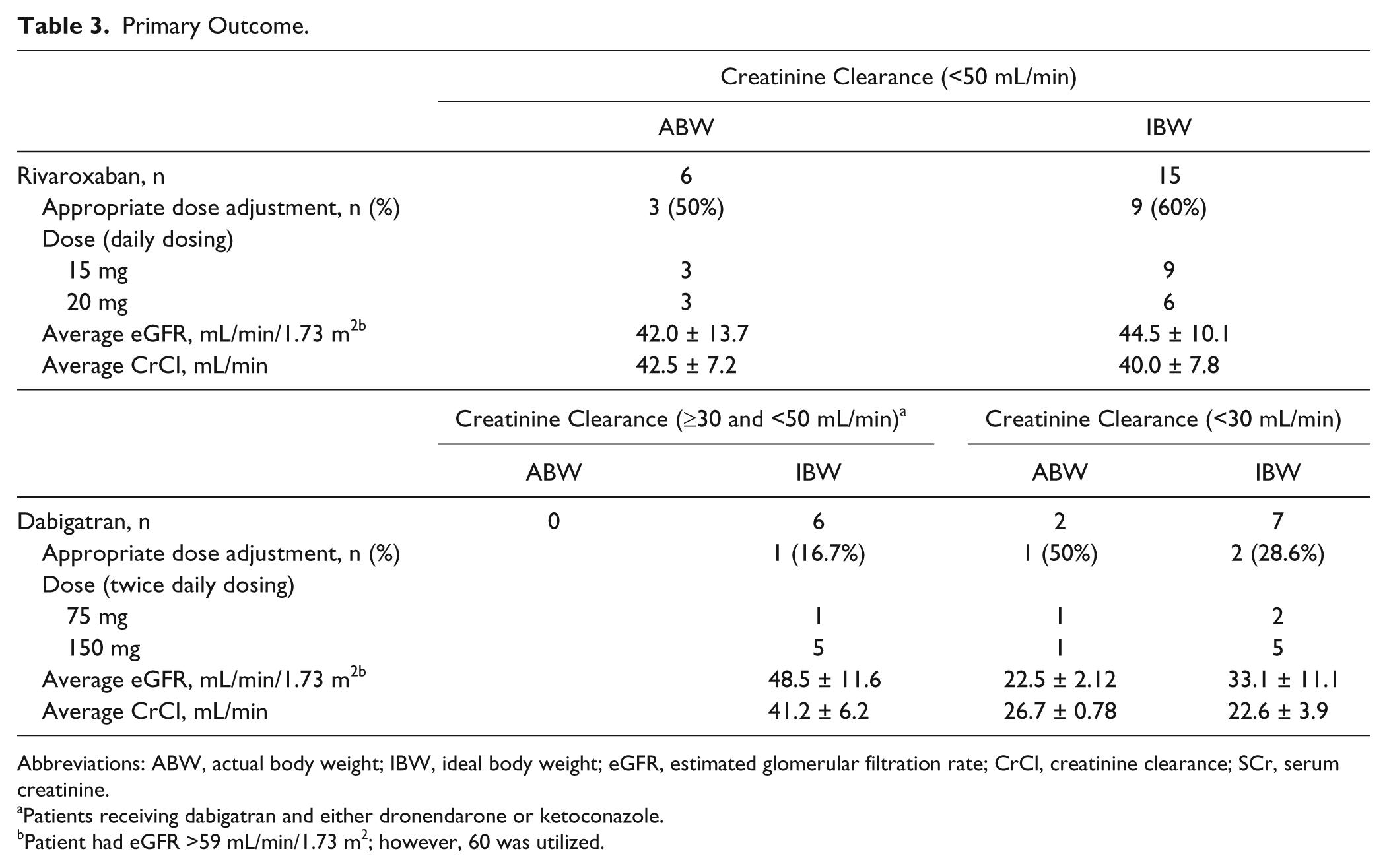
Abbreviations: ABW, actual body weight; IBW, ideal body weight; eGFR, estimated glomerular filtration rate; CrCl, creatinine clearance; SCr, serum creatinine.
Patients receiving dabigatran and either dronendarone or ketoconazole.
Patient had eGFR >59 mL/min/1.73 m2; however, 60 was utilized.
In the dabigatran group there were 2 patients with an ABW CrCl of < 30 mL/min and 7 if IBW was utilized in the CrCl calculation. Only 1 of 2 (50%) patients in the ABW CrCl and 2 of 7 (28.6%) in the IBW CrCl had dabigatran doses reduced to 75 mg twice daily. When certain medications (eg, dronedarone, systemic ketoconazole) are used concomitantly with dabigatran, a dose reduction is recommended when CrCl is between 30 and 50 mL/min. There were 38 patients who were on concomitant dabigatran and dronedarone or ketoconazole during the study period. When ABW was utilized there were no patients who fell into this category. Six patients required a dose reduction but only 1 of 6 (16.7%) had a dose reduction to 75 mg twice daily when IBW was utilized for CrCl.
Discussion
This retrospective review of our current prescribing practices of dabigatran and rivaroxaban indicate that there could be confusion regarding which patients may need a dose adjustment depending on which weight is utilized for CrCl calculation. While the package inserts of both medications recommend utilizing ABW for CrCl, many clinicians routinely use IBW, which may lead to potentially inappropriate dose reductions. When calculating CrCl with IBW, as many pharmacists have been trained, there were 15 patients with CrCl <50 mL/min in the rivaroxaban group and 7 patients with a CrCl < 30 mL/min in the dabigatran group. Based on these data, 11 patients (9 in rivaroxaban group and 2 in dabigatran group) received inappropriate dose reduction resulting in less than the recommended dose according to the manufacturer. This could potentially lead to subtherapeutic serum levels of the drug.
Regardless of how CrCl was calculated there were very few patients (2.3% [8 of 355] utilizing ABW) who needed a dose reduction based on current package insert recommendations. When using ABW CrCl, there were 3 of 6 (50%) patients in the rivaroxaban group and 1 of 2 (50%) in the dabigatran group who had an appropriate dose reduction. Overall, these data showed that the majority of patients who received either rivaroxaban or dabigatran most did not require dosage adjustment. Based on the current analysis, there were an equal percentage of patients between the 2 groups to have appropriate dose adjustment utilizing ABW. Unlike the dosing adjustments for rivaroxaban, there are specific recommendations for dabigatran regarding renal dysfunction with specific drug interactions. Patients who have a CrCl between 30 and 50 mL/min while receiving dronedarone or ketoconazole should have a dose reduction to 75 mg twice daily. The recommendation to reduce the dose of dabigatran in patients with a CrCl 30 to 50 mL/min with concomitant dronedarone was infrequently followed when IBW was utilized in this analysis. However, when ABW was utilized there were no patients who met these criteria.
Our analysis included both inpatient and outpatient utilization of rivaroxaban and dabigatran to assess dosing strategies in 2 distinct settings. Our data indicate that 77.5% (n = 275) of the utilization was on an outpatient basis. Unfortunately, we were unable to assess how many of these outpatient prescriptions were “new-starts” or refill prescriptions. Despite this limitation, we noted 2 patients had no SCr recorded in their medical record and the average time in days since their last SCr was checked prior to having the medication filled was 11.4 ± 44.9 days, which indicates many clinicians may disregard the need for renal function assessment with these medications.
According to the most recent Center for Disease Control and Prevention (CDC) data, the incidence of obesity is highest in the southern United States. South Carolina had a 30.8% prevalence (confidence interval = 29.6-32.1) in 2011. 5 One finding in this study is the difference in calculated CrCl based on utilization of ABW versus IBW. When the different weights were applied to the Cockcroft–Gault equation there was a much higher (>20 mL/min) CrCl when ABW was utilized. With a medication that needs a dosage reduction based on renal function, it is vital to have the most accurate measurement of renal function to optimize the anticoagulation effects. It is interesting that the recommendation to determine CrCl in the package insert for the respective medications is to use ABW in all patients regardless of their weight. There has been a longstanding debate regarding appropriate weight to use since the original study by Cockcroft and Gault in 1976. 6 While lean body weight (LBW) was utilized in the original study, it has not been clearly established how well LBW correlates to renal function in a society where obesity is prevalent. Recently, Winter and colleagues tried to correlate various body weights and serum creatinine concentrations to the accuracy of the Cockcroft–Gault equation by comparing to a measured 24-hour urine CrCl. 7 Their findings suggest that the ABW should be utilized in underweight patients, IBW in patients with a normal weight, and an adjusted body weight should be utilized for overweight, obese, and morbidly obese patients. It should be noted that while our analysis showed a difference between IBW and ABW, regardless of which weight was utilized in calculating CrCl, there was only a small percentage of patients who required a dose reduction. (Table 3).
Another important consideration is the availability of eGFR, which is provided with the SCr when results from a basic metabolic panel are reported. If the physician utilizes the given eGFR instead of a calculated CrCl, there is a risk of inappropriate dosing. While assessment of renal function is correlated through estimates of GFR, this is not how most drug dosing recommendations are determined. The amount of creatinine excreted in the urine is the result of filtration by the glomerulus and secretion in the proximal tubule. Based on this physiological relationship, it is known that CrCl overestimates GFR by approximately 10% to 40% in patients with normal renal function and is much more unpredictable in patients with CKD. 8
There were a small number of patients who had both eGFR and ABW CrCl below 50 mL/min (n = 10). There were more patients with CrCl < 50 mL/min as assessed by eGFR (n = 39) as compared with ABW CrCl (n = 13). Underdosing of these medications could lead to adverse thromboembolic events. When the pharmacokinetic and pharmacodynamic properties of rivaroxaban and dabigatran were studied, renal function was evaluated with a 24-hour urine collection for calculation of CrCl.9,10 It is impractical for all patients to have a 24-hour urine collection to determine a CrCl; therefore, several equations have been developed over time to estimate renal function. Two of the most commonly utilized are the Cockcroft–Gault and Modification of Diet in Renal Disease (MDRD) equations. Even though these equations have been validated, there are specific limitations to their utility, which should be considered prior to initiation of these medications. Cockcroft–Gault utilizes a patients serum creatinine, which may be affected by age, sex, race-ethnicity, weight, muscle mass, and diet, while the MDRD equation has been utilized primarily in patients with known chronic kidney disease.6-8 Furthermore, drug interactions must be taken into consideration.
While this study did not evaluate bleeding outcomes, one of the biggest concerns is the potential for accumulation of the active drug leading to significant bleeding complications. Unlike warfarin, which has several reversal agents for bleeding episodes, there are conflicting data regarding the appropriate reversal agents for rivaroxaban and dabigatran.11-13
There are several limitations with this study. First, this was a retrospective review looking at a specific point in time. Renal function was evaluated based on a single laboratory serum creatinine value at the time of drug initiation or as close to that time point as possible. Therefore, patients who may have developed renal insufficiency over time were not captured, and our data may underestimate how many patients are inappropriately dosed. Also, patients may have had their medication regimen changed at a later date, but due to our data collection at a single time point, we did not capture that data.
While it has been documented in phase III trials and review articles that bleeding is a major complication of these medications, we did not evaluate bleeding outcomes in these patients.14-19 Therefore, the impact of the dosing regimens on these outcomes is unknown.
Conclusion
Based on this evaluation, only a select few patients were inappropriately dosed due to renal dysfunction. However, this analysis helps emphasize the discrepancies seen with various creatinine clearance calculations. Prescribing clinicians need to ensure that if renal function affects medication dosing the package insert should be consulted to review how creatinine clearance was evaluated in the original studies.
Footnotes
Authors’ Note
The information contained within this article was presented at the Southeastern Residency Conference in April 2013.
Declaration of Conflicting Interests
The author(s) declared no potential conflicts of interest with respect to the research, authorship, and/or publication of this article.
Funding
The author(s) received no financial support for the research, authorship, and/or publication of this article.