







Abstract
Introduction
Inhalation is an important and common method of administering medication to patients with respiratory disease. 1 There are 2 main types of inhalation devices, inhalers and nebulizers. Inhalers are the simplest portable drug delivery system that is in a mist or spray form, which directly gets into the lungs when a person inhales. 2
Nebulizers are capable of converting liquid into aerosol droplets suitable for patient inhalation. It is used to administer drugs like bronchodilators, corticosteroids, antibiotics, anticholinergics, and mucolytic agents that help the management of respiratory disease. 3 Nebulizers are generally used when extremely large doses of bronchodilator medications are administered to the airways, when the patients find it difficult to breathe.
The nebulizer devices are larger in size, its handling is more complicated, and requires more maintenance than the inhalers. If one component of the nebulizer system is altered, the drug delivery performance and overall efficiency of the drug is altered and becomes necessary to reset the nebulizer system. The appropriate use of a nebulizer device is crucial in achieving successful therapy.1,3 This aims of this study are to systematically review the knowledge, attitude, and practice of nebulization therapy with the objective to assess the setting up and operating, cleaning and disinfecting, drying, and maintenance of the nebulizer technique and also to interpret the outcome of the studies.
Methodology
Scopus, PubMed, BMJ, and another database from 2000 to 2020 were searched. The literature suggests that nebulization was in use from the year 1864; we wanted to know the scenario of home nebulization for the last 20years. These databases were chosen to collect the most relevant information related to the nebulizer therapy using Boolean operators (AND, OR, NOT, or AND NOT). Search terms were “Nebulizer technology” AND “Practice” AND “Experience” AND “Attitude” AND “Knowledge.” PubMed, BMJ, Cochrane, and other databases produced 251, 362, and 958 numbers, respectively, for a total of 1571 numbers. Articles were screened for nebulizer technology and for inclusion and exclusion criteria from the title and abstract. Articles other than in English were rejected, resulting in 27 articles. After full text screening 16 articles were included in the study. The literature search was completed by the middle of February 2021. Any ambiguity regarding the screening process was resolved with a coinvestigator, and the objective of the study is to assess the knowledge, attitude, and practice among patients using nebulizers. The outcome of the study is very crucial in understanding the knowledge and practice gaps in rational use of nebulizers as it helps patients with difficulty in breathing and also plays a major role in improving the quality of life.
Inclusion Criteria
The review of articles included studies conducted among patients with respiratory diseases of all age groups, with the nebulization therapy as a treatment.
Exclusion Criteria
The research articles and review articles of nebulization therapy performed in a hospital setting were excluded.
Study Procedure
The study procedure was as depicted in Figure 1.
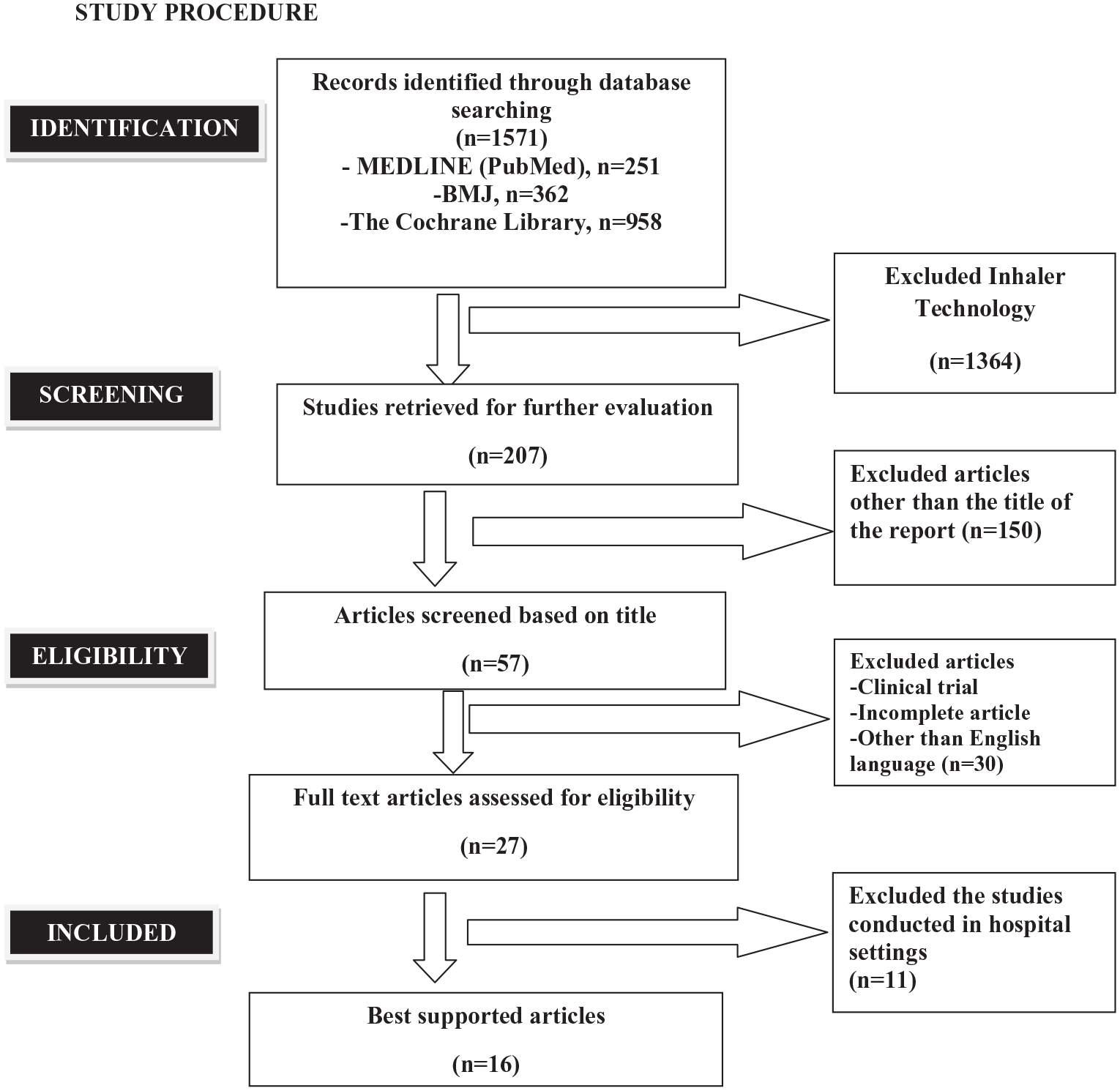
Flow chart detailing the screening of literature.
Results
Knowledge
Knowledge about the setting up and operating, cleaning and disinfecting, drying, and maintenance about the nebulizer is critically important in achieving maximum therapeutic outcome and also to reduce infection or reinfection from contamination of nebulizers.
Most of the patients (94%) chose the nebulizer system themselves, without any medical information. Studies reveal that a minority of subjects had received some information about nebulizer use and maintenance from health caregivers. Most patients in the study reported that they never received any instruction on the complete utilization of the nebulizer (optimal fill volume or drug solvent). 3
In a study conducted by Alhaddad and colleagues, 4 most of the patients failed in operating, cleaning, and disinfecting nebulizers. The study was conducted among 50 patients wherein some patients failed to ensure that the vaporizer head is freely moving, either not understanding this part’s function, or not knowing it was detachable. It was reported that one of the patients thought that it has to be tight fitting. Also, patients were unaware on why dilution was required wherein one patient thought that the dilution was to mash the taste of the medicine, and another patient was substituting saline with boiled or distilled water for dilution. Some of the patients were unaware about the breathing technique. Several patients performed holding the breath prior to exhalation. Although in most cases patients had not been instructed on breathing technique, they recognized the importance of deep breathing. A patient using nebulizer for the past 10 years reported that nobody ever said anything about breathing technique, it just seems that while breathing very shallowly there is some part of the lung that is not getting the medication, and it probably ought to.
In maintaining the nebulizer system most nebulizer manufacturers recommend that facemasks/mouthpieces and tubing to be replaced every 3 months with daily use, and the British Thoracic Society advises replacement of such parts at 3 to 6 monthly intervals. One of the patients never replaced the filters and reported that the patient never got any instructions on replacement. The majority of the patients got their nebulizers outside of the hospital and had never been taught on how to use them. 4
Many patients mentioned that they chose their own nebulizer equipment. Without any medical knowledge, the majority of patients (94%) chose the interface system on their own. A small percentage of the participants had obtained some guidance from their health care providers about how to use and maintain nebulizers. The majority of patients (78%) also stated that they were never given any instructions on the appropriate fill volume or medication solvent, and the mean fill volume was found to be 3.8 mL. 3
In a study conducted in the United Kingdom, nebulizers were issued to patients from the Department of Respiratory Medicine. The correct use of the nebulizer was demonstrated, and a medication prescription and written instructions for the routine care and cleaning of the nebulizer chamber and compressor system are issued. Later it is followed up by a respiratory consultant after a 2-week trial of medication using an appropriate nebulizer device and compressor system. 5
In the study conducted by Alhaddad and colleagues, a 64-year-old female patient, who was on nebulizer for 3 years, expressed challenges in diluting of medications, while she was not clear in the sequence of adding medication or diluting medication into the medication reservoir, which was the common issue faced by many study participants. Also, one of the patients reported that he does need somebody to make sure he is doing it properly. 6 Overall, the review showed that there is lack in knowledge about the proper dilution of medication with many study participants.
Regarding the replacement of nebulizer parts, most patients had not performed it. About 25% of the patients lacked knowledge about the necessity. However, a high rate of nebulizer hygiene behavior not recommended was found in this report, reinforcing the need for this population’s awareness to be strengthened. Therefore, better knowledge about this area should be encouraged between patients and caregivers. 7
Practice
Patients with respiratory disease utilizing nebulizer at home experienced challenges at all stages, including the following:
Setting up and operating the nebulizer
Filling of medication
Inhalation technique and end point dismantling
Cleaning and drying the nebulizer device
Setting Up and Operating the Nebulizer
The study conducted by Alhaddad and colleagues 4 mainly assessed the challenges in assembling and operating, ensuring that the vaporizer head is freely moving. The study reported that about 22 participants (n = 50) failed to ensure it prior to filling the drugs. 4 Another study conducted by Alhaddad and colleagues 6 reported that the patient caretaker found it difficult to set the nebulizer at home. This study was conducted among 14 participants in which 8 participants experienced difficulty in setting up and operating the nebulizer. 6 Setting up the breathing tube and ventilator settings have direct effect on the amount of medication that is reaching or dispensed to the patient’s lungs. It is suggested that delivery efficiency should be carefully assessed for a given nebulizer/circuit/ventilator combination. 8
Filling of Medications
Required amount of the medication in the medication cup of the nebulizer set (3-5 mL), proper instruction regarding the patient sitting in the upright position during nebulization, duration of nebulization (5-10 minutes), and utilization of mouthpiece over face mask for nebulization will greatly help in improving the drug delivery and in reducing improper use, and thus decrease unpleasant experiences. This overall increases the efficacy of the treatment. 9 Most of the studies have not focused on the filling of medications, which is important to assess the outcome of the treatment.
Inhalation Technique and End Point Dismantling
Breathing pattern has a greater effect on the amount of drug that reaches the site of action. Slow and deep breathing encourages the effective delivery of vaporized particles in the lower respiratory tract and alveoli. When the breathing rate is fast and inspiratory volume is small, the intrapulmonary deposition will get reduced. 3 In the study conducted by Melani and colleagues, 3 a nebulizer user reported that breathing pattern as no or short (less than 2-3 seconds) breath-holding after inhalation. In a study conducted by Bos and colleagues, 10 many participants made mistakes on breathing technique. A total of 13.3% of the participants made the mistake by sealing their lips around the mouth piece, and 26.7% of the participants failed to take a deep breath. Only 23.3% of the participants kept the mouth piece in a straight position in the mouth, and 16.7% of the study population followed the correct exhalation process. 11
An article reported that almost half of their patients used nebulizers for more than 30 minutes in a single session. The British Thoracic Society recommends that a single nebulization session last no longer than 10 minutes. Despite the fact that the long nebulization period is just a rough measure of equipment efficiency and may also be attributable to the common practice of combining more drugs for a higher fill rate, they were concerned about the suboptimal choices for nebulizer equipment. Their data seem to show that the diffusion of home nebulizers varied largely among participating centers. However, large variations of home nebulizer use are known according to the different local habits. 2
Cleaning and Drying the Nebulizer Device
The review evidently shows that there is a difficulty in handling the nebulizer by many participants. In a study conducted by Alhaddad and colleagues, 4 the improper practice of disinfecting the hands and parts of the nebulizer (apart from the tubing) were found and many participants failed to run the nebulizer with saline/empty. Similarly, in the study conducted by Riquena and colleagues, 7 it was reported that 71.6% pathogen contamination was found due to inappropriate cleaning of nebulizer, with 56.8% bacterial contamination and 45.9% fungal contamination. In nebulizer parts, the frequency of contamination observed in the interface and cup was 60.8% and 62.2%, respectively. The study conducted by Zuana and colleagues 12 also detected the contamination of nebulizers in 57.5% cases, wherein 40.0% of mouth pieces and 47.5% of cups were contaminated.
According to the findings of a questionnaire study, there may be some concerns with the usage and maintenance of home nebulizer systems. Although the patients say they have been told how to use and care for their nebulizer, their responses to the questions on the servicing and replacement of disposables indicate that these replacements may not be undertaken as suggested or recommended. Particular concern is raised by the infrequent changes of the tubing and the chambers and the frequency of cleaning of the chamber. Patients are supplied with replacement chambers and tubing when the nebulizer is serviced annually, and instructed that the chambers should be washed with warm soapy water, rinsed, and left to dry after each use as recommended in the current British Thoracic Society guideline on nebulizer use. The infrequent cleaning may be a source of bacterial contamination, and patient compliance also appears to be suboptimal. 5
Attitude
Patients/care takers should follow the manufacturer’s instructions in cleaning the nebulizer system after dismantling the nebulizer and discarding the remaining liquid. The majority of the patients did not adhere to good practice with regard to washing the parts in warm soapy water after each use, never disinfecting nebulizer parts, and few using the machine empty or with saline after use.
The majority of the patients did not adhere to these recommendations, making their own judgments regarding the need for replacements. One of the patients in a study said that there were no any changes when it is working, thus never replacing the nebulizer. Most of the patients reported that they had never replaced the compressor. Only 2 patients changed the nebulizer parts monthly. 4
Blau and colleagues stated that the manufacturer’s instructions provided with PARI Medical Holding GmbH nebulizer systems were inadequate, since they still recommended soaking the nebulizer in a solution of water and acetic acid for disinfection, which does not ensure disinfection against Staphylococcus aureus or Burkholderia cepacia.13,14
In maintenance of nebulizer devices, most of the participants failed to follow the instruction from the user’s information leaflet or from the manufacturer. In the study conducted by Alhaddad and colleagues, most of their patients failed to follow the instructions on how to use the nebulizer. The study also reported that among 50 participants, 37 failed to check and replace the nebulizer and face mask, 36 failed to recheck and replace tubing and filter, and 39 failed to service the device annually and to check it for any electrical fault. 4 In another study, Melani and colleagues 15 reported that only 10.1% of the patients reported replacing the device as instructed from the user guide, whereas 47.3% changed the reservoir only in case of evident visual or auditory defects (eg, cracked parts, air leakage) and nearly 40% never replaced the nebulizer.
A study about the knowledge, attitude, and practice of mothers of asthmatic children toward asthma reported that 85% believed that taking drugs to avoid asthma attacks was appropriate, although 36% did not believe that steroid inhalers and other asthma therapies would regulate asthma, and 21% did not support the use of inhalers.
In another study, staff nurses’ knowledge of nebulization therapy was inadequate. Initially in the pretraining assessment, the nurses had inadequate knowledge regarding the breathing pattern during nebulization, type of drugs used, proportion of dilution, changing of filter, and type of mask. They did, however, have a lot of information about the total period of nebulization, the end point of nebulization, and the cleaning of the accessories after nebulization. After a short instruction and hands-on learning regarding the proper procedures related to nebulization and inhaled drugs, there was a statistically significant increase in awareness toward nebulization therapy. 16
According to a survey, the majority of nurses believe that offering some level of education about nebulization therapy to patients during their hospital stay or at the time of discharge is the responsibility of the staff nurses who serve as a link between doctors and patients. Few of them, however, believe that it is the primary duty of physicians or respiratory therapists to teach patients about the proper and accurate use of nebulization in order to avoid complications and adherence to inhaled medicines. 16
Discussion
The articles show that generally patients’ knowledge about the use of a nebulizer is poor. Mostly the patients who buy/collect the nebulizer from outside the hospital are unaware about the proper utilization of the nebulizer as the patient education on nebulizer use by health care provider is not possible. It is the responsibility of the health care professionals such as nurses, pharmacists, or manufacturers to provide sufficient information to the patients. Thus, it is necessary to educate the patients using leaflets or videos that include the setting up and operating, cleaning and disinfecting, and maintaining the nebulizer in the colloquial language with pictograms wherever necessary.
A study conducted about the supervision and asthma management knowledge of patients possessing home nebulizers suggests that a simple care and crisis plan should be included with each nebulizer purchase, highlighting the main areas that patients should know regarding its use and care. Unsupervised use of nebulized bronchodilator can lead to disaster. Soa kit that educates on rational use of such device is crucial.
Perfect knowledge about the nebulizer makes perfect practice. Most of the patients experience difficulty in various stages of nebulization therapy. Despite the fact that most of the patients are given initial guidance on nebulizer usage and maintenance, the majority of nebulizers were no longer fit for use due to hygienic or technical reasons, and most patients were advised to replace parts such as the filter, air tubes, and medicine cups. According to the findings, an annual checkup and daily information about nebulizer maintenance are required. Inappropriate cleaning and disinfecting causes pathogen contamination. In most of the studies interface and cup are the mostly affected parts. Compliance with instructions given on the use and maintenance of home nebulizers was suboptimal. These areas can be improved with proper guidance, patient counseling, or by introducing a patient information leaflet. Better information provision has a crucial role in improving compliance.
Some studies reported about the unsatisfactory knowledge about the nebulization therapy among staff nurses. One of the studies concluded that after implementation of an educational program, remarkable improvement has occurred in knowledge, practice, and self-efficacy subscores. So knowledge on appropriate use of nebulizers for respiratory therapist, nurses, pharmacists, and other health care workers is very crucial to provide safe and effective care to patients and also in keeping the patients educated. A periodic training on nebulization therapy can be provided to staff nurses and other health care workers. Patients should get adequate programs, facilities, and support if optimum outcomes are to be achieved, reducing disease burden for patients, and promoting cost-effectiveness. 16
Limitations
Very few studies were conducted among patients who use nebulizers at home. Most of the studies included in this review were based on questionnaires; thus, there is a possibility that the participant answering the questionnaires related to knowledge, attitude, and practice may be affected by information and recall bias. The study has not included the use of nebulizers in the hospital setting. Hence, the results cannot be a generalized to the patients who use nebulizers at health care settings.
The study has not covered the studies conducted among the health care workers who are the source of information to patients on the use and maintenance of the device.
Conclusion
Patients with respiratory disease using nebulizers at home find it difficult in appropriate and rational use of the device. The inappropriate and lack of knowledge and awareness in using the nebulizer ultimately reflects in the patient’s outcome.
As home nebulization remains a viable option for symptomatic conditions, it is difficult to treat respiratory disease with frequent use of rescue medications. Health care providers should understand the importance of educating the patients and patient caretaker on appropriate and effective use of nebulization for maximum clinical outcome and improved quality of life.
The review reveals very poor compliance with the instructions given by the manufacturers. The review evidently shows that there is a huge lack of knowledge of appropriate use of nebulizer, which has to be crucially considered by the health care providers before educating the users of the device and take necessary steps in verifying that knowledge is used in practice for a better outcome.
Apart from the device user’s instruction from the manufacturers, it is suggested that a short audiovisual demonstrating the appropriate and effective use of nebulizers in their colloquial language would greatly help in improving the effective use of nebulizers. The results of this study indicate that compliance with instructions given on the use and maintenance of home nebulizers were suboptimal.
Footnotes
Declaration of Conflicting Interests
The author(s) declared no potential conflicts of interest with respect to the research, authorship, and/or publication of this article.
Funding
The author(s) received no financial support for the research, authorship, and/or publication of this article.
