







Abstract
A key part to assimilating into an organization in a leadership role is managing transitions. Health-System Pharmacy Administration and Leadership (HSPAL) Residency Programs focus on laying the foundation for continued growth in management and leadership skills. This article focuses on keys for transitioning from HSPAL Pharmacy Resident to Pharmacy Leader. Managing transitions is and will continue to be an important topic for all leaders. As HSPAL Residents transition to new pharmacy leaders, understanding pharmacy practice building relationships, maintaining them, and having a thoughtful strategy through this transition will allow for a more complete understanding of the organization to navigate complexities, develop people, and complete projects and initiatives. While this article is specific to HSPAL residents, these concepts can apply to the transition to pharmacy leaders.
Keywords
Introduction
A key part to assimilating into an organization in a leadership role is managing transitions. This topic is well documented in the leadership literature in journal articles and many best-selling books.1-9 While these principles can be related to many disciplines inside and outside of pharmacy, a gap remains in perspectives for pharmacy leader transitions. 10 Additionally, the literature is sparse in discussing the transition from a learner to pharmacy leader, with existing literature focusing on onboarding. 11
Health-System Pharmacy Administration and Leadership (HSPAL) Residency Programs focus on laying the foundation for continued growth in management and leadership skills. 12 HSPAL Residencies emphasize safe and effective medication-use systems, quality assurance and improvement, the management of human resources, the management of financial resources, the use of technology, and advanced leadership. 12 Furthermore, HSPAL Pharmacy Residency Programs seek to prepare residents for a clinical or operational management or supervisory role in a variety of work settings. 12 In 2020, the American Society of Health-System Pharmacists (ASHP) Residency Directory listed 107 HSPAL Pharmacy Residency Programs. 13 Additionally, data from the National Matching Services (NMS) reflect an 88% growth in HSPAL Pharmacy Residency Programs from 2014 to 2020. 14 Due to the limited amount of literature available, and growth of HSPAL Residency Programs, this article focuses on keys for transitioning from HSPAL Pharmacy Resident to Pharmacy Leader.
Success When Onboarding
Onboarding is a significant part of managing a transition from HSPAL Pharmacy Resident to Pharmacy Leader. Onboarding is regularly referred to as the first 90 days. 1 Whether starting a career at the same institution as residency, or beginning at a different institution, it is likely that onboarding will be experienced. A transition can result in learning a significant amount of information. However, the focus of onboarding should be on meeting with staff, communicating expectations, building relationships, understanding financials, and shadowing and training. 11 This is represented as Figure 1. Perspectives of this article may relate to onboarding, but the authors hope to provide perspectives to be successful following onboarding, and into the first leadership position following residency.
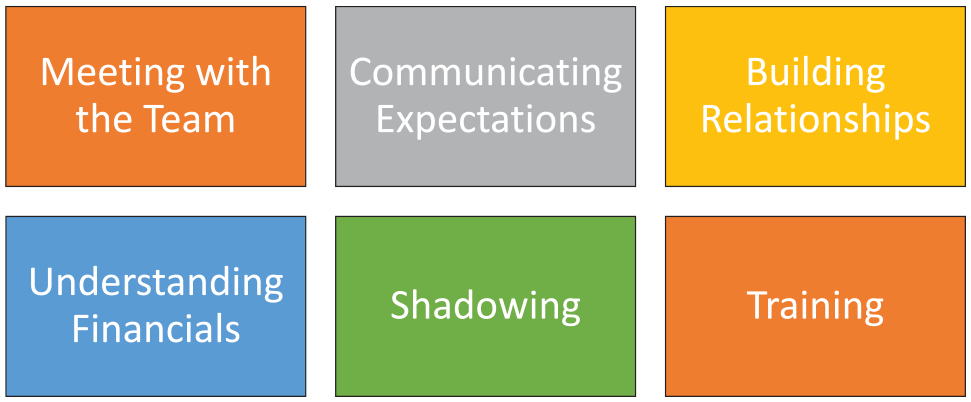
Onboarding focus.
Appreciation of Pharmacy Practice
It is important to understand the practice of pharmacy at the given institution and as it relates to the operation one may oversee. Key steps to this include the following: learning how each position overseen operates (including pharmacist and technician roles) and understanding practice and distributional models. However, the latter may be role dependent. It is essential to understand the above components as failing to understand during onboarding could cause frustration for staff and a lack of a comprehensive understanding of the area.
Though the new leadership role may bring excitement, it is important to understand that leaders are pharmacists first. Pharmacy is a clinical profession, and it is essential to understand the pharmacist’s role in providing care. A complete understanding of the pharmacist in the institution will help with decision making and conceptualization throughout the transition.
Similarly, it is also necessary to understand the role of the pharmacy technician in the given institution and area if applicable. Pharmacy technicians are key to expanding the scope of the pharmacist. Understand their role in the operation to ensure that the pharmacist is leveraged to provide extensive pharmacy services. Additionally, as pharmacy technicians complete many skilled roles, understanding their roles and responsibilities will provide a good understanding of staffing plans and operational infrastructure. Given that pharmacy technicians can serve as pharmacy extenders, it is essential to evaluate how they support the given department. Residents should develop the skills to assess pharmacy technicians given the exposure during residency, and many HSPAL Pharmacy Residents will oversee pharmacy technicians in their first transition.
Last, it is vital to build an understanding of practice and distributional models. Knowing what pharmacy services are provided and how they are offered will pay dividends throughout a transition. In addition to getting to know the people, do not forget to understand the key processes that drive pharmacy operations. The importance of understanding this topic as it relates to the area the new leader will oversee is critical to the success of the new leader.
Understanding the Organization
Outside of the individual area one may oversee, transitioning HSPAL Pharmacy Residents should seek to understand culture, key stakeholders, and customers. Culture is a defining characteristic of an organization that shapes priorities, decision making, and relationships. Key stakeholders and customers can influence the way pharmacy services are organized and offered.
Hopefully, during the time of interviewing one is able to develop an understanding of the culture of the organization. Time should be spent assessing culture before, during, and after interviewing. Perhaps, this may not have been a possibility, and if this is the case, then it is paramount to understand culture throughout the transition. Culture will drive many organizational projects and initiatives. New leaders should seek to understand the culture of the organization in which they are transitioning.
Building Relationships
With any transition, it is essential to build and maintain relationships. As one transitions from HSPAL Pharmacy Resident to Pharmacy Leader, an opportunity will likely be presented to build relationships with staff, supervisor, leadership team, and with individuals external to the department of pharmacy.
Some of the most important relationships to form during the transition are those with staff. Staff members are key to understanding the operation, the history, the organization, what has and has not worked in the past, and providing ideas for future directions. Transitions usually provide one chance for staff to perform a first impression of a new leader, and training and working alongside the staff will help with the transition.
Apart from staff, both pharmacists and technicians, that may be overseen, it is foundational to achieve an understanding of what other positions do to support the operation. It may be best to think of all the people the position may interact with regularly, and getting to know them as well. This can include buyers, individuals from finance, and potentially regulatory and compliance.
Another critical relationship that will begin during the transition is the relationship with the supervisor. Understanding what is important to the supervisor and the pharmacy executive will help with ensuring that the team is aligned with priorities outside of the area overseen. Additionally, the new pharmacy leader should spend time getting to know and developing a relationship with the pharmacy executive.
Whether transitioning to a new organization or remaining in the same organization, the new pharmacy leader will transition to be a new member or have a new role in the pharmacy leadership team. During the transition, it is key to build relationships with peers on the pharmacy leadership team. It is likely to work with many leaders through either departmental initiatives or day-to-day operations, and having a baseline relationship will help advance and streamline the task at hand.
Last, as previously mentioned, it is crucial to have key relationships with stakeholders in the organization. These external leaders can include nurse managers or leaders other senior pharmacy leaders interact with such as senior organizational leaders or c-suite members. A positive working relationship with these leaders can be key to advancing pharmacy services. Spend time throughout orientation developing a plan to build relationships and understand perspectives of pharmacy services from key stakeholders and external customers.
Changing Focus Points
One area that the authors have observed that should be recognized is the changing focus when one transitions from HSPAL Pharmacy Resident to Pharmacy Leader. During HSPAL Pharmacy Residencies the HSPAL Pharmacy Resident is exposed to many areas. This is intentional to provide the HSPAL Pharmacy Resident with a broad perspective to understand health system pharmacy, and results in the HSPAL Pharmacy Resident having connectivity to many areas. When the HSPAL Pharmacy Resident transitions to a Pharmacy Leader, their knowledge base will transform to narrow and deep, and they will begin to have connectivity with one area instead of many areas. Embracing this transition is recommended to ensure a successful transition is made. Success can be defined as building relationships, completing projects and initiatives, leading teams, and advocating for pharmacy outside of the department. Success overtime will result in the connectivity to many areas. This is illustrated as Figure 2.
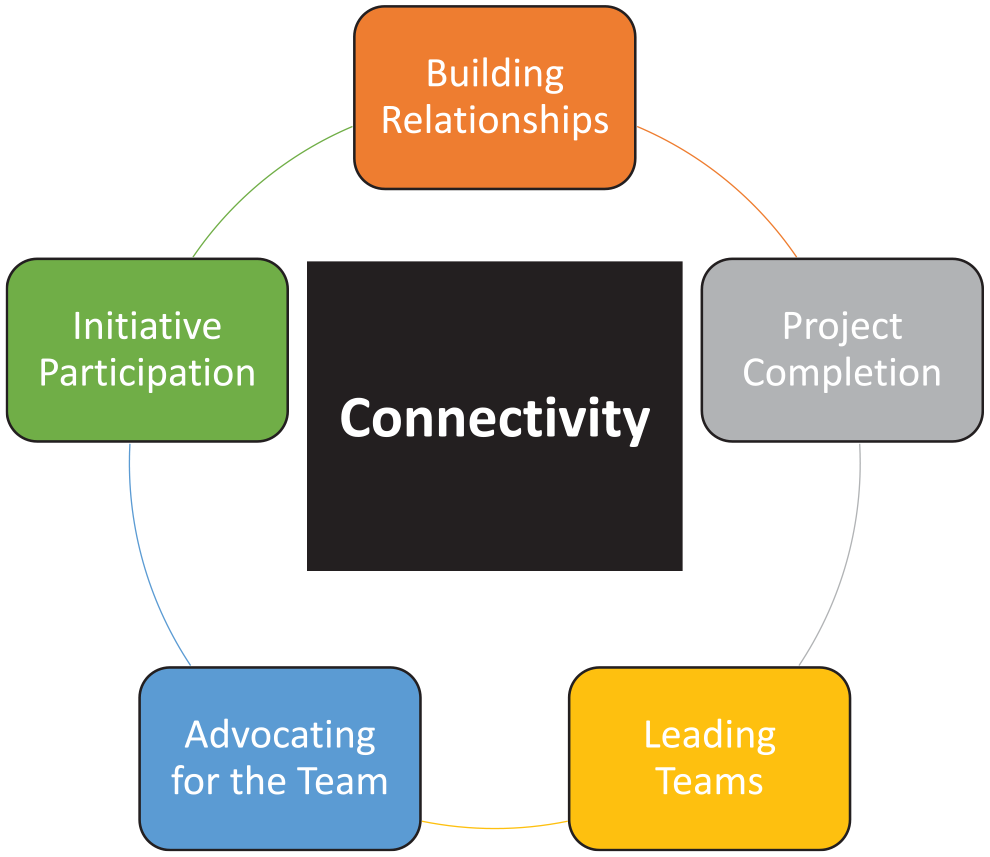
Elements of success.
Creating a Strategy
First, it is paramount to be committed to the new role. During HSPAL Residency, the HSPAL Pharmacy Resident is exposed to a wide selection of pharmacy activities. This results in building the experience of the resident as they have some understanding of the workings of the department. As a new Pharmacy Leader, the role requires an in-depth approach to understanding the area being overseen. The transition from breadth to depth is necessary, and appropriate. It will be necessary to complete this transition following HSPAL Pharmacy Residency. This will result in the new pharmacy leader doing well, and gaining experience over time. While the first 90 days are important, ensure a plan is developed past the first 90 days to provide value to the new team overseen, department of pharmacy, and the organization. During the orientation period it is key to understand the obstacles for the department, barriers and challenges for the team, and what projects and initiatives should be completed. For example, this may include initiatives the department is focusing on, but also activities that can enhance the work culture of the area. The new pharmacy leader should think about how they want to conduct team meetings, meet with employees, and communicate with the team and other pharmacy leaders.
Last, pacing is essential to sustainability. Remember the transition from HSPAL Pharmacy Resident to Pharmacy Leader should not be another year of residency. In residency, many projects are completed in a month. In the workforce, projects may take much longer to complete, and may be appropriate to complete in longer than a month’s time. Careers are marathons, not sprints. The new leader will have strategic ideas and ways to improve the area. Working with staff and stakeholders to initiate and complete those ideas overtime will be more successful than trying to complete everything in the first few years post residency. HSPAL Pharmacy Residents should have an appreciation that HSPAL Pharmacy Residency will prepare for them for the transition from resident to leader.
Conclusion
Managing transitions is, and will continue to be an important topic for all leaders. As HSPAL Residents transition to new pharmacy leaders, understanding pharmacy practice building relationships, maintaining them, and having a thoughtful strategy through this transition will allow for a more complete understanding of the organization to navigate complexities, develop people, and complete projects and initiatives. While this article is specific to HSPAL residents, these concepts can apply to the transition to pharmacy leaders.
Footnotes
Declaration of Conflicting Interests
The author(s) declared no potential conflicts of interest with respect to the research, authorship, and/or publication of this article.
Funding
The author(s) received no financial support for the research, authorship, and/or publication of this article.
