







Abstract
Teacher turnover is an important issue in education. Studies have reported that almost half of new teachers leave by their fifth year. The problem is being examined in a number of ways, including the preparation of new teachers, costs to school districts, the impact on student achievement, and models of supply and demand. In the current study, Arizona high school band teacher turnovers were tracked during a 4-year period to compare with national trends. Also during this period, the participation of marching bands was compared with the amount of band teacher turnover at each school to see if any relationships exist. Overall, results indicate that as the amount of band teacher turnover increases, marching band participation decreases. Schools with no band teacher turnover have the most consistent levels of student participation.
One of the most urgent issues in education is the problem of teacher turnover in the K–12 school system. Some studies have reported that each year 13.2% of all teachers move from one school to another or leave the profession entirely (Ingersoll, 2001). The National Center for Education Statistics (2005) and the National Commission on Teaching and America’s Future (NCTAF, 2007), both report that the number was actually higher, at 16.8%. The most current data from the National Center for Education Statistics report that 15.5% of teachers leave the profession or move to other schools each year (Keigher, 2010). Some school districts cited by the NCTAF (2007) have higher teacher turnover rates than student dropout rates. The Alliance for Excellent Education (AFEE, 2005) cites the rate of attrition in lower poverty or at-risk schools as roughly 50% higher than that of wealthier schools.
The NCTAF (2003) reported that 33% of teachers leave sometime during their first 3 years of teaching and almost half (46%) leave by their fifth year. Boe, Cook, and Sunderland (2008) have critically reanalyzed these data and report that the 3-year attrition rate is closer to 25.5% and that 38.5% of teachers leave after 5 years. They determined that 8.5% of teachers quit in their first, second, or third year and 6.5% of teachers quit in their fourth and fifth year. These figures are important because the Center for Public Education (2005) found that it takes most teachers 5 years of classroom experience (among other qualifications) to become effective. This means a significant portion of teachers leave the profession too early.
Contributing to the teacher turnover problem are the teachers who move from one position to another during their careers. Ingersoll (2001) described many reasons why teachers move from one school to another or leave the profession. The most serious causes are the following: reduced school funding and budget concerns (41% migration and 12% attrition), personal reasons such as starting a family or health problems (33% migration, 45% attrition), and overall job dissatisfaction, which includes low pay (79% migration, 73% attrition), administrator concerns (25% migration, 34% attrition), and workload (4% migration, 18% attrition). Retirement accounts for 12% of the number of teachers leaving.
Terry and Kritsonis (2008) state that an examination of current research indicates that teacher turnover and related staffing issues are not primarily due to teacher shortages but to an insufficient supply of qualified teachers. In addition, Ingersoll (2001) describes a “graying” teaching force that is getting ready to retire, which would increase the number of positions opening in the coming years. Researchers are examining the supply-and-demand model, noting that when the pool of teachers decreases, schools tend to hire less effective teachers (Murnane & Steele, 2007). Teachers who generally take alternative certification methods to fill these positions have an even greater attrition rate. Some estimates indicate that as high as 80% of these teachers leave the profession after only 2 years (Darling-Hammond & Sykes, 2003). In terms of music education, Hill (2003) questions the qualifications of teachers who fill music positions with an alternate route to certification and the quality of musical experiences their students will receive.
The implementation of teacher accountability reforms, such as the No Child Left Behind Act of 2001, may contribute to teachers moving schools or leaving the profession. By 2006, teachers had to be “highly qualified” to teach their content area, a requirement that aimed to hire and retain more effective teachers. With financial benefits to effective classrooms and schools rather than ineffective, disadvantaged schools, many teachers have left disadvantaged programs, where effective teachers are needed the most (Murnane & Steele, 2007).
In terms of student achievement, studies have shown that effective teachers have the most positive impact on student achievement (Ingersoll 2001, 2003; Murnane & Steele, 2007; Sanders & Rivers, 1996; Terry & Kritsonis, 2008). Conversely, excessive teacher turnover in lower poverty neighborhoods appears to have a negative impact on student achievement (Darling-Hammond & Sykes, 2003). Guin (2004) found that schools with higher teacher turnover rates had fewer students meeting the state standards in reading and math. The problem of hiring less effective teachers can also be measured in subsequent student achievement tests (Sanders & Rivers, 1996). Sanders and Rivers found that over time, students with more effective teachers can make significant academic gains even if they have been taught earlier by less effective teachers. Over a 3-year period, students with three highly effective teachers scored 50 percentile points higher than students with three less effective teachers.
Current research on the financial cost of teacher turnover is producing staggering results. Villar and Strong (2007) present a case that the cost of hiring a replacement teacher represents 50% of a new teacher’s salary. The NCTAF has created a “Cost of Teacher Attrition” calculator, 1 in which school districts can determine how much it will cost to find, hire, train, and retain new teachers. Multiplying that cost by the number of teachers leaving or moving schools results in a cost of $4.9 billion each year. The state of Texas alone will pay more than $500 million every year to recruit and train new teachers (AFEE, 2005; NCTAF, 2007).
Some school districts are effectively looking at the problem of teacher turnover and have started making changes to address these issues. Research has shown that teacher preparation is a factor in retaining teachers each year (AAFE, 2008; Ingersoll, 2003; NCTAF, 2007). The Clark County School District, in Las Vegas, Nevada, started giving financial incentives to teach in its most disadvantaged schools, resulting in a 50% drop in attrition (NCTAF, 2007). The Chicago Public Schools created an apprenticeship/mentoring/cohort program for their new teachers. The attrition rate fell from 30% to just 5% after the first year of teaching (NCTAF, 2007). The NCTAF (2003) reported that when school districts seek and hire experienced and effective teachers, their attrition rate is reduced by 50%. Villar and Strong (2007) found that every dollar invested in proactively keeping an effective teacher results in saving the district $1.66 over time.
Studies on music educator turnover rates show data comparable with that of national trends. Analyzing the national Teacher Follow-up Survey data specific to music teachers, Hancock (2009) found that the average rate of music teacher turnover over four survey periods (1988–1989, 1991–1992, 1993–1994, and 2000–2001) was 16%. This means that 84% of the music teachers sampled stayed at their positions each year. The average migration rate for teachers was 10%, whereas 6% left the profession.
In a 6-year study of 255 music education graduates from one institution, Madsen and Hancock (2002) found that only 34% of music educators left their teaching positions after 6 years compared with the NCTAF (2003)–cited national average of 46% over 5 years and the 38.5% reported by Boe et al. (2008). Finding that national causes of teacher turnover may not be the same for music teachers, Madsen and Hancock (2002) write, “The reinforcing nature of music, idiosyncratic teacher prerequisites, and unique demands placed on the in-service music teacher (e.g., performances)” (p. 8) contribute to making generalizations on national trends difficult. They also found similar reasons for leaving the music education profession: administration/advocacy concerns, personal/family reasons, and underestimation of the time involved in teaching in the music classroom. Concerns found only in music education include a perceived lack of musical challenge, interests outside music, and wanting to perform rather than teach.
The purpose of this descriptive study was to examine high school band teacher turnover in Arizona over a 4-year period. Using data from the Arizona Band and Orchestra Directors Association (ABODA), marching band participation in programs with different levels of teacher turnover were compared. The following research questions will be addressed:
How does the yearly turnover rate of Arizona high school band teachers compare with national teacher and national music educator turnover rates?
Is there a relationship between teacher turnover and marching band participation?
Is there a difference in the participation of marching bands comparing the last year of a band teacher’s tenure with the first year of the next?
Method
In 2004, ABODA first required that all marching bands verify how many total students participate each season. These data are not collected for any other instrumental ensemble in Arizona schools. Each band teacher has to confirm the number of students with a school administrator so the marching band can be accurately placed into an appropriate performance division, which is based on the number of student performers. The master list is kept on file with the ABODA board.
There were 107 high school marching bands eligible to participate in an ABODA marching band event between 2004 and 2007. Schools with missing data tended to be new schools that did not exist in 2004, rural schools in which teachers may not have had enough students to create marching bands in certain years, or schools that chose not to participate in the marching band festival system for one or more years. Band teachers were contacted through e-mail or by phone to ascertain any missing numbers. Of the 107 total schools, 96 were able to provide data for all 4 years.
In Arizona, high schools that employ two or more band teachers are in the vast minority. For this study, only the “head” band teacher, or the band teacher who was solely the head of the marching band program, was counted. Most second band teachers are employed part-time at the high school and part-time at a feeder program.
After the data were collected, schools were separated into groups based on the number of band teachers each school had between the falls of 2004 and 2007. In schools with band teacher turnover, current teachers were contacted to find out how long they had been at the school between the 2004 and 2007 marching band seasons. Some information was also verified by the ABODA music educator directories and the Arizona Interscholastic Association website. 2
Results
Descriptive statistics reveal that 59.4% of the schools had one band teacher for the entire 4-year period (n = 57). Schools with one band teacher leaving during this period represented 35.4% (n = 34). Schools that had two band teachers leave for a total of three teachers in 4 years was the smallest group at 5.2% (n = 5). None of the schools in the sample had four new band teachers in 4 years.
1. How does the yearly turnover rate of Arizona band teachers compare with national teacher turnover and national music educator rates?
From the sample (N = 96) between the school years 2004 and 2005, there were 11 band teachers who left their positions, a rate of 11.46%. Between the school years 2005 and 2006, there were 14 band teachers who left their positions, a rate of 14.48%. Between the school years 2006 and 2007, there were 19 band teachers who left their positions, a rate of 19.79%. Compared with the national averages, which varied from 13.2% to 16.8% in different reports, the band teacher turnover rate in Arizona has steadily increased from below to above the national averages during the time period being studied. The average rate of Arizona band teacher turnover during this study was 15.24%. This number reflects the similar yearly national rates.
Of the band teachers in the sample who were working in 2004, 39 left their positions by the year 2007. This 4-year turnover rate of 40.62% lies above the 5-year music educator turnover rate of 34% found by Madsen and Hancock (2002) and the rate of 38.5% reported by Boe et al. (2008). It is below the reported NCTAF (2003) 5-year national attrition rate of 46%.
2. Is there a relationship between teacher turnover and marching band participation?
During the years 2004–2007, marching band participation followed a bell curve, with slightly more participation in the middle years. Table 1 shows the mean marching band size and the total student participation in ABODA festivals over this period. It is interesting to note that both the mean participation and the total sum of participation show that there were fewer students participating in marching bands in 2007 than in 2004.
Descriptive Statistics: Marching Band Participation
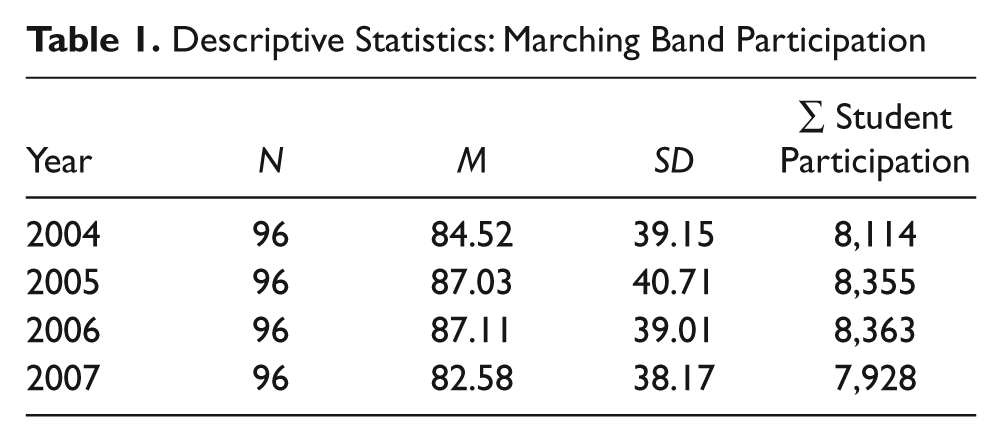
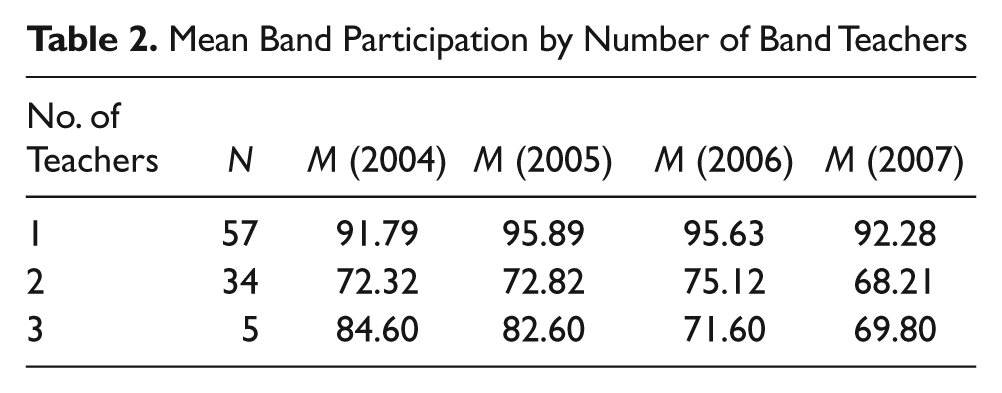
Table 2 shows a descriptive comparison of mean marching band participation grouped by the amount of band teacher turnover at each school. The mean of marching band participation with one band teacher remains fairly consistent, increasing from 91.79 to 95.28 students enrolled. The mean participation of bands with two band teachers over the 4-year period dropped slightly from 72.32 to 68.21 students enrolled. Bands with three band teachers had the biggest change in mean participation, from 84.60 to 69.80 students enrolled. Bands with a consistent band teacher have consistent numbers and hold the highest amount of student participation in all 4 years.
Mean Band Participation by Number of Band Teachers
Four one-way analyses of variance (ANOVAs) were conducted to explore the impact of the number of band teachers on marching band participation. First, Levene’s test for homogeneity of variance was conducted on the marching band participation data. All significance values were >.05, which means that the data were homogeneous.
Table 3 shows that there was statistical significance found in comparing the number of band teachers and marching band participation in 3 years: 2005, F(2, 93) = 3.64, p = .03, partial η2 = .07; 2006, F(2, 93) = 3.54, p = .03, partial η2 = .07; and 2007, F(2, 93) = 4.91, p = .01, partial η2 = .10. The effect size, calculated using partial eta-squared, showed an increase in the amount of variance explained during the 4-year period. These effects fall in the medium effect range of .059 to .138 (Huck, 2000).
Results of Four One-Way ANOVAs: Comparing Marching Band Participation by Number of Band Teachers
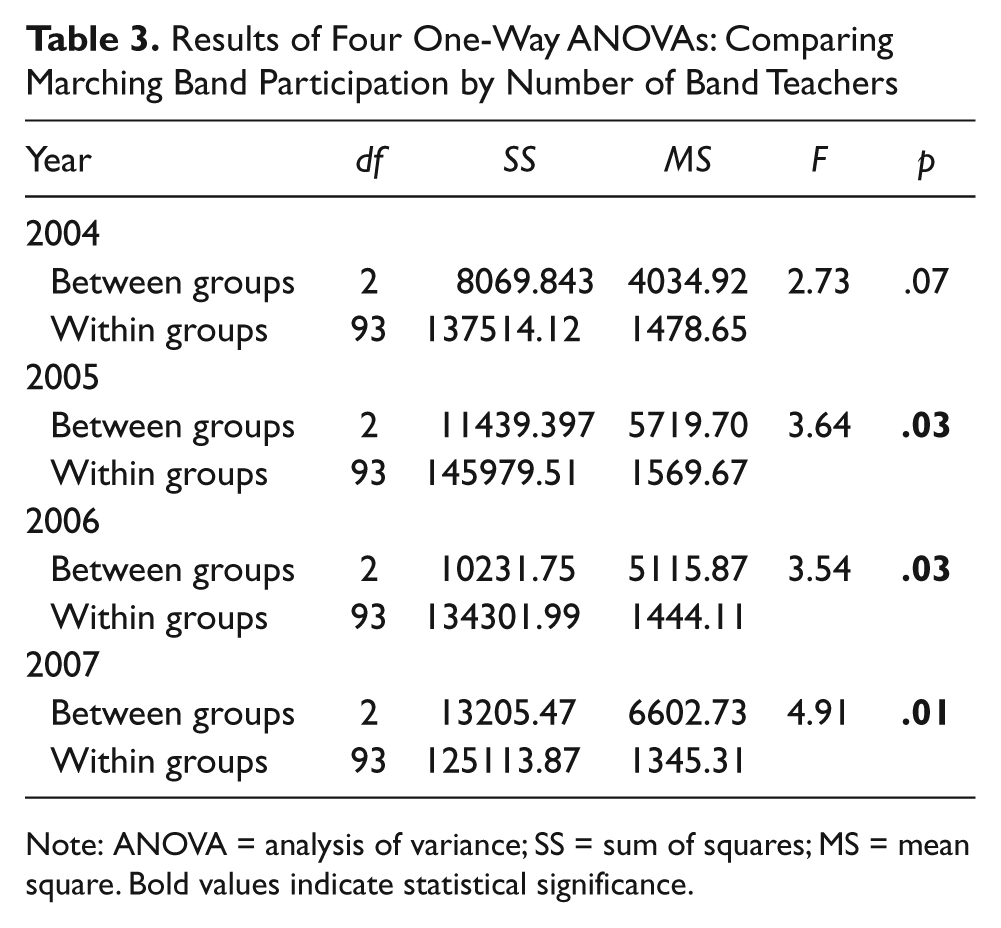
Note: ANOVA = analysis of variance; SS = sum of squares; MS = mean square. Bold values indicate statistical significance.
Post hoc comparisons using the Tukey honestly significant difference test indicated that in 2005, the mean score for schools with one band teacher (M = 95.89, SD = 44.01) was significantly different from that of schools with two band teachers (M = 72.82, SD = 32.53). In 2006, the mean score for schools with one band teacher (M = 95.63, SD = 41.47) was significantly different from that of schools with two band teachers (M = 75.12, SD = 33.52). In 2007, the mean score for schools with one band teacher (M = 92.28, SD = 39.38) was significantly different from that of schools with two band teachers (M = 68.21, SD = 33.26). There was no significant difference between groups in 2004, nor were there any significant differences with any of the schools that had three band teachers. A lack of power, with only five schools having three band directors, was probably the cause of the lack of significance.
3. Is there a difference in the participation of marching bands comparing the last year of a band teacher’s tenure with the first year of the next?
From the data set, the participation rates of the marching band before and after a new teacher arrived were extracted. There were 44 total turnovers throughout the 4-year period (N = 44). The before bands had a mean participation of 74.86, whereas the after bands had a mean participation of 68.27. Looking at the sum of participation, the before bands had 3,294 students participating, whereas the after groups had 3,004 students participating, a decrease of 290 students.
A paired-samples t test was conducted to evaluate the impact of a band teacher leaving a program on student participation in the marching band. There was a statistically significant decrease in student participation from before (M = 74.86, SD = 33.12) to after (M = 68.27, SD = 29.46), t(43) = 2.56, p < .01 (two-tailed). Calculating the eta-squared statistic for the degree of mass effect results in a value of .13, which is very close to having a large effect (.139; Huck, 2000). The mean decrease is equal to losing 8.8% of participation in the marching band after a band teacher leaves.
Discussion
Results of this study indicate that there is a relationship between band teacher turnover and marching band student participation in Arizona. Programs with stability in the number of band teachers generally have stable amounts of student participation. The more band teachers a school has to change in a short period of time, the more it negatively affects the participation level at that school. It is interesting to find that there were generally fewer students participating in a marching band immediately after the band teacher left.
The results of this study support the importance of band teacher retention. According to the NCTAF (2007), the 44 band teacher turnovers during this study cost schools and school districts between $1.7 million and $3.5 million. 3 Focusing on the retention of band teachers will not only save schools money but will also stabilize student participation.
Turnover rates for band teachers increased during the 4 years of this study. This study did not investigate the causes of the increase in teachers leaving their schools, but research has shown that there are many factors involved in their deciding to leave or stay (Hancock, 2009; Ingersoll 2001, 2003; Madsen & Hancock, 2002; Murnane & Steele, 2007; Sanders & Rivers, 1996; Terry & Kritsonis, 2008). Starting, building, and maintaining a band program, especially in a disadvantaged area, is very challenging. It is also time-consuming, which could lead to an unsustainable situation for a teacher. Similar to teachers who leave lower poverty schools for better funded programs, band teachers may also change positions for the instant gratification of an extant strong band program.
Teacher preparation is another factor to consider. Many new band teachers, like all new teachers, may be unaware of the daily time commitment, challenges, paperwork, or even performance demands they are expected to handle by their school districts. Much of the research suggests that effective mentoring programs will help new teachers face all these challenges and reduce the amount of turnover (Ingersoll, 2001). However, because many Arizona band programs only have one band teacher, mentoring may be difficult. It is encouraged that fellow band teachers in a district mentor new teachers and that new teachers open up to these mentors and ask for help when needed. Effective mentoring may help reduce the job dissatisfaction often cited as a reason to leave the profession.
Surprisingly, there is a lack of research on what happens to the sustainability of 4-year high school band programs, or any 4-year performing arts programs (band, orchestra, choir, etc.), when there is a high amount of teacher turnover. Furthermore, there is a lack of research on student attitudes toward teacher turnover in 4-year music programs. This study also raises more questions about just how much the band teacher is a factor of student retention and attrition. Further study concerning this student perspective and attitudes about teacher turnover may provide more insight into the complexities of the relationship between band teachers and their students.
Footnotes
The author(s) declared no potential conflicts of interest with respect to the research, authorship, and/or publication of this article.
The author(s) received no financial support for the research, authorship, and/or publication of this article.