







Abstract
The purpose of this study was to investigate the confidence, anxiety, and attitude of novice string student improvisers. A form of the Fennema–Sherman Mathematics Attitudes Scales, as modified for improvisation by Wehr-Flowers, was given to middle school and high school string students (N = 121) after their participation in a 4-month improvisation curriculum. Whereas females in Wehr-Flowers’s study were found to be significantly less confident than males in either study, the confidence level of females in the current study was not significantly different from any other group. Females in both studies were significantly more anxious toward improvisation than males, and the results of the attitude comparisons were inconclusive. The higher confidence level of females in the current study may have resulted from the different populations studied, maturation/history effects, or exposure to a curriculum specifically designed to build confidence and allay fears toward improvisation.
Research suggests that improvisation should be a fundamental component of any music curriculum (Azzara, 1993; Elliot, 1995; Gordon, 1997; Kratus, 1996). Its practice contributes to the improvement of students’ music performance and promotes the acquisition of higher order thinking skills in music (Azzara, 1993). As such, providing students with the abilities and tools needed for improvisation should be a primary goal of music educators (Azzara, 1993, 1999; Gordon, 1997). Our profession has supported this position by establishing the ability to improvise as an achievement standard in the National Standards for Arts Education (Music Educators National Conference, 1994). Improvisation has also been recommended as a major component of music programs in schools of the future (Grant & Kohut, 1992).
Although the ability to improvise has been recommended by researchers and notable educators as an integral part of music education programs, it is one of the National Standards least successfully implemented in the classroom (Adderly, 1999; Azzara, 1993, 1999; K. Smith, 2010; Woody, 2007) and one rarely taught with great rigor (Guilbault, 2009; Lehman, 2000). Many music teachers consider improvisation difficult to teach because of their lack of improvisation experiences and the perceived difficulty of implementing improvisation experiences into an ensemble curriculum (Azzara, 1999; Byo, 1999; Della Pietra & Campbell, 1995; Hamann & Gillespie, 2009; Reveire, 2006; K. Smith, 2010).
In addition to perceived pedagogical difficulties, previous research has identified a gender bias in students’ instrumental improvisation performance. In her study of gender and jazz improvisation, Wehr-Flowers (2006) found female members of middle school, high school, and collegiate jazz ensembles significantly less confident, more anxious, and have poorer attitudes toward learning jazz improvisation than their male counterparts. Collier (1995) found that more girls and women are participating in jazz than in the past but are reluctant to improvise solos. Other studies found no significant relationship between gender and students’ abilities in jazz improvisation (Bash, 1984; Hores, 1977; Madura, 1999; McDaniel, 1974). If males and females possess similar abilities in jazz improvisation, why do they have different opinions concerning their abilities? A summary of Wehr-Flowers’s (2006) extensive review of literature reveals the following considerations:
Jazz education is more accessible than ever, yet male participation continues to surpass that of females.
The issue of girls’ and women’s participation in jazz might not be one of ability, skills, or talent but rather one based in social psychology.
If young girls do not see success in jazz improvisation as rewarding for their gender group, they may have a less positive attitude towards learning improvisation (pp. 338-340).
Various instructional methods have been shown to be effective in the teaching of improvisation (Aitken, 1975; Bash, 1983; Burnsed, 1978; Carlson, 1980; Damron, 1973; Guilbault, 2004; Hores, 1977; Kalmer & Balasko, 1987; Partchey, 1974; Paulson, 1985; Wig, 1981). It is also known that instructional sequences related to improvisation may result in improved attitudes toward the act of improvising (Berard, 1998). Although the results of these studies indicate that improvisational achievement improves with instruction, little is known about the comparative effectiveness of individual instructional techniques (D. T. Smith, 2009). A few aspects of improvisation instruction have been studied, with noteworthy conclusions. Amchin (1995) found that instruction using verbal interactions was not effective in improving students’ improvisation ability. Other studies have found variables such as self-evaluation and aural imitation to be good predictors of achievement in jazz improvisation (Greennagel, 1994; May, 2003). Additional variables found to be positively correlated with jazz improvisation achievement were as follows: attitude toward the ensemble, creativity, experience in jazz, listening to jazz, and musical achievement (May, 2003). Wehr-Flowers (2006) recommended that future researchers investigate whether instructional and environmental factors could be successfully controlled enough to foster female participation.
A curriculum for introducing fearless improvisation to string students was developed by the researchers as part of a National Education Association Student Achievement Grant (Williams & Alexander, 2009) based on methodologies recommended by Allen, Gillespie, and Hayes (2002), Brungard, Alexander, Anderson, and Dackow (2004), Hamann and Gillespie (2009), Reviere (2006), Stabley (2001), and Wehr-Flowers (2006). The researchers sought to create a curriculum that would introduce improvisation to middle school and high school string ensembles in a painless and fail-safe environment in order to address the domains of confidence, anxiety, and attitude toward improvisation. At the conclusion of the curriculum, students would be able to improvise short melodic passages over a basic harmonic accompaniment, interact musically while experimenting with various improvisation techniques, and recognize elements of their own improvisations in those of an artist improviser.
Many of the methodologies recommended by the aforementioned authors were designed for the string orchestra classroom, and some were specifically designed to relieve anxiety and build confidence in improvisation. For example, Allen et al. (2002) recommended beginning with only a limited set of pitches so the chances of error are minimized. Brungard et al. (2004) suggested starting with one measure of improvisation and increasing length with mastery, using a seating that allows for students to follow each other without a break in the tempo, and affirming each student after their performance. Reviere (2006) proposed using the term improvisation games instead of exercises so that students would view improvisation as fun and not work. She admonished teachers to set ground rules in order to create a safe environment and not to tolerate laughing or negative comments. She also recommended that teachers should emphasize that there are no wrong notes in improvisation, only notes that need to be resolved. Stabely (2001) proposed that improvisation be introduced with only a few notes, performed over drones, and followed by complete scales over drones. He suggested that improvisations over chord changes be introduced as root position chord progressions so that they are easily read and understood. Hamann and Gillespie (2009) recommended that all students be actively involved in the improvisation process so that they will feel a desire to participate and suggested asking for volunteers when introducing a new concept so that others will follow their example. When learning to improvise over chord progressions, they suggested that students practice improvising over one chord at a time (e.g., I or V) and then put them together (I-V-I). Wehr-Flowers (2006) suggested modeling styles in small, repeatable phrases, giving instruction on how to practice and providing recordings for individual practice at home.
These ideas and others were incorporated into a 36-step sequential curriculum that was applied in each of the orchestra performance classes at a suburban high school (two classes, Grades 9–12) and middle school (two classes, Grades 7 and 8) over a 4-month period. The researchers presented a 30-minute demonstration on the first day of each week of instruction that covered 1 to 5 steps in the curriculum. During the remainder of each week, the classroom teachers practiced those procedures as part of their 10-minute daily ensemble warm-up. The curriculum began with soloists clapping improvised rhythms echoed by the ensemble and concluded with solo improvisations over the ensemble accompaniment of Johann Pachelbel’s Canon in D and Johnny Mercer’s Autumn Leaves as arranged by Aebersold (1992). As a capstone experience, jazz violinist Jon Raveneau conducted a clinic on jazz string techniques with each class and performed Dizzy Gillespie’s A Night in Tunisia with the high school ensemble. An overview of the sequential steps to Fearless Improvisation is included in the appendix. The guidelines used in developing and implementing the curriculum are included in the next section.
Curriculum Guidelines
Although improvisation has traditionally been considered a solo art, any improvisation curriculum for use in the ensemble classroom should provide a means to actively involve all students. In early improvisations, all students can be involved through echo/play of each individual’s improvisation. In more advanced improvisations, the class can provide a rhythmic accompaniment or chord progression while individuals improvise.
To create fearless improvisers, the class must accept that the improviser is never wrong. In other words, if an echo/play procedure breaks down, it is the fault of the teacher in their management of the procedure or the inability of the class to properly echo an improvisation that is the problem, not the creativity of the improviser.
Student confidence is built by starting small (one- and two-measure improvisations) and using a prescribed set of pitches. Each improvisation should be followed by a smile or positive verbal affirmation from the teacher.
Although pitches, key, or scale may be prescribed (limited to those that they can perform), rhythm should have no limitations. There are few, if any, rhythms that students have not experienced at some point in their life. When a rhythmic concept is performed that the students do not yet know how to notate (syncopation, triplet, etc.), take advantage of the teachable moment and show the class what it looks like on the board.
Explain to students when their turn to improvise will occur by determining an order of performance, such as rows or seating in sections. This will enable students to mentally prepare for their improvisation and keep the procedure from breaking down between students. Develop a gesture to “cue” each new improviser in rhythm. The procedure should be stopped only to identify a new concept introduced by a student during their improvisation (triplets, appoggiatura, passing tones, etc.). This is both to reassure the improviser in his or her creativity and to introduce the notation of new concepts. These new concepts should be labeled as good.
When presenting or creating chord progressions with the class, identify theoretical concepts and terminology; this provides a hands-on introduction to music theory (thirds, root, I, IV, V, etc.). Use the chalk board or white board so that all can see and have the students participate by naming chord tones and so on used in the accompanying chord structures played by the ensemble.
When the class is accompanying a soloist, have the class play pizzicato while the soloist uses the bow; this will help with balance issues.
Use a rhythmic synthesizer (incorporating Latin, dance, and rock rhythms) as a background to generate rhythmic style and variety during improvisations.
Keep improvisation fresh by including it as a part of the ensemble’s daily warm-up, lasting no more than 5 to 10 minutes of each class. In large classes, have a different section improvise each day.
Purpose
The purpose of the current study was to investigate the confidence, anxiety, and attitude of middle school and high school string students toward improvisation after a prescribed course of study and to compare those results with those of the middle school, high school, and collegiate jazz ensemble members studied by Wehr-Flowers (2006). As in the Wehr-Flowers study, the null hypotheses included multivariate equality of means over all groups with no difference between males and females.
Method
The Fennema–Sherman Mathematics Attitudes Scales (Fennema & Sherman, 1976) are composed of nine domain-specific, Likert-type scales that measure attitudes toward learning mathematics. Wehr-Flowers (2006) modified the confidence, anxiety, and attitude scales by replacing some terms specific to math with terms more appropriate to jazz improvisation. For example, the terms ability and musical task replaced the term subject and the term practice replaced the term study. Wehr-Flowers’s reliability coefficients (confidence .93, anxiety .93, and attitude .88) were found to be acceptable. In the current study, Wehr-Flowers’s adaption of the confidence, anxiety, and attitude scales were used to survey string students (N = 121) enrolled in one of the two performing groups in their respective orchestra programs at one high school and one middle school who had completed the 4-month improvisation curriculum designed by the authors. Both schools were in the same school district, classified as suburban. String students were selected as participants for this study because little research in improvisation had been conducted with this population (K. Smith, 2010). Because none of the participants reported having performed in a jazz ensemble or having previously performed improvised solos in their ensemble, it was assumed they had no experiential bias in regard to improvisation.
The survey was administered by the students’ ensemble directors during their orchestra ensemble classes and took approximately 10 minutes to complete. All participants were informed that they could ask questions at any time before, during, or after the survey and that they could choose not to participate at any time during the survey. Eight students chose not to complete the survey. Completed surveys (N = 113) were returned by 50 male and 63 female participants, of which approximately 50% attended high school and 50% middle school. The sample included 57 violinists, 27 violists, 18 cellists, and 11 bassists.
Results
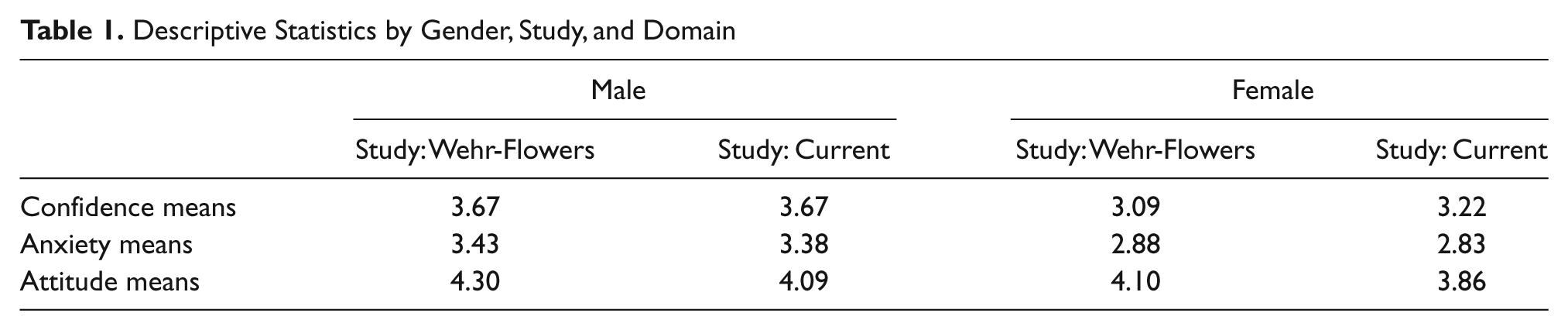
The means of three dependent variables (confidence, anxiety, and attitude), obtained from two studies (Wehr-Flowers, 2006, or the current study), were compared on the independent variable of gender (male or female). A descriptive comparison of overall means by domain, study, and gender is featured in Table 1.
Descriptive Statistics by Gender, Study, and Domain
The assumption of univariate normality in the current study was checked by running Q–Q plots on each domain as dependent variables (Park, 2008). Evaluation results for the assumption of normality were satisfactory for all three dependent variables. Cronbach’s alpha reliability coefficients were found to reflect high reliability (.90 for confidence, .92 for anxiety, and .82 for attitude).
A one-way analysis of variance was used to determine if any of the means were significantly different from each other (see Table 2). At least two of the average mean scores across gender by dependent variables were significantly different, F(1, 11) = 24.37, p < .001.
Means of Confidence, Anxiety, and Attitude by Study and Gender
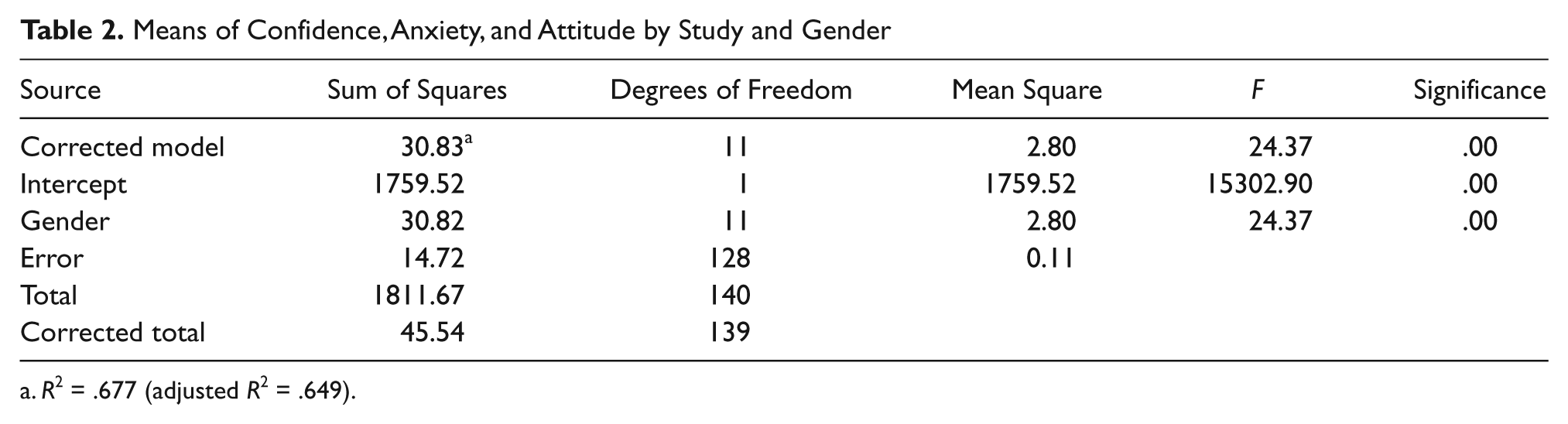
R2 = .677 (adjusted R2 = .649).
Following the rejection of the null hypothesis of equal group means, a post hoc test, Tukey’s honestly significant difference, was used as a multiple-comparison procedure to test for differences among the group means and as an attempt to control the overall error rate of the study. Significant differences between groups for each domain are illustrated in Table 3.
Significance of Confidence, Anxiety, and Attitude by Study and Gender
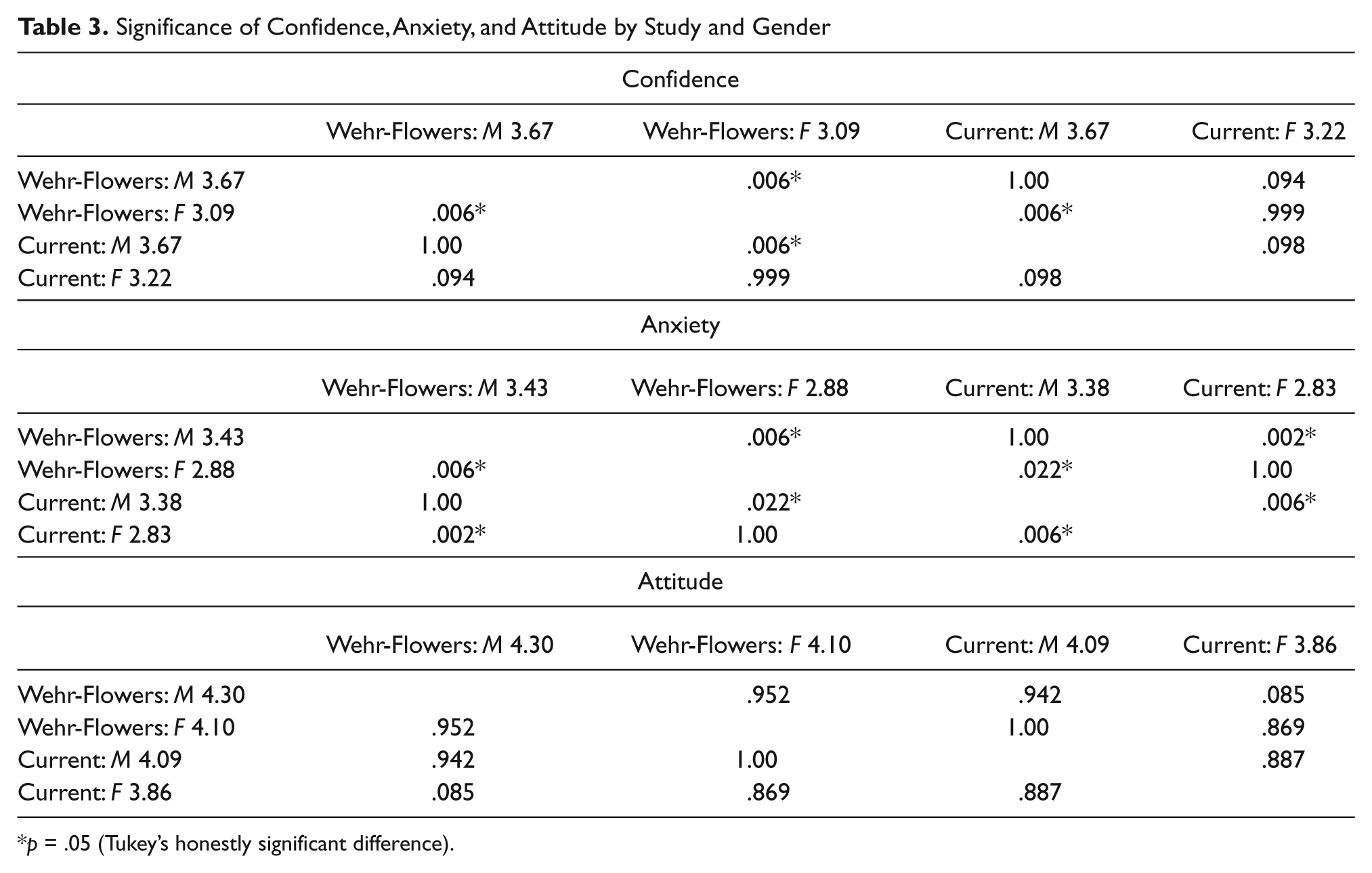
p = .05 (Tukey’s honestly significant difference).
Discussion
The male students in both the current study and the Wehr-Flowers (2006) study exhibited very similar confidence levels in their ability to improvise (p = 1.00) and were significantly more confident in their improvisational abilities than the females of the Wehr-Flowers study (p = .006). The confidence level of females in the current study was not significantly different from that of the males of either study but, with a mean of 3.22, was closer to that of the females in the Wehr-Flowers study (M = 3.09) than to that of the males of either study (M = 3.67). The higher confidence level found in females in the current study, as opposed to that found in females of Wehr-Flowers study, may have occurred because of the different populations studied, maturation effects caused by varying ages of participants between the studies, the length of time (4 years) between the two studies, or exposure to a curriculum specifically designed to build confidence and allay fears toward improvisation.
The results of the anxiety domain were very similar in both studies: The males in both studies were significantly less anxious toward improvisation than their female counterparts (p = .006 in both cases). There were also very similar responses between the like sexes of both studies (p = 1.00). These data substantiate the findings of Wehr-Flowers (2006) that males of these populations are significantly less anxious toward improvisation than females.
The current study found no significant differences between groups in their attitude toward improvisation. This was in contrast to the finding of Wehr-Flowers (2006) that males had significantly better attitudes toward improvisation than females. Wehr-Flowers’ alpha reliability for attitude (.88) was lower than that of either confidence (.93) or anxiety (.93). In the current study, the alpha reliability for attitude also reflected the lowest level of reliability for the three domains (.82). The relatively low level of reliability in both studies on the attitude domain does not provide enough strength to either confirm or reject the conclusions of Wehr-Flowers.
Although the effects of different populations, maturity of populations, time between studies, and completion of a particular course of study in improvisation may have contributed to the increased confidence levels of females in the current study versus those of the Wehr-Flowers (2006) study, any variable(s) that positively affected the confidence level of females in the current study had no significant effect on their anxiety: Both studies found that females were significantly more anxious about improvisation than their male counterparts. This supports the findings of other researchers on anxiety and gender in adolescent and collegiate musical performance (Kokotsaki & Davidson, 2003; Osborne & Kenny, 2008). It must be considered that, for pedagogical reasons, the issue of female anxiousness toward such performance may not be a negative issue at all; rather, it is possible that the lack of similar levels of anxiousness in the male population may limit the quality of males’ performance (Hamann & Sobaje, 1983; Kokotsaki & Davidson, 2003).
Woolfolk (2004) suggests avoiding situations where anxious students have to perform in front of large groups. These students may be best served by improvisation exercises contained in the course of sectional rehearsals. Wehr-Flowers (2006) recommended introducing improvisation in private lessons or peer groups, such as flute ensemble, all-female groups, or small combos of similar personalities. In addition, we suggest the further development of curricula that present improvisation in a sequential, fail-safe environment, which promotes positive reinforcement of each student attempt. Additional resources and materials beyond those used in the current study may also prove helpful to the curriculum developer (e.g., Gazda & Stoutamire, 1997; B. P. Smith & Froseth, 2003).
In the implementation of our curriculum, we found that the students readily acquired the theoretical material when they used it immediately in performance. We also found that the students were much more eager to improvise than to listen to us talk about improvising; this encouraged us to give instructions of limited scope: tempo, pitches or key used, and duration of improvisation. We found that when we used rows or seating order and kept the metronome playing to give a rhythmic pulse, the entire class could give a brief improvisation within a matter of minutes. Conversely, when the teacher asked for volunteers and then discussed each of their improvisations, very few students had the opportunity to improvise.
Research on the reliability and effectiveness of such curricula may help define its usefulness. Expanding the Likert-type survey instrument to include space for participants to answer not just how they feel but why they feel that way may provide greater insight into the issue of anxiety in female improvisations. Replication of the current study in the area of vocal jazz improvisation or in an all-female or similar-personality setting may provide further definition to those findings of both the current study and those of Wehr-Flowers (2006).
Footnotes
Appendix
Curriculum Procedures: Sequential Exercises in String Improvisation
Acknowledgements
Assistance in application of the National Education Association grant was provided by Alex Parker, Director of Jazz Studies, Baylor University; Blair Williams, Orchestra Director, Midway Independent School District; and Matt Cross, Orchestra Director, Midway Independent School District.
Declaration of Conflicting Interests
The author(s) declared no potential conflicts of interest with respect to the research, authorship, and/or publication of this article.
Funding
The author(s) disclosed receipt of the following financial support for the research, authorship, and/or publication of this article: This research was conducted with the assistance of the Institute for Statistical Studies at Baylor University. Funding for part of this research was through a National Education Association Student Achievement Grant.