







Abstract
Music technology classes designed to use the latest in music software to develop music compositional skills within high school students are becoming more prominent in K–12 education. The purpose of this case study was to describe the development of creativity in high school students through their participation in a music technology course at one Midwest high school. The central research question for the study was the following: How do music teachers and students describe the students’ development of creativity through their participation in a music technology course? Purposeful samplings of two teachers who were instructors of the course plus high school students (N = 10) enrolled in the class were surveyed and interviewed. A set of four themes illustrated the creative process of the music students using technology.
Entering into a small and narrow computer lab, high school students from West River High School navigate their way to their assigned seats, carefully and methodically lifting the plastic covers off the Yamaha electronic keyboards and powering up iMac computers in preparation for the next music lesson. An enlivened music educator greets the young composers in the room while anticipating what artistic sounds might evolve. Over the course of eighteen weeks, the music students enrolled in the electronic music theory class explore the art of composing and arranging musical sounds through the use of music software.
Creativity is a broad term that has been used in the arts to express the use of one’s imagination to form original ideas. Researchers have explored and debated how to define and measure creativity. Two substantial literature reviews by Richardson (1983) and Running (2008) have compiled a comprehensive list of this research. Through the literature, various theories have been developed that connects creativity to cognitive development, music aptitude, and personality attributes (Balkin, 1990; Gordon, 1993; Guilford, 1957; Perkins, 1981; Torrance, 1966/1974; Weisberg, 1986).
Webster (1990) stated the confusion about creativeness as a concept and what it means in terms of assessment in music teaching and learning has been the central issue for music education. Webster’s model of creative thinking in music emphasized the importance of having learning environments that promote divergent thinking along with convergent thinking. The National Standards for Arts Education (Consortium of National Arts Education Associations, 1994) established improvising, composing, and arranging within set guidelines as two important music standards. Furthermore, public schools are designing curriculum and instruction that support the goals of 21st-century skills of creativity and innovation, critical thinking and problem solving, and communication and collaboration. Even with these standards and frameworks, music educators are still challenged with the task of developing appropriate and successful instructional models that foster creative activities, such as music composition within a predominantly performance-based music curriculum.
The growth of technology in supporting music composition and multimedia projects has grown immensely over recent years. Researchers are beginning to explore how to use technology to enhance the development of creativity (Bolton, 2008; Demonline, 1999; Howell & Murphy, 1993; Pike, 2000; Reese, 2001) and in the use of technology for music composition (Folkestad, Hargreaves, & Lindstrom, 1998; Gall & Breeze, 2005; Mellor, 2008; Seddon & O’Neill, 2001). Music compositions, such as jingles or loop-based songs focus more on the aural components of music structure rather than the visual manifestation of music in manuscript form. Ley (2004) supported this multidimensional approach of creativity development in which students explore, create, and manipulate sounds by sequencing, recording, and notating music.
The issue facing educators has not been how to learn the technology, rather how to integrate the technology to enhance learning strategies in teaching music composition. The current shift in American education requires students to use technology to be creative in their problem-solving skills (Assey, 1999). Technology has simply enhanced the opportunities to teach various musical elements in a format different from a performance-based class. Furthermore, the new trend in education that involves mobile learning using a smartphone, iPod, or iPad has begun to open up new possibilities in education (Johnson, Levine, Smith, & Stone, 2010). For example, the GarageBand app is now available for the iPad. There is no doubt that mobile devices will have an impact on music education, however, research inquiries of this subject is in its infancy.
The music technology course at West River High School was developed from the Yamaha Music in Education (MIE) curriculum system. This concept-based learning system uses state-of-the art keyboards to teach students to sing, play, listen, discuss, and compose music. The objective is to teach the basic elements of melody, harmony, and form along with the music notation concepts of note reading and writing through a comprehensive general music curriculum. “Music in Education expects students to mimic what expert musicians do . . . perform, critique, improvise, and compose” (Yamaha, 2009).
The purpose of this case study was to describe the development of creativity in high school students through their participation in a music technology course at one Midwest high school. The central research question for the study was the following: How do music teachers and students describe the development of creativity through their participation in a music technology course? The following specific subquestions to support the overarching question were identified:
What types of technology seemed to foster musical creativity within the students?
What student characteristics seemed to be predictors of creativity?
What types of class activities assisted students in discovering their own music composition skills?
How did students describe their comfort levels in using various types of technology?
How did teachers describe the ways technology has changed the process in which students learn and create music?
The Setting
West River High School, located in a large Midwestern city, is a school with enrollment of approximately 1,700 students and is known for aggressive and innovative teaching strategies and technology development. The demographics of the school range from low- to middle-level-income families and represent a wide cross-section of ethnic and cultural backgrounds. The music department at West River is a typical music program with opportunities being afforded to the students in various performing ensembles as well as beginning and advanced guitar, history of American pop music, and a music technology course that became known as the West River Project.
The music lab at West River High School was equipped with 10 computer stations that included a 21.5-inch, 2.5-Ghz iMac computer and a 3XG keyboard with headphones. The MIE keyboards would allow for 18 students to participate, but the facility did not allow for that size of class. The original MIE courseware was organized into individual lessons that are called “Opus.” Each Opus focused on a specific musical concept, such as steady beat, form, or ostinato. The West River curriculum was adapted to form a series of 10 “projects” with the specific goal of developing visual and aural music literacy to enable and empower the students as composers.
The 18-week course had three different components. The first component involved the use of GarageBand from the iLife Suite. The teachers indicated that this provided the students with a “basic level” understanding of using music computer software and the “manipulation of loops.” The second component of the curriculum adapted the lessons of the MIE program into projects that focused on specific musical elements beginning with an understanding of steady beat. Even though some of the students may have little to no background in keyboard playing, the lessons helped develop the skills and knowledge of the keyboard and note reading. Other lessons focused on the concepts of melody and ostinato creation and musical form, such as A-B-A form and 12-bar blues. The final component incorporated the use of Sibelius, music notation writing software. This program allowed students to create a visual manifestation of their musical compositions.
The Participants
The participants were 2 teachers and 10 of the 19 students involved in the West River Project. Pseudonyms were used to protect the identity of all participants.
Mrs. Carley, a veteran music teacher at West River High School with 20-plus years in the profession, has served as chair of the music department since the school opened in the fall of 2003. She teaches three vocal classes, one section of the music technology course, and oversees the administrative duties of the music department. Mrs. Carley was the first to admit that her “background was very limited” in the knowledge and skills of instructional technology at the inception of this course.
Mr. Davis, a young teacher in the profession, has taught at West River High School for 5 years. He teaches and administers the entire instrumental music program, including marching band, concert band, orchestra, and he teaches one section of the music technology course. His first year of teaching was the first year the West River Project was implemented. He commented that “being a first year teacher and learning this brand new program was very challenging.”
The students enrolled in the class included both performing music students and nonperformance students in Grades 10 to 12. The opportunity to participate in the study was offered to all students. Of the 10 students that agreed to participate in the study, 7 were enrolled in another music class, 2 in orchestra, 4 in choir, and 1 in band. Since these students were already receiving fine arts credit for those performance classes, the students opted to take this class for technology credit. The three nonperformance students, who have not participated in a music class since the required general music class in their respective middle schools, chose to enroll in the class for fine arts credit. The learning curve in becoming skilled at using the technology was minimal for all students; however, the various musical concepts required more time depending on their musical background.
Method
A case study was chosen for this inquiry. Creswell (2007) described an intrinsic case study as one in which the focus is on the case itself because the case presents an unusual situation. The West River project fit this definition because it was a unique music class designed for the purpose of teaching music composition through the use of technology. Purposeful and convenience sampling was used to select the participants for this study. The two music teachers that teach one section of this course were interviewed as well as 10 students who agreed to participate in the study, 5 from Mr. Davis’s class and 5 from Mrs. Carley’s class.
Collection methods of data used classroom observations and interviews of the two teachers. The student data were gathered via a survey, which asked questions about their perceptions of technology, music learning, and creativity using a Likert-type scale of strongly agree to strongly disagree. The students were also interviewed and a document review of individual student compositions and projects were analyzed.
Stake (1995) highlighted the importance of using protocols or procedures to reduce misrepresentation and misinterpretation of the data. Using triangulation allows the researcher to use a variety of different sources, methods, or investigations to provide coherent validation (Creswell, 2007). First, a handheld Olympus WS-600S digital recorder was used for the teacher and student interviews. The researcher transcribed the interview recordings, and transcripts were sent to the interviewees for member checking. This step provided the researcher clarification of participant comments as well as an opportunity for the participant to expand on any of the given topics. Second, the interviews were analyzed and coded in which four major themes emerged. The narrative section was once again shared with the participants in order to establish descriptive validity. The participants were asked to provide specific comments about the interpretation by the researcher. Besides basic rewording of a few phrases, the participants supported the overall themes generated from the data.
Third, the themes generated from the teacher interviews were triangulated by the data collected through the student surveys, interviews, and analysis of student projects. Analysis of creative works by students is difficult to quantify (Rohwer, 1997). Amabile (1983) provided three requirements to determine the level of a creative work: (a) the task must provide an observable product, (b) the product must allow for flexibility and uniqueness, and (c) the task does not rely on specific skills that only certain individuals have mastered. In analyzing music compositions in this study, the researcher used a rubric that awarded creative and divergent thought processes. The data collected from the student compositions were then compared with the main four themes.
Finally, peer review and debriefing between researcher and music colleagues provided an external check of the research process and data analysis. During this “devil’s advocate” approach of review as described by Lincoln and Guba (1985), a clear and accurate interpretation of the data was achieved. A panel of three music educators, two college professors, and one public school teacher were provided the following items for the peer review; (a) a completed written manuscript, (b) original interview transcripts, (c) coded interview data, (d) project rubrics, (e) study survey and survey data, and, (f) a researcher journal. The panel members were asked to review the study data and provide input back to the researcher in written form. Two panel members provided positive feedback concerning the initial themes with minor rewording for clarification. The third panel member suggested a closer analysis of the learning activities section of the study in relation to convergent and divergent thought processes. Therefore, the researcher returned to the student interview transcripts and student project analysis in order to provide a more detailed picture of the effectiveness of the class activities in relation to the development of student creativity.
Findings
Every student appeared to have a sense of creative prowess whether they realized it or not. During the course of the semester, that awareness of self-creativity began to surface. The student survey provided an initial positive perception of the course and of the learning activities. Survey questions were divided into three specific categories; technology, class activities, and creativity. Students were asked to rate each question using a Likert-type scale ranging from strongly agree to strongly disagree (see Table 1).
Frequencies and Means on Student Creativity Survey.
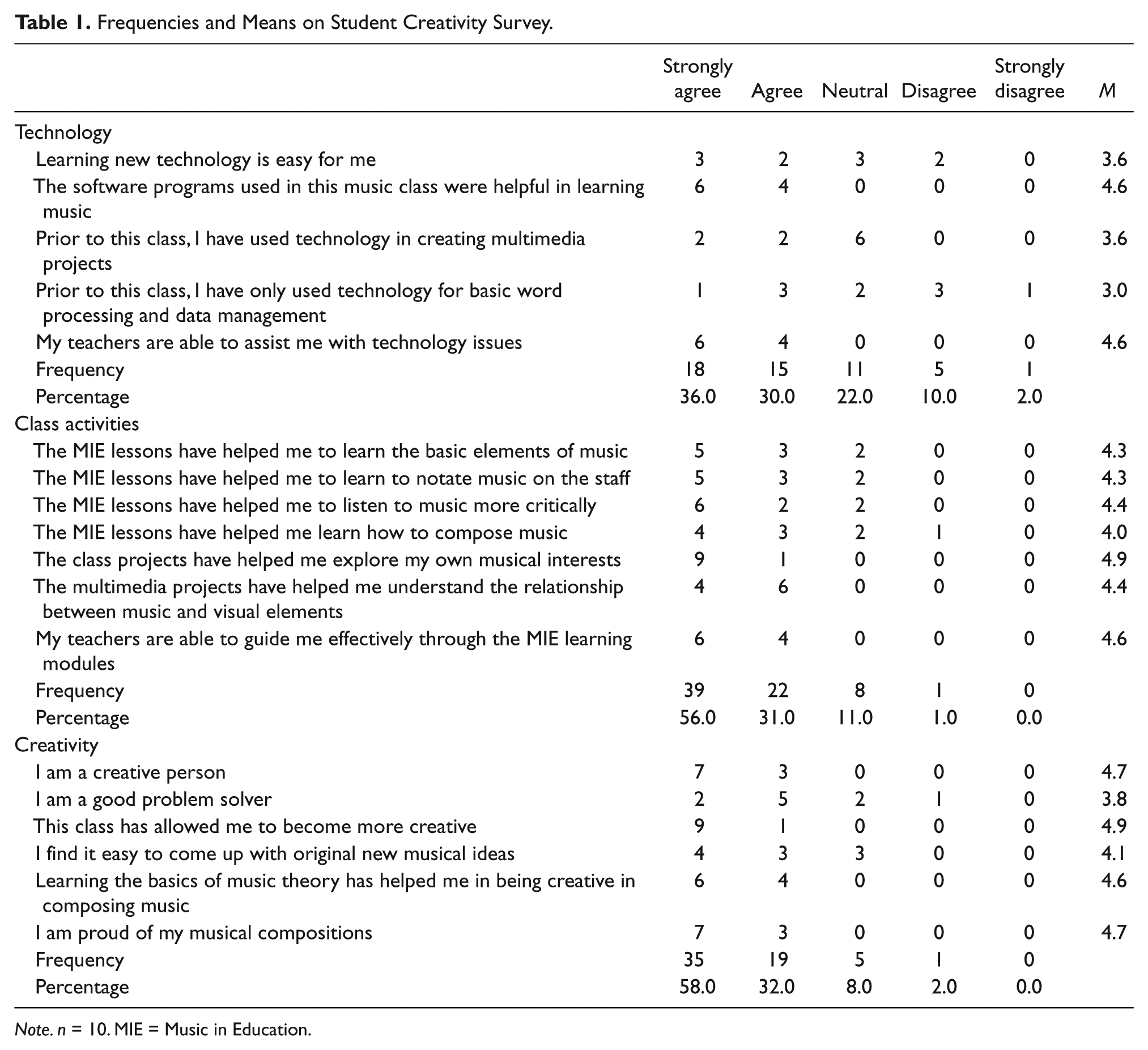
Note. n = 10. MIE = Music in Education.
Four main themes emerged from this case study that influenced the creativity development of the students: the technology background of the student, the musical background of the student, their music style preferences, and the type of learning activities of the course.
Technology Background
The learning curve of the students with the music technology software was relatively short and positive. Mr. Davis explained his experiences in teaching GarageBand:
I used to teach and delineate each step of how to use GarageBand. Now, I ask the students to explore the program on their own. I refer to GarageBand as puzzle pieces. You have all these loops on there that look like bubbles. We are creating a musical puzzle. I think visually it helps the students to put together their own puzzle.
GarageBand provided a basic and easy approach for students to explore the structure and manipulation of musical sound. Regardless of their musical background, the students “can experience immediate success” in this early stage of composition because of the absence of musical notation. The use of technology to assist in the creative process has been supported in previous research studies (Demonline, 1999; Howell & Murphy, 1993; Pike, 2000; Reese, 2001).
The MIE program also had a low learning curve for the students. Listening examples, visual concepts, and assessment strategies were incorporated using the music keyboards with headsets. Mr. Davis explained that “some of the students have taken piano lessons, but the majority of the kids have not.” The MIE comprehensive approach to learning music by performing, listening, and creating provided a logical approach to creativity development within the students. One of the lessons focused on listening and understanding chord progressions. Joel, a student in Mrs. Carley’s class, commented that, “when we followed the music on MIE, it was hard to keep up because I was not a piano player. But once you found the chord progression that worked, it was really cool.”
The Sibelius music notation software program provided new challenges to some students. Students learned the various aspects of the program “at different rates.” The students “that excel musically are the ones that understand the music program” in a shorter time frame. Their musical background and understanding of music notation had an effect on their understanding of how to write music via Sibelius. For the music students, it opened up a new door for them. Amy expressed, “I always have heard these songs in my head” and “it was so much fun” to finally be able to represent those sounds in music notation. Joel recognized that in “GarageBand, you use other beats and loops already created, but with Sibelius, you make your own music and you learn about music faster than if you are using someone else’s loops.” For the nonmusic students, the technical aspects of learning Sibelius were not an issue as much as understanding how to visually represent their music in the traditional form. Therefore, both music teachers commented they were less worried about students following correct music notation rules in the early stages of the semester. For this class, it was more important to focus on the creative process of music composition and as the students learned more about the theoretical aspects of their music, more focus was placed on the accuracy of the musical score.
Mrs. Carley summarized the overall learning curve of the technology by students:
Not only was there a learning curve for the teachers, but for the kids. But they pick it up so fast. They eventually will say, “Hey Mrs. Carley, did you know this program does this, and I will say, No, please teach me.” They are so much quicker on learning technology than I am.
Musical Background
The musical background of the student displayed different approaches to creating something new and original. Mr. Davis shared that, “The students with a music performing background, our band, orchestra and choir students, are more structured.” They had a general understanding of basic music theory based on their performing experiences. They tend to create musical pieces that exhibit form and tonality. Laura, a choir student, represented that approach.
Did you find it was easier to be more creative as you learned more about the elements and structure of music?
At first I kept to the guidelines, I did not mess around very much. I simply got it done right. He [Mr. Davis] told me I was doing it right, but I did not go outside the box much. Towards the end of the semester, I tried to go outside of the guidelines.
Was it more fun once you became more adventurous in your compositions?
Yes, I created this melody that I really liked. It was nothing that I had ever heard before. It came about after I just messed around with the notes until I got something I really liked.
Mr. Davis also indicated that “The nonperformers are very random.” Their first attempt in composing music tended to not follow any specific guidelines. The multiple musical ideas were streamed together with very little musical connection. This approach was quite typical in the early stages of the student’s compositions. David, one of the nonperformance music students, indicated that the one thing he learned from the MIE lessons was the importance of an ostinato in music and how musical ideas can be developed. “I learned that repeating is okay in music. You don’t have to come up with a new thing every time.” The three consistent music elements from the MIE lessons that many of the students indicated were helpful in developing their compositions were steady beat, ostinatos, and chord progressions. The creative process of music composition is based on the students’ knowledge of tonal and rhythmic vocabulary (Gordon, 1993; Morin, 2002).
Music Style Preferences
As Mr. Davis had indicated, the nonperformance students were very random in their early attempts in creating music. They were relying more on their own music preferences. They chose sounds based on what favorite music they like to listen to. Asking David what his favorite type of music was, he indicated “80s / 90s Rock and modern day heavy metal.” When asked if that influenced his compositions, he said, “at first it did while using the program GarageBand, but when I used Sibelius, I found myself switching to more classical sounds.”
When asked about her favorite kind of music, Laura said, “I am into all kinds of music. But when I sing, I like country, it is easier and it’s my kind of style.” A follow-up question about whether that influenced her compositions yielded this response, “yes, I have more of the country styles in my music. It is easier to write when it is a style you like and understand.”
As students described their final projects, appreciation of their own approach to music was evident. Joel described his final composition; “I can’t really explain it, but it is really alive. I like how it repeats the main theme and it ends very nicely with a beautiful chord. It is just awesome.”
Learning Activities
The learning activities of the course provided a multitude of opportunities to explore music composition. At a very basic level, only general concepts were introduced. The MIE lesson that taught steady beat focused on “why we tap our foot.” Concepts of how music repeats, how one idea links to another, and the use of ostinatos to drive the momentum of a composition are explored. “A lot of students think that everything that they write musically has to be a new idea.” The teachers provided guidance and boundaries on some projects, but enough freedom to allow students to explore on their own. The students are asked to “describe musically” a picture or a title that was given to them. Examples of titles used for this project, included “Dance of the Pumpernickels” or “Flamingos Raindance.” If the student selected the title “Thunder on the Mountain” out of the hat, he or she might choose a timpani loop to describe the thunder and another instrument might represent the mountain. “They get really bizarre” as Mrs. Carley points out, but a crucial part of this exercise was to discuss why the student decided to musically depict the title or picture in the way they did. All the class projects prepared the students for the final project. Mr. Davis explained the final project for the class:
The final outcome of the class is a Sibelius composition, totally original. I provide no boundaries. It is literally like looking at a blank piece of paper and telling them to write a book. This is generally a moment of “freak-out” for some students while others are eager to start. Once they have their composition, they go out and get photos on digital cameras. Using the iMovie application, they create a movie. We share all of our movies with each other by creating a class DVD.
For some students, it becomes an intimidating task at first to come up with initial ideas while other students “simply dive in.” Some of the students indicated that during the course of the semester, their self-confidence grew with regards to creating their own musical ideas. Specific guidance by the teachers as well as opportunities for exploration provided the most success. Freund (2011) suggested that the compositional process should be divided into three steps: (a) defining the materials and limits, (b) exploring the possibilities, and (c) making choices and communicating the resulting music through some sort of notation.
Discussion
The intent of this case study was to provide suggestions of the impact of music technology courses on the creativity development in students. More than half of the students in the class participated in the study; however, because of the small number of research participants, their perceptions may or may not reflect the broader music community. When the teachers were asked to describe creativity, they expressed how hard it was to put that concept into words. The music teachers described creativity as “thinking outside of the box,” coming up with something “original” or “unique” in a relatively “short amount of time.” It was also described as “pushing the envelope.” It was evident in their answers that creativity is not only a process of “doing,” but also a product. Researchers have debated this dichotomy of creativity. Balkin (1990) emphasized the importance of the product-centered approach to creativity while Johnson-Laird (1987) believed creativity was process centered. Students provided the same types of explanations. Laura shared the most vivid analogy of creativity:
It is when a person takes more time to try to go outside of the lines, like coloring an elephant grey. Why not make the elephant another color like pink? That is thinking outside of the box. There are a lot of things that will look [or sound] good in a different way if you take the time to explore it.
The final project for the West River Project provided evidence of the dichotomy between the process and product of creativity. Elliott (1989) described creativity as one in which a person is engaged in the process of “doing”—in music that includes composing and improvising—with the result of a final product. As students used their prior musical knowledge as well as personal experiences of music coupled with learning the technology through various learning activities, their confidence levels of original thought and ideas were developed. This process-based approach to creativity was similar to the four-step process of creativity development designed by Wallas in 1926 (Balkin, 1990; Hickey & Webster, 2001; Oehrle, 1986). Balkin described creativity as being different from basic spontaneity because there is a final product that emerges, a product that provides an important contribution to society. The four steps include
Preparation, using information and skills developed to complete a task
Incubation Period, the period in which the unconscious mind develops ideas and concepts
Illumination, the new idea is formed. This is the “light-bulb” moment
Verification, the last stage in which the new idea is verified through time and testing
The music technology course in this case provided such an environment for students to be creative. From the teacher’s standpoint, the key element in developing student music creativity was to understand the process focused around problem solving. If the student was not satisfied with a certain sound, then what are the solutions? Does it require a different instrument, changes in rhythm or pitches, or did it require more focus on the form of the piece? The students learn to synthesize the knowledge and skills that they have acquired in solving these complex musical problems.
Gordon (1989) states that the potential in creating music compositions is based on the ability to audiate. He refers to the stages of audiation similar to how people learn language. “Audiation is to music what thinking is to a language” (p. 77). The initial learning stages of the class were to learn basic music knowledge, which in return allowed the students to create a vocabulary of tonal and rhythmic patterns. It was from this bank of musical ideas that students were able to reorganize these musical elements into new and creative compositions. An observation by the classroom teachers indicated the students who were able to “sing melodies to themselves were able to find early success in the composition process.”
The West River music technology course also supported 21st-century skills. Besides being creative, students learned to collaborate with each other, provide meaningful and constructive feedback on musical compositions, and learn to make connections to other discipline areas. Opportunities for self and peer reflection of student work was available, which assisted in the musical growth of the student. From the teacher interviews, it was evident that creativity involves a personal level of satisfaction. Each student has his or her own unique musical tastes. It is important to respect that personal level of music creating. “It’s always something new” and the process of creativity “is about the engagement of the individual—they are doing their own thing.” There is no right or wrong. The students learned that making mistakes were considered a normal part of the creative process. Christine, one of the students, shared that “creativity comes from your own perspective and it develops from whatever comes naturally from your mind.” To evaluate individual creativity, there is a level of subjectivity even through the objective guidelines of the teacher. This supports the Bolton (2008) case study in which the benefits of compositional learning and attitude benefits were based on the development of a positive self-concept about ability to compose and the enjoyment of the process of compositional learning.
The product also played a crucial role in the self-reflection of the music student. Mr. Davis commented that, “yes, the process is important, but the product is equally as important.” The final outcome will be different for each student providing a personal level of satisfaction. Clark (1986) compared the product of creativity to winning a race. The final product of creativity is not a separate act from the process just like winning a race is not a separate act from running the race. Creativity is personal and will mean different things to different students. The combined process of developing and fostering new ideas as well as reflecting on the final product must work hand in hand to provide the overall creative experience.
Implications for Music Education
The class under study was only a semester course providing a short time frame in which to collect data. Therefore, the sampling size was very small. Out of 19 students enrolled in the class for the fall semester, 10 agreed to participate in the study. Stake (1995) mentions in his book that it is not uncommon for researchers to make assertions on a small sample of data. The teachers’ perspectives did provide a wealth of knowledge about the structure of this music technology course as well as their perceptions of student growth in creativity. Defining the term creativity was difficult for both the teachers and students because it is such an abstract concept. Hence, the descriptions of the personal experiences were essential at getting at the heart of this phenomenon.
Future research in how music technology may enhance the collaboration of creative projects will be important. Although composing and arranging music is one of the nine National Standards of Music, many music teachers feel inadequate in their skills and knowledge to guide and assess student music compositions and arrangements. Best practices in teaching music composition, arranging and improvisation using instructional technology should be developed and implemented to enhance this aspect of music education as well as support 21st-century skills development for students. Models of teaching methodologies, lesson activities, and assessment practices are needed to expand the compositional opportunities within the music curriculum and in music teacher training. The models and resources must be easily assessable for in-service music teachers to review and use. Furthermore, a focus on how to design composition lesson strategies should be incorporated into preservice music training programs. Although teachers’ comfort level and background in music composition was not the focus of this study, further studies should look at a correlation between teacher compositional skills on students’ creativity development. Finally, there is a need for a new model of collaboration between composers and teachers similar to the Contemporary Music Project of the 1960s. With the aid of technology, music composers can become a valuable resource for public school teachers. Through the use of web-based, social networking and mobile devices, students can be mentored by practicing composers and receive constructive feedback on their developing creative work.
Music composition should no longer be considered a separate activity in the music making process. Similar to how language is learned, we learn to speak and write so that original ideas and thoughts can be expressed to others. With the aid of music technology, there is a wealth of opportunities to expand the music curriculum and to foster music creativity with all students.
Footnotes
Declaration of Conflicting Interests
The author(s) declared no potential conflicts of interest with respect to the research, authorship, and/or publication of this article.
Funding
The author(s) received no financial support for the research, authorship, and/or publication of this article.