







Abstract
Neuroscientists have worked for over two decades to understand how the brain processes music, affects emotions, and changes brain development. Much of this research has been based on a model that compares the brain function of participants classified as musicians and nonmusicians. This body of knowledge reveals a large number of benefits from music education including improvements in memory, language acquisition, executive function, and brain plasticity. These findings offer the beginnings of an evidence-based argument in favor of music education for every child. Yet if the potential of this research is to be leveraged for this purpose, music educators need to know the type, period, and age range for music education that has been shown to affect positive, measurable, and enduring change in brain development. This article explores the criteria used to define musician and suggests ways these criteria could be used to advocate for specific developments in music education curricula.
The fields of neuroscience and music have been intertwined over the past two decades in an effort to unlock some of the secrets of how the human brain develops and functions. Eminent neuroscience researcher Robert Zatorre (2005) wrote that “music involves a tantalizing mix of practically every human cognitive function” (p. 312) and because of this music provides unique insights into how the brain develops and processes information. Early studies involved participants listening to music while positron emission tomography and functional magnetic resonance imaging technology was used to observe how the brain made sense of the sounds. Comparative studies that observed responses to different melodies or rhythmic samples were undertaken. Brain imaging technology rapidly advanced so that neuroscientists could observe musicians in the act of making or imaging to make music. Theories of how musical and nonmusical information is stored and processed began to emerge.
Neuroscientists began to see identifiable differences between participants they classified as musicians and nonmusicians. These differences are divided into two areas: brain structures (the areas in the brain, such as corpus callosum and auditory cortex) and brain functions (the mechanisms the brain uses to form message pathways and process information). These differences covered a variety of attributes. Participants classified as musicians were found to have heightened capacities in multiple areas of the brain, including memory (Degé, Wehrum, Stark, & Schwarzer, 2011; Jonides, 2008), language acquisition and syntax (Dammann, 2009; Patel, 2009), executive function (Hanna-Pladdy & MacKay, 2011; Posner, Rothbart, Sheese, & Kieras, 2008), and brain plasticity (Hannon & Trainor, 2007; Hyde et al., 2009). These differences sparked a number of studies that attempted to identify how and why participants classed as musicians displayed significant differences in their brain function and structure to nonmusicians.
This research had the potential to support many of the inherent beliefs about the importance of music education that I based my practice on as a university teacher educator and high school music teacher. The findings showed that music education could positively and permanently improve cognitive skills, physical development, and emotional well-being. Although these benefits have often been argued from an aesthetic education perspective (Austin & Reinhardt, 1999; Leonhard & House, 1959; Meyer, 1956; Reimer, 1993; Swanwick, 1979), neuroscience offered a “hard science” perspective and body of knowledge that implicated music education as a core learning area for children. Both aesthetic and scientific research suggested ways that music education could help students succeed in tomorrow’s world and the broader implications of these findings could “support music as a core within the complete curriculum” as outlined in the Advocacy statement of the NAfME Strategic Plan (NAfME, 2011, p. 1)
Yet in order for these findings effectively underpin advocacy for music education, a significant question related to the relevance of those findings to everyday people, in this case children of school age, not “musicians” needed to be answered. What does neuroscience classify as a musician? And how significant are factors such as the type and length of music education the participants in those studies had received, and the age at which they had received it? In short, an investigation of the design parameters of those studies was needed before the findings could be translated in the school context and for effective advocacy of music education.
Benefits of Music Education to Brain Development
Before outlining the review method and findings, it is helpful to gain an overview of the benefits of music education to brain development, as suggested by recent neuroscientific research. This is by no means an exhaustive overview but aims to better inform music educators of relevant findings in the field.
Many are aware of the broad claims made in the name of the preliminary research by Rauscher, Shaw, and Ky (1993) on the Mozart Effect (Campbell, 2001) and the capacity for music, but not music education, to raise intelligence levels. Campbell’s interpretation of the Rauscher et al. study along with many other studies has been refuted by numerous researchers in the field and may have done music education a great disservice at the time. However, the field of neuroscience has continued to discover, and strengthen, the links between music education and positive brain development. The study in this article aims to give music educators more recent and credible findings about music education from the decade of research since the Mozart Effect. As mentioned in the introduction, the use of these findings to support and advocate for the importance and value of music education needs to be viewed in tandem with the specific criteria that researchers have used to define a musician.
Musicians have been found to possess advanced skills in both long and short-term memory (Jonides, 2008) and memory storage and retrieval (Dunbar, 2008). It has been suggested that music rehearsal helps improve the memory pathways in the brain and that musicians use pictures and narrative to link memories. Furthermore, it has been suggested that musicians attach multiple “tags” to a single memory, such as a conceptual tag, emotional tag, and contextual tag, and this considerably enhances memory storage and retrieval. Enhanced verbal memory is linked to these skills and suggests that music education enhances the pathways for melodic memory and that the brain translates this into language. Most recently, Koelsch (2011) has suggested that “the human brain, particularly at an early age, does not treat language and music as strictly separate domains, but rather treats language as a special case of music” (p. 16).
Following on from this finding, musicians have been found to acquire language and understand the rules of language and its syntax more effectively than nonmusicians (Dammann, 2009; Peretz et al., 2009; Wandell, Dougherty, Ben-Shachar, Deutsch, & Tsang, 2009). This area has attracted attention from researchers on the basis that the study of music processing might provide insight into the development of language processing in the brain (Patel, 2008). Researchers suggest that music education assists in the understanding of musical syntax, which in turn assists in understanding language syntax. In fact, music education may develop the mirror neuron system in the brain (Haslinger et al., 2005; Molnar-Szakacs & Overy, 2006; Overy & Molnar-Szakacs, 2009). This system enables the brain to complete two processes at once, making the brain work twice as effectively in the same amount of time. In essence, a musician’s brain can work twice as well in half the time. However, it should be noted that at the time of writing, significant debate remains over whether music education is solely responsible for this type of brain development, or if it simply capitalizes on preexisting differences in an individual’s mirror neuron system (Zatorre, Chen, & Penhune, 2007).
The same mirror neuron system allows simultaneous processing of different types of information, for example, analyzing a sound for both its perceptual and hierarchical qualities. This area of brain development connects with a group of skills known collectively as Executive Function. Musicians have been found to have higher levels of Executive Function (Geake, 2009; Hanna-Pladdy & MacKay, 2011), which refer to a group of interlinked tasks that include planning, strategizing, setting goals, and paying attention to detail. To perform these tasks at a high level, the brain needs to be able to analyze information simultaneously and consider both the cognitive and emotional aspects. High levels of Executive Function are evident in a person who can successfully resolve internal and external conflict, or solve problems effectively. Again, research has suggested that musical rehearsal assists with the development of attention skills, which is a significant factor in Executive Function (Jonides, 2008).
Musicians also appear to have higher levels of brain plasticity and this was one of the original areas that sparked investigation of the benefits of music education to brain development (Munte, Altenmuller, & Jancke, 2002; Schlaug, 2001). Brain plasticity refers to the capacity of the brain to change, remain flexible, and continue to learn throughout one’s life. This challenges earlier thinking that the human brain became “set” or unable to change or learn once we reached adulthood, summed up by the adage “you can’t teach an old dog new tricks.” Music education has been found to encourage high levels of plasticity in the auditory cortex (where we process sound information) and frontal cortex (where we process many executive functions such as the ability to predict consequences, moderate emotional reactions, and determine similarities and differences). This plasticity allows for higher levels of creativity and divergent thinking (Gibson, Folley, & Park, 2009) as well as improved brain health into later life (Moser, 2005).
Although the above review of neuroscience research is not exhaustive, it does highlight the benefits of the type of music education that involves making, rehearsing, performing, and understanding music on brain development. Although these findings are useful when advocating for the importance and value of music education within the curriculum, such advocacy can be strengthened by a greater understanding of the type and length of music education that has led to these research findings.
Too often music education is devalued by other educators, leaders, and policy makers who see it as a vehicle for entertainment for the school community. The fact that the final product, the performance, is the public face of the music education program in a school can neglect the meaningful learning that occurs in the learning process leading up to a performance. The argument may now be made, using findings based in the scientific rather than artistic fields, that the learning process is far more important than the performance for the overall neurological development of a child. A paradigm shift of this kind could have significant implications for all aspects of music education. To assist in this recognition the music profession needs specific details from the research that advocates for this type of shift.
The review that follows will outline the type, length, and age period of music education that has been shown to affect positive and permanent changes in brain development as outlined in the current body of research in the neuroscientific field.
Review
This review consisted of 14 studies and took the form of a meta-analysis that compared the criteria used in each study to identify musicians and nonmusicians. The studies were selected from a larger literature review to the field of music education and neuroscience. The comparison focused on the specific activities that were identified as music education and over what period of time and at what age these activities occurred.
The key issue on review of the studies was the age of the participants when the study occurred. Many of the earlier studies were conducted using professionals and amateurs adult musician whereas a number of the more recent studies involved children of various ages. Some of the studies investigated one small part or activity within the brain whereas other studies focused on the broader range of brain activity that was influenced by music education. To further complicate the process, details of the selection criteria could be extremely brief. In a published research article, this information was typically buried in a single sentence in the methodology section or scattered throughout the findings and discussion sections.
The studies selected for review needed to be broad enough to provide an overview of the research findings and narrow enough to define a musician for the purposes of informing and advocating for the importance of music education in a child’s learning. Therefore, the studies were divided equally between adult and child participants. The term commonly used in the studies to identify music education was formal music training. For the purposes of this review, the term formal music training will be used in the place of music education.
Selection of Studies
The 14 studies fall into two groups based on their participants. The list of the studies can be found in Table 1 and will be referred to in this article as Studies 1, 2, and so on. Studies 1 to 7 involve adult participants. These studies compared professional musicians (those drawing their primary income from musical performance or music education) with nonmusicians (who had no significant formal instrumental music education experiences). The criterion for a musician in this group was defined in a number of different ways: by the average hours of practice per day (Studies 1, 6, and 7), if they had participated in continuous music learning from childhood through adolescence (equal or more than 10 years; Study 4), and/or trained at a specified music school (Studies 1, 2, 3, and 5).
Studies Included in the Literature Review.
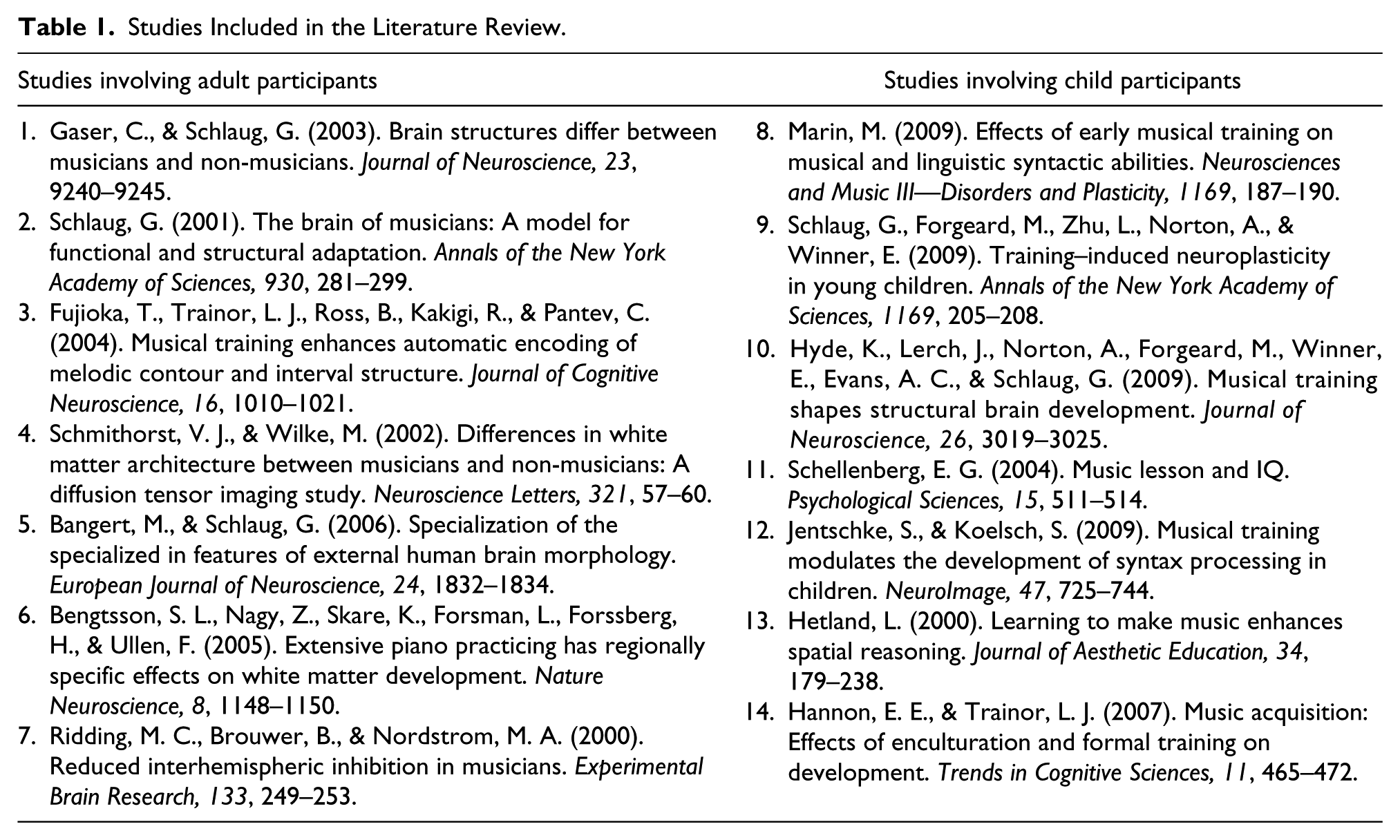
The second group of studies, Studies 8 to 14, involved child participants between the ages of 3 and 11 years. Six out of the seven studies compared those who undertook formal music training in the form of instrumental music lessons. The only study that used an alternative form of music education was Study 11, which undertook formal Kodaly lessons in a classroom environment.
Exclusionary Criteria Within the Studies
Several exclusionary criteria existed in each study. The most prominent was that all participants selected for the experiment were right handed, which was determined by the use of the Edinburgh Handedness Test (Oldfield, 1971). As these studies involved scientific testing, this is a commonly used criterion to limit variability in the results. Participants were also excluded on the grounds of a history of hearing and vision problems, a history of seizures, metal implants, pregnancy, or head trauma with loss of consciousness (Study 4), problems or delays with language acquisition, learning problems, and if they had given up learning an instrument (Study 12). Two interesting exclusions used in the studies were those participants who learnt more than one instrument (Studies 3 and 5) and those who learnt a foreign language before 6 years of age (Study 12).
Findings
Type of Music Education
The majority of the studies, with the exception of Studies 8 and 11, defined formal music training as the learning of a musical instrument. This included string, keyboard, or conventionally recognized musical instruments. This choice could have been made for a number of reasons: For the purposes of a scientific study this option presents far fewer variables, the participant group would be easier to access, students are likely to undertake this type of musical learning for several years with the same teacher as opposed to multiple classroom teachers and methodologies during the same period. Studies 8 and 11 used weekly Orff or Kodaly lessons, respectively, in their definition of musician, and although Study 8 did use Orff instruments in conjunction with other Orff activities (such as singing and games), learning a single musical instrument was not the primary objective of this type of formal music training.
In addition to this definition, the review revealed further details about the type of formal music training that contributed to the definition of a musician. Disregarding Studies 8 and 11, all studies required weekly lessons on a musical instrument during the school year in a one teacher/one student format. Studies 8 and 11 listed formal music training as weekly lessons during the school year in a one teacher/no more than six student format.
Period of Music Education
Studies 1 to 7 involved professional musicians and therefore the duration of their training varied significantly but was always more than 10 years and involved weekly one-to-one lessons. Studies 8 to 14 provided more information that could be useful to a music educator. Among other objectives, these studies sought to determine the length of formal music education required to produce structural and functional brain changes. Essentially, they were searching for a minimum period of music training required to change the brain. Studies 9, 10, and 14 found that participants who underwent weekly instrumental lessons from between 8 weeks and 15 months showed either structural or functional changes in brain activity but not both. Studies 12 and 13 showed that both structural and functional changes in the brain occurred after a minimum of 2 years of formal instrumental music training.
Age of Music Education
The age at which formal music training occurred varied widely. The studies involving children only examined children in their primary school years (<11 years of age) whereas the studies involving adults examined a far wider age range. Study 6 examined the average practice hours of professional musicians in three important periods during their childhood and adolescence, the age they began practicing till 11 years, 12 to 16 years, and 17 years until time of test. Study 6 found that the earlier the students began practicing a musical instrument the more significant the changes in the brain. Study 13 echoes this finding and Study 4 used the continuation of instrumental lessons through childhood and adolescence as a criteria for their musicians.
Conclusions
The review revealed a number of useful research findings and also some significant questions that deserve further investigation. In essence, positive changes in brain structure and function have been observed in musicians who have learned a musical instrument in a weekly one-to-one lesson for more than 2 years and have commenced learning as early as is appropriate for their instrument. In terms of music education, this definition would support the concept of experiential learning or learning through doing that Dewey (1910) and Eisner (2002) understood education to be. This type of music education would fall into the paradigm on which many of our state and national curricula are based, that music education must occur through the medium of music making. In an even narrower sense, it is music making that occurs through performance, rather than composition. This definition also supports the direct instruction or master and apprentice model of music education that includes regular weekly connection with an expert on the instrument. This has been the predominant model for instrumental tuition for centuries, but rather than consider this as a best practice model, it should move appropriately to be considered the most established or predominant. The minimum of 2 years tuition in this format is an interesting finding for music educators. Music programs can be organized in a myriad ways, but a common learning period is for one semester or 1 year. Looking at musical development in 2-year time frames may not be as common and this finding may encourage a reexamination of how we view musical development when related to brain development.
The definition of a musician in these studies begs a number of questions that future research might usefully address including: Is instrumental music training the only form of music education that has positive effects on brain development? If students learn in a group or social situation does this lessen the positive effects of formal music training? If a child plays a violin and begins learning at 3 years of age, is their brain development greater than a child who takes up trombone at 10 years of age?
Our current body of research does not appear to provide answers to these questions. The field itself is relatively young (entering its third decade) and research not only needs to be initiated but also verified and replicated in different contexts and at different times in history. Some suggest that using these findings even now is too soon (Gruhn, 2004). I would venture that learning a musical instrumental is not the only form of music education that positively effects brain development, but it provides clear and easy parameters on which to base a scientific study. It is also an easy and large participant group to access. These two reasons may make this group attractive to neuroscientists, more so than a classroom program based on an Orff or Kodaly methodology or informal music learning environments.
Music educators know that every music ensemble or music learning environment is unique and different. It depends on the aims of the ensemble, performance goals, resourcing, rehearsal space and frequency, student personalities, and teaching style. For a scientist, the number of variables this context introduces makes it unattractive for scientific study. Yet some scientific studies have examined this aspect of music education (Koelsch & Siebel, 2005), and Sloboda (1991) argues that the physical setting and social dynamics of a music making experience are just as important as any brain development that occurs. Research in this area, using the small knowledge base that already exists, could assist music educators to understand how and why music education in a group can affect brain development. Similarly, the imperative for active music making rather than more passive music appreciation could be bolstered by such research.
The age at which music education begins has been widely researched and findings in this area are similar; the earlier a child begins to be exposed and understand music the more they benefit. Although this idea is important, it will be just as important to follow the musical learning and brain development of children over a longer period than 2 years, which will likely happen as the field continues to grow and research questions become more sophisticated.
The purpose of research should always be to inform and improve practice. The findings from this review could be applied in a broad range of circumstances, including the following:
Supporting research for the establishment of an instrumental music program
Supporting research for the extension of a compulsory music program to a minimum of 2 years
Supporting research for the expansion of an instrumental music program that may have been established on a pilot, voluntary, or user-pays basis
Supporting research for the justification of the continuation of an instrumental music program that is in danger of closure
Supporting research in the education of parents, community bodies, and school administrators on the benefits of instrumental music education
As music educators, we find ourselves consistently arguing for the importance and value of our discipline. In these times of economic restraint and the constant call to fit more learning into a smaller time frame, we will see ourselves continue to argue our case. In the past, our arguments have been based predominantly on the aesthetic benefits of the arts in the development of a well-rounded student. I do not believe we should cast aside those important points in favor of a scientific-based argument, but by presenting our position with findings from both sides, it is more likely that our arguments will reach and influence a larger number of people who value different types of evidence. The ultimate goal of this approach is to shift the current paradigm of the value of music education in each child’s development to reflect Oliver Sacks’s conviction that “for the vast majority of students, music can be every bit as important educationally as reading and writing” (2007, p. 102). Importantly, the research field has advanced sufficiently to the point that instead of passively reading the questions posed by the neuroscience, we may begin to actively ask the questions ourselves and work together to better understand music education.
Footnotes
Declaration of Conflicting Interests
The author declared no potential conflicts of interest with respect to the research, authorship, and/or publication of this article.
Funding
The author received no financial support for the research, authorship, and/or publication of this article.