







Abstract
Based on the needs for viable melodic dictation strategies and thoughtful approaches to teaching prerequisite skills, the central research question guiding this qualitative study was as follows: What strategies do dictation takers describe having used on successfully completing a standard melodic dictation? Six sophomore music majors, recommended by their theory professors as consistently successful in melodic dictation, completed two cycles each of a standard dictation coupled with a follow-up reflection interview focused on strategies. Three overarching themes emerged from data analysis: (1) Participants are highly skilled at directing their attention during dictation, (2) participants prioritize tasks carefully during each listening of a dictation, and (3) participants skillfully coordinate a variety of musical and problem-solving skills to complete dictations successfully.
Melodic dictation is a complicated musical task, requiring highly developed perceptual and cognitive skills (Covington, 1992; Karpinski, 2000). Challenges to acquiring and properly using these skills abound. For example, research suggests that students may have difficulty remembering all the information in a melody long enough to be able to write it down in standard music notation (Miller, 1956; Pembrook, 1986). The process of remembering even a portion of a dictation is complicated by the aural distraction of ensuing sections of the target melody (Karpinski, 2000). Dictation takers must employ flexible working memory quite extensively during dictation to manage multifaceted aural stimuli (Berz, 1995).
Students may approach these challenges through differentiated learning styles (Beheshti, 2009) and may use a variety of specific strategies to boost correct perception, memorization, and notation (Karpinski, 2000). Researchers have found that students may use motor and visual imagery (Mikumo, 1994; Thompson, 2004), contextual solfège syllable systems (McClung, 2001), and “chunking” of bits of information into larger pieces (Madsen & Staum, 1983; Potter, 1990) to take dictation successfully. Some students, however, may not have chosen specific strategies, and some may not even have learned multiple strategy options through coursework (Klonoski, 2006). Furthermore, some strategies believed by instructors to be helpful may, in fact, hinder the process. Pembrook (1987), for example, found that singing back a dictation melody before writing it down actually hindered most students’ success, because they were not able to sing it back accurately.
Melodic dictation plays a crucial role in music education because it serves as one of the ways to assess students’ cognitive transfer capabilities between the visual and aural domains. High school and college students, with guidance from their instructors, can benefit from knowledge of a wide variety of dictation strategy options, not only for completing an isolated task but also for enhancing internal musical skills overall (Klonoski, 2006). The purpose of this study was to explore successful melodic dictation strategies employed by undergraduate music majors.
Rationale and Research Question
Based on the needs for viable melodic dictation strategies and thoughtful approaches to teaching prerequisite skills, the central research question guiding this study was as follows: What strategies do dictation takers describe having used on successfully completing a standard melodic dictation? The analysis and discussion presented in this article aim to provide numerous strategy possibilities to instructors and students of melodic dictation at the high school and collegiate levels.
Method
This qualitative study was based on phenomenological inquiry (Finlay, 2009). The main thrusts of the methodology employed were to engage multiple participants in description of a lived experience—the dictation process—in order to distill the experience down to the essence of the relationship between perceiver and perceived (Creswell, 2006; Moustakas, 1994). Reports from participants would serve to define the dictation experience in context of the human mind that experienced it, ultimately revealing important information to teachers and learners of aural skills about “what is at work in or during the phenomenon” (Randles, 2012, p. 16).
Participants
Participants in this study were six undergraduate music majors, aged 18–20 years, enrolled in their third semester of aural skills at a large northeastern university. All were recommended by their theory professors as having maintained a consistent record of success in melodic dictation. Participants represented a variety of academic programs and primary instruments within the undergraduate music major, although these categories were not included in data analysis. The only determining factor in their selection was the probability that they would master two standard melodic dictations and be able to describe the successful strategies that they employed in subsequent reflection interviews.
Procedures
I met with each participant twice and each meeting consisted of two parts: a standard dictation and a follow-up reflection interview about the process. Each participant first took a melodic dictation individually with headphones on a laptop computer. While participants completed the dictation, I took field notes for data triangulation. The participant heard the melody three times total, with 30 seconds to work after each listening. After those 30 seconds, I photocopied the participant’s answer sheet for reference during the subsequent interview. The photocopying took approximately 10 seconds, in which the participant and I remained silent. Although the photocopy machine created slight mechanical noise, it was not unlike typical intervening noise heard in an aural skills classroom, and participants reported that it did not bother them. Immediately following the photocopying, participants began the subsequent listening. The purpose of the dictation exercise was to encourage rich and accurate description from participants about their approach.
During the reflection interview, participants were able to view each of their drafts to more accurately and thoroughly describe the dictation process and their personal strategies. Participants completed the dictation/reflection process twice, contributing to data triangulation and capturing a clearer picture of their approach.
Dictation Prompts
I developed the two dictation prompts, one for each meeting, in consultation with a university professor of music theory (see Figure 1). The prompts were created using the standard piano patch in Encore® notation software. Answer sheets consisted of a staff, clef, barlines, key signature, time signature, and the first two notes of the melody (see Figure 2).
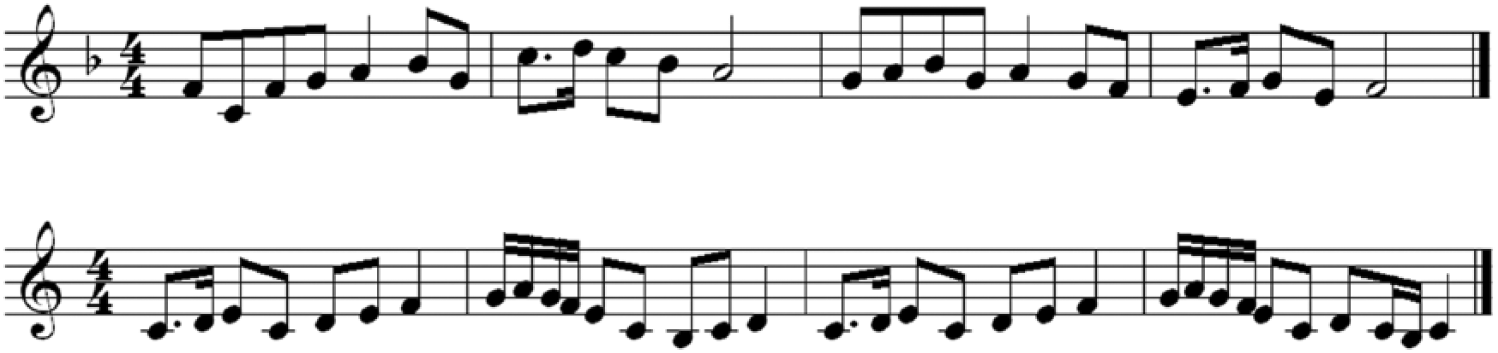
Dictation prompts.
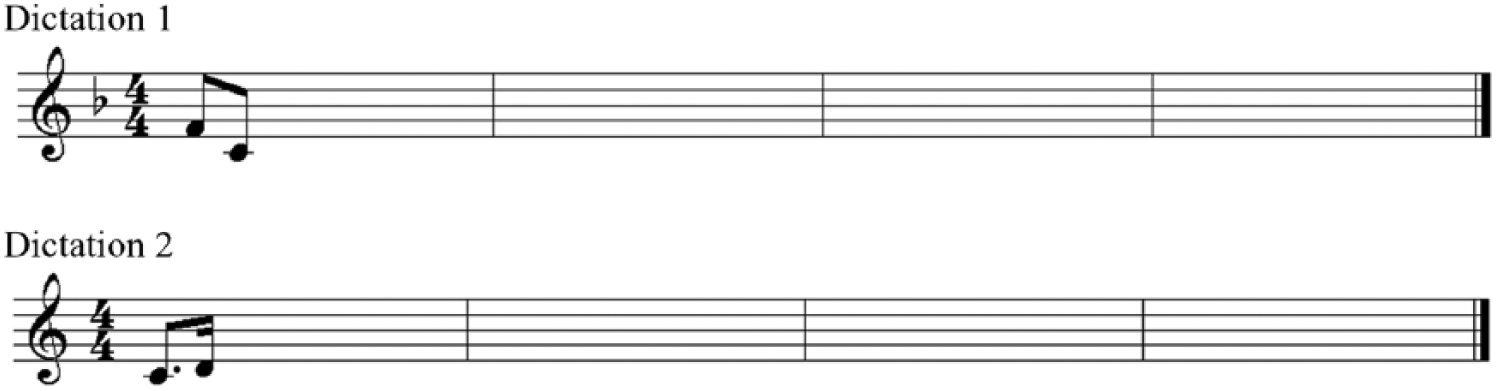
Answer sheets.
The purpose of the prompts was not to test participants’ skills but to prime them with an authentic dictation experience just prior to the interview. I hoped that recent completion of the dictations would inspire thoughtful and accurate reflection on participants’ approaches to the process. All participants completed both dictations with near-perfect accuracy in rhythm and pitch.
Interviews
Structured questions guided the interview process, with an occasional follow-up question for clarification. Although phenomenological researchers typically use semistructured or unstructured questioning to probe for depth of description (Seidman, 2006), the structured interviews in the current study were necessary to highlight “practicality and utility” as “hallmarks of phenomenology” (Randles, 2012, p. 19). The interviews prompted participants to reflect on how they had approached the dictation process during and between each of the three listenings. I informed participants that even if they had already answered a question indirectly, they would still be asked it, to offer the opportunity to add to their response and to maintain consistency across all interviews. I audio recorded all interviews for accuracy in transcription.
Analysis and Trustworthiness
I sent transcripts of the interviews to the participants for member checking (Lincoln & Guba, 1985). This step was an important contribution to the trustworthiness of this study, as participants were invited to clarify any transcript statements that did not accurately reflect their understanding of the experience. Once all transcripts had been reviewed and returned, I began multiple rounds of coding to determine common themes and subthemes emerging from the data. Triangulation of data was achieved through review of a combination of multiple interviews, dictation answer sheet drafts, and researcher field notes (Denzin & Lincoln, 2011). Analysis of two interview transcripts from each participant minimized the chance that any given participant’s description might reflect a one-shot atypical dictation experience for that person. Answer sheets (three for each dictation) allowed me to reference participants’ work from each of the three listenings while conducting, transcribing, and analyzing the interviews. The information from these answer sheets provided greater insights into participants’ processes, and enabled greater clarity in reporting results, because I was able to follow each participant’s sequential work through the three drafts. Field notes provided additional insights about participants’ approach. These notes helped to inform the interviews, confirm participants’ responses, and clarify their dictation drafts.
Results and Discussion
Three overarching themes emerged from data analysis: (1) Participants are highly skilled at directing their attention during dictation, (2) participants prioritize tasks carefully during each listening of a dictation, and (3) participants skillfully coordinate a variety of musical and problem-solving skills to complete dictations successfully.
Each of these themes is composed of three subcategories of strategies, which will be discussed under the general heading of the parent theme.
Attention Direction
During dictation, limits on time and repetitions challenge students to maintain optimal focus. In the words of Andrew, 1 “It’s a little like doing a puzzle, but there’s a time limit on it. So, there was a little bit of anxiety . . .” Dictation melodies encompass multiple musical aspects, each of which can attract—or distract—the listener’s attention. According to these participants, dictation success depends on attention direction skills of mental preparation prior to listening, awareness of overall characteristics of the melody, and ability to target specific bits of melodic information while ignoring others.
Mental Preparation Prior to Listening
Participants discussed the state of mind they create just before they listen. Jason emphasized keeping an open mind in preparation for the first listening: “So I think I try to not assume anything, at least in this [first listening], where I have no idea what it was going to be.” Edward expressed a similar approach to the second listening, after having already notated the second half of the melody completely.
I think it was pretty fresh [the second listening]. I probably should have been thinking about something . . . like now I’m just seeing how they have the same rhythm, the first two measures and the last two, but I think I just listened to it with a clean slate.
David and Kyle both highlighted the importance of counting internally as the opening chord sequence sounded. Kyle also reported singing, on the second and third listenings, the first bit of the melody he had already notated before it sounded again.
Before and during this [opening] cadence, just preparing myself. I was just carefully counting “1-2-3-4” so that that way I wouldn’t be lost . . . the whole time I’m singing the starting note, or the starting pattern in my head, which obviously helps prepare me, because if I’m not expecting it, and then I just hear it go, I think it might throw me off as to where the next note is.
This active, expectant approach to melodic dictation will be echoed in multiple applications throughout the results of this study. Finally, Andrew noted the practical importance of clearing the mind of any unmusical distractions.
Things didn’t fall into place on the first [listening], and there’s a little anxiety about “Am I going to get this in time?” . . . I had to push [the anxiety] to the side, and make sure I was completely focused, and that I could fill in from my clues and cues that I had written in, what the actual notes were and everything.
A clear, open, ready mind before and during dictation seems to contribute to the success of these participants.
Attention to Broad Melodic Characteristics
Participants reported attending to broad musical parameters that served them in subsequent deductive reasoning, a finding consistent with Karpinski (2000). Jason offered the following thoughts about rhythm and diatonic pitch content: I recognized the rhythm, I guess, I didn’t even think about it consciously, but I definitely recognized the rhythm in the first two bars as the same as the second two bars. . . . I also heard that it’s all diatonic. . . . That’s just something I didn’t even think about, that I just . . . when I saw the flat was in the key signature, I knew I wouldn’t even have to write any accidentals.
Jason clearly had brought a breadth of attention to this first listening, which would later complement a depth of attention to more salient details.
Andrew noted that attention to the overall pitch range of a dictation can spark a process of elimination, helping the listener later to pinpoint details accurately.
There were some parts where I could figure out basically it didn’t go above a certain note or below a certain note, so I knew the general range. I didn’t notate that anywhere, but I could tell it was in a certain range, which makes it easier, when you have fewer choices.
David described recognition of an underlying sense of meter, even though he was not specifically counting beats during a listening.
It’s more of just feeling a pulse. I mean you can tell if a piece is in four or in three. So, you can hear beat one just by the pulse. So, when my beat four sounded like beat one, I thought “This isn’t right.”
Participants cited the importance of general recognition of patterns. Kyle pointed out his observation of melodic sequence on the first listening, even though he had not been able to pinpoint specific pitches and rhythms.
I was basically just trying to kind of let it all soak in. I mean, there were different patterns, like this [first] measure repeated again up a third over here [third measure], so, I mean, I was able to hear that.
Edward echoed this observation, noting how it became a strategy for the next round.
You kind of have an idea of what it’s going to do. You know there are not going to be crazy intervals in there. If the next measure is just going to go up a third, you kind of know where the pitches are going to lay out, because it’s just going to stay in that range, but I wasn’t sure of what the rhythm was, or what the specific pitches were.
Awareness of broad melodic characteristics appears to provide these participants with underlying understanding for subsequent listenings.
Ignoring Extraneous Information
Participants cited their ability to “tune out” information, for a variety of reasons, as a key component of their success. They discussed the usefulness of ignoring melodic information they had already recorded correctly, in order to heighten their attention to missing information. Kyle explained, I was sort of not paying attention to the rest of it, I guess. I mean, I was listening to it, because I need to know when to start copying, but I think it was more that I was just specifically listening for that [missing second measure].
Andrew echoed the idea of listening to correct information only insofar as it may help direct attention to information that is still needed.
If I have note values [written] in that I think are correct, it’s almost like I’m not focusing quite as much on listening to that, and I’m more concerned with what’s coming after that, and I’m just checking . . . like if I had the second measure, and I thought it was secure, and the third measure I didn’t quite have, I would just check the second measure, and then when I got to the third measure, I would know I was at the third measure, and I would try to get that more secure.
Edward pointed out the danger of distraction due to listening to finished material, especially when that material occurs at the end of the dictation, promoting a potentially dominating recency effect.
I think I was just thinking “memorize the first two measures,” like I had memorized the last, and I wasn’t going to pay any attention at all to the last measures at all this time around, and just work on getting the notes and rhythms of the first two measures. . . . I pretty much zoned out the last two measures, just to focus on the first two. And, I mean, I wasn’t sure if everything was right in the last two measures, but I figured I would listen to that on the third time. . . . I think I’m even thinking about [the first two measures] while the last two measures are playing, because the last two measures if I even listen to them, they’ll be fresh in my mind, and I just have to remember the first two. I think I’m pretty much replaying [the first two measures] as the third and fourth measures are going along.
David described the occasional need even to ignore bits of information that have not yet been recorded, in order to invest in larger chunks of information that will be more helpful in the long term.
You kind of half focus on the beginning at least, because you don’t want to get caught up on that. If you’re looking at this [first measure], and you realize it’s not right, and meanwhile the rest of it goes by . . . well, you just wasted a listening. So, it’s kind of “Just let it go by . . . alright, second bar, this is what I have to get.” And then, maybe if I can hear a little bit of the third bar, but . . . but that’s the goal of the third take. You know, it’s like a schedule.
He further explained this “sacrificing and investing” approach.
When I’m looking at this sheet [first draft], and I think “Okay, I’m really going to be in the hole, if I just focus on beats 3 and 4 of the first bar, and I miss the second measure. Because then I’m going to have only one chance to figure out this whole bar. And, if disaster strikes, and I don’t even solidify the rhythm for the rest of it, then I’m really in trouble. So, two beats can be sacrificed, just to get more info. Because, really it goes “broad . . . less broad . . . specific,” to the end of it.
Edward also described more refined stages of the selective listening process, as the sum total of missing information became more specific and isolated.
I kind of knew where the gaps were, where I didn’t remember what the notes were, but I remembered there being notes, so I just made a mental note to listen for the last measure, the first beat. . . . I thought this [first beat of last measure] was either an eighth note rhythm or a dotted eighth-sixteenth rhythm, so I just made a mental note of those things to listen for.
Participants’ success seems to depend on their ability to focus their attention on what they deemed most important and ignore distracting aural information.
Task Prioritization
Human accuracy in processing aural tasks generally decreases as complexity of tasks increases (Byo, 1997). Data presented in this section describe careful choices about specific information on which participants focused first. All participants described deliberate prioritization of tasks at various stages in the process. Their overarching plan of attack seems to have been set from the beginning, with alterations made when necessary. Their responses tell us that dictation success is boosted by careful choices about whether to focus first on pitch or on rhythm; whether to focus first on the beginning, middle, or end of the melodic target; and whether to change priorities midstream.
Pitch and Rhythm
Melodic dictation typically targets two main aspects for notation of the finished product: pitch and rhythm. While the end goal is to integrate these in written form as a complete melody, many dictation students choose to focus on one or the other aspect at a time, distributing their listening efforts accordingly across multiple listenings (Karpinski, 2000). Participants in the current study stated their approach and, more important, discussed why they chose it.
Kyle, David, Edward, and Jason all described listening for pitches first. They explained that since they felt rhythm was the easier of the two aspects, it was crucial to attempt pitch identification right away. These participants chose to focus first on what they found to be the more difficult aspect of the two, whereas the easier aspect gradually revealed itself in the background. Jason described, I actually retained the rhythm pretty easily, so I was more concerned with the melody notes [pitches]. I’m usually first concerned with the notes, mostly because I’m not as good at getting the notes. So I feel like I don’t have to worry about the rhythm as much as I have to worry about the notes.
The other participants, Andrew and Marty, both described the opposite choice. They attended to rhythms first, to establish a framework or context for later placement of pitch information. This strategy is consistent with Beckett’s (1997) finding “Subjects said that without rhythmic organization they could not hold pitches in memory. . . . Having the rhythmic structure in place might aid pitch memory” (p. 621). For Andrew and Marty, it appears that “difficult aspect first” was the general plan as well, as detailed by Marty, “Pitch wasn’t as important because I figured in the third listening, it’s a lot easier generally to get pitch than rhythm.”
Attending to one aspect first, of course, implies attending to the other later, as was explained by David.
I go from an 80/20 pitch-to-rhythm ratio at first, to 60/40, to 40/60 by the end. So, by the end I’m really making sure I have everything really lined up, all the beats . . . because by the third listening I should definitely have at least 90 percent of the pitches.
Although participants in this study differed in which aspect they attended to first, it is worthwhile to note that all of them had a specific plan of attack prior to listening. This plan was confirmed through both interviews and review of the drafts for each participant.
Chronological Decisions
Another crucial decision to be made during dictation is which part or parts of the melody, chronologically speaking, should receive primary attention (Karpinski, 2000). Participants’ reports revealed a variety of definitive approaches. Jason and Kyle worked straight from beginning to end, relying purely on memory, as noted by Kyle, “I memorized the first two measures, but then I couldn’t do any more.”
Edward took the opposite approach, focusing on the end of the dictation, and subsequently working backward.
It’s easiest to memorize the last section, because that’s sort of what’s fresh in my mind. So, I wrote down what I remembered from the last two measures. . . . As I was listening to the first two measures, I tried to listen to the first note of the first measure and the first note of the second measure, just so I have the basis of all the other notes. So I know where it’s going, or what the other notes in the measure are leading to in the next measure.
David echoed the importance of knowing in what direction the melody is going, by pinpointing the end first.
I usually get lost after about a bar or two at a tempo like that, so I wasn’t really worried about getting measure two, and then for bars two and three I was just kind of trying to get the general gist of it, a gestalt if you will. Then the last bar, the last few beats were easy to recollect, because that was the most recent memory.
David seems to be alluding to a “bookends” approach to chronological task prioritization, a plan corroborated by Andrew.
First I tried to listen to the overall listening of it, and, as you can see, the first measure. . . . I got the general note areas and rhythm and ending. I could tell at the end it went “ti-do-re-ti-do,” so most of mine usually have a little bit at the beginning, a little bit at the end, and then I try to fill in. All I was able to do [on the second listening] was continue to work from the ends in. So, I moved a little bit further in from the very beginning, and a little bit in from the end.
This approach appears to capitalize on a combination of primacy and recency effects in music listening (Margulis, 2005), offering multiple avenues for further development on subsequent listenings. Andrew explained, I kind of think of it like, if you’re watching “Wheel of Fortune,” and you see that there are a few letters in, and you start working on the first word, and you’re trying to figure out what that is, and then you go to another one. I kind of equate it to that, like I’m not exactly sure what that is, so I’ll jump back to something else to see how it fits and how it relates to everything.
Andrew’s phrase “how it relates to everything” suggests that he was considering the big picture and using everything he knew to inform subsequent decisions about filling in gaps. Marty also espoused the “bookends” approach and cited the possibility of deductive reasoning as a follow-up tactic.
I tried to get as much of the beginning as I possibly could, and I tried to figure out the direction of where it was ending . . . working from the beginning to the middle, and then the end to the middle. And then if I couldn’t get anything, I could still imply notes . . . to mesh them together.
In making chronological priority decisions, participants again represented a variety of approaches, but demonstrated through their interviews and dictations that they had clearly chosen their plan beforehand.
Changes in Priorities
Several quotes from the previous section reveal a flexible mindset, approaching the dictation “puzzle” from multiple, shifting angles. Although participants appear to have developed their plans of attack prior to listening, they were also willing to shift strategies when necessary. Jason confirmed the importance of being willing to adapt one’s plan as the dictation unfolds.
I think initially I was trying to retain a lot of stuff and then I got through the first measure or two, and then I just decided I was going to just listen to see what the rest of it sounds like. . . . I would say it basically changed. It started as retaining as much as you can, and then in the middle, “Alright, you know what, I’ll just listen, because I already won’t remember past this point.”
Jason had shifted his attention from specific information to broad melodic concepts, two separate but related tools in his dictation arsenal.
Skills Coordination
Participants reported using many musical and problem-solving skills in combination to complete dictations successfully. They relied on a variety of musical skills learned through performance and academic studies to process musical percepts accurately. They employed creative, efficient approaches to sketching and notating on their papers. Finally, they coordinated various cognitive skills when checking their completed work.
Musical Skills From Performance and Academics
Participants described training in voice, percussion, trumpet, and piano as serving them well in providing help with inner hearing, rhythmic understanding, tactile pitch determination (valves), and notation fluency, respectively, when taking dictation. Extensive training on these instruments seems to have created strong connections between applied performance skills and internal processing skills for use during dictation. Jason gave a clear example: I guess being able to sing something back to myself, even if it’s not aloud, even if it’s just in my head. I was in a choir for a long time, and I feel like I’ve been in some kind of choir from seven years old to seventeen years old. I haven’t been in a choir since then, but I think that helps. . . . You really just have to hear it in your head, so that’s what I do.
Edward and Kyle concurred on the importance of being able to hear notes internally and “sing” them back later. Jason also described how music reading fluency helps him with dictation.
I haven’t even really thought about this until I got to college, I think, but just the fact that I’m so used to seeing notes, and having that mean music, mean sound, I think that makes a huge difference. . . . It’s like looking at words on a page. You’re not thinking about “Wow, look at the precision the printer made,” you’re just thinking “That word means ‘brain surgery,’ or something.”
Researchers have noted the similarity of skills evidenced in dictation, sight-singing, and error detection (Grutzmacher, 1987; Killian, 1991; Larson, 1977; Sheldon, 1998). Andrew made this clear in describing his approach during the second and third listenings, while looking at what he had already sketched.
Like when you hear something and you’re listening along, if you have an actual score or something, you can tell when something is right or not, I guess. I don’t know, I guess it’s just all the music training I have. I mean, obviously I can tell, like when you write something down, like in the first measure I have some wrong notes in the second listening. I’m just able to tell it’s not the right note, I guess.
Edward, David, and Andrew cited the helpfulness of solfège skills for pinpointing specific pivotal notes or patterns. Andrew reported, “I was able to know it was ‘ti’ like right out of . . . without knowing where I was, in the second or third measure, I was able to get that.”
Telesco (1991) described the development of aural analytical skills as “the wedding of the aural experience to abstract musical constructs” (p. 179). Consistent with this description, participants reported putting their written music theory knowledge to work during dictation. Edward, Andrew, Kyle, and Dan all described specific situations in which they relied on knowledge and logic to reconcile lingering questions or fix potential errors. Examples ranged from recognizing that a passage belonged to the major scale or that four full beats were needed in a measure of 4/4 time, to more involved thought processing as reported by Kyle: I heard that . . . the notes were the same [in the third measure], I mean, the rhythm and everything was the same [as in the first measure], and the shape of the line. . . . I first put it on “F,” started on “F,” but then I realized that wasn’t right, and moved it down. . . . I was thinking more about how it connected to this [fourth measure], so I started doing “F-G-A,” but then I realized that didn’t really work.
Marty also combined deductive reasoning with music theory knowledge, working in reverse chronological order.
[In the third listening, I wanted to] figure out where the second phrase started relative to where the first phrase ended. And follow it to where the fourth measure picked up. And I figured out that it started on the same note that it . . . that’s the leading tone. So I figured it had to make sense, going into that.
These data are consistent with the framework of Margulis’s (2005) model of melodic expectancy, highlighting the importance of both forward and reverse time in listeners’ perceptions of, and responses to, music. It seems that the participants of the current study had developed a flexible understanding of aural stimuli such that they were actually able to use it as a tool during dictation.
Marty and David discussed the importance of generating implied harmonies internally to contextualize aural percepts logically and make wise dictation decisions. Marty described this process: Well, I pay a lot of attention to the harmony. That’s what helps me the most, is paying attention to the harmony, because it makes the melody make sense. And, if I don’t catch anything in the melody, and I just have a faint idea of what it sounds like, I can just fill it in based on what the harmony has to be in a certain situation, and it helps me to make sense of it, so that’s my strategy. I don’t think like “I, IV, V” or anything, but I hear it. I try to look for [the implied harmonies], because that really helps make sense of the melody.
David pointed out the importance of using implied harmonies to aid the process of elimination with regard to pitch information.
I don’t think you need to particularly think “one . . . four . . . four-six . . .,” but if you can just hear that there is a change. . . . I think we can pick out when it’s different from “one.” “Oh, that’s ‘fa.’” All of a sudden there is a little bit of tension, and we can get a gist of the tension and resolution. I think that can help us, because we know that somewhere right around here we go away from home base . . . if we can generalize. It’s almost like process of elimination. If it doesn’t sound like “one,” it’s not “do,” “mi,” or “so,” and it’s most likely part of the five chord.
Many of these quotes suggest that participants were employing a narrowing approach to gathering information. Rather than simply imagining that the music could be absolutely anything, they constantly discarded possibilities in search of the correct pitches and rhythms. This may be helpful to teachers and students of dictation as they plan and practice overarching strategies.
Notation Strategies
All the preceding sections have focused on listening to and understanding the melodic material. The final product of dictation is typically written using standard notation. This stage of the dictation process requires highly developed music literacy and, as participants described, creative approaches to efficiency and accuracy.
Almost all participants used notehead slashes, simple diagonal marks on lines and spaces, to record pitch information quickly. Andrew, on the other hand, began by sketching a rhythmic framework above the staff. In all cases, pitched noteheads were filled in later on the staff as standard oval dots. Of those who used notehead slashes, Kyle and Dan spaced the slashes according to basic rhythmic groupings, as Dan explained, I just draw dots, or actually, like little lines. So, I could turn that [little dash on staff] into a quarter note, or half note, or a whole note or . . . anything really. And then, if I group them together, then I know that’s some kind of eighth note, whether it’s like a dotted pattern or something, or if I separate it a little bit, then I know it’s a quarter. Like, here, if I look at this here [group of four notes, and one separated note] then I would be thinking “Oh, that’s probably two sets of eighth notes and a quarter note,” for when I go around the next time. And then I can just go back and fill in the rhythms.
Jason and Edward emphasized the importance of marking the first note of each measure when sketching, to serve as a pitch and rhythm reference when later organizing the rest of the melodic material.
Participants also reported that they avoided sketching incorrect information. It appears that part of their strategy was gathering general information that could be mentally invested and detailed later, rather than getting something down on paper, if it might be incorrect. In Andrew’s words, “I knew what the notes were, but wasn’t sure where to write them, so I didn’t want to write them in, and then have to erase them later.” Again, it seems that participants were willing to sacrifice a few bits of information at present, in order to invest their focus in more important aspects of the dictation.
Double-Checking
While the majority of double checking was described in relation to the third and final listening of the dictations, participants cited examples of how they checked their work throughout the process. Almost all participants described inner singing, or silent singing, as their primary mode of checking their work. They “sang” both between listenings—during silent work time—and during listening. Participants’ accounts illustrate both commonalities and differences in their approaches.
Jason described his silent singing between listenings, to gather the information and make it stable.
I think at that point I’m just trying to remember what something sounds like so I can sing it back. Again, not necessarily out loud. But, first of all, if I have something in front of me, then I can already try to sight-sing it or sight-hear it, and that’s kind of like a reinforcement that I find useful, and so then it’s already pretty much reinforced, so you don’t even have to think about that anymore. And you just focus on getting what you don’t have yet, and learning what’s new that you don’t have yet.
Marty reported singing silently along with the recorded music on the second and third listenings.
Instead of trying to memorize [the second listening] so much, it was humming this [what I had written down] in my head, along to the played music, so that I could compare it and see where I was wrong. . . . The first thing I do is replay in my head what I thought I heard. [I’m] humming it along . . . well, not actually humming, but in my head, playing along with it, and seeing where it matches up and where it doesn’t match up. And then, at the same time, if it doesn’t match up, trying to catch what I got wrong, so I can fix it.
Kyle and David described singing silently along with the dictation as well, but they did so just before the music sounded physically. In Kyle’s words, It’s not even that I’m singing along with it in my head, it’s that I’m singing along before, so I know what I want to hear, but if I hear something else . . . like I’m singing this [last notes of first measure] just before it happened, but I had a feeling it wasn’t right, so I was prepared to change it.
Finally, Jason pointed out the importance of focusing on only the correct information when a discrepancy has been found between sound and sight.
I am remembering the correct notes. I’m definitely remembering “I don’t know what I wrote last time, but it wasn’t right, so I’m going to write in those two notes next time.” I’m just trying to not even think about what the wrong notes are. I’m just trying to keep that in the back of my mind while I’m also trying to gather up the other information that I missed last time.
Jason’s comment also demonstrates attention direction, specifically, the ability to ignore extraneous information. The participants in this study were able to draw on a variety of cognitive faculties in a logical and efficient manner, in order to complete the dictations successfully.
Conclusions and Recommendations
The results of this study point out both similarities and differences in participants’ approaches. Even strategies specifically espoused by a majority of participants reflected variations according to each individual. One concern in the initial selection of participants was that all of them were drawn from the same university and might simply report the same strategies that they had learned together in classes. This concern was partially alleviated by the fact that participants had been enrolled in multiple sections of theory taught by multiple professors. Participants further alleviated the concern in their interviews, frequently mentioning a strategy they had learned in class, and then discussing why they had chosen an alternate strategy that worked better for them. This finding is consistent with Thompson’s (2004) categorization of undergraduates’ multiple—and customized—pitch decoding strategies. This suggests that aural skills students might benefit most from knowledge of a large number of potential strategies coupled with encouragement to craft their own best path to success.
Participants were able to see quite clearly into the workings of their own minds when prompted by an authentic dictation experience. They sometimes wrestled with how to express what they actually do during dictation, perhaps indicating a need among aural skills students for more frequent reflection on the strategies they use in class. Andrew voluntarily noted the helpfulness of evaluating one’s own approach to dictation, as targeted throughout the course of this study.
I think that verbalizing it can be helpful. It’s not something that I normally do, like when I’m practicing it. Before coming in here, I didn’t know that this is my exact strategy. It’s kind of like an internal thing, but when you really verbalize it and try to explain it, it makes it . . . it seems like it’s a better process when you verbalize it and try to understand the actual process, so you can improve that process and make it work better for you. I think that’s helpful.
Although specific strategies may be researched, suggested, and taught in the classroom, students’ success with those strategies ultimately depends on their careful consideration of options and subsequent choices for their own work. Some strategies may not be successful for some students (Pembrook, 1987). Through reflection and discussion exercises, instructors of aural skills may help students succeed not only in completing an isolated dictation as part of a required course but also in developing and refining the internal aural and visual skills needed for effective processing of musical stimuli. The paper that a student turns in after a dictation exercise should “serve as objective and efficient means for measuring and evaluating students’ potential to audiate” (Gordon, 2007, pp. 43–44). It is the responsibility of both instructors and students of aural skills to ensure that the learning process includes not just “quick fix” strategies but lasting comprehension and skill development (Klonoski, 2006).
Results of this study provide strategy options for students and instructors to consider in aural training. Future studies might explore the same research purpose at other educational institutions representing differences in geographical area, theory course sequence style, and age or developmental level of students. Researchers might also pursue experimental comparisons of various specific strategies as measured by dictation scores, and longitudinal studies of personal strategy development by dictation students.
Footnotes
Declaration of Conflicting Interests
The author(s) declared no potential conflicts of interest with respect to the research, authorship, and/or publication of this article.
Funding
The author(s) received no financial support for the research, authorship, and/or publication of this article.