







Abstract
The purpose of this study was to describe the perceptions of teachers, ensemble members, and outside observers when evaluating the effectiveness of rehearsals conducted with reduced amounts of verbal instruction. Preservice teachers led choral rehearsals employing Archibeque’s “rule of seven,” wherein instructions were delivered in seven words or fewer. Immediately following the teaching session, participants responded to the question: “What was your perception of this assignment and what did you notice about teaching effectiveness?” Outside observers responded to the same prompt. Findings indicated that choral members preferred rehearsals with reduced verbal instruction because they were able to perform more, with fewer interruptions. The preservice teachers favored the opportunity to organize their thoughts and focus instruction, but they expressed frustration with feeling stifled in leading rehearsal. The outside observers approved of the rehearsal pacing but were concerned by the lack of specificity in instruction and feedback.
The issue of teacher talk in music rehearsals is multifaceted and perplexing. On one hand, there are pedagogues who insist that instructions and feedback should be limited to facilitate rehearsal efficiency. Others advocate that verbal instruction and making time for connecting with the ensemble are critical components of music teaching and music making. The issue is further confounded by the varying opinions on the role of the conducting gesture as a nonverbal substitute for instruction and the idea that not all types of teacher talk are inefficient, as students are more or less attentive depending on the content. It is necessary to continue to explore the relationship between teacher talk and perceived teacher effectiveness, perhaps using a variety of research methodologies.
Two polarizing statements illustrate the crux of the problem related to duration of teacher talk and perceptions of effectiveness. Kohut and Grant (1990) stated, One of the quickest ways to bore an ensemble and put the performers to sleep is with excessive talk and verbal explanation . . . do not waste time talking about things that will not be remembered by anyone anyway. (p. 113)
Similarly, Manfredo (2006) offered that directors’ comments should be kept to 10- to 20-second intervals, because if students learn by doing, the doing is playing the music, not listening to the director talk. Single (1990), however, relayed that the importance of the teacher verbalization is often overlooked in the rehearsal setting. Some questioning is important, as it provides a means of checking for student understanding, reinforces learning, and often helps keep students on-task. Clearly, there are differing opinions on the role of teacher talk in rehearsals and whether its impact is positive. Nonetheless, there has been extensive research on duration of teacher talk in the classroom.
Researchers have indicated that successful teachers spent between 35% and 45% of time engaged in teacher talk. Outstanding band directors talked for 42% (Pontious, 1982) and 44% (Sherill, 1986) of their total class time. Successful choral conductors spent between 35% (Caldwell, 1980) and 40% (Thurman, 1977) of their rehearsal time talking. Furthermore, evidence has suggested that the ways in which time was spent in rehearsal distinguished experienced teachers from novices and student teachers. Goolsby (1996) found that instrumental student teachers talked more than novice or experienced teachers, and that expert band teachers talked less than novice and beginning teachers (Goolsby, 1999). Novice elementary teachers spent more time in preparation activities (Moore, 1976), and expert elementary teachers gave directions in half the time beginning teachers did (Wagner & Strul, 1979). There seemed to be a trend for more experienced teachers to talk less than beginning teachers and for this reduced talk to be equated with increased effectiveness. In fact, Grechesky’s (1985) research documented a strong relationship between a high quantity of talking and less effective instrumental teachers.
Researchers have also examined teacher talk as it relates to student attentiveness and student attitude. Consistently, students were least engaged during periods of nonperformance/teacher talk in high school choruses (Brendell, 1996; Dunn, 1997; Napoles, 2007; Yarbrough & Price, 1981), secondary instrumental ensembles (Witt, 1986), university bands (Spradling, 1985), private piano lessons (Kostka, 1984), university classes (Madsen & Geringer, 1983), and elementary general music classes (Forsythe, 1977; Madsen & Madsen, 1972; Moore, 1987). When comparing higher and lower levels of teacher talk, the high-teacher talk condition yielded more negative attitudes in university band students (Spradling, 1985) and high school choral students (Napoles, 2007). The question of what constitutes excessive is not altogether clear.
Varying solutions have been offered by pedagogues to increase student attentiveness and engagement in rehearsal. Brinson and Demorest (2013) advised choral teachers to minimize talk and to employ Archibeque’s (1992) “rule of 7: tell the choir what you want them to do in 7 words or fewer” (p. 18), in order to avoid discipline problems. Others have suggested that the conducting gesture itself, if clear, is an efficient substitute for teacher talk. Bloomquist (1973) stated, “My best advice is don’t talk—do! Don’t attempt to accomplish with your mouth what your baton can do much better. An overly talkative director is easy to ignore” (p. 79). Kohut and Grant (1990) also advocated for a clear conducting gesture. “A good rehearsal conductor relies first on conducting techniques to convey her or his musical intentions. . . . Show them how with your hands; avoid telling them anything that can be easily communicated with the hands” (p. 103).
In an endeavor to explore this pedagogical advice, several researchers have compared the two modes of communication, verbal (explicit instructions) and nonverbal (conducting gestures), with choral students. In each case, participants actually responded better to verbal communication than to conducting gestures when executing dynamics (Napoles, 2014b; Skadsem, 1997) and desired articulations (Napoles, 2014a). Thus, the pedagogical advice to allow conducting to take the place of teacher talk was not supported in those contexts with those participants.
Other solution-based approaches have included examining the various types of teacher talk to determine whether some were more effective/efficient than others, and how these modes contributed to perceptions of teaching effectiveness. Napoles (2006) found that students were least attentive during instances of teacher talk that did not include any academic content, and most attentive when the teacher was simply giving a direction about where to begin performing. However, student attentiveness is only one variable to consider when examining perceived effectiveness.
In a recent study, Whitaker (2011) examined rehearsal behaviors of high school band directors and found that they perceived teaching effectiveness differently than their high school students did; students rated episodes with more teacher talk lowest, while band directors rated these highest. She speculated that the difference in perceptions was situational and influenced by varying value systems. Furthermore, these differences also related to who was actively engaged; students liked performing, so teacher talk was considered less rewarding. Spradling’s (1985) participants shared a similar viewpoint, going as far as to say that instances of teacher talk were considered “timeout from reinforcement” (p. 123).
Purpose of the Study
The majority of research has focused on rates of teacher talk, regularly suggesting that educators limit the use of verbal instruction, but the question remains, “How do teachers gauge appropriate levels of verbal instruction?” The purpose of this study was to investigate perceptions of teaching effectiveness in choral rehearsal settings with reduced teacher talk, using the seven words or fewer model. A secondary purpose was to consider whether perceptions of teaching effectiveness were similar among those receiving the instruction (music education students), delivering the instruction (preservice teachers), and observing the instruction (outside observers).
Method
Procedure
This case study was intended to examine a critical incident (Stake, 2000) and gather comprehensive, systematic information about the case of interest, focusing on how human beings make sense of the experience (Patton, 2015). There were 48 total participants (n = 12 preservice teachers, n = 34 peers, and n = 2 outside observers). It was conducted in the context of a university choral rehearsal techniques class, wherein senior preservice teachers (five females and seven males) were asked to conduct a 6- to 7-minute choral rehearsal of an instructor-chosen octavo while incorporating Archibeque’s (1992) rule of seven (tell the choir what you want them to do in seven words or fewer each time you stop them). Each conductor chose a different selection and had 3 weeks to prepare for the rehearsal with the task of organizing their instructions and feedback accordingly. The class met three times weekly. However, on 1 day of every week of the semester, these preservice teachers taught their peers (music education students enrolled in woodwind, percussion, brass, and string methods courses) in a laboratory setting.
Immediately following their teaching, the researcher, who was also the instructor of the class, asked the preservice teachers and their peers to complete an open-ended response to the question: “What was your perception of this assignment and what did you notice about teaching effectiveness?” No definition for teaching effectiveness was provided so that responders could use their own paradigm for its meaning. Neither was there a limitation for the comments or number of words required in their responses. In addition to seeking feedback from the preservice teachers and their peers, two outside observers—experienced, expert music teachers (one university music teacher educator, one retired public school chorus teacher) unfamiliar with the participants, and from two different states—viewed two of the teachers’ videotaped rehearsals (randomly selected) and were asked to comment about teaching effectiveness. In total, there were 48 participants: 12 preservice teachers, 34 peers/music education students, and 2 outside observers. Neither the observers nor the peers were aware of the rule of seven requirement. All procedures were carried out according to institutional review board protocols.
Reliability and Validity
A combination of data types and perspectives—triangulation—was used to increase validity (Marshall & Rossman, 1989). Member checks were used to ensure the trustworthiness of the data (Lincoln & Guba, 1985), and participants were asked if the codes were adequate reflections of their intentions. Furthermore, interrater reliability of coding between the graduate student and researcher was 91.20%, using the formula agreements/total observations.
Results
After all data were collected, a final analysis generated a master list of codes that were then grouped into categories and overarching themes (see Table 1). Categories emerged from the open-ended responses as patterns existed (Patton, 2015) with respect to both negative and positive comments. These were separated into three groups: those responses that came from the preservice teachers (12 total comments), responses from peers (36 total comments), and responses from outside observers (9 total comments). Care was taken to select quotations that would capture the voices of the participants so as to provide rich context (Lincoln & Guba, 1985).
Positive and Negative Themes on Perceptions of Teaching Effectiveness.
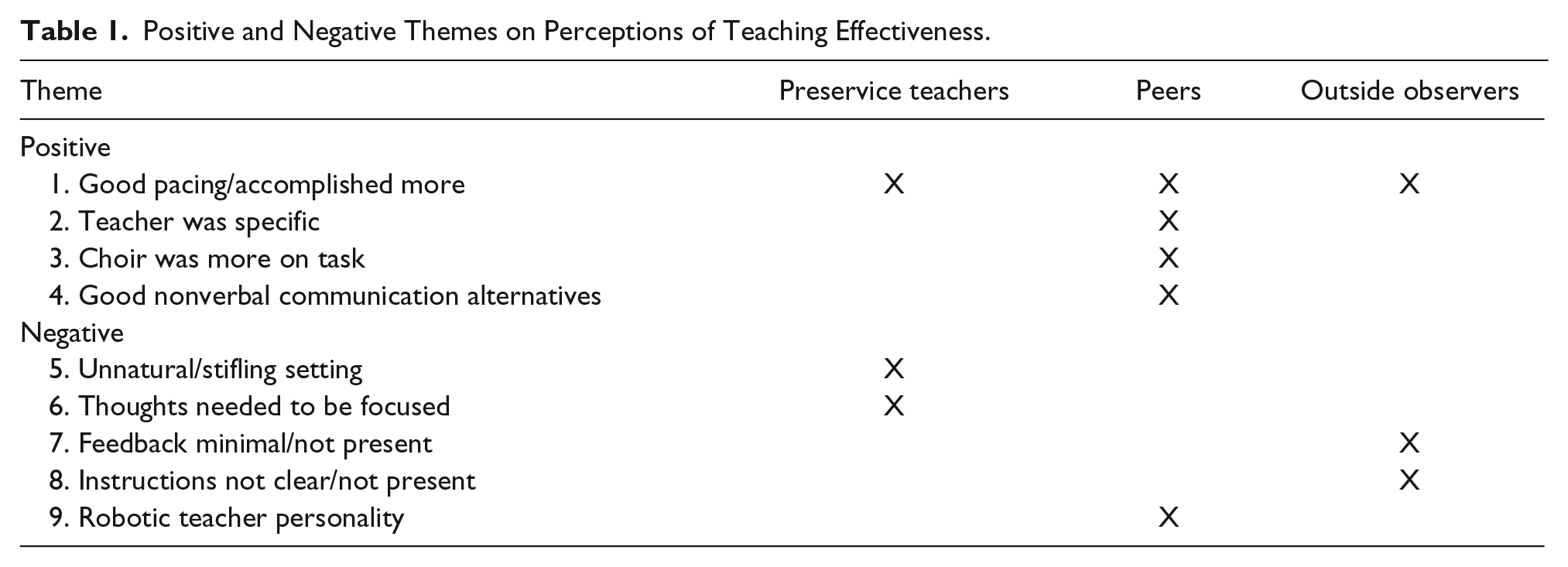
The researcher and a doctoral music education student coded comments independently, then compared and discussed similarities and differences (Patton, 2015), especially checking for redundancies in the categories. After consultation, three themes emerged for the preservice teachers’ responses, two positive and one negative: (1) a sense that more had been accomplished in the rehearsal as a result of the reduced teacher talk, (2) an observation that their thoughts needed to be focused in preparation for the assignment, and (3) a feeling that the setting was unnatural and stifling.
Some examples of preservice teachers’ positive comments included, “We really accomplished more. . . . I liked teaching this lesson the most as I got to conduct a big chunk of music and to choose what concept I wanted them to accomplish” (Theme 1). “This was a tough but very useful assignment as a teacher. I had to really concentrate on being as concise as possible to give the choir the information they needed” (Theme 2).
I think it is a great exercise for us as teachers to experience the effectiveness of teaching in this manner. It helped me to focus my comments and only give one direction to the choir so I didn’t confuse or overwhelm the choir. (Theme 2)
“On the teacher side of things, each silence seems to last forever! However, once you calm down, I feel that I am able to think more before I speak and get less nervous and bumbly” (Theme 2).
Negative comments were focused on the challenges present as a result of having only seven words to convey all of their ideas. “I felt far less effective as a teacher. I was preoccupied with how many words I was saying rather than listening and actually rehearsing” (Theme 3). “As a teacher, I definitely felt this was the hardest lesson. I felt like it wasn’t natural, and I felt a bit stifled. However, I did think it was more effective than the other lessons” (Theme 3).
Peer comments were categorized into five themes, four positive and one negative. These included the following: (1) faster pacing/more accomplished; (2) conductor/teacher was specific; (3) choir was more on task; (4) good nonverbal communication alternatives through conducting gesture; and (5) robotic personality, lack of clarity, and limiting. Most of the peers really liked this rehearsal style, and their comments reflected this preference for singing through the music without letting excessive teacher talk get in the way.
“As a member of the ensemble, I was glad to spend more time just singing and working out my part. Sometimes, too much rehearsing gets in the way” (Theme 1). “With this assignment I felt that the conductors made more use of their time. Their rehearsals were more efficient and we accomplished a lot” (Theme 1). “I really liked how straightforward and specific the conductors were because they could only use a certain amount of words” (Theme 2). “I feel that the choir is more on task when the teacher speaks less” (Theme 3). “My absolute favorite was how much more expressivity they all showed in their face and conducting as a result of not using more words” (Theme 4). “I think this assignment is really good in many ways! We, as a choir, must pay closer attention to other methods of communication: singing, eyes, conducting, etc.” (Theme 4). “I found it very effective because it made me look up more to see if they were using hands for their instruction, instead of just using their words” (Theme 4).
A few peers expressed frustration over the experience, mostly centered around their own confusion about instructions and their observations of how the teachers’ personalities shifted in unnatural ways. “I wish they could have spoken more because their few words were confusing” (Theme 5). “My observation is that there is less personality, which can create a more robotic rehearsal” (Theme 5). “It was good to use fewer words, but I think it sometimes limited what we could do” (Theme 5). “It wasn’t as good, I think. It does help with wordiness, but conductors need to explain more, get what they want, and not feel limited” (Theme 5).
Outside observers only viewed two of the preservice teachers and purposely had no context for these teachers or the assignment. There was one female teacher and one male teacher. Observers made more comments per person than the other two groups did, and these were categorized into three themes: (1) good pacing, (2) feedback was minimal or not present, (3) instructions were unclear or not present. For example, “Overall, there is very little down time; the teacher is providing students with multiple opportunities to sing” (Theme 1). “After the group sang, no specific feedback was given, especially to the basses who were specifically asked to sing” (Theme 2). “While there are numerous thumbs up gestures, there is very little in the way of specific feedback related to students’ responses” (Theme 2). “He did tell the basses they had a good crescendo but then asked them to do it again without telling them what to look out for” (Theme 3). “Regarding instruction, there were many directive statements (where to start), but little in the way of instruction” (Theme 3). Lack of clarity and specificity with instructions and feedback were troubling to the outside observers.
In analyzing the data quantitatively, there was a ratio of 29 positive to 7 negative peer comments (about 4:1), 8 positive to 4 negative preservice teacher comments (2:1), and 6 positive to 3 negative observer comments (2:1). Peers were most positive, and preservice teachers and experts were less positive.
Discussion
The purpose of this study was to examine teachers’, ensemble members’, and outside observers’ perceptions of teaching effectiveness of choral rehearsals deliberately incorporating reduced teacher talk. Preservice teachers led choral rehearsals employing the rule of seven wherein instructions were delivered in seven words or fewer each time the ensemble was stopped. Perceptions of teaching effectiveness among the three groups (teachers, ensemble members, and outside observers) varied, as with Whitaker (2011), based on which groups were actively participating. There were also some overlapping themes.
According to the reflections of the outside observers, it appears that there is indeed such a thing as “too little teacher talk” if clarity and feedback are sacrificed. If the ensemble is asked to perform an excerpt, but they do not know why they need to do it, or what they need to improve on, there is a potential problem. Additionally, if after they perform as they are asked they receive no feedback, they have no way to gauge whether the goals were accomplished. Clarity and specificity in feedback and instruction seem to be highly valued traits that contribute to perceptions of teaching effectiveness.
From the preservice teacher perspective, the requirement of having to say the very minimum forced them to have to focus on their instruction and be very organized in their thinking. Perhaps one of the positive effects of this study was having preservice teachers reflect on how important it is to think about why they are stopping the ensemble and what they want to have happen before dispensing a new directive. They also felt challenged by the task in negative ways. There was an additional step in filtering their thoughts that caused some to feel limited and stifled. While they would normally say what they wanted to, without restriction, rehearsing with the rule of seven sometimes required them to leave out critical instruction or necessary feedback. Teacher educators could potentially assist these preservice teachers with organization of thoughts and with finding efficient ways to deliver instruction and feedback. Guided practice before teaching may be helpful, as well as repeated sessions so that behaviors become more natural and consistent with their personalities.
The ensemble members were very positive, reflecting that reduced teacher talk allowed them to sing more and thus accomplish more in the rehearsal. It is possible that because preservice teachers were leading rehearsals and their peers were used to having them practice teaching on them, peers may have considered interruptions from singing as annoying. Like Spradling’s (1985) participants, they considered interruptions in the rehearsal for teacher talk to be “timeout from reinforcement” (p. 123). The positive effect of the connection between faster pace and sense of accomplishment noted by the choral ensemble members and outside observers can also be experienced by students in the classroom. Teachers are better able to accomplish performance goals when students are on-task and actively engaged. It might be interesting to examine the impact of the rule of seven on the rehearsals of experienced choral directors and compare the results with this study.
There were several limitations to this study. No attempt was made to generalize these findings beyond these participants due to the restriction in context and participants. Given that these preservice teachers all came from one university and were all members of one class, it is possible that their values were influenced by those of the instructor. This particular assignment was anomalous and peers could have been responding to the novelty of the rehearsal style. It is not clear whether they were comparing this rehearsal to a previous rehearsal, and a number of variables could have contributed to their perceptions of teaching effectiveness.
It is perhaps naive to think that teacher talk was of huge consequence, anymore than any other single variable can completely define teaching effectiveness. Clearly, communication in the classroom is only one facet of effective teaching, a construct that has many elements. Reducing teacher talk is not a panacea for poor teaching. In other words, a poor teacher does not become a better teacher simply by talking less. And an excellent teacher may speak with many words or with few words, purposely, for effect. Additional research is needed to examine pedagogical paradigms, such as the rule of seven, to empirically investigate the merits of these ideas.
Footnotes
Declaration of Conflicting Interests
The author(s) declared no potential conflicts of interest with respect to the research, authorship, and/or publication of this article.
Funding
The author(s) received no financial support for the research, authorship, and/or publication of this article.
References
Supplementary Material
Please find the following supplemental material available below.
For Open Access articles published under a Creative Commons License, all supplemental material carries the same license as the article it is associated with.
For non-Open Access articles published, all supplemental material carries a non-exclusive license, and permission requests for re-use of supplemental material or any part of supplemental material shall be sent directly to the copyright owner as specified in the copyright notice associated with the article.
