The roll-coating analysis of viscous nanofluid using lubrication approximation theory over a flat porous sheet is investigated. We considered water-based copper (Cu) nanoparticles to discuss the roll-coating analysis. The rate of fluid entering at the roll surface is assumed equal to the rate of fluid leaving on the web surface. The resulting differential equation developed under lubrication approximation and closed-form expressions is obtained for velocity and pressure gradient. The effects of entering velocity, Reynolds number, geometric parameter, and nanoparticle volume fraction with different models on physical quantities such as pressure, pressure gradient, velocity, force, power input are calculated. Some of these effects are presented graphically. It is noted that increasing nanoparticle volume fraction increases the pressure gradient, pressure distribution and has negligible effect on the velocity profile. Model II has a greater effect on pressure and pressure gradient than model I and has an inverse effect on force and power factor.
Roll-coating is a process where a liquid is applied on a moving web/sheet to create a uniform thin fluid layer on the sheet. In the coating process, the word “web” is often used to represent the sheet or film to be coated. The roll coating process is used in various industries such as producing plastic film, paper, textile fiber, paperboard cellulosic film, metal foils, etc. The theoretical roll coating investigation is first carried out by Greener and Middleman1 assuming small roll curvature. They analytically computed equations for pressure distribution and film thickness under lubrication approximation for a Newtonian fluid. They also numerically calculated roll-separating force, pressure and film thickness for viscoelastic and power law fluids. Middleman2 discussed the roll coating process theory in his textbook. Coyle et al.3 used the finite element method to solve the full Navier–Stokes equations and gave comparison of the results of lubrication approximation model, and found that the lubrication model was correct only in the case of high capillary numbers having weak surface tension. Hintermaier and White4 investigated the water flow between the two rolls by applying the lubrication model and their calculated solutions were similar to their experimental results. Benkreira et al.5–8 investigated both theoretically and experimentally the coating flows for Newtonian and various non-Newtonian fluid models. Sofou and Mitsoulis9 analyzed numerically the roll-over-web coating flow by employing the lubrication theory for the power law, Bingham plastics and Hershel–Bulkley models. Zahid et al.10 studied the roll coating process by utilizing lubrication approximation for a third grade fluid and computed all the physical quantities numerically. Also, Zahid et al.11 theoretically investigated the roll coating process of second grade fluid by taking both the roll and sheet to be porous. The rate of fluid entering at the roll surface is assumed equal to the rate of fluid leaving through the web surface. Ali et al.12 discussed the roll-over-web-coating process for a couple stress fluid by applying the lubrication model. They computed numerically all the physical quantities such as velocity, pressure, pressure gradient, power input and roll-separating force and compared their results with the Newtonian fluid by approaching the couple stress parameter to infinity. Gaskell et al.13 applied an optical sectioning procedure to experimentally study both the forward and reverse roll-coating process in meniscus fluid mechanics. They performed four experiments to obtain the physical quantities such as film thickness, inlet flow rate, pressure field and meniscus location.
Nanofluids are broadly used in many technological and industrial applications, for example, polymer melts, paints, biological solutions, glues and asphalts, etc. Many researchers have analyzed the problems concerning nanofluids in different situations. Acharya et al.14 studied the squeezing flow of Cu-kerosene and Cu-water nanofluids in a magnetic field and solved the transformed model using numerical and semi-numerical techniques. Sheikholeslami et al.15 presented the laminar flow of nanofluid with the existence of magnetic field in a semi-porous channel. They obtained the results via different methods, e.g. Galerikin, least square and Runge–Kutta methods and compared all methods with each other. Abbas and Hasnain16 examined the two-phase magnetic convection flow of Fe3O4 nanofluid in a horizontal composed annular with porous space numerically. Pourmehran et al.17 discussed analytically the unsteady squeezing flow of nanofluid between two parallel plates considering different nanoparticles with water as base fluid. Abbas et al.18 analyzed the flow of magnetic water nanomaterial in an inclined channel with thermal radiation and slip boundary conditions at the channel walls. Zhang et al.19 investigated the Couette and Poiseuille flows of different nanoparticles between parallel plates by applying molecular dynamics simulations. Dogonchi et al.20 studied the squeezing unsteady nanofluid flow and heat phenomena between infinite parallel plates in the presence of MHD and thermal radiation using Duan-Rach approach (DRA). Abbas and Sheikh21 discussed the numerical study of homogenous–heterogeneous chemical reactions on stagnation point flow of ferrofluid with non-linear slip conditions at the wall.
Coating of nanocomposites to enhance the mechanical, thermal and barrier properties of thermoplastic polymers is studied by Sanchez-Garcia et al.22 and Atayev and Oner.23 Throughout the literature cited above, we note that there are no studies that discuss the theoretical analysis of roll-over-web coating of viscous fluid containing nanoparticles. Here, the objective is to formulate the flow mechanism of the roll-over-web coating of viscous fluid containing different nanoparticles. Nanoparticles can be metallic or non-metallic with base fluid (e.g. water, ethylene glycol (EG), glycerin, etc.). Closed form solution is constructed of the resultant flow equations using physical boundary conditions on roll-over-web coating. The influences of different parameters of base fluid and nanoparticles of coating process are shown graphically and discussed.
Governing equations
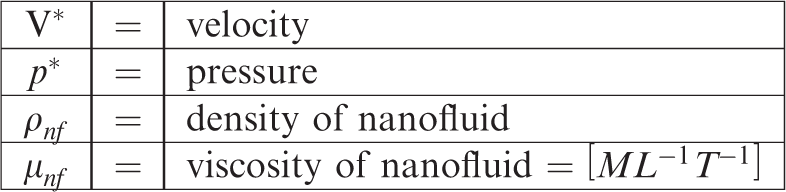
The governing equations for an incompressible, isothermal viscous fluid with nano-particles in the nonexistence of body force are
where
=
velocity
=
pressure
=
density of nanofluid
=
viscosity of nanofluid
Mathematical formulation
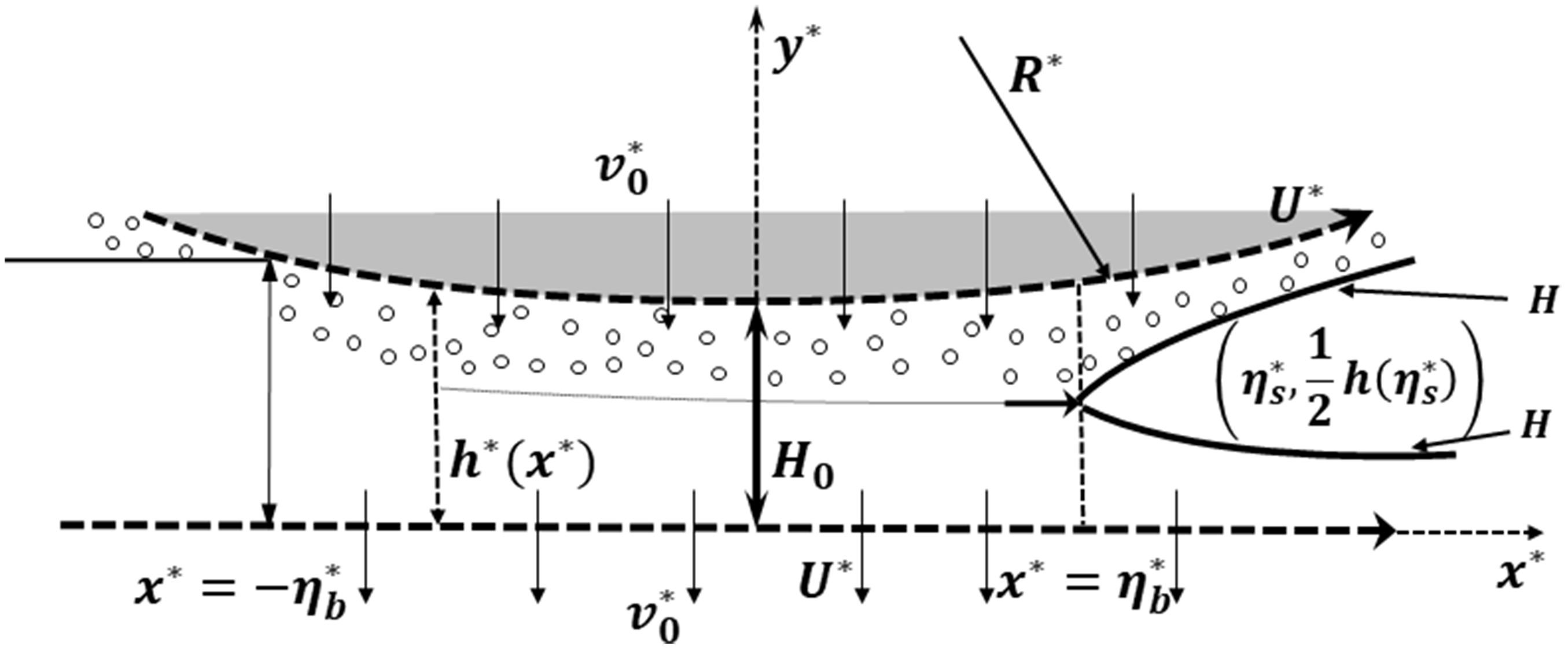
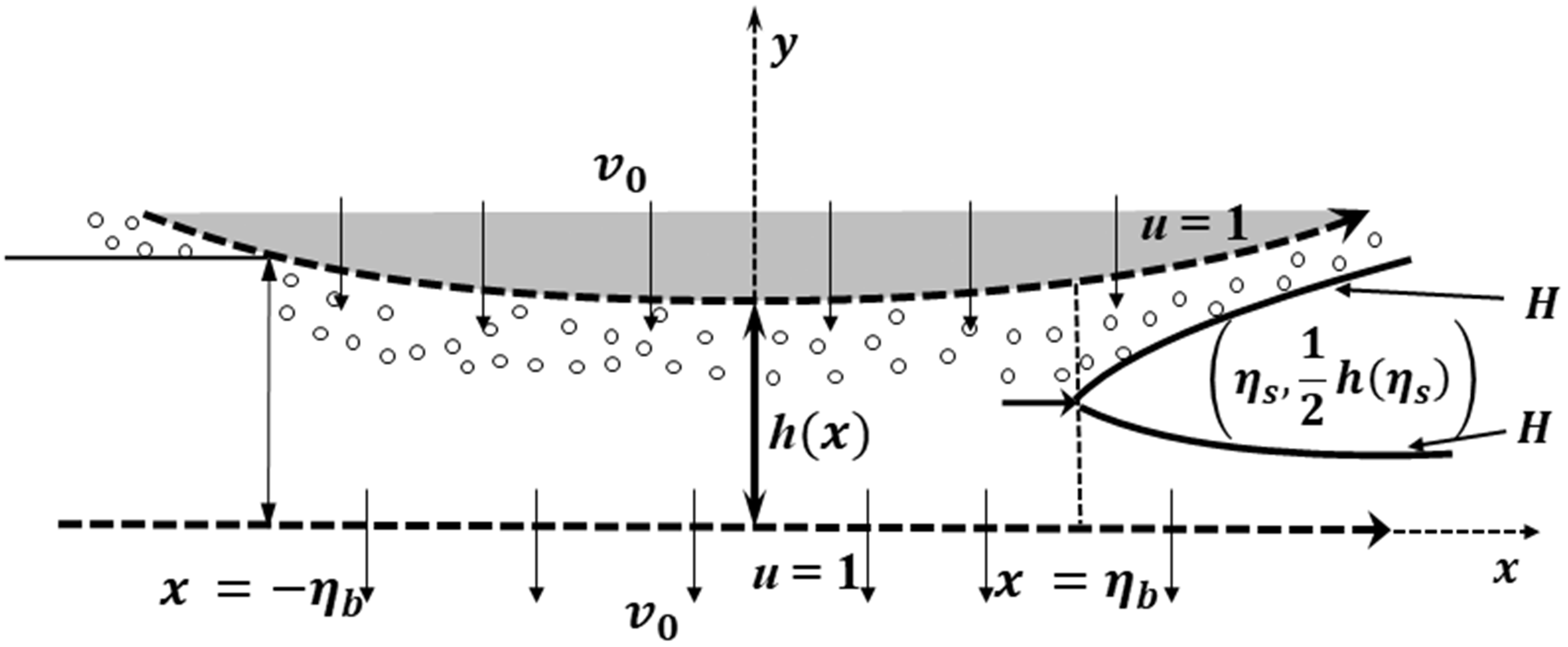
We consider a laminar, incompressible flow of viscous nanofluid to apply a thin liquid coating on a porous moving sheet. The roll with radius is rotating anticlockwise. Both the roll and plane are moving with the same angular velocity , and their gap width at the nip region is . The sheet from upstream region first touches the plane at point as displayed in Figure 1. Additionally, we assume that so that the flow in the nip region and continuing to either boundary can be taken among the two parallel boundaries. Hence, the velocity field is given as
Geometry of roll-coating process of nanofluid.
Geometry in dimensionless variables.
Taking into account of the above velocity field, equations (1) and (2) can be written as
As the flow is assumed to be parallel, the fluid velocity in the y-direction is very small as compared to the x-direction. It is also supposed that both the plane and roll are porous, that is, mass with velocity enters into the gap between the roll and moving web, whereas the same mass with velocity leaves along with the web surface, where is a constant which represents the entering or the leaving velocity .
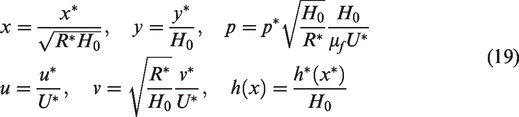
To attain the distinctive scale for the velocity and pressure, we assume for simplicity an order of magnitude analysis. We can classify the given scales for , , and , respectively as
which indicates that the order of magnitude of a longitudinal velocity is larger than transversal velocity , where the distinctive length is given by . The characteristic pressure is computed from equation (2) as a result of a dominant balance between the pressure and viscous terms and is given as
In light of the above analysis, equations (4) to (6) become
where equation (12) implies that pressure is a function of alone.
Also, simplifying the equation of motion finally becomes
Now, pressure can be calculated by integrating equation (27) with boundary condition at as given by
where is the certain value of in the upstream region.
Here, is still unknown in the above equation. This unknown can be associated to the exit coated thickness as
While we assume that liquid breaks uniformly to coat both the sheet and roll, the above equation in dimensionless form becomes
The above assumption also permits us to distinguish the separation point as , where the velocity and pressure become zero. Hence, from equation (28), we get
When is known, the separation point can be computed by using the above equation. Nevertheless, in the current situation, it is difficult to analytically integrate equation (29). Considering these complications, substituting the value of from equation (32) into equation (29) and integrating the resultant equation from (case of upstream region from an infinite reservoir) to where .
Theoretically, the problem is to obtain the value of from the expression given as
where is the equation of after putting the value of from equation (32). Any root finding algorithm can be applied to obtain the required from equation (33). Newton’s iterative technique is applied for this current evaluation. This technique proposes to create the iteration process as
The iteration process is started with initial guess and the final solution is acquired after five iterations. can be found immediately from equation (32) once is found. When and are obtained, equation (29) gives the pressure distribution. The process explained above is executed in Mathematica 11. Note that the algorithm is validated by replicating the results of Middleman.2
Operating variables
The roll-separating force per unit width and power input can be computed as given as
The force and power input in dimensionless form are stated by
Additionally, the dynamic parameter as defined by Middleman 2 is given as
Results and discussions
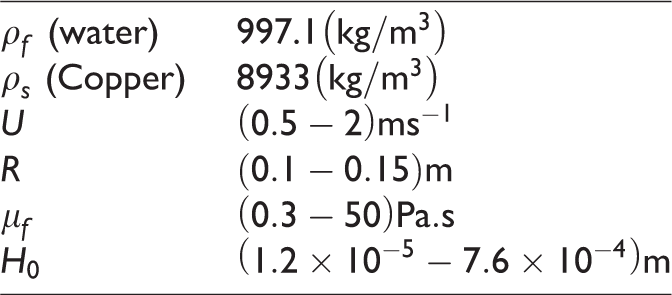
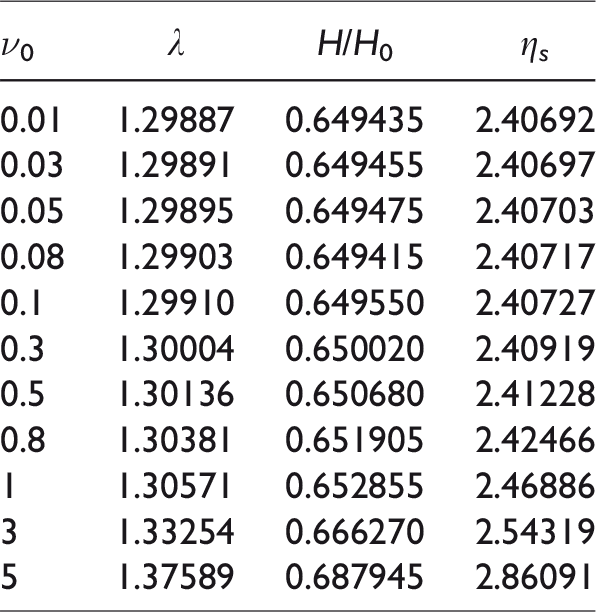
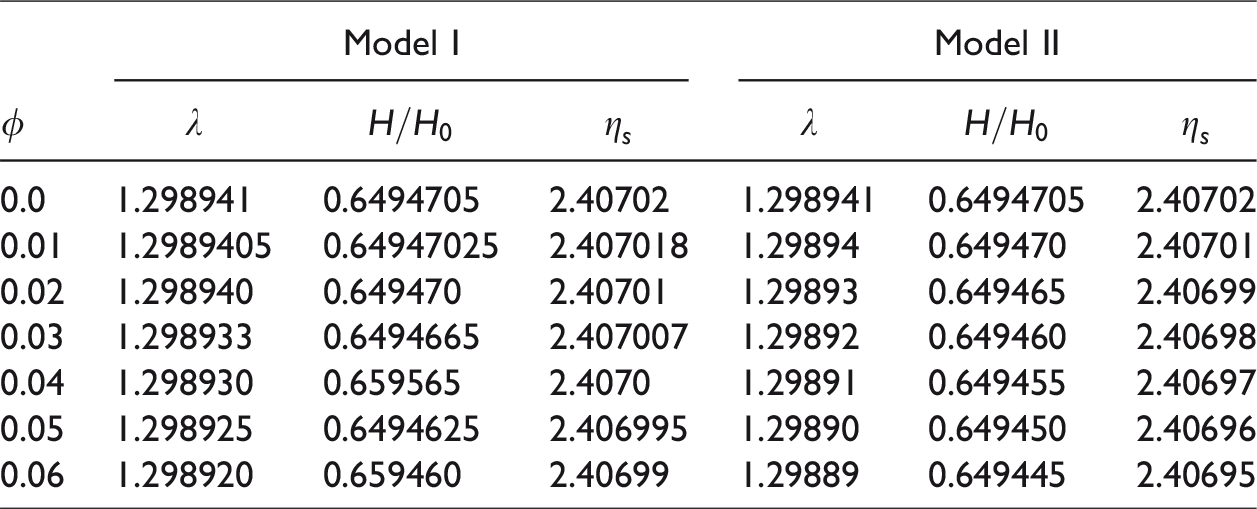
In this paper, the roll-over-web coating of viscous fluid containing nanoparticles is investigated and the effects of different parameters on the pressure gradient, pressure, velocity, dynamic parameter , power input and separation force are shown graphically and discussed. This a general analysis for any nanoparticle (metallic or non-metallic) with different basefluids and the graphical example we present is for Cu nanoparticles with water as base fluid. The graphical results are generated by using different viscosity models as given in Table 1. Table 2 gives the physical parameters and densities of base fluid and nanoparticles which are used in this study. Table 3 is created by varying with , and , while Table 4 is created by varying for both models with and .
Physical parameters and densities of base fluid and nanoparticles used in roll-coating.2,15
(water)
997.1
(Copper)
8933
Entering velocity ν0 impact on (dimensionless volumetric flow rate), H/H0 (exit coating thickness) and ηs (separation point) at ϕ=0.05 and Re=B=0.5 for roll coating a viscous fluid with Cu-water nanoparticles from an unbounded reservoir.
ν0
λ
H/H0
ηs
0.01
1.29887
0.649435
2.40692
0.03
1.29891
0.649455
2.40697
0.05
1.29895
0.649475
2.40703
0.08
1.29903
0.649415
2.40717
0.1
1.29910
0.649550
2.40727
0.3
1.30004
0.650020
2.40919
0.5
1.30136
0.650680
2.41228
0.8
1.30381
0.651905
2.42466
1
1.30571
0.652855
2.46886
3
1.33254
0.666270
2.54319
5
1.37589
0.687945
2.86091
Nanoparticle volume fraction impact for both models on (dimensionless volumetric flow rate), (exit coating thickness) and (separation point) at and for roll coating a viscous fluid with Cu-water nanoparticles from an unbounded reservoir.
Model I
Model II
0.0
1.298941
0.6494705
2.40702
1.298941
0.6494705
2.40702
0.01
1.2989405
0.64947025
2.407018
1.29894
0.649470
2.40701
0.02
1.298940
0.649470
2.40701
1.29893
0.649465
2.40699
0.03
1.298933
0.6494665
2.407007
1.29892
0.649460
2.40698
0.04
1.298930
0.659565
2.4070
1.29891
0.649455
2.40697
0.05
1.298925
0.6494625
2.406995
1.29890
0.649450
2.40696
0.06
1.298920
0.659460
2.40699
1.29889
0.649445
2.40695
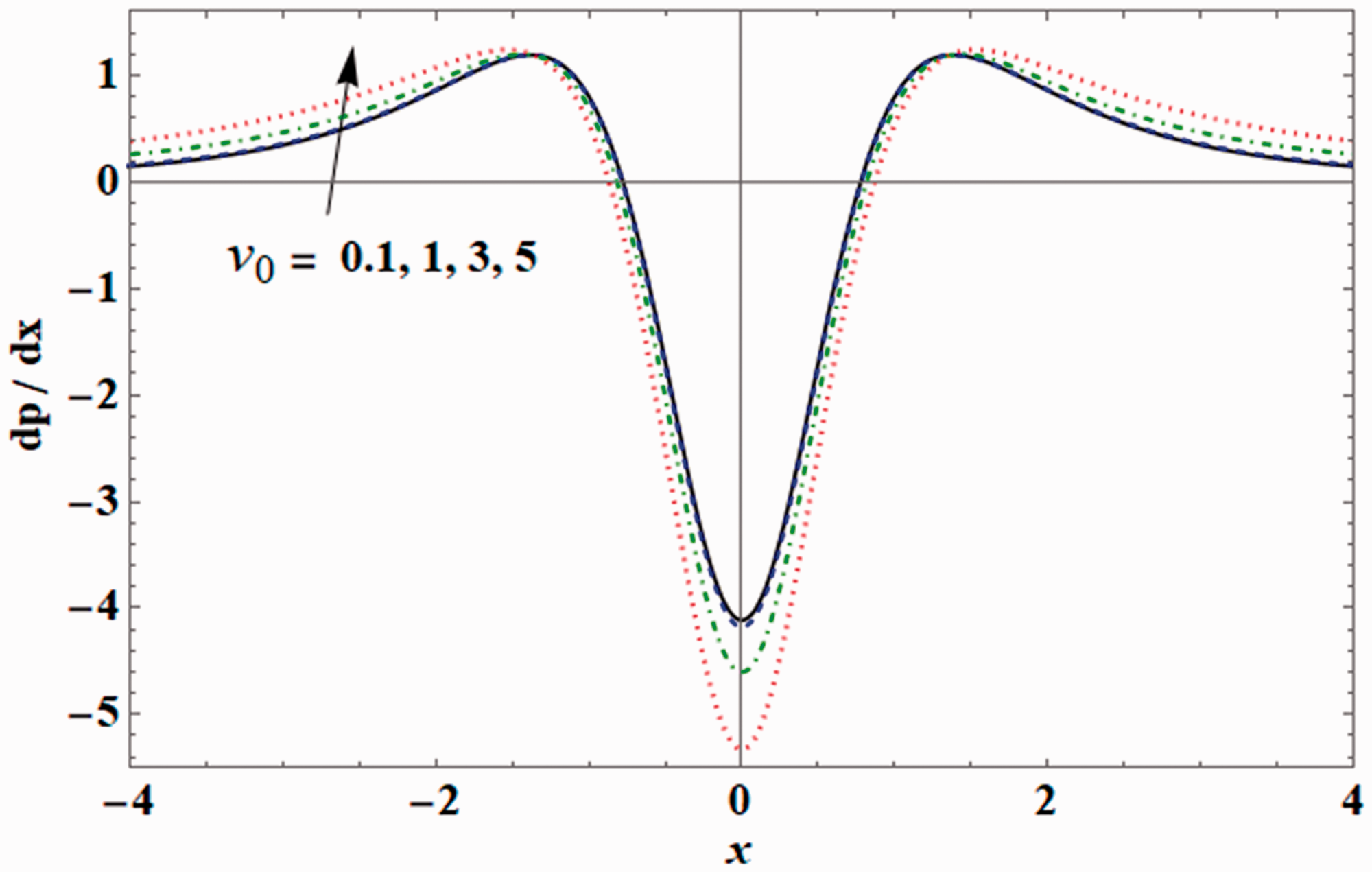
Figure 3 displays the pressure gradient versus for increasing entering velocity . The plot gives three separate regions, termed as, upstream region with , nip region with and downstream region with . The flow is resisted by the pressure gradient in the upstream and downstream regions, while drag flow is assisted in the nip region. The resistance or assistance increases with increasing entering velocity .
Pressure gradient versus for increasing entering velocity with and .
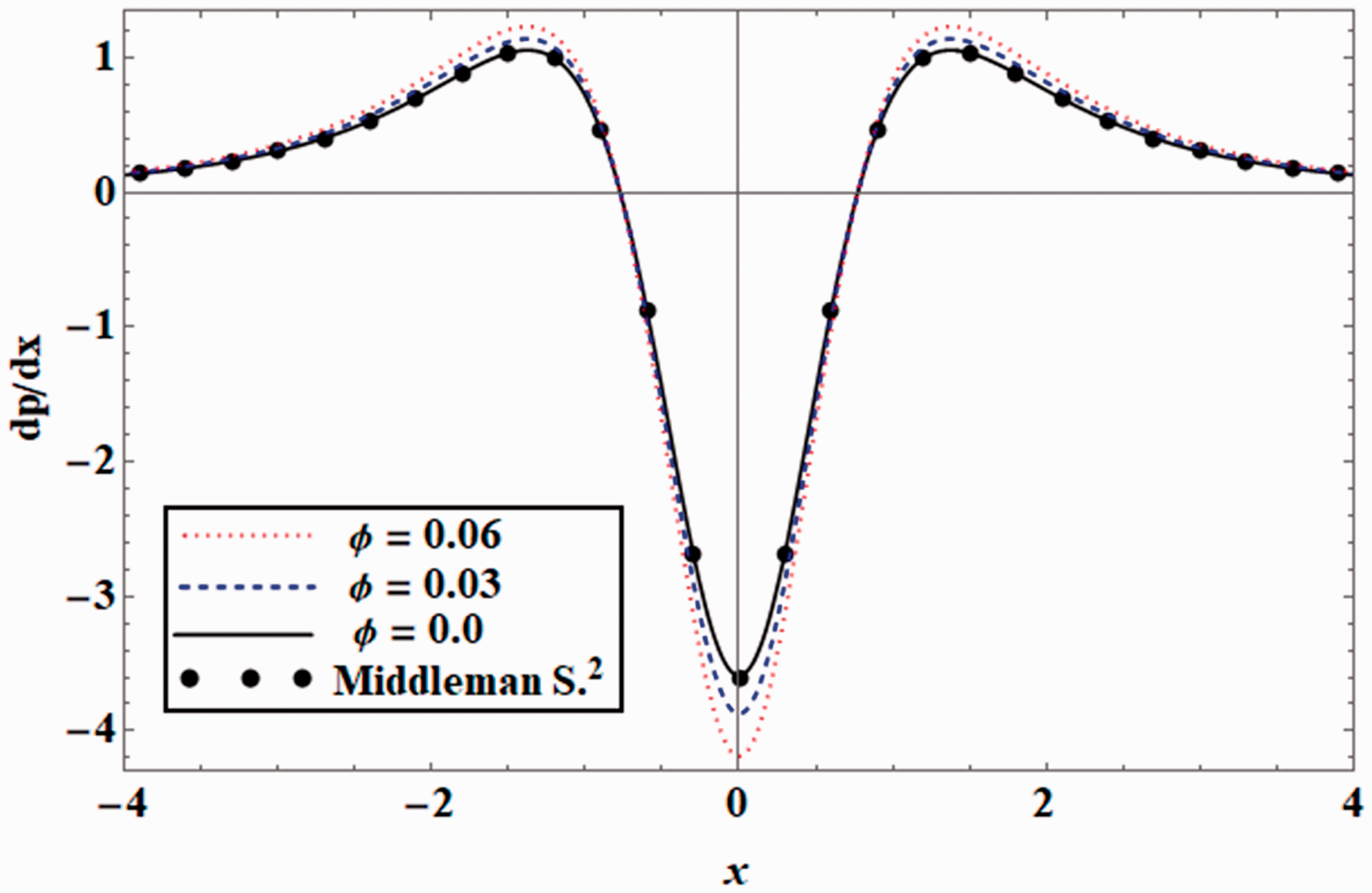
Figure 4 displays the pressure gradient versus for increased nanoparticle volume fraction . Here result for is compared with the case of Middleman.2 It is noted that the resistance or assistance to the flow by the pressure gradient increases with increasing the nanoparticle volume fraction and for , the graph is the same as Middleman.2
Pressure gradient versus for increased nanoparticle volume fraction with and . Here relates to the case of Middleman.2
Figure 5 displays the pressure gradient versus to for both viscosity models with graph to compare the Middleman2 results. It is noted that the resistance or assistance to the flow for model II is higher than model I and for , the graph is verified by replicating the results of Middleman.2
Pressure gradient versus for both viscosity models with , and . Here relates to Middleman.2
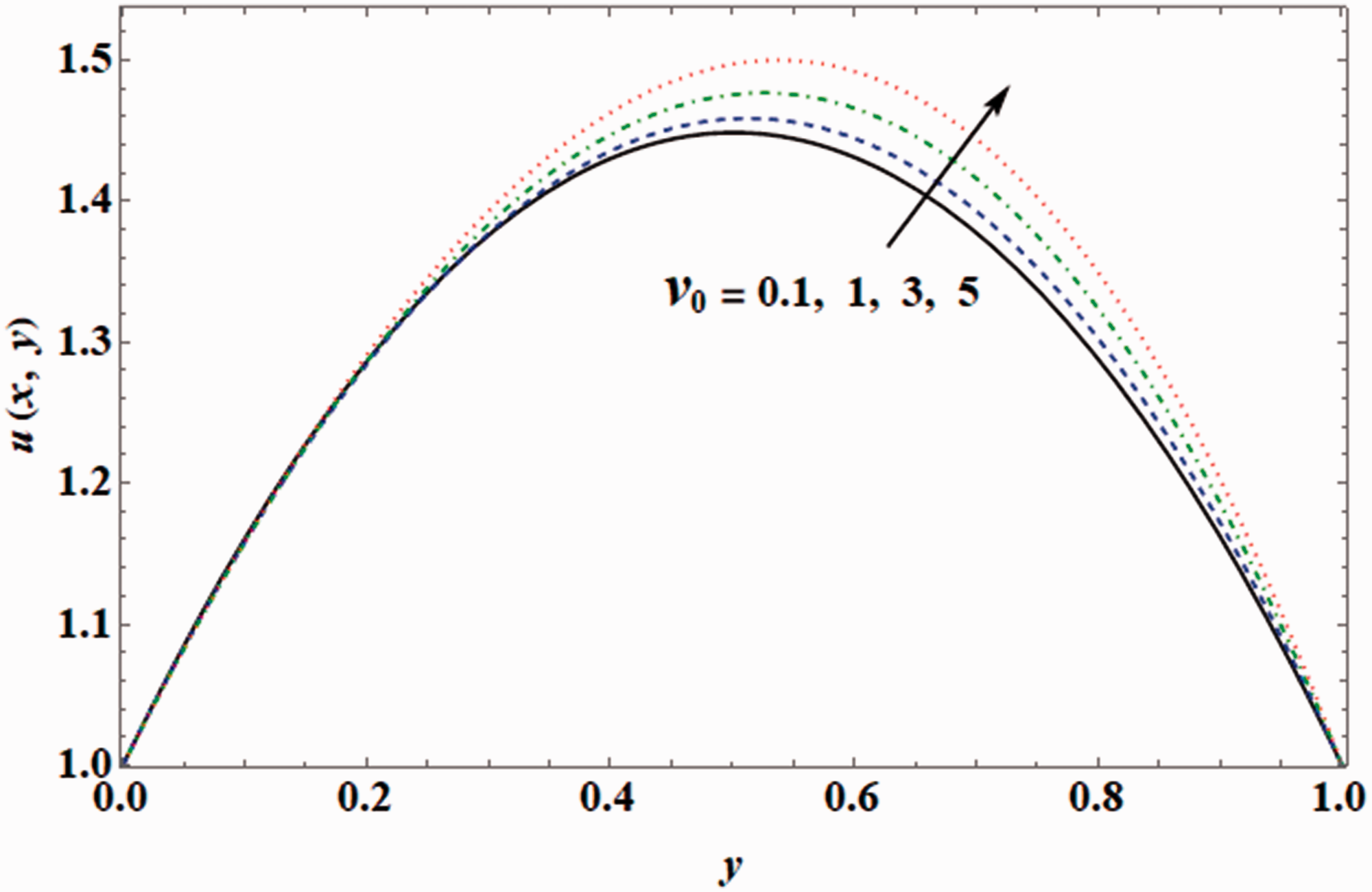
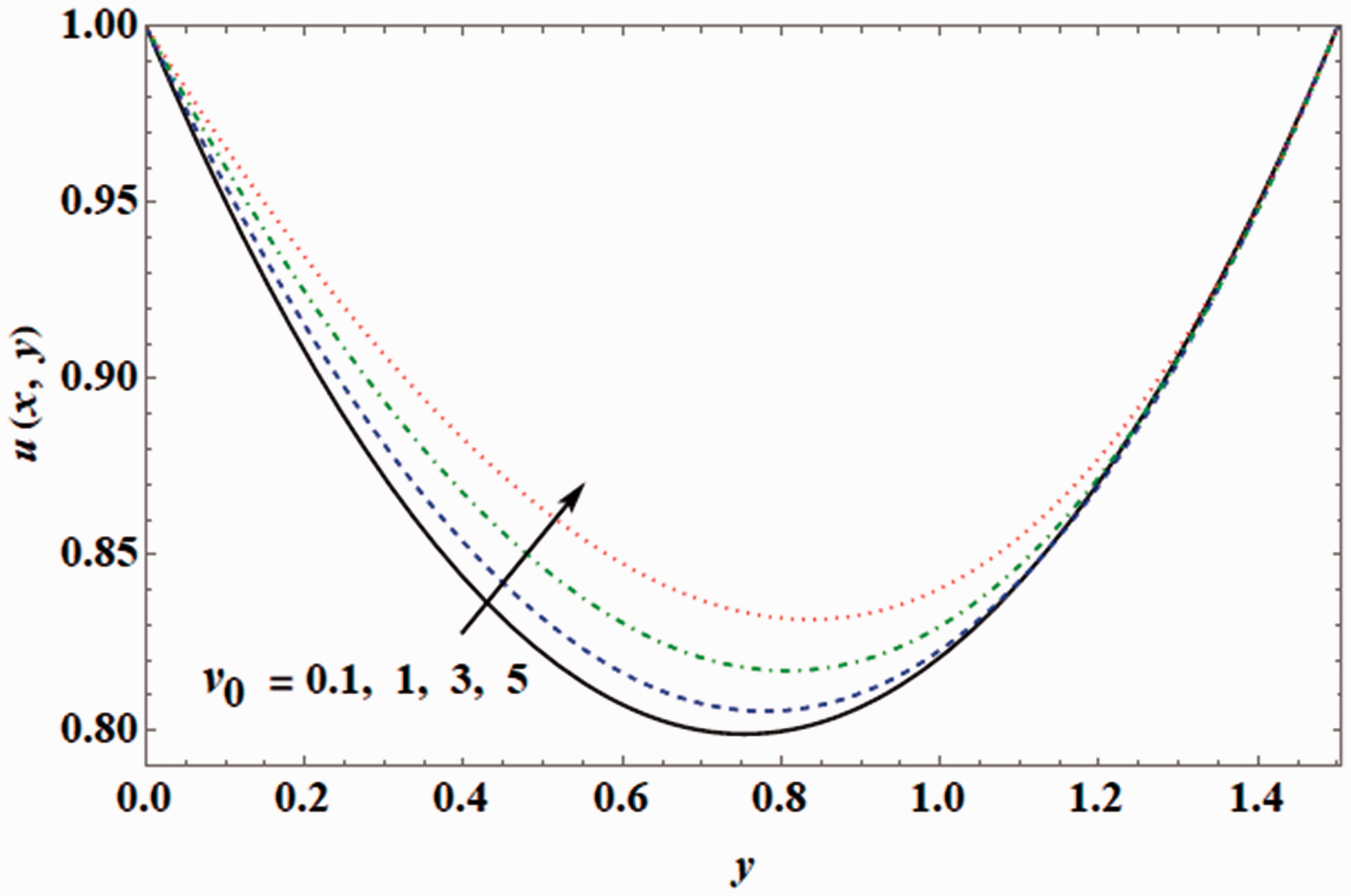
Figures 6 and 7 display the velocity profiles versus for increasing entering velocity at and . It is noted that the velocity profile is increased by increasing the entering velocity at different points for both cases.
Velocity versus for increasing entering velocity at with and .
Velocity versus for increasing entering velocity at with and .
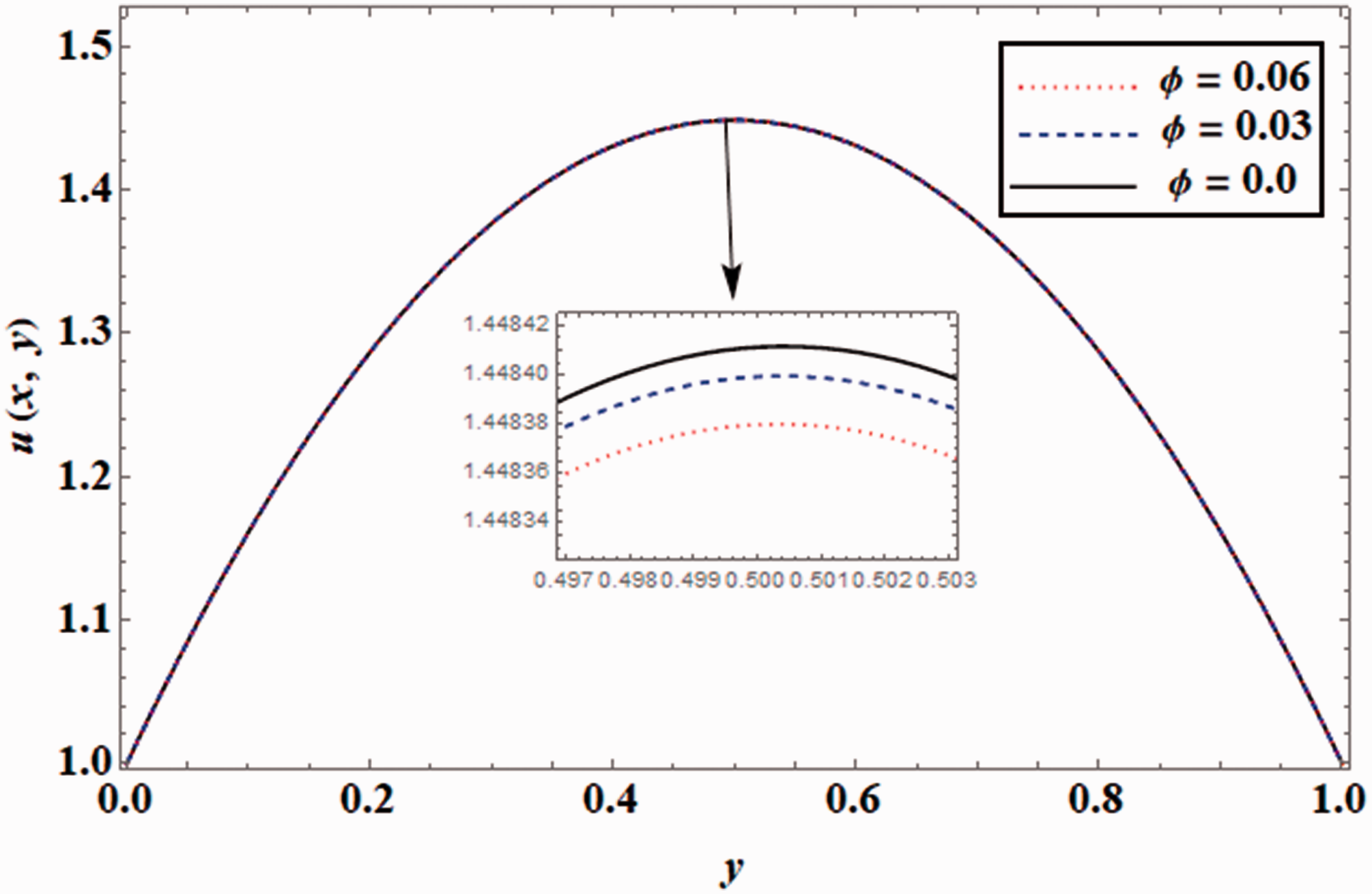
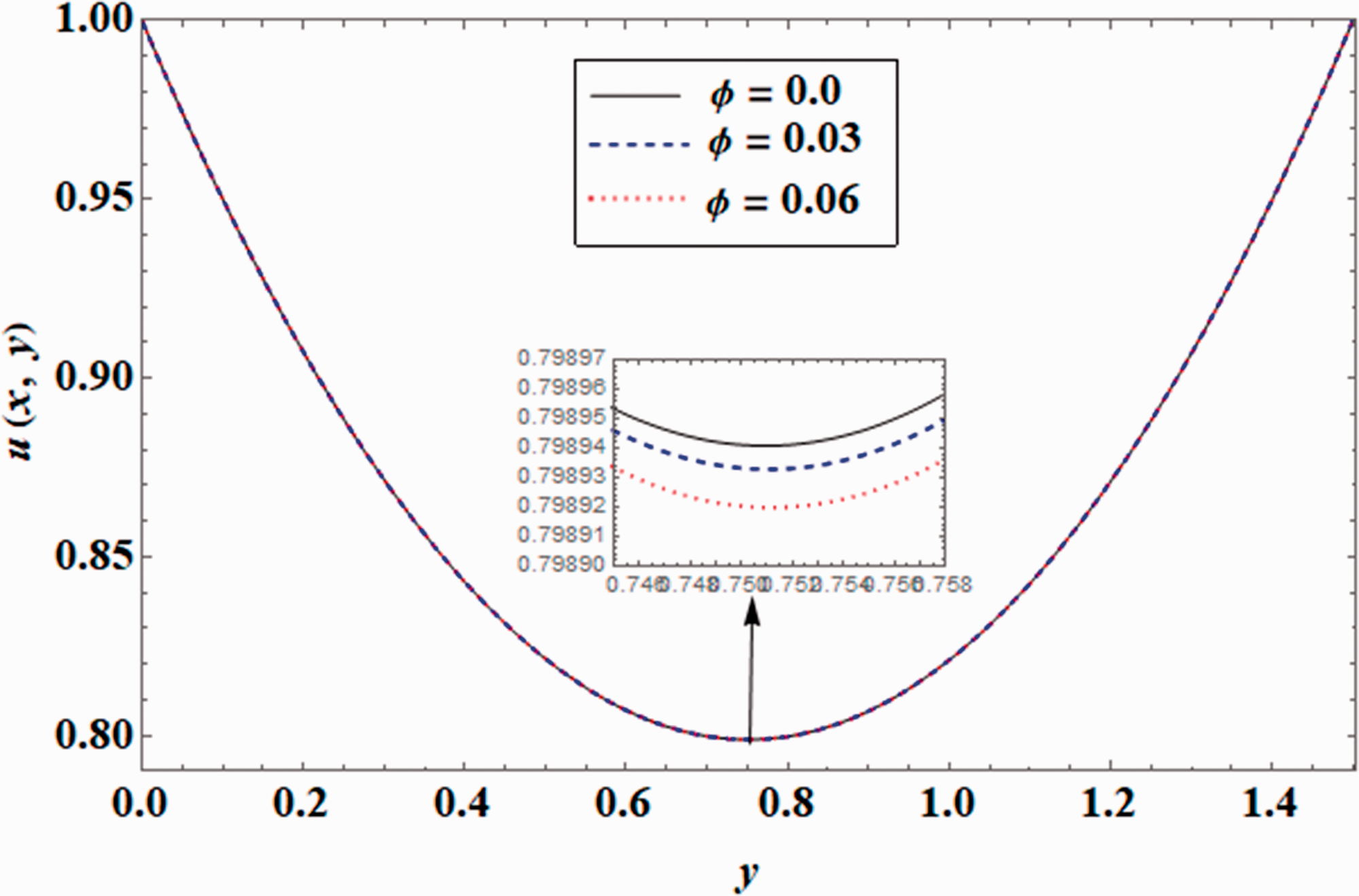
Figures 8 and 9 display the velocity profiles versus for increasing nanoparticle volume fraction at and . It is noted that the nanoparticle volume fraction has a negligible impact on the roll coating process velocity at different points.
Velocity versus for increasing nanoparticle volume fraction at with and .
Velocity versus for increasing nanoparticle volume fraction at with and .
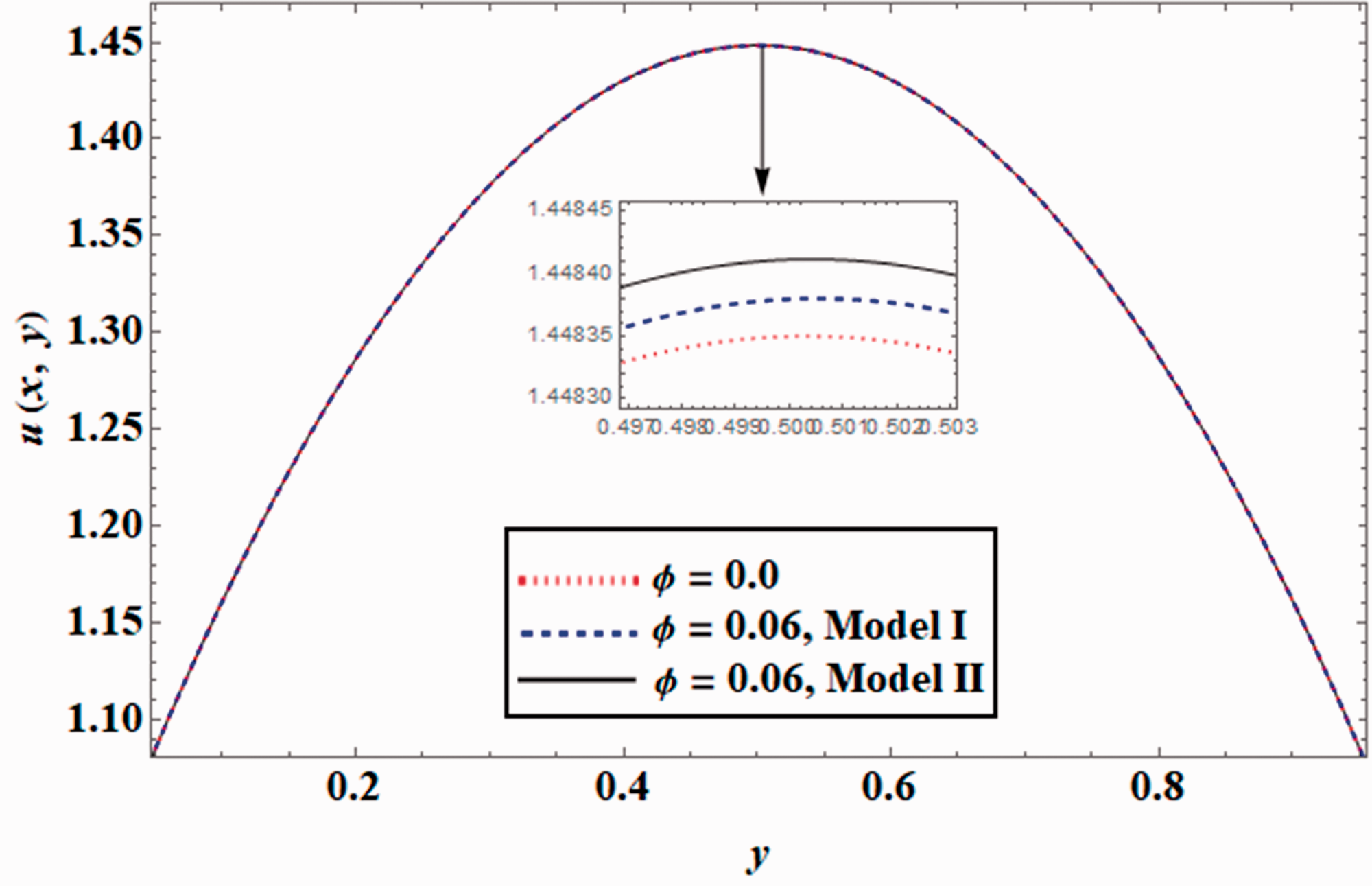
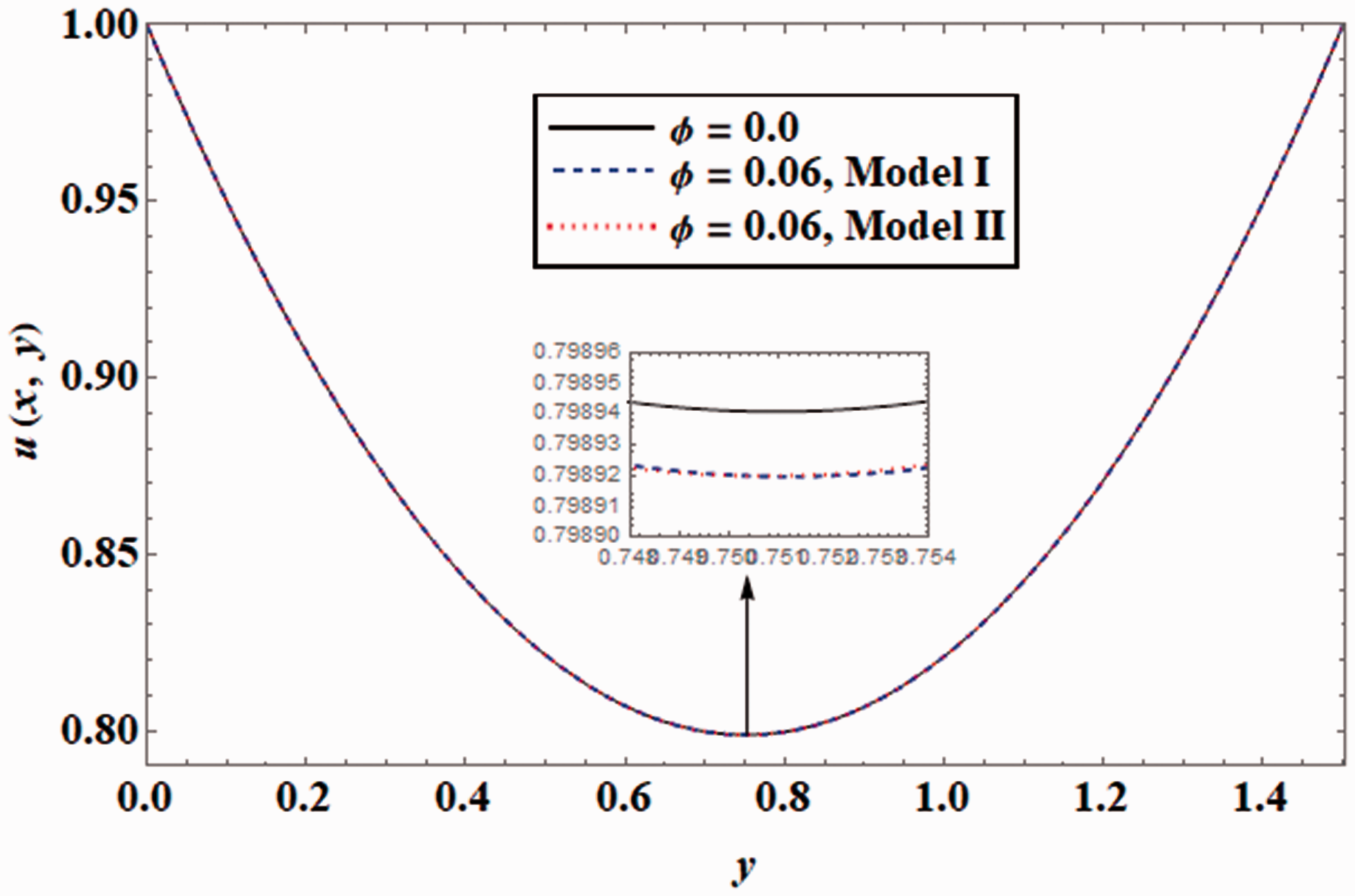
Figures 10 and 11 display the velocity profiles versus for both nanofluid viscosity models with at and . It is noted that there is a negligible difference between the Model I and II velocities at different points.
Velocity versus to for both viscosity models at with , and .
Velocity versus for both viscosity models at with , , and .
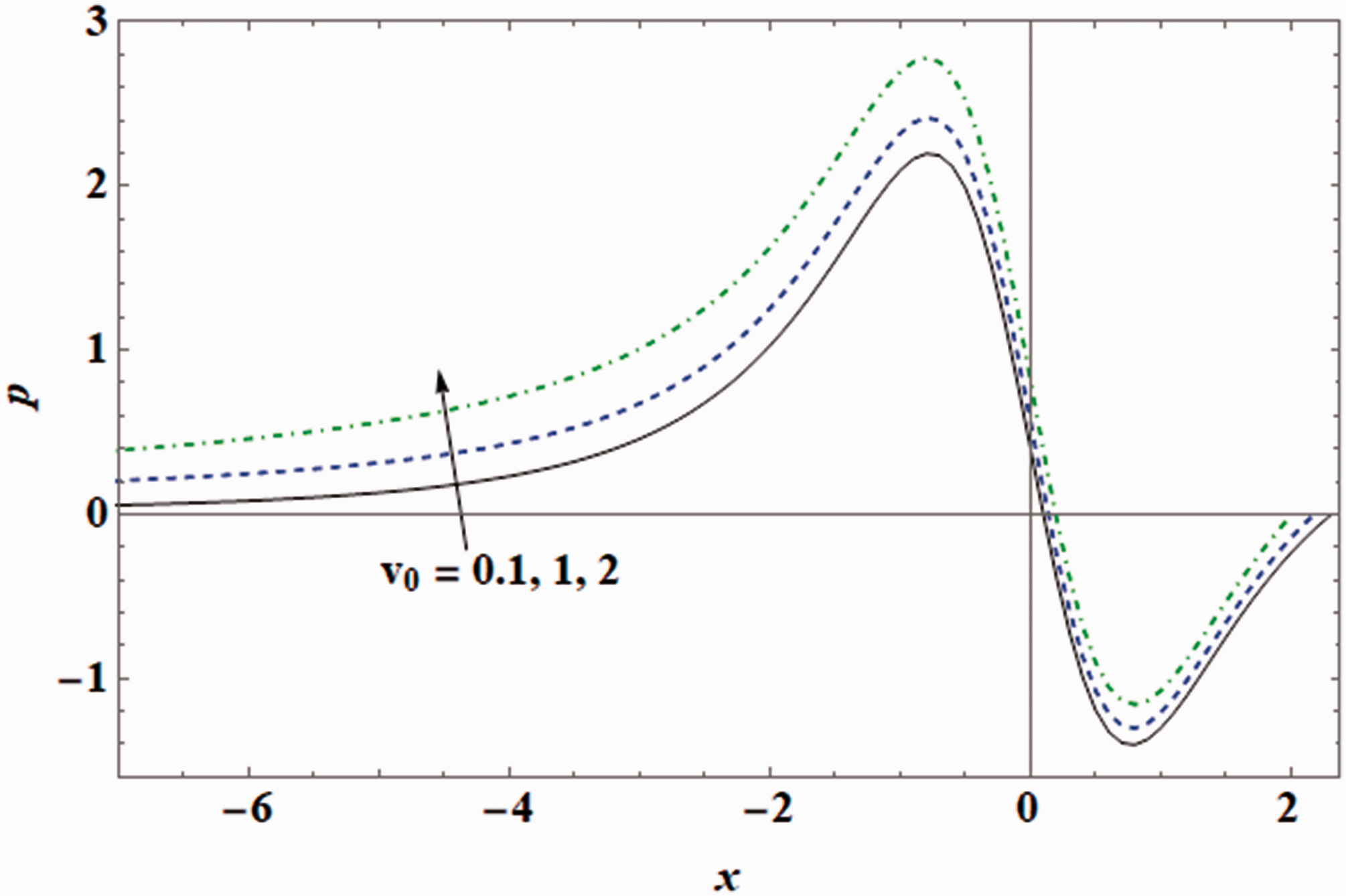
Figure 12 displays the pressure profile versus for varying entering velocity . It is noted that the pressure attains its maximum value before and approaches to zero at . After , pressure attains its minimum value and then approaches to zero at . Also, the magnitude of pressure distribution is increased by increasing the entering velocity .
Pressure versus for increasing entering velocity with and .
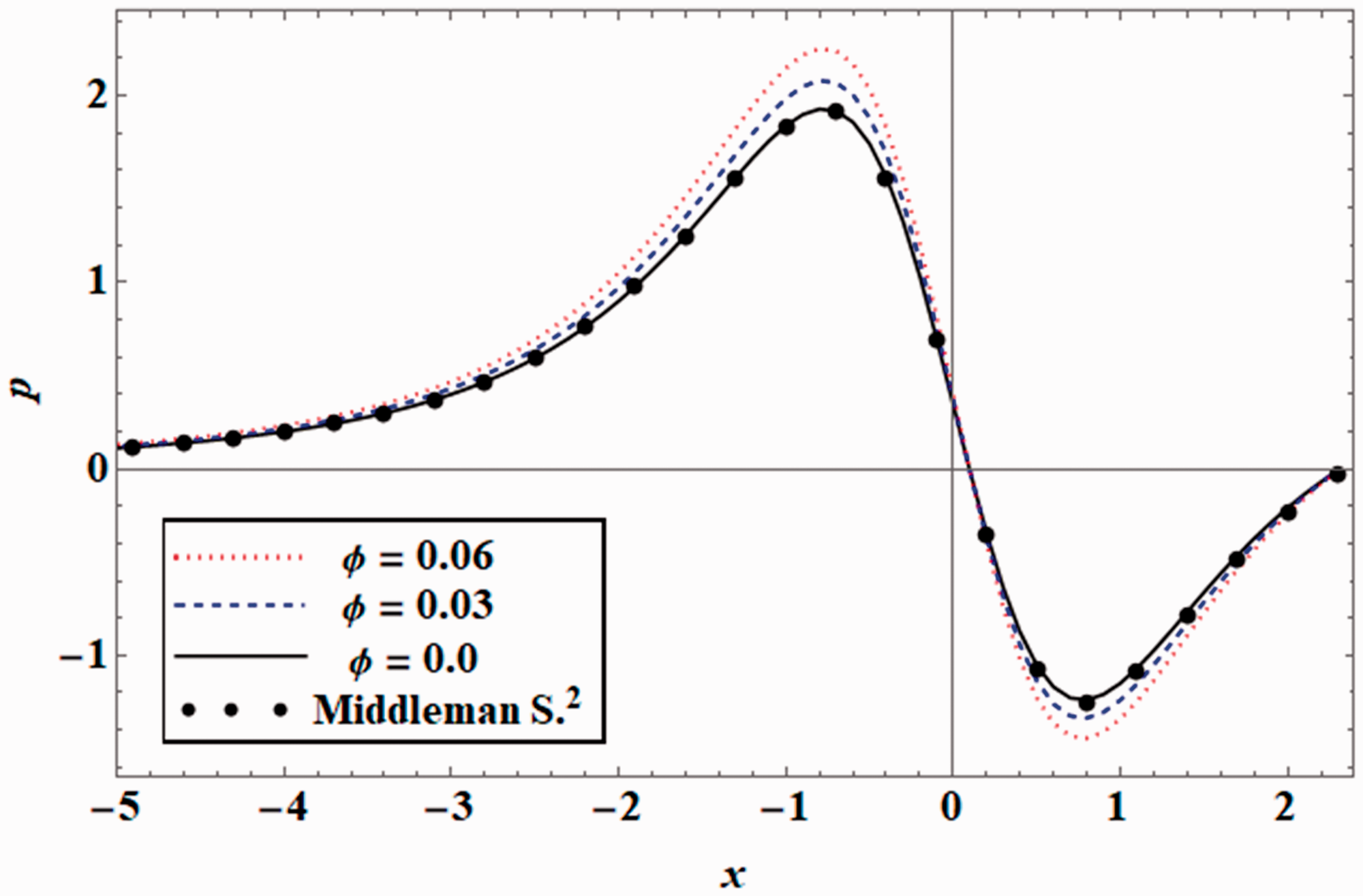
Figure 13 displays the pressure profile with respect to for varying nanoparticle volume fraction .
Pressure versus for increasing nanoparticle volume fraction with and . Here relates to the case of Middleman.2
Here is compared with Middleman.2 It is observed that for , the result is identical to Figures 8to 11 of Middleman.2 Also, the pressure distribution maximum and minimum increases with increased nanoparticle volume fraction .
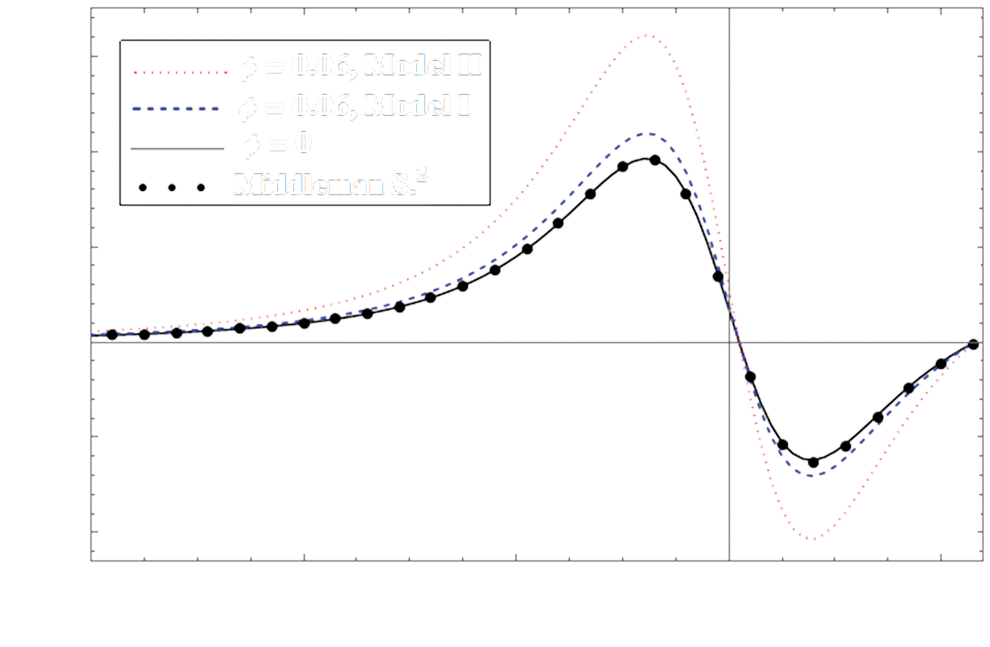
Figure 14 displays the pressure profile with respect to for both models of viscosity at . Here graph is compared with the graph of Middleman.2 It is observed that the graph at is identical to the graph of Figures 8to 11 of Middleman.2 Also, the magnitude of pressure distribution is greater for model II than that of model I.
Pressure versus for both viscosity models with , and . Here relates to Middleman.2
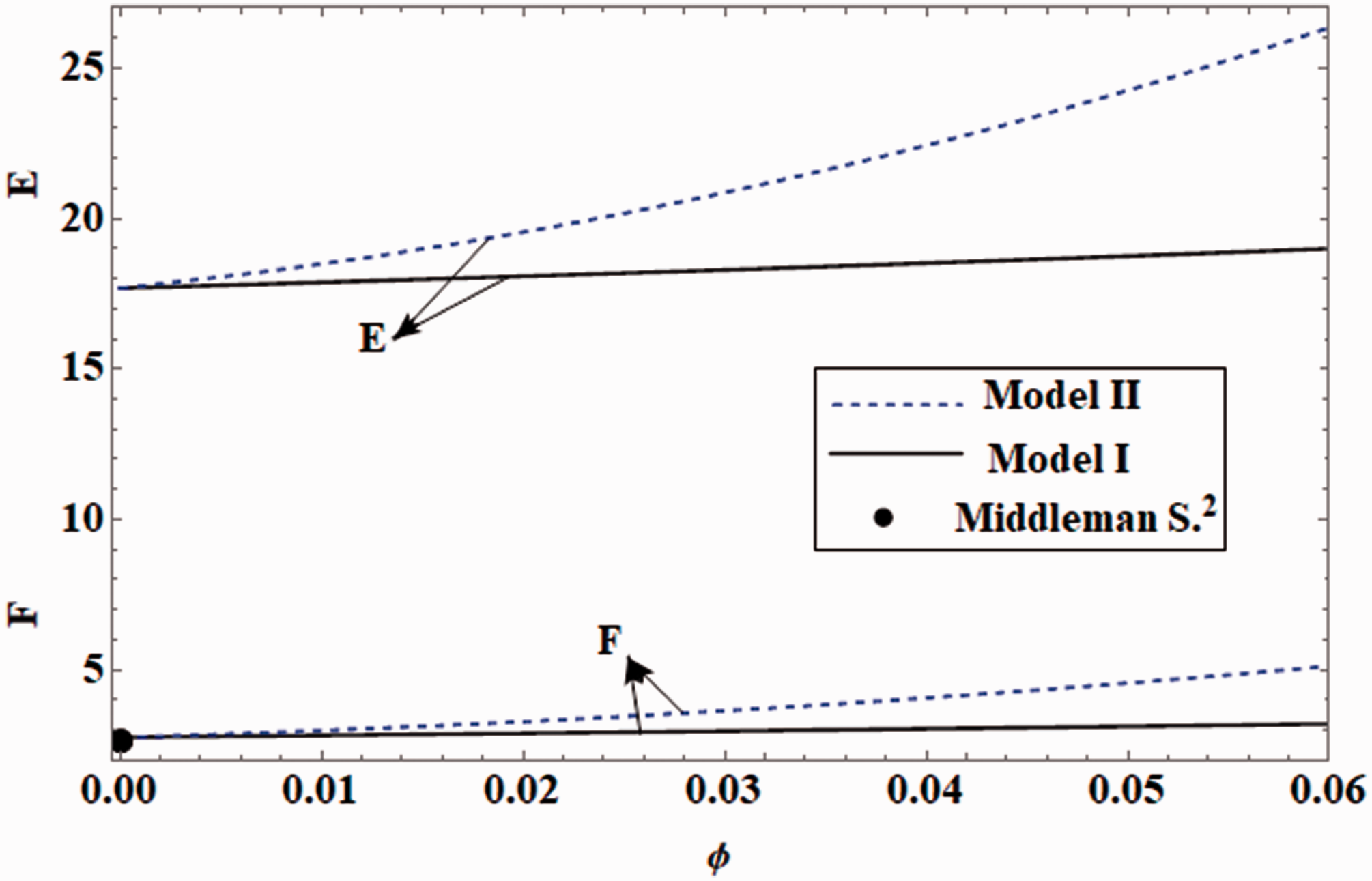
Figure 15 displays the power factor and force versus for both models. It is noted that both power input and roll-separating force versus increase more for model II than for model I. Also, for , the roll separating force F is equal to that computed by Middleman.2
Power factor and force versus for both models with and . Here relates to Middleman.2
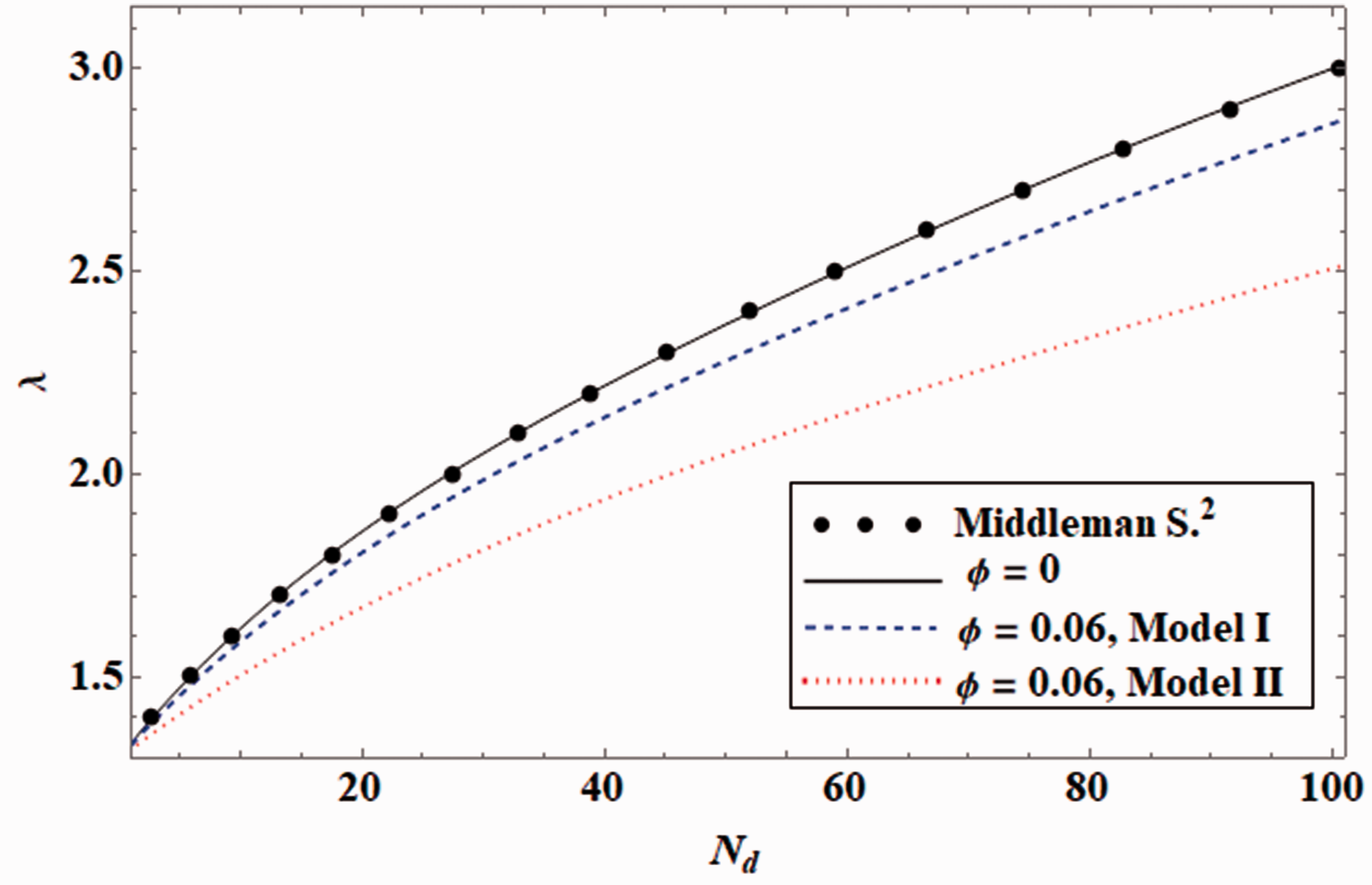
Figure 16 displays the dimensionless volumetric flow rate versus dynamic parameter for both viscosity models with . It is noted that the dimensionless volumetric flow rate asymptotically approaches 1.3 as (dynamic parameter) goes to zero and increases with increasing . Also at any fixed , is higher for model 1 than for model II.
Dimensionless volumetric flow rate versus dynamic parameter for both viscosity models with , and . Here relates to Middleman.2
Conclusions
In this paper, the analysis of roll-coating of a viscous nanofluid is carried out to obtain numerical results by using lubrication approximation theory over a flat moving sheet from an infinite reservoir. The following main findings are concluded as:
Increasing results in an increased pressure gradient, velocity and pressure distribution.
Increasing nanoparticle volume fraction results in an increased pressure gradient, pressure distribution and has negligible effect on velocity profile.
Pressure and pressure gradient increase for model II as compared to model I and have negligible effect on velocity profile.
Both power input and roll-separating force increase more versus for model II than for model I.
By taking , the results of Middleman 2 are reproduced and found in good agreement.
At any fixed dynamic parameter , is higher for model 1 than for model II.
Footnotes
Acknowledgement
We are thankful to the anonymous reviewers for their suggestions to improve the quality of paper.
Declaration of Conflicting Interests
The author(s) declared no potential conflicts of interest with respect to the research, authorship, and/or publication of this article.
Funding
The author(s) received no financial support for the research, authorship, and/or publication of this article.
Biographies
Sabeeh Khaliq received his MPhil degree in Mathematics from Bahauddin Zakaria University, Multan, Pakistan in 2016. At present, he is a PhD Scholar at The Islamia University of Bahawalpur, Pakistan. His research interest include nanofluids, roll coating and calendaring flows.
Zaheer Abbas is an assistant professor in the Department of Mathematics, The Islamia University of Bahawalpur, Pakistan. He earned his PhD in applied mathematics from Quaid-I-Azam University Islamabad in 2010. His research interests include Newtonian and non-Newtonian fluids flow, multi-phase flows, flow of nanofluids, heat and mass transfer mechanism, magnetohydrodynamics and fluid dynamics of blood flows.
References
1.
GreenerYMiddlemanS.A theory of roll coating of viscous and viscoelastic fluid. Polym Eng Sci1975;
15: 1–10.
2.
MiddlemanS.Fundamentals of polymer processing.
New York:
McGraw-Hill, 1977.
3.
CoyleDEMacoskoCWScrivenLE.Film-splitting flows in forward roll coating. J Fluid Mech1986;
171: 183–207.
4.
HintermaierJCWhiteRE.The splitting of a water film between rotating rolls. Tappi J1965;
48: 617–625.
5.
BenkreiraHPatelREdwardsMF, et al.
Classification and analyses of coating flows. J Non Newton Fluid Mech1994;
54: 437–447.
6.
BenkreiraHEdwardsMFWilkinsonWL.Roll coating of purely viscous liquids. Chem Eng Sci1981;
36: 429–434.
7.
BenkreiraHEdwardsMFWilkinsonWL.Roll coating operations. J Non Newton Fluid Mech1984;
14: 377–389.
8.
BenkreiraHEdwardsMFWilkinsonWL.A semi-empirical model of the forward roll coating flow of Newtonian fluids. Chem Eng Sci1981;
36: 423–427.
9.
SofoUSMitsoulisE.Roll-over-web coating of pseudoplastic and viscoplastic sheets using the lubrication approximation. J Plast Film Sheet2005;
2: 307–333.
10.
ZahidMHaroonTRanaMA, et al.
Roll coating analysis of a third grade fluid. J Plast Film Sheet2017;
33: 72–91.
11.
ZahidMRanaMASiddiquiAM.Roll coating analysis of a second-grade material. J Plast Film Sheet2018;
34: 232–255.
12.
AliNAtifHMJavedMA, et al.
A theoretical analysis of roll-over-web coating of couple stress fluid. J Plast Film Sheet2017; 1: 43–59.
13.
GaskellPHSavageMDSummersJL, et al.
Modeling and analysis of meniscus roll coating. J Fluid Mech1995;
298: 113–137.
14.
AcharyaNDasKKunduPK.The squeezing flow of Cu-water and Cu-kerosene nanofluids between two parallel plates. Alex Eng J2016;
55: 1177–1186.
15.
SheikholeslamiMHatamiMGanjiDD.Analytical investigation of MHD nanofluid flow in a semi-porous channel. Powder Technol2013;
246: 327–336.
16.
AbbasZHusnainJ.Two phase magnetoconvection flow of magnetite nanoparticles in a horizontal composite porous annulus. Results Phys2017;
7: 574–580.
17.
PourmehranORahimi-GorjiMGorji-BandpyM, et al.
Analytical investigation of squeezing unsteady nanofluid flow between parallel plates by LSM and CM. Alex Eng J2015;
54: 17–26.
18.
AbbasZRahimTHusnainJ.Slip flow of magnetite-water nanomaterial in a inclined channel with thermal radiation. Int J Mech Sci2017;
122: 280–296.
19.
ZhangZQYuanLSLiuZ, et al.
Flow behaviors of nanofluids in parallel-plate nanochannels influenced by the dynamics of nanoparticles. Comp Mater Sci2018;
145: 184–190.
20.
DogonchiASDivsalarKGanjiDD.Flow and heat transfer of MHD nanofluid between parallel plates in the presence of thermal radiation. Comp Methods Appl Mech Eng2016;
310: 58–76.
21.
AbbasZSheikhM.Numerical study of homogenous-heterogeneous reactions on stagnation point flow of ferrofluid with non-linear slip condition. Chinese J Chem Eng2017;
25: 11–17.
22.
Sanchez-GarciaMDOcioMJGimenezE, et al.
Novel polycaprolactone nanocomposites containing thymol of interest in antimicrobial film and coating applications. J Plast Film Sheet2008;
24: 239–251.
23.
AtayevPOnerM.Effect of incorporation of clay and zinc oxide nanoparticles on oxygen barrier properties of polypropylene sheet. J Plast Film Sheet2014;
30: 248–265.