






Abstract

Calendar of future events

Recycling and Circular Economy
https://www.raceconferences.com/
SPE Thermoforming Conference
Attendees may participate in the online version or in person in Grand Rapids,

Michigan.
Contact Lesley Kyle, Conference Coordinator
Phone: 914-671-9524
Email:
https://thermoformingdivision.com/conference/thermoforming-conference/overview/
The AIMCAL R2R Conference has been a champion of roll-to-roll processing, and the converting industry for many years. If you are a newcomer to this annual event, you will see why it consistently rates high as a valuable resource for anyone who has interest in the R2R process. The conference has steadily grown by delivering solid technical programming and valuable networking opportunities to attendees.
Learn more: https://www.aimcal.org/ (click “Events”)
SPE International Polyolefins Conference
Virtual as well as In person conference
Galveston Island Convention Center
Galveston Tx
Future details at: https://spe-stx.org/international-polyolefins-conference-2/
SPE Precision Extrusion Topcon
Hilton Nashville Green Hills, Nashville, TN
Hosted by SPE Extrusion Division
Olivier Catherine, Cloeren:
David Anzini, Celgard:
Regulatory Expert Corner
Senior Scientist
Sevee & Maher Engineers, Inc.
Email:
Global Food Contact Regulation Updates
Food contact materials or articles are regulated by government agencies around the world. Understanding these regulations and keeping up with the new regulations are essential for maintaining market access for food contact products. In this section, we will provide global plastics food contact regulation developments and updates relevant to plastic film and sheet for food packaging.
COUNTRY/Region
Asian/Pacific
China
China solicits opinions on two draft biodegradable voluntary national standards. The first standard is biodegradable drinking straws. The second standard is degradability and identification requirements of biodegradable materials and products, stipulates the content of text identification and provided the graphic logo of biodegradable materials and products.
Europe
European Food Safety Authority (EFSA) recently reached conclusion that titanium dioxide can no longer be considered safe as a food additive. A critical element in reaching this conclusion is that the genotoxicity concerns after consumption of titanium dioxide particles cannot be excluded. Titanium oxide is commonly used in food contact materials as colorants or fillers.
EFSA updated its administrative guidance documents for applications for authorization of food-contact materials (FCMs) subject to EU-harmonized legislation. The administrative guidance covers food contact materials of plastics, recycled plastics, and Active and Intelligent Packaging.
France
France has signed into law (Law No. 2020–105 Regarding a Circular Economy and the Fight Against Waste), aims to help change the French society model “from a linear economy to a circular economy,” where waste is minimized and resources are reused as much as possible. This new economic model would feature a low consumption of non-renewable resources, the reuse of waste as a resource, products that have a longer useful life, the recycling of 100% of plastics, and less wastefulness.
United Kingdom
The United Kingdom introduces a tax on packaging made with less than 30% recycled content, giving it a clear economic incentive for businesses to use recycled material.
North America
USA
US lawmakers introduced four Bills that could impact plastics packaging, including a pause on building new plastics facilities, recycling content standard, and the establishment of a national bottle bill.
Africa
Tanzania
Tanzania announced draft standards that propose for heavy metals and total aromatic amines content limits in food contact materials (FCMs). Additionally, it also announced a positive list for colorants and dyes that are allowed to be used in FCMs. Both standards are set to be adopted by July 2021 and become effective in January 2022.
Stats Corner
By Shari Kraber email:
Stat-Ease, Inc.
Minneapolis, MN 55413
Undercovering the Lack of Fit Statistic
An analysis of variance (ANOVA) is often accompanied by a counter statistic called a lack of fit test. A statistically significant lack of fit (LOF) value often worries experimenters. This blog will provide experimenters a better understanding of this statistic and what could cause it to be significant.
The formula is:

Figure 1 is an illustration of a data set that had a statistically significant model, but also had a statistically significant lack of fit. Believe it or not, there are actually six center points on the graph. They are so close together that they overlap, and some are hidden below the response plane. Now look at the other model points. Many are positioned off the response plane. Although the predicted response surface fits the model points well (providing the significant model fit), the differences between the actual data points and the response plane are
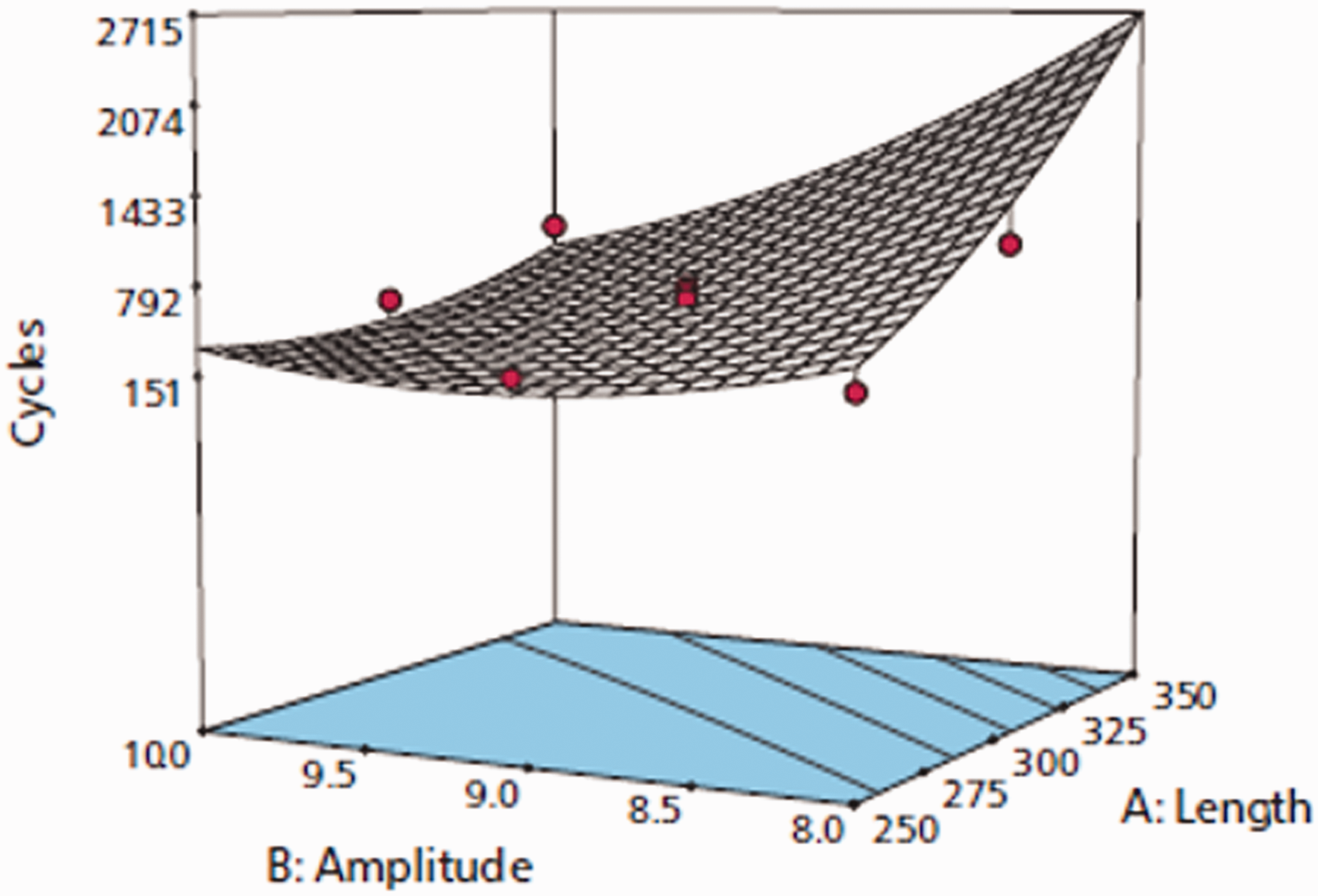
The centerpoints have less variation than the model points, causing significant lack of fit
When there is significant lack of fit, check how the replicates were run— were they independent process conditions run from scratch, or were they simply replicated measurements on a single setup of that condition? Replicates that come from independent setups of the process are likely to contain more of the natural process variation. Look at the response measurements from the replicates and ask yourself if this amount of variation is similar to what you would normally expect from the process. If the “replicates” were actually run more like repeated measurements, it is likely that the pure error has been underestimated (making the LOF denominator artificially small). In this case, the lack of fit statistic is no longer a valid test and decisions about using the model will have to be made based on other statistical criteria.
If the replicates have been run correctly, then the significant LOF indicates that perhaps the model is not fitting all the design points well. Consider transformations (check the Box Cox diagnostic plot). Check for outliers. It may be that a higher-order model would fit the data better. In that case, the design probably needs to be augmented with more runs to estimate the additional terms.
If nothing can be done to improve the fit of the model, it may be necessary to use the model as is and then rely on confirmation runs to validate the experimental results. In this case, be alert to the possibility that the model may not be a very good predictor of the process in specific areas of the design space.
Industry News
The American Institute of Chemical Engineers has monthly bulletins on process safety. They are accessible at the following web site.
https://www.aiche.org/ccps/resources/process-safety-beacon/archives
Three recent bulletins are:
April, 2021 – Recent nitrogen fatalities are a vivid reminder May, 2021 – Valve position errors can cause serious incidents June, 2021 – Combustible dust hazards are everywhere!
Safety is very important and being aware of your surrounding should always be at the top of your list.
Sustainability
From the Daimler web site 1 here is a quote by Markus Schäfer, Member of the Daimler AG Board of Management responsible for Corporate Research and Mercedes-Benz Cars Development.
“With Ambition 2039, we have set the course for sustainable mobility. In addition to the consistent electrification of our product portfolio, we also look at the supply chain to realize our long-term objective of climate neutrality: part of the battery cells for the next vehicle generation of our EQ product and technology brand are to be produced using 100 % electricity from renewable energies.”
Daimler like many other companies is committing their future to a sustainable future and are working to protect our planet from global warming.
Plastic Pollution
From the GreenPeace web site 2 a blog on fighting plastic pollution.
“The flow of plastics into our environment has reached crisis proportions, and the evidence is most clearly on display in our oceans. It is estimated that up to 12 million metric tons of plastic enter our ocean each year.
Our oceans are slowly turning into a plastic soup, and the effects on ocean life are chilling. Discarded plastic fishing lines entangle turtles and seabirds, and plastic pieces of all sizes choke and clog the stomachs of creatures who mistake it for food, from tiny zooplankton to whales. Plastic is now entering every level of the ocean food chain and is even ending up in the seafood on our plates.
Our planet can no longer tolerate a culture of throw-away plastics. Single-use plastics are filling up our landfills, choking our rivers, and contaminating our oceans. For far too long, corporations have put the onus on all of us to deal with their own failed design problem. We have been told that the individual should simply recycle away the billions of tons of plastics corporations produce and that it will make the difference needed to sustain our planet.
We have been told a lie.
Over 90% of plastics are not recycled. Recycling alone is simply never going to solve this problem. The scale of the problem corporations have created must be met with a fundamental shift in how they bring products to people. It is up to all of us to demand better — to tell these corporate giants that we will no longer tolerate the plastics they force upon us. Our world deserves better, and we don’t need their products if they refuse to adapt.
It’s time for us to reject the old corporate story that a throw-away lifestyle makes us happy. Nothing that is used for a few minutes should end up polluting our oceans for a lifetime.
With enough pressure from our supporters and allies around the world, the biggest companies like Coke, Pepsi, Starbucks, McDonald’s, Unilever, Nestlé, and Procter & Gamble will embrace a better model through innovation and redesign. They will reject the old story, and rediscover how to produce and deliver goods in a way that respects our oceans and our planet.
Together, we can do better. We can bring about a simpler life without endless waste. A life where people and the planet flourish.”
Greek Island to become an Electric Island.
Astypalea island will install a solar and battery system by 2023 to power all electric autos. The project was announced in November 2020. The long-term goal for Astypalea is to become a “flagship island for sustainable mobility and green energy”. In June 2021 they received first VW ID.4 models for use by the police, the port police, the airport authority, and the island’s municipality.
They will develop a fully electric car-sharing service and ride-sharing service to replace the existing bus service. In addition, the island will open a 3MW new solar park by 2023, which will cover 100 percent of the energy needed to charge the EVs on the island and more than 50 percent of the island’s overall energy demand. By 2026, the green energy system will be expanded to cover more than 80 percent of the island’s demands.
Chemical Recycling Europe
Chemical Recycling Europe 3 (ChemRecEurope) was established in 2019 to promote and implement the innovative solutions that the chemical recycling of plastic waste offers to benefit our economy and society. ChemRecEurope represents the interest of the European chemical recycling industry towards the public and European institutions. Chemical recycling technologies play a decisive role in closing the loop and supporting the transition towards a more sustainable and circular economy in Europe.
They intend to provide sustainable solutions to overcome the current challenges of recycling processes.
Contact Info:
Chemical Recycling Europe
Avenue de Cortenbergh 71, 1000 Bruxelles, Belgium.
Mohammad HAYATIFAR (General Secretary)
+32 2 669 18 76
Consulting firm expands into food-safety regulatory compliance services
CUMBERLAND, ME – [June 10, 2021] – Regulatory compliance consultant Sevee & Maher Engineers, Inc. (SME) announces the firm has broadened its range of product stewardship services for clients operating in the food, beverage, consumer products, chemicals, materials, and food packaging industries.
“Product stewardship dovetails naturally with services SME has offered for over 35 years, and we are excited to expand our capabilities to fully support our clients,” said company principal Philip Gerhardt, PE, who leads SME’s environmental compliance group. SME helps manufacturers, processors, packagers, sellers, and brand owners meet essential safety, regulatory requirements, and material sustainability economically and responsibly.
SME hired Huqiu Zhang, PhD, an internationally recognized expert in product chemical safety and global food contact regulations, to direct the firm’s expanded product stewardship services and staff. As Senior Chemist, Dr. Zhang oversees SME’s product chemical safety and global regulatory compliance programs for clients in the food contact material, food packaging, and consumer product industries.
Dr. Zhang has over 25 years of product stewardship experience through her prior work with large global corporations and interaction with government agencies. Her extensive regulatory compliance expertise supports clients in challenges such as obtaining governmental clearance and approval for new food-contact materials; developing supply chain chemical management programs and Good Manufacturing Practice (GMP); identifying chemical hazards; and performing risk assessment. In addition, her years of experiences working in leading corporation’s product stewardship programs help clients in planning global regulatory compliance strategies; conducting business due diligence; and incorporating safety, regulatory compliance, and managing perception into new product development life cycle.
Dr. Zhang has authored technical articles for professional journals and frequently presents at major international conferences.
Founded in 1985, SME is a multidisciplinary environmental and civil engineering consulting firm. From its headquarters in Cumberland, Maine, and branch offices in greater Atlanta, Chicago, and Phoenix, SME assists clients ranging from small family businesses to Fortune 500 industrial companies. More company information at sme-engineers.com.
CONTACT INFO:
Philip H. Gerhardt, PE
Principal and Senior Environmental Engineer
Sevee & Maher Engineers, Inc.
4 Blanchard Road, P.O. Box 85A, Cumberland, ME 04021
Office: + (207) 829-5016
Cell: +(973) 610-0263 (cell)
Email:
Huqiu Zhang, PhD
Senior Chemist
Sevee & Maher Engineers, Inc.
P.O. Box 2488, Glen Ellyn, IL 60138
Office: + (207) 829-5016
Cell: +(518) 229-1853 (cell)
Email:
