






Abstract

Industry news
Upcoming conferences

SPE Thermoset TopCon.
Madison, Wisconsin.
Join the leaders in the industry and learn about opportunities for thermoset innovative technologies in multiple markets.
Hosted by the SPE Thermoset Division.
More information: https://spethermosets.org/topcon/

R2R USA Conference & Expo.
Join us in Cleveland for the industry’s leading roll-to-roll converting event. See what’s next in materials, machinery, and manufacturing.
More information: “https://www.rolltoroll.org/2026-r2r-usa”
2026 SPE Asean Section Seminar - Polymer Trends and Technologies.
Nanyang Technological University (NTU), Singapore.
Hosted by the SPE ASEAN Section.
More Information: https://www.4spe.org/i4a/pages/index.cfm?pageID=9938.
Sustainability World Congress Detroit.
Huntington Place Convention Center.
Keynote Speeches, Technical Presentations, Genius Talks & Student Poster Presentations and an Exhibit Hall Full of Exciting Ideas and New Products to Explore!
For Sponsorship, Contact Dr Sassan Tarahomi, Conference Chair.
989-335-0600 starahomi22[at]gmail.com.
For General Information, Contact Karen Rhodes-Parker.
248-244-8993 Ext. 3 karen[at]spedetroit.com.
More information: https://spedetroit.org/events/sustainability-world-congress/
SPE Extrusion Optimization TopCon.
Join the SPE Extrusion Division for an exclusive Optimization TopCon—a premier event designed to elevate your extrusion expertise. Gain valuable insights from industry-leading speakers as they explore key challenges in the extrusion process and share strategies to overcome limitations. Whether you’re an engineer, technician, operator, or simply eager to deepen your understanding of extrusion, this conference is the perfect opportunity to refine your skills and optimize your process. Don’t miss out on this chance to connect, learn, and advance in the industry!
Holiday Inn Montreal.
900 Rue St Charles East, Longueuil, Quebec, Canada, J4H3Y2.
More information: https://www.4spe.org/i4a/calendar/details.cfm?id=1152&pageID=3277.
23rd International Coating Science and Technology Symposium.
The ISCST Symposium provides a forum for scientists and engineers from around the world to present and discuss the latest developments and discoveries in the application and solidification of thin liquid films.
The Lofton Hotel Minneapolis, MN, USA.
More information: https://www.aiche.org/conferences/international-coating-science-and-technology-symposium/2026.

6th SPE Middle East Plastics Conference 2026: Advances in Sustainable Packaging.
Location in Arabia TBD, More information https://www.4spe.org/i4a/pages/index.cfm?pageid=9923#gsc.tab=0.

Society of Rheology 97th Annual Meeting - Boston, MA.
More information: https://www.societyofrheology.org/meetings.
Process safety
The American Institute of chemical engineers has monthly bulletins on process safety. They are accessible at the following web site
https://www.aiche.org/ccps/resources/process-safety-beacon/archives.
Three recent bulletins are: • December 2025 – Loss of Primary Containment (LOPC) events start an incident • January 2026 – Near-misses predict future incidents • February 2026 – Inherently Safer Principles
The Process Safety Beacons Archive is available in 32 languages, includes all past Beacons and is available to everyone to download and share. Reproduction for non-commercial, educational purposes is encouraged. However, reproduction for any commercial purpose without express written consent of AIChE is strictly prohibited.
Another source for understanding safety comes from the U.S. Chemical Safety Board (CSB) which is an independent, nonregulatory federal agency that investigates the root causes of major chemical incidents. Their web site is https://www.csb.gov/.
Low Pressure, Fatal Consequence: Explosion at Yenkin-Majestic
Washington D.C., December 9, 2025.
U.S. Chemical Safety Board Releases New Safety Video on the Low Pressure, Fatal Consequence: Explosion at Yenkin-Majestic Resin Plant Vapor Cloud Explosion and Fire. Watch video at: https://youtu.be/35FkCArjLU0.
CSB releases safety video on combustible dust explosions
U.S. Chemical Safety Board Releases New Safety Video on the Fatal Combustible Dust Explosions and Fires at Didion Milling in Cambria, Wisconsin.
Washington D.C., February 4, 2026.
The U.S. Chemical Safety and Hazard Investigation Board (CSB) released a new safety video [https://www.youtube.com/watch?v=9h3bar6eIss] on its investigation into the fatal combustible dust explosions and fires at the Didion Milling facility in Cambria, Wisconsin, that occurred on May 31, 2017. Five employees were killed in the incident, and 14 others were injured. The incident also destroyed the facility, resulting in over $15 million in property damage.
The CSB’s new safety video, called “Deadly Dust: Explosions at Didion Milling,” includes an animation of the events leading to the incident, and commentary from CSB Board Member Sylvia Johnson and CSB Investigators Melinda Hartz and Cruz Redman.
Didion Milling is an agricultural processing company with several facilities based in Wisconsin. At Didion’s dry corn mill, located in Cambria, Wisconsin, corn kernels were ground into smaller components for use in a variety of corn-based products. The process of grinding corn kernels produces corn-based products and dust as a byproduct. The CSB’s investigation found that both the product and dust can be combustible.
Shortly after 10:30 pm on May 31, 2017, multiple employees at the Didion facility noticed an unusual smell or saw smoke. The CSB determined that the smoke was likely coming from a “smoldering nest” of dust, located inside the corn grinding process. The smoldering nest ignited, leading to a combustible dust explosion within milling equipment and fires that spread to other areas of the facility. Secondary explosions also spread throughout the mill buildings.
The CSB released its final report on its investigation in December 2023. The new safety video covers five of the 13 key safety issues identified in the CSB’s report that contributed to the incident: process hazard recognition, dust hazard analyses, fugitive dust management, process safety leadership, and regulatory coverage of combustible dust. The video also highlights safety recommendations made by the CSB to Didion Milling, the National Fire Protection Association, and the federal Occupational Safety and Health Administration (OSHA).
Among other important issues, the CSB’s report and the new video point out that since 2006, the CSB has called on OSHA to develop an overarching standard on combustible dust for general industry. OSHA has yet to issue a combustible dust standard, however.
Board Member Sylvia Johnson states, “The CSB has been calling for a comprehensive standard on combustible dust for many years to help prevent tragic, deadly incidents like the one at Didion from continuing to occur. Robust regulation is absolutely essential to keep these incidents from happening in the future.”
The CSB is an independent federal agency charged with investigating incidents and hazards that result, or may result, in the catastrophic release of extremely hazardous substances. The agency’s core mission activities include conducting incident investigations; formulating preventive or mitigative recommendations based on investigation findings and advocating for their implementation; issuing reports containing the findings, conclusions, and recommendations arising from incident investigations; and conducting studies on chemical hazards.
The agency’s board members are appointed by the president subject to Senate confirmation. The Board does not issue citations or fines but makes safety recommendations to companies, industry organizations, labor groups, and regulatory agencies such as OSHA and EPA.
Please visit our website, https://www.csb.gov/. For more information, contact Communications Manager Hillary Cohen at
U.S. Chemical Safety board releases investigation report on the 2023 explosion and toxic ethylene oxide release at Dow Plant in Plaquemine, Louisiana
Washington D.C. February 26, 2026.
The U.S. Chemical Safety and Hazard Investigation Board (CSB) released its final investigation report [https://www.csb.gov/assets/1/6/dow_investigation_report-final_(002).pdf] into the July 2023 explosions, fires, and toxic ethylene oxide (EtO) release at the Dow Chemical Company’s (Dow) Louisiana Operations Glycol II plant in Plaquemine.
At approximately 9:15 p.m. on July 14, 2023, a series of explosions and fires occurred at Dow’s Glycol II unit, causing significant damage to nearby process equipment and resulting in the release of more than 31,000 pounds of toxic EtO, which is produced at the facility. EtO is a reactive and flammable chemical product and is a known human carcinogen. Local authorities issued a shelter-in-place order affecting hundreds of nearby residents.
The CSB determined that the incident began when EtO inadvertently entered pressure relief piping that contained air. The mixture ignited and propagated through approximately 50 feet of piping to a pressure relief valve. When the valve lifted due to increased pressure, the flame traveled into the vapor space of a reflux drum containing both liquid and vapor EtO. The vapor EtO heated and decomposed, causing pressure to rise until the drum catastrophically failed and exploded, releasing its toxic contents.
The CSB’s investigation found that metal debris punctured a rupture disc, allowing EtO to enter the pressure relief piping. The debris came from portable work lights that had been inadvertently left inside a large reflux drum by workers who had been performing turnaround maintenance activities in the drum in May 2023, a couple of months before the incident. Over the next several weeks, after the Glycol II unit was restarted, the work lights degraded, creating debris that thereafter entered downstream equipment and eventually punctured the rupture disc, which led to the subsequent fire, explosion, and EtO release.
CSB Chairperson Steve Owens said, “This catastrophic incident should never have happened. The workers did not remove all the work lights from inside the drum, and Dow did not have an effective procedure in place to ensure that they did so. When dealing with a highly hazardous chemical like ethylene oxide, even a seemingly small mistake can have enormous consequences.”
The CSB identified several key safety issues. Inadequate vessel closure practices that allowed the reflux drum to be sealed and restarted without positive confirmation that it was clean and free of foreign materials. There also were deficiencies in the inerting system control, as Dow was unaware that nitrogen had slowly leaked out of the pressure relief piping over time and had filled with air, enabling the EtO to ignite.
Additionally, the CSB found that the design of the cooler’s emergency pressure relief system contributed to the severity of the incident. The system discharged back into the reflux drum, allowing the flame front to propagate into the drum’s vapor space and intensify the explosion. The CSB noted that Dow could have eliminated the thermal expansion hazard and the need to vent ethylene oxide into the reflux drum when it replaced the product cooler in 2010, but Dow did not do so.
CSB Supervisory Investigator Mark Wingard said, “Companies must ensure that equipment is clean and verified before startup, that inerting systems are actively monitored, and that pressure relief systems are designed to prevent flame propagation.”
The CSB concluded that the probable cause of the incident was the puncture of the rupture disc by metal debris, which allowed EtO to enter air-filled piping, ignite, and propagate into the reflux drum. Contributing factors included Dow’s inadequate vessel closure procedures, failure to maintain an inert atmosphere in the pressure relief piping, and the design of the emergency pressure relief system.
As a result of the investigation, the CSB is issuing recommendations to Dow and two national standards organizations.
The CSB recommended that Dow identify all EtO process lines that should be inerted and are not continuously monitored, determine whether those lines can be eliminated, and implement appropriate inerting and monitoring controls where necessary. The CSB noted that, following the incident, Dow implemented a new vessel closure process and established a “Global Foreign Materials Exclusion Standard”; therefore, the CSB did not issue a recommendation to Dow on vessel closure procedures. However, the CSB is urging Dow to ensure that the company strictly adheres to the new requirements.
The CSB also issued recommendations to the National Fire Protection Association (NFPA) to update NFPA’s “Guide for Safe Confined Space Entry and Work” and NFPA’s “Standard for the Safeguarding of Tanks and Containers for Entry, Cleaning, or Repair”, to include guidance and requirements ensuring that vessels are left clean and ready for startup after confined space entry. The CSB issued a similar recommendation to the American Society of Safety Professionals (ASSP) to update its “Safety Requirements for Entering Confined Spaces” to address post-entry vessel cleanliness and startup readiness.
The CSB is an independent, nonregulatory federal agency charged with investigating incidents and hazards that result, or may result, in the catastrophic release of extremely hazardous substances. The agency’s core mission activities include conducting incident investigations to identify root cause of releases; formulating preventive or mitigative recommendations based on investigation findings and advocating for their implementation; issuing reports containing the findings, conclusions, and recommendations arising from incident investigations; and conducting studies on chemical hazards.
The agency’s board members are appointed by the President subject to Senate confirmation. The Board does not issue citations or fines but makes safety recommendations to companies, industry organizations, labor groups, and regulatory agencies such as OSHA and EPA.
Please visit our website, https://www.csb.gov/. For more information, contact Director of External Affairs Hillary Cohen at
U.S. Chemical Safety board releases investigation report on fatal hydrogen sulfide release at the PEMEX Deer Park refinery in Texas
Washington, D.C. February 23, 2026.
The U.S. Chemical Safety and Hazard Investigation Board (CSB) today released its final investigation report [https://www.csb.gov/assets/1/6/PEMEX_Investigation_Report_Final.pdf] into the fatal October 10, 2024 release of toxic hydrogen sulfide at the PEMEX Deer Park Refinery in Deer Park, Texas. Two contract workers died as a result of exposure to the toxic gas, 13 others were transported to local medical facilities, and dozens more were treated at the scene. Over 27,000 pounds of toxic hydrogen sulfide gas were released during the incident, and a shelter-in-place order was issued for two neighboring cities.
The release occurred at approximately 4:23 p.m. on October 10, 2024, during maintenance activities in the refinery’s Amine Unit when contract workers from Repcon, Inc. (Repcon) mistakenly opened a flange on piping that contained pressurized hydrogen sulfide. The workers were supposed to open a different flange on piping that was located approximately five feet away. One Repcon worker was fatally injured when the gas was released. The hydrogen sulfide vapor subsequently traveled downwind into an adjacent unit, where a worker employed by another contractor (ISC) inhaled the toxic gas and was also fatally injured.
The release continued for nearly 1 hour until refinery emergency responders reassembled the leaking flange and stopped the discharge. Because of the release, local officials in the neighboring cities of Deer Park and Pasadena, Texas, issued shelter-in-place orders that remained in effect for several hours. Although the refinery did not sustain physical structural damage, the company reported approximately $12.3 million in property damage related to loss of use of the Amine Unit and downstream processes.
CSB Chairperson Steve Owens said, “Two people died and the surrounding community was put at risk because of a completely preventable mistake. Companies must ensure that hazards are clearly identified and that effective procedures are in place to protect workers in facilities like this and the people who live and work nearby.”
The CSB’s final report concludes that the incident resulted from the failure to positively identify the correct equipment before mistakenly opening the piping that contained hydrogen sulfide instead of the piping that had been clear of the toxic gas. Contributing to the severity of the incident was the refinery’s failure to adequately assess the hazards of conducting pipe-opening activities in an active unit next to an area where numerous other workers were present. The investigation also found that deviations from established policies and procedures contributed to the event.
The CSB’s final report further identifies several key safety issues:
Positive Equipment Identification: The CSB found that the refinery lacked an effective method to clearly identify the correct piping flange before work began. Drawings and flange lists were insufficient to distinguish nearly identical segments, and the identification tag for the correct flange was placed out of view. Without reliable identification, workers searched for unlocked flange devices similar to what they had seen elsewhere in the refinery. The CSB noted that accidental releases from opening the wrong equipment are common in the chemical and refining industries and that no industry-wide standard currently addresses this issue.
Work Permitting and Hazard Control: The refinery issued a broad work permit covering multiple jobs with varying hazards and without clear hold points. Workers overlooked a written instruction to stop work and obtain an operator’s presence before opening the hydrogen sulfide piping. The permit also failed to address the hazard of opening piping in an operational unit upwind of other contractors.
Turnaround Contractor Management: On the day of the incident, workers were reassigned from a shutdown unit to a partially operational unit containing hydrogen sulfide. This abrupt change, combined with the proximity of the units, led workers to believe they were still working in the shutdown environment, and they were not specifically informed of the risks in the operational unit.
Conduct of Operations: The CSB identified gaps between written procedures and actual practices at the facility. While the refinery’s policies aligned with industry standards, management and operations personnel often misunderstood or deviated from them, contributing to failures in work permitting and hazard evaluation.
CSB Investigator-in-Charge Tyler Nelson said, “Opening hazardous process piping is a common maintenance activity that can be performed safely with effective equipment identification and work permitting practices. This tragic incident underscores the critical importance of equipment identification methods that are clear, consistent, and verified by both facility operators and contract workers before equipment is opened. Strong equipment marking practices, effective work controls, and disciplined operations are essential to preventing deadly releases like this one.”
The CSB’s report issues several safety recommendations to PEMEX Deer Park Refinery and the American Society of Mechanical Engineers (ASME). The CSB is recommending that PEMEX Deer Park label all piping in the relevant unit at the refinery in accordance with ANSI/ASME A13.1, implement procedures to ensure that workers reassigned to units in “Positive Isolation Status” are clearly informed of associated hazards and safeguards before beginning work, and establish a comprehensive conduct of operations system consistent with the Center for Chemical Process Safety’s guidance on operational discipline, including enforceable performance metrics and routine audits. Separately, the CSB recommended that ASME develop written guidelines establishing a standard practice for marking equipment prior to opening, including clear identifiers and requirements for removing markings after work is complete.
The CSB is an independent, nonregulatory federal agency charged with investigating incidents and hazards that result, or may result, in the catastrophic release of extremely hazardous substances. The agency’s core mission activities include conducting incident investigations to identify root cause of releases; formulating preventive or mitigative recommendations based on investigation findings and advocating for their implementation; issuing reports containing the findings, conclusions, and recommendations arising from incident investigations; and conducting studies on chemical hazards.
The agency’s board members are appointed by the President subject to Senate confirmation. The Board does not issue citations or fines but makes safety recommendations to companies, industry organizations, labor groups, and regulatory agencies such as OSHA and EPA.
Please visit our website, https://www.csb.gov/. For more information, contact Director of External Affairs Hillary Cohen at Hillary.Cohen@csb.gov.
Other news
Ocean Cleanup https://theoceancleanup.com/
Ocean Cleanup develops and scales technologies to rid the oceans of plastic. Their cleaning technologies are deployed around the world they have conducted the largest cleanup in history. For over 10 years, The Ocean Cleanup has been researching, extracting, and monitoring plastic pollution in oceans and rivers globally – with tens of millions of kilograms removed to date.
Please go to their website to see the progress they have made and see their future plans.
Plastics research Council https://plasticsresearchcouncil.com/
From the Plastic Research Council’s website, here are their Vision, Mission and Core Commitments:
Vision
We are an independent, nonprofit research organization dedicated to a world where every individual, educator, policymaker, and industry stakeholder is empowered by transparent, scientific facts to freely choose products-whether made from wood, paper, glass, plastic, or other materials-fully understanding the environmental impact of their decisions. We envision sustainable choices that are accessible, informed, and respected, supporting both environmental stewardship and personal autonomy.
Mission
To ensure that all individuals, educators, policymakers, and industry stakeholders have the right and ability to make informed, independent choices about the products they use and promote. We achieve this by providing clear, unbiased, and scientifically substantiated information on the environmental impacts of all materials. Our commitment is to equip the public and decision-makers with the facts necessary to understand the consequences of their choices, enabling responsible decisions that align with personal values and advance environmental sustainability.
Core Commitments
• Uphold the right to free choice by ensuring access to comprehensive, science-based information on all materials. • Empower our audiences to understand and compare the environmental impacts of their decisions, fostering true agency and responsibility. • Advocate for transparency and comparability in environmental data across product categories. • Support sustainable decision-making that respects both individual preferences and global environmental goals. • Vehemently opposed to misinformation. • Committed to a better future for all
The Plastics Research Council’s is fully dedicated to scientific integrity, informed choice, and balanced, sustainable progress for society.
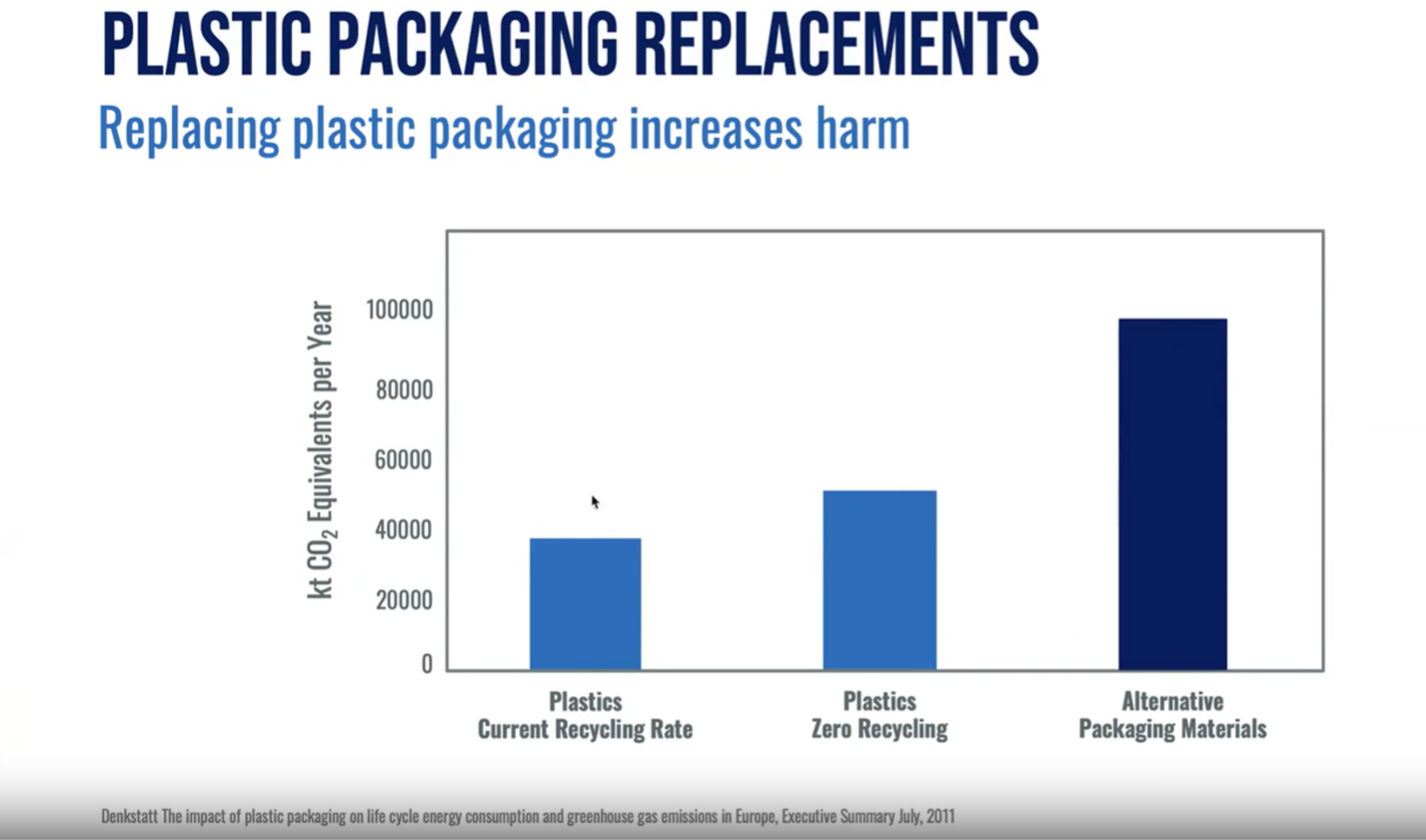
On their homepage is a video that discusses facts for a brighter future. A figure in that video shows that replacing plastic packaging increases harm. This graphic is from a 2011 report on the impact of plastic packaging on life cycle energy consumption and greenhouse gas emission in Europe by denkstatt GmbH Vienna, Austria. It shows that at the then current plastics recycling rate about 40,000 kt CO2 Equivalents per Year is generated and that Alternative Packaging Materials would generate about 100,000 kt CO2 Equivalents per Year. As the recycling rate increases the CO2 generation will decrease.
The challenge
NGOs take the easy path by making emotion-based appeals for donations, even though their claims are not grounded in reality, and even though their misinformation makes matters worse for future generations.
Even the former President of Greenpeace left in dismay and outed them for peddling lies for donations, as detailed in his books. He went on to say that other household name “environmental groups” have sold out and abandoned their original raison d’être and now run get rich quick schemes instead.
Well-intentioned people give their hard-earned money to these NGOs, and competitors to the plastics industry are only too happy to help fund them too.
The plastics industry has been slow to react against this attack. At first they probably assumed that it would go away, and later they left it up to their trade associations to act, but they were let down.
Now, everyone has been hoodwinked by the propaganda machine. Our children are being taught nonsense at school and the public believe it too. We need to act now, before the situation gets even worse. • Call out misinformation • Set the record straight • Provide solutions that work