






Abstract
Industry news
Upcoming conferences
23rd International Coating Science and Technology Symposium
The ISCST Symposium provides a forum for scientists and engineers from around the world to present and discuss the latest developments and discoveries in the application and solidification of thin liquid films.
The Lofton Hotel Minneapolis, MN, USA
More information: https://www.aiche.org/conferences/international-coating-science-and-technology-symposium/2026
6th SPE Middle East Plastics Conference 2026: Advances in Sustainable Packaging
Location in Arabia TBD
More information https://www.4spe.org/i4a/pages/index.cfm?pageid=9923#gsc.tab=0
SPE CONFERENCE: Innovation in Polyolefins
Gran Palas Experience Spa & Resort, Calle De La Sequia Major 5, 43480, La Pineda, Tarragona, Spain
Hosted by the SPE Southern Europe Regional Interest Group
More information https://www.4spe.org/i4a/pages/index.cfm?pageID=9710
Society of Rheology 97th Annual Meeting - Boston, MA
More information: https://www.societyofrheology.org/meetings
2027 Center for Hydrogen Safety Americas Conference
California State University, Los Angeles
Presented by the Center for Hydrogen Safety, the CHS Americas Conference brings together industry professionals to explore practical, real-world hydrogen safety challenges and solutions. Attendees will gain valuable insights through expert-led sessions, collaborative discussions, and opportunities to engage directly with leaders in the global hydrogen safety community.
More information https://www.aiche.org/chs/conferences/center-hydrogen-safety-conference/
Novel Trends in Rheology XI
Tomas Bata University in Zlín, Faculty of Technology, Vavrečkova 5669, 760 01 Zlín, Czech Republic
Presented by the SPE Czech Republic-East Europe Section, SPE Applied Rheology Division and the Czech Group of Rheology
More information https://noveltrends.ft.utb.cz/home/
Process safety
The American institute of chemical engineers has monthly bulletins on process safety
They are accessible at the following web site.
https://www.aiche.org/ccps/resources/process-safety-beacon/archives
Three recent bulletins are: • March 2026 - Decontaminate Before Opening! • April 2026 - Emergency response systems save lives! • May 2026 - Training after a change
The Process Safety Beacons Archive is available in 32 languages, includes all past Beacons and is available to everyone to download and share. Reproduction for non-commercial, educational purposes is encouraged. However, reproduction for any commercial purpose without express written consent of AIChE is strictly prohibited.
Another source for understanding safety comes from the U.S. Chemical Safety Board (CSB) which is an independent, nonregulatory federal agency that investigates the root causes of major chemical incidents. Their web site is https://www.csb.gov/.
U.S. chemical safety board opens investigation into fatal chemical tank implosion at Nippon Dynawave paper mill in Washington
Washington, D.C., May 27, 2026 — The U.S. Chemical Safety and Hazard Investigation Board (CSB) announced today that it is opening an investigation into the fatal chemical tank implosion at the Nippon Dynawave Packaging paper mill facility in Longview, Washington, that occurred during the early morning hours of May 26.
A team of CSB investigators will be arriving at the incident site in Longview today.
According to local authorities, the incident involved the rupture and implosion of a large tank containing white liquor, a corrosive chemical solution used in paper and pulp processing.
Initial reports to the CSB indicate that the incident resulted in multiple fatalities and serious injuries. Several workers are unaccounted for as emergency response and recovery operations continue.
CSB Chairperson Steve Owens said, “The CSB is opening an investigation into this tragic incident to determine how it happened and what can be done to prevent something like this from happening again.”
The CSB will provide additional information as it becomes available. Updates on the investigation will be posted at the agency’s website.
The CSB is an independent, nonregulatory federal agency charged with investigating incidents and hazards that result, or may result, in the catastrophic release of extremely hazardous substances. The agency’s core mission activities include conducting incident investigations to identify root cause of releases; formulating preventive or mitigative recommendations based on investigation findings and advocating for their implementation; issuing reports containing the findings, conclusions, and recommendations arising from incident investigations; and conducting studies on chemical hazards.
The agency’s board members are appointed by the president subject to Senate confirmation. The Board does not issue citations or fines but makes safety recommendations to companies, industry organizations, labor groups, and regulatory agencies such as OSHA and EPA.
Please visit our website, https://www.csb.gov/. For more information, contact Director of External Affairs Hillary Cohen at
Low pressure, fatal consequence: Explosion at Yenkin-majestic
Washington D.C., December 9, 2025
U.S. Chemical Safety Board Releases New Safety Video on the Low Pressure, Fatal Consequence: Explosion at Yenkin-Majestic Resin Plant Vapor Cloud Explosion and Fire. Watch video at: https://youtu.be/35FkCArjLU0
CSB releases safety video on combustible dust explosions
U.S. Chemical Safety Board Releases New Safety Video on the Fatal Combustible Dust Explosions and Fires at Didion Milling in Cambria, Wisconsin
Washington D.C., February 4, 2026
The U.S. Chemical Safety and Hazard Investigation Board (CSB) released a new safety video [https://www.youtube.com/watch?v=9h3bar6eIss] on its investigation into the fatal combustible dust explosions and fires at the Didion Milling facility in Cambria, Wisconsin, that occurred on May 31, 2017. Five employees were killed in the incident, and 14 others were injured. The incident also destroyed the facility, resulting in over $15 million in property damage.
The CSB’s new safety video, called “Deadly Dust: Explosions at Didion Milling,” includes an animation of the events leading to the incident, and commentary from CSB Board Member Sylvia Johnson and CSB Investigators Melinda Hartz and Cruz Redman.
Didion Milling is an agricultural processing company with several facilities based in Wisconsin. At Didion’s dry corn mill, located in Cambria, Wisconsin, corn kernels were ground into smaller components for use in a variety of corn-based products. The process of grinding corn kernels produces corn-based products and dust as a byproduct. The CSB’s investigation found that both the product and dust can be combustible.
Shortly after 10:30 pm on May 31, 2017, multiple employees at the Didion facility noticed an unusual smell or saw smoke. The CSB determined that the smoke was likely coming from a “smoldering nest” of dust, located inside the corn grinding process. The smoldering nest ignited, leading to a combustible dust explosion within milling equipment and fires that spread to other areas of the facility. Secondary explosions also spread throughout the mill buildings.
The CSB released its final report on its investigation in December 2023. The new safety video covers five of the 13 key safety issues identified in the CSB’s report that contributed to the incident: process hazard recognition, dust hazard analyses, fugitive dust management, process safety leadership, and regulatory coverage of combustible dust. The video also highlights safety recommendations made by the CSB to Didion Milling, the National Fire Protection Association, and the federal Occupational Safety and Health Administration (OSHA).
Among other important issues, the CSB’s report and the new video point out that since 2006, the CSB has called on OSHA to develop an overarching standard on combustible dust for general industry. OSHA has yet to issue a combustible dust standard, however.
Board Member Sylvia Johnson states, “The CSB has been calling for a comprehensive standard on combustible dust for many years to help prevent tragic, deadly incidents like the one at Didion from continuing to occur. Robust regulation is absolutely essential to keep these incidents from happening in the future.”
The CSB is an independent federal agency charged with investigating incidents and hazards that result, or may result, in the catastrophic release of extremely hazardous substances. The agency’s core mission activities include conducting incident investigations; formulating preventive or mitigative recommendations based on investigation findings and advocating for their implementation; issuing reports containing the findings, conclusions, and recommendations arising from incident investigations; and conducting studies on chemical hazards.
The agency’s board members are appointed by the president subject to Senate confirmation. The Board does not issue citations or fines but makes safety recommendations to companies, industry organizations, labor groups, and regulatory agencies such as OSHA and EPA.
Please visit our website, https://www.csb.gov/. For more information, contact Communications Manager Hillary Cohen at
Other news
KHS SUPREME FOR SENSITIVE BEVERAGES
Crystal clear benefits 3/26/2026,
With the KHS SUPREME PET bottle, KHS is taking protection of oxygen-sensitive beverages up to the next level. The innovative system for aseptic filling combines the benefits of glass with the handleability of PET by applying proven Plasmax barrier technology.
KHS presents the result of an extensive development study: with the KHS SUPREME PET bottle, the Dortmund turnkey supplier is turning its attention to the product protection of oxygen-sensitive beverages such as tea. Here, besides providing high-quality design, KHS chiefly makes use of its tried-and-tested Plasmax barrier technology, a wafer-thin, transparent layer of silicon oxide that coats the inside wall of PET bottles like glass. Less than 100 nm thick, this reliably protects sensitive beverages from oxidation, retaining their taste, color and quality for lengthy periods of time. This means that products also keep up to 10 times longer.
Plasmax technology, that’s been in successful use for over 20 years, is being constantly evolved by KHS at its
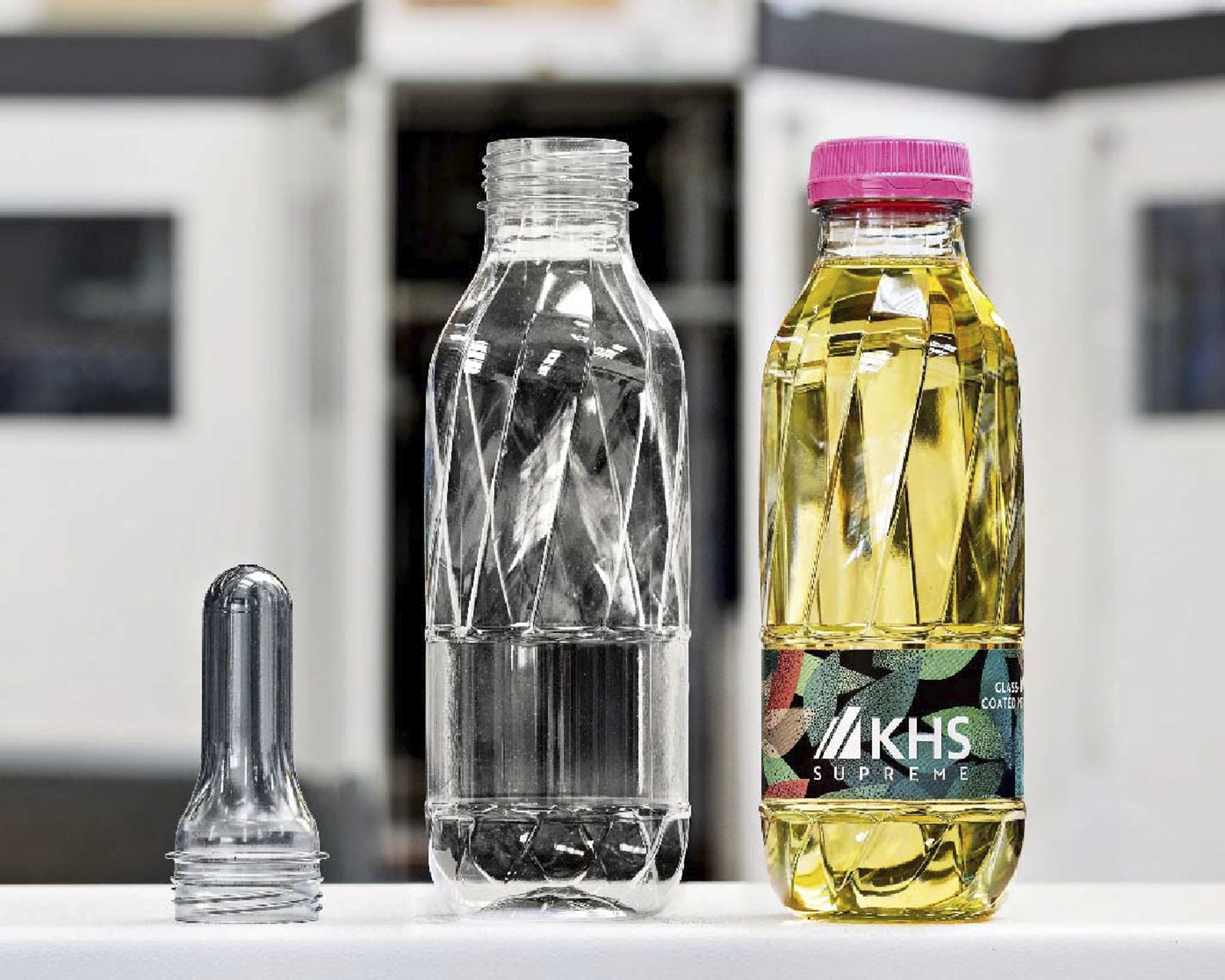
KHS SUPREME provides maximum product protection for quality-sensitive beverages thanks to innovative Plasmax barrier technology.
Protection for quality-sensitive beverages
“Our barrier system is ideal for premium products such as green tea. This particularly quality-sensitive beverage has to satisfy the highest requirements on markets in Asia, for example, explains Philipp Langhammer, product manager for barrier technology at KHS. Tea oxidizes easily, leading to unwanted changes in color and taste. The glass barrier prevents this, making for longer shelf lives, freshness and safety.”
Up to 60,000 bottles per hour
This technology, originally developed for pharmaceutical glass containers, is based on many years of research and process optimization. The first Plasmax systems were piloted in the food sector back in the early 2000s. Since then, KHS has continuously optimized the Plasmax barrier. It was recently scaled up to industrial production speeds of up to 60,000 bottles per hour – without any detriment to its protective properties.
100% rPET-compatible
Besides providing technical precision, Plasmax technology also scores with its environmental friendliness. One definitive benefit is its full recyclability: in the recycling process, the glass coating is simply washed off with caustic – without impacting the quality of the material. Unlike chemical scavenger technologies that make recycling more difficult, the purity of the separated PET is maintained. What’s more, the coating is fully compatible with 100% rPET: this means that it can both be recycled and is suitable for use with recycled PET. “We thus refer to this as a fully circular barrier technology,” says Langhammer. “It combines all the benefits: optimum product protection and complete circularity.”
Any further questions?
KHS GmbH, Hamburg, Germany
+49 40 67907
Ocean cleanup https://theoceancleanup.com/
IN the last 6 months The Ocean Cleanup group has issued 12 press releases. The last one from 4 June is highlighted below.
Quezon City, 4 June 2026
The Philippine government has formally entered into a partnership with global non-profit The Ocean Cleanup, signing a 5-year agreement aimed at removing floating waste from the Pasig River and the introduction of low-cost innovative technologies for a rigorous scientific data exchange and baseline situational analyses.
“The Pasig River has carried the burden of our consumption habits for far too long,” Secretary Juan Miguel Cuna said. “We cannot allow this river to remain a pipeline of plastic to the ocean. This agreement is a decisive step toward breaking that cycle.”
The agreement, signed this week by the Department of Environment and Natural Resources (DENR), represents a two-front strategy. “This partnership allows us to confront the problem from both ends — by holding producers accountable and by deploying the technology needed to intercept the waste already in our waters,” Secretary Cuna added.
With the support of the Philippine Embassy in The Hague and the Dutch Embassy in Manila, the partnership is designed to complement the government’s upstream regulatory push under Republic Act 11898, the Extended Producer Responsibility Act, which requires large companies to recover and recycle the plastic packaging they produce.
The Ocean Cleanup has become known for engineering large-scale river Interceptor™ and ocean cleanup systems. The group has deployed 21 Interceptors in 10 countries and to date has collected more than 52 million kilograms of trash from aquatic environments as of April 2026. Its technology, solar-powered, automated, and designed for high-volume capture, is expected to be adapted to the Pasig River’s heavy and continuous waste load.
The Manila Bay Region, including the Pasig River System, is one of the key waterways The Ocean Cleanup is set to deploy in as part of its 30 Cities Program. Launched last year, the Program sees the scaling of the organization’s proven Interceptor solutions across 30 key cities in Asia and the Americas, with the aim to eliminate up to one-third of all plastic flowing from the world’s rivers into the ocean before the end of the decade.
“This strategic initiative is a direct response to the urgent directives of President Ferdinand Marcos Jr., serving as a vital technical pillar for the administration’s flagship ‘Pasig Bigyang Buhay Muli’ (PBBM) project,” Secretary Cuna explained. “By integrating The Ocean Cleanup’s cutting-edge solutions with the government’s local restoration programs, the partnership aims to fulfill the President’s vision of a clean, navigable, and vibrant Pasig River that serves as a cornerstone for sustainable urban renewal and national pride.”
Over the next 5 years, the partnership will prioritize knowledge transfer to the Pasig River Coordinating and Management Office (PRCMO) under the DENR-National Capital Region. “This ensures that once the project reaches maturity, local authorities will be fully equipped with the specialized skills and technological insights necessary to maintain the river’s cleanliness for future generations,” Secretary Cuna said.
“Plastic pollution is a global problem that requires strong local partnerships to solve it,” said Boyan Slat, Founder and CEO of The Ocean Cleanup. “This agreement with DENR brings together local leadership and global expertise to accelerate action in one of the world’s most important coastal regions. By combining research, data and operational experience, we can identify where our Interceptor technology will have the greatest impact and help stop plastic before it reaches the Manila Bay Region and the ocean.”
“The Ocean Cleanup has deployed solutions around the world and demonstrated that large-scale reduction of plastic pollution is achievable,” Slat continued. “We look forward to working alongside DENR and local partners to build on existing efforts and help drive lasting results for the Philippines.”
The Ocean Cleanup’s work in Manila is being supported by Energies PH. “EnergiesPH sees this collaboration with The Ocean Cleanup as part of a larger initiative: to help build sustainable communities by connecting clean energy, clean water, resilient infrastructure, and practical environmental stewardship. The Interceptor is a technology, but the real project is larger. It is about restoring confidence that even our most difficult environmental problems can be addressed when science, government, enterprise, and community work together,” commented Antonio A. Ver, Chairman & Chief Executive Officer of Energies PH.
Preparations for deployments across the Manila Bay region are underway. The Ocean Cleanup has already surveyed nearly 100 sites and is working with the DENR to identify key deployment locations that will yield maximum impact. In addition to strategic sites along the Pasig River currently being identified by the PRCMO, The Ocean Cleanup is set to deploy its first Interceptor barrier in the Meycauayan River in Bulacan.
About the ocean cleanup
The Ocean Cleanup is a nonprofit organization that develops and scales solutions to rid the oceans of plastic. By conducting extensive research, engineering scalable solutions, and partnering with governments, industry, and like-minded organizations, The Ocean Cleanup is working to stop plastic inflow via rivers and remove legacy plastic already polluting the oceans. As of June 2026, the non-profit has collected over 52 million kilograms (114.6 million pounds) of trash from aquatic ecosystems around the world. Founded in 2013 by Boyan Slat, The Ocean Cleanup now employs a multi-disciplined team of approximately 200 people. The organization is headquartered in Rotterdam, the Netherlands, with international operations in 10 countries.
The other 11 press releases are available at https://theoceancleanup.com/press/ • 4 June 2026 DENR, The Ocean Cleanup forge strategic alliance to purge plastic waste from Pasig River • 13 May 2026 The Ocean Cleanup expands LA project: New agreements aim to stop hundreds of tons of plastic from Pacific • 30 April 2026 The Ocean Cleanup moving towards deployment of Mumbai Interceptors™ • 28 April 2026 The Ocean Cleanup marks first milestone with Meycauayan plastic Interceptor rollout • 9 April 2026 Hyundai Glovis renews partnership with The Ocean Cleanup • 1 April 2026 Pacific Cup to increase scientific understanding of plastic pollution • 9 March 2026 The Ocean Cleanup secures vital funding for scale up in mission to rid oceans of plastic • 16 February 2026 CTI-CFF and The Ocean Cleanup Sign MoU • 10 February 2026 The Ocean Cleanup Enters India; To Tackle Mumbai’s 5 Million kg Plastic Flow into the Arabian Sea & Indian Ocean • 6 February 2026 Singapore convenes regional science, partnership, and finance to cut river plastic flowing into Southeast Asia’s oceans • 3 February 2026 The Indonesian government and The Ocean Cleanup Sign an MoU to Reduce Plastic Waste from Rivers to the Ocean • 26 January 2026 The Ocean Cleanup to deploy plastic waste Interceptors in Manila Bay Region in 2026