







Abstract
Interest in documenting the history and evolution of the American Council for Rural Special Education (ACRES), from the perspective of its original members, resulted in distribution of a survey and interviews. The data collected recount the original mission of ACRES and describe the organization’s impact over the past 37 years. Overarching themes that emerged from the data include the unique needs of rural special education, ACRES’s voice for rural environments, people with a passion for rural special education, and friendliness of the organization. The results identified future directions of the organization.
Membership in professional organizations provides advantages for professionals, family members, and individuals with disabilities. Among these are access to the most current information in the field through publications, webinars, and other resources provided by the organization; advocacy information on policies important to the mission of the organization; the opportunity to expand the work of individuals to make a greater impact on a larger scale through connecting with a group; and the opportunity to belong to a group of individuals who share a common interest (Collins, 2018).
The American Council on Rural Special Education (ACRES) is one such professional organization founded in 1981 with a mission “to provide leadership and support that will enhance services for individuals with exceptional needs, their families, for the professionals who work with them, and for the rural communities in which they live and work” (https://www.acres-sped.org/about, para. 3). ACRES is the only professional organization in the United States that was founded to focus exclusively on special education topics important to professionals, families, and individuals living and working in rural areas. Long-standing issues unique to rural areas have created and sustained the need for such an organization. For example, the literature has reported challenges of recruiting and retaining qualified teachers in rural America that are related to higher salaries in more urban areas, a lack of support from school administrators, and a lack of resources (Timar & Carter, 2017). Rural schools have long struggled with poverty levels of the families they serve, and rural schools often do not have the required resources to adequately serve students with disabilities (Johnson, Ohlson, & Shope, 2018; Sutton, Bausmith, O’Connor, Pae, & Payne, 2014). The geographic distances between rural schools affect their ability to provide efficient related service delivery, and the miles between the district and more populated areas affect teachers’ ability to receive frequent and high-quality professional development (Johnson & Howley, 2015). Finally, researchers report a lack of attention to rural issues by national legislators as an area that creates challenges for rural districts (Johnson et al., 2018).
New challenges also are emerging for rural communities providing special education services. Recently, Johnson et al. (2018) compared demographic rural enrollment in the United States from the 1999-2000 school year to the 2014-2015 school year. They found that although the number of rural students and rural special education students has remained relatively consistent over time, the numbers of “rural [English language learners], rural economically disadvantaged students, and rural minority students” have dramatically increased (p. 143). As a result of these demographic changes, the authors discuss the increased resources that will be needed to meet the demands of serving these students and the new challenges that will be faced by rural communities to find the resources to meet the demand. These continuing issues have maintained the need for ACRES over the years.
ACRES as an organization is dedicated to maintaining the history of ACRES as evidenced by the election of individuals to serve as historians on the Board of Directors as described in the ACRES Bylaws (ACRES, n.d.). As a result, a group of past and present historians teamed up to examine what had been documented for the organization related to ACRES’s history and evolution. They discovered a lack of historical data had been procured for the organization with a few exceptions, including historical annual conference data (e.g., conference location, award winners, officers) housed on the ACRES website and two documents outlining ACRES’s history (Esping & Thurston, 2000; Fishbaugh & Mitchem, 2005). None of this information, however, included the perceptions of founding and early members of the organization.
Therefore, past and current historians served as investigators of this study and planned a survey and interview of founding and longtime members with the purpose of documenting and sharing information about the purpose, evolution, and impact of ACRES from their perspectives. Research questions included the following:
The responses were analyzed, and results are presented along with recommendations on directions for growth and development of ACRES in the years ahead.
Method
Sample and Recruitment
The investigators conducted the study in two phases: a survey followed by interviews. Both phases received human subjects protection approval. The methods, procedures, and data analysis for each phase of the study are described separately.
Survey
In 2014, the investigators located as many of the early members and founders of ACRES as possible and distributed a survey that focused on purposes of ACRES’s founding and the progress observed since its founding. To locate founders and early members, the investigators used nonprobability sampling, specifically a convenience sample (Nardi, 2016), as names were suggested by ACRES Board members and derived from ACRES records. The investigators obtained contact information for 41 individuals who were either founding members or who had been instrumental in the organization in past years (e.g., served as officers, members for more than 20 years) and sent them the survey. Some members on the initial list of individuals were deceased, some could not be located, and some did not respond. However, nine individuals responded to the survey.
Interview
In 2017, investigators conducted interviews with 10 of the early members to derive additional information and confirm results from the survey. These individuals were identified in two ways. First, the investigators met to identify names of longtime members to contact for interviews. Second, when these members were contacted, they were asked to provide names of other individuals for an interview who were longtime members or were involved in the founding of the organization.
Survey and Interview Instruments
Survey
The investigators developed a Web-based survey of items that also included a consent form. The survey items and response options are shown in the appendix. Items 1 and 2 identified years of participation and type of participation within ACRES. Items 5, 8, 9, and 10, and 11 gauged the fulfillment of the organization’s mission and impact on legislation, educational practices, and teachers. A Likert-type scale offering five possible responses, with wording of response options varying according to the item, was used for several items as shown in the appendix. At the end of the survey, the investigators asked for permission to use survey respondents’ quotations. All other items allowed for open-ended responses and were related to the founding of the organization and recollections of past conferences.
Interview
The investigators developed an interview protocol with 10 questions that asked for detailed information regarding the purpose of founding ACRES and the areas of its impact from the perspective of these early members and leaders in the organization to gain additional qualitative information. Interview question topics are described in Table 1 and were worded to answer the research questions under investigation.
Codes and Definitions Used for Interview Response Codebook.
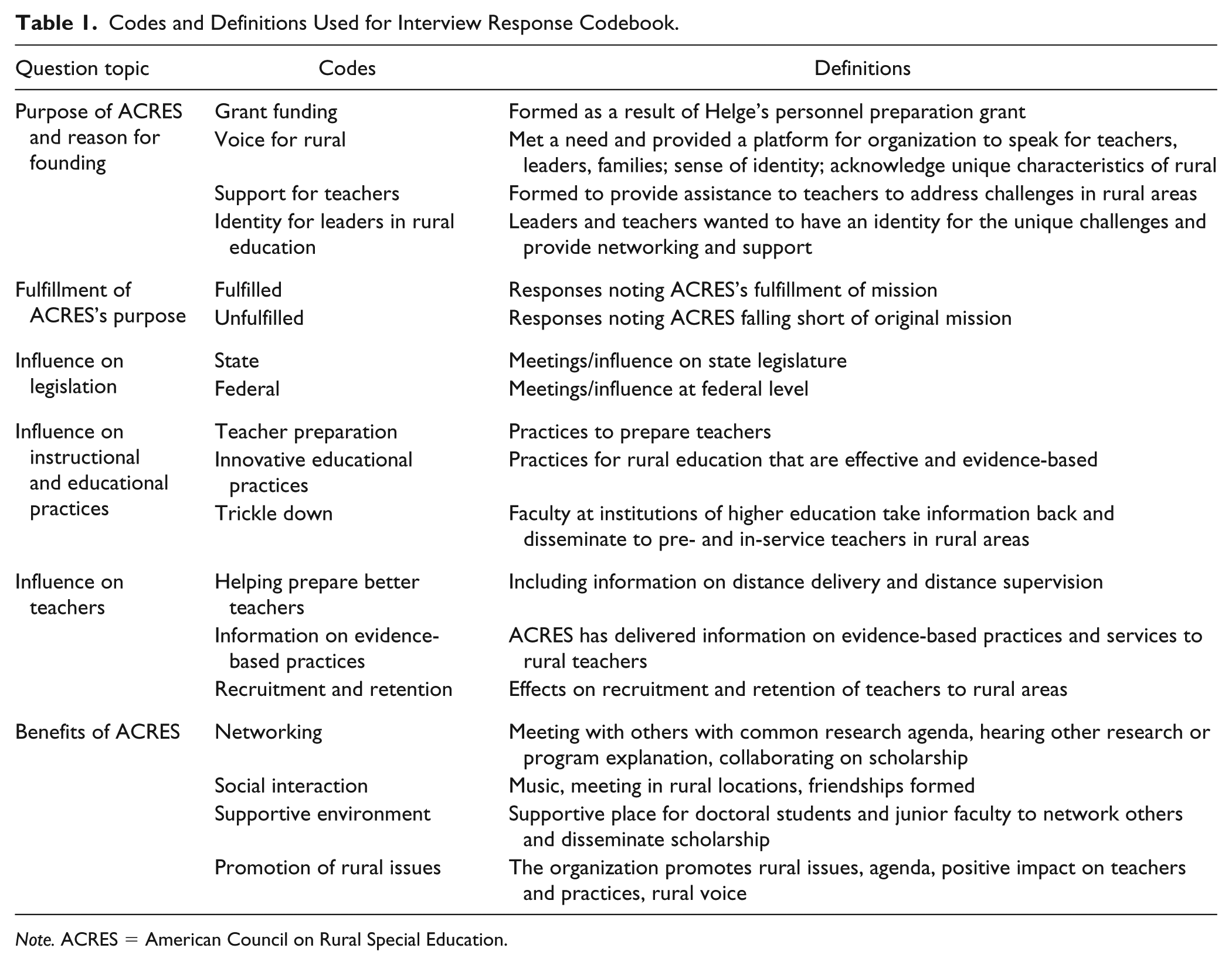
Note. ACRES = American Council on Rural Special Education.
Procedures
Survey
The investigators distributed invitations to complete the survey to the email addresses of the identified sample. The survey was self-administered, anonymous, and was available in an online version using a secure Web-based platform. All of the submitted surveys contained responses complete enough to be used in the final analysis.
Interview
The investigators contacted the interviewees via email to make an appointment for the interview. The investigators then conducted the interviews either over the phone or in person. Interviewees were read a script describing the purpose of the interview and the interest in documenting the evolution and influence of ACRES. Once interviewees verbally agreed to participate, the interview was conducted. Interviewers asked the 10 questions, using follow-up questions to ensure clarity as needed. The interview responses were recorded by the interviewer taking notes and were not audio-recorded.
Data Analysis
The second author summarized the survey data using descriptive statistics. For the interview data, the investigators analyzed the data by focusing on developing codes and themes that described the founding, evolution, and impact of ACRES from the perspective of individuals who had been involved in the founding and early work of the organization. Responses of the interviewees were recorded in separate rows of an Excel spreadsheet with columns beside each response to indicate the name of the interviewee and assignment of qualitative codes. The first and third authors served as the primary coders of the data. These investigators analyzed the responses using an open coding, categorization, and development of themes (Charmaz & Bryant, 2016; Strauss & Corbin, 1998).
The analysis of the interview responses was conducted in a series of steps. A constant-comparative method was used to generate initial codes, followed by meetings between the coders to refine and define the codes, develop categories emerging from the data, and ensure rigor (Lincoln, 1995; Lincoln & Guba, 1985). First, the two investigators independently read through three interviews that each of them had personally conducted and formed initial analytical codes for categorizing responses related to the founding and impact of ACRES. Second, the investigators met to discuss and refine the initial codes. During this meeting, the investigators organized the Excel sheet by survey question, reached a consensus on codes to use for each question, collaboratively defined the codes, and created a codebook. The codes and definitions, by survey question, are shown in Table 1. Third, using the codebook, the investigators independently recorded all of the seven interviews they had not coded, as well as reviewed the three they had originally coded, to make adjustments using the codebook. They continued to use this constant-comparative method (Lincoln & Guba, 1985) to determine whether the data could be categorized using one of the existing codes or whether additional codes should be included to capture the categories that emerged from the data (Miles, Huberman, & Saldaña, 2014). Fourth, the investigators then met again to compare codes they assigned to responses, discuss, and reach consensus if a disagreement occurred. Finally, after all interviews had been coded, the investigators independently identified overarching themes that emerged from the data and then met to reach consensus on the themes.
Triangulation of the data in this study was accomplished by using multiple researchers to analyze the data, develop codes, discuss definitions, and reach consensus on 100% of the interview responses. Data were also gathered from multiple survey respondents and interviewees that reflected diversity in geographic location, age, and time of involvement with the organization (Glesne, 2016). Once interviews were conducted, the investigators sent the typed responses to each survey question to the interviewees and asked them to indicate whether the typed response adequately and accurately represented their original response. All edits were added to the data as needed. This member checking process enhanced the credibility of the data by ensuring the interviewees’ responses were accurately reflected in the data (Krefting, 1991). To enhance dependability, the investigators provided access to the survey questions, the methods employed, and analysis used so that other researchers could replicate the procedures (Shenton, 2004). To ensure that the findings were an objective representation of the data rather than biases of the investigators, multiple researchers coded all interviews and reached consensus on the codes and theme development (Brotherson & Goldstein, 1992).
Results
Both the survey and interview results are provided in this section. Under each heading, we present the survey data followed by the interview codes that contribute additional information to the same topic. Quotations from the interviewees are provided to support and exemplify the codes.
Participants
Years of active involvement
Of the survey respondents, one reported active involvement in ACRES since its inception. Five of the survey respondents had been active since 1989, and the remaining three had been actively involved in ACRES since 1994. Two of the interviewees had been involved in the organization since 1986, four took on leadership roles in ACRES in 1992, with the remaining four in 1995 and 1996. The scarcity of data from the years prior to 1989 may be due to the small number of survey respondents and difficulty locating individuals from the earliest years of ACRES’s existence.
Leadership roles in ACRES
The majority (n = 7) of the survey respondents reported that their involvement with ACRES was as an officer, a member of the Board of Directors, and/or an ACRES committee chair. Survey respondents reported they were historian, editor of the journal Rural Special Education Quarterly (RSEQ), member of the RSEQ editorial review board, or codirector of the ACRES headquarters. Others mentioned being employed by the National Rural Development Institute (the organization that preceded ACRES), being editor for Journal of Rural Social Sciences, preparing ACRES’s newsletters, writing and proofing monographs, running the information clearinghouse at Western Washington University, and “representing a national clearinghouse on education of children and youth with disabilities.” Survey respondents appeared to have been actively involved in the operations of ACRES throughout its earliest years. The interviewees were all past board members and two had been editors of RSEQ.
Purpose and Evolution of ACRES
According to one survey respondent’s recollection, the beginnings of an organization to address the needs of rural special education were formed in the late 1970s. The majority of interviewees indicated that ACRES was founded as a result of an Office of Special Education Programs (OSEP) personnel preparation grant acquired by Dr. Doris Helge, a faculty member at Murray State University in Kentucky. The focus of the grant was to address rural special education issues and prepare teachers to teach in rural communities. Initially, as the early members recall, Dr. Helge started the National Rural Development Institute which was intended to support rural education research by “linking members with similar interests and providing data banks of resources” (Esping & Thurston, 2000, para. 1). Early on, Craig Howley with ERIC Clearinghouse on Rural Education and Small Schools (ERIC-CRESS) and the Northwest Regional Education Lab were also supporters.
The first conference of the organization was held at Murray State University in Murray, Kentucky, in 1981 and was a grassroots effort. At that conference, Dr. Helge served as the executive director and founder of ACRES (ACRES, 2017; Fishbaugh & Mitchem, 2005). Dr. Helge recruited individuals who were directors of other rural teacher preparation grants to the organization. An interviewee recalled meeting Dr. Helge at the Council for Exceptional Children (CEC) conference and being invited to attend the ACRES conference the following year. Dr. Helge invited Bill Wienke, Barbara Ludlow, and Joan Sebastian who also had grant-funded teacher preparation projects, to the sixth conference in Tucson, Arizona, in 1986. This conference also was attended by Norm Howe and Robert Gilmore of the Office of Special Education and Rehabilitative Services of the U.S. Department of Education. ACRES has held a conference every year since then with the exception of 2012, a year that the board voted to not hold a conference.
Survey respondents noted five reasons for the founding of ACRES: (a) to provide a clearinghouse for the discussion of research and practice related to rural special education; (b) to provide a voice in congressional committees and in various legislatures, in support of children and their families in rural areas; (c) to bring national attention to rural special education through a professional publication (RSEQ) and through ACRES national conferences; (d) to promote the preparation of quality teachers, ready to provide needed services and to work with individuals with disabilities in rural and remote environments; and (e) to address a gap in the research literature and focus on needs of individuals with disabilities who live in rural and remote areas.
Thus, ACRES provided not only a venue for presenting research for these purposes but also an outlet for dissemination of information on rural issues in its journal. One early member recounted that RSEQ originally disseminated information to its early members on carbon copies. Today, the journal highlights innovative practices for teachers in rural areas and is distributed in print and electronic formats, thus reaching a wider audience.
The interviewees, several who had been members since ACRES’s early days, expanded upon four of the themes identified in the survey in their statements about the purpose of ACRES’s founding. From the perspective of these early members, ACRES’s original mission was (a) to provide a voice for the unique needs and challenges faced by rural leaders and teachers, (b) to provide an identity for leaders in rural education, (c) to help shape policy that would provide support to meet those needs, and (d) to help better prepare teachers to provide special education services in rural areas.
Voice
Interviewees (n = 3) saw ACRES’s founding as a way to provide a voice for those in rural special education. Interviewees mentioned that prior to ACRES, rural special education “did not have a voice,” that ACRES was the “first organization to be focused on the rural special education process,” and that there was “no organization that focused on the unique needs of special education in the context of rural.” “As I recall,” recounted one of the original members, the federal government emphasis was on the problems and needs of inner city schools—educators in rural communities were advocating for the special concerns of the schools in their communities. ACRES was a subset of those activities focused on special education.
ACRES “met a need that was significant at the time.”
Identity
Interviewees (n = 4) also discussed how the organization brought people together, including universities and college faculty who were preparing teachers to teach in rural special education, provided a place to support and assist others interested in serving individuals with disabilities in rural areas, and provided a sense of identity. For example, one individual stated, “Rural is very different depending on where you go. Our national organization provides a sense of identity, opportunities, potential ideas, and innovation that can be tried in those different contexts.”
Support
Similar statements were made about ACRES’s mission to support rural teachers. Interviewees (n = 4) discussed the challenges of recruitment and retention of rural teachers, and the need for an organization to assist, support, and address those unique challenges of education in rural areas. One interviewee mentioned that the OSEP grant was awarded in recognition of “how difficult it is to serve students with disabilities in small, rural areas.”
Teacher preparation
Early commitment to the organization centered on issues for rural families in totality and included issues such as health and education. The focus evolved to encompass students with disabilities and the preparation of teachers to teach in more rural areas. This focus has been accomplished by involving higher education faculty, state special education directors, and rural teachers in the organization and its yearly conference.
Strong Leadership Through the Years
Several interviewees remarked on ACRES’s leaders. “In the beginning Doris Helge did everything for ACRES.” Several years later, the founders and Doris could no longer sustain the efforts and energy she had invested in the organization. "She had been the face of ACRES since its inception.” After the grant funds were depleted, different universities took on various responsibilities. ACRES’s central headquarters, the fiscal organization of ACRES, has moved around over the years and has been housed in several locations including Washington; Oklahoma; Kansas; shared by Kentucky, Utah, Florida, and West Virginia; Montana; and now is in West Virginia. At one point, a large donation was given by Dennis Cates to help sustain the organization. Sustainability, however, has been an issue for ACRES as an organization. Concerns related to membership, conferences, maintaining effective advocacy, and just keeping the organization going have been raised throughout its history.
The interviewees indicated that strong leadership within the organization has been ACRES’s saving grace; at one point when the organization floundered, there was no headquarters. Members of different institutions of higher education worked together to take on responsibilities as a "labor of love," according to one early leader, until the organization regained its financial stability. There was a real spirit of keeping ACRES going through the years. Another interviewee stated, ACRES has been “blessed with remarkable leaders.”
At several points in its history (2011 and 2014), ACRES had considered joining forces with larger organizations. ACRES members had discussed a merger with the National Rural Education Association (NREA) and becoming a special interest group (SIG) of the CEC. To some of the early members, this seemed like a prudent idea both financially and professionally. A merger would allow members to present and network at national conferences with a larger number of individuals interested in special education and rural issues. A merger could have even allowed the journal to reach a larger national audience; however, ACRES’s leadership and members found themselves divided in support of a merger. The NREA organization drew in practitioners but fewer higher education faculty. Its focus was primarily on rural education, not special education. While aspects of CEC centered in special education and teacher preparation, the organization was large in size and scope, and some of ACRES’s leaders worried that in such a large organization, with such an expansive conference, ACRES’s members and their interests might get shortchanged. Some early members felt concerned that the identity that had been forged as a small, personal, caring organization would be lost. In the end, ACRES has remained its own entity and kept its identity. An interviewee stated, “The advantages of being smaller but more focused were greater than the advantages of a small voice in a larger organization or maybe no voice at all.”
Has ACRES Fulfilled Its Purpose?
Survey respondents were asked to indicate whether ACRES has been effective given its purpose. All nine respondents indicated “somewhat” to “extremely well” on the survey. However most survey respondents (n = 4) marked “Somewhat.”
The sentiments of the early ACRES leaders who were interviewed were divided as to whether ACRES had fulfilled its original purpose as expressed by its mission. Half of the 10 interviewees felt ACRES had fallen short of fulfilling its original purpose. These early members expressed concern that in the 37 years since ACRES’s founding, the nation is still largely unaware of the challenges faced by rural special education teachers. Members commented on the lack of funding, the lack of advocacy by leaders for rural issues, the small number in the membership, the modest number of attendees at the national conference who were largely higher education faculty and rural special education administrators, and the limited readership of the journal. These members expressed a desire for rekindling a wider focus for the organization to include rural families of children with disabilities, rural teachers, and rural schools. As one early member stated, Part of the original goal of ACRES was also to serve the schools—in the beginning the RuraLink newsletter had more information for classroom teachers and conferences had more information for teachers, but we have not been able to maintain that focus. [Rather] mostly higher education faculty attend the conference, publish in the journal, and run the organization so their interests do not align as well with school interests.
However, an equal number of the interviewees stated ACRES had done an “exemplary job” of fulfilling its mission. First, interviewees indicated that the organization attracts higher education faculty preparing teachers to work in rural areas and has served them well. The conference and journal disseminate innovative practices that help prepare better teachers. “I think ACRES has done a good job of educating and serving the higher education community—the fact that the journal is respected and the organization continues to do well is testament to that.” Second, interviewees felt one of ACRES’s strengths was its members and that it has been able to sustain its mission because it has attracted committed and strong leaders who are passionate about rural issues. “We have maintained that original focus in that we are the only organization that focuses on the needs of rural special education, students with disabilities, teachers and families.” Third, interviewees said ACRES was meeting its mission by continuing to advocate for the needs of rural schools and individuals with disabilities with state agencies, federal agencies, and legislative bodies.
Notable Conference Topics Addressed Over the Years
Survey respondents were asked to provide information on conferences and notable topics covered by the organization. They indicated that the first conferences were linked with the National Small Schools organization, with school administrators and higher education faculty attending the conferences. Survey and interview comments highlighted the keynote speakers, interesting sessions during the conference, and networking with colleagues involved with the editorial board. Graduate students were welcomed and assistant professors were encouraged to share their research. One survey respondent wrote, “Two things that drew me to staying with ACRES all these years . . . [are] . . . its dedication to the realization that gifted is a category of exceptionality and its ability to welcome research.”
A variety of topics were identified in the survey as “hot” or important topics addressed over the years. Several topics align with the identified mission for ACRES: the historical value of rural special education; policy and advocacy in supporting rural education; rural educators’ retention, training, and evaluation; the delivery of educational programs for children living in rural communities; and practices in schools such as response to intervention, functional behavior assessment, inclusion, No Child Left Behind, assessment, technology, meeting student needs, teacher preparation and recruitment, and online education.
Areas of Impact
Both survey respondents and interviewees were asked to reflect on the impact of ACRES. Of note, the areas of impact that came forward mirror the purposes outlined for ACRES’s founding. Survey respondents indicated that ACRES has striven to influence legislation related to rural special education, teachers, and educational practices. Interviewees mostly spoke to advocacy and awareness and educator support as areas of impact.
Impact on legislation and federal policy
When asked how well ACRES had affected legislation, no survey respondents marked “extremely well,” and one marked “unsure.” The remaining eight survey respondents indicated that ACRES’s influence on legislation has been “somewhat” or “well.”
From the perspective of the early members who were interviewed, the data indicate that efforts to impact rural legislation and policy have fluctuated over the years. At the state level, members visited their own congressional delegation office in key rural states to raise awareness. Members have lobbied for funding and received grants to organize rural centers to train and support teachers in their state. At the federal level, ACRES members have continued to communicate with their legislators and raised the level of awareness for rural special education issues. ACRES has presented white papers and policy statements, and publications in RSEQ have addressed many rural special education issues. Federal policy and guideline updates have been provided at many ACRES conferences by individuals from organizations such as the OSEP and the American Association of Colleges for Teacher Education, as examples. ACRES members worked with consultant Jane West and went to Washington, DC., to talk with and educate congressional representatives on how legislation under consideration would affect rural areas. An interviewee noted, “As a result, the word ‘rural’ was placed in a grant competition” for personnel preparation grants: [We have been a] a small organization and [at times] struggling to survive. The voice is not always present. [There are] not the resources to [work with legislators]. As the organization gets stronger [and] grows, hopefully by putting the journal with [Hammill], that will take the burden off for some folks. [By] growing stronger and being more stable [we may be able to] make [interactions with congressional representatives] a priority.
Another interviewee stated, [ACRES] brings a voice. Because we exist we bring that attention to that [rural] population. We’ve really struggled to maintain the organization over the years and that is commendable as that tiny voice could go away. We exist because we are still out there advocating for this population and it has an impact, not as much as we’d like but it is still there.
Impact on instructional and educational practices
When asked how well ACRES had affected instructional and educational practices in rural areas, most (n = 8) survey responders marked “somewhat” or “well.” Not all survey respondents were “sure.” No one marked “extremely well.”
Survey respondents indicated that ACRES has informed educational practices. One respondent wrote, “The journal, newsletter, conference, and proceedings are positive and tangible forces to influence educational practices.” ACRES dissemination of information and training is specialized, specific to the topic of rural special education. ACRES has promoted improvements in many areas of remote and rural special education such as in areas of low incidence disabilities, health/medical issues, ethics, use of technology, resources, and work with families, in short “ . . . professionalizing rural special education.”
Comments from the early members during the interviews on ACRES’s impact on instructional and educational practices were grouped into three categories: (a) dissemination of information on innovative educational practices; (b) the trickle-down effect when higher education faculty, involved in preservice teacher preparation, used effective teaching strategies and practices and taught their students to use these practices; and (c) preparation of rural special education teachers.
Innovative educational practices
One early member stated, “Our membership is entrepreneurial, more willing to adopt practices that work for rural areas.” Another individual stated, “ACRES was from the beginning a leader in mainstreaming, then a leader in inclusive education and has continued to be a leader in multi-tiered systems of support.” ACRES has been instrumental in disseminating information on rural and remote educational needs including remote learning or experimenting with different approaches that work for teachers in remote areas and strategies for working with students in rural areas.
Trickle down
Interviewees indicated that professors brought back what they learned at the ACRES conference to their classes with preservice teachers. “ACRES has been a vehicle for helping to spread best practices throughout its professional community. Then that has ripple effects in other professional communities.”
Teacher preparation
In the words of one ACRES leader, Through research and promising practices published in our journal of best practices, [we have helped to prepare better teachers.] A monograph on distance delivery, for example, was timely [for] how you prepare individuals to teach in rural communities. ACRES is a real rich resource that can be utilized.
Another individual stated, I am absolutely sure that ACRES has had an impact on higher education practices because it was our members doing the groundbreaking work in distance education and later online learning and disseminating it though our journals. It is harder to get a handle on how much the presentations and publications focused on school-based practices have impacted the field.
For supporting educators, four of the interviewees felt that ACRES’s biggest impact has been on the preparation of teachers who work in rural areas. “ACRES was involved in promoting live distance classes using satellite which first appeared in Utah.” Better prepared teachers also meant preparing them to teach in rural areas and supporting them to remain in their rural schools.
Impact on teachers
From the perspective of the survey respondents, ACRES influence on teachers has been primarily (a) indirect by influencing university and college instructors (n = 6), (b) through the ACRES journal, RSEQ (n = 2), and (c) at times through the ACRES National Conference (n = 1). ACRES provides a forum (through the ACRES National Conference and through RSEQ) for presenting relevant research related to rural special education which then encourages more research and which may include teachers in the actual research, hence fostering collaboration. University and college faculty who attend the ACRES Conference and who read articles and submit manuscripts to RSEQ are better informed about issues relevant to rural special education. Faculty share that information in preservice programs with teacher preparation candidates. In addition, teacher candidates can read selected articles or attend the national conference when it is held near them.
The interviewees also spoke of how ACRES has influenced teachers by (a) helping to prepare better teachers, (b) providing information on evidence-based practices, and (c) through efforts to contribute to recruitment and retention of rural teachers.
Preparing better teachers
As many ACRES members are faculty at institutions of higher education, most of the interviewees indicated that ACRES has allowed them to prepare better teachers by sharing strategies and ideas at the conference and through publishing in RSEQ. Sharing innovative strategies allows faculty to reach preservice and in-service teachers that need the information to provide quality special education. Topics mentioned included using new technologies, developing and delivering courses, and conducting field supervision.
Evidence-based practices
Other interviewees discussed how ACRES has focused on providing information on evidence-based methods and services for rural areas. ACRES has disseminated methods that “are effective in small, rural programs,” and it has been a “clearinghouse for individuals looking for services” when they are unsure about what to do. Others mentioned that ACRES members who are faculty take the practices they learn at the conference back to their “home campus,” which influences what they teach in their courses. Participation with ACRES allows faculty to learn research-based practices through discussions with peers and by accessing RSEQ.
Recruitment and retention
Finally, interviewees mentioned that ACRES has influenced teachers by disseminating information on recruitment and retention that may have affected school systems in rural districts. In addition, one interviewee said that ACRES’s teacher scholarship program, which provides stipends for rural special educators seeking advanced degrees in special education, helps to “build the capacity to have folks go into rural school districts.”
Benefits of ACRES
We asked interviewees to describe additional benefits they could attribute to ACRES. They discussed benefits related to networking, socializing, a supportive environment, and awareness and promotion of rural issues.
Networking
First, most interviewees reported that being a member of ACRES afforded them the opportunity to network and meet with others who had similar research interests and provided opportunities for collaboration. Interviewees said that ACRES allowed them to “form relationships with others” with whom they could write and research rural issues, to meet with individuals and share ideas and strategies, and to develop relationships that have supported their “college teaching and research for many years.” One interviewee stated, “The social networking in a fun atmosphere has created relationships in my career for collaborating on research and grants.”
In addition, ACRES helped individuals have a network of professionals to call upon when problem-solving issues arise in rural special education and to assist when trying to determine how to implement a particular practice in their home area. One member indicated that because of the small nature of ACRES, “everyone is involved,” “has a role,” and all function together, which is the power of the organization. Members have buy-in and make a contribution.
Relationships
One of the special qualities of ACRES, which makes it different from other professional organizations in our field, is the friendliness of the ACRES members. A number of individuals mentioned that having the opportunity to develop social relationships was a benefit of being a member of ACRES. They named many social events that had taken place at conferences such as boat rides, fish fries, barn dances, silent auctions, and conference receptions. Perhaps the Old Timers-New Comers reception best depicts the warmth of the members and their receptiveness to people attending ACRES Conferences for the first time. An individual stated this reception was unique in that the old timers didn’t just talk among themselves in their own world and club (like so many of the other professional organizations I attended over the years), but everyone welcomed newcomers and used the reception as a time to recruit activity among researchers, teachers, and those representing colleges and universities.
There have been a variety of interesting events, awards, and prizes over the years and interviewees had several comments. “I look(ed) forward to the awards, especially the golden toilet plunger. We all love the ‘you must be rural’ jokes and awards given during the conference.” “[I] also have fond memories of the bidding wars at the silent auctions each year.” When describing the silent auctions, an interviewee stated, You may recall an item you really liked that was on display at one of the silent auctions. You place a bid for it, check on your bid and no one else has bid . . . and then 15 seconds before the auction closes, when you are sure you have won it, someone slips in and out bids you! Lots of fun!
Another interviewee stated that the small size of the organization has allowed the opportunity to develop “deep personal friendships.” This is one of the “major values of ACRES.”
Scholarship in a supportive environment
Individuals also named scholarship opportunities as a benefit of ACRES. They mentioned activities such as collaborating on projects and papers, publishing in RSEQ, building research agendas, and presenting at the conference. One individual discussed how ACRES has been a venue for many new and continuing faculty to build their scholarship. “I have loved involving my doctoral students in ACRES so they get to know people on a personal basis.”
Awareness
Finally, interviewees noted that the organization allows for the awareness and promotion of rural issues. First, RSEQ has invited nationally known authors and had an identity as a respected journal that published articles focusing on issues of rural education (e.g., recruitment and retention of special education teachers in rural regions). Second, ACRES has provided a voice for rural special education in advocacy efforts at the federal level. ACRES has been influential because its members are special education leaders from across the country, in the “North, East, South, and West.” ACRES has focused national attention on understanding the differences that are encountered in rural special education as well as the challenges and “similarities in rural special education.”
Conclusion and Discussion
The purpose of this study was to provide a historical record of the early members of ACRES, and their recollections of the founding and evolution of the organization. In addition, the study examined the perceptions of the participants on the impact of ACRES on rural special education, the benefits of membership, and future directions. Based on the demographics of the participants, we were successful in identifying survey respondents and interviewees who were early or founding members and who had been involved in a variety of leadership roles over the years, although the relatively small number of survey responses and interviews is a limitation of this study. Although outside of the scope of this study, future research may consider searching RSEQ and the conference proceedings for additional historical information about ACRES that may be gleaned from these sources.
The investigators identified five overarching themes that emerged from the data. These were themes that occurred multiple times throughout the survey and interview data and were mentioned by multiple participants. The themes included (a) unique needs of rural special education, (b) a voice for rural special education, (c) people with a passion, (d) friendliness of the organization, and (e) future directions. Study findings are discussed in terms of each theme.
Unique Needs of Rural Special Education
The theme that rural special education is unique and needs to be a focus of the organization emerged across the survey and interview data. Respondents indicated how ACRES emphasizes that special education within a rural context has unique problems and features that require unique solutions and discussion. For example, interviewees noted long-standing challenges of recruitment and retention of teachers in rural areas, and while the challenges persist, the methods used to solve the problems have evolved over time, with the most recent application being technologies to reach rural teachers. Some interviewees noted that while ACRES has largely focused on rural special education, there was a need to concentrate on a wider scope of needs for individuals living in rural areas. ACRES could address topics that pose unique challenges in rural areas such as the economy, general education, families, and health issues. Most survey respondents and interviewees agreed that ACRES has influenced educational practices and teachers in rural areas, mostly through teacher preparation using distance education and strength of the higher education faculty who heavily influence the organization. Both RSEQ and the annual conference were identified as valuable contributions for individuals who were looking to gather information in their own area.
Voice for Rural
ACRES serving as a voice for rural issues emerged as a theme. While interviewees seem to agree that ACRES provides a voice for rural environments in advocacy, dissemination of information, and in support of teachers, they did not agree on the effectiveness of that voice. Some interviewees pointed to positive impacts in these areas, but others indicated room for improvement. They noted limitations of ACRES’s relatively small membership, which prevents large impact at local, state, and federal levels, and the lack of diversity of the membership given the high number of higher education faculty.
People With a Passion
Survey respondents and interviewees repeatedly noted that the organization has sustained its work over the years due to the passion of the individuals who have served the organization. The participants noted the relationships they formed with each other with similar interests made them a strong force. Their work has been a “labor of love,” and strong leaders with interest in rural education have sustained ACRES over time.
Friendliness of ACRES
An additional theme that emerged is the friendliness of the organization as a strength of ACRES. Numerous individuals noted that ACRES was unique in its focus on a friendly and supportive environment for individuals to network and develop their scholarship. Longtime members were noted as interacting with new members in events such as receptions with many opportunities provided for networking at conferences. ACRES is known as an organization that is highly receptive to doctoral students and junior faculty developing their scholarship, although some individuals note that the small size of the conference, although advantageous for networking, was a disadvantage for faculty wanting to make more of an impact with their travel funds and presentations.
Future Directions
Across survey and interview responses, the results indicate a final theme: the need for ACRES to do additional work to adequately meet its mission. These responses provide an important starting point for gathering information from ACRES’s past and providing informed suggestions to the ACRES Board.
During the interviews, the investigators noted possible future directions for ACRES as they were mentioned. These included expanding the reach of ACRES, using technology to assist in meeting its mission, expanding its advocacy efforts, building its membership, and marketing ACRES’s initiatives.
Expanding ACRES focus
Interviewees made recommendations including expanding ACRES’s focus beyond a higher education focus to become more “practitioner or family based as well,” and to “get back to the mission of family as a whole.” One individual mentioned the possibility of joining with other organizations to expand ACRES’s influence. Another similar direction would be to present more at national conferences and explore forming a rural SIG with the CEC. Collins, Leahy, and Ault (2017) described the importance of individuals, other than higher education faculty, becoming active in professional organizations to expand their influence beyond their local areas to state and national levels.
Utilizing technology
Strategic use of technology and the Internet also was mentioned as a future direction. One individual mentioned using ACRES’s website as a place for individuals to find “good ideas and not worry about joining” ACRES, perhaps having a practitioner journal that individuals could access on the Internet. Additional use of the Internet was mentioned for advocacy purposes by issuing Call to Action alerts for issues that arise during the year, advocating for technological advances that would be advantageous for rural special education, and advocating for getting that technology in place for those practitioners and students who need it. Researchers have described the use of technology as a way to deliver professional development and prepare special education teachers in rural regions (Dieker, Hynes, Hughes, Hardin, & Becht, 2015; Hager, 2011; Rooks-Ellis, 2017) and to deliver services in geographically isolated areas. This has included the use of telepractice to deliver speech/language services to rural communities (Lowman & Kleinert, 2017) and coaching of parents of children with autism using the Internet (Meadan, Meyer, Snodgrass, & Halle, 2013). Finally, an interviewee mentioned that ACRES could have more influence in the future through providing webinars and having more of a presence through the use of an interactive website and social media outlets.
Advocacy and building membership
Interviewees noted that continued advocacy should be a focus of the future including writing letters to make a case for rural special education at the federal level and reaching out internationally to countries who have many rural areas. Recently, Rude and Miller (2018) discussed current policy issues important for rural special education, and Ault, Bausch, and Ackerman (2018) discussed how individuals can effectively advocate with legislators for rural issues.
Finally, ACRES should continue membership efforts to increase the numbers of members, perhaps reaching out to past members who were one-time members who may have left the organization. An increased effort on marketing and awareness of the activities of ACRES is an important future direction to recruit new members.
In summary, from the perspective of these early members ACRES has actualized its original mission in many ways. However, there are several opportunities to expand ACRES’s impact and reach, and comments from these pioneers within the organization point a way forward.
Footnotes
Appendix
Survey Items and Response Options.
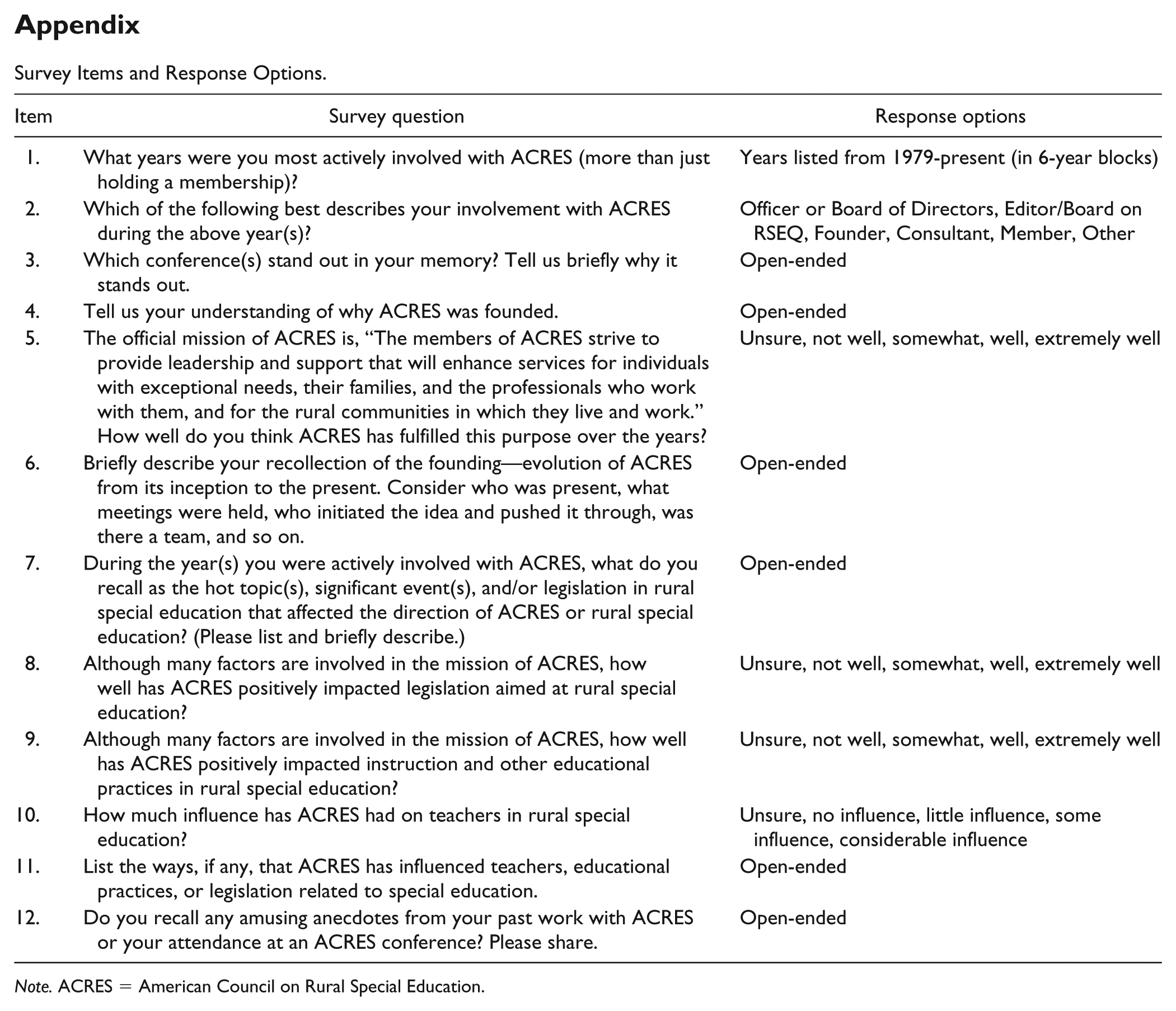
| Item | Survey question | Response options |
|---|---|---|
| 1. | What years were you most actively involved with ACRES (more than just holding a membership)? | Years listed from 1979-present (in 6-year blocks) |
| 2. | Which of the following best describes your involvement with ACRES during the above year(s)? | Officer or Board of Directors, Editor/Board on RSEQ, Founder, Consultant, Member, Other |
| 3. | Which conference(s) stand out in your memory? Tell us briefly why it stands out. | Open-ended |
| 4. | Tell us your understanding of why ACRES was founded. | Open-ended |
| 5. | The official mission of ACRES is, “The members of ACRES strive to provide leadership and support that will enhance services for individuals with exceptional needs, their families, and the professionals who work with them, and for the rural communities in which they live and work.” How well do you think ACRES has fulfilled this purpose over the years? | Unsure, not well, somewhat, well, extremely well |
| 6. | Briefly describe your recollection of the founding—evolution of ACRES from its inception to the present. Consider who was present, what meetings were held, who initiated the idea and pushed it through, was there a team, and so on. | Open-ended |
| 7. | During the year(s) you were actively involved with ACRES, what do you recall as the hot topic(s), significant event(s), and/or legislation in rural special education that affected the direction of ACRES or rural special education? (Please list and briefly describe.) | Open-ended |
| 8. | Although many factors are involved in the mission of ACRES, how well has ACRES positively impacted legislation aimed at rural special education? | Unsure, not well, somewhat, well, extremely well |
| 9. | Although many factors are involved in the mission of ACRES, how well has ACRES positively impacted instruction and other educational practices in rural special education? | Unsure, not well, somewhat, well, extremely well |
| 10. | How much influence has ACRES had on teachers in rural special education? | Unsure, no influence, little influence, some influence, considerable influence |
| 11. | List the ways, if any, that ACRES has influenced teachers, educational practices, or legislation related to special education. | Open-ended |
| 12. | Do you recall any amusing anecdotes from your past work with ACRES or your attendance at an ACRES conference? Please share. | Open-ended |
Note. ACRES = American Council on Rural Special Education.
Declaration of Conflicting Interests
The author(s) declared no potential conflicts of interest with respect to the research, authorship, and/or publication of this article.
Funding
The author(s) received no financial support for the research, authorship, and/or publication of this article.
