







Abstract
This article reports on a qualitative secondary data analysis of a study of upper elementary students’ narrative writing progress in U.S. rural schools. It compares students working online in pairs with those working alone. We explain why the intervention had some positive effects for struggling writers but few effects for skilled writers. The qualitative analysis of student online writing products, student peer feedback, and teacher interviews indicated that struggling writers in the experimental group wrote more ambitious but less coherent stories than struggling writers in the control group, and that skilled writers in the experimental group received poor-quality feedback and were less inclined to revise than skilled writers in the control group. We provide suggestions for writing instruction and technology support for skilled and struggling writers.
Nationally, employers rank writing as both the most important skill for college graduates and the skill that is most deficient in high school students (Casner-Lotto & Barrington, 2006). Results from the 2012 National Assessment of Educational Progress (NAEP) writing assessment indicated that more than 70% of students in U.S. schools did not demonstrate writing proficiency (National Center for Education Statistics, 2012). The Common Core State Standards have shifted emphasis from the writing process to specific writing applications (Porter et al., 2011). For students to be strong writers when they graduate, this emphasis on writing applications must begin early. Meta-analyses of writing research in the elementary grades have suggested effective approaches to improving students’ writing skills. Among these, strategy instruction (average weighted effect size = 1.02) and peer assistance (average weighted effect size = 0.89) were the two most promising interventions (Graham et al., 2012). Although not as strong as the strategy instruction and in-person peer assistance, a meta-analysis of the effects of using computers in writing indicated that use of computers in composing drafts improves both the quantity (average weighted effect size = 0.5) and quality (average weighted effect size = 0.4) of written products (Goldberg et al., 2003).
Given that online environments have long been shown to be fertile spaces for collaboration (e.g., Talib & Cheung, 2017; Williams & Beam, 2019), we designed a study to examine those approaches identified as evidence-based in a meta-analysis by Graham et al. (2012) (i.e., peer assistance and strategy instruction) in an online learning environment (see S. Lee et al., 2019). In this original or “parent” study, we paired a small group of struggling writers at one elementary school with a group of skilled writers at another elementary school, both schools in rural areas, where collaborations tend to be difficult due to geographical isolation (McKissick et al., 2017). We also chose heterogeneous pairings to reflect rural settings where teachers tend to serve students with a wide range of abilities due to smaller enrollments than urban schools (McKissick et al., 2017). Contrary to our expectations, students who worked in pairs did not show clear writing improvement over those who worked independently, particularly among skilled writers. Thus, the present study aims to explain why the expected outcome was not found in the parent study by applying a secondary analysis to the data yielded in the parent study.
Cooperative Writing
Despite the need to learn more about collaborative writing, Graham et al. (2012) calculated an average weighted effect size of 0.89 for four studies that examined the effects of peer assistance in elementary school writing in a meta-analysis of grade school writing interventions. In one of the four studies, Olson (1990) noted that among mixed-ability students, students in two peer-assistance groups produced higher quality writing than did students in the other two groups. In all of the mixed-ability studies cited by Graham et al. (2012), positive effect sizes were found for both typical and struggling writers for revision with peer feedback.
Qualitatively, Daiute and Dalton (1993) analyzed 7,512 verbal interactions between third-grade students as they wrote collaboratively; these students helped each other generate and evaluate ideas, and 95% of the revisions resulted from the collaborative talk. Sutherland and Topping (1999) further examined peer helping with writing, comparing heterogeneous versus homogeneous groupings using a paired writing method in which one student acted as a helper to the other student who was the writer. In short, both heterogeneous and homogeneous pairs improved their writing more than the control group’s solitary writers. When writing collaboratively, homogeneous groups made progress, but it was difficult to determine the progress of the heterogeneous groups because the writing they produced was better than the writing produced alone by the low-ability writers but worse than the writing produced alone by the helpers.
At the secondary level, Dailey (1991) showed that cooperative writing instruction was more effective for struggling writers than was individual writing instruction in terms of both writing length and overall writing quality. MacArthur et al. (1991) further demonstrated that struggling writers who were taught a peer revising strategy wrote better narratives than those who received process writing instruction alone. Patchan (2011), studying college writers, concluded that homogeneous groupings were most effective for both low- and high-achieving writers; however, even in heterogeneous groupings, both high- and low-achieving writers benefited from peer review. Collectively, these investigations showed that collaborative writing has a positive impact on writing quality for diverse writers, including struggling and skilled writers.
Online Cooperative Writing
Although online collaborative writing is still a relatively new field, the emerging research indicates potential benefits of virtual collaboration for young writers. These include greater attention to larger writing blocks or micro revisions compared with oral feedback among undergraduate second-language learners (Tuzi, 2004), positive student perceptions of digital writing tools for high school students (Nobles & Paganucci, 2015), and improved writing accuracy for undergraduate students (Kessler et al., 2012). Concerning young writers, L. Lee (2010) showed that elementary students learning Spanish as a second language demonstrated higher motivation for self-regulation related to their writing quality by working closely with their peers through a wiki. In particular, students reported that a “wiki fostered collaborative scaffolding through which they helped each other re-organize the content and correct errors” (L. Lee, 2010, p. 268). Two recent review studies additionally showed that technology facilitated collaborative writing and the development of composition and revision skills of kindergarten to 12th-grade students (Talib & Cheung, 2017; Williams & Beam, 2019).
Previous studies also underscore that the simple introduction of collaborative writing tools was not sufficient to instigate improvement, especially for young writers. Students were not inherently engaged by digital technology (Agee et al., 2009), so appropriate instruction must accompany the use of technology to achieve the full benefit from collaborative writing technologies. In particular, writers need to first learn how to collaborate more generally for their online collaboration to be successful (L. Lee, 2010).
Parent Study
Our parent study was designed to examine how peer assistance and revision strategy instruction in an online environment improved writing performances of heterogeneously paired writers (see S. Lee et al., 2019). In this experimental study, we paired struggling writers at two rural elementary schools with skilled writers at two other rural elementary schools. We asked partners to give one another feedback over the course of writing and revising two online stories on Storybird (https://storybird.com/), a user-friendly website where students can write stories and communicate with peers. Skilled and struggling writers in control groups used the same writing strategy instruction lessons and technology but self-assessed their writing and did not receive peer feedback.
We expected to find greater improvement among paired students (experimental group) than students who worked independently (control group). However, contrary to our hypothesis, only struggling writers in the experimental group showed more improvement than those in the control group. When the pre- and post-test writing samples were analyzed in relation to the story logic and ideational originality, the skilled writers who were paired did not show as much improvement as those who wrote alone.
Present Study
The unexpected and somewhat counterintuitive findings from the parent study prompted us to return to our original data with a new question: Why did we not see a clearer improvement in the experimental group’s writing, especially among skilled writers? Our current inquiry uses a qualitative examination of the data gathered in that parent study; namely, we examine the writing process demonstrated on Storybird to explain the outcomes reported in the parent study. This qualitative approach to secondary data analysis is particularly useful in revisiting lingering or emerging questions from parent studies (Greeno & Singer, 2010). In this iteration, we also analyzed comments students gave one another and reanalyzed interviews with teachers who provided insight into the cooperative revision intervention. To understand the unexpected results of the parent study, we formulated three new research questions:
Method
Participants
Two special education teachers and two gifted education teachers, along with five students from each teacher’s class (ranging from fourth to seventh grade), participated in the study. Each of the participating teachers was in a different school in rural areas. All participating teachers had more than 2 years of teaching experience with appropriate teaching endorsements (either special education or gifted education); had struggling writers (special education teachers) or advanced writers (gifted education teachers); and had not used Storybird at the time of recruitment. All the teachers reported providing some writing instruction to their students.
The participating students took the Wechsler Individual Achievement Test–Third Edition (WIAT-III; Wechsler, 2009) to qualify for inclusion in the study. To be identified as a struggling writer, the students needed to receive special education services, and the special education teacher verified that writing was an area of difficulty. Students’ WIAT Written Expression Standard Score was at or below the 25th percentile. Struggling writers in the experimental and control groups did not differ in WIAT Written Expression Composite Standard Scores, t(8) = 1.473, p = .179. To be identified as a skilled writer, participants should have IQ scores exceeding 125, should have obtained achievement above 95% in at least one academic subject area, and should have received gifted education services. In addition, students had to score at or above the 85th percentile on the WIAT-III Written Expression Subtest. Skilled writers in the experimental and control groups did not differ in WIAT Written Expression, t(8) = 1.704, p = .129. Descriptive statistics for both struggling and skilled writers are provided in Table 1.
Participant Characteristics for Study on Narrative Writing.
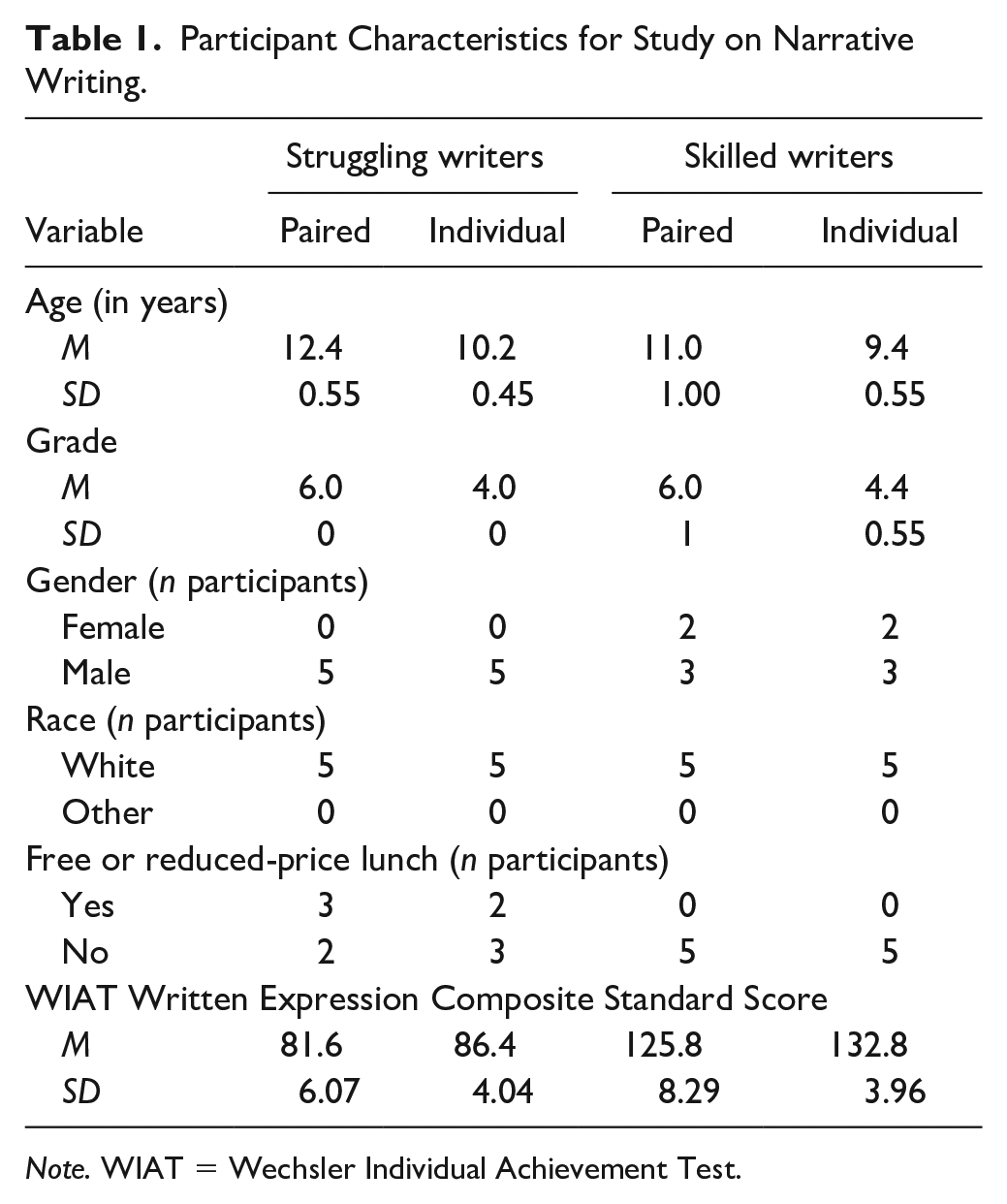
Note. WIAT = Wechsler Individual Achievement Test.
Each teacher’s class was housed in a different small school district across the same rural state. These schools are located in four different rural areas with fewer than 10,000 people (ranging from 69 to 9,318) and over 27 miles from urban areas (ranging from 27 to 95 miles). The size of the schools varied from 236 to 727 students. In the experimental group, five pairs of struggling writers and skilled writers engaged in online collaborative revision. In the control group, five struggling writers and five skilled writers engaged in independent digital story writing. These students were stratified prior to pairing so that their grade levels were identical or close to each other (i.e., no more than one grade level apart).
Instruments, Materials, and Procedures
The Wechsler Individual Achievement Test–Third Edition
The WIAT-III (Wechsler, 2009) is an individually administered standardized test of oral language, reading, written language, and mathematics. All the participating students individually took the Sentence Composition, Essay Composition, and Spelling subtests administered by a trained graduate assistant. Then, the Written Expression Composite was computed and was employed to measure the student’s comprehensive compositional writing skills.
Instructional materials
We provided a script-based teacher’s manual and instructional PowerPoints to all the participating teachers. These instructional materials described step-by-step procedures for how to provide online collaborative writing revision instruction for the experimental group and how to provide online independent writing revision instruction for the control group. The Storybird activities were implemented on internet-accessible classroom computers. Lessons were prestructured according to the “ReadTell ReadAsk ReadSearch” strategies (S. Lee et al., 2019), in which students planned their writing, revisions, and edits and monitored their progress toward their goals. Students used the accompanying revision for each strategy and proofreading-related checklists for the ReadSearch strategy.
The “ReadTell ReadAsk ReadSearch” strategies were developed based on the components of the Self-Regulated Strategy Development (SRSD) peer revision strategy to reflect the demand of online digital writing tasks (e.g., commenting through writing instead of verbal comment; Harris et al., 2008). The first substep, ReadTell, focuses on revising main story structure and elements, whereas the second substep of ReadAsk emphasizes reviewing semantic aspects of the story, such as clarity of the story and adding details. The third substep of ReadAsk was developed to improve high-level writing, including story coherence, creativity, sensory details, and use of figurative language. The last substep of ReadSearch includes editing mechanical aspects of writing, such as punctuation and spelling. All the instructional materials were adapted from Powerful Writing Strategies for All Students (Harris et al., 2008).
Online writing space
We used the online writing space, Storybird, as the site for our writing lessons. Storybird includes a bank of more than 10,000 premade colorful illustrations from illustrators to inspire student creativity (e.g., an image of a flying elephant with five balloons attached to it). Storybird also provides social features such as story “liking” and commenting. The students used a story commenting feature to record their feedback (either for their partner or for their self-assessments). We used the assignment feature to organize the stories into Story 1 and Story 2. The safety features, such as a private classroom, enabled us to connect students from two schools without making students’ writing public and allowed for comment moderation and alerts to cyberbullying or profanity, although we did not experience any such problems.
Procedures
General procedures
All teachers were randomly assigned to an intervention or a control group. Gifted education teachers were randomly assigned either to the experimental or to the control group as were the special education teachers. Depending on their assigned instructional condition (i.e., experimental or control condition), the first and second authors trained all teachers for 8 hr to use Storybird and to implement online peer revision writing instruction for their assigned instructional condition. Next, trained graduate students administered pretests and WIAT-III in each of the four classrooms to preassess writing skills of the participating students. After training and pretests were complete, each of the four teachers taught their students14 writing instruction lessons (60 min each). Students in the experimental group were paired up and revised their stories on Storybird collaboratively, whereas students in the control group worked independently. Then all the students took the posttests administered by the graduate students. Finally, the first author interviewed the four teachers for an hour each; the topic of this interview was their perceptions of the programs’ strengths and weaknesses. Instructional fidelity was monitored biweekly by two trained graduate students, and the results indicated that instruction was provided on 95% of the curriculum components.
Instructional procedures
During the 14 writing sessions, the role of the teacher was to teach the “ReadTell ReadAsk ReadSearch” strategies and model the use of Storybird. In the first and second lessons, all the students learned the “ReadTell ReadAsk ReadSearch” strategies and how to use Storybird. During the second session, students in the experimental group learned how to provide and read comments from their assigned partner on Storybird, whereas those in the control group did not receive this cooperative revision instruction. Paired students in the experimental group exchanged short autobiographies (name, school, and one interesting fact about themselves), but students in the control group did not.
In the third through ninth lessons, all the students wrote and revised a story (Story 1). In the third and fourth lessons, students wrote their first story on Storybird. From the fifth to seventh lessons, students revised Story 1 three times by applying the steps of the ReadTell (fifth lesson), ReadAsk (sixth lesson), and ReadSearch (seventh lesson) strategies and monitoring revision processes by using checklists that provided a list of possible areas to revise, in line with “ReadTell ReadAsk ReadSearch” strategies. Teachers also provided explicit modeling on how to provide feedback in each of the “ReadTell ReadAsk ReadSearch” strategies. Students in the experimental group wrote comments to their peers via Storybird commenting features, whereas control group students wrote feedback to themselves. In the eighth session, all the students finalized and celebrated their completion of Story 1 (see Table 2 for the overview of the instructional procedures). In the 9th through 14th lessons, students repeated the process with a second story (Story 2).
Summary of Comparison Between Experimental and Control Conditions.
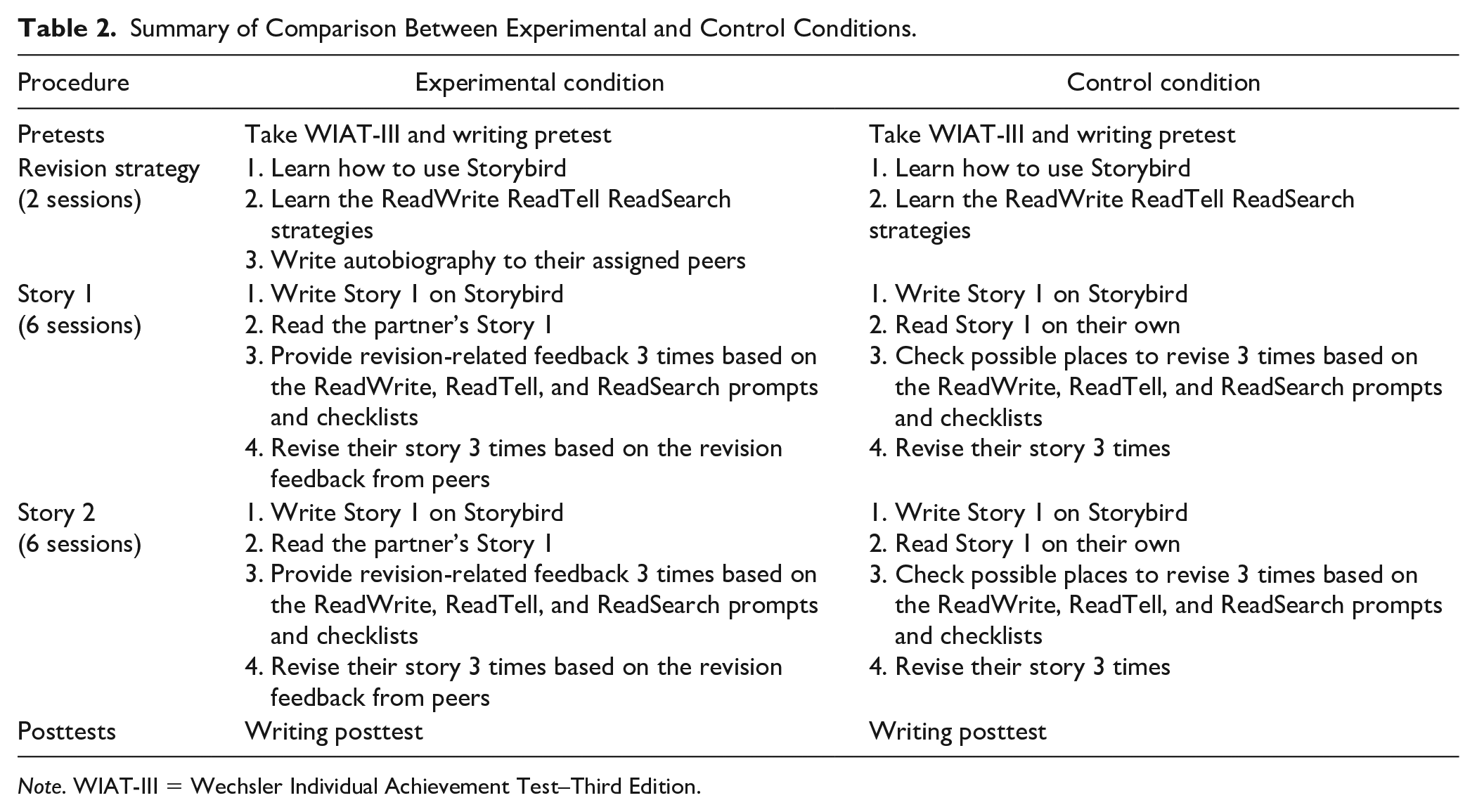
Note. WIAT-III = Wechsler Individual Achievement Test–Third Edition.
Data sources
Our analysis examined three data sources: (a) 20 Story 1 and 20 Story 2 on Storybird (two stories per student; total 40 stories) that students wrote and revised over the course of 14 lessons, (b) approximately 100 total comments that students posted on their own stories or on their partners’ stories (each student was requested to post three comments on Story 1 and another three comments on Story 2, but not everyone posted their comments), and (c) four semi-structured interviews with teachers regarding the strengths and weaknesses of the intervention. All names present in the data were replaced by pseudonyms. The semi-structured interview consisted of 28 questions that directed teachers to describe their experiences using Storybird, their writing instruction, the commenting features, the process of revision, and the overall experience (see Table 3); lasted approximately 30 min; and was conducted by the first author. The responses were audio-recorded, transcribed, and member-checked.
Semi-Structured Interview Questions for Teachers.
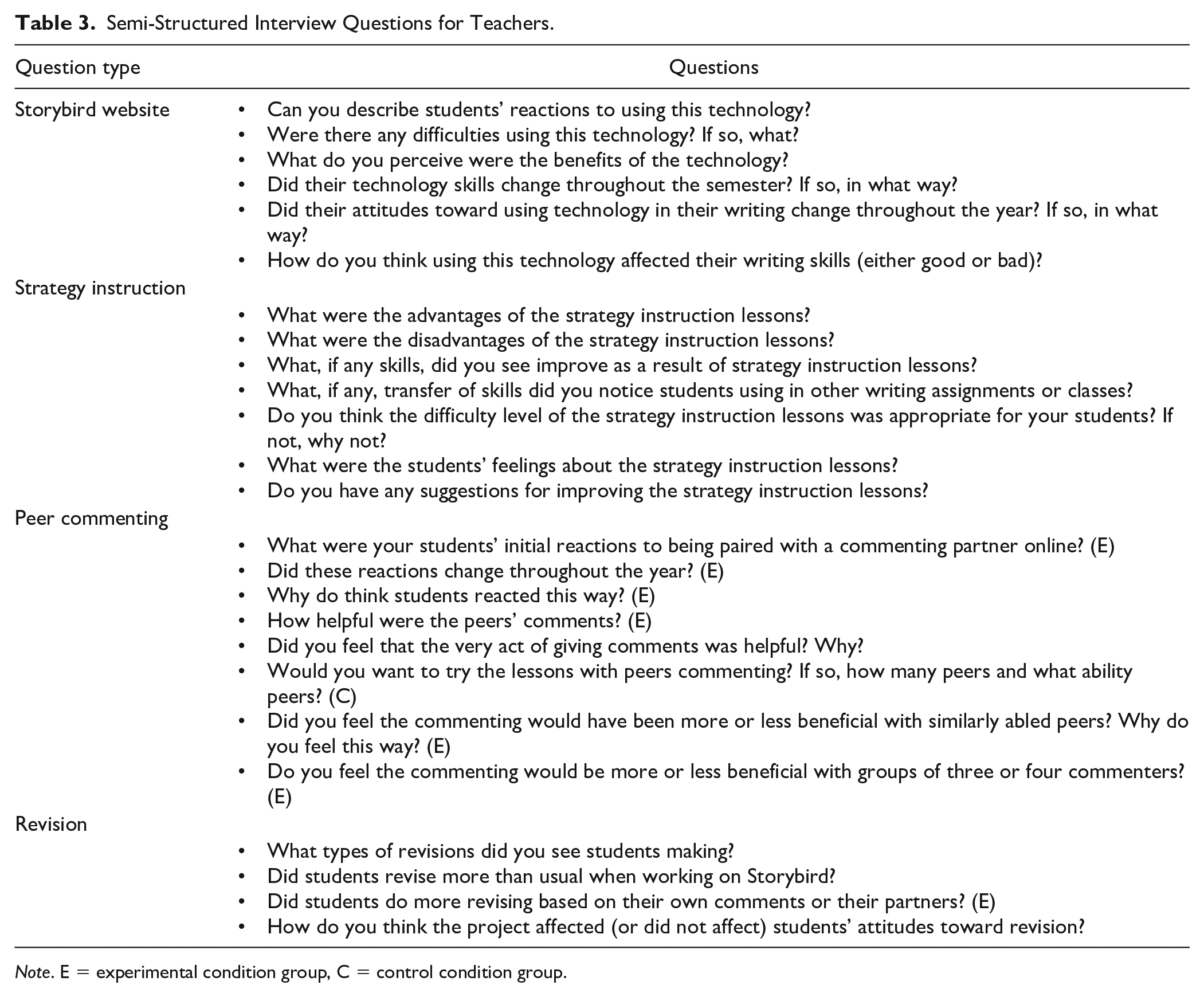
Note. E = experimental condition group, C = control condition group.
Data analysis
To understand how and why some students benefited more from the intervention than others, the data analysis was completed in four phases. In Phase 1, the first and second authors read a sample of four stories (one story from each grouping) and discussed the full range of ways in which the stories could be compared. The primary coder was not blind to the condition of the story, while the secondary coder was. This preliminary discussion was data-driven, rather than theory-driven, that is, the analyzers focused on the ways in which the stories differed and used those differences as the starting points for developing analytic codes, rather than using existing theories to guide the analysis.
Then, the primary and secondary coders identified two central areas to measure progress: creativity and coherence. More specifically, creative stories were defined as original (unusual/different), appropriate (purposeful), and high quality (e.g., using specific vocabulary or demonstrating knowledge of genre conventions). Stories that were not creative were predictable or similar to other stories. Coherent stories were defined as logical, and their varied components (structure, character, tone, and language) were interconnected. Incoherent stories were random, disconnected, or incomplete. We also identified four ways that stories demonstrated creativity and coherence: structure, tone, character, and language. Structure referred to the organization, plot, and genre conventions of the story. Tone referred to the mood of the story. Character referred to character development. Language referred to word choice and use of dialogue and metaphor.
The authors addressed individual biases in a range of ways. First, the three authors come from different subfields and typically situate their work in different scholarly traditions: gifted education, learning disabilities, and literacy and cognition. This range of perspectives allowed for both investigator triangulation and theory triangulation (Stake, 1995), as we challenged one another’s interpretations and ultimately used the data to guide our analytic path.
We ensured that these data-driven analytic themes could be enlisted in service of our research questions, and indeed, our lines of inquiry aligned with analytical themes. We used three forms of data (i.e., stories, comments, and teacher interviews) that were directly related to the three research questions (related to writing progress, student feedback, and teacher insight). The multiple data sources were used as triangulation for validity and reliability purposes (Yin, 1994).
In Phase 2, the first author read all 40 Storybird stories and wrote two to three sentences of descriptive comments for each. These comments focused on creativity and coherence in the stories’ use of character, tone, structure, and language. She also made a subjective judgment about the second story’s holistic improvement (creativity and coherence). She descriptively rated the stories’ creativity and coherence using the following designations: none, slight, moderate, significant improvement, regression. It would not have been aligned with the study’s purpose to judge these stories objectively or against an absolute measure. The researchers had been monitoring the students’ writing progress throughout the study implementation, and individual progress was a specific aim of the study. The first author’s in situ perspective was necessary to understand the extent of each student’s progress. The first author’s 10 years of expertise in teaching writing and 3 years researching talented writers provided further analytical credibility.
In Phase 3, the first author read the comments relating to creativity and coherence that students wrote on their stories or on their partner’s stories. She assigned the comments two subjective ratings based on two criteria: detail and feedback. For example, a comment that suggested one place to add sensory detail might receive a rating of “slight detail” because it would improve the creativity of the story to add sensory detail. A comment suggesting multiple improvements in sensory detail or pointing to important elements of the story that were missing would be labeled as “moderate detail.” Comments that included both moderate detail and conceptual suggestions for making the story themes less confusing or more unique were rated as “significant detail.”
The amount of editing feedback suggested could be none, slight, moderate, or significant. Furthermore, as the first author read the stories, she kept analytic memos of insights and patterns she saw in the students’ writing and comments. Memos included entries for eight separate dates, for a total of about 2,500 words. Story improvement ratings and details are included in Table 4.
Story Improvement and Commenting Ratings.
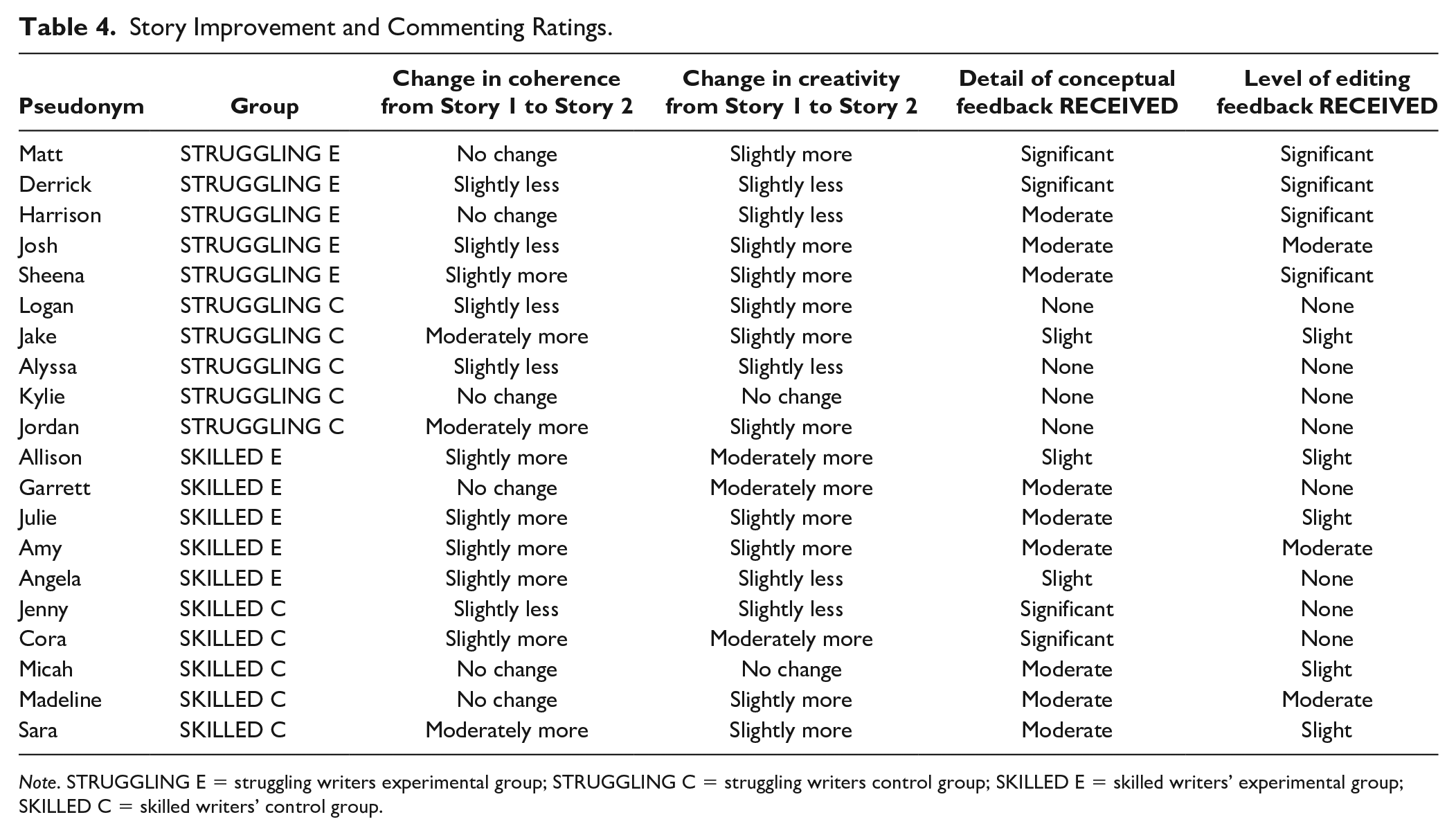
Note. STRUGGLING E = struggling writers experimental group; STRUGGLING C = struggling writers control group; SKILLED E = skilled writers’ experimental group; SKILLED C = skilled writers’ control group.
Finally, the first author reviewed the four teachers’ interviews and independently coded them for “strengths of the intervention” and “weaknesses of the intervention.” She compared these codes between the intervention and control groups to further explain the writing progress and process of each group. At all stages of the qualitative analysis, the first author had primary responsibility for coding; the second author individually coded about 20% of the coding samples. Then, the first and second authors discussed, listened to each other’s rationale, and offered points of possible disagreement for resolution (Baxter & Jack, 2008). Coding themes and frequencies are included in Table 5.
Coding Results of Teacher Interviews.
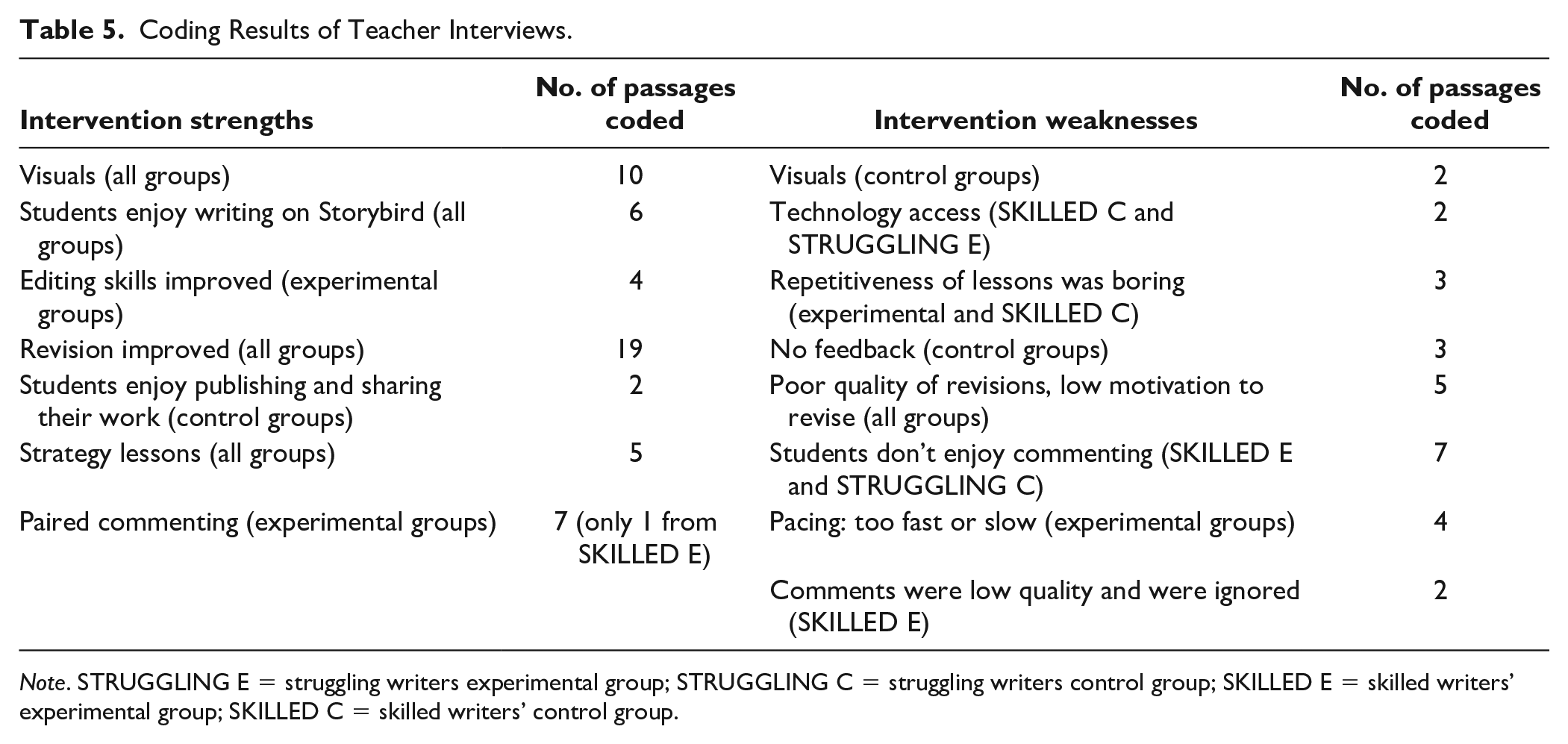
Note. STRUGGLING E = struggling writers experimental group; STRUGGLING C = struggling writers control group; SKILLED E = skilled writers’ experimental group; SKILLED C = skilled writers’ control group.
Results
First Research Question: Writing Progress From Story 1 to Story 2
First, we asked whether the students showed improvement from Story 1 to Story 2 that were written on Storybird during the online paired writing instruction. Improvement was rated subjectively according to coherence and creativity of character, tone, language, and structure.
Writing progress of struggling writers: Experimental group
Three students in the experimental group of struggling writers improved the creativity of their stories from Story 1 to Story 2, and one student improved coherence. This growth in creativity was demonstrated in the story structure and tone. For example, Josh wrote his first story about a cat and a dog that scared away a group of giants. It was a simple story with a linear plot and resolution. Josh’s second story had more plot events: the dog slept, waited for a bus, felt sick, and visited various candy stores. Because of this more complex, less predictable storyline, the story was more creative. However, the story was built around mainly the pictures and lacked a clear theme. The story began as the main character gave the judge of Candy World a haircut, but, in the rest of the story, the main character was looking for candies. Thus, the story was neither very coherent nor tied to an abstract theme. The struggling writers generally added unexpected plot events, jokes and surprises, and sensory description; creativity increased but logic was unaffected.
Writing progress of struggling writers: Control group
Three students in the struggling writers control group improved both their stories’ creativity and coherence. These students made use of the pictures in Storybird to give their story logic. For example, Jake’s second story used pictures of just two characters. The story was written in dialogue like a play, with the pictures indicating who was speaking. Because Jake did not select a variety of seemingly unrelated pictures, weaving them into a complex plot, the story was simpler but more coherent. The improvements in this group’s stories were due to their ability to balance basic story elements: a dose of plot, a dose of character, and simple conflicts. The researcher determined that the experimental group did not show more growth than the control group.
Writing progress of skilled writers: Experimental group
Four students in the skilled writers’ experimental group showed improvement in the second story’s coherence, and three showed improvement in their second story’s creativity. Students in the skilled writers’ experimental group showed growth in creativity mainly through the addition of sensory description. Students also added creativity by adding a twist or a question at the story’s end and setting a tone or theme for the story. For example, Allison showed creativity in her story through her use of humor. In her second story, she continued to use humor but added multiple conflicts and plot events in her story featuring an older couple’s adventurous road trip. She further used sensory details to describe the smell of a scientist’s potion. She added an unexpected twist when an escaped cat started talking and then drove the older couple home. The skilled writers seemed to show their creativity through detail and description more so than through structure, tone, or characterization.
Writing progress of skilled writers: Control group
Three of the students’ stories improved in creativity and two in coherence. For example, Cora improved the creativity from her first story to her second story by adding themes of coming of age and imagination. In the first story, she wrote about a brother and sister who were lost in the woods and picked flowers before finding a cave to sleep in. The brother cared for his little sister by making her a leaf bed and playing her a lullaby. The story contained charming details but a fairly straightforward plot and resolution.
The second story was more complex because it traced the change in a character across time. It described a girl who had an imaginary friend and then grew apart from her imaginary friend and went to high school. The story was also creative because the focus shifted from the main character’s loneliness to the loneliness of her imaginary friend. This was an unexpected diversion from a simpler story structure in which there was only one main character, conflict, and resolution. As a group, these students wrote lengthy stories with complex plot structures and a great deal of descriptive dialogue. However, similar to the students in the skilled writers’ experimental group, the conflicts in the stories were easily resolved. The researcher determined that, overall, the experimental group did not show more progress than the control group.
Second Research Question: Student Feedback
To understand how the quality of students’ feedback might have contributed to students’ writing outcomes, the first author rated the level of detail in the comments received as no comments, slightly detailed comments, moderately detailed comments, and significantly detailed comments. Because some students wrote more conceptual comments, and others wrote more comments focusing on edits for grammar, punctuation, capitalization, and spelling, the original first author gave a separate rating for conceptual and editing comments.
Comments of struggling writers: Experimental group
The struggling writers who were paired with skilled writers received more high-quality feedback than the struggling writers who commented upon their own stories. Skilled writers commented upon the reasoning displayed in the stories. While not explicitly explaining why the details were creative, Matt’s partner Garrett also picked out the most creative uses of language to compliment. Garrett chose to compliment moments that were unusual, specific, and tone setting. Because Garrett made multiple, specific comments that addressed abstract concepts and provided a direct, explanatory nexus to story logic and creativity, his comments were rated “significant.”
Comments of struggling writers: Control group
Conversely, the struggling writers in the control group recorded almost no helpful comments on their own stories. Most students did not write any comments, despite the specific lessons and instructions. One student used the comments as a “texting” feature to say hi to another student. In our teacher interviews, we asked why students did not record their comments. The teacher noted that the students often made changes to their stories based on the feedback guide but refused to record these changes because they felt this was redundant.
Comments of skilled writers: Experimental group
The skilled writers in the invention group received slightly detailed comments from their peers who were struggling writers. Most of these comments were suggestions for adding sensory details. For example, Julie received the following comment from her partner Derrick: “Wut did the grand (ground) smell like wen the dog landed on its fase. [sic]” (Derrick, Story 2). Angela received the following comments from her partner (Story 1): “You can describe what Sonia is wearing. Sight: Describe the forest more. Sound: Describe if they have a low or high pitch voice.” While these students had frequent absences and were occasionally missing comments, their comments showed they were able to apply the concept of “sensory details” to the critique of specific stories and identify places to be more descriptive.
Comments of skilled writers: Control group
The skilled writers in the control group were adept at giving themselves conceptual suggestions. While again most of these comments were related to adding descriptive details, some of the skilled writers were also able to critique their story holistically and put themselves in the position of a reader. For example, in addition to many examples of adding descriptive details, Jenny added comments addressing story logic and humor: “The part of the story that could be most confusing to the reader is why Cooper disappeared.” “I could make this less confusing by saying he was a very curious bunny” (Jenny, comments, Story 1). “I can make my story funnier by adding ‘Milo ate his PB costume’” (Jenny, comments, Story 2). The skilled writers paid less attention to editing their own work for spelling, grammar, and punctuation.
Third Research Question: Teacher Insight
The first author read each of the four teacher interviews and coded excerpts as “strengths of the intervention” or “weaknesses of the intervention.” Overall, all four teachers felt that the strategy instruction in revisions, paired with writing on the Storybird website, was a positive experience. All four teachers noted that students increased the number of revisions they made to their writing as a result of the strategy instruction lessons. All four teachers noted the students enjoyed writing stories on Storybird, found it easy to navigate, and used the pictures as anchors to expand their ideas. To determine differences between the control group and the experimental group, we compared the descriptions of strengths and weaknesses of the intervention, first between the two struggling writers’ groups and then between the two groups of skilled writers.
Teacher insights about struggling writers
The major difference between the experimental group of struggling writers and the control group of struggling writers was the impact of the comments received. The struggling writers in the experimental group received high-quality comments and were motivated to revise based on these comments. Their SPED Teacher 1, the special education teacher of the experimental group, noted, I think they were very helpful. You can definitely tell that the writers that they were working with who are above their levels and the kids kind of knew that and picked up on that because the first time they read any of their bios or their first stories were like, wow, they are really good writer, they did a really good job with this, so they could tell that. And most all but maybe one or two of them really took their comments to heart and really tried to integrate them into their stories. (SPED Teacher 1, individual teacher interview, May 22)
Furthermore, the teacher of the experimental group believed her students were not intimidated by the quality of their peers’ writing and comments: Like if they have been working with a group of higher level kids in their own grade, I think I would’ve seen that because there are kids they see outside of the class on a daily basis whereas these are kids they don’t know, they’ve never met before so it’s okay, it was almost to them like getting feedback from the teacher that they’ve never met but it was, you know, cool for them because it was somebody their own age. (SPED Teacher 1, May 22)
In contrast, students in the struggling writers control group felt that typing comments on their story was redundant because they were the only ones reading the comments. Some of the students made revisions without recording their comments, and some did not want to admit weaknesses in their writing and so ignored the comments. Their SPED Teacher 2, the special education teacher of the control group, noted, Yeah, there were some of them that was just say, “It’s fine, I swear, it’s fine.” I’ve looked them over and they would just insist and refuse it, continue on with that and they would say, I already fixed it and they didn’t want to have that added, commenting even though it helped them, they would see and get to the comment, but they would fix the mistake. (SPED Teacher 2, May 30)
Although the commenting process worked better for the experimental group, the experimental group also noted problems with the strategy instruction lessons that the control group teacher did not mention. The teacher of the experimental group felt that the lessons were too difficult for some of her students and that the lessons’ repetition was boring, and her students experienced problems with internet access at the school. Together, these problems may have hindered her students’ performance.
Teacher insights about skilled writers
When comparing the experiences of the skilled writers’ experimental group with those of the control group, it seems that the skilled writers in the experimental group did not benefit as much from their peers’ comments as did the struggling writers in the experimental group. While Gifted Teacher 1, the teacher of the skilled writers’ experimental group, noted that the students did spend a slightly higher amount of time revising than they normally would, she believed that the comments they received from their peers were of poor quality and were sometimes ignored. “I think they would have liked to be paired with someone more on their level” (Gifted Teacher 1, May 10). When asked about the students’ reactions to their peers’ comments, the teacher of the experimental group said, “They probably just didn’t like being told what to do”(Gifted Teacher 1, May 10).
Furthermore, the teacher of the experimental group explained that when the skilled writers saw the struggling writers’ stories, this lowered the bar on expectations for their own stories: I think they would have been challenged more and they would’ve tried harder to writing a good story if they were going to read someone else’s story because these kids are competitive and they want, they don’t want to look like theirs is bad, but if they see another one it’s not that great then they’re not going to say, “Well, you know, mine is going to be fine.” (Gifted Teacher 1, May 10)
In addition, the teacher of the experimental group reported that they did not enjoy editing their peers’ multiple surface-level errors. Thus, it seems like the skilled writers were not engaged with the revision process because they were accustomed to performing well without revising, and they were not inspired by their peers’ comments or model stories, despite their frequent validity.
The students in the skilled writers’ control group similarly were not accustomed to revising their work. However, Gifted Teacher 2, their control group teacher, noted greater improvements in revision and transfer of revision skills: Before it, they would have written something they would have written it once maybe they would write it once and the still turn them in without making many corrections. But I do think that especially the last one they did many of them without being prompted to go back and revise they got out their packets with their grammar check lists and questions check lists and all their graphic organizers and few of them use them without even being told they have available they automatically went to it. (Gifted Teacher 2, May 20)
While Gifted Teacher 1, the teacher of the experimental group, agreed that the students’ attitudes toward revision improved, she said she noticed only minor revisions in their work. In contrast, Gifted Teacher 2, the teacher of the control group, described the students’ writing as improving “100 and 10 percent” (Gifted Teacher 2, May 20).
Discussion
The original intent of the present study was to explain why our paired online writing revision instruction, provided across rural schools that were geographically separated, had some positive effects for struggling writers but little effects for skilled writers compared with those who worked independently when stories written in the pretest and the posttest were analyzed (S. Lee et al., 2019). The use of online collaboration is advantageous for geographically separated students because they do not need to be in the same physical space to collaborate. In other words, online collaboration coupled with evidence-based writing instruction removes the geographic challenge of rural schools. With this intention, the present study qualitatively analyzed how the struggling and skilled writers in the experimental and control groups improved their writing over the course of the instruction by analyzing two stories and comments written on Storybird as well as teacher interview. Our results showed that one clear reason for the struggling writers’ improvement was the high-quality story models and comments that the skilled writers provided.
The teacher for the experimental group noted that her students took the suggestions and incorporated them into their stories. On the other hand, skilled writers in the intervention group did not show such improvement on Storybird stories because the quality of feedback received devalued the revision process.
Stories on Storybird
Our qualitative analysis of the learning trajectory from Story 1 to Story 2 on Storybird shows that online revision does not produce more growth in creativity and coherence regardless of whether struggling and skilled writers work in a pair or not. Together with S. Lee et al. (2019), the present findings seemingly support the previous research that students gain more academic ground with homogeneous grouping than with heterogeneous grouping (Kulik & Kulik, 1992; Lou et al., 1996).
Nevertheless, a cautious interpretation of these findings is warranted because, first, some struggling writers in the experimental group seemed to write more ambitious stories than the struggling writers in the control group. One plausible reason for this positive change could be that they may have been modeling their stories after their skilled writing partner’s stories, which had many interconnected plot events. Although qualitative analysis of stories in creativity and coherence generally does not show the advantage of collaborative online writing revision over independent online revision, this result seemingly suggests that struggling writers still benefit from reading high-quality model papers from their skilled peers, specifically aspects of writing that are not often demonstrated from their struggling writers with similar writing abilities.
Another important finding from the story analysis was that struggling writers, in both the experimental and the control groups, showed improved creativity partly because they were able to link many disconnected pictures they chose in Storybird. These results support the previous study that images, when provided during writing, scaffold the planning and story organization process (Fahsl & McAndrews, 2012). However, their ambition and creativity caused them to add plot events and details that were sometimes disconnected from a theme or irrelevant to the progression of the story. This might explain why the improvement was not more significant when compared with the control group.
Finally, although the analyses in the present and the parent study (S. Lee et al., 2019) are not equivalent, we noted that all the students’ stories written on Storybird were considerably better than those that were written for the timed pretests and posttests in the parent study (S. Lee et al., 2019). These findings suggest that when students have visual prompts, extended time to write, and strategy instruction in revision skills, they may improve their story in the areas of logic, complexity, dialogue, and sensory description.
Feedback
The qualitative analysis of comments/feedbacks for the online revision points to one critical finding. The explanation for the lack of difference between the skilled writers in the intervention and control groups is likely due to the quality of feedback received. The students in the control group gave themselves more revision feedback, whereas the students in the experimental group (who were not accustomed to revising) relied on the lack of feedback as an excuse not to revise, according to the teacher interview. These students also did not seem to value their peers’ feedback as much, and the quality of feedback they received was limited. Skilled writers were aware that their partners were struggling writers, and when asked to compliment their partner’s stories, they sometimes only noted, “I liked the pictures.” Because of their advanced writing skill, it was easy for the skilled writers to devalue their partner’s feedback and model stories. Similar to Dailey (1991), we found that heterogeneous pairings of writers resulted in a lack of improvement to skilled writers’ products.
Teacher Insight
In general, the teachers describe that struggling writers benefited more from the collaborative online writing revision than the control group, whereas skilled writers improved the most from writing independently. These findings are not consistent with the previous research that writing revision with peer feedback benefits both struggling and typical writers (Graham et al., 2012) and in both the heterogeneous and homogeneous pairs (Sutherland & Topping, 1999).
Confirming our analysis of comments, the teachers of struggling writers recognized that their students benefited more when receiving high-quality feedback from their skilled peers. In contrast to the struggling writers, the teacher with the skilled writers’ experimental group noted that reading and commenting stories from struggling writers lowered the expectation of her skilled writers.
Furthermore, the teacher in the control group reported that she emphasized to students the importance of revision for creating a published final product. She also noted that her students transferred their revision skills learned from the present study to other writing assignments. On the other hand, the teacher in the experimental group did not note this generalization. Thus, the skilled writers in the experimental group were contending with poor-quality feedback, devaluing of peer feedback and story models, and devaluing of the revision process.
Finally, teacher interview data showed that students with different writing abilities used pictures in different ways when they wrote stories on Storybird. Skilled writers sometimes wrote books following a “children’s picture book” format because Storybird lent itself to these simpler texts. Some of the skilled writers complained that they would like to be able to write longer scenes on each page rather than being forced to either reuse the same picture or move on to a new scene. This indicated that they may have been more likely to write more complex or mature stories without the page word limit and child-friendly picture prompts. The students in the struggling writers’ groups, however, benefited from the picture prompts. They allowed them to “fill in” aspects of the story that may have been difficult for students to translate into writing. In addition, the picture prompts challenged them to connect disparate images into one coherent storyline, which they did with varying degrees of success. In other words, the use of pictures on Storybird reported by the teachers support our analyses on Storybird stories and previous findings (Fahsl & McAndrews, 2012) that images, when provided during writing, scaffold planning and story organization process.
Limitations
The major limitation of this study is the small sample size of students in each group. Gifted students and students with learning disabilities represent a small percentage of the school population. Furthermore, the schools we worked with were rural districts with small school populations. It is possible we would have noted improvements from the experimental group with a larger sample size. Both a strength and a limitation of this study is the qualitative nature of the analysis. We found multiple possible explanations and practical implications for our intervention outcomes; these were largely based on our first author’s expert and subjective judgment. Thus, the subjectivity of the primary coder might be another limitation of the present study.
In addition, the primary coder was not blind to the condition of the story, and during the coding process, the primary and secondary coders did not reach a complete consensus of all the data, although both coders discussed and resolved the disagreement. Therefore, the analysis should not be generalized to dissimilar populations until future research replicates our findings with a larger group of students.
Practical Implications
Rural schools and classrooms face unique challenges relative to geographic isolation and students with a wide range of abilities due to low enrollment (McKissick et al., 2017). Our findings show that online peer writing collaboration allows students in rural schools the same collaboration opportunity with varying group of students as students in larger district through online collaboration when the following educational implications are considered.
In the present study, first, we noted that skilled writers did not benefit from the limited choices of pictures on Storybird, whereas struggling writers benefited from the presence of pictures on Storybird. Thus, the use of picture prompts should be differentiated. Although pictures of Storybird can support the writing process of struggling writers, skilled writers may need fewer picture prompts or pictures that evoke complex themes than those provided in Storybird.
Second, we noted both groups of students were successful when they were offered comments and were asked to make revisions related to sensory description. Our lesson materials included a specific lesson on the sensory description. Conversely, our lesson did not include instruction on how to make the stories more logical or creative. These abstract concepts of “logic and creativity” might need to be explicitly taught, for instance, by asking students to intermix genres or combine two conflicting character traits to make a character more rounded.
Finally, the last implication is especially relevant to rural schools that often face unique challenges of having a wide range of abilities of their students (McKissick et al., 2017). Our findings suggest the following precaution when pairing peers virtually. We suggest that skilled writers be offered time to work with other skilled writers and receive feedback from both skilled writers and teachers, especially when collaborating at a distance. Finding peers with similar interests and skills allows skilled writers to develop a supportive community and receive high-quality feedback (Olthouse, 2012a, 2012b). In addition, when working in heterogeneous parings, these skilled writers needed instruction on how to recognize and support struggling writers’ skills, as well as how to identify and respond to helpful comments. Similarly, struggling writers might improve the quality of peer feedback if they were to record verbal feedback rather than typing their comments.
Conclusion
Based on the literature supporting the benefits of collaborative writing, we believe that online peer revision writing strategies would improve writing skills by giving writers in rural settings an authentic audience and an engaging method of interacting by using online commenting features. Although there was some descriptive evidence of improvement for struggling writers, there was little evidence of improvement for skilled writers. While this might be due to the small sample size, it may also be related to the discrepancy between the writers’ abilities. The struggling writers in the experimental group wrote more ambitious but less coherent stories, whereas the skilled writers in the experimental group received poor feedback and did not put in as much effort into their revisions as the students in the control group. Further studies might explore possible solutions for these difficulties, such as recording verbal feedback for struggling writers, offering differentiated revision guides and visual supports, and grouping students in homogeneous pairs or triads.
Footnotes
Acknowledgements
We acknowledge deceased co-author, Dr. Jill M. Olthouse, for her contribution to this research and her qualitative data analysis.
Declaration of Conflicting Interests
The author(s) declared no potential conflicts of interest with respect to the research, authorship, and/or publication of this article.
Funding
This research was supported by a West Virginia University Faculty Senate Research Grant.
