







Abstract
Culturally relevant pedagogy is as much about what teachers do in the classroom as how they think about students and their students’ social environment. There remain critical gaps in research on teacher knowledge of student lives outside of school and how this knowledge informs instructional decisions. This study investigates teacher observations of the lives of English learners with disabilities through remote instruction during the COVID-19 pandemic. We analyzed qualitative interviews with 21 teachers from 20 schools in seven districts in the U.S. state of New Mexico, approximately two-thirds of whom taught in rural community schools. Interviews were conducted during the pandemic, when participants had a unique opportunity to peek into the lives of their students onscreen. We reported what they learned through this proverbial window into student lives and how they responded to support their students. These findings contribute to the research on culturally relevant pedagogy and critical place pedagogy for English learners with disabilities in rural communities.
Keywords
English learners (ELs) with disabilities are entitled to supplemental services to support their multiliteracy skills and a free and appropriate public education in the least restrictive environment with supplementary aids and services to support their academic achievement (New Mexico Public Education Department, 2023). Although these mandates seem clear, supporting ELs with disabilities is an ongoing challenge for schools (Kangas et al., 2024). As a result, this student population continues to experience barriers to receiving a sufficient education, particularly in rural communities (Kangas et al., 2024; Yettick et al., 2014).
Preparing teachers to educate this student population requires training in culturally relevant pedagogy, facilitating both student outcomes and teacher retention (Peterson et al., 2020). Culturally relevant pedagogy is as much about what teachers do in the classroom (i.e., curriculum and instruction) as it is about how they think about their students and the students’ social environment (Ladson-Billings, 2021a). As rural education scholars have noted, “Place does not sit waiting outside the school doors. It is brought into the classroom with every learner” (Azano & Biddle, 2019, p. 9). Practices that are considered culturally relevant for one group of students can have different applications for another, and teachers’ underlying belief systems about themselves and their students are instrumental in shaping how and what they teach (Ladson-Billings, 2021a). Educators who understand their students’ lives and see their work in the classroom as connected to the community are better equipped to make instructional decisions that support student learning in that community. Yet, there remains a gap in the research on teacher knowledge of student lives outside of school and the extent to which this knowledge informs their instructional decisions (Morrison et al., 2022). This study investigated teacher observations of the lives of ELs with disabilities in New Mexico; more than 60% of the study participants taught in rural schools.
Conceptual Framework
Ladson-Billings (2021a, 2021b) operationalized culturally relevant pedagogy in three parts: student learning, cultural competence, and sociopolitical consciousness. Accomplished teachers must facilitate student learning and achievement through exemplary pedagogical practices. They must also be culturally competent to help their students become multiculturally competent to thrive in a diverse and multicultural world. Finally, sociopolitical consciousness calls for instruction where students are not simply rewarded for memorizing facts and following rules, but are also explicitly taught to analyze, synthesize, and critique what they are learning and how their education and environment influence their growth and capacity to be effective members of society.
Culture is dynamic and heterogeneous and requires ongoing inquiries to develop and maintain relevant practices (Ladson-Billings, 2021a). Yet, the application of these concepts has historically had a strong urban focus, and rural education scholars remind us that the core-periphery (i.e., urban–rural) narrative has historically framed rural communities through a deficit lens defined by poverty, loss, and despair (Azano & Biddle, 2019). The diversity among rural communities underscores the significance of culturally relevant pedagogy to all students regardless of where they live. As this study examines what many teacher participants learned about their students’ home lives outside of school in a state that has historically been beset with deficit narratives, it raises questions about what it means to be in these places and the roles of teachers and teacher educators in these spaces. We acknowledge the importance of discussing these issues from a critical place framework as we strive to improve them (Azano & Biddle, 2019). Students’ cultural identities and out-of-school experiences matter to their academic performance in the classroom. We use Ladson-Billings’ culturally relevant pedagogy and Azano and Biddle’s critical place pedagogy to frame the discourse on supporting ELs with disabilities in rural communities. Ladson-Billings (2021a) reminds us that “all teaching is political,” and this understanding is essential in a democratic society (p. 6). Azano and Biddle (2019) remind us that this understanding extends to rural communities, which have often been excluded from culturally relevant discourse. As these educators contend, when teachers can engage meaningfully in conversations around culturally relevant pedagogy, they can deepen the connection between classroom materials and their students’ lives. Remote instruction during the pandemic offered unique opportunities for teachers to observe the real lives of their students. We captured these observations through interviews, and the teacher participants in this study shared their reflections of the intersection of student lives and their educational experiences.
Literature Review
Many studies have described the demographic trends and conditions of ELs with disabilities, and these data suggest that ELs with disabilities often live in communities that lack access to basic modern needs such as electricity and the Internet, which can be barriers to advancing their learning outcomes (Kangas et al., 2024; Running Bear et al., 2021). Researchers have also raised concerns that these data are often decontextualized (Kangas et al., 2024) and turn to qualitative studies to describe these findings through narratives and interviews with caregivers or individuals with disabilities. Qualitative findings among individuals with disabilities in rural communities suggest that they are less likely to seek services, more likely to perceive stigma when seeking services, and may wait until their conditions worsen before seeking help (Rennie & Goforth, 2020). Francis et al. (2020) interviewed 13 caregivers of young Latine adults with disabilities in a rural region in a midwestern state and found many caregivers felt discouraged with their struggles to provide adequate food and shelter, childcare, or internet access for their children. Participants also reported having reservations about receiving support due to social stigma and legal ramifications. For example, undocumented families avoided accessible resources such as “food stamps” and “a medical card” out of fear that their “papers” will be denied if they were seen “as a burden” (Francis et al., 2020, p. 26).
Other studies have examined teachers’ attempts to learn about ELs with disabilities and to connect students’ in-school with out-of-school experiences. These include the following: visiting students and their families in the evenings and “walk[ing] the neighborhood” (Thomas & Berry, 2019, p. 26); having student–teacher dialogues that educators then use to inform their instructional decisions (Emdin, 2020); assigning classroom projects that contain examples of students’ home cultures and languages (Hoover et al., 2020), such as photobiography projects (Store, 2023); and taking university coursework that emphasizes culturally responsive teaching (Morrison et al., 2022). In a 5-year model demonstration project to improve literacy and special education referrals for ELs in three rural community schools, Hoover et al. (2020) found that teacher participants reported valuing diversity. The researchers also reported that the teachers addressed ELs’ broader living environment, including family and community influences, when making instructional and referral decisions.
Yet, there have also been critiques of these types of efforts. While Thomas and Berry’s (2019) participants acknowledged the importance of building classroom communities to engage students, they also noted that they found much of this work to be removed from the lived experiences of their students. Store (2023) warned that some students may experience subordination if their cultural artifacts are not embraced by their peers. Morrison et al. (2022) found that some teachers who completed coursework in culturally responsive teaching questioned the application of these trainings as they often occurred in decontextualized university classrooms. In addition, many of these studies focus on students without disabilities and students in urban settings.
In rural education research, critical place pedagogy is a prominent framework that informs culturally responsive practices, and it shapes the discourse on how teachers connect with rural students and places (Starrett et al., 2021). Operating on this framework, teachers would aim to integrate the local workforce, natural environment, culture, people, history, and community with content areas to connect with their students and places (Irvin et al., 2019), enhance curricular relevance (Biddle & Azano, 2016), and contribute to revitalize and sustain the rural communities (Starrett et al., 2021). Rural schools often serve essential functions for their communities, beyond providing an education, by being a vital part of the social structure, and in many cases, an extension of families (Starrett et al., 2021). As a result, teachers’ connection to these communities significantly correlates with the quality of their relationships with students (Starrett et al., 2021).
Rural settings have distinct characteristics, but few studies have described the experiences of ELs with disabilities in rural communities (Sutter et al., 2025). This study contributes to ongoing conversations about ways to educate these students in these places through the lens of culturally relevant pedagogy and critical place pedagogy. More than 60% of teacher participants in this study taught in rural schools, as defined by population density. Their reports give us a peek into the worlds of ELs with disabilities across the socially constructed urban–rural geographical boundaries (Azano & Biddle, 2019).
Context of the Study
The teacher participants of this study work in public school districts across New Mexico. The state ranks 45th out of 50 states in population density with an average of 17.5 residents per square mile, which designates it as a largely rural landscape (U.S. Census, 2020). The population density is concentrated along two interstate highways that roughly divide the state into four quadrants. Approximately 31% of the state public school population is concentrated in two school districts in the greater Albuquerque metropolitan area. New Mexico also has a diverse population of 49% Hispanic, 36% White, 11% Native American, 3% Black, and 2% Asian. Approximately 33% of the state population lives in rural areas, compared with the national average of 20% (U.S. Census, 2024). It is also home to 23 federally recognized tribes (Native American Election Information Program, 2024). The state is linguistically diverse, as 32% of the state population speak a language other than English at home, compared with the national average of 22% (U.S. Census, 2024). At the same time, 17% of the state population’s income is below the federal poverty level, a rate 5% higher than the national average (U.S. Census, 2024), and a quarter of New Mexico’s children ages 0–17 have experienced two or more adverse childhood experiences (ACEs), or traumatic events in childhood that are linked to long-term physical and mental health issues (Center for Disease Control and Prevention, 2024). This is the highest rate of ACEs in the country (United Health Foundation, 2024). Relatedly, the landmark consolidated case Yazzie/Martinez v. State of New Mexico (2018) ruled that the state failed to provide a sufficient education for their students, particularly for ELs, students with disabilities, students from low-income households, and Native Americans.
The impact of COVID-19 on rural communities was surprising. While low population density was believed to reduce the virus’s spread, rural areas were significantly impacted, particularly Native American communities (Yellow Horse et al., 2020). The pandemic highlighted existing inequities including under-resourced health care systems, a lack of adequate indoor plumbing, and limited broadband infrastructures which hindered communication and instruction. By happenstance, this period provided teachers with a chance to learn about student lives beyond what they had previously known in the classrooms, because the home environment became the new classroom environment during quarantine. We interviewed teachers of ELs with disabilities to understand how they supported their students during remote instruction from 2020 to 2021. The teacher participants shared more than just the learning experiences of their students during remote instruction. We learned that the nonacademic narratives beyond curriculum and instruction were just as compelling as the academic components, and these narratives warranted their own analysis. This article focuses on the nonacademic accounts of student lives that the teacher participants reported observing through remote instruction during the pandemic. The following research questions guided this study:
Method
All research activities were approved by the authors’ university institutional review board. We incorporated basic qualitative methods (Tisdell et al., 2025) and relied on qualitative interviews with one interview per participant to gather all data. We employed reflexive thematic analysis, a patterned-based approach, to develop themes across interviews from codes based on organizing patterns in the data (Braun & Clarke, 2022). We were drawn to Braun and Clarke’s contention that “themes do not emerge” but are “values-based” constructions resulting from the researchers’ “creative, reflexive, and subjective” analysis (Morriss, 2024, pp. 745–747). Although Braun and Clarke (2022) outline six phases for conducting reflexive thematic analysis, these processes are “not strictly linear” (p. 36). Instead, the researchers actively engage with the analytical process in “a progressive but recursive” (p. 36) fashion with “unexpected twists and turns” (p. 76) in their development of themes as coherent patterns of shared meaning are identified (Braun & Clarke, 2022). Unlike other forms of thematic analysis, Braun and Clarke’s approach has “no codebook or framework that guides the process of coding,” and the aim among multiple coders is not to reach a consensus but to develop “richer and more complex insights into the data” (p. 55).
Participants and Setting
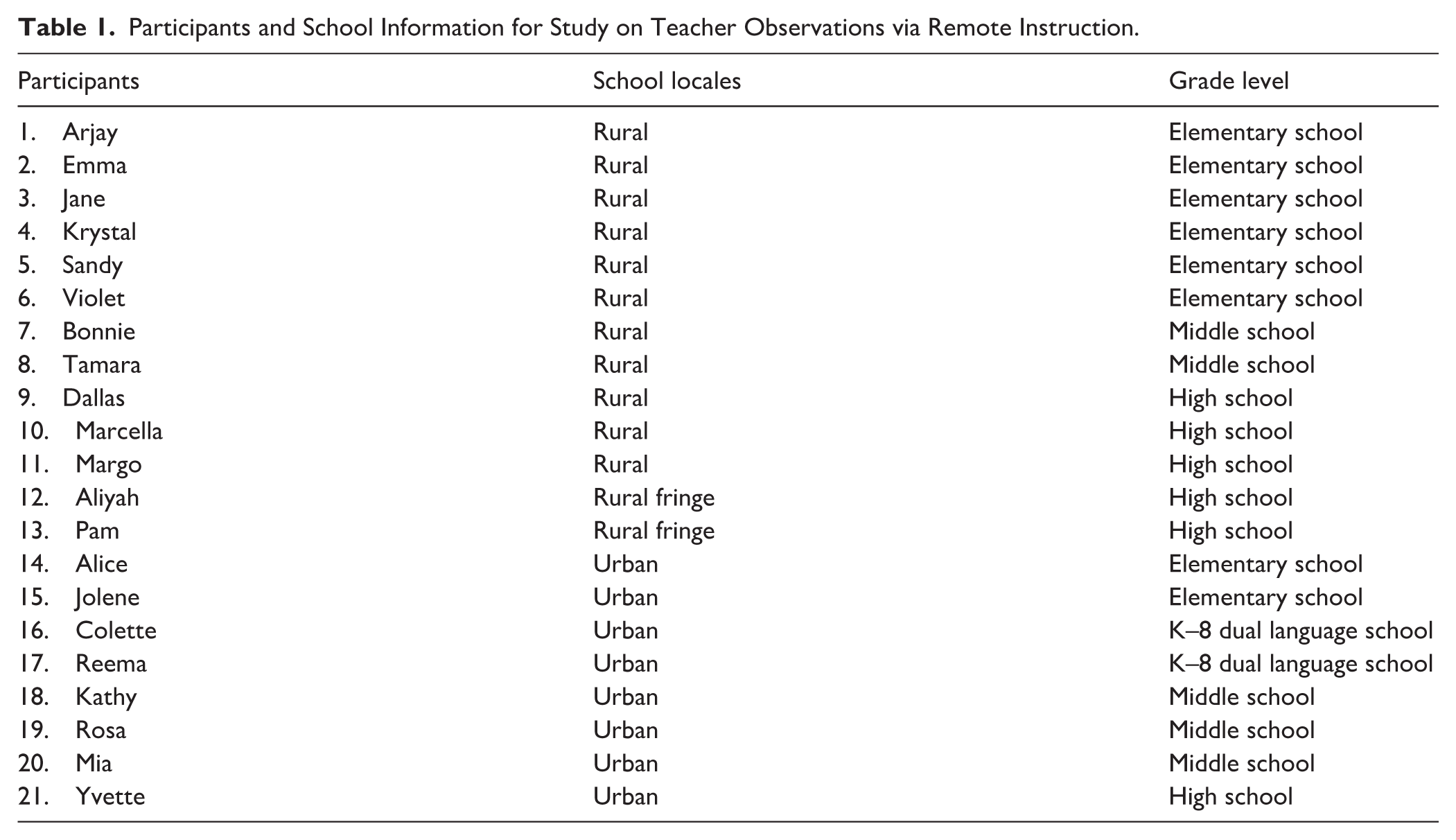
Participants were recruited via email and word-of-mouth across different regions of the state. To be included in this study, participants must have had at least one student whom they identified as an EL with an individualized education program between March 2020 and December 2021. In total, we interviewed 21 teachers from 20 Title 1 public schools in seven districts in this state; 13 of the 20 (65%) schools were in a rural community. Participants reported that their ELs spoke Spanish and Native American languages (Diné, Keres, Tiwa, and Zuni). Participants had a wide range of teaching backgrounds and experiences. Two reported having prior teaching experiences outside of the state (Aliyah, Kathy); two were former educational assistants in the same district prior to becoming teachers (Alice, Violet), two were dually licensed to teach both general and special education (Sandy, Tamara), and two were special education coordinators at their schools (Colette, Yvette). Two participants reported having less than 5 years of teaching experience (Aliyah, Violet); three reported having more than 20 years of teaching experience (Bonnie, Jolene, Margo); four did not indicate how long they had been teaching (Arjay, Reema, Rosa, Sandy). One teacher was male; the rest were female. One participant identified as Black, three as Asian, three as Hispanic, and the remaining participants identified as White. See Table 1 for a list of the participants and their school locales.
Participants and School Information for Study on Teacher Observations via Remote Instruction.
Data Collection
We followed a one-on-one interview format using a mix of grand tour and follow-up prompts (Spradley, 2003). Grand tour prompts included:
Tell me about your experience as a special educator in general.
Tell me about your approach to teaching during the pandemic.
Tell me about the learning experiences of your special education students who are ELs compared with those who are native English speakers.
Follow-up prompts included, “Tell me more about . . . Tell me what you mean by . . .” We deliberately kept the interview conversational rather than scripted to create space for spontaneity in participant responses and let them raise issues that we had not anticipated when developing the interview questions (Spradley, 2003). The average length of the interviews was 40 min, and participants received a US$15 gift card for their time. All interviews were conducted remotely, audio-recorded, and transcribed verbatim. The first author cross-checked all transcripts with the audio recordings to confirm accuracy, and three research team members reviewed the transcripts for accuracy and removed all identifiable information.
Data Analysis
We followed a systematic process to thematically analyze the data, beginning with multiple readings of the transcripts and taking notes of initial impressions at the conclusion of the final interviews (Braun & Clarke, 2022). Before initiating formal coding, the deidentified transcripts were uploaded to Dedoose, an online qualitative data analysis program. Two authors identified preliminary codes, focusing on those that were most salient to the research purpose.
We met almost daily to discuss the meaning of each code, examine excerpts within each code, and devise cogent definitions of each code. In an inductive recursive process, we worked through all transcripts, developed and refined codes, challenged our assumptions by recoding additional data, and discussed our perception and biases. We purposefully implemented these procedures to ensure reflexivity and trustworthiness. Afterward, we organized the codes in a hierarchical fashion, clustering those that appeared related to each other and identifying some as subordinate to others. Throughout our discussions, we used a twofold criterion: That the patterns must be identified across multiple participants, and that the identified patterns said something meaningful with respect to the study’s overall purpose. Periodically, we solicited feedback on our analysis from other research team members. Next, we describe how we addressed potential biases to ensure reflexivity and trustworthiness.
Accounting for Biases
Coding and developing themes are inherently subjective and influenced by all that the researcher brings to the process of data analysis, including their values, skills, experience, and training (Braun & Clarke, 2022). Recognizing and accounting for potential biases, especially those stemming from the researchers’ positionalities and preconceptions, is critical to the trustworthiness of naturalistic research. These “personal, professional, cultural, and theoretical lenses” can potentially influence multiple stages of a research project (LeCompte & Schensul, 2013, p. 48). Our research team is diverse in each of these aspects, including personal experience with monolingualism and multilingualism, identified disabilities among research team members and/or close family members, work histories, academic disciplines, ethnicities, cultural affiliations, countries of origin, and theoretical orientation, among others. For example, three of the authors are bilingual; three are special educators, and one was a speech language pathologist. One is an immigrant, two are women of color, one has disabilities, and three are close family members of individuals with disabilities. Two have lived in rural communities abroad but not in the United States, one grew up in rural communities in a neighboring state, and one grew up in a rural area, attended rural schools, and taught in a rural community school as a special educator in New Mexico. One is a first-generation high school graduate, and one is a first-generation college graduate. Recognizing our differences as a strength, we purposefully involved all team members in the study design and the identification and discussion of codes. During discussions, we highlighted differences in interpretations to widen the lens of our analysis by asking what others saw in the data, probing for reasons for agreement or disagreement on codes, and reconsidering all initially identified excerpts for a potential coding category.
We also sent results from the final stages of analysis to the participants for their feedback. We emailed all participants a concise six-page report that included themes, codes, and representative quotes from the entire sample so they could evaluate the validity of our data. Ten participants responded that the results captured what was shared during their interviews. There were no comments or suggestions to change our analysis.
Results
The participants shared that online instruction and increased communication with families during the pandemic created an opportunity for them to learn more about the intersection of their students’ home lives and educational experiences. We identified 58 excerpts where participants described these insights and created three themes: Living Conditions, Responsibilities Outside of School, and Support for Students and Parents. We described each theme below and provided examples to illustrate these patterns.
Living Conditions
Living conditions were defined as prominent circumstances in the students’ home environment that impacted their school performance. These conditions included (a) access to necessities such as running water, electricity, Internet access, and other technology; (b) survival needs that supplanted learning needs; and (c) student safety concerns.
Access to Necessities
Several participants described challenges to accessing resources, particularly for students in rural areas. Emma, who taught in a rural community school, recognized that some students lacked adequate cellphone service, and this impacted her communication with students and families. She explained: “We had students who didn’t even have phone service at their homes, so I would only catch a parent if they happened to be not at their house, or they went somewhere else to check for service.” The informants acknowledged that many families did not have access to essential resources that would help their students to engage in learning effectively. Violet stated: “I work in a very low-income area. So even though I wanted the families to provide certain resources in their homes to make learning more accessible, it just wasn’t a reality for my students.” Tamara shared similar sentiments: “It was again, lack of resources, and more with the EL special ed students than even just with regular special ed students.” Bonnie added:
We had families driving around to hotspots to pick up the Internet, especially out onto the reservation and outlying areas. So here’s grandma with four grandkids, driving around to wherever she could to get Internet for these kids. You can’t say you have to be in class at eight o’clock in the morning if you can’t get Internet service . . . on top of it, there was a loss of income for families . . . just one piece of what our students were going through.
The participants who recognized that there were barriers to basic needs also reported asking parents what schools can do to support their families, but their experience was that the parents were often too stressed to engage. Tamara framed it this way:
We would reach out to the families regularly. I would make phone calls and say, “What can we do? How can we get you access to Internet? Like what do you need?” A lot of the time those were parents who worked essential jobs, like McDonald, fast food places, Walmart, and they sometimes wouldn’t answer, or they’d call me back really late at night because they were working the whole time. And if they would answer, it was more of, “I don’t have time to deal with this. I’m trying to work, I’m super busy, my kids are all at home. The big ones are watching the little ones and I don’t know what to tell you.”
Survival Needs
As the lack of basic needs strained family resources, multiple participants noticed that educational needs were often supplanted by other needs in daily life. The participants described many families whose parents were essential workers who often had to work outside of the typical work hours. As a result, there was often no one at home to be with the students or monitor their learning. As Krystal described it:
They’re just trying to survive and meet the needs for their family. So, you have these families who are trying to put food on their table, trying to keep their home paid, their bills paid; those are realistic things . . . I’m not saying that education isn’t important, but there are other needs that superseded those during the pandemic.
Emma made a similar observation and added that schools can provide important resources pertinent to survival beyond an education:
I think that was a huge thing for me to realize, we can try to do a lot, but I think it also made me realize how big of a role school has in a lot of families’ lives from providing a place for children to go every day, but then also meeting so many of their needs through food and clothing and things like that.
While Krystal and Emma highlighted the importance of basic survival needs and the school’s role in supplementing those needs, Reema pointed out the impact of individual living circumstances on equitable access to learning, particularly for ELs:
I really saw patterns between students who were learning English as a second language and also living in poverty as being students who were more high risk of not being able to come to class or having technology issues. And so, I feel like poverty has also played a big part on who has access and who doesn’t.
Safety Concerns
Three participants noted activities that could potentially compromise students’ safety at home. Although these instances were rare, they were causes of major concerns for the participants. Violet reported seeing mistreatment on screen:
This is the first time that a lot of people were really getting to see the lives of our students at home. We saw some things that we would have never, ever thought we would have ever had to witness. I felt like I was doing a lot of reporting between [Children, Youth, and Families Department] . . . physical abuse . . . neglect . . . cussing . . . I had a student who her ceiling fell on her in the middle of Zoom class . . . I witnessed a dad shoving a kid up against a wall. So, a whole range of things.
Kathy reported learning about the lives of her students at home for the first time and discussed her concerns about safety that she felt were beyond her ability to address:
I talked to some of the kids about it, just trying to get a sense of what their home life is . . . they’re a little bit scared in the evening when their mom goes to work and it’s just her and the little sister and who’s like one grade lower . . . there’s a little brother. I don’t know how old he is. So, I don’t know if she’s in charge of them because there’s no dad right now . . . she’s like, oh, we can’t lock the door at night when my mom goes to work . . . and I’m like, that just doesn’t sound safe.
Dallas reported seeing an increase in drug use during and after the pandemic and attributed this to the lack of adult supervision. She stated:
Drug use, smoking weed in the bathroom, you’re always going to have that at the high school level, but this year it’s more intense than it’s ever been before . . . there were a few times last year where we would tell the kids, “Guys, this is being recorded,” and you could still see the smoke rising up in their bedrooms. Their parents weren’t home. There was nobody there to stop them from doing what they wanted to do.
Responsibilities Outside of School
Several participants shared that their students had responsibilities that impacted their learning. These included expectations of employment, caretaking of younger siblings with limited resources, and essential chores.
Employment Expectations
Several participants observed that their EL students worked outside of school. Dallas explained: “A lot of my non-English speakers, they typically went to work, because from their parents’ backgrounds, if you are at home, you are not at school . . . so you’re going to do something productive.” Margo made a similar observation:
This one kid, he came to live with his aunt, because in Mexico where he’s from, they stopped training or educating the kids with special needs at sixth grade. Once you’ve hit sixth grade, and you receive special education services, you’re out of school. They expect you to be working.
Margo shared that the aunt disagreed: “She didn’t think that her 12-year-old nephew should be working, so she brought him to the town we live in and put him in school.” Jolene added that some of her ELs chose to work:
I had two of my ELs, I know one of them maybe had to get a job, I’m not going to discredit the parents on that. But the other one, he didn’t have to, but he just chose to . . . that goes back to the expectations that we had for them. If they don’t have to be online all day, if they can just scribble on a piece of paper and turn it in, why not go get a full-time job? It’s shocking how many kids went and got full-time jobs during the pandemic.
Caretaking of Younger Siblings
The participants also learned that their students took care of younger siblings while their parents worked. Tamara reported:
You don’t notice it so much in person, but you would notice it on Zoom, especially when we had those kids, like the older students were taking care of their younger siblings. So they’d be running late to class, or you’d hear them pause and start yelling at somebody in the background or you’d see them holding a baby on Zoom. They’re like, “Well, I’m watching my baby sister because my mom’s at work and we can’t afford day care because my mom’s the only one working right now.” Those differences were so magnified through remote learning.
Kathy described a similar observation: “Sometimes I can see at home . . . she was maybe having to watch a little sibling at the same time, so that’s a big responsibility.” Some participants observed that these responsibilities were sizeable and impacted their students’ capacity to complete school tasks. Krystal described a specific example of how caretaking responsibilities impacted a student’s learning:
I know that she struggled with trying to find a space in the house that wasn’t real loud and also just having good connection. So, her dad wasn’t home, but she was with her siblings. And then the baby is home, so it was just a loud environment, so trying to find a place that was quiet enough and then finding a place that had good connection.
The teacher participants also observed that their students who had school-age siblings had to share the learning space at home with these siblings. As Alice described: “Sometimes mom was there to help, other times he was left with siblings who were in schools as well, so they can’t always come to help him, and so [providing instruction was] kind of challenging for a nonreader.” The participants also observed an increase in behavioral concerns, as Alice recalled:
I don’t know if that could be due to home environment . . . or them sometimes raising themselves and their siblings while their parents work or while their parents are absent. But it’s just a lot. The disrespect and even aggression towards staff has gotten worse.
Essential Chores
The participants noted that ELs with disabilities had household responsibilities beyond typical chores. Bonnie described one example:
The native English speakers were more comfortable with it [remote learning] than my English learners . . . Many of our Native [American] children out here they . . . had to do the whole hooking up the wireless and getting Internet service. Their lives are not geared to the things that we kind of take for granted, cable TV, any of that. The same with many of our Hispanic children. They live kind of out away from that . . . I think for them, it was tough to fit this piece into their day, because if you’re chopping wood and hauling water and taking care of livestock and all those things, it’s kind of hard to figure out when you’re going to do your online learning.
Support for Students and Parents
In addition to learning more about the lived experiences of students, the informants also became more aware of what parents were experiencing at home. For example, as Yvette noted: “They were busy working their own jobs and they were busy with multiple kids.” Mia added: “They had to cook food, and they had other kids, they were taking on other responsibilities, so they needed independent work tasks,” clarifying that these parents were asking for teachers to provide work that can allow their children to work independently rather than needing parental support at home to complete.
Language Support
The participants became more aware of the impact of home language on student learning. Tamara identified various levels of the language barrier that could differentially impact educational equity for ELs with disabilities. She explained:
You noticed it more in remote than you do in person . . . you have parents who are really involved and want their kids to learn English and want them to be involved in extracurriculars . . . then you have the other half of the parents who, they work so much that they really don’t know or worry about their child’s education because they’re so worried about providing for their child, that they don’t have that. And then you have those few parents who have no access, because they don’t speak English themselves. They have no access to even ask a teacher like, what can I do to help my kid, because they have that language barrier.
The language barrier was compounded by some parents’ work hours. Kathy had a young student who was unable to get assistance at home because his mom worked late hours and his dad was not fluent in English:
A lot of families have odd hours and they’re working two jobs, so there’s no consistency for support. I just talked to a young man . . . I was like, can you take 10 minutes and practice at home with your mom? He’s like, oh, at one o’clock in the morning? . . . You know, dad doesn’t speak, he speaks Spanish, so he can’t really help him with his English.
Social-Emotional Support
The participants also reported observing both students and parents experiencing social-emotional stress. Bonnie reflected: “Some of the students had a lot of loss in their families and it took a real toll on them psychologically, emotionally to even, I mean, to even be able to function at all.” In addition to loss and grief, the participants also reported that their students experienced other challenges that had more urgency and significance than completing schoolwork. Tamara explained:
We had one family who was facing deportation . . . and that gets really difficult because they were trying to get documentation from the school to prove that these kids were in school and that they couldn’t be deported and their focus was more on trying to stay here, than it was worrying about what assignments the student didn’t turn in.
A few participants noticed that the parents needed emotional supports too but admitted that they themselves too were taxed to support their students’ parents. As Kathy shared: “Sometimes the parents would talk for like 20 minutes and then telling you all their problems. It was kind of hard, so I stopped calling parents because I didn’t really want to hear the extra stuff.” Mia described her experience with a parent of one of her EL students who was nonverbal and autistic: “It was sad to see like the mother expressed that she was just overwhelmed; she didn’t know what to do.” Jane shared a similar experience: “I learned more about family life than I wanted to know.”
Last, after learning about the home lives of their students, some participants reported using this information to better support students and families and guide their teaching practices. As Tamara described:
I know as teachers we get just as frustrated. We want to see these kids do well, and we right away go to the parents and say, “Well, your kid needs to do this, and he needs to do that, and she needs to do this.” And we don’t stop and think what else is going on at home. Since coming back in person, I have stopped and said, okay, maybe there’s something going on at home. Let me approach this in a different way.
Sandy offered another example of how teachers shifted their instructional approach given what they saw. Sandy said: “Actually see into their home life, it makes you think about what do they deal with every single day when they’re not with me? Within my schedule this year, we have a social-emotional day, and we have a check-in where they can talk to me about things.” Having this perspective allowed Sandy to restructure her approach to classroom routines. Both teachers adapted their instructional approach to better support their students and provide them with access to an equitable learning environment.
Discussion
Culture is dynamic and learning about student lives can inform culturally relevant pedagogy to enhance equitable and effective outcomes for all students (Ladson-Billings, 2021a). This study supports the proposition that deepening this professional knowledge demands an understanding that “place is not a backdrop” (Azano & Biddle, 2019, p. 9) and requires active inquiry and integration of critical thinking about instructing and constructing knowledge with students. Online instruction during the pandemic provided many teachers a closer look at the lives of their students at home for the first time. These insights into student lives informed their instructional strategies, expectations about parent engagement, deeper understanding of students’ home lives, and a disposition toward the what Azano and Biddle (2019) call a “socially conscious place-based critical pedagogy,” even though the participants did not have the vocabulary to name this construct at the time of their interviews.
Of Ladson-Billings’ three propositions for culturally relevant practitioners (student achievement, cultural competence, and sociopolitical consciousness), the second one is the most misunderstood and the third one is the most ignored (Ladson-Billings, 2021b). Both requires deep understanding of the lives of students in ways that may challenge teachers’ existing beliefs, and an intentional effort to integrate content to enhance learning beyond the coverage of materials. Starrett et al. (2021) found that rural teachers excelled at connecting with rural students and implementing place-based pedagogy if they themselves came from that community. Many participants were unaware of the home conditions of their ELs with disabilities before the pandemic. The participants’ comments reflected their prior assumptions about students and families having access to basic needs and safety, a quiet space at home to do homework, and a requisite degree of resources to support their children’s learning. They also discussed that they lacked the resources to support ELs with disabilities and their families. Through online instruction during the pandemic, these participants gained insight into the realities of their students’ living conditions, responsibilities outside of school, and need for support, and recognized that some of their assumptions were inaccurate.
The results presented under the theme living conditions highlighted the complexities of home life and how the lack of necessities and safety can impact students and their education, and the important role that schools can have in providing material support and resources beyond an education. Access to necessities for these students impacted both their quality of life and the quality of their learning experiences. Certain conditions relevant to student learning and wellbeing may not be feasible for parents or teachers to change, such as parents’ need to work multiple jobs to provide for their families. However, socially conscious place-based critical pedagogy requires that teachers understand that students’ lives outside of school are connected to their educational experiences and, therefore, work to incorporate instructional strategies that support their learning beyond the classroom.
Responsibilities Outside of School highlighted the many expectations that many ELs with disabilities had at home. These included expectations of employment, caretaking of siblings, and essential house chores to maintain daily living. These expectations and responsibilities can contribute to behavioral challenges and equitable access to resources and learning opportunities for ELs with disabilities. This theme illustrates how larger cultural and social norms can impact students’ opportunities to learn, and the need for schools and teachers to address the resulting issues these challenges may present within the school context. Other scholars have noted that the sporadic online instruction during the pandemic created opportunities for many high school students to find jobs, and called on schools to incorporate technology widely, including access to asynchronous lessons where students can learn at their own time, condition, and pace (Ladson-Billings, 2021b).
The final theme, Support for Students and Parents, highlighted the dynamic family systems that the participants became aware of because online instruction provided a window into students’ lives that is typically obscured from view. They saw the impact of real human problems, such as grief, loss, parental stress, and larger sociopolitical issues such as deportation, that they otherwise might not be privy to. Witnessing these issues increased some participants’ awareness of ways to support students and families, including carving time during the school day for social-emotional support and rethinking ways to involve parents who are coping with multiple stressors at home.
These results suggest that ELs with disabilities face multiple and complex challenges even before the pandemic, but that teachers became aware of these issues because online instruction during the pandemic gave them unique insights into their students’ lives. Many participants had assumed a certain level of support for students at home, such as a quiet place to study, parents who were around and could read English, and time for students to complete schoolwork at home. During the pandemic, they learned that many students do not have home situations conducive to studying, and that many parents must work more than one job and often long hours that prevent them from spending time with their children. Although many of these issues are known (Ladson-Billings, 2021b), the teacher participants learned about them first-hand through direct observations onscreen and increased communications with families during the pandemic, which had a more lasting impact on their psyche. The participants also learned that many ELs with disabilities have significant responsibilities at home, such as caretaking for siblings, house chores, and paid employment. Importantly, some informants reported using what they learned to improve instructional support for students. Below, we discuss how these results can inform future practice around culturally responsive teaching to reduce a fragmented educational experience for ELs with disabilities in rural schools.
Implications for Culturally Relevant Pedagogy
The pandemic provided a unique opportunity for educators to gain additional insight regarding the roles of schools in rural communities and the barriers that students were facing. The teacher participants learned that schools offer a respite for many students and families that included routine, food, and safety (Ladson-Billings, 2021b). These were new revelations, and some observations challenged teachers’ existing assumptions about their students. Unfortunately, they were not prepared to address many of the issues that they saw in student homes, especially while they were also learning how to deliver instruction online. A few participants did report that the new insight helped to inform a more intentional and comprehensive instructional approach, such as designing learning tasks that could be completed independently without parental support at home and making space in their lessons to address social-emotional issues. In response to similar observations during the pandemic, Borrero et al. (2022) proposed that teachers can engage in an ecological asset mapping as a literal and figurative tool to explore sources of community assets and engage with their students’ social environment.
While these strategies can mitigate the negative impact of some barriers to student learning, they do not alleviate the underlying issues around equitable access to resources essential to providing a sufficient education for students. Effective instruction for ELs with disabilities requires attention to the ways that systemic inequities constrict students’ lives and impacting their language development and learning needs (Ladson-Billings, 2021a). This calls for culturally relevant pedagogues to understand the needs of their students in the context of their social environment. Practicing culturally relevant pedagogy is hard, particularly for teachers working in overburdened schools with multiple challenges and limited resources. At the same time, teachers’ own biases can limit them from seeing how the same content can be taught differently in different contexts and exploring opportunities for developing social awareness that could serve their students (Starrett et al., 2021). Professional development for teachers needs to be focused, systematic, and account for the realities of the unique contexts in which they work and the multiplicities of how students show up to school.
The challenges reported by the participants raise questions about what constitutes a sufficient and appropriate level of support for ELs with disabilities and their families, and how much responsibility should fall to individual teachers. For example, although the Yazzie/Martinez case (2018) found that current educational practices and related supports in New Mexico were insufficient for ELs, students with disabilities, students from low socio-economic backgrounds, and Native American students, the court also emphasized that change should occur at the state and district levels, well above the level of individual teachers. It is equally important for state and district leaders, school leaders, teacher educators, researchers, and professional organizations (e.g., Collaboration for Effective Educator Development Accountability and Reform, CEEDAR; Aceves et al., 2024) to actively participate in conversations on counternarratives that challenge deficit-based assumptions about ELs with disabilities in rural communities even as we strive to improve their outcomes.
Implications for Home–School Partnership
Family engagement involves dynamic communication between families and schools (Wheeler et al., 2024) with the goals of improving student academic, social, and behavioral outcomes (Boonk et al., 2018). Effective home–school partnership can lower levels of stress for parents and teachers (Passmore & Zarate, 2021). While research demonstrates myriad advantages from improving home–school partnership, the results from this study suggest that there are major hurdles for forming and maintaining such partnerships, especially for teachers working with ELs with disabilities in rural communities. The provision of supports and resources to families was further limited in our study by cultural and linguistic differences between many of the teacher participants and the families they served. We found that interactions essential for engagement can be hindered by insufficient broadband and access to reliable interpreters or cultural brokers. This aligns with Hoover et al.’s (2020) finding that the Latine population has substantially increased in many rural communities, and many schools are largely unable to engage with families from culturally and linguistically diverse backgrounds for a variety of reasons, such as the inability to access interpreter services. There were also family situations that were beyond teachers’ capacity to resolve, such as living conditions that made it difficult for students to focus on learning objectives, including threats of deportation.
In these instances, teachers can refer parents to resources available through schools and local communities, but the lack of awareness may prevent teachers and families from accessing them. Teacher awareness of resources is important given that families may need supports beyond that which teachers and school can provide. Research shows that families are more likely to learn about resources from teachers than they are to independently seek information (Huscroft-D’Angelo et al., 2022). However, many teachers report limited familiarity with and access to various services (Gee & Zebehazy, 2020; Lawrence et al., 2023). Previous studies reported that teachers experienced challenges with not knowing where to find information about supports and resources; inaccurate, disorganized, and outdated information; limited time to seek and confirm information; difficulty accessing knowledgeable parties; and isolated knowledge that may be difficult to integrate when students or families have more comprehensive needs (Lawrence et al., 2023).
Many common indicators of home–school partnership can be difficult for both parents and teachers to implement and holding parents and teachers accountable for behaviors they cannot control can demoralize this partnership (Bettencourt et al., 2023). Common measures of parent involvement such as reading to their children and volunteering at their children’s schools can be difficult for many parents to implement, as evidence from this study would support. The findings in this study underscore the importance of promoting home–school partnership that are equitable to families and practical for teachers who work with students who experience multiple challenges.
Educators can be a source of reliable information for families, but teachers cannot be expected to individually seek out this information on their own. In some larger school districts, there are dedicated centers that act as clearinghouses for such information. While such effort may be a heavy lift for smaller rural districts, networking and collaborations among rural districts, the state department of education, and public universities could be an effective means of accessing such information. For example, New Mexico has 10 regional educational cooperatives serving rural community schools throughout the state. Information about such resource centers should be part of teacher preparation programs and highlighted through current means of providing information to teachers, including teacher unions, state clearinghouses, and district communication portals. While such efforts may already exist, findings from this study suggest that the information is not sufficiently available to teachers to address the myriad of supports that students and their families need.
Limitations
Although the participants reported how they used what they observed about their student lives to inform their practice, we did not follow up with participants to ascertain if and how they have incorporated the knowledge that they have learned to continue improving classroom instruction and support of students and families. Follow-up data might show additional information that can advance teacher training in culturally relevant pedagogy, such as whether the changes in teacher practice reported by participants persisted over time or contributed to improving student outcomes and teacher retention. In addition, although the sample size was adequate, it only included teachers from one state, and the experiences of ELs with disabilities in rural schools in other states might be different.
Conclusion
Knowledge of student lives outside of school can inform teacher behaviors and expectations to better educate ELs with disabilities and their families. Culturally relevant pedagogy requires ongoing inquiries and reflection on what works and what does not work for specific students. Observations into the lives of students had a real impact on the participants in this study. While this observational period has ended, it is still possible for teachers to learn about their students as part of their ongoing effort to identify relevant, meaningful, and equitable ways to support the growing student population of ELs with disabilities in rural communities. It remains to be seen if the lessons learned during the pandemic will generate long-term change or if they become a historical snapshot that decays in our collective memory, and students’ out-of-school struggles continue to adversely impact their opportunities to learn with little recourse.
Footnotes

Funding
The authors would like to acknowledge the Center for Regional Studies at the University of New Mexico for funding this study.
Declaration of Conflicting Interests
The authors declared no potential conflicts of interest with respect to the research, authorship, and/or publication of this article.