







Abstract
Healthcare integration projects typically involve significant organizational change, with the intention of providing improved patient services and outcomes through the integration of healthcare services. Some of the management needs of healthcare integration arguably go past the traditional domain of project management, leading practitioners in these projects to use change management in combination with project management. The focus of this article is on the ways that project managers, responsible for merging and integrating healthcare services, have used project management and change management approaches in combination when delivering these projects. The article involves an inductive analysis of data from the integration of 10 healthcare networks. The aim of this article is to contribute to the growing stream of project management literature that explores the blending of both project management and change management. Analysis of these healthcare integration projects led to five key themes, which can be summarized as: (1) traditional project management only partly aligns to the needs of healthcare integration projects; (2) benefits were found in combining project management with change management; (3) change management was particularly beneficial if used early in the project life cycle; (4) the life cycles of these two disciplines did not align, causing complications in practice, and (5) practitioners used an intuitive and improvisational approach to combining the disciplines.
Keywords
Introduction
The economic conditions of the 21st century have led organizations toward downsizing and agency restructuring (Soni, 2004). The healthcare sector is not immune from these pressures. Healthcare organizations have historically implemented change strategies in response to fiscal restraints (Casebeer & Hannah, 1998), focusing on issues of efficiency and economies of scale. Cost control has been considered a great incentive to integrate healthcare services (Suter, Oelke, Adair, & Armitage, 2009). However, healthcare organizations represent one of the most complex forms of organizations (Drucker, 1993; Shigayeva, Atun, McKee, & Coker, 2010) due to the number of stakeholders, multiple missions, decision makers with professional autonomy, and lack of information in managing a change process (Golden, 2006). Unfortunately, policy makers and managers have applied inadequate tools and procedures for addressing such complexities (Atun & Menabde, 2008). Restructuring strategies within healthcare often either fail to be sustainable or are less effective than anticipated (Shediac-Rizkallah & Bone, 1998).
The Canadian public sector, including the healthcare sector, has been adopting project management methods for many years (Lundy & Morin, 2013). The healthcare sector in Canada has had many disconnected silos, and the process of healthcare services integration requires further attention (Leatt, Pink, & Guerriere, 2000; VanDeusen Lukas et al., 2007). In the province of Ontario, Canada, healthcare integration has largely been recognized as a necessary process for enhancing patient delivery and responding to fiscal restraints. Ontario’s 14 Local Health Integration Networks (LHINs) are examples of recent efforts to integrate healthcare provisions across the province. The LHINs were developed in 2006 (Jiwani & Fleury, 2011). The goal of establishing these networks was to drive regional coordination and integration of services within healthcare and social systems. Managing the establishment of these integrated networks presented significant project management and change management challenges. The development of the LHINs could be considered organizational change projects. Previous research has shown that the delivery of organizational change projects requires a diverse range of skills, some more common in project management and others more common in change management (Pollack & Algeo, 2016). The focus of this article is on the ways that project managers responsible for merging and integrating healthcare services have used project management and change management approaches in combination when delivering these projects.
The aim of this article is to contribute to the growing stream of project management literature that explores the blending of both project management and change management practices in designing integrated healthcare services. Furthermore, this research will respond to two significant issues that have been identified in the literature. First, this research will contribute to calls in the literature for more alignment between change management and project management. Second, this article will respond to the observation that change management may be more suited to addressing some of the issues faced in implementing integrated healthcare projects than project management. Through an inductive research approach, rather than specific hypotheses, this research examines the ways that project managers delivered healthcare integration projects in Ontario, Canada, with a particular focus on how project management and change management practices were used in the delivery of integrated healthcare services.
Literature Review
This section examines the literature on healthcare integration, which will help in understanding the specific demands surrounding these projects. The literature on ways of combining project management and change management is then examined, with a particular focus on how these disciplines have been applied during the merger and integration of healthcare services.
Healthcare Integration Projects
Over the last two decades, healthcare integration and the merging of healthcare services have gained popularity as a way of reforming the healthcare system. Although fiscal constraints and opportunities play parts in motivating healthcare integration, the primary justification typically relates to service improvement. Integration is a response to the poor patient outcomes that can result from fragmented healthcare services. In many healthcare systems, services are centered on functions, as opposed to the direct needs of patients. Functional units create territorial silos within healthcare systems that inadvertently ignore the patient experience, which results in low satisfaction ratings from patients and increased costs (Leatt et al., 2000). Integration is an attempt to unify and simplify fragmented and uncoordinated services. Examples of integration include centralizing intake systems for patients, care management, and coordinated teams (Ogles, Trout, Gillespie, & Penkert, 1998).
The first and second editions of Lawrence and Lorsch’s (1986) work on organizational integration have been viewed as seminal contributions to the field of research on integration (Barki & Pinsonneault, 2005; Turkulainen & Ketokivi, 2012). Although a precise definition of integration continues to be debated (Atun, Jongh, Secci, Ohiri, & Adeyi, 2010), here we use Lawrence and Lorsch’s (1986) “…state of interdepartmental relations” (p. 11) as the definition for integration throughout the article. Integration is a harmonious reflection of how organizational departments exercise a coordination of activities (Barki & Pinsonneault, 2005). Integration is a multidisciplinary approach, otherwise known as integrative medicine (Bell et al., 2002). Integrative medicine can generally be considered a transformational strategy to increase intra-organizational engagement in healthcare delivery (VanDeusen Lukas et al., 2007).
There are two broad categories of healthcare integration: vertical integration and horizontal integration. Vertical integration focuses on the acquisition of primary care physicians, establishing physician alliances between hospitals and the organizations where services are managed, and establishing an organizational culture of patient healthcare maintenance. Horizontal integration exists when mergers and strategic alliances lead to the development of a multi-hospital system (Burns & Pauly, 2002). Vertical and horizontal integrations can also be accomplished either structurally or functionally (Halley, 2012). Structural integration is achieved following an acquisition, whereby previous organizational units merge into appropriate units within the new organization (Puranam, Singh, & Chauduri, 2009; Puranam, Singh, & Zollo, 2006). The benefit associated with structural integration is its ability to generate coordination among the organizational units of the acquirer and the target firms (Puranam et al., 2009). In addition, structural integration places greater emphasis on the legal requirements and contracts associated with the integration (Halley, 2012). Upper management experiences the greatest pressure from structural integration, as it challenges the strategic goals of the organization and seeks to change the boundaries for organizational improvement (Fleury, 2006).
Functional integration provides a different focus on the intended organizational change; it does not mean that the functions or subunits of an organization have merged into one entity (Turkulainen & Ketokivi, 2012), but rather a quality of collaboration among departments to achieve the organization’s strategy in a uniform fashion (Emery, 2009; Lawrence & Lorsch, 1986). Functional integration places greater emphasis on networks, relationships, and linkages between parties (Halley, 2012). Barki and Pinsonneault (2005) demonstrate that functional integration can be executed internally when administrative and support activities are integrated with the process chain of an organization. External functional integration is achieved when such activities are integrated across various firms. Functional integration benefits an organization through the uniformity of subsystems and access to communication. With respect to healthcare systems delivery, Schneider (2004) suggests that functional integration is achieved when patient records are available across various healthcare services. In other words, utilizing technology to develop electronic medical records is a perceived benefit of functional integration.
Integrated models of healthcare have been found to increase organizational performance when quality improvement is a priority to the organization (Dey & Hariharan, 2006). Integration is not primarily undertaken as a means for cost savings. Burns and Pauly (2002) have identified that economies of scale, and cost savings are minimally achieved during hospital mergers. Integrated healthcare models have evolved to focus on the continuum of care and how healthcare services are coordinated to better accommodate this continuum (Leatt et al., 2000), not as a means of saving money. Integration is a response to issues associated with information sharing, duplication of services, resource competition, and cycle time. It aims at achieving a holistic treatment approach that boosts patient satisfaction and wellness (Levesque, Prochaska, & Prochaska, 1999).
A variety of frameworks have been developed that can guide healthcare integration. These include the concept of an organized delivery system (ODS) (Shortell, Gillies, Anderson, Mitchell, & Morgan, 1993); the integrated delivery system (IDS) (Longest, 1998; Crosson, 2009); and Dey and Hariharan’s (2006) framework for boosting healthcare uniformity. Research has also considered innovation in organizational integration (Graham & Hardaker, 2000), barriers to supply chain integration (Richey, Chen, Upreti, Fawcett, & Adams, 2009), the effect of integrating a supply chain on service provision (Vickery, Jayaram, Droge, & Calantone, 2003), and competitive capabilities and business performance (Rosenzweig, Roth, & Dean, 2003). However, Suter et al. (2009) have suggested that little practical guidance exists as to the application of integration within healthcare systems. The implication may be that existing frameworks remain overly abstract or impractical, or there is a lack of practitioner awareness of these systems.
Merging healthcare services is a complex process of organizational and behavioral changes. Shortell et al. (1993) identified that the barriers to integration include a failure to understand a new core business, resistance to change a hospital paradigm, failure to persuade a cash cow system to accept an integrated strategy, lack of governance understanding of an integrated environment, failure to define roles and responsibilities, inability of managers to implement a care strategy, failure to execute an integration strategy, and an integrated approach that is misaligned with the organization’s strategic plan. The traditional view of healthcare, however, is that hospitals should be responsible for acute and subacute care. Integration often results in services being transferred from hospitals to general practitioners or other community healthcare authorities. This affects the governance of healthcare organizations (Lega, 2007), challenging established views of how these services should be provided. A common convergence of objectives that satisfy a wide variety of stakeholders is required for successful integration (Chreim, Williams, Janz, & Dastmalchian, 2010). Review of these factors suggests that successful healthcare integration involves not just the delivery of objectives measured to specified project criteria, but also the management of the cultural and behavioral aspects of how these organizations operate.
Project Management and Change Management in Healthcare Integration Projects
Healthcare integration typically involves significant organizational change. Change management has been explicitly used to facilitate the transformation of healthcare services (Lehman, 2008), particularly to link change processes with implemented outcomes (Casebeer & Hannah, 1998). Evidence can be found in the literature of previous researchers’ examinations of change management challenges within healthcare. For example, Golden (2006) has developed a four-stage change management framework for healthcare organizations, which could be applied in healthcare integration. In addition, VanDeusen Lukas et al. (2007) researched 12 healthcare service provider transformations, revealing the five elements necessary for change: (1) impetus to transform based on external pressure; (2) a commitment to quality at the executive level; (3) engaging staff through improvement initiatives; (4) the alignment of goals through their resource allocation at all organizational levels; and (5) integration.
There is less evidence of the explicit use of project management in the delivery of organizational changes in the healthcare sector. There is no question that organizational change can be considered a project (Englund, Graham, & Dinsmore, 2003), or that formal project management is commonly found in IT projects delivered in a healthcare context (e.g., Devaraj & Kohli, 2003; Hu, Chau, Liu Sheng, & Tam, 1999; Kumpf & Wittelsberger, 2005; Wantland, Portillo, Holzemer, Slaughter, & Mcgee, 2004). However, relatively little attention has been paid to project management in other facets of healthcare. Some exceptions to this include the application of a project management approach when managing healthcare infrastructure and patient needs (Sa Couto, 2008), the development of internal project management systems to assist in healthcare service provision (Kumpf & Wittelsberger, 2005), and the 2005 former partnership between the Project Management Institute’s (PMI) Healthcare Project Management Specific Interest Group and the executive committee of the National Association for Public Health Information Technology (Claudio, 2005). The intention of this partnership was to promote the use of project management in healthcare departments.
There are barriers to the application of project management in healthcare. The aerospace (Morris, 2013); engineering industries (Pollack & Adler, 2015); and hard systems techniques, such as cybernetics (Urli & Urli, 2000), systems engineering, and systems analysis (Morris, 2002) have had a strong influence on the early development of project management. Their influence can be seen in the popular project management normative texts, which commonly demonstrate a top-down management style of the organization, focusing on single and discrete projects with tangible physical deliverables (Crawford, Costello, Pollack, & Bentley, 2003). These guides emphasize the use of quantitative techniques to control the schedule, budget, and quality of deliverables (Yeo, 1993). The emphasis tends to be on delivering predetermined and stable deliverables as efficiently as possible, minimizing variance, and coordinating complicated delivery schedules. Turner and Cochrane (1993) provided an early acknowledgment that some projects behave very differently than those in which the goals and methods can be unambiguously defined during initiation. Although traditional project management techniques are more applicable to projects in which both the goals and methods are clearly defined, projects involving organizational change often face significant ambiguity in terms of both the goals to be achieved, and how one should go about achieving them. Goals may be specified, but only at a high level, or they may be contested by significant stakeholders. In organizational change projects, stakeholder management is often the key determinant of success, not an optional extra. This is further supported by Peltokorpi, Alho, Kujalo, Altamurto, and Parvinen (2008), who proposed a six-step selection process for change management projects. Research has also suggested that while project managers tend to focus on budget control, scheduling, planning, supplier performance, and resource allocation, change managers emphasize organizational alignment, communication, and balancing stakeholder viewpoints as critical success factors (Pollack & Algeo, 2016). This suggests that organizational change projects may place significantly different demands on the people managing them.
Review of Shortell et al.’s (1993) barriers to healthcare integration reveals that there is little alignment between the kinds of problems faced in healthcare integration and the kinds of problems that traditional project management is most effective at addressing. Project management clearly has a role to play in managing the implementation of healthcare integration. However, comparisons between the barriers to healthcare integration that Shortell et al. (1993) identify and the separation of activities between project managers and change managers identified by Pollack and Algeo (2014b) suggest that many of the issues in healthcare integration may be as much about effective change management as about project management.
Some researchers have equated project management with the management of change, commenting that projects are actually change initiatives (Wideman, 1995) or that “…the nature of project management is change…” (Griffith-Cooper & King, 2007, p. 14). There are significant differences, however, between project management and change management (Garfein & Sankaran, 2011). Lehmann (2008) identified that one of the key differences is that while the research in project management has tended to focus on techniques and methods, change management research has tended to focus on understanding the underlying dynamics of change. Hornstein (2015) contrasted the middle management perspective taken by project management with the strategic position adopted by change management, which suggests that the two fields might have significantly different strategic orientations. The fields also have quite different heritages. Change management draws on a diverse literature, including human relations, organizational development, and strategy (Crawford & Nahmais, 2010). Change management also tends to focus on issues associated with ensuring an organization is ready for change through communication of a desired future state, and the individual and collective competencies needed to ensure the success of a change (Armenakis, Harris, & Mossholder, 1993). Key texts in the field include Kotter (1996) and Hiatt (2006). Both authors treat change management as something that is applied to a whole organization, not to a single project or program. The former takes a leader-led, process-based perspective on change management, identifying a series of steps that can be taken to improve the chances of successful change implementation. The latter takes an approach more comparable with a focus on critical success factors that can accelerate or retard the progress of organizational change.
Although there are many differences between the disciplines, there are also similarities that can provide the basis for collaboration. Englund et al. (2003) identified that organizational change and project management share four key traits: both involve (1) a conscious process, (2) an identified leader, (3) goals, and (4) a clear timeline. Hornstein (2015) argued that projects should generally be viewed as organizational change initiatives. Similarly, Parker, Charlton, Ribeiro, and Pathak (2013) suggest that both change management and project management should not be viewed as independent fields of studies, since both aim to align objectives to better serve an organizational strategy. Many benefits to combining project management and change management have been identified in the literature. For example, a study by King and Peterson (2007) noted the importance of integrating change leaders and stakeholder engagements into the project planning process. Zoo and Lee (2008) identified how change principles can lower actual project costs. Lundy and Morin (2013) identified that resistance to change can be combatted through engaging leadership styles in addition to the utilization of formal project management methods. A combination of project management and change management has also been generally identified as a potentially effective combination in projects involving a significant aspect of organizational change (Boddy & Macbeth, 2000; Levasseur, 2010; Leybourne, 2006; Pádár, Pataki, & Sebestyen, 2011; Winch, Meunier, Head, & Russ, 2012).
A variety of examples of research can be found that examine the relationship between these disciplines. For example, Jarocki (2011) provides a framework for the integration of the disciplines, informed by a project management perspective on process. Durbin and Doerscher (2010) examine how portfolio management can control change events, whereas Haudan and Contardi Stone (2007) provide a methodology designed to engage employees in organizational strategies and support them through change. Crawford and Nahmais (2010) and Pollack and Algeo (2014b) both provide frameworks for determining project manager and change manager involvement in projects; the former based on the levels of leadership, cultural support, and behavioral change required, whereas the latter focuses on the specific activities that will be needed to achieve the project objectives.
Interest in the ways these disciplines can be combined appears to be growing. Burnes (2005) noted that academic interest has shifted to better understanding the complexities associated with transformational change. In addition, Huemann, Keegan, and Turner (2007) noted that project management research is evolving from focusing strictly on technical tasks to people-oriented issues. This research brings project management closer to the traditional disciplinary focus of change management. There is also evidence that the normative literature on project management is adapting. The publication of Project Management Institute’s (2013b) Managing Change in Organizations: A Practice Guide suggests that consideration of the different requirements of organizational change projects is increasing.
The research presented in this article contributes to the growing stream of project management literature that explores ways that project management and change management can be used together in practice, and contributes to the literature on the application of these approaches in healthcare integration. This research responds to two significant issues that have been identified in the literature. First, this research contributes to calls in the literature for greater alignment between change management and project management. Second, this article responds to the observation that change management may be more suited than project management to addressing some of the issues faced in healthcare integration projects. In response to this issue, this research explores the roles that project management and change management play in healthcare integration and the ways in which these approaches can be used together in practice. This area of enquiry was explored using an inductive research approach and, as such, was conducted using an area of enquiry, rather than specific hypotheses. The research examined the ways that project managers delivered healthcare integration projects in Ontario, with a particular focus on how project management and change management were used in the delivery of merging healthcare services. The research examined the documentation that supported these initiatives and the practitioners’ observations about the potential for a combination of project management and change management in healthcare integration.
Methodology
Case Description
Ontario is the second largest province in Canada equating to more than one million square kilometers in size, with a population of over 13.5 million (Government of Ontario, 2015). The Ministry of Health and Long-Term Care (MOHLTC) provides Ontario’s government oversight of healthcare. In 2006, the MOHLTC divided the province into 14 health regions, each managed by an organization known as a Local Health Integration Network (LHIN) (Ontario’s Local Health Integration Networks, 2015). These 14 organizations (LHINs) would be accountable to the MOHLTC and then be regionally responsible for oversight and decisions related to healthcare planning, funding, and integration of healthcare services. On 1 April 2007, the MOHLTC legislated LHINs with authority for healthcare services within their respective regions. Healthcare sectors, such as community support, hospitals, mental health and addiction, community care, community health centers, and long-term care became accountable to their LHINs. LHINs also aimed to support partnerships across the various healthcare sectors to ensure Ontarians could gain more effective and efficient access to the local healthcare system with an improved patient experience (Ontario’s Local Health Integration Networks, 2015). Data were collected from 10 project managers responsible for various integrations across the 14 provincial regions (LHINs). Each project manager provided both team leadership and oversight to numerous ongoing integrations. This research examined best practices and approaches when exercising both project management and change management in over 50 healthcare integrations across the province. The intention of this research was not to examine the details of any one integration in particular or assess an individual project’s level of success.
Data Collection
This study used an inductive research approach, involving multiple sources of data, including project records and documents, archives, and interviews. Multiple data sources were collected in April 2013 to provide a triangulation of the research results and reduce the potential for researcher bias (Patton, 1999). The benefit of this approach was to gain additional insights into identifying gaps or better understanding implementation strategies (Crowe et al., 2011). Thirty-three provincial documents were collected as evidence of the ways in which project management and change management were used in healthcare service integrations in Ontario. These documents included project status reports, project activities and timelines, project financial reports, project charters, project plan templates, project risk assessment reports, tactical plans, client status reports, deployment plans, project evaluation reports, and change management and adoption plans.
In addition to the document analysis, in-depth one-on-one interviews were held with the project managers who were responsible for facilitating and managing the healthcare integrations and mergers in each provincial region. Interviewee selection was based on criterion sampling (Miles & Huberman, 1994) for additional quality assurance. The lead author of this article was the project manager of an LHIN in the province. Invitations were sent to the other 13 project managers, 10 of whom agreed to be interviewed. The interviewees each had direct experience delivering the project management and change management aspects of healthcare system service integrations and mergers. A semistructured interview process was used, allowing the researcher to gain additional insights into gaps identified during the interviews or better understanding implementation strategies (Crowe et al., 2011). The interviews were conducted via videoconference or teleconference.
This research has deliberately not used a clear and explicit definition of project management or change management based on the literature. Both of these are evolving and developing disciplines, with ambiguous boundaries. The purpose of the research is to learn from practice and practitioners, rather than impose definitions or restrict interpretation to the limitations of predefined frameworks, which is consistent with the inductive research methodology. In addition, research has found a divide between theory and practice in project management (Ruuska & Teigland, 2009) and change management (Pollack, 2015). In addition, it has been noted that theory often follows practice (Munby & Russell, 1996). It was considered that imposing definitions of project management and change management based on theory would limit both the respondents’ ability to communicate the issues in their practice and the researchers’ ability to induce patterns within their responses. As such, interview questions made reference to project management and change management without providing respondents with a definition, so as to understand the respondents’ perspectives of these management approaches, not only those aspects that fit within an imposed framework.
The participants were asked questions about the approach they took to managing and facilitating service integrations and/or mergers, project management barriers, and techniques of managing stakeholder anxiety in the midst of organizational change. The interview began by asking participants to elaborate on their educational background, project management certifications and experience, and responsibilities affiliated with their role. Examples of the questions asked, included: “When managing projects, are there specific tools and techniques you use that assist stakeholders through a change process?” “Based on your experience, what are the enablers and obstacles to project management during integrated healthcare changes?” “From your experience, are there specific actions or methodologies that project teams should be adhering too?” And “What change management training have you received to support your project management role?” The interviews ranged from 30 to 75 minutes in length. Each interview was recorded and transcribed within 48 hours. The transcripts of the interviews represented over 68,000 words of data. Interviewees reviewed the transcripts of their interviews to ensure that their views had been recorded accurately.
Data Analysis
The unit case for this study was Ontario’s healthcare system. The purpose of the research was not to develop case studies of the separate projects, but to develop an understanding of how project management was being practiced in the delivery of healthcare integration in Ontario. The projects being managed under this program varied from hospital integration to community healthcare provider integration, in both unionized and non-unionized environments. The variety of contexts prohibited direct comparisons between the projects, but did allow commonalities to be identified in the project managers’ approaches to the management of the mergers and integrated services. Even though ten project managers were interviewed, data saturation was reached after eight interviews, as common themes across various interviewee responses were realized.
Because of the lead author’s involvement in the environment, and the declared interest in understanding the challenges of combining project management and change management in healthcare integration, an intrinsic case study approach (Stake, 1995) was used. The research design also made reference to Yin’s (2009) principles for case study research. Yin (2009) identifies four analytic techniques that can be utilized in case study research. First, pattern matching is used to identify specific patterns throughout the acquired data. Second, explanation building is predominantly used in explanatory case studies, where patterns are used to support explanations of the phenomena. Third, time series analysis examines patterns in light of a theoretically significant trend. Fourth, logic models can be used to examine chains of events with the goal of matching theoretical predicted events with observed events. This research predominantly involved pattern matching supported by the structural coding techniques as described by Saldaña (2009).
A threefold synthesized process (Saldaña, 2009) was used to analyze the interviews and other collected documents. The goal of each round of coding was to highlight and filter features of the data for the purposes of generating concepts, categories, themes, and theory development. An initial structural coding process was used to identify 83 codes. These codes were then examined for frequencies within both the transcripts and archival documents. A frequency analysis was then able to compare similarities and differences between the transcripts and the archival documents, revealing 36 categorical elements. Each category was examined for frequencies within both the transcripts and archival documents. Each of the categories was evident in the transcripts, yet nine of the categories were not found in any of the documents used by the project managers. For example, an agile approach, as an enabler to project management, was recorded as ten frequencies in the transcripts; however, there were zero frequencies in the archival documents referencing or reflecting agile as an enabler to project management. In total, 655 frequencies were recorded across the 36 codes. More specifically, 328 frequencies were recorded as referenced within the transcripts, and 327 frequencies were identified as referenced within the archival documents. This demonstrates a near-equal number of frequencies between the transcripts and archival documents, even though some categories were not found in any of the documents. The meta-analysis of coding patterns revealed explanatory characteristics within the data, leading to the emergence of themes through meta-level codes (Miles & Huberman, 1994).
Results
Five themes, which emerged from the analysis of the interviews and project documentation, are discussed as follows. The themes broadly spoke to a misalignment between traditional project management and the needs of a healthcare integration environment, and that this could partly be resolved by using change management to address the aspects of the situation that techniques developed in an engineering environment could not. These projects included significant aspects of organizational change for the participant organizations, specifically focusing on horizontal and functional integration, with a lesser focus on vertical and structural integration. Change management was used as a strategic process in these projects, as opposed to being used as a project management afterthought designed to increase user uptake of a service. These healthcare integration projects typically included mergers of internal organizational divisions and integration of services between previously separate organizations. This was a considerably different process to that experienced in commercial mergers and acquisitions because, in many cases, there was no dominant party to dictate direction due to the vast amount of regulatory stakeholders in government healthcare. Changes to organizational governance, accountability, and delegations were matters of negotiation. Significant organizational changes were implemented, with the intention of improving patient outcomes and not reducing service delivery during implementation.
Project management and change management were used throughout these projects, but the participants found practical issues combining these approaches. The interviewees stated that they had to combine the approaches intuitively, given a lack of support from the existing normative guides and existing organizational documentation. These themes emerged from this research: Established project management processes only partly align to the needs of healthcare integration projects; Benefits were seen in combining change management and project management in healthcare integration projects; Change management provided more benefit if used early in the project life cycle; Difficulties were experienced combining project management and change management, because the stages of the approaches did not align; and Practitioners took an intuitive and improvised approach to combining project management and change management.
Theme 1: Established Project Management Processes Only Partly Align to the Needs of Healthcare Integration Projects
The first theme discussed in this article relates to the research participants’ expressed need to adapt project management to their particular context. All of the participants were aware of the Process Groups as described in A Guide to the Project Management Body of Knowledge (PMBOK® Guide) – Fifth Edition (Project Management Institute, 2013a), but the ways in which they were applied varied widely. Seventy percent of participants acknowledged the value of the PMBOK® Guide’s Process Groups; however they treated them as a dynamic approach for project planning, as opposed to a static approach. Only five frequencies were identified in the archival documents as not following the Process Groups; in other words, the majority of project documents and toolkits used by the healthcare project managers aligned more strictly with the Process Groups, yet the participants felt the Process Groups were too rigid for use in their integration projects. The greatest consistency in how the research participants used the Process Groups was in the initiation stages of their project. Half of the participants indicated that they adhered to the PMBOK® Guide’s Process Groups during planning, although there was little consistency in how this was done. Participant A3 indicated that the majority of the formal project management in healthcare integration was at the front end of the process, providing the following example, “…it’s all PMBOK® Guide based. As I mentioned, most of the work that I have done for XXXX, with respect to healthcare integration work, is mostly done out of the front end. But for sure we, you know, when doing these facilitated integrations, most of the work is the concept phase or the initiation phase and the work is set up, or the activities are laid out to address the requirements producing that integration plan or that business case.”
Participant B2, who discussed the process they used to request and define projects prior to initiation, echoed this sentiment. The most common finding was that during the execution stage, project processes were followed in an adaptive and iterative way, with little formal documentation of structured phasing. For example, of the project charters that were reviewed, only the documentation provided by Participant A5 demonstrated the PMBOK® Guide’s Process Groups, and even this one excluded the Monitoring and Controlling Process Group. This is not uncommon, as Orr and Sankaran (2007) used action research to further reiterate the fact that project management literature needs to re-examine the relevance of rigid processes in complex environments. A lack of clear alignment between described processes and the tasks participants took in completing their projects was referred to this way: “I find that execution, controlling and monitoring kind of all get lumped together cause that’s kind of where all the work is happening. So there are not a lot of specific things” (Participant A1). This was similar to how Participant A2 described his project. When asked if he applies all five of the PMBOK® Guide’s Process Groups he commented, “So I guess it’s going to be a yes and no answer. Yes, we do pay attention to what phases the projects are in, but we don’t, I don’t hold a project plan other than the schedules.” Other interviewees’ comments also referred to the contrast between the PMBOK® Guide’s Process Groups and the clearer processes used on the front end, compared with the latter stages of a project: “…organizations in which government and XXXX are included are great at the first three steps, but not so great at the last two” (Participant A3). Participants did refer to other methodologies that tend to better compliment the planning and implementation of the integration projects. Ten frequencies were recorded in the transcripts regarding the use of agile as an enabler to project management. Similarly, 40% of participants indicated value in adhering to lean methodologies, and 50% of the participants adhered to a stage-gate approach. Interestingly, there were no references in the archival documents to these three approaches; yet, many of the participants followed such approaches in fulfilling their integration projects.
After initiation, many respondents indicated that their projects did not follow a structured process, which created a challenge in the planning of each project. Fourteen frequencies were recorded in the archival documents, demonstrating planning as an enabler of change. The participants agreed on the importance of planning, but as stated earlier, the project toolkits did not allow for iterative cycles in fulfilling the projects. Planning was undertaken, but delivery appears to have been predominantly iterative: “So we are still doing, you know, charters and work plans and that, but when we are delivering, we are delivering in small iterations…” (Participant B2). Participant A5 provided a similar sentiment: “…We’ve taken on our project philosophy as an iterative design and development as we go through results.” Participant B2 further added: “So we do work in iterations in small pieces and we actually get more work done because as you probably know in healthcare we almost get immobilized by the planning and never do anything. So we are trying to deliver in smaller iterations.” An iterative approach seems to have given the interviewees the ability to perform a discrete set of actions and then review the impact of these actions before progressing further. This can be seen as a response to a lack of alignment between formal approaches to project management and the needs of their practice environment.
This theme leads to the following propositions: Traditional models of project management do not closely align to the needs of healthcare integration projects, with the exception of front-end planning; and An iterative approach to project execution more closely aligns to the needs of healthcare integration projects than a linear ‘plan-then-execute’ model.
Theme 2: Benefits Were Seen in Combining Change Management and Project Management in Healthcare Integration Projects
A common theme that emerged from participants’ responses to the interview questions was that they perceived that the use of change management could add benefit to the process of managing their projects. The benefits of linking project management and change management were related to a perceived likelihood of generally increased success in the long term, greater alignment to the organization, and an increased ability to manage the people side of the project. Thirty percent of participants adhered to specific techniques, such as a combination of one or more of the following approaches: ADKAR, Prosci, Kotter, Lean, agile, Gating, or Six Sigma in blending both project management and change management in their projects. In addition, 12 of the archival documents further requested the inclusion of change management strategies within their project plans. For example, Participant B1 referred to change management making a substantial difference in healthcare integration project delivery: “So project management is your base…change management is really that variable driver when you really want to be successful.” Participant B3 was also adamant about the need to incorporate change management in these kinds of projects: “…if it is really a project that has to do with something that an organization is going to do, then most of those are going to involve a change and you have to incorporate the standards of change management at the same time.”
Change management was perceived as a way of linking projects to the long-term success of healthcare integration. Without change management, project management was seen to potentially focus on successful delivery, neglecting consideration of issues such as organizational adoption and uptake. This was echoed in a comment made by Participant A3: “And so I think that we all, and certainly that has been my tendency, I tend to say right it’s done, and sustainability is where something is going to fail.” The tools, techniques, and methodologies of project management guide practitioners’ attention and it was perceived that if used on its own, project management could neglect issues related to how stakeholders engage with the outputs of a project, and engagement of stakeholders in the development and delivery process. Aligning stakeholder interest was critical to gaining buy-in and support for the integration process, which was often referred to as managing the people side of change. Participant B5 confirmed this by stating: “Applying the stages of change management for me is really about managing the people side of change. So I do think that it is a success factor. I think that we do a poor job of it now…” Participant A1 reiterated this: “It’s [combining project management and change management] not really an area of focus for project management, whereas it should be, because that is probably why a lot of projects will fail, because you don’t focus enough on the people part of it.” With respect to the archival documents, seven frequencies were recorded requiring managers to report on which stakeholder relationships needed more attention, in an effort to drive the required change forward.
This and the preceding theme lead to the following propositions: Change management was seen as addressing some of the misalignment between traditional project management and the needs of healthcare integration projects; and The different perspectives that project management and change management brought to the projects helped practitioners to address a greater variety of significant success criteria.
Theme 3: Change Management Provided More Benefit if Used Early in the Project Life Cycle
Participants were asked if the stages of change management were considered when developing their project plans. Participant A1 pointed toward the initiation phase of the project. Participant B1 also indicated the need to consider change management early in the project life cycle, commenting: “So setting up change management at the very beginning ended up benefiting at the end.” Integrating change management early in the project management process was seen as a way of encouraging stakeholder engagement and commitment. Not only did the transcript frequencies record the importance of stakeholder engagement, but ten frequencies were found in the archival documents that required project managers to document and monitor stakeholder engagement initiatives. When asked about the possibility of combining change management and project management, Participant B5 raised the need for early alignment by stating: “Yes, absolutely and it’s got to be done early on. I think too often we get into the middle of the project before getting that buy-in and engagement and communication and by then it’s too late. You already lost them. You really need to spend time up front doing that.”
The importance of change management in stakeholder engagement was also raised by Participant A1, who noted the benefits of using change management at the start of a project: “During the initiation. Getting people involved, hearing from their perspective what their risks or their issues are and then trying to plan around that.” Evidence of the early involvement of change management could also be seen in the project documentation. For example, Participant A1 shared a change management plan that prompts the project team to clearly identify key activities in the project, which will enable stakeholders to adopt the change. Such activities include a stakeholder consultation plan, stakeholder work group, terms of reference, and a stakeholder analysis assessment. Each of these are vetted by a steering committee or project sponsor for approval. Participant B1 provided a project Tactical Plan Template that requests the change objectives be included in the scope statement of the project. The importance of conveying the project benefits to stakeholders had the largest number of recorded frequencies in the archival documents. Twenty-seven frequencies were found in the documents to stress the importance of conveying the project benefits to stakeholders as a technique to drive change.
It was interesting to note that the benefits of using change management early in the project process extended beyond the broad stakeholder involvement in the development process. Participant B2 referred to the role that change management can play in the overall governance of a project: “When you are doing the charter, it is the best time to ask those change management questions because upfront you are identifying the governance structure for your project and a lot of that will help you with your change management.” Such questions surrounded issues of change readiness, training, visions, strategic alignment, urgency, and senior leader involvement. Thirteen frequencies were observed in the archival documents as requiring project managers to engage governance and steering committees to enable the change process. This latter perspective is interesting, because it suggests a more mature combination of project management and change management, where change management is seen less as an optional addition to project management, and more as a partner to the project process. In many of the preceding extracts, change management appears to be added to project management as a way of increasing the emphasis that the participants placed on stakeholders during the project process. In other words, change management was an addition to a predominantly project management process. In this last example, change management appears to be influencing the governance process, suggesting that it is affecting the overall way in which the project was conducted.
It is interesting to note that the interviewees found that both project management processes and change management could provide benefit at the front end. This emphasis on the front end raises questions about the role that a structured approach plays in increasing the visibility of potential opportunities. Participants found that project management structures and processes were of benefit during the initiation and planning stages of their projects, but that during implementation they needed to stray from traditional processes, adopting ad-hoc, iterative, and unstructured approaches. It is possible that the fact that some project management structure was applicable to the front-end gave the interviewees greater opportunity to see ways that this could be built upon or adapted with change management processes. If the participants were using a form of project management that had been tailored to the demands of healthcare integration project execution and post-delivery, it is suggested that they may have also emphasized the benefits that change management could have provided during these phases.
This and the preceding themes lead to the following propositions: Earlier involvement of change management provided more benefit to the project, particularly with respect to stakeholder management; and Project management provided a structure to the front-end of the projects, and this structure may have helped participants to find opportunities to use change management.
Theme 4: Difficulties Were Experienced Combining Project Management and Change Management, Because the Stages of Each Approach did not Align
Although the research participants expressed a need to combine project management and change management, they also commented that this was far from simple to achieve. Eighty percent of the participants agreed that a gap exists in blending project management and change management. Participant B3 noted that, although the disciplines share a common focus on the achievement of project outcomes, they are based upon very different perspectives: “I know that there are [sic] different bodies of knowledge and there are two different standard vocabularies and ways of approaching things. But to me they are all very connected.” Different vocabularies are an inevitable result of the different literature that support these disciplines. They inhibit the transfer of learning between the disciplines, and make it harder for practitioners to apply techniques from one discipline in a context where the vocabulary of the other discipline is dominant.
Different perspectives about project implementation priorities and the management of change can create contradiction and conflict, particularly when the existing and endorsed internal project templates favor one approach over the other. The project managers of these healthcare projects sought to integrate change management with project planning. However, their project documentation templates failed to include the dominant characteristics of change management practices. There were no examples in the archival documents addressing this. A reason for this is because the project management and change management toolkits either singularly addressed project or change management, rather than a blended approach. This caused issues during implementation: “There’s all kinds of other documents on change management, but like you say they are not really blended in with the project management framework” (Participant A1). A similar sentiment was expressed by some of the other interviewees. For example, Participant B5 identified that further work was needed to align project management and change management: “The stages don’t line up.…the stages of change don’t clearly align to the stages of project management and so I think that’s where people get confused in how you blend the two. I certainly think there’s value, but I think that’s an area of weakness and it’s a big knowledge gap right now.”
One approach to using change management within an overall project management framework was to manage the project as a series of implementation waves. Participant B1 explained: “…We broke it out into wave one, wave two, wave three, and started looking at it from…more of a change management perspective on implementing.” This approach appears to have provided an overall project management framework within which change management could be used in an iterative way.
This and the preceding, themes lead to the following propositions: The different perspectives and life cycles of project management and change management caused difficulties in combining these approaches in practice; and The lack of normative, or local organizational, guidance hindered the combination of project management and change management.
Theme 5: Practitioners Took an Intuitive and Improvised Approach to Combining Project Management and Change Management
The interviewees’ responses revealed that their use of change management was intuitive, often unplanned, and not supported by existing organizational standards. Ten frequencies were recorded in the transcripts of participants, recognizing that a gap exists in blending project management and change management. As a result, they intuitively blended both approaches without any formal processes. Not surprisingly, there were no examples in the archival documents referencing an informal project or change management process. Participants relied on their knowledge of change management and the kinds of issues faced in healthcare integration projects to know when and in which ways change management should be used. This was evident in Participant B1’s response: “…We didn’t necessarily build one [a change management plan] up front, but because of our experience we knew as soon as certain things crop up we knew what to do.” Similarly, Participant B5 commented: “I would definitely say it is not formal, it’s not an organizational standard or it’s more intuitive when we approach each project. We incorporate steps of change management within but it’s not something formally we are even aware of, I don’t think.” As there was no common, formal acknowledgment of change management in the organizational processes where the participants worked, the participants tended to rely on an immediate interpretive approach to combining the disciplines. “We are pretty much reliant on our own knowledge and understanding of the change management process and what would be required in the specific circumstances that we are involved in” (Participant A3). The ways that participants combined these two approaches seemed to be guided by their experience and the immediate needs of the environment, rather than on a formal or established approach.
It is also interesting to note the reference to an unconscious approach to combining change management and project management in the quote from Participant B5 in the paragraph above. Participant B1 expressed a comparable sentiment: “We do it without even realizing it. We waste a lot of time using the philosophies and the processes without actually documenting them” (Participant B1). This comment further supports that fact that frequencies were not recorded in any of the examined documents that give reference to documenting change management processes within the project management toolkits, nor documenting project management processes with their change management toolkits. This has been recognized in the literature, yet practitioner gaps still exist. Dwyer, Stanton, and Thiessen (2013) have contributed to this through their examination of project management literature and projects within the healthcare and service sectors. They developed a framework that assists project managers to better evaluate and choose appropriate methods to accomplish projects.
The relationships between the themes are represented in Figure 1.
This and the preceding themes lead to the following proposition: A lack of normative, or local organizational, guidance led practitioners to combine project management and change management in an intuitive and improvised way.
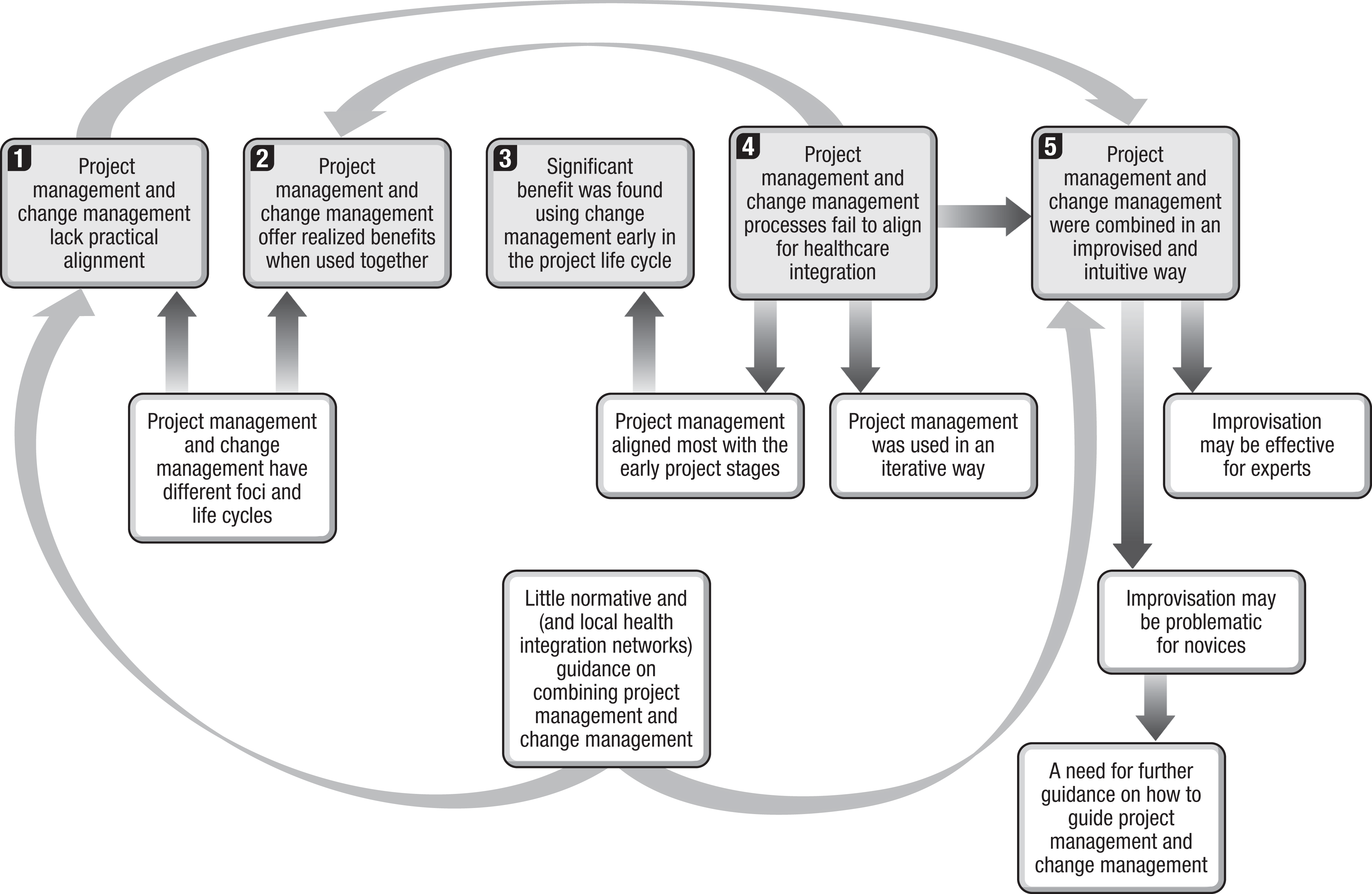
The relationship between the research themes.
Discussion and Implications of the Study
Concerns about a universal approach to project management have often been raised in the literature, suggesting that project management success is due to context-specific circumstances. A project management approach or technique that is successful in one project, under certain circumstances, might be a failure in a different project, or under different circumstances (Engwall, 2003). Research has found that the traditional model has not provided satisfactory results (Klein, Biesenthal, & Dehlin, 2015), and criticizing the rigidity of the traditional model of project management is common in project management research (Leybourne, 2009). Project management has grown beyond the fields of construction and engineering (Kloppenborg & Opfer, 2000); in response, many researchers are calling for our views of project management to be rethought (Cicmil & Hodgson, 2006). When healthcare project managers adopt a project life cycle that was designed outside of the healthcare industry, some adaptation of project management processes may be required. This is further supported by theme 1, which identified the disconnect between established project management processes and the project management requirements of healthcare integration projects.
The results from this research suggest that traditional project management, as represented by the commonly accepted normative guides, does not align with the needs of healthcare integration projects. A detailed design and plan for implementation is necessary in the delivery of an infrastructure or engineering products, but is less necessary when developing and adapting systems of human interaction and organizational change. This is due to the complexities of human interaction and the strong likelihood and impact of unforeseen events. In this research, it was identified that there was a large difference between how participants described their project processes in the interviews and how project processes were documented. All of the participants were aware of and valued, the PMBOK® Guide’s five Process Groups, yet these were treated as a guide for moving projects forward, rather than a rigid recipe. The archival documents showed a close alignment to established processes, but participants expressed the need for some fluidity during integrated healthcare changes. These findings are consistent with previous research (Wells, 2012) in which 47.9% of the sample considered strict adherence to a project management methodology a hindrance to project delivery. The normative project management literature is being challenged to review its underlying assumptions in light of application in complex dynamic environments where outcomes can be difficult to predict or control (Orr & Sankaran, 2007).
Healthcare integration projects involve significant organizational change to working practices and cultures; as a result, an iterative approach was found to be viable. An iterative approach did not rely heavily on front-end planning, allowing for work to start earlier in the project process, and for adaptation in response to emergent change. An iterative approach to project implementation also provides an alternative to the standard way of addressing ambiguity in project management. The traditional response to ambiguity is to put additional emphasis on planning in an effort to reduce ambiguity. An iterative approach, however, allows the project manager to take small steps, either in serendipitous moments when opportunities arise, when ambiguity momentarily clears, or to experiment with what may work in an uncertain environment. Hagen and Park (2013) point out that those project managers who drive change in ambiguous environments will demonstrate innovation, entrepreneurial traits, and are adaptive. The findings of this research are reflected in theme 5, whereby practitioners utilized improvisation and intuition when conducting their project management and change management initiatives. This is further reminiscent of Leybourne’s (2006) study of six organizations, which found nearly universal support for an improvisational approach to project management. Improvisational approaches have been found to be particularly valuable when engaged in organizational change project settings (Leybourne, 2006).
As defined earlier, the goal of each LHIN in this study—whether it was a vertical or horizontal integration—was gaining functional integration outcomes. Project planning within integrated healthcare planning requires iterative improvisation due to the necessary management of stakeholder engagement, considering the healthcare sector is not a static environment. Fluidity, iterative improvisation, and adaptation to the needs of the practice environment appear to be essential to the management and delivery of healthcare integration projects. The research participants focused on the need to adapt processes, the role that change management could play in iterative delivery, and the benefits that change management could provide in terms of output adoption and stakeholder engagement.
The interviewees consistently identified that there was benefit in using both project management and change management in delivering healthcare integration projects, but that there were difficulties in combining the approaches. Part of this incompatibility can be seen in the different ways these disciplines view the life cycle of organizational change. Theme 4 confirms the perceptional incompatibility of life cycle stages between project management and change management. Considering the interviewees’ failure to be in alignment with both life cycles, this demonstrates both the value and contribution that each discipline offers, yet the increased complexity when managing projects that enable change. Applying the life cycle of organizational change is continuing to evolve. Durbin and Doerscher (2010) demonstrate the need to unify functional portfolios; by doing so, portfolio decisions more readily address appropriate needs as reflected from the continuum of change. A traditional approach to project management will view the project starting after a business case has been approved and concluding at the completion of handover. From a change management perspective, the life cycle of a change is much more inclusive. Change processes (e.g., Kotter, 1996) often start when a need for change is first identified, before there is widespread support for the change, let alone approved funding. Change management also continues well past the delivery of project outputs, including consideration of usage, uptake, transition to business as usual, and the sustainability of a transformation. Activities at both ends of this spectrum are often considered outside the scope of project management. The differences between the life cycle models of project management and change management may have contributed to the project managers’ ad-hoc, intuitive approach to combining the disciplines. The findings from this research align with the results of Hornstein (2015) and Pollack and Algeo’s (2014a) research, which found that project management was considered operational compared with change management’s more strategic organizational outlook.
Existing processes within the project managers’ environments did not provide significant guidance as to how the two disciplines could, or should, be combined. Without clearer guidance on how these disciplines can be used together, practitioners may be deterred from using change management in their projects; those who do are more likely to use change management in an improvised fashion. Far from representing a lack of skills, improvisation has been found to be most used by experienced managers (Leybourne & Sadler-Smith, 2006). Improvisation can represent a level of mastery, not a lack of skills. Klein et al. (2015) refer to improvisation as a “…spontaneous, context-dependent and novel utilisation of tools…” (p. 268) and a form of practical excellence. However, while the improvisation of experts may be beneficial, that of novices may be less effective, with practitioners picking and choosing only those aspects that fit within their understanding of the approaches. The consequence of this is that the full benefits of an overall change management perspective on project delivery may not be realized. An intuitive combination may have resulted in a loss of opportunities that more explicit consideration of the situation may have provided. This can be offset by the inclusion of theme 3. Project managers who apply the principles of change management at the onset of their projects are more likely to experience realized benefits, particularly as change processes are integrated into the project plan. The intentional application of change processes will reduce the risks of loss opportunities, as described earlier.
Theme 2 recognizes the benefits in combining both change management and project management; however, even PMI’s Managing Change in Organizations: A Practice Guide (2013) reveals the difficulty in combining both disciplines. It appears that the authors of this guide have attempted to fit change management into an existing project management framework. In doing so, this guide identified parallels between change management and project management, program management, and portfolio management. While project, program, and portfolio management are commonly seen as separate, but related, activities, change management is a single activity operating at, and integrating, these different organizational levels. Modifying a change management framework to accomodate the existing project, portfolio management structure risks reducing the integrative role that change management can play. The need to control changes in project plans or scope is not a result of merging both project management and change management frameworks. This further aligns with the five themes identified in this research, as the intentions of this research was not to provide advice on how to control project changes. This research recognizes the benefits of combining both frameworks (theme 2), in light of the challenges associated with aligning both life cycles (theme 4), and demonstrates the need to identify less rigid project management processes for healthcare integration projects (theme 1). Due to the ambiguity that exists around blending change management and project management (theme 4), healthcare project managers adopt improvisation and intuition when engaging both disciplines (theme 5); however, greater benefits are reaped when project managers integrate change management strategies into the early planning stages of their healthcare integration project life cycles (theme 3).
An implication of this research is that, although it may be problematic to attempt to fit change management into a project management framework, it may be possible to do the reverse. Given the broader scope of change management—both from the perspective of organizational levels and of life cycle duration—an alternative is to place project management within the context of change management. It may be more effective to consider how project management can strengthen the planning and implementation aspects of change management, than how change management can supplement stakeholder engagement in project management.
Limitations of this Study and Recommendations for Future Research
This case study explored the ways practitioners combined project management and change management during healthcare integration in Ontario, Canada. A cross section of project managers working at provincial, regional, and local levels were recruited and interviewed in this study. It was evident in the transcripts that project managers had a knowledge base of change theory, including an awareness of change barriers and enablers; however, formalized approaches to applying stages of change to their project management processes were missing. It was evident that some Local Health Integration Networks had more robust project management offices than others. As a result of these inequities, some LHINS were equipped with more project management and change management resources than others. Despite this variation in organizational support, there was considerable consistency in how the practitioners talked about the practice of project management and change management. The purpose of this research was not to define these practices, but rather to explore the ways practitioners were using these management approaches in combination. Future research may want to consider exploring practitioners’ ideas of the boundaries of these disciplines, and analyze if and how this differs from how these disciplines are depicted in the literature.
Healthcare integration provided the context for this study, not of the subject. Considering that the integrations had a common goal of gaining functionality as an outcome, this study examined project management and change management processes and did not distinguish between integration types, as they applied to both vertical and horizontal integrations. It is possible that differentiating between each type of integration would have derived different results. In addition, it is acknowledged that these research findings have been developed based on data from one particular project type, in one specific geographic region. Future research may consider a comparable study in a different industry, or a different region, to understand how transferrable the results of this research are.
Future research could build upon this research in a variety of ways, including exploring how project management could be used within a change management framework, rather than attempting to fit change management into a project management framework. The interviewees found that change management could provide benefits at the front end of projects, but research could consider the benefits that change management can provide during implementation and post-delivery. Future research is also needed to understand the specific inconsistencies between project management and the needs of a healthcare integration environment, to clarify how project management can be adapted to more effectively service these environments. In addition, the interviewees were consistently found to have used an iterative approach, rather than a structured and controlled approach to project management. However, there is very little consideration of iterative or improvisational project management in the literature. Further research in this area could formalize and legitimize this practice, making it a more accepted area for research and investigation.
Conclusion
In the province of Ontario, Canada, healthcare integration has largely been recognized as a necessary process to enhancing patient delivery and addressing fiscal restraints. Managing change has become a prevalent issue within healthcare organizations. The field of project management has evolved from its origins and spread beyond engineering, construction, and information systems. Project management practices have now been integrated into government organizations; however, managing change in a healthcare environment comes with the challenges in managing projects that are contingent on diverse stakeholder support, involving significant organizational change. This research reports on the approach taken by the managers of Ontario’s Local Health Integration Networks when managing healthcare integration change projects, to understand the challenges faced in delivering these kinds of projects.
Themes from the interviews and archival documents were developed through a meta-analysis. Five themes were discussed in this article. The themes broadly spoke to a misalignment between traditional project management and the needs of a healthcare integration environment, which could partly be resolved by using change management to address the aspects of the situation that project management could not. The participants, however, found practical issues combining change management and project management. These issues were related to the differences between the ways that these approaches structure the stages of a project, differences in the vocabularies they use, and a lack of formal guidelines in the existing normative texts and organizational documentation. In response, the managers of these projects combined project management and change management in an intuitive, iterative, and improvised way. The research participants also identified the need for greater change management involvement during the early stages of a project to ensure that appropriate early consideration is given to stakeholder engagement and the impacts that change management can have on the project governance process.
This article makes a contribution to the literature on healthcare integration, project management, and change management. Relatively little research has explored project management in facets of healthcare other than in IT projects. Still less research has explored the relationship between project management and change management in the delivery of healthcare integration projects. The theoretical contributions of this article include the finding that the traditional model of project management does not clearly align with the requirements of healthcare integration projects. Although research (e.g., Engwall, 2003) has generally argued against a one-size-fits-all model of project management, this had not previously been verified in the context of healthcare integration. This research also found that the structure that project management provided in the early stages of the projects may have provided opportunities for practitioners to find ways that change management could be applied in their projects. In response, further development of normative guidelines on how to combine these approaches is needed. However, structuring guidelines from a project management perspective may limit the ways in which change management can provide benefits in these kinds of projects. Given change management’s broader organizational scope and longer duration of engagement with a project, it may be more effective to develop frameworks for the combination of these approaches by framing project management within a change management context, than the other way around.
Footnotes
Declaration of Conflicting Interests
The author(s) declared no potential conflicts of interest with respect to the research, authorship, and/or publication of this article.
Funding
The author(s) received no financial support for the research, authorship, and/or publication of this article.