







Abstract
This study aims to explore the relationship between the critical success factors (CSFs) and the performance of integrated project delivery (IPD) projects based on empirical data from IPD projects. Data from 16 projects, in relation to 25 success factors and four performance areas (schedule performance, cost performance, defects, and change orders), were gathered and analyzed according to the qualitative comparative analysis method. As a result, this study identifies 17 factors as conditions that frequently occurred in successful IPD projects. This study also derives combinations of factors that led to IPD project success regarding each of the four performance areas.
Keywords
Introduction
Project delivery systems are very important in achieving the desired outcomes of projects (Leicht, Molennar, Messner, Franz, & Esmaeili, 2016) and in mitigating the risks associated with projects (McGraw-Hill Construction, 2014). Therefore, developing a novel and promising project delivery system and testing it in real projects is important in addressing the chronic problems of the construction industry, such as adversarial relationships among project participants, fragmented information that causes inefficiency and errors in the work, and discrepancies between designed products and actual products. In this context, integrated project delivery (IPD), as a new project delivery system, has frequently been discussed in project management discourse (Baiden, Price, & Dainty, 2006; Bryde, Broquetas, & Volm, 2013; Mesa, Molenaar, & Alarcón, 2016) as a promising means to “integrate people, systems, business structures, and practices into a process that collaboratively harnesses the talents and insights of all participants to optimize project results, increase value to the owner, reduce waste, and maximize efficiency through all phases of design, fabrication, and construction” (AIA, 2007, p. 2). Therefore, many researchers have studied and reported the benefits of IPD typically against non-IPD systems. For example, El Asmar, Hanna, and Loh (2015) showed that IPD exhibits better project performance overall than other delivery systems (i.e., design-build, design-bid-build, and construction management at risk). In addition, IPD is known to deliver better performance in communications, in the management of change, and in business performance (Hanna, 2016).
Despite the studies that have reported the effects of IPD, questions still remain unanswered about how to anticipate the success of an IPD project given project contexts and how to make an IPD project successful with limited project resources. Studies that compare IPD systems with other delivery systems often deal with IPD and IPD-like projects as one identical group irrespective of the IPD-specific factors presented in these projects. As a result, although these studies are successful in highlighting the superiority of IPD over other delivery systems, they did not answer the important question concerning how to implement IPD successfully given the situation where a project is put. For example, when an IPD project has a contract that states responsibility and liability clearly and establishes a proper organization before the design phase, will this project be successful? In what aspect will the project participants put more effort into making this project successful?
To shed light on the relationship between the managerial efforts in IPD projects and their success, some researchers have suggested critical success factors (CSFs) for IPD projects by tailoring traditional CSFs of construction projects to fit the characteristics of IPD systems (Brennan, 2011; Hall, Algiers, Lehtinen, Levitt, Li, & Padachuri, 2014; Hassan, 2013; Sun, 2013). However, because there are many factors that are called “critical,” those studies cannot provide IPD project participants with adequate support in predicting whether or not a project will be successful and in determining which aspect they should focus on (Cooke-Davies, 2002). Indeed, this approach assumes that all factors are critical and necessary for project success. As Ram and Corkindale (2014) pointed out, indicating the relationship between CSFs and project performance is very challenging without empirical data that allow researchers to isolate each relation and see the effects of a certain factor on project success.
The aim of this study is to contribute to the existing body of knowledge regarding the factor-performance relationship of IPD projects by providing empirical evidence of the relationship and of the combinatorial effects of factors on IPD performance. Because IPD performance can be defined in multiple ways, the authors reviewed key performance indicators in the annual UK Industry Performance Report (Glenigan, 2015), and the literature on the evaluation of IPD project performance. As a result, the following four specific outcomes were deemed to be indicative of the success of IPD projects: schedule performance, cost performance, defects, and change orders. Schedule performance and cost performance are commonly used to gauge the success of construction projects. In evaluations of IPD performance, defects (representing the quality of the product) and change orders (representing the quality of the process) are often mentioned as key benefits of the use of IPD in projects (El Asmar, Hanna, & Loh, 2013; El Asmar et al., 2015; Hanna, 2016).
In order to explore the relationship between CSFs and IPD success in four performance areas, this study conducted a qualitative comparative analysis (QCA) for the following two main reasons. First, IPD is not yet commonly used in practice, and there are many possible factors that might affect the success of IPD projects. Therefore, it is difficult to acquire enough numbers of IPD cases to perform traditional statistical analyses (e.g., regression analysis). To deal with such small or intermediate N problems (Rihoux & Ragin, 2009), QCA enables researchers to characterize IPD cases as a set of CSFs and outcome variables and compare them in a formalized way. Second, QCA is useful in revealing the complex causality between multiple variables (CSFs) and outcome events (four performance areas). In other words, it takes into account the combinatorial effects of factors when deriving necessary and sufficient conditions that have led to certain events (the IPD project success in four performance areas of interest) in observations. Necessary conditions are factors that are almost always present in successful IPD projects. Sufficient conditions are factors that almost invariably lead to the success of IPD projects.
The results of the QCA (i.e., necessary and sufficient conditions for IPD project success) can then be used to form hypotheses that might be of interest to researchers who want to prove them statistically. The results can also help practitioners decide whether or not they apply IPD in their projects and determine which CSFs they need to take into account more significantly depending on their project-specific situations and performance goals. For example, if the success factors A and B comprise a solution that leads to IPD success in schedule performance, and factor A is deemed satisfied after an investigation by a company, the company can focus on satisfying factor B during the preparation of an IPD project. Also, if factors A and C comprise a solution that leads to successful cost performance, and the company values cost performance as the most important goal, the company might want to focus on satisfying factor C rather than factor B (that is related to the schedule performance).
Prior Work on Integrated Project Delivery
IPD has been studied and discussed by many researchers as an alternative delivery system to alleviate the current problems in construction, such as adversarial relationships between participants and low productivity caused by inefficiency and rework (Thomsen, Darrington, Dunne, & Lichtig, 2009). Because IPD is a relatively new concept and has not been used extensively in practice (Rowlinson, 2017), many researchers have compared IPD projects with non-IPD projects to show that IPD is superior in performance to non-IPD projects. For example, El Asmar et al. (2013) evaluated the performance of 12 IPD and 23 comparable non-IPD projects using 31 performance metrics and concluded that IPD delivers higher quality projects faster without a significant cost increase. The t-test was utilized to show the statistical differences between IPD and non-IPD projects for each metric. In 2015, El Asmar et al. developed a comprehensive composite measure that combines performance metrics and used the measure to evaluate 35 projects that cover different delivery systems, including Design-Bid-Build (DBB), Construction Management at Risk (CMR), Design-Build (DB), and IPD. As a result, 10 IPD projects included in the study outperformed other projects delivered using other systems (i.e., DB, CMR, and DBB in the order of high scores in performance). Although this type of research highlights the superiority of IPD over other delivery systems and would motivate practitioners to adopt IPD more actively in their projects, it does not reveal the knowledge of which set of factors are the main contributors to the discrepancy in performance.
The other line of research deals with how to implement IPD successfully in construction projects. For example, Brennan (2011) conducted a Delphi survey in which the roles of 40 CSFs were evaluated in multiple rounds by 51 subject matter experts (owners, designers, contractors, and users). Sun (2013) conducted a content analysis based on a report of the American Institute of Architects (AIA) (2012) that introduces successful IPD projects and conducted a case study on a failed IPD project. By comparing successful and failed IPD projects, the author identified seven principal factors and five secondary factors that might have influenced the implementation of the IPD projects. Hassan (2013) also identified 12 factors that would affect IPD project success in a healthcare setting through an extensive literature review and an analytic hierarchy process method. Similarly, other researchers have used the survey and case study methods to identify CSFs (e.g., decision-making systems, risk management, early involvement of key participants, trust-building attributes, and clear and realistic objectives) that seem important in implementing IPD projects (Brennan, 2011; Hall et al., 2014; Pishdad-Bozorgi, 2017; Sun, 2013). In addition, Uihlein (2016) discusses engineers’ roles that would make IPD projects successful after assessing several AIA reports (2007, 2012) and Ove Arup’s integrative objectives toward “total design.” Teng, Li, Wu, and Wang (2017) suggest applying a game theory model in determining profit-sharing policies for successful IPD project implementation. These studies have contributed to IPD project implementation by providing the valuable information required to develop an appropriate vocabulary for IPD and to establish a set of success factors for IPD projects. However, to enable IPD project participants to predict whether or not a project will be successful and to determine which success factors to focus on in a given situation, the detailed relationships that might exist between the factors and the success of IPD projects need to be further investigated based on empirical data. Indeed, as there are many possible success factors for IPD projects and there are limited numbers of IPD projects researchers can access at a time, most studies utilize case studies, literature reviews, and expert survey methods to identify CSFs.
Overall, exploring which factors have the most significant effects on certain aspects of IPD project success still remains a challenge. In the absence of this information, it would be difficult for the project team to gauge the success of their IPD applications. Studies that derive success factors with the use of empirical data, which can ensure the effects of the “success factors” in real settings (Ram & Corkindale, 2014), are still lacking in the body of knowledge about IPD project implementation.
Research Methodology
This study applied fuzzy-set QCA, among other different QCA techniques, because fuzzy-set qualitative comparative analysis allows researchers to determine partial membership using values ranging between 0 (non-membership) and 1 (full membership) without abandoning the core theoretical principles on which QCA theory builds (e.g., subset relation) (Rihoux & Ragin, 2009). Therefore, this study defines the outcome variables of IPD projects in five-point fuzzy sets. QCA was conducted using fuzzy-set QCA, a platform developed by Charles Ragin, Sean Davey, and Kriss Drass (2008).
Qualitative Comparative Analysis
Qualitative comparative analysis (QCA) was originally a Boolean-based technique that allows researchers to identify the underlying causal relationship in practice based on a limited number of cases (i.e., a small or intermediate number of samples). In other words, QCA enables the systematic view of factor-performance relationships from a small number of cases that would otherwise have been too few to derive any meaningful findings in traditional statistical analyses (Hall et al., 2014; Rihoux & Ragin, 2009). Specifically, QCA produces a table that shows the relationship between different sets of conditions (i.e., independent variables) and outcome events (i.e., dependent variables) from the raw observations of each case, which is referred to as the “truth table” (Rihoux & Ragin, 2009). Based on the observations in the truth table, QCA derives necessary and sufficient conditions, often in a combinatorial form, as the main outputs of the analysis. When a certain condition is identified as a necessary condition, it is often eliminated from the truth tables and from the composition of sufficient conditions (Rihoux & Ragin, 2009).
When researchers deal with a large number of variables and find it difficult to gather enough cases to conduct statistical analyses and derive statistically significant results, they often use QCA as the primary research method. For example, in the construction industry, Chan, Levitt, and Garvin (2010) used empirical data from 14 projects to study the impacts of seven independent factors on a project’s relational-legalistic renegotiation approach. Boudet, Jayasundera, and Davis (2011) explored which of the 14 factors strongly affected an infrastructure’s legal and political conflicts in two sectors—namely, the water supply sector, comprising 15 cases, and the pipeline sector, comprising 11 cases. Choi, O’Connor, and Kim (2016) studied the impacts of nine CSFs on the costs of industrial modular projects and their schedule performance using empirical data from 16 cases. Therefore, similarly, our intent in this study is to utilize QCA to explore the relationship between various success factors and the success of IPD projects because such projects have not yet been used extensively in practice and it is difficult to acquire an adequate number of actual cases to conduct statistical analyses.
Research Design
IPD Success Factors as Conditions
To determine the IPD success factors to be included and tested in this study, the authors identified possible success factors from the existing literature about both IPD success factors (Brennan, 2011; Hall et al., 2014; Hassan, 2013; Sun, 2013) and project success factors (Andersen, Birchall, Arne Jessen, & Money, 2006; Atkinson, 1999; Chan, Ho, & Tam, 2001; Chan, Scott, & Chan, 2004; Chan, Scott, & Lam, 2002; Lim & Mohamed, 1999; Sadeh, Dvir, & Shenhar, 2000; Shenhar, Levy, & Dvir, 1997). The following criteria were established and considered during the process: (1) IPD success factors are selected only when they comply with the principles and concepts of IPD recommended by the guidelines of the AIA (2007), such as full participation by all project participants (Chan et al., 2001), the effectiveness of the decision-making process (Andersen et al., 2006), and the project team leader’s early and continued involvement in the project (Chan et al., 2004); (2) factors that are more commonly applied and discussed than other factors in IPD cases reported by the AIA (2012) are selected; and (3) the popularity and the level of application of the factors are also considered in the selection: Some factors that are used less frequently, such as “A3 and A4” (a one-page report that steers the problem-solving and decision-making processes [AIA, 2012]), the choosing-by-advantages decision-making system, and utilization of some technologies like the last planner system and SMART board, were excluded from this study. In addition, success factors related to the use of building information modeling (BIM) were divided into three levels according to how BIM is applied in a project—namely, for visual aid only, for design development and documentation, and for a higher level of project management (e.g., clash detection, constructability review, and scheduling coordination).
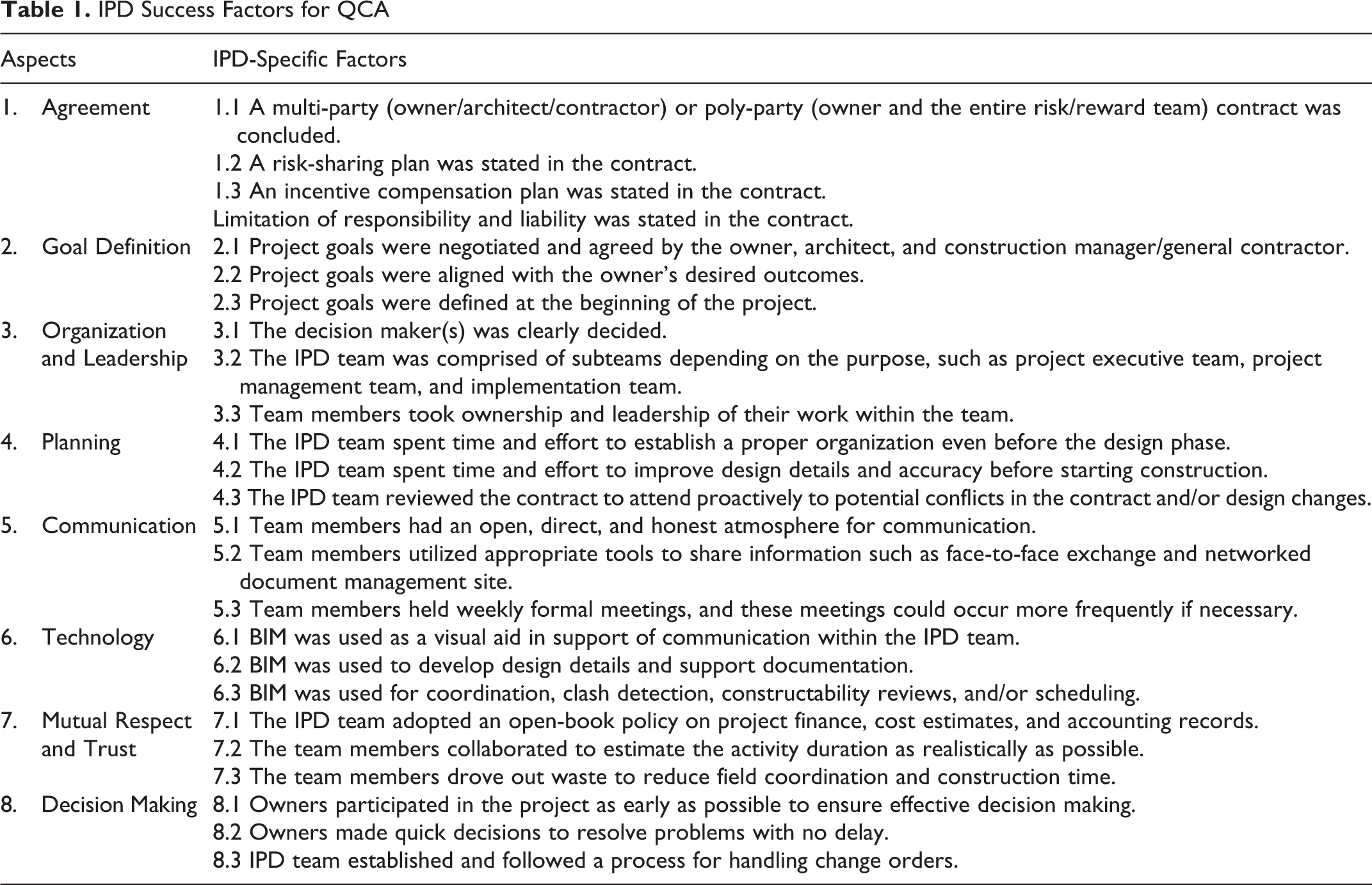
Using the process described above, 25 IPD success factors in eight aspects were established for the analysis, as shown in Table 1. These aspects are based on the definition of nine principles in the AIA guide (2007) and 17 categories in the AIA case studies (2012). The eight aspects established for this study were agreement, goal definition, organization and leadership, planning, communication, technology, mutual respect and trust, and decision making. In this study, the list of the established factors was used as a checklist to assess each IPD project regarding whether or not these factors were included and practiced in the project.
IPD Success Factors for QCA
IPD Performance Metrics as Outcome Events
As discussed in the introduction, based on the annual industry performance report and other relevant literature such as El Asmar et al. (2013, 2015) and Hanna (2016), four IPD performance areas were selected for this study to represent the success of an IPD project (i.e., schedule performance, cost performance, defects, and change orders). In order to measure these performance areas, survey questions and five-point fuzzy answer sets were developed according to the guidelines from QCA literature (Boudet et al., 2011; Rihoux & Ragin, 2009), as shown in Table 2.
IPD Performance Metrics for QCA
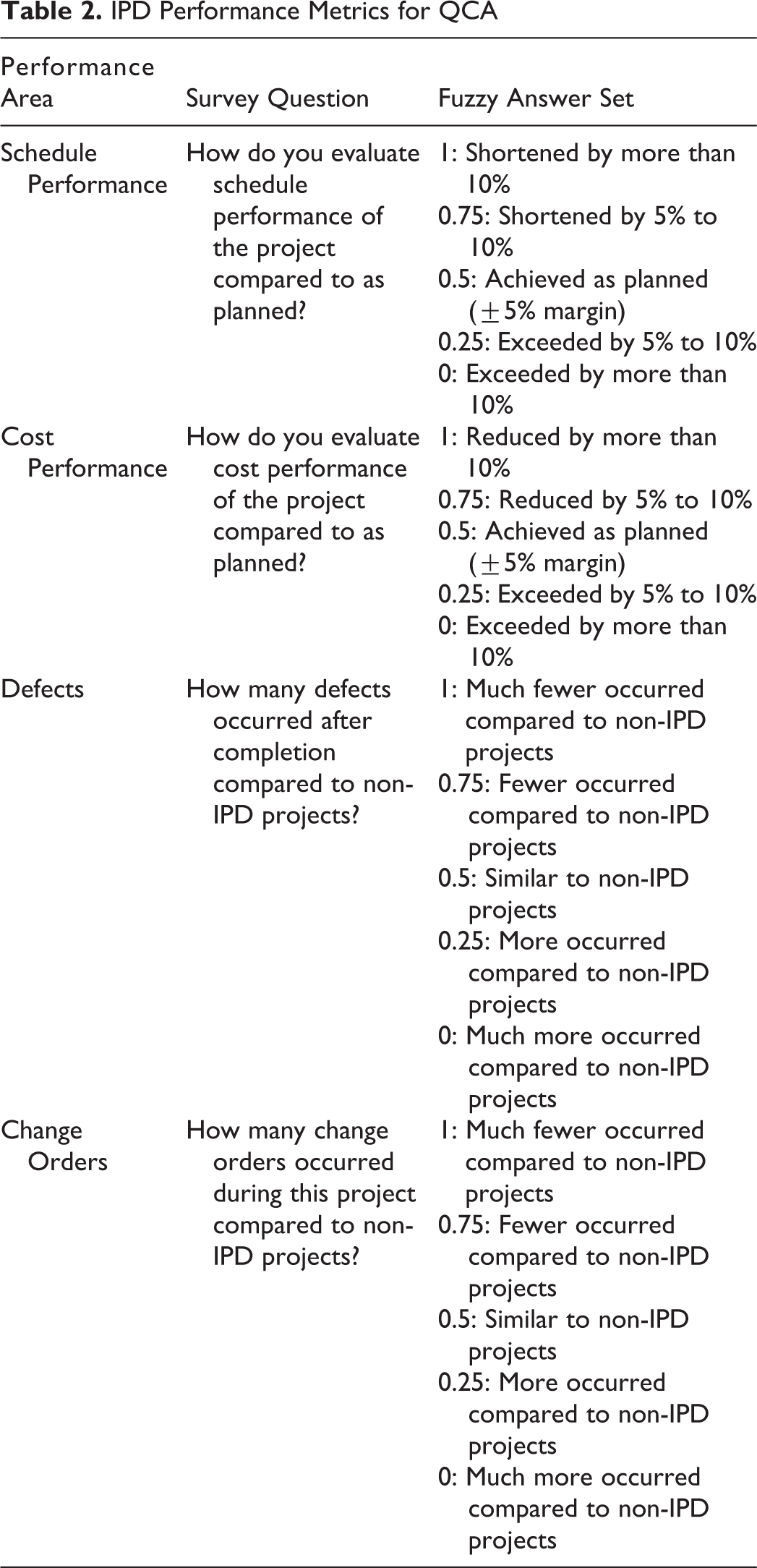
For measuring the project success in schedule and cost performance, this study compared the actual performance with as-planned performance so as to give the score of 1 (full membership) when the actual performance is 10% better than as planned and the score of 0 (non-membership) when the actual performance is 10% worse than as planned. As for measuring defects and change orders, because there is no standard to compare with, this study compared the actual performance with imaginary non-IPD projects so as to give the score of 1 (full membership) when the actual performance is superior to what would have been performed in non-IPD projects and the score of 0 (non-membership) when the actual performance is inferior to that of non-IPD projects. The score of 0.5 for all performance areas represents the “crossover point,” where the performance is similar to the as-planned performance or the performance of imaginary non-IPD projects. Note that these criteria were determined based on the authors’ own discretion after several interviews with project management experts. Changing these criteria (by defining successes and failures of IPD projects differently) will affect the factor-performance relationships that are derived from this study. In addition—because it was challenging to acquire actual project performance data, such as actual cost and schedule data, the number of defects, and the number of change orders— these performance areas were evaluated by asking IPD project participants about them in a survey, which is described in the following section.
Data Collection
The authors conducted a survey to gather empirical data about IPD project implementation and performance from individuals who had participated in an IPD project. The survey was organized into two parts. In the first part, the participants were asked to check whether or not each success factor was practiced in their project (“yes” when a certain factor was practiced in their project; “no” when it was not). They were also allowed to check “not applicable (N/A)” when they were not sure or were not permitted to answer. In the second part, the participants were asked to evaluate the performance of their projects according to the performance metrics shown in Table 2. Similar to the first part, they were allowed to check “not applicable (N/A)” when they were not sure or not permitted to answer.
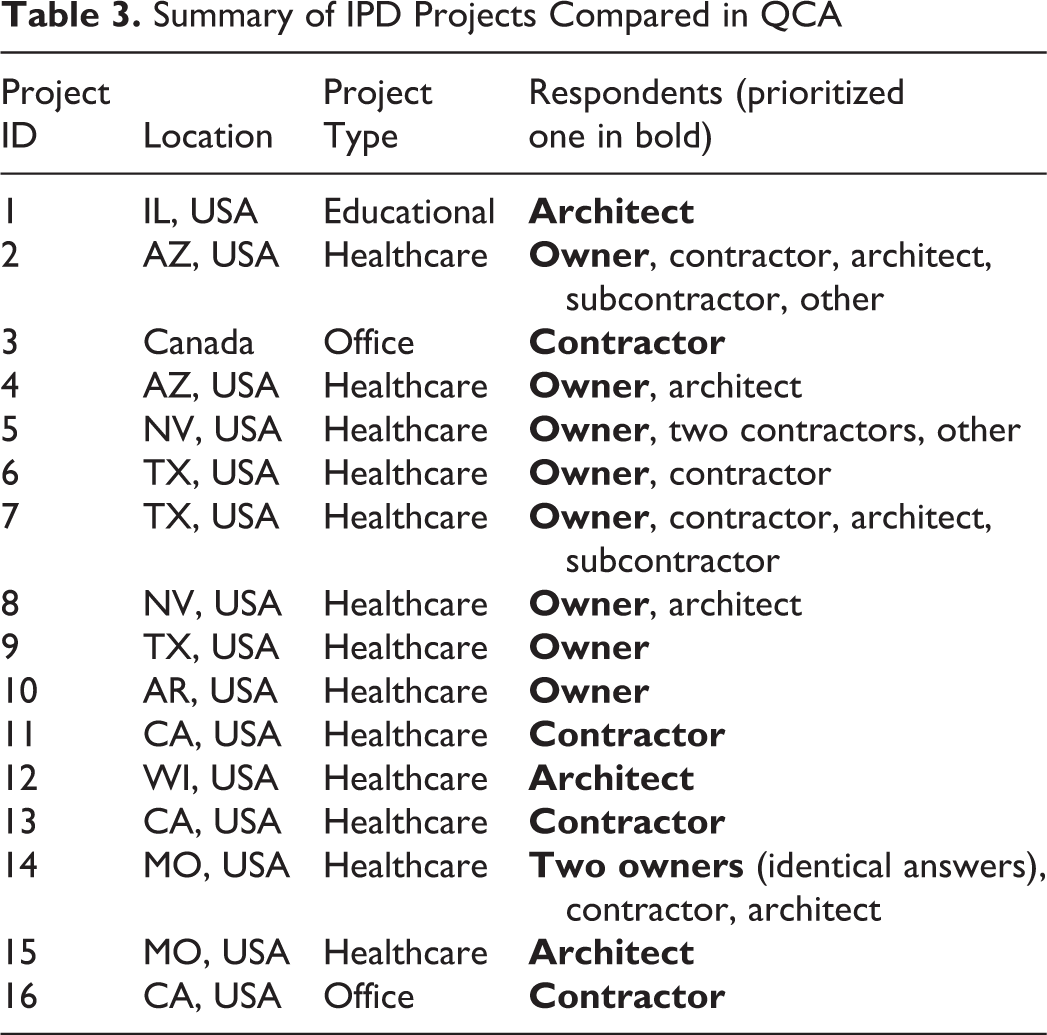
The data were collected in the following steps. First, the authors identified 12 IPD projects from the AIA’s case study report (2012) and 12 IPD projects by conducting an online search. The authors then gathered the names and contact information of the owners, architects, and contractors for these projects and contacted them through email. The participation rate for the survey was as low as 33%. Second, to increase the participation rate and gather empirical data for more IPD projects, the authors contacted potential respondents by telephone and asked them to participate in the survey. During this step, one respondent helped the authors identify five more IPD projects that his company had performed. After this step, the authors collected the responses from 32 IPD project participants (10 owners, eight architects, 10 contractors, two subcontractors, and two others) covering 16 IPD projects. Third, although the answers were generally consistent across respondents, when there were two or more respondents for a project and their answers were different, we gave priority in the order of owner, contractor, and architect. As a result, the data used in this study came from nine projects reported by owners, four reported by contractors, and three reported by architects (a total of 16 projects). Note that this survey measures the perceptions of the project participants (instead of actual project data) on success factors and IPD performance, and more than half of the respondents are owners. Therefore, despite the general consistency across different parties, the results of the study might represent owners’ perceptions more than those of other parties. The survey was conducted from December 2015 to March 2016 using a Google online survey tool. Table 3 summarizes the IPD projects assessed and used in this study, which were mostly healthcare projects located in the United States.
Summary of IPD Projects Compared in QCA
Results and Discussion
This section describes the outputs of the QCA, including necessary and sufficient conditions for IPD success in four performance areas (i.e., schedule, cost, defects, and change orders). From the data acquired from the 16 IPD projects, the authors identified 17 CSFs as necessary conditions that frequently occurred in successful IPD projects. Sufficient conditions were also suggested in a combinatorial form for each of the four performance areas. These outputs contribute to the understanding of how to make an IPD project successful and how to anticipate the success of an IPD project.
Necessary Conditions
The analysis of CSFs required for necessary conditions of IPD success in four performance areas is important for IPD project participants because the identification of those CSFs supports the participants in determining which CSFs they need to take care of more significantly depending on their performance goals. Table 4 shows the results of the necessity analysis for IPD project performance. In this analysis, CSFs with consistency scores (i.e., the degree to which the empirical data support the theoretic relations that were set) greater than 0.9 were deemed to be necessary conditions (Ragin et al., 2008). These CSFs are shown in bold font in Table 4.
Necessary Conditions of IPD Project Success Derived by QCA*
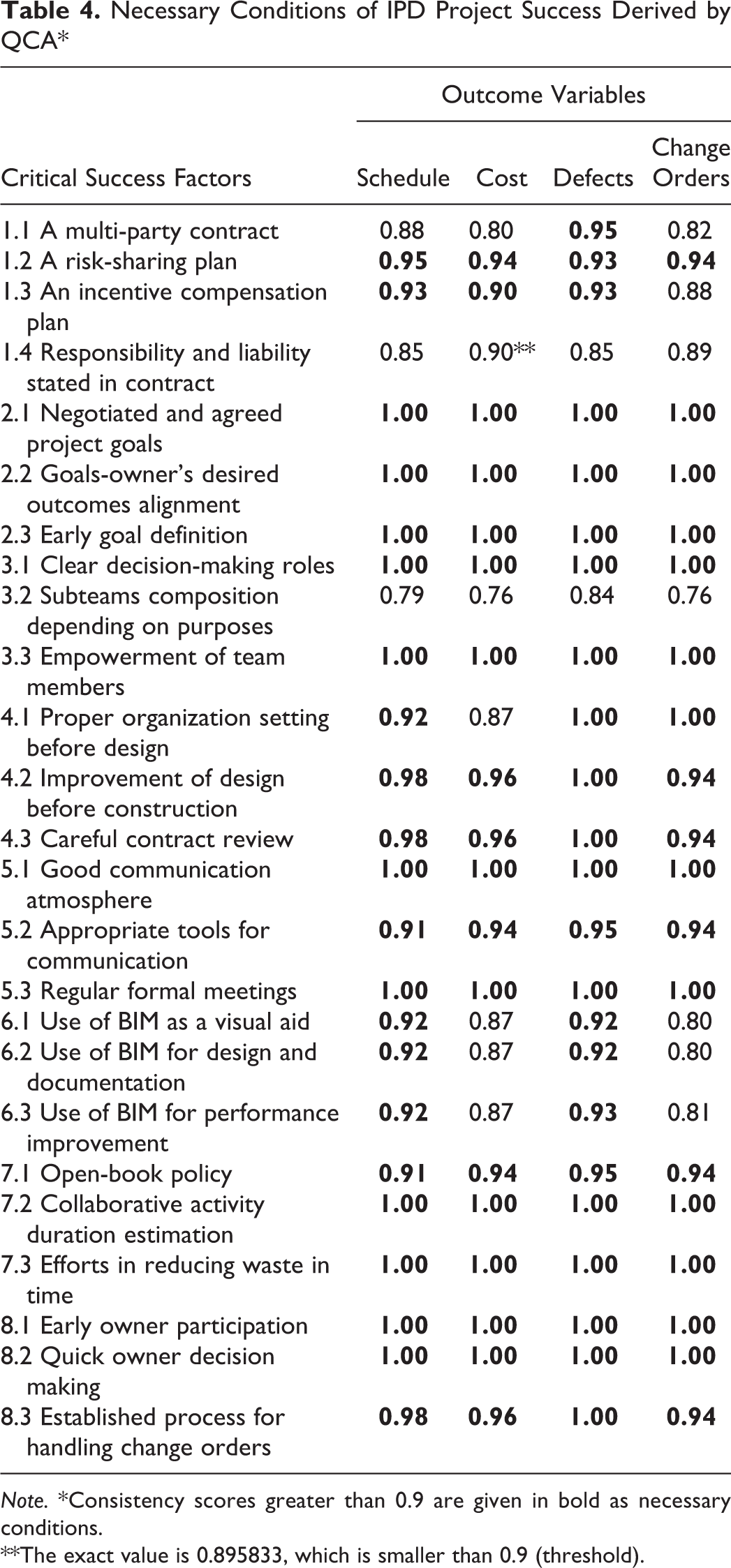
Note. *Consistency scores greater than 0.9 are given in bold as necessary conditions.
**The exact value is 0.895833, which is smaller than 0.9 (threshold).
Seventeen factors were frequently observed in successful IPD projects and identified as necessary conditions that are common in four performance areas. This implies that, without the satisfaction of all common necessary conditions, the IPD project team will have difficulty leading IPD success in any of the four performance areas. The following 17 factors are required for necessary conditions (the CSF numbers refer to the CSF ID shown in Table 4): A risk-sharing plan that is stated in the contract (CSF 1.2); At the beginning of the project, key stakeholders (owners, architects, and construction manager/general contractor) negotiate and agree on project goals aligned with the owner’s desired outcomes (CSFs 2.1, 2.2, and 2.3); Decision makers are clearly decided, and team members work with ownership and leadership within the team (CSFs 3.1 and 3.3); Before the construction phase, the IPD team tries to improve the design details and accuracy and to review the contract to proactively deal with potential conflicts (CSFs 4.2 and 4.3); The IPD team is organized in a way that promotes an open, direct, and honest atmosphere for communication; utilizes appropriate tools to share information; and holds weekly formal meetings, which can occur more frequently, if necessary (CSFs 5.1, 5.2, and 5.3); To ensure mutual trust and respect, the IPD team uses an open-book policy on project finance, cost estimates, and accounting records. Under this policy, team members collaborate to estimate the duration of the activity as realistically as possible and to eliminate “waste” to reduce the time required for field coordination and construction (CSFs 7.1, 7.2, and 7.3); and Owners participate in the project as early as possible and make decisions quickly to resolve problems to ensure effective decision making, and the IPD team establishes and follows a process for handling change orders (CSFs 8.1, 8.2, and 8.3).
Sufficient Conditions
Knowing sufficient conditions of IPD success is also important for IPD project participants because it allows them to prioritize CSFs to focus on given project contexts and performance goals to achieve. For the sufficiency analysis, the number of conditions must be kept low because a large number of conditions tends to individualize the cases, making it difficult to find patterns in the cases (Rihoux & Ragin, 2009). Therefore, to derive sufficient conditions for the four performance areas of interest, in this study, the authors included only two to seven conditions after excluding the necessary conditions with high consistency scores, according to the suggestions of Rihoux and Ragin (2009).
The following two measures were used to assess qualities of the solution in a performance area (Rihoux & Ragin, 2009; Chan et al., 2010): (1) consistency measures the proportion of the IPD projects with sufficient conditions (in fuzzy scores) that turned out to be successful (also in fuzzy scores) (please see Rihoux & Ragin, 2009 for the formula). A high consistency score implies that, if all conditions in a solution are satisfied in an IPD project, the project is highly likely to be successful in the performance area that is explained by the solution. (2) (Solution) coverage measures the proportion of the successful IPD projects that are explained or covered by the solution. A high coverage score implies that many successful IPD projects turn out to be satisfying all conditions in a solution and there are only a few observed cases where IPD projects are successful but the conditions are not satisfied. Therefore, if a solution has low coverage, it is empirically insignificant even though it has high consistency (Chan et al., 2010). Table 5 shows the results of the sufficiency analysis.
Sufficient Conditions of IPD Project Success Derived by QCA*
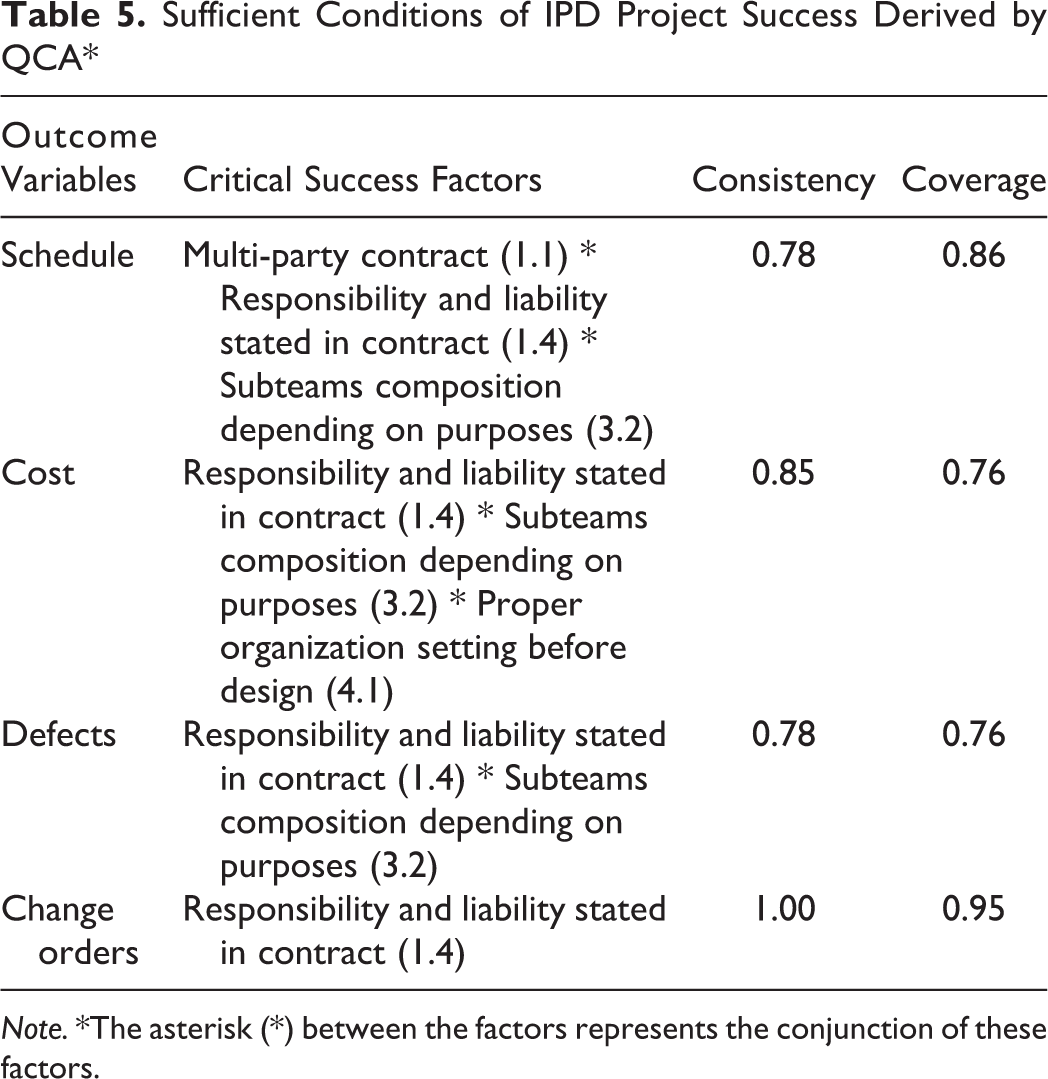
Note. *The asterisk (*) between the factors represents the conjunction of these factors.
The implications of the results shown in Table 5 were as follows (the CSF numbers refer to the CSF ID shown in Table 4): Schedule performance: When the following three IPD success factors are used in a project, the project is highly likely to be successful in terms of schedule performance—namely, CSF 1.1 (a multi-party [owner/architect/contractor] or poly-party [owner and the entire risk/reward team] contract is concluded), CSF 1.4 (the limitation of responsibility and liability is stated in the contract), and CSF 3.2 (the IPD team is comprised of subteams depending on the purpose, such as the executive team, the management team, and the implementation team). Cost performance: The combination of the three following success factors is sufficient for achieving high cost performance in IPD projects: CSF 1.4 (limitation of responsibility and liability is stated in the contract), CSF 3.2 (the IPD team is comprised of subteams depending on the purpose, such as the executive team, management team, and implementation team), and CSF 4.1 (the IPD team spends time and effort to establish a proper organization even before the design phase). Use of BIM technologies, in any level, is not a part of the sufficient condition for success in cost performance in IPD projects, which need to be further investigated with more empirical data or in-depth case studies. Product quality (defects): The combination of the following two success factors is sufficient for achieving high product quality in terms of defects in IPD projects: CSF 1.4 (limitation of responsibility and liability is stated in the contract) and CSF 3.2 (the IPD team is comprised of subteams depending on the purpose, such as the executive team, project management team, and implementation team). Process quality (change orders): Interestingly, the analysis shows that only one success factor, CSF 1.4 (limitation of responsibility and liability is stated in the contract), is sufficient for achieving high process quality (measured in change orders) in IPD projects. Other factors, such as incentive compensation plan (CSF 1.3) and use of BIM technologies (CSF 6.1 through 6.3), do not form the sufficient condition for success in reducing change orders.
Discussion
Overall, the findings of this study are robust because (1) the derived necessary and sufficient conditions are strongly related to observed IPD successes for a given performance area (i.e., high consistency scores), and (2) most of the observed IPD successes can be explained by the derived sufficient conditions (i.e., high coverage scores). Although QCA does not prove the relationships between IPD success factors and performance, it enables researchers to derive such robust findings by comparing a limited number of cases in a systematic and quantitative manner.
The authors found that many CSFs are necessary for IPD project success. Specifically, 92% (23 out of 25) of the tested factors are necessary for defects (product quality). For schedule performance, 88% (22 out of 25) of the factors are necessary. For cost performance and change orders, 72% (18 out of 25) of the factors are necessary. These necessary CSFs are in compliance with the existing literature concerning how to make IPD projects successful. For example, Hanna (2016) states that a multi-party contract is key to IPD project success because it contractually ensures mutual respect and trust. The Construction Management Association of America (2012) also points out that IPD projects require that participants be involved from the early project stage and that the problem of late decision making, especially by owners, must be solved to avoid project delays and cost overruns. Significantly, all factors that belong to the following four aspects turned out to be necessary for all performance areas: goal definition, communication, mutual respect and trust, and decision making. Thus, these four aspects seem to be the basic requirements for successful IPD implementation.
Using BIM for visual aid (CSF 6.1) and design detailing and performance improvement (CSFs 6.2 and 6.3) is considered necessary for schedule success and the reduction of defects in IPD projects. However, it is notable that these technology-related success factors are involved in neither necessary nor sufficient conditions in terms of cost performance and change orders. Indeed, this observation is supported by some literature that studies the relationship between the use of BIM and the project performance. Wong, Salleh, and Rahim (2014) surveyed the perception of quantity surveyors on BIM and found that BIM capabilities are more related to time and quality performance than to cost performance. Bryde et al. (2013) conducted a content analysis using 35 projects that applied BIM and reported that there were six cases where BIM negatively affected cost reduction, whereas there were fewer cases exhibiting a negative benefit on schedule reduction or quality increase.
Some factors also function more significantly for a specific performance area. Multi-party contracts are found to be necessary for reducing defects in IPD projects, whereas they are not included in necessary or sufficient conditions for cost performance and process quality (change orders). This implies that “IPD-ish” or “near-IPD” projects, which use the IPD concepts and philosophy but do not conclude a multi-party contract (El Asmar et al., 2013; Hanna, 2016), can be more effective in reducing or controlling project schedule and defects than in reducing or controlling project costs and change orders. In addition, once necessary conditions for process quality are satisfied in an IPD project, stating responsibility and liability explicitly and clearly in a contract (CSF 1.4) is found to be the only one sufficient condition for high performance in process quality with very high consistency and coverage scores.
Although QCA does not offer these findings with a statistical significance, it reports what is observed in the gathered cases by systematically comparing causes (success factors in this study) and results (IPD success in this study). These findings can be interesting hypotheses to be tested or studied further through other research methods, such as statistical analyses, case studies, and action research.
Conclusion
Although many researchers have studied the benefits of IPD systems, questions still remain unanswered about how to anticipate the success of an IPD project and how to make an IPD project successful. A theoretical challenge in answering these questions lies in the lack of knowledge on the relationship between success factors and the performance of IPD projects. This study contributes to the IPD theory by providing empirically-based knowledge about the factor-performance relationship in IPD projects.
Specifically, a qualitative comparative analysis (QCA) was conducted using the data gathered from 16 real IPD projects in relation to eight CSF aspects (agreement, goal definition, organization and leadership, planning, communication, technology, mutual respect and trust, and decision making) and four performance areas (schedule performance, cost performance, defects, and change orders). Robustness of the findings was tested based on the consistency and coverage scores. To claim the generality, QCA was conducted using the data gathered from projects with three different project types (i.e., educational, healthcare, and office). Respondents also include three different project participant types (i.e., architects, owners, and contractors). The findings from this study include: Factors that act as necessary conditions for all of the four performance areas are: a risk-sharing plan, negotiated and agreed-upon project goals, goals-owner’s desired outcomes alignment, early goal definition, clear decision-making roles, empowerment of team members, improvement of design before construction, careful contract review, a good communication atmosphere, appropriate tools for communication, regular formal meetings, an open-book policy, collaborative activity duration estimation, efforts in reducing waste in time, early owner participation, quick owner decision making, and an established process for handling change orders. Factors that act as sufficient conditions for performance areas are: (1) a set of multi-party contracts, responsibility and liability stated in the contract, and subteams composition depending on purposes for schedule performance, (2) a set of responsibility and liability stated in the contract, subteams composition depending on purposes, and proper organization setting before design for cost performance, (3) a set of responsibility and liability stated in the contract and subteams composition depending on purposes for product quality (defects), and (4) responsibility and liability stated in the contract for process quality (change orders). Notable observations that need to be further studied and tested are: (1) the use of BIM technologies is necessary for success in schedule performance and product quality but is involved in neither necessary nor sufficient conditions for success in cost performance and process quality; (2) “IPD-ish” or “near-IPD
Because this study provides practitioners with a better understanding of the success of factor-performance relationships in IPD projects, using the results of this study, practitioners can determine the application of IPD in their projects based on the self-evaluation of their capabilities against necessary and sufficient conditions regarding the four performance areas. This study can also help them make decisions about how to make their projects successful even after deciding to adopt IPD as their project delivery system. Because different IPD projects may have different priorities in four performance areas, to maximize the performance of IPD projects given limited resources, IPD project participants would need to develop their own IPD implementation strategy (e.g., which success factor to achieve first and which one to achieve later) considering necessary and sufficient conditions for specific performance areas. In addition, construction companies would want to put their efforts into achieving and monitoring necessary conditions continuously to see more successes in their IPD projects.
Although this study claims generality by involving multiple types of projects and multiple types of participants during QCA, additional data collection (e.g., more project cases, more project types, changed criteria in fuzzy sets, and more participant types) will help confirmation of the relationship between the CSFs and performance of IPD projects. In addition, the findings of this study are based on project participants’ answers about IPD success factors (whether or not the factors were included and practiced in the project) and their performance in a five-point fuzzy answer set. Therefore, gathering and analyzing actual project data, instead of the survey, would provide more accurate knowledge of the IPD factor-performance relationship by removing errors from the discrepancy between the perception of the participants and the actual phenomenon. Finally, QCA does not allow statistically proven results but suggests hypotheses that might be of interest to researchers and practitioners. Therefore, in exploring the factor-performance relationship, it would also be helpful to further collect data and conduct other analyses to test these hypotheses in a more rigorous manner. For example, the effects of using BIM at various levels can be tested with more data, including locations and types of projects. Success patterns of IPD projects and IPD-ish projects can be studied and compared to provide the participants of an IPD-ish project with useful practical information about its implementation. Effects of stating responsibility and liability explicitly in an IPD contract on project performance should be further studied to confirm the relationship between the factor and project performance.
Footnotes
Declaration of Conflicting Interests
The author(s) declared no potential conflicts of interest with respect to the research, authorship, and/or publication of this article.
Funding
The author(s) received financial support for the research, authorship, and/or publication of this article: The present research has been supported by the Research Grant of Kwangwoon University in 2017. This work was supported by the National Research Foundation of Korea (NRF) grant funded by the Korean government (MSIT) (NRF-2017R1A2B4012228).