







Abstract
Megaprojects involve managing external stakeholders with diverse interests. Using an Indian megaproject case study, we discuss how the project managed external stakeholders through strategies such as: persuasion, deputation, give and take, extra work for stakeholders, and flexibility. Drawing from theories and frameworks of power, we explain how these strategies emerge through a process of tactical clustering. We also analyze the resources available to the project team—such as recruitment discretion, government backing, and fund discretion—that influence these power dynamics and enable these strategies. We posit that changes in the resource base can significantly affect strategic action and, in turn, megaproject outcomes.
Introduction
Quantitatively, megaprojects can be classified as projects costing more than US$1 billion (Flyvbjerg, 2014); qualitatively, these projects are colossal, costly, controversial, and complex, with multiple loci of contested control (Clegg, Sankaran, Biesenthal, & Pollack, 2017; Frick, 2005). Despite their growth in number and opportunities to learn from them globally, their failure to reach expectations (Flyvbjerg, 2014) signifies a “performance paradox.” In addition to flawed project management, such as implicit optimism biases (Flyvbjerg, 2008), explicit strategic misrepresentation (Wachs, 1989), lack of up-front planning (Morris, 1994), and use of rigid contracts in conditions of uncertainty (Stinchcombe & Heimer, 1985), pluralism has been seen as another explanation for problems in megaproject delivery (Gil, 2015). Megaprojects combine multiple competing partners with different interests, values, and rationality (van-Marrewijk, 2015), creating pluralistic sites in which power is diffused among distributed actors and conflicting institutional logics are evident (Biesenthal, Clegg, Mahalingam, & Sankaran, 2018). Pluralistic settings, in the context of the features already elaborated make standard project management routines for decision-making processes more difficult to implement (Denis, Lamothe, & Langley, 2001). Not only do various sponsors and experts provide diverse engineering and design solutions, but also external stakeholders will have conflicting diagnoses of problems and prescriptions that may be opposed to the project’s goals (Miller, Lessard, & Sakhrani, 2017; Mok, Shen, & Yang, 2015).
We adopt Mitchell, Agle, and Wood’s (1997) broad definition of stakeholders, which includes virtually anyone who can have an impact on the organization’s actions or who experiences an impact as a result of them. Stakeholders are in a position to influence the well-being of an organization, defined in terms of its capacity to achieve goals (Freeman, 1984); thus, they are significant in the project context (Achterkamp & Vos, 2008). In their review of stakeholder literature in projects, Littau, Jujagiri, and Adlbrecht (2010) note that stakeholders can be classified in three ways: (1) those who have an interest in the project; (2) those who can affect the project; and (3) those who both have an interest in and can affect the project. Mok et al. (2015) stress that stakeholder management in megaprojects is more complex than in small-scale projects because there are many more stakeholders. Not only are there more, but they are also not as easy to identify due to the limited cognition of project managers with regard to the boundaries of stakeholder inclusion. Stakeholders of the most unexpected kinds can materialize from unlikely places, such as the natural environment (Clegg & Kornberger, 2015).
External stakeholders—stakeholders outside the project organization—present more complexities than internal stakeholders who, in principle, will be subject to contractual regulation. These diverse external stakeholders may articulate conflicting representations of many of the specifics of the planned megaproject (Olander & Landin, 2008; Szyliowicz & Goetz, 1995), such as its basic design, function, and alignment; the users to whom it caters; its impact on communities; the effect of project operations on land use, amenity, and values; the utilities that the project will disrupt; the construction methods adopted, and so forth. Stakeholders spread across different organizations will have different interpretations of the specifics of the megaproject, and may well stand in an adversarial relation to the project strategies, goals, and practices. These representations occur during all stages in the project life cycle (Aaltonen & Kujala, 2010) and may be enacted through a range of measures that include lobbying, political action, petitioning, negotiating, and influencing as well as direct action (Aaltonen, Jaakko, & Tuomas, 2008; Flyvbjerg, 1998). These actors are also referred to as “stakeholders of the shadows” (Winch, 2017) because they seek to shape major megaproject decisions, including budget and scope, in accord with specific vested interests, sometimes subtly, other times less so. Thus, megaprojects present ample opportunities for capturing and demonstrating individualized forms of public benefit rather than ones that are collective (Lehrer & Laidley, 2008). Multiple studies have demonstrated that complying with the demands of external stakeholders can lead to scope creep (Shapiro & Lorenz, 2000) and escalation of commitments (Ross & Staw, 1986) on the part of the project team—a prime reason for the underperformance of infrastructure megaprojects (Gil, 2015; Mok et al., 2015).
Troubled stakeholders sprout up during the course of a project much as mushrooms after a deluge. While the project team’s interest is in completing the project as per the contracted scope, budget and timelines, external stakeholders have representational interests that involve no obligations or responsibilities to such parameters. Moreover, where the project team depends on external stakeholders to complete the project, especially in situations in which there is no reciprocal dependency from the stakeholders, the latter may well have power without responsibility. External stakeholders in infrastructure megaprojects thus straddle porous boundaries, are frequently ungovernable, and cannot be held accountable to the project’s scope, budget, and timelines. Since governance instruments such as contracts and conformance to standards are unavailable to govern these stakeholders, project teams muddle through with short-term tactics that, temporally, cohere into strategies. We aim to understand what these strategies are and how they vary with contexts. We see these strategies as emergent constellations of tactics strategically bundled together, dependent on the resources available and oriented to specific stakeholder issues. We use an organizational power-based approach to understand the dynamics of managing external stakeholders using strategies, which we now describe.
Organizational Power
A recently published special issue on megaprojects in the Project Management Journal® (PMJ) stresses that megaproject success is often driven by power-related factors (Söderlund, Sankaran, & Biesenthal, 2017). The complexity and interrelatedness of major projects open them to equally complex and interrelated social relations of power, political process, and conflict (Marshall, 2006; Pinto, 1996). Megaprojects are delivered by organizational entities socially constructed by relations of power both inter- and intra-organizationally (Clegg & Kreiner, 2013). A large part of project management’s political work seeks to marshal, coordinate, orchestrate, and control internal and external entities’ resistance. Where actors seek to advance their vested interests, they will use power relations to do so, enacting and creating conflicts of interest (Schwenk, 1989).
One of the earliest sociological definitions of power was that of Max Weber, who defined power as, “the probability that one actor within a social relationship would be in a position to carry out his own will despite resistance” (Weber, 1947). More recently, power has been understood as a phenomenon either structurally lodged in multiple dimensions (Fleming & Spicer, 2014; Lukes, 1974) or as flowing through multiple circuits (Clegg, 1989; Clegg, Courpasson, & Phillips, 2006). The most common structural distinction is between the overt dimensions of power and those that are more covert. Overt power involves the direct exercise of power easily observable when some agency seeks compliance with its directives on the part of some other agency, such as an individual, a team, an organization, or even a material artifact. Covert power, however, cannot be as easily observed, because this power tends to be congealed into more enduring institutional structures, practices, and taken-for-granted ideas through which the flows of overt power relations ebb and swell as per the circuits of power theory (Clegg, 1989). The circuits of power framework offer an explicit mechanism for tracing the exercise of power (Lapsley & Giordano, 2010). Here, overt power depends on “standing relations,” such as the existing rules and practices that are part of the covert circuit. The resources available to the project team can be considered as part of these existing rules and practices that determine the episodic action, or the strategies used (Heracleous & Barrett, 2001). These existing practices are sometimes referred to as “hidden structures of power” or “deep structures” (Allen & Kern, 2001; Clegg, 1975), because people tacitly accept and reproduce them.
In managing external stakeholders, whose enactment as such is project specific and thus bounded by specific times and spaces, project managers typically use more overt power. Largely, this power is constituted in relation to stakeholders who strive to resist or influence the project in some way. Project teams’ overt responses to the claims of external stakeholders may embrace any adaptation, compromise, avoidance, or dismissal as evolving responses to dynamic situations (Aaltonen & Sivonen, 2009). Some strategic responses recorded on the part of project teams include (re)framing (Castaño, Hartmann, Dewulf, & van Huffelen-de Kort, 2015) and fair process approaches (Kim & Mauborgne, 2003). Other strategies include the use of negotiations, trade-offs, incentives, and concessions (Chinyio & Akintoye, 2008; Yang, Wang, & Jin, 2014) for handling the relational consequences of interests being vested in megaprojects (Altshuler & Luberoff, 2004). While such literature has documented means to manage external stakeholders, there is a lack of evidence concerning when, why, and how strategies can be used in different contexts. Institutionalized power relations embedded in broader structures of hegemony and domination tend to come more into focus as different tactical responses to differentially powerful agencies and actors cohere into strategically distinct repertoires of action. Hence, understanding the project team’s response to stakeholder resistance through emergent strategic practices (Mintzberg & Waters, 1985) and resources that enable these practices can be of substantial value in understanding how a project’s scope can be better managed.
Building upon Dahl’s (1957, p. 201) concept of power as providing “one with the ability to make another do something they would not otherwise do,” consideration of what kinds of resources are capable of being mobilized to achieve the desired effect has ensued. In what is perhaps the most influential research in this area, French and Raven (1959) suggest five generic bases of power: coercive, reward, legitimate, expert, and referent power. Coercive power is the power to punish for non-compliance and is dependent on fear of the negative results from failing to comply. Reward power is the opposite of coercive power and is dependent on the positive rewards obtained by complying. Legitimate power represents the formal authority to control and use organizational resources based on one’s structural position in the organization. Expert power involves the possession of some special knowledge, skill, or expertise. Referent power is the power of being a role model. Even though the use of these resources is sensitive to context, they can be used as a means of advancing knowledge and building on past contributions. The act of acquiring, developing, and using resources in power relations to obtain a preferred outcome (Pfeffer, 1992) is referred to as the use of influence tactics. Influence tactics, in turn, are dependent on the resources brought to bear on power relations (Wilensky, 1967).
Influence tactics have been broadly classified into nine types: rational persuasion, inspirational appeal, consultation, ingratiation, exchange, personal appeal, coalition, legitimating, and pressuring (Kipnis, Schmidt, & Wilkinson, 1980; Yukl & Tracey, 1992). Rational persuasion uses logical arguments and factual evidence to persuade subjects. Inspirational appeal enthuses by appealing to the subject’s values or ideals. Consultation invites participation in planning and policy making. Ingratiation flatters the subject into doing something. Exchange exploits the norm of reciprocity. Personal appeal leverages loyalty and friendship. Coalition conjoins others in alliance. Legitimating claims the authority or right to make the decision. Pressure involves the use of demands, threats, or persistent reminders to influence the subject to do what the agent wants. Literature exploring the use of such tactics in organizations considers the direction of usage (Kipnis et al., 1980), sources of power (Yukl, Kim, & Falbe, 1996), content of games (Yukl, Kim, & Chavez, 1999), culture (Fu & Yukl, 2000), and leader’s quality (Cable & Judge, 2003). Figure 1 consolidates literature on how the use of influence tactics varies with the sources of power available.
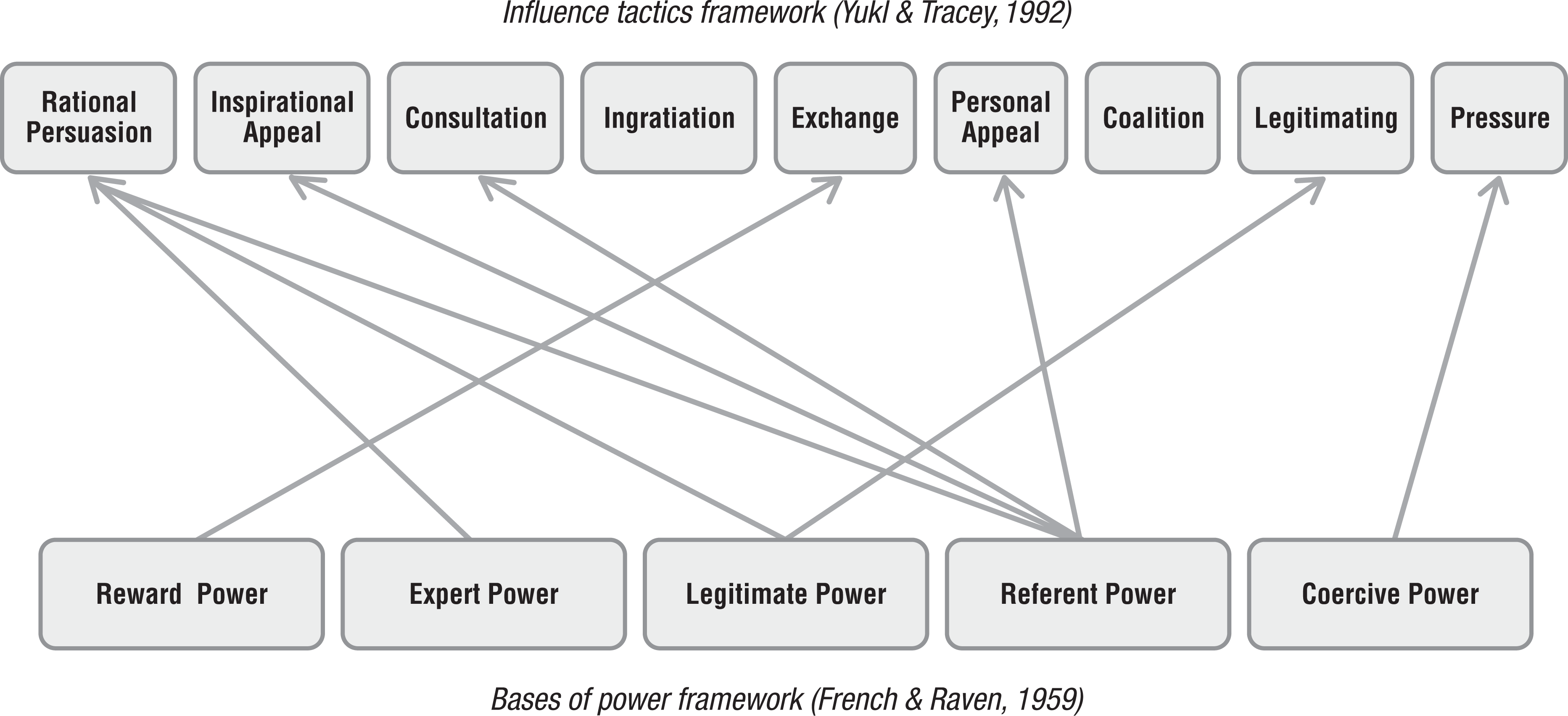
Relation between bases of power and influence tactics (compiled from literature).
Agents with high expertise will seek to use rational persuasion (Hinkin & Schriesheim, 1990; Yukl et al., 1996) while those that dominate power relations can often eschew rationality (Flyvbjerg, 1998). The dominant agents are more inclined to use coercive power as a source of pressure (Yukl & Tracey, 1992), while the use of legitimating rhetoric (Yukl & Michel, 2006) and rational persuasion (Hinkin & Schriesheim, 1990) tend to be weapons of those who do not dominate, according to Flyvbjerg (1998). Agents with strong referent power resort to consultation and inspirational or personal appeals (Yukl et al., 1996) as well as rational persuasion (Hinkin & Schriesheim, 1990). Exchange tactics involve a promise of reward in exchange for compliance, relying on reward power (Yukl & Falbe, 1990). The influence tactics of coalition and ingratiation differ from others as both are typically used from a position of lack of power (Hinkin & Schriesheim, 1990). Tactics are used in combination as well as singly: For instance, Falbe and Yukl (1992) note that when ingratiation is used in combination with rational persuasion, better outcomes are achieved.
The literature surveyed has largely been developed in social psychology, focusing on individual’s tactics for securing influence; hence, these characteristic tactics are strongly oriented toward dyadic relations arranged hierarchically in terms of supervision and superordination, being supervised and subordinated. It needs to be ascertained whether similar tactics can be identified in a multiorganization project level of analysis such as a megaproject, how they are enabled by configurations of resources, and how clusters of such tactics can become represented as strategic action in contexts in which the presence of government and multiple superordinate agencies is paramount in shaping the arenas in which stakeholders operate. In this article, we address these issues by posing two research questions: First, what bundles of tactics characterize the emergent strategies used in managing external stakeholders? Second, how do these strategies relate to available power resources?
Research Setting and Method
We conducted a case study of the ABC (fictive name) metro rail megaproject in South India to understand the external stakeholder management practices. Metro rail projects in India started with the Kolkata Metro in 1972, and following the success of the Delhi Metro, began to be taken up throughout the country (Ashokan, 2015). A majority of the infrastructure projects in India are significantly delayed due to land acquisition issues (Iyer & Sagheer, 2010; Sawhney, Agnihotri, & Paul, 2014; Thomas, Kalidindi, & Ananthanarayanan, 2003). The process of acquiring land in India is very time consuming and can take up to three years, even when resistance is absent (Mahalingam & Vyas, 2011). Land acquisition policy in India, as in China, advocates “reasonable compensation” for direct losses, meaning that only the value of the land will be compensated in contrast to the “value to the owner” principle followed in Australia and Hong Kong and the “just compensation” policy followed in the United States and United Kingdom (cf. Mahalingam & Vyas, 2011, for a comparison of land acquisition in India with other countries). Bureaucratic inertia (Sawhney et al., 2014), permit risks (Iyer & Sagheer, 2010), and lack of support (Thomas et al., 2003) are also stressed as critical factors for the delay in infrastructure projects in India. Delays due to utility relocation are also significant, often observed to be in the range of five to 52 months in a study of 11 infrastructure projects in India (Vilventhan & Kalidindi, 2018). The critical factors causing these delays are slow response from utility agencies, difficulty in identification of the nature and location of underground utilities often due to lack of information, as well as conflict between agencies (Vilventhan & Kalidindi, 2016). Thus, the construction of a new project in collaboration with other infrastructure services is a complex process that requires multiple organizations to collaborate (van Marrewijk, 2018). Based on this context, we limit our focus of external stakeholders to “stakeholders in land” and “stakeholders in existing services.”
The ABC project has a planned cost of US$2.2 billion and thus satisfies the quantitative requirement of being a megaproject (i.e., a cost greater than US$1 billion). The project was proposed as the answer to the traffic demands of a rapidly growing city. It was conceived in 2007 and had multiple objectives, including boosting the economic growth of the city and reducing pollution. Phase 1 of the project consisted of two corridors of a total length of 45.1 kilometers, which had both elevated and underground sections, with the majority (55%) underground. The project would cut across multiple utilities, including sewers, water mains, telecommunication cables, electricity cables, and so on, and the megaproject construction would require these utilities to be uninterrupted during the construction. Lands are permanently required for depots, stations, running sections, ramps, car parking spaces, ventilation shafts, property development, and power stations, which are acquired from both private and government landholders. For the successful implementation of the project, a special purpose vehicle was set up as a joint venture with the federal government of India and the state government.
We identify the prevalent external stakeholder management strategies in this infrastructure megaproject to understand the power dynamics surrounding them. To do this, we adopted a qualitative research methodology. Scholars have suggested such a method when the aim is to gain familiarity with a problem or to generate new insights for future research (Eisenhardt, 1989). Single cases in particular provide excellent opportunities to enhance contextual understanding because of their depth in data collection and analysis (Lundin & Steinthórsson, 2003).
The data were collected mainly through face-to-face semi-structured interviews (Spradley, 1979) with project team members. Given the primary interest in the strategies used, we interviewed members of the project team who enacted them. We sought insights concerning the external stakeholders encountered, the interests and demands these stakeholders posed for the project, and the resources and strategies used by the project team to manage the stakeholders. We conducted a retrospective case study on the phase that had been completed and inaugurated six months prior to fieldwork, which enabled us to talk to the project team, still in situ carrying out some of the finishing items. Thus, the participants could recall several recent, specific incidents relating to their experience with managing external stakeholders.
Data collection was conducted over a three-month period in 2017. We conducted a total of 18 interviews with 15 members of both the project organization and the contractor organizations’ project team, which together added up to 25 hours of interview data. The participants were restricted to the top management team of the project, such as general managers, deputy general managers, and managers. Each interview ranged from a minimum of one hour to a maximum of around three hours. Whenever the project team cited challenges, we asked for specific vignettes from the project to anchor and triangulate instances with other respondents. These examples of organizational storytelling tap into deep experiences of project life as a source of scientific development, as Flyvbjerg (2006) notes. We conducted a second round of interviews with three participants and compared comments made by various respondents on a given issue that emerged as the locus of the storytelling, to increase internal consistency and validity of our data (Yin, 1984). We also triangulated the data with reports and news articles published on the issues that the respondents cited. The contextual data in the findings were anchored in existing literature on Indian megaprojects for validation. We transcribed our interviews and then coded the data.
We went through each of the interview transcripts and extracted every reported incident or story that involved external stakeholders and their demands and the ways in which the project team managed them. Each of these incidents was assigned to a category. We initially started by talking to the project team about the challenges they faced from external stakeholders. We created two broad categories of stakeholders—stakeholders in lands and stakeholders in existing services—into which we coded relevant data. As we surveyed more issues, we were able to create subcategories, such as “lands acquired for construction purposes” within that category. After this, we probed into details of how issues that arose in each category were managed, which enabled us to capture the strategies and resources that the project team used to manage the interests of each of these external stakeholders. These enabling strategies and resources were derived from data, iterated as the data “talked back” (Flyvbjerg, 2006), summarized in tabular form (Eisenhardt, 1989), and were anchored in the “influence tactics” theoretical framework and the “bases of power” theoretical framework, respectively.
Findings
The data we collected from the ABC megaproject were spread across two external stakeholder categories—stakeholders in lands and stakeholders in existing services. We now discuss each of these stakeholder categories in detail.
Stakeholders in Lands
We discuss separately situations where stakeholders’ land is acquired for construction purposes or disrupted due to construction.
Lands Acquired for Construction Purposes
The land required for construction purposes had to be acquired from multiple landowners involving both private and government owners. In some cases, the land was held and occupied legally, and in other cases the land might be legally owned by an entity but occupied illegally by a section of the population squatting on that land—not an uncommon phenomenon in India. Land held legally might be owned either by private owners or government agencies.
The existing land acquisition act in India has provisions for private lands being acquired for “public purposes,” such as infrastructure development, by compensating the owner with a government-guideline land value. Such valuation is often significantly lower than the market value of the property. Therefore, when a request for land acquisition is made, the owners typically will not give up the land voluntarily but will go to the courts and submit reasons why the land should not be compulsorily purchased. The reasons vary: Typically, they might include proposals that alternative land is available for construction or that the land in question is the only resource that the family owns. Many infrastructure projects in India are critically delayed and even stalled due to the long litigation processes accompanying the attempts to acquire land (Iyer & Sagheer, 2010; Singh, 2012). The megaproject we researched adopted some specific strategies to mitigate issues in acquiring land from private owners. The ABC project organization decided to compensate the private owners with market rates to reduce litigation and complete the project on schedule. As a general manager of the ABC project organization informed us: One ground of land [223 square meters] in this region actually cost INR2 Crores [US$320,000] while the guideline value of the same was INR60 Lakhs [US$94,000]. We were able to acquire land as we paid market prices.
There are no such land acquisition guidelines for acquiring lands from government bodies. In the case under consideration, this included land held by the Indian Army, railways, and airport authority. Since there is no mandate for these government bodies to give up their land, they simply refused to relinquish control, an approach that in the past has caused many projects simply to avoid planning to use land that belonged to other government bodies. In our case, one of the aims of the megaproject was to increase interconnectivity for an existing transportation system. The ABC project sought to connect the airport and rail network and thus it required hubs close to their facilities. After repeated rounds of talks, the railway and airport authority agreed to give some land for the construction of the elevated metro rail station to the project. The terms varied.
The airport agreed to this only if the structural construction within the airport premises could be handled by the airport itself. They used this opportunity to design the station in a way that was aesthetically similar to the design of the airport, using many steel members, even constructing an extra level of parking for airport employees. The ABC project team had freedom to use funds for purposes, such as speeding up the construction of the metro rail. On this issue, one senior manager from the ABC project organization remarked: They [the airport] also want[s] something from us…This [parking for airport employees] is an added facility for them…these kinds of projects work that way only…give and take…
Large chunks of land near the airport were held by the Indian Army and thus land acquisition from them was unavoidable. The talks with the Indian Army for the land did not work out as planned. The Indian Army sought an equivalent value of land elsewhere in the state. A small area of land in the city would amount, in equivalent value terms, to a vast area outside the city limits. However, the ABC project organization was unable to acquire the large area requested for this purpose. Consequently, the project had to scrap the plan for a depot as well as an elevated station exit and had to change the viaduct route, all of which had been planned earlier on Indian Army land. The new viaduct route had to have sharper turns, which meant the adoption of a construction methodology that was far more expensive than planned. These design and methodology changes were enabled by the ABC project, accommodating experts’ experiences gained from other metros in India as well as in other countries around the world. As an official in charge of track-work construction remarked: People are hired from Singapore metro, Delhi metro, etc. and they are given good positions too…even juniors, we [ABC project organization] give promotions and have accommodated here in higher positions.
Illegal landholders occupying government lands would, in most cases, be politically supported by local politicians or social movements. Many projects that had tried to remove them in the past had failed. In the ABC project case, there was a section of squatters who occupied land close to the airport runway. The project required this illegally occupied land for connectivity to the airport. Since the ABC project was a project of considerable political interest, the deputy chief minister, a very influential political person in the area, came and spoke to the squatters, asking them to move elsewhere. Elected representatives hold a significant position in Indian society. Ashokan (2015) mentions similar instances where the central railway minister who supported the Konkan railway project was able to persuade the state’s chief minister and administration in the railways effort.
Landholders with illegal titles were a different category than the squatters. These were people who had been cheated into purchasing government lands that they now occupied by “con artists” making false claim to the land title. These actors had paid the market value for the land but lacked legitimate legal title. Until they received notice from the ABC project organization stating that the land they occupied was government land and now was allotted to the ABC project for construction, these landholders were unaware that they were illegal occupants. These cases were quite complex in terms of project negotiations. In the case of the ABC project, the project team went to these illegal landholders and convinced them that, whereas the ABC project was entitled to use the full land for construction purposes, the project required only a portion of the land in question: The remainder could still be occupied. The project team, made up of employees recruited on a contractual basis, warned the residents that if they went to court, they might end up losing all the land. Employees who were contracted, compared to government team members bound by the rules of bureaucracy, had more freedom to act and not be held accountable for doing so. As an official who was recruited on a contractual basis for five years remarked: The full land [that] they [illegal landholders who were cheated] occupy is legally given to us [the ABC project organization] by the government…if we take the land by force, they may go to court…so we talked to them and warned them [persuaded] that they would lose the full land if they go to court…If they agree now, we will only take what is required for our construction and spare the rest.
Lands on Which Construction had an Impact
Some landholders objected that the ABC project team was tunnelling under their private land. In such cases, the project team asserted that, similar to the situation with mineral resources, landholders did not have legal rights to what lies 20 meters below their land. In another instance, when the landholders complained about the project blocking the entrance to their houses, the project team altered their designs to change the pier distances to accommodate stakeholder interest.
Ecological considerations also came into play. A total of 385 trees had to be cut down for construction of the ABC project. When the community around which the project was housed raised concerns about this, the project team resolved to plant approximately 59,000 trees and saplings throughout the area where the project had an impact. The community also expressed concerns at the reduction of park areas to enable the construction of the project. In response, the project team agreed to develop and maintain parks under the metro rail viaducts and on the station land. Unused lands owned by the highway department that were near the metro rail stations were converted to parks and subsequently were to be maintained by the project organization. The project team also agreed to renovate the parks affected due to construction after the construction was completed. Similarly, during the construction works of the Konkan Railway (Ashokan, 2015), the project team gifted wells, pipes, culverts, and roads to the community affected due to construction.
Megaprojects in construction are noisy, dirty, and draining of energy. The construction and operation of the metro rail were criticized by landholders along its alignment for its noise and vibration impact. The project team agreed to monitor these levels frequently and take adequate steps to keep their impact within permissible limits. In terms of energy, the metro rail project operates on electricity, represented as being an environmentally friendly and clean alternative to diesel. However, the project is housed in a city that suffers from electricity outages, which the metro rail, it was feared, would exacerbate. To address the concerns of the community at large—in particular, those residents who lived close to the metro—about the project drawing electricity from the common pool and thus increasing disruptions due to power outages, the project team agreed to install solar panels on all metro stations and in other locations accessible to the project. The team stated that it would export the surplus energy produced to the grid to address the needs of the community at large.
Stakeholders in Existing Services
The megaproject was situated within an existing urban system, and during its construction and operation, many existing services would be adversely affected. The agencies responsible for these services, not surprisingly, put the interests of their organizations before those of the megaproject.
A network of services, such as electricity, drinking water, sewerage, telecommunications, and so forth, are required for the welfare of the population in the city and disruption to any of these affect the business and livelihood of many residents. Most of the construction work for the stations and viaduct for the elevated stretch were located beside the highway, which was also the site of all underground utilities.
Coordination with the utility owners was required to ascertain the position of utilities, to shift these, and to repair/restore utilities damaged during construction. The ABC project organization and the contractor organization mandated to construct the project approached these utility owners, seeking their cooperation. Arranging appointments with the government staff of these agencies proved troublesome due to multiple bureaucratic procedures—oftentimes, the contractor representative would spend hours waiting and never be able to make the planned appointment. To counter delays, the ABC project organization hired employees on deputation from these utility owners, such as the electricity, water, and sewerage boards, and from the government telecommunications board for a period of four to five years to facilitate construction. These recruits, being from the same utility organization, had good relations with their colleagues, thereby speeding up the utility shifting process. The ABC megaproject had adequate political support to request the state government bureaucracy to deputize staff from other government agencies to enable better coordination. One of the top officials in the human resources department in the ABC project organization commented: We [ABC project organization] are given authority by the chief secretary [of the state government] to get anyone deputed on board from other agencies [government] for long-term coordination. Whenever electric issues are intersecting our work, these fellows [deputed employees from electricity board] will go and deposit the amount to their office, coordinate shifting, etc. because without knowing, we cannot touch their work.
In some instances, with the drinking water and sewerage board, the project team, following instructions from the water authorities, had to shift these heavy utilities to a new location temporarily and then replace them in the old location after construction works were complete. Through the ABC project organization undertaking these works, many bureaucratic procedures were avoided, which resulted in time savings but at the cost of increased project expenditure. In one case, the construction of a station foundation could not occur as planned because of the presence of water lines that proved impossible to move, and thus the ABC project organization had to change the design of the foundation they were building, based on the available land. An official who was involved in this design change commented: We [design team] will be designing piles beautifully, but only once the excavation starts, we will be able to know the real challenges underneath…the challenges faced mainly were because of utilities and not due to ground conditions…we sometimes had to adjust [be flexible] for the utilities and use eccentric foundation designs to accommodate the utilities. We [the ABC project organization] were asked [by the telecommunication government agency] to install [a] new and modern cabling system with inspection chambers in place of the conventional cabling systems that we wanted to shift…We did it for them free of cost [extra work for stakeholders] even though we were not obliged to do so.
The project team had to handle roadway traffic during construction, as the metro rail viaducts were planned along the median strip of the highway. The highway network is under the control of the highways department, whereas the traffic police department is responsible for maintaining an uninterrupted traffic flow. To enable coordination, the ABC project organization received a high-level police officer and a senior official from the highways department on a deputized basis to enable relatively seamless coordination. Whenever construction work required a longer period than anticipated, the project team proposed diversions and received approval from the highway department and traffic police department. To achieve these approvals, the ABC project organization submitted traffic diversion plans to their offices and even showed live simulations of how the new diversion would affect the traffic. These government offices gave permission only after ascertaining that traffic disruptions would be minimal. They looked at the traffic volume and allowed construction only during the night hours when the traffic volume was low. Movement of equipment, such as transit mixers, cranes, trailers, and boom placers, was also restricted to night time when traffic was much less dense.
The airport posed a special challenge for the metro rail project due to the height restrictions that were required during construction to ensure a flight’s safe vertical clearance, which restricted the use of tall cranes. The project team had to change the construction methodologies for a few stations because of restrictions on the use of tall cranes for lifting structural members. They used an approach of multiple launchings to reach the required height with a short crane. In spite of this, there were time restrictions on working at these heights so as to cause only minimum disturbance to air traffic. Unlike highway traffic, airport traffic was at its peak during the night hours as most international flights operated during this time. Even after repeated rounds of negotiations, the airport authority only agreed to allow six hours of work per week for construction of these stations. To facilitate coordination with the airport authorities, the project organization hired a manager who had construction work experience in two international airports in India to head construction and coordination along the airport stretch, even though he had no special metro rail experience. The manager knew many of the current employees of the airport and had a good relationship with the director of the airport, which improved coordination for the metro rail project. The project team had to change a 500-meter elevated section near an auxiliary runway (as per the detailed project report) to an underground section complying with the request of the airport authority. The authority said that the section was too close to the runway to satisfy the vertical clearance requirements. There were height restrictions for two stations that were situated within the air funnel region. The project team changed the design from a curved roof to a flat roof to accommodate the height restrictions. The authority also expressed concerns about the electronic interference that the 25-kilovolt electric supply on the viaducts might cause to the aircraft systems. The ABC project organization carried out a detailed electronic interference study with the help of a premier educational institute, which concluded that no such electronic interference with the aircrafts would occur. Next, the airport authority said that moving trains would cause visual disturbance for pilots nearing the landing zone. Thus, fiber reinforced plastic (FRP) sheets with red and white stripes designed to restrict any visual disturbance to the pilots when they neared the landing zone were used to cover all the metro rail track sections that were located under the air funnel region. An official who was involved in this coordination remarked: They [airport authority] have codal provisions for their flight zone that there should not be any visual disturbances during flight landing and taking off…we [the ABC project team] had a lot of meetings with airport authority and finally we together decided to use shielding…they wanted it in red and white check colour [sic]…this was not there in our initial design and was an extra work.
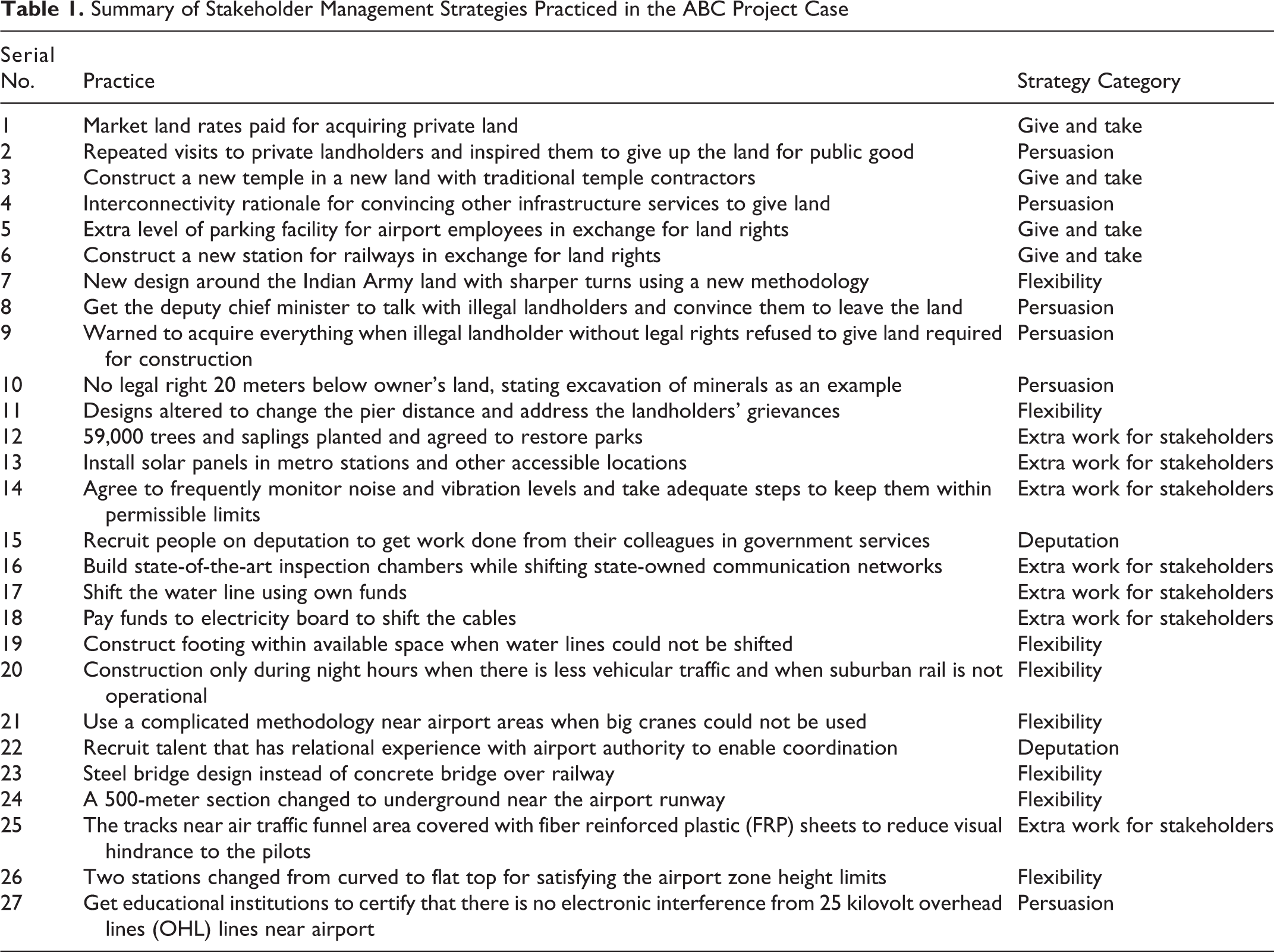
We see that the project team resorted to different strategies to deal with the external stakeholders in lands and existing services. From the ABC project discussed above, 27 different strategic practices pertaining to specific stakeholder management instances that spanned across stakeholder types, and the categories under which they were coded are consolidated in Table 1 for quick reference.
Summary of Stakeholder Management Strategies Practiced in the ABC Project Case
Discussion
The findings from the ABC project show that megaprojects experience different sets of interests and demands, depending on the external stakeholders involved. To manage these interests, the project team resorted to different emergent strategies. The analysis of the project team’s strategies and resource bases in the ABC project from a power perspective helps us understand how the project team combatted different types of stakeholder challenges in project settings.
Strategies in Practice for Managing External Stakeholders
The project team used an emergent set of five strategies, each composed of distinct clusters of influence tactics. Each of these strategies is discussed below.
Persuasion—We see the project team use persuasion to convince the legal landholders who refused to move, even after providing market rate compensation through referring to a public good and using “inspirational appeals” (Yukl & Tracey, 1992). The project team combined this inspirational appeal with some “pressure” (Yukl & Tracey, 1992), “rational persuasion” (Yukl & Tracey, 1992), and “consultation” (Yukl & Tracey, 1992) to convince these landholders that the market rates would be an adequate compensation for their loss. The informal “coalition” (Yukl & Tracey, 1992) with the government ensured that the deputy chief minister came and spoke to the squatters, asking them to move elsewhere. The project team was able to persuade the airport authority by using experts from a premier educational institution to convey that no electronic interference was posed by the 25-kilovolt power line on the viaducts. The literature backs these findings—the use of storytelling and framing strategies, for instance, can get work done in megaprojects (Castaño et al., 2015). The “persuasion” strategy was widely deployed with all stakeholder groups, as shown in Table 1.
Deputation—Coordination is a critical area for managing external stakeholders in megaprojects. The project team coordinated with external stakeholders by using employees deputed from government agencies, such as electricity, highways, railways, telecommunications, and police departments, following the co-optation strategy outlined by Selznick (1949) in the case of the Tennessee Valley Authority (TVA). These deputed employees, temporarily on the other side of the fence, were able to convince their own colleagues to coordinate effectively. In situations where deputation was not possible, such as in the case of the airport, the project organization appointed managers who had worked in the government agency before and had a good relationship with them. Tapping into these existing circuits of power in the form of previous relations of membership proved to be a viable strategy. These employees on deputation acted as “boundary spanners” (Mahalingam & Levitt, 2005) and helped coordination by gaining access to these agencies’ offices, complying with their bureaucratic procedures, getting insights into their concerns and interests, and persuading these stakeholders through multiple rounds of negotiations until resolution of the issue was achieved. “Consultation” was used with these government agencies as they were invited in planning the specifics of how the megaproject could be executed. The strategy of coordination with deputation builds on the tactic of “personal appeal” (Yukl & Tracey, 1992). Since, the deputation strategy worked with government agencies, the influence tactic of “personal appeal,” behind the specific strategy “deputation,” is one that can be used successfully with government employees.
Give and take—With some stakeholders, the project team adopted a give-and-take strategy. Negotiating through diverse circuits of power, while acquiring lands from the airport authority, the project team permitted the construction of additional parking spaces for airport employees from the ABC project funds; in the case of railways, the project team constructed the station for the railway and the metro rail together in exchange for their rights to the land. With the give-and-take strategy, the project team entered into an “exchange” (Yukl & Tracey, 1992) following “consultation” with the stakeholders to compensate them for the cost implications, and this was particularly seen in land acquisition from the private and government legal landholders. With government stakeholders, “exchange” was used in combination with “personal appeal” enabled by project team members on deputation.
Extra work for stakeholders—For stakeholders who experienced service disruption issues during metro rail construction, the project team carried out extra work to speed up the process of shifting services. Innovating circuits of power that bypassed those that were already bureaucratically seconded, but that followed the rules of the bureaucracy while not making demands on their resources, was a strategy that proved viable. For the state-owned telecommunications agency, the ABC project organization had to move cables and also build state-of-the-art inspection chambers as per the demands of the agency. For the community, the project team agreed to plant more trees and install solar panels to compensate for the energy the metro system would be drawing from the grid. The ABC project organization secured cooperation for stakeholders in lands (excluding land acquisition) and existing services that were affected by activating a norm of reciprocity (see Gouldner, 1960, for the classic statement). This strategy was enabled by the combination of “exchange,” “consultation,” and “personal appeal” made by the project team members on deputation. While the give-and-take strategy was accompanied by a contract that made the exchange formal, in contrast, the strategy of “extra work for stakeholders” was premised on more of a quid pro quo, enforced through more subtle means.
Flexibility—In most cases, the designs suggested in the detailed project report, the construction methods suggested in the work plan, and the work timings suggested in the project schedule would not have completely considered the concerns and interests of the external stakeholders. As the project team became aware of the many stakeholders who experienced disruption because of the project into whose circuits of power they became embroiled, they learned to accommodate resistance. Expression of these grievances changed the ways the design, methodology, and schedule of the project evolved. The project team was able to change the design when land was not made available by the Indian Army. The construction methodology was changed by using small cranes to satisfy the airport authority’s height restriction standards. To reduce disturbance to existing infrastructure services, such as highways, railways, and airports, the construction activities were rescheduled to take place only during lean traffic hours. Thus, this strategy of being flexible with regard to design and design intents was effective in accommodating stakeholder interests in the project and securing their support, as shown in Table 1. The strategy is based on a combination of “consultation” to invite stakeholders in planning how the megaproject could be executed, “rational persuasion” to convince the external stakeholders that a new design or new methodology addressed the concerns raised by them, and “exchange” by increasing the project’s cost in order to achieve continued stakeholder cooperation in the project and deflect resistance.
We observed the use of all the influence tactics from the Yukl and Tracey framework (1992) in the megaproject with the exception of “ingratiation,” involving flattery, which was not observed in the interorganizational project setup; although, it may have been deployed in more face-to-face situations to which we did not have access.
Resource-Based Power That Enables Strategies
Those strategies that were emergent were made possible only because of the existence of accessible resource bases rooted in underlying power structures. Figure 2 shows the resources used and their role in enabling specific strategies of the project team.
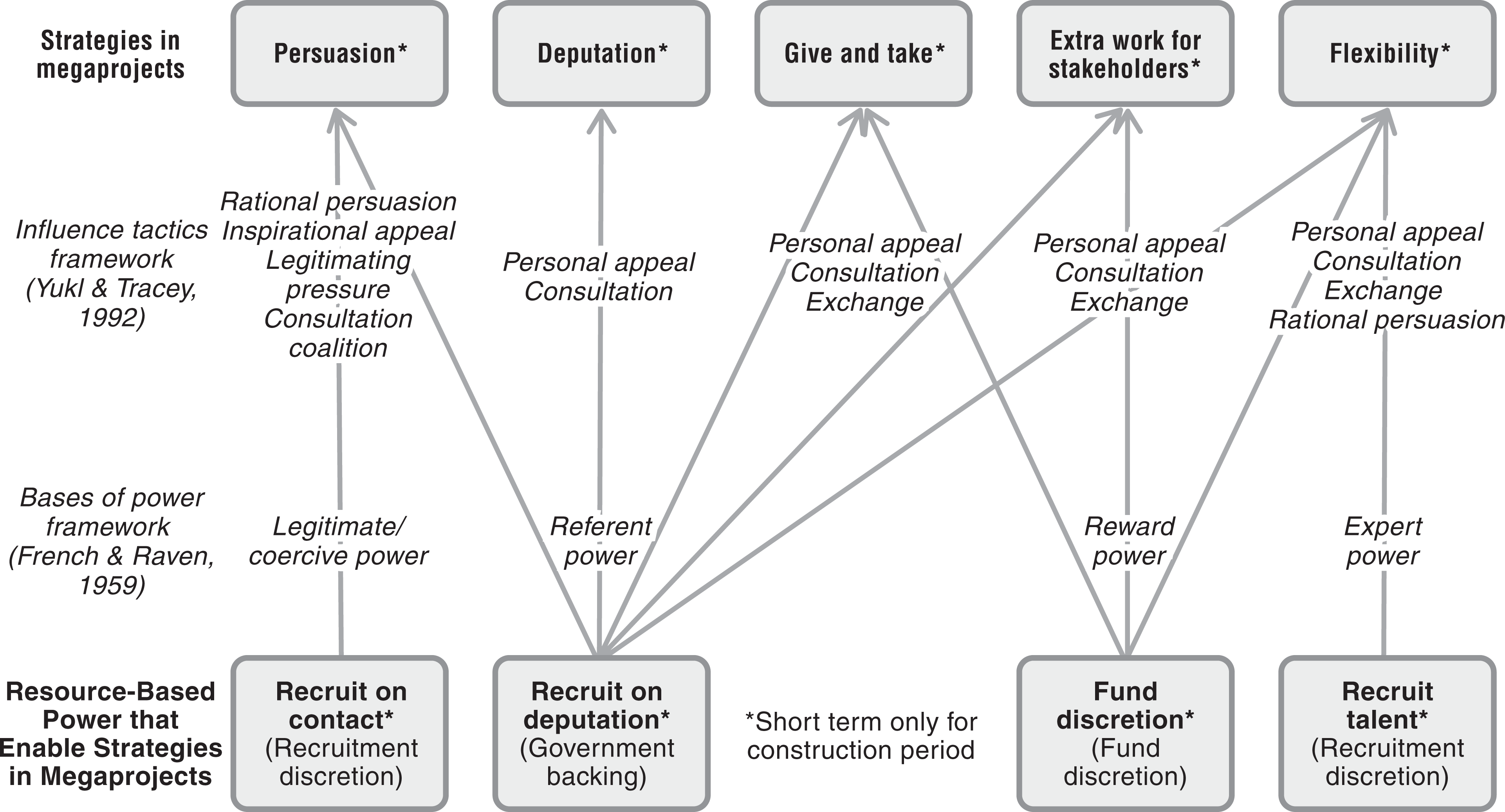
Strategies and resource-based power in megaprojects.
Recruiting on a contractual basis—The project team was able to convince certain stakeholders using rational persuasion because the project organization hired employees on a contractual basis. In India, government officials are often concerned about being investigated by anticorruption agencies for paying extra compensation to landowners and tend to be very conservative in their calculations (Mahalingam & Vyas, 2011). However, since these project team employees were recruited on a contractual basis, they had more freedom to act. The project team paid market compensation to legal landowners and informed the landholders with illegal titles that the full land would be taken from them if they refused to give up land for construction, but if they cooperated then some partial element of the land would be made available. A government team member would not be able to give such assurances, because their decision could be questioned or challenged in the future as not being in accord with the rules of rational legality. The employees recruited under contract had “legitimate” power (French & Raven, 1959) to make offers and not be held accountable for doing so in terms of an existing bureaucratic precedent. The warning that non-compliance could lead to the full land being taken from them shows the use of “coercive” power by these employees. Supporting this, Mahalingam and Levitt (2005) note that where freelance expatriates are recruited on a contractual basis as part of the megaproject team, they are able to make decisions that are not bound by the “shadow of the future.” The contract-based employees had only one mandate—to complete the work as quickly as possible. Hence, their orientation to the megaproject was highly instrumental.
Recruitment on the basis of secondment—The “deputation” strategy was possible only because the project organization was able to accommodate people who were seconded from external stakeholder organizations who then acted on the basis of the “referent” power (French & Raven, 1959) that the organization enjoys. The megaproject had adequate political support, and hence, they could ask the state government to deputize staff from government agencies; the staff could use personal circuits of power in the project’s interests. As seen in the case of illegal landholders, the ABC megaproject also specifically drew on existing power relations in terms of elected representatives, a significant referent power in Indian society. The strategy of “personal appeal” worked exceptionally well in the case of deputed staff interfacing specifically with government agencies among the multiple categories of stakeholders, a significant contribution to understanding when to use what strategies.
Fund discretion—Convincing stakeholders where there are cost implications is possible only because the ABC project organization had fund discretion. The ability to raise and use funds at their own discretion gives the organization a base with which to “reward” (French & Raven, 1959) other players who support their cause. The discretion to use funds to build a new station for the railway department led the ABC project organization to apply for and receive land permits to construct their own metro rail station using the give-and-take strategy. The discretion to use the metro rail funds to pay for shifting communication cables and building inspection chambers resulted in faster utility shifting as part of performing the “extra work for stakeholders” strategy. The fund discretion also enabled the project team to adopt the costly “flexibility” strategy. Rewards encourage “exchange” tactics.
Recruiting expert talents—The “flexibility” strategy that the project team used depended on the organization being able to recruit special talents, or “experts” (French & Raven, 1959) whose expertise helped provide innovative design ideas and enabled the “rational persuasion” of stakeholders to accept these often-creative solutions. The organization recruited from other metro rail projects in India and worldwide, something that is not possible with other public projects whose specific recruitment policies do not allow such global recruitment. As an example of the utilization of this resource in combination with others discussed here, the ABC project organization went through multiple rounds of negotiations to change the concrete bridge to a steel bridge over a suburban rail network, which was only possible with the combination of special talents, fund discretion, and deputation.
In summary, these four resources available to the project team formed the bases of power that allowed them to enact strategies to manage external stakeholders. Depicted in Figure 2, these resources can be consolidated into recruitment discretion (to recruit on a contract basis and recruit special talents), government backing (to recruit on deputation), and fund discretion. These resources available to the project team based on the covert structures of meaning enabled the overt strategic action seen in managing external stakeholders in line with the circuits of power theory (Clegg, 1989). The strategies and resources were only available to the project team during the duration of the construction project, unlike in general management, where they exist for an indefinite period of time.
Conclusion
Our study contributes to our understanding of external stakeholder management in complex settings as exemplified by megaprojects. While extant research has documented ways in which stakeholder views can be managed (Aaltonen & Sivonen, 2009; Castaño et al., 2015; Chinyio & Akintoye, 2008; Kim & Mauborgne, 2003; Yang et al., 2014), our key contribution in this article is to provide insights on how these strategies work by bringing in an organizational power perspective that is often ignored or underplayed. As shown in Figure 2, by studying the strategies used to manage external stakeholders and by investigating the resource bases available to the project organization, we demonstrate how emergent strategies coalesce around influence tactics that use bases of power embedded in specific resources that project organizations use to manage external stakeholders. We therefore posit that changes in the resource base can trigger power circuits that significantly affect strategic action and, in turn, project outcomes. Thus, understanding how and why project organizations use specific strategies to engage with stakeholders requires a critical appreciation of power relations and resources.
Our aim was not to demonstrate methods that might eliminate all stakeholder issues in infrastructure megaprojects—we think that this is impossible—nor was it our intention to comprehensively document all the issues that a megaproject might face and all the resources and strategies available to the project team to manage them. Instead, the study theoretically documents and categorizes strategies used in relation to diverse external stakeholders in a metro rail megaproject. External stakeholders considered in our study can be classified as stakeholders in lands and in existing services. To manage these external stakeholders, the project team resorted to five strategies: (1) persuasion, (2) deputation, (3) give and take, (4) extra work for stakeholders, and (5) flexibility, each of which, in turn, were composed of multiple influence tactics. The resources available to the project team for enabling these strategies are recruitment discretion, government backing, and fund discretion.
The study provides empirical validation of the link between strategies and power resources empowering the project team in dealing with the external stakeholders. Fund discretion enabled monetary support for “give and take,” “extra work for stakeholders,” and “flexibility.” Recruitment discretion enabled recruiting talents from other metro rail projects that had previously dealt with similar issues for “persuasion” and “flexibility.” Government backing enabled the “deputation” strategy. Articulating the level of analysis in organizational terms and addressing the circuits of power entailed, significantly advances analysis that previously had looked at phenomena such as the direction of usage (Kipnis et al., 1980; Yukl & Tracey, 1992), sources of power (Yukl et al., 1996), the content of games in play (Yukl et al., 1999), culture (Fu & Yukl, 2000), and leader’s quality (Cable & Judge, 2003). We have distinguished strategies deployed in relation to government from strategies deployed in relation to private organizations, because personal appeal worked especially well with government agencies, as opposed to private organizations.
The work has some limitations. First, since a retrospective case study was used as the research methodology, only instances of overt resource-based power were evident. An in-depth ethnographic study could explore more covert power and the role of the institutional environment in the strategies used. Second, we cannot consider the categories of external stakeholders explored to be exhaustive or completely representative of megaprojects, because we dealt with only stakeholders in lands and existing services. There are other external stakeholder groups, such as special interest groups, courts, media, and so forth that were not considered in this article. Also, in the study, we have observed that external stakeholder management strategies emerge based on the resources available with the project team as opposed to resources emerging based on the stakeholder characteristics and strategies employed. This may be peculiar to megaprojects because the cast of external stakeholders is relatively unknown at the start of the project (Mok et al., 2015). However, the directionality of the strategy-resource link can be tested on other projects. Finally, since our case study was restricted to an infrastructure megaproject, we were not in a position to observe contextual nuances that would arise in other megaprojects, such as an Olympic stadium or an Apollo mission.
Footnotes
Declaration of Conflicting Interests
The authors declared no potential conflicts of interest with respect to the research, authorship, and/or publication of this article.
Funding
The authors received no financial support for the research, authorship, and/or publication of this article.
Author Biographies