






Abstract
This article examines the role of social media in public stakeholder and intrastakeholder group strategies to influence decision making in the consultation stage of UK infrastructure megaprojects. The context is the consultation process on the construction of a new Crossrail 2 station in Chelsea, London, where there is resistance. Analysis of social media communication by the affected public groups and interviews with the opposing group shows different intragroup concerns, with stakeholders developing a strong identity enabled by social media. To reduce perceived lack of responsiveness, we recommend that project managers harness social media marketing principles for ongoing relationship building.
Keywords
Introduction
There has been a substantial increase in infrastructure megaprojects around the world to match the needs of growing communities, with the largest including the US$23 billion expansion of the world’s first underground railway, which is the London Crossrail project (Desjardins, January 2017). Megaprojects attract massive public attention, as they have a huge impact on the environment, economics, communities, and societies (Altshuler & Luberoff, 2004; Batheram, Hardin, & Whitfield, 2005, Giezen, 2013). This impact, including political implications, can last for varying periods of time (Koehn, Kothari, & Pan, 1995). UK infrastructure megaprojects—from High Speed 1 (HS1), High Speed 2 (HS2), to Crossrail 1 (C1) and Crossrail 2 (C2)—being costly (above US$1 billion) and complex in nature, similarly generate a lot of interest and sometimes conflict from the public and other stakeholders (Flyvbjerg, 2014). Stakeholders are defined as “any group or individual who is affected by or can affect the achievement of an organization’s objectives” (Freeman, 1984). Stakeholder definitions like Freeman’s (1984) use the stakeholder-focal firm perspective as its basis, whereas Schneider and Sachs (2017) perceive stakeholders as social groups, defining a stakeholder group as a “collective of two or more individuals who perceive and evaluate themselves on the basis of shared norms, values, and goals in the context of a socioeconomic issue” (p. 42), drawing on social identity theory. They also define stakeholder identity “as individuals’ knowledge of their affiliation to a stakeholder group and the related value and emotional importance derived from this group affiliation” (p. 42).
It is essential that stakeholders are effectively managed to accommodate often conflicting stakeholder interests (Aaltonen & Kujala, 2010; Aaltonen, Kujala, Havela, & Savage, 2015; Davis, 2014; Eskerod, Huemann, & Savage, 2015). This is particularly pertinent in the United Kingdom, where a project promoter is legally obligated to engage key stakeholders, including the public, before the project can move into the development stage (Kudadirgwa, 2013). This is especially challenging for managers on complex megaprojects (Remington & Pollack, 2007). Stakeholder theory has developed into three genres: descriptive, instrumental, and normative (Donaldson & Preston, 1995), with the second genre’s focus on what would result in profit gain, whereas the third considers what firms should do for accountability. However, there is less descriptive empirical work (Berman & Johnson-Cramer, 2017; Laplume, Sonpar, & Litz, 2008) and a paucity of research from the stakeholders’ perspective (Butterfield, Reed, & Lemak, 2004; van den Ende & Marrewijk, 2018), especially the community stakeholders’ perspective (Di Maddaloni & Davis, 2018). This article aims to fill the gap in the literature on stakeholder action. Stakeholder actions aim to bring about changes in the activities of the focal firm, which can result in costs, and so, is a critical issue for managers (Hayibor & Collins, 2016; Teo & Loosemore, 2014). In their review of stakeholder theory, Laplume et al. (2008) found that only 12% of 179 articles were from the stakeholder perspective or about stakeholder behavior. According to Frooman and Murrell (2005), the majority focus on stakeholder attributes like claim, legitimacy, power (Bonke & Winch, 2002; Mitchell, Agle, & Wood, 1997), interests, and location. Thus, the focus of this article is the stakeholder’s perspective and stakeholder action taken, based on the perception of the stakeholder about the firm–stakeholder relationship (Hayibor & Collins, 2016).
Furthermore, since Freeman’s (1984) seminal contribution and despite more than 30 years of academic research in stakeholder theory (Freeman, Harrison, Wicks, Parmar, & de Colle, 2010), there has been surprisingly very limited research (Williams, Ferdinand, & Pasian, 2015) examining the role of social media in empowering and mobilizing stakeholder alliances and intrastakeholder influence strategies to influence decision making on infrastructure megaprojects. The current literature does not discern the interactions within a stakeholder group through shared goals and affiliation, emerging as a single, strong stakeholder group. For example, one stakeholder group may interact with another group or several groups through social media or other means to form a single, more powerful group to take collective action against an organization. Neville and Menguc (2006) studied these interactions between stakeholders, referring to them as stakeholder multiplicity, in which various stakeholder claims reinforce one another.
In this article, we refer to these complex interactions between various stakeholders as “intrastakeholder alliances,” emerging as a single powerful stakeholder group. We refer to these interactions and influence strategies as “intra” (within a group) and not “inter” (between various groups) because even though the groups may have originally been formed individually, their similar goals, strategies, and claims against the organization result in emergence as an alliance and as a bigger, stronger group against an organization, and for that organization, the different small groups become one. Thus, all structures, strategies, and interactions between them are called intrastakeholder structures, strategies, and interactions. Williams et al. (2015) recommend investigating intrastakeholder structures and “the possible influence of these structures on stakeholder action” as well as identifying additional modes by which stakeholders can exert influence on projects for future research (Williams et al., 2015, p. 101).
We therefore attempt to fill the gap in the literature by providing a contextualized perspective (as advocated by Mok, Shen, & Yang, 2015) of public stakeholder interests and their intragroup strategies in an attempt to influence decision making across recent UK infrastructure megaprojects with a particular focus on two public stakeholder groups’ (and their intragroups) engagement using social media, from 2015 to 2016, on the proposed new Crossrail 2 station on King’s Road, Chelsea in London. The research question is:
How does social media empower the public stakeholder and its intragroups to mobilize collectively to influence decision making in the consultation stage of an infrastructure megaproject?
In the United Kingdom, High Speed 2 (HS2) and Crossrail 2 (C2) are examples of infrastructure megaprojects that have had varying responses from stakeholders, facing major negativity from the public on their proposed routes as well as the need for such investment, with opposition especially visible online (e.g., @stophs2, stophs2.org, nocrossrailchelsea.com). Despite the Department for Transport’s (2012) efforts, HS2 was heavily criticized for weaknesses in its business case (Williams et al., 2015) and the public still feels that the consultation process has shortcomings (Aizlewood & Wellings, 2011).
Crossrail 2 (C2), which would serve stations throughout the South East, linking southwest and northeast London, as well as destinations across Surrey and Hertfordshire (source: http://crossrail2.co.uk/route/) is going through a similar process while in the planning phase. C2 has held four major public consultations since summer 2013 to inform proposals for its route through the United Kingdom’s South East. It is facing major opposition in regions of London, such as Wimbledon and Chelsea, which are threatening its viability (Evening Standard, 6 March 2017). A protracted consultation process like this can lead to cost overruns and delays.
C2, the project promoter, has used innovative methods like social media to engage the public, whereas social media was not as prevalent during C1. C1 used public engagement methods like 24/7 telephone help lines, drop-in sessions, “exhibition centers,” and so forth. 1 Meanwhile, HS2 failed to incorporate a social media strategy early on, despite social media being important in public engagement by this time (Williams et al., 2015).
Furthermore, for a deeper understanding of the public stakeholder environment around megaprojects and to answer our research question, we briefly examine the legal and managerial process of public stakeholder management of UK infrastructure megaprojects from Crossrail 1 (C1), HS2, and up to the current phase of Crossrail 2 (C2). The focus is a proposed new C2 station on King’s Road, in the Royal Borough of Kensington and Chelsea (RBKC) in London. To examine how social media empowers the public stakeholder and its intragroups to influence decision making, an analysis is conducted of social media content published by the two major groups of public stakeholders for a particular period (2015 to 2016)—proponents for (Chelsea4Crossrail2) and against (NoCrossrailChelsea) this new station development through Chelsea. 2 These data are triangulated with interviews with intragroups of public stakeholders in the NoCrossrailChelsea group.
We bring together the stakeholder management and social media marketing management literature as the lens in making a contribution to the literature. Last, we conclude and discuss the managerial and theoretical implications of our research, including limitations and future research.
In the next section, we discuss the relevant aspects of these types of literature for our research and briefly analyze the various important international and national legislations that govern the process of public engagement in the United Kingdom.
Literature Review
Stakeholder Management in Megaprojects
In their systematic review of research on stakeholder management on megaprojects from 1997 through 2014, Mok et al. (2015) identified four major research topics, of which “stakeholder interests and influences” is closest to the area investigated in this article. Despite their complexity, megaprojects enhance well-being and improve the quality of life in modern societies (Flyvbjerg, 2014). However, stakeholders may not share this perspective, as evidenced in the consultation process of infrastructure megaprojects.
The various project stakeholders have been divided into two categories: internal and external (Bonke & Winch, 2002). According to these researchers, members of the project coalition are internal stakeholders. Those who are affected by the project in a significant way are external stakeholders, where the affected members of the public are public stakeholders. Others have made a distinction between primary stakeholders (customers, employees, shareholders) with formal contractual relationships, and secondary stakeholders (community, etc.) who do not engage in transactions directly relating to the company and without formal contractual relationships. The latter are essentially stressed only by stakeholder theory (Clarkson, 1995). Managers have sought to categorize and prioritize stakeholders because of the assumption that some among them matter more than others (Derry, 2012), but this can affect stakeholder trust formation toward the focal firm (Pirson, Martin, & Parmar, 2017). With the internet, these decisions by the firm are visible to increasingly interconnected stakeholders and can build or erode trust across stakeholders and stakeholder groups (Crane, 2018).
These managerial decisions could be made based on stakeholder salience attributes such as legitimacy (Mitchell et al., 1997). Using proprietary archival data of an international sample of 199 large companies, Thijssens, Bollen, and Hassink (2015) show there is growing evidence that secondary stakeholders, such as community groups, religious groups, and other nongovernmental organizations, are able to persuade firms to be responsive to their needs. Furthermore, some of these secondary stakeholder groups are better able to influence (disclosure) decisions than others, which is mainly associated with differences between stakeholders’ legitimacy (Thijssens et al., 2015). While in proposing an agenda for future research on the attributes of salience, Neville, Bell, and Whitwell (2011) position the legitimacy of claims as primary, whereas stakeholder legitimacy is seen as secondary.
As mentioned, the importance of external stakeholder management to project success, particularly for infrastructure megaprojects, has been increasingly recognized (Aaltonen, Jaakko, & Tuomas, 2008; Aaltonen & Kujala, 2016; Bourne & Walker, 2005; Fewings, 2013; Jepsen & Eskerod, 2009; Olander & Landin, 2005). However, according to Yang, Shen, Ho, Drew, and Xue (2011), the process of identifying stakeholders and their needs, assessing their impact, and formulating effective engagement strategies is the main challenge that project managers face in megaprojects. In Mok, Shen, Yang, and Li’s (2017) network analysis of stakeholder concerns based on a single major engineering project, they identify “conducting public and community consultation during construction phase” as one of the main challenges.
This challenge becomes more complicated in the age of social media because social media allows people to connect, convey messages, organize protests, and form alliances rapidly with minimal financial resources. In 1999, Frooman argued that ease of information sharing reduces the costs of forming a stakeholder alliance, enabling weaker stakeholders to organize effective action, and is thus, an incentive for their mobilization.
Furthermore, understanding stakeholder mobilization strategies is helpful for project managers to predict stakeholder behavior and to manage the stakeholder environment more systematically (Frooman, 1999). Meanwhile Aaltonen et al. (2008) classify eight influencing strategies that stakeholders adopt during the project execution stage: resource building, credibility building, direction action, coalition building, communication, conflict escalation, direct withholding, and indirect withholding. Stakeholders can increase the probability of influencing project outcomes with an appropriate strategy (Aaltonen et al., 2008). Furthermore, stakeholder influencing strategies are dynamic over the project life cycle because stakeholders take on different roles and actions in response to the changing project environment (Aaltonen & Kujala, 2010). However, influencing strategies have been investigated from the viewpoint of a focal organization taking the lead role in project implementation, rather than the stakeholder perspective. Frooman and Murrell (2005) is an example of the latter, identifying coercion and compromise as strategies. Meanwhile, five strategies are identified regarding project organizations’ responses to stakeholder claims: adaption, compromise, avoidance, dismissal, and influence (Aaltonen & Sivonen, 2009).
Project stakeholder management is thus critical for the pluralistic setting of megaprojects (Aaltonen et al., 2015; Aragonés-Beltrán, García-Melón, & Montesinos-Valera, 2017; Gil and Tether, 2011; Mok et al., 2017; Pitsis, Clegg, Marosszeky, & Rura-Polley, 2003) to build consensus across stakeholders. Furthermore, megaprojects affect large numbers of stakeholders, creating numerous interfaces, which will have to be managed effectively (Chinyio & Akintoye 2008), with Walker, Bourne, and Shelley (2008) suggesting the use of visualization tools for stakeholder management to help simplify complex situations. Managing these stakeholders has been defined as:
Meanwhile, according to Eskerod and Vaagaasar (2014), the majority of projects do not regard stakeholder management as a dynamic and ongoing process, thus requiring more than a cross-sectional analysis. Missonier and Loufrani-Fedida (2014), however, acknowledge stakeholder analysis as a longitudinal process, and take an actor–network theory approach to move from a dyadic perspective of individual stakeholders and a focal organization, to a relational perspective. These researchers’ dynamic and relational perspective is in keeping with McElroy and Mills’ (2000) definition of stakeholder management, which is about “…continuing development of relationships with stakeholders” (p. 103).
Yet, the literature has failed to recognize that stakeholders external to a project have different concerns than profit and gain or technological advancements (van den Ende & Marrewijk, 2018), and that powerful organizations have a responsibility to be fair if they wish to avoid alienating stakeholders (Smyth, 2008). Further, stakeholders’ perception of fairness in the firm–stakeholder relationship affects their response and action (Hayibor & Collins, 2016). The following section briefly analyzes the various important international and national legislations that govern the process of public engagement in the United Kingdom.
Laws Governing Public Engagement Processes in the United Kingdom
The United Kingdom, like the United States, is perceived to be more shareholder-, rather than stakeholder-oriented (Thijssens et al., 2015), with consequent emphasis on the economic rather than the social and environmental perspectives. However, there are various important international and national legislations that govern the process of public engagement in the United Kingdom.
The relevant laws include the Aarhus Convention, the Code of Practice on Consultation, and the Hybrid Bill, where a bill is a proposal presented for debate before Parliament to either form a new law or change an existing one. The first two obligate project promoters to engage the public before the development phase, whereas the Hybrid Bill is put forward for debate in Parliament when there is work proposed that is considered of national importance. The Aarhus Convention has established three rights for the public—access to information, public participation in decision making, and access to justice in environmental matters—and requires relevant institutions to adapt their internal practices and procedures to its provisions (Environment, European Commission, 2013). The UK government set out The Code of Practice on Consultation to improve the transparency, responsiveness, and accessibility of consultation in 2000. The code gives an opportunity to stakeholders and the government to have an open dialogue and obtains the views of those affected or who have a particular interest (Department for Business, Enterprise and Regulatory Reform, 2008). However, the code does not legally bind any party, and the public may perceive it as an “empty ritual” (Elmahroug, Tutesigensi, & Brookes, 2014). There are also consultation criteria to assist the engagement process, which include: when to consult, the duration of consultation, accessibility, and the responsiveness of consultation exercises.
The government initiates hybrid bills, which are rare, to obtain authorization for major projects, as only 11 have been issued in the United Kingdom in the past 25 years (Department for Transport, 2012). Hybrid bills have a long process, with the Crossrail 1 Hybrid Bill taking more than three years to become the Crossrail Act 2008.
The next section discusses the public as an external stakeholder, its collective identity development, and collective action.
The Public Stakeholder, Its Collective Identity, and Action
Several studies report the challenge and conflict that arise from external stakeholders, especially around large infrastructure projects, which can have diverse effects on the outcomes of the megaproject (Flyvbjerg, 2014; Miller & Olleros, 2000; Morris & Hough, 1987). But there is a gap in the literature on collective action and collective identity development processes by public stakeholders as they mobilize in response to megaprojects.
Although studies on collective actions have focused on nongovernmental organization activism (den Hond, de Bakker, & Doh, 2015), very little research has been focused on the formation of alliances among different stakeholder groups of one focal organization, what is referred to as intrastakeholder alliances by Fassin, De Colle, and Freeman (2017). In their analysis of seven cases of plant-closing decisions, Fassin et al. (2017) found that consumers tend to become engaged “to save” small local plants, especially those making consumer goods with an emotional connection due to tradition and cultural heritage. The latter is exemplified in Teo and Loosemore’s (2014) ethnographic study of a controversial housing project, notable for its in-depth analysis of one of Australia’s longest standing community protests against a construction project. This project site has ecological, cultural, and historical heritage importance to the aboriginal and other parts of the community, where core protest group members played a vital role in sustaining the protest, as the protest group was largely informal and unstructured. It resulted in significant distrust in the authorities and the developer concerned due to what was regarded as their incompetence and lack of concern toward community stakeholders (Teo & Loosemore, 2014). In addition, Fassin et al. (2017) and Bruijn and Whiteman (2010) found that collective identity is most pronounced in small towns and for the latter case, complicated by indigenous tribes’ self and community identification being strongly linked to place. According to King (2008), this presence of shared meanings and a collective or group identity facilitates the emergence and effectiveness of collective action.
Williams et al.’s (2015) study on stakeholder social media interactions in HS2’s planning stage also identifies a gap in the literature regarding stakeholder identity development processes, which could impact its coherence as it mobilizes for action, and on intrastakeholder groups, where “little work has been directed to understanding intragroup network structures and the possible influence of these structures on stakeholder action” (p. 101). New research in these areas may be useful to identify new modes by which stakeholders can exert influence in projects (Williams et al., 2015).
Even in a democratic society like the United Kingdom, little consideration can be given to public inputs (Kudadirgwa, 2013; Lemley, 1996), which can differ at different project stages (El-Gohary, Osman, & El-Diraby, 2006). It is thus vital to understand their potential impact by successfully identifying and effectively collaborating with these stakeholders to minimize negative outcomes and maximize positive inputs (Bourne & Walker, 2005) as well as for long-term success (van den Ende & Marrewijk, 2018).
The next section briefly discusses how innovative digital platforms, in the form of social media, can be harnessed by public stakeholders for influencing decisions on megaprojects.
Social Media Marketing and Stakeholder Management
Social media research is a relatively new field of study, with Facebook the dominant social media platform among adult users (Duggan, Ellison, Lampe, Lenhart, & Madden, 2015); others include Twitter, YouTube, and Instagram. Today, social media platforms enable the expansion of communication for sharing information among the public, from one-to-one, one-to-many, and many-to-many communication. Kaplan and Haenlein (2010) define social media as “a group of internet-based applications that build on the ideological and technological foundations of Web 2.0, and that allow the creation and exchange of user generated content” (p. 61). Managers must learn to shape social media communication using tools like blogs and networking platforms (Mangold & Faulds, 2009). Social media also allows for reduced costs of coordination and is nonhierarchical (Boyd & Ellison, 2010), elements that enhance the potential for public participation, mobilization, and engagement (Shirky, 2011; Skoric, Zhu, Goh, & Pang, 2016). Furthermore, Greene, Choudhry, Kilabuk, and Shrank’s (2011) qualitative evaluation of posts from Facebook communities dedicated to diabetes reveal how patients, family members, and friends share information and receive emotional support.
The latest social media platforms allow firms to implement innovative forms of communication (e.g., live video) and to co-create content with customers (Tiago & Veríssimo, 2014). For most effective utilization, firms must also adopt social media as a channel for “connecting with stakeholders” (Tiago & Veríssimo, 2014, p. 708). Celebrity endorsement is another way of connecting and engaging with customers, improving recall and sales (Dhotre & Bola, 2010; Wei & Lu, 2012). Palmieri (2013) investigated if celebrity endorsement on social media, like Twitter, and in print differs, in terms of memorability and credibility in the minds of young consumers. Her findings suggest that investment on celebrity endorsement should be more in print ads than on Twitter. Whereas Tiago and Veríssimo (2014) recommend marketers to focus on relationship-based interactions with customers to improve digital engagement. Marbach, Lages, and Nunan (2016) seek fine-grained understanding, attempting to understand personality traits of customers, and linking this to their perceived value of online engagement. This understanding can help managers to better segment and evaluate their customers’ online engagement.
However, according to marketers, firms face challenges and pressures in adopting a digital presence on social media platforms, which involves less of a focus in the literature (Leeflang, Verhoef, Dahlström, & Freundt, 2014; Tiago & Veríssimo, 2014). These challenges include filling “talent gaps,” adjusting the “organizational design,” and implementing “actionable metrics” (Leeflang et al., 2014, p. 1). Zhao and Zhu (2010) also advocate metrics to determine return on investment in social media marketing. Temporary project-based organizations may face similar challenges harnessing social media and budget allocation for maintaining such platforms.
In construction, social media strategy development is increasingly of interest (Wilkinson, 2009), whereas Pryke (2004) and Chinowsky and Taylor (2012) encourage researchers to apply the method of social network analysis to investigate networks in the engineering and construction context. Drawing on Pryke’s (2004) quantitative approach, Williams et al. (2015) studied stakeholder social media interactions in the planning stage of HS2, conducting social network analysis of Twitter content, and identifying clusters that stabilized over the one-year period of the study.
We, on the other hand, draw on a qualitative, interpretive approach to content analysis to examine the use of social media by public stakeholders in the consultation process of Crossrail 2 in Chelsea. This approach is justified, as our focus is on in-depth investigation and “rich” data analysis for substantive theory generation, rather than generalizable results.
The next section describes the research method and the Crossrail 2 project setting.
Method
Figure 1 illustrates the research framework used for this study showing the purpose and outcomes at each stage and how each stage informs subsequent stages. As shown, data are from interviews and the main public stakeholders
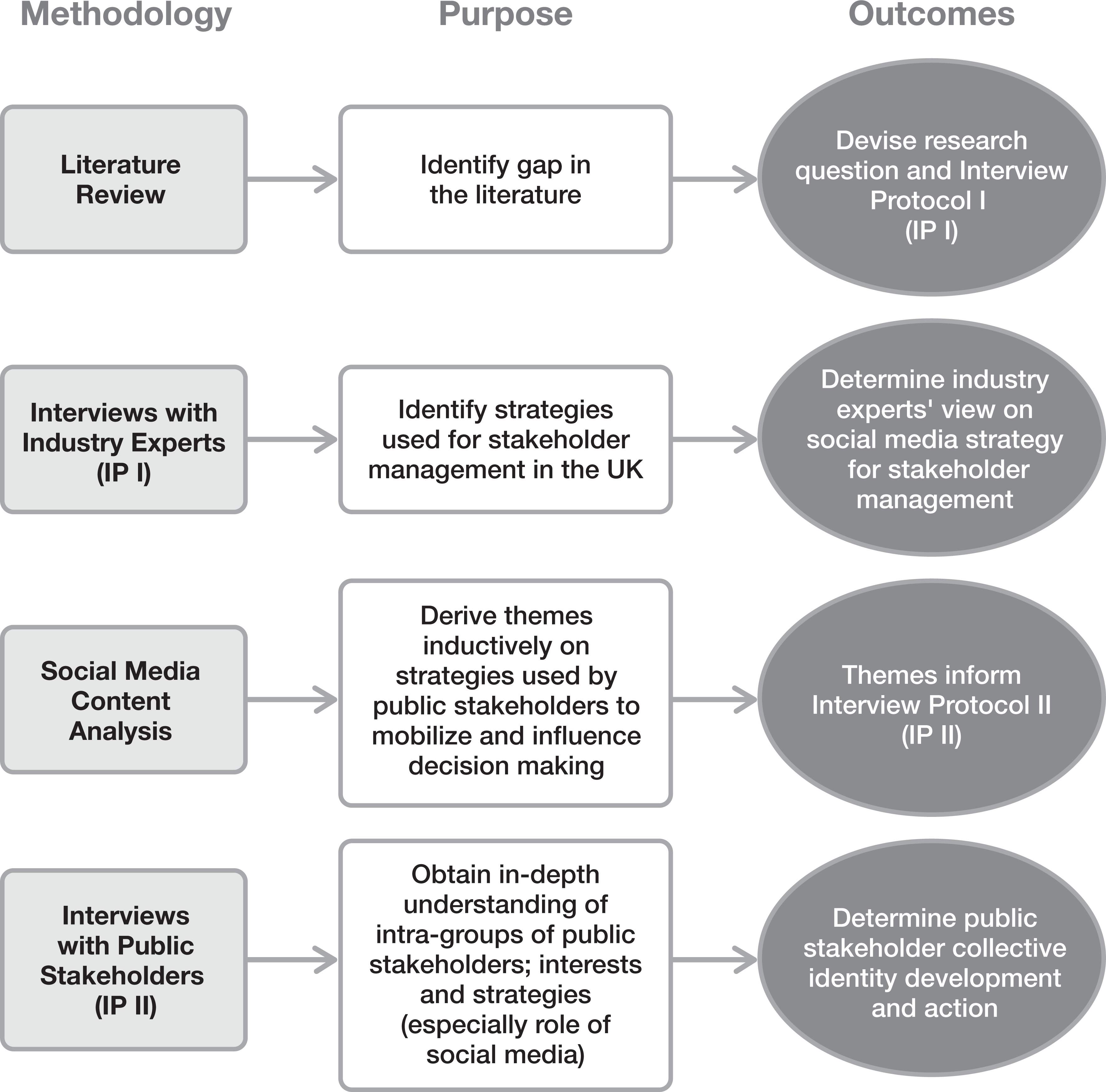
Research framework.
Other studies utilizing multiple methods include DiStaso and Bortree’s (2012), on the transparency in social media practice of organizations and public relations professionals, which integrates data from a content analysis of social media campaigns, a survey, and interviews (DiStaso & Bortree, 2012).
The central unit of analysis is “the relationship between a business and the influencing strategies used by the collective groups and individuals who can affect it or are affected by it” (Freeman et al., 2010, p. 5), as advocated in stakeholder theory. The research approach is qualitative and interpretive, with details described in the next section.
Qualitative Approach
This approach includes semi-structured interviews and social media content analysis.
Interviews
The details of the six interviews conducted with industry experts to gather lessons learned about public engagement across UK infrastructure megaprojects is in Table 1. These interviews were conducted by this study’s second author in 2016.
Industry Experts’ Interviewee Details

Themes around social media strategy emerged from the inductive analyses of the interviews with the six industry experts. These themes as well as directions for future research drawn from Williams et al.’s (2015) article, secondary data on the consultation process, and an initial telephone call with a committee member of NoCrossrailChelsea were used to inform the development of the interview protocol used for the interviews with public stakeholders affected by the proposed new station development on King’s Road, in the Royal Borough of Kensington and Chelsea (Table 2).
Public Stakeholder Interviewee Details

These interviews were conducted by the first author in the first quarter of 2017. Both interviews were recorded, but because the interviews were held in public cafés, the quality is not very good. Notes were also taken during these interviews. The interviewee details have been anonymized in accordance with their wishes and following research ethics guidelines. The interview data were analyzed based on the themes from the interview protocol (Interview Protocol II, refer to Figure 1) with further themes emerging inductively.
Social media content analysis
Social media analysis is called “netnography,” which is ethnography adapted to the study of online communities (Kozinets, 2002, p. 61; Kozinets, 2010). These online communities’ naturally occurring interactions on social media, such as Facebook posts, tweets (Twitter posts), images, and videos are used as a data source for content analysis
Social Media and Internet Presence of the Main Public Stakeholders and Crossrail2 Organization

The longitudinal social media analysis draws on Schreier’s (2012) guidance on qualitative content analysis. The qualitative coding of our social media data is data driven, that is, derived inductively from the data while coding, while being informed by the literature review, analysis of interview data from consultants, and secondary data. The social media content analysis undertaken from 2015 to 2016 is to gain understanding of the key areas the public stakeholder groups had concerns about Crossrail 2, their ongoing campaign, and the influence strategies used during the consultation process, augmented by drawing on general media and other secondary data.
Secondary data
Secondary data were analyzed to triangulate the data gathered from social media and interviews. This includes government reports, reports on the consultation process, leaflets produced by the public stakeholder groups, and newspaper articles (Table 4).
Secondary Data

The next section briefly describes the project setting, the C2 consultation process, and C2’s public stakeholders in Chelsea.
Crossrail 2 Project Setting
Crossrail 2 would serve stations (Figure 2) throughout the South East (UK), linking southwest and northeast London, and destinations across Surrey and Hertfordshire (crossrail2.co.uk/route) and also integrate with HS2:
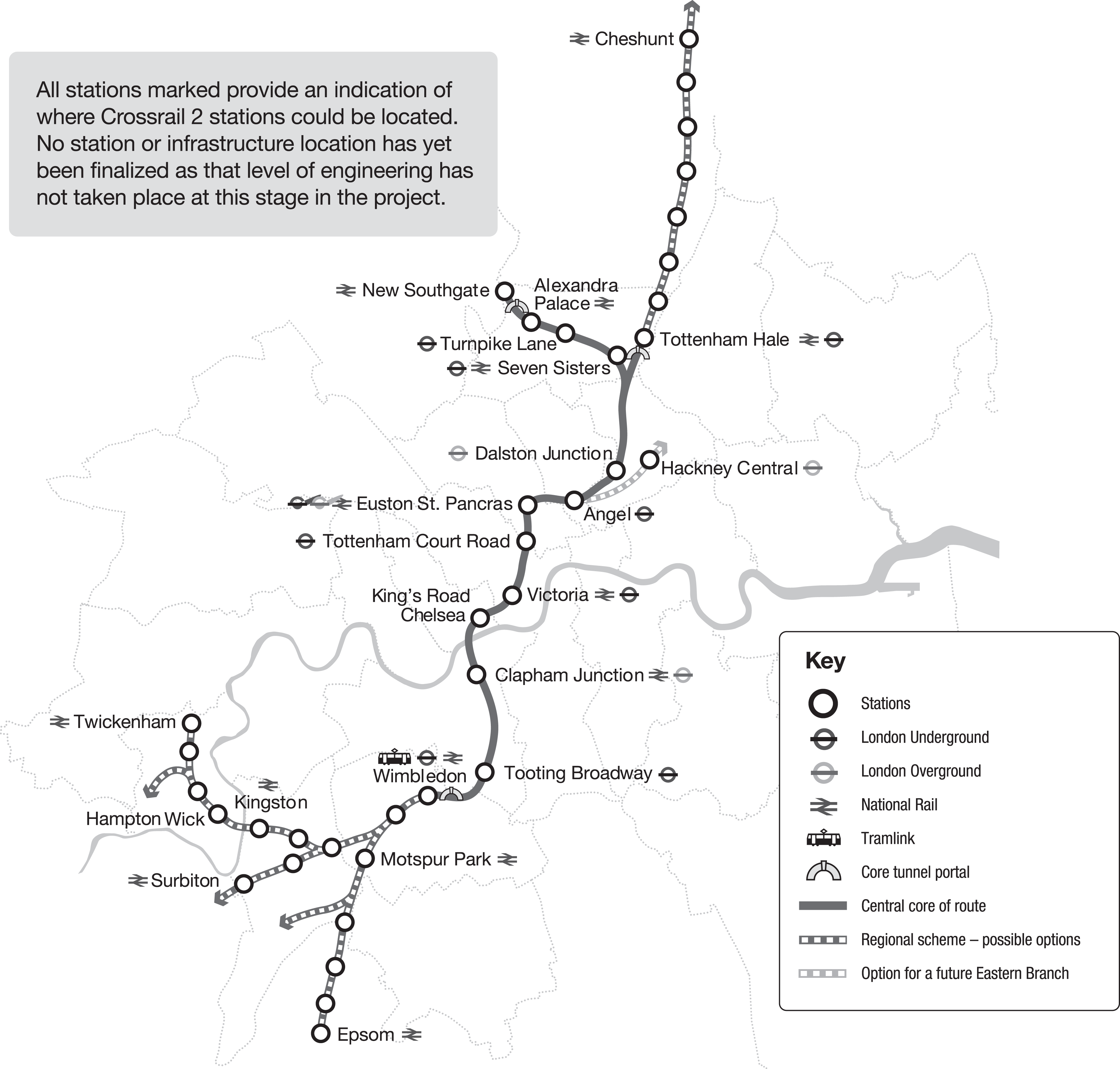
Proposed route map for Crossrail (www.consultation.tfl.gov.uk).
Public Consultations for Crossrail 2
To date in the first quarter of 2017, Crossrail 2 has held four major public consultations to inform its proposals. The first consultation started in summer 2013, which focused on the principle of the scheme. The second consultation was in 2014 on specific route options, including Kensington and Chelsea. The Department for Transport also carried out a safeguarding consultation from November 2014 to January 2015. Crossrail 2 then ran another major consultation in autumn 2015 providing more detail on its proposals. These consultations, together with technical work, discussions with the government, local authorities, and others have informed the latest proposals for Crossrail 2 (http://crossrail2.co.uk/consultation). A further consultation was expected in 2017, but there has not been one since 2015.
Public stakeholders for C2 in Chelsea
The two main public stakeholders are the NoCrossrailforChelsea and Chelsea4Crossrail2 groups, respectively opposing and supporting the proposed C2 route through Chelsea. Other than these stakeholders who live and/or work in the community, the Royal Borough of Kensington and Chelsea (RBKC) Council is a stakeholder for C2 in Chelsea. The RBKC Council supports the proposed King’s Road station in Chelsea (www.rbkc.gov.uk/planning-and-building-control/planning-policy/consultations/crossrail/crossrail-2) because of the economic benefits. While another stakeholder, the Chelsea Society, founded in 1927, has the aim of “protecting the interests of all who live and work here and to preserve and enhance the unique character of Chelsea” (http://chelseasociety.org.uk/). It is against C2 in Chelsea.
The Royal Borough of Kensington and Chelsea website states that the earliest date for submission of a Crossrail 2 bill to Parliament is late 2017 (it now could be in 2019), with construction potentially commencing in the early 2020s and completion by the early 2030s.
Research Ethics
There is public access to the social media sites, so content was freely available for examination and analysis (i.e., through unobtrusive observation). This allows researchers to observe without influencing the event that is being observed (Casselman & Heinrich, 2011), thus limiting researcher bias. The opposing public stakeholder group was informed that its social media sites’ content was being analyzed. In addition, due to the sensitivity of the ongoing consultation, the two public stakeholder interviewees were assured that the research is for purely academic purposes and anonymity is guaranteed.
(Please note: The first author became a member of the opposing group’s Facebook site as a nonparticipant observer in 2017, to receive alerts when new posts were added.)
Findings
The next sections analyze the interview and social media data from public stakeholders. These will be briefly discussed in the following sections. Note that C1 did not have a social media strategy, relying successfully on other methods to engage with public stakeholders (Table 5).
Results of the Public Consultation on Crossrail 1 (Crossrail, 2005)

Data from Twitter clearly show that the Stop HS2 Twitter account was active and created one year before (i.e., March 2010) the official HS2 Twitter account (i.e., March 2011). The social media activity (tweets) of Stop HS2 is also much higher, compared to the HS2 account (18,000 compared to 2,996), as shown in Figure 3. This indicates that HS2 did not have a social media strategy early on in their external stakeholder engagement approach. Furthermore, Stop HS2’s Twitter tagline clearly states their main arguments against HS2: “no business case, no environmental case, no money to pay for it.”
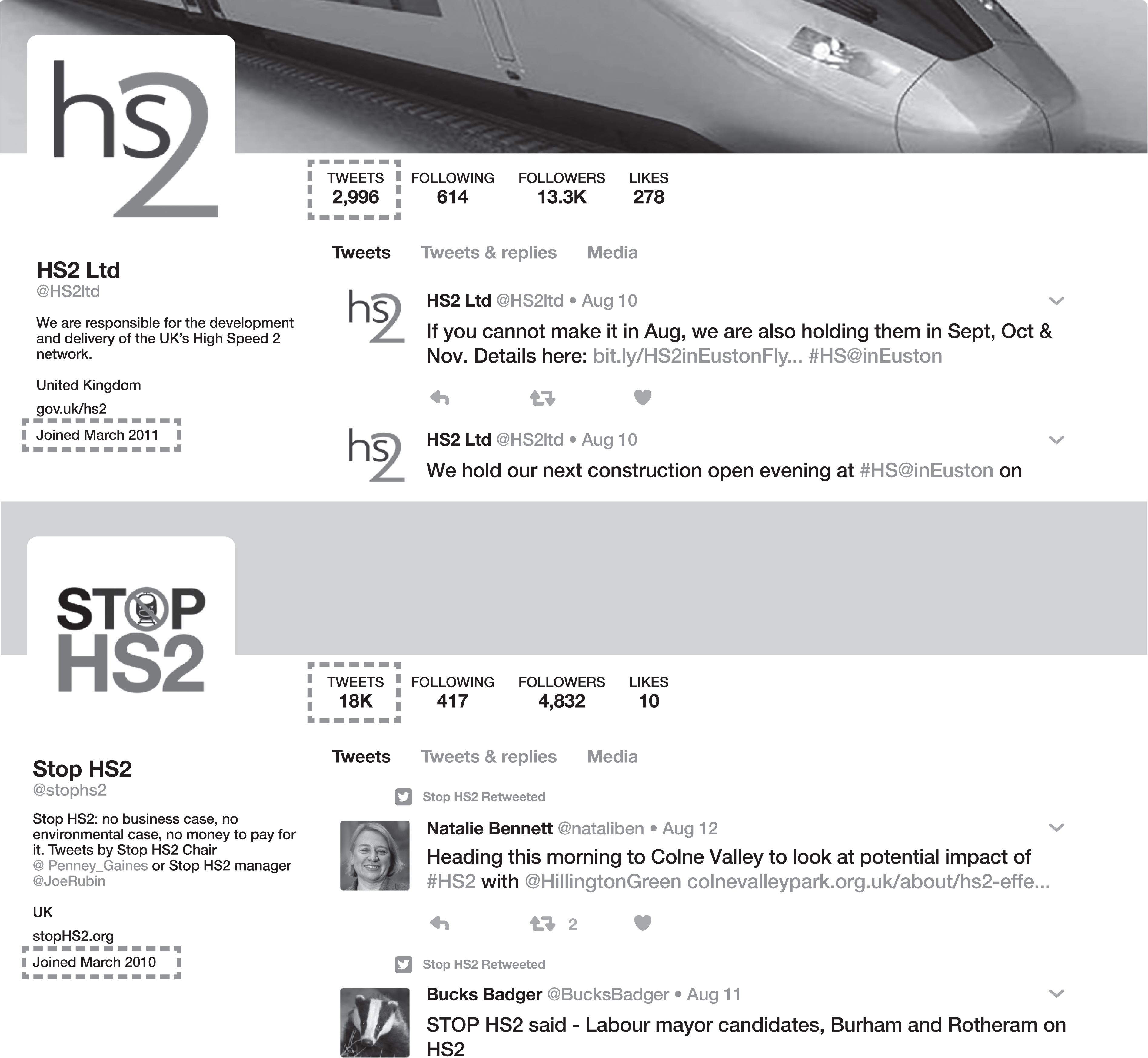
Twitter accounts of HS2 and Stop HS2 (as of 14 August 2016).
Whereas the C2 official Twitter account was registered early (in March 2013) and has more activity compared to the NoCrossrail2 in Chelsea account, which was registered only in mid-2015 (1,377 compared to 430 tweets as of 14 August 2016) (Figure 4). This shows that C2 had a social media strategy early on, promoting C2’s benefits. This early engagement indicates that C2’s external stakeholder management via social media may be more effective compared to HS2. The tagline for the NoCrossrail2 in Chelsea Twitter account is focused on the unity of the community (i.e., residents and local businesses) in opposing C2 in Chelsea.
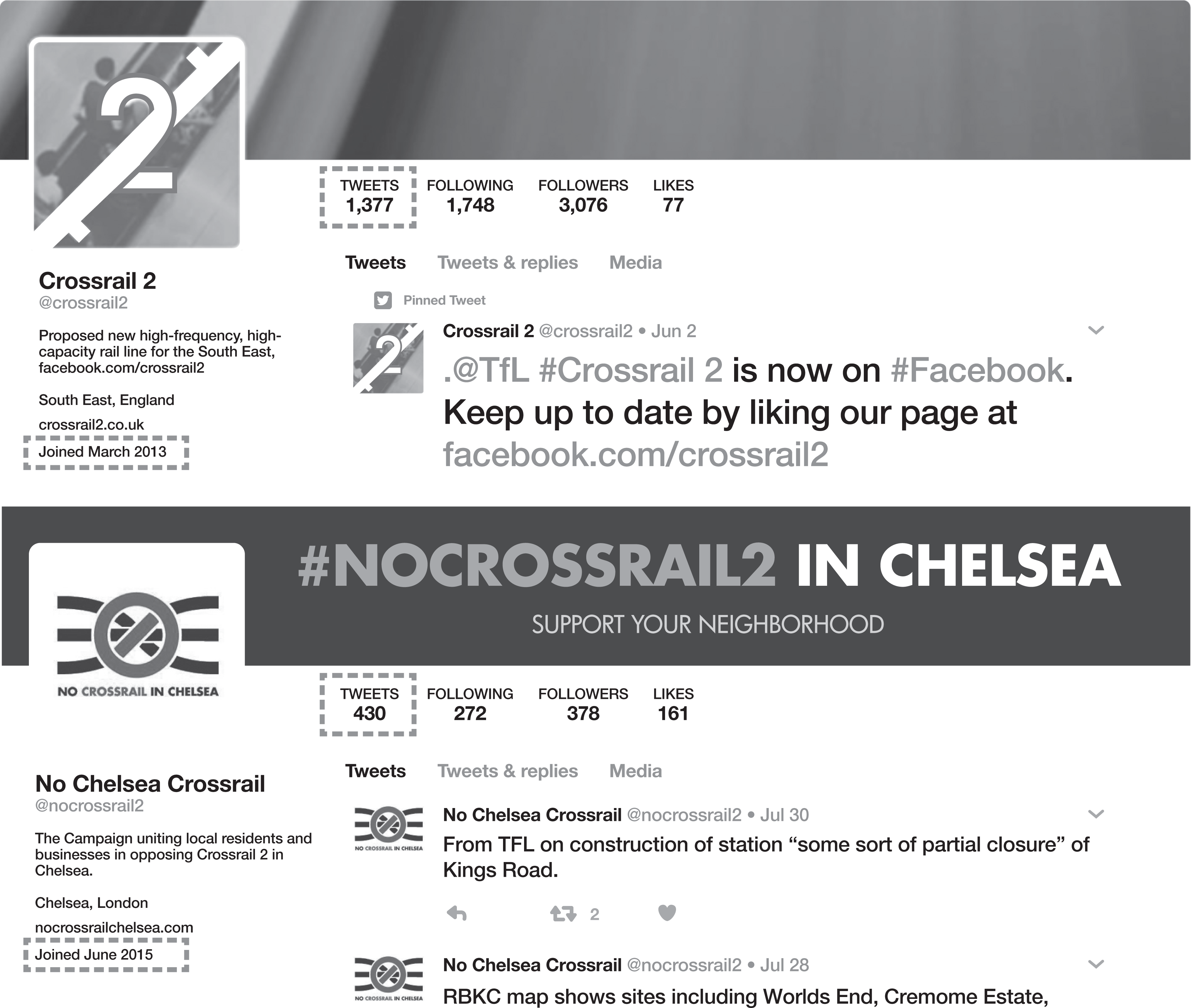
Twitter accounts of C2 and NoCrossrail2 in Chelsea (as of 14 August 2016).
The data indicate that C2 also has a better social media strategy overall than HS2, communicating relevant benefits to the affected public, which contributes to the support for this infrastructure megaproject: For C2, it’s much more modern, so they have been much faster off the mark [in] setting up a Facebook group; they regularly post on Facebook and same on Twitter. There is a LinkedIn group of C2, so it’s a much bigger social media footprint, and at the moment it’s 80% positive, because they have spun the project focus on housing, and of course HS2 made the mistake of selling itself as a high-speed railway, whereas in fact it is really needed for capacity. So, the whole campaign for C2 has been much better strategized in how it’s going to be sold to public. So, it is absolutely essential for transport that they are linking that with jobs and homes, which I think is a very powerful message currently. (UK Rail Industry Expert 2A)
The next section discusses the findings from the interview data analysis with public stakeholders.
Analysis of Public Stakeholder Influence Strategies via Interviews
The NoCrossrail in Chelsea campaign is “the voice of Chelsea.” The purpose and views of the NoCrossrailChelsea group are stated on their website (www.nocrossrailchelsea.com).
Some of the reasons why they oppose Crossrail 2 in Chelsea are: Massive waste of taxpayer money No help in delivering Crossrail 2’s strategic objectives Transport benefits would be modest
The following subsections discuss the intragroup structure, mobilization, and their objection to C2 in Chelsea.
Intragroup structure of NoCrossrail2
The intragroup structure of the NoCrossrail2 group includes Chelsea residents (about 100), celebrity patrons (12), and local businesses (about 80). There is also a committee that drives the efforts and keeps the group informed. Through the interviews, it became clear that the intragroups’ main concerns about Crossrail 2 through Chelsea are quite different. However, the overarching objective was: “To stop them.”
Interviews with a NoCrossrailChelsea committee member (CM) and a resident (R) living near the proposed site of the new station are analyzed. During the interviews, it became clear that the interviewees were not aware of the earlier consultation exercise in 2014, despite TfL stating that they had distributed leaflets about it in Chelsea. Through the Freedom of Information Act (FOI), the NoCrossrailChelsea committee discovered that TfL had not distributed the leaflets as widely as it had claimed.
Group inception and mobilization
The NoCrossrail2 group was established in April 2015, with four core residents setting up the group. According to committee members, it was not difficult to get the community mobilized, with 50 active people in the group. Twitter and Facebook accounts were set up and a public-relations firm was hired in September 2015 by the NoCrossrail2 group to maintain social media and the website. These resources were financed by the local community. The mobilization of this group to gain claim legitimacy (Neville et al., 2011) through information gathering and formal and peaceful means is shown in Table 6.
Public Stakeholders’ Legitimacy and Mobilization (From Secondary and Interview Data)

Objections to Crossrail 2 in Chelsea
From the interview data analysis, the intragroups within NoCrossrailChelsea opposing C2 have five main objections (i.e., the viability or need for the proposed route through Chelsea, the transformation and thus loss of character of King’s Road where the proposed new station would be, the impact of engineering works on listed buildings and homes, disruption to local schoolchildren’s lives, and local small businesses’ fear of increased rates and bigger chains taking their business; refer to Table 7).
Objections to C2 in Chelsea by Intragroups of the NoCrossrailChelsea Public Stakeholder Group

CM = Committee Member; R = Resident
Furthermore, existing transport links in Chelsea are excellent. It is in an area rated by TfL with the second highest score for transport links (according to the Public Transport Access Level).
Local businesses’ concern
Local businesses’ main concern is that they will suffer losses if big corporations start operating in the area. They are also concerned that business rates will go up as well as rentals, because the RBKC Council expects them to benefit from greater foot traffic due to the proposed new station. To make their position stronger in opposing the project, they aligned themselves with a larger group (i.e., the local residents).
Moms’ concern
According to a resident (R), who has young children, a local mom sent out an email to other moms she knew in a local nursery to alert them to what the new development would mean for their daily school runs and availability of green spaces for their children. This “snowballed,” with moms contacting other moms in the community.
It emerged from this interview that moms with young kids are another intragroup within the NoCrossrailChelsea group, although they are not categorized as such in the group’s website. However, R mentioned that the amount of time spent campaigning by this intragroup, collecting signatures and conducting other activities in 2015, meant that their kids and husbands “hardly saw them.” R thought that “they [TfL] are depending on the fact that we will not be able to keep this up.” This shows that they believe their concerns are being ignored and a lack of trust has formed toward the focal firm.
Stakeholder Action in Response to Perceived Stakeholder–Firm Relationship
The actions taken by the NoCrossrail Chelsea intragroups as a result of their perception of a lack of concern and transparency by the focal firm are as follows.
Efforts to engage with project promoters
There were meetings held with TfL and the RBKC councillors. A key meeting was held in July 2015, where the committee member (CM) met the head of TfL and Michele Dix (managing director of C2) face to face, to convey their concerns. However, there have been no further meetings since then, despite his efforts. There was also a public meeting at the Chelsea Town Hall in November 2015, where Michele Dix, a council representative, and members of the NoCrossrail group were on the same platform:
Six-hundred people present…TfL did not take us seriously…we were irrelevant. (Committee Member)
The NoCrossrail group felt that it was in a “David and Goliath” situation, as described by one resident, and their concerns were not given attention:
Not a transparent process. TfL visited the site a few times…“tick-box” exercise. (Committee Member)
Campaign to influence: celebrities, media, and leaflets
Celebrities living in Chelsea were contacted because the committee wanted to publicize their cause in the main daily paper in London, the Evening Standard. They realized that “to get stories into the Standard, they need a celebrity” (Committee Member).
Leaflets were developed and distributed. In addition, the success of their campaign during the 2015 consultation was publicized in print and online media.
Media publicity: response to the 2015 consultation exercise
The group actively campaigned during the 2015 consultation and publicized the results in 2016, which overwhelmingly supported their campaign:
There were 21,000 responses to the 2015 consultation from the whole of London, with Chelsea contributing just under 10,000 responses. Ninety-five percent of these 10,000 opposed the development of the King’s Road station. This was publicized in the Evening Standard…and on The NoCrossrail2 website. (Committee Member)
Gaining decision makers’ backing
Key decision makers such as Members of Parliament and the then London mayoral candidates (Zac Goldsmith and Sadiq Khan), the Greater London Authority, and other relevant bodies were approached. However: …since November 2016, there has been no engagement…when the [Theresa May] government said TfL had to reconsider the cost, as a savings of £1 billion is needed. (Committee Member)
Assembly of information and evidence
When asked about how the committee went about making their case against C2, the committee member stated that assembling information and evidence is key:
In the beginning, assemble information to make the case…it is important to have information to back any assertions or statements made.
They had to resort to using the Freedom of Information Act a few times to access relevant information, for example, on the actual number of and the response types to the 2015 consultation exercise. In addition, the committee member accessed the Public Transport Accessibility Level map for London. From this source, the committee member was able to find out that Chelsea was rated second in terms of public transport access (highest is 1; grade is from 1 to 10), and so, this was proof that there is a “poor argument for further improvement to public transport,” compared to other parts of London. For instance, there are “six buses going along King’s Road already…they serve north-south and east-west routes” (Committee Member).
Accessing resources to engage
The committee member mentioned that he realized that his group has the resources (financial and otherwise) to work together, set up a website, and social media accounts (Twitter and Facebook), which helped it carry out a coordinated and well-organized campaign. Furthermore, as Chelsea residents, some of whom are celebrities, they have a level of influence. He realized that not all public stakeholders may have access to similar resources and that would affect their engagement.
Emphasis on the financial argument
According to the committee member, the government “needs to save £4 billion. The King’s Road station will cost about £1.2 billion,” and so, he hoped the government would consider dropping the proposed King’s Road station in Chelsea to achieve some savings.
Lessons learned
Based on the committee member’s experience, lessons learned from the campaign against Crossrail2, which can be applied by public stakeholders to future UK infrastructure megaprojects are: “Use the Freedom of Information Act. Get involved as early as possible.”
Both interviewees (Committee Member, Resident) were unprepared for the hurdles they had to face in the consultation process. The result is a loss of trust in the process:
The Role of Social Media
Opposition by the public stakeholders in the community (NoCrossrail2 in Chelsea group) is because quality of life is the foremost concern. Another distinct group that is in support of the development is the Chelsea4Crossrail2 group.
Intragroup structure of Chelsea4Crossrail 2
The Chelsea 4Crossrail 2 group includes Nicholas Coleridge, Commander of the Most Excellent Order of the British Empire (managing director of Condé Nast Britain and president of Condé Nast International), the museums located in South Kensington, Harrods, and the Cadogan Estate, each with their own interest in having the King’s Road station go ahead [in communication with Resident]. This group is much smaller (five members are named on their website) and has been less active in terms of campaigning for their cause, yet are very influential. They share the view of the RBKC councillors and TfL, supporting the development of the new proposed King’s Road station. There are no other members listed on their website supporting Crossrail 2 in Chelsea. Economic interests are foremost.
Both of these groups have harnessed social media, including Facebook and Twitter, to promote their cause; however, the group supporting Crossrail 2 is less active and has far fewer followers (Table 8). Furthermore, the Chelsea4Crossrail2 group only mobilized on Twitter eight months after the group opposed it.
Main Statistics of the Chelsea Public Stakeholder Groups’ Twitter Accounts Compared (as of the end of 2016)

Analysis of the tweets of NoChelseaCrossrail
Certain themes emerged on analysis of the 433 tweets of this group (as of the end 2016), which are coded into the following three categories: sharing information, promoting their cause, and responding to stakeholders.
Figures 5 and 6 are examples of sharing information online.
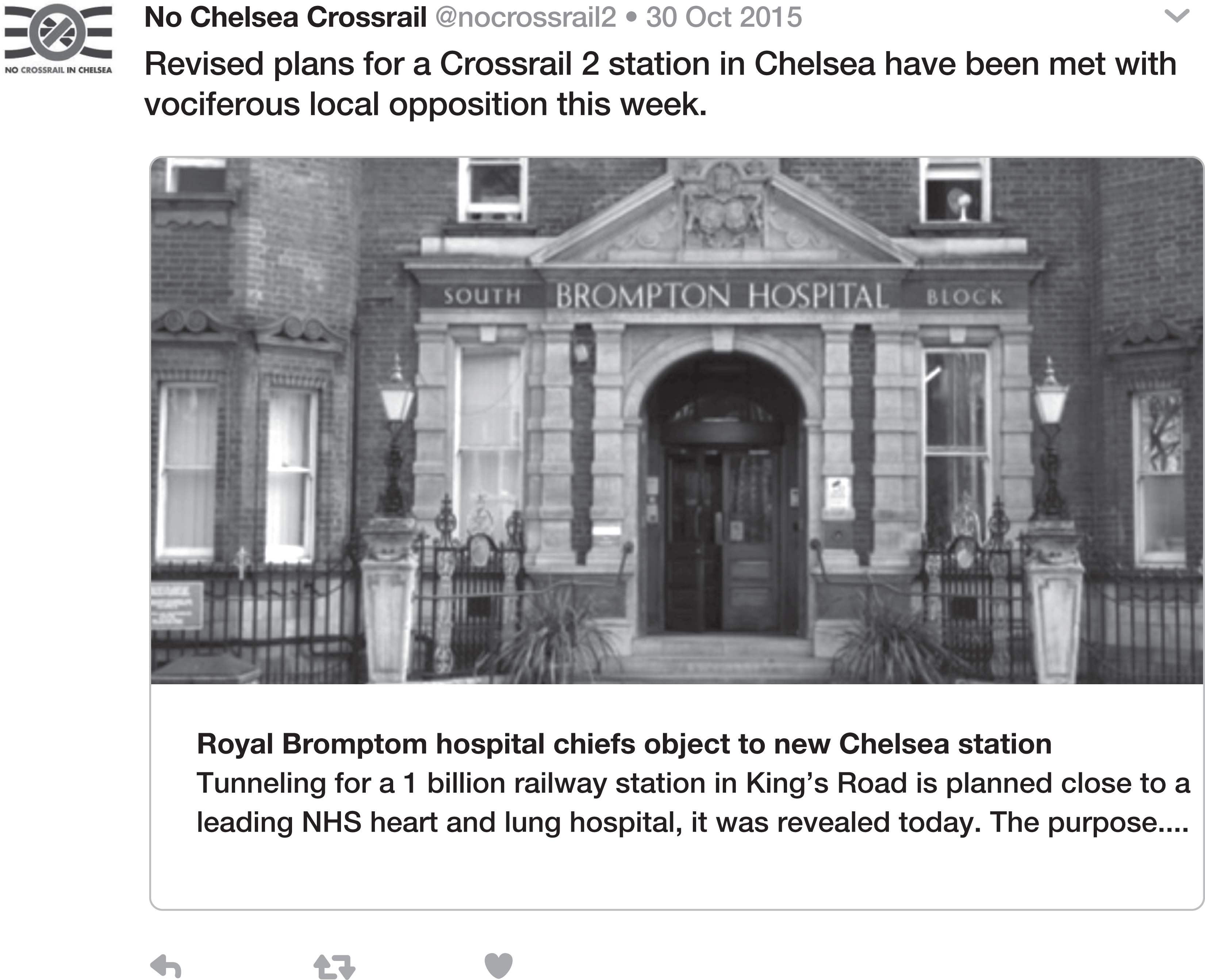
Local opposition to the revised plans shared (30 October 2015).
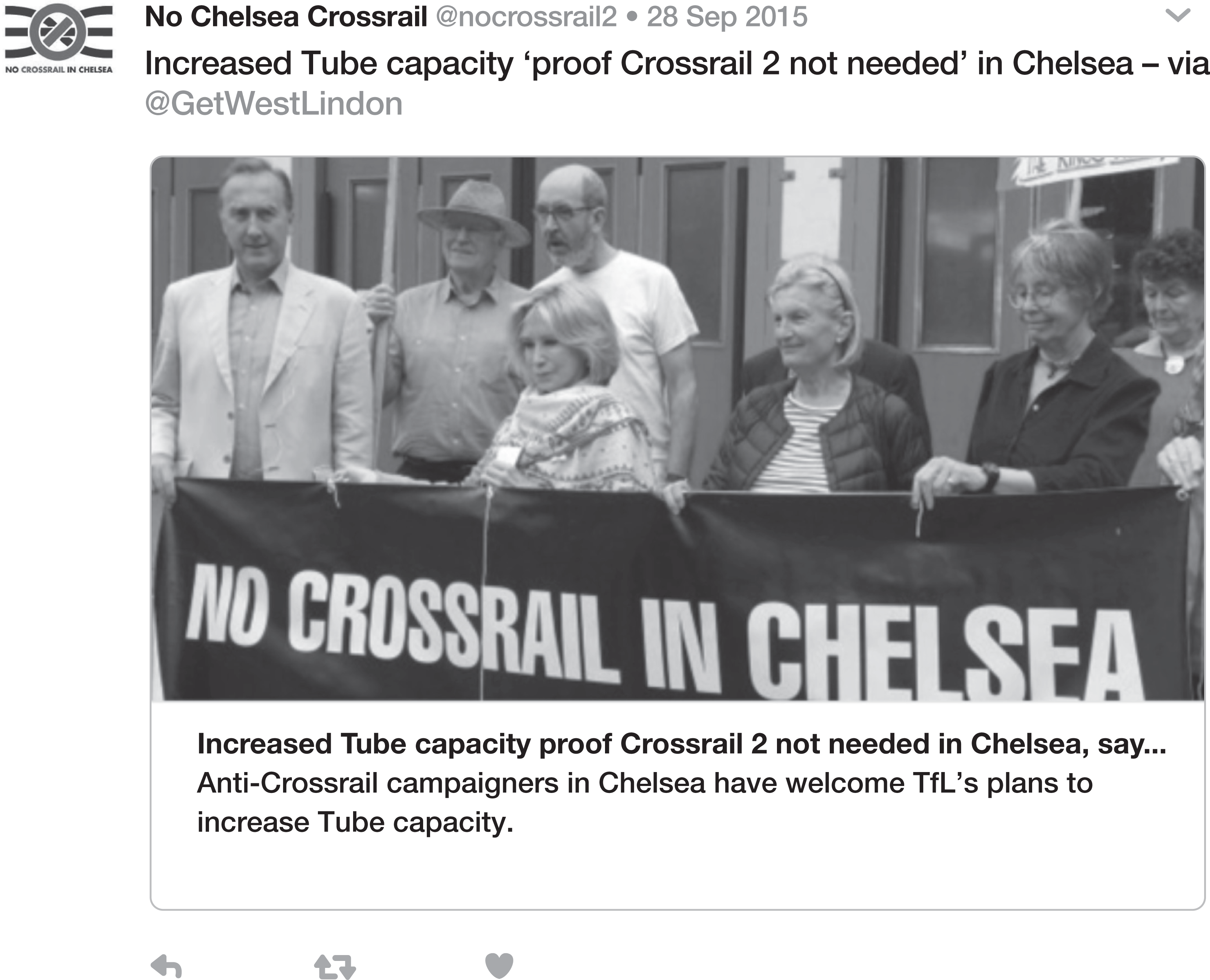
NoChelseaCrossrail group with celebrity patrons campaigning in Chelsea (28 September 2015).
The second category is promotion of the cause.
Figures 7, 8, and 9 are examples of NoChelseaCrossrail “promoting” their cause.
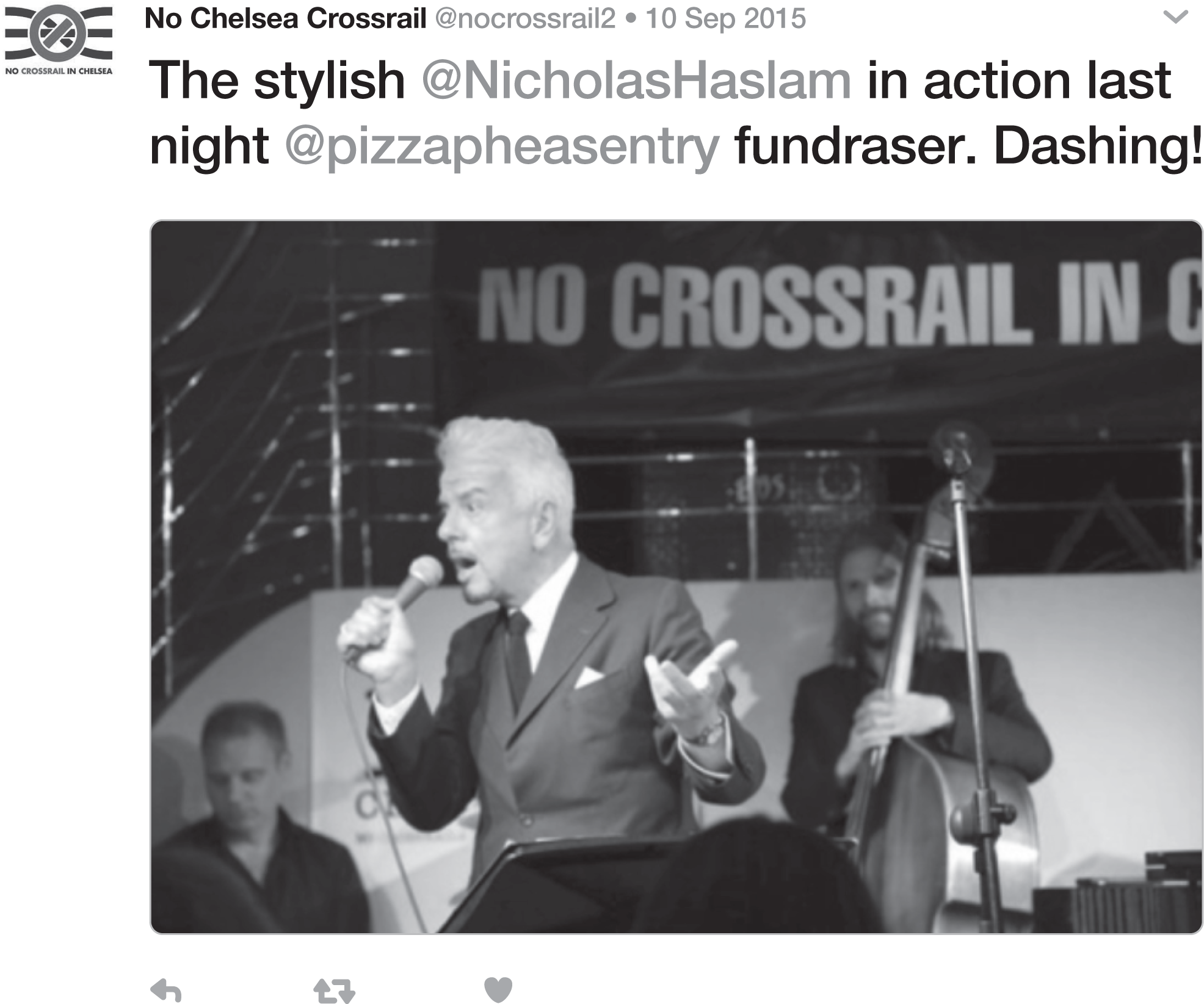
Fundraiser held by NoCrossrail group (September 2015).
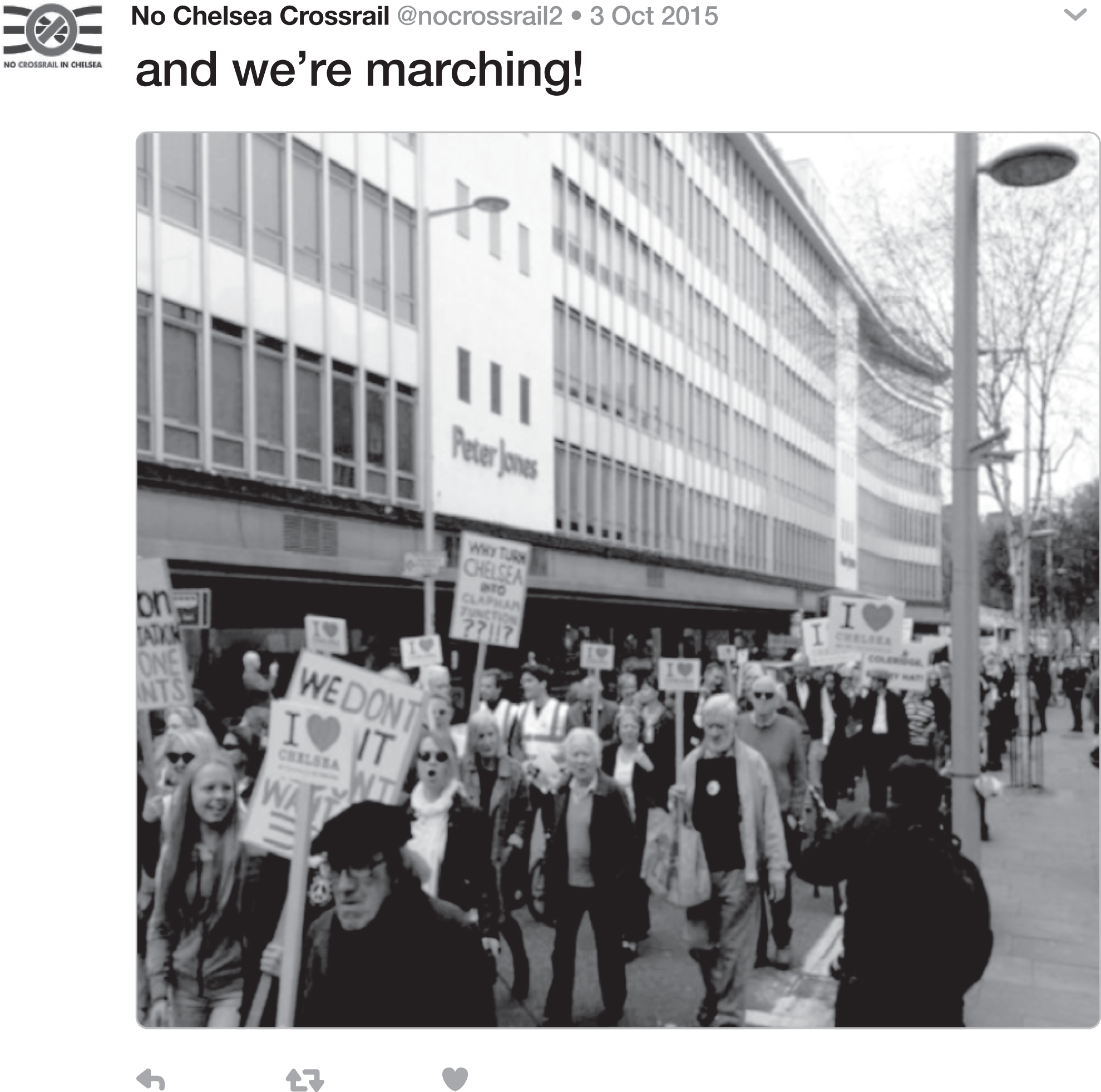
Protest march by NoChelseaCrossrail group (3 October 2015).
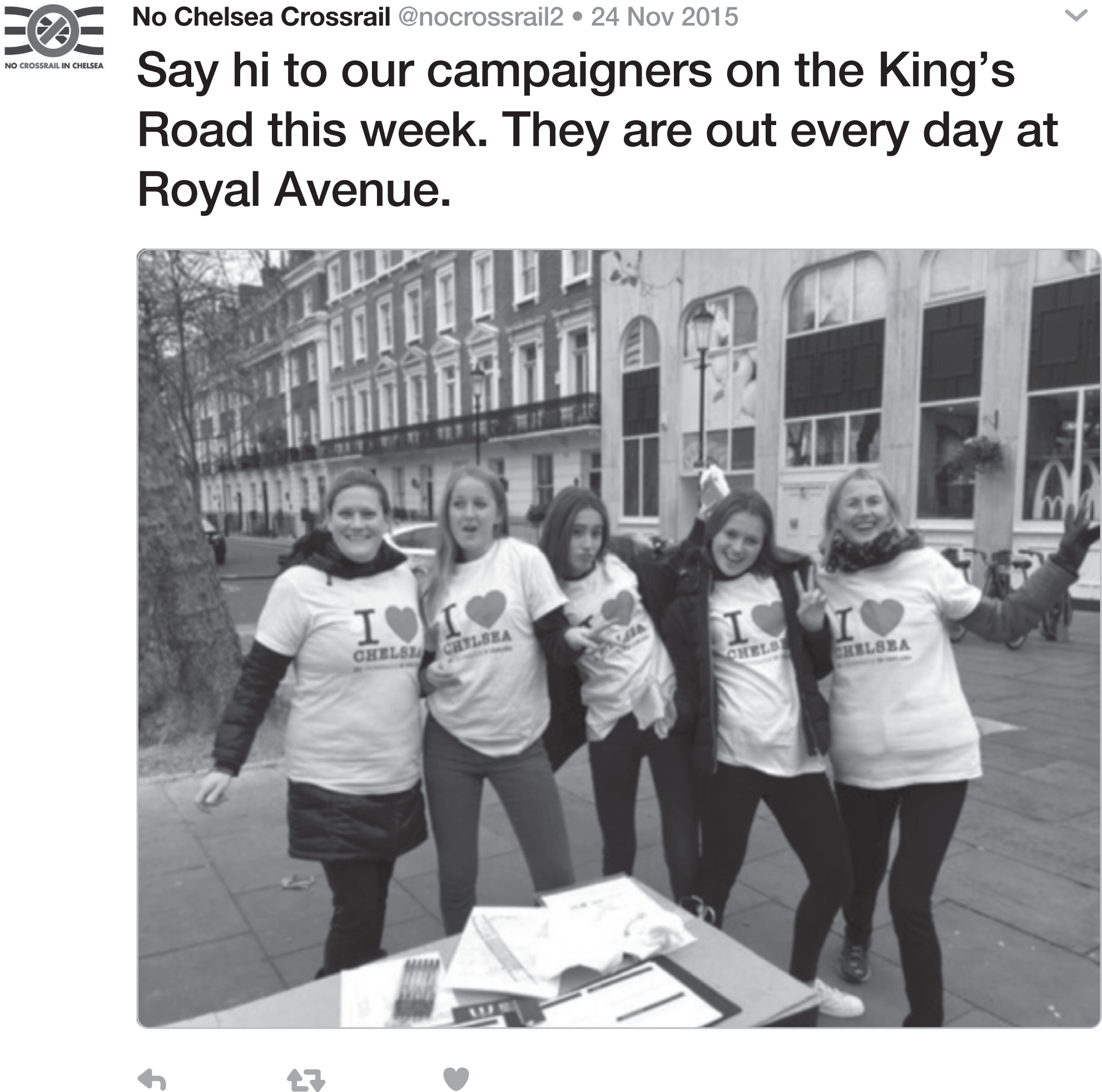
Promoting the NoCrossrail campaign on King’s Road (24 November 2015).
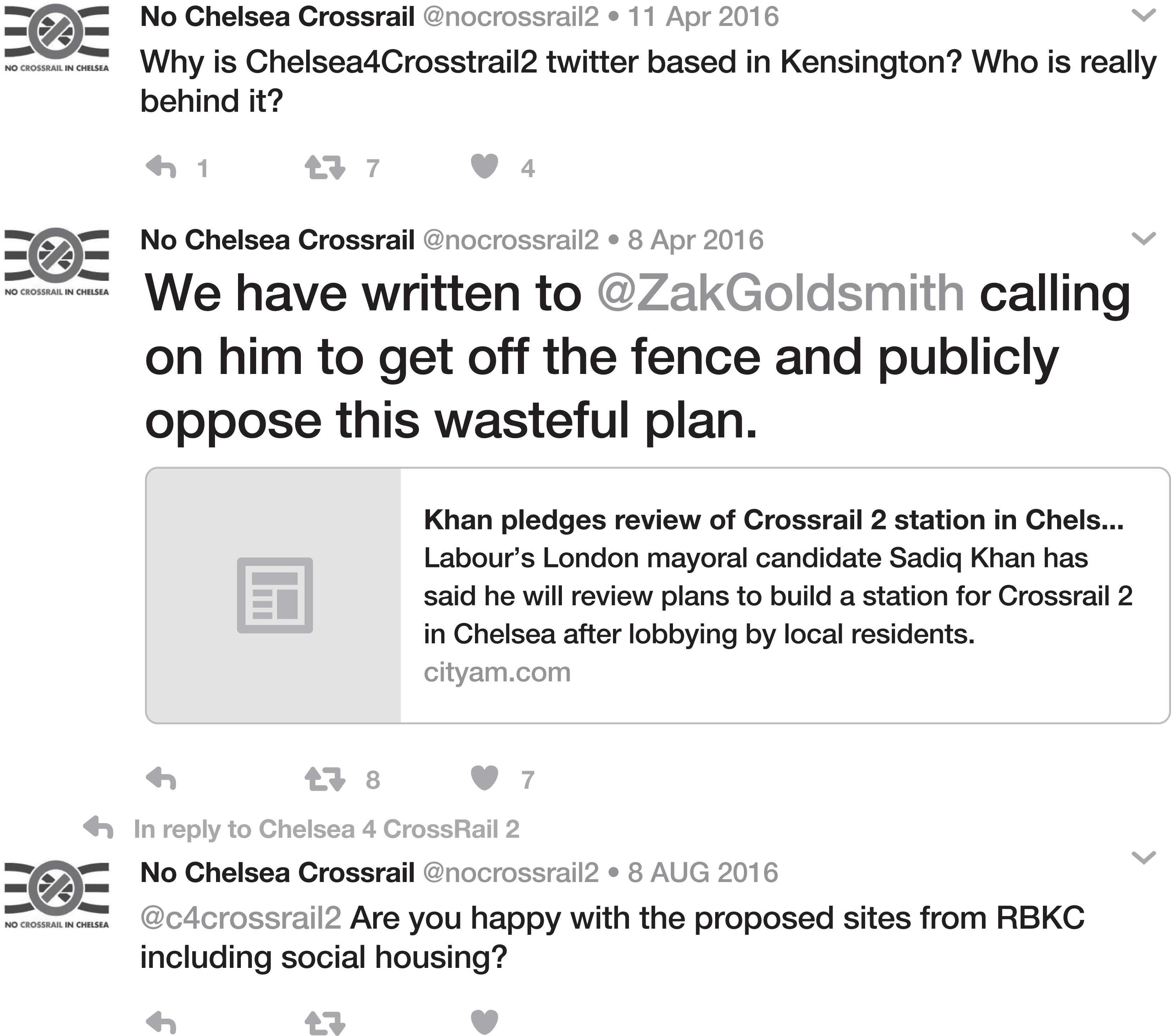
Examples of responses by the NoChelseaCrossrail group.
Influencing strategies
The tweets also show the various influencing strategies used by the opposing group and its intragroups (local small businesses, celebrities, and residents) to get their views heard and to gather information, including petitions to City Hall and the RBKC council (Table 9), and use of the local and national media, such as Kensington and Chelsea News, the Evening Standard, and the Guardian to promote their cause. The support of some 2016 London mayoral candidates and celebrities on print and social media are examples. Tweeted examples are included in Table 9.
The Role of Social Media (Twitter) in Empowering and Mobilizing Intrapublic Stakeholder Groups into Collective Action, Using Strategies to Influence Decision Making in the Consultation Stage of C2

TfL’s response, however, seems to be “avoidance” and “dismissal” (Aaltonen & Sivonen, 2009) to this opposing group’s strategies to influence decision making in the consultation stage of C2, from 2015 to 2016.
The focal organization, TfL’s “avoidance” response (prompts opposing stakeholder group’s Twitter response):
20 June 2016: TfL ignoring calls for King’s Road Crossrail 2 station to be removed are abandoning their duty, say campaigners.
This group also drew on the Freedom of Information Act (FOI) to find out the detailed results of the 2015 consultation.
24 June 2016: TFL FOI confirms that 92% of RBKC respondents opposed station; 95% of Chelsea respondents.
The NoChelseaCrossrail group’s perception of being voiceless and powerless about maintaining the village character and quality of life in Chelsea despite petitions and high-profile support is exemplified by the following tweets: 30 March 2016: RBKC ignores the views of local people 14 June 2016: RBKC claim 3,500 new homes from King’s Road station in RBKC! But Michele Dix “no oversite development.” What is going on? 20 June 2016: TfL ignoring calls for King’s Road Crossrail 2 station to be removed are abandoning their duty, say campaigners
Despite its perceived failure to attract the attention of the focal organization and influence the consultation process outcome, its ongoing and persistent campaign demonstrates NoChelseaCrossrail’s strong identity and the coherence of its intrastakeholder groups, mobilizing around a common objective to “press” the focal organizations, like RBKC and TfL, to “listen” to them through collective identity development and action.
Analysis of the tweets of crossrail for Chelsea
The tweets of this group can be divided into two categories, sharing of information and responding to other stakeholders.
Sharing: Media, articles, website links, reports of various other groups and other stakeholders of Crossrail 2, including content from official reports supporting their view or campaign.
Replying: To other stakeholders, individuals, and groups with wit and criticism; rejecting their ideas of opposing Crossrail 2 in Chelsea.
This group does not have any planned activity or events compared to the first group. Therefore, it does not have the third category of tweet (i.e., promoting). Another interesting fact is that most tweets in this account use the first person singular pronouns “I” and “me,” and contain images or content related to one person and not a group, suggesting a single, public person managing the social media account, despite calling it a group. Therefore, the data indicate that Chelsea4Crossrail is portrayed as a group on social media, yet has little activity that affirms its status as a coherent group, whereas the NoCrossrailChelsea group uses first person plural pronouns like “us” or “we,” which suggest a coherent group, speaking together with one voice, and a single, unifying objective.
Some examples from the Chelsea4Crossrail2 social media account are provided in Figures 11 through 13 to support this analysis.
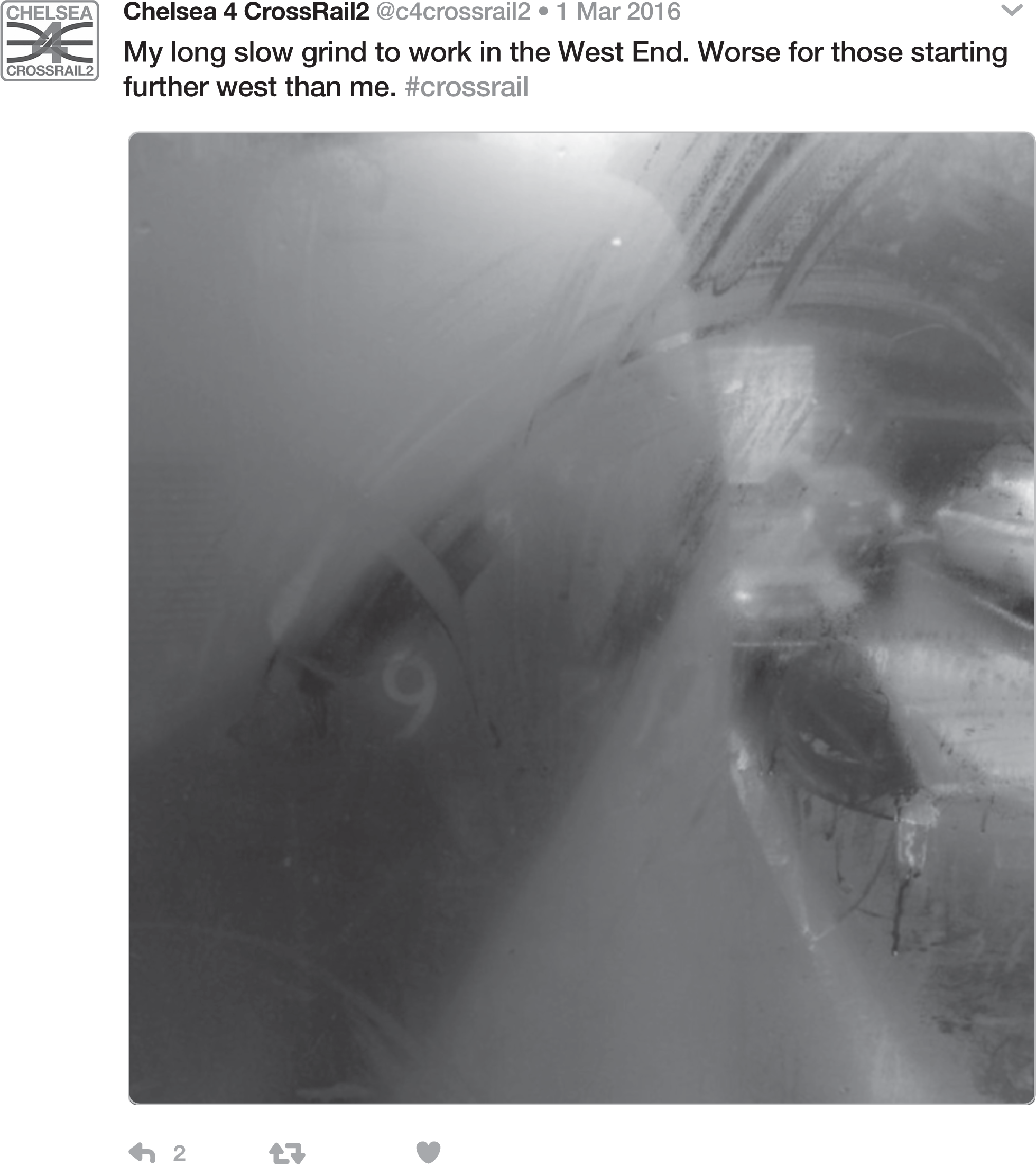
Example of sharing and responding (personal view) by Chelsea4Crossrail2.
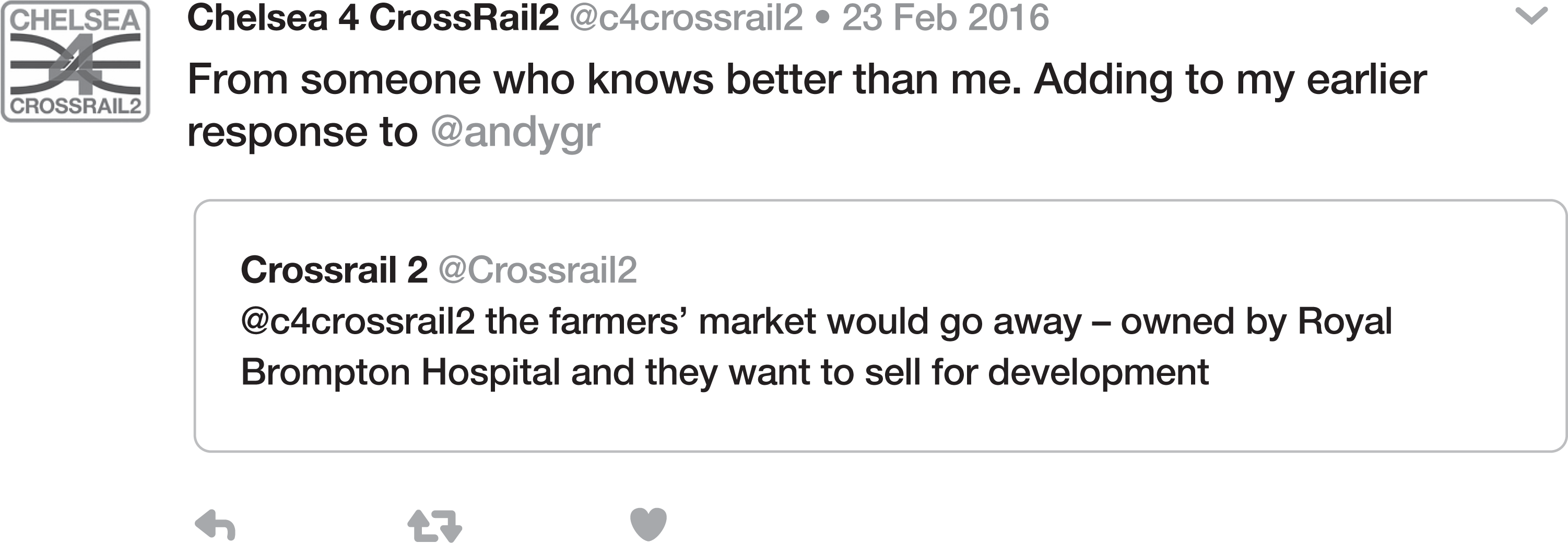
Example of sharing and responding by Chelsea4Crossrail2.
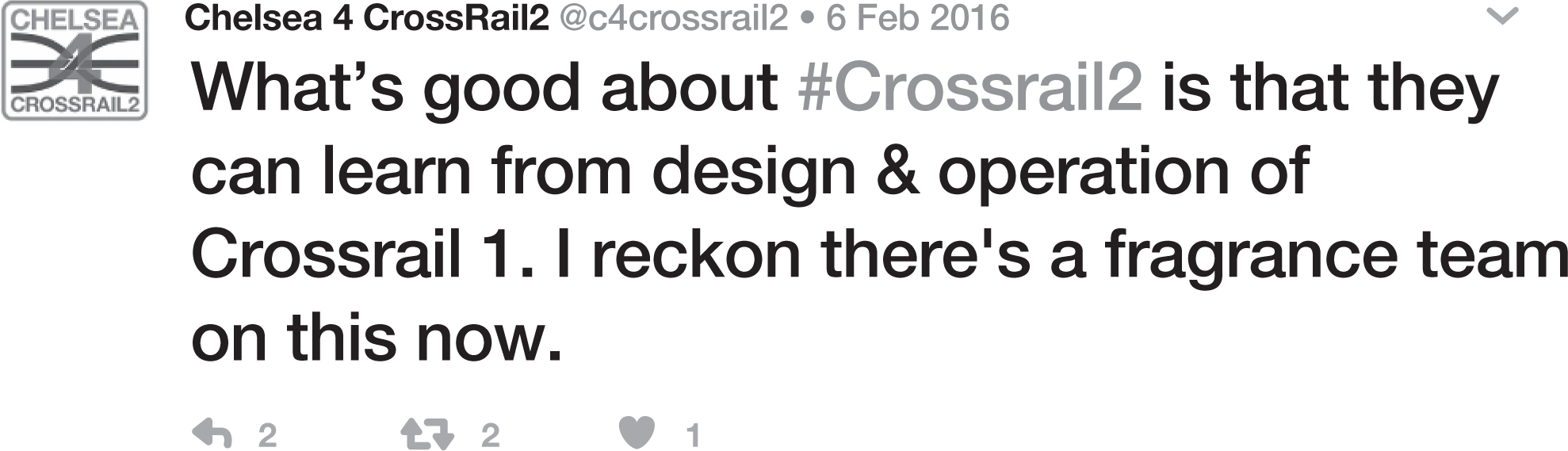
Example of sharing and responding (personal view) by Chelsea4Crossrail2.
The public stakeholder group, Crossrail4Chelsea, comprises established and prestigious institutions with its objective aligned to the focal organization, TfL and the local council, RBKC. It is also very influential and thus, has stakeholder legitimacy. The analysis suggests this may be the reason why it did not attempt to develop a strong collective identity nor action.
Websites Compared
In terms of layout and design, both groups’ websites have a logo, look professional and up-to-date; however, in terms of content, there is a difference. The opposing group’s (i.e., NoChelseaCrossrail) website has a lot more to offer compared with the supporting group. For example, it has a clear stance on why the group does not support the C2 project in Chelsea. It provides a list of all its active members and intragroups (committee members, patrons, local businesses) that support the campaign, whereas the supporting group mostly relies on the data published by the official C2 project website. It only has five people named on the website who form the management team.
The public stakeholders of the NoChelseaCrossrail group would have liked to have been involved in influencing decision making much earlier but were unaware that the consultation on C2 had begun. Lack of widely available information on the earlier consultation in 2014 did not help build trust between the project promoter and this public stakeholder group and its intragroups.
Face-to-face meetings with TfL were sought by the NoChelseaCrossrail public stakeholders, but not with much success. This opposing group was getting national media coverage, yet, perceive their case as being disregarded and “dismissed” (Aaltonen & Sivonen, 2009). The analysis seems to suggest a “them and us” approach rather than a collaborative, trust-building, and fair relationship in the C2 consultation process between stakeholders and the focal firm (Pirson et al., 2017).
Discussion and Conclusion
Project stakeholder management has been transformed in the social media era, providing both opportunities and challenges (Williams et al., 2015). This research draws on an emerging stakeholder perspective on stakeholder theory (Crane, 2018; Hayibor & Collins, 2016; Pirson et al., 2017) and project stakeholder management and social media literature in making a theoretical contribution, with some managerial implications. The research question directing this study has been:
How does social media empower the public stakeholder and its intragroups to mobilize collectively to influence decision making in the consultation stage of an infrastructure megaproject?
Theoretical Contribution
To gain the stakeholder perspective, the qualitative analysis of social media content by public stakeholders of a megaproject has not been attempted before in project stakeholder research. The analysis suggests the lack of fairness and trust perceived in the stakeholder–firm relationship resulted in particular actions taken by a public stakeholder and its intragroups (Crane, 2018; Hayibor & Collins, 2016) to influence decision making, which, with social media, has exponential reach and impact. Integrating the social media and project stakeholder fields, the theoretical contribution from this empirical study on stakeholder action is threefold. First, strong collective identity development was evidenced despite disparate intragroup concerns with social media playing a key role to cohere, empower, and mobilize stakeholders. Second, stakeholders’ influence strategy of “information demand” is a novel contribution, in responding to avoidance strategies used by the focal firm. Third, for the period of the study, the analysis indicates that stakeholder legitimacy, rather than claim legitimacy, may be more of a consideration by the focal firm in terms of assessing which stakeholder concerns to address.
Further, building on Williams et al.’s (2015) recommendation to investigate intragroup structures, this research suggests that there are also differences in intragroup concerns. Yet, a strong identity was developed by the opposing group, NoCrossrailChelsea, linked to place (Bruijn & Whiteman, 2010). The data also suggest, despite differences, that the intragroups have aligned with a larger public group (NoCrossrailChelsea) because it has more resources and ability to influence. Furthermore, echoing Greene et al.’s (2011) finding, the analysis suggests that social media not only allows information sharing but provides emotional support to intragroups. The impact on local businesses of increased business rates, the transformation of the neighborhood, and its impact on homes, listed structures, and green, safe spaces for their children during the many years of tunneling and construction, is of foremost concern, despite Flyvbjerg’s (2014) view that megaprojects improve well-being and quality of life. The data show that identity development for the (opposing) public stakeholder group is enabled by a commitment to a shared objective linked to place (King’s Road, Chelsea), an effective social media and offline strategy (offline strategies of the NoCrossrailChelsea group include a group logo and carol singing at Christmas), the right information, and sufficient resources. Furthermore, the data indicate that the group’s coherent strategy and strong identity, despite late involvement, underlie its successful engagement in the 2015 consultation exercise (95% opposed the 2015 consultation). This strong collective identity has been enabled and sustained by the core group or NoCrossrailChelsea’s committee, as found in Teo and Loosemore’s (2014) study of a protest group in Australia. In addition, an interconnected public stakeholder (Crane, 2018) is the group opposing C2 in Wimbledon, which may mobilize and take advantage of social media, aware that the onus is very much on them to garner support and prove their case about the negative impact of C2 on the Wimbledon town center (http://crossrail2.co.uk/stations/wimbledon).
Another key finding, like Fassin et al.’s (2017) study on intrastakeholder alliances for collective action to stop local plant closures, our study found that the “village” character of Chelsea helped intrastakeholder groups cohere and build a collective identity for mobilization to preserve their quality of life. Table 9 shows the main contribution of this empirical study on stakeholder theory in terms of the role of social media in empowering and mobilizing intrapublic stakeholder groups into collective action through influencing strategies. It thus fills the gap stated by Williams et al. (2015) on examining the influence of intragroup interactions and structures on mobilizing stakeholder action. Although the first three influencing strategies in Table 9 have been identified in prior research (Aaltonen et al., 2008), these strategies were employed by stakeholders in the project execution stage, and furthermore, were not associated with distinct intrastakeholder groups. The “information demand” response by the opposing stakeholder group (using the Freedom of Information Act) is an example of action taken due to the focal organization’s “avoidance” (Aaltonen & Sivonen, 2009) of the issues and the opposing group’s sense of powerlessness. The information demanded on the 2015 consultation results would prove there is great support for their cause. This “information demand” influence strategy utilized by public stakeholders to counter “avoidance” by the focal firm is a novel contribution to the literature on stakeholder action.
Finally, the data from the opposing public stakeholder group suggest that their feeling of powerlessness is exemplified because of perceived lack of response, despite evidence of huge opposition to the project (i.e., the 2015 consultation results), and thus, the legitimacy of their claims. The analysis suggests that the powerful Chelsea institutions making up the intragroups of the Chelsea4Crossrail 2 group have stakeholder legitimacy, which may be why the project promoter may not be responding appropriately to specific intragroup concerns of the opposing NoCrossrailChelsea group (Marbach et al., 2016). This finding is opposite to what is proposed by Neville et al. (2011) as the primary consideration for legitimacy, which is claim legitimacy, as evidenced by the size of the opposition toward the 2015 consultation exercise. Despite their disaffection, the opposing group resorted to peaceable and formal actions, not resorting to aggression or riots (Dewey & Davis, 2013; van den Ende & Marrewijk, 2018) to strengthen its stakeholder legitimacy.
Managerial Implications
This research is contextualized as advocated by Mok et al. (2015), under the particular conventions and codes for UK infrastructure megaprojects before a hybrid bill can be passed in Parliament. Industry experts deem the code of practice for consultation, exemplifying partnership, as the most important for offering guidance.
This “partnership” view is significant due to the high costs of a protracted consultation process, or worse still, abandonment of a proposed project. In addition, the analysis reveals that open information is a key area for successful public stakeholder management. The project promoter may not always be perceived to adhere to this, and with no “umpire” to referee the dispute (Gil & Pinto, 2017), it can lead to loss of trust in the promoter and the process.
Qualitative inductive analysis indicates that social media activities by public stakeholders involves mainly sharing of information and responding to other stakeholders. In the case of the opposing group, a third mode of engagement is promotion of the cause. Patronage by highly influential people and celebrities can also help improve follower numbers on social media and cause endorsement. The data show that this established marketing technique (Dhotre & Bola, 2010; Wei & Lu, 2012) has been harnessed by public stakeholder groups. Though its effectiveness is not known, the data suggest that a coherent, targeted, and ongoing relationship-building strategy (Eskerod & Vaagaasar, 2014; McElroy & Mills, 2000; Missonier & Loufrani-Fedida, 2014) is necessary for stakeholder–firm trust building, and thus, an effective consultation process. Project and consultation managers will be able to develop more effective mixed offline-online strategies for future public stakeholder management, drawing on social media marketing principles, including enabling conversations, co-creation of content and relationship building (Tiago & Veríssimo, 2014).
Realizing the public’s concern about Crossrail 2 (Hammond, 2016 January) the government is waiting for a robust business case from TfL. According to a roundtable on Crossrail 2 held on 15 November 2017, “Development of Crossrail 2 is ongoing, with construction scheduled to start in the early 2020s pending government consent…to become operational in the early 2030s” (http://crossrail2.co.uk/news/crossrail-2-roundtable-underscores-economic-impact-enterprise-m3-lep-area).
In March 2018, TfL and the Department for Transport announced an independent affordability review to examine ways to make C2 more affordable. This should be encouraging for the NoChelseaCrossrail group. But there was renewed concern in autumn 2018, because TfL has launched a consultation, which ended on 9 November 2018, on changing certain London bus routes, including on the King’s Road (https://consultations.tfl.gov.uk/buses/central-london/). One of the opposing group’s strongest arguments against C2 was that Chelsea is well served by transport, that is, buses (see Table 6). This has reignited activity on NoCrossrailChelsea’s Facebook site and the group has garnered a local Member of Parliament’s support to run a petition to “Save Our Buses.” Further, in a 1 January 2019 post on their Facebook page, the NoCrossrailChelsea group stated: “We will continue to submit FOIs to find out what is happening and let you know the moment things become clear.” Uncertainty over a C2 station in Chelsea continues.
Limitations and Future Research
As this study is focused on a particular case in a shareholder-oriented country, the resulting contribution from the in-depth analysis is substantive. For future research, similar investigations in the consultation stage of infrastructure megaprojects would enable comparative research as well as generalizability. The labor-intensive aspect of qualitative social media content analysis could be overcome through “rigorous” use of technology like web-crawler software (open source examples include Scrapy or Heritrix) to “crawl” the internet for relevant search items related to the research to facilitate larger and multiple case studies (i.e., in terms of time span and coverage). This would also reduce potential researcher bias. Where the research topic may be sensitive, use of software to gather data also reduces the need for special researcher skills. In addition, similar research in a stakeholder-oriented country could produce different findings. Finally, research could be conducted at different project stages, and on different types of infrastructure projects, such as roads, airports, and nuclear stations, to investigate the unfolding of the dynamic stakeholder-focal firm relationship in an attempt to influence decision making, from consultation to use.
Footnotes
Declaration of Conflicting Interests
The author(s) declared no potential conflicts of interest with respect to the research, authorship, and/or publication of this article.
Funding
The author(s) received no financial support for the research, authorship, and/or publication of this article.
Notes
Author Biographies