





Abstract
This article examines the vulnerability of megaprojects using complex network theory. The megaproject is first abstracted as a weighted directed network, after which a novel vulnerability metric is designed to quantify megaproject vulnerability. The proposed approach is then applied to a megaproject, which demonstrates its effectiveness in assessing vulnerability and identifying critical projects. Several protection strategies are finally proposed to enhance megaproject management. Overall, this study proposes a quantitative method to assess megaproject vulnerability that can reduce vulnerability and assist in the development of proactive risk approaches to ensure successful megaproject completion.
Introduction
Rapid global urbanization has led to an increased demand for large infrastructure systems; thus, a wide range of megaprojects has appeared worldwide (Flyvbjerg et al., 2003), such as the Channel Tunnel in Europe, the Maglev train in Germany, the Three Gorges Dam in China, and the Oresund Bridge between Denmark and Sweden. Megaprojects are highly complex and uncertain, have significant social and economic impacts, and typically cost over US$1 billion, much of which is usually provided by local/national governments (Chapman, 2016; Flyvbjerg, 2014). Consequently, megaproject failure can lead to the failure of a company and/or the fall of a government (Merrow et al., 1988). Because of their size and complexity, there are many factors that can adversely affect successful megaproject completion. Therefore, to ensure smooth megaproject implementation, previous research has focused on issues associated with cost overruns (Olaniran et al., 2015), scheduling delays (Han et al., 2009), stakeholder management (Williams et al., 2015), and risk management (Boateng et al., 2015).
Vulnerability analyses provide powerful tools for proactive risk and crisis management (Johansson & Hassel, 2010), with some studies having suggested that these analyses should be integrated into the project management process (Vidal & Marle, 2012; Zhang, 2007). However, while there have been some recent studies that have focused on project vulnerability (Deng et al., 2014; Fidan et al., 2011; Vidal & Marle, 2012), there have been few studies on megaproject vulnerability. With a rise in the number of megaprojects and the growing uncertainty in modern society, effective assessment of megaproject vulnerability is increasingly vital to enhance the operational efficiency and improve the construction process. To address this research gap, this article investigates megaproject vulnerability using complex network theory. Based on the topological structure and the specific features, the megaproject is first abstracted as a weighted directed network. To measure megaproject vulnerability, a novel vulnerability metric is proposed and an experiment is conducted to demonstrate its effectiveness. Subsequently, several protection strategies are proposed to enhance overall megaproject management. This study provides a basis for emergency response preparations, gives deeper insights into the methods that can be used to protect megaprojects, and offers ways to improve megaproject performance.
The main contributions of this article are as follows. First, this article lays the groundwork for the evaluation of megaproject vulnerability by developing a novel approach based on complex network theory. This quantitative approach could assist managers in quantifying megaproject vulnerability, predicting the impact of a task failure, and identifying the projects that are most critical to the functioning of the megaproject. Thus, our approach promises to complement the three main techniques currently in use to measure project vulnerability: historical data on similar projects, expert judgments, and on-the-spot investigation. Second, this study can aid overall megaproject management. Several protective countermeasures are also suggested to improve megaproject management. That is, through the evaluation of megaproject vulnerability, not only can researchers better understand and predict the impact of megaproject failures, but managers can also better identify vulnerabilities, respond to the possible losses, develop effective maintenance plans, and enhance their capacity to handle potential risks.
The remainder of this article is organized as follows: The next section reviews the literature on vulnerability and vulnerability assessment methods, and briefly introduces complex network theory in project management. After that, we abstract the megaproject as a weighted directed network, review the structural properties of the megaproject network, and propose associated megaproject vulnerability assessment models. Then, we apply the proposed method to a megaproject to assess the vulnerability. We provide insights on the managerial implications, existing limitations, and possible future work, before summarizing the research conclusions in the final section.
Literature Review
For a systematic introduction to the research topic and the vulnerability assessment approach to be used in our study, three main research areas were explored: existing vulnerability and project vulnerability studies, principal vulnerability assessment techniques, and a brief introduction to complex network theory to explain how network analytical techniques have been applied to project management.
Vulnerability
“Vulnerability” has been frequently confused with “risk” (Ezell, 2007), however risk involves the interactions between potential threats, and vulnerability generally focuses on possible consequences (Fidan et al., 2011; Vidal & Marle, 2012). Vulnerability is the inherent weaknesses in a system (Dikmen et al., 2008; Haimes, 2006) and is related to the system’s susceptibility to a risk event (Zhang, 2007). In other words, system vulnerability may lessen the capability of a system to withstand a threat, to sustain its intended function, or to fulfill its objectives (Murray & Grubesic, 2007). Vulnerability has been examined in many different fields, such as sustainability studies (Turner et al., 2003); the protection of critical infrastructure, such as power grids (Albert et al., 2004); fiber networks (Neumayer et al., 2011); and transportation networks (Kermanshah & Derrible, 2016).
Project vulnerability analyses can highlight the project inborn weaknesses and complement proactive risk management approaches (Vidal & Marle, 2012; Zhang, 2007). More recent studies have focused on project vulnerability. For example, Fidan et al. (2011) suggested that project vulnerability should be accounted for during risk modeling and developed an integrated risk and vulnerability assessment approach to quantify cost overruns in construction projects. Vidal and Marle (2012) also believed that studying project vulnerability could allow managers to concentrate on the inherent weaknesses, which could greatly assist in project risk management. Deng et al. (2014) explored how the international project is vulnerable to political risks and concluded that vulnerability management needed to be integrated into the risk management process to mitigate such political problems. However, these studies only considered the vulnerability of the individual project, and there has been a paucity of studies on the vulnerability of megaprojects.
Vulnerability Assessment Methods
Vulnerability has been quantified using various mathematical modeling methods: multicriteria decision-making techniques, such as the weighted sum method, the technique for order preference by similarity to ideal situation (TOPSIS), fuzzy decision-making approaches (e.g., Aleksić et al., 2014; Islam et al., 2017; Jun et al., 2013; Kuo & Lu, 2013), and complex network theory (e.g., Albert et al., 2004; Arianos et al., 2009; Bompard et al., 2011; Deng et al., 2015).
Multicriteria decision-making techniques are able to quantify system vulnerability from the vulnerability sources: exposure, sensitivity, and adaptive capacity (Aleksić et al., 2014; Jun et al., 2013). Using vulnerability indicators to symbolize vulnerability sources, vulnerability can be assessed by ranking indicator values. For example, as most real-world systems contain both quantitative and qualitative data, Aleksić et al. (2014) developed a fuzzy model to assess organization vulnerability so as to enhance the organizational business performance. To strengthen project risk management, Kuo and Lu (2013) quantified the impact of vulnerability factors on projects using the fuzzy decision-making approach. Islam et al. (2017) claimed that combining TOPSIS with fuzzy can provide the weights of evaluation criteria based on expert judgment and thus can better quantify risk and identify vulnerabilities.
Systems are made up of components, some of which play a vital role in systems operations and functional systems (Bompard et al., 2011; Zhang et al., 2016). And system vulnerability can be quantified as the maximum vulnerability of all its components (Arianos et al., 2009; Latora & Marchiori, 2005). As there is a close link between topological structure and physical behavior, complex network theory is applied to evaluate system vulnerability and identify the critical components. For example, Arianos et al. (2009) developed a network metric to calculate the impact of line outages on power grid performance to identify the most vulnerable lines. Bompard et al. (2011) used an extended topological approach, which coupled the network metrics with the power grid engineering features, to quantify power system vulnerability and identify the critical components, and Deng et al. (2015) built a new framework to study subway vulnerability based on complex network theory and the Failure Mode, Effects, and Criticality Analysis (FMECA) method so as to distinguish the critical functional modules in the subway system.
Therefore, multicriteria decision-making techniques and network theory techniques can be used to facilitate system vulnerability analysis from different perspectives; that is, multicriteria decision-making techniques focus on assessing the system vulnerability from the sources of vulnerability, and network analysis focuses on the structure of the system. Megaprojects are intrinsically networked systems that are made up of a collection of sequential or concurrent components; therefore, any component failures can impact the connectivity level of the entire megaproject and result in major problems. To identify the most vulnerable components in a megaproject, this article quantifies the megaproject vulnerability using complex network theory.
Complex Network Theory in Project Management
Complex network theory, which originated from graph theory, can expose the hidden laws behind complex systems from a structural global point of view (Boccaletti et al., 2006), and has been successfully applied to many economic, technological, and social systems. It has also been used to explore the issues in projects. For example, Kastelle and Steen (2010) used network analysis to investigate the influence of a project-based firm’s communication network structure on its innovative capability. Ellinas et al. (2016) adopted network science to explore the susceptibility of a project to systemic risk, and Pryke et al. (2018) used complex network theory to explore the organizational complexity of large infrastructure projects to assist project managers in optimizing their team structures. Complex network theory has therefore proven to be a powerful systems engineering tool for solving project problems. Moreover, several researchers suggested that the network theory approach should be more widely adopted in the project management domain (Ellinas et al., 2016; Kastelle & Steen, 2010; Kratzer et al., 2010; Locatelli et al., 2014; Pryke et al., 2018).
Megaproject Vulnerability Assessment Model
Based on an in-depth analysis of the structural properties of megaprojects, the megaproject is abstracted as a weighted directed network, after which vulnerability assessment models are proposed.
The Megaproject as a Network
Network-Based Megaproject Description
A megaproject refers to a program that contains multiple closely connected projects (Flyvbjerg, 2014; Hu et al., 2015; Li et al., 2018; Lycett et al., 2004; Martinsuo & Hoverfält, 2018; Pellegrinelli, 1997; Rijke et al., 2014; Turkulainen et al., 2015; Turner, 2014). The multiple projects in programs run in parallel or sequential order (Lycett et al., 2004; Maylor et al., 2006); there are three main types of organizational structure: a chain (one project after another), a portfolio (all projects taking place at one point), or a network (interlinked projects) (Maylor et al., 2006). This article focuses on a megaproject that has many interlinked projects within a network structure.
To build a suitable megaproject network, the network model properties must be in line with the structure of real-world megaprojects. An individual project within the megaproject is a set of tasks that generally run sequentially or concurrently. Workflow of projects usually travels along links from predecessor tasks to successor tasks; that is, only when the predecessor tasks are completed can the successor tasks commence. To capture the topological structure of an individual project, the project is constructed as a directed network with a set of nodes representing the tasks and a set of directed links representing the relationships and the sequential order between the tasks. The project interdependencies actually occur between the tasks and are also expressed by directed links to represent the relationship dependencies. Therefore, the megaproject network can be represented as
As tasks that take longer tend to have a much greater impact than shorter tasks (Ellinas et al., 2015, 2016), it is assumed that the node weight (
where
Communities Within the Megaproject Network
Community structures exist in most complex networks (Newman, 2006). A community is a network structure comprised of a group of nodes that are “comparatively tightly linked to each other but sparsely connected to other dense groups in the network” (Newman & Girvan, 2004, p. 1), as shown in Figure 1. Detecting the community structures in the network is vital for network comprehension and supervision.
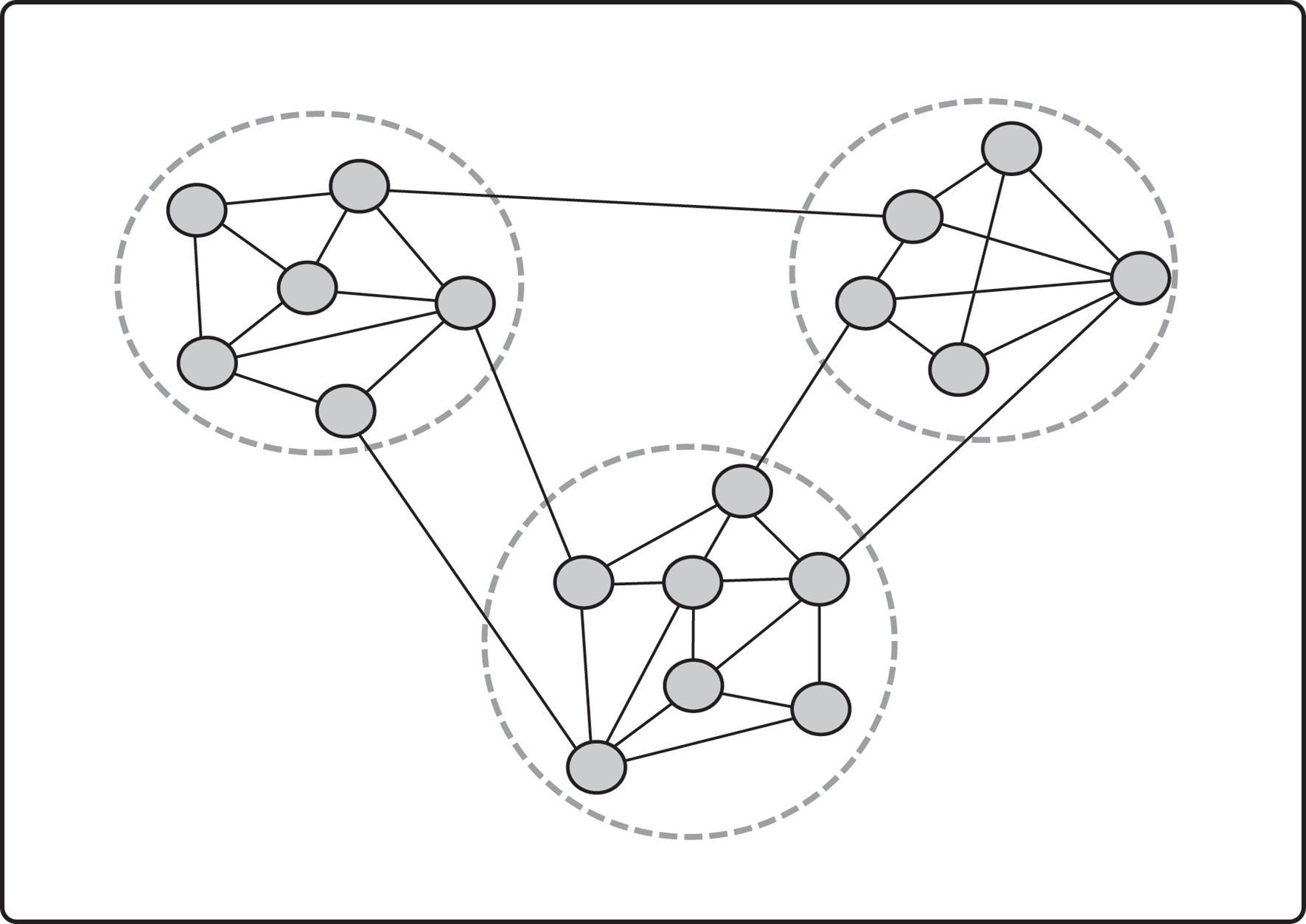
A network with three communities.
Megaprojects are a group of related projects that together achieve a higher order goal (Lycett et al., 2004; Martinsuo & Hoverfält, 2018; Turner, 2014); the individual projects might have the same specific function within the megaproject. The internal dependencies between the tasks in each project are denser than the interdependencies between each project; that is, tasks in the same project are densely connected to each other but sparsely connected to the tasks in the other individual projects. Therefore, communities in a megaproject network might represent related tasks on a single topic, that is, each individual project could be seen to correspond to a community within the megaproject network.
To measure how well a given network partition compartmentalizes its communities, Newman and Girvan (2004) proposed a quality function: modularity. Modularity has been found to be a good indicator of functional network divisions in many cases (Newman, 2006). From Leicht and Newman (2008) and Newman (2004), the modularity
where
Vulnerability Assessment Models
System vulnerability can be defined as the maximum vulnerability of all its components (Arianos et al., 2009; Latora & Marchiori, 2005). Therefore, megaproject vulnerability can be defined as the maximum vulnerability of all its individual projects. As the inner structure and outer connectivity of an individual project affect project vulnerability, in this article, the community vulnerability metrics are first extended to evaluate the vulnerability of a project to other projects (“outer” vulnerability); network efficiency variations are adapted to assess the internal state of the project (“inner” vulnerability); and then both the internal and external connectivity characteristics are incorporated to calculate the overall project vulnerability.
Community vulnerability assessment focuses on the connectivity “degree” of one community to the other communities. Rocco S. and Ramirez-Marquez (2011) proposed community vulnerability metrics to assess community vulnerability in undirected and unweighted networks, which, in this article, are extended to the megaproject network to assess a project’s “outer” vulnerability. Let
The vulnerability set from
where
where
As the internal state of the individual projects within a megaproject can severely impact normal operations, each project’s “inner” vulnerability must be accounted for when assessing overall megaproject vulnerability. Vulnerabilities within systems are independent of exogenous disturbances, thus they can be usually identified by exploring the consequences of internal component failures (Albert et al., 2004; Arianos et al., 2009; Kermanshah & Derrible, 2016; Neumayer et al., 2011). Therefore, the project vulnerabilities are identified by examining the consequences of task failures. From Latora and Marchiori (2005) and Arianos et al. (2009), the vulnerability of
where
where
As the vulnerability of
As network vulnerability is the maximum vulnerability of all its components (Arianos et al., 2009; Latora & Marchiori, 2005), the megaproject vulnerability (
Experimentation
In this section, the proposed approach presented in the previous section is applied to a megaproject to assess its vulnerability and identify the critical projects. The simulations were conducted using Python and NetworkX. NetworkX is a Python package for the creation, manipulation, and study of the structure, dynamics, and functions of complex networks (Hagberg et al., 2008).
Modeling the Megaproject as a Network
As shown in Figure 2, the megaproject network, drawn with a spring layout, denotes a megaproject that has 19 projects, 643 nodes, and 1,001 weighted directed edges. Each node in the megaproject network corresponds to a task, the links within each project representing the task interactions and sequential order, and the links between the different projects representing the project interdependencies.
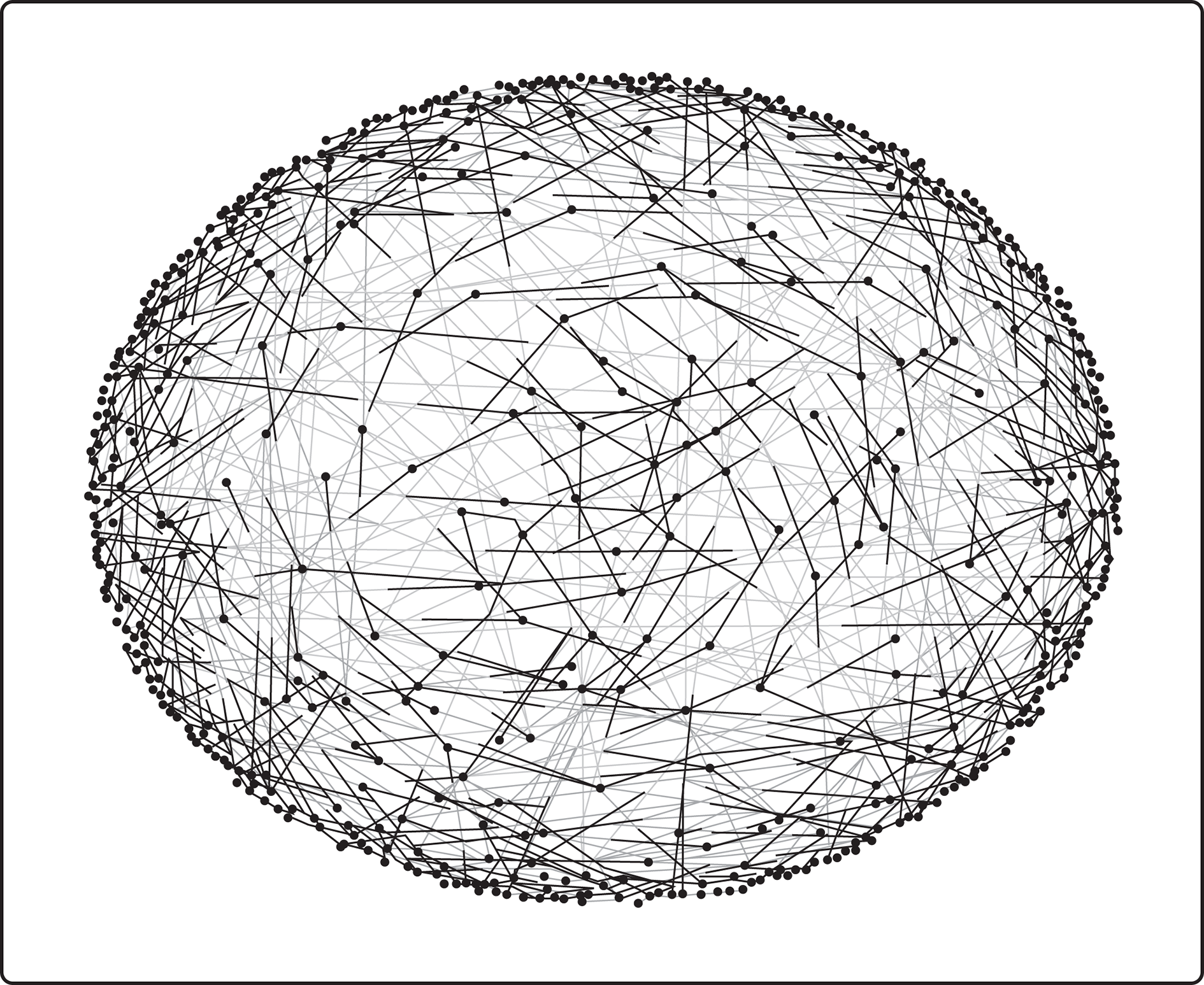
A megaproject network with 643 nodes and 1,001 links.
As tasks in one project are usually tightly linked to each other, but sparsely connected to the tasks within other projects, it can be assumed that each individual project corresponds to a community within the megaproject network; that is, this megaproject network can be partitioned into 19 communities.
As this megaproject is too large for a detailed description, the project interdependencies within the megaproject network are described in a simplified figure (Figure 3), and the task interdependencies within the individual projects are not depicted. The number written above the links reflects the intensity of the interactions, which is quantified by using Equation (1).
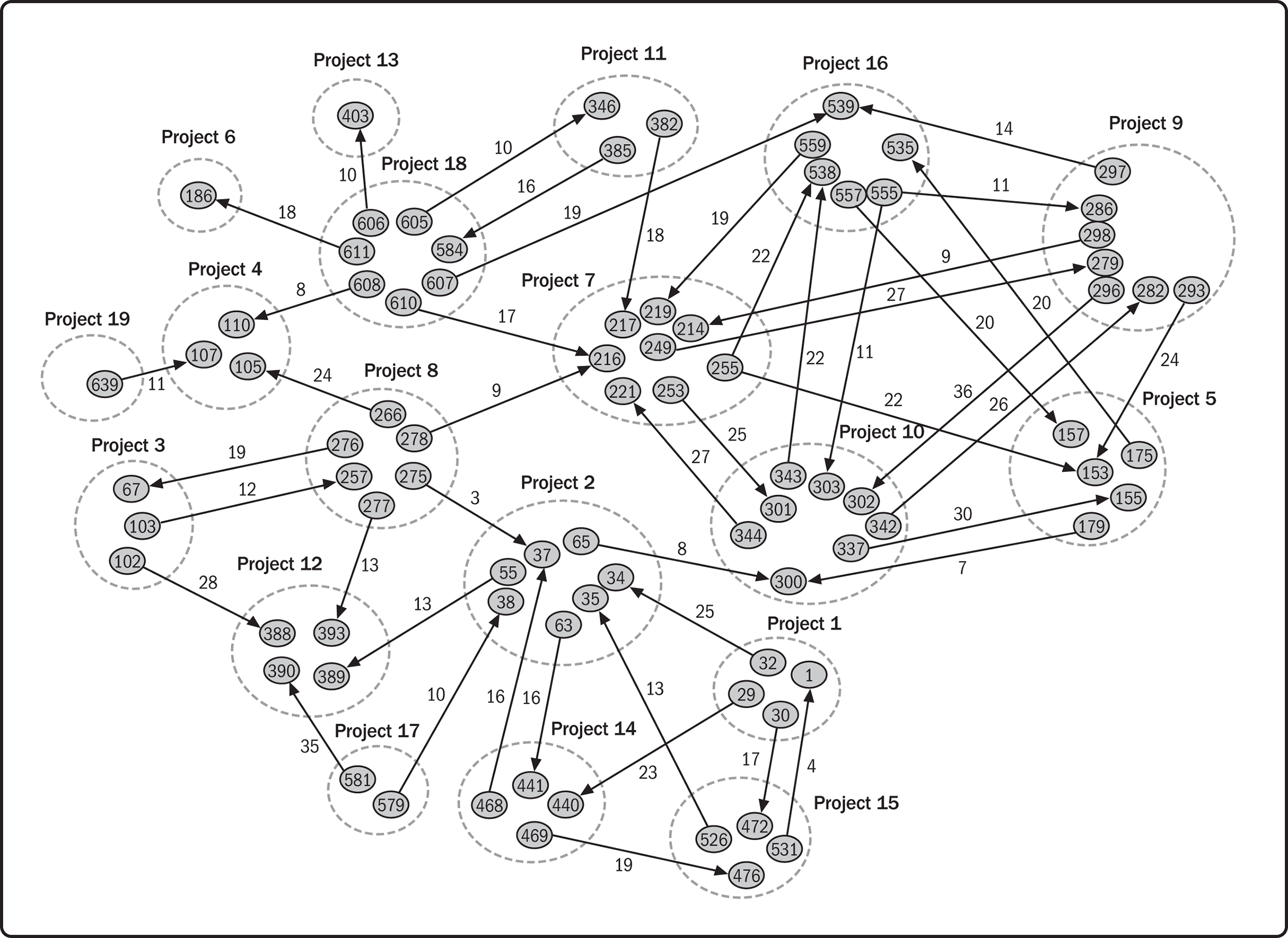
Project interdependencies within the megaproject network.
Megaproject Vulnerability Assessment
The experiment demonstrated the applicability of the proposed methodology. The megaproject vulnerability assessment considers both a project’s “inner” vulnerability, and a project’s “outer” vulnerability. Specifically, the megaproject vulnerability is assessed as follows:
Step 1: Calculate the
Step 2: Calculate the
Step 3: Calculate the
Step 4: Calculate the
Step 5: Calculate the megaproject vulnerability (
The results for the project vulnerability to the rest of the megaproject network (
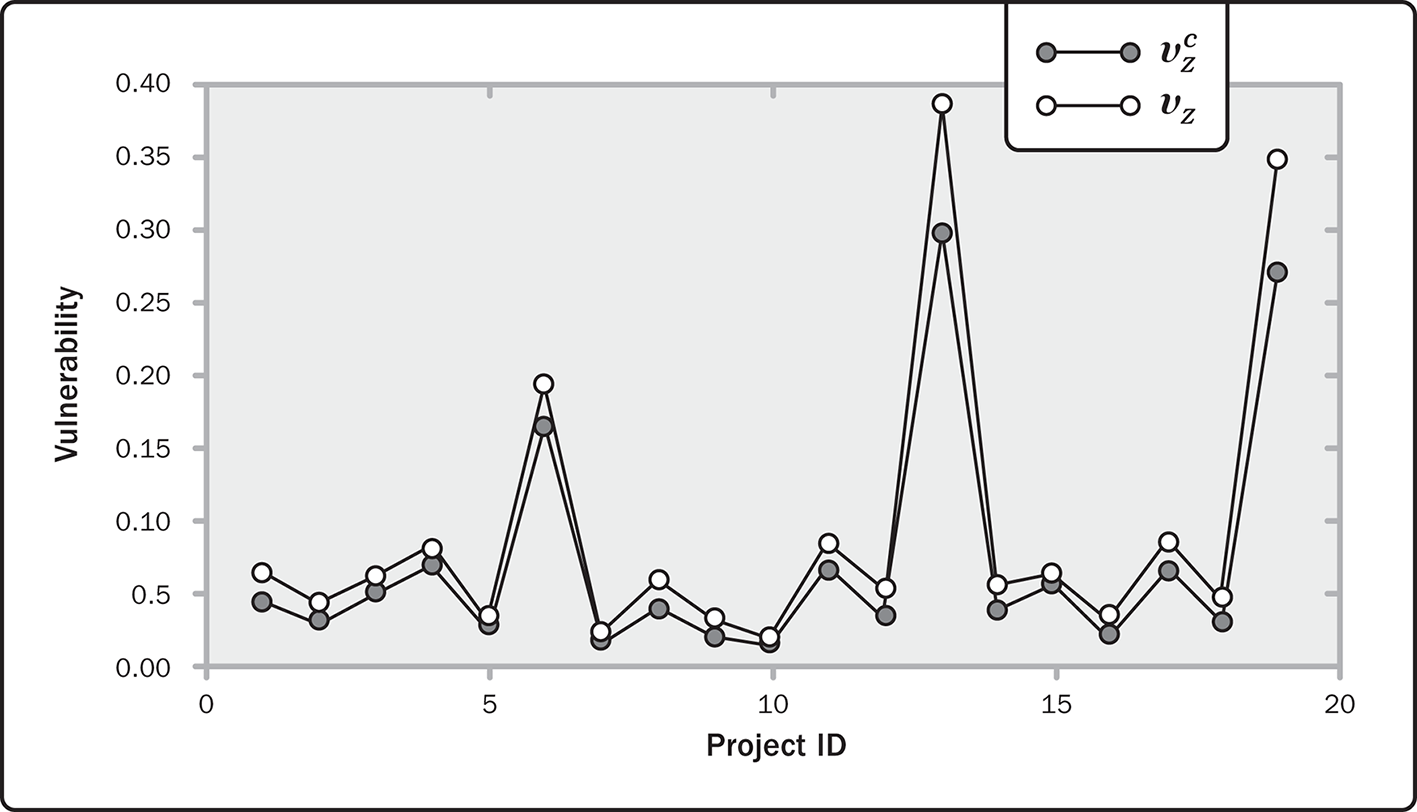
Project vulnerability in the megaproject network.
Vulnerability Indexes in the Megaproject
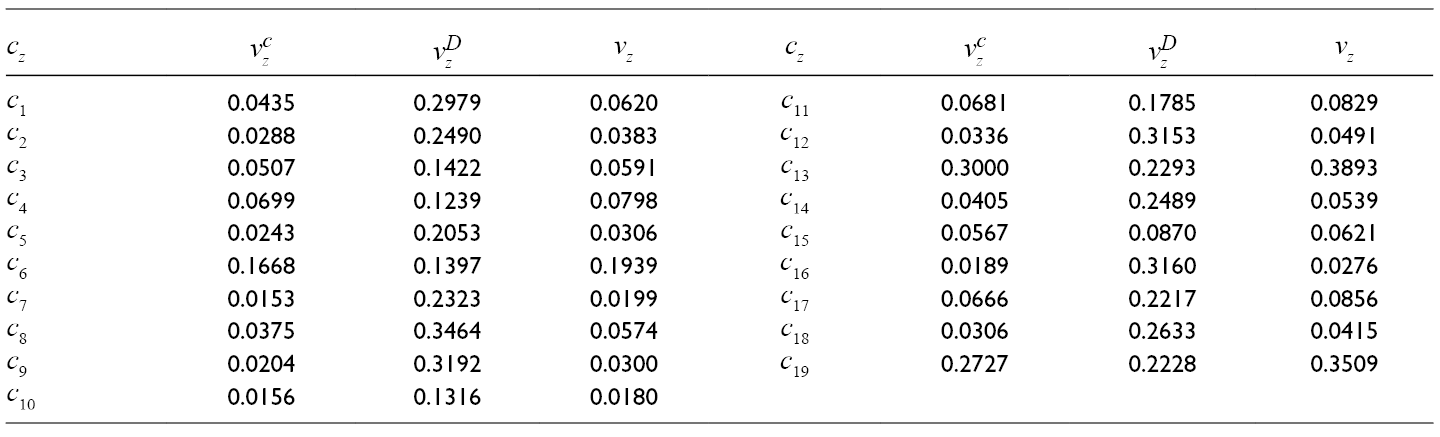
The project “inner” vulnerability (
In Figure 4, the line with the white circles represents
Discussion
The insights gained from the experimentation results have implications for managers in the implementation of protective measures to ensure megaproject success. In this section, three protective countermeasures are presented and several limitations and possible future work are discussed.
Optimizing Megaproject Structures
Vulnerability analyses can give guidance on the design of optimal megaproject structures. In the megaproject planning stage, a comparison of the megaproject vulnerability under different design structures could assist in the choice of an optimal megaproject structure. The experimental results indicated that there were dramatic improvements in megaproject robustness as the interdependencies increased between the projects; that is, the projects with weak interdependencies with other projects were found to be more vulnerable, whereas the projects with stronger interdependencies were observed to be less vulnerable. Therefore, strengthening the cooperative relationships between projects could be an effective method for optimizing megaproject structures. Moreover, the projects with fewer tasks tend to have higher “inner” vulnerability, which may aggravate megaproject vulnerability; therefore, avoiding small-scale projects can contribute to mitigating the vulnerability of megaprojects. The core of this strategy, therefore, is to enhance the robustness of megaprojects in the planning stage.
Prioritizing Megaproject Protection Strategies
Despite the unpredictability of component failures, it is possible to conduct vulnerability analyses to identify the components most critical to megaproject functioning and performance. As critical task/project failures can significantly affect megaproject success and the resources needed to protect the megaproject are limited, the protection of the most critical tasks/projects should be given priority. Specifically, the prioritization of protection strategies, such as giving precedence to resource allocation, component maintenance, and emergency response preparation, could be based on critical task/project rankings. In short, setting strategic protection priorities not only could reduce the impact of task/project failures on megaproject but also could optimize the megaproject resources.
Assisting Megaproject Risk Management
Component failures can result in workflow interruptions, work delays, and additional costs. Risk is generally viewed as a combination of possible consequences and associated uncertainties (Aven, 2007); that is, the risk of component failures can be estimated by considering the probability of component failures and its possible consequences. Megaproject vulnerability assessments can help in understanding the consequences of component failures; with the information of failures probability, the risk of component failures can be quantified in advance; thus, managers may predict whether the megaproject is within acceptable risk levels under different situations. Therefore, it can assist managers in better preparing the most suitable measures to reduce possible risk and adjusting the megaproject to cope with any negative consequences. Critically, our approach complements the three main techniques currently in use to measure project vulnerability: historical data on similar projects, expert judgments, and on-the-spot investigation. As a quantitative tool focused on the structure of the current project rather than on historical data, our approach seeks to enhance the rigor of megaproject vulnerability assessment. In brief, our approach to the assessment of megaproject vulnerability could provide a basis for better understanding risks, which can aid in enhancing megaproject risk management.
Future Research
Despite the novelty of applying complex network theory to the assessment of megaproject vulnerability, this study has some limitations. First, during the network modeling process, it was assumed that the task weights only depended on task duration. However, when additional data become available, a more comprehensive indicator for evaluating the node weights could be developed to strengthen the proposed model. Second, this article studied megaproject vulnerability from a static topological perspective without considering dynamic network behaviors. However, because of the task interactions, the study of cascading failures in megaprojects is a vital direction for future research, as this would improve understanding about the extent to which task failures could trigger system-level breakdowns or whether a ruptured interdependence could initiate a collapse of the whole megaproject. Third, a comparison of megaproject vulnerability under different organizational structures could provide a more comprehensive view of vulnerabilities identification and risks prevention.
Conclusion
With the rise in the number of megaprojects and growing levels of uncertainty in all its manifestations, there has been a commensurate demand in megaproject proactive risk management. Megaproject vulnerability assessments can complement proactive risk management, and can provide powerful tools for the enhancement of operational efficiency and the improvement of the construction process. To assess megaproject vulnerability, a vulnerability metric based on complex network theory was proposed in this article. The proposed approach was applied to a megaproject and was demonstrated to be effective in assessing vulnerability and identifying critical projects. Subsequently, several protective strategies based on theoretical analysis and the experimentation results were suggested for managers to ensure the success of megaproject operations. Overall, this study developed a quantitative megaproject vulnerability assessment approach that can help to expose a megaproject’s inherent weaknesses, which could assist managers in reducing possible risks and responding to possible adverse effects, thereby improving overall megaproject performance.
Footnotes
Acknowledgments
We thank the anonymous referees for their invaluable suggestions.
Declaration of Conflicting Interests
The author(s) declared no potential conflicts of interest with respect to the research, authorship, and/or publication of this article.
Funding
The author(s) disclosed receipt of the following financial support for the research, authorship, and/or publication of this article: This work was supported by the National Natural Science Foundation of China [grant numbers 71672145, 71802003, 71702149, 71402142], the Humanity and Social Science Foundation of Ministry of Education of China [grant numbers 16XJC630002, 18YJC630040], and the Provincial Natural Sciences Basic Research Plan in Shaanxi, China [grant numbers 2017JQ7011, 2018JM7002].
Author Biographies