







Abstract
Ethical aspects of stakeholder behavior can have a wide range of implications for other areas of project management. This research critically reviewed project ethics under the philosophical paradigm change from modernism to late modernism, which led to a flexible and realizable ethical framework based on Levinasian and Nietzschean moral psychologies. A qualitative approach was adopted through a multiple-case study to confront the theoretical framework with the empirical world, evaluate its authenticity, and obtain a better understanding of its challenges. Research results showed that stakeholders’ unconscious desire for existential meaning can provide considerable potential for dealing with ethical challenges.
Introduction
A wide range of unacceptable phenomena in projects (e.g., modern slavery, corruption, unsustainability) have originated from stakeholder behavior, which is inherently challenging to predict and explain based on the current behavioral theories (Stingl & Geraldi, 2017). Project stakeholders include both formal and informal actors who may affect, be affected by, or perceive themselves to be affected by a project. Unethical behavior of stakeholders in business and project management has been always a challenging issue (Damoah et al., 2018; Locatelli et al., 2017). An invitation to ethical behavior is often assumed as a cumbersome constraint, imposed by ethical codes, preventing key stakeholders from progress in a competing and unmerciful business world. Therefore, “more research in the area of business ethics and, particularly around codes of ethics implementation, is needed” (Olugbenga Oladinrin & Ho, 2014, p. 16). According to the structuration theory, stakeholder behavior is influenced by various external and internal motivational factors (Giddens, 1984/1986; Stones, 2005). For example, in many instances, stakeholders adopt ethical behavior to handle social pressures (Kaptein, 2019; Kouchaki, 2015; Soltes, 2017; Tajalli & Segal, 2019a; Zhang, 2020). In other words, “business leaders sometimes donate to charity because they want to increase their prestige in the public” (Zhang et al., 2020, p. 80). There are differences between “acting from virtue and acting in conformity to virtue” (Alzola, 2019, p. 26). For a better understanding of external motivation factors, analyzing the ethical behavior of stakeholders from a structural (institutional) perspective would be very effective (Locatelli et al., 2017). However, ethical analysis without considering the complexity of internal motivation at the agency level, which is grounded in internal psychological drivers, may not lead to an authentic explanation of stakeholders’ unethical actions (Colle & Freeman, 2020; Kaptein, 2019). Therefore, current strategies for promoting ethics (e.g., common ethical training, tightening of ethical codes or regulations, and ethical commitment from top management) may not lead to desired ethical behavior (Evert et al., 2018; Olugbenga Oladinrin & Ho, 2014; Tajalli & Segal, 2019b; Zhang, 2020).
One major challenge of research in the area of project ethics is that many variables are beyond the scope of project management literature. Research on ethics cannot lead to reliable findings without considering theoretical achievements in moral philosophy and psychology. Nevertheless, it is not a straightforward path. Despite the concentration of previous studies on the ethical crisis in business, according to the philosophy of ethics, “it is ethic itself that is in crisis” (Tajalli & Segal, 2019b, p. 1). There are many persuasive philosophical arguments, which demonstrate there is no moral reality (Katsafanas, 2016; Leiter, 2019). In this regard, relativism is more acceptable, because a universal definition of ethics cannot be provided. Therefore ethical behavior “can never be fully achieved yet must always be pursued” (Rhodes & Badham, 2018, p. 93; Tajalli & Segal, 2019a). Ethical relativism may cause challenges for many management systems that are using rational ethical codes as a universal instrument for guiding stakeholder behavior toward predefined goals, which reduce morality to another formal or informal control system for imposing power (Nietzsche, 1886/2018). Besides, establishing ethical systems based on predefined theories or principles would not always be effective, because regarding the theoretical contradictions, contextual complexity, and psychological uncertainty, “wrong ethical outcome can easily be blamed on the inadequacy of the theory” (Tajalli & Segal, 2019a, p. 73). Ethical behavior is also critical in project management because it has important consequences for all three economic, social, and environmental dimensions of sustainability (Sarhadi et al., 2021). Therefore, under the philosophical paradigmatic change from modernism to late modernism, this research aims to identify root causes that prevent project stakeholders from ethical behavior, propose a flexible ethical framework for more realistic ethical expectations, and consequently, promote better ethical strategies in accordance with the basic characteristics of human nature.
This article is organized as follows: The Theoretical Background section provides a brief critical review of ethical behavior in business focusing on project ethics. This review provides a theoretical shift from structural analysis to the psychological analysis of ethical behavior. In this regard, a theoretical ethical framework for project stakeholders is suggested based on findings in philosophy and moral psychology. The Research Description section describes the methodology, data collection, and analysis approaches. Then, the Findings of Cross-Case Analysis around the authenticity and challenges of the suggested framework are presented. Based on these findings, the Discussion section clarifies the relation between the ethical framework and stakeholder participation as an important structural strategy for promoting ethical behavior. Finally, the Conclusion and Research Limitations and Directions for Future Studies sections are presented.
Theoretical Background
Ethical Behavior: From Modernism to Late Modernism
Two evolving patterns in western philosophy are under the paradigmatic shift from modernism to late modernism, which extensively influence different areas of knowledge; specifically, analytical approaches are used to explain stakeholder behavior and guiding them toward ethical actions (Table 1). This section briefly overviews the realized and unrealized dimensions of these two evolving patterns and clarifies their relation with the ethical aspects of project stakeholder behavior.
Philosophical Paradigm Change and Its Influence on Strategies for Guiding Stakeholder Behavior
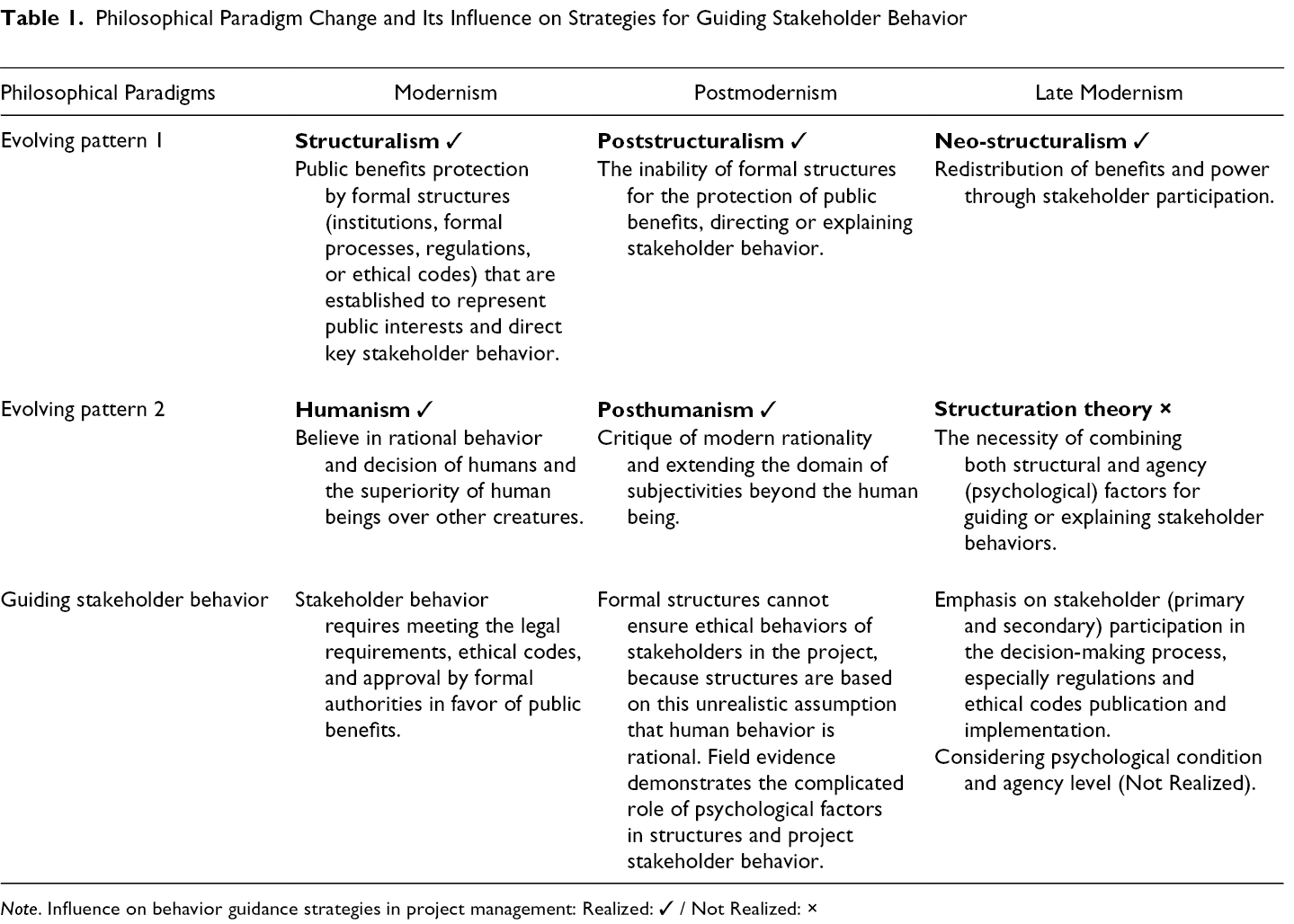
Note. Influence on behavior guidance strategies in project management: Realized: ✓ / Not Realized: ×
Realized Dimension of Late Modern Paradigm
In the modern paradigm, under a specific interpretation of structuralism and humanism, it is assumed that stakeholder behavior can be directed through external pressure and formal structures, such as regulation systems, ethical codes, monitoring mechanisms, formal institutions, and authorities (Owusu et al., 2019). This approach derives from the assumption that the social environment is more influential than the individual character in ethical decisions (Müller et al., 2013; VanSandt, 2003). According to structuralist thinkers, there is “considerable support for the idea that social elements surrounding a decision often dominate individual character and personality” (Alzola, 2019; Soltes, 2017, p. 460). This approach is also based on the assumption that a human is a rational creature with significant superiority over other creatures, behaving rationally in accordance with structural guidelines (Scott et al., 2016; Sheffi & Blanco, 2018). Therefore, it is expected that both supervisors and stakeholders behave rationally following predefined ethical codes, formal processes, regulations, and other predefined project structures.
Deontology and Consequentialism are two well-known modern ethical schools that have had remarkable impacts on project ethics (Jonasson & Ingason, 2013). According to Kantian deontology or duty-based ethic, from a moral perspective, decisions about the rightness and wrongness of an action should be judged under a series of rules rather than consequences (Jonasson & Ingason, 2013). On the other hand, consequentialism argues that those actions that their consequences increase benefit and decrease pain for more people are ethical (Bergo & Andolek, 2019; Rachels & Rachels, 2014). These philosophical findings have multidimensional consequences for business ethics. For example, Nisberg (1988, p. 43) defines business ethics as “a set of principles that guides business practices to reflect a concern for society as a whole while pursuing profits.” In project management, as reflected in the IPMA Code of Ethics and Professional Conduct and the PMI Ethical Decision-Making Framework (EDMF), the management approach toward project stakeholders should be upgraded from stakeholder management to management for stakeholders, or even managing for society (Barnett, 2016; Eskerod & Huemann, 2016; Jonasson & Ingason, 2013; Maddaloni & Davis, 2018).
The postmodern paradigm, realized through the post-structuralism and posthumanism schools of thought, criticizes this approach by revealing the importance of emotional and irrational aspects of the human mind, which leads to weakening the positions of both explicit and implicit structures for explaining human behavior or encouraging project stakeholders toward ethical actions (Baker, 2017; Burr, 2014; Gagné & Deci, 2014; Hawkes, 1977; Marchesini, 2017; Tuncel, 2014). Institutions and formal authorities not only cannot protect public benefit (Freeman, 2010; Idowu et al., 2013, p. 2), but on some occasions, as Kouchaki (2015) discussed, professional institutions can also increase the likelihood of conducting unethical behavior. Furthermore, both designers and followers of structures, are extensively impacted by psychological drivers, which are mainly relevant to power relations (Leiter, 2019). Power relations may lead to the instrumental application of ethics for unstated intentions. In other words, pretending to be moral can be the source of power (Kouchaki, 2015). According to postmodern criticisms, an ethical decision is a subjective phenomenon, context-dependent, and cannot be defined by a set of codes or principles (Arıkan, 2020).
In response to postmodern criticisms, the late modern paradigm, at the structural level, proposes broad stakeholder participation in all decision-making processes (Sarhadi et al., 2018), such as ethical codes and regulation compilation, monitoring stakeholder behavior as a neo-structural approach for increasing transparency, preventing key stakeholders from unethical or illegal actions, and motivating all stakeholders to consider legal and ethical guides (Dekker, 2007; Ferilli et al., 2016; Parés et al., 2012; Sarhadi et al., 2018; Silvius et al., 2017). Regarding the inherent ineffectiveness of representative mechanisms, previous studies concluded that stakeholder participation, through the distribution of power, leads to a more effective consequential ethic. Therefore, stakeholder involvement can empower a wide range of stakeholders to directly protect and increase benefits and transparency, and decrease those unethical and corrupting behaviors that infringe the ethical codes and rights of powerless stakeholders (e.g., local communities, future generations, or even plants and animals represented by environmentalists and nongovernment organizations [NGOs] (Hatami & Firoozi, 2019; Keeys & Huemann, 2017; Liu et al., 2016; Maddaloni & Davis, 2017; Pinto & Winch, 2016).
Unrealized Dimension of the Late Modern Paradigm
Despite the unprecedented progress of stakeholder participation in promoting ethical behavior in favor of all categories of stakeholders, there are still some critical challenges reducing its potentials, which have not been appropriately addressed. There is much evidence that stakeholder participation is not an easy process (Innes & Booher, 2005), especially because many stakeholders do not have a positive attitude toward one another (Maddaloni & Davis, 2017). Many key stakeholders consider stakeholder participation as “nothing more than rituals designed to satisfy legal requirements” (Innes & Booher, 2005, p. 419). Furthermore, previous studies have demonstrated that involved stakeholders are not appropriately aware or even skillful enough to protect their benefits in participative processes, especially because of the more complex unethical behavior—termed power-oriented relationship—of more powerful stakeholders as a root cause of many other challenges, such as difficult consensus-building process (Badir et al., 2012; Ng et al., 2012; Wei et al., 2016; Zhang et al., 2013). Power-oriented relationship is defined as a conscious or unconscious application of contextual techniques in complex social interaction to put psychological pressure on others to accept the premade decisions, instead of consensus-based and collective decision-making based on authentic reasons (Sarhadi et al., 2021). One common example is the underestimation of costs and overestimation of benefits in feasibility study reports for getting a project started (Flyvbjerg, 2014). It can be concluded that the main challenges of stakeholder participation are psychological and occur at the agency level, and it is why “Aristotle’s influence in business ethics has mushroomed in recent decades” (Bredillet, 2014; Bredillet et al., 2015; Steyl, 2020, p. 417) and stakeholder character and previous behavior have attracted attention (Kouchaki, 2015).
Furthermore, modern scholars and practitioners hold that if one sincerely judges an action right, then they are motivated to some extent to behave in accordance with that judgment (Heinrichs et al., 2013; Katsafanas, 2016; Leiter, 2019). Moral judgment may sometimes provide individuals with sufficient motivation to ethical action, but this is not necessary (Vasiliou, 2016). For example, even awareness of this fact that “neglecting both a green earth and future generations as stakeholders can destroy environmental equilibria and equations” (Hatami & Firoozi, 2019, p. 2), cannot provide sufficient motivation for key stakeholders to behave ethically in favor of social and environmental requirements. Although the results of some studies showed that most consumers expressed their willingness to purchase sustainable products, sales data demonstrated that only a few are really willing to purchase relatively expensive sustainable products (Sheffi & Blanco, 2018). Besides, some forms of moral judgment that appear objective and clear on the surface, beneath the surface, serve some desired aims on the unconscious level (Bartels, 2009; Katsafanas, 2016). In fact, “there are moralities which are intended to justify their creators before other people” (Nietzsche, 1886, p. 88). Therefore, “moral judgments are post-hoc rationalizations of feelings that have an antecedent source” (Leiter, 2019, p. 9), and is not bound to rational thinking but incorporates attitudes and emotions as well (Baker, 2017; Diochon & Nizet, 2019; Soltes, 2017; Weiner, 2006; Yacout & Vitell, 2018).
It can be concluded from the above explanation that “people are not always aware of the forces that lead them to behave unethically” (Baker, 2017, p. 4); therefore, moral psychology is necessary for ethical behavior analysis (Doris, 2012; Steyl, 2020). This finding is extensively supported by structuration theory, which completes the evolving pattern 2 in the late modern paradigm (Table 1). However, it has not been sufficiently considered in the project management literature. According to the structuration theory, structural and macro-level challenges without recognizing psychological and micro-level variables, cannot be comprehensively understood and resolved (Giddens, 1984/1986; Stones, 2005). Therefore, along with social variables and structural factors (Ladkin, 2018; Zhang et al., 2020), the ethical behavior of project stakeholders needs to be analyzed at the agency level (Müller et al., 2016; Zhang, 2020).
Meaning as an Irreplaceable Source of Morality
Based on the above discussion, the psychological analysis of ethical behavior is critical. Therefore, those moral psychologies that are supported by philosophical schools with a consistent explanation of human nature can provide valuable insights (Katsafanas, 2016; Leiter, 2019; Tajalli & Segal, 2019a). In this regard, this section offers a brief comparison of the Levinasian account (infinite responsibility for others) and Nietzschean account (inherent desire to power). These two moral schools are then critically evaluated to explain how human desire for existential meaning paves the way for a flexible ethical framework for project stakeholders.
Will to Power Versus Infinite Responsibility
In one of the most important books in the philosophy of ethics, Beyond Good and Evil, Nietzsche acknowledged the psychological drivers of human behavior (Katsafanas, 2016; Leiter, 2019) and extensively criticized previous philosophical schools and religious ethical principles. He distinguished between two general types of ethical manner, including master morality and slave morality (Nietzsche, 1886/2018). Master morality values independence, power, and nobility, whereas slave morality values sympathy, kindness, and empathy. Nietzsche, consistent with his critical philosophy, was a proponent of master morality and argued in support of his claim by analyzing the psychological drivers of ethical behavior (Nietzsche, 1886/2018).
According to Nietzsche’s philosophy, various forms of emotions, including competition and pride, which motivate humans in general and project stakeholders in particular to continuous progress, derive from an underlying human will to power (Katsafanas, 2016; Leiter, 2019; Nietzsche, 1883/1995). Power describes one’s ability to influence others (Ferris & Treadway, 2012) or to be applauded by them. Power is a central concept to the philosophy of Friedrich Wilhelm Nietzsche and Paul Michel Foucault, both well-known thinkers of the postmodern paradigm, and has extensive influences on different disciplines of western philosophy (Ferris & Treadway, 2012; Foucault, 1976/1990; Habermas, 1984). Formal power has one or multiple obvious sources outside the actor, such as organizational position. However, informal power derives from the actor itself, and includes popularity, verbal communication skills, knowledge, and many others that are context-based and unconsciously affect the attitudes, emotions, and behaviors of an actor in a complex relational network (French & Raven, 1959; Peiro & Melia, 2003). In practice, these two types of power have complicated interactions (Foucault, 1969/1982).
Regarding the role of power in shaping the human psychological state, Nietzsche rejected Kantian and Christian morality, and even many other kinds of modern or traditional moral systems that are based on predefined principles such as helping others and kindness. According to Nietzsche they are not aligned with human nature and are destructive for both helper and who is helped, preventing them from competition, progress, and self-actualization. Human evolution needs direct and alone confrontation of individuals with life’s challenges. Based on Nietzsche’s genealogy of morality, ethical norms are prohibiting mechanisms that are gradually shaped by slaves in conscious and unconscious social processes to prohibit masters (Nietzsche, 1886/2018). In this regard, morality and ethical codes cannot be based on rationality or predefined modernistic principles (Kaptein, 2019), leading to relativism, situationism, and “meaninglessness of morality itself” (Steyl, 2020; Tajalli & Segal, 2019b, p. 2).
Contrary to prevalent belief, the absence of a moral system or relativism does not necessarily lead to questionable ethics or unethical behavior (Mudrack & Mason, 2020; Tajalli & Segal, 2019b). In Nietzsche’s account, morality is unique to each person, and the wanted or unwanted principle of ethic is the will to power, which invites individuals to self-realization (Tajalli & Segal, 2019b). Within this framework, even helping others is unconsciously rooted in the will to power and superiority (Kouchaki, 2015). Therefore, master morality is a necessary and inevitable form of morality and is not equal to cruelty and oppression. In this regard, “all we need to do is to discover our own particular ethics” (Tajalli & Segal, 2019b, p. 2), which encourages competition and continuous progress for self-actualization. Therefore, universal and rational-based ethical codes have never been completely successful in their mission to provide practical ethical guidelines for project management and even the management of stakeholder behavior, simply because they are not in accordance with human nature and do not consider the unique aspects of any particular context.
Despite the valuable insights provided by Nietzsche, his moral account has attracted criticism. When project leaders attempt to behave ethically under their values, they will always encounter resistance that is imposed by others with different beliefs, values, and various interpretations of the world (Ladkin, 2018). Furthermore, existential philosophy provides us with a very different view of what Nietzsche termed slave morality, as a new theoretical perspective for analyzing project management practices (MacMillan et al., 2012; Odiorne, 1966; Vandyshev, 2015). Based on existential philosophy, which is another branch of the postmodern paradigm, helping others can also be explained as a human will to meaning, which is another fundamental driver in humankind at both conscious and unconscious levels that extensively influence our behavior (Batthyany & Russo-Netzer, 2014, Park & Jeong, 2016; Vandyshev, 2015; Wang et al., 2016; Yalom, 1980). In this regard, Levinas believes one’s infinite responsibility for the other, “without waiting for reciprocity,” is an inherent principle of being a human being (Levinas, 1995, p. 98; Tajalli & Segal, 2019a) and is the foundation of all knowledge (Levinas & Peperzak, 2005). “Morality is not a branch of philosophy, but first philosophy” (Levinas & Lingis, 1969, p. 304). Levinas’s account of human ethics is supported by Dostoevsky (1993/1912, p. 57), who believes that “we are all responsible to all for all.” The unlimited responsibility in which a human finds oneself comes from “prior to every memory” or “prior to or beyond essence” (Levinas, 1998, p. 10), leading to a new framework of responsibility for the business (Jørgensen & Boje, 2010).
Meaningful Project and Ethical Stakeholder
From the perspective of existential psychology, Levinas’s and Nietzsche’s ethical schools cannot be repressed in favor of each other, because both of them are complementary and irreplaceable sources of meaning (Hatami & Firoozi, 2019; Tajalli & Segal, 2019b). From this perspective, they can be illustrated as two ends of a spectrum, and a flexible balance between these two is a difficult responsibility but an essential element for an ethical project stakeholder (Figure 1; Table 2).

Proposed ethical framework.
Proposed Ethical Framework in Comparison with Levinasian and Nietzchean Ethical Accounts
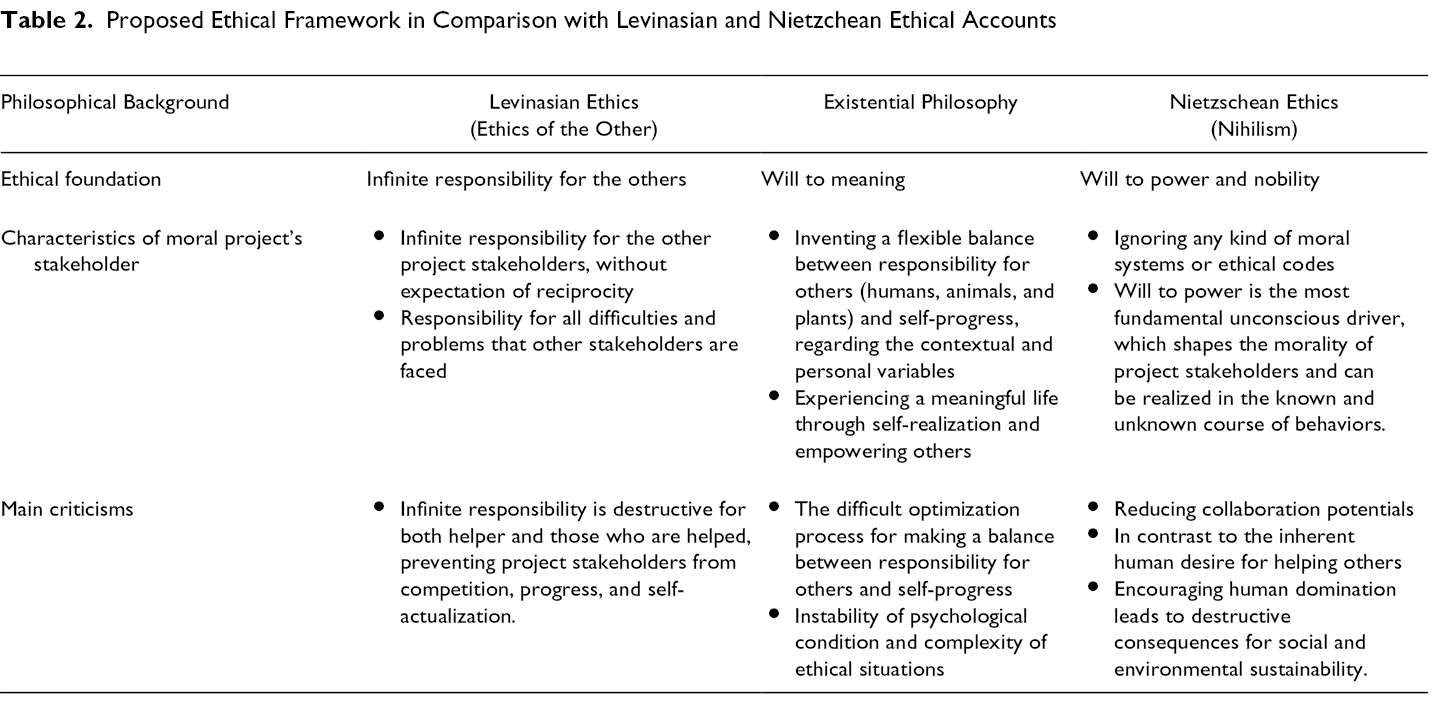
Under the influence of postmodern criticisms, modern and traditional sources of meaning were marginalized in the postmodern era, leading to a feeling of concern and heavy responsibility in the face of existential realities and unanswered questions regarding the way of a meaningful life. Frankl (1946/2013, p. 131), in his book entitled, Man’s Search for Meaning mentioned: “Man should not ask what the meaning of his life is, but rather he must recognize that it is he who is asked.” In such a condition, the role of work has been unprecedentedly strengthened to give meaning to our life and self-actualization. Responsibilities and competing environment of the construction project play the role of amnesia by converting the extreme will to power to the illusionary source of meaning (Tajalli & Segal, 2019b, p. 6), helping us to temporarily ignore the essential questions about the purpose of existence, which continuously and most probably, in unconscious ways up to the surface of our mind (Batthyany & Russo-Netzer, 2014; Scott et al., 2016). Nevertheless, temporary and unconvincing responses convert these questions to the root of various conscious and unconscious psychological disorders, including depression, anxiety, and meaningless (Rolfe et al., 2017; Vandyshev, 2015; Yalom, 1980). According to the quality-of-life research center in Copenhagen, Denmark, only one-third of staff feel happy in their jobs (Ventegodt, 1995). And this is a common challenge in both developing and developed countries (Comprehensive Mental Health Action Plan 2013–2020, 2013).
According to the WHO Special Initiative for Mental Health (2019–2023), “there can be no health or sustainable development without mental health” (Ghebreyesus, 2019, p. 1). Existential concerns are not separate from everyday life and need to be dealt with in the context of their occurrence instead of clinics, hospitals, or other healthcare institutions (Yalom, 1980). Meaningful work can increase employee creativity (Akgunduz et al., 2018) and produce self-initiated energy (Lee, 2015), greater well-being, and self-efficacy (Steger & Dik, 2009). Meaning in work helps us go beyond existential concerns through self-transcendence and making positive influences in our environment, which maintain our being in the form of our effect on the environment. Therefore, a competing environment of a project, which is essential for progress and self-realization, needs to be subtilized through our responsibility toward others, including humans, animals, and plants, which are irreplaceable sources of meaning (Hatami & Firoozi, 2019). In this regard, a human’s internal desire for spirituality and meaning calls them to ethical behavior. Although there is, in fact, an irreconcilable bind between infinity of ethics and our finite capabilities for response (Rhodes & Badham, 2018, p. 92), helping others, such as nongovernment organizations (NGOs), local communities, and even plants and animals are an irreplaceable source of meaning. It is also a necessary complementary dimension for inhibiting nonconstructive will to power, as a reason for self-alienation. Therefore, it seems that we need others, as they need us for experiencing a meaningful kind of will to power and psychological well-being (Hatami & Firoozi, 2019). Based on existential psychology (Yalom, 1980), ethical goals can transform the role of a project from the source of amnesia to the source of meaning in our lives by making a flexible balance between will to power and responsibility for others (Koger & Winter, 2010; Rasmussen & Elverdam, 2008; Ward & King, 2017). Our attitude toward work can give meaning to our lives, because meaning is a subjective phenomenon (Adams, 2012; Wiersma & Wright, 2012; Wiersma & Mills, 2014), and depends on the stakeholder’s approach and efforts (Lee, 2015). Therefore, work can create the sense of direction, significance, and coherence, which are the three fundamental pillars of meaningful work (Schnell et al., 2013; Ward & King, 2017; Wiersma & Wright, 2012) and the main sources of job satisfaction (Hodson, 2002). This kind of project can be termed a meaningful project.
Furthermore, regarding the contextual variables, ethical project stakeholders can make a flexible and evolving balance between responsibility for other and will to power in innovative ways, which is vital for experiencing a meaningful life. Especially because, in accordance with the revival form of virtue ethics (Steyl, 2020), “it is being good rather than looking good that provides the sense of achievement and psychological well-being” for stakeholders (Alzola, 2019, p. 16). Understanding the dynamic nature of human psychology, contextual variables, and seeing the other in their otherness (beyond rules and principles) leads to such flexibility in ethical decision‐making (Hatami & Firoozi, 2019, p. 3; Steyl, 2020). Therefore, ethical behavior in the project is completely optional and subjective and should not be forced or even judged by others; instead, it “needs to be practiced in real situations” of projects (Ljungblom & Lennerfors, 2018, p. 15; Steyl, 2020). The most crucial task of the project environment is “removing the impediments that repress the moral impulse that comes from the encounter with the other” (Tajalli & Segal, 2019a, p. 84). Within this framework, a meaningful project paves the way for stakeholders to make a balance between the two above-mentioned sources of meaning and promotes the culture of discussing existential concerns and sharing meaningful experiences among stakeholders as a critical strategy for realizing the ethical project.
Research Description
Research Questions
For evaluating the authenticity of the proposed ethical framework, achieving a better understanding of its challenges, and developing strategies for dealing with identified challenges, two research questions were considered:
Research Method
In this research, the case study research method was used to achieve a nonstereotypical and in-depth understanding of ethics in project practice (Dalcher, 2012; Engwall, 2012; Hoorn, 2016; Jacobsson et al., 2016). In response to criticism of Eisenhardt’s and Yin’s positivist prescriptions for the case study, an abductive qualitative approach was adopted. Abduction is a process of providing a theoretical explanation for unmet expectations or empirical puzzles through continuous and flexible back-and-forth movement between theory and the empirical world to provide new insights and modify existing theory (Piekkari & Welch, 2018). This research is distinct from Eisenhardt’s (1989) approach to the case study because it does not follow theory-building or theory-free empirical inquiry, due to the critical role of current theories in data interpretation (Ragin, 1997). It is also distinct from Yin’s (1984) approach to the case study by acknowledging the unpredictability and emerging nature of the research process. To evaluate the authenticity of the proposed ethical framework and achieve a better understanding of its challenges, “confronting theory with the empirical world” is critical (Piekkari & Welch, 2018, p. 345). In this regard, to understand the extent to which the theoretical framework reflects the contextual realities, four construction projects from different organizations, were selected. Two of them are regular projects with profit-oriented goals, and the other two are charity projects, which simulate helping others at the project level and give priority to benevolent goals over monetary profits. Confronting the theory with practice through within-case analysis revealed some mismatches and provided new insights for rethinking the initial theoretical framework by conducting cross-case analysis (Figure 2).
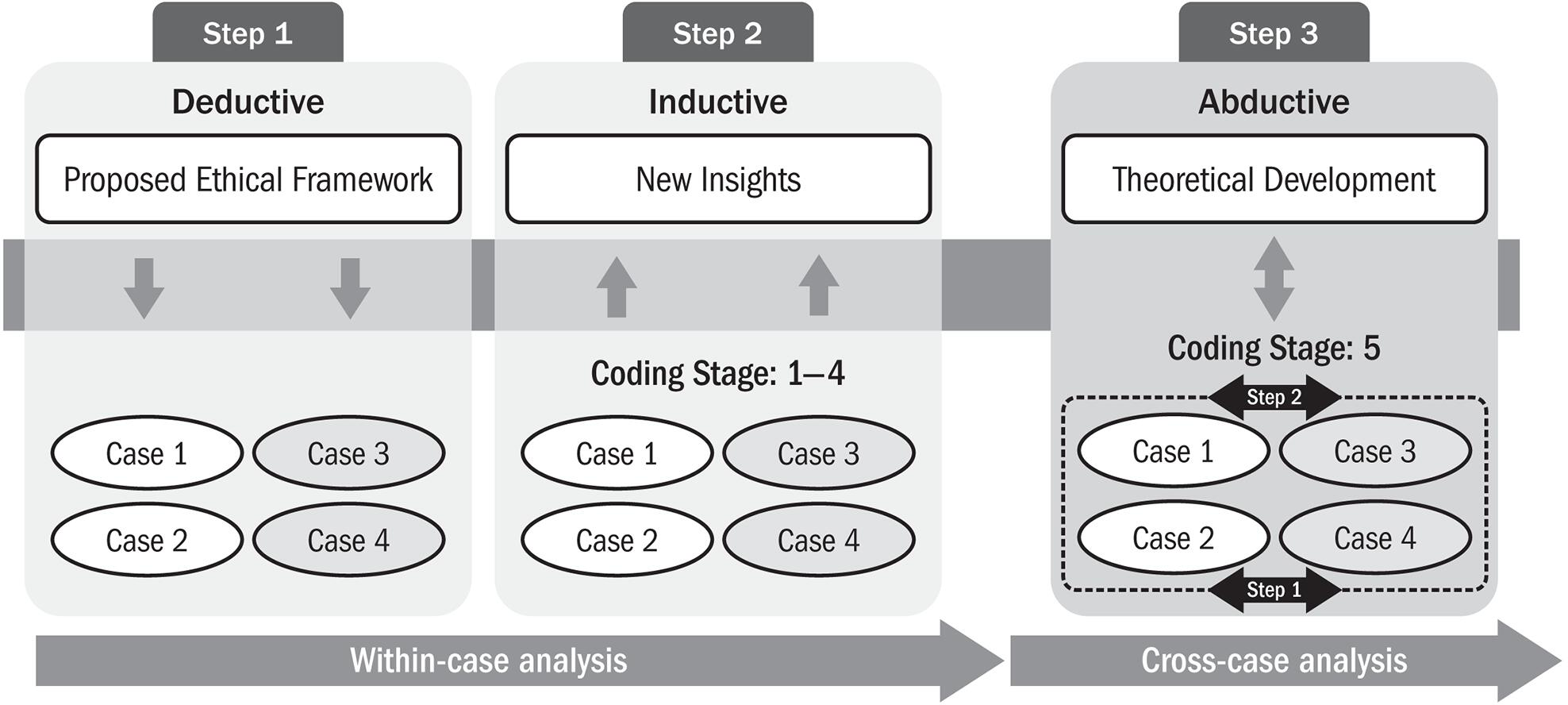
Research process.
In qualitative research, credibility, dependability, confirmability, and transferability are necessary elements of trustworthiness (Rapport et al., 2015; Rezapour Nasrabad, 2018). Within this framework, trustworthiness is realized by increasing the transparency of the research process and presenting the findings to research participants. In this regard, the first researcher coded data independently, and then the research team reviewed the results to test the credibility and confirmability of the coding process and make the necessary corrections.
Sampling and Data Collection
In the first step, to acquire sufficient background understanding and design introductory and main questions, related documents of four selected construction projects were reviewed. Sixteen semistructured interviews were conducted with project team members, including both experts and workers to provide a “theoretical explanation for empirical puzzle” (Piekkari & Welch, 2018, p. 354). In this regard, possible biases in data interpretation were attempted to be reduced by conducting informal conversations and open-ended interviews with different stakeholders (Eisenhardt & Graebner, 2007). Based on the theoretical background, all interviewees were asked a consistent set of predesigned questions. Semistructured interviews were followed with informal conversation, which helped us to go beyond formal communication borders and theoretical backgrounds (Rolfe et al., 2017). The interviews and informal conversations were conducted in Persian and typically lasted between 45 and 70 minutes. They were recorded and transcribed verbatim for the qualitative coding process. Due to COVID-19 restrictions, 12 out of 16 interviews were conducted virtually. Table 3 illustrates the characteristics of the research participants and research cases.
Research Participants’ Characteristics
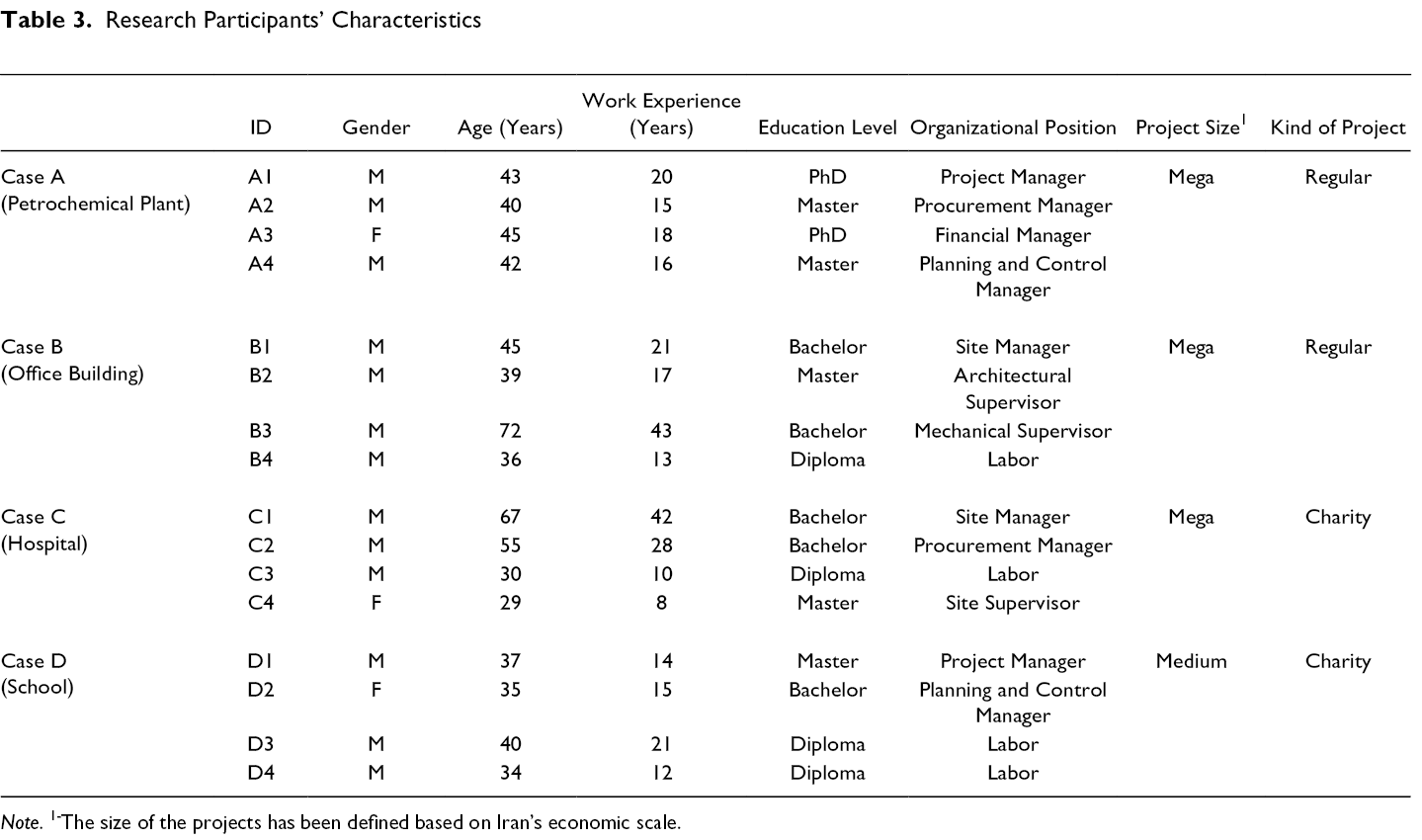
Note. 1-The size of the projects has been defined based on Iran’s economic scale.
Studied Cases
To increase the generalizability of the results, this research is mainly concentrated on developing a theoretical framework based on philosophical findings and inductively identified those relatively context-free aspects that have the potential to be evaluated and applied in other contexts. In this regard, this section provides a brief description of the studied cases. The first studied case is being constructed in Bushehr province in the southwest of Iran. The petrochemical project with a private owner is mainly financed by the public through a loan with a low interest rate. The project delivery system is a design-build (engineering, procurement, and construction [EPC]). Petrochemical projects are complex projects and often directed by well-educated and experienced project team members with a relatively higher salary. The supervision mechanism in this project is multilayered and includes government institutions, such as lending banks and the National Petrochemical Company (NPC). Given the important role of the petrochemical industry, it receives more support from the government. In recent years, previous formal procedures have changed, and many purchases are conducted through informal procedures to bypass economic sanctions.
The second studied case is the office building of the Hamedan University of Medical Sciences in Hamedan, Iran. This project is financed by the government in the form of an annual budget. The project delivery system is a traditional design-bid-build. Under macro-level rules, the contractor was selected through a public bidding process. A supervisory institution, including both the designer consultant and owner, is responsible for the constant financial and technical supervision on the project.
The third studied case is a cancer hospital project in Hamedan, Iran, which is planned to cover the medical needs of western provinces. This project is financed by the Farshchian Charity Foundation and Medical Science University. The project delivery system is a traditional design-bid-build. The project experienced high cost and schedule growth.
The fourth studied case is a medium-size school project in Isfahan, Iran. This school is financed by charitable funding and public financial resources through the Organization for Development, Renovation and Equipping Schools of Iran, a governmental institution. The project delivery system is a traditional design-bid-build. School projects are the most favorable kinds of projects among benefactors.
Data Analysis
Within-Case Analysis
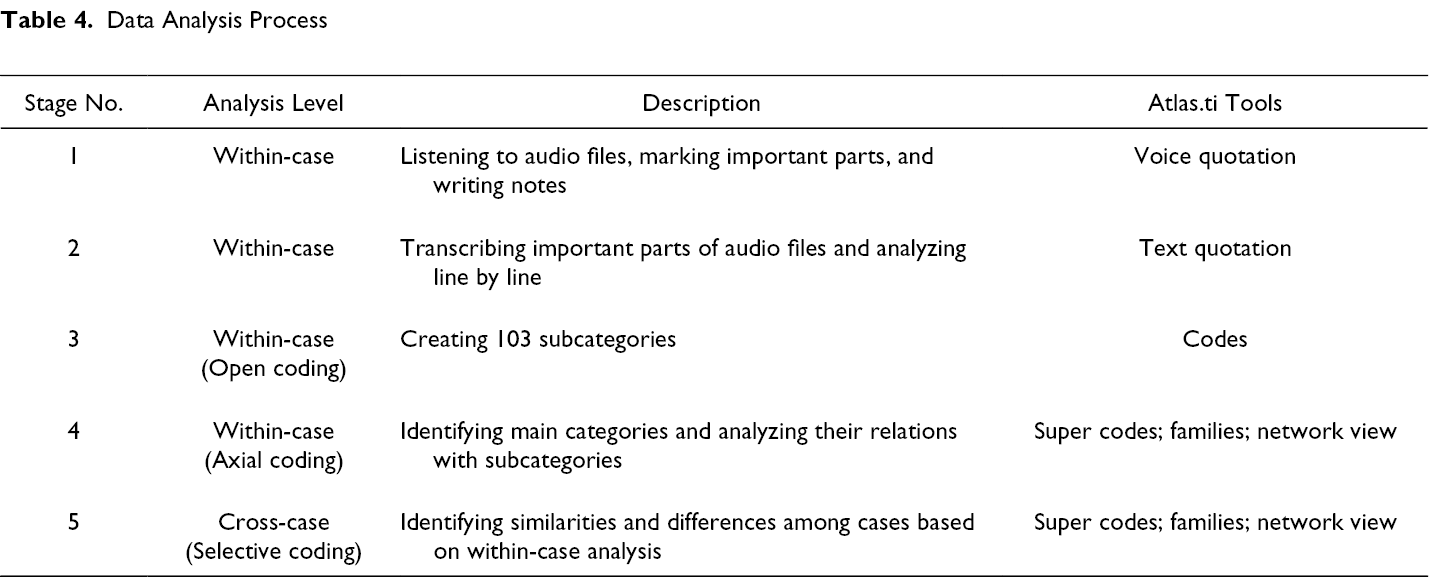
The data analysis process was conducted by network view, family, and super code mechanisms in Atlas.ti software, which facilitates the classification of a high volume of qualitative data under the more subjective categories (Holton, 2018). In the first stage, by listening to audio files, important parts were marked, and some notes were written by the voice quotation mechanism of Atlas.ti software. In the second stage, the selected parts of audio files were transcribed and analyzed line by line for extraction of “what the interviewees were saying, thinking or feeling” (Donald et al., 2020, p. 29) (Table 4). In the third stage of the coding process, 103 subcategories were created (N Case A = 24; N Case B = 27; N Case C = 31; N case D = 21). In the fourth stage, main categories were identified and connected to subcategories in terms of characteristics and dimensions, providing a hierarchy of codes in each case as a solid foundation for cross-case analysis.
Data Analysis Process
Cross-Case Analysis
In the fifth stage of data analysis, abductive cross-case analysis was conducted by identifying similarities and differences among cases based on the findings of within-case analysis (see Figure 2), which enabled the analysis process to climb the ladder of abstraction. Given the research questions, a comparison of cases under the insight of within-case analysis leads to the extent of identified theoretical framework around the practical mechanisms that project stakeholders adopt to make a balance between the will to power and responsibility for other (
Findings of Cross-Case Analysis
Dealing with Internal Ethical Conflict
Following the theoretical framework, it can be inferred that almost all interviewees have often experienced the psychological tension between responsibility for other and will to power or self-progress in project ethical situations, which proves the relevance of theoretical framework to practice. Interviewees’ explanations showed that the uniqueness and complexity of ethical situations and psychological instability lead to existential tension in the form of unexplainable reciprocal movement between two ends of the spectrum that are not even clear to stakeholders themselves. In this regard, one of the interviewees emphasized:
“I always face ethical challenges in the project, and I can’t define any process or even fixed criteria for my ethical decision-making…Sometimes, I behave more ethically than other times. When I come back and look at my decisions, it seems that if I had been in another situation, I would have behaved differently, so I doubt the correctness of my decisions.”
Another interviewee stated that:
“Heavy responsibilities in the project prevent me from doing justice to the complexity of ethical situations. In many instances, ethical behavior is in contradiction with project performance.”
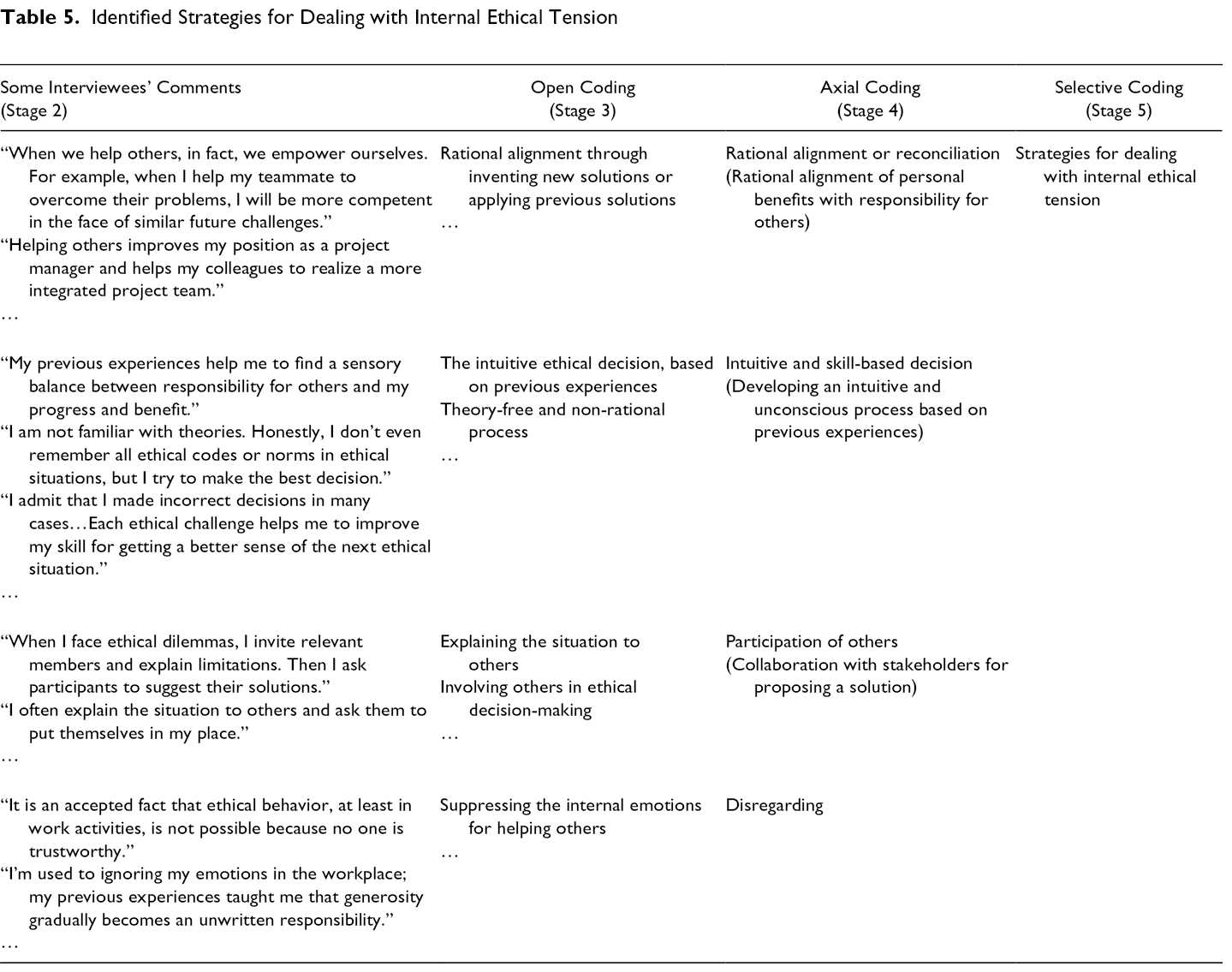
Further analysis of qualitative data demonstrated that project stakeholders often acknowledge the impossibility of optimized decisions, leading to existential challenges. However, they have developed different strategies for dealing with this internal tension, which is vital for realizing stable psychological conditions and ethical behavior. Table 5 summarizes the results of cross-case analysis around this subject. Identified strategies can be realized in different ways and are not a complete success, nevertheless, they can pave the challenges.
Identified Strategies for Dealing with Internal Ethical Tension
From Structural Ethics to Individual-Based Morality
The refusal and concern of project stakeholders, especially project team members in the four cases, to talk about ethical aspects of the project and ethical violation were highlighted in the cross-case analysis. More analyses on interviews and project documents revealed that there is no clear boundary among formal rules, social ethics, and ethical codes in project practice (Figure 3). Ethical codes have a function similar to that of formal rules and are extensively under the influence of social-ethical norms. Although there are differences in the importance of ethical codes, regarding their proximity to equivalent rules, ethical code violation is assumed as a rules violation. This approach is supported by some well-known references in project management. For example, the PMI Code of Ethics and Professional Conduct (2006, p. 8) emphasizes, ethical codes “not only describe the ethical values to which the global project management community aspires but also addresses the specific conduct that is mandatory for every individual bound by this code.” One of the interviewees defined ethical behavior as a “commitment to regulations and processes.” Another interviewee stated that “more clear process and regulations lead to more ethical behavior.” After more reflection, many of them acknowledged that morality is “something beyond the rules.” For example, one of the interviewees emphasized: “I think ethics encompasses formal rules.” Others presented a more complicated picture by referring to “unethical regulations” and “unfair rules” terms to express all rules are not necessarily ethical. Therefore, morality includes even the law-making process. A formal regulation system, social ethics, and project ethical codes have a similar structural function and put external pressure on behavior, which has made their differences insignificant from stakeholders’ perspectives and changed their function to an assessment tool or even a power-imposing instrument in project activities. It is in contrast with almost all philosophical schools that consider a voluntary nature for ethics. The quotes mentioned in Table 5, and further analysis through the hierarchies of codes, indicate that a universal approach to ethics such as what can be seen in project management institutions’ codes of ethics or even local codes in studied projects is faced with two important challenges. First, an authenticity crisis, as described in the following two quotes, refers to this challenge:
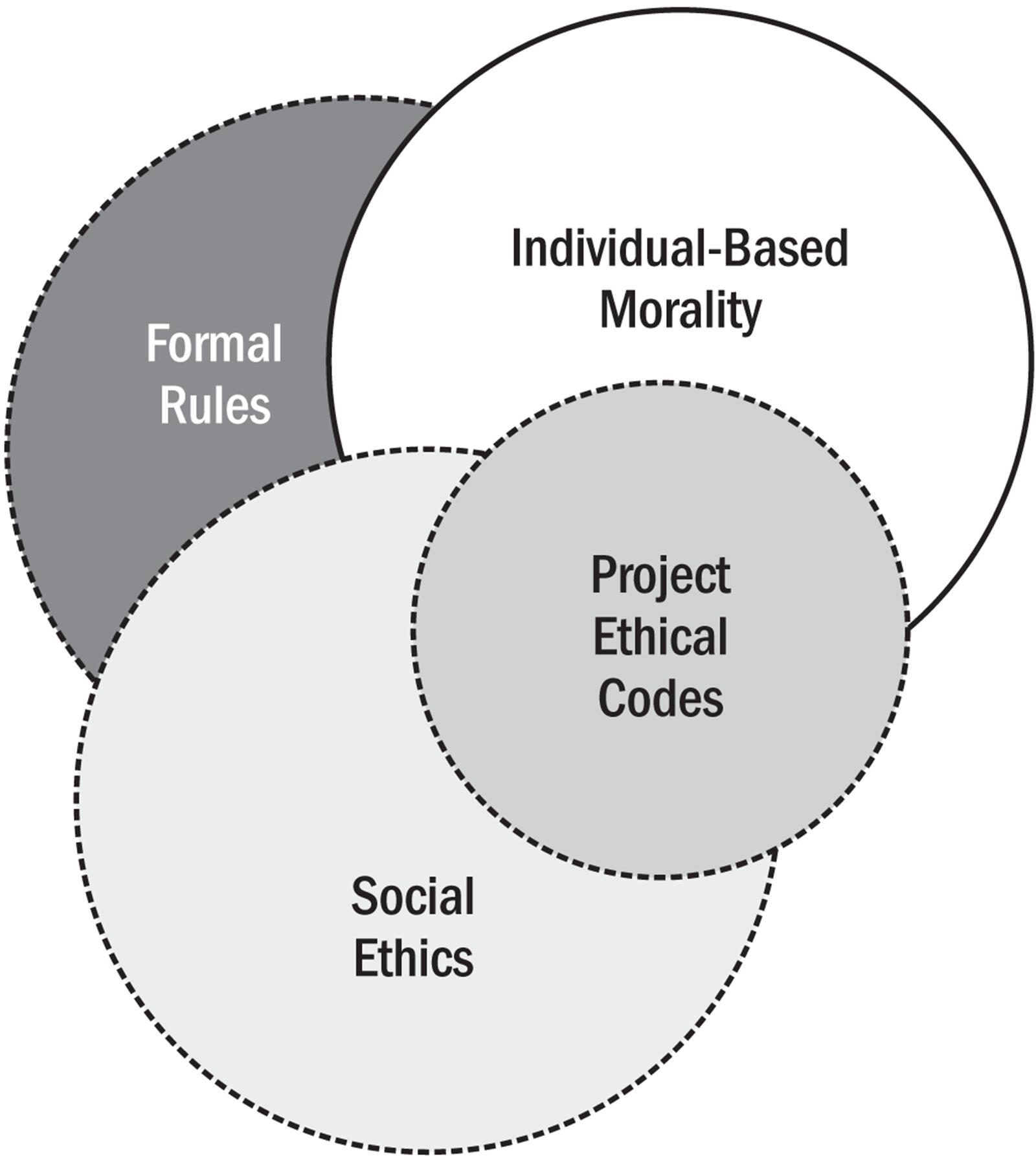
Relations among social ethics, project ethical codes, formal rules, and individual-based morality.
“In many instances, ethical codes are similar to social norms; many of them are valuable and informative. However, project team members, especially younger ones, believe these codes are based on incorrect traditional assumptions.”
“In my view ethical behavior, at both the individual and organization levels, is mainly conducted with the aim of social reputation and monetary profit.”
Second, current ethical norms and codes cannot provide sufficient motivation for stakeholders to behave ethically, especially because the ethical atmosphere of the project mainly depends on project stakeholder desires and tendencies:
“Ethical behavior in the project is not possible. Almost always, motives for unethical behavior overtake the motive for adherence to ethical codes.”
Cross-case analysis by comparing the hierarchies of codes indicated that current ethical principles and even regulation systems are not consonant with the contextual realities. Therefore, all of these structural and top-down mechanisms have failed to prevent corruption and motivate project stakeholders to behave ethically, because external pressure decreases innovation and marginalizes individuality as critical components of ethical behavior. While under the influence of macro social changes from tradition to postmodernism, an increasing number of project stakeholders tend to define their unique ethical values and interpretation of current ethical norms, which include both similarities and differences compared with other sources of ethics in projects (see Figure 3).
Meaningful Project and Moral Stakeholders
Initial investigation through within-case analysis illustrated that there is no significant difference between regular and charity projects in terms of providing meaningful experiences for project stakeholders engaged in the construction phase. Further analysis through cross-case analysis confirmed this finding, which can be considered as a mismatch between theoretical framework and empirical findings. Some interviewees clearly emphasized that ethical and charity aspects of the project are mainly relevant to the owner. Even one of them mentioned: “Final function of this building does not matter to me, because I am an ordinary worker in this project.” Further analysis of data showed that stakeholder attachment to the project, especially among construction workers, is at the lowest level, mainly because of the lowest participation in the decision-making process and weak communication mechanisms. There is no difference between charity projects and regular projects for many stakeholders when they have no contributions to the goals and final consequences of the project. A kind of pessimism was identified toward the final goals of projects. For example, one of the employees mentioned that: “Sometimes corruption and unethical behaviors are hidden behind the charity projects.” Juxtaposing these findings and the results of previous studies helped us to achieve a clearer picture of the relation between psychological and structural factors of ethical behavior, which will be elaborated in the Discussion section.
Despite these initial findings, further analysis of codes illustrated that some interviewees implicitly referred to sporadic meaningful experiences in previous projects. These experiences were described by the terms “enjoyable,” “exceptional,” “self-satisfaction,” and “unforgettable.” Further analysis of identified codes revealed that a sense of meaning is not common, but it has a high potential to promote a specific kind of ethical behavior. For example, one of the interviewees emphasized that:
“In a railway project, when I explained about the vital role of the railway in the improvement of the social and economic situations of poor local communities, I saw collaboration and friendship among them, and a remarkable increase in workers’ performance, as they are working for their own families… even some of them expressed interest in working on holidays as well.”
The discussed relations of individual-based morality with formal rules, social ethics, and project ethical codes in the previous section, under the insight of motivational potentials of meaningful experiences, directs us to a completely different approach to ethics, supported by the identified theoretical framework. It can be inferred that sense of meaning is an internal motivational factor for ethical behavior. For example, one of the interviewees emphasized that:
“I sometimes intend to share my knowledge with unknown others in the form of lessons learned, merely because it is enjoyable to me.”
In this regard, existential meaning has a remarkable potential to create a way out of a wide range of ethical dilemmas in project management. Analysis of data showed that stakeholders have the unrealized psychological capability to prioritize those meaningful aspects of responsibility for other and will to power, which are essential for self-realization and non-instrumental ethical behavior. According to interviewees, the exchange of existential experiences and meaningful aspects of the project among stakeholders helped them to “trust each other” and “take more flexible stances” in favor of meaningful goals. A sense of meaning in the project invites us to consider the unique situational variables and realize our responsibility toward others in our own way, through self-scrutiny and internal motivation. Therefore, in accordance with structuration theory, empirical findings provide persuasive evidence that formal rules and ethical codes are necessary foundations for coordination and interaction, and thus cannot be eliminated. Rather, they need to be designed for flourishing existential meaning as a fundamental mechanism of individual-based morality. Formal and informal external pressure is not effective, because morality is ontologically a voluntary phenomenon in the face of unique contextual factors for experiencing a meaningful life.
Discussion
Theoretical Contribution
Based on theoretical findings, it can be concluded that neither will to power nor responsibility for other cannot be repressed in favor of each other. Furthermore, empirical findings indicated that project stakeholders apply different strategies for creating an optimized balance, merely because, psychologically, they need both of them as important sources of meaning and self-realization. However, due to the uniqueness of each ethical situation and psychological instability, stakeholders mostly experienced a reciprocal movement between two ends of this spectrum, probably because an optimized point cannot be easily achieved and needs to be always pursued (Rhodes & Badham, 2018; Tajalli & Segal, 2019a). It is, in fact, a transition from absolutism to inevitable relativism that leads to ambiguity and, finally, a difficult decision-making process (Loo, 2002). Nonetheless, relativism in ethical decision-making is critical for achieving a deeper understanding of themselves, making innovative meaningful experiences and ethical behavior that is also supported by Aristotelian virtue ethics (Bredillet, 2014; Bredillet et al., 2015; Ljungblom & Lennerfors, 2018; Steyl, 2020) and paradox theory (K. Smith et al., 2017; Smith & Lewis, 2011). This approach is not acknowledged by the current project management guidelines. Current project structures, such as top-down formal rules and ethical codes, unknowingly suppress any innovative method and strategy that project stakeholders can invent to realize their personalized meaningful work. Therefore, participative structures are not only a critical element for an ethical project at the structural level but also a vital prerequisite to help stakeholders perceive the meaningful aspects of a project. This is especially true, because weak participatory structures and ineffective communication decrease the sense of project attachment among stakeholders and lead to indifference toward project goals, including meaningful goals. Therefore, the ethical project not only needs to be meaningful from the stakeholders’ viewpoint at the agency level but also participative at the structural level (Figure 4). Both primary and secondary stakeholders should be involved in both the worldly and spiritual aspects of a project. As illustrated in this article, ethical aspects of stakeholder participation are extensively acknowledged by previous studies (Sarhadi et al., 2018), and the importance of meaning-making, with different interpretations, has been highlighted by some recent studies (Carlsen & Pitsis, 2020; Floris & Cuganesan, 2019; Sarhadi, Hasanzadeh, Yousefi, 2021; Sergeeva & Winch, 2020). Project stakeholders have the potential to perceive the project meaningful at the individual level. They can also help each other to experience the meaningful aspects of a project and psychological well-being. They can accomplish this when they are involved in tailoring a project’s flexible structures—such as ethical codes, formal rules, and many others—and are encouraged to exchange their existential concerns and experiences.
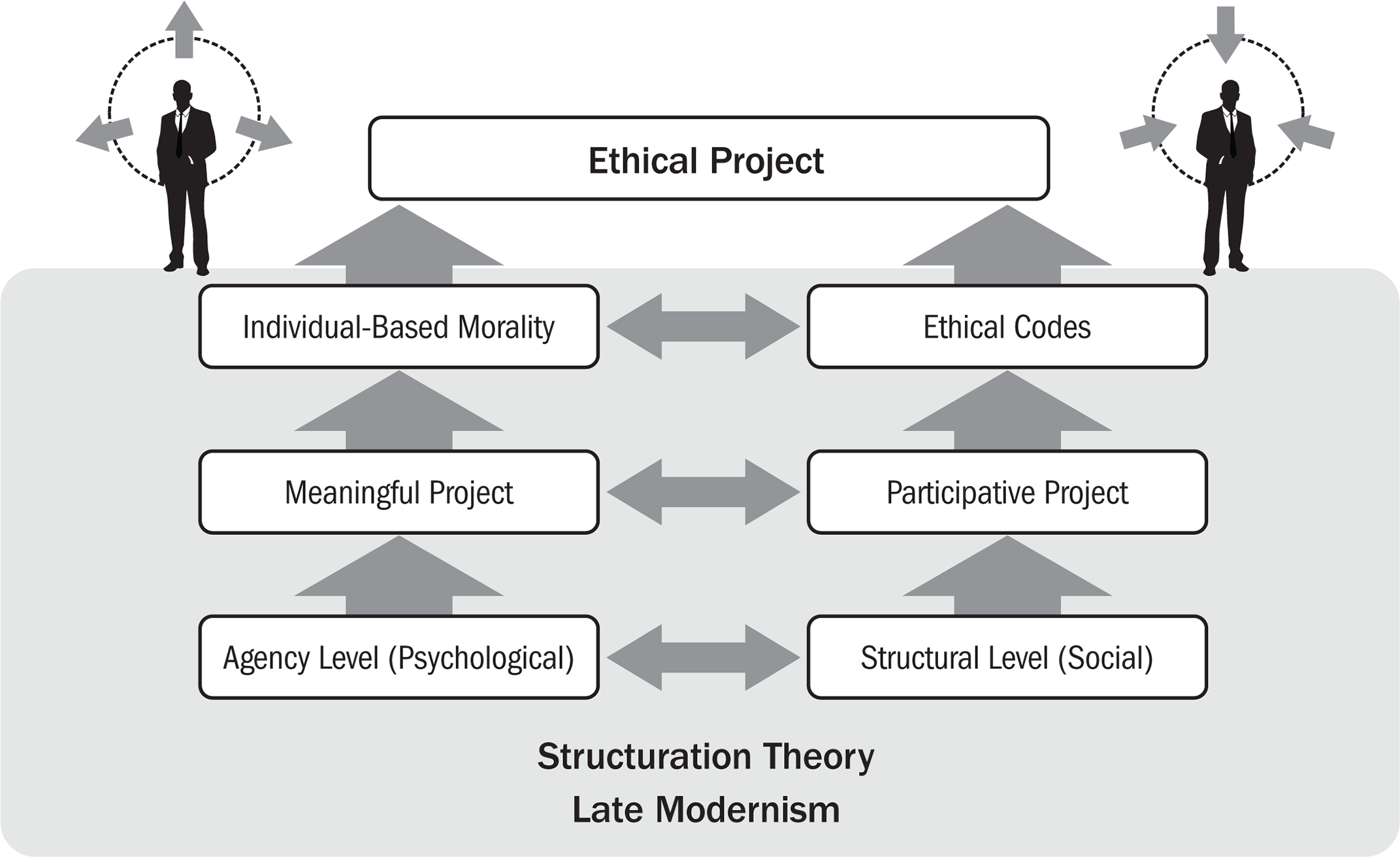
Structural and agency levels of an ethical project.
Practical Implications
Under the proposed ethical framework and empirical findings, the practical implications for project management can be extensive; however, they can be summarized in two complementary levels: individual and structural levels.
Individual Level
Meaning-making needs to be recognized as a vital skill or competency for construction project leaders and other stakeholders.
Meaning-making can be incorporated into project management education and standards for skillful confrontation with psychological pressures and “murky decisions they will inevitably face” (Soltes, 2017, p. 460).
Developing meaning-making skills, includes abstract art, story-telling, shifting perspective and reducing stress (Floris & Cuganesan, 2019), exchanging existential experiences, documenting meaningful experiences, collective reading, talking about literary or artistic works, and any other innovative ideas.
Structural Level
The inherent existential desire of stakeholders for meaningful work needs to be recognized, and project structures and procedures should not be inhibitive.
Project charters, ethical codes, and even regulation systems can be developed through participatory processes, with special emphasis on sustainable, charity, or any other goals with enough potential to provide meaningful experiences for stakeholders.
Innovative ideas that can provide meaningful experiences for stakeholders should be encouraged.
Designing an appropriate communication strategy based on the communication styles of project stakeholders (Sarhadi, 2016) is a critical step to experiencing a meaningful project.
Conclusion
The present study reviewed the ethical behavior definition in project management under the philosophical paradigm change from modernism to late modernism, which revealed the importance of the psychological aspects of ethical behavior at the agency level. In this regard, two well-known schools of moral psychology in western philosophy were critically discussed, which resulted in a theoretical ethical framework. Confronting the theory with the empirical world through a case study verified important aspects of the identified framework and provided new insights, which led to theoretical development through abductive cross-case analysis. The results of the cross-case analysis revealed the remarkable potential of existential meaning for creating internal motivation, which is an irreplaceable source for realizing individual-based morality in projects. Meaningful experiences help stakeholders develop their personalized ethics and necessary skills for ethical behavior, and experience psychological well-being. Research results indicated that experience of meaning in a project not only depends on stakeholder approach and project goals but also the rate of stakeholder participation in both the worldly and spiritual aspects of a project. Therefore, ethical projects not only need to be meaningful at the agency level but also need to be participative at the structural level.
Research Limitations and Directions for Future Studies
This study has prioritized generalizable dimensions of studied cases over detailed descriptions of contextual variables. Second, stakeholders were reluctant to talk about ethical issues; therefore, we had to mainly investigate those ethical aspects that have no legal consequences. The informal conversation was used for trust-building and going beyond conservative remarks. However, more innovative methods and data gathering mechanisms need to be developed to achieve a better understanding of ethical aspects in project practice. Furthermore, ambiguous relations between mandatory and voluntary domains of projects in general, and ambiguous relations among formal rules, social ethics, ethical codes, and individual-based morality in particular need more studies.
Footnotes
Declaration of Conflicting Interests
The author(s) declared no potential conflicts of interest with respect to the research, authorship, and/or publication of this article.
Funding
The author(s) received no financial support for the research, authorship, and/or publication of this article.