







Abstract
Drawing on leadership theory, this research verified what makes shared leadership an effective form of leadership for agile project teams, and whether using it influences the outcomes achieved by such teams as well as the more distal outcomes. Survey data were collected from 251 members of agile project teams implementing projects of an iterative and incremental character. Structural equation modeling (PLS-SEM) was adopted to test the hypotheses. Our research confirms that shared leadership is an effective form of leadership for agile project teams whose members are empowered to engage in leadership functions or processes. The findings confirm a positive direct impact of shared leadership on the performance of agile project teams and indirect impact on project efficiency and effectiveness. The research results also confirm the influence of project team–related contextual moderators on shared leadership inputs and outputs. The study contributes to leadership theory in the plural leadership research stream and confirms the shift from individual leadership to collective leadership as a result of the growing popularity of the agility paradigm.
Introduction
Contemporary organizations carry out more and more projects of ever-growing complexity. Under such circumstances, the effective delivery of project objectives can require using different types of project teams. Effective project teams work together to take full advantage of the knowledge, experience, and engagement of the individual members (Scott-Young & Samson, 2008). This is exemplified by self-managing (agile) teams where leadership is shared (Manz & Sims, 1987) and decisions on the activities of the team are made collectively (Leffingwell, 2010). While such teams occur mostly in the IT industry (Hoda & Murugesan, 2016; Oprins et al., 2019), they are becoming more and more common in other industries as well (Ciric et al., 2018; Papadakis & Tsironis, 2018). For agile project teams, shared leadership can be a valuable solution enabling them to make full use of their potential (Carson et al., 2007) and attain the planned team performance (Nicolaides et al., 2014; Sousa & van Dierendonck, 2016) as well as the more distal outcomes (Pearce & Conger, 2003; Sweeney et al., 2019). Pearce and Conger define shared leadership as a “dynamic, interactive influence process among individuals in teams for which the objective is to lead one another to the achievement of team or organizational goals, or both” (Pearce & Conger, 2003, p. 1). Defined this way, shared leadership emerges in an agile project team and involves the distribution and rotation of leadership (Pearce & Sims, 2002; Pearce, 2004).
In the literature, a distinction is made between shared leadership and other kinds of leadership (Denis et al., 2012). It is particularly visible in agile approaches to project management where a key role is played by self-managing teams with no formally nominated leader (Leffingwell, 2010). This means that individual agile team members will have to assume the leadership role and functions (Denis et al., 2012). Thus, there is an alternative way of organizing project teams where leadership is shared among team members, and scholars now seek to determine what makes this leadership form effective (Srivastava & Jain, 2017; Kakar, 2017; Imam & Zaheer, 2021; Nauman et al., 2022). This article focuses on shared leadership as an effective form of leadership for agile project teams (Srivastava & Jain, 2017). The use of this form of leadership can have a positive influence on how these teams work (Iqbal et al., 2019) as well as on their ability to generate multilevel outcomes (Scott-Young et al., 2019). The organization and functioning of agile project teams, with team members leading one another (Pearce & Conger, 2003) instead of having a formal leader (Manz & Sims, 1987), distinguishes them from traditional project teams (Leffingwell, 2010). Therefore, practicing other forms of collective leadership (Denis et al., 2012), and even more so vertical (Hoch, 2013) or balanced leadership (Müller et al., 2018), will not necessarily bring the expected results. Thus, it seems appropriate to examine the circumstances that make shared leadership an effective form of leadership for project teams without a formally designated leader. Based on the above, we formulate the following research questions:
What makes shared leadership an effective form of leadership for agile project teams? Does practicing it have a positive influence on the performance achieved by such teams as well as the creation of the more distal outcomes?
An appropriate quality of shared leadership is essential to achieving the expected agile team performance and project results. This quality is construed as the effectiveness of the mutual influence process that emerges within an agile project team (Martin et al., 2020). Adopting such a perspective requires taking into account behaviors that influence how this process occurs (Carson et al., 2007; DeRue, 2011) as well as its capacity to create the expected outcomes (Pearce & Conger, 2003; Mathieu et al., 2008). An appropriate quality of shared leadership ensures that leadership is efficiently distributed and voluntarily shared within an agile project team, ensuring its proper functioning and ability to create multilevel outcomes. To examine what makes shared leadership an effective form of leadership for agile project teams and whether it influences multilevel outcomes, we developed a model linking the quality of shared leadership and behaviors influencing this quality (Carson et al., 2007; Nicolaides et al., 2014), agile team performance (Melo et al., 2013; Iqbal et al., 2019), and outcomes at the project and organization level (Pearce & Conger, 2003; Scott-Young et al., 2019). The empirical testing of the model thus defined enabled us to verify the usefulness of shared leadership as an effective form of leadership for agile project teams. This includes identifying the individual and team behaviors influencing how shared leadership emerges in agile project teams, and establishing whether using this form of leadership enables such teams to achieve the planned team performance as well as the more distal outcomes.
The main contribution of the article is to show that a form of leadership that does not include vertical leadership can be effective in terms of team efficiency and project results. This challenges the idea, prevalent in the literature on project management, of the importance of the project manager as an individual or supportive leader (Geoghegan & Dulewicz, 2008; Anantatmula, 2010; Müller et al., 2018). This also confirms the effectiveness of other forms of leadership in which there is no traditional vertical project manager structure (Denis et al., 2012). A second contribution is to advance theories of shared leadership in the literature on project management by showing the importance of goal, entrepreneurial, and excellence orientation in ensuring the quality of shared leadership (Carson et al., 2007; DeRue, 2011; Nicolaides et al., 2014), including the contextual factors moderating the shared leadership relations (Gemünden et al., 2018; Scott-Young et al., 2019).
Research Framework and Hypothesis Development
In our research, we adopted the idea of a
The proposed theoretical model is based on these assumptions and verifies their appropriateness for agile teams and projects. According to the model, the behaviors of agile team members—manifested at the individual and team level in their pursuit of goals, entrepreneurial mindset, and openness to excellence—have a particular and direct impact on the quality of shared leadership (Schwaber & Beedle, 2001; Leffingwell, 2010), that is, on the effectiveness of the mutual influence process in an agile project team. This enables an efficient transfer of leadership to the team member who is the most competent in a given situation (Pearce & Sims, 2002; Pearce, 2004; Carson et al., 2007; Hoch & Dulebohn, 2013). An appropriate quality of shared leadership has a direct impact on agile team productivity (Melo et al., 2013; Iqbal et al., 2019) and an indirect impact on project performance on scope, time, and expenses (Pinto & Slevin, 1988; Pearce & Sims, 2002; Jugdev & Müller, 2005) as well as project effectiveness; that is the creation of stakeholder value and benefits to the business (Cooke-Davies, 2002; Pearce & Sims, 2002; Müller & Turner, 2007).
The model thus links individual and team behaviors that exert influence on the quality of shared leadership with the outcomes that an appropriate quality of shared leadership allows to create at the level of a team, project, and entire organization. The links between the variables visible in the model define the research hypotheses adopted (Figure 1). The accuracy of the prepared model was verified in the context of agile project teams carrying out iterative and incremental projects.
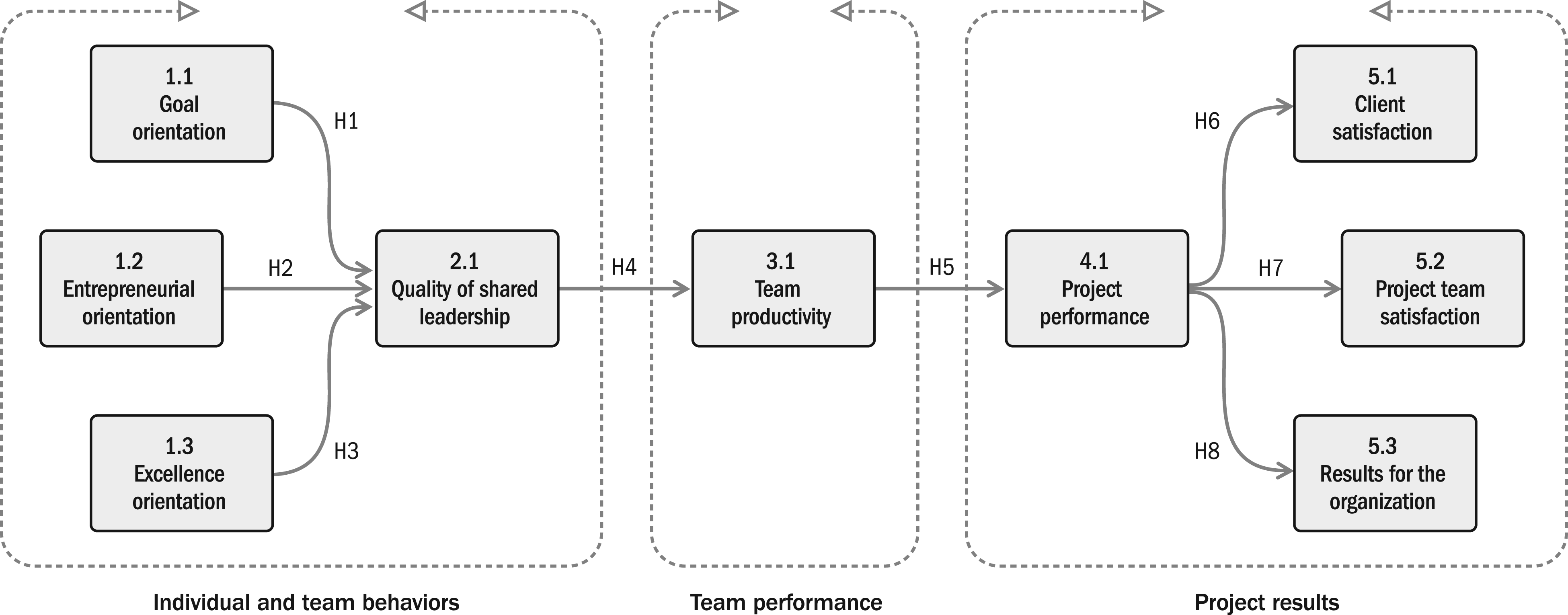
Research model.
The model consists of nine constructs: four endogenic and five exogenic. We distinguished the constructs to describe the cause-and-effect relationships occurring between them based on our predictions. All the constructs distinguished in the model are of a reflexive character, which means that they reflect the functioning of a hidden phenomenon described with a latent variable.
Conceptualization of Shared Leadership Quality
Pearce and Conger define shared leadership as a “dynamic, interactive influence process among individuals in groups for which the objective is to lead one another to the achievement of team or organizational goals, or both” (Pearce & Conger, 2003, p. 1). Nicolaides makes this definition more specific, indicating that it is “a set of interactive, influence processes in which team leadership functions are voluntarily shared among internal team members in the pursuit of team goals and to increase team effectiveness” (Nicolaides et al., 2014, p. 924). Shared leadership should thus be treated as a mutual influence process, thanks to which leadership is efficiently distributed (Muethel & Hoegl, 2013; D’Innocenzo et al., 2016) and voluntarily shared (Nicolaides et al., 2014) within an agile project team, at different phases of the team and project life cycle (Kozłowski et al., 2016; Wu & Cormican, 2016).
What sets this form of leadership apart from individual leadership, as well as other forms of plural leadership, is the collective leadership in a project team, with team members leading one another (Denis et al., 2012). It is an effect of continuous interaction (DeRue, 2011) and dialogue among members of a project team (Rawlings et al., 2000). The essence of shared leadership is the rotation of leadership among different agile team members, depending on the needs or situation in a given team or project (Pearce & Sims, 2002). This means that changing the leader or leadership style in a given situation can have a positive influence on the decision-making and work coordination method as well as the level of engagement of the agile project team members (Bock & Kim, 2002; Mathieu et al., 2000; Fausing et al., 2015; Wang et al., 2017). According to shared leadership theory, a vertical leader can coexist with shared leadership (Pearce & Manz, 2005). In such circumstances, a vertical leader encourages team members to share leadership among themselves (Hoch & Dulebohn, 2013). Nonetheless, in the case of agile project teams, which have no formal leader (Muethel & Hoegl, 2013), shared leadership has a solely horizontal character, hence leadership functions are performed alternately by all team members depending on the needs or circumstances (Pearce & Sims, 2002; Pearce, 2004; Nicolaides et al., 2014). This is related to the shift from vertical, individual leadership to horizontal, collective leadership (Cullen-Lester & Yammarino, 2016), and the growing popularity of agile approaches where self-managing project teams play a key role (Leffingwell, 2010; Schwaber & Sutherland, 2017, 2021).
This study focuses on shared leadership as an effective form of leadership for agile project teams (Chiu et al., 2016; Srivastava & Jain, 2017; Kakar, 2017; Imam & Zaheer, 2021). A multilevel, team-oriented, and process-based perspective was adopted to analyze this phenomenon. Shared leadership thus defined emerges as a consequence of interactions among agile project team members who rely on and influence one another (DeRue, 2011). Therefore, the roles and relationships among agile project team members may emerge, coevolve, and change across the entire life cycle of the project (D'Innocenzo et al., 2016). The effectiveness of the mutual influence process determines the quality of shared leadership in an agile project team (Martin et al., 2020). Adopting such a perspective requires taking into account individual and team behaviors that influence how this process occurs (Carson et al., 2007; DeRue, 2011) as well as the capacity of the process to create multilevel outcomes (Mathieu et al., 2008; Scott-Young et al., 2019). An appropriate quality of shared leadership ensures the effective functioning of an agile project team (Pearce & Sims, 2002; Nicolaides et al., 2014). This is achieved by making a collective, informed decision on the best (in a specific situation) team member who will take over the role of the leader and guarantee focusing on the goal and keeping up the pace of work and the level of engagement of the other project team members, thus ensuring the attainment of the planned outcomes at the level of an agile team, project, or organization (Pearce & Conger, 2003; Nicolaides et al., 2014; Scott-Young et al., 2019). The quality of shared leadership is thus manifested in the following dimensions: collectivism (Small & Rentsch, 2010), shared purpose (Carson et al., 2007), mutual trust and support, as well as knowledge sharing (Fausing et al., 2015).
Factors Influencing Shared Leadership Quality
Hoch and Dulebohn point out the characteristics of individual team members and supporting factors from within the team as factors having influence on shared leadership (Hoch & Dulebohn, 2013). A key aspect of shared leadership is the strengthening of individual behaviors in a team (Hoch & Kozłowski, 2014) for the purpose of leading the project team to achieve the expected team performance (Pearce & Conger, 2003; Nicolaides et al., 2014). The orientation of team members, manifested at the individual and team level, thus influences how shared leadership will emerge in an agile project team (Carson et al., 2007; Hoch & Kozłowski, 2014). For the needs of this article, orientation is defined as the effort of individual members and an entire project team to operate according to the principles of a given philosophy or approach (Foxall, 1984; Miles et al., 1995; Carvalho et al., 2019). Team members’ behaviors manifested in their pursuit of goals (Nicolaides et al., 2014), entrepreneurial attitude (Ahmed et al., 2014), and openness to excellence (Leffingwell, 2010) through combined influence, determine their ability to assume the leadership role and influence the direction, mode of action, and engagement of the entire agile project team (Carson et al., 2007; DeRue, 2011; Hoch & Dulebohn, 2013). Thus, it can be stated that goal, entrepreneurial, and excellence orientation at the individual and team level influence the way that shared leadership emerges in an agile project team (Carson et al., 2007; Hoch & Dulebohn, 2013).
Goal Orientation
Goal orientation is manifested in the engagement of all team members in the achievement of project results (Shalley et al., 2009). The literature on the subject distinguishes between two aspects of goal orientation: performance and mastery goal orientation (Elliot & Church, 1997; Gong et al., 2013; Chen & Lin, 2018). Research confirms the positive influence of both of them on the outcomes achieved by a project team (Pieterse et al., 2011; Pieterse et al., 2013) as well as project results (Park & Lee, 2014). Performance goal orientation is manifested in the involvement of project team members in defining the expected outcomes and actively working to achieve them. Mastery goal orientation focuses more on the aspect of the self-development of the individual team members (Janssen & Van Yperen, 2004). Agile project team members who share leadership can actively contribute both kinds of orientation to the team processes and to achieving the team’s shared goals (Kozlowski et al., 2016). The involvement of agile team members in defining project objectives and each iteration is essential for the operationalization of the construct goal orientation. Goal orientation is confirmed by the effort of an agile project team to achieve the goal set for a project and iteration (Schwaber & Sutherland, 2017, 2021).
The goal orientation of team members has an impact on the way a project team works (Pieterse et al., 2011; Nicolaides et al., 2014). Goal orientation shown by the individual team members determines the focus on the goal to be attained by an agile team (Pearce & Conger, 2003; Nicolaides et al., 2014; Schwaber & Sutherland, 2021); it also strengthens the motivation of team members to attain the goal set for the team (Giritli et al., 2013; Tyssen et al., 2013). Thus, each team member who takes on leadership will strive to achieve the goals agreed upon by the agile project team, which exerts beneficial influence on how shared leadership emerges in such a team (Nicolaides et al., 2014; Kozlowski et al., 2016). Striving to attain the goals agreed upon within an agile project team also builds a sense of shared purpose among its members (Mathieu et al., 2000; Carson et al., 2007). Therefore, the following research hypothesis was proposed: H1: Goal orientation at the individual and team level has an influence on the quality of shared leadership.
Entrepreneurial Orientation
The entrepreneurial orientation of project teams should be developed so that the strategic objectives of an organization are implemented (Rauch et al., 2009; Anderson et al., 2015). The research conducted thus far indicates the beneficial influence of the entrepreneurial orientation of team members on project success (Martens et al., 2018). Ahmed et al. (2014) showed that an entrepreneurial attitude of individuals in project teams translates positively into project success. The entrepreneurial orientation construct is operationalized through the degree to which team members are autonomous in performing the tasks entrusted to them (Lumpkin et al., 2009; Vezzoni et al., 2013) and through their preferences concerning the use of innovative solutions ensuring the competitiveness of the product (Lumpkin & Dess, 2001; Martens et al., 2018). The extent to which the team’s willingness to take risks is accepted by the management is another important dimension of this variable (Vezzoni et al., 2013).
The literature on the subject indicates that the entrepreneurial orientation of team members has an impact on how a given project team operates (Ahmed et al., 2014; Martens et al., 2018). Agile team members showing entrepreneurial orientation seek to take on leadership alternately in different situations, which helps retain the decision-making capacity of the team (Bock & Kim, 2002; Mathieu, 2000) and build collectivism and mutual trust (Small & Rentsch, 2010). It can thus be assumed that the entrepreneurial orientation of agile project team members triggers in them the desire to be leaders and to influence how their team works, which has a beneficial impact on the quality of shared leadership (Carson et al., 2007; DeRue, 2011; Hoch & Dulebohn, 2013). This assumption is expressed in the following research hypothesis: H2: The entrepreneurial orientation at the individual and team level has an influence on the quality of shared leadership.
Excellence Orientation
The conducted research indicates a correlation between organizational agility factors and operational excellence (Vinodh et al, 2010; Wageeh, 2016; Carvalho et al., 2019). The openness to the excellence of every aspect of how a project team functions becomes a necessity in the case of projects employing agile approaches (Leffingwell, 2010). These approaches require agile project team members to improve every aspect of the functioning of such a team from the methodical, process, and interpersonal perspectives (Schwaber & Sutherland, 2017, 2021). For the operationalization of the excellence orientation construct, the following were used: the degree to which a team was aware of the need to improve the way it works; readiness to identify possible improvements at the end of an iteration; the degree to which the improvements identified by a team were applied in subsequent iterations; and verification of the extent to which team members were improving a given product based on systematic inspection and adaptation (Schwaber & Beedle, 2001; Schwaber & Sutherland, 2017, 2021).
Striving to achieve excellence in all aspects of the project team’s functioning makes it possible to create an atmosphere of cooperation, knowledge sharing, and learning within an agile team (Small & Rentsch, 2010; Liu et al., 2014; Fausing et al., 2015). Excellence orientation manifested by team members triggers in them the desire to improve all aspects of the functioning of an agile project team (Schwaber & Sutherland, 2021). Thus, every team member performing leadership functions will encourage other team members to improve their leadership skills (Liu et al., 2014) as well as the effectiveness of the mutual influence process (Pearce & Conger, 2003), which has a beneficial influence on how shared leadership emerges in such a team. This assumption is reflected in the following research hypothesis: H3: Excellence orientation at the individual and team level has an influence on the quality of shared leadership.
Team Performance and Team Productivity
The influence of shared leadership on team performance is confirmed by the literature on the subject (Kozłowski, 2016). This influence is multidimensional and manifests itself in various areas (Scott-Young et al., 2019). Pearce and Sims indicate that shared leadership can have a positive impact on team effectiveness (Pearce & Sims, 2002). Other authors indicate the beneficial influence of shared leadership on team satisfaction (D'Innocenzo et al., 2016; Serban & Roberts, 2016), sense of belonging (Barrick et al., 2007), and team viability for future projects (D'Innocenzo et al., 2016). The multitude of perspectives can result from the fact that team performance is understood and defined in different ways. From the most comprehensive categories, such as team effectiveness (Pearce & Sims, 2002), to those of a more analytical nature, such as lack of delays in a project or the quality of a product (Ramírez & Nembhard, 2004), and categories directly related to team efficiency such as velocity, throughput, or lead time (Poth et al., 2020). For the purposes of this study, team performance is understood as the productivity of an agile project team (Iqbal et al., 2019). We adopted a classic definition of productivity, that is, the amount of work done by an agile project team (tasks, user stories) per unit of time, which can be an iteration or a release (Trendowicz & Münch, 2009; Fatema & Sakib, 2017). Agile project team productivity thus defined was supplemented with two additional dimensions, namely the timeliness and quality of the work performed (Melo et al., 2011, 2013). Adopting such an approach was necessary to balance the way this construct is measured and to eliminate situations where the productivity of an agile project team increases at the expense of the quality of the work performed.
Sharing leadership makes it possible to better manage the resources, distribute workload more evenly, and increase task capacity, thus improving the productivity of an agile team (Sousa & van Dierendonck, 2016). Efficiently distributed and voluntarily shared leadership enhances the functioning of an agile team, which enables achieving better task performance (Carson et al., 2007; D'Innocenzo et al., 2016; Bruccoleri et al., 2019). Better task performance translates directly into agile project team productivity (Trendowicz & Münch, 2009; Sousa & van Dierendonck, 2016; Fatema & Sakib, 2017; Iqbal et al., 2019). This assumption is reflected in the following research hypothesis: H4: The quality of shared leadership influences the productivity of an agile project team.
Project Results
In the literature on the subject, project results are treated as a separate theoretical construct of a multifaceted and multidimensional nature (Andersen et al., 2006). Project results are defined in terms of two dimensions describing the effects at the project (Jugdev & Müller, 2005) and organization level (Shenhar & Dvir, 2007). The first one is project performance on scope, time, cost, and quality. The second dimension—described as project effectiveness—is understood more broadly in terms of the value that the accomplishment of project objectives delivers to project stakeholders (Pinto & Slevin, 1988; Cooke-Davies, 2002; Jugdev & Müller, 2005). Thus, the effectiveness of a project team's performance can be measured from two perspectives: project performance on cost, time, and quality, and project effectiveness in terms of the value it delivers to its stakeholders (Cooke-Davies, 2002; Jugdev & Müller, 2005; Shenhar & Dvir, 2007; Carvalho & Rabechini, 2017). Defining project results from these two perspectives can also be useful for agile teams and projects (Turner & Zolin, 2012; IPMA, 2016; Tam et al., 2020). Given the above-mentioned considerations, we can assume that agile project results consist of the following dimensions: project completion within a given scope, time, and expense (project performance); customer and agile project team satisfaction; and the achievement of the business objectives (project effectiveness).
Project Performance
The analysis of the literature allows us to conclude that, from the point of view of the main project stakeholders, such as the client, user, and sponsor, project performance is the primary and main dimension of measuring project results (Davis, 2014, 2017). According to Badewi, scope, time, and expenses are still used as parameters to assess project performance (Badewi, 2016). These parameters have been applied in different business areas such as engineering and construction (Lim & Mohamed, 1999) or agile software development (Stankovic et al., 2013).
Scott-Young indicates that shared leadership impacts the “more distal outcomes like project performance” (Scott-Young, 2019, p. 575). Efficiently distributed and voluntarily shared leadership (Nicolaides et al., 2014) makes it possible to achieve the expected level of agile team productivity (Sousa & van Dierendonck, 2016; Iqbal et al., 2019), which ensures that the planned scope of work will be completed within an iteration or release (Stankovic et al., 2013; Tam et al., 2020). The quality of shared leadership thus has a direct impact on agile team productivity and an indirect impact on project performance on cost, time, and scope. This assumption is expressed in the following research hypothesis: H5: The productivity of an agile project team influences project performance.
Project Effectiveness
Shared leadership can make an organization more innovative and more adaptive in the face of change (Buchanan et al., 2007). It can also indirectly help implement the organization’s strategy and achieve its business objectives and key performance indicators (Scott-Young et al., 2019). Project effectiveness can be considered in terms of indirect results attained through the achievement of project performance. Serrador and Turner indicate that project performance on time, cost, and quality affect stakeholder satisfaction (Serrador & Turner, 2015). The efficient delivery of project objectives thus determines the satisfaction of key project stakeholders, including the client and project team (Turner & Zolin, 2012; Serrador & Turner 2015; Davies, 2017). Lech (2013), in turn, found that a project was successful if it met functionality (schedule, budget) and organizational goals.
An appropriate quality of shared leadership in an agile project team enables achieving project performance on scope, time, and cost, which translates into stakeholder satisfaction (Carson et al., 2007; Serrador & Turner, 2015) and organizational effectiveness (Pearce & Sims, 2002; Lech, 2013; D'Innocenzo et al., 2016). By making this assumption, it is possible to structure and follow the logic of shared leadership outputs at the team, project, and organizational levels (Scott-Young et al., 2019). A customer will be satisfied only if the agile project team practicing shared leadership successfully delivers the project objectives. Similarly, the satisfaction of an agile team should flow from achieving the project objectives. Attaining project performance on scope, time, and expenses gives an agile team the conviction that they have successfully delivered the project objectives and is an important reason for the team to feel satisfied. Achieving project performance should also contribute to achieving business performance. Considering the limited resources involved, each project initiated should contribute to the implementation of the organization’s strategy and achievement of its business objectives. This assumption is reflected in the following research hypotheses: H6: The achievement of agile project performance determines client satisfaction. H7: The achievement of agile project performance determines project team satisfaction. H8: The achievement of agile project performance determines achievement of results for the organization.
Team-Related Contextual Moderators
Contextual factors were also taken into account when a theoretical model linking shared leadership, agile project team performance, and project results was constructed. The influence of these factors can have a positive (supporting) or negative (inhibiting) character. As suggested in the literature, project team–related boundary conditions were identified and tested for the proposed theoretical model (Oc, 2018; Gemünden et al., 2018). This was necessary in order to identify the project team–related situations that have an impact on (1) how strongly behaviors at the individual and team levels influence the quality of shared leadership; and (2) how these situations influence the outcomes that can be achieved at the team, project, and organization level thanks to shared leadership emerging properly. In the model, the influence of contextual factors was verified by including moderating variables and examining their impact on the relationships between variables in the model (Antonakis et al., 2012; Nicolaides et al., 2014). Moderators are contextual variables that specify the boundary conditions for the relationship between two variables. The impact of moderators either strengthens or weakens the relationship (Chiu et al., 2016).
Variables that may have a moderating effect on the relationships predicted by the model have been identified in the literature (Scott-Young et al., 2019). From the perspective of project team–related boundary conditions, the following variables are significant: team member characteristics (Carson et al., 2007; Mathieu et al., 2008; Hoch & Kozlowski, 2014), team size (Nicolaides et al., 2014), team tenure (Wang et al., 2014), and team dispersion and virtuality (Hoch & Kozlowski, 2014). Based on the analysis of the literature, four moderating variables were identified, taking into account the composition of an agile project team and the way it operates (Figure 2).
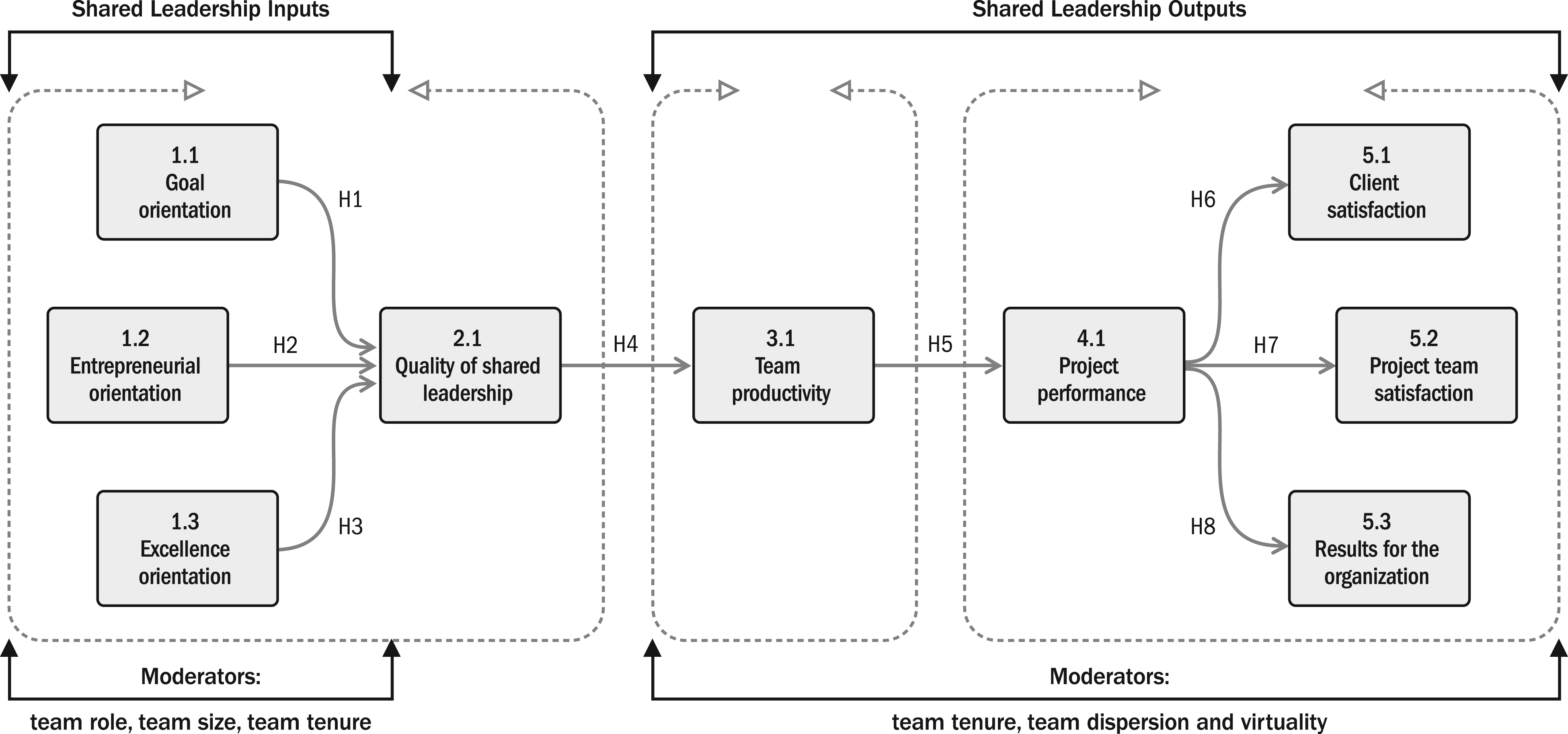
Research model with contextual moderators.
The first moderating variable is the role that a given person has in an agile project team. The role performed in such a team is a derivative of the knowledge, expertise, and competence of a given team member (Mathieu et al., 2008; Hoch & Kozlowski, 2014). Two categories of roles were identified within this variable: developers and other team members, that is, product owners and scrum masters (Schwaber & Sutherland 2021). Team size was the second moderating variable (Nicolaides et al., 2014). Three categories of agile teams were analyzed in the case of this variable: small, up to three team members; medium, four to six team members; and large, seven to 10 team members (Schwaber & Sutherland, 2021). The tenure of an agile project team was the third moderating variable (Wang et al., 2014). Three categories of teams were also distinguished for this variable: teams working together for less than six months, teams working together for six months up to a year, and teams working together for more than a year. The dispersion and virtuality of an agile team was the fourth and last moderating variable (Hoch & Kozlowski, 2014). Three categories of teams were distinguished for this variable: on-site, remote, and hybrid agile project teams (in the latter, on-site and remote work modes are combined).
Taking into account the context and characteristics of the functioning of agile project teams it was assumed that these variables influence the strength of the relationships among latent variables envisaged in the research model.
Method
Sample and Data
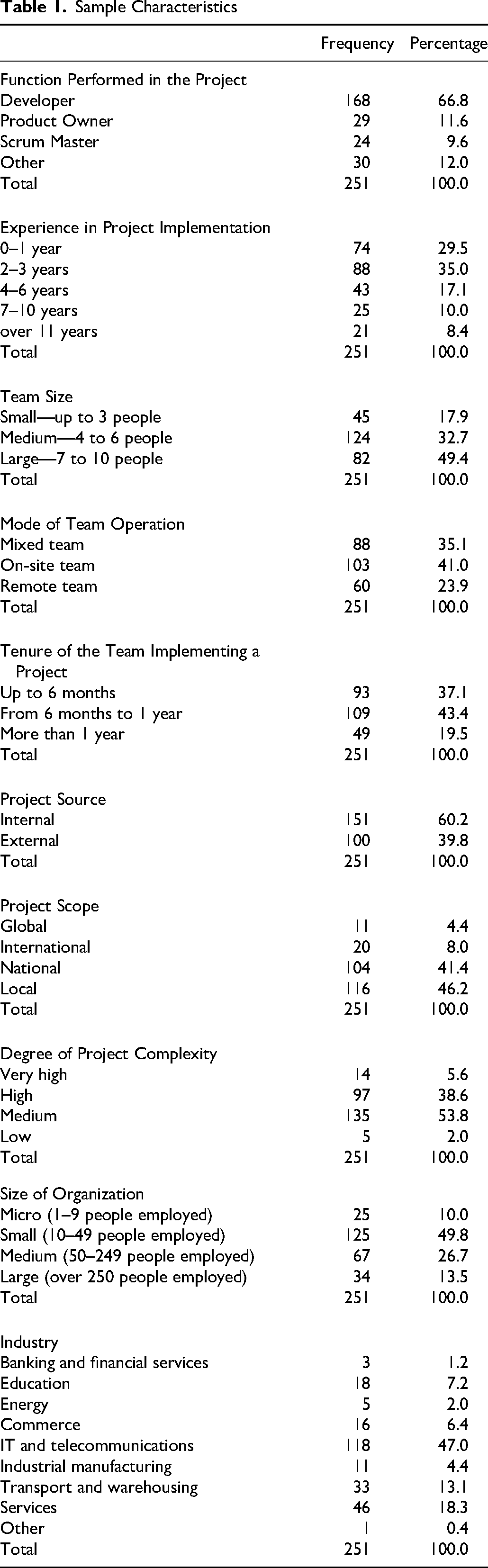
Owing to the character of the present research, purposive sampling was used to conduct the survey. The respondents were agile project team members who, during the course of the past year, had participated in a project consisting of iterations, during which the client’s requirements were changing, and every iteration ended with an increment in the product’s functionalities. Data were collected using the CATI (Computer Assisted Telephone Interviewing) method, whereby respondents are interviewed by phone and the person conducting the survey reads the questions and records the answers using a special form. The use of this method ensured reaching respondents who met the selection criteria, and thus a high accuracy and reliability of the data were obtained. A specialist external company was entrusted with conducting the survey with this method as well as the collection of empirical data. The independence of opinions of individual respondents, in other words, ensuring that they represent different agile project teams, was an important condition of the survey. A total of 2761 potential respondents were contacted as part of the survey. The recruitment questions verified whether the respondents had participated in an iterative and incremental project in the past year. Such an approach made it possible to select a group of 251 people who represented various agile project teams and fully responded to the statements in the survey questionnaire. They constituted the survey sample whose characteristics are presented in Table 1. An analysis of its structure (e.g., the role the respondents played in the team, characteristics of the implemented project, and type of organization) shows that the respondents in the sample represented different agile project teams and were involved in projects of different types and complexity, implemented by companies of different sizes, operating in different industries. It can therefore be assumed that the results of the survey accurately describe the behaviors influencing the quality of shared leadership and its impact on the performance of agile teams, projects that such teams implement, and organizations as a whole. The survey was conducted in December 2020 and January 2021 and was limited to Poland.
Sample Characteristics
Measurement
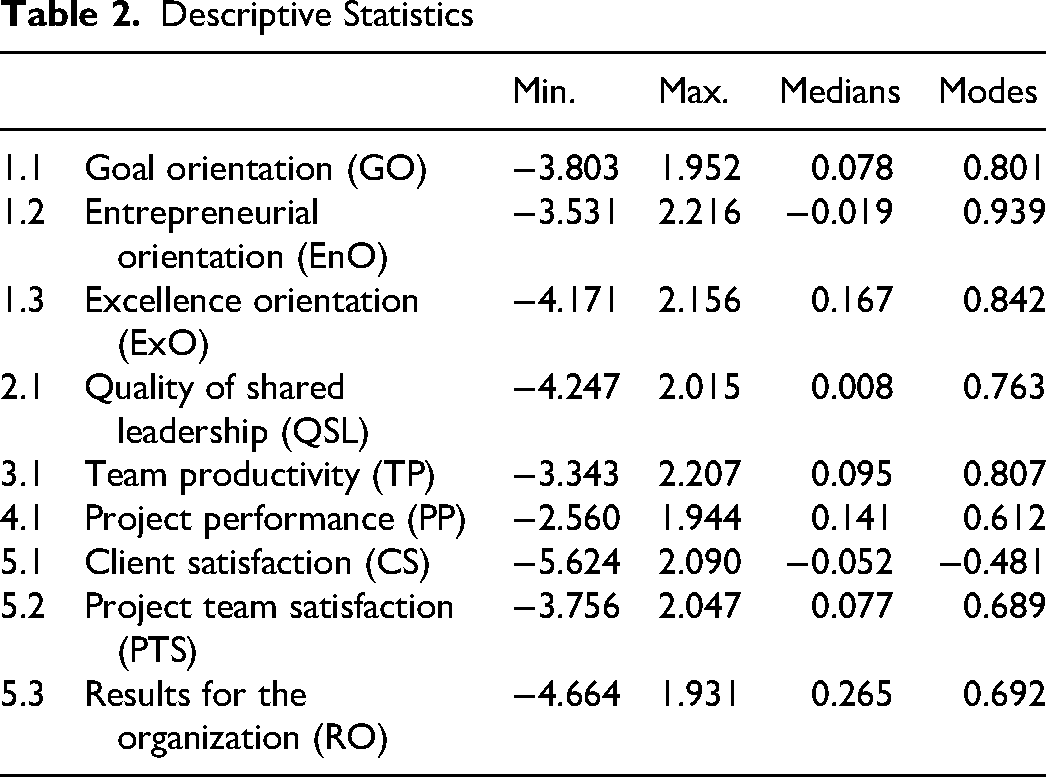
The operationalization of the latent variables was carried out using a multi-item scale. In the presented model, the rule of at least three items for constructs described by a greater number of observed variables was adopted (Hair et al., 2014). For the constructs goal orientation, entrepreneurial orientation, excellence orientation, quality of shared leadership, team productivity, client satisfaction, project team satisfaction, and results for the organization, the measurement scales were prepared for the purposes of the research procedure based on a review of the literature on the subject. The method of measuring the project performance construct is indicated in the literature (Badewi, 2016), and the measurement scale used in this case has already been used in previously conducted research (Teller & Kock, 2013; Tam et al., 2020). The measurement was conducted using a survey questionnaire and a dichotomous, seven-point Likert scale ranging from 1 (I definitely disagree) to 7 (I definitely agree). In our survey, we investigated the individual team members’ perceptual ratings of their agile team. Then, we calculated collective metrics representing the overall team attitude or behavior (Pearce & Sims, 2002; Hoch & Kozlowski, 2014; Grille & Kauffeld, 2015; Scott-Young, 2019). The descriptive statistics are shown in Table 2.
Descriptive Statistics
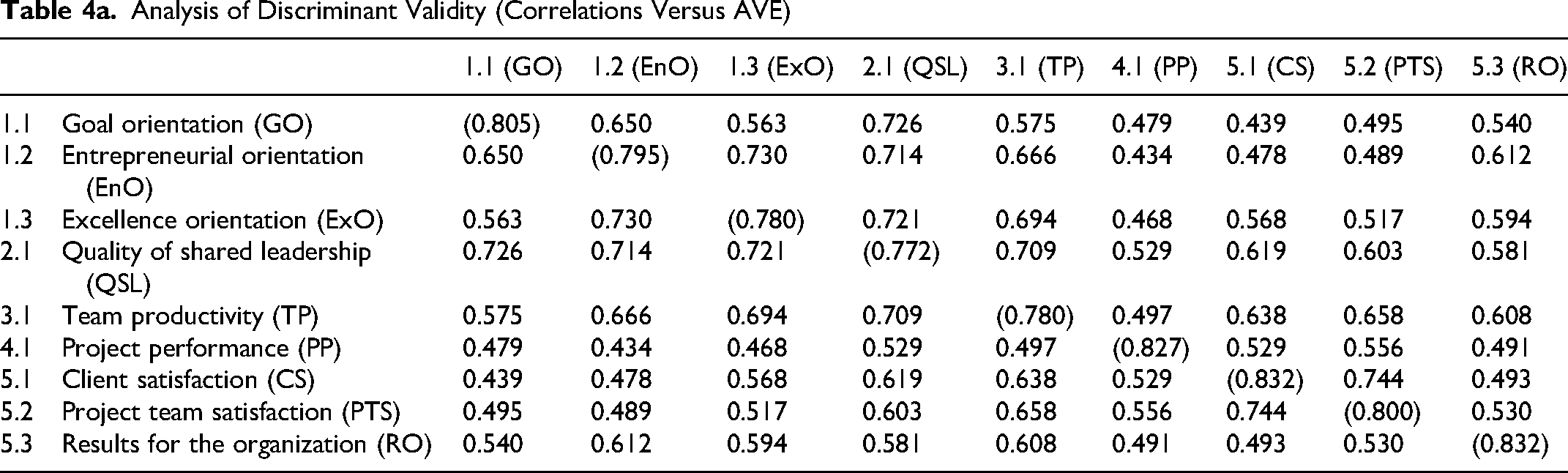
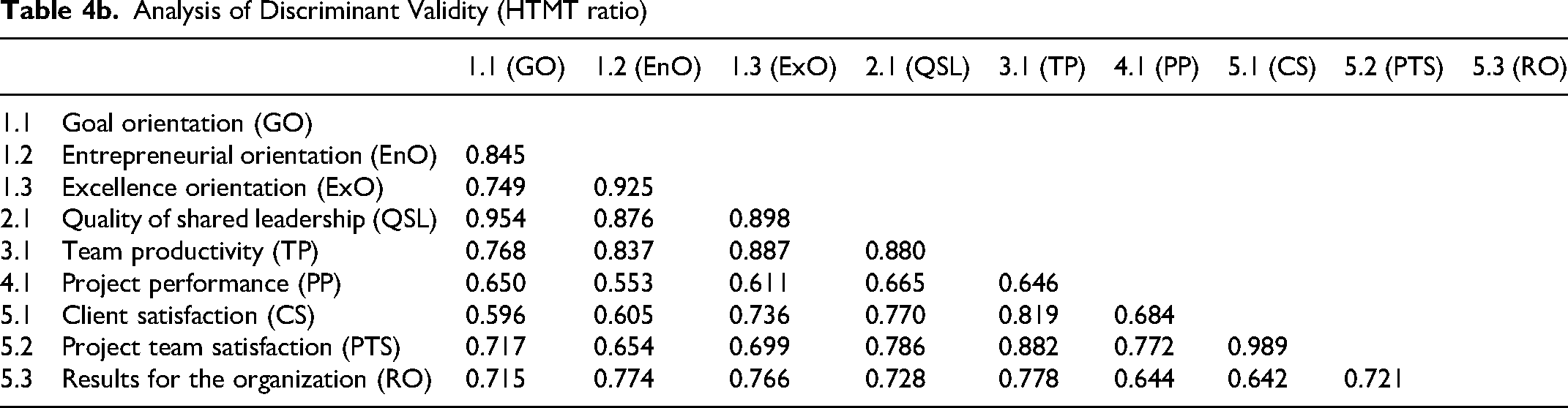
Due to the size of the survey sample and character of the survey, the PLS-SEM method was used. This method makes it possible to verify the existence of a cause-and-effect relationship among the variables in the model. It is recommended when the survey sample is not large, the analyzed data are not consistent with a normal distribution, and the tested structural model is complex, which means it contains a large number of constructs and measures (Hair et al., 2011). The validity of the measurement model was verified by means of confirmatory factor analysis (Brown, 2006). Convergent and discriminant validity tests were carried out to assess the validity of construct distinction. The convergent validity of the constructs was measured using AVE, and the discriminant validity of the constructs was measured using the HTMT ratio. The HTMT ratio assumes the value of < 0.9 when describing good discriminant validity and < 0.85 in the case of very good validity. Discriminant validity was also confirmed by comparing the construct correlations among latent variables with square roots of AVEs. The reliability of construct distinction was measured with Cronbach’s alpha and composite reliability (CR) coefficients. In the case of Cronbach’s alpha, the value of 0.6 is regarded as satisfactory reliability, whereas the value over 0.7 means good and over 0.9 excellent reliability (Cronbach, 1951). The value obtained for CR is interpreted in a similar way.
The adjustment of the structural model was assessed using the following measures: AVIF and AFVIF (examining the collinearity of variables), GoF (examining the predictive power of the model), SPR (occurrence of Simpson’s paradox), and SSR (analysis of statistical suppression). For AVIF and AFVIF, values < = 5 are acceptable and values < = 3.3 are ideal. In the case of the GoF index, the reference values are as follows: low predictive power > = 0.1, medium > = 0.25, and high > = 0.36. The SPR should take values > = 0.7 (the ideal value is 1). The reference values for SSR should be greater than 0.7. For SRMR and SMAR, in turn, values < = 1 are regarded as acceptable. Pooled standard error was used as part of the multigroup analysis method (MGA) to test the impact of moderator values on the path values of the model.
The calculations were carried out using the WarpPLS 7.0 software.
Results
The Measurement and Structural Model
The results of the convergent and discriminant validity tests for the individual constructs are shown in Tables 3, 4a, and 4b. The analysis of the obtained results shows that the constructs have an appropriate reliability and satisfactory convergent and discriminant validity.
Analysis of Reliability and Convergent Validity of the Constructs

The results of the confirmatory factor analysis verifying the validity of the measurement model are included in the Appendix at the end of the article. The model shows a good fit to empirical data: APC = 0.475, p < 0.001, AARS = 0.387, p < 0.001, AVIF = 2.233, AFVIF = 2.674, GoF = 0.502, SPR = 1.000, SSR = 1.000. The results of an extended analysis of the goodness-of-fit indices of the model show that it is a good fit: SRMR = 0.083 and SMAR = 0.067. Figure 3 shows the structural model describing the direction and strength of the predicted relationships among the latent variables. The research hypotheses were verified on their basis.
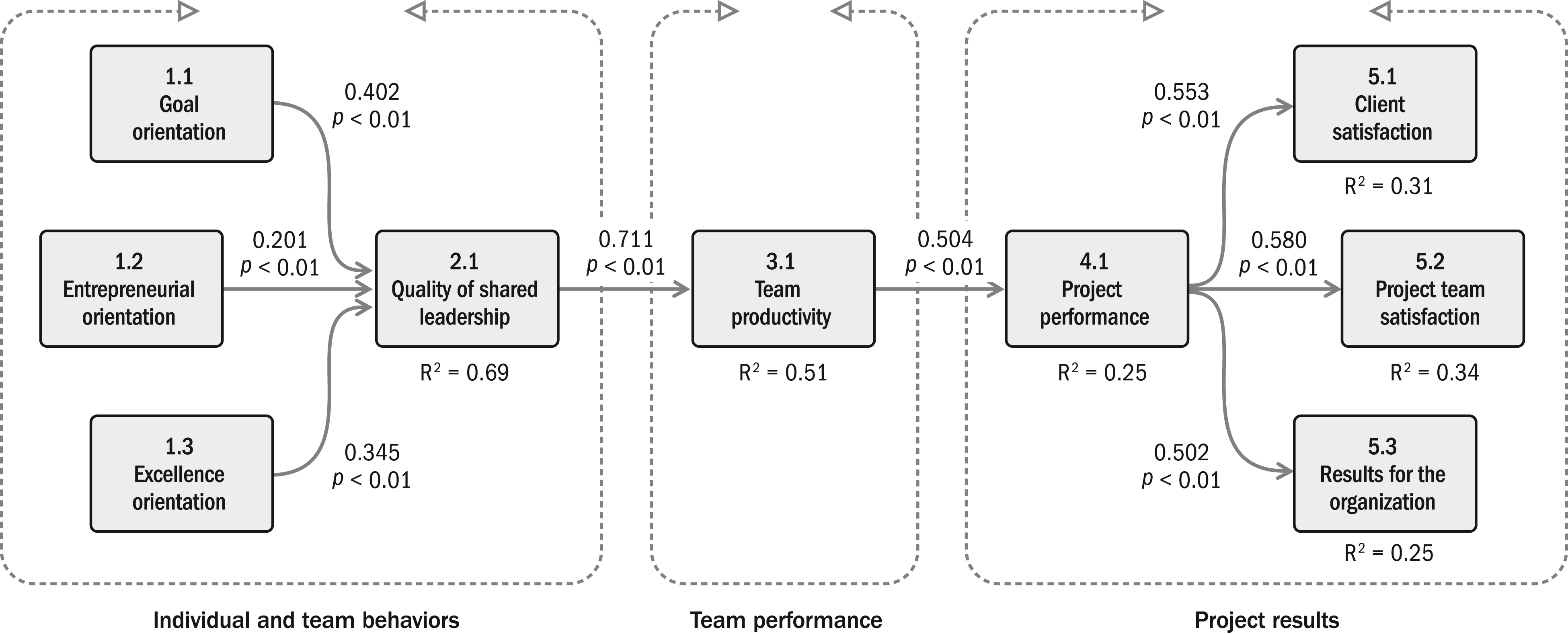
Research model with respective informants and results (n = 251).
According to the adopted hypotheses, goal orientation (H1), entrepreneurial orientation (H2), and excellence orientation (H3) of individuals and teams have an impact on the quality of shared leadership. Empirical data confirm that the goal (β = 0.402, p < 0.01), entrepreneurial (β = 0.201, p < 0.01), and excellence (β = 0.345, p < 0.01) orientation, manifested at the individual and team level, have a positive and statistically significant influence on the mutual influence process effectiveness in an agile project team. Thus, hypotheses H1, H2, and H3 were confirmed.
The conducted research also confirmed the assumption that the quality of shared leadership determines the level of productivity of an agile project team. This, in turn, influences the achievement of project performance. According to the adopted hypotheses, the quality of shared leadership has an impact on agile team productivity (H4), whereas productivity translates into project performance (H5). The obtained data show that the quality of shared leadership has a strong, positive, and statistically significant influence on the productivity of an agile project team (β = 0.711, p < 0.01). Empirical data also confirm that the productivity of an agile team has a positive influence on agile project performance (β = 0.504, p < 0.01). Thus, hypotheses H4 and H5 were also confirmed.
The influence of agile project performance on organizational effectiveness was also confirmed. According to the adopted hypotheses, the achieved project performance determines the level of client satisfaction (H6), project team satisfaction (H7), and results for the organization (H8). The analysis of empirical data confirms that the achievement of agile project performance exerts a positive and statistically significant influence on the level of client satisfaction (β = 0.553, p < 0.01), project team satisfaction (β = 0.580, p < 0.01), and the results generated by the project for the parent organization (β = 0.502, p < 0.01). Thus, the research hypotheses assuming the existence of such cause-and-effect relationships, that is, H6, H7, and H8 were confirmed.
The Influence of Moderating Variables
Pooled standard error was used as part of the multigroup analysis method (MGA) to test the impact of moderator on the path values of the model. The analyses of invariance indicate that the adopted moderating variables influence the strength of the paths but do not influence factor loadings. This means that the influence of moderators on the paths depends on moderating variables.
The first moderating variable was the role performed by a given member of an agile project team (Carson et al., 2007; Mathieu et al., 2008; Hoch & Kozlowski, 2014). We examined how the relationships among constructs would change depending on whether the respondents were developers (n = 168) or product owners and scrum masters (n = 53) (Schwaber & Sutherland, 2021).
The moderating effect of this variable on the relationships between the constructs goal orientation and quality of shared leadership proved statistically significant. In the case of developers, a slightly lower coefficient of covariance (β = 0.376, p < 0.02) between these variables was noted (Figure 4). For product owners and scrum masters, on the other hand, it was definitely higher (β = 0.669, p < 0.02). The moderating effect of this variable on the relationships between the constructs excellence orientation and quality of shared leadership proved statistically significant as well. In the case of developers, the coefficient of covariance between these variables was at a similar level (β = 0.371, p < 0.02), whereas for the product owners and scrum masters, it was definitely lower (β = 0.070, p < 0.02).
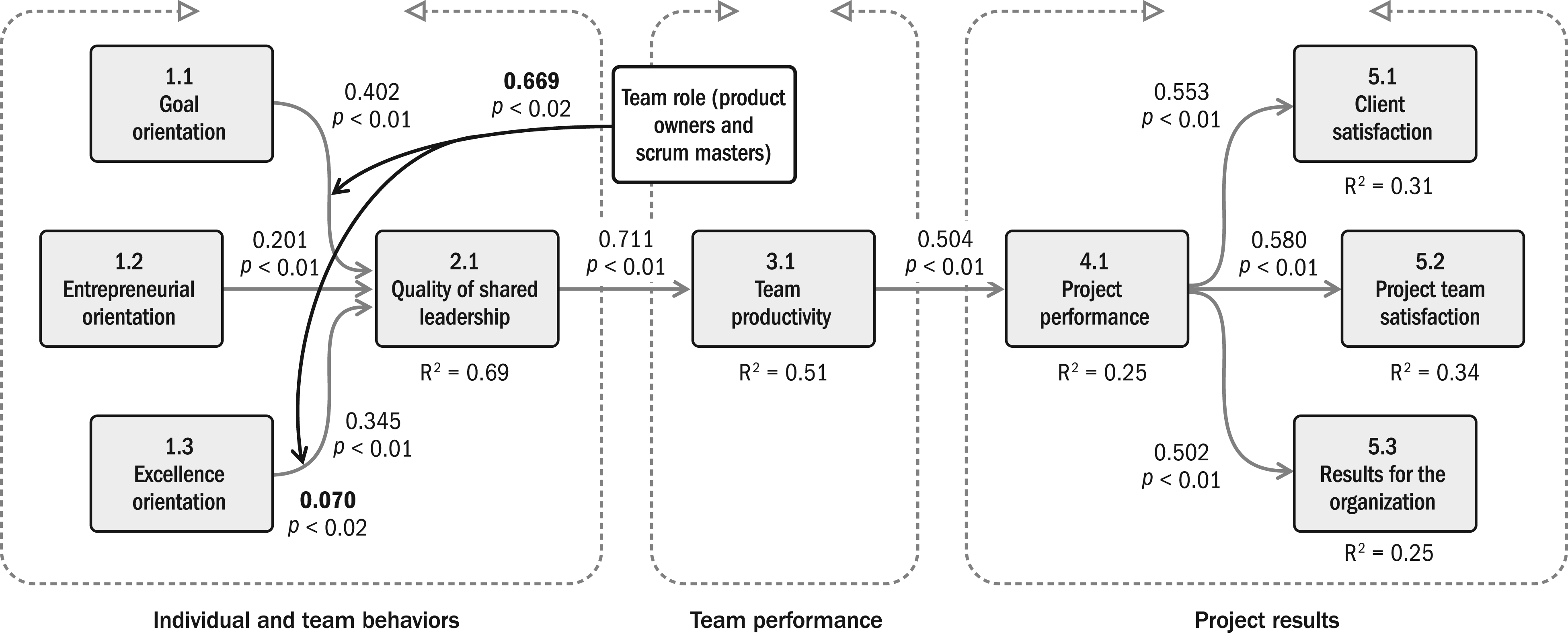
Structural model for the moderating variable role in team (product owners and scrum masters, n = 53).
Team size was the second moderating variable (Nicolaides et al., 2014). We examined how the relationships would change among constructs in the case of small (n = 45), medium (n = 124), and large (n = 82) agile project teams (Figure 5). Small teams consisted of up to three people, medium teams were from four to six people, and large teams were from seven to 10 people (Schwaber & Sutherland, 2021).
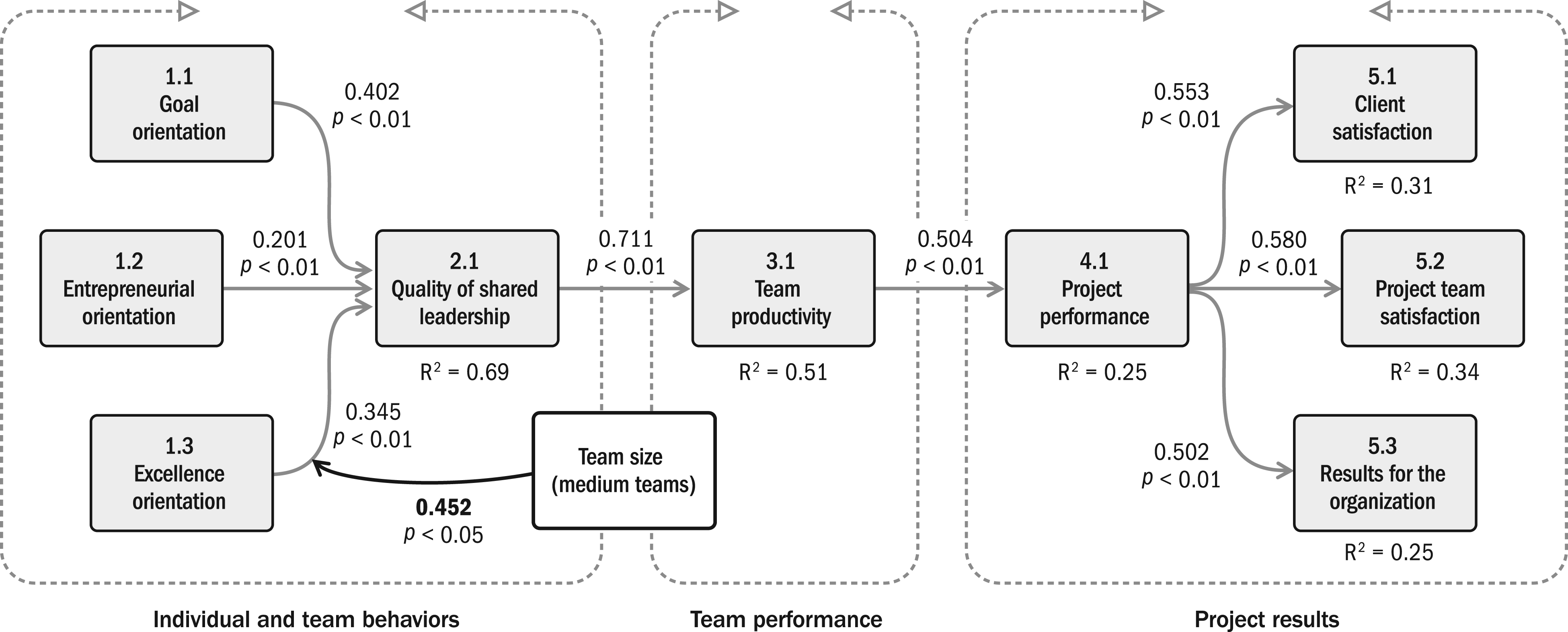
Structural model for the moderating variable team size (medium teams, n = 124).
The moderating effect of this variable on the relationships between the constructs excellence orientation and quality of shared leadership proved statistically significant (p < 0.05). Taking into account the moderating variable, the coefficient of covariance between these constructs for small teams was lower than in the structural model (β = 0.190, p < 0.05), also lower for large teams (β = 0.253, p < 0.05), but higher for medium teams (β = 0.452, p < 0.05). This means that the cause-and-effect relationship between the variables excellence orientation and quality of shared leadership is the strongest for medium teams (see Figure 5).
Team dispersion and virtuality was the next moderating variable (Hoch & Kozlowski, 2014). We examined how the relationships would change among constructs in the case of on-site (n = 103), remote (n = 60), and hybrid (n = 88) agile project teams (Figure 6).
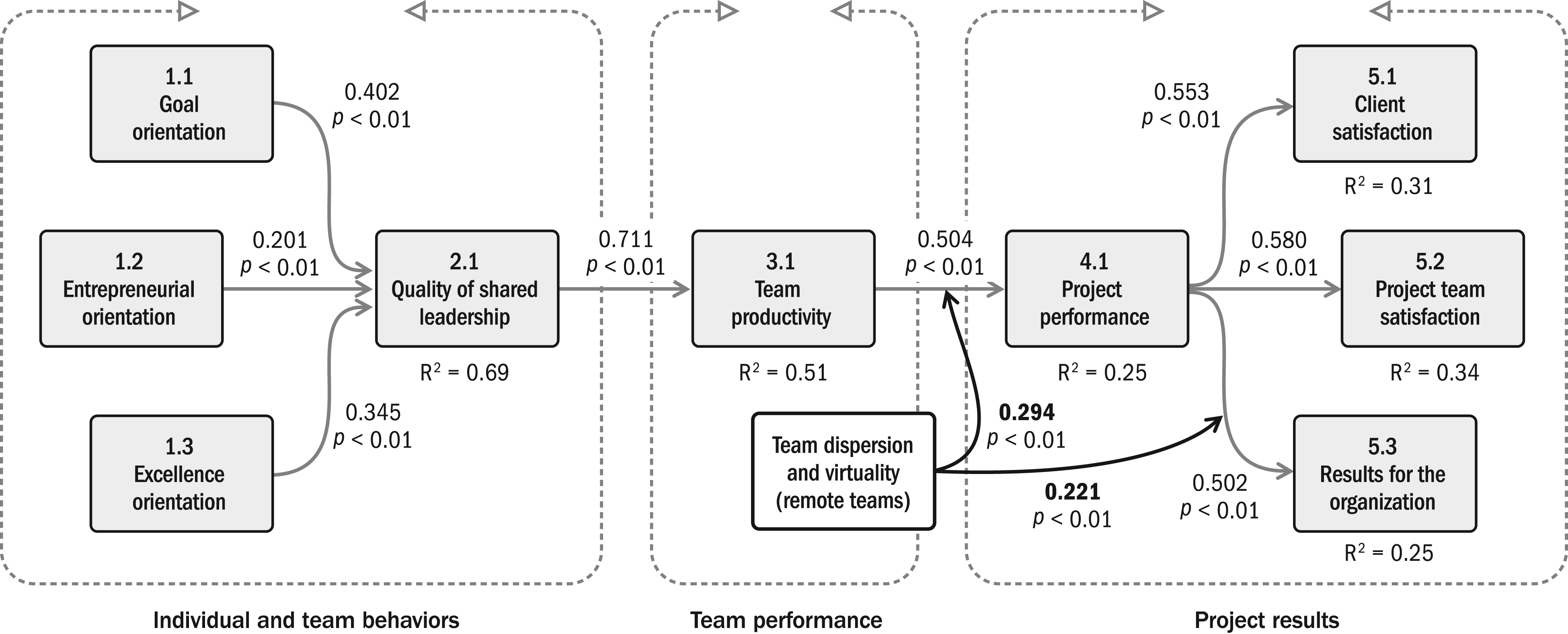
Structural model for the moderating variable team dispersion and virtuality (remote teams, n = 60).
The moderating effect of this variable influenced the relationships between the following constructs: team productivity and project performance, project performance and results for the organization. In the case of teams working on-site, the covariance coefficient reflecting the influence of agile team productivity on agile project performance (β = 0.536, p < 0.01) was comparable to the values for the structural model. The influence of agile project performance on the results for the organization was higher (β = 0.635, p < 0.01). For teams working in hybrid mode, in other words, combining remote and on-site work, these factors were higher: β = 0.644, p < 0.01 and β = 0.625, p < 0.01, respectively. In the case of agile teams working exclusively in remote mode, the covariance coefficients describing the strength of the relationship of team productivity with agile project performance and of agile project performance with results for the organization were definitely lower than the coefficients for the structural model (see Figure 6). The values were as follows, respectively: β = 0.294, p < 0.01 and β = 0.221, p < 0.01.
The team tenure variable was found to have no statistically significant moderating effect on the relationships among constructs in the model (Wang et al., 2014). Agile teams working together for less than six months (n = 93), working together for six months to one year (n = 109), and working together for more than one year (n = 49) were investigated.
Findings
According to the survey findings, goal (β = 0.402, p < 0.01), entrepreneurial (β = 0.201, p < 0.01), and excellence orientation (β = 0.345, p < 0.01), manifested at the individual and team level, determine the quality of shared leadership in an agile project team. The survey results indicate that these behaviors (orientations) of the individual team members reinforced at the team level have a positive influence on how shared leadership emerges in an agile project team (Carson et al., 2007; Mathieu et al., 2008; Hoch & Dulebohn, 2013). The survey results also confirmed the existence of a very strong and statistically significant influence of the quality of shared leadership on the productivity of an agile project team (β = 0.711, p < 0.01). Our research demonstrates that the quality of shared leadership determines an agile project team’s productivity, understood as the amount of work completed by such a team during an iteration (Trendowicz & Münch, 2009; Melo et al., 2013; Fatema & Sakib, 2017). In turn, the productivity of an agile project team translates into agile project performance, understood as the achievement of the project objective with regard to the key parameters, which are scope, time, and budget (Badewi, 2016; Malik et al., 2021). This cause-and-effect relationship can also be described as strong (β = 0.504, p < 0.01). The achievement of the expected agile project performance determines the achievement of project effectiveness, that is, client satisfaction (β = 0.553, p < 0.01), project team satisfaction (β = 0.580, p < 0.01), and results for the organization (β = 0.502, p < 0.01). The obtained results confirm that shared leadership has a direct influence on the productivity of an agile project team and an indirect influence on project efficiency and effectiveness. This confirms researchers’ assumptions that shared leadership can create multilevel and the more distal outcomes (Mathieu et al., 2008; Scott-Young et al., 2019). Thus, the relationships between all the constructs and hypotheses (H1, H2, H3, H4, H5, H6, H7, and H8) were confirmed. The assumptions in the hypothetical–deductive model were confirmed in empirical terms (see Figure 3).
The results of the analysis of how the moderating variables influence the strength of the relationship among constructs in the structural model are also interesting. It turns out that, from the perspective of developers, the quality of shared leadership is similarly influenced by goal orientation (β = 0.376, p < 0.02) and excellence orientation (β = 0.371, p < 0.02). On the other hand, from the perspective of the product owners and scrum masters, goal orientation has the strongest influence on the quality of shared leadership (β = 0.669, p < 0.02), whereas excellence orientation is of marginal importance in this case (β = 0.070, p < 0.02). This allows us to conclude that developers regard goal orientation and excellence orientation as equally significant behaviors influencing the appropriate quality of shared leadership. Among product owners and scrum masters, goal orientation is predominant. It was found that the strength of relationships between constructs excellence orientation and quality of shared leadership was also influenced by the team size moderating variable (Nicolaides et al., 2014). In the case of small and large teams, the influence of excellence orientation on the quality of shared leadership was smaller than in the structural model (β = 0.190, p < 0.05 and β = 0.253, p < 0.05 respectively), whereas in the case of medium teams, it was greater (β = 0.452, p < 0.05). This means that in the case of medium teams, excellence orientation is the factor with the strongest impact on the quality of shared leadership. Interesting results were also observed in the case of the moderating variable team dispersion and virtuality (Hoch & Kozlowski, 2014). Our research shows that in the case of agile teams working in hybrid mode, in other words, on-site work combined with remote work, team productivity has the strongest impact on project performance (β = 0.644, p < 0.01), whereas project performance influences other results for the organization (β = 0.625, p < 0.01). For teams working only remotely, the influence of productivity on project performance is smaller (β = 0.294, p < 0.01). In the case of remote teams, the influence of project performance on the results for the organization is much smaller as well (β = 0.221, p < 0.01). The obtained results show that in the case of agile teams working in hybrid mode, team productivity has the strongest impact on project performance, whereas project performance translates into results of key importance for the further development of an organization. For teams working only remotely, the influence of team productivity on project performance becomes considerably weaker. The influence of the project performance on results of key importance for the further development of an organization is much weaker as well. In the case of the tenure of an agile team carrying out a project, this variable was found to have no statistically significant moderating effect on the relationship among constructs in the model (Wang et al., 2014).
The results of discriminant validity analysis are also intriguing (see Table 4b). They show that agile team members have a similar perception of the constructs client satisfaction and project team satisfaction. They treat these two aspects of project results in a similar way, associating client satisfaction with team satisfaction (HTMT ratio 0.989). This is all the more remarkable because previous research shows that these constructs, making up the project results, are viewed by the respondents differently (Jiang et al., 2016; IPMA, 2016; Carvalho & Rabechini, 2017). This is evidence of a change in how these issues are viewed by members of agile project teams. They treat these two aspects of project results as one, associating client satisfaction with team satisfaction.
Analysis of Discriminant Validity (Correlations Versus AVE)
Analysis of Discriminant Validity (HTMT ratio)
Discussion
Theoretical Implications
Agile project teams have a high degree of independence when establishing their own goals, monitoring their own progress, and making decisions (Denis et al., 2012). In such teams, leadership is shared and decisions are made collectively. Thus, the issues of power, competition, and conflicts may interfere with shared leadership (Holm & Fairhurst, 2018). Nevertheless, the organization and manner of operation of these teams make it possible to mitigate this risk, which has a positive influence on how shared leadership emerges in such a team and on the team’s ability to create multilevel outcomes (Leffingwell, 2010; Scott-Young et al., 2019). It seems that the attitude of an organization’s top management, allowing experimentation and fluctuation of leadership within agile project teams, definitely facilitates the achievement of these outcomes (Pearce & Sims, 2002; Lichtenstein & Plowman, 2009). The analysis of the characteristics of shared leadership in agile project teams indicates that it becomes even more similar to teamwork, which results in the blurring of differences between this form of leadership and other phenomena such as problem-solving, collaboration, or teamwork (Denis et al., 2012; Gronn, 2015; Holm & Fairhurst, 2018).
The non-traditional way in which agile teams without a formal leader are organized and in which they function allows us to assume that shared leadership can be an effective form of leadership for them. It is also the reason why using other forms of plural leadership, and even more so vertical or balanced leadership, will not necessarily bring the expected results (Denis et al., 2012; Müller et al., 2018; Holm & Fairhurst, 2018), while they may even have a negative impact on how such teams function. The obtained results indicate unequivocally that shared leadership, being an outcome of the mutual influence process, is an effective form of leadership for agile teams, allowing them to achieve team performance, project efficiency, and effectiveness. This confirms observations previously made by researchers that agile project teams can draw significant benefits from using this particular form of leadership (Denis et al., 2012; Scott-Young et al., 2019), and challenges the idea, prevalent in the literature on project management, of the importance of the project manager as an individual (Geoghegan & Dulewicz, 2008; Anantatmula, 2010) or supportive (Müller et al., 2018) leader. It also confirms the noticeable shift from individual leadership to collective leadership (Cullen-Lester & Yammarino, 2016), which is a result of the growing popularity of the agility paradigm (Conforto et al., 2016).
A detailed analysis of the research results allows us to conclude that goal, entrepreneurial, and excellence orientation manifested at the individual and team level have a beneficial influence on successful shared leadership in an agile project team. This means that entrepreneurial, excellence, and goal-oriented members of agile project teams are more comfortable with the shared leadership formula. Such an orientation of team members triggers in them the desire to be leaders and decide on team activities, which influences how shared leadership emerges in agile project teams. Agile team members sharing common beliefs and aspiring to similar things have a greater trust in one another and cooperate more effectively, which translates into the quality of shared leadership (Mathieu et al., 2000; Zaccaro et al., 2001). The obtained results confirm what other researchers have found, namely that the behaviors of the individual team members (Carson et al., 2007), reinforced at the team level (Hoch & Kozłowski, 2014) have a significant impact on the way shared leadership emerges in agile project teams. Our research also confirms that the use of shared leadership by agile project teams enables them to attain multilevel and more distal outcomes. While such a capacity was predicted by researchers for traditionally organized project teams using this form of leadership (Pearce & Conger, 2003; Mathieu et al., 2008; Scott-Young et al., 2019), our survey has confirmed its occurrence in agile project teams as well. The obtained results prove that the way shared leadership emerges in an agile project team has a beneficial and direct influence on its productivity. This means that efficiently distributed and voluntarily shared leadership improves the functioning of agile project teams thanks to a more even distribution of the workload, increased task capacity, and improved task performance. The results of our research confirm previous research findings assuming the positive influence of shared leadership on project team performance (D’Innocenzo et al., 2016; Chiu et al., 2016; Bruccoleri et al., 2019). Thus, the positive influence of shared leadership on team performance has also been confirmed for the specific type of teams, that is, agile project teams (Sousa & van Dierendonck, 2016; Srivastava & Jain, 2017). Our study demonstrates that using shared leadership by agile project teams also enables the creation of the more distal outcomes at the project and organizational level. The obtained results confirm the indirect influence that shared leadership used by agile teams has on project performance on scope, time, and expenses. An effective mutual influence process, through which leadership is efficiently distributed and voluntarily shared within an agile project team, makes it possible to attain the planned productivity level of such a team and thus deliver project performance on scope, time, and expenses. This confirms the findings of other researchers who assumed that using shared leadership by project teams could have a positive influence on the successful delivery of project results (Stankovic et al., 2013; Malik et al., 2021). It is debatable whether the influence of shared leadership on project results is indirect (Scott-Young et al., 2019) or direct (Imam & Zaheer, 2021), because project success can be influenced by many other factors alongside shared leadership. The obtained results suggest that this influence is indirect, and the achievement of outcomes at the project level depends on the way that shared leadership emerges in an agile project team. Our research also confirms that successful shared leadership in an agile project team indirectly enables the achievement of the more distal outcomes (i.e., project effectiveness) thanks to the delivery of project objectives. This confirms other researchers’ assumptions about the existence of an indirect influence of shared leadership on client satisfaction (Carson et al., 2007), business performance (D'Innocenzo et al., 2016), and organizational effectiveness (Pearce & Sims, 2002).
Our research has also demonstrated the influence of contextual factors moderating shared leadership relationships. These factors were previously identified by researchers (Carson et al., 2007; Mathieu et al., 2008; Hoch & Kozlowski, 2014; Nicolaides et al., 2014; Wang et al., 2014), and their influence was expected to impact the inputs and outputs of the mutual influence process (Scott-Young et al., 2019). The influence of the following moderating variables was verified: role in an agile team, team size, team tenure, team dispersion, and virtuality. The obtained results indicate that the role performed in an agile team determines the way of thinking about shared leadership. Developers conclude that the quality of shared leadership is influenced by goal, entrepreneurial, and excellence orientation in a similar way. From the perspective of effective shared leadership, goal orientation is crucial to other agile team members. This confirms the influence of the role in a team moderating variable on the inputs of the mutual influence process (Mathieu et al., 2008; Hoch & Kozlowski, 2014) and indicates the relevance of building a sense of shared purpose among members of an agile project team (Carson et al., 2007). The obtained results show that the continuous striving for excellence is a factor that exerts the strongest influence on how leadership is distributed and shared in medium agile project teams. It is understandable because such teams can benefit from the knowledge and experience of an optimal number of members, which stimulates collectivism, knowledge sharing, and learning, and has a positive impact on the way shared leadership emerges in agile project teams. The obtained results confirm the influence of the team size moderating variable on shared leadership inputs (Nicolaides et al., 2014). However, the results of our research do not confirm the moderating effect of the tenure of an agile team carrying out a project. The influence of this variable on shared leadership inputs (Wang et al., 2014) and outputs (Nicolaides et al., 2014) was predicted by researchers. The obtained results also indicate that agile project teams that use shared leadership and combine on-site and remote work modes are the ones that deliver project objectives and the more distal outcomes (it means, project effectiveness) most efficiently. On the other hand, in the case of teams working exclusively in remote mode, it is more difficult to translate the productivity of an agile team into project performance and business effectiveness. Our research confirms the assumptions of other researchers who predicted the influence of the team dispersion and virtuality moderating variable on shared leadership relationships (Hoch & Kozlowski, 2014).
Practical Implications
The obtained results can also be valuable from the practical perspective. The empirical verification that shared leadership in the agile project management context should be considered from a multilevel perspective can provide important information to managers of organizations moving toward agility. According to our findings, the orientation (that is, way of thinking and acting) of individual members and an entire agile project team has a positive impact on the quality of shared leadership. This means that entrepreneurial, excellence, and goal-oriented members of agile project teams are more comfortable with the shared leadership formula. These behaviors trigger in them the desire to be leaders, actively influence the way their team operates, and decide on its activities, which has a beneficial influence on how shared leadership emerges in an agile project team. Thus, in order to improve the effectiveness of the mutual influence process in agile project teams, goal orientation, entrepreneurial attitudes, and continuous striving for excellence should be developed among team members because the influence of such behaviors on the quality of shared leadership in agile project teams has been confirmed empirically.
The knowledge presented in this article can be useful in the management of agile organizations in the context of selecting and configuring agile project teams whose members are to share leadership functions. Our research indicates that team members who have common beliefs and similar aspirations place a greater trust in one another and cooperate more effectively, which translates into the way that shared leadership emerges in agile project teams (Mathieu et al., 2000; Zaccaro et al., 2001). Practitioners will also find it interesting to know that the use of shared leadership by agile project teams enables them to achieve not only the planned team performance but also, more importantly, the more distal outcomes, in other words, successful delivery of project objectives, client satisfaction, business performance, and organizational effectiveness.
Limitations and Future Work
The limitations of the present survey primarily concern the sampling method used (purposive sampling), which means that the sample does not meet the criteria of representativeness in statistical terms. Nonetheless, the analysis of the sample structure indicates that the respondents represented different agile project teams. The analysis of the sample structure indicates the dominant position of companies operating in the IT and telecommunications industry and in services. This confirms the researchers’ observation that agile teams most often work on projects in the IT industry (Hoda & Murugesan, 2016; Oprins et al., 2019), even though they more and more frequently appear in other industries as well (Ciric et al., 2018; Papadakis & Tsironis, 2018). What is unique about companies in these industries is the high degree of integration of the offered product or service with the software component, which allows creating added value for the customer. It can be thus assumed that the obtained results can also be representative for companies from other industries, offering products with similar characteristics (for example, banks). A certain limitation is the fact that most of the scales used to measure the studied phenomena were developed for the purposes of the research procedure and had not been verified before. The adequacy of the scales used could be verified and validated in future research.
Researchers can also focus on validating and scaling the model proposed in the article, including looking for ways to measure aspects that were not included in this study, but play an important role in project implementation by agile teams. In their future work, researchers can verify whether competition and conflicts influence the quality of shared leadership in agile project teams (Holm & Fairhurst, 2018) and confirm the positive influence of the attitude of an organization’s top management on how shared leadership emerges in agile project teams (Pearce & Sims 2002; Lichtenstein & Plowman, 2009). It is also worth verifying and validating the logic of multilevel outcome creation adopted in the model in different types of teams (Scott-Young et al., 2019). A replication of the survey according to the research model proposed would enable the verification of the findings in other countries as well, taking into account different cultural determinants, because the literature indicates a possible influence of national culture on the efficiency of shared leadership (Antonakis et al., 2012).
Conclusions
The article contributes to leadership theory in the plural leadership research stream. It indicates the circumstances that make shared leadership an effective form of leadership for agile project teams, and verifies whether using this kind of leadership enables such teams to achieve team performance as well as create the more distal outcomes.
The obtained results confirm that agile project teams whose members are empowered to engage in leadership functions or processes can achieve significant benefits when applying shared leadership. Our research confirms a positive direct influence of shared leadership on the productivity of agile project teams and a positive indirect influence of using this form of leadership on project efficiency and effectiveness. This challenges the dominant idea of the importance of the project manager as a team leader and confirms the noticeable shift from individual leadership to collective leadership. The research also verified the importance of goal, entrepreneurial, and excellence orientation in ensuring the quality of shared leadership, as well as the project team–related contextual factors moderating the shared leadership relations.
We hope that this study will contribute to the advancement of knowledge in the field of collective leadership and its impact on team, project, and organizational results.
Footnotes

Author Biographies
Appendix. Specification of the Measurement Model (Results of the Confirmatory Factor Analysis)
Composite reliability coefficient = 0.844 Cronbach’s alpha = 0.720
Average variances extracted = 0.648
The team was involved in defining the project goal.
0.657
The team members took an active part in defining the iteration goal.
0.868
The team was striving to achieve the goal set for an iteration.
0.870
Composite reliability coefficient = 0.873 Cronbach’s alpha = 0.806
Average variances extracted = 0.632
The team members had autonomy in performing the work assigned to them.
0.782
When working on the product, the team members preferred innovative solutions.
0.805
The team’s willingness to take risks was accepted by the management.
0.826
The team members cared about the competitiveness of the product they were working on.
0.767
Composite reliability coefficient = 0.861 Cronbach’s alpha = 0.784
Average variances extracted = 0.608
The team members indicated the possible improvements at the end of an iteration.
0.779
The improvements indicated by the team were applied in subsequent iterations.
0.813
The team was aware of the need to improve the way it works.
0.806
The team members were improving the product based on systematic inspection and adaptation.
0.716
Composite reliability coefficient = 0.881 Cronbach’s alpha = 0.830
Average variances extracted = 0.596
The team members trusted one another when making decisions in the project.
0.769
The team members were supportive and helped one another.
0.819
All the team members had an opportunity to demonstrate their leadership skills.
0.748
The team members had common goals when implementing the project.
0.773
The team members were jointly making key decisions in the project.
0.750
Composite reliability coefficient = 0.861 Cronbach’s alpha = 0.784
Average variances extracted = 0.608
The team achieved the assumed average sprint velocity.
0.767
During an iteration, the team completed more tasks than planned.
0.800
The achievement of the expected level of team productivity resulted in the lack of delays in the project.
0.822
The quality of work performed by the team conformed to the set parameters.
0.726
Composite reliability coefficient = 0.866 Cronbach’s alpha = 0.767
Average variances extracted = 0.683
The project was completed according to its defined scope.
0.806
The project was completed within the set budget.
0.876
The project was completed according to the accepted schedule.
0.796
Composite reliability coefficient = 0.871 Cronbach’s alpha = 0.778
Average variances extracted = 0.692
The client was satisfied with the product created.
0.827
The client expressed their satisfaction and declared their willingness to work again.
0.842
The client’s expectations and needs were well understood by the team.
0.827
Composite reliability coefficient = 0.840 Cronbach’s alpha = 0.712
Average variances extracted = 0.641
The team members expressed satisfaction with their participation in the project.
0.855
The team members declared their willingness to work together again on subsequent projects.
0.876
The team members shared their favorable opinion about working in the team.
0.651
Composite reliability coefficient = 0.871 Cronbach’s alpha = 0.777
Average variances extracted = 0.693
New knowledge and competences crucial for the organization’s development were obtained thanks to the implementation of the project.
0.771
The implementation of the project enabled the organization to increase its competitive edge.
0.879
The implementation of the project enabled the organization to increase its market share.
0.843