







Abstract
Despite abundant research on project management offices and project portfolio management offices (PPMOs), it is still unclear whether PPMOs contribute to business success. This study explores the role of employee voice behavior in the relationship between PPMOs and business success. The findings from 255 portfolios reveal that PPMO contributions and voice behavior positively relate to management quality, which subsequently relates to business success. Moreover, voice behavior enhances the relationships among PPMO contributions, management quality, and business success. These results have important implications for research on voice behavior in a multiproject context and for understanding PPMOs’ performance and social dynamics.
Keywords
Introduction
A project portfolio management office (PPMO)—a type of project management office (PMO)—is a centralized organizational unit that supports a project portfolio’s stakeholders in managing the collection of multiple projects. Despite the abundance of research on PMOs in general (Aubry et al., 2007; Aubry et al., 2010; Aubry et al., 2014; Bredillet et al., 2018a; Müller et al., 2013; Pellegrinelli & Garagna, 2009; Tsaturyan & Müller, 2015) and quantitative work on the performance of PMOs (Dai & Wells, 2004; Otra-Aho et al., 2018) and PPMOs (Unger et al., 2012a), the relationship to organizational performance, specifically business success, is still unclear (Aubry et al., 2009). Additionally, previous research investigating PPMOs’ performance effects did not consider necessary boundary conditions that enable or reduce PPMOs’ benefits (Unger et al., 2012a). Specifically, organizational benefits of PPMO contributions—directed at improving prioritization, coordination, and knowledge transfer—might strongly depend on project employees’ information behavior, specifically their voice behavior.
Voice behavior is the “discretionary communication of ideas, suggestions, concerns, or opinions about work-related issues with the intent to improve organizational or unit functioning” (Morrison, 2011, p. 375). Employee voice behavior is intentionally constructive extra-role behavior focused on changing the current situation, processes, or procedures and may help the organization reach its goals. Open communication is generally important in project work (Zaman et al., 2021), and the extra-role communication behavior of portfolio stakeholders should be specifically relevant (Beringer et al., 2013; Kaufmann & Kock, 2023). Yet, previous research on voice behavior in a multiproject context is rare (Ekrot et al., 2016; Jiang et al., 2023; Kaufmann et al., 2020), and no previous study has analyzed its interaction with PPMO contributions. Therefore, this article addresses two research questions:
How do PPMO contributions and project employee voice behavior relate to project portfolio management quality and, eventually, business success?
How do PPMO contributions and project employee voice behavior interact in their influence?
Project portfolio management (PPM) quality is the central mediator in our framework, defined as “the degree of excellence to which the project portfolio management process is executed” (Jonas et al., 2013, p. 216). Our central hypotheses are that PPMO contributions and project employee voice behavior independently improve PPM quality and leverage each other. PPMOs increase the information quality and the communication flow between projects and portfolio managers who decide about resource allocation to projects and coordination between them to exploit synergies and mitigate risks. PPMOs also increase the information flow for project resource demands and resource deliveries from line units. Project managers and team members who raise their voices give essential hints on improving practices in PPM and creating more value for their projects. More importantly, we assume these two influences leverage each other and each is necessary to unfold the other’s benefits. In other words, it takes two to tango: PPMOs are brokers who listen to project managers’ voices, use their suggestions, and communicate them to senior management; engaged project managers who raise their voices support PPMO managers in getting the necessary information. PPMO managers and project managers may thus recognize, re-enforce, and stabilize each other.
We empirically investigate these questions using a multi-informant survey of 255 project portfolios involving 1,576 informants. Portfolio managers assessed PPMO contributions, portfolio decision makers assessed outcomes, and several project managers (median of three per portfolio) assessed voice behavior. The results show that PPMO contributions and voice behavior leverage each other: Without sufficient project employee voice behavior, higher PPMO contributions are not associated with PPM quality and vice versa. PPM quality, in turn, positively relates to business success. Voice behavior also strengthens the relationship between PPM quality and business success. The results contribute to research on the performance of PMOs, the financial consequences of portfolio management processes, and the role of voice behavior in project environments. Specifically, the findings have implications for understanding the PPMO as a social phenomenon and for understanding voice behavior’s organizational consequences in a multiproject context.
Conceptual Background
Project Portfolio Management Offices
A project management office (PMO) is a department or group in an organization responsible for the centralized and coordinated management of projects. The PMO helps standardize and improve project management processes and supports and guides project managers. PMOs can focus on a single project, a group of projects, or an organization’s entire project portfolio. Consequently, they can operate at various organizational levels and have multiple, diverse responsibilities (Hobbs & Aubry, 2007); for example, developing project methodology, supporting ongoing projects, providing training and development opportunities to project employees, or coordinating the project portfolio. According to their diverse functionalities, different types of PMOs have evolved, which have been described and categorized by previous research (Artto et al., 2011; Aubry & Brunet, 2016; Hobbs & Aubry, 2007; Kaul & Joslin, 2018; Müller et al., 2013; Sandhu et al., 2019).
Previous research analyzed PMOs’ dynamic evolution (Aubry, 2015; Aubry et al., 2010; Bredillet et al., 2018a; 2018b), their role in organizational change (Pellegrinelli & Garagna, 2009), or as a value-realizing function (Hurt & Thomas, 2009). Other research modeled the capabilities of high-performing PMOs (Ershadi et al., 2023) or investigated how PMOs support learning (Hadi et al., 2022; Pemsel & Wiewiora, 2013), innovation (Sergeeva & Ali, 2020), development of business ecosystems (Sandhu et al., 2019), and continuity among life cycle phases (Paton & Andrew, 2019). The success of PMOs has been discussed intensively, for example, by Kaul and Joslin (2018) in their structured overview. They suggest that PMO success should encompass (1) successfully achieved performance of delivered services, (2) successfully achieved internal development of PMOs, and (3) successfully achieved contribution to discrete success outcomes, for example, project success. However, findings on the performance impact of PMOs are somewhat mixed (Dai & Wells, 2004; Otra-Aho et al., 2018), and it is difficult to determine the direct effects due to PMOs’ diverse and constantly changing responsibilities (Aubry et al., 2010).
We concentrate on the project portfolio management office (PPMO), a type of PMO specifically focused on supporting the portfolio of projects within an organization (Unger et al., 2012a). The PPMO essentially acts as a project portfolio manager (Jonas, 2010) and provides decision support for evaluating, selecting, prioritizing, and managing the portfolio of projects to ensure they align with the organization’s strategic goals. It is also responsible for monitoring and controlling the portfolio of projects to ensure they are on track and delivering the expected benefits. Unger et al. (2012a) identify three roles a PPMO fulfills: a coordinating role, a controlling role, and a supporting role. The coordinating role means steering the project portfolio under senior management’s mandate, including appraising projects, allocating resources, and facilitating cross-project and cross-department cooperation. The controlling role involves providing decision-making support by gathering, updating, and providing reliable and current information on projects and resources. The supporting role offers project managers and team members services during project implementation. These services include developing and promoting standards and supporting knowledge management and learning. Unger et al. (2012a) quantitatively show that the coordinator role improves cooperation and resource allocation quality, and that the controller role improves information quality.
Although these findings suggest positive performance outcomes of PPMOs, previous research did not establish a link to organizational success such as business success. We apply the suggestions of Kaul and Joslin (2018) to PPMOs and investigate how PPMOs contribute to PPM quality for its stakeholders. We focus on the PPMO stakeholder groups of project managers who lead projects, line managers who supply resources, and decision makers who decide about project portfolios.
Previous studies on the performance outcomes of PPMOs did not consider boundary conditions that might enable or prevent beneficial PPMO activities. We suggest that a central contingency factor overlooked in investigating PPMOs as decision-making supporting functions is the information behavior of the involved project managers and team members. Specifically, we suggest that these project employees’ voice behavior plays a decisive role.
Voice Behavior
Voice behavior is “discretionary communication of ideas, suggestions, concerns, or opinions about work-related issues with the intent to improve organizational or unit functioning” (Morrison, 2011, p. 375). Considering this definition, one can quickly realize that it is relatively broad regarding the content of the communicated information. Besides suggestions for improvement or new projects, voice behavior includes nearly every issue of importance, positive or negative, for organizational functioning (Dyne & LePine, 1998; Morrison, 2011). However, organizational outcomes of employee voice behavior may significantly differ depending on its content. Accordingly, Liang et al. (2012) divided the voice construct into promotive and prohibitive voice behavior. Promotive voice behavior is “employees’ expression of new ideas or suggestions for improving the overall functioning of their work unit or organization” (Liang et al., 2012, p. 74). The focus lies on realizing a future ideal state by improving existing or initiating new things. Prohibitive voice behavior “describes employees’ expressions of concern about work practices, incidents, or employee behavior that are harmful to their organization” (Liang et al., 2012, p. 75). Prohibitive voice behavior, therefore, concerns stopping or preventing harmful actions or events.
Voice behavior can be clearly distinguished from related constructs. Upward communication, defined as transferring information from lower to higher members in the hierarchy and the meaning inferred from that information (Roberts & O'Reilly, 1974), is a broader concept than voice and includes every communication between subordinate and supervisor, even the transference of required information, for example during standard reporting procedures regarding the project’s status quo (Morrison, 2011). In contrast, voice behavior is, by definition, about the verbal communication of non-required information (LePine & Van Dyne, 1998). Whistleblowing concerns only information about illegal, illegitimate, or inappropriate organizational activities and includes external communication (Near & Miceli, 1985). Issue selling focuses on influencing corporate strategy by directing top managers’ attention to an issue (Dutton et al., 2002) and is a subset of voice (Morrison, 2011). Employee silence is consciously withholding opinions, ideas, and concerns about organizational issues, the opposite of voice (Morrison & Milliken, 2000). Knowledge and information hiding are similar concepts (Connelly et al., 2019). Despite the differences, these concepts share essential commonalities with voice behavior.
Voice behavior is important in three key domains: human resource management, industrial relations, and organizational behavior (Wilkinson et al., 2020). However, Wilkinson et al. (2020) argue that these three fields are poorly integrated, which impedes progress toward comprehensive understanding. In organizational behavior, the prevailing perspective portrays voice as a discretionary behavior challenging the existing norms, intending to facilitate positive changes for the organization or the work unit. Conversely, research in industrial relations perceives voice as the expression of worker interests that deviate from the firm’s interests (Wilkinson et al., 2020). Employees strive for the opportunity to voice their opinions to exert influence over decisions that affect their work and safeguard their interests. Human resource management researchers connect voice to employee engagement and the endeavors of employers to implement high-performance work practices (Wilkinson et al., 2020).
Although empirical investigations of voice behavior’s organizational-level outcomes are rare, Bashshur and Oc (2015) reviewed the literature on the influence of similar concepts. The opportunity to express concerns and arguments positively related to different measures of individual performance and organizational citizenship behavior, outcome satisfaction, job satisfaction, and organizational commitment (Thomas et al., 2010). De Dreu and West (2001) found that minority dissent is positively related to innovation; however, only if participation in decision-making in the unit is high. Furthermore, research has shown that multiple mechanisms to express voice are positively associated with high retention rates, which should benefit organizations (Spencer, 1986).
A few project studies have investigated the consequences of project employee voice behavior. Kaufmann et al. (2020) showed that project employees’ voice behavior positively relates to the organization’s agile capabilities, facilitating emergent strategy recognition. Zaman et al. (2021) identified that project team members’ silence negatively affects the success of mega-construction projects. Apart from these relatively scant empirical findings, employee voice behavior is claimed to be positively related to organizational learning, process improvement, adaptability, decision-making, and performance (Edmondson, 2003; Morrison & Milliken, 2000). Bashshur and Oc (2015, p. 1542) emphasize that by identifying critical information and challenging fundamental assumptions, voice behavior is “one pathway through which learning occurs at the organizational level.”
Hypotheses
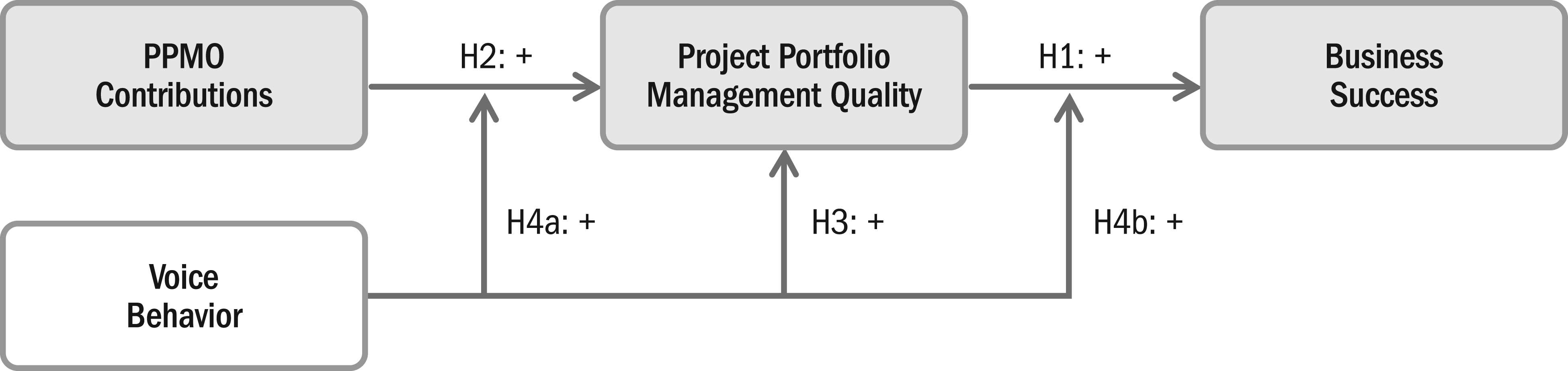
Our framework in Figure 1 posits that, on average, PPMO contributions improve PPM quality and, eventually, business success. Similarly, we assume that project employees’ voice behavior improves PPM quality. More importantly, however, we argue for complementary effects of voice behavior in that it leverages the positive effects of PPMOs and PPM quality. In the following sections, we discuss the hypotheses in more detail.
Conceptual framework.
PPM Quality and Business Success
Project portfolio management (PPM) quality is the central mediator in our framework. Jonas et al. (2013, p. 216) defined PPM quality as “the degree of excellence to which the project portfolio management process is executed.” This process quality is a second-order construct comprising collaboration quality, information quality, and allocation quality (Dammer et al., 2006; Jonas et al., 2013; Kock et al., 2020; Teller et al., 2012). Information quality is “the transparency that is achieved over the whole scope of projects of a certain portfolio and the availability and reliability of project status information supplied by project and line managers” (Jonas et al., 2013, p. 217). Collaboration quality is “the degree of excellence and mutual support throughout the project portfolio management process” (Jonas et al., 2013, p. 218). Allocation quality means “effective, efficient, and reliable assignment and redistribution of human resources within the project portfolio” (Jonas et al., 2013, p. 217). Unger et al. (2012b, p. 678) introduced a fourth dimension called termination quality, describing “how well the decision-making and termination process is executed, characterizing the effectiveness of the abortion process of single projects.” Termination quality captures the extent to which decision makers can abort projects that do not add value and whether project termination is unconnected to the personal failure of participating individuals. All four dimensions are closely related but distinct and collectively define the quality of the PPM process, regardless of the specific management activities (Jonas et al., 2013; Kock et al., 2020).
The idea behind PPM quality is that good collaboration among PPM stakeholders in line and project positions increases the quality and amount of exchanged information. This increases the transparency about the resource demands of projects and availability of resources in line units of the organization(s) that own(s) the projects. Transparency will, in turn, increase mutual understanding and trust among PPM stakeholders; it enables the decision makers to make better decisions for research allocation and potential termination of projects. Taking a dynamic view, sound decisions that are implemented successfully will further improve collaboration. Thus, the four dimensions reinforce one another and may create upward or downward spirals. Although external shocks may influence these processes, we assume that firms with a high PPM quality are more resilient and can adapt better and more quickly to such shocks. The question is: How can managers trigger positive spirals regarding PPM quality?
Business success is the degree to which a business unit, as the owner of a project portfolio, achieves commercial performance goals better than its competitors (Meskendahl, 2010). This performance can manifest in several indicators such as market share, revenue, or profitability (Griffin & Page, 1996). The execution quality of the PPM process likely affects business success positively because improved information quality, better collaboration among stakeholders, faster allocation of resources, and enforcement of necessary project termination will increase the effectiveness and efficiency of portfolio decision-making, resulting in improved portfolio success (Jonas et al., 2013). Previous studies showed a positive association between PPM quality and portfolio success (Jonas et al., 2013; Kock et al., 2020; Teller et al., 2012). Portfolio success, in turn, has been shown to relate to commercial performance (Kester et al., 2014). Therefore, we expect that PPM quality eventually improves business success, although previous research has not empirically tested this relationship; hence, we posit:
H1: PPM quality positively relates to business success.
PPMO Contributions and PPM Quality
We assume that PPMO contributions involving coordination, controlling, and supporting activities will improve PPM quality (Unger et al., 2012a). PPMO contributions, such as controlling activities, will more likely provide reliable, specific, accurate, and current information on single projects and resources. This information will provide transparency, facilitate resource allocation to projects, provide early warning of troubled projects, and support decision-making regarding project termination. Coordinating activities of the PPMO will improve resource utilization, minimize failure in resource allocation, enforce resource commitment, and anticipate resource conflicts (Unger et al., 2012a). This will also enhance information quality, collaboration quality, and allocation quality. PPMOs’ supporting function will improve standards, facilitate single project management practices, reduce methodological error, and safeguard a learning organization, increasing transparency and allocation quality, reducing conflicts, and supporting tough decisions.
Unger et al. (2012a) showed positive associations between different functions of PPMO and selected dimensions of PPM quality. We, therefore, expect that PPMO contributions will improve the execution quality of PPM processes above and beyond the mere formalization of these processes (Teller et al., 2012); hence, we posit:
H2: PPMO contributions positively relate to PPM quality.
Direct and Moderating Influences of Voice Behavior
Communicating problems, important issues, or ideas to higher-level project portfolio managers will avoid duplication, reinventing the wheel, and repeating problems, creating additional opportunities throughout the project portfolio (Kaufmann et al., 2020). A solid and open communication culture in project portfolio management fosters project coordination and collaboration among stakeholders (Beringer et al., 2012; Beringer et al., 2013). Therefore, even outside the standard reporting procedures and even if the information is highly unfavorable (Kaufmann & Kock, 2023), project employees’ candid and timely communication of their project’s status may be crucial to provide higher-level decision makers with reliable information (Martinsuo & Lehtonen, 2007). A culture fostering a high level of project employees’ self-initiated and intentionally constructive voice behavior may help to counteract their tendency to euphemize serious project situations and, finally, may play a significant role in improving decision-making processes on a project portfolio level. This line of thought is consistent with more general claims that whistleblowing mitigates organizational wrongdoing (Near & Miceli, 1985) and that voice behavior facilitates error detection (Morrison, 2011).
We hypothesize that project employees’ voice behavior enhances the information availability and quality for decision makers on a project portfolio level. Information quality is a measure of the transparency of the project portfolio and, hence, a prerequisite for the coordination of the different projects, a major challenge of project portfolio management (Jonas et al., 2013). By communicating timely, honest, and unrequested information, project employees enhance the accuracy, reliability, and complexity of information available for decision makers on a project portfolio level (Martinsuo & Lehtonen, 2007). Openly voicing problems in projects, among projects, or between projects and line managers will also anticipate graver conflicts, likely increasing collaboration and resource allocation quality.
An excess of voice behavior might also bear negative consequences because exaggerated communication could lead to delays or, in an extreme case, the leaking of confidential information to outsiders. However, we argue that the benefits of voice behavior outweigh these potential drawbacks and, therefore, posit:
H3: Voice behavior positively relates to PPM quality.
In Germany, the police are often called “Dein Freund und Helfer” (your friend and helper). This phrase expresses the dual nature of the police. On the one hand, police officers need to protect and support citizens; on the other hand, they must ensure that rules are followed and prosecute violations. The individual perception of the police’s role depends on the personal and cultural contexts. This perception also applies to PMOs and PPMOs: project managers may see them as friends and helpers. Still, they may also perceive them as controlling units working primarily for other stakeholders’ interests. Which perception dominates depends on the project managers’ individual experiences and personalities but is also a cultural issue (Kwon & Farndale, 2020). How PMO and PPMO roles are perceived may depend on organizational culture.
Similarly, employee voice behavior depends on organizational culture. Given its proactive yet challenging nature, employee voice carries the inherent risk of being misconstrued, potentially causing disruptions in interpersonal relationships (Kwon & Farndale, 2020). Consequently, employees weigh the benefits and risks before expressing their voice; they consider whether speaking up is effective in achieving the intended outcome and whether it is safe to do so (Morrison, 2011, 2014).
An essential aspect of comprehending the perceived consequences of voice behavior involves considering the organizational channels through which employees can express their opinions, which can be categorized as formal or informal (Kwon & Farndale, 2020). These channels manifest in organizational mechanisms such as “collective bargaining, quality circles, empowered teams, suggestion schemes, and formal meetings between employees and managers” (Kwon & Farndale, 2020, p. 2). Within the organizational context, norms begin to emerge regarding the utilization of different voice channels (Whiting et al., 2012). These norms serve as signals to employees, indicating whether voicing their opinions is secure and likely to yield positive outcomes.
When project employees actively make suggestions and honestly speak up about problems that might cause severe loss to the work unit—even when dissenting opinions exist—we can assume they feel safe to do so and are convinced that their suggestions are effective for making improvements and their organizations will support them. If this assumption is correct, their suggestions will be more often reported to upper management and get more support, reinforcing voice behavior. It also means that the project managers will report not only more information but also more sensitive information. Information delivery will occur proactively before problems escalate and become more challenging. Thus, regarding the relevance, timeliness, and accuracy of opportunities and threats, the PPMO and the decision makers will be better informed.
We propose that project employee voice behavior will leverage the PPMO’s effect. The PPMO is the key entity brokering between project managers and portfolio decision makers. PPMO members listen to the project managers, adopt their suggestions, and pass them on to upper management. This means if the project managers provide more, better, and earlier information to PPMO members through increased voice behavior, PPMOs will also deliver better and more timely information to upper management. Thus, project managers, PPMO managers, and decision makers reinforce and stabilize one another. Controlling and coordinating activities of the PPMO will have stronger leverage and lead to better decision-making quality if the aggregated information is actively, freely, and richly communicated instead of just received over standard reporting measures.
Regarding upper management’s preferences for using the information they get from PPMOs and project managers, we can apply the models for decision-making behavior from Vroom and Yetton (1973) and Vroom and Jago (1988). Both models specify conditions under which managers should make autocratic, consultative, or group decisions with their employees. Both models recommend a more participative decision-making style if the subordinates possess critical information for the decision and if their commitment is essential for its implementation. Empirical studies show that decision makers would move to more participative solutions if these two conditions were present. Decision makers prefer more autocratic decisions if they believe they already have sufficient information, if the time for decision-making is severely limited, or if the likelihood of their subordinates’ commitment to the chosen solution is high (Field et al., 1990).
Most projects possess uncertainty. Therefore, it is likely that the subordinates in the projects have valuable information that decision makers should consider. Thus, it is rational for upper management to listen to their PPMO and project managers if they want to make better decisions for project portfolios. Project teams usually possess higher autonomy than operational teams because they must react quickly to unforeseen changes. Therefore, project managers are more likely to have a stronger influence on implementing decisions. Independent of the quality of the decisions made in project portfolio boards, these decisions must be implemented to generate the expected business value. Therefore, we do not only expect a positive leverage effect of voice behavior on PPMO contributions but also on the relationship between PPM quality and business success; hence, we posit:
H4: Voice behavior strengthens the relationships between (a) PPMO contributions and PPM quality and (b) PPM and business success (positive moderation).
Method
Sample
We test the proposed model with a cross-industry sample of private companies. The business unit’s project portfolio is the unit of analysis. We collected survey answers from three different informants for each portfolio: (1) a senior manager with decision-making authority who was involved in selecting and terminating projects and was generally part of the portfolio board (e.g., division head or CEO), (2) a portfolio coordinator who had a good overview of the project portfolio (e.g., head of PMO or portfolio manager), and (3) multiple project managers leading some of the portfolio’s projects (median of three per portfolio). Using different informants to assess different variables in the model reduces common method variance (Podsakoff et al., 2003). Using different perspectives on the project portfolio from various sources also ensures that the informant with the best knowledge assesses the construct. Therefore, the senior manager assessed business success and PPM quality, the coordinator PPMO contributions, and the project managers assessed voice behavior, which we then aggregated for each portfolio.
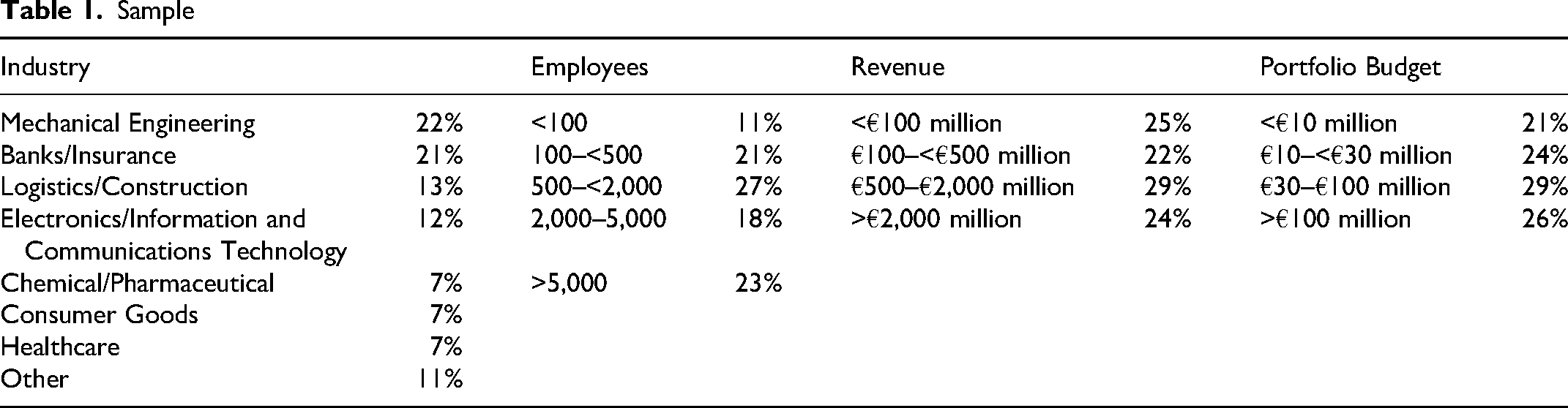
We combined data from three survey waves where each followed the same procedure. To collect the survey data, we invited medium to large-sized organizations by email to participate. In follow-up telephone calls, we informed the companies about the study design. After the companies registered, we sent personalized links to the different informants. We matched the informants’ answers per portfolio after they completed the survey. We received 2,123 individual responses from 448 portfolios (421 coordinators, 404 decision makers, and 1,298 project managers from 325 portfolios). After matching informants to portfolios, removing multiple participations, and removing observations with missing values, 255 portfolios with complete information from all three types of informants remained for further analysis. The final sample thus contains survey information from 255 coordinators, 255 senior managers, and 1,066 project managers (median of 3, mean of 4.18 per portfolio). We did not find significant differences in the variables across the three survey waves, but we still controlled for the wave in the analyses reported as follows using dummy variables. Table 1 shows that the sample contains diverse industries, company sizes, and portfolio sizes.
Sample
Measurement
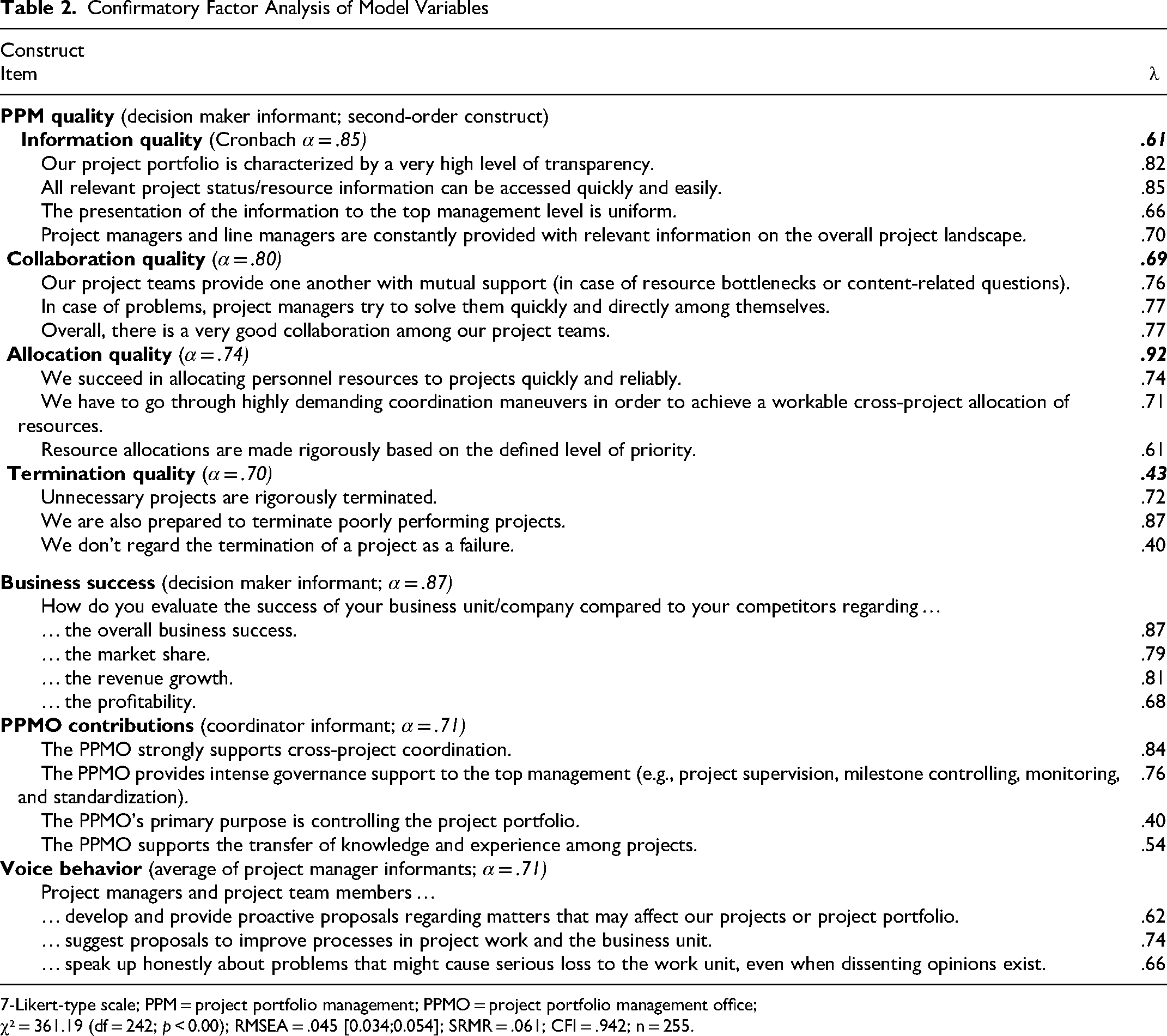
We used multi-item scales from existing literature to measure the variables for the analysis. Unless otherwise stated, the items applied seven-point Likert scales ranging from 1 (“strongly disagree”) to 7 (“strongly agree”). Table 2 shows the items’ wording.
Confirmatory Factor Analysis of Model Variables
7-Likert-type scale; PPM = project portfolio management; PPMO = project portfolio management office;
χ² = 361.19 (df = 242; p < 0.00); RMSEA = .045 [0.034;0.054]; SRMR = .061; CFI = .942; n = 255.
Business success uses four items capturing the economic success of the business unit in comparison to competitors (Griffin & Page, 1996; Meskendahl, 2010) ranging from 1 (“much worse”) to 7 (“much better”). We decided on this type of assessment because objective performance data (e.g., return on investment) are not always available, and this measurement allows for comparing highly diverse business units across industries. The senior manager assessed these items (Cronbach’s Alpha = 0.87).
Following prior literature (Jonas et al., 2013; Teller et al., 2012; Unger et al., 2012a), PPM quality was assessed as a second-order construct using the four dimensions of information quality (four items), collaboration quality (three items), allocation quality (three items), and termination quality (three items). Collectively, they describe the quality of the management processes. We used senior managers’ assessments of these questions. Coordinators also assessed these items, and the two measurements had a high agreement (r = 0.49), further increasing confidence in the measure’s reliability and validity.
PPMO contributions were measured with four items taken from Unger et al. (2012a), assessing the coordinating, controlling, and supporting functions of PPMOs. The coordinator informant assessed this construct (Alpha = 0.71).
Voice behavior captures to which degree project managers and project team members actively raise their voice to point out opportunities or problems. We used three items from Liang et al. (2012) and adapted them to the project context (see also Ekrot et al., 2016; Kaufmann et al., 2020, who used similar items). Project managers assessed these items (Alpha = 0.71); however, they did not report on their individual voice behavior but assessed the overall voice behavior of the organization’s project managers and team members. We then averaged their ratings for each portfolio (median of three ratings per organization). This procedure ensures a more robust assessment of the project organization’s voice behavior because it is not as biased by self-assessment or individual outliers.
We included several control variables to exclude alternative explanations for the effects. First, we used dummy variables for the second and third survey waves (the first being the reference value) to account for potential differences. Second, size might affect business success and the quality of management processes. Larger organizations might also have more barriers to voice behavior. Therefore, we controlled for firm size by including the number of employees and for portfolio size using the project portfolio’s annual budget in million Euros. We transformed them using the natural logarithm because both variables show a skewed distribution. Third, more complex project portfolios might affect management quality and the effectiveness of its antecedents (Teller et al., 2012). We, therefore, controlled for portfolio interdependency using four items from Teller et al. (2012) that assess how strongly projects depend on one another. Fourth, we wanted to control for the degree of standardized reporting to isolate the effect of voice behavior as a form of extra-role communication. Therefore, we included the formalization of single project management (four items, Alpha = 0.74) and project portfolio management (four items, Alpha = 0.92) as control variables (Kopmann et al., 2015; Teller et al., 2012).
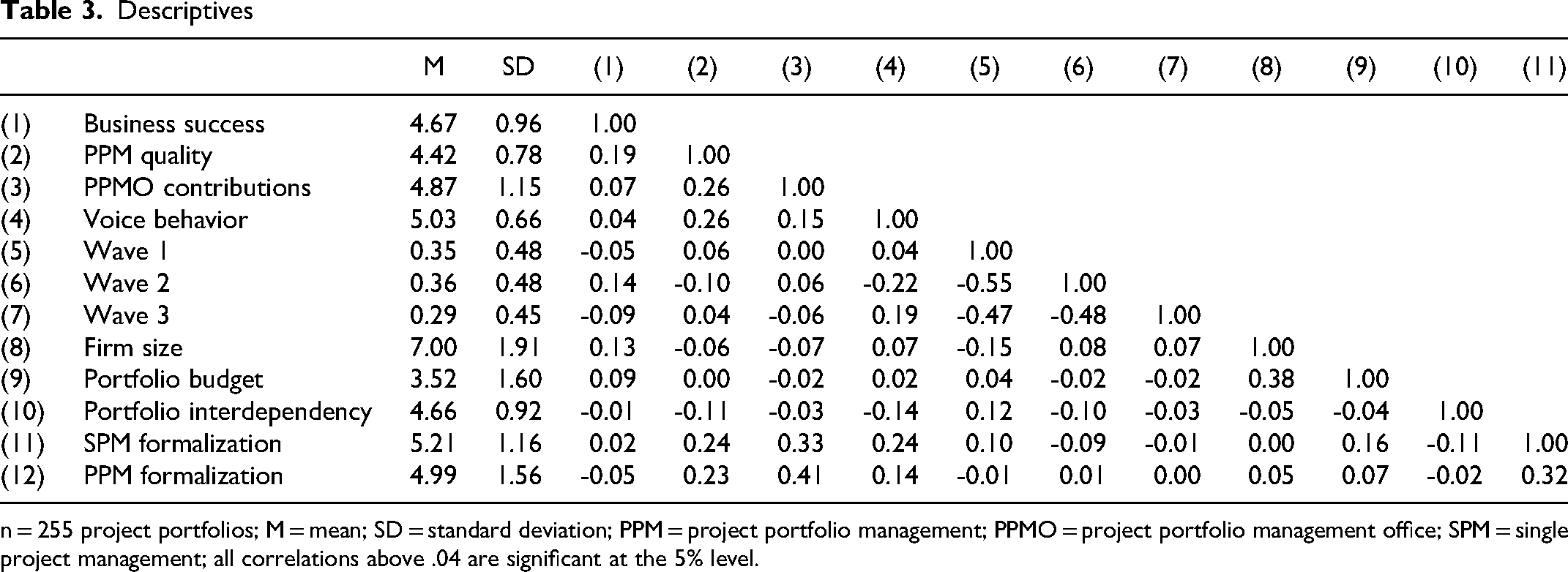
We validated the model’s scales using confirmatory factor analysis (CFA) and assessed scale reliability using Cronbach’s Alpha with acceptable values larger than 0.7. We followed the guidelines of Hu and Bentler (1998) to evaluate structural equation models. They suggest a comparative fit index (CFI) above .90 for acceptable fit, a root-mean-square error of approximation (RMSEA), and a standardized root-mean-square residual (SRMSR) below .08 for acceptable fit. Table 2 shows all variables’ item wording and the CFA results. The model had an acceptable fit (χ2[242] = 361.19; CFI = .94; RMSEA = .045; SRMR = .061). These results also confirm the second-order nature of PPM quality, because the second-order loadings are high and significant, and the model fit is not worse than that of a model with only first-order factors (Δχ2[11] = 10.9, p = 0.4516). Overall, the measurement model can be deemed satisfactory. Table 3 shows the constructs’ correlations and descriptives.
Descriptives
n = 255 project portfolios; M = mean; SD = standard deviation; PPM = project portfolio management; PPMO = project portfolio management office; SPM = single project management; all correlations above .04 are significant at the 5% level.
Results
We used hierarchical regression to test the proposed framework. Table 4 presents the results in five different models with PPM quality (models 1–3) and business success (models 4 and 5) as dependent variables. Model 1 only includes control variables, which collectively explain 10% of PPM quality’s variance. Confirming previous research (Teller et al., 2012), SPM formalization and PPM formalization relate to management quality positively (unstandardized regression coefficients b = 0.11, p = 0.013, and b = 0.09, p = 0.005, respectively). However, firm size, portfolio budget, and interdependency do not show any significant relationship. Model 2 includes the independent variables. PPMO contributions are positively related to PPM quality (b = 0.11, p = 0.020), which supports hypothesis 2. Voice behavior also shows a positive relationship (b = 0.11, p = 0.020), supporting hypothesis 3. Model 2 explains 15% of the variance in PPM quality.
Results
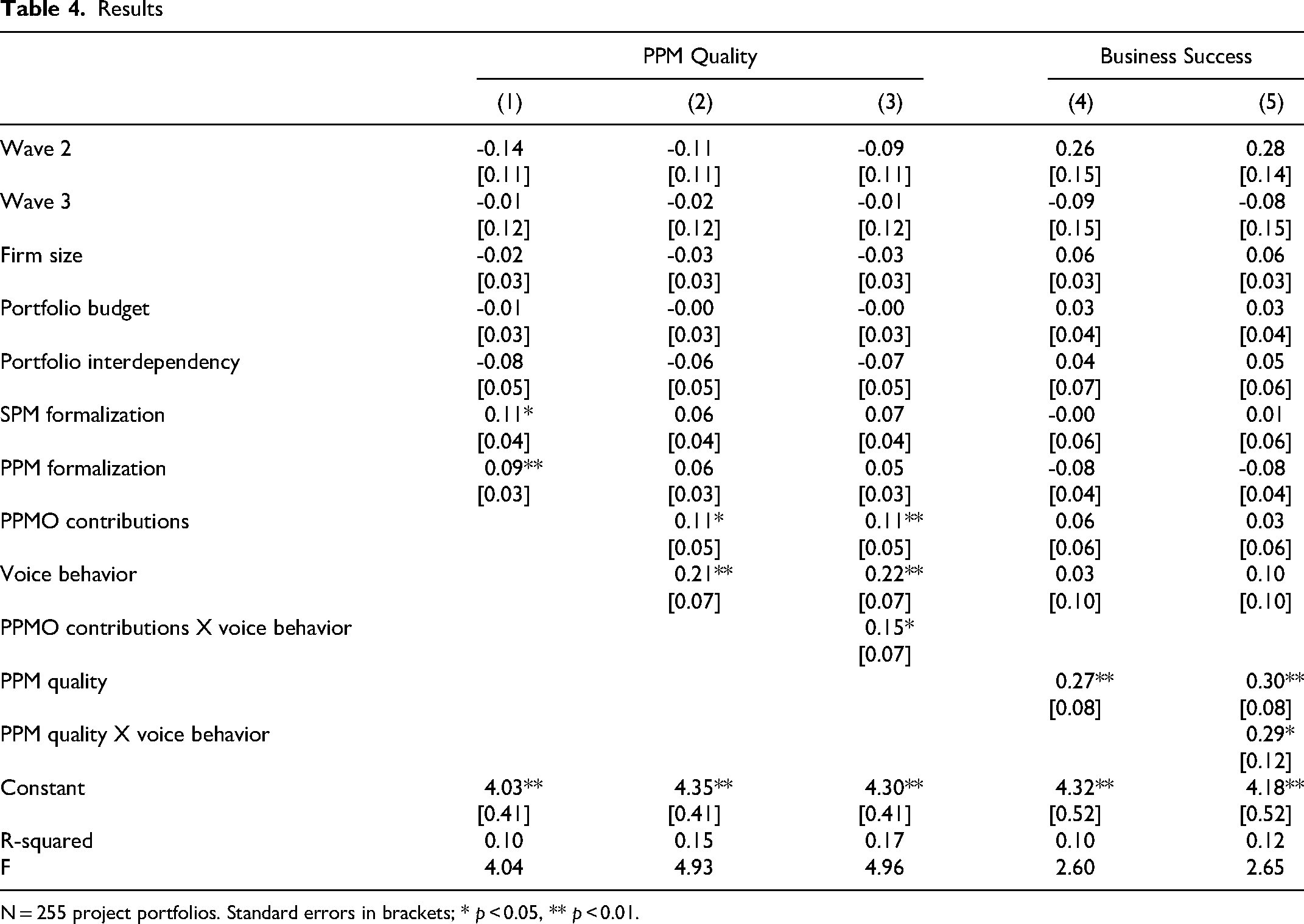
N = 255 project portfolios. Standard errors in brackets; * p < 0.05, ** p < 0.01.
To investigate hypothesis 4, we used interaction effects with mean-centered variables. The simple slopes in Figure 2A and the marginal plots in Figure 2B show the nature of these interaction effects. Model 3 includes the interaction effect between PPMO contributions and voice behavior. The coefficient of the product term is positive (b = 0.15, p = 0.033), which supports hypothesis 4a. The top panel in Figure 2A shows the slope of PPMO contributions for low/high (minus/plus one standard deviation) values of voice behavior. The effect is only positive when voice behavior is high (b = 0.21, p = 0.002) but zero when voice behavior is low (b = 0.02, p = 0.771). The marginal plot in the top panel of Figure 2B suggests that the effect of PPMO contributions becomes significantly positive only when voice behavior is higher than 4.9. Therefore, a sufficient level of voice behavior is necessary for PPMO contributions to be beneficial for PPM quality.
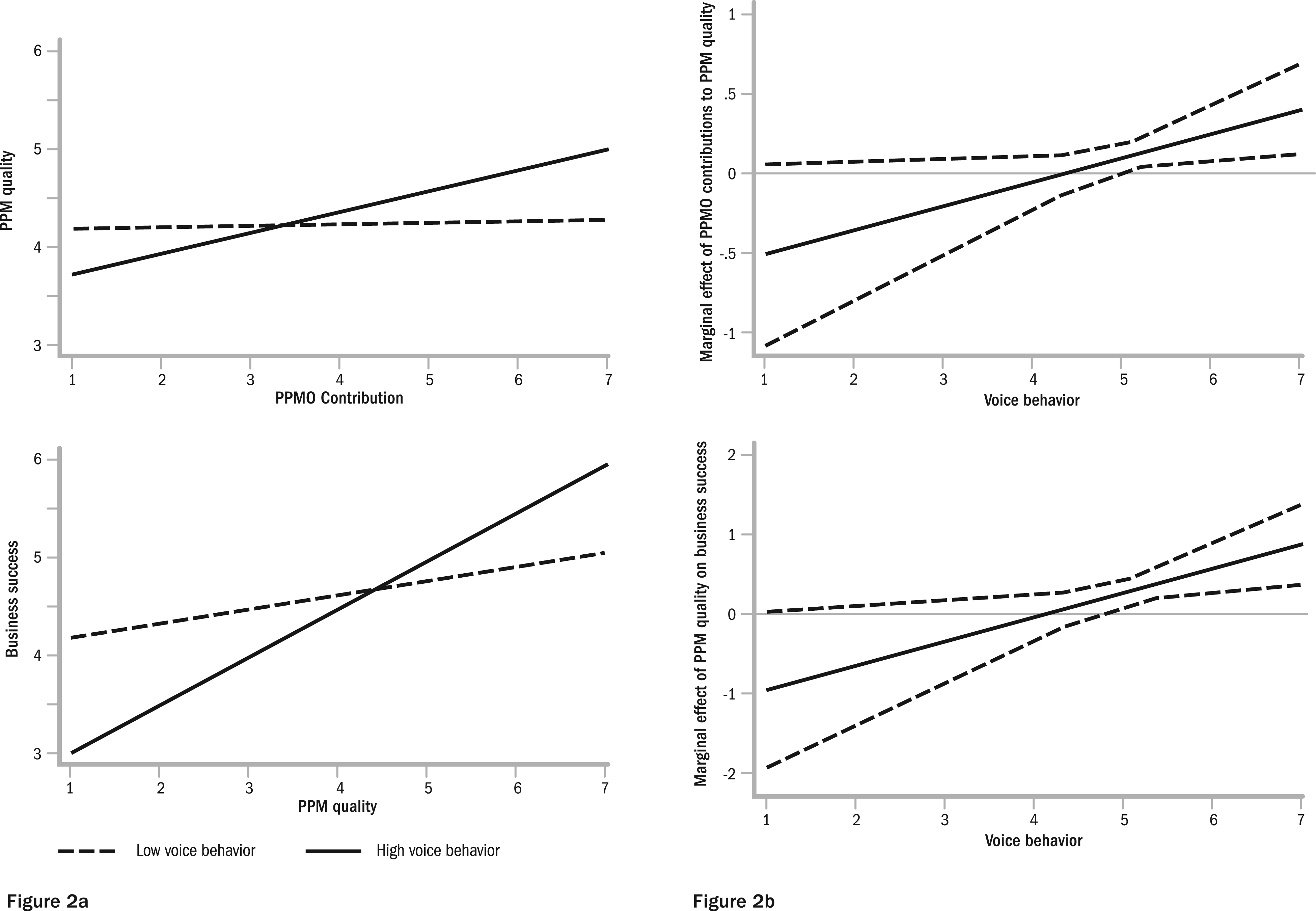
Figure 2A: Simple slopes for low and high voice behavior. Figure 2B: Marginal plots with 95%-confidence intervals (dashed lines).
Model 4 shows that the relationship between PPM quality and business success is positive (b = 0.27, p = 0.001). The model explains 10% of the variance in business success. This result supports hypothesis 1. Model 5 includes the interaction effect with voice behavior, which is positive (b = 0.29, p = 0.012). This finding supports hypothesis 4b. Figure 2A shows the nature of this effect in the lower panel. The contribution of PPM quality to business success is strongly positive when voice behavior is high (b = 0.49, p = 0.000) and not significant when voice behavior is low (b = 0.11, p = 0.276). The marginal plot in the lower panel of Figure 2B shows that the relationship of PPM quality with business success becomes significantly positive only when voice behavior is higher than 4.7.
Discussion
The results show that PPMO contributions and voice behavior independently relate to PPM quality, which in turn relates to business success. The marginal plots in Figure 2B document that the positive effects of PPMO are increasing with an increasing level of voice behavior. The two independent variables moderate each other positively. Figure 2B also shows that below an intensity level of 4.9 of voice behavior, the marginal effect of PPMO contributions on PPM quality is not significant. This result means it takes “two to tango.” To improve the PPM quality, the context of the PPMO should possess a high willingness for constructive collaboration and sufficient courage to raise the voice to give constructive recommendations.
The members of a PPMO can, of course, contribute to creating such a context and search and find project managers and project team members who behave in such a way, but it is unlikely that the PPMO members can do this on their own. They likely need support from other interested stakeholders in the project portfolio.
The correlations in Table 3 show a second path on how PPMO members can support voice behavior. We see substantial correlations of PPMO contributions with the formalization of single projects (r = 0.33) and the project portfolio management process (r = 0.41). In addition, the formalization of single project management processes correlates positively with voice behavior (r = 0.24), and the formalization of the portfolio processes correlates positively with voice behavior (r = 0.24). Thus, on its own, the regular work of PPMOs may contribute to increasing voice behavior.
The findings suggest that a culture encouraging, protecting, and exploiting voice behavior pays off because it can lead to better project portfolio decisions. The positive leverage effect of voice behavior on the positive relationship between PPM quality and business success suggests that these decisions are also implemented better. However, constructive suggestions by project employees who raise their voices can also lead to other improvements independent of project management and project portfolio management issues. For example, they can suggest technological solutions that create products and services that enhance customer value or lower production and delivery costs. Future research could differentiate between both explanations of the leverage effect we observe.
Theoretical Implications
This study makes three different types of contributions: (1) to PMO research, particularly regarding the PMO as a social phenomenon; (2) to PPM research, specifically the performance consequences of PPM processes; and (3) to research on voice in project contexts, in particular voice behavior’s organizational consequences in a multiproject context.
This study contributes to PMO research by showing that PPMOs relate to business success through increased management quality of PPM processes. Interestingly, this effect remains even if we control for the formalization of project and portfolio management. We derive from the research on PMOs that PPMOs primarily drive this formalization, and if we control for this driver, the formalization’s effect vanishes. However, PMOs and PPMOs can also deliver other supporting contributions beyond formal processes: first, the supporting contributions of a PPMO in coordinating and controlling PPM processes; second, the social contributions of a PPMO, which contribute to a better understanding of the portfolio stakeholders and building trust and commitment.
This study provides important large-scale empirical evidence on PMOs’ and PPMOs’ performance and value-enhancing effects. We thus extend previous research on PPMOs (Unger et al., 2012a) by investigating not only process quality dimensions but also by considering eventual business success. More importantly, however, we observe a critical contingency in these relationships. The significant interaction effects with voice behavior show that the influence only materializes if voice behavior is sufficiently high. This result could explain the mixed findings of studies on PMO performance effects that did not consider behavioral constructs such as voice behavior (Dai & Wells, 2004; Otra-Aho et al., 2018).
A second contribution concerns research on the performance and value of project portfolio management (Jonas, 2010; Martinsuo & Killen, 2014; Meskendahl, 2010). Previous studies have shown the importance of execution quality for portfolio success (Jonas et al., 2013). Others demonstrated that innovation portfolio success is important for market performance (Kester et al., 2014). The present study is the first to investigate how the execution quality of PPM relates to business success, which has only been conceptually proposed before (Jonas, 2010; Meskendahl, 2010). More importantly, we show that these effects are contingent on voice behavior, contributing to research on the importance of context in PPM (Martinsuo, 2013; Martinsuo & Geraldi, 2020).
Finally, the results contribute to project research on voice (Ekrot et al., 2016; Jiang et al., 2023; Kaufmann et al., 2020) and silence (Zaman et al., 2021; Zhu et al., 2019). In accordance with multiple findings on similar concepts, such as the opportunity to express concerns and arguments or minority dissent (Thomas et al., 2010) and numerous theoretical assumptions of leading voice researchers (Bashshur & Oc, 2015; Morrison & Milliken, 2000), we found a positive relationship of project employees’ voice behavior with the execution quality of the project portfolio management process, which in turn positively relates to business success. We thus follow the call to investigate organizational consequences of voice behavior and show that voice behavior is critical to success in multiproject environments due to its direct and leveraging effects. Other research on voice behavior in a project context looked at antecedents (Ekrot et al., 2016) or the relevance in agile portfolios (Kaufmann et al., 2020) or single projects (Zaman et al., 2021; Zhu et al., 2019). We show how voice behavior affects performance (through PPM quality) and that it complements PPMO contributions.
Managerial Implications
This study’s findings carry mixed news for decision makers and PPMO managers because they cannot expect that PPMO contributions will automatically create value. While, on average, PPMO contributions seem to be associated with increased PPM quality and business success, these relationships strongly depend on project employees’ voice behavior. Therefore, PPMO activities should be complemented by a culture that allows voice. Our results indicate that managers should introduce managerial measures to foster an open and honest communication culture in project management. Decision makers on a project portfolio level require project-level information to steer the overall project portfolio (Martinsuo & Lehtonen, 2007). Our study suggests that it is beneficial to have a strong project manager community that voices concerns and problems or ideas and suggestions when necessary. However, decision-making processes also need to be receptive to information from lower levels, meaning that decisions are not, per se, made in a top-down manner. Companies could establish an organizational culture that encourages decision makers on higher levels to devote attention to ideas, concerns, or suggestions of lower-level employees, such as project managers, and to integrate this information into their decisions (Ekrot et al., 2016; Kaufmann et al., 2021; Kock et al., 2015).
Limitations and Future Research
Like in every empirical study, the results need to be viewed in light of some limitations. The first and most obvious limitation is that we simultaneously measure contributions, process quality, and business success. However, there is clearly a sequence in PPMO contributions and voice behavior affecting future PPM quality, which, in turn, affects future business success. Measuring independent and dependent variables at different points in time—as, for example, recent studies on project success do (Kaufmann & Kock, 2022)—is difficult to achieve on the portfolio level of analysis, typically resulting in very low sample sizes (Jonas et al., 2013; Unger et al., 2012b). Including project, portfolio, and business unit levels with multiple informants, as in this study, further complicates longitudinal analyses. However, our study design enabled a large sample, allowing the identification of moderating effects and reduction of common method variance due to multiple informants.
A second limitation is that we could only investigate aggregated effects of PPMO contributions and not differential effects of PPMO roles. Future studies could investigate whether the findings are similar for different types of PPMO contributions. It might also be fruitful to examine whether various forms of voice have other effects, for example, prohibitive versus promotive voice (Liang et al., 2012), voice toward superiors versus peers (Liu et al., 2010), or deliberate versus habitual voice (Lam et al., 2018). Future studies could also analyze the role of voice amplification—the public endorsement of another person’s contribution, with attribution to that person (Bain et al., 2021). Other moderators, for example, other forms of employee behavior or norms and values, might also affect how PPMO contributions affect management quality and success.
Conclusion
This study investigates how project portfolio management offices (PPMOs) relate to private firms’ business success and the leveraging role of employee voice behavior. Our investigation confirms PPMOs benefit project portfolio management quality and, eventually, business success. Furthermore, the findings highlight the significant role of employee voice behavior in project environments. We discovered that voice behavior not only directly contributes to the effectiveness of project portfolio management but also amplifies the positive effects of PPMO contributions. Conversely, insufficient voice behavior will render PPMO contributions ineffective. This study underscores the importance of both structural mechanisms and the empowerment of individuals in achieving organizational goals. By integrating these elements, organizations can foster a more effective and successful project management environment, enhancing overall business performance.
