







Abstract
This article considers and reflects upon the mark that Ralf Müller made through his published research on project governance. From project governance to governance of interorganizational project networks, Müller, along with his coauthors, has made significant contributions to project governance literature. In light of these two decades of theoretical development, we compare and synthesize the key elements of project governance and network governance. We provide a model that integrates project governance and network governance and propose several main themes for future research, including investigation of network governors, network governance design, mechanisms and principles, and its impact on improved project performance.
Introduction
Three decades ago, projects were theorized as “temporary organizations” to form a coherent theoretical framework for project management (Lundin & Söderholm, 1995; Turner & Müller, 2003). This theoretical framework builds the foundations and needs for project governance (Müller, 2009), whereas project governance defines the processes, roles, and responsibilities of projects therein. However, there is a recent surge of research on project networks that stems from the increasingly interorganizational nature of projects (Bakker et al., 2016; Sydow & Braun, 2018; Windeler & Sydow, 2014). This stream of work gives rise to scholarly attention on network governance for interorganizational projects (IOPs) (Müller et al., 2022; Ruuska et al., 2011; Wang et al., 2023a). The involvement of multiple organizations becomes so salient (Davies & Mackenzie, 2014; Roehrich & Lewis, 2014) that the success of interorganizational projects necessitates the network governance. That is, the design of the governance structure determines project performance, especially for large-scale projects (Denicol et al., 2020), which is further supported and validated by scholarly insights on the importance of designs of governance of interorganizational relationships (Gil & Fu, 2021; Müller et al., 2022; Ruuska et al., 2011).
Despite this theoretical extension from the governance of projects (Müller, 2017) to the governance of interorganizational project networks (Unterhitzenberger et al., 2022), the associations and distinctions between the two theoretical perspectives still remain largely unknown (Dille et al., 2022; Wang et al., 2023a). This extension not only incorporates the multiplicity of participating organizations but also implicates the shift of temporal dimensions from temporary to semipermanence (Brookes et al., 2017), given the fact that project networks can last for multiple projects. The projects being carried out by temporary multiorganizations (Lizarralde et al., 2011) can and should be governed differently from those carried out by reoccurring collaborations (Müller et al., 2022).
However, as we will outline in more detail, scholars left unaddressed how different governance paradigms were associated or diverted. Little is known on the distinction between project governance and governance of interorganizational project networks. The understanding of the governors, governing mechanisms, and the aim of governance for these two types of project governances also needs further theoretical clarifications. The current state of our scholarly understanding requires an integrated theorizing to move forward the field of project governance research. Hence, we ask:
Research Question: How could the differences and relationships between the project governance and the governance of interorganizational project networks be conceived theoretically?
To answer the research question, we adopt a theoretical typology approach for a conceptual article with an aim to clarify the differences and relationships between project governance and the governance of interorganizational project networks (Helkkula et al., 2018). We theorize these two streams of research and propose a novel research agenda therein. Drawing on the institutional logic (Powell & DiMaggio, 1991) and temporary organization perspective (Bakker, 2010), we argue that project governance and governance of interorganizational project networks differ not only from a numeral perspective but also from a temporal, structural, and institutional perspective. The tension between temporary organizing (Bakker et al., 2016) and permanent governing requires scholarly attention (DeFillippi & Sydow, 2016). Based on a literature review, a model of interplays of project governance and governance of IOP networks is set forth. A newly proposed research agenda is suggested, which centers on the nuanced understanding of the network governor, network governance design, mechanisms and principles, and its impact on advanced project performance.
We contribute to the extant literature in three ways. First, we extend project governance (Müller, 2009) literature by elaborating on the relative importance and distinct role of governance of IOP networks. Second, we contribute to IOP (Sydow & Braun, 2018) literature by clarifying the multilevel governance mechanisms for multiple projects. Third, we enrich the project performance literature by illustrating the theoretical foundations for the project performance from a network governance perspective.
Theoretical Foundation of Projects as Temporary Organizations In Need of Governance
Nature of Project Governance
Unlike permanent organizations, projects aim to achieve certain goals and are typically characterized by multiorganizational participation, temporality, complexity, and uncertainty. A project is defined as a temporary organization, “to which resources are assigned to undertake a unique, novel, and transient endeavor managing the inherent uncertainty and need for integration in order to deliver beneficial objectives of change” (Turner & Müller, 2003, p. 7). Project management has become an increasingly important research field since the 1940s, gaining wide scholarly attention thereafter. The number of IOPs as a hybrid way of organizing appears along with other novel forms of organizing, including virtual organizations, dynamic alliances, and borderless organizations. The IOPs are particularly difficult to govern. Both the traditional governance approach and project portfolio management under a single organization are unlikely to safeguard these IOPs. The failure of IOPs may be mostly due to complexities in the resource allocation (Wang et al., 2023b), completing logics (Qiu et al., 2019), and subsequent paradoxical tensions (DeFillippi & Sydow, 2016). Addressing these issues from a governance perspective is required due to the complexity of the issue and broad involvement of stakeholders. The Association for Project Management (APM) defines project governance as the area of corporate governance dedicated to project activities from the perspective of organization management (Association for Project Management, 2004). Since a project is a special form of organizing stemming from traditional organizations, the theoretical foundations for project governance are heavily influenced by corporate-level governance theories (Ruuska et al., 2011). However, we know little about how governance functions work when faced with the nexus of interorganizational relations. Projects often consist of temporary and dynamic interorganizational networks rather than long-term or permanent interorganizational relationships. Transaction-cost economics (Chakkol et al., 2018; Williamson, 1985) and agency theory offer limited theoretical explanations for project governance at the network level (Turner & Müller, 2004).
Adopting an organizational theory perspective, we define projects as standalone, self-adjusting, and sovereign organizational units, which require multilevel governance in order to contribute to the wider organization in the most beneficial way (Müller, 2009, 2017) . It is imperative to first understand the nature of project governance. The nature of governance can be understood from different perspectives, including systems of controls, processes, and relationships (Müller, 2017), as explained in the following subsections.
System of Controls
Governance is a system or collection of control structures and mechanisms, including the distribution of power and responsibility, the balance of economic and social goals, and the balance of individual and common goals (Larcker & Tayan, 2011). Governance provides the value control system that allows projects to achieve organizational objectives in the interest of internal and external stakeholders.
Process
Governance performs the role of directing and supporting the management process of the organization (OECD, 2001). Governance is an organizational design that reflects a sustained focus on the process of stakeholders’ engagement, interaction, and the success of common goals.
Relationships
Governance defines the relational connection of an organization’s legitimate stakeholders and resolves the relationship tensions between the organization’s internal and external stakeholders (Monks & Minow, 2008). Balancing and fulfilling the diverse needs of multiple stakeholders is challenging for governance.
Even though the governance of projects as a temporary organization shares some similarities with the governance of permanent organizations, there are differences and associations between the two. In alignment with the broader definition of project governance, there are four levels of project governance, including project governance, governance of projects (e.g., programs or portfolios), board-level governance of projects, and corporate governance in project-based organizations (Müller, 2017).
Project governance refers to the steering group’s governance of a single project. The steering group appoints the project manager, defines the project scope and objectives, provides resource reports, and develops management plans. As shown in the project governance model in Table 1, the participating organizations are considered part of the projects, and project governance is considered internal to a specific project (Ahola et al., 2014).
The Characteristics of Four Types of Governance (Adapted from Müller, 2017)
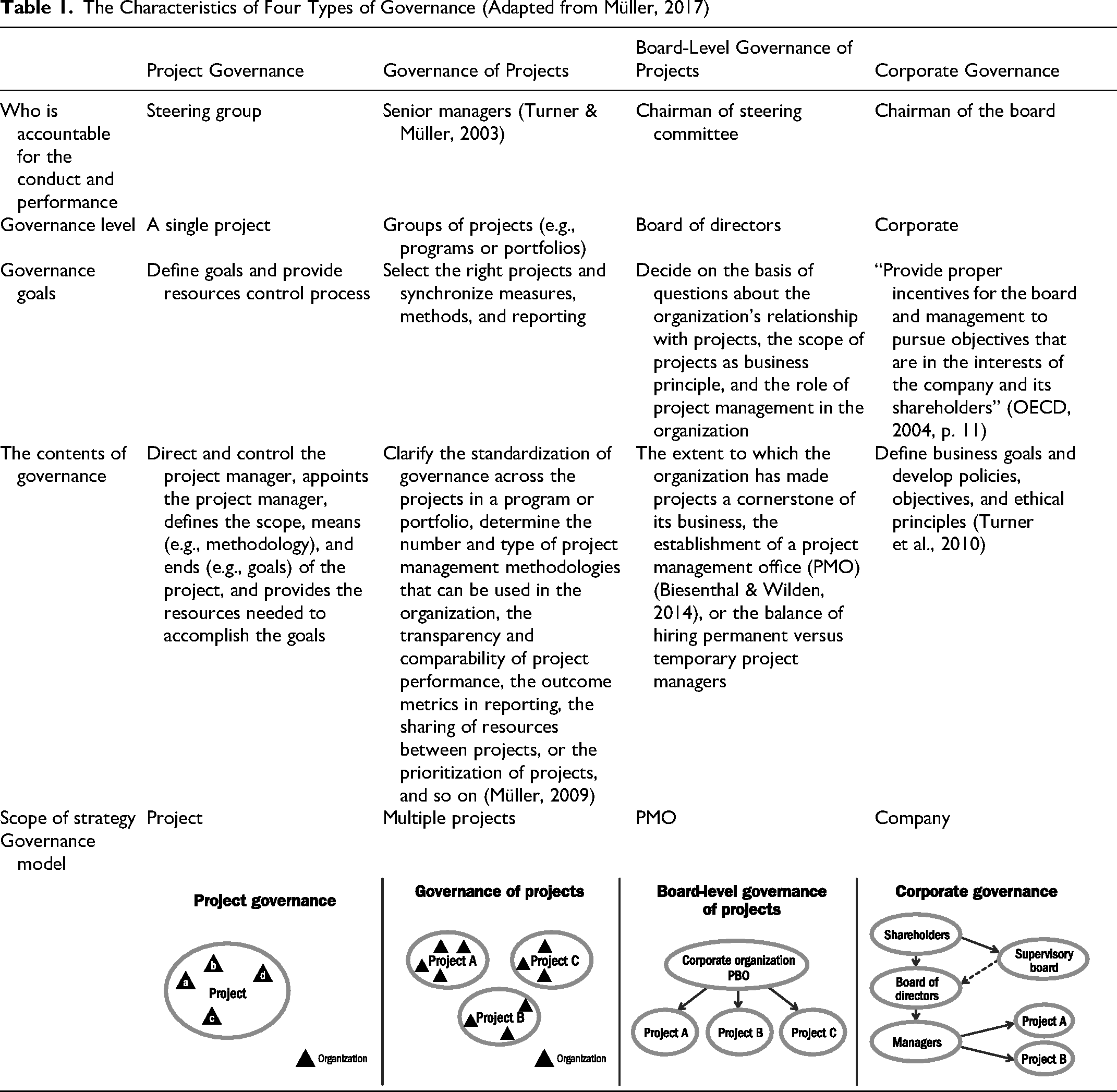
Governance of projects refers to the governance of a set of projects such as portfolio management. Elements of governance include the identification of the type and number of management methods available to projects, the prioritization of projects, the sharing of resources and transparency among projects, and the disclosure of project performance. Multiproject governance needs to be implemented by authorized senior managers. Again, as shown in the governance of projects model in Table 1, multiple projects are governed by organizations, where projects can share a same governing organization.
Board-level governance of projects refers to project-related governance at the board level. This level of governance links the organization to projects and clarifies the position of projects in the organization. For example, this could be the degree of project orientation in the organization, the establishment of a project management office (PMO), or the trade-off between temporary/permanent project managers.
Corporate governance in project-based organization involves the relationships among the board of directors and shareholders, senior management, regulators and auditors, and other stakeholders. Corporate governance is the process of strategizing, implementing decisions, monitoring, and accountability for the use of power in modern corporations (Williamson, 1984). The characteristics of the four types of governance are shown in Table 1.
Project Governance Principles
Sound governance can be summarized in four principles: transparency, accountability, responsibility, and fairness (Aras & Crowther, 2010). These principles are universally applicable to governance at different levels within a given organization, thus migrating the governance principles to a project organization allows us to further theorize them.
Transparency
Transparency represents the accurate and timely disclosure of performance information of concern to stakeholders by a project or organization. Governance institutions (e.g., steering groups, program or portfolio managers) must collaborate to develop clear and standardized governance processes and guidelines that encourage public disclosure, for example, public disclosure of better innovation techniques or new information. At the single project level, the PMO increases project visibility by engaging in project audits, project manager communications, and collecting project performance data that reflect business value. In particular, it is worth specifying that transparency is generally achieved through an atmosphere of mutual trust rather than through coercive pressure. Transparency in governance means that stakeholders are able to make continuous improvements based on clear, consistent, and comparable governance principles. Research has shown that highly transparent organizations achieve better project results (Müller et al., 2008).
Accountability
Accountability describes the governance roles, authority, and responsibilities of key players, thereby enhancing the effectiveness of governance. The project steering group defines the roles of the key project participants (such as project manager, sponsor, program and portfolio manager). It is valuable for the steering group to supervise the accountability of the project manager to the project sponsor in order to better achieve the project objectives, thus reducing principal–agent problems. Accountability operationalizes and visualizes governance, thereby guaranteeing the function of governance and enabling the alignment of performance measures with strategic goals.
Responsibility
Responsibility implies the organizational members’ commitment and contribution to the governance, which drives the project governance to perform in line with professional standards. This includes the requirement for individuals, teams, and organizations to fulfill their responsibilities to work together to accomplish tasks and share adverse consequences (Müller et al., 2014). Project owners, sponsors, steering groups, and planning managers are accountable to their parent organizations for the project’s operational results. Training can stimulate and reinforce the sense of responsibility for the organization’s members.
Fairness
Fairness is the equal intention of project participants, such as project members, suppliers, and contractors, during the organizational design process (Müller, 2017). Fairness reflects a shared understanding of the balance of strategic and tactical priorities. Fairness integrates morals and ethics throughout the governance mechanisms. Fairness stems from the rational distribution of work, the respect for cultural or personal value systems, and the avoidance of inappropriate supplier and employee management. Fairness can only be ensured when the project management methodology operates legally, consistent with the organization’s policies. Contracts are powerful means of preventing illegal behavior and protecting participants. Fairness helps actors involved in governance to gain general acceptance.
While these governance principles reflect the hard side of governance, the soft side of governance should not be overlooked in the course of governing. Governance is not only the design of the principles of management, but more importantly the art of governing people, in other words, governmentality (Foucault, 1991). Governmentality refers to the mindset, perceptions, and interaction styles of those in governance roles in achieving, maintaining, and changing the governance structure (Müller, 2017). Governmentality reflects governors’ attitudes toward the governed and the collaborative mindset with other organizations. Governmentality is used as a link between different levels of governance and as a complement to governance tasks (Müller et al., 2019). It clarifies how governance is executed in an organization.
The Missing 4M Dimensions in Theorizing Project Governance
Multiple organizations are temporarily brought together to engage in an interorganizational project in order to achieve a shared objective (Jones & Lichtenstein, 2009). Such collaborative coordination between two or more entities has been observed in a variety of industries, including construction (Winch, 1989; Yang et al., 2022), biotechnology (Powell et al., 1996), computer systems (Gomes-Casseres, 1994), entertainment (Bechky, 2006), and fashion (Uzzi, 1997). Projects in these industries are typically characterized by complexity, scale, and sometimes long durations, where a single organization becomes shorthanded and several organizations necessitate the managing and governing of projects. The number of involved actors constitutes a specialized network of organizations dedicated to project implementation. However, the inherent characteristics brought by this network of organizations may also bring challenges to project governance within this network. We follow Müller et al. (2022) and term them as governance of interorganizational project networks. These characteristics are multiplicity, multilevel structure, multitemporal, and metaorganization.
Multiplicity
The
Recent advancement also highlights the different institutional logics brought by these actors, which may end up with institutional complexity (Qiu et al., 2019; Winch & Maytorena-Sanchez, 2020). Institutional logics are “overarching sets of principles that prescribe how to interpret organizational reality, what constitutes appropriate behavior, and how to succeed” (Thornton, 2004, p. 70).
The multiplicity of actors also adds to the relational complexity (Zheng et al., 2021). The interorganizational project networks are characterized by relational complexity, especially when no prior ties exist (Roehrich & Lewis, 2014). Relational complexity refers to the relational interdependencies and intensive coordination (Flyvbjerg, 2017) faced by actors. This is inherently different from a bilateral perspective, which mainly focuses on the nature of the ties, be it relational or contractual (Roehrich et al., 2020). Relational complexity at the network level not only aggregates these bilateral exchanges between actors but also allows for emerging network effects; the participant collectively generates value on the project (McIntyre & Srinivasan, 2017). When it comes to the network of relationships, focusing merely on a dyadic relationship, in other words, the bilateral relationship between contractors and suppliers, may not steer the value creation at the collective level.
Multilevel Structure
The
Multitemporal
Metaorganizations
Ideas for Theorizing the Network Dimensions in Project Governance
In this section, we propose several themes in understanding the network dimensions in project governance, including the theoretical pluralism, the governors, governance mechanisms, and governance aims.
Theoretical Pluralism in the Network Governance of IOP Networks
According to these synthesized pathways toward an improved understanding of network governance of IOP networks, we further theorize the role of network governance in the extant project governance landscape (Figure 1). When it is a single organization involved 1 in the governance of a single project, the theoretical focus resembles that of corporate governance, and agency theory and stewardship theory can be involved in theory development (Müller, 2017). When it is a single organization involved in the governance of multiple projects, the research questions address the resource allocations from the perspective of a steering group (Müller, 2009). Contingency theory and resource-based view can underpin their theoretical argument. When it is multiple organizations involved in the governance of a single project, then the issues center on the exchange and tractions between organizations. Hence, transaction-cost economics and relational-exchange theory offer a theoretical lens. As for the multiple organizations involved in the governance of interorganizational project networks, the emerging issues include the collaborations and value creation of these networks of actors. Therefore, social network theory and new institutionalism (Söderlund & Sydow, 2019; Song et al., 2022) are beneficial to unpacking these dynamics and complexities.
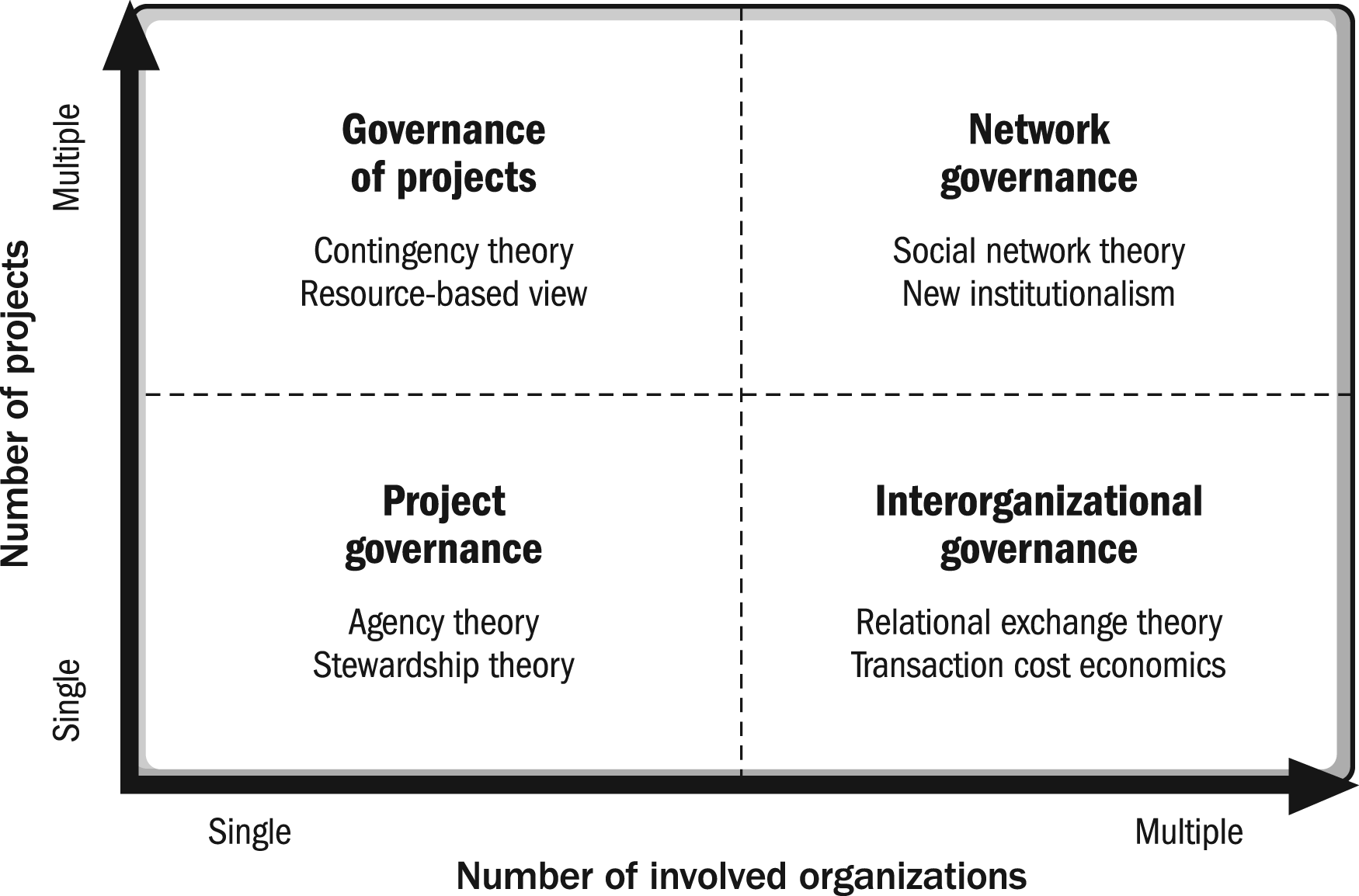
Matrix of project governance.
Theorizing the network governance for IOP networks is the fundamental and effective way of explaining the differences and associations between project governance and network governance for IOP networks. In the following sections, we elaborate on four groups of research questions that deserve future scholarly attention.
Who is Governing?
This question, which addresses the seemingly missing network governor, is critical to the network governance of IOP networks. The network governors are the actors of the governance mechanisms of IOP networks who use, design, and leverage governance tools to exert impact on the members of IOP networks. Extant literature has not clearly defined who the network governor is (Müller et al., 2022; Wang et al., 2023a). Network governors matter because they are the rule makers of the IOP networks. Emerging networks or synchronized networks might have different network governors, with the former being self-regulated and the latter being organized by lead organizations. Different governors might adopt different governing measures and tools; for example, public network governors and private network governors may rely on different governance tools. Müller’s work has identified a series of different network governors depending on the varying formality, including clubs, agencies, and boards (Müller et al., 2022).
How Are IOP Networks Governed?
The Design of Network Governance
The design of network governance is the structural part of IOP networks, which focuses on the development, implementation, and execution of network governance (Wang et al., 2023a). The design properties of network governance can be either theorized through the typology of the network or through social network metrics. As for the former, IOP networks enjoyed a long history of scholarly attention, including public–private partnerships (Hueskes et al., 2017), temporary multiorganizations (Lizarralde et al., 2011), and lead organizations (Sydow & Braun, 2018). There are also other typologies for IOP networks that are yet to be discovered; for example, vertical network organizations share some commonalities with the networks of megaproject actors. As for the latter, IOP networks can be characterized and defined through microlevel structural properties, including density, centralization, heterogeneity, path length, and clusters (Pryke et al., 2018). These network metrics further call for a nuanced understanding of IOP networks in different project implementation stages or industrial contexts.
Governance Mechanisms
Governance mechanisms typically encompass formal and informal mechanisms that either steer intraorganizational or interorganizational relationships. Network governance mechanisms in the IOP networks context differentiate themselves from network governance mechanisms in the general management context. Network governance mechanisms for IOPs rely more on informal measures (Wang et al., 2023a), and may also involve formal governance elements, including contractual arrangements, formal institutions, and digital platforms. The diversity of network governance mechanisms creates a large research gap to gain an anatomical understanding of the dynamics of network governance.
Governance Principles
Governance principles for IOP networks clarify the fundamental rules for the insurance of governance measures and tools. Transparency for network governance extends to the regular focus on a few project organizations and highlights the clarity of the roles and regulations of all new suppliers. The accountability and responsibility rule for network governance should incorporate the perspective of the IOP network as a whole and project members as constituting members. This links the contributing role of the project organization with the benefits of the entirety of the network. Moreover, the fairness for network governance should aim at the relationship between different project organizations within the IOP networks. Tailored network governance principles may incorporate the four principles of governance and reflect the complexity and dynamics of network governance mechanisms.
To What End Are IOP Networks Governed?
The purpose of the network governance of IOP networks should be multifold, aiming at both the project and network levels. The primary purpose of network governance ought to be improving project success. Network governance of IOP networks plays an important role in project success (Unterhitzenberger et al., 2022). However, there are recent developments on reunderstanding project success, including benefits realization, stakeholder perception, issues of timing, and sustainability (Ika & Pinto, 2022). Benefits realization and issues of timing, the objective and short-term assessment, may largely depend on project management. Whereas the stakeholder perception and sustainability, the subjective and long-term assessment, may be subject to the network level of governance design and mechanisms to leverage contributions from all involved actors.
Stakeholder perception of success often has little to do with whether the projects are completed on time, at cost, and with the desired quality (Turner & Zolin, 2012). This implies that the satisfaction of stakeholders may require governance of interorganizational relationships. Network governance of IOP networks allows stakeholders to effectively engage with one another (Yang et al., 2022). Network governance facilitates the “network effect” (Uzzi, 1996), which was not utilized due to the institutionalized termination of the projects.
Sustainability can also be achieved through network governance measures. Since the temporality of projects inherently hinders long-lasting sustainability, the latter typically must give way to the constraints of projects (Huemann & Silvius, 2017). Network governance extends the temporality to an unpredetermined timeframe, if not permanent, by allowing actors to reactivate their relationships in the next collaborative project. Network governance broadens the spaces for making strategic decisions that eventually benefit all involved actors. Hence, it may be challenging to march toward sustainability by running a single project, but networks revolving around consecutive projects make it possible.
Discussion and Conclusion
Ralf Müller is a prolific author on the topic of project governance with pioneering ideas. His seminal works (Müller, 2009, 2017) have significantly contributed to a comprehensive understanding of project governance and recently incorporated governance of interorganizational project networks (Müller et al., 2022; Unterhitzenberger et al., 2022) into new project governance literature. In this research, we take on a reflective perspective and build on his (and his colleagues’) recent literature review on network governance (Wang et al., 2023a) and address the challenging questions of what are the differences and relationships between project governance and the governance of interorganizational project networks. By synthesizing extant literature on the theoretical foundation of the project as a temporary organization in need of governance and incorporating the missing network dimensions, we are able to theorize a research model to integrate project governance and network governance. Furthermore, we have also identified several research gaps as agendas for future research, addressing network governors, network governance designs, mechanisms and principles, and network governance goals.
We contribute to the extant literature by, first, extending project governance literature. We elaborate on the important and distinct role of the network governance of interorganizational project networks in relation to project governance literature. Network elements and aspects are saliently visible in the existing project governance literature (DeFillippi & Sydow, 2016), however, the role of these network elements and associated challenges were not analyzed or specified by current literature. We theorize the network governance as the missing patch to address governance challenges with multiple participating organizations and multiple projects (see the upper right quadrant in Figure 1). This novel theorizing will allow future research to explore nuanced understanding of network governance with a clarified theoretical foundation. Second, we contribute to interorganizational project literature by clarifying the missing 4M network dimensions that are particularly salient from a governance perspective. The existing theories primarily mixed different types of project governance and especially overlooked the inherent characteristics of network governance for IOP networks. We push this theoretical boundary further by identifying and highlighting all of the constituting 4M dimensions, including multiplicity, multilevel structure, multitemporal, and metaorganization. These constituting network elements can serve as pillars for further theoretical development in answering why, who, how, and to what end are IOP networks governed (Wang et al., 2023a). Third, we shed light on project performance literature by illustrating the theoretical foundations for improving sustainable performance through network-level governance measures. One of the main ongoing scholarly focus in projects is how to contribute to sustainability (Caiado et al., 2019; Hueskes et al., 2017). Hence, it is imperative to design sustainability thinking from the governance level. Our conceptual findings help existing literature find novel paths toward sustainability through network governance of IOP networks. The novel “network governance” can pave new roads in governing projects and organizations for a more permanent effect and social impact.
Given the conceptual nature of this article, the limitation of our research may lie in the nature of the research. We choose theoretical typology (Helkkula et al., 2018) as the main approach to develop our understanding toward the differences between project governance and governance of IOP networks. This approach helps us differentiate key concepts and perspectives theoretically. However, other relevant approaches can be applied or adopted to gain further insight into the theoretical insights on the relationship between project governance and governance of IOP networks, including processual or pragmatic understanding of the related issues.