






Abstract
This article traces the genealogy, architecture, and afterlife of the concept of project ecologies. Originating from an extended immersion into London's Soho advertising industry, the concept proposed a six-layer architecture—team, firm, epistemic collective, personal network, locality, and institution—to capture how temporary projects are embedded in, and recursively reshape, more durable relational configurations. The article reconstructs the intellectual tributaries that fed the concept (heterarchy, temporary organizing, the knowledge economy, the new spirit of capitalism); maps its subsequent diffusion across creative industries, megaprojects, urban development, and infrastructure delivery; and tracks how recent scholarship has advanced—and complicated—its constitutive dimensions along what are here termed the 4 + 2 Ts: time, task, team, transition plus territory and things. In a concluding act of retrospective candor, six limitations—typological drift, empirical reach, boundary delineation, power asymmetries, normative undertone, and conceptual overlaps—are diagnosed and paired with concrete research directions that aspire to convert a capacious but underdetermined trading zone into a proper research program.
From Soho, With Bewilderment
The idea arose neither from a conceptual epiphany nor from an exercise in methodical deduction: the notion of the project ecology, rather haltingly, began to take shape during an extended immersion into the world of advertising in Soho (London). Part expedition (through largely uncharted terrain, back then) and part safari (with encounters of exotic organizational creatures), this quest sought answers to one question: How had Soho transformed itself from a subordinate outpost of Madison Avenue's utilitarian “first wave” into a global creative hot spot pioneering the self-reflective “second wave” of advertising? (Grabher, 2001a, p. 351).
Although most conspicuously celebrated and legitimized by a surge of Cannes-Lions decorated advertising campaigns, Soho’s creativity was by no means limited to the realm of its tangible output. Already a center of gravity of Swinging London’s creative industries 2 , this tiny district (of roughly a square mile) also catalyzed a radical transformation of the production process: breaking away from the ritualized antagonism between the hearts and the suits, between the creatives (embodying an artistic ethos) and the account managers (honoring a business ethos), Soho agencies pioneered the professionalization of account planning (introducing, in fact, a scientific ethos into creative production) (Grabher, 2001a, p. 352). 3 The ad village, as it was colloquially referred to, moreover afforded a fertile breeding ground for bold experiments (that is the safari part) with corporate governance. The persistent inception of mavericks like the employee-owned Agency of the Year in 1997, St. Lukes, time and again, enriched the genetic pool for further organizational and governance mutations (see also Grabher & Stark, 1997, p. 536).
By venturing ever deeper into the variegated life world of Soho advertising, the early fascination with this dazzling empirical reality increasingly began to intermingle with a sense of conceptual unease, not to say bewilderment. At least viewed from a far-off university desk, the exploration of Soho initially held the prospect of adding yet another richly textured contribution to the economic geography of territorial innovation models (Moulaert & Sekia, 2003). Although still perceived as the morally lowest of all industries (before the creativity hype-cycle consecrated advertising as the avant-garde of the creative economy), an examination of the Soho advertising business promised a service industry-based contribution to the economic geographic inventory of territorial innovation models centered around manufacturing.
Varyingly discussed as industrial districts, innovative milieux, regional innovation systems, learning regions or, in terms of the long prevailing notion, as clusters, the conception of territorial innovation models was derived from an increasingly motley collection of euphoric tales of regional economic success (or at least survival) that should corroborate above all this: any spatial concentration of industries, in principle at least, could galvanize territorial innovation—even in the most startling corners of the world.
Despite conceptual nuances and different empirical foci, the blueprint of the various territorial innovation models was built around a rather straightforward architecture: the firm as the atomic unit of economic endeavor, the region as a spatially concentrated set of interorganizational relations. And despite the intentions to institute yet another analytical vocabulary, the various models invariably converged toward a single theoretical axiom: embeddedness. While Polanyi (1944) was occasionally mentioned in passing, paying tribute to Granovetter’s (1985) reinterpretation of Polanyi’s paradigmatic notion became de rigueur in economic geography. By scaling down Polanyi’s understanding of embeddedness from the macro-level of institutionally conditioned economies, Granovetter (1985, p. 490) had presented an analytical access to embeddedness that stressed the role of concrete relations and networks in generating trust (Hess, 2004, p. 171).
For economic geography, this relational reading of embeddedness appeared as a perfect analytical match: it lent the framing of regional economies as tightly knit bundles of interorganizational relations the scientific authority of economic sociology. Yet the entanglement with the embeddedness heuristic also steered the discipline into tricky terrain: it foregrounded the social situatedness of economic action but encouraged “tautological explanations and overly consensual accounts of local economies” (Peck, 2005, p. 132). Accounts of industrial districts increasingly read like rediscoveries of a preindustrial Arcadia in which trustful interfirm collaboration had coalesced into socially cohesive economies driven by the self-reinforcing logics of mutual learning and collaborative innovation (for a first scorching critique of industrial-district romanticism, see Amin & Thrift, 1992).
Diving ever deeper into the entrails of the London advertising business made increasingly clear: rather than a simple mutation of an established territorial innovation model, this local economy seemed an entirely different organizational creature. Foregrounding the efficiency of trustful collaboration across robust local ties glossed over what actually made Soho's economy tick: rather than trustful collaboration, fierce rivalry; rather than a robust interorganizational architecture, an ever-changing rewiring of nested hierarchies and crisscrossing networks; and rather than institutional coherence, productive friction (Grabher, 2001a, 2002a, 2004a, 2004b). Moreover, the ever-shifting relational fabric defied any clear-cut geographic delineation within a neatly demarcated patch of the city, perforating any district boundaries with task-specific ties spanning national and continental boundaries. London, definitely, was not the Emilia-Romagna; and Soho, likewise, did not match Prato.
Since the advertising business, obviously, defied the systemness and long-term stability that had long lent industrial districts their conceptual appeal, a first attempt at a conceptualization settled on the notion of the heterarchy (Grabher, 2001a). This notion afforded a conceptual vocabulary to capture constellations that appeared fleeting (but not arbitrary), collaborative (but far from harmonious) and exhibited structure (but without a commanding center). This conceptual affinity was hardly incidental: emerging from early neurology and cybernetics, heterarchy had been contrived precisely to describe systems in which ordering principles coexist without collapsing into a single vertical axis—as paradigmatically evinced in McCulloch’s (1945) model of neural networks or Bateson’s (1972) analyses of distributed cognitive processes. In organization studies, the term later gained traction in analyses of postbureaucratic and innovation-driven environments that operate through overlapping logics, competing evaluative principles, and recurrent role reconfigurations (Hedlund, 1986; Grabher & Stark, 1997; Stark, 2009; Williams & Lee, 2011; Schumacher et al., 2022). 4
Beyond Heterarchy, Toward Ecology
Heterarchy provided a powerful conceptual leverage to push beyond the Elysian portrayals of territorial innovation models and, hence, to understand what Soho was not. The concept, however, proved less conducive to specify the organizational, relational, and institutional features of which this constellation actually was. Heterarchy, in other words, owed its conceptual appeal more to unsettling the orthodox perspective than to providing a granular architectural template. Since heterarchy, most conspicuously, broke with notions of long-term stability, “temporary organizing” turned into the primary keyword in the search for conceptual inspiration to frame an economy that pulsated in the fast-paced rhythm of projects—the second viewfinder for this very quest.
As a first consequential discovery, the search revealed the centrality of Lundin and Söderholm’s (1995) seminal theorization of temporary organizations, famously built around the Four Ts of time, task, team, and transition that offered precisely the analytical grammar that heterarchy lacked. Lundin and Söderholm’s (1995) account was truly groundbreaking for its time: it inverted the ontological order of organization studies by treating temporariness not as a deviation from permanence but as a legitimate mode of organizing sui generis. 5 The Soho fieldwork mapped almost uncannily onto this framework: sharply delimited time horizons (i.e., the campaign deadline), tightly bounded tasks (i.e., the 15-second TV commercial), teams assembled according to the local mantra (i.e., always change a winning team), and project-induced transitions (i.e., advancing procedural and creative capabilities). What appeared deficient through the Marshallian optic of an industrial district suddenly made sense as a sequence of nested temporary organizations orchestrated within a wider ecology.
Debates sparked by Midler’s (1995) notion of the projectification of the firm added a second, decisive insight: rather than merely unfolding within organizations, projects actively reshape them. While his French automotive case illustrated how repeated project work reconfigures authority and knowledge inside established firms, Soho presented an even more radical variant: rather than being transformed by projects, firms existed because of projects. Engwall’s (2003) insistence that no project is an island prompted a complementary impulse that resonated strongly with the temporary organizing in Soho in which projects were time bounded, yet densely entangled: client relations crystallized around robust personal ties, project teams reconfigured around reputational networks, and freelancers navigated overlapping personal networks stretching across agencies, production houses, and the neighborhood’s informal social circuitry (Grabher, 2002b, pp. 249–253; Grabher & Ibert, 2010, pp. 186–189).
A further crucial conceptual inflection was provided by the Making Projects Critical network (orchestrated by Svetlana Cicmil and Damian Hodgson), whose anti-functionalist stance later sharpened by Geraldi and Söderlund’s (2018) emancipatory interest, cut against the functionalistic reflexes of mainstream project management. By foregrounding power struggles, identity work, goal ambiguity, and “scope creep” (Girard & Stark, 2002, p. 1940), this research network dismantled technocratic notions of projects as easy targets of engineering optimization (Hodgson & Cicmil, 2006). In Soho, tensions between creative autonomy and client preferences, artistic ethos and managerial imperatives, were not disruptive side effects but generative forces of collective creativity. Taken together, these strands of pertinent research on temporary organizing redirected the analytical gaze away from firms, regions, or projects as isolated and sharply demarcated analytical categories toward their patterned interdependencies. Project ecologies emerged as a way to capture this dynamic: not as a spatial container, but as a relational matrix; not as a coherent system, but as an evolving topology of tasks, teams, ties, and temporalities through which creative work is continuously recomposed (Grabher, 2001a; 2002a, p. 208; 2002b, p. 246). 6
Beyond the literatures on temporary organizing and project management proper, the conceptualization of project ecologies was further shaped by broader currents in organization theory that, during the same period, began to loosen the grip of bureaucratic orthodoxy. Long before agility entered the managerial lexicon, notions such as adhocracy (Mintzberg & McHugh, 1985) and flexible specialization (Piore & Sabel, 1984) challenged the assumption that stability, hierarchy, and formalized routines constituted the default-state of organizing (see also Geraldi et al., 2025a, p. 3). These perspectives foregrounded fluid authority relations, lateral coordination, and responsiveness to shifting task environments, ultimately culminating in a projectification of everything (Jensen et al., 2016). What these strands of organization theory supplied was a language to conceive of organizing as provisional, situational, and contingent—an insight that dovetailed with, but also extended beyond, theorizing temporary organizing.
A further, equally formative influence arose from debates on the knowledge economy
Finally, and perhaps most provocatively, Boltanski and Chiapello’s (2005) account of the new spirit of capitalism elevated the organizational logics of flexibility, networking, and projects from contingent crises responses into the very normative core of contemporary capitalism. What might be read as a continuation of post-Fordist theorizing (Boyer, 1991), furnished the macrosocietal horizon within which project ecologies acquired further analytical traction. In a world increasingly organized through connections, flows, and short-term engagements, projects emerged as the fragile yet indispensable devices that momentarily stabilized action, responsibility, and accumulation (Graan, 2022, p. 737). “Projects,” Boltanski and Chiapello (2005, pp. 104–105) maintained, “make production and accumulation possible in a world which, were it purely connexionist, would simply contain flows.” Project ecologies thus crystallized at the intersection of post-bureaucratic organizing, distributed knowledge production, and a capitalism increasingly dependent on temporary, nonetheless consequential, forms of coordination (Grabher, 2001b, 2004d).
Layered Architecture, Incremental Assembly
What the foregoing detour through heterarchy, temporary organizing, and project thinking made increasingly clear is this: taking each, the firm, the project or the region in isolation as the primary unit of analysis would have flattened what was most distinctive about Soho and similar project-based fields: their capacity to achieve temporary order without rigid hierarchy. The architecture of project ecologies unfolds along six analytically distinct but empirically intertwined layers. This architecture, however, is less a design that was ever drawn up in full than a retrospective consolidation: none of the foundational publications, each driven by its own empirical preoccupations, dealt systematically with all six layers; the layered structure presented here (see Figures 1 and 2) emerged incrementally—assembled across a series of studies with shifting analytical foci rather than expounded, at any single point, as a coherent whole.
The core team constitutes the immediate site of task execution and problem-solving (see also DeFillippi & Arthur, 1998). It is here that milestones and deadlines become operative, cognitive distances are negotiated, and creative friction is leveraged. Core teams are temporary by design, yet their effects endure: professional identities are sharpened, reputations are forged, and collaborative knowledge is generated under time pressure. Firms (and other organizations) in project ecologies, rather than commanding projects from above, are hosting them; their role is less one of hierarchical command than of selective memory: codifying tools, enacting cultures, and furnishing narratives that travel from one project to the next. Firms thus function as repositories of partial stabilizations: they accumulate project capabilities (see also Davies & Brady, 2000; Brady & Davies, 2004) whose value lies in enabling recombination rather than enforcing standardization. Epistemic collectives evolve from task-specific constellations of in-house professionals, clients, and suppliers. Although these collectives are organized around shared problem framings, operative standards, and evaluative principles, they are rarely harmonious: rather than through consensus, knowledge is generated through confrontation, and legitimacy is earned through pragmatic problem-solving rather than professional status (see also Knorr Cetina, 1999; Lindkvist, 2005). Personal networks form the most elusive yet indispensable layer of the ecology. These networks stretch across projects, firms, and communities; carrying experience, trust, and reputation through time (see also Faulkner & Andersen, 1987; Jones, 1996). Although they operate largely in the background and only sporadically surface in ephemeral encounters (Wittel, 2001), they are crucial for recombining teams and preventing the notorious amnesia of project-based work: learning in projects, remembering in networks, in brief (Grabher, 2004b). Localities are neither reducible to physical proximity nor interchangeable with regions as territorially bounded systems (Scott, 1997; Hutton, 2000). Rather, they afford dense arenas of exposure in which actors are continuously immersed in informational noise and informal encounters. Copresence facilitates not so much deliberate coordination as processes of enculturation: learning to accommodate to locally shared yet weakly codified professional standards and to acquire the habitus of the coveted stylistic creed (Ekinsmyth, 2002). What matters is not local embeddedness per se, but the capacity of place to afford visibility and to amplify rivalry. Institutions, finally, constitute another diffuse but nonetheless consequential layer of embeddedness. In the early articulations of project ecologies (Grabher, 2002a, 2002b), institutions did not appear as an additional organizational stratum but as a set of background conditions that patterns action without prescribing it. Professional norms, labor market conventions, and industry standards shape what counts as legitimate participation, professional performance, and creative originality (see also Dawes, 1994; Meyerson et al., 1996). Rather than stabilizing behavior through formal rules, institutions operate as enabling infrastructures, affording coordination and continuity without central control (for a recent discussion of institutions, see Söderlund & Sydow, 2019; Sydow & Söderlund, 2023; Thiel & Grabher, 2024).
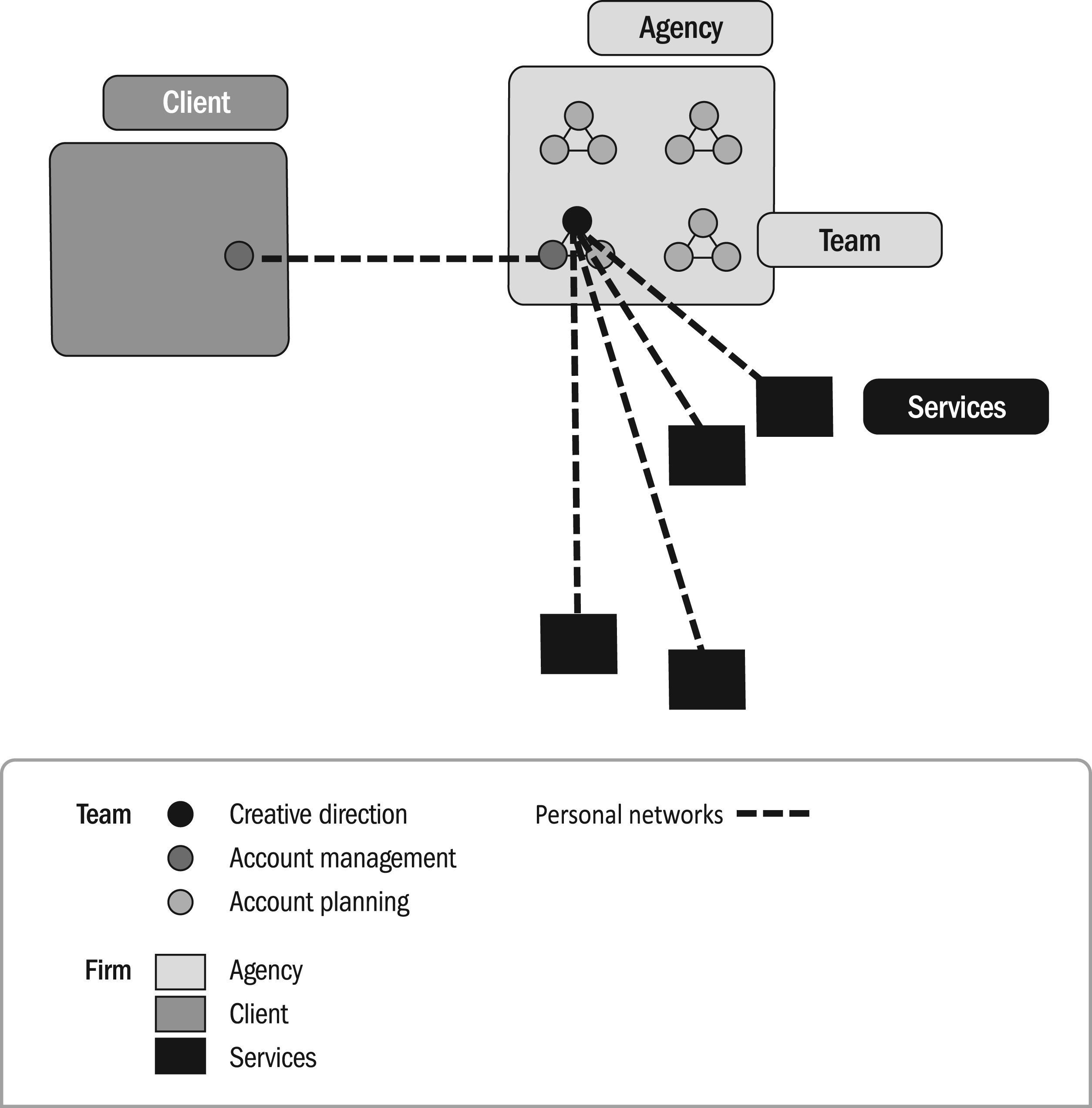
Layers of project ecologies: Team, firm, networks.
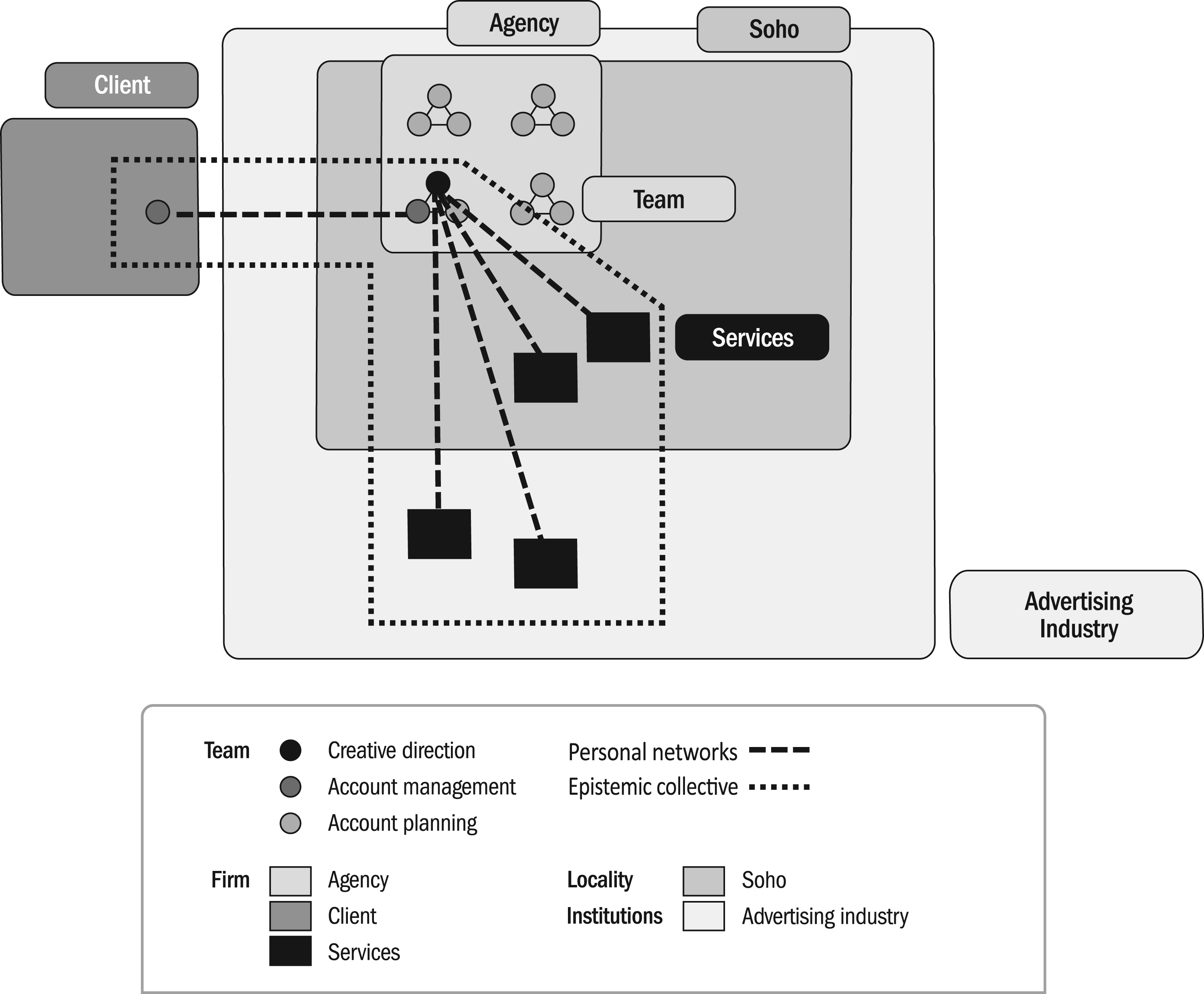
Layers of project ecologies: Locality and institutions.
Organizing Principles, Constitutive Tensions
Choosing ecology over neighboring concepts is not a terminological mannerism but a theoretical commitment. It signals a break with assumptions of coherence, equilibrium, and linear causality that continue to haunt much of the project literature (see also “What Project Ecologies are Not”)
7
.
Rivalry. Project ecologies are populated by individual and collective actors with divergent interests, evaluative principles, and professional creeds. Rivalry between teams, agencies, or aesthetic styles is not an unfortunate side effect to be smoothed out by governance mechanisms, but a generative force that fuels variation, experimentation, and creative recombination. Whereas concepts such as networks or systems implicitly privilege alignment, trust, and relational stability; ecology foregrounds contest, comparison, and selective pressures. Disequilibrium. Ecology replaces equilibrium thinking with an evolutionary sensibility. Project ecologies are permanently out of balance: resources are abruptly reallocated under escalating time pressures, loyalties are shifting from agencies to clients, the mimetic spread of a new aesthetics demands stylistic reinvention to creatively stick out yet again. Ecologies mutate through entry and exit and through controversial innovation rather than smooth adaptation. Recursivity. Most decisively, the notion of ecology foregrounds a recursive ontology in which projects, rather than being passively embedded in the external context of an ecology, actively reproduce and recalibrate it. Each project assembles a team whose collaboration sediments into personal networks that, in turn, provide the social substrate for subsequent projects, gradually reshaping reputations and evaluative standards that condition future project formation. Projects, then, draw on ecological resources while simultaneously reshaping their distribution, setting in motion a feedback loop in which ecology and project coevolve (for a systematic advancement of this recursive ontology, see Hernes, 2025, p. 447). Not a label for any project environment. Designating the environment of a project an ecology without specifying how they interact reduces the concept to a decorative synonym for context. Rather than a gesture toward embeddedness, project ecology is an analytically specified configuration of interdependent layers. Not a synonym for a project network. Networks map relational ties between discrete actors; ecologies encompass the broader configuration of teams, firms, epistemic collectives, personal networks, localities, and institutions within which those ties are enacted. A network is one layer of an ecology, not its equivalent. Not an allusion of a hierarchically orchestrated ecosystem. Unlike hub-and-spoke models or focal-firm architectures, project ecologies are heterarchical: rather than from a single orchestrating node, coordination emerges from the interplay of multiple, overlapping authority structures. Not a designation of a bounded territory. Although localities constitute one important layer, project ecologies are not coterminous with a district, city, or region. Their relational fabric routinely perforates spatial boundaries through task-specific ties spanning translocal scales. 5. Not merely a template for topological mapping. The six-layer architecture can certainly inform operationalization, but treating it as a checklist of variables sells short its fuller purchase: guiding the boundary judgments and interlayer dynamics that distinguish an ecology from a mere inventory of contextual factors. 6. Not a snapshot of a static configuration. Project ecologies are processual configurations that evolve through the recursive interplay of projects and their layered contexts. Capturing an ecology at a single point in time mistakes a single frame for the entire film. 7. Not a proprietary concept of a single discipline. The concept was forged at the intersection of economic geography, organization studies, and project management. Reducing it to the vocabulary of any single discipline forfeits precisely the cross-disciplinary leverage that constitutes its comparative advantage.
What Project Ecologies are Not
Conceptual Truncations
Methodological Shortfalls
Typological Ambitions, Disciplinary Detours
With the six-layer architecture in place, the initial ambition was to push the concept of project ecologies beyond the empirical confines of Soho advertising (and software development in Munich) toward a comprehensive typology. The plan was straightforward: any of the six layers could, in principle, assume the role of dominant coordinating axis around which a given project ecology is primarily anchored. Although each type is illustrated here through a single emblematic domain, the typological ambition was precisely to trace how the same dominant-layer logic operates across diverse empirical settings (see Table 1).
Six Types of Project Ecologies: A Comparative Overview
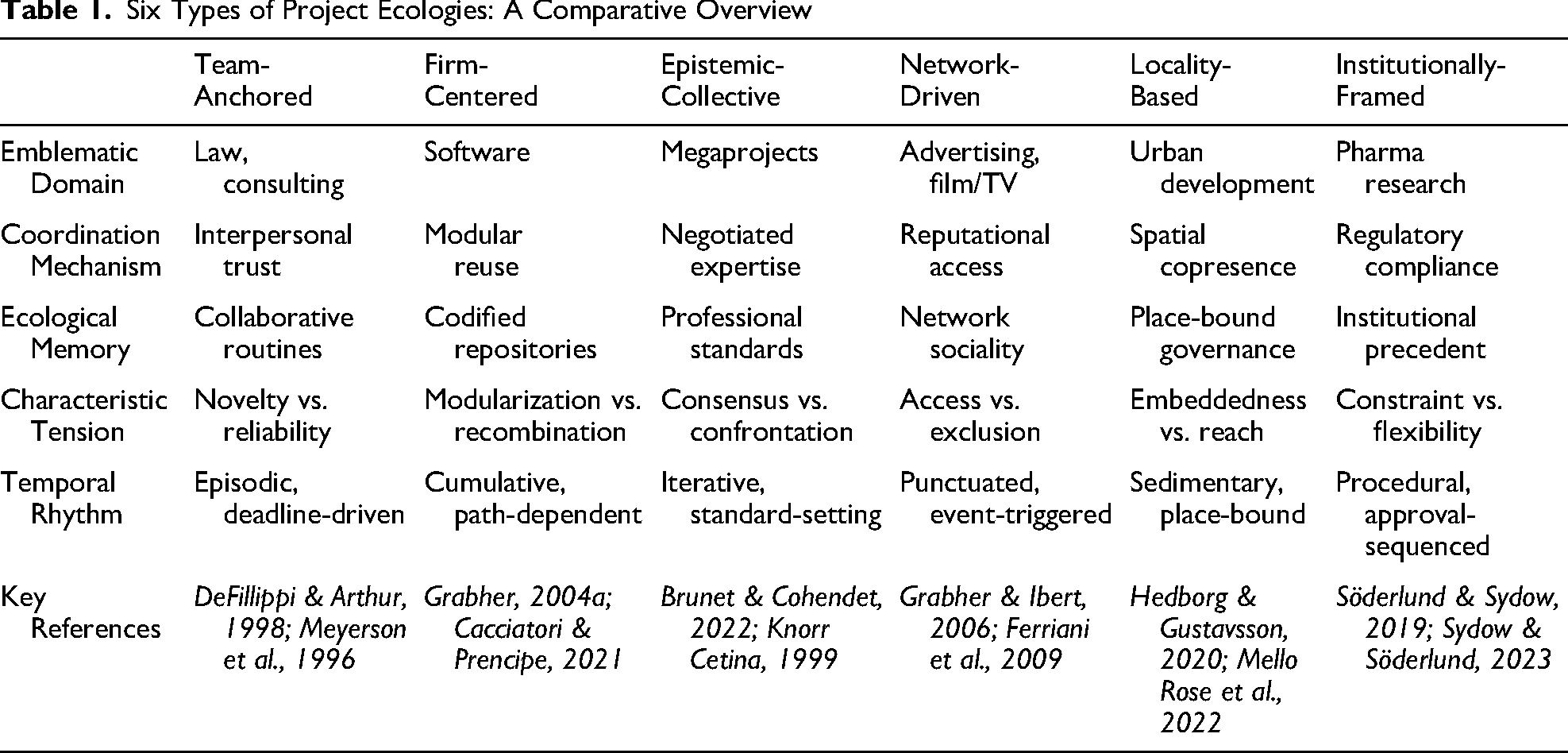
The tight, skill-complementary core group of professional services such as law pivots coordination on the team's internal expertise and the trust forged under time pressure (team-anchored ecology; Grabher, 2002a; Grabher & Ibert, 2006); software development, by contrast, lodges continuity in the firm as the repository of reusable modules sedimented across project cycles (firm-centered ecology; Grabher, 2004a; Cacciatori & Prencipe, 2021). Where megaproject construction draws coherence from specialist communities negotiating epistemic common ground among diverse expert groups (epistemic-collective ecology; Thiel et al., 2021a; Brunet & Cohendet, 2022), advertising assembles—and perpetually reassembles—its projects through the ephemeral sociality of personal networks carrying reputation and access across organizational boundaries (network-driven ecology; Grabher & Ibert, 2006; Ferriani et al., 2009). In urban development, the site-specific entanglement of regulatory frameworks and place-bound stakeholder constellations renders the locality the dominant coordinative axis (locality-based ecology; Hedborg & Gustavsson Karrbom, 2020; Mello Rose et al., 2022); in pharmaceutical research, finally, strict regulatory protocols governing clinical trials and approval procedures define the perimeter within which all other layers operate (institutionally-framed ecology; Söderlund & Sydow, 2019; Sydow & Söderlund, 2023).
This agenda, frankly, never materialized in a comprehensive fashion, not least due to yet another detour in the academic trajectory of its author: the focus of my own research shifted from grappling with the notorious “organizational amnesia” (Grabher, 2004a, p. 1492) in interorganizational project constellations toward the challenge of “learning from rare events” (Christianson et al., 2009; Lampel, et al., 2009; Starbuck, 2009) at the urban scale, reflecting a disciplinary migration from economic geography to urban and planning studies. More importantly, though, the reception and diffusion of the concept did not really care too much about initial intentions of its author but rather verged off in unexpected and surprising directions. Rather than gaining traction as a diagnostic template for granular examinations of project architectures, the concept was brought to bear as a prism that refracted project organizing into temporary organizations and their more permanent contexts.
In economic geography, the discipline in which the concept was originally launched, project ecology never established itself as a distinct entry in the conceptual repertoire. What the discipline did, however, was absorb key arguments of ecology theorizing into its own vocabulary: assimilating the foregrounding of the project as the key organizational unit into work on creative industries (e.g., Leslie & Rantisi, 2006, on design) and professional services (e.g., Faulconbridge, 2007, on law firms), and, more consequentially, translating the insistence on temporariness and cyclical relational rewiring into the established idiom of clusters: from permanent agglomeration to temporary (Maskell et al., 2006) and cyclical clusters (Power & Jansson, 2008). These absorptions, less conspicuous than an outright conceptual adoption, were nonetheless consequential at the disciplinary level: they helped pivot economic geography from its fixation with stable relational ties toward ephemeral constellations and punctuated proximity (e.g., Grabher & Ibert, 2026). Bathelt and Sydow (2025), who explicitly bridge the temporary-cluster literature with the concern for temporary organizing in project studies, offer the most programmatic (and most recent) expression of this convergence.
In project studies, the concept advanced less as a classificatory template than as an orienting framework: a commitment to treating projects as embedded, interdependent, and recursively linked to the conditions they simultaneously reproduce and transform. By morphing from a structural proposition into a paradigmatic orientation, the concept multiplied points of departure for project research across what might now be called the Four + Two Ts. The ensuing sections track these advances—from time and task over team and transition, and by proposing two further dimensions, into things and territory.
T1: Time
Most generally, recent scholarship has reframed project time from a scheduling constraint to a constitutive property of organizing. The project-ecology perspective aligns with calls by Ika et al. (2025) to take time seriously, moving beyond the default assumption of time as something that, notoriously just runs out. Their triptych of clock time, event time, and process time echoes earlier ecological observations that projects are interwoven with ongoing professional, organizational, and institutional schedules rather than unfolding in isolation. Stjerne and Svejenova (2016) similarly diagnose the shadow of past and future projects, showing how even the most temporary ventures are tethered to sequences of prior episodes and anticipated successors. What emerges is a multitemporal ontology: projects inherit legacies, shape trajectories, and are recursively embedded in broader temporal flows (Thiel & Grabher, 2024).
This temporal layering becomes even more conspicuous with the juxtaposition of short-cycle event projects with long-horizon megaprojects. Our own work on the London 2012 Olympic Games (Grabher & Thiel, 2015) revealed how Olympic projects, despite their uncompromising countdown logic, rely on knowledge and routines accumulated across successive Games: a merciless sprint built atop multiple marathons of learning along individual careers and in professional communities and industry associations. At the opposite extreme, Brookes et al. (2017) demonstrate that megaprojects inhabit overlapping time regimes: the bounded project of delivery coexists with asset life cycles, regulatory calendars, and organizational endurance that may outlive the original consortium (Thiel & Grabher, 2021). Rather than a coordination failure, however, such temporal mess (Thiel & Grubbauer, 2025) might incubate innovation: in the early phases of large-scale projects, ambiguity about milestones, end states, and temporal pacing sustains exploration and protects imaginative solutions from premature closure (see also Thiel & Grabher, 2021).
Across ecologies, then, temporality becomes a site of coordination work rather than its backdrop. Actors must navigate the tensions between countdown pressure and cumulative learning, between ephemeral collaboration and enduring commitments. Pemsel and Söderlund (2020) elucidate how practitioners surf temporal complexity by selectively aligning with, decoupling from, or sequencing competing (political, financial, professional) time frames. Obstfeld’s (2012) analysis of creative projects likewise reveals that breakthroughs often hinge on temporal improvisation, not temporal compliance. Taken together, recent research positions time as an arena of sustained negotiations within project ecologies: projects both draw on inherited rhythms and remake temporal expectations for what follows, producing a recursive coupling of project cycles and ecological time that resists linear sequencing (see also Sydow et al., 2025).
T2: Tasks
In the original formulation of project ecologies, tasks were anchored in relatively bounded settings: In Soho, advertising projects (Grabher, 2002a, 2004a) are tasked with tightly scoped creative challenges executed by small teams embedded in familiar pools of in-house professionals, clients, and specialized service suppliers. Subsequent scholarship has stretched the conception of task far beyond these rather intimate constellations, demonstrating how ecological thinking travels as tasks scale up and multiply. In biomedicine, Newell et al. (2009), and later Swan et al. (2010), reveal that innovation tasks escape firm boundaries and instead traverse distributed webs of universities, biotech ventures, funding bodies, and regulators.
This expansion of the conceptual scope extends further in research on megaevents and megaprojects, where the task horizon stretches from discrete deliverables to nested systems of interdependent undertakings. Brunet and Cohendet (2022) depict large construction projects as heterarchical megaproject ecologies, whose innovation challenges cannot be contained within a single hierarchy but require distributed governance architectures (Brunet et al., 2024). In a similar vein, Davies and Mackenzie (2014) demonstrate how delivering the London 2012 Olympics necessitated decomposing the task into a system of systems managed through layered integration roles, while Davies et al. (2014) elucidate how Crossrail’s innovation work unfolded across complex and shifting coalitions of contractors and suppliers. Across this body of work, tasks no longer denote bounded work packages: they become platforms for coordination across entire actor ecologies.
Most recently, these elaborations of tasks have crystallized into a wider research trajectory within project management and temporary organizing. Hedborg et al. (2020) as well as Hedborg and Rosander (2024) examine urban development as a project ecology composed of overlapping infrastructure, housing, and placemaking tasks that unfold in parallel and in sequence. In these urban contexts, tasks stretch not only across organizations but across temporalities and territories, revealing ecologies in which no single actor defines task scope, sequencing, or completion. What counts as the task is itself fluid: it expands, fragments, and recomposes as stakeholders join or exit and as problem framings mutate (Thiel et al., 2021a). Rather than predefined deliverables, tasks in this expanded conception morph into generative hubs around which actors, resources, and knowledge coalesce, dissolve, and recombine (see also Sydow et al., 2025).
T3: Teams
While early conceptualizations portrayed project teams as ensembles of complementary skills organized around a shared goal (Goodman & Goodman, 1976), ecological perspectives have since complicated this harmonious image. Rather than frictionless containers of aligned expertise, project teams are now understood as sites of negotiation, fragmentation, and shifting loyalties. Grabher and Ibert (2006) highlight the ambivalence of personal knowledge networks: they may foster cohesion, but they also breed dependence, exclusion, and conflict. Particularly in creative fields, team members often operate with overlapping affiliations and asynchronous commitments, leading to tensions within and across project boundaries. Recent work has extended this perspective to consider how emotional labor, competing obligations, and power asymmetries destabilize the assumption of seamless complementarity, reframing teams as fragile constellations (Geraldi et al., 2025a).
This reorientation becomes especially salient as project organizing expands from intraorganizational teams to distributed architectures across megaprojects in which coordination entails not only managing internal team dynamics but also navigating cross-organizational alignments. Brunet and Cohendet (2022) as well as Davies and Mackenzie (2014) exemplify how innovation in megaprojects depends on heterarchical coordination across loosely coupled teams (Grabher & Thiel, 2014) rather than on hierarchical control. As Davies et al.’s (2014) study of Crossrail reveals, project success relied on managing interdependencies between technical units, contractors, and delivery partners. These constellations render traditional team concepts inadequate: coordination, in fact, hinges on “knowledge entrainment” (Söderlund, 2010) through shared temporal structures and interpretive frames, boundary-spanning roles, and “extensive identity work” (Geraldi et al., 2025a, p. 7).
State-anchored projects add yet a further layer of complexity, as public institutions assume hybrid roles as sponsor, client, and regulator. In urban development contexts, the challenge of project management is not limited to coordinating firms but is complicated through the entanglement with planning regimes and political processes. Projects like Hamburg’s Elbphilharmonie (Dreher & Thiel, 2022) or Amsterdam’s smart city initiatives (Mello Rose et al., 2022) involve actors with divergent mandates, competencies, and metrics of success; generating tensions between symbolic ambitions and participatory rhetorics of public institutions on the one hand, imperatives of operational efficiency and coherence, on the other. Project ecologies, then, shift the analytical focus from cohesive team-building to the ongoing orchestration in highly politicized contexts—where what constitutes a team is itself open to contestation (Söderlund, 2004; see also Naderpajouh et al, 2024; Sydow et al., 2025).
T4: Transition
In Lundin and Söderholm's (1995) influential Four-T framework, transition denoted the deliberate movement from a project's initiation toward its predefined end state, typically tied to the delivery of a specific output. This teleological conception assumed a temporal vector pointing from the past into a known future. Project ecology scholarship, however, has recast transition through a recursive prism: rather than goal-directed trajectories within the boundaries of individual projects, transitions encompass transformations in the ecology itself that recalibrate the conditions, constraints, and trajectories of future projects. Instead of singular acts of goal attainment, transition turns into an ongoing reconfiguration of the institutional, material, and relational architectures that scaffold successive rounds of project organizing (Thiel & Grabher, 2024; Hernes, 2025).
This ecological perspective of transition has proven particularly instructive in investigations of infrastructure megaprojects, where transformation occurs not only through built artifacts but through reconfigured institutional and industrial logics. In their longitudinal study of Crossrail, Davies et al. (2014) elucidate how transitions are not merely about implementing solutions but also about redesigning the frameworks that define solutions. Subsequent work by Davies et al. (2019) further articulates how these transitions recursively modify industry practices: through cascading shifts across supply chains, regulatory provisions and professional norms, delivery model innovations spill beyond project boundaries and influence how infrastructure procurement and governance are conceptualized. Similarly, Dreher and Thiel (2022) illustrate how star architecture projects like the Elbphilharmonie Hamburg recalibrate the geographies of innovation in the construction supply chain, catalyzing shifts in interfirm collaboration. Thiel et al. (2021b) extend this further, showing how large-scale projects can reshape the knowledge infrastructures that underpin standard practices, expanding transition into a reframing of industry standards.
Beyond specific sectors, project ecologies afford a conceptual prism that reveals how a single event can reconfigure multiple organizational fields simultaneously. The London Olympics, as our analysis demonstrates (Thiel & Grabher, 2015), not only recalibrated standards of project delivery and systems integration in the domain of megaproject construction: in the field of urban megaevent policy, it institutionalized new modalities of stakeholder involvement and narrative framing that reoriented how cities bid for and stage global spectacles; and in the field of urban regeneration, the Games served as a catalytic device for legitimizing large-scale interventions, justifying exceptional planning instruments, and reframing urban futures in terms of project legacies. This generativity is not unique to global spectacles: as af Rosenschöld (2019) argues, projects can induce institutional change by embedding new procedural norms and accountability frameworks. Likewise, Gasparro et al. (2022) conceptualize “vanguard projects” as intermediation spaces in sustainability transitions, where experimentation fosters systemic learning. Project ecologies thus foreground transition not as linear transformation, but as emergent realignment within evolving actor constellations and multiple institutional logics.
First Conceptual Extension - T5: Territory
In the foundational formulations of project ecologies, place featured not simply as a physical container or a passive background, but as a constitutive layer within the architectural logic of project-based organizing. Rather than territorially bounded systems, localities were conceptualized as dense arenas of mutual observation and localized noise: a locus of professional enculturation by “hanging out.” What mattered was not embeddedness per se, but the performative capacity of place to afford visibility, amplify rivalry, and sediment reputation. By attending to the critical role of civil society actors in urban development ecologies, our recent work (Mello Rose et al., 2022) has complicated the understanding of the territorial embeddedness of projects even further: rather than on a flat plain, embeddedness here plays out in a vertically stratified and politically charged fashion through a highly selective inclusion of civil society actors in urban project arenas.
This spatial grounding has also been extended through analyses of the organizational and material infrastructures that constitute project spaces. Rather than formal hierarchies alone, as Bosch-Sijtsema and Tjell (2017) compellingly demonstrate, spatial proximity and colocation enable real-time coordination in complex project constellations. In a similar vein, Hedborg et al. (2020), as well as Hedborg and Rosander (2024), show how developers in urban development ecologies orchestrate overlapping projects through spatial routines that stitch together multiple life cycles into ongoing processes of transformation. Foregrounding the materiality of ecologies (more about this in the subsequent section) with the introduction of the notion of “sticky products,” recent research by Dreher et al. (2021) and Dreher and Thiel (2022) challenges the orthodox understanding of the geographies of multilocal production: rather than crystallizing around sticky knowledge, the materiality of artifacts anchors project performance in a specific place: not in the pristine atmosphere of a research lab, but in the unfolding thicket of the construction site.
Returning to creative and design-intensive industries, scholars have further deepened the relational and multiscalar conception of place. Faulconbridge (2009) elucidates how global architecture firms adapt their practices to locally specific regulatory and cultural contexts, emphasizing the embeddedness of design in place-bound institutional regimes. In a related move, Lieto (2020) traces how high-profile design projects rely on multiscalar ecologies where expertise and influence circulate across regions while, at the same time, remaining firmly anchored in project-specific localities (see also Cole, 2008). Stjerne and Svejenova (2016) advance the notion of “boundary work” in creative production to analyze how sequential film projects navigate translocal spaces while remaining institutionally moored, thereby shaping and being shaped by localized logics. Across these diverse domains, project ecologies foreground a spatial sensibility that is relational and recursive: projects remake the places they inhabit, just as those places configure how projects are imagined, assembled, and sustained (see also Hedborg & Addyman, 2024).
Second Conceptual Extension - T6: Things
Despite building the architecture of project ecologies from six layers, the inaugural studies (Grabher, 2002a, 2002b, 2004a, 2004b; Grabher & Ibert, 2006) cast their analytical focus predominantly on the relational dynamics and organizational entities around which sequences of temporary projects unfold. Materiality and artifacts remained largely outside the analytical frame: they were neither conceptually foregrounded nor were they flagged as an absent dimension. Subsequent research, however, has addressed this lacuna by examining the role of material artifacts in mediating learning, memory, and routine formation in project environments. Cacciatori (2008) introduced the notion of “memory objects” to analyze how material traces from past projects function as repositories of experiential knowledge that can be retrieved and adapted in future undertakings. Extending this line of inquiry, Cacciatori (2012) conceptualized “systems of artifacts” as material constellations that support the resolution of conflicts in complex problem-solving by channeling attention and action. In a further elaboration, Cacciatori and Prencipe (2021) explore how artifacts do not merely carry routines but actively shape their enactment in project-based organizing, thus integrating materiality into the dynamics of organizational memory and improvisation.
Ensuing from a dedicated ecological angle, research on megaprojects and large-scale construction has further affirmed the constitutive role of materiality in project ecologies. In their analysis of high-profile construction projects, Dreher et al. (2021) and Dreher and Thiel (2022) evince, as previously mentioned, how the physicality and inertia of artifacts tie innovation processes to specific locales, thus foregrounding the performative spatialities of materials: mock-ups, prototypes, demonstrators and other artifacts of urban future-making serve both as epistemic devices and as temporal markers that transform speculative visions into tangible realities. Rather than merely populating project ecologies as passive props, artifacts actively reify and stabilize imagined futures. This emphasis on the affordances of materials shifts attention from abstract planning to the thick materiality of enactment.
A complementary strand, rooted in engineering studies and science and technology approaches, has further nuanced the mediating role of artifacts in collaborative coordination. Ruge and Bögle (2021), along with Ruge et al. (2022), highlight how models as well as digital simulations serve as “artifacts of collaboration” that allow distributed actors, despite divergent expertise, interests, and temporal horizons, to co-orient their practices. Similarly, in the field of disaster management, the physical configuration of central control rooms has been perceived as the material encoding of procedural hierarchies that afforded the material syntax for role-based coordination among unfamiliar actors. The spatial layout of the Central Operations Room for the funeral of Pope John Paul II in Rome, for instance, enabled intense collaboration off the cuff through its deliberate material ordering and microgeographical allocation of the specific competences and responsibilities involved (Cacciatori et al., 2007). Artifacts, seen through this prism, are not mere byproducts or outputs of project work, but coproducing agents that shape the dynamics and rhythms of project ecologies: they mediate between abstraction and materiality, between vision and construction, and, thus, reveal how profoundly things matter in the architecture and evolution of project ecologies.
Architectural Faultlines, Constructive Joints
What follows in this concluding section—six limitations, none of them trivial and several of them stubbornly resistant to quick remedies—might easily be read as a eulogy
8
for the concept of project ecologies. However, it is not. If we may stay within this ancient genre for a moment, it is rather a confession: an honest reckoning with conceptual limitations that, rather than asking for absolution (let alone promising to sin no more), is oriented toward renewal by pairing each diagnosis with a concrete research direction that aspires to convert retrospective candor into forward momentum.
Typological Drift. If this Thoughtlet should have made unmistakably clear one thing, it is this: the concept of project ecologies has gained currency across a broad range of domains, from creative production over megaevents and infrastructure delivery to urban development. This widespread uptake, however, comes at the cost of conceptual deepening. Rather than evolving into a robust methodological framework or a cumulative research program, the notion of project ecologies has often served as a rhetorical gesture to signal contextual sensitivity. As a result, the distinctive organizational, relational, and institutional manifestations that characterized early articulations (Grabher, 2001b, 2002a, 2002b, 2004a, 2004b, 2004c; Grabher & Ibert, 2006) have not really been further advanced with conceptual nuance and methodological rigorousness. The very features that enabled its diffusion, such as terminological flexibility and metaphorical resonance, have also diluted its analytical precision.
Countering this drift would require nothing less than a return to the original typological ambition by differentiating, say, the governance architectures, creativity regimes, and knowledge dynamics that set network-driven ecologies apart from, for instance, firm-centered and locality-based ones and submitting these distinctions to the discipline of comparative, multisite research designs. Pemsel and Söderlund (2025), who map governance archetypes across project-based organizations with precisely this kind of systematic rigor, offer an instructive template for the undertaking; and by drawing stylized comparisons across the four governance modes of market, hierarchy, network, and heterarchy, Brunet and Cohendet (2022) elucidate the conceptual value-added of such contrastive matrixes.
Empirical Reach. The foundational articulations of project ecologies drew primarily from creative industries characterized by thick relational tissues and dense interproject linkages. Yet, in sectors with thinner relational infrastructures or more episodic projectification, such as public-sector planning in post-socialist contexts (Krumova, 2012) for example, the ecology concept may have limited analytic purchase. Tellingly described as “projects without ecologies”, temporary organizing in such contexts unfolds in near isolation, lost in institutional voids rather than embedded in vibrant ecologies. This asymmetry in empirical resonance, then, raises the question of how universally applicable the ecology concept can be.
It is precisely this asymmetry, however, that opens a generative research frontier: the systematic comparison of thick ecologies, nourished by a dense relational tissue and repeated collaboration, with thin or emergent ones in which projects navigate institutional voids with scant interorganizational scaffolding. Hedborg and Gustavsson Karrbom (2020), who apply the ecology concept to urban construction, offer compelling evidence that ecologies can crystallize through spatial proximity and temporary coexistence alone, without the repeated collaboration cycles presumed by the foundational accounts; and Sydow et al. (2025), reveal that even contexts habitually deemed relationally sparse develop stabilizing practices that allow projects to absorb significant disruptions while preserving coordinative coherence. Tracing such, as these authors term it, “project plasticity” across divergent institutional settings could afford a much-needed corrective to the tacit assumption that project ecologies require thick relational tissues to take root.
Boundary Delineation. As the foundational contributions underscore, ecologies are not discrete entities but configurations that span multiple levels, from individual careers and teams, to organizations, interorganizational arrangements, industries, and regulatory environments. Mapping an ecology thus involves nontrivial boundary judgments: who and what should be counted as part of the ecology surrounding a project? Should distant regulatory actors or tangential professional communities be included? How far out should participation, reputation or memory be traced? Ethnographic studies, such as those by Hedborg et al. (2020) for example, offer forensic insights into the layered interfaces between projects, yet they are time- and resource-intensive and typically specific to one particular setting. Moreover, such complexity renders comparative analyses elusive and poses questions of scale: when is an ecology too sparse to be meaningful, and when too diffuse to be tractable?
Methodologically, the challenge invites multilevel mapping protocols that combine the rigorous depth of ethnography at the project interface with the synoptic breadth of relational analysis across organizational and field boundaries. Yet recent work suggests that boundary delineation is not merely a methodological puzzle but an ontological one. By proposing a recursive model in which ecologies are emergent outcomes of triangular interactions among organizing processes, temporary organizations, and their ecologies, Hernes (2025), in a Whiteheadian move, reframes boundary delineation as an ongoing accomplishment rather than a one-off methodological decision. More specifically, Hedborg and her colleagues (Hedborg et al., 2020; Hedborg & Gustavsson Karrbom, 2020) demonstrate in the context of urban construction that ecology boundaries crystallize through the interplay of spatial proximity, temporary coexistence, and organizational interdependencies: an empirically grounded (and methodologically accessible) triad that could serve as an operational template for boundary judgments.
Power and Conflict. Whereas initial work highlighted trust, flexibility, and interorganizational learning, it paid less attention to how hierarchies, gatekeeping, and strategic exclusions operate within ecologies. Later scholarship has sought to address this blind spot. For example, our analysis of the London Olympics (Thiel & Grabher, 2015) reveals how project ecologies not only distributed authority but also imposed rigid regulatory constraints through institutional oversight. Even the spatial dynamics of projects, as Faulconbridge (2009) and Stjerne and Svejenova (2016) suggest, are shaped by struggles over control, visibility, and narrative authority.
Extending this critical trajectory calls for combining the ecology lens with governance frameworks that foreground the diverse modalities through which power operates: from Clegg’s (2023) circuits-of-power framework, which distinguishes episodic (individual instances), dispositional (norms and rules), and facilitative (organizational systems) circuits, through Clegg and Ninan’s (2023) Foucauldian reading of project ecologies as arenas of governmentality, to Brunet and Choinière (2025) perception of Canada’s major public project governance framework through a neo-institutional lens, demonstrating how macro-level institutional layering defines the regulatory perimeter within which ecologies form and reform: an insight that connects power analysis to the boundary-delineation challenge just discussed.
The four limitations diagnosed here concern the concept's internal architecture—its typological precision, empirical reach, boundary demarcation, and the power dynamics it has tended to disregard. The following two shift the lens outward: to the normative freight carried by the ecological metaphor and to the concept's contested borders with neighboring frameworks.
Borrowed Metaphors, Sharpened Contours
Normative Undertone. The connotation of the ecological metaphor with adaptability, learning, and distributed agency may inadvertently romanticize dense connectivity as “healthy” and inherently positive. 9 Yet, the same tight couplings that enable trust and tacit knowledge flow can also produce lock-in, inertia, and social closure (Grabher, 1993). As Sydow and Staber (2002) and Ferriani et al. (2009) caution, dense project networks, such as those found in TV and film production, can become exclusionary, privileging incumbents and rendering entry points opaque. The ecology concept, if left unqualified, risks masking these dynamics under a veil of harmonious evolution and neglecting the downsides of over-embeddedness, group think, and reputational gatekeeping.
Viewed from a more candid analytical posture, project ecologies would be framed as tension-ridden configurations—sites where trust and exclusion, learning and lock-in, openness and closure coexist not sequentially but simultaneously, in recursive interplay that defies tidy resolution. The recent turn toward tensions and paradox in project studies (Braun & Lampel, 2020; Sydow et al., 2025) furnishes exactly the vocabulary needed for investigating such ambivalences without dissolving them into comforting narratives of ecological health (or pathology, respectively). Empirical footholds for such a tension-sensitive ecology research are already emerging: Vedel and Geraldi (2023) anatomize the emergence of trust-control paradoxes and Vestola and Hedborg (2025) reveal the crucial role of informal “wiggle room” in coping with the incommensurable demands of parent and project organizations respectively; crucially, Gaim et al. (2022) afford evidence that organizational paradoxes in projects are not merely obstacles to be resolved but generative forces opening up new possibilities—if paradoxes are dialogically embraced instead of denied for the sake of wrong unequivocalness (see also Grabher & Thiel, 2015).
Conceptual Overlaps. Project ecologies intersect with notions of project networks, temporary clusters, epistemic communities, and organizational fields. As Söderlund (2011a, 2011b) cautions, terminological proliferation risks analytical dilution unless new concepts clearly articulate their added value. Some proponents have responded by extending project ecologies into new theoretical territories, such as governance (Clegg & Ninan, 2023), temporal structuring (Hernes, 2025), and field theory (Thiel & Grabher, 2015; see also Söderlund & Sydow, 2019), to demonstrate its distinctiveness. Still, the challenge remains to delineate the conceptual contours of ecologies vis à vis neighboring constructs and to resist taxonomic sprawl.
Two recent contributions advance precisely this agenda. By returning to the conceptual roots of project ecologies, Brunet and Cohendet (2022) retrieve what the subsequent diffusion of the ecology concept has somewhat buried: the original insistence on heterarchy as its defining governance principle. Where networks draw their coordinative coherence from relational trust and hierarchies from authority, project ecologies are distinguished by the coexistence of multiple, overlapping authority structures: a configuration that resists reduction to any single coordination mode and that, precisely for this reason, continues to warrant conceptual investment. By directly comparing project networks, project ecologies, temporary clusters, and field-configuring events, Bathelt and Sydow (2025), however, arguably offer the sharpest boundary-drawing exercise available. By refracting a single empirical phenomenon—trade fairs—through each conceptual lens in turn, they render visible what the project perspective illuminates (relational coordination) and what it structurally overlooks (the place-based knowledge ecologies that economic geography foregrounds).
True: the greatest achievement of the concept of project ecologies—i.e., its diffusion across disparate domains—has outpaced its conceptual consolidation. Yet the very breadth that invites the charge of analytical imprecision has also accomplished something that narrower, disciplinary-contained frameworks rarely achieve: it has opened a “trading zone” (Galison, 1997) capacious enough to draw scholars from project management, organization studies, economic geography and urban research into sustained conversation—not unlike the creative friction among disparate professional communities in Soho's advertising ecologies, where this conceptual journey took off. What the six research directions sketched here suggest, however, is that the trading zone has matured to a point where it could (and should) sustain more exacting transactions: sharper typological distinctions, the systematic comparison of thick and thin ecologies, multilevel boundary protocols, a tension-sensitive vocabulary, and power-aware governance analytics. The confession just tendered aspires to convert that trading zone into something altogether more demanding: a proper research program.
Whether this ambition will survive first contact with academia’s well-practiced talent for absorbing critique without changing course is, naturally, another matter—but then, confession has never guaranteed amendment.
